
Life, 1918-09-19 · page 11 of 34
Life — September 19, 1918 — page 11: what you’re looking at
What you’re looking at
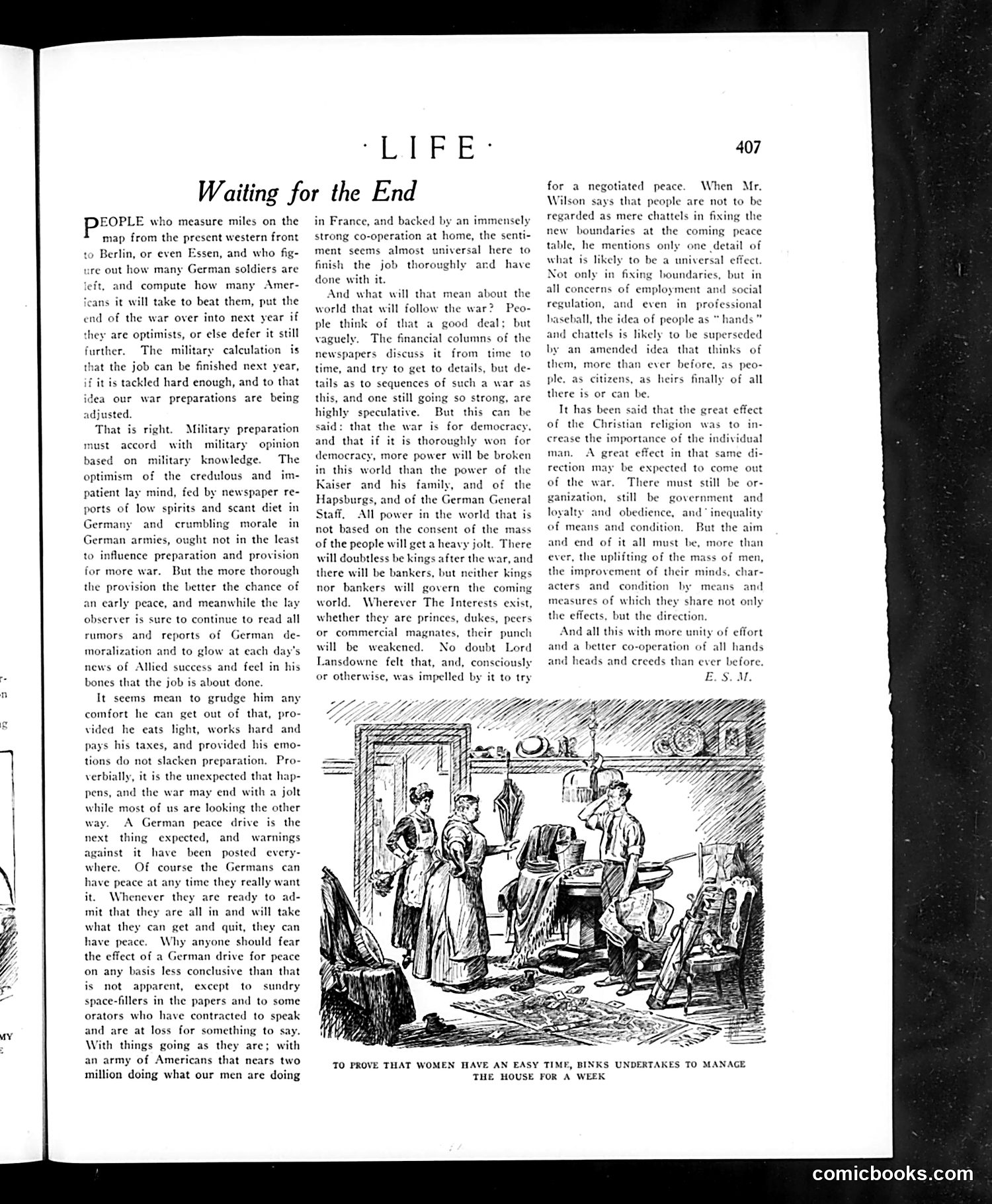
This page contains an article titled "Waiting for the End" discussing post-WWI peace prospects and social reorganization. The accompanying illustration satirizes domestic labor by showing women managing a household while men are away at war. The cartoon's caption reads: "TO PROVE THAT WOMEN HAVE AN EASY TIME, RINKS UNDERTAKES TO MANAGE THE HOUSE FOR A WEEK" — suggesting someone named Rinks (likely a public figure) volunteered to run a household to demonstrate women's work is simple. The sketch shows multiple women directing the bewildered man, satirizing the complexity of domestic management that was typically underestimated or dismissed. The broader article discusses post-war peace negotiations, democratic reorganization, and the need for improved social conditions and cooperation among nations.
📄 Transcribed text from this page (OCR, searchable)
Machine-transcribed from the original scan — historical spelling and the odd misread are preserved.
“Ld FE Waiting for the End EOPLE who measure miles on the map from the present western front to Berlin, or even Essen, and who fig- ure out how many German soldiers are . and compute how many Amer- s it will take to beat them, put the end of the war over into next year if they are optimists, or else defer it still further. The military calculation is that the job can be finished next year, it is tackled hard enough, and to that idea our war preparations are being adjusted. That is right. must accord with based on military knowledge. The optimism of the credulous and im- patient lay mind, fed by newspaper re- Military preparation military opinion ports of low spirits and scant diet in Germany and crumbling morale in German armies, ought not in the least to influence preparation and provision for more war. But the more thorough the provision the better the chance of an early peace, and meanwhile the lay observer is sure to continue to read all rumors and reports of German de- moralization and to glow at each day's news of Allied success and feel in his bones that the job is about done. It seems mean to grudge him any comfort he can get out of that, pro- vided he eats light, works hard and ays his taxes, and provided his emo- tions do not slacken preparation. Pro- verbially, it is the unexpected that hap- pens, and the war may end with a jolt while most of us are looking the other way. A German peace drive is the next thing expected, and warnings against it have been posted every- where. Of course the Germans can have peace at any time they really want it. Whenever they are ready to ad- mit that they are all in and will take what they can get and quit, they can have p Why anyone should fear the effect of a German drive for peace on any basis less conclusive than that is not apparent, except to sundry space-fillers in the papers and to some orators who have contracted to speak and are at loss for something to say. With things going as they are; with an army of Americans that nears two million doing what our men are doing in France, and backed by an immensely strong co-operation at home, the senti- ment seems almost universal here to finish the job thoroughly ard have done with it. And what will that mean about the world that will follow the war? Peo- ple think of that a good deal; but vague! The financial columns of the newspapers discuss it from time to time, and try to get to details, but de- tails as to sequences of such a war as this, and one still going so strong, are highly speculative. But this can be said: that the war is for democracy and that if it is thoroughly won for democracy, more power will be broken in this world than the power of the ‘aiser and his family, and of the Hapsburgs, and of the German General Staff. All power in the world that is not based on the consent of the mass of the people will get a heavy jolt. There will doubtless be kings after the war, and there will be bankers, but neither kings nor bankers will govern the coming world. Wherever The Interests exist, whether they are princes, dukes, peers or commercial magnates, their punch will be weakened. No doubt Lord Lansdowne felt that, and, consciously or otherwise, was impelled by it to try TO PROVE THAT WOMEN HAVE AN EASY TIME, BIN 407 When Mr. s that people are not to be regarded as mere chattels in fixing the new boundaries at the coming peace table, he mentions only one detail of what is likely to be a universal effect. Not only in fixing boundaries, but in for a negotiated peace. Wilson s all concerns of employment and social regulation, and even. in professional haseball, the idea of people as “ hands" and chattels is likely to be superseded by an amended idea that thinks of them, more than ever before, as peo- ple, as citizens, as heirs finally of all there is or can be. It has been said that the great effect of the Christian religion was to in- crease the importance of the individual man, A great effect in that same di- rection may be expected to come out of the war. There must still be or- ganization, still be government and loyalty and obedience, and inequality of means and condition. But the aim and end of it all must be, more than ever, the uplifting of the mass of men, the improvement of their minds, char- cters and condition means and measures of which they share not only the effects, but the direction. And all this with more unity of effort and a better co-operation of all hands and heads and creeds than ever before. E.S.M. UNDERTAKES TO MANAGE THE HOUSE FOR A WEEK comicbooks.com