
Life, 1918-09-19 · page 20 of 34
Life — September 19, 1918 — page 20: what you’re looking at
What you’re looking at
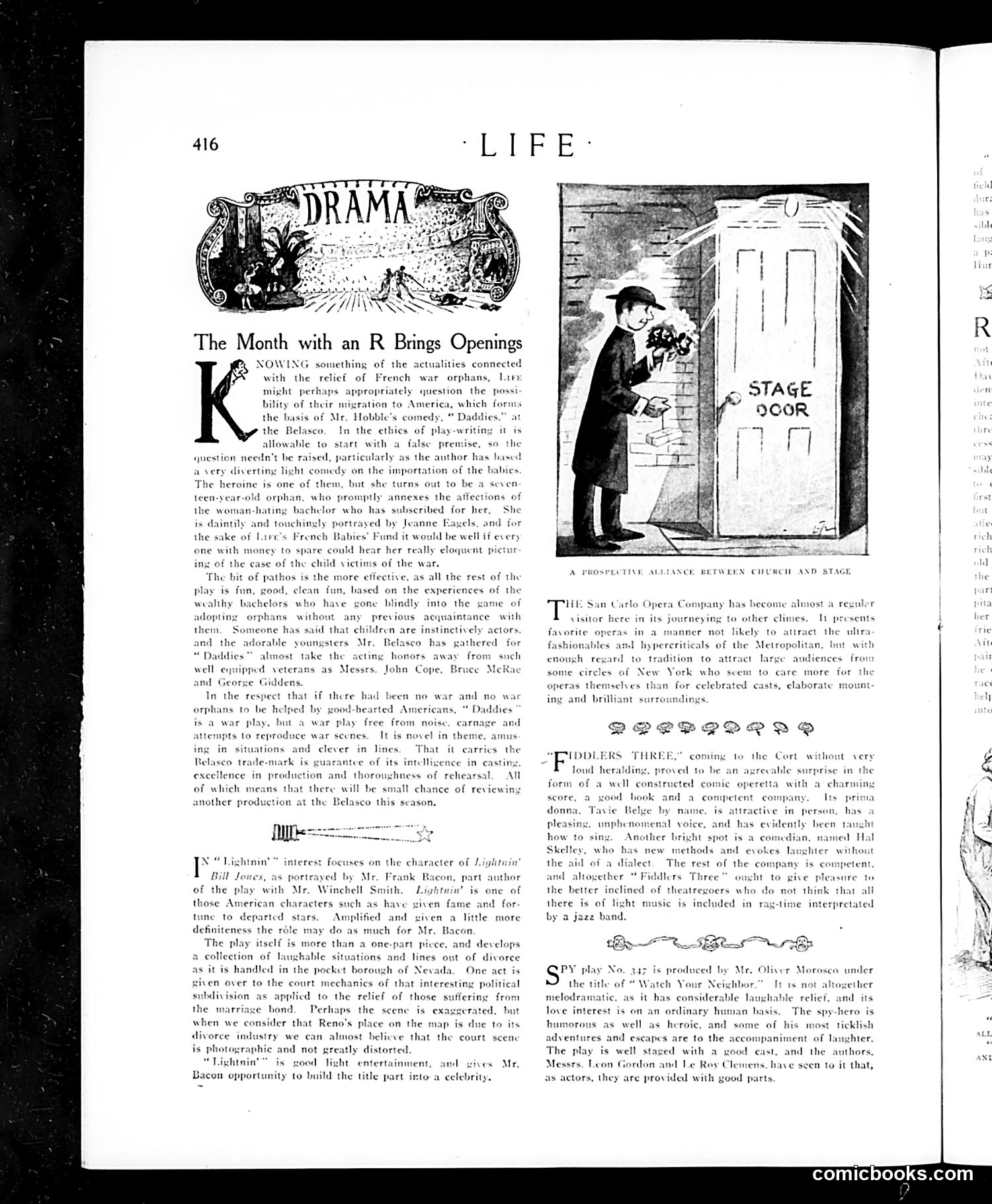
This page reviews three theatrical productions opening in a month with an "R" (likely September): **"Daddies"** at the Belasco Theatre concerns French war orphans being adopted by wealthy American bachelors. The accompanying illustration shows a man at a stage door, captioned "A Prospective Alliance Between Church and Stage"—suggesting the morally questionable premise of the play. The reviewer questions whether importing foreign orphans to America is ethically sound, though he praises the production's entertainment value and the performance by Jeanne Eagels. **"Lightnin'"** features Frank Bacon as the American character Bill Jones, showcasing "one-part" comedy through humorous situations and clever dialogue rather than war spectacle. **"Fiddlers Three"** is a comic operetta with charming score and good performances, notably comedian Hal Skelley, though the reviewer notes it includes jazzy ragtime interpretations. The overall tone is typical Life satire—critiquing theatrical choices while acknowledging entertainment merit.
📄 Transcribed text from this page (OCR, searchable)
Machine-transcribed from the original scan — historical spelling and the odd misread are preserved.
The Month with an R Brings Openings NOWING something of the actualities connected with the relief of French war orphans, Lire might perhaps appropriately question the pos bility of their migration to America, which forms the basis of Mr, Hobble’s ¢ the Belasco, In the ethics of 1 Howable to start with a false premise, so the ed, particularly as the author has based ht comedy question ne he 2 he importation of the babies. but sh a very diverting li turns out to be a seven The heroine is one wh exes the promptly at teen-year-old orphan hating bachelor who has subscribed for her, She ily and touchingly portrayed by Jeanne Eagels, and for the sake of Lire’s French Babies’ Fund it would be well if every t hear her really el nt pic one with money to sp: < of the case of the child victims of the war. The bit of pathe ore effective, as all the rest of the play is fun, n the experier the wealthy bachelors. wt ily into of adopting ¢ previous acquainta: with has said that children are instinctively actors. and the a Mr. B “Daddies” almost take the acting hy them. Sor us gathered away from such well equipped veterans as Messrs. John Cope, Bruce \ and Ge Giddens. In the respect that if there had been no war and no wa orphans to be helped by good-h 1 Americans, “ Daddies is a war play, but a war play free from noise, carna s. It is novel in attempts to reproduce war scer sations and clever in lines. That it k is ence in production a th ing ins Rel exce ce of its intellixe co trade-ni d there will be small chance of reviewing ghness of of which ny another produc the Belasco this season, Mp “ Lightnin’ ” interest es on the character of Lights Biil Jones, Mr. Frank Bacon, the play with Mr. Winchell Smith. Lightrin’ iso! part author AS portray ose American characters such as have given fame and for tune to departed stars. Amplified and given a little more defini ay do as much for Mr. Bacon ness the ri more than a one-part piece collection of Iaughat of divorce as it is handled in the pocket borough of Nevada. One act is he play itselé is lines 0 ns ven over to the court mechanics of that interesti tical Midivision 4 of those suffering from applied to the rel the marriage bond. Perh when we consider that Reno's place on the map is due to its ps the scene is erated, but n-almost believe that the cou phic and not greatly distorted word is ty to build the title part in t scene pinin’ is ht entertainment, and gives Mr. oa celebrity. Bacon opport ae SS He ¥ A PROSPECTIVE ALLIANCE BETWEEN CHURCIE AND STAGE HE San Carlo Opera Company has become aly Visitor here in its journeying to other climes favorite operas in a manner not likely to fashionables and hypereriticals of ugh regare to attr a a es from ome circles k who sve pre for the operas them + celebrated casts, elaborate mou ing and brill “TIDDLERS THREE,” coming to the Cort with oud heraldin very proved to be an agreeable surprise in the form of a well co with a charmi score, 1 hook and a competent co ny. Ths by name, is attractive in-person. pleasing, unphenomenal ve nd has evidently been tam how to sing. Another bright spot is a comedian, named Hal a 1 the aid of a dialect. The rest of the company is c her “Fiddlers T better inclined of theatre Skelley, who has new methods ; ughter without npetent iltoget an ree t to give pleasure to 1 pers who do not think that all is of light music is inch: led in rag-time interpretated by a jazz band. sry play No. 347 is produced by Mr, Oliver Morosco under the title of “Watch Your Neighbor.” Tt as n sether laugh nhasis, The spy-hero is of his most ticklish iment of laughter. melodramatic, as it has considera! ble relief, and its love interest is on hu adventure: porous as well ind se The play is well staged with a good cast, and the authors, Messrs. Leon Gordon and le Roy Clemens, have scen to it that, as actors, they are provided with good parts. comicbooks.com )