
A complete issue · 36 pages · 1909
Life — November 18, 1909
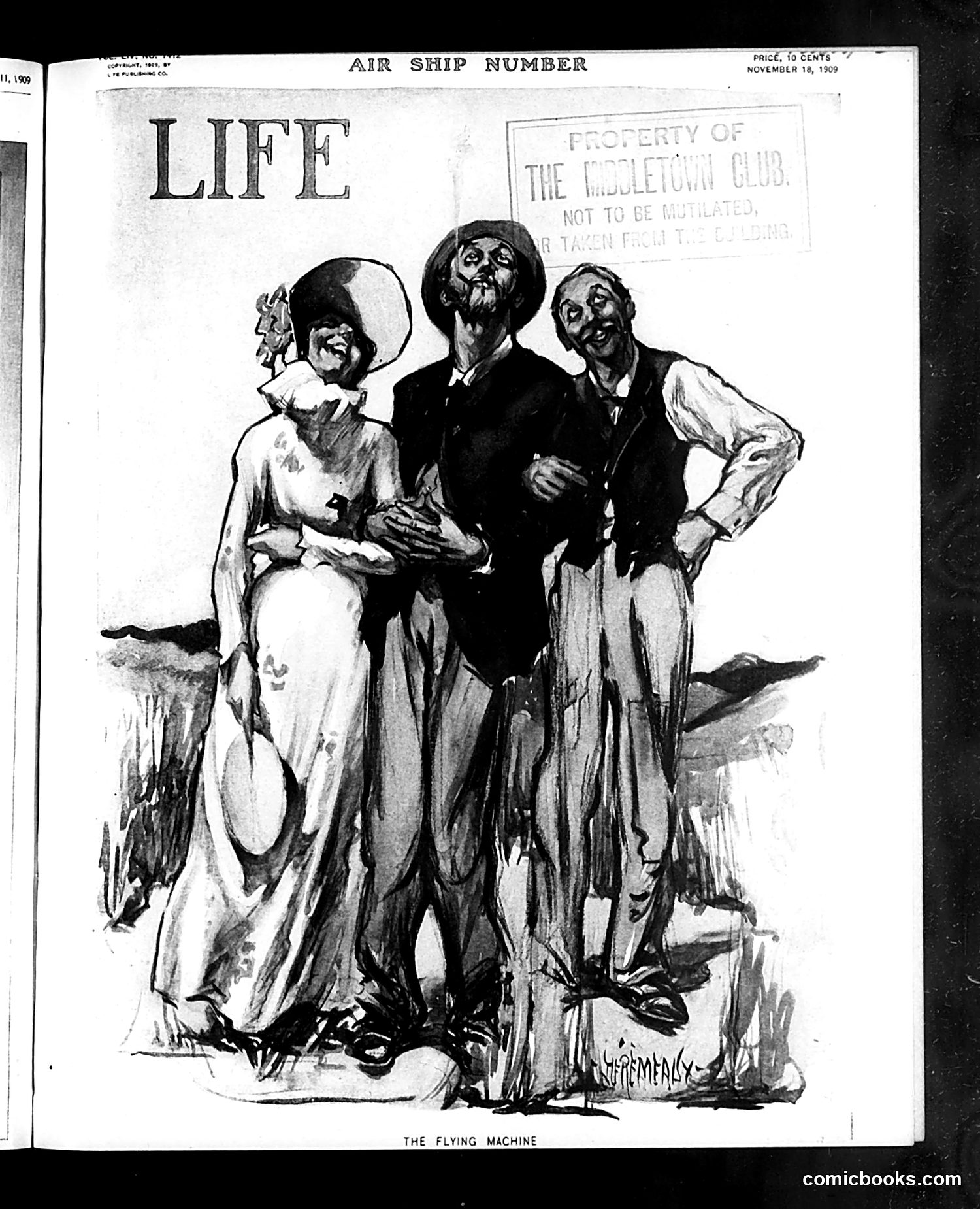
This is a satirical cartoon titled "The Flying Machine" from *Life* magazine (price 10 cents, dated November 11, 1909). The image depicts three figures in a surreal scene—likely caricatured political or public figures of that era—interacting in an exaggerated manner suggestive of chaos or instability. The "flying machine" reference appears metaphorical rather than literal, possibly mocking some contemporary aviation development or a political scheme described as ambitious but impractical. The grotesque caricatures and theatrical poses suggest the cartoon ridicules specific public figures or a failed venture. Without clearer identification of the specific individuals or event, the precise satirical target remains unclear, though the style indicates commentary on 1909 American politics or society.
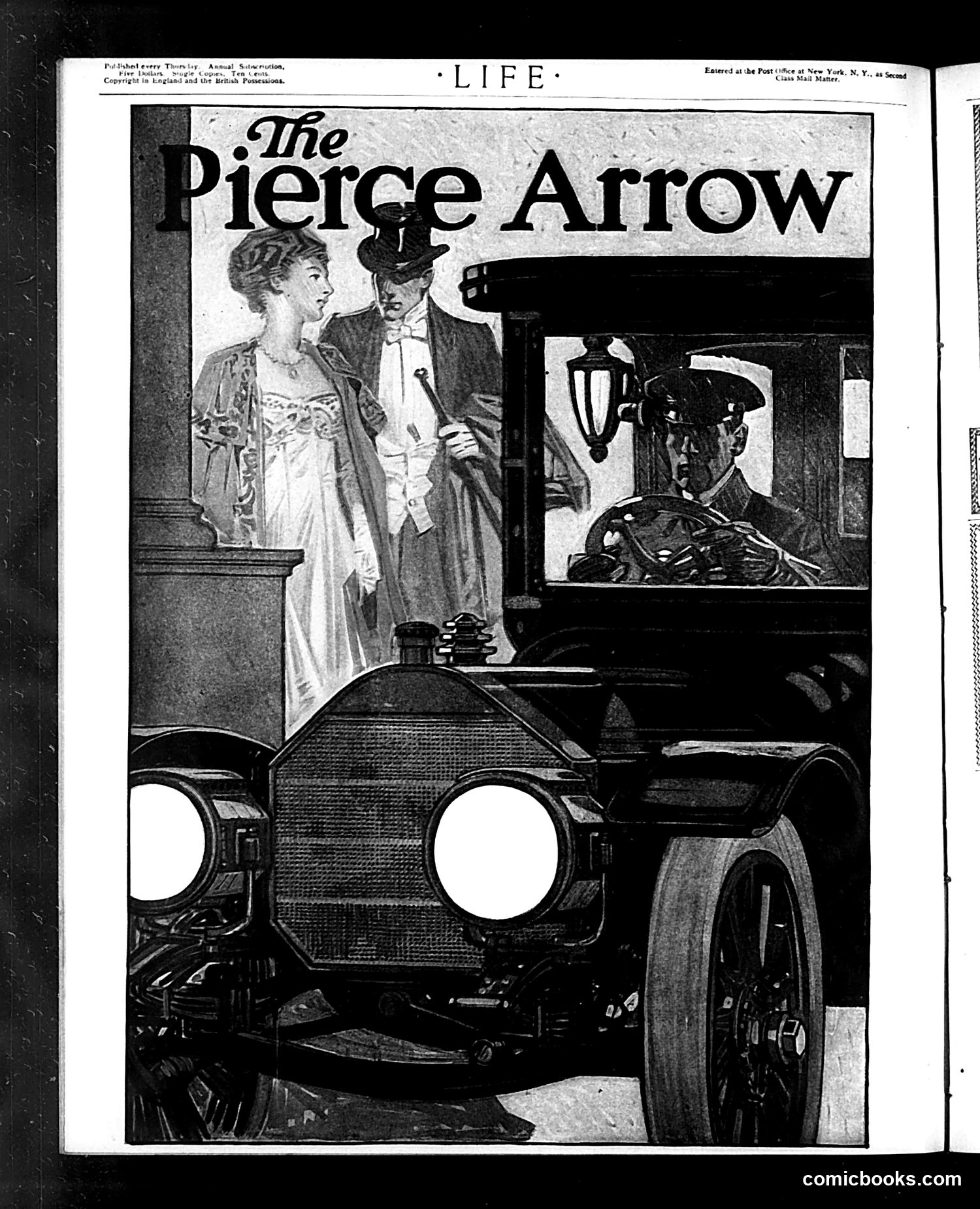
This appears to be an advertisement or promotional illustration for Pierce-Arrow automobiles, a luxury car brand popular in the early 20th century. The image shows a well-dressed couple—a woman in an elegant gown and a man in formal evening wear with a top hat—alongside a Pierce-Arrow vehicle. A chauffeur is visible in the car's window. The humor or satire isn't explicitly political but rather social: the illustration plays on aspirational messaging common in luxury car advertising of the era, presenting automobile ownership as a marker of sophistication and high social status. The formal attire and refined setting suggest this vehicle was marketed to wealthy Americans seeking to display their wealth and refined taste.
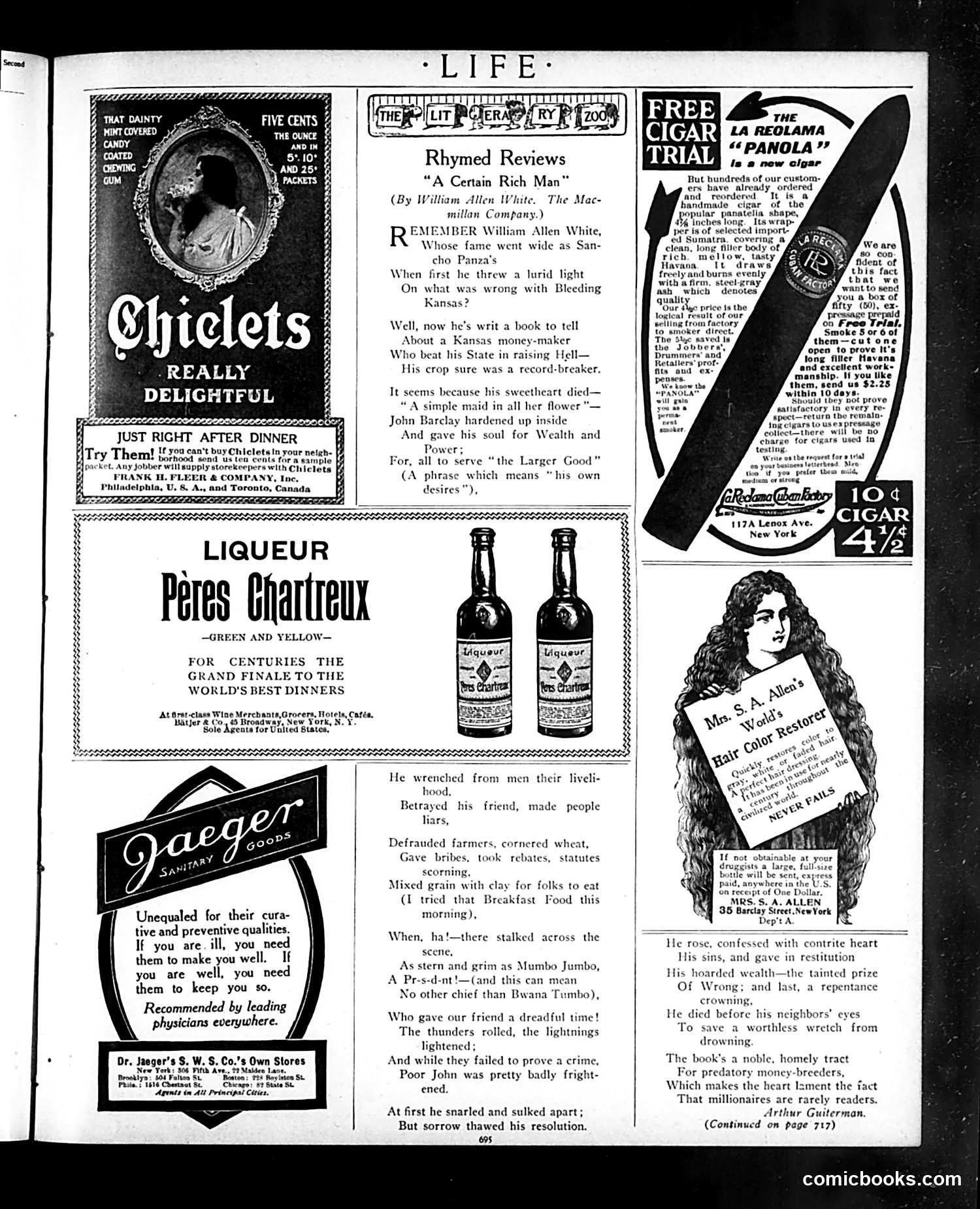
This page is **primarily advertisements** interspersed with a poem titled "A Certain Rich Man" by William Allen White. The ads include: - **Chiclets gum** (top left) - **Pères Chartreux liqueur** (center) - **Jaeger sanitary goods** (left side) - **La Reoulma Panola cigars** (right) - **Mrs. S.A. Allen's Hair Color Restorer** (bottom right) The poem itself, not a cartoon, appears to be **satirical social commentary**. It tells of a wealthy Kansas businessman ("John Barclay") who accumulated wealth through questionable means—defrauding farmers, cornering wheat, mixing grain with clay. White's verse suggests that despite his materialism and exploitation, the man ultimately found no redemption, dying unmourned. The final attribution notes this critiques how "millionaires are rarely readers." **No political cartoons appear on this page.**
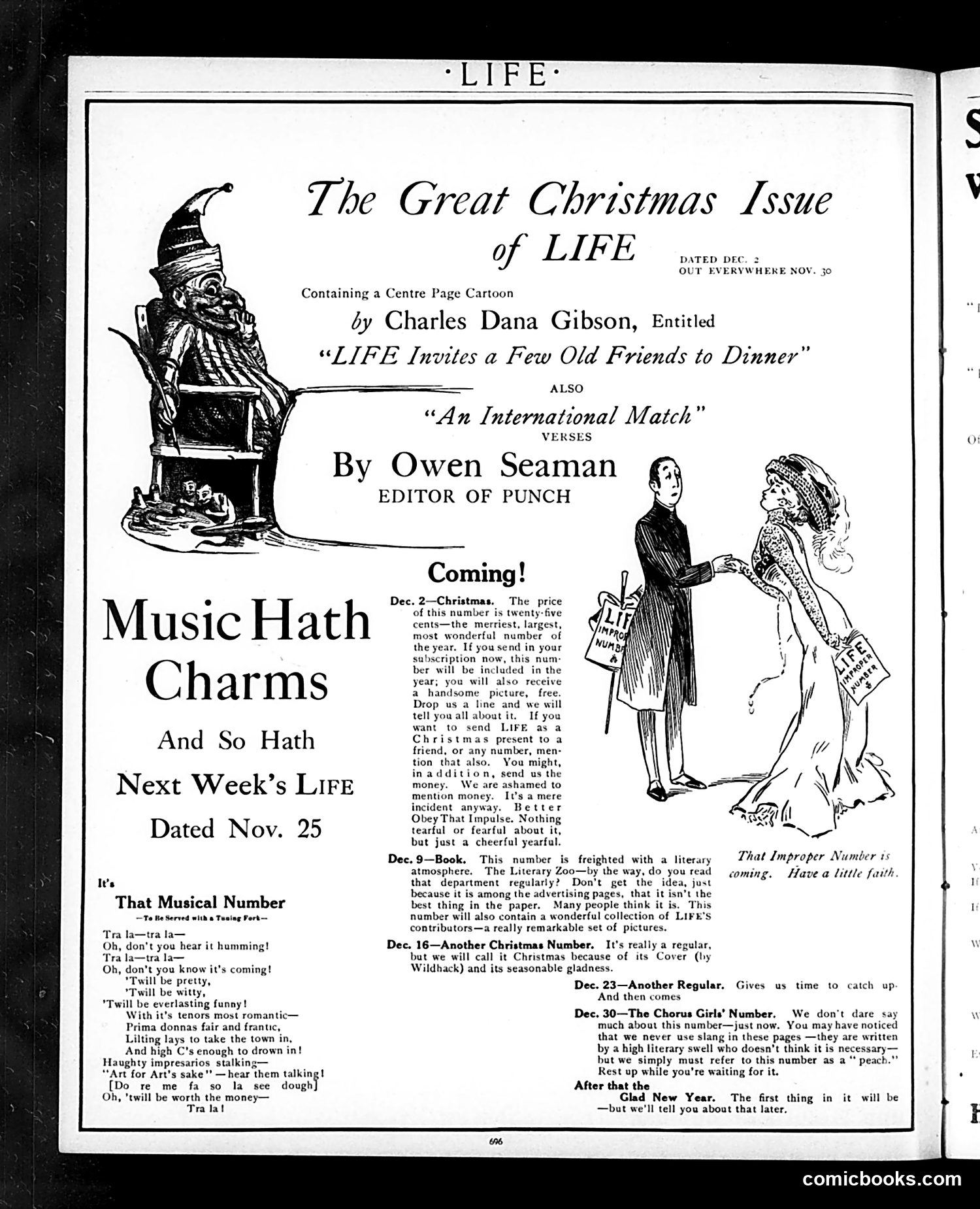
This is primarily a **promotional page** for Life magazine's upcoming Christmas issue (dated December 2, priced twenty-five cents). The main cartoon by **Charles Dana Gibson** appears to show two figures exchanging a Life magazine as a Christmas gift—the illustration labeled "That Improper Number is coming. Have a little faith" suggests the Christmas issue will be entertainingly controversial or edgy. The page advertises featured content: Owen Seaman (editor of Punch) will contribute verses titled "An International Match," and includes a musical number with sheet music lyrics promising romantic tenor performances. The satirical angle is unclear without seeing the actual Christmas issue content, but the playful tone and "improper" reference suggest the magazine marketed itself as sophisticated, slightly risqué holiday entertainment for educated readers.
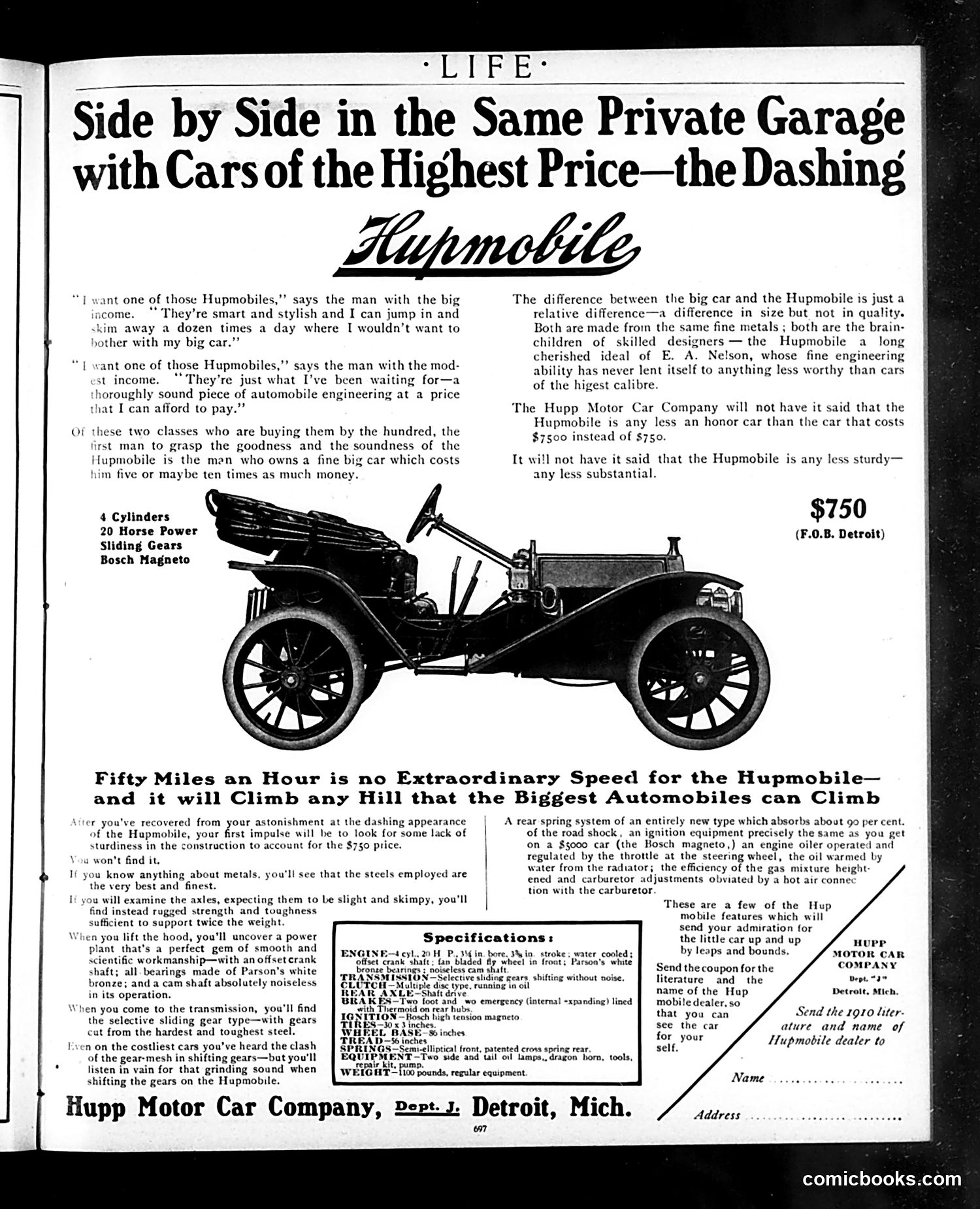
This is a **product advertisement**, not political satire. It promotes the Hupmobile automobile, priced at $750 (F.O.B. Detroit), manufactured by the Hupp Motor Car Company. The ad's humor is commercial rather than political: it appeals to buyers by positioning the affordable Hupmobile as comparable to expensive luxury cars. The tagline "Side by Side in the Same Private Garage with Cars of the Highest Price" suggests that owning this modest vehicle offers the same prestige as owning expensive automobiles. The copy emphasizes the Hupmobile's mechanical sophistication (4 cylinders, 20 horsepower, Bosch magneto) and performance capabilities (50 mph speed, hill-climbing ability) to justify its value proposition. The satire targets buyer psychology—making an inexpensive car seem aspirational—rather than addressing political or social issues.
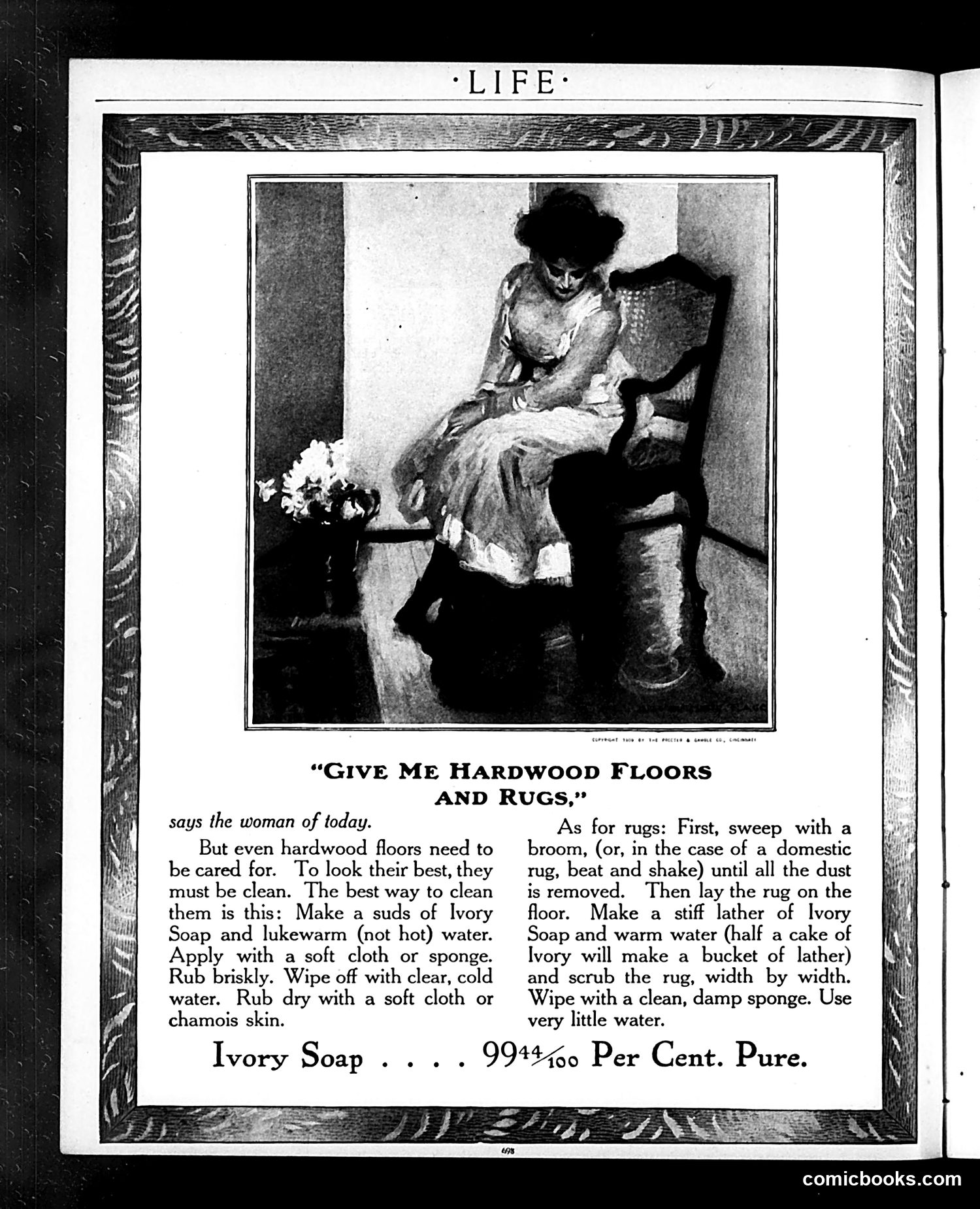
This is primarily **advertising copy, not satire or political commentary**. The page promotes Ivory Soap with cleaning instructions for hardwood floors and rugs. The image shows a woman in early 20th-century dress sitting and tending to her child's feet or legs, with flowers visible nearby. The accompanying text captures period attitudes about housekeeping: the "woman of today" supposedly desires hardwood floors and rugs, and the ad provides detailed cleaning methods using Ivory Soap and lukewarm water. The piece reflects **contemporary gender roles and domesticity** — presenting household cleaning as women's primary concern and expertise. The emphasis on purity ("99 44/100 Per Cent. Pure") was Ivory Soap's actual marketing slogan. This represents typical early 1900s advertising normalizing women's domestic labor.
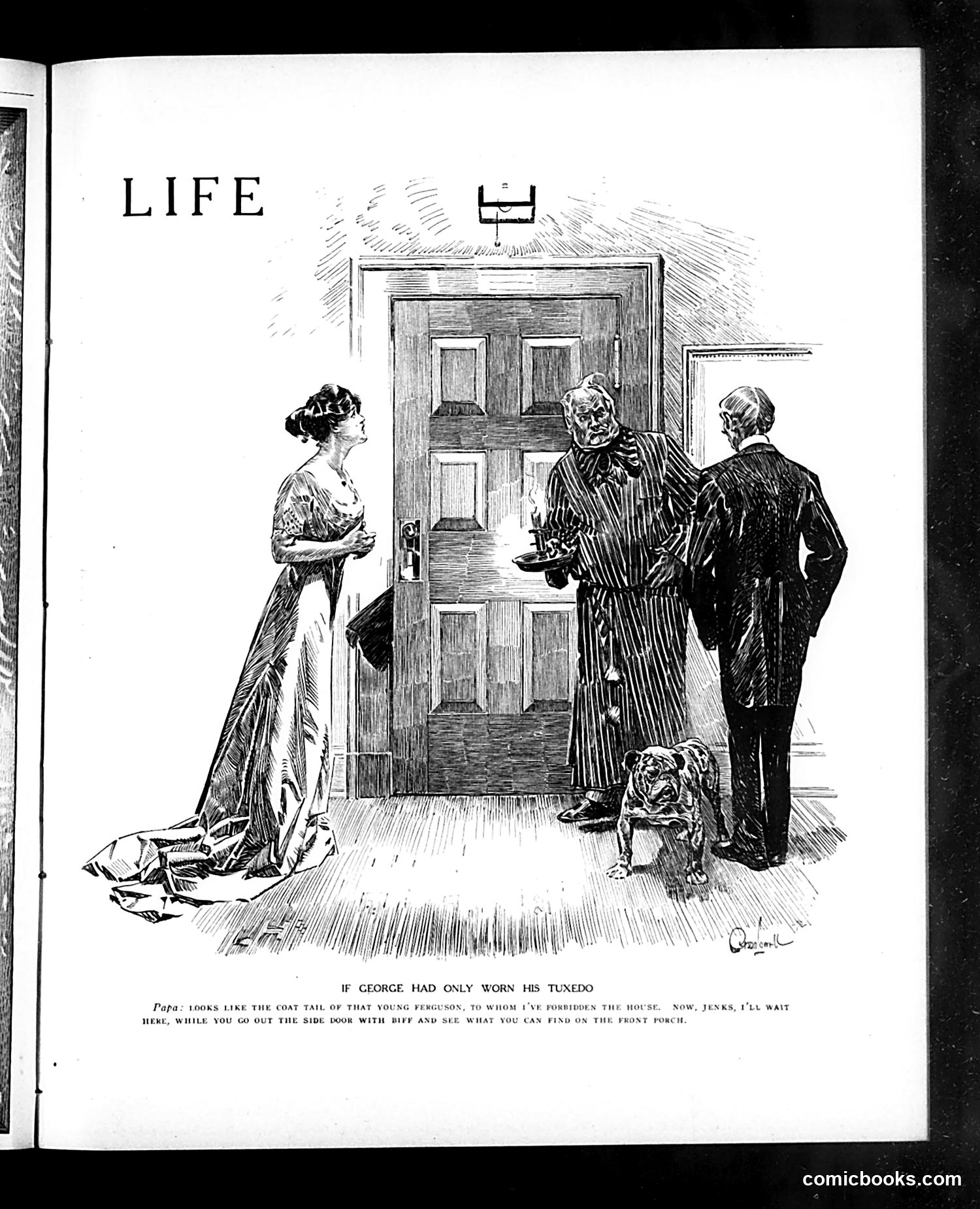
This is a satirical cartoon from *Life* magazine depicting a domestic scene. The caption references "George" wearing a tuxedo and makes a joke about coat tails resembling those of "that young Ferguson," to whom the father forbids access to the house. The humor involves a father's concern about his daughter's suitor. The joke appears to be that George looks so disreputable in his tuxedo that he resembles a disreputable person named Ferguson, whom the father has already blacklisted. The father instructs the servant to escort the young man out the side door while he investigates his credentials on the front porch. The cartoon satirizes parental anxiety about unsuitable young men courting daughters—a common social concern of the era. The specific reference to Ferguson remains unclear without additional historical context.
The main illustration depicts a figure labeled "FROST" wearing what appears to be formal attire with a badge or medallion. Based on the accompanying article text, this likely represents a candidate in New York's mayoral election. The article critiques the election campaign, noting the candidate's controversial background and questioning whether voters made a wise choice. The text mentions "Tammany" (the Democratic political machine) and discusses whether various candidates deserved support. The specific cartoon appears to be satirizing political candidacy itself—the formal dress and medal suggest the pretense or grandeur politicians adopt. Without clearer visual identification of the figure, the exact target of ridicule remains somewhat unclear, though the piece overall mocks New York's electoral process and political machine corruption.
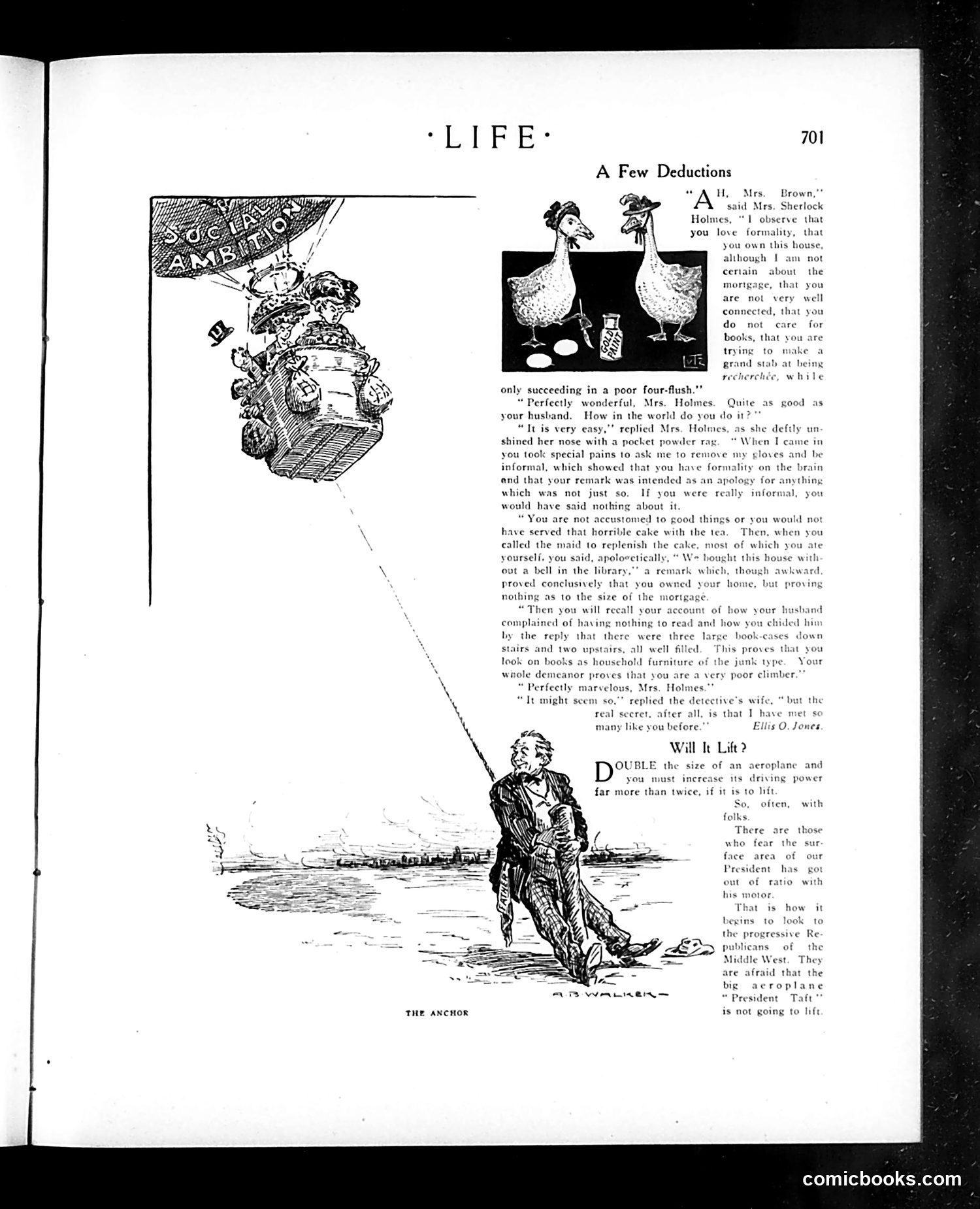
This page contains two satirical pieces from Life magazine. The top section, "A Few Deductions," features a dialogue where Mrs. Sherlock Holmes deduces details about another woman's life from observations—her love of formality, financial struggles, poor housekeeping, and limited reading. The satire mocks both detective fiction conventions and women's domestic stereotypes of the era. Below, "Will It Lift?" addresses aviation concerns about President Taft's weight. The accompanying illustration shows a man (likely representing Taft) standing on a beach. The text references Progressive Republicans' fears that an enlarged airplane called "President Taft" won't achieve flight, playing on contemporary anxieties about both aviation technology and the president's famously large physique.
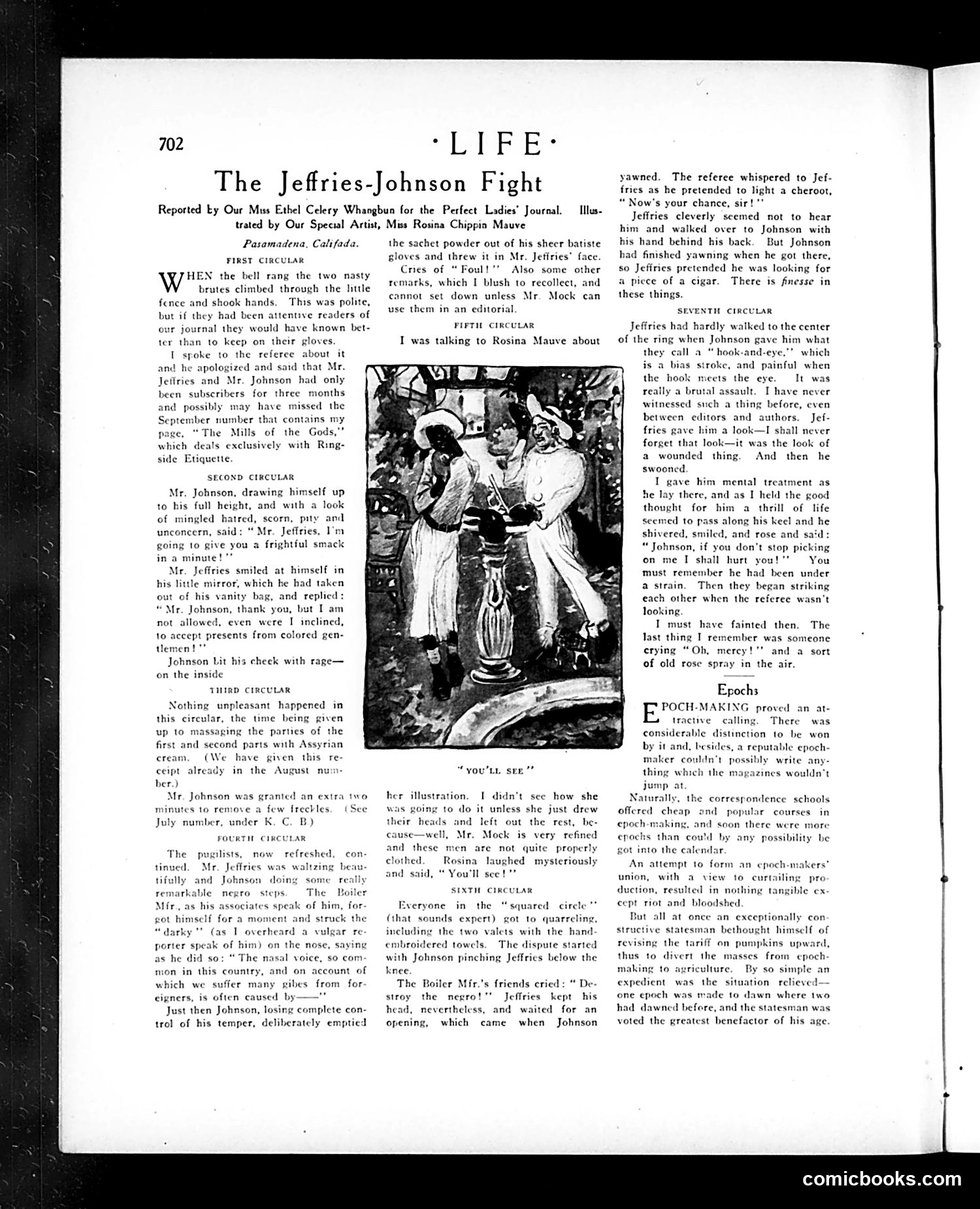
This page reports on a boxing match between Jim Jeffries and Jack Johnson, as narrated by "Ethel Celerey Whagebun" for *Life* magazine's humor section. The central illustration depicts the fight itself. The text describes several dramatic moments: Johnson taunting Jeffries, Jeffries throwing powder in Johnson's face, Johnson delivering a brutal "hook-and-eye" punch, and the referee intervening. The account is written as eyewitness commentary with exaggerated, comedic details—fainting observers, emotional reactions, and humorous asides about the crowd's behavior. The satire mocks both the fight's brutality and contemporary journalism's breathless coverage of sporting events, treating the match as absurdly dramatic entertainment rather than athletic competition.
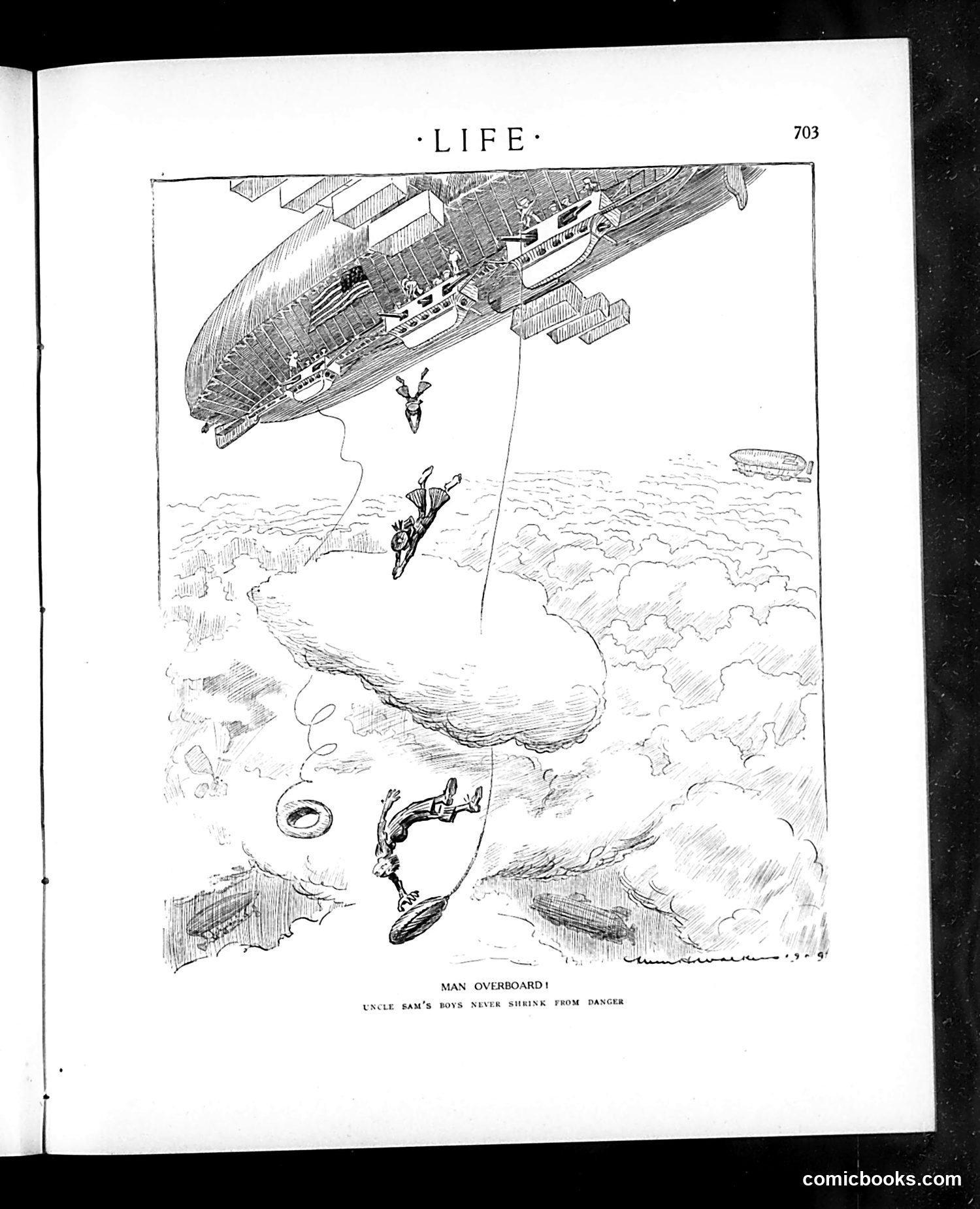
This is a satirical cartoon depicting a dramatic rescue scene. The caption reads "MAN OVERBOARD! UNCLE SAM'S BOYS NEVER SHIRK FROM DANGER." The image shows a military or naval vessel at the top with crew members, with rescue ropes extended downward into clouds below. Figures appear to be suspended on these ropes—likely representing American servicemen performing a rescue operation. The style suggests this is patriotic propaganda, celebrating American military courage and duty. The "Uncle Sam's boys" reference identifies these as American military personnel. The overall message appears to be promoting American military heroism and readiness to rescue those in danger, likely created during a period when the U.S. military was emphasized positively in public messaging. The specific historical context and any particular event referenced remains unclear without additional dating information.
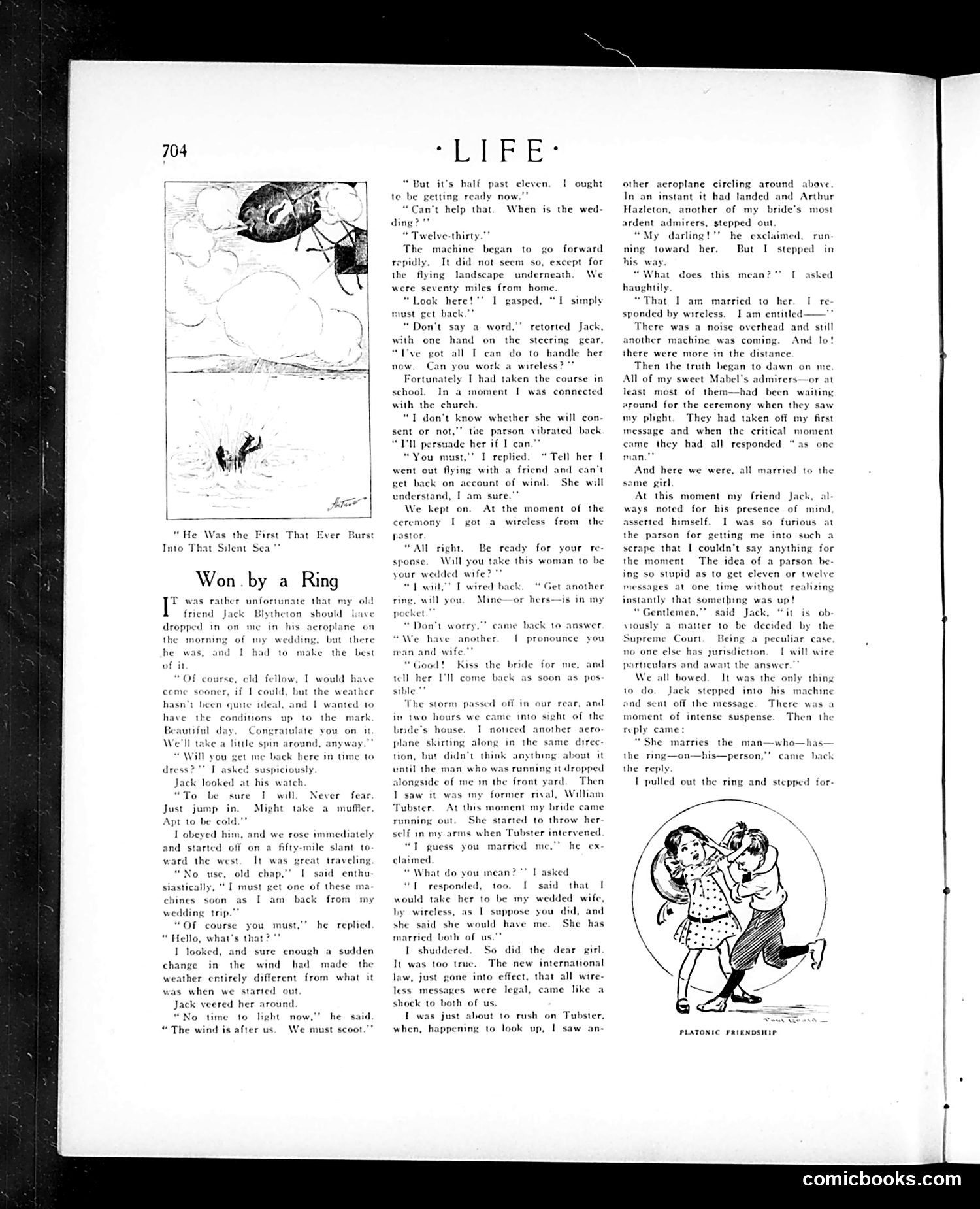
This page presents a romantic aviation story about a pilot who wins his bride by wireless message during an airplane flight. The narrative describes an aerial race and competition between suitors, with the protagonist using early wireless technology to communicate and secure his marriage proposal. The small cartoon at bottom right, labeled "Platonic Friendship," depicts two figures in a playful embrace—likely satirizing the notion of purely platonic relationships between men and women, a common satirical theme in early 20th-century humor magazines. The story itself celebrates modern aviation and wireless communication as romantic enablers, reflecting the era's fascination with new technologies. The illustrations show aircraft in flight and dramatic aerial scenes, emphasizing the daring, technological modernity of the courtship.
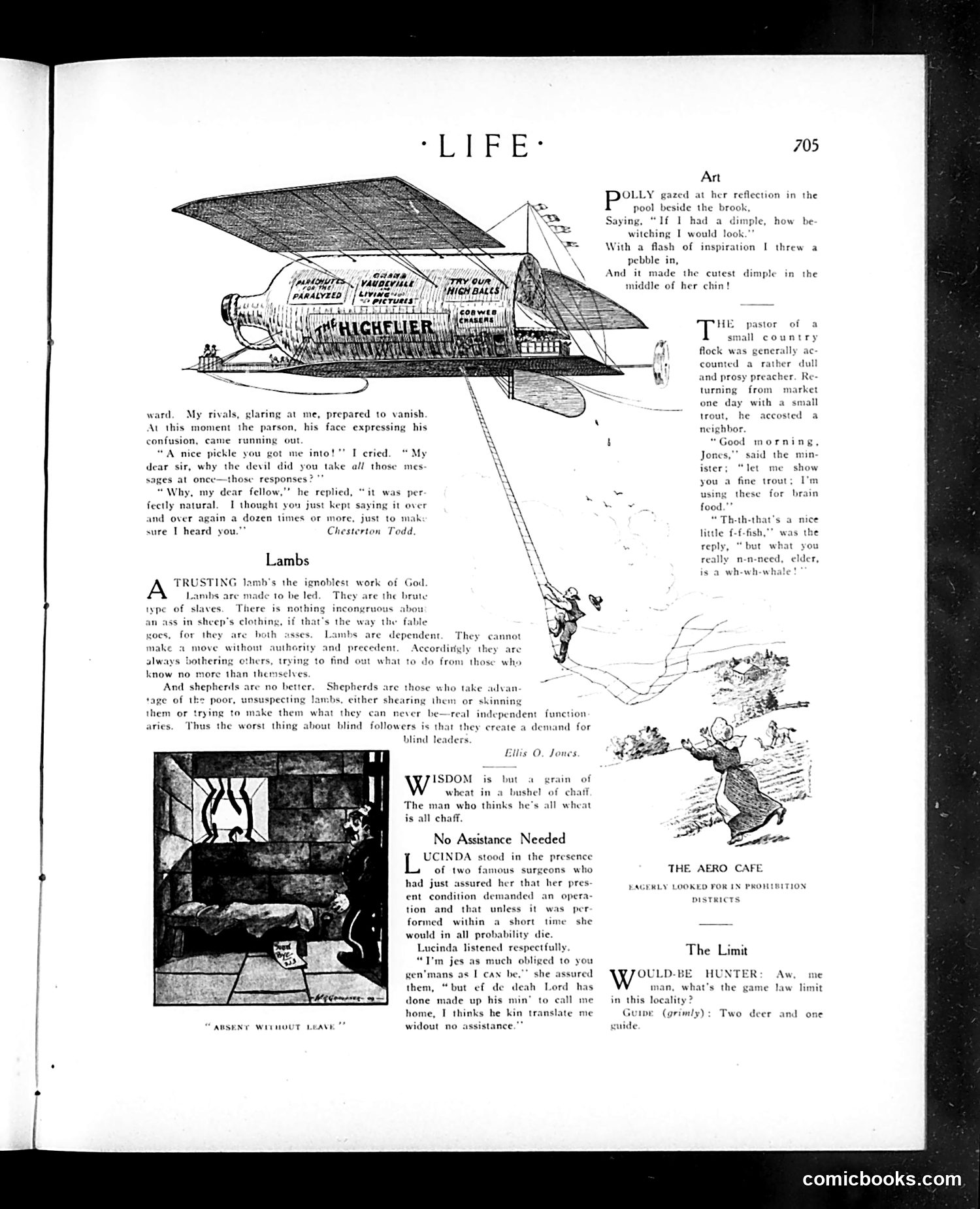
This page contains several literary excerpts and illustrations but no clear political cartoon. The content includes: **"Lambs"** — A philosophical piece (attributed to Ellis O. Jones) about sheep as dependent creatures requiring shepherds, likely serving as social commentary on blind followers and leadership. **"No Assistance Needed"** — A narrative excerpt about Lucinda, a woman refusing surgical help, trusting divine will instead. This appears to satirize either religious extremism or stubborn independence regarding medical care. **"The Aero Cafe"** — An illustration labeled as "eagerly looked for in prohibition districts," suggesting satire about speakeasies during Prohibition era. **"The Limit"** — A hunting dialogue joke about game limits. The page primarily features literary satire and social commentary rather than visual political cartoons. The Prohibition reference dates this to the 1920s-1930s.
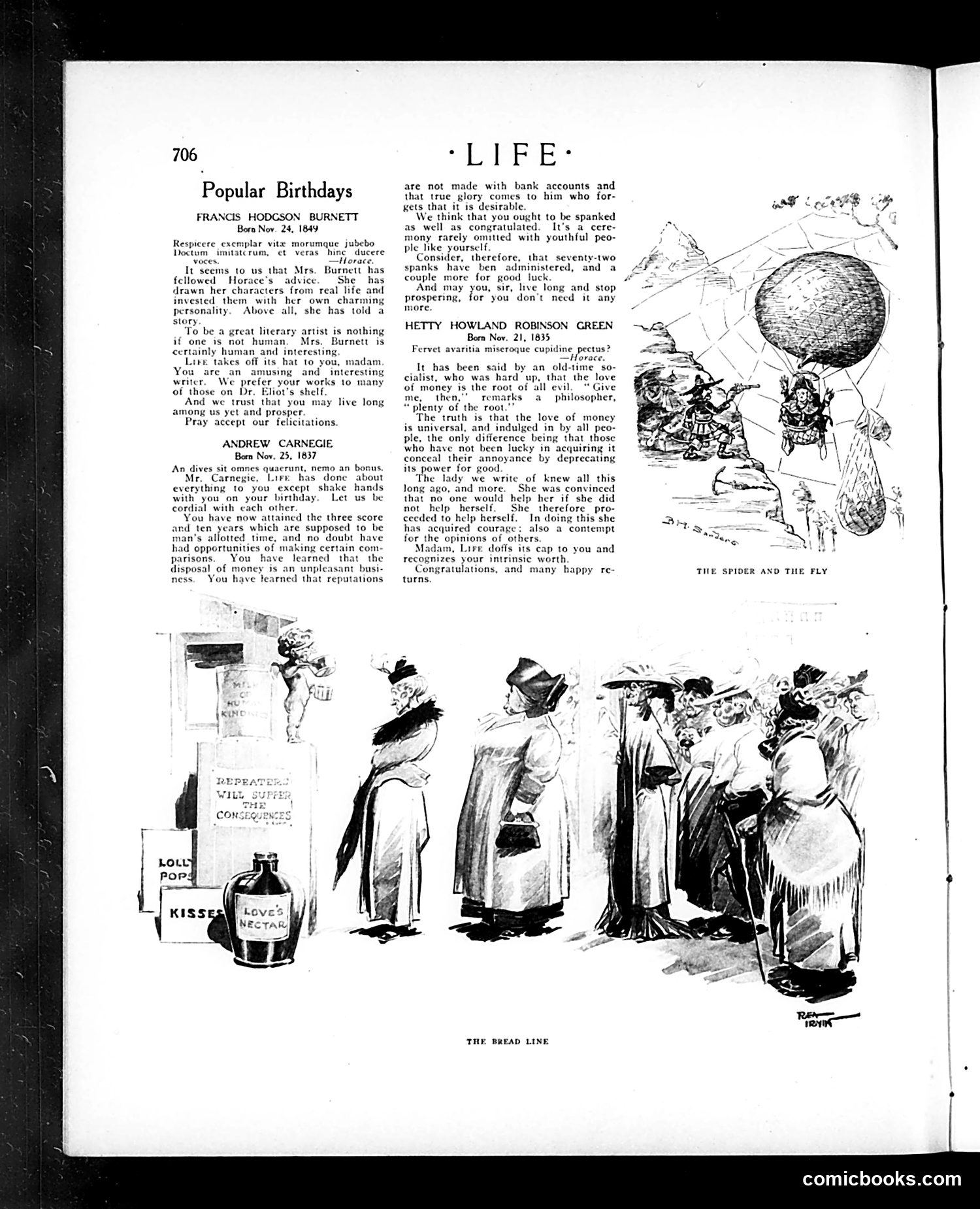
This page celebrates three prominent figures' birthdays with satirical commentary: **Francis Hodgson Burnett** (author): Praised genuinely for drawing literary characters from real life with charm and humanity. **Andrew Carnegie** (industrialist/philanthropist): The satire is sharp—Life congratulates him on reaching 70 but sarcastically suggests he deserves "spanking" alongside congratulations. The joke: Carnegie accumulated vast wealth but struggled with how to spend it responsibly. Life urges him to "stop prospering"—a cutting remark implying his wealth-building is outdated and he should focus on legacy instead. **Hetty Green** (financier): Called the "Witch of Wall Street," she was famous for extreme frugality despite immense wealth. Life's Latin epigraph translates roughly to "avarice burns in the heart." The satire praises her self-reliance while mocking her obsessive money-hoarding. The cartoons below illustrate wealth and poverty: "The Bread Line" shows desperate poor queuing for food, contrasting sharply with the birthday tributes to the ultra-wealthy above—highlighting Gilded Age inequality.
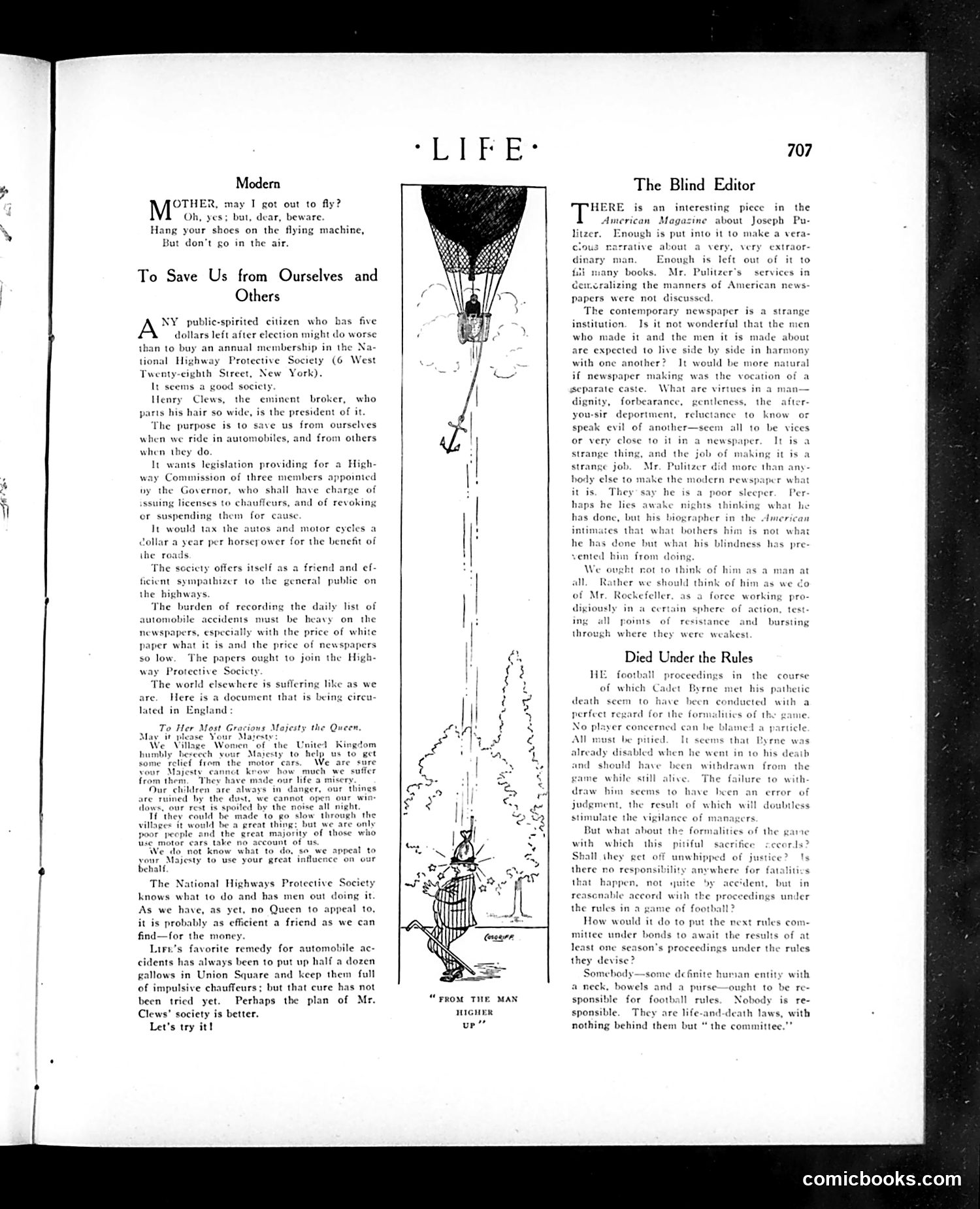
**Left side: "To Save Us from Ourselves and Others"** This mocks the newly-formed National Highway Protective Society, led by prominent broker Henry Clews. The society proposes licensing chauffeurs and taxing automobiles to fund road safety—a response to the alarming rise of automobile accidents in early 1900s America. The satire suggests the cure (bureaucracy) may be worse than the disease. Life's own "remedy" was facetiously placing gallows in Union Square to deter reckless drivers. The accompanying illustration shows a hot-air balloon, sardonically suggesting alternative transportation. **Right side: "The Blind Editor"** This discusses Joseph Pulitzer's biography without naming him directly. It praises his revolutionary impact on American newspapers while noting the irony that newspaper editors, who expose others' faults, are themselves expected to operate ethically within tight constraints. The title references Pulitzer's actual blindness (he became blind in 1889). Both pieces exemplify *Life*'s irreverent social commentary on modern institutions—automobiles, journalism, and regulatory reform.
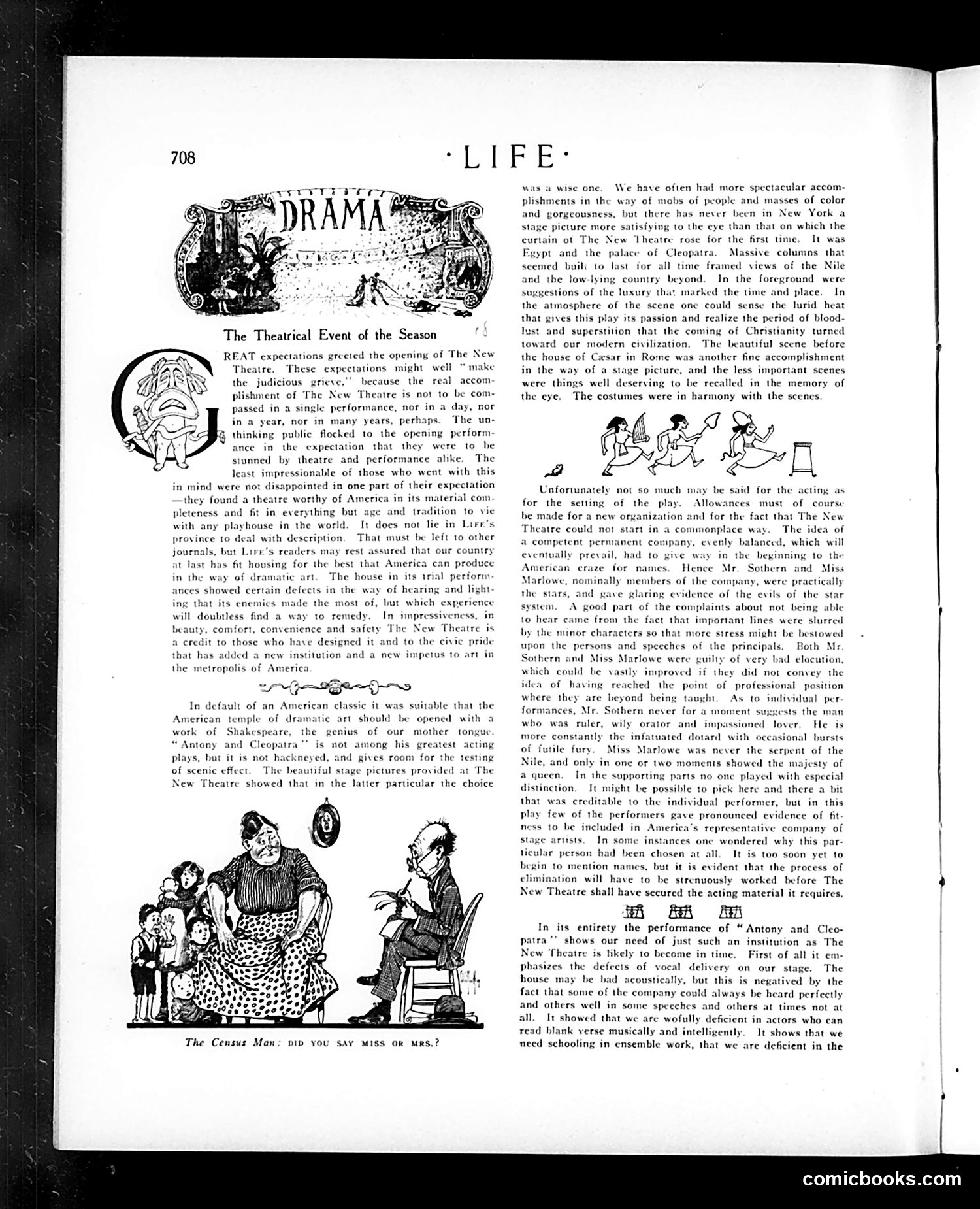
This page reviews the opening of The New Theatre, a prestigious new playhouse that had just opened in New York. The text praises the theatrical *setting*—particularly the elaborate Egypt and Rome scenes—as magnificent achievements in American stagecraft. However, the review is sharply critical of the *acting*. The article critiques the star system, specifically calling out **Mr. Sothern and Miss Marlowe** (prominent actors of the era), who were nominally company members but functioned as stars. The complaint: they monopolized attention while minor characters were underutilized, and both actors suffered from poor diction and seemed to believe themselves "beyond being taught." The cartoon at bottom ("The Census Man: Did You Say Miss or Mrs?") appears unrelated—a domestic humor sketch about a census-taker's awkward question. The satire targets American theater's prioritization of famous names over ensemble quality and proper vocal technique, despite having finally built a world-class venue.
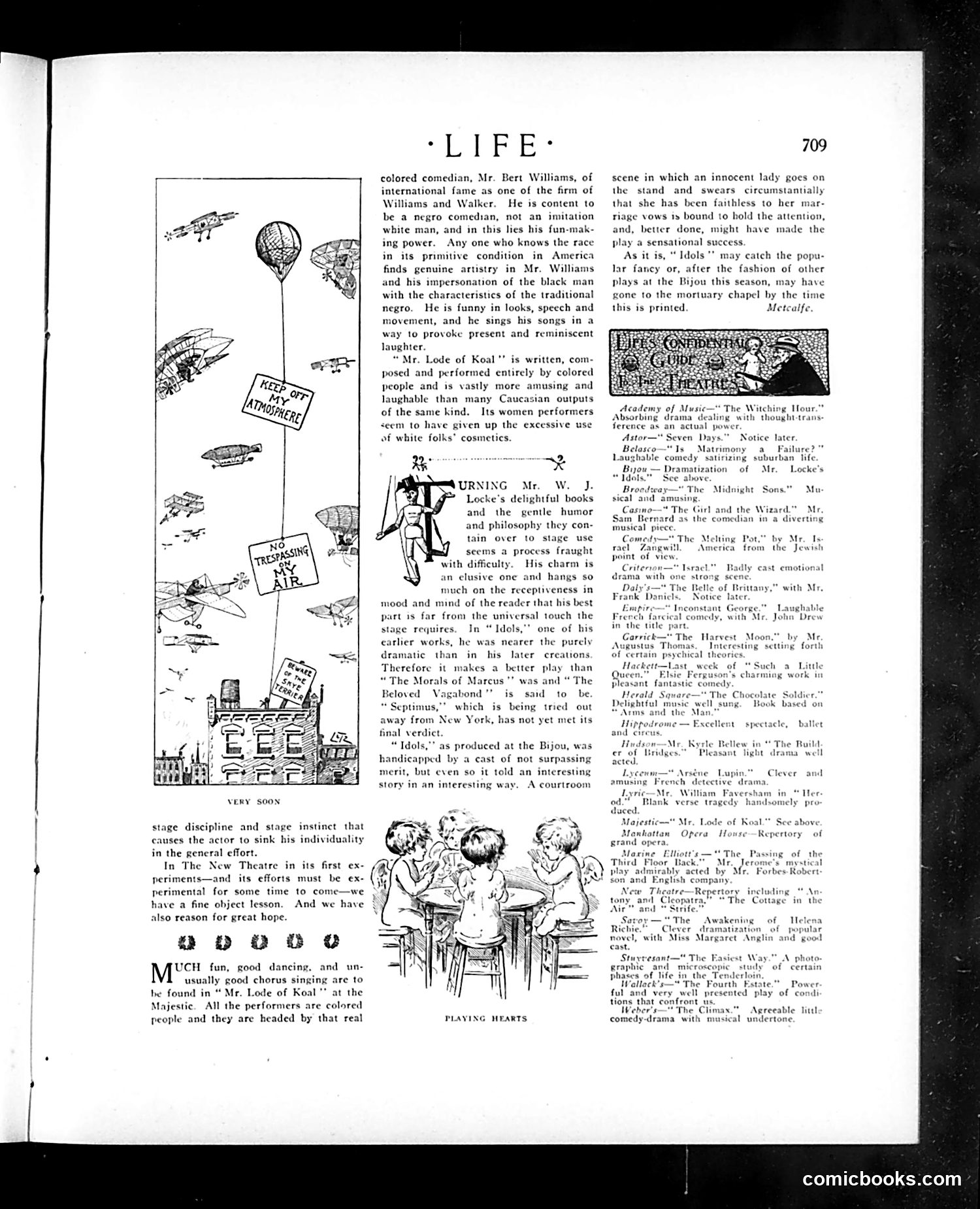
This page reviews theatrical productions, with particular focus on **"Mr. Lode of Koal"** at the Majestic Theatre, headlined by **Bert Williams**, a famous Black comedian of the Williams and Walker vaudeville partnership. The review praises Williams and the all-Black cast for their authenticity and humor, explicitly contrasting them favorably with white performers doing similar material. The critic notably approves that the female performers have abandoned "excessive use of white folks' cosmetics"—a reference to blackface makeup conventions of the era. The larger point reflects early-20th-century theatrical attitudes: the review treats an all-Black production as noteworthy and superior *precisely because* it presents authentic Black performance rather than white performers in blackface. This was progressive for *Life* magazine's era, though the language—referencing "primitive condition" and "traditional negro" characteristics—reflects the paternalistic racial attitudes of the time. The page includes standard theater listings and reviews of other contemporary productions.
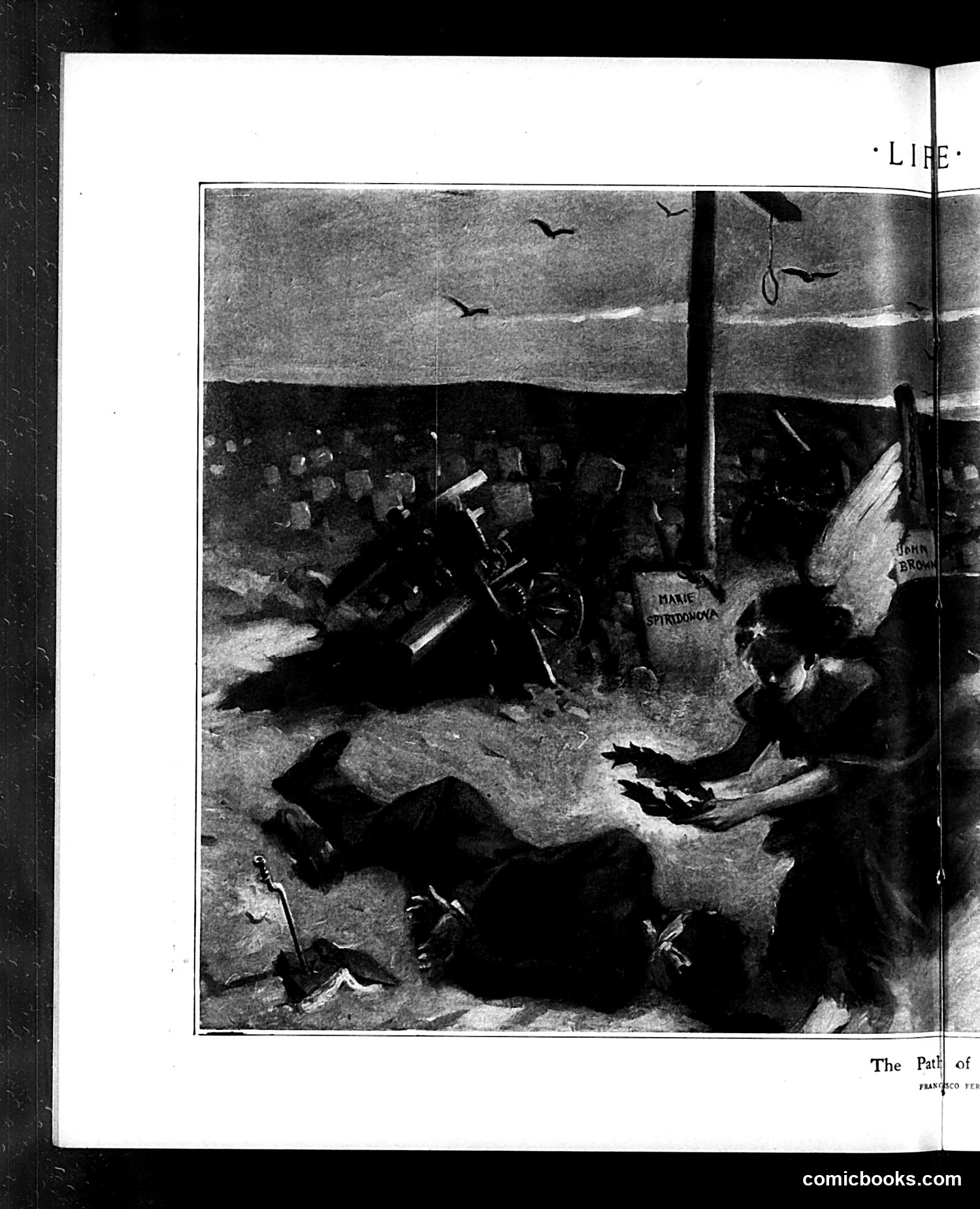
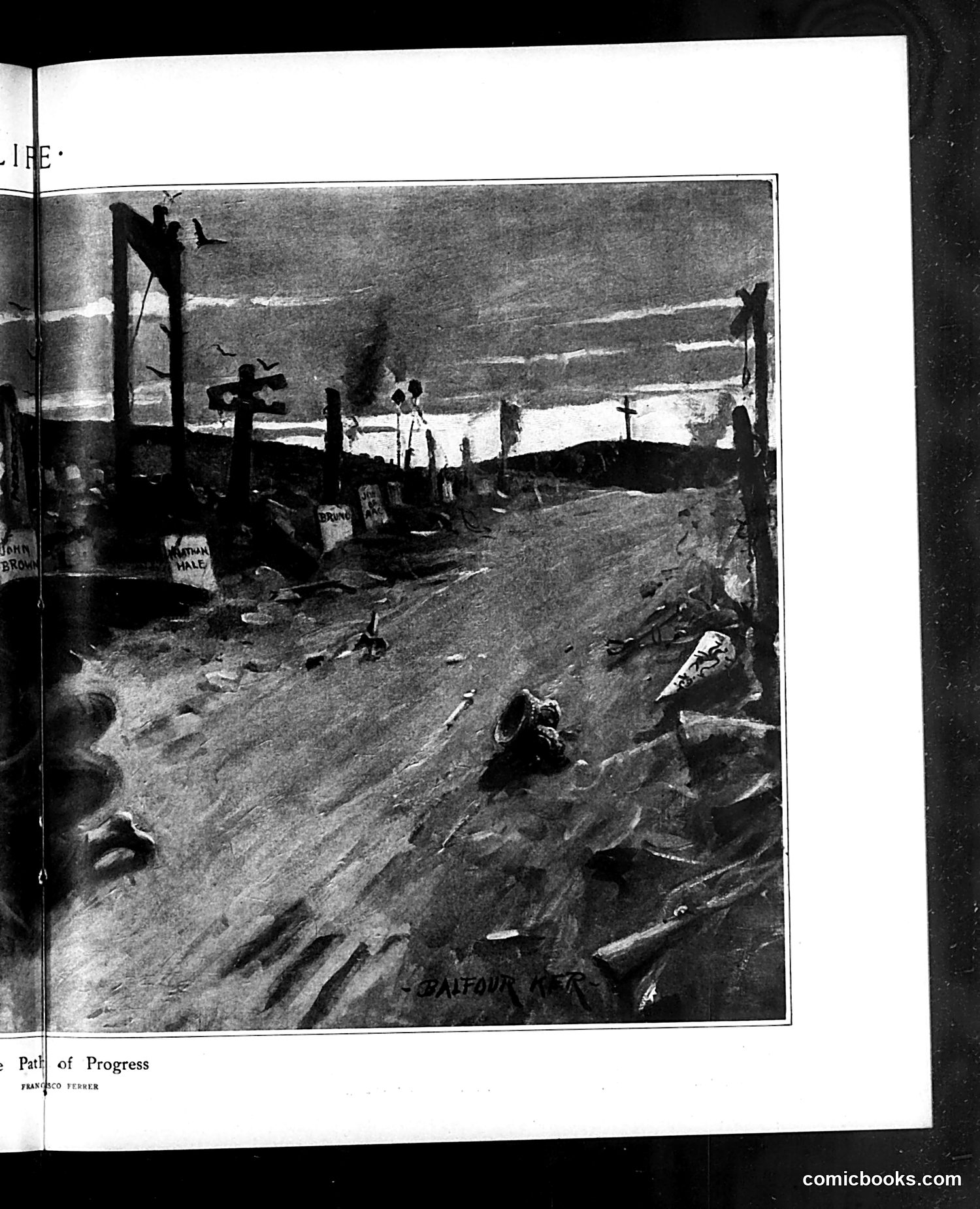
This appears to be a political cartoon depicting a cemetery or graveyard scene with multiple crosses marking graves. The caption reads "Path of Progress" with attribution to "Francisco Ferrer." The image likely references Francisco Ferrer, a Spanish educator and anarchist executed in 1909 for his alleged involvement in Barcelona's "Tragic Week" uprising. His execution by Spanish authorities was controversial internationally and made him a martyr figure among progressive and anarchist movements. The cartoon's satirical point seems to criticize the notion of "progress" by showing a graveyard—suggesting that the path of progress leaves death and destruction in its wake. The scattered bodies and crosses imply that technological or political advancement comes at human cost, particularly reflecting early 20th-century anxieties about industrialization, authoritarianism, and social unrest.
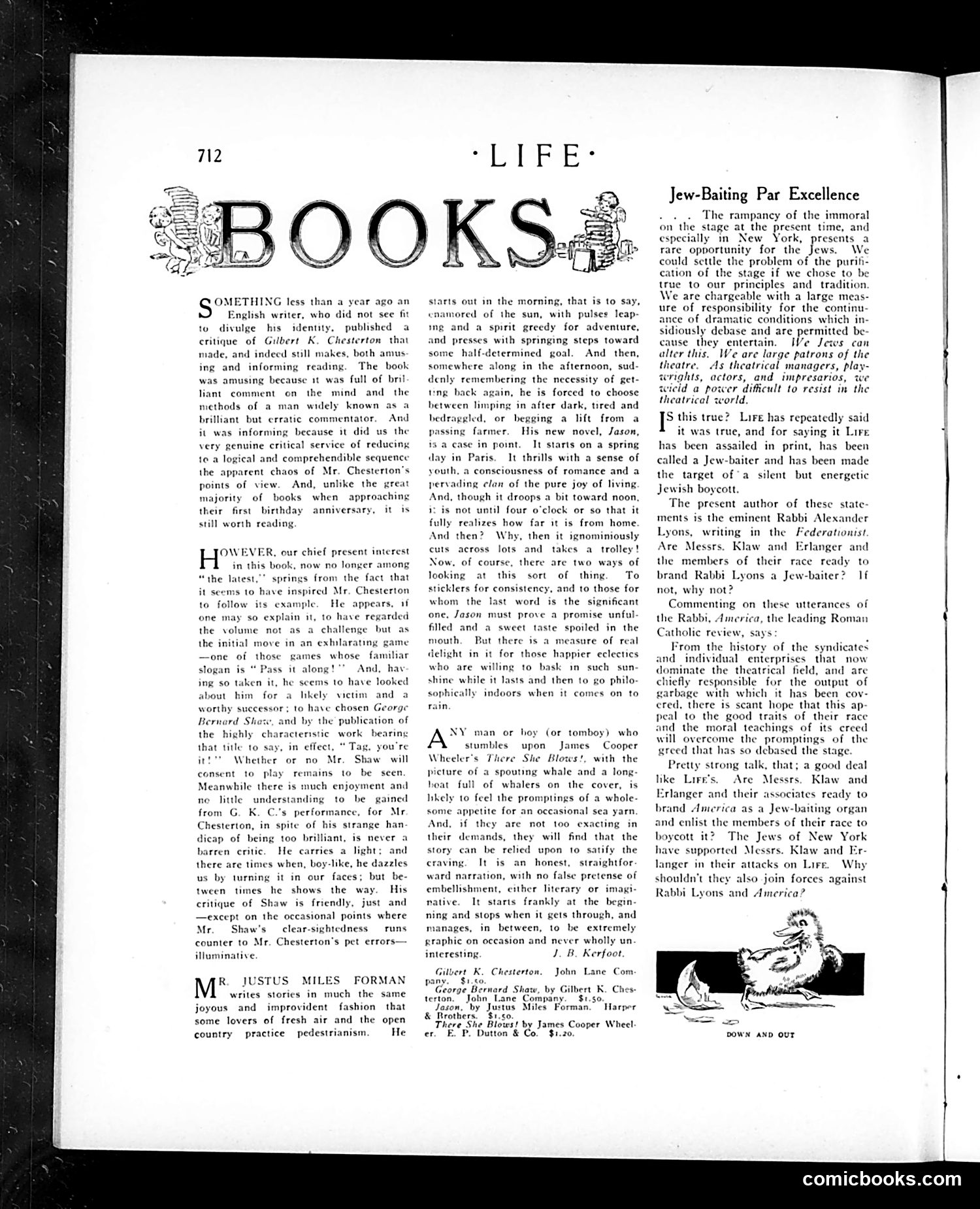
This page contains literary book reviews rather than political cartoons. The main content discusses: 1. **Gilbert K. Chesterton critique**: A review of a recently published anonymous critique of writer G.K. Chesterton, noting it inspired Chesterton to write about George Bernard Shaw in return—described as a friendly intellectual "tag, you're it" game between celebrated writers. 2. **Justus Miles Forman's "Jason"**: A novel review praising Forman's spontaneous, improvident writing style. The reviewer compares Forman's creative process to a pedestrian starting a journey with enthusiasm but needing to "beg a lift" home—a metaphor for the novel's initial promise that droops toward its conclusion. 3. **James Cooper Wheeler's "There She Blows!"**: A brief mention of a whale-hunting narrative. The small illustration labeled "DOWN AND OUT" shows what appears to be a person in distress—likely reflecting the Forman review's theme of exhausted creative energy. This is primarily a **literary criticism page**, not a political satire page.
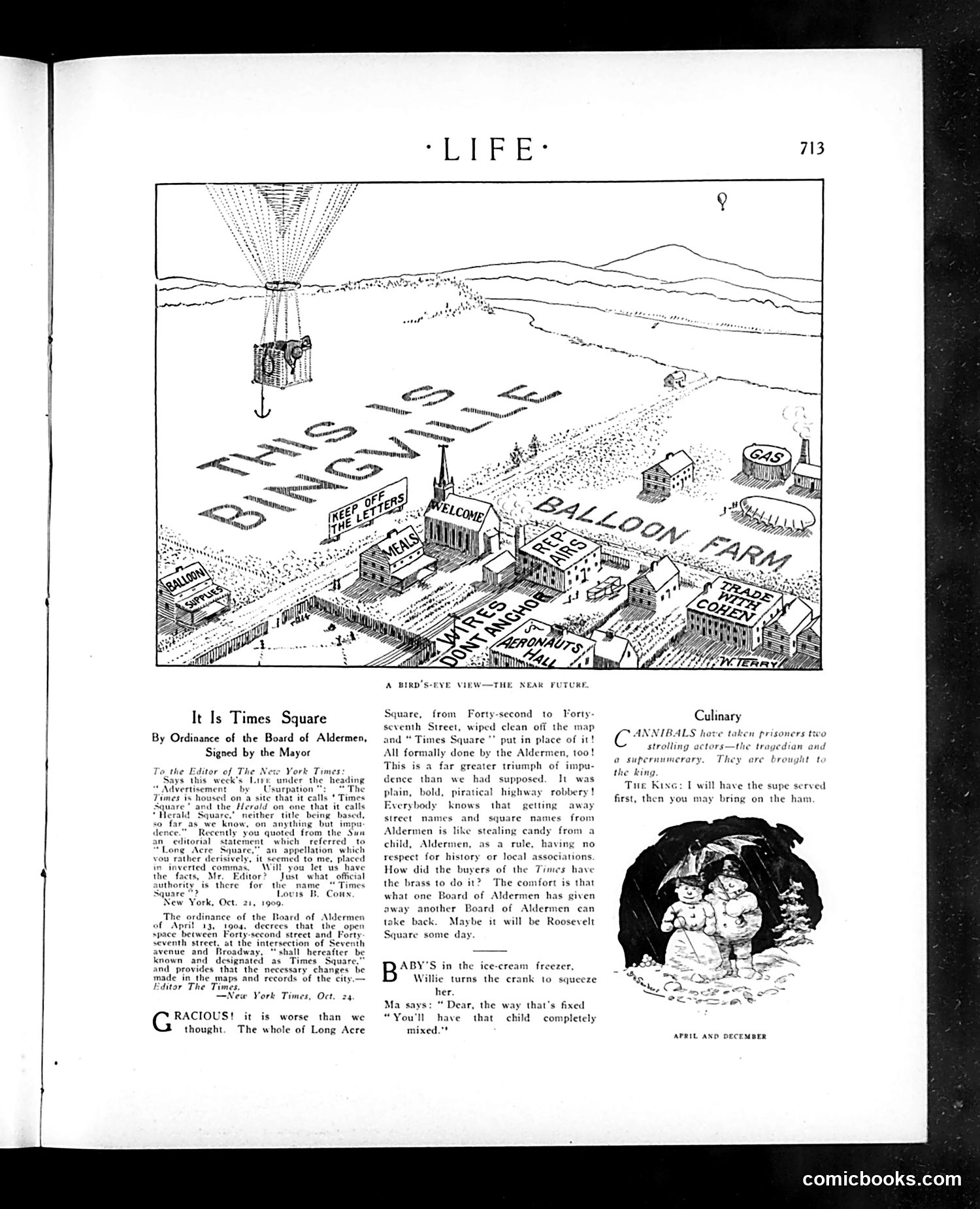
This page satirizes the New York Board of Aldermen's decision to officially rename the intersection of 42nd-47th Streets and Seventh Avenue from "Long Acre" to "Times Square"—apparently at the behest of the *New York Times* newspaper. The cartoon's "bird's-eye view" shows a futuristic landscape labeled with various corporate/institutional names, mocking the blatant commercialism and political corruption of the renaming. The satire's core point: the Aldermen have brazenly sold off historic place names to the highest bidder, treating it as casually as "stealing candy from a child." The author acidly notes that what one Board of Aldermen gives away, another might reclaim—perhaps renaming it "Roosevelt Square" instead. The secondary cartoons are unrelated domestic humor sketches. The satire reflects Progressive Era skepticism toward municipal corruption and corporate influence over civic institutions.
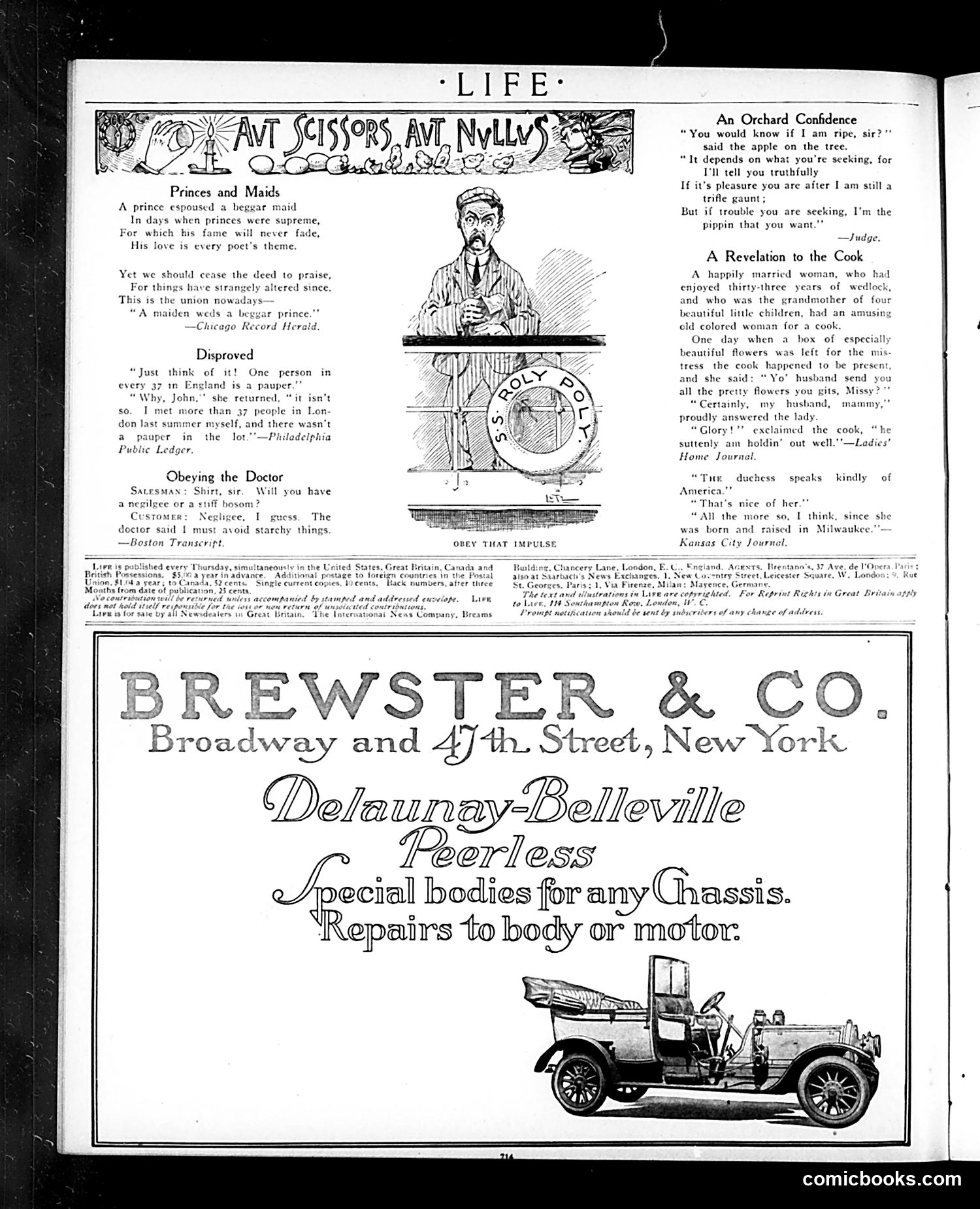
This page contains several humorous short pieces typical of Life's satirical style: **"A Maiden Weds a Beggar Prince"** critiques romantic idealization—the poem notes that while a prince marrying a beggar maid was once celebrated as noble love, "things have strangely altered since," suggesting modern attitudes find such unions less admirable. **"Disproved"** is a brief joke mocking statistics: a woman claims one in 37 English people is a pauper, but a man counters he saw 37+ people in London last summer without meeting a pauper—implying the statistic is nonsense. **"Obeying the Doctor"** jokes about a doctor's advice to avoid starchy foods, with a patient cheekily noting they followed those orders themselves but found no improvement. The remaining pieces—"An Orchard Confidence," "A Revelation to the Cook," and "The Duchess Speaks"—are light anecdotes playing on miscommunication or class differences, featuring a colored cook and wealthy households. The page is primarily advertising (Brewster & Co. automobiles) beneath the editorial content.
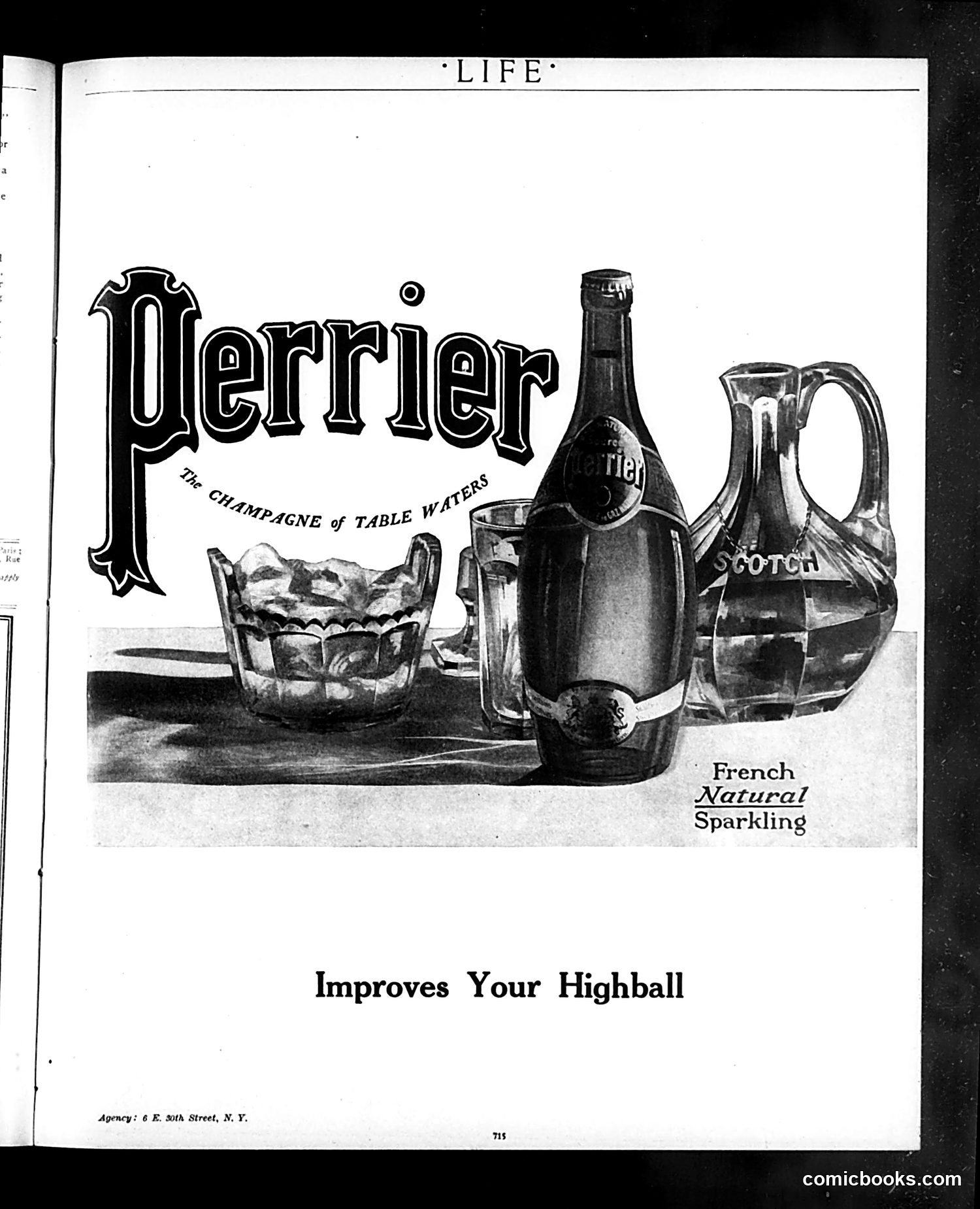
This is a **Perrier advertisement**, not political satire. The page shows a bottle of Perrier sparkling water alongside serving vessels (a bucket, glass, and pitcher labeled "Scotch"), promoting the product as "The Champagne of Table Waters." The ad's slogan—"Improves Your Highball"—suggests mixing Perrier with scotch whisky to create a cocktail. This dates to the Prohibition era or its immediate aftermath, when sparkling water was marketed as a mixer for alcoholic beverages. The "French Natural Sparkling" designation emphasizes the product's imported prestige. The sophisticated glassware imagery appeals to upscale consumers. This is straightforward commercial advertising with no political commentary or satire present.
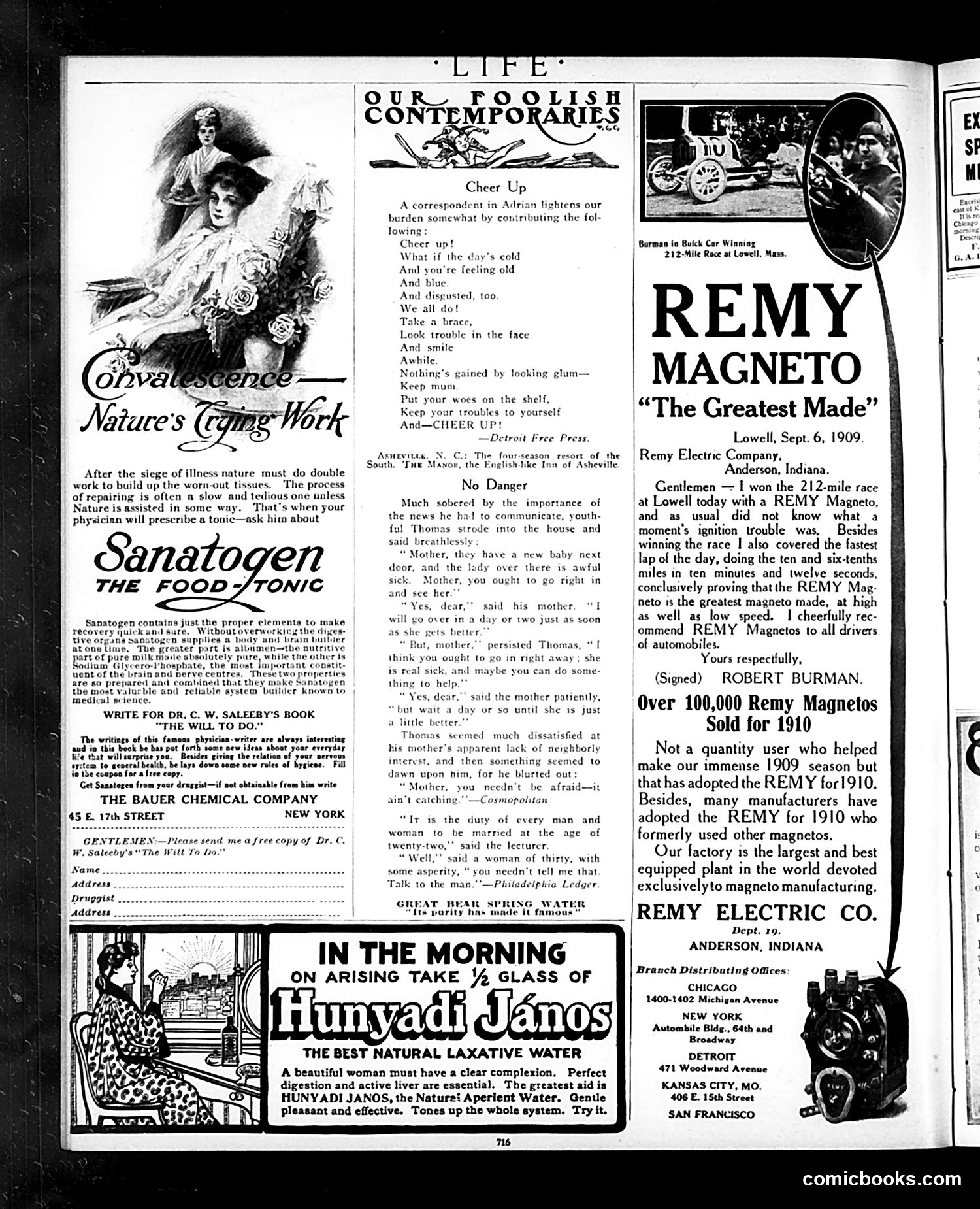
This page from *Life* magazine is primarily **advertising**, not satire or editorial cartooning. The content consists of four print advertisements and three short humorous anecdotes: **Upper left**: "Sanatogen" (a food tonic) advertisement with an art nouveau-style illustration promoting post-illness recovery. **Center**: Brief jokes, including one where a boy worries about visiting sick neighbors (implying contagion), and another where a woman challenges a lecturer's claim that women should marry by age twenty-two. **Lower left**: "Hunyadi Janos" natural laxative water advertisement with period illustration emphasizing complexion and digestion. **Right side**: "Remy Magneto" automotive ignition system, featuring a testimonial from racing driver Robert Burman about winning a 212-mile race. There is **no political satire or caricature** here—this represents typical early-20th-century magazine advertising mixed with light domestic humor aimed at the magazine's middle-class readership.
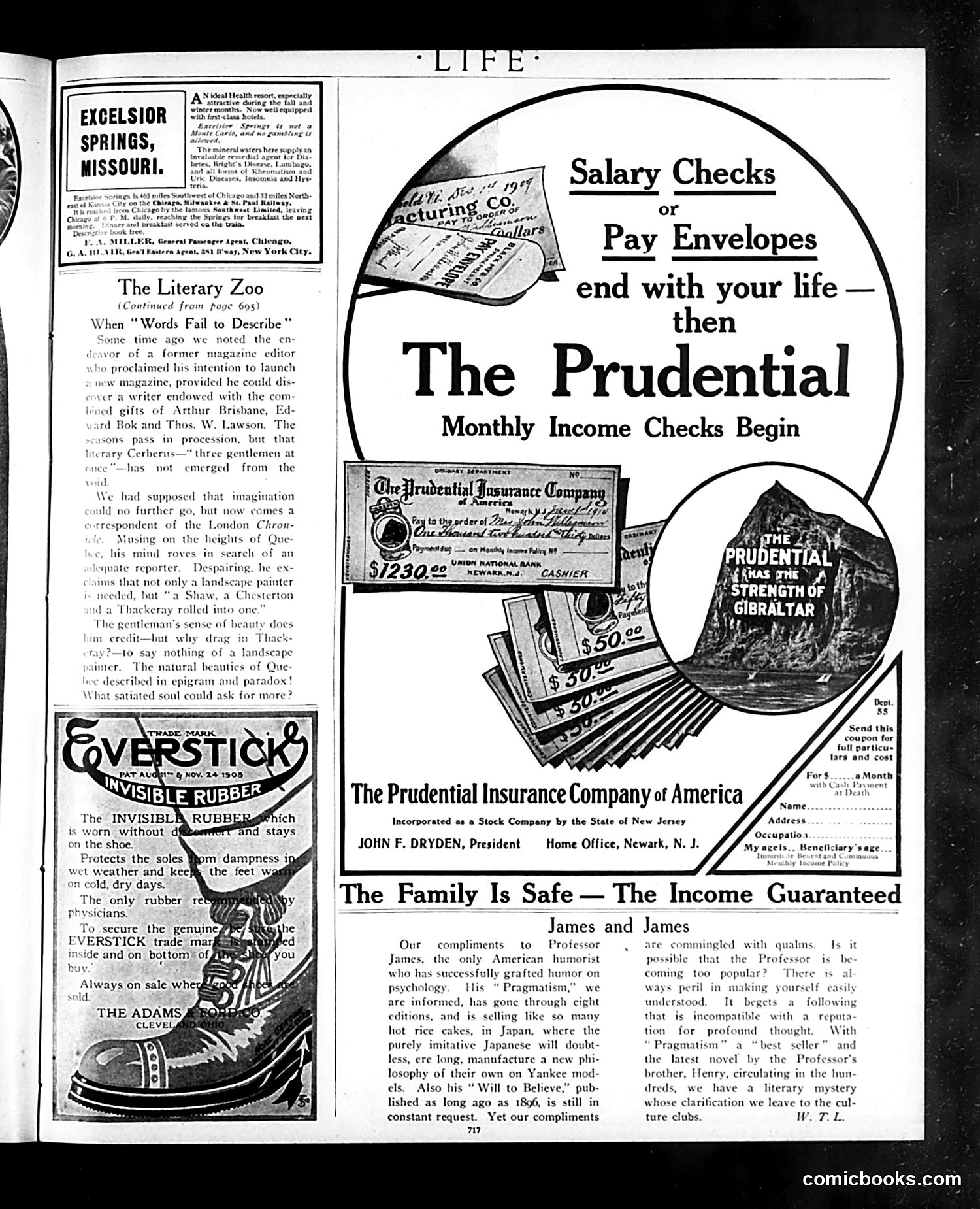
This page is primarily **advertising**, not satire or political commentary. The main content features a large advertisement for **The Prudential Insurance Company of America**, emphasizing their "Monthly Income Checks" product—insurance policies that provide guaranteed lifetime monthly payments to beneficiaries. The ad contrasts salary checks (which "end with your life") with Prudential's continuing income, using the company's Gibraltar Rock logo as a symbol of financial strength and stability. Below this is a brief **literary commentary** praising Professor William James, the American philosopher and psychologist. The writer notes James's "Pragmatism" and "Will to Believe" have become bestsellers, particularly in Japan, jokingly suggesting this popular success may undermine his reputation for "profound thought"—implying accessibility conflicts with serious intellectual credibility. The page also contains minor advertisements for **Excelsior Springs, Missouri** (a health resort) and **Everstick invisible rubber** shoe soles.
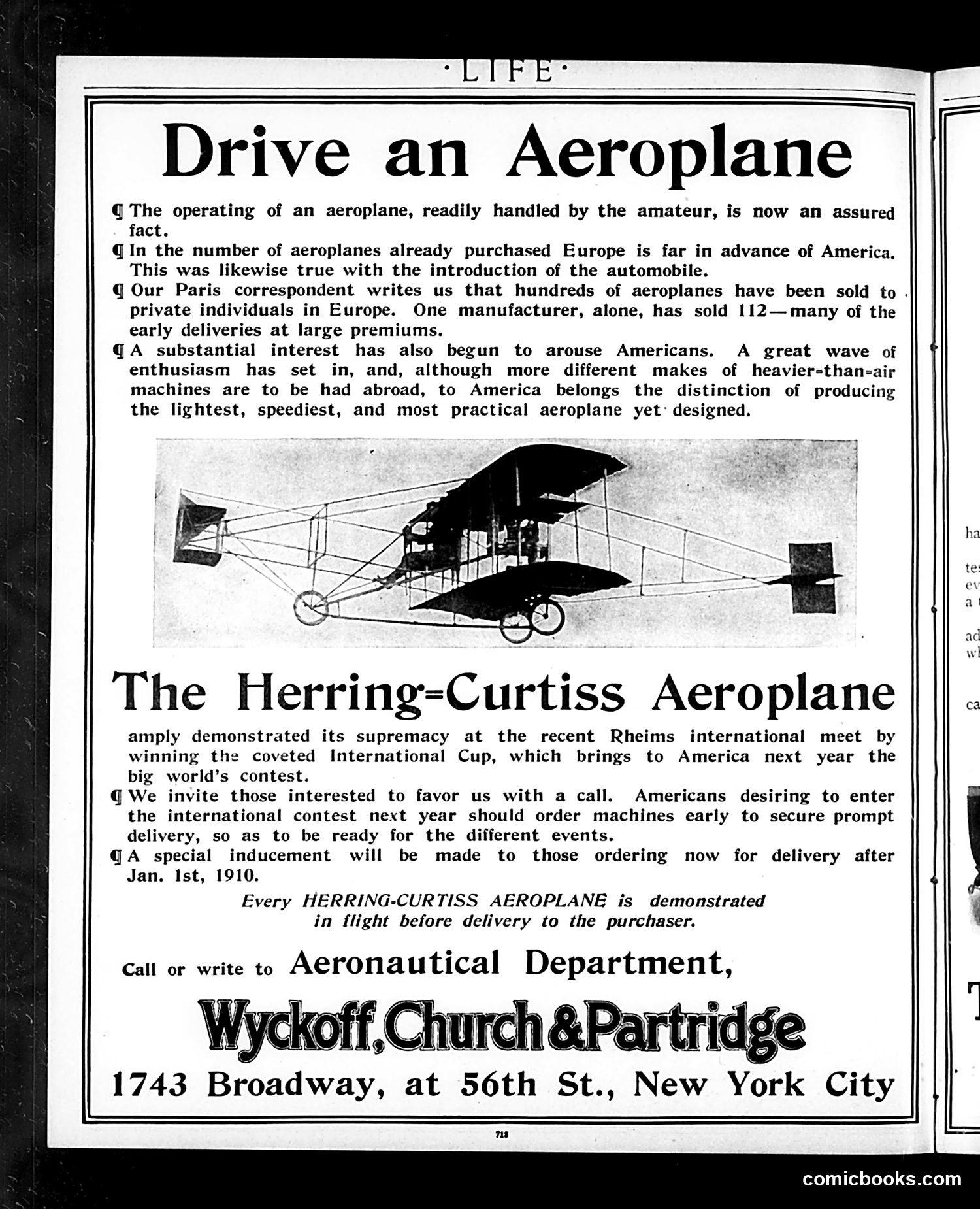
This is primarily an **advertisement**, not satire or political content. It promotes the Herring-Curtiss Aeroplane through Wyckoff, Church & Partridge in New York City. The page's opening text frames early aviation as an emerging consumer product, drawing a parallel to the automobile's adoption. It notes Europe leads in airplane purchases but claims America produces "the lightest, speediest, and most practical aeroplane yet designed"—nationalist boosterism typical of early 1900s advertising. The Herring-Curtiss plane won the International Cup at Rheims, a real aviation competition. The ad exploits this prestige to encourage American orders, offering special pricing for delivery after January 1, 1910, and promising in-flight demonstrations before purchase. For modern readers: this shows aviation transitioning from spectacle to luxury consumer goods, marketed to wealthy amateurs willing to pay substantial sums for experimental machines. The tone reflects pre-WWI American optimism about technological superiority and private ownership of cutting-edge technology.
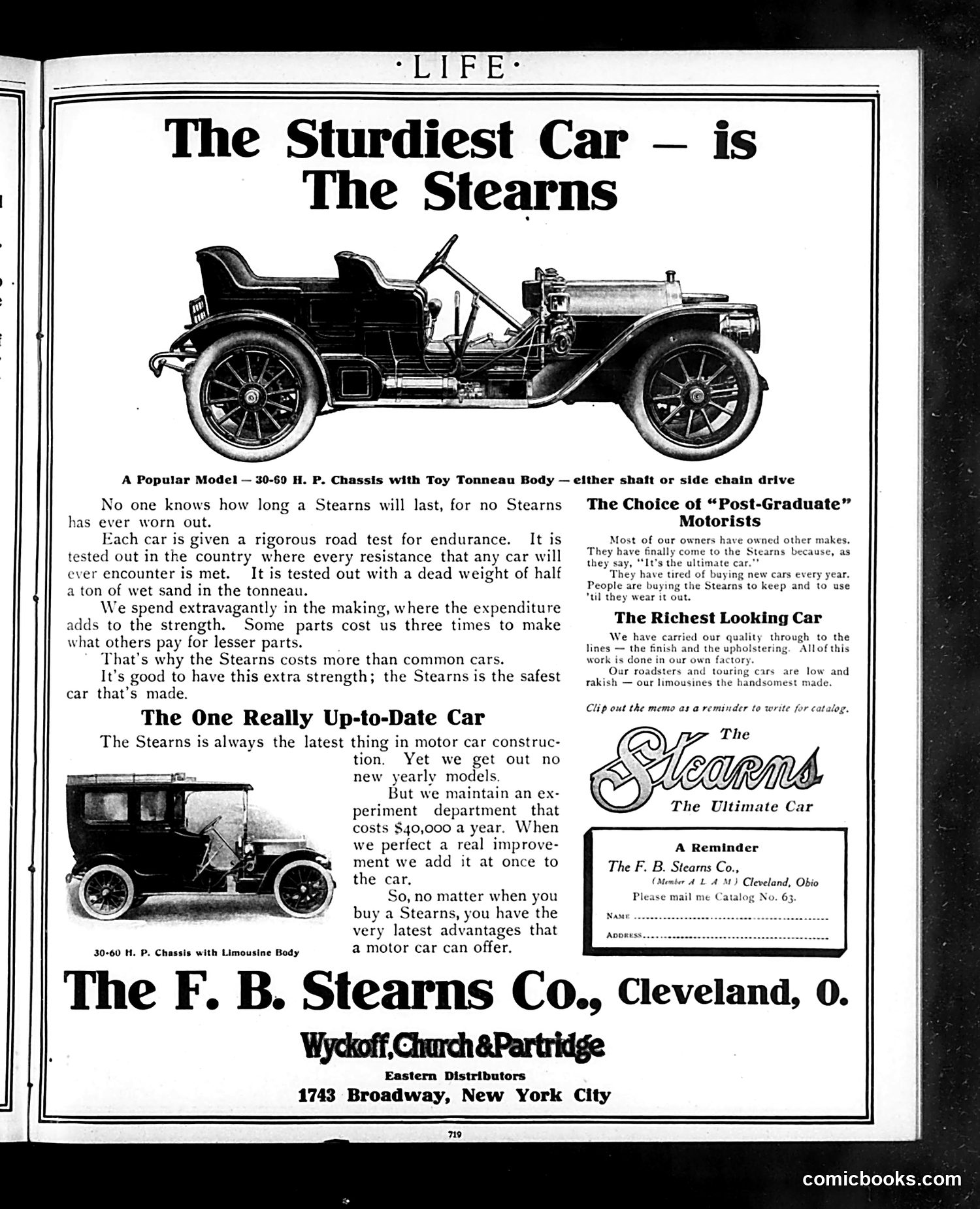
This is **not a cartoon or satire**—it's a straightforward automobile advertisement from Life magazine's advertising section (page 719). The F.B. Stearns Company, based in Cleveland, Ohio, marketed their cars as premium vehicles emphasizing durability and craftsmanship. The ad targets affluent buyers by claiming Stearns cars never wear out and undergo rigorous testing (including being loaded with half a ton of wet sand). Key selling points include: - **Durability over novelty**: Unlike competitors releasing yearly models, Stearns maintains an experimental department costing $40,000 annually, adding improvements continuously rather than in staged model years - **Quality materials**: Parts cost three times more to manufacture than competitors' lesser parts - **Prestige appeal**: Marketed as the choice of "post-graduate motorists" who keep their cars indefinitely The two illustrated models show a popular open-air chassis and a limousine body, appealing to wealthy urban and suburban buyers circa 1910s-1920s.
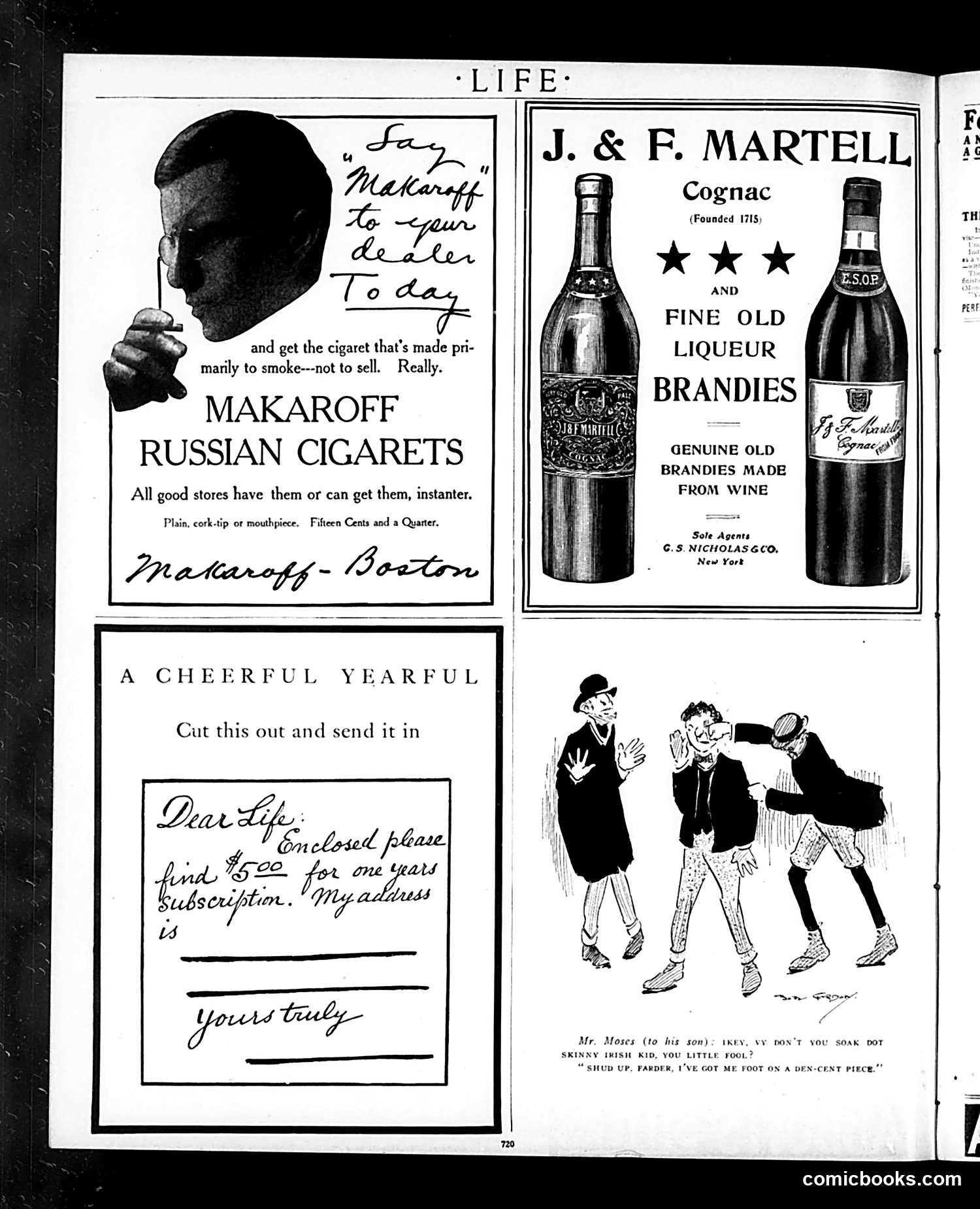
This page contains **advertisements and one ethnic stereotype cartoon**, typical of early 20th-century Life magazine content. The **top advertisements** promote Makaroff Russian Cigarettes and J. & F. Martell Cognac/Brandies—luxury goods marketed to affluent readers. The **cartoon at bottom** depicts a Jewish father ("Moses") scolding his son for not dunking an Irish boy ("skinny Irish kid") in water, apparently as bullying sport. The son refuses, claiming he's standing on a ten-cent piece—implying he prioritizes money over violence. **The satire's offensive premise**: relies on ethnic stereotypes (Jewish materialism, Irish poverty, casual childhood violence) that were considered acceptable humor in this era. Modern readers should recognize this reflects period prejudices rather than humor standards today. The "joke" equates Jewish identity with greed and presents violence between poor children as comedic fodder.
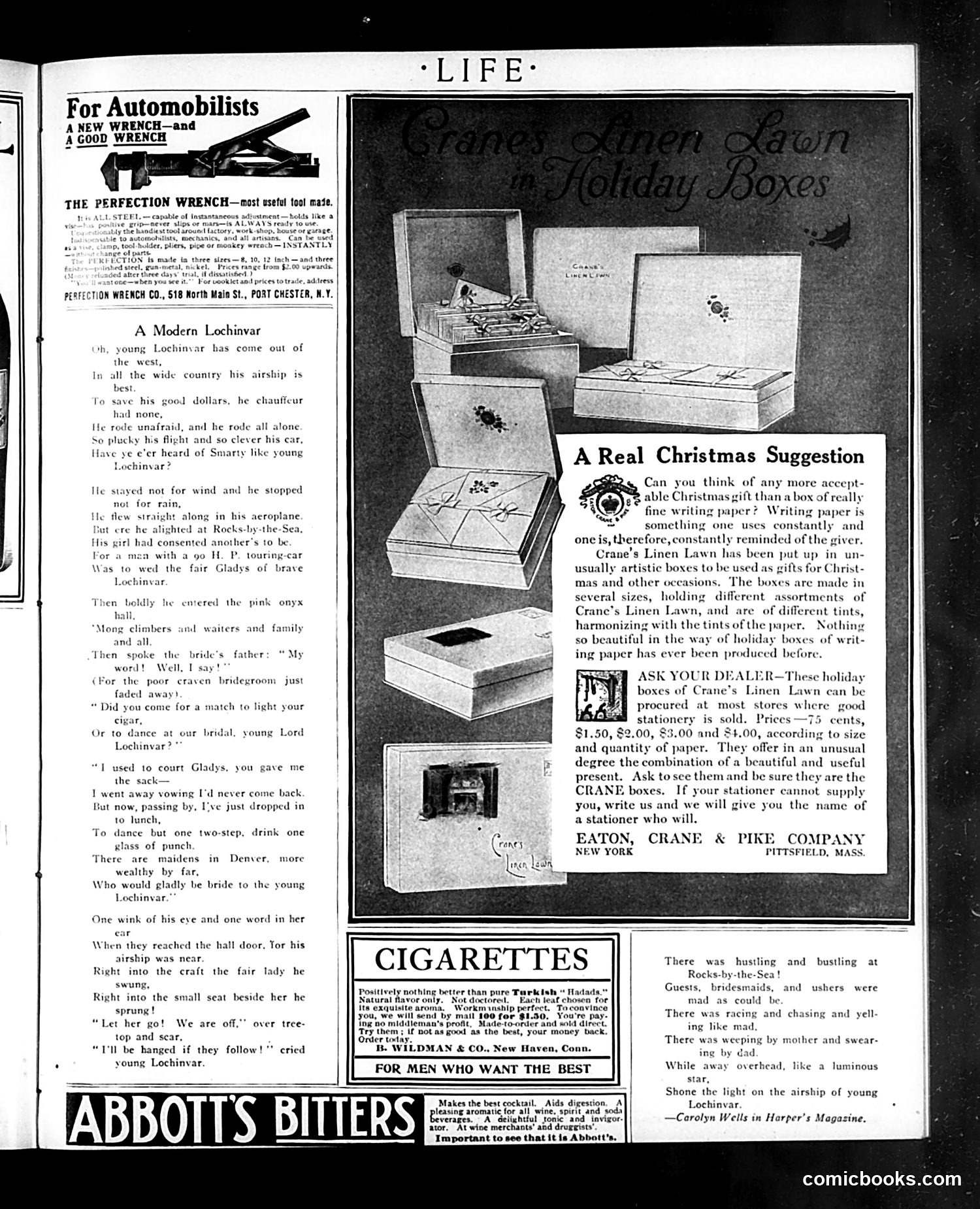
This page parodies the famous Romantic poem "Lochinvar" by Sir Walter Scott, but updates it for the early aviation age. Instead of a knight on horseback, the hero is a young aviator with an expensive airship who elopes with "fair Gladys" from a seaside wedding. The satire targets wealthy early-aviation enthusiasts and the fascination with this new technology. The original poem's dramatic elopement becomes absurd when the "dashing escape" is by flying machine—the modern substitute for romantic heroism. The joke hinges on deflating Romantic notions: the suitor's main asset isn't bravery or virtue but rather he's "plucky" with newfangled machinery and has "$90 H.P." (horsepower)—reducing romance to technological bragging. The surrounding advertisements (wrenches, cigarettes, writing paper) emphasize this is primarily a commercial magazine promoting modern consumer goods and leisure activities to affluent readers.
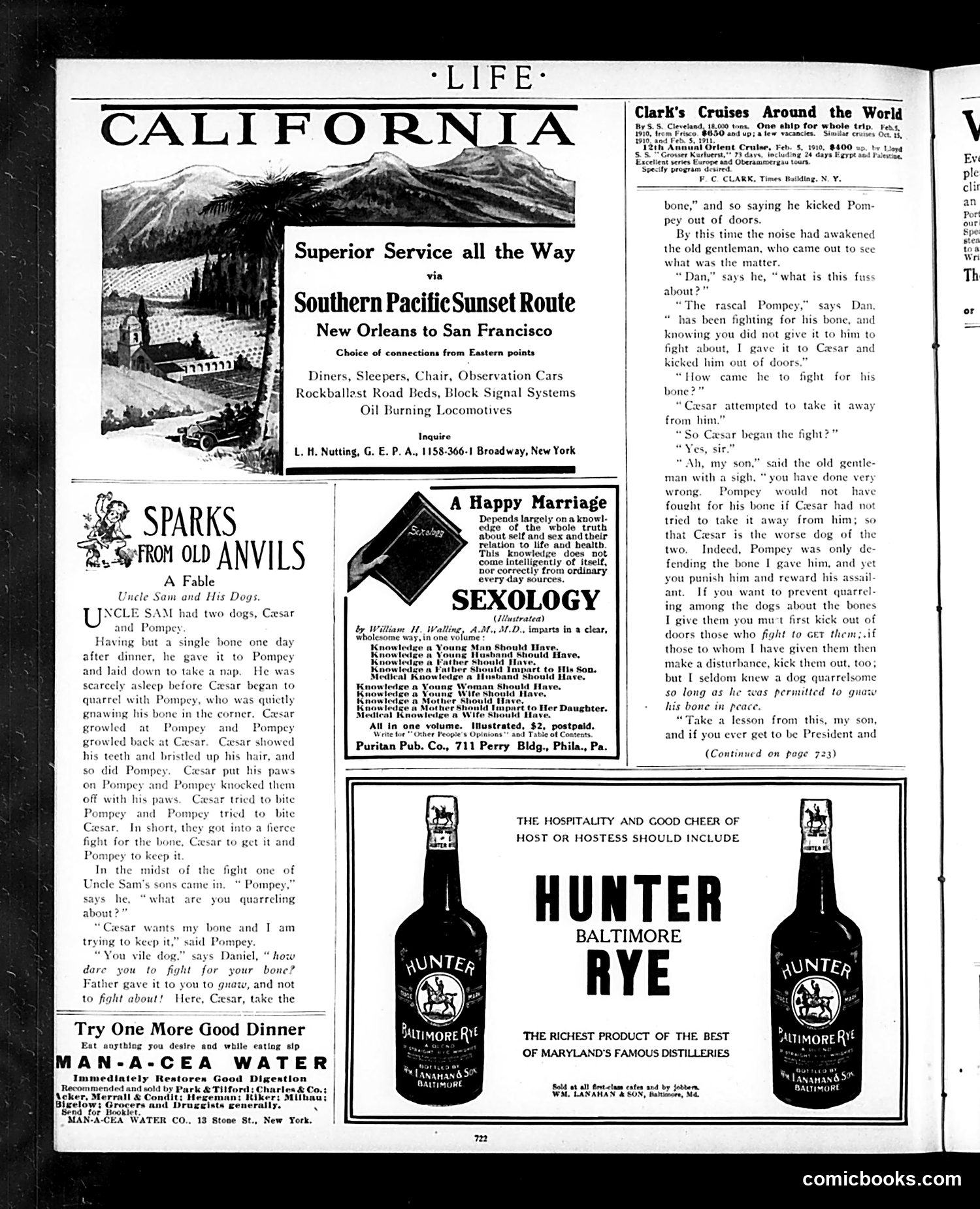
This allegorical cartoon uses dogs to teach a political lesson about fair governance. Uncle Sam owns two dogs, Cesar and Pompey, representing competing political factions or interests. When they fight over a bone (resources/power), Uncle Sam punishes the defending dog (Pompey) rather than the aggressor (Cesar), rewarding wrongdoing. The moral—delivered directly to the reader—warns that if you become President, you must punish those who *initiate* conflict, not those defending what's rightfully theirs. This appears to critique unfair or inconsistent governance that punishes victims rather than aggressors. The fable format was a common satirical device in *Life* magazine for commenting on contemporary politics without naming specific figures. The page is otherwise advertisements, suggesting this was mid-to-early 20th century.
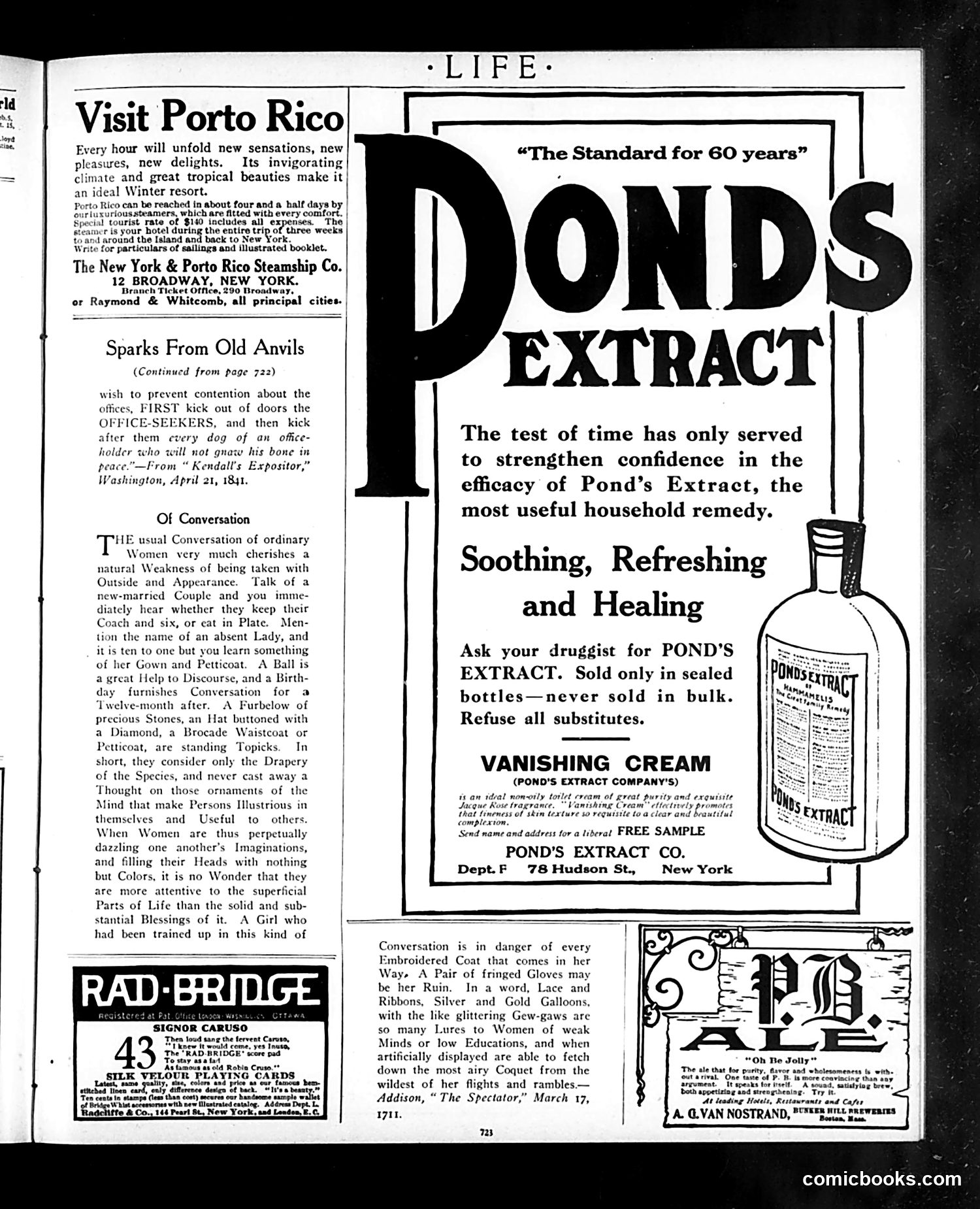
This page is primarily **advertisements and reprinted historical content** rather than satirical cartoons. The main elements: 1. **Porto Rico Tourism Ad**: Promotes steamship travel to Puerto Rico as a winter resort, emphasizing luxury and tropical appeal. 2. **"Sparks From Old Anvils"**: A historical reprint from an 1841 Washington newspaper criticizing office-seekers and political patronage—early American political commentary about government corruption. 3. **"Of Conversation"**: An 18th-century essay (attributed to Addison's *Spectator*, 1711) satirizing women's supposedly shallow interests in fashion and appearance rather than intellectual matters. This reflects **period misogyny**—it stereotypes women as vain and easily distracted by material goods like lace, ribbons, and jewels. 4. **Product Advertisements**: Pond's Extract (a patent medicine), vanishing cream, and ale ads occupy significant space. The "conversation" piece is the closest to satire here, but it's historical rather than contemporary commentary—presenting 18th-century social criticism about gender and materialism that modern readers would recognize as sexist rather than humorous.
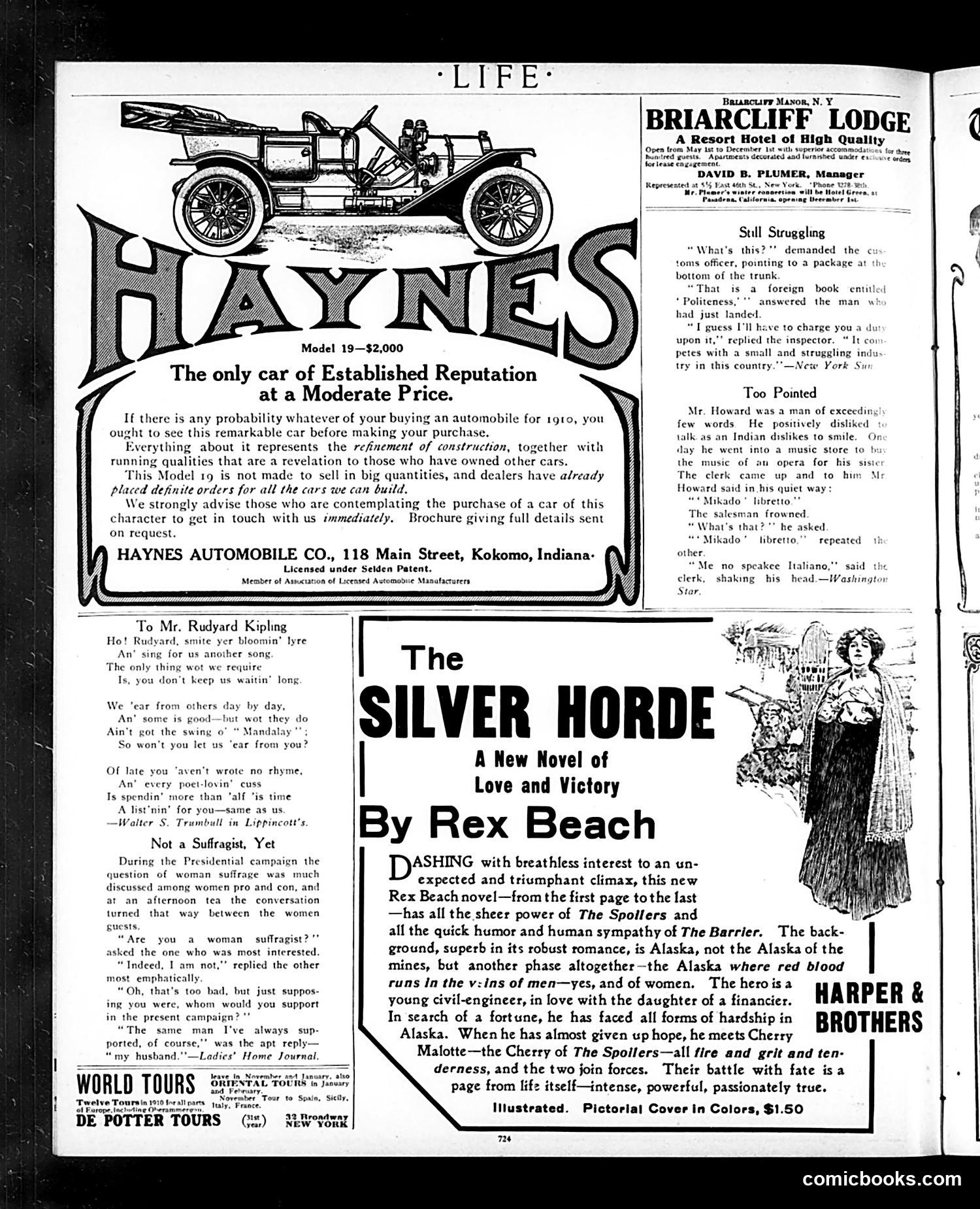
This *Life* magazine page (circa 1910) contains mostly **advertisements and light humor pieces**, not political cartoons. The main content includes: - **Haynes automobile ad**: Promoting the Model 19 as an affordable quality car—reflecting early auto industry competition - **Poem to Rudyard Kipling**: A humorous plea for the famous author to write more, using cockney dialect ("bloomin' lyre"), suggesting readers missed his work - **Three brief jokes**: Including one mocking a customs inspector's charges and another playing on a clerk's feigned inability to understand "Mikado" as an opera (the joke relies on the clerk pretending ignorance, perhaps to avoid admitting unfamiliarity) - **"The Silver Horde" book ad**: Rex Beach's novel set in Alaska, emphasizing adventure and romance The **suffrage anecdote** ("Not a Suffragist, Yet") shows a woman rejecting suffragism during the Presidential campaign, reflecting the contemporary political debate over women's voting rights. The page reflects early 20th-century concerns: automobile technology, popular literature, and emerging women's rights debates.
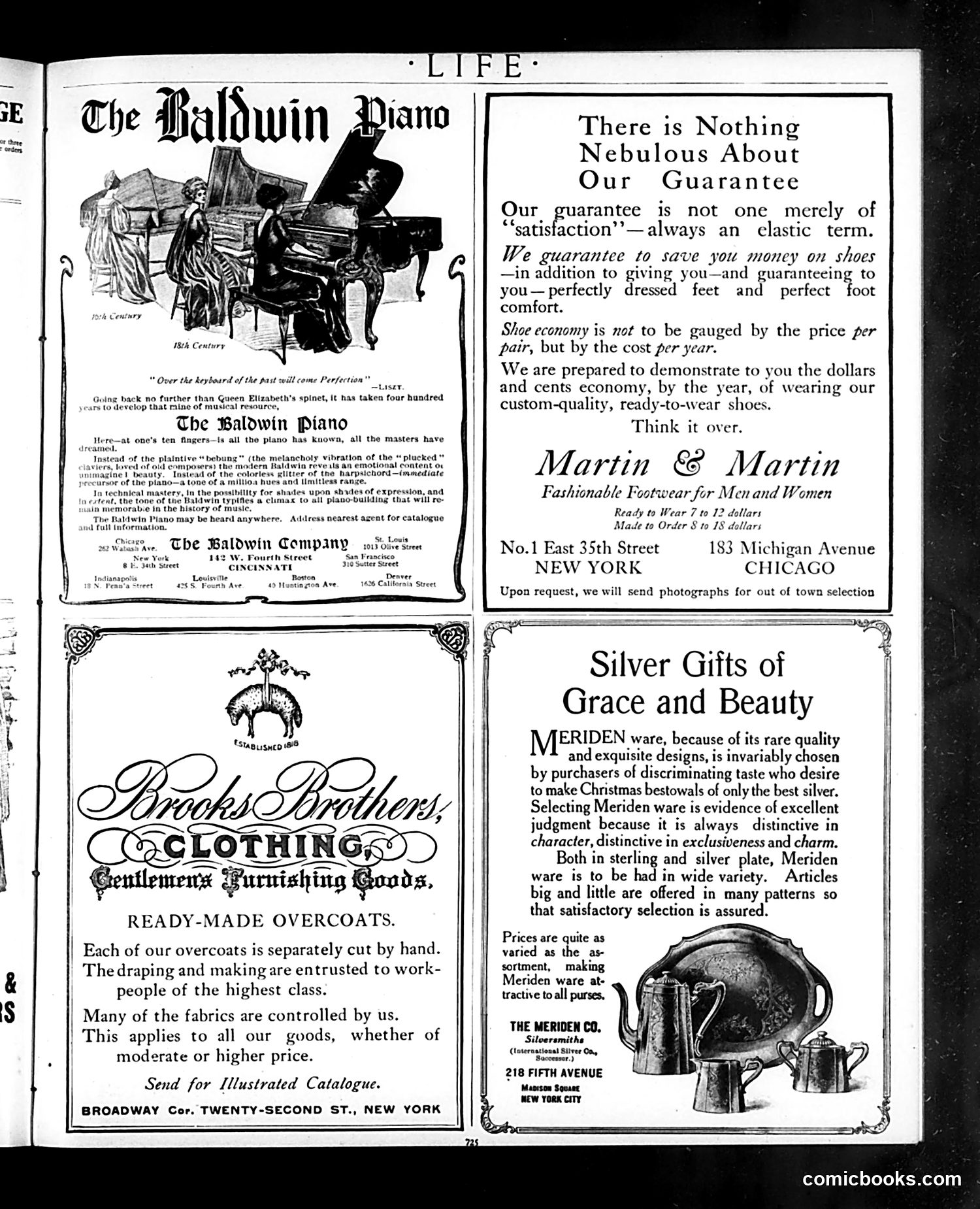
This is primarily an **advertising page**, not a satirical cartoon. It contains four luxury product advertisements from the early 20th century: 1. **Baldwin Piano**: Markets pianos as instruments with superior emotional range, referencing Queen Elizabeth's historical spinet to establish prestige and longevity. 2. **Martin & Martin Shoes**: Advertises "fashionable footwear" by emphasizing long-term cost savings ("cost per year" rather than per-pair price)—a practical appeal to middle-class consumers. 3. **Brooks Brothers Clothing**: Promotes ready-made overcoats as custom-quality, hand-cut garments for "the highest class," suggesting mass production rivals bespoke tailoring. 4. **Meriden Silver**: Markets silver gifts as markers of "discriminating taste" and social status, positioning the brand as distinctively exclusive. The page reflects **early 1900s consumer culture**: luxury goods are marketed by emphasizing both quality/exclusivity and value/practicality, targeting aspirational middle-to-upper-class readers.
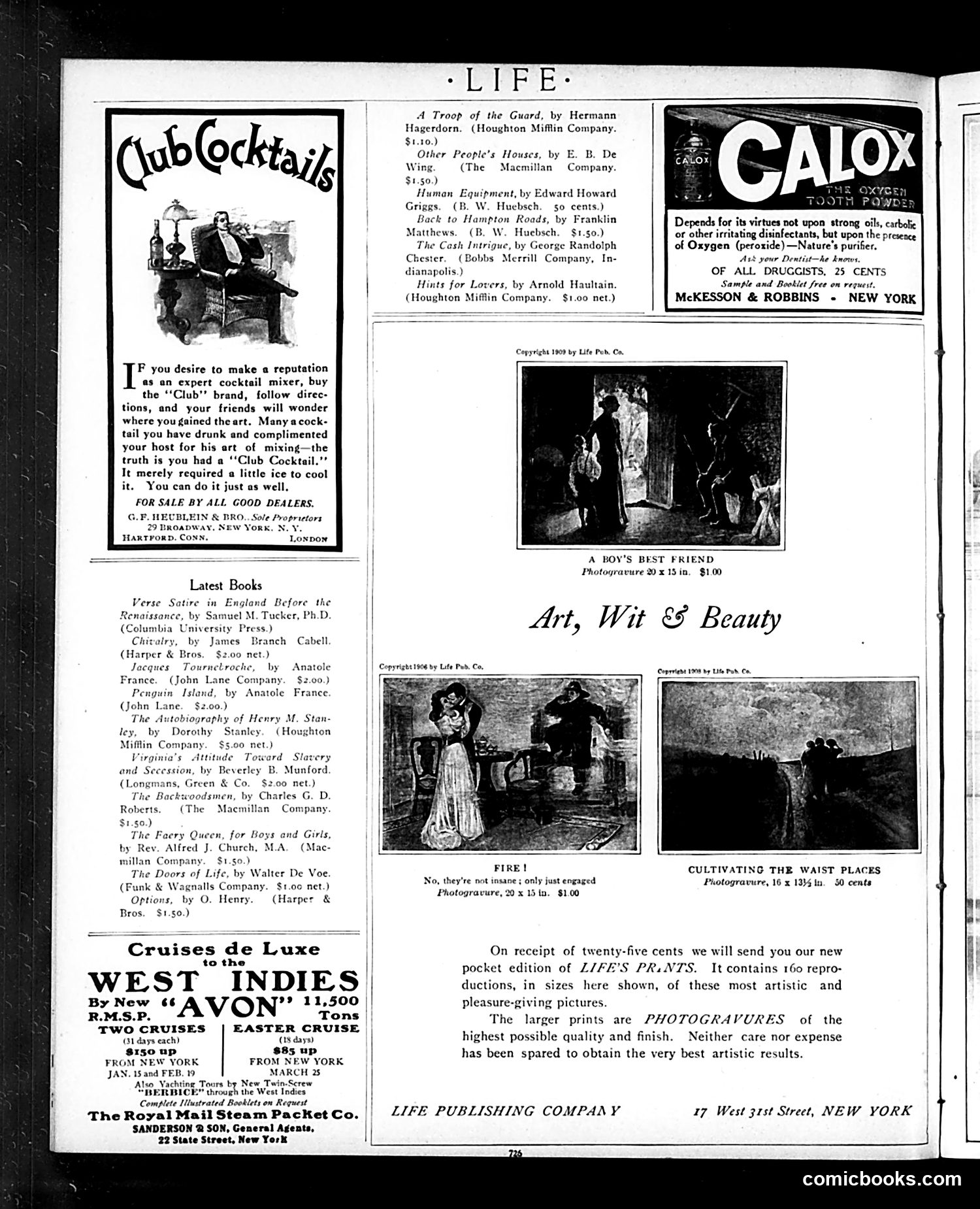
This page is primarily **advertising and book listings** rather than satirical cartoons. The dominant content includes: **Main Features:** - A "Club Cocktails" advertisement promoting a pre-mixed cocktail brand, implying that using their product makes one appear skilled at mixology - Book advertisements and listings (literary works, biographies, travel guides) - Luxury cruise advertisements to the West Indies - Two small photogravure images titled "A Boy's Best Friend" and "Cultivating the Waist Places" - the latter appearing to show a woman in corsetry, referencing early 1900s fashion concerns about waist constriction **Social Context:** The cocktail ad subtly mocks social pretension—suggesting hosts could fool guests into thinking they possessed bartending expertise. The waist-training imagery reflects contemporary anxieties about women's fashion and health. The page reflects turn-of-the-century consumer culture, class aspirations, and gender norms, but contains no explicit political satire or identifiable caricatures worthy of detailed analysis.
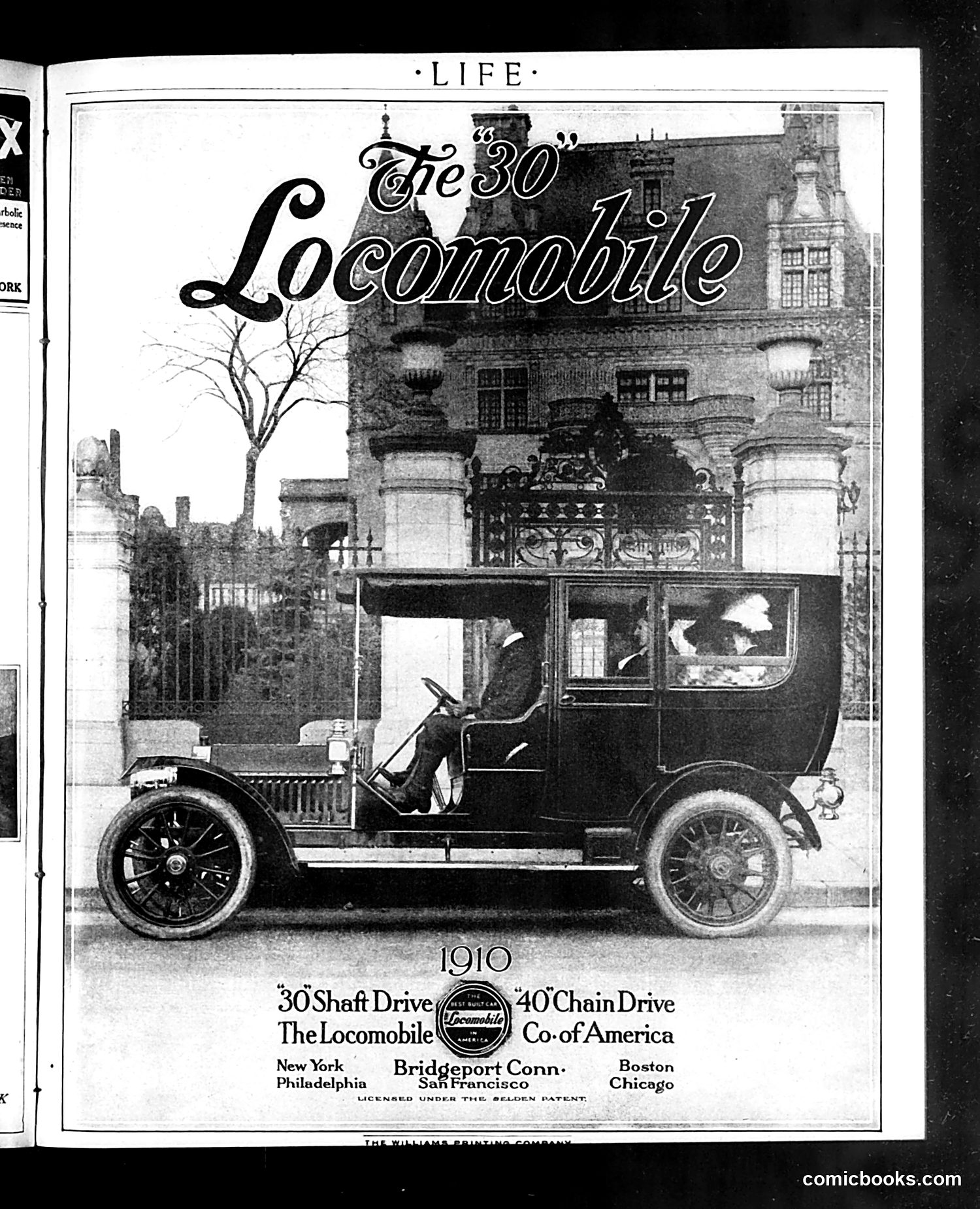
This is primarily **an advertisement**, not a satirical cartoon. It appears in *Life* magazine from 1910 and showcases "The 30 Locomobile"—an early automobile manufactured by the Locomobile Company of America. The image displays the vehicle in profile against an elegant mansion backdrop, emphasizing its luxury and sophistication. The advertisement highlights two drivetrain options: shaft drive and chain drive, suggesting technical innovation for the era. The "Selden Patent" reference indicates the vehicle was licensed under a controversial early automobile patent that dominated the industry. For modern readers: this represents early automotive marketing targeting wealthy consumers, showcasing mechanical specifications as status symbols. The stately setting and formal presentation reflect how automobiles were luxury goods marketed to the affluent, not yet mass-market transportation.
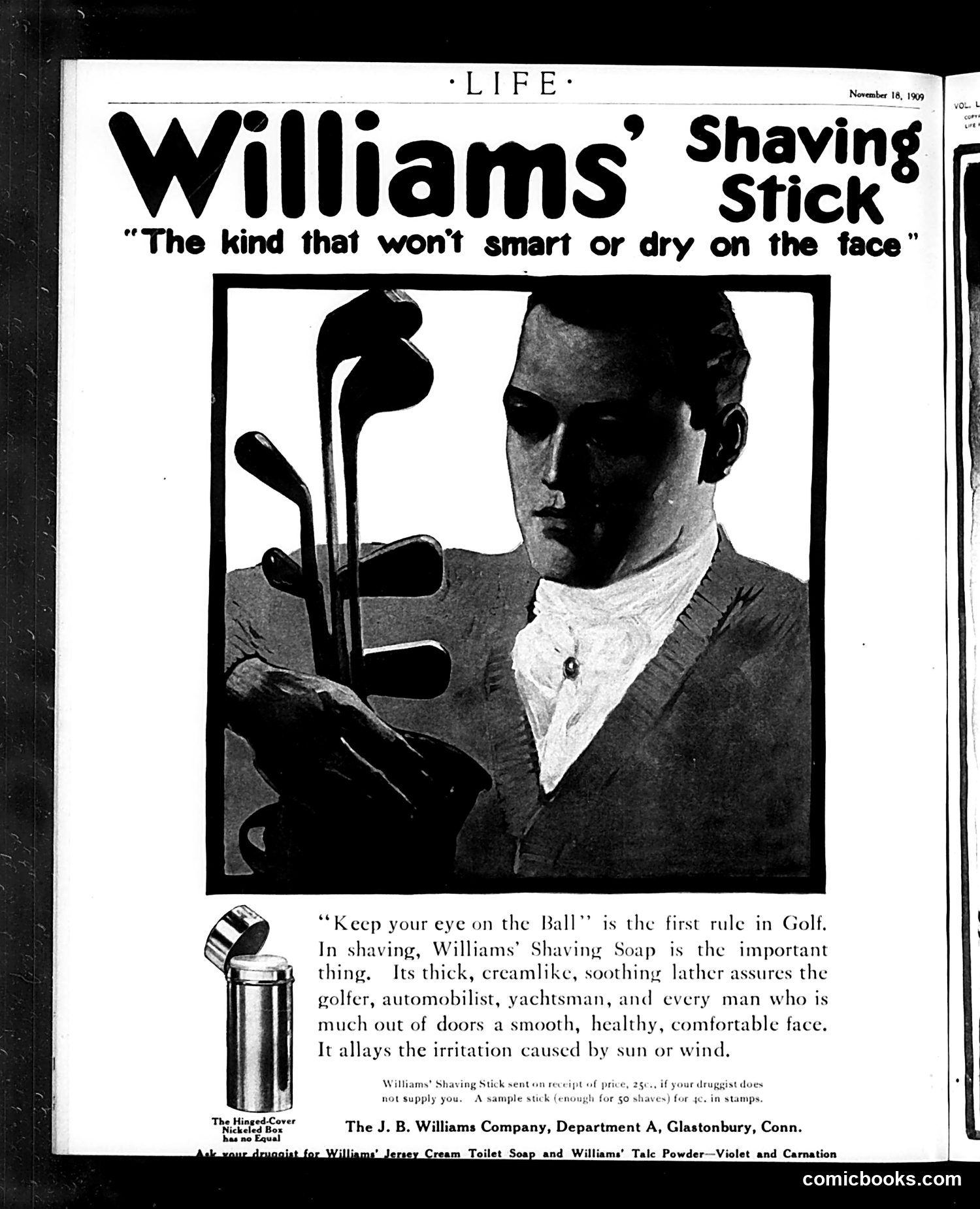
This is a **product advertisement**, not a political cartoon. It promotes Williams' Shaving Stick with an appeal to early 20th-century masculine outdoor pursuits. The image shows a well-dressed man holding golf clubs, representing the target demographic: active sportsmen (golfers, automobilists, yachtsmen) who spend time outdoors. The advertisement's strategy links the product to an aspirational lifestyle—suggesting that proper shaving maintenance is essential for men engaged in vigorous outdoor activities. The tagline "The kind that won't smart or dry on the face" addresses practical concerns: sun and wind irritation. The reference to "Keep your eye on the Ball" in Golf serves as a clever parallel—just as focus matters in golf, Williams' Soap supposedly matters in shaving. This reflects period marketing targeting affluent, active male consumers, emphasizing grooming as part of a gentlemanly outdoor lifestyle.