
Life, 1909-11-18 · page 20 of 36
Life — November 18, 1909 — page 20: what you’re looking at
What you’re looking at
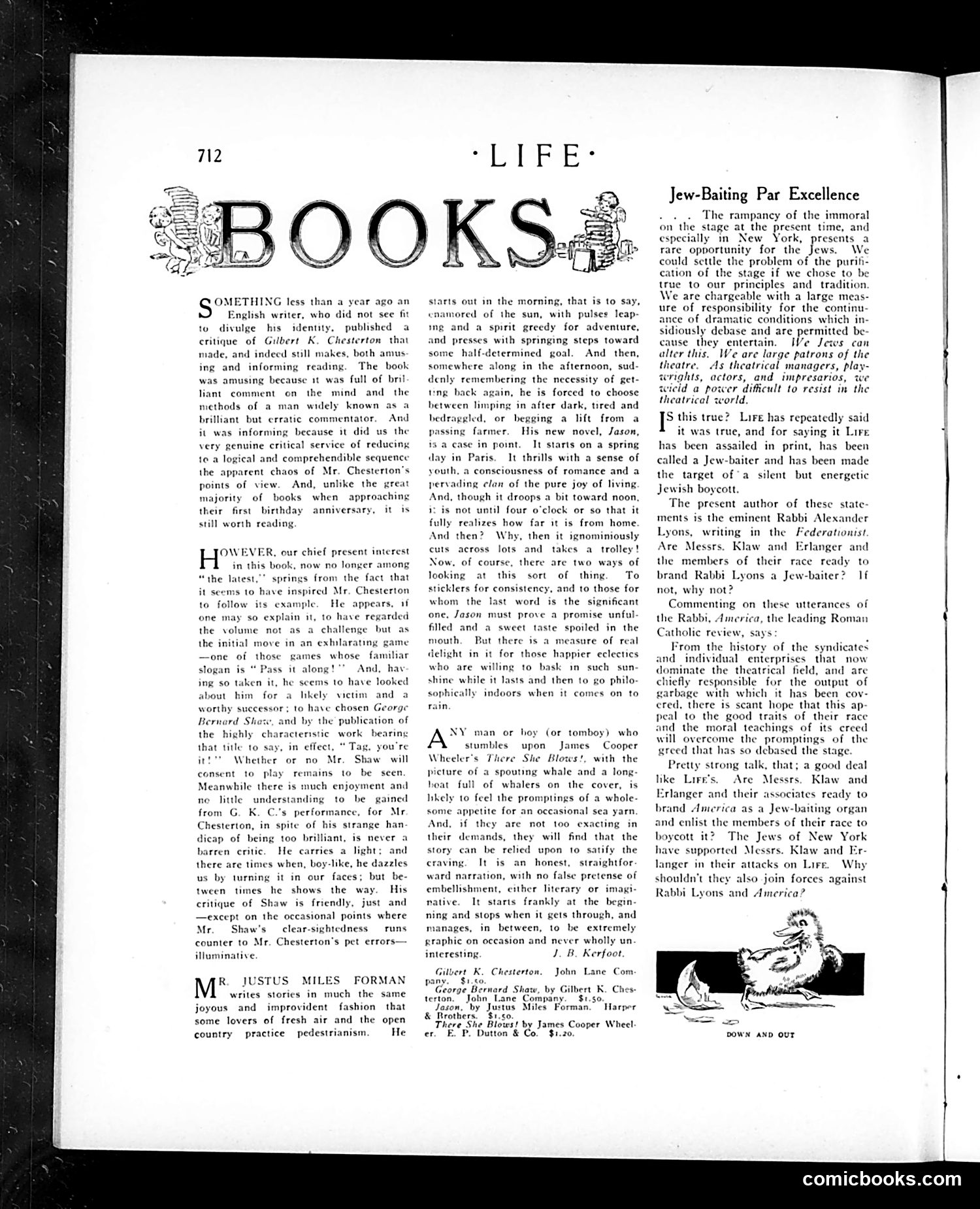
This page contains literary book reviews rather than political cartoons. The main content discusses: 1. **Gilbert K. Chesterton critique**: A review of a recently published anonymous critique of writer G.K. Chesterton, noting it inspired Chesterton to write about George Bernard Shaw in return—described as a friendly intellectual "tag, you're it" game between celebrated writers. 2. **Justus Miles Forman's "Jason"**: A novel review praising Forman's spontaneous, improvident writing style. The reviewer compares Forman's creative process to a pedestrian starting a journey with enthusiasm but needing to "beg a lift" home—a metaphor for the novel's initial promise that droops toward its conclusion. 3. **James Cooper Wheeler's "There She Blows!"**: A brief mention of a whale-hunting narrative. The small illustration labeled "DOWN AND OUT" shows what appears to be a person in distress—likely reflecting the Forman review's theme of exhausted creative energy. This is primarily a **literary criticism page**, not a political satire page.
📄 Transcribed text from this page (OCR, searchable)
Machine-transcribed from the original scan — historical spelling and the odd misread are preserved.
OMETHING less than a year ago an English writer, who did not see fit to divulge his identity, published a critique of Gilbert K. Chesterton that made, and indeed still makes, both anvus. ing and informing The book was amusing because it was full of bril the mind and the methods of a man widely known as a brilliant but crratic commentator, And it was informing because it did us the reading. liant comment on very genuine critical service of reducing to a logical and comprehendible sequence the apparent chaos of Mr. Chesterton's And, unlike the gre: when approaching anniversary, it is view. majority of books their first’ birthday still worth reading. points of H™ EVER, our chief present interest in this book, now no longer among the latest,’ springs from the fact that it seems to have inspired Mr. Chesterton appears, 1f to follow its example. He one may so explain it, to have regarded challenge but as the volume not as the initial move in an exhilarating game —one of es whose familiar slogan is “Pass it along!’ And, hav seems to have looked likely victim and a those ing so taken it, he him for a : to have chosen George about worthy successe Bernard Shar, and by the publication of the highly characteristic work bearing that title to say, in effect, “Tag, you're it!’’ Whether or no Mr. Shaw consent to play remains to be Meanwhile there is no little understanding to be gained from G. K. C.’s performance, for Mr Chesterton, in spite of his strange han dicap of being too brilliant, is never a barren critic. He carries a light; and there are times when, boy-like, he dazzles lurning it in our faces; but be- tween times he shows the way. His critique of Shaw is friendly, just and —except on the occasional points where Mr. Shaw's clear-sightedness runs counter to Mr. Chesterton's pet errors~ will seen uch enjoyment and us by illuminative Me JUSTUS MILES FORMAN writes stories in much the same joyous and improvident fashion that some lovers of fresh air and the open country practice pedestrianism He starts out in the morning, that is to say enamored of the sun, with pulses leap- ing and a spirit greedy for adventure, and presses with springing steps toward some half-determined goal. And then, somewhere along in the afternoon, sud- denly remembering the necessity of get- tng back again, he is forced to choose between limping in after dark, tired and begging a lift from a His new novel, Jason, hedraggled, or passing farmer isa case in point. It starts on a spring day in Paris. It thrills with a sense of youth, a consciousness of romance and a pervading clan of the pure joy of living And, though it droops a bit toward noon. i: is not until four clock or so that it fully realizes how far it is from home And then? Why, then it ignominiously s across lots takes a trolley! Now, of course, there are two ways of looking at this sort of thing. To sticklers for consistency, and to those for is the significant one, Jason must prove a promise unful- filled taste spoiled in the mouth. delight in it for those happier eclectics re willing to in such sun- while it lasts and then to go philo- comes on to and whom the last word and a sweet there is a measure of real who bask sh sophically indoors when it rain A” man or hoy (or tomboy) who stumbles upon James Cooper Wheeler's There She Blows!, with the picture of a spouting whale and a long hoat full cover, is hkely to feel the promptings of a whole- of whalers on the some appetite for an occasional sea yarn. And, if they are not too exacting in their demands, they will find that the story can be relied upon to satify the craving. It is an honest, straightfor ward narration, with no false pretense of or imagi native. It the begin ning and stops when it gets through, and manages, in between, to be extremely graphic on occasion and never wholly un embellishment, either literary starts frankly at interesting J.B. Kerfoot Gilvert K. Chesterton. John Lane Com “George Bernard Shaw, by Gilbert K. Ches- terton. John Lane Company. $1.S0 Jason. by Justus Miles Forman & Rrothers. $1.50. There She Blows! by James Cooper Wheel er. E.P. Dutton & Co. $1.20. Harper Jew-Baiting Par Excellence . .. The rampancy of the immoral on the stage at the present time, and especially in New York, presents a ‘are opportunity for the Jews. W. could settle the problem of the purifi- ation of the stage if we chose to be true to our principles and tradition We are chargeable with a large meas- ure of responsibility for the continu- ance of dramatic conditions which in- sidiously debase and are permitted be- use they entertain. We Jews can alter this. We are large patrons of the theatre. As theatrical managers, play- rights, actors, and impresarios, we wield a power difficult to resist in the theatrical world. S this true? Lire has repeatedly said it was true, and for saying it Lire has been assailed in print, has been called a Jew-baiter and has been made the target of°a silent but energet Jewish boycott. The present author of these state ments is the eminent Rabbi Alexander Lyons, writing in the Federationist Are Messrs. Klaw and Erlanger and the members of their race ready to brand Rabbi Lyons a Jew-baiter? If not, why not? Commenting on these utterances of the Rabbi, America, the leading Roman atholic review From the history of the syndicates and individual enterprises that now dominate the theatrical field, and are chiefly responsible for the output of garbage with which it has been cov- cred, there is scant hope that this ap peal to the good traits of their race and the moral teachings of its creed will overcome the promptings of the greed that has so debased the stage. Pretty strong talk, that; a good deal like Lire’s. Are Messrs. Klaw and Erlanger and their associates ready to brand America as a Jew-baiting organ and enlist the members of their race to boycott it? The Jews of New York have supported Messrs. Klaw and Er- langer in their attacks on Lire. Why shouldn't they also join forces against Rabbi Lyons and America? says DOWN AND OUT comicbooks.com