
A complete issue · 36 pages · 1909
Life — October 28, 1909
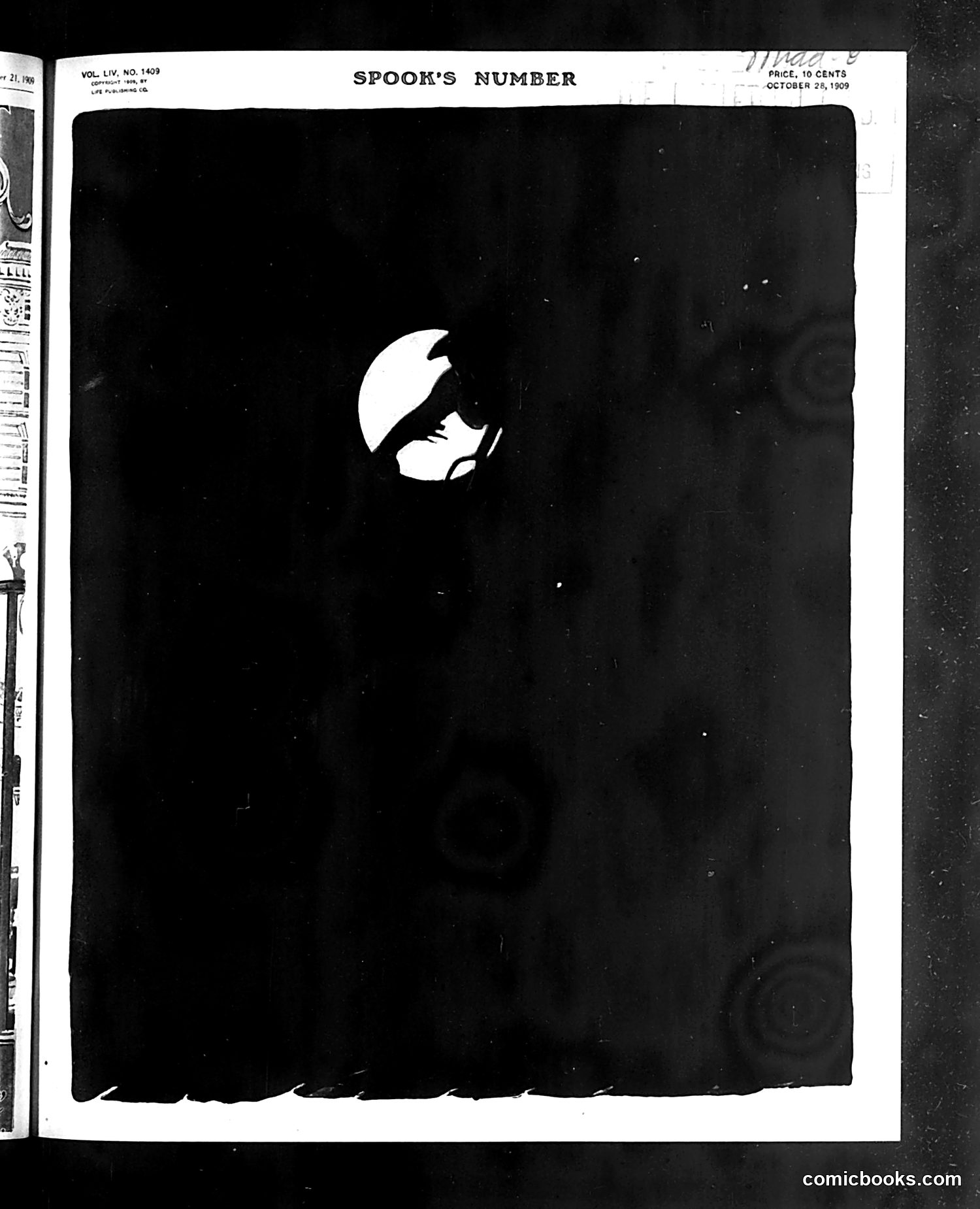
I can see this is the cover of Spook's Number from Life magazine, dated October 29, 1909, priced at 10 cents. The cover features a silhouette illustration against a black background showing what appears to be a ghostly or spooky figure in white. However, without being able to read accompanying text or captions on this page, I cannot definitively identify which specific political or social figures are being referenced, or explain the particular satire intended. The "Spook's Number" title suggests this was a Halloween-themed issue, but the specific cartoon's meaning—who the figure represents and what contemporary event or person it's mocking—remains unclear from the image alone.
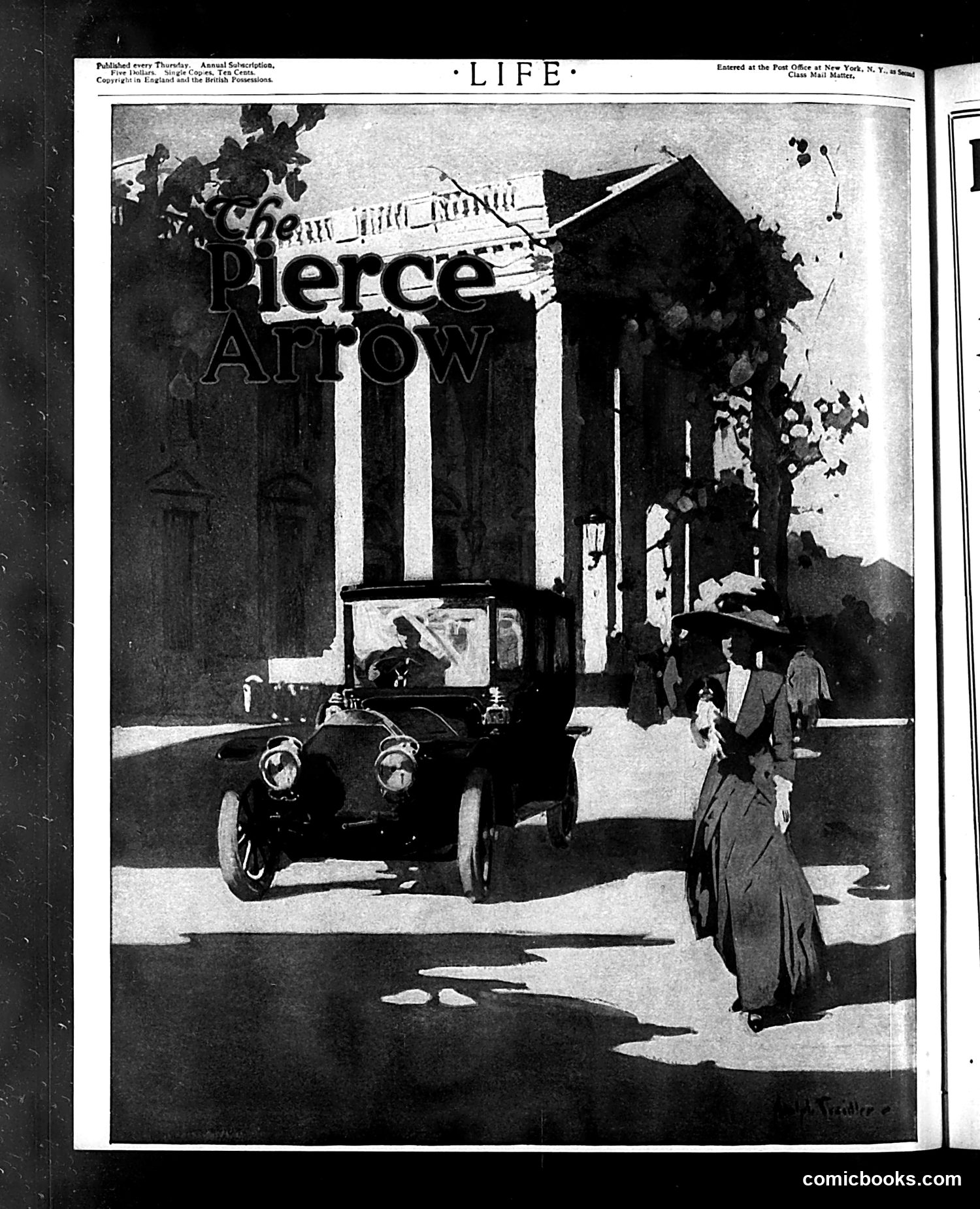
This appears to be a Pierce-Arrow automobile advertisement disguised as satirical content. The image shows a luxurious early 20th-century car positioned before a grand classical building with columns (possibly referencing government architecture). A well-dressed woman stands in the foreground while passengers are visible in the vehicle and crowds gather above. The satire likely comments on wealth disparity and conspicuous consumption—the juxtaposition of the expensive automobile with the imposing classical architecture suggests commentary on the nouveau riche displaying their prosperity. The crowds observing from above may represent the general public witnessing the elite's extravagance. However, without visible OCR text on the image itself, the specific political message remains somewhat unclear. This blends advertising with social commentary, typical of Life magazine's approach.
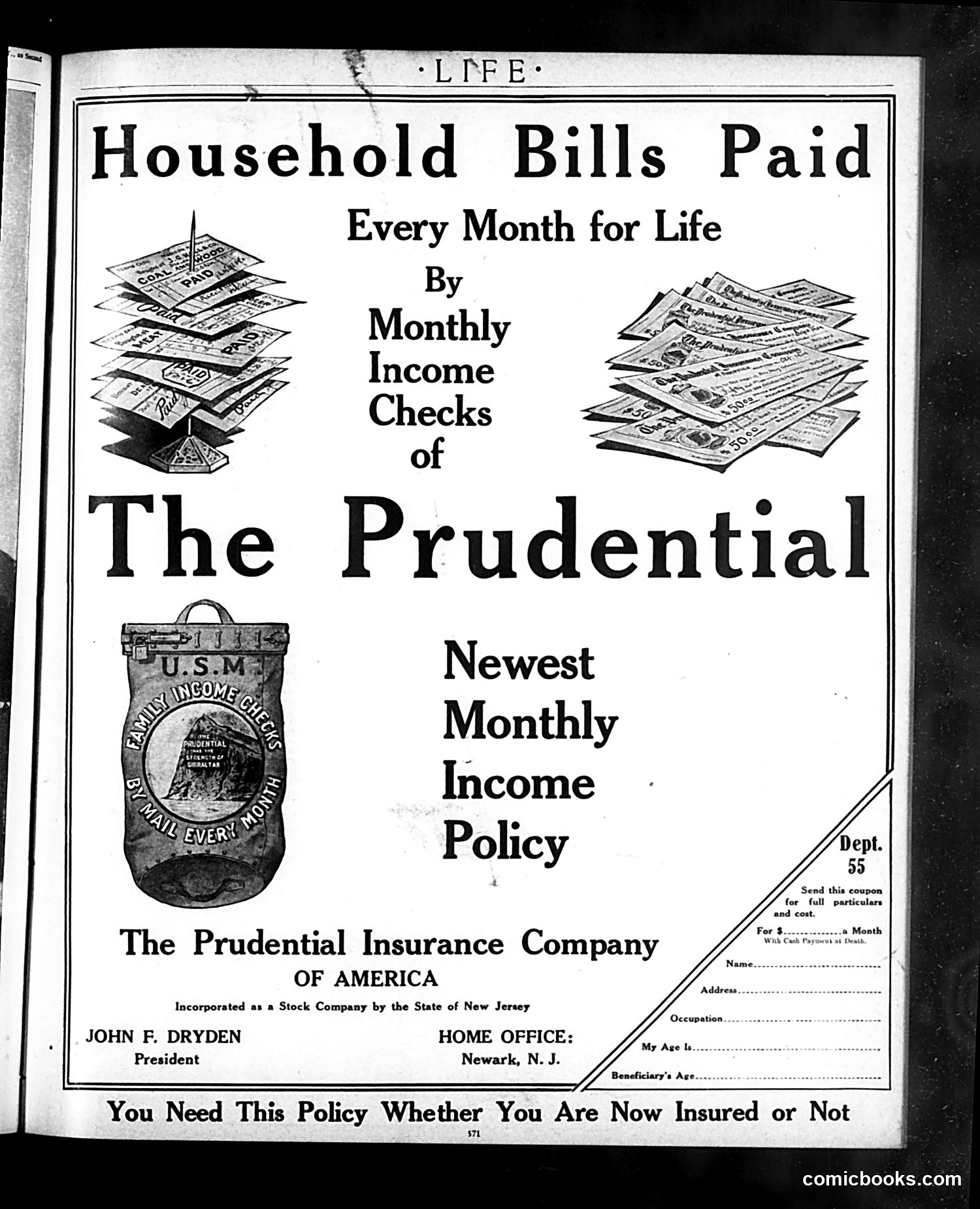
This is primarily **advertising, not satire or political content**. The page promotes The Prudential Insurance Company's "Family Income Check" policy—a monthly income insurance product for households. The visual elements are commercial illustrations: stacks of bills and checks representing regular monthly payments. The large branded pouch at bottom left shows Prudential's logo and slogan "By Mail Every Month." The headline promises that household bills can be paid "Every Month for Life" through this insurance policy. The text emphasizes this is a "Newest Monthly Income Policy" and includes a coupon for requesting information. There is no political satire, caricature, or social commentary present—this is straightforward early 20th-century insurance marketing targeting middle-class families concerned about financial security.
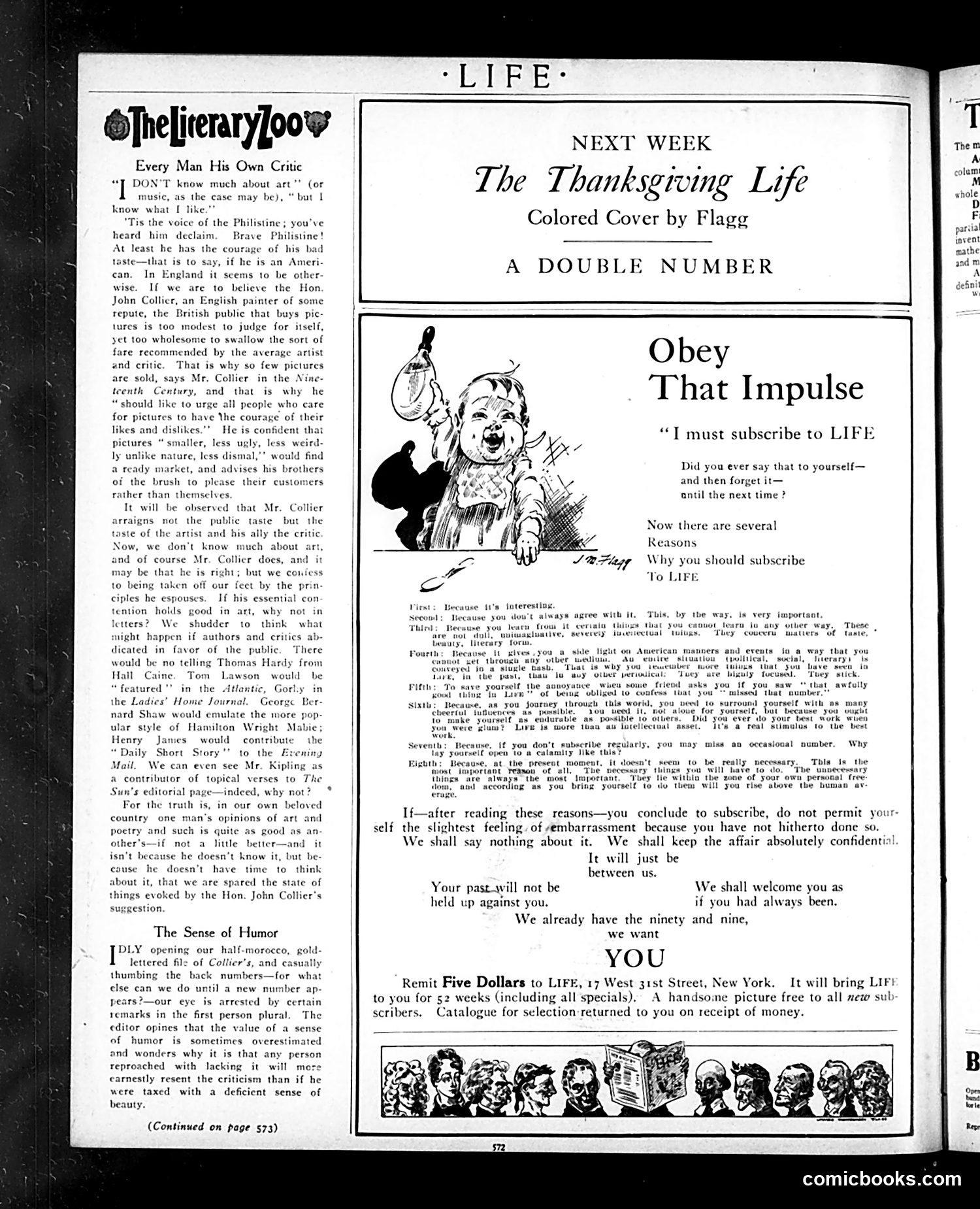
This page combines editorial content with a subscription advertisement. "The Literary Zoo" column on the left discusses art criticism and public taste, referencing English painter John Collier's views on how the public judges art. The main advertisement "Obey That Impulse" promotes Life magazine subscriptions for five dollars. It lists eight reasons to subscribe, emphasizing that Life provides humor, interesting content, and perspectives unavailable elsewhere. The cartoon illustration shows an excited man gesturing enthusiastically—likely representing the reader's impulse to subscribe immediately. The ad's tone is lighthearted and self-promotional, using urgency and flattery to convince readers. The small illustrations at the bottom show various people reading Life, suggesting broad appeal. This represents typical early 20th-century magazine marketing strategy.
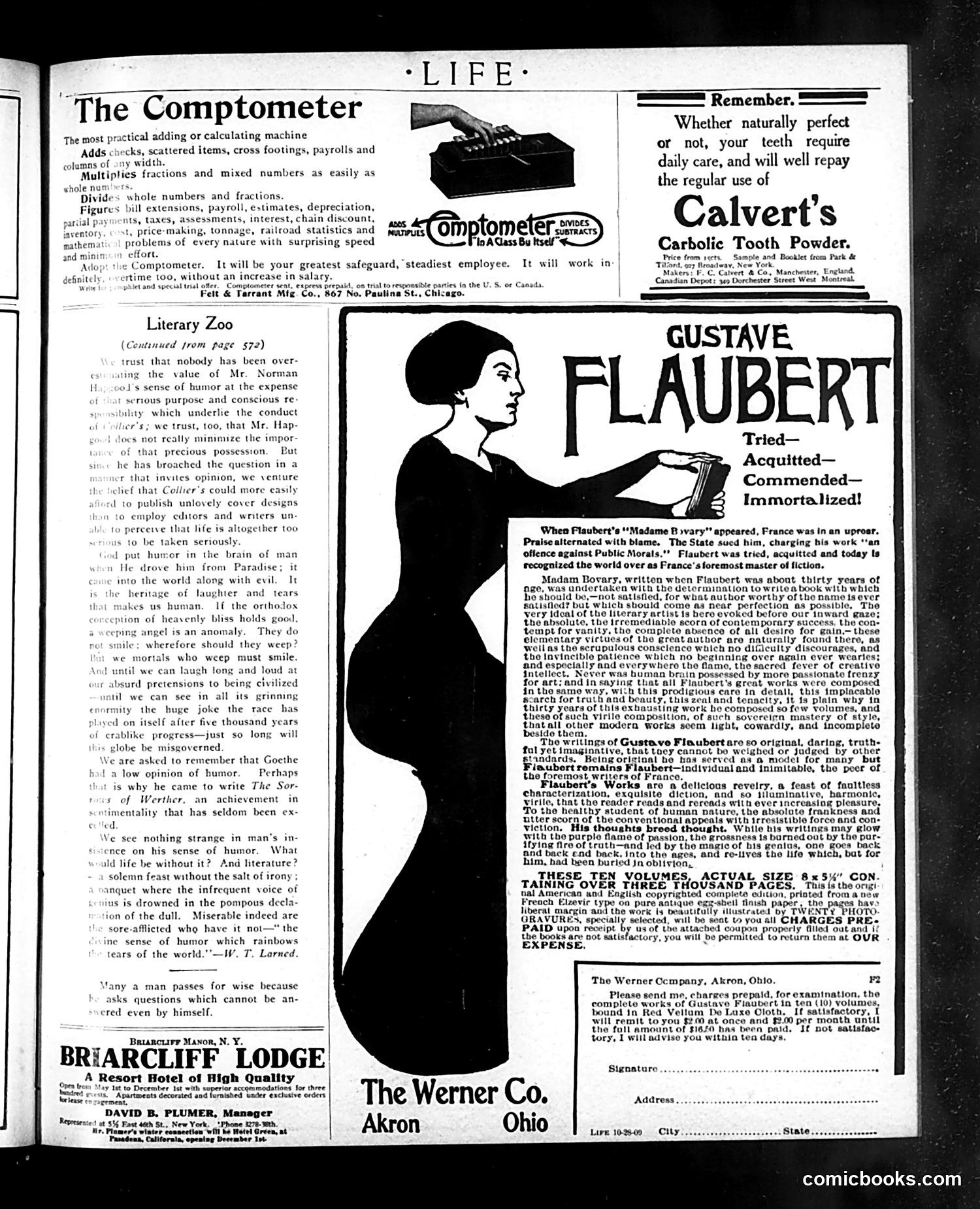
This Life magazine page is primarily **advertising and literary content**, not political satire. The main feature is a large advertisement for **Gustave Flaubert's complete works** (ten volumes), published by The Werner Co. of Akron, Ohio. The silhouette portrait shows the 19th-century French novelist. The ad emphasizes Flaubert's literary stature: "Tried—Acquitted—Commended—Immortalized!" (referring to his prosecution for obscenity). Supporting ads include: - **The Comptometer** (adding machine) - **Calvert's Carbolic Tooth Powder** - **Barcliff Lodge** (resort hotel in Biarnescure Manor, N.Y.) There is a literary article titled "Literary Zoo" discussing humor in literature, referencing Goethe and Collier's magazine. The page reflects early 20th-century Life magazine's mix of advertising, literature discussion, and light commentary—not political satire.
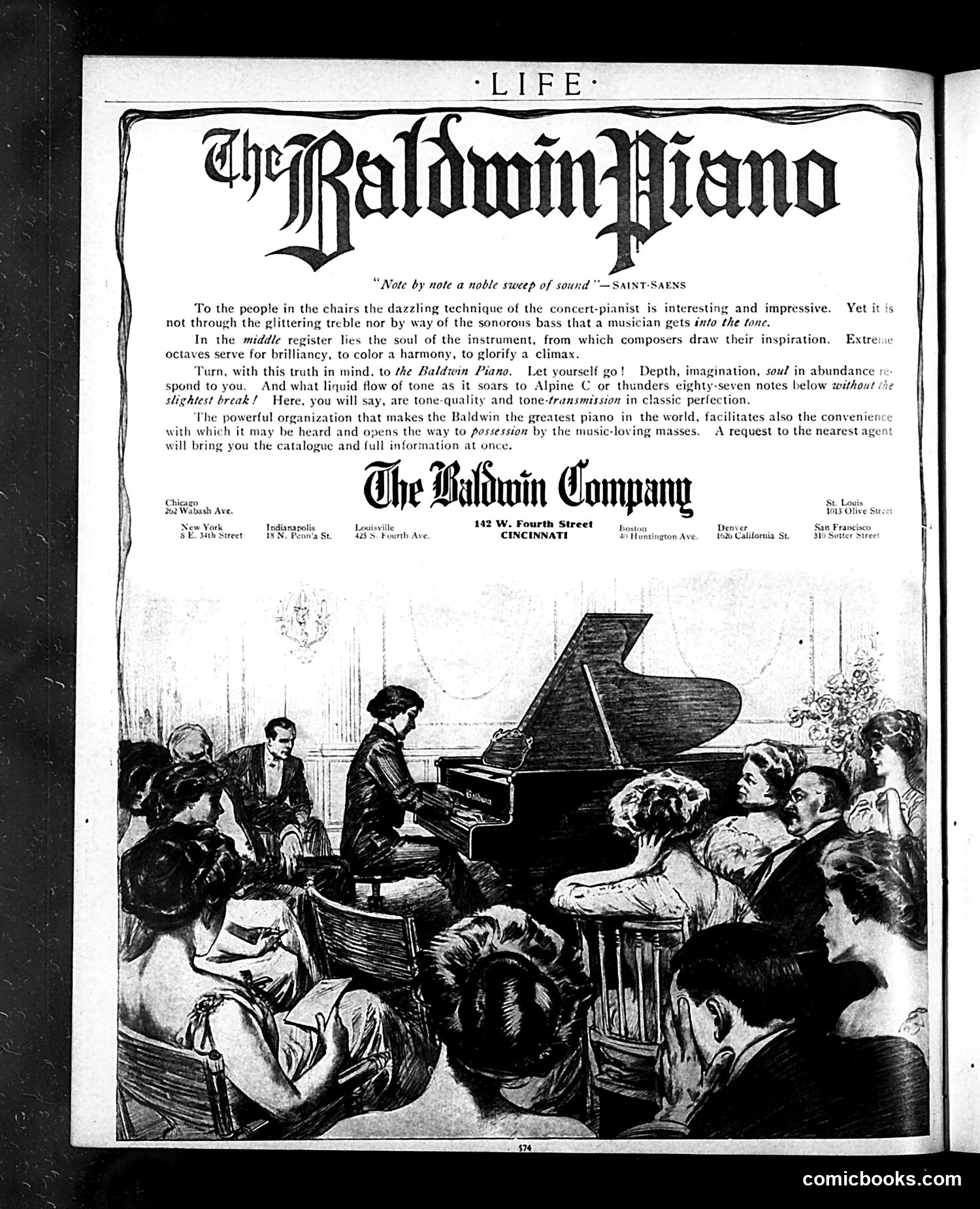
This page is primarily a **product advertisement**, not political satire. It promotes the Baldwin Piano Company's grand piano through an idealized illustration of a concert pianist performing for an elegant audience. The advertisement uses rhetoric common to early 20th-century piano marketing: emphasizing the instrument's "soul," technical superiority, and ability to convey "depth, imagination, [and] soul in abundance." The quote attributed to Saint-Saëns (a famous composer) adds prestige. The illustration depicts a refined social scene—well-dressed listeners attending a private concert—designed to appeal to middle and upper-class consumers who associated piano ownership with culture and sophistication. The Baldwin Company's multiple office locations (Cincinnati, New York, Indianapolis, etc.) suggest a major national manufacturer. This is commercial messaging, not political commentary.
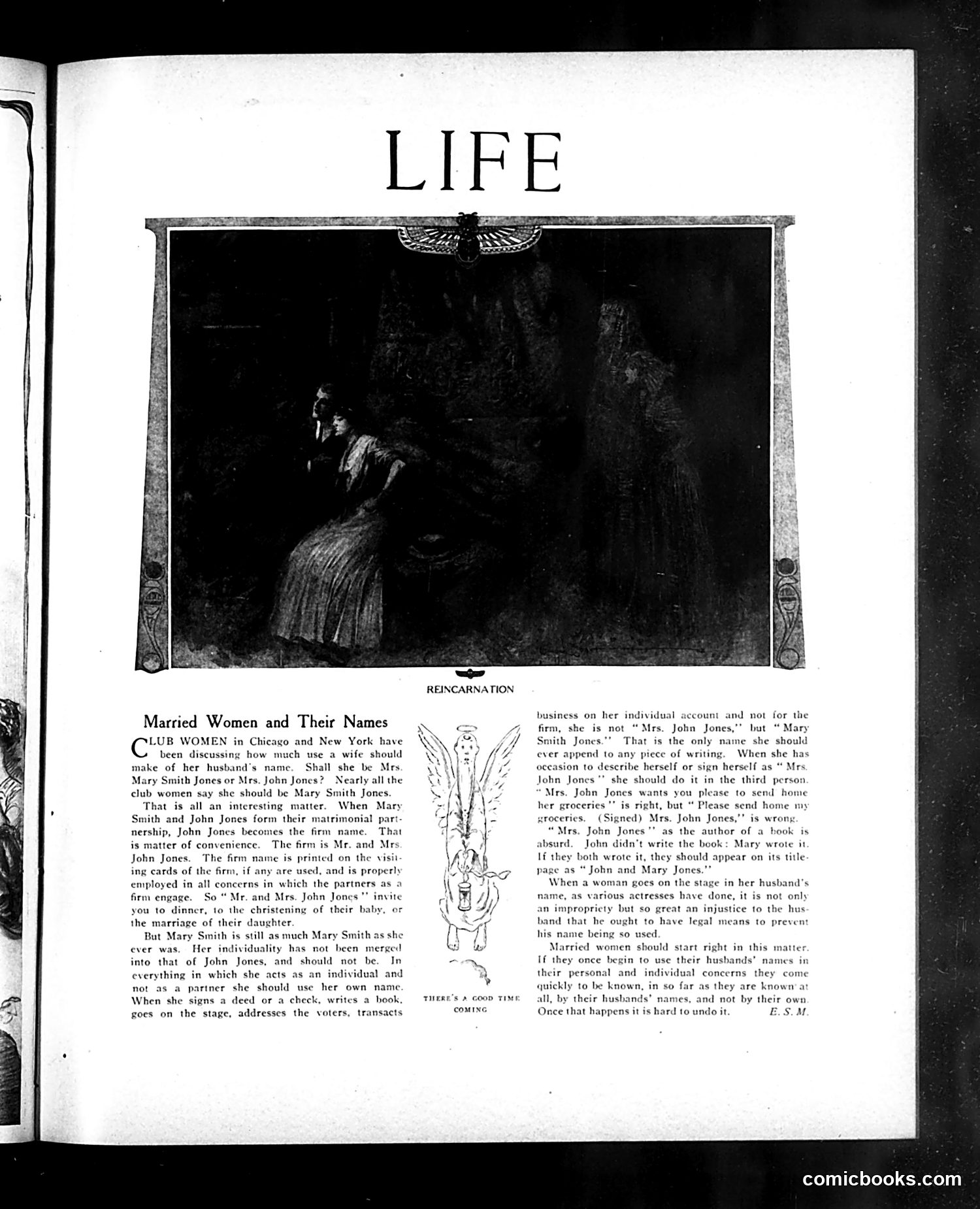
This article satirizes a debate about married women's identity and legal naming conventions. The piece argues that club women in Chicago and New York should retain their maiden names rather than adopt their husbands' names entirely. The satire critiques the assumption that marriage requires women to surrender individual identity. The author contends that a woman signing professional documents, conducting business, or performing on stage should use her own name—not her husband's—to maintain legal and professional standing as an individual person. The illustration labeled "REINCARNATION" appears to show a dramatic scene, though details are unclear. The piece advocates for women's legal autonomy and individual recognition separate from marital status—a progressive stance for the era.
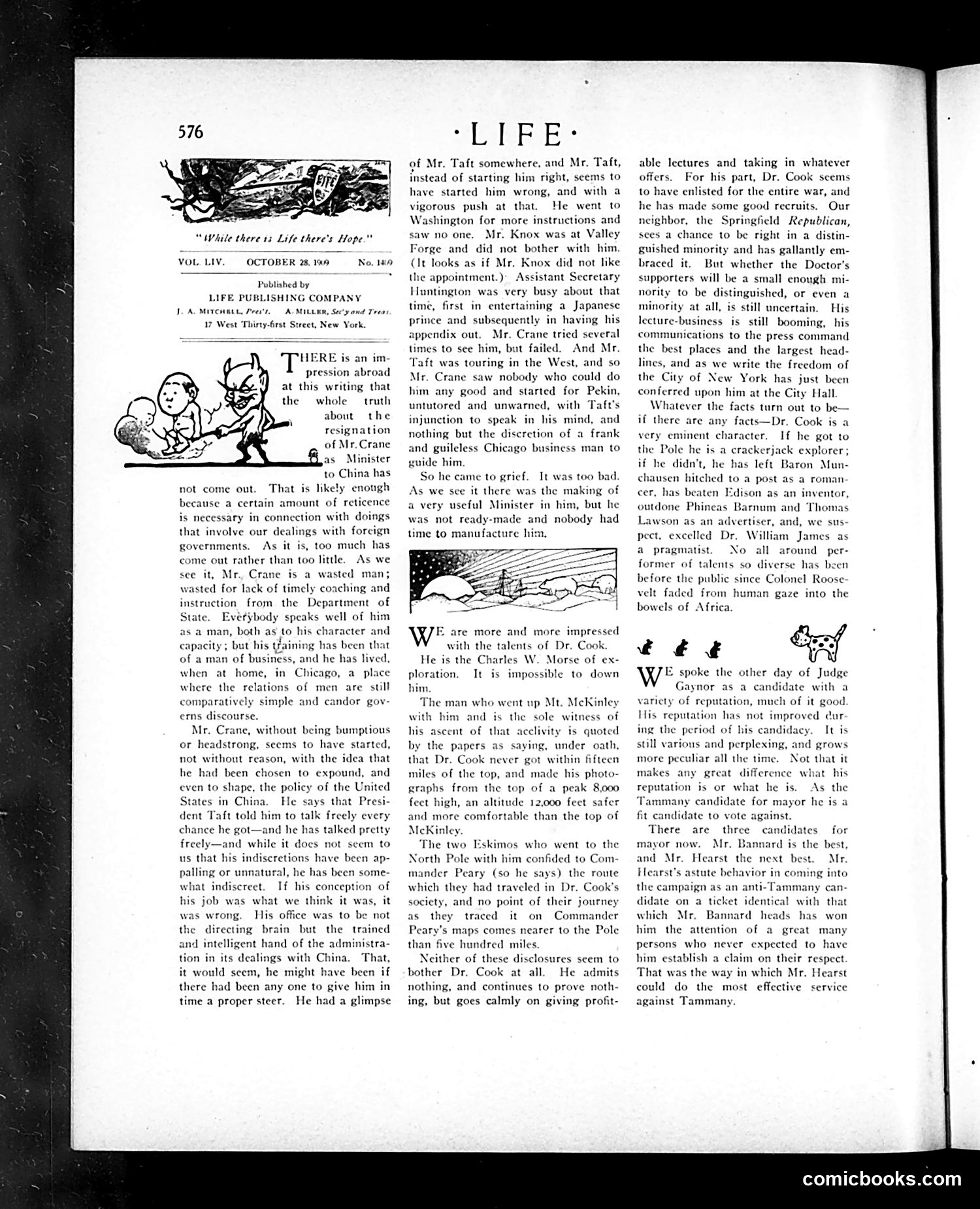
This page contains a satirical article about American political figures and exploration, with two cartoon illustrations. The main text discusses **Dr. Frederick Cook** and his disputed Arctic exploration claims, comparing him unfavorably to other explorers. The article criticizes Cook's character and business practices while praising other figures like **Dr. William James** and explorer **Charles W. Morse**. The article also mentions **Judge Gaynor** as a mayoral candidate, alongside **Mr. Bannard** and **Mr. Hearst**, discussing their reputations and fitness for office. The cartoons appear to satirize these public figures, likely depicting them in exaggerated or unflattering ways typical of Life's style. The overall thrust is mockery of questionable public figures and their credibility with voters and the press.
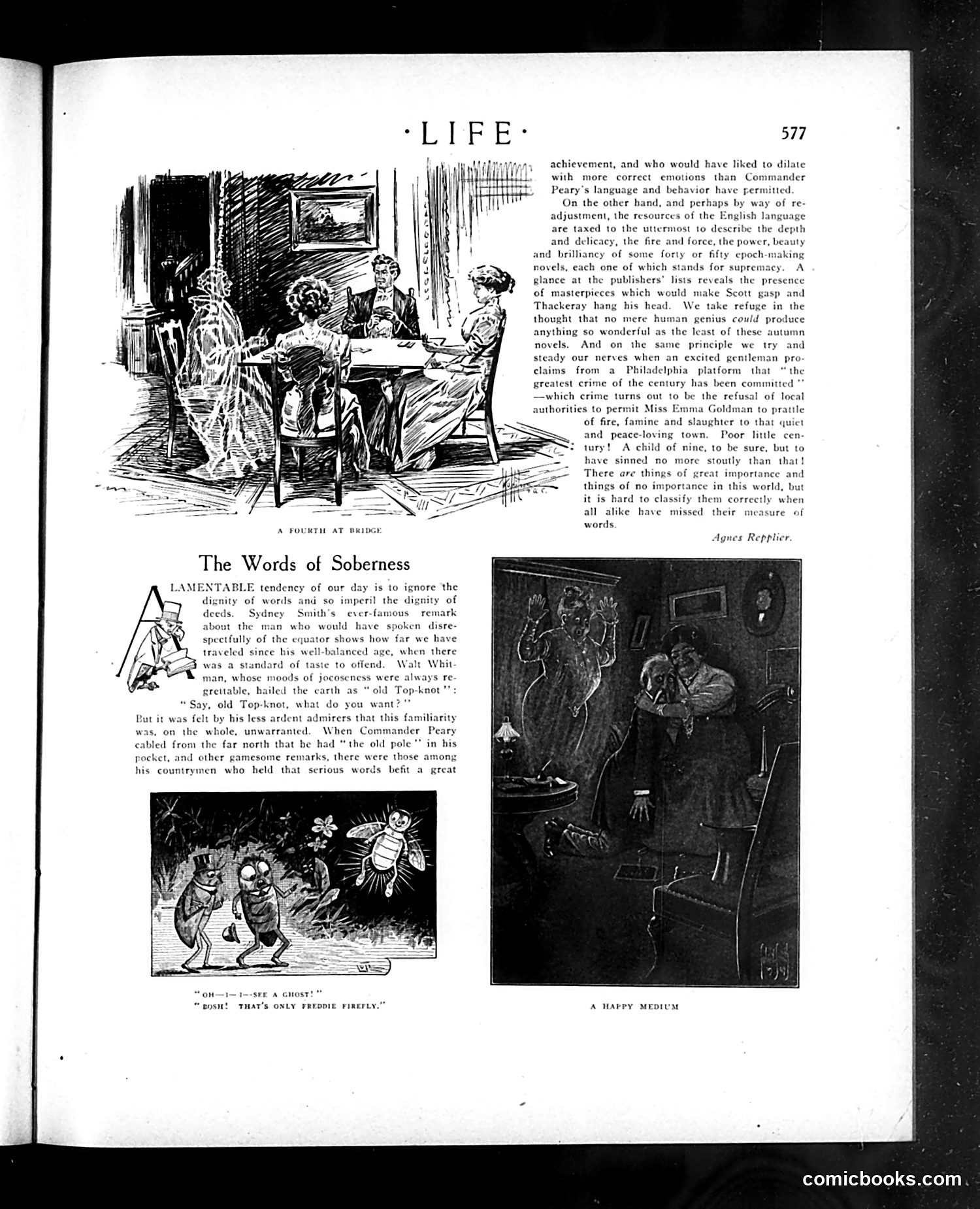
This page critiques the era's casual, overly familiar speech patterns. The article laments that serious language has lost dignity due to people using slang and colloquialisms indiscriminately. The text references "Commander Peary" (likely Arctic explorer Robert Peary) and "Walt Whitman" as examples of figures whose serious language carried weight—contrasting with modern speakers who use frivolous remarks. It mentions a scandal involving "Miss Emma Guldman" in a Philadelphia town, suggesting minor local incidents received exaggerated attention. The cartoons illustrate this theme of linguistic degradation: one shows children encountering what appears to be a ghost with casual dismissal ("See a ghost?" / "Gosh! That's only Freddie Firefly"); another titled "A Happy Medium" depicts a spiritualist séance, likely mocking both supernatural claims and careless speech patterns.
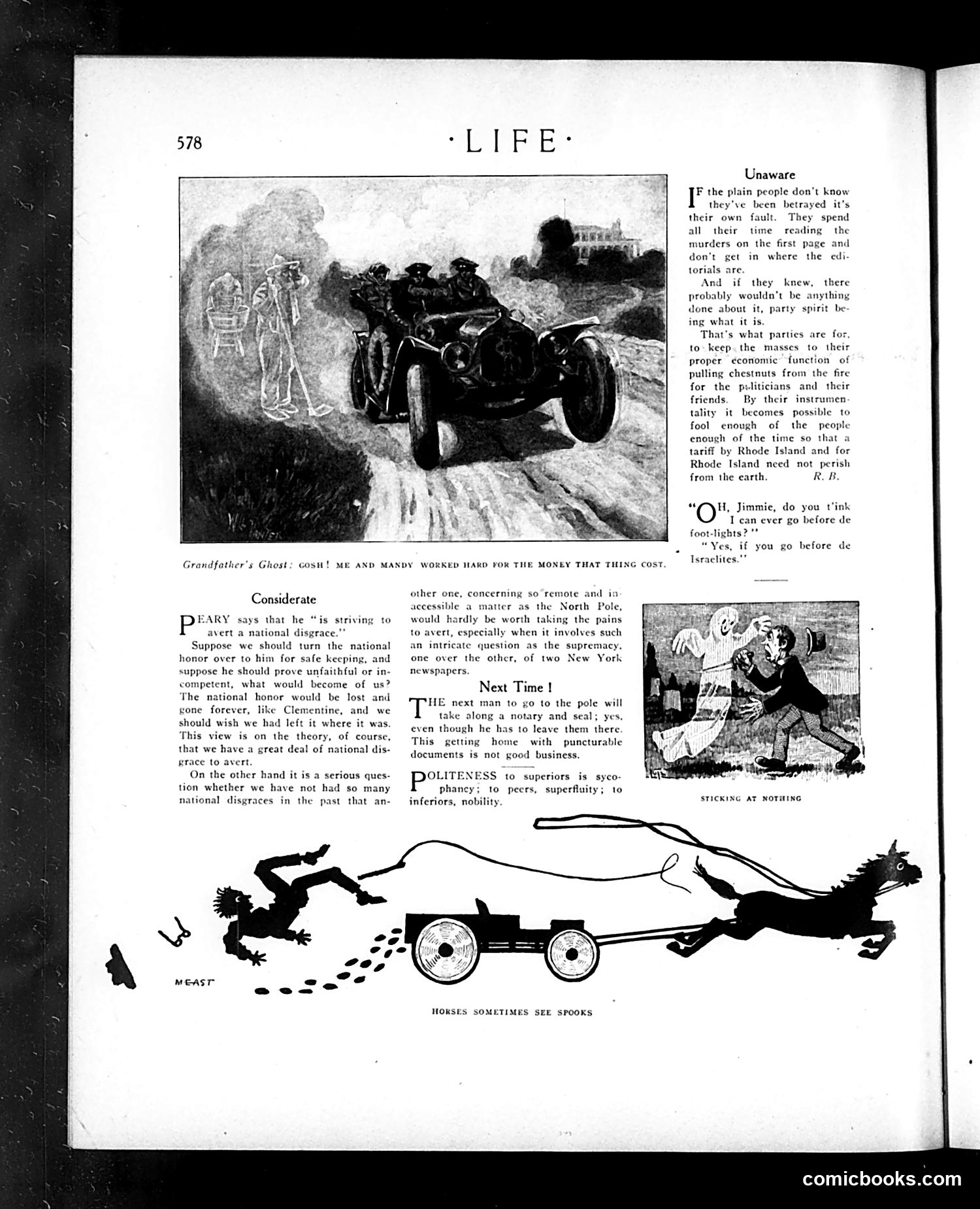
This page contains three distinct satirical pieces: 1. **"Grandfather's Ghost"** (top): An illustration showing a car with passengers encountering a ghostly figure. The caption suggests commentary on automotive costs and reckless spending—the "ghost" likely represents wasted money or financial consequences. 2. **"Unaware"** (right column): Editorial commentary criticizing newspaper readers who remain ignorant of media manipulation regarding political matters (possibly Rhode Island politics, based on the text mentioning "Rhode Island"). 3. **"Considerate," "Next Time!," and "Politeness"** (lower sections): Brief satirical pieces on social behavior and national honor. 4. **"Horses Sometimes See Spooks"** (bottom): A humorous illustration showing a horse startled by a toy car, the joke being animals' irrational fears. The page reflects early 20th-century concerns about automobiles, media literacy, and social propriety.
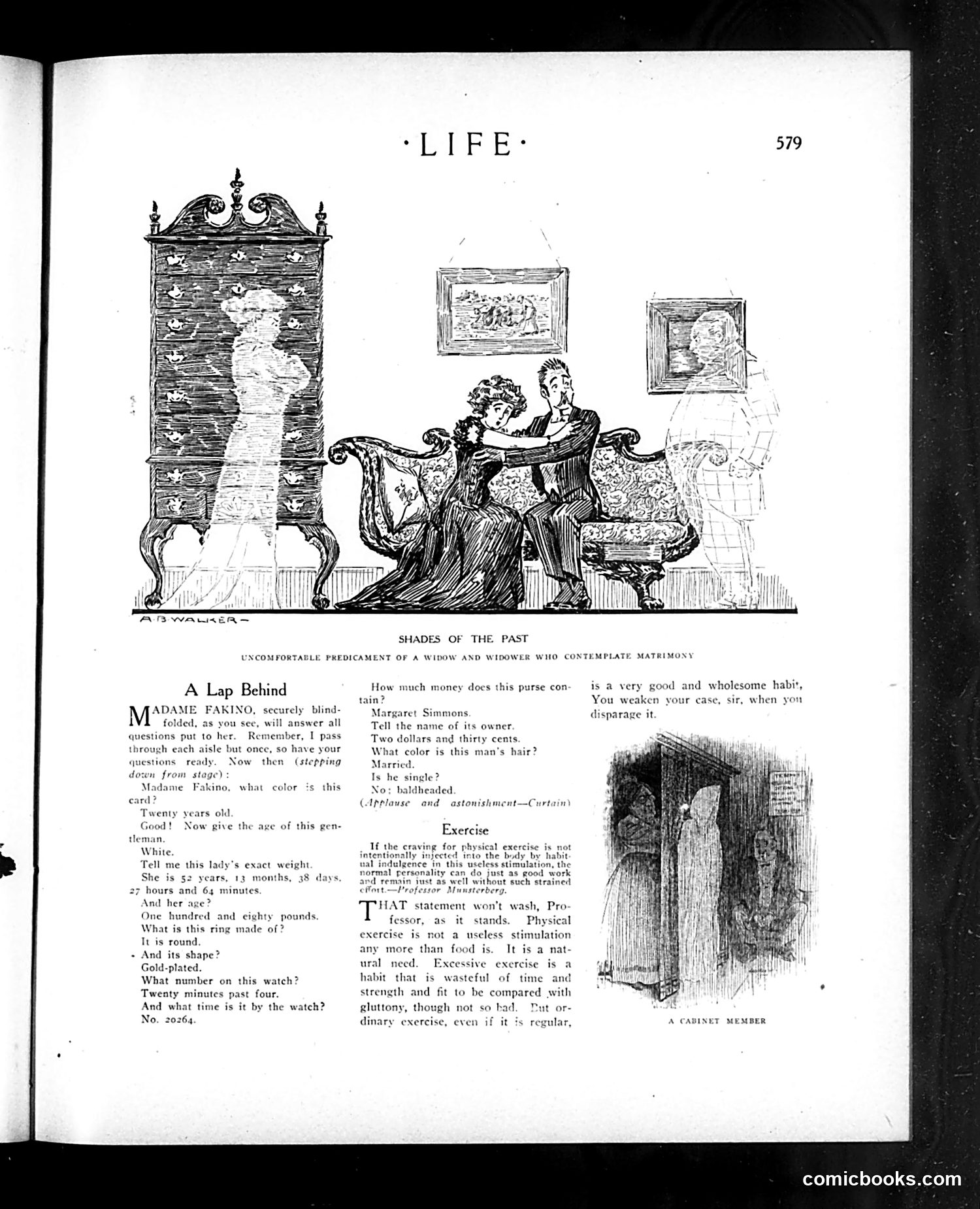
The top illustration satirizes remarriage between a widow and widower. The caption calls it an "uncomfortable predicament" as the couple contemplates matrimony while surrounded by furniture and portraits—presumably from their previous marriages. The humor targets Victorian social anxieties about second marriages, suggesting that existing possessions and memories of first spouses create awkwardness. Below, "A Lap Behind" mocks fortune-telling, showing Madame Fakino conducting a séance-style consultation with a client. The detailed "reading" of the woman's age, weight, and possessions appears absurdly specific, satirizing fraudulent psychics who used cold-reading techniques to impress gullible clients. The character's name itself suggests fakery.
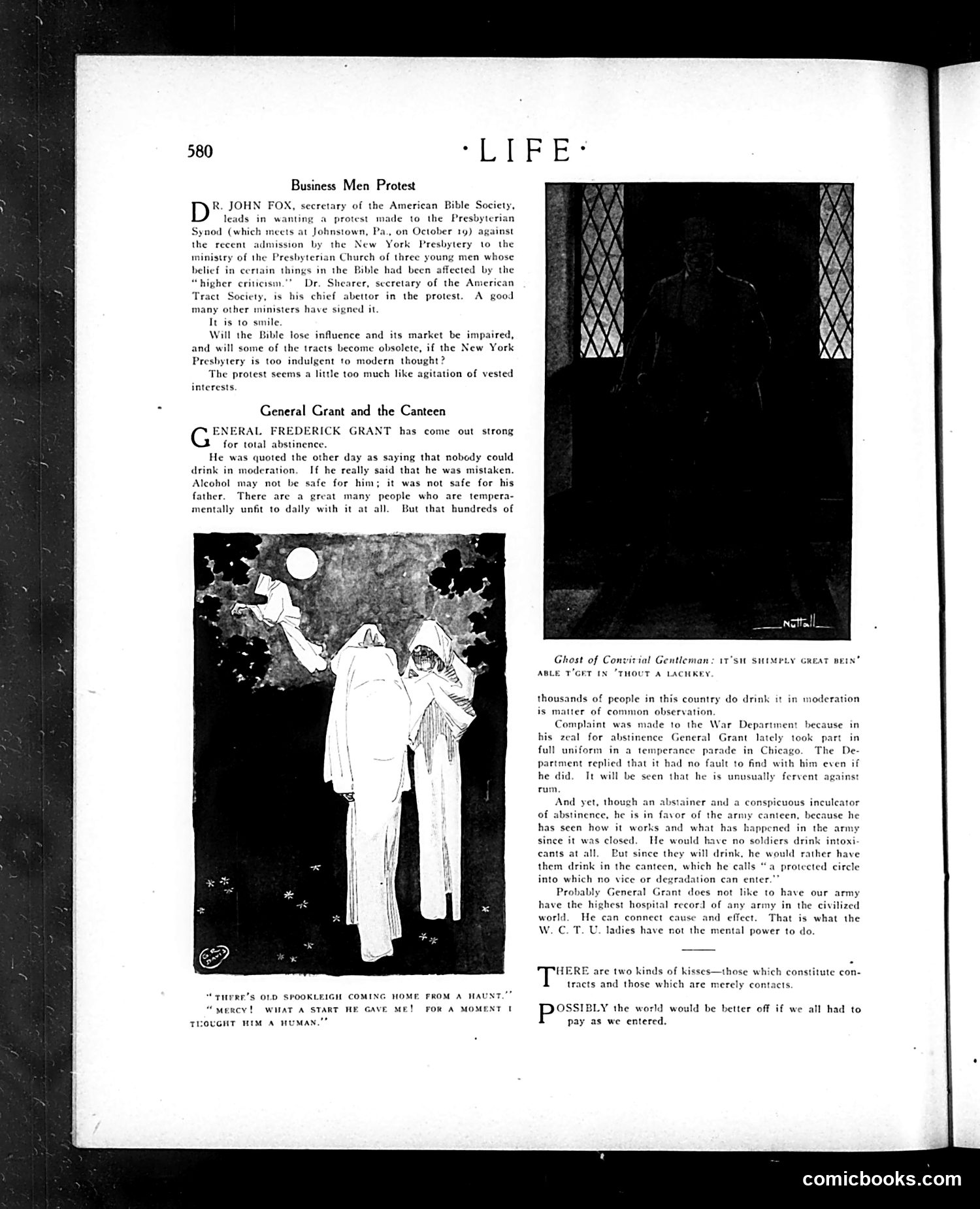
This page contains two distinct sections: **"Business Men Protest"** discusses Dr. John Fox of the American Bible Society leading a protest against the Presbyterian Church admitting three young men to ministry whose Biblical interpretation reflects "higher criticism" (scholarly analysis of scripture rather than literal interpretation). The article satirizes this as an overreaction—suggesting the Bible's influence won't be harmed by theological modernism. **"General Grant and the Canteen"** features an illustration captioned "There's old Spookleigh coming home from a haunt" showing a ghostly figure, accompanying text about General Frederick Grant's advocacy for army canteens serving alcohol, contrasting with temperance movements. The cartoon satirizes Grant's position through supernatural imagery, though the specific joke's intent remains somewhat unclear from the visible text.
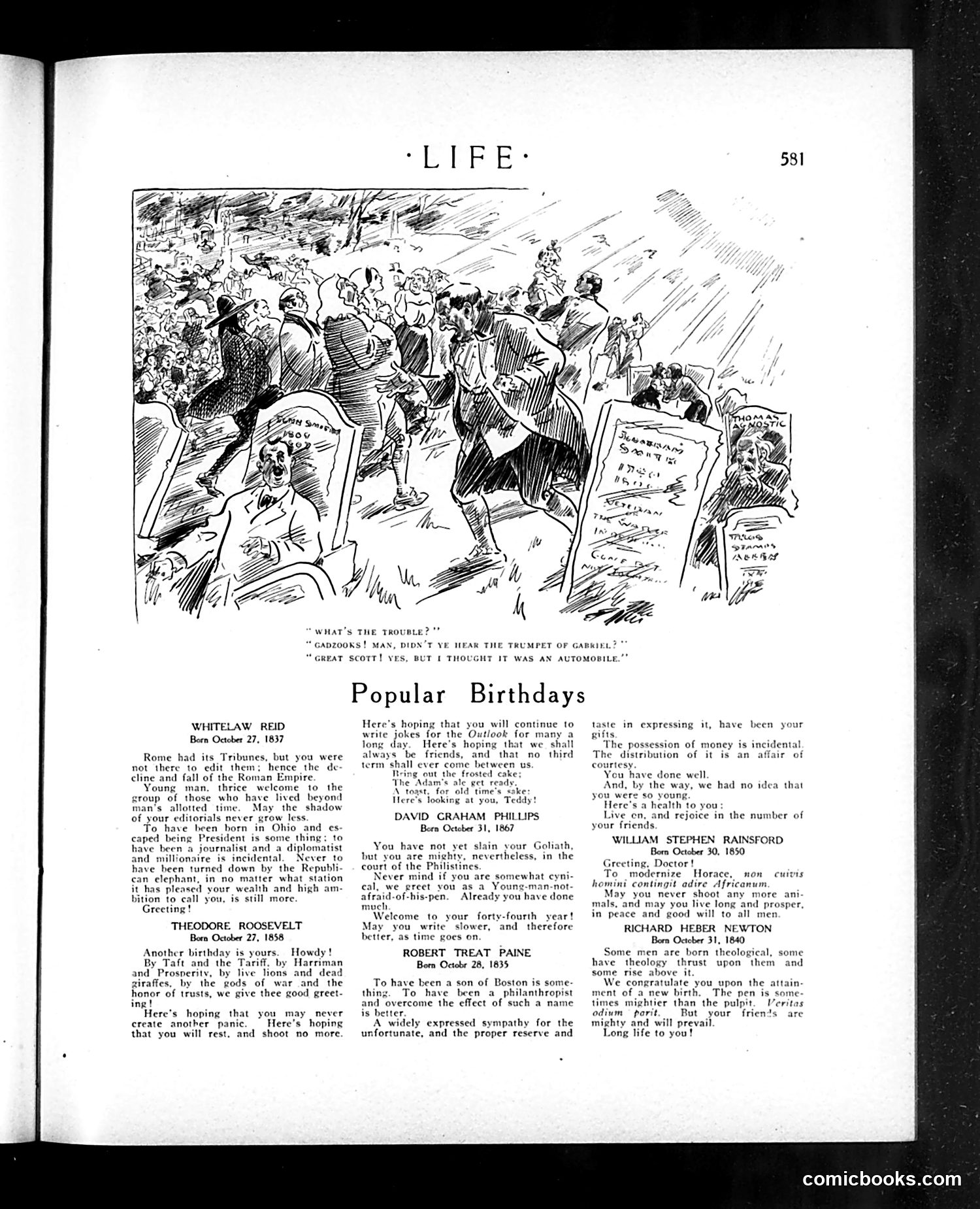
This Life magazine page features a satirical cartoon about a cemetery gathering. The caption quotes someone saying "What's the trouble?" with a response invoking "the trumpet of Gabriel" and an automobile, suggesting death-related humor about early automobiles. Below is a "Popular Birthdays" section celebrating notable figures including Theodore Roosevelt, Whitelaw Reid, and others with humorous birthday messages. The cartoon appears to joke about automobiles as death traps—a common satirical theme in early 20th-century America when cars were new and dangerous. The cemetery setting reinforces this dark humor, with what appears to be graves marked with automotive-related epitaphs, mocking both new technology and mortality. The exact date and all depicted individuals require the magazine's publication date to confirm completely.
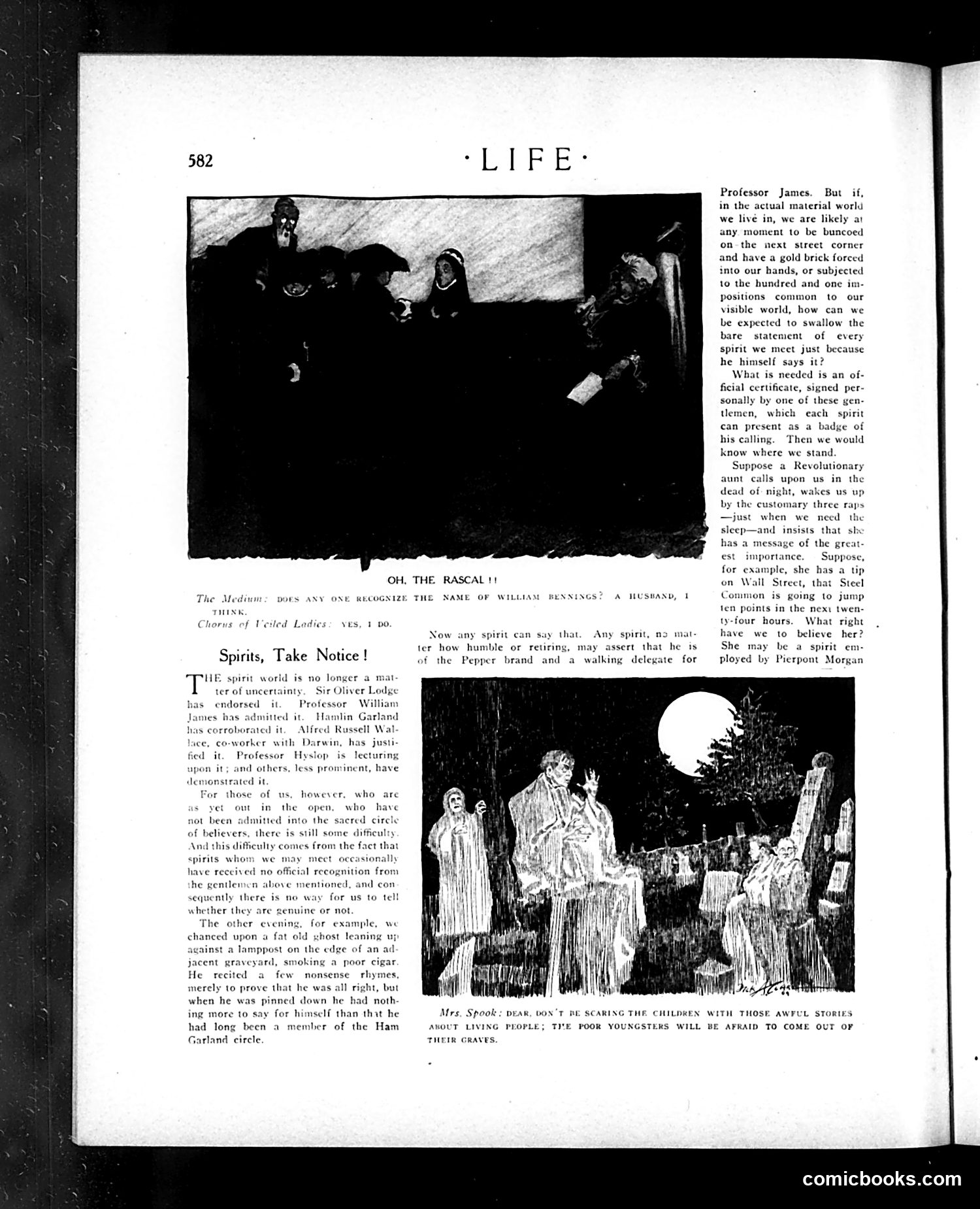
This page satirizes the early 20th-century spiritualism craze by mocking prominent intellectuals who endorsed it. The text references **Professor William James** (Harvard psychologist), **Hamlin Garland** (author), and **Alfred Russell Wallace** (naturalist Darwin's collaborator)—all real figures who publicly supported spiritualism. The satire's central joke: if we wouldn't trust a stranger claiming to sell us a gold brick on the street, why trust unverified spirits? The proposed solution is humorous—spirits should carry "official certificates" proving their authenticity. The cartoons illustrate the absurdity: one shows a séance with dubious participants; another depicts "Mrs. Spook" scolding a ghost for scaring children with frightening stories "about living people." The satire targets both gullible spiritualists and the respected academics lending them credibility, suggesting spiritualism exploits the same human vulnerabilities as street con artists.
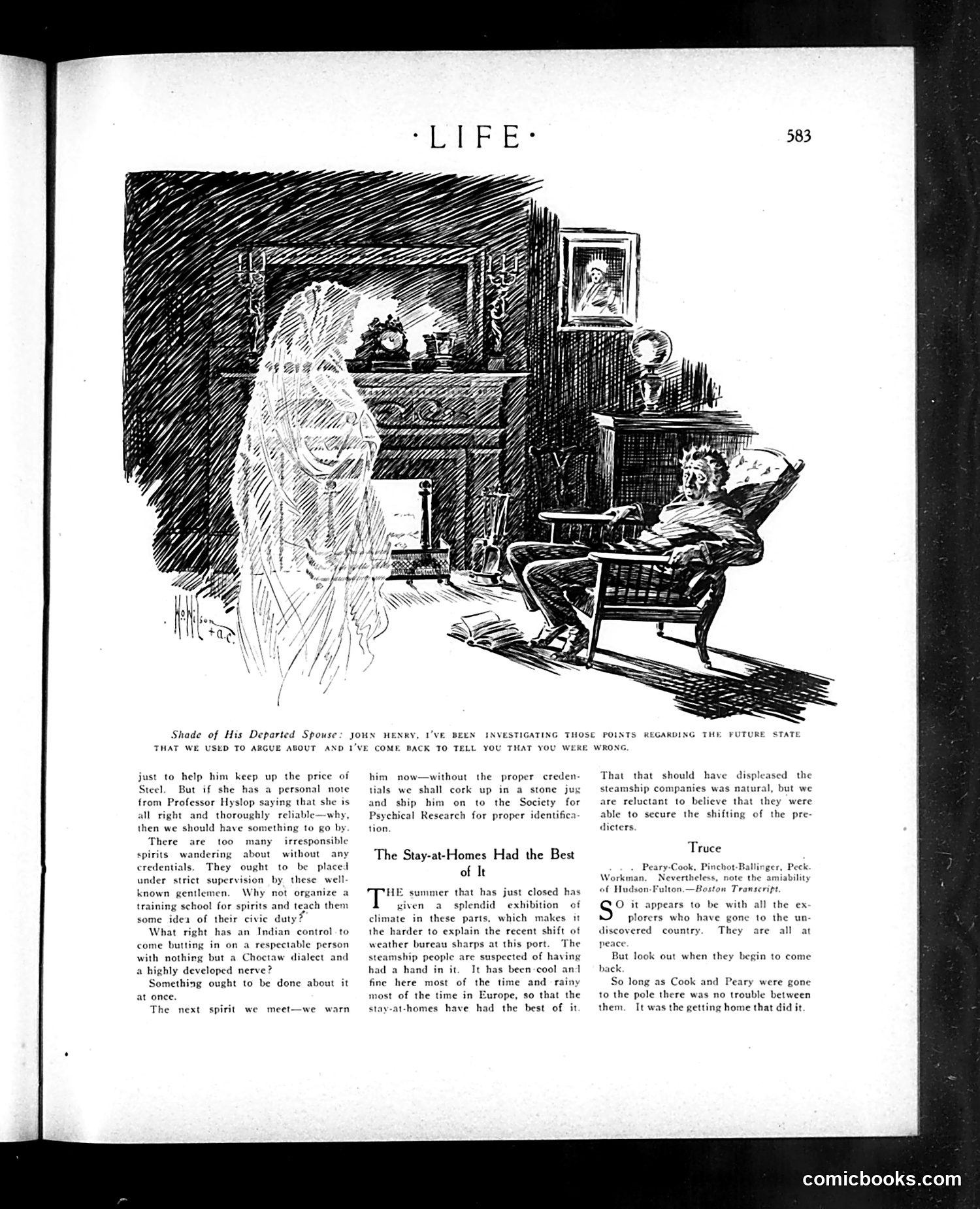
This page contains three satirical pieces targeting early 20th-century American debates: **"Shade of His Departed Spouse"** mocks spiritualism and séances—then-popular attempts to contact the dead. The cartoon shows a ghost appearing to a man, claiming to have investigated the afterlife and prove him wrong about it. The text sarcastically suggests spirits need "credentials" and formal training, poking fun at how gullible people accepted unverified supernatural claims without proper verification. **"The Stay-at-Homes Had the Best of It"** jokes about weather prediction failures. Steamship companies are humorously suspected of somehow manipulating weather to discourage travel, since Europe had poor weather while home ports had pleasant conditions. **"Truce"** references famous polar explorers Peary and Cook (who competed bitterly over North Pole discovery claims), plus controversies involving Pinchot and Ballinger. The point: explorers remained friendly only while absent; conflict erupted upon their return home. All three pieces mock contemporary American anxieties: gullibility toward pseudoscience, commercial interests, and ego-driven competition.
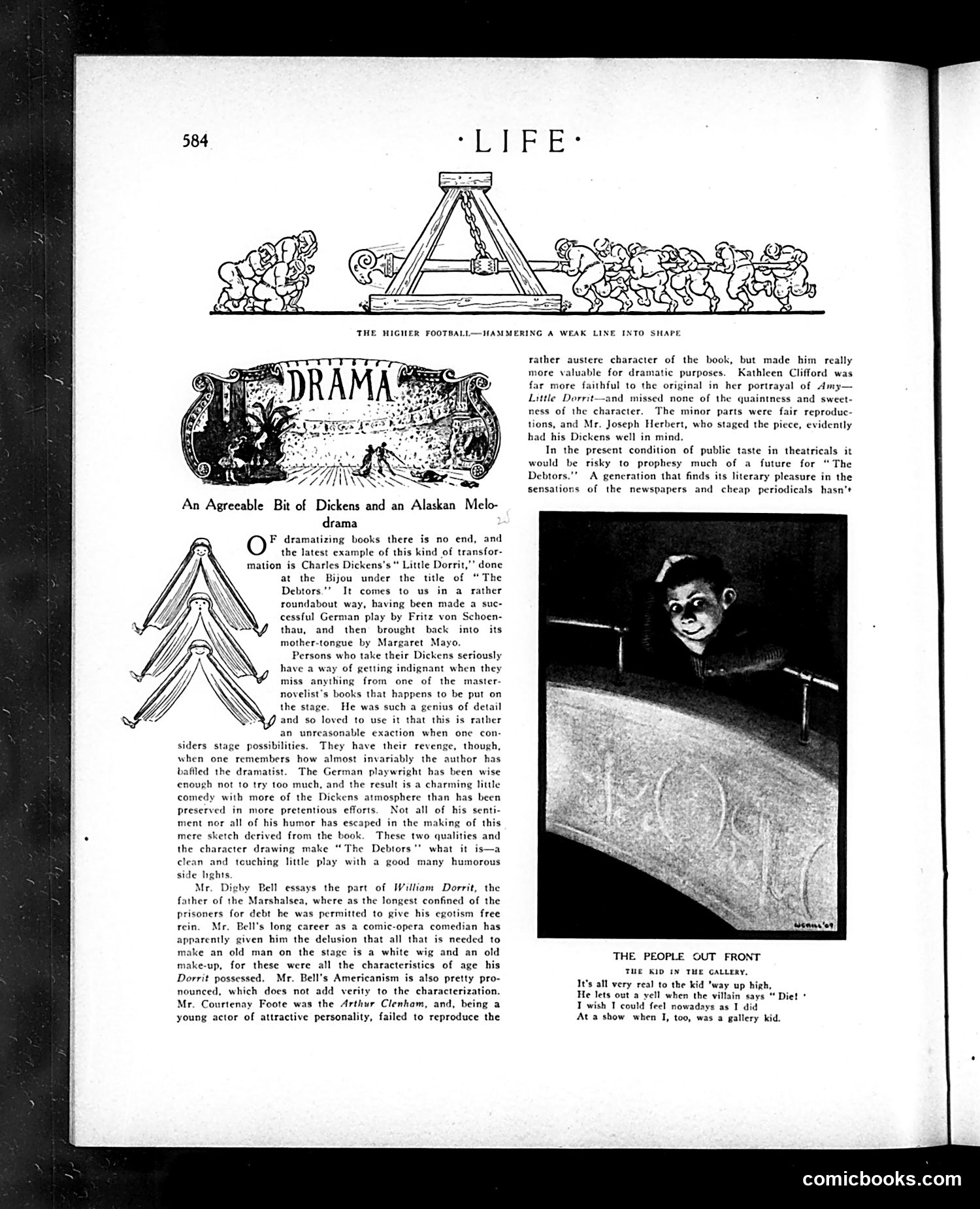
**Top Cartoon:** "The Higher Football—Hammering a Weak Line Into Shape" depicts a fulcrum/lever mechanism with football players on either side. This is a satirical commentary on American football strategy, comparing coaching techniques to mechanical engineering—the "weak line" (offensive or defensive line) is being "shaped" through systematic force, likely critiquing either overly rigid coaching methods or the dehumanizing nature of competitive sport. **Main Article:** Reviews Charles Dickens's *Little Dorrit*, adapted as a stage play titled "The Debtors." The critic praises the German playwright's restraint in adaptation, finding it captures Dickens's atmosphere better than more ambitious efforts. However, he criticizes actor Digby Bell's portrayal of William Dorrit as relying on superficial old-age makeup (white wig) rather than genuine characterization, and notes Bell's American mannerisms undermine the English setting. **Side Photo Essay:** "The People Out Front" features a gallery kid's perspective on theater, nostalgically recalling watching shows from the cheapest seats.
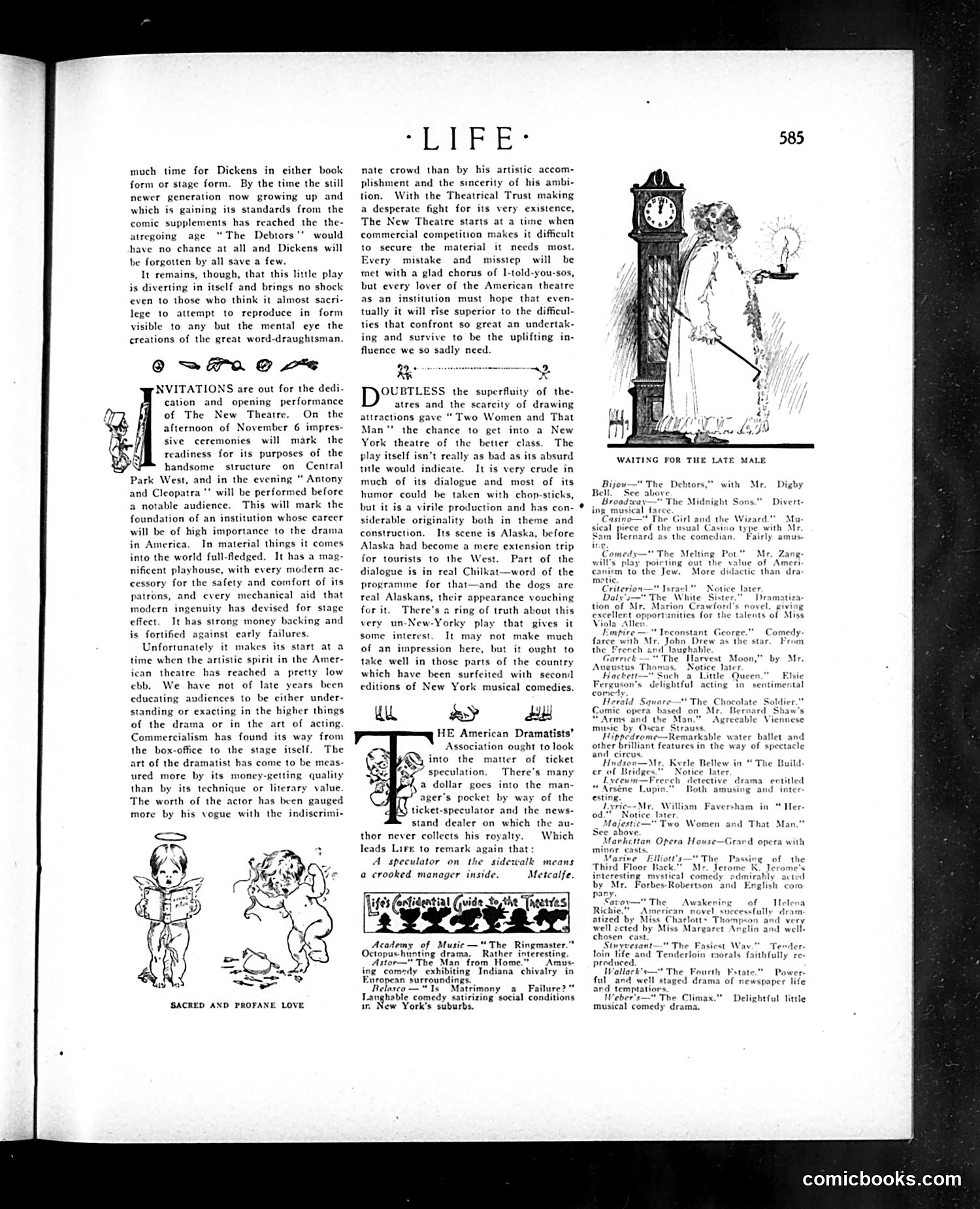
This page discusses New York theatre in the early 1900s, focusing on the upcoming opening of "The New Theatre" (November 6). The main text criticizes American theatre's declining artistic standards, blaming commercialism and the "Theatrical Trust" for prioritizing profit over quality. It warns that The New Theatre, despite excellent facilities and funding, faces a cultural climate where audiences have been conditioned by "comic supplements" rather than serious drama. The page reviews two plays: "The Debtors" (criticized as Dickens adaptation that will soon be forgotten) and "Two Women and That Man" (set in Alaska, praised for originality despite crude dialogue and absurd title). The cartoon "Sacred and Profane Love" (lower left) appears to show cherubs or cupids in contrasting states—likely satirizing the theatrical tension between highbrow and lowbrow entertainment discussed in the text. The page reflects Progressive Era anxieties about mass culture degrading public taste.
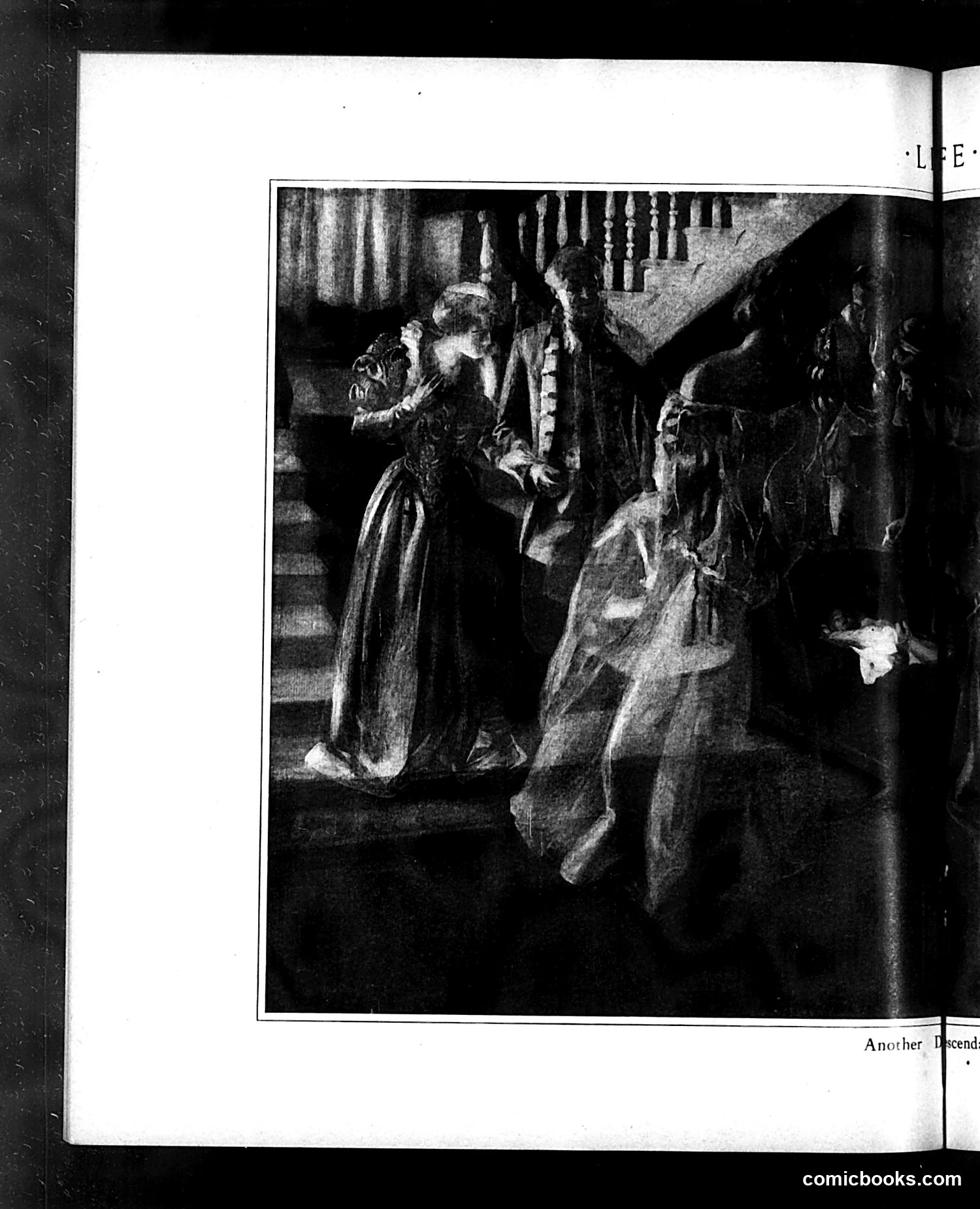
This page appears to show a dramatic theatrical or historical scene rather than a political cartoon. The black-and-white illustration depicts what seems to be a period drama—possibly 18th or 19th century based on the elaborate costumes and architectural setting with a grand staircase visible in the background. The central figure is a woman in formal dress gesturing expressively, surrounded by other elaborately costumed figures. The caption reads "Another D[escend..." (text cut off), suggesting this illustrates a narrative sequence or scene from a serialized story. Without the complete caption or article text, I cannot definitively identify the specific historical event, theatrical work, or satirical target this represents. The image quality and theatrical nature suggest this may be illustrating literature or drama rather than contemporary political satire.
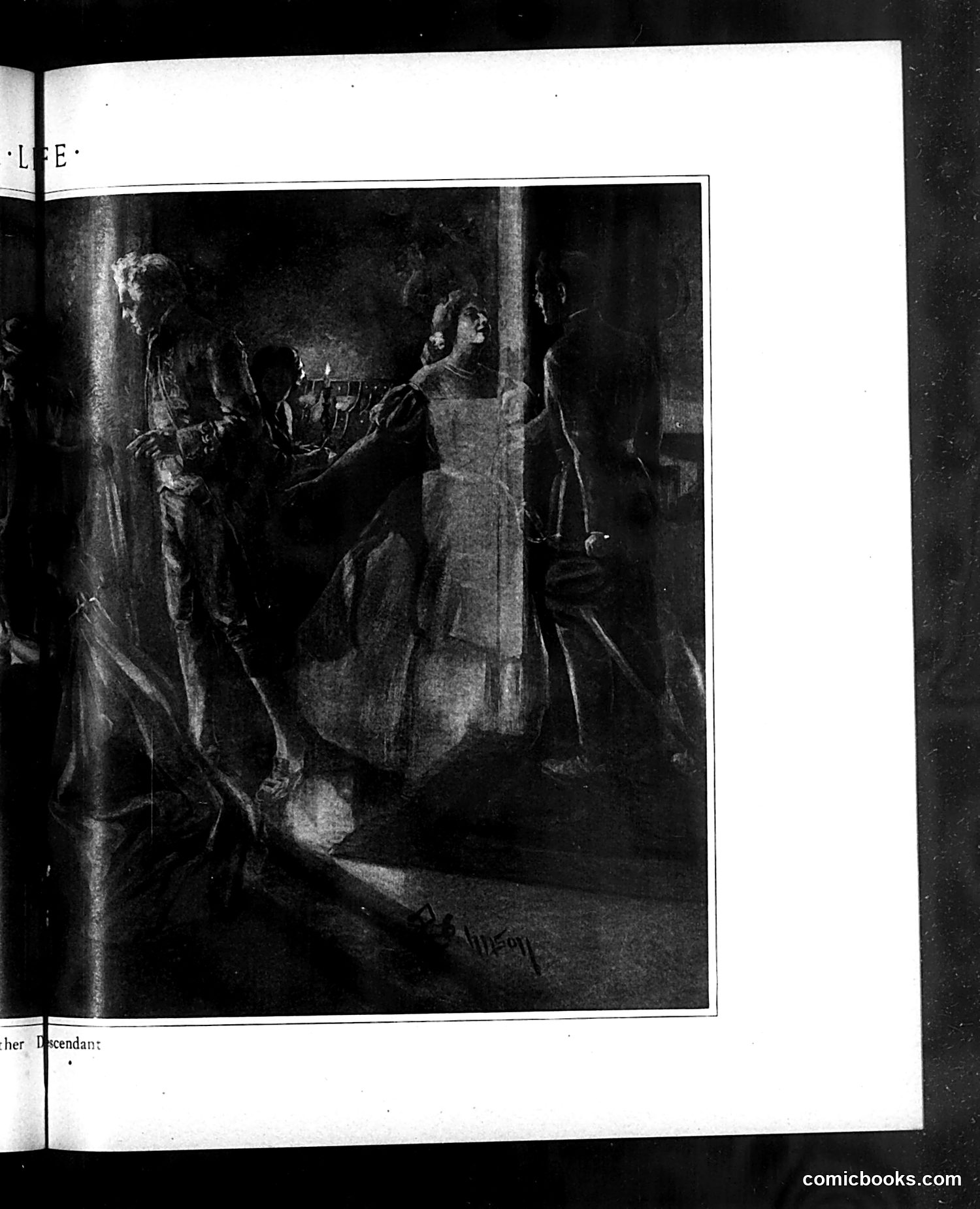
This appears to be a dramatic illustration from *Life* magazine showing what looks like a historical or theatrical scene. The image depicts several figures in period costume (possibly 18th or 19th century military dress) in an interior setting with columns. A central figure appears distressed or in conflict with others around them. Without clearer caption text or identifying information visible in the OCR'd content, I cannot definitively state what specific political event, historical moment, or satirical point this illustration represents. The signature appears present but is not clearly legible enough to confirm the artist's identity. To provide accurate historical context for a modern reader, I would need more legible text identifying the scene, figures, or referenced event.
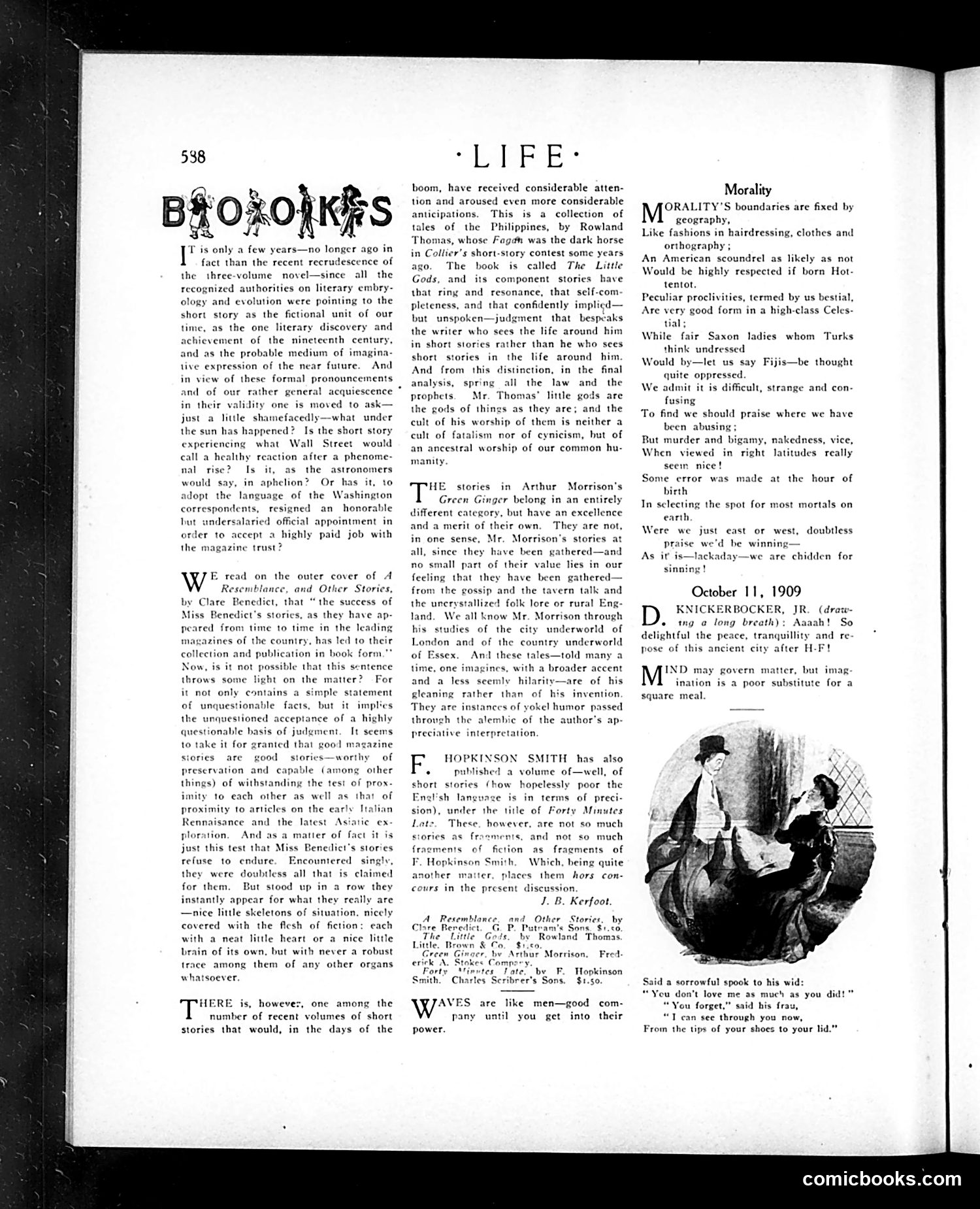
This page contains literary criticism rather than political satire. The author reviews recent short-story collections, discussing whether the short story—once hailed as the nineteenth century's great literary achievement—has lost its cultural prominence. The review critiques Clare Benedict's collected magazine stories, arguing that while individually acceptable, they lack substance when grouped together—merely "nice little skeletons of situation" without robust development. The author praises Rowland Thomas's *The Little Gods* (Philippine tales) for authentic observation of life, and Arthur Morrison's *Green Ginger* for drawing on genuine folk material from rural England rather than invented plots. The small illustration shows a domestic scene with dialogue about shoes, unrelated to the text. This was typical of Life's mixed-content pages blending serious criticism with humor and illustration.
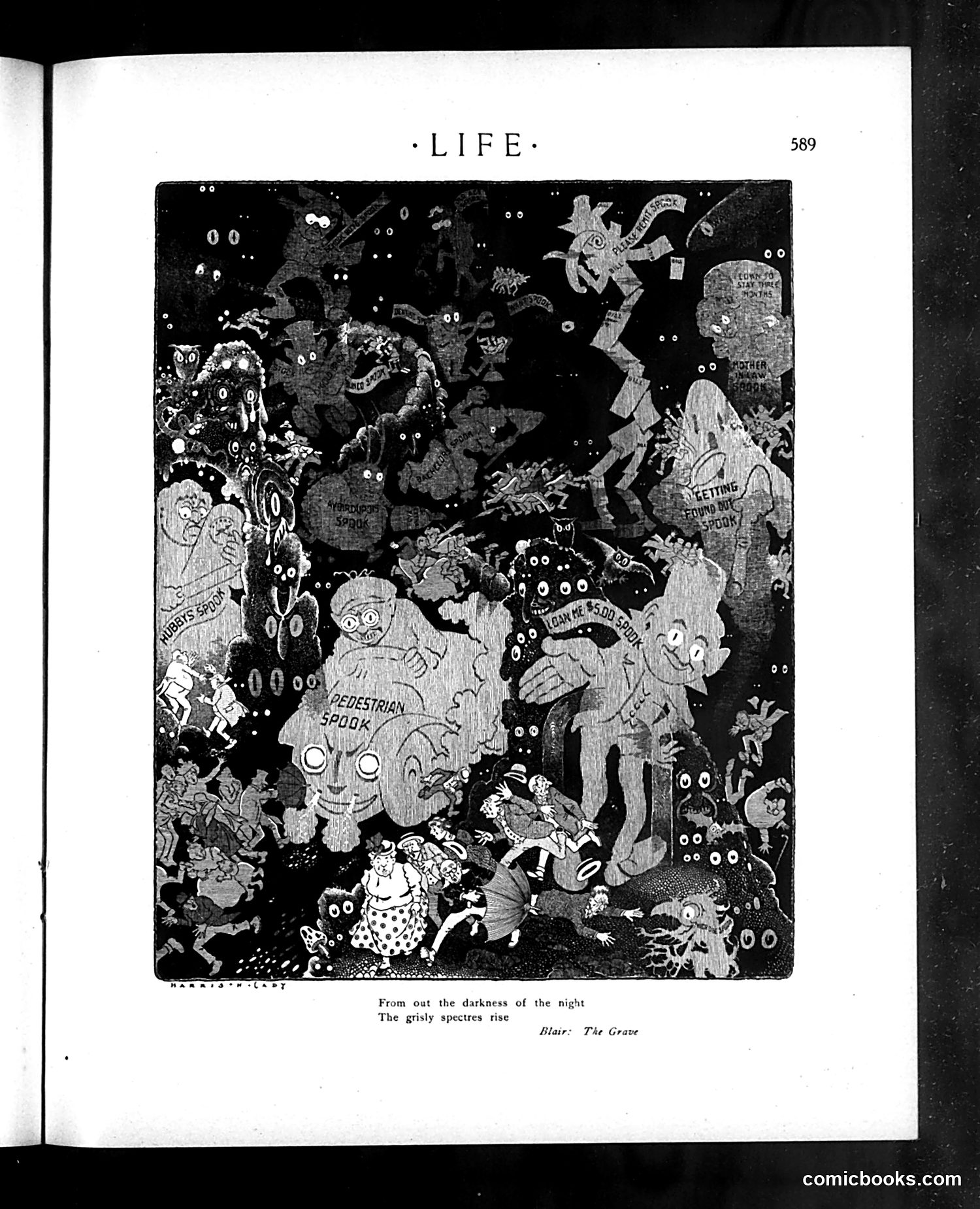
This is a dark, surreal illustration attributed to artist Blair, titled "The Grave." The image depicts a nightmarish scene crowded with grotesque figures, skeletons, and ghostly forms emerging from darkness—fitting the quoted text about "grisly spectres" rising at night. The specific identities of individual caricatures are unclear from the image alone. However, this appears to be **political satire** using gothic/supernatural imagery, a common Life magazine technique. The labels visible on some figures suggest they represent contemporary political or social figures, though the exact references are difficult to read clearly. The overall effect creates an ominous commentary on contemporary society or politics through macabre theatrical imagery—a sophisticated approach to satirical illustration popular in early-to-mid 20th century American humor publications.
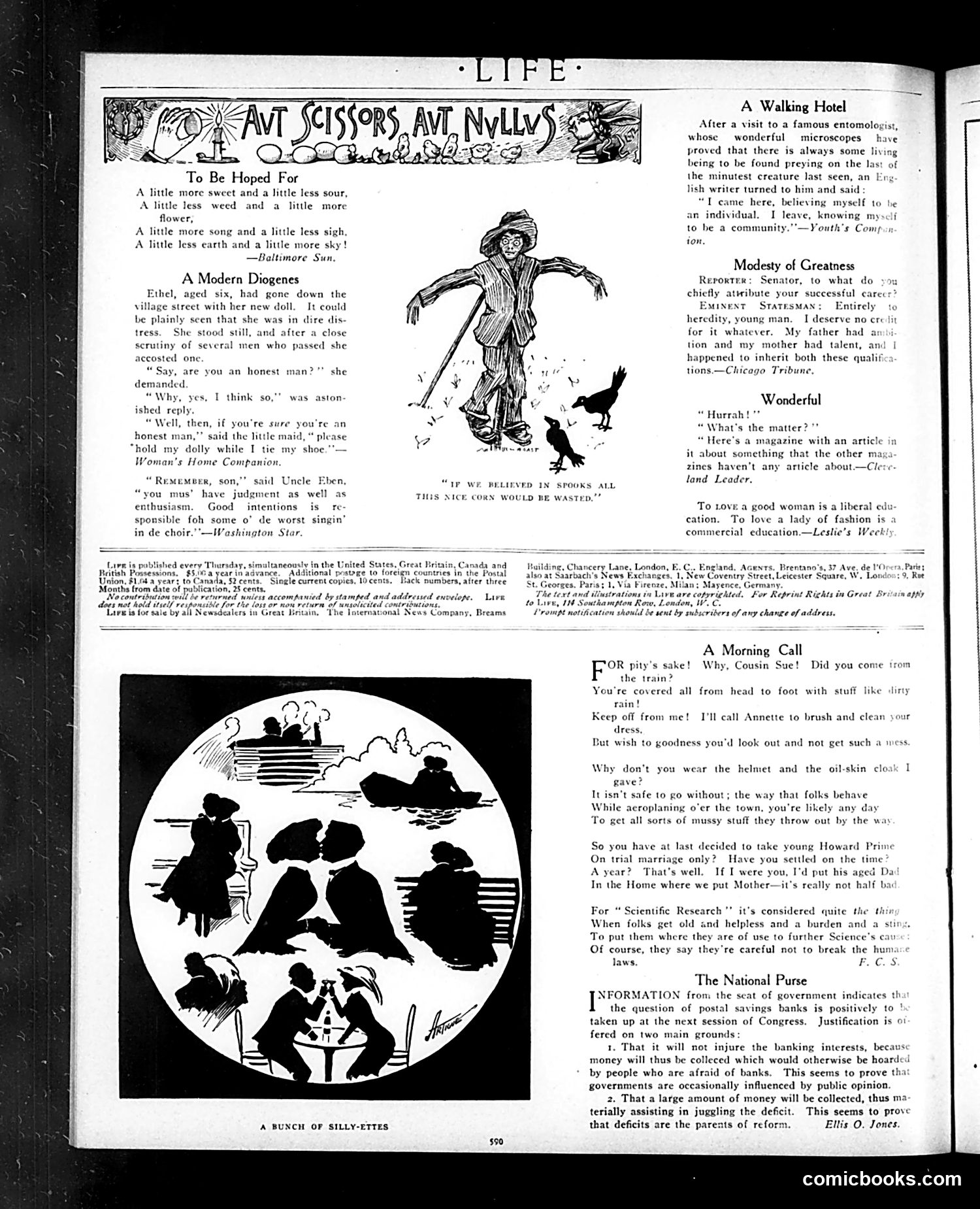
This Life magazine page (appears to be early 1900s) contains several short humorous pieces and illustrations: **Main cartoon ("A Bunch of Silly-Ettes")**: A silhouette illustration showing various people in social situations—appears to depict everyday domestic or social comedy scenes. **The humor pieces** are brief satirical observations: - "A Modern Diogenes" references the ancient Greek philosopher who sought an honest man; here a six-year-old girl tests strangers for honesty before trusting one with her doll—satirizing that genuine honesty is rare. - "A Walking Hotel" jokes that microscopic examination reveals humans host countless parasites, making us "communities" rather than individuals. - "A Morning Call" is dialogue mocking someone who's gotten dirty from early aviation (aeroplane) travel. The page reflects early 20th-century concerns: skepticism about human virtue, fascination with scientific discovery, and the novelty of aviation technology. The tone is lighthearted social commentary typical of Life magazine's satirical purpose.
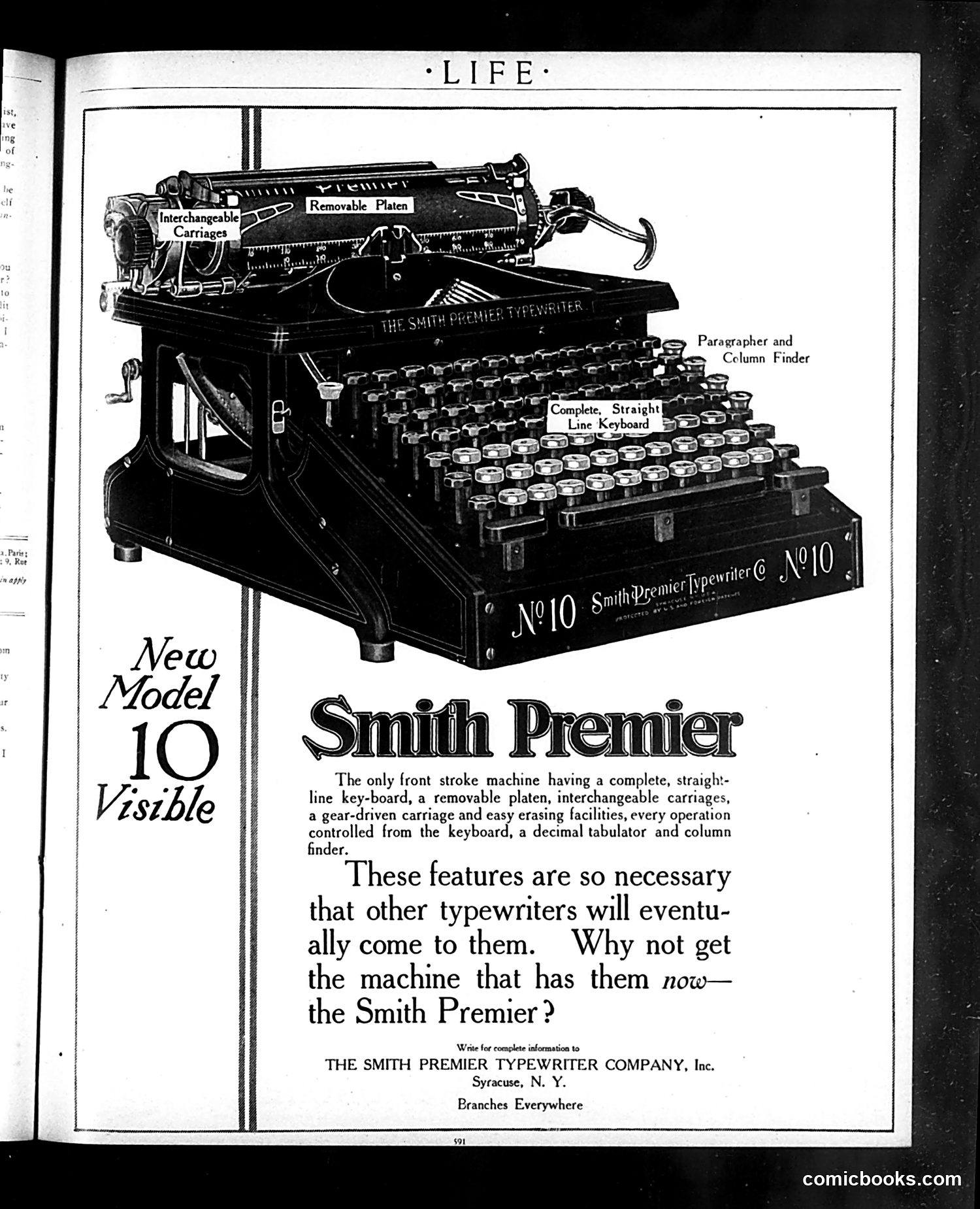
This is not a cartoon but a full-page advertisement for the Smith Premier Model 10 typewriter, published in *Life* magazine. The image shows a detailed mechanical drawing of the typewriter with labeled features like the "removable platen," "interchangeable carriages," and "complete, straight-line keyboard." The ad's pitch claims these innovations are so superior that competitors will eventually copy them—so consumers should buy the Smith Premier *now* rather than wait. This is straightforward product advertising using technical specification and competitive advantage as selling points, typical of early 20th-century machinery ads. There is no satire or political commentary; the page simply represents how *Life* magazine monetized through advertising while maintaining its editorial content elsewhere.
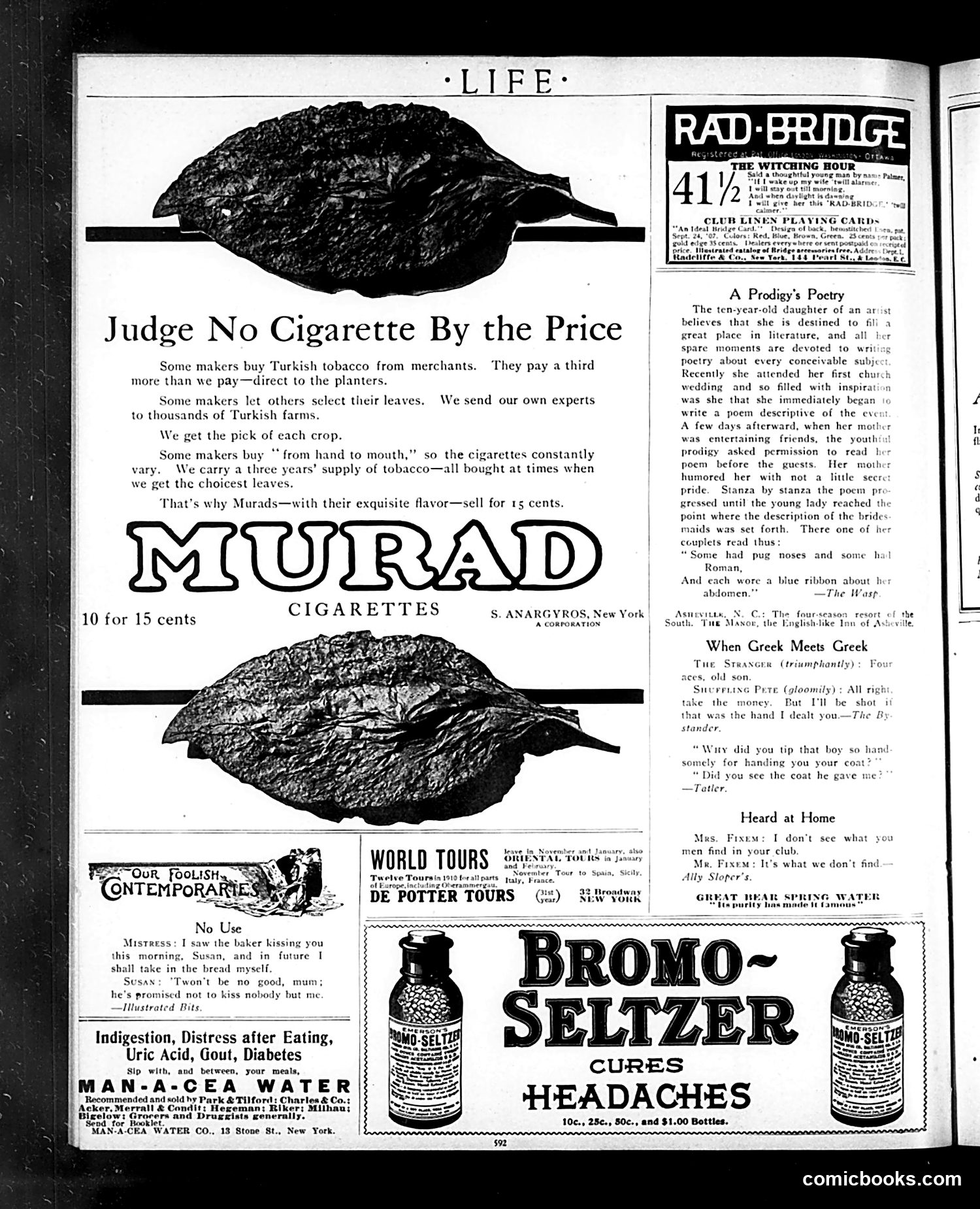
This page combines cigarette advertising with humorous short pieces typical of early 20th-century satirical magazines. **Main Content:** The Murad cigarettes advertisement dominates, emphasizing quality control—the company employs experts to select Turkish tobacco directly from farms, rather than buying from middlemen. This justifies the 15-cent price point. **Humor Pieces:** Several brief comic anecdotes follow: - "A Prodigy's Poetry" mocks a precocious child whose poem about bridesmaids includes the line about pug noses and blue ribbons around abdomens—the joke being the child's innocent, unflattering description - "When Greek Meets Greek" and "Heard at Home" are short conversational jokes about tipping and marital dynamics - "No Use" depicts a domestic quarrel over kissing **Ads:** Man-a-cea Water (patent medicine for digestive complaints), Bromo-Seltzer, and De Potter Tours round out the page. The content reflects period attitudes toward advertising claims, domestic comedy, and mild social satire—nothing overtly political.
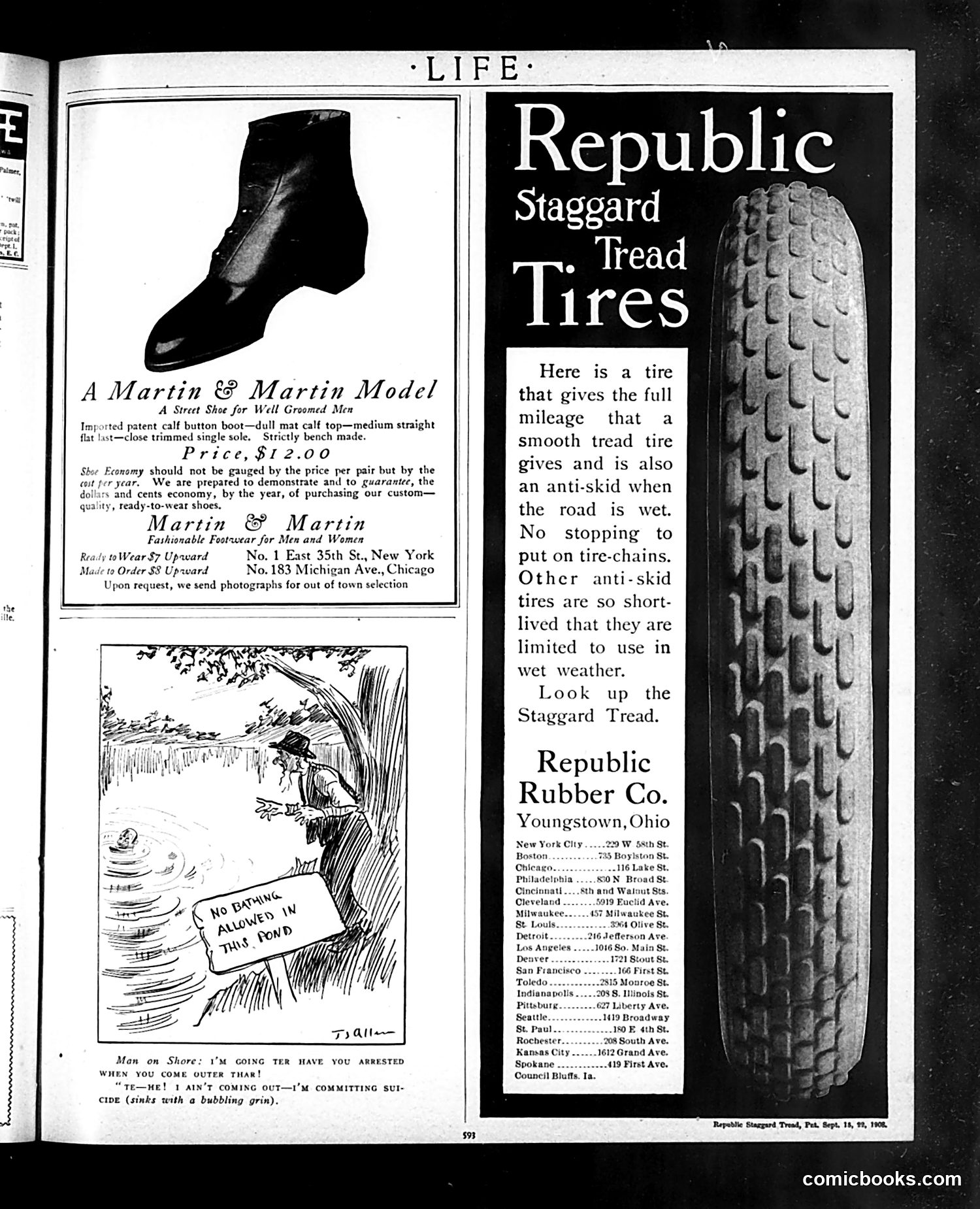
This page combines **advertising with editorial cartoon**. The cartoon depicts a man in water refusing to emerge despite a threatening shore official, announcing he's "committing suicide" with a grin. The joke appears to be dark humor about someone preferring drowning to facing arrest—likely satirizing either legal troubles, debt, or social shame so severe that death seems preferable. The bubbling grin suggests absurdist comedy rather than serious commentary. The advertisements are period-typical: Martin & Martin shoes (emphasizing durability and value) and Republic Rubber's "Staggard Tread" tires, which the company claims offer both mileage AND anti-skid properties—addressing early automotive safety concerns. The tire ad lists numerous American cities, indicating nationwide distribution. **Context for modern readers:** This reflects early 1900s anxieties about personal debt and legal consequences, combined with emerging automobile safety marketing.
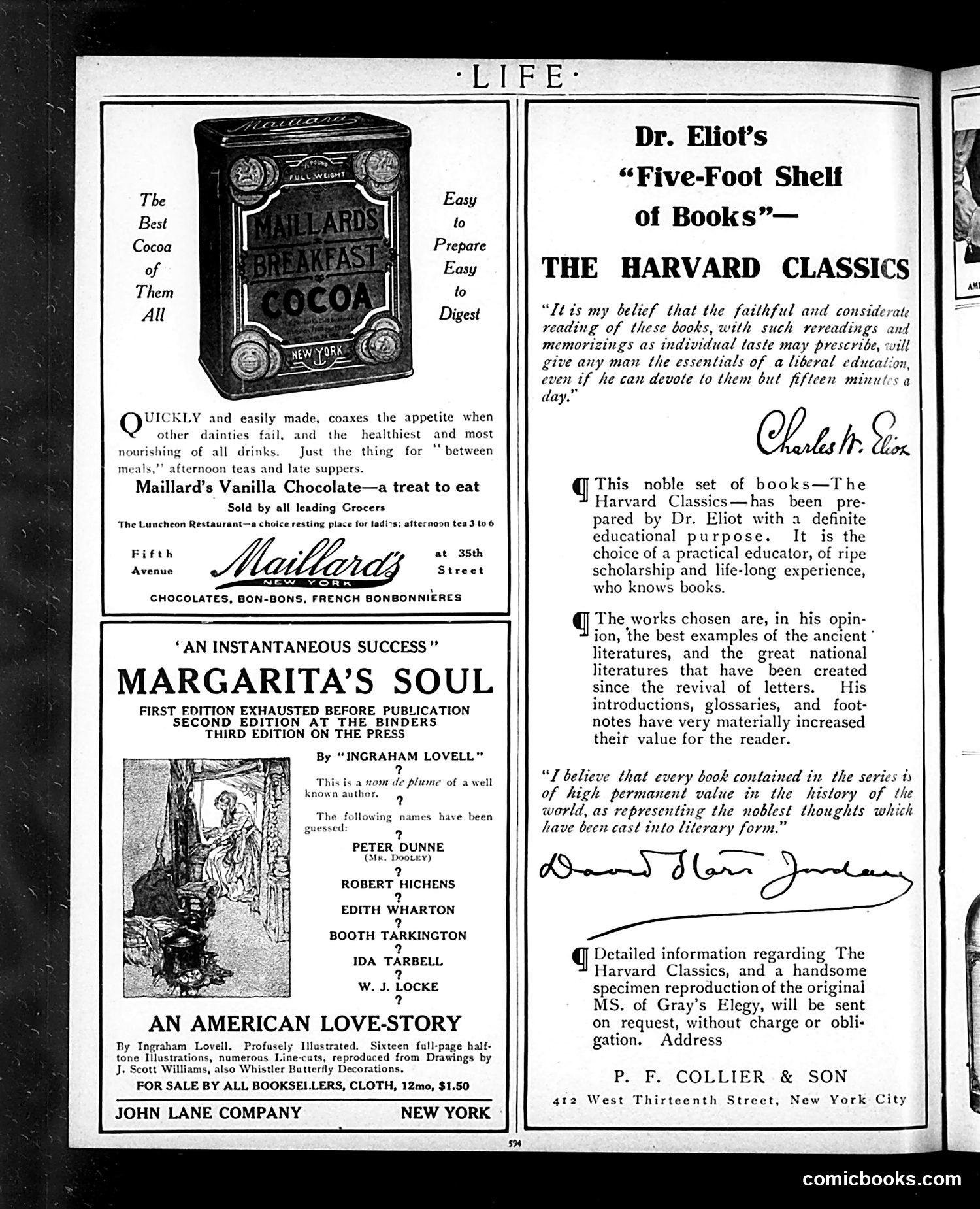
This is primarily a **advertising page**, not satire. It features three product ads: 1. **Maillard's Breakfast Cocoa** — A chocolate drink advertised as appetite-stimulating and nutritious, marketed for "between meals" consumption. 2. **"Margarita's Soul"** — A mystery novel by the pseudonymous "Ingraham Lovell" (actual author unknown). The ad playfully notes the first edition sold out before publication, and lists famous writers as guesses for the real author—a common marketing gimmick of the era that generated intrigue and sales. 3. **Dr. Eliot's Harvard Classics** — A curated five-foot shelf of classic literature prepared by Harvard president Charles W. Eliot, marketed as providing a liberal education in fifteen minutes daily. This was a genuine, popular product of the early 1900s aimed at self-improvement. The page reflects early 20th-century consumer culture promoting both luxury goods and educational self-advancement.
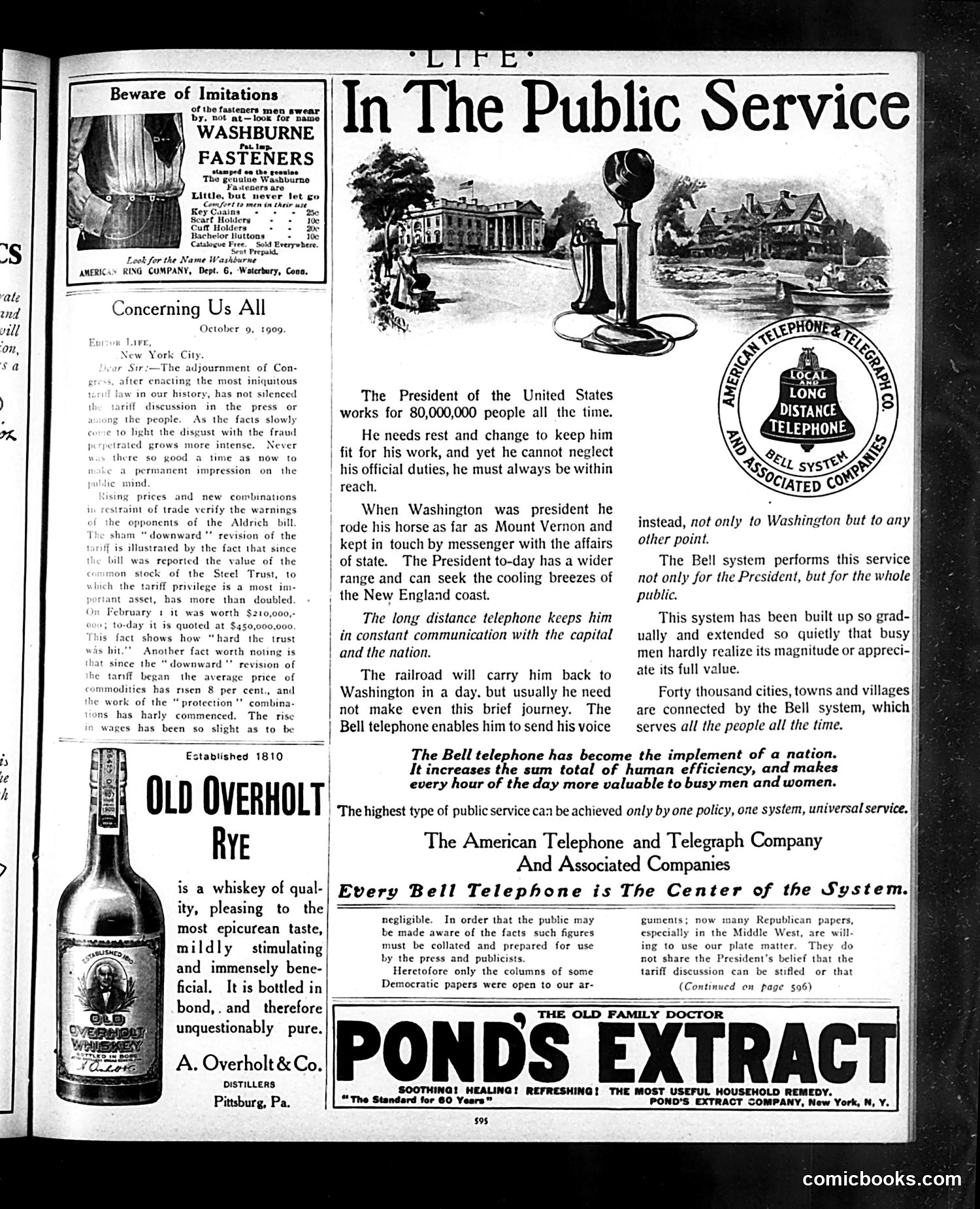
This page features a **Bell Telephone Company advertisement** disguised as editorial content—a common early 20th-century marketing tactic. **The Main "Article":** The piece argues that President Theodore Roosevelt needs reliable long-distance communication to govern effectively while traveling. It contrasts Washington's era (horseback to Mount Vernon, messengers) with modern needs, positioning the Bell telephone system as essential national infrastructure. The rhetoric is propagandistic: Bell serves "all the people all the time" and represents "universal service." **The Satire/Context:** This appears in *Life* magazine during the Progressive Era when monopolies faced scrutiny. The ad's grandiose claims about public service subtly defend AT&T's dominance by framing it as patriotic necessity rather than corporate power. The tagline "Every Bell Telephone is The Center of the System" emphasizes centralized control. **Supporting Content:** The page includes anti-tariff commentary and vintage ads (Washburne fasteners, Old Overholt whiskey, Pond's Extract), typical of 1909 magazines mixing editorial, advocacy, and advertising without clear distinction.
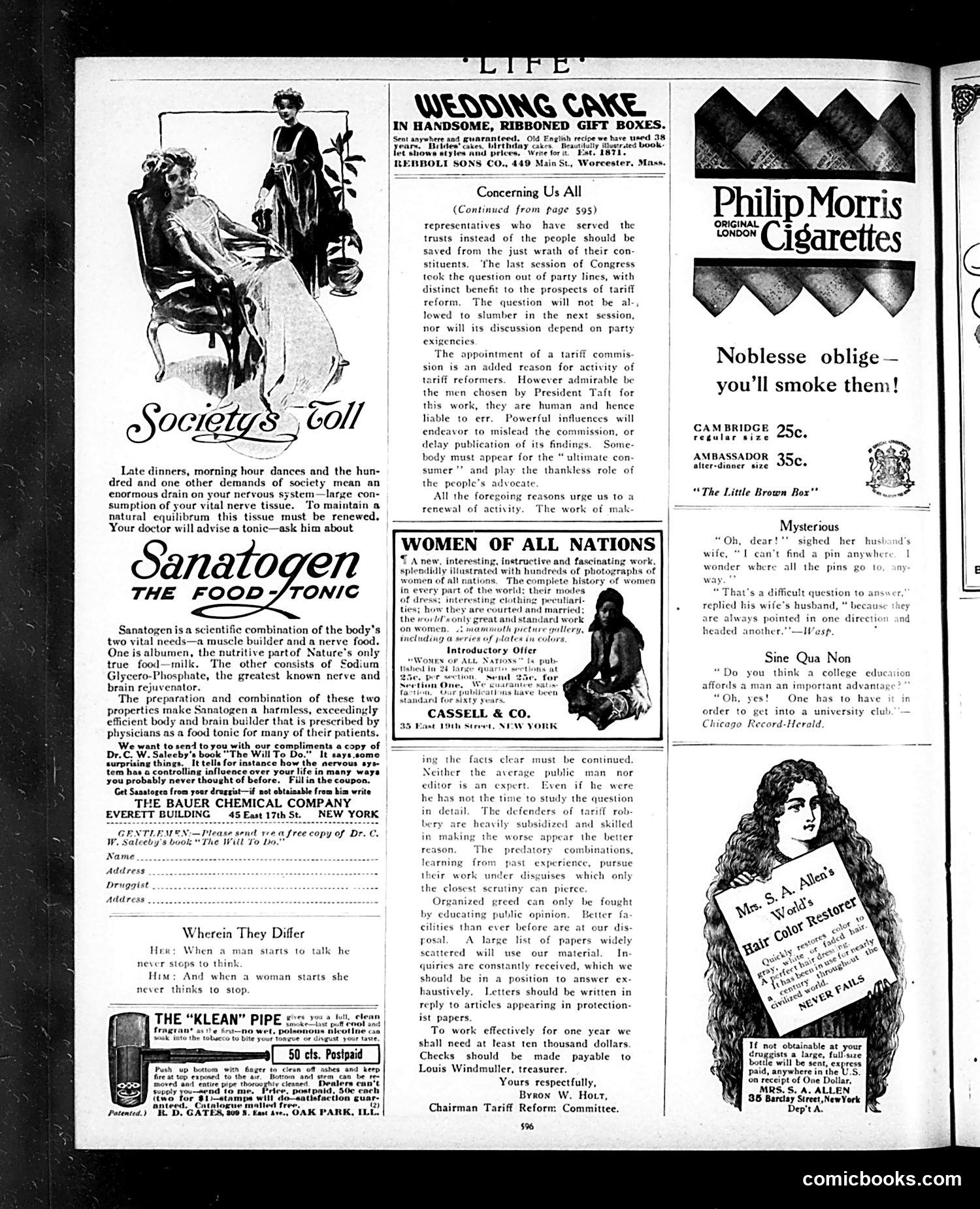
This page from *Life* magazine contains primarily **advertisements and advice columns** rather than political satire. The main content includes: **"Society's Toll"** — A wellness advertisement for Sanatogen tonic, arguing that society's demands (late dinners, dances) drain the nervous system and require dietary supplementation. **"Concerning Us All"** — An editorial about tariff reform, arguing that Congressional representatives should serve "the people" rather than special interests. It advocates for a tariff commission and warns against powerful industries misleading it. **"Women of All Nations"** — An advertisement for an illustrated book about women worldwide. The page also features Philip Morris cigarette ads and various other period advertisements (wedding cake, pipes, hair color restorer). The tariff reform discussion reflects early 20th-century Progressive Era politics, when reformers battled industrial monopolies and protectionist policies. The emphasis on "the people's advocate" suggests populist sentiment against corporate influence on government.
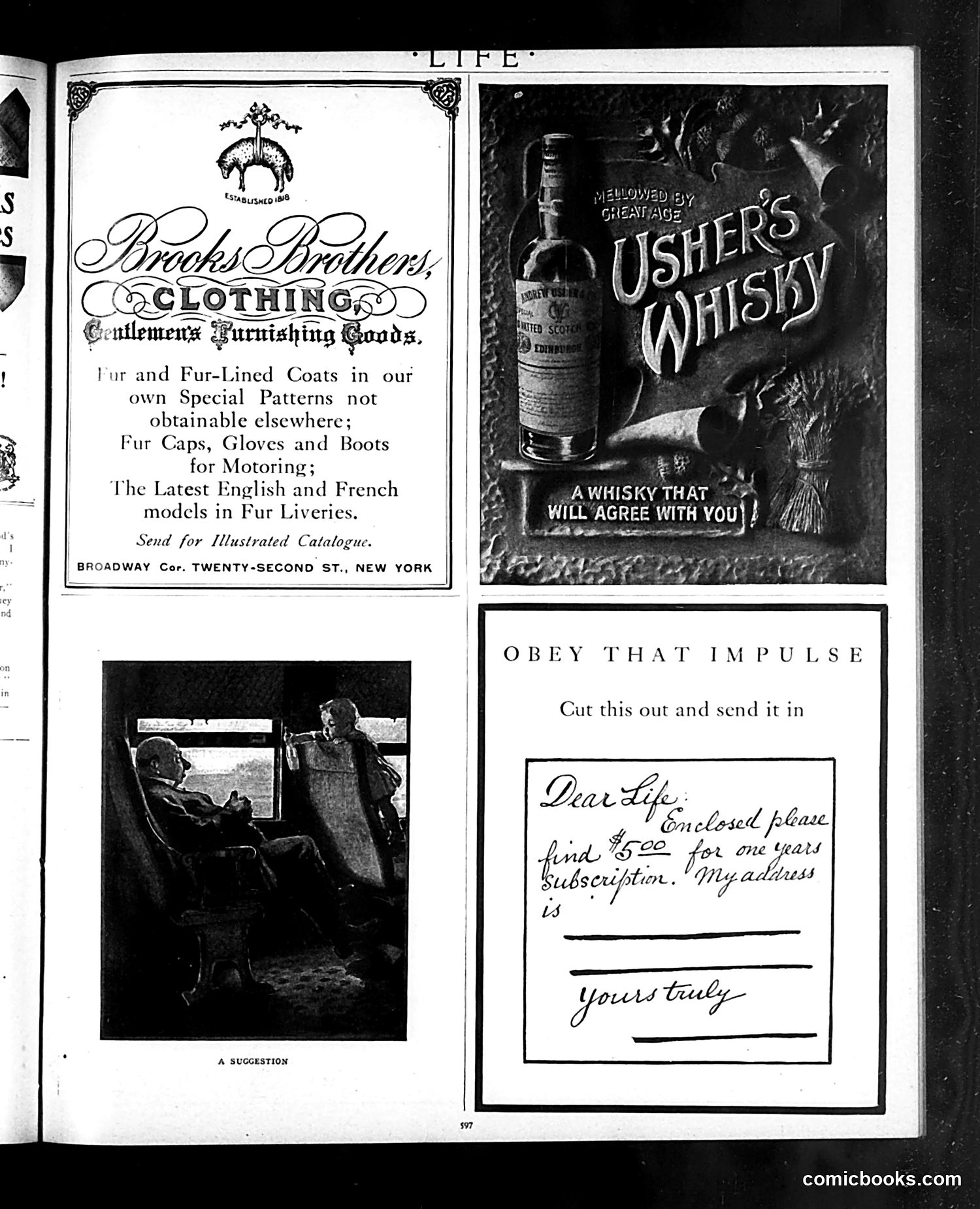
This is primarily an **advertising page** from an early 20th-century Life magazine, not political satire. The left side advertises **Brooks Brothers** clothing (fur coats, caps, gloves for "motoring"—automobiles). Below is an illustration labeled "A Suggestion" showing two figures in what appears to be a car, suggesting the advertised fur goods for automotive travel. The right side promotes **Usher's Whisky** with the slogan "A Whisky That Will Agree With You"—appealing to consumer impulse purchasing. Below this is a cutout subscription form for Life magazine itself, inviting readers to send $5.00 for a year's subscription. The page reflects early 1900s consumer culture: luxury goods (fur clothing, imported whisky) marketed to affluent readers, plus the magazine's own subscription solicitation. The humor appears gentle—"Obey That Impulse" gently mocks consumerism—rather than pointed political satire. The page is essentially commercial rather than editorial content.
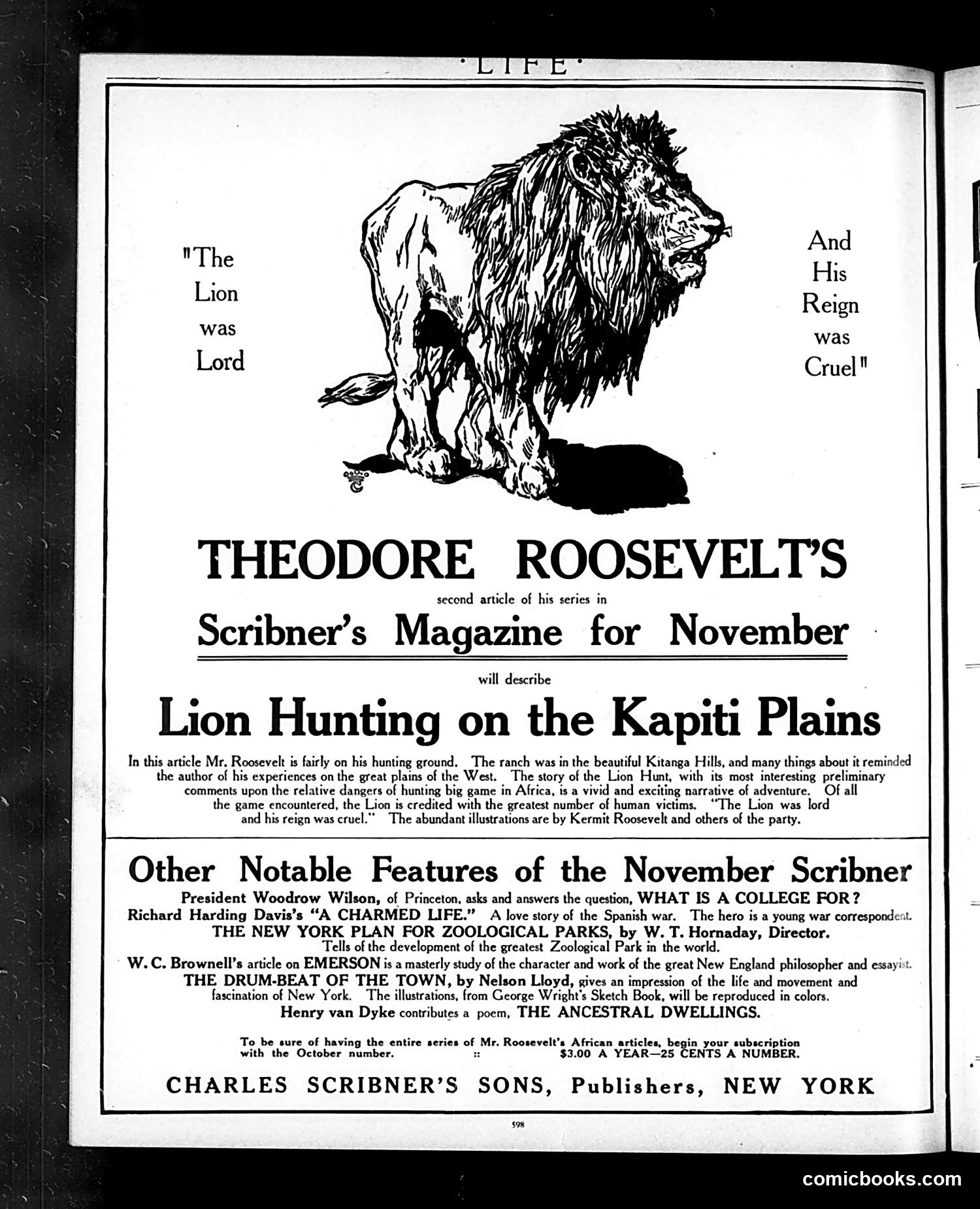
This is primarily an **advertisement page** for Scribner's Magazine's November issue, not a political cartoon. The lion illustration is decorative, accompanying promotional text for Theodore Roosevelt's article about his African hunting expedition. **Key context:** Roosevelt, recently out of office (his presidency ended in 1909), undertook a famous African safari. This ad promotes his serialized account in Scribner's, positioning him as an adventurer-author rather than politician. The quoted phrases—"The Lion was Lord" and "His Reign was Cruel"—appear to be Roosevelt's own description from the article, using the lion as a dramatic subject, not as political allegory. The page also advertises other notable articles: President Woodrow Wilson on education, Richard Harding Davis's Spanish-American War romance, and essays on Emerson and New York life. This reflects the magazine's positioning as a prestigious literary publication for educated readers. The satirical magazine *Life* is simply featuring this **paid advertisement**—not creating original satirical content itself.
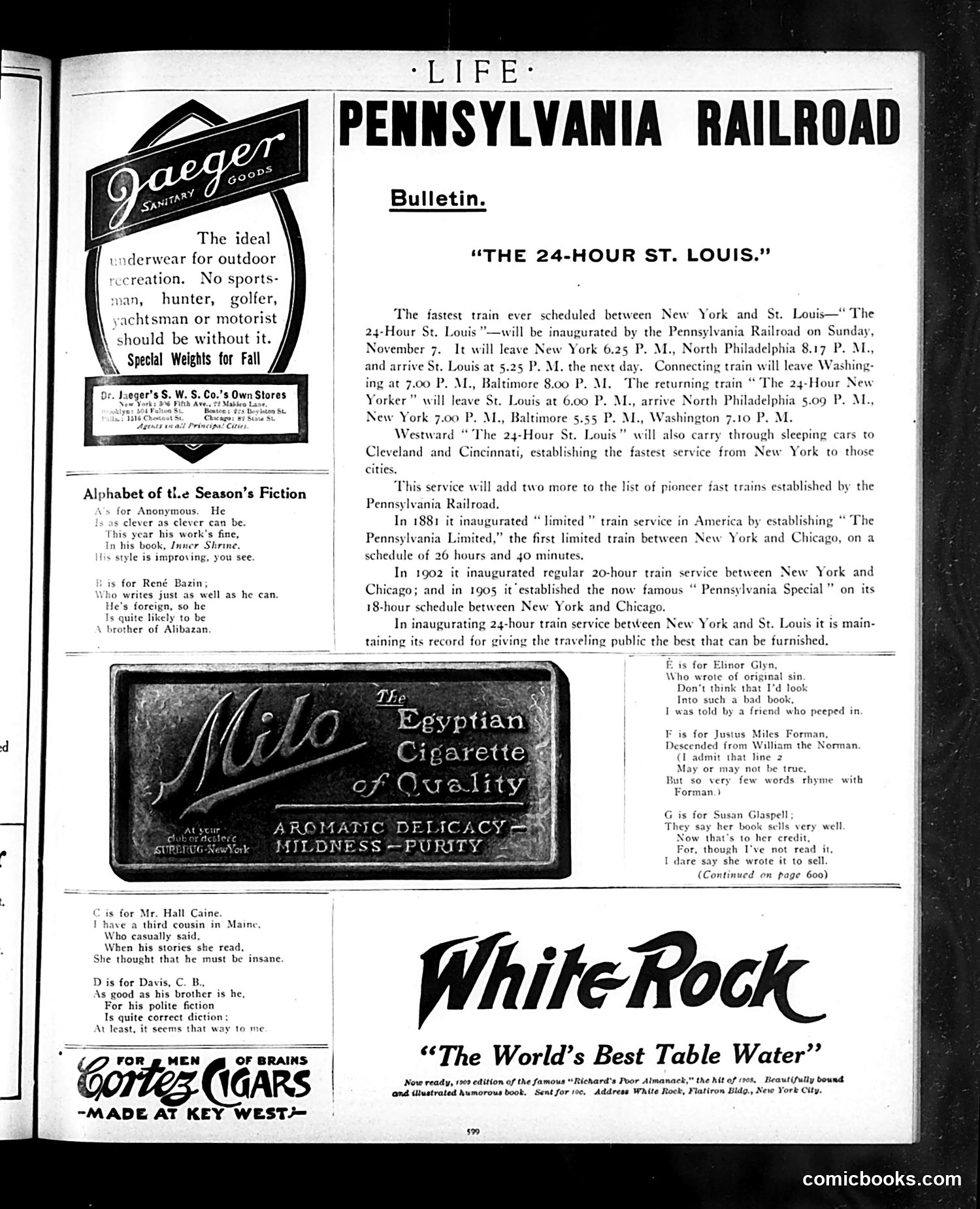
This page is primarily **advertising and railroad promotion**, not political satire. The main content is a Pennsylvania Railroad bulletin announcing "The 24-Hour St. Louis," a new express train service between New York and St. Louis, inaugurating November 7. The railroad boasts this maintains its pioneering record in fast train service (having established limited train service in 1881 and the famous "Pennsylvania Special" in 1905). The page includes period advertisements for Jaeger underwear, Nilo cigarettes, Cortez cigars, and White Rock table water. A secondary feature, "Alphabet of the Season's Fiction," provides humorous verse about contemporary authors (Elinor Glyn, Justus Miles Forman, Susan Glaspell, Hall Caine, C.B. Davis). These brief satirical couplets mock the authors' work or reputations—for instance, Glyn is ribbed for writing about "original sin," while Glaspell is praised for commercial success. The humor is light and literary-focused rather than political.
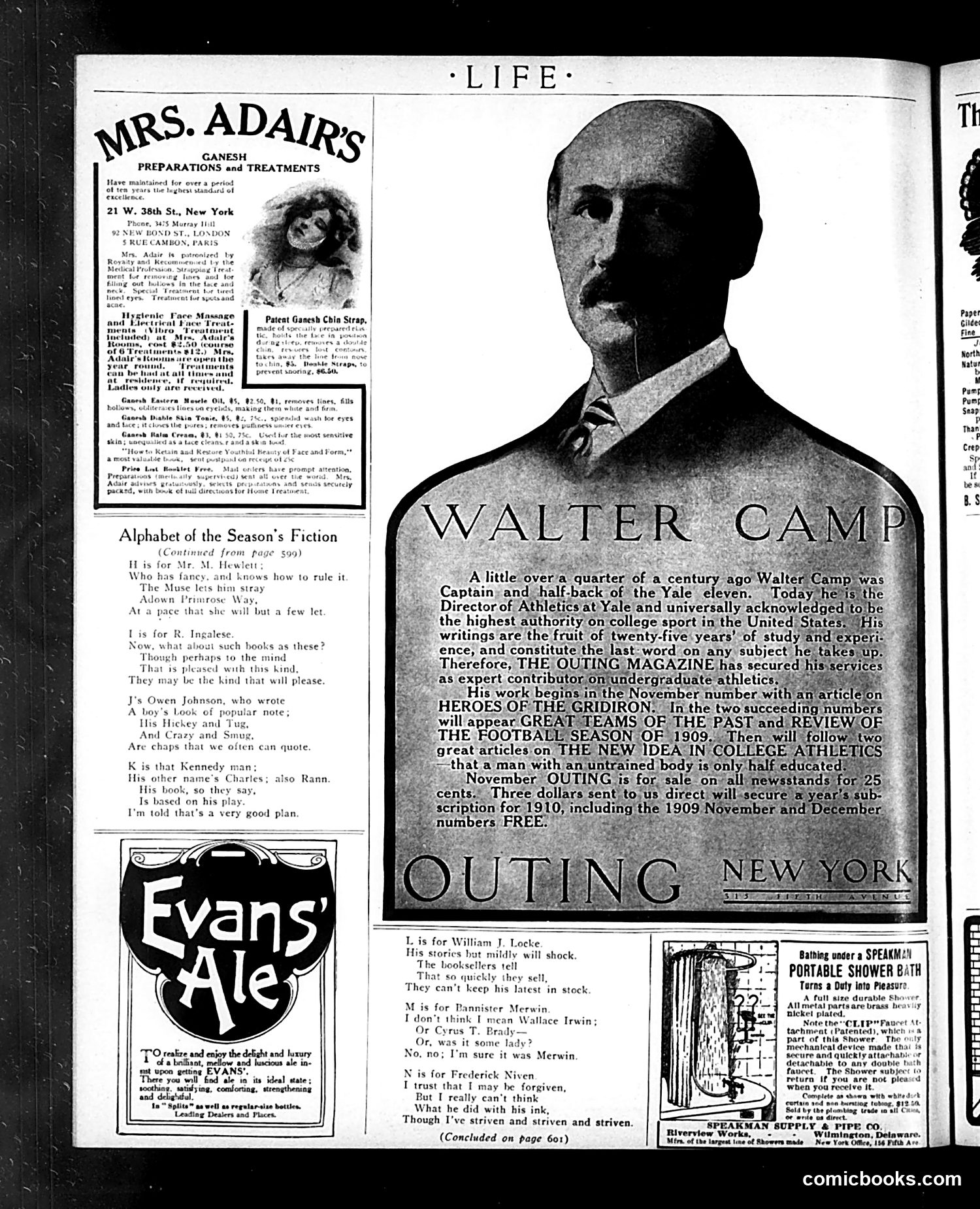
This Life magazine page contains mixed editorial and advertising content typical of early 1900s publications. **Main Feature:** A large portrait advertisement for **Walter Camp**, identified as Director of Athletics at Yale and described as the highest authority on college sport in the United States. The text promotes his upcoming articles in *Outing Magazine* about football and college athletics, soliciting subscriptions. **Editorial Content:** "Alphabet of the Season's Fiction" is a playful literary column reviewing contemporary authors through alphabetical verse—references appear to include Owen Johnson (known for school stories) and other popular writers of the era, though some names are unclear in the OCR. **Advertisements:** Include Evans' Ale and a Speakman portable shower bath. The Walter Camp feature reflects his genuine historical prominence in early American sports—he essentially invented modern football rules. The piece treats him as a celebrity whose expertise commands premium magazine space, reflecting how seriously early-20th-century publications took athletic authority.
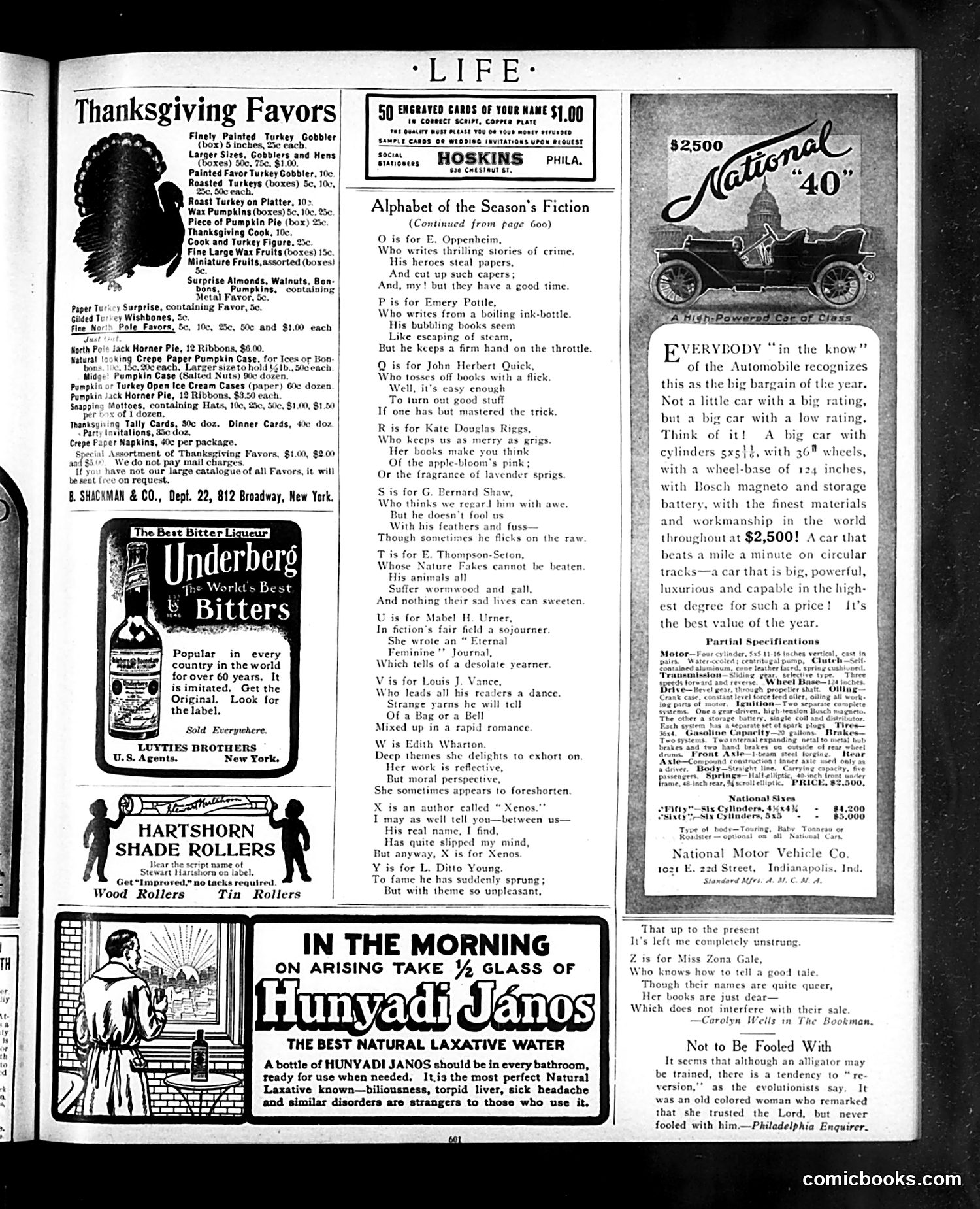
This page consists primarily of **advertisements and commercial content**, not political satire or cartoons requiring historical interpretation. The left side features Thanksgiving party favors and novelty items from B. Shackman & Co., plus ads for Underberg Bitters, Hartshorn Shade Rollers, and Hunyadi János laxative water—typical early-20th-century consumer goods marketing. The right side contains "Alphabet of the Season's Fiction"—a lighthearted verse guide to contemporary authors (Oppenheim, Shaw, Wharton, etc.), poking gentle fun at their writing styles and subject matter. This is literary humor rather than political commentary. Below is an automobile advertisement for the National "40," emphasizing its value as "a big car with a low rating." **No significant political cartoons or satirical commentary appear on this page.** It's a typical magazine issue mixing consumer advertising with light literary entertainment.
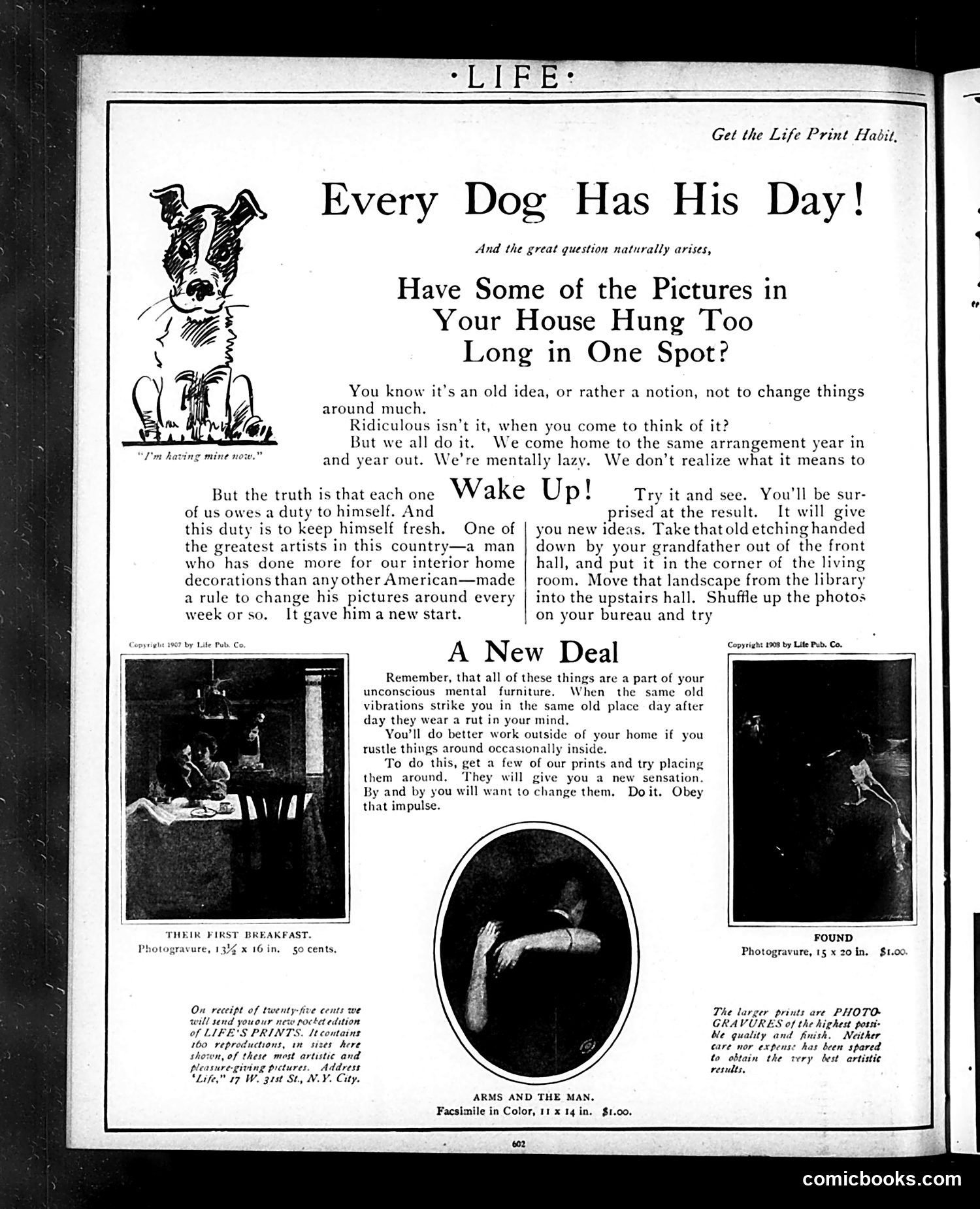
This is primarily an **advertisement for Life magazine's art prints**, not political satire. The page promotes purchasing reproductions of artwork to decorate one's home. The central argument is quasi-philosophical: Americans are mentally lazy, leaving pictures hung in the same spots year after year, creating psychological ruts. The solution? Regularly rearrange artwork and purchase Life's affordable prints to refresh one's living space. The opening dog illustration ("I'm having mine now") is a playful visual pun on the phrase "every dog has his day"—anthropomorphizing the dog enjoying its moment while promoting the idea that homeowners should give themselves a similar mental "refresh." The three sample photographs shown—"Their First Breakfast," "Found," and "Arms and the Man"—are examples of the art prints Life sells. This is essentially **early 20th-century home-décor marketing disguised as lifestyle advice**, encouraging readers to purchase prints as a form of mental wellness and interior design refreshment.

This is not a cartoon or satirical content—it's a **full-page advertisement** for Hartford Dunlop Detachable Tires, published in *Life* magazine. The ad promotes tires manufactured by the Hartford Rubber Works Company of Hartford, Connecticut. It claims the Dunlop is "The Most Rational Tire in the World," listing superiority claims: largest lived tire, fastest reported tire, most resilient, best-looking, easiest to ride on, safest, and "ideal tire equipment." The central image is a large photograph of an actual tire, with text overlaid inside the circular form. The ad notes these tires come "in all standard sizes, with plain tread and the famous HARTFORD WIRE GRIP NON-SKID MIDGLEY PATENT." There is no satire or political commentary here—it's straightforward early-automotive advertising targeting consumers considering tire purchases.
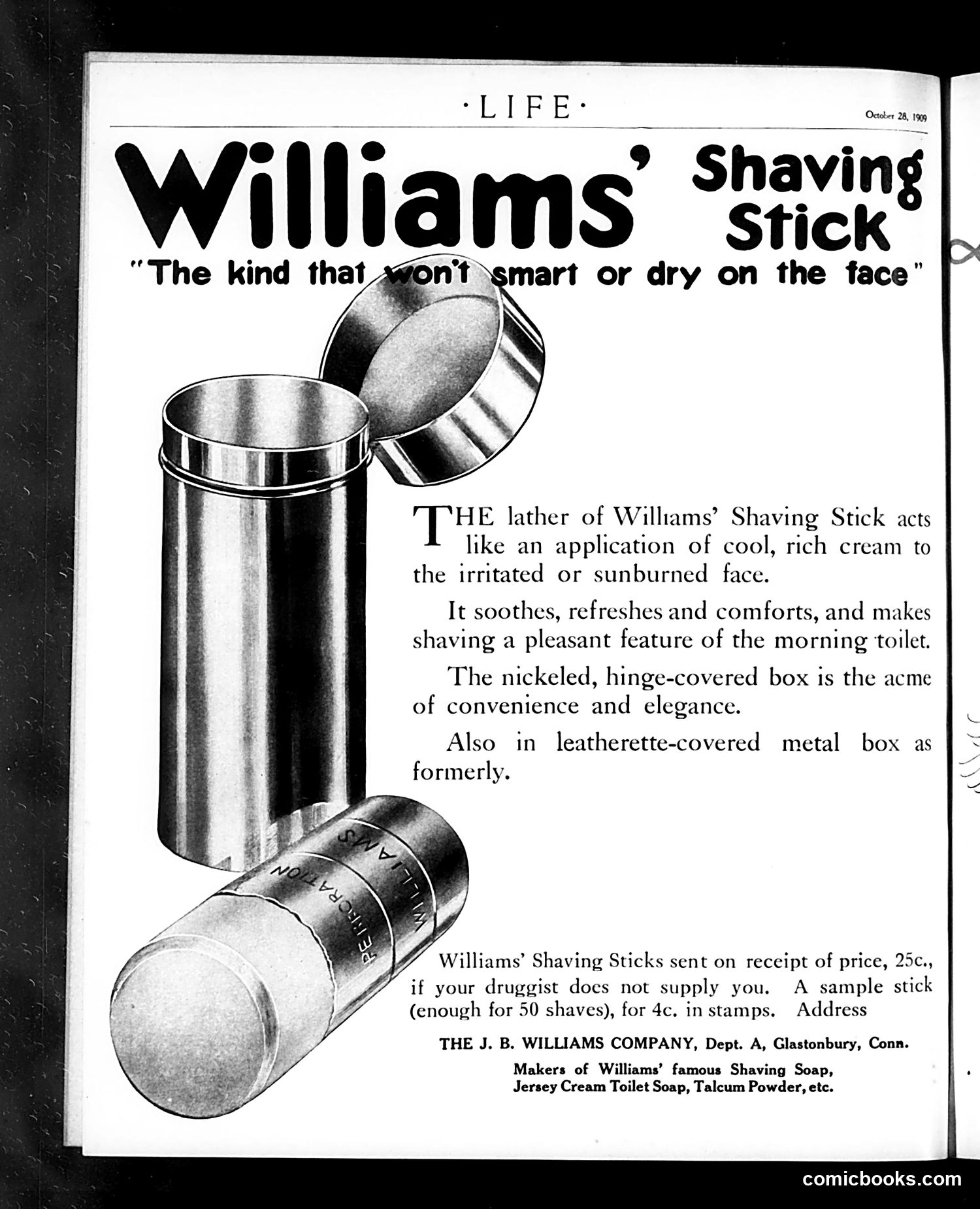
This page is a straightforward product advertisement for Williams' Shaving Stick, not a political cartoon or satirical content. It appeared in *Life* magazine on October 28, 1909. The ad promotes a men's shaving product with claims typical of early 20th-century marketing: the lather soothes irritated or sunburned skin and makes shaving pleasant. The visual shows the product's container—a nickel-plated hinged box designed for convenience and elegance. The ad offers mail-order purchasing at 25 cents, or a sample stick for 4 cents in stamps. It's from J.B. Williams Company of Glastonbury, Connecticut, makers of related grooming products. There is no satire, caricature, or political commentary here—simply vintage commercial advertising reflecting period attitudes toward masculine grooming and consumer convenience.