
Life, 1909-10-28 · page 8 of 36
Life — October 28, 1909 — page 8: what you’re looking at
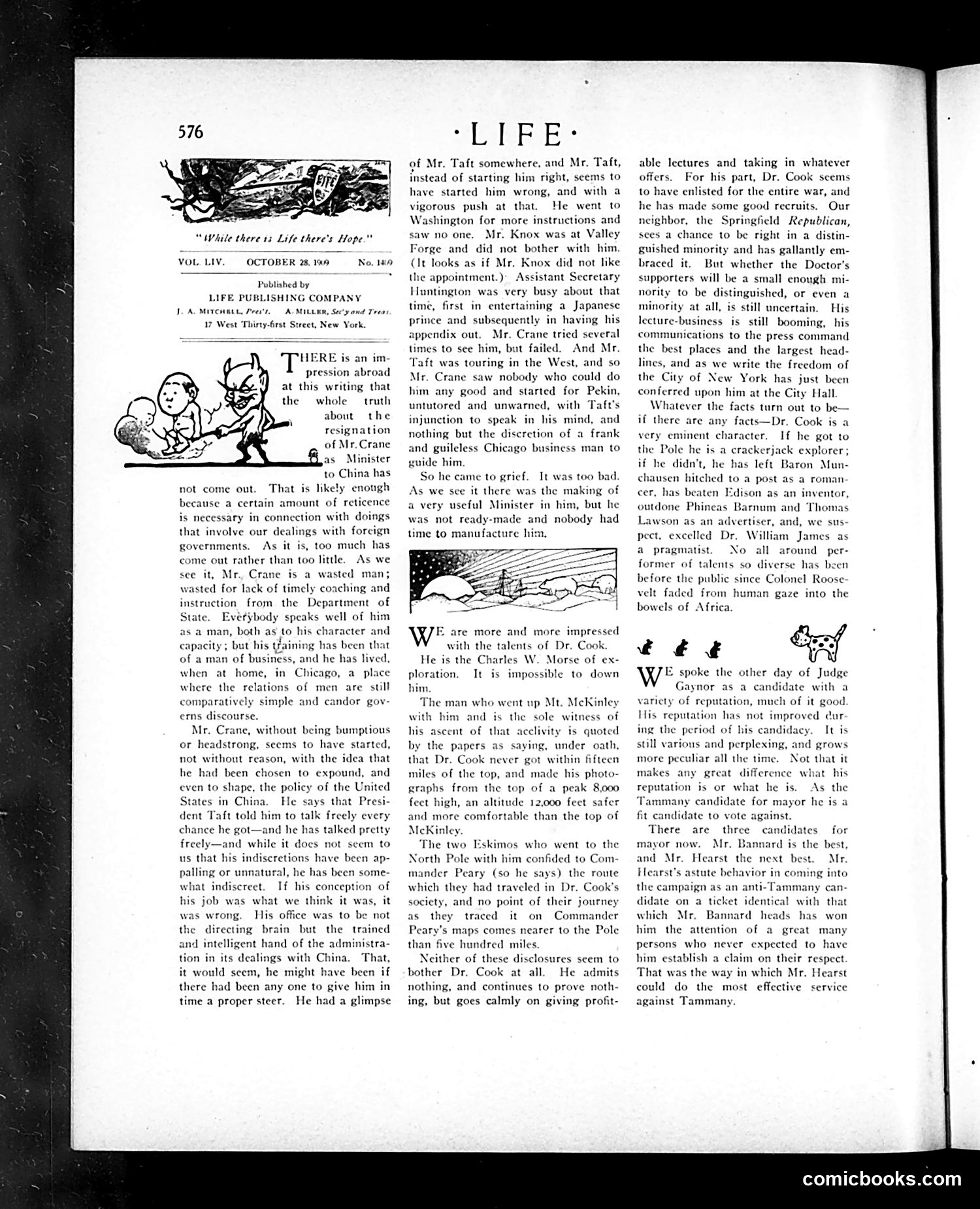
What you’re looking at
This page contains a satirical article about American political figures and exploration, with two cartoon illustrations. The main text discusses **Dr. Frederick Cook** and his disputed Arctic exploration claims, comparing him unfavorably to other explorers. The article criticizes Cook's character and business practices while praising other figures like **Dr. William James** and explorer **Charles W. Morse**. The article also mentions **Judge Gaynor** as a mayoral candidate, alongside **Mr. Bannard** and **Mr. Hearst**, discussing their reputations and fitness for office. The cartoons appear to satirize these public figures, likely depicting them in exaggerated or unflattering ways typical of Life's style. The overall thrust is mockery of questionable public figures and their credibility with voters and the press.
📄 Transcribed text from this page (OCR, searchable)
Machine-transcribed from the original scan — historical spelling and the odd misread are preserved.
VOL LIV. J “While there 1s Life there's Hope." OCTOBER 28, 199 No. Wa Published by LIFE PUBLISHING COMPANY AL MITCHELL Pret, A MILLER, Sec'y and Treas 17 West Thirty-Grst Street, New Vork. HERE is an im- pression abroad at this writing that the whole truth about the resignation of Mr.Crane as Minister to China has not come out at is likely enough because a certain amount of reticence is necessary in connection with doings that involve our dealings with foreign governments. As it is, 100 much ha: come out rather than too little. As we see it, Mr. Crane is a wasted man; wasted for lack of timely coaching and instruction from the Department of te. Evétybody speaks well of him as a man, both as to his character and capacity ; but his taining has been that of a man of business, and he has lived, when at home, in Chicago, a place where the relations of men are still comparatively simple and candor gov erns discourse. Mr. Crane, without being bumptious or headstrong, seems to have started, not without reason, with the idea that he had been chosen to expound, and even to shape, the policy of the United States in China. He says that Presi- dent Taft told him to talk freely every chance he got—and he has talked pretty freely—and while it does not seem to us that his indiscretions have been ap- palling or unnatural, he has been some- what indiscreet. If his conception of nis job was what we think it was, it was wrong. His office was to be not the directing brain but the trained nd intelligent hand of the administra- tion in its dealings with China. That, it would seem, he might have been if there had been any one to give him in time a proper steer. He had a glimpse ASRS of Mr. Taft somewhere, and Mr. Taft, instead of starting him right, seems to have started him wrong, and with vigorous push at that. He went to Washington for more instructions and saw no one. Mr. Knox was at Valley Forge and did not bother with him. (It looks as if Mr. Knox did not like the appointment.) Assistant Secretary Huntington was very busy about that time, first in entertaining a Japanese prince and subsequently in having his appendix out. Mr. Crane tried several times to see him, but failed. And Mr. Taft was touring in the West, and so Mr. Crane saw nobody who could do him any good and started for Pekin, untutored and unwarned, with Taft's injunction to speak in his mind, and nothing but the discretion of a frank and guileless Chicago business man to guide him > he came to grief. It was too bad. s we sce it there was the making of very useful Minister in him, but he was not ready-made and nobody had time to manufacture him, are more and more impressed with the talents of Dr. Cook. He is the Charles W. Morse of ex- ploration. It is impossible to down hi The man who went up Mt. McKinley with him and is the sole witness of his ascent of that acclivity is quoted by the papers as saying, under oath, that Dr. Cook never got within fifteen miles of the top, and made his photo- graphs from the top of a peak 8,000 feet high, an altitude 12,000 fect safer and more comfortable than the top of McKinley The two E to the North Pole with him confided to Com- nander Peary (so he says) the route which they had traveled in Dr. Cook’s society, and no point of their journey as they traced it Commander Peary'’s maps comes nearer to the Pole than five hundred miles. Neither of these disclosures seem to bother Dr. Cook at all. He admits nothing, and continues to prove noth- ing, but goes calmly on giving profit- kimos who went on able lectures and taking in whatever For his part, Dr. Cook seems to have enlisted for the entire war, and he has made some good recruits. Our neighbor, the Springfield Republican, sees a chance to be right in a distin- guished minority and has gallantly em- braced it. But whether the Doctor's supporters will be a small enough mi- nority to be distinguished, or even a minority at all, is still uncertain. His lecture-business is still booming, his communications to the press command the best places and the largest head- lines, and as we write the freedom of the City of New York has just been conferred upon him at the City Hall. Whatever the facts turn out to be— if there are any facts—Dr. Cook is a eminent cl cter. If he got to the Pole he is a crackerjack explorer; if he didn’t, he has left Baron Mun- chausen hitched to a post as a roman- cer, has beaten Edison as an inventor, outdone Phineas Barnum and Thomas Lawson as an advertiser, and, we sus- pect, excelled Dr. William James as a pragmatist. No all around former of talents so diverse has been before the public since Colonel Roose- velt faded from human gaze into the bowels of Africa. WE spoke the other day of Judge Gaynor as a candidate with a variety of reputation, much of it good His reputation has not improved dur ing the period of his candidacy. It is still various and perplexing, and grows more peculiar all the time, Not that it makes any great what his reputation is or what he is. As the ‘Tammany candidate for mayor he is a fit candidate to vote against. There are three candidates for mayor now, Mr. Bannard is the best, and Mr. Hearst the next best. Mr. Hearst's astute behavior in coming into the campaign as an anti-Tammany can- didate on a ticket identical with th: which Mr. Bannard heads has won him the attention of a great many persons who never expected to have him establish a claim on their respect That was the way in which Mr. Hearst could do the most effective against Tammany offers. very per- difference service comicbooks.com