
Life, 1909-10-28 · page 17 of 36
Life — October 28, 1909 — page 17: what you’re looking at
What you’re looking at
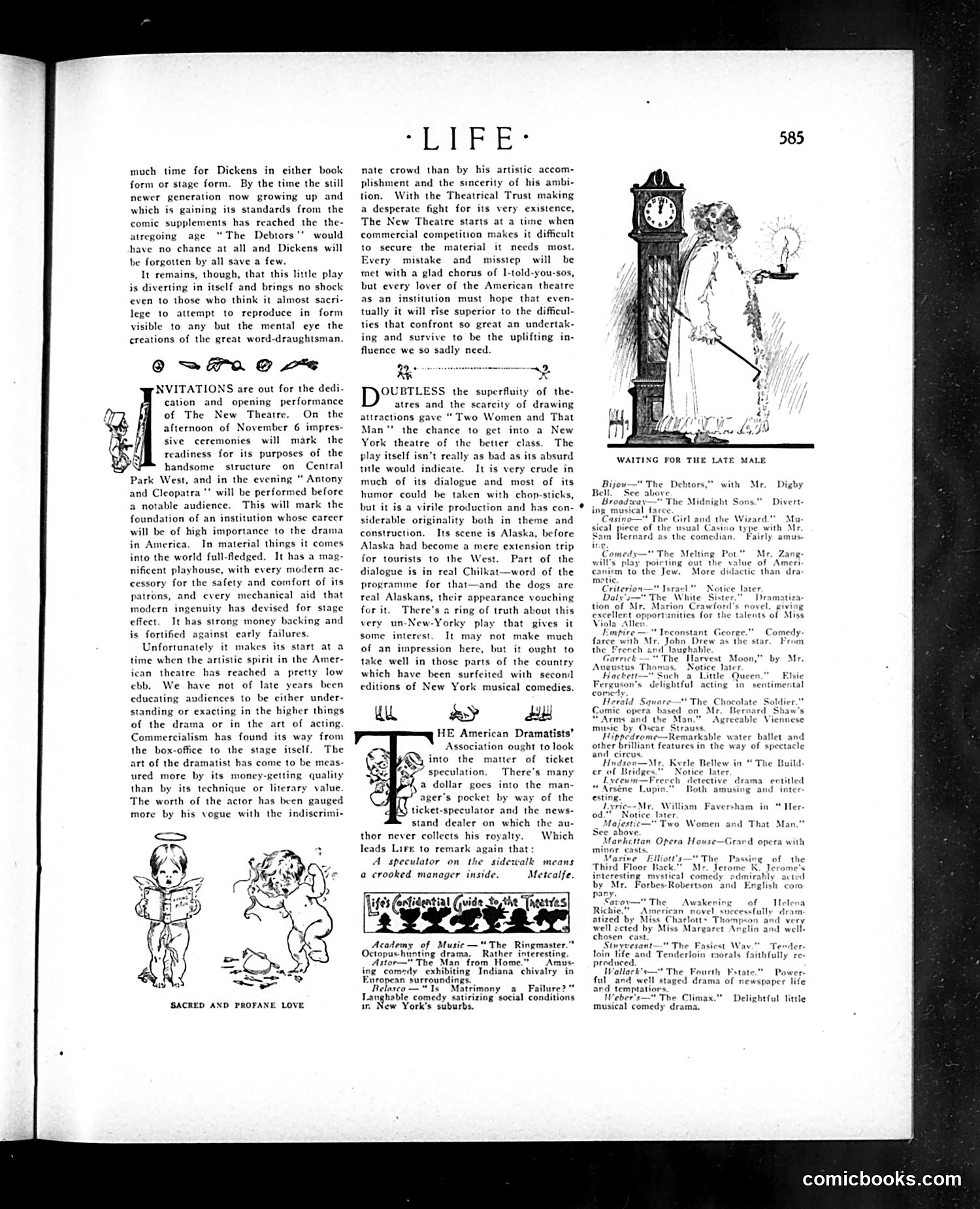
This page discusses New York theatre in the early 1900s, focusing on the upcoming opening of "The New Theatre" (November 6). The main text criticizes American theatre's declining artistic standards, blaming commercialism and the "Theatrical Trust" for prioritizing profit over quality. It warns that The New Theatre, despite excellent facilities and funding, faces a cultural climate where audiences have been conditioned by "comic supplements" rather than serious drama. The page reviews two plays: "The Debtors" (criticized as Dickens adaptation that will soon be forgotten) and "Two Women and That Man" (set in Alaska, praised for originality despite crude dialogue and absurd title). The cartoon "Sacred and Profane Love" (lower left) appears to show cherubs or cupids in contrasting states—likely satirizing the theatrical tension between highbrow and lowbrow entertainment discussed in the text. The page reflects Progressive Era anxieties about mass culture degrading public taste.
📄 Transcribed text from this page (OCR, searchable)
Machine-transcribed from the original scan — historical spelling and the odd misread are preserved.
much time for Dickens in either book form or stage form. By the time the still newer generation now growing up and which is gaining its standards from the comic supplements has reached the the- atregoing age “The Debtors"? would have no chance at all and Dickens will be forgotten by all save a few. It remains, though, that this little play is diverting in itself and brings no shock even to those who think it almost sacri- lege to attempt to reproduce in form visible to any but the mental eye the creations of the great word-draughtsman, 0 Ko. Oo He NVITATIONS are out for the dedi- cation and opening performance of The New Theatre. On the afternoon of November 6 impres- sive ceremonies will mark the readiness for its purposes of the handsome structure on Central Park West, and in the evening “ Antony and Cleopatra "’ will be performed before a notable audience. This will mark the foundation of an institution whose career will be of high importance to the drama in America. In material things it comes into the world full-fledged. It has a mag- nificent playhouse, with every modern ac cessory for the safety and comfort of its patrons, and every mechanical aid that modern ingenuity has devised for stage effect. It has strong money backing and is fortified against early failures Unfortunately it makes its start at a time when the artistic spirit in the Amer- ican theatre has reached a pretty low ebb. We have not of late years been educating audiences to be her under- standing or exacting in the higher things of the drama or in the art of acting. Commercialism has found its way from the box-office to the stage itself. The art of the dramatist has come to be meas- ured more by its money-getting quality than by its technique or literary value ‘The worth of the actor has been gauged more by his vogue with the indiscrimi SACRED AND PROFANE LOVE al cg nate crowd than by his artistic accom- plishment and the sincerity of his ambi- tion. With the Theatrical Trust making a desperate fight for its very existence, The New Theatre starts at a time when commercial competition makes it difficult to secure the material it needs most. Every mistake and misstep will be met with a glad chorus of I-told-you-sos, but every lover of the American theatre as an institution must hope that even- tually it will rise superior to the difficul- ties that confront so great an undertak- ing and survive to be the uplifting in- fluence we so sadly need. OUBTLESS the superfluity of the- atres and the scarcity of drawing attractions gave “Two Women and That Man"? the chance to get into a New York theatre of the better class. The play itself isn’t really as bad as its absurd utle would indicate. It is very crude in much of its dialogue and most of its humor could be taken with chop-sticks, but it is a virile production and has con- siderable originality both in theme and construction. Its scene is Alaska, before Alaska had become a mere extension trip for tourists to the We: Part of the dialogue is in real Chilkat—word of the programme for that—and the dogs are real Alaskans, their appearance vouching for it. There's a ring of truth about this very un-New-Yorky play that gives it some interest. It may not make much of an impression here, but it ought to take well in those parts of the country which have been surfeited with second editions of New York musical comedies. cc ay A HE American Dramatists’ Association ought to look AQ, into the matter of ticket Re” speculation. There's many a dollar goes into the man- ager’s pocket by way of the ticket-speculator and the news- stand dealer on which the a thor never collects his royalty. Which leads Lire to remark again that: A speculator on the sidewalk means a crooked manager inside. Metcalfe. Academy of Music—“The Ringmaster.” Octopuchunting drama, Rather interesting Astor—“ The Man from Home.” Amus ing comedy exhibiting Indiana chivalry in European surroundings. Relasco— “1s Matrimony a Failure?” Langhable comedy, satirizing social conditions an. New York's suburbs. WAITING FOR THE LATE MALE Bijou—" The Debtors," with Mr Bell. See above “The Midnight Sons.” al farce —" The Girl and the Wizard.” Mu piece of the usual Casino type with Mr, fernard as the comedi Digby Divert- Comedy—" The Melting Pot." Mr. Zang: will’s play poirting out the value of Amer canism to the Jew. More didactic than dra Criterion—" Israel" Notice later Daly's—" The White Sister.” Dramatiza. tion of Mr. Marion Crawlord's novel. giving excellent opportunities for the talents of Miss Viola All Empire — * Inconstant George.” Comedy farce with Mr. John Drew as the star. From the French and laughs Garrick — "The Harvest Moon,” by Mr. Augustus Thomas. Notice later “Such a Little Quee Elsie delightful acting in sentimental comedy opera based on, Mr. Bernard Shaw's “Arms and the Man." Agrecable Viennese music by Oscar Strauss Hippedrome—Remarkable water ballet and orher brilliant features in the way of spectacle and cirew Hudson Kerle Belle er of Bridges.” Notice later Lyceum—Frerch sletective “ Nrséne Lupi esting. I.yric--Me, William Faversham in“ Her- od." Notice. tat ~ Majestic—" Two Women and That Man.” See above Marhcttan Opera Honse—Grand op: Varive Elliott's—“The Passing of the Third Floor Mack." Mr. Jerome K. Jerome" interesting mystical comedy 0 by Mr. Forbes-Robertson and pany. Savoy—" The Awakening of Ielena hie." American novel successfully dram atized by Mise Charlott> Thompeon and very well scted by Miss Margaret Anglia and well: chosen cast Stu yeesant—“ The Fasiest Way." Tenders loin life. and Tenderloin taorals faithfully re- preduced. . Welleck's h Fstate." Power: ful and well staged drama of newspaper life and temptations veber's—" The Climax.” musical comedy drama. Fairly amus: in “ The Build drama entitled Roth amusing and inter ably act English com Delightful little comicbooks.com