
A complete issue · 32 pages · 1909
Life — September 30, 1909
I can see this is labeled "HUDSON NUMBER" from Life magazine (Vol. LIV, No. 1405), and there's a property stamp indicating it belonged to "The Lincoln Centre" library. However, the image itself is almost entirely black/dark, with only a faint illustration barely visible in the lower center portion—it appears to show some kind of architectural or structural element, possibly a bridge or tunnel opening. The OCR text provided contains only the header information and no article or caption text that would explain the cartoon's meaning. Without legible visual detail or accompanying text, I cannot reliably identify the specific figures, political references, or satirical intent of this page's content.
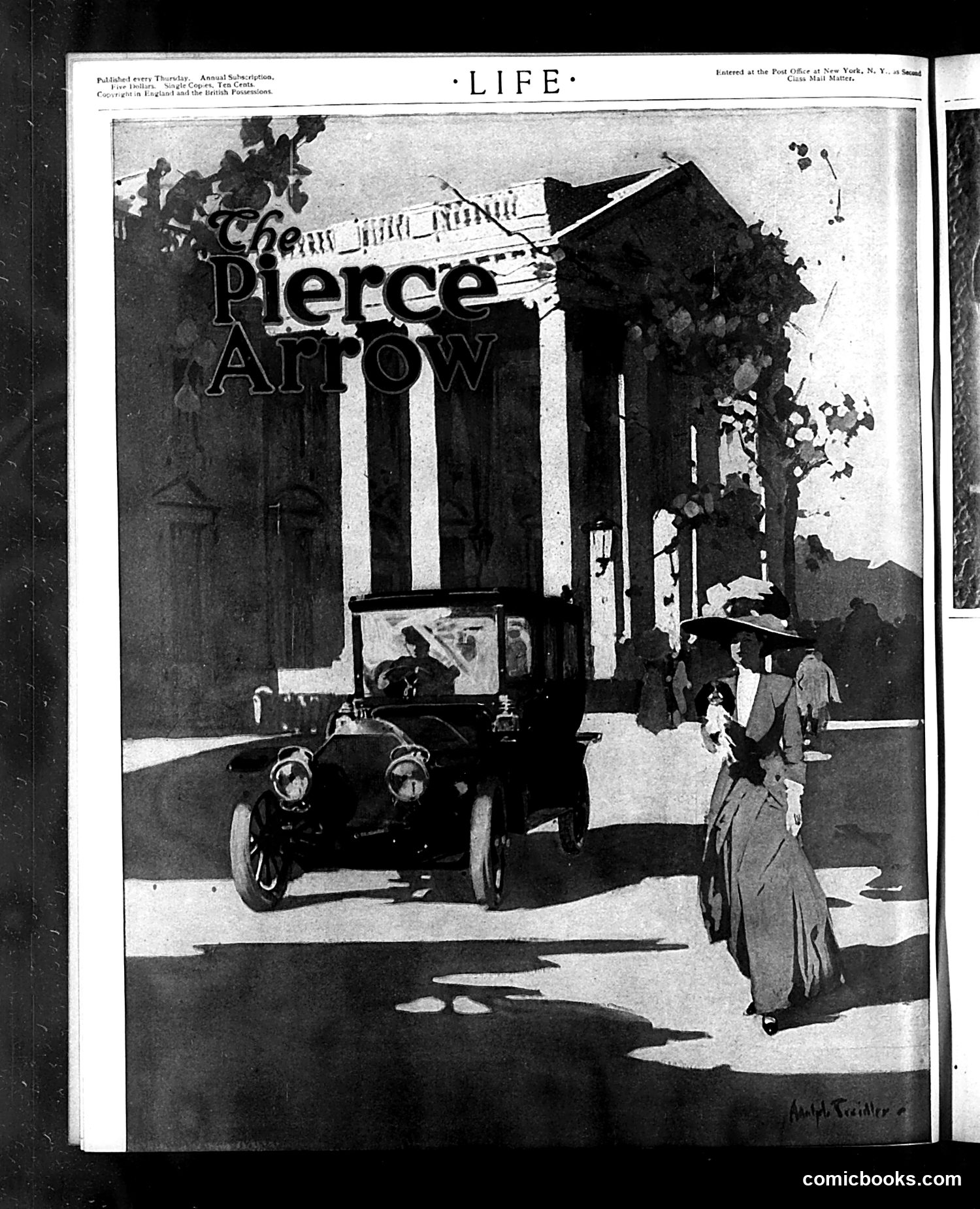
This is **not a political cartoon** but rather a **automobile advertisement** for the Pierce-Arrow motor car, published in *Life* magazine. The image depicts an elegant scene at what appears to be a classical building with grand columns. A Pierce-Arrow automobile is prominently displayed in the foreground, with well-dressed figures (likely representing wealthy or fashionable society) admiring or arriving in the vehicle. The architectural setting and refined clothing suggest this ad targets affluent consumers. The advertisement uses the classical, prestigious backdrop to convey luxury and status—associating the Pierce-Arrow brand with wealth, sophistication, and high society. This was typical marketing strategy for premium automobiles in the early 20th century, appealing to aspirational upper-class audiences.
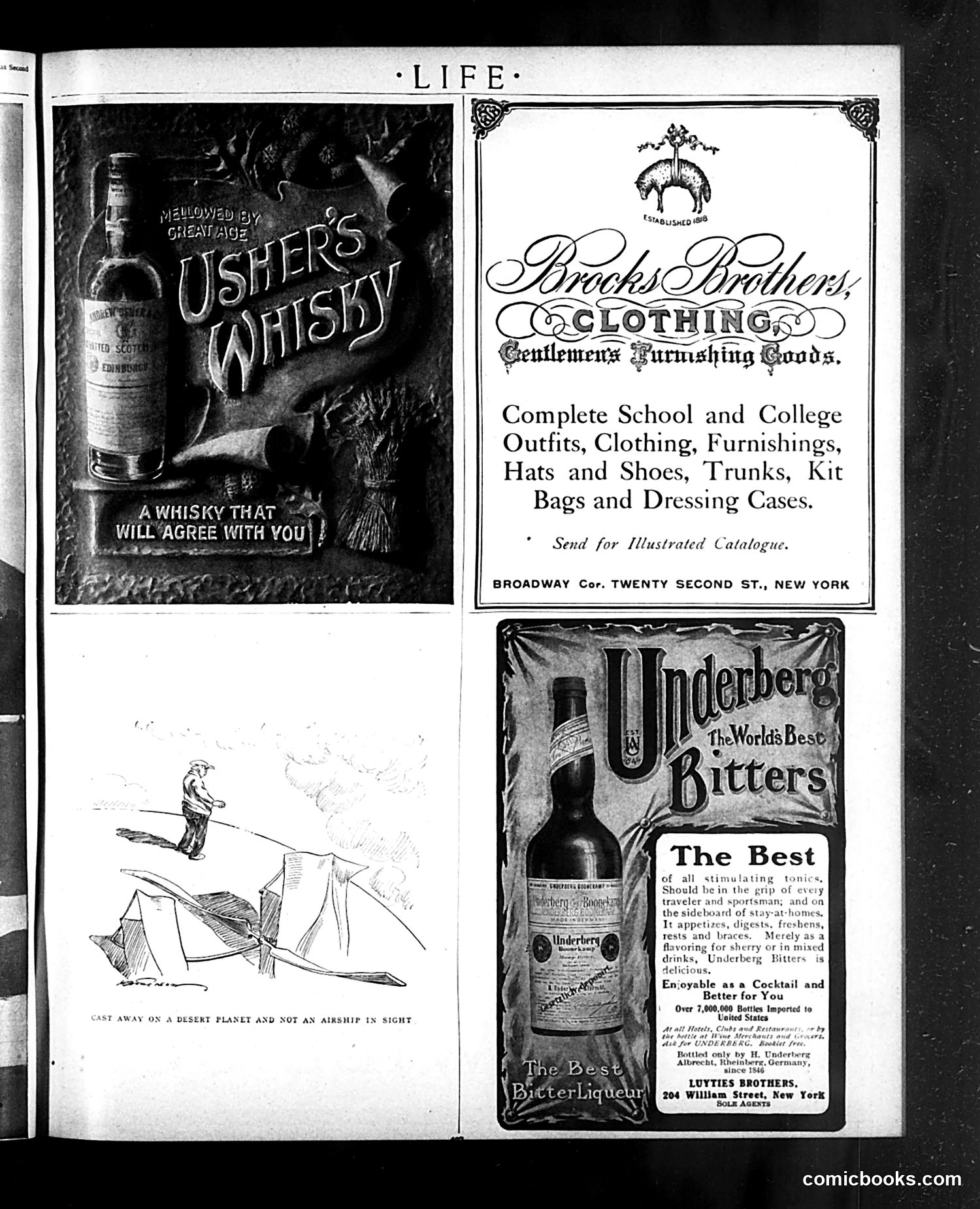
This page is primarily **advertisements** rather than editorial content. The top left features Usher's Whisky ("A Whisky That Will Agree With You"), upper right shows Brooks Brothers clothing for gentlemen, and the lower right advertises Underberg Bitters ("The World's Best"). The only cartoon appears at bottom left: a simple line drawing showing a figure lying on what appears to be a desert planet with a sailing ship nearby, captioned "Cast Away on a Desert Planet and Not an Airship in Sight." This is a **science fiction joke**—likely referencing early 20th-century fascination with space travel and airships. The humor relies on the absurdity of being stranded on another planet without even the technological option of an airship to escape.
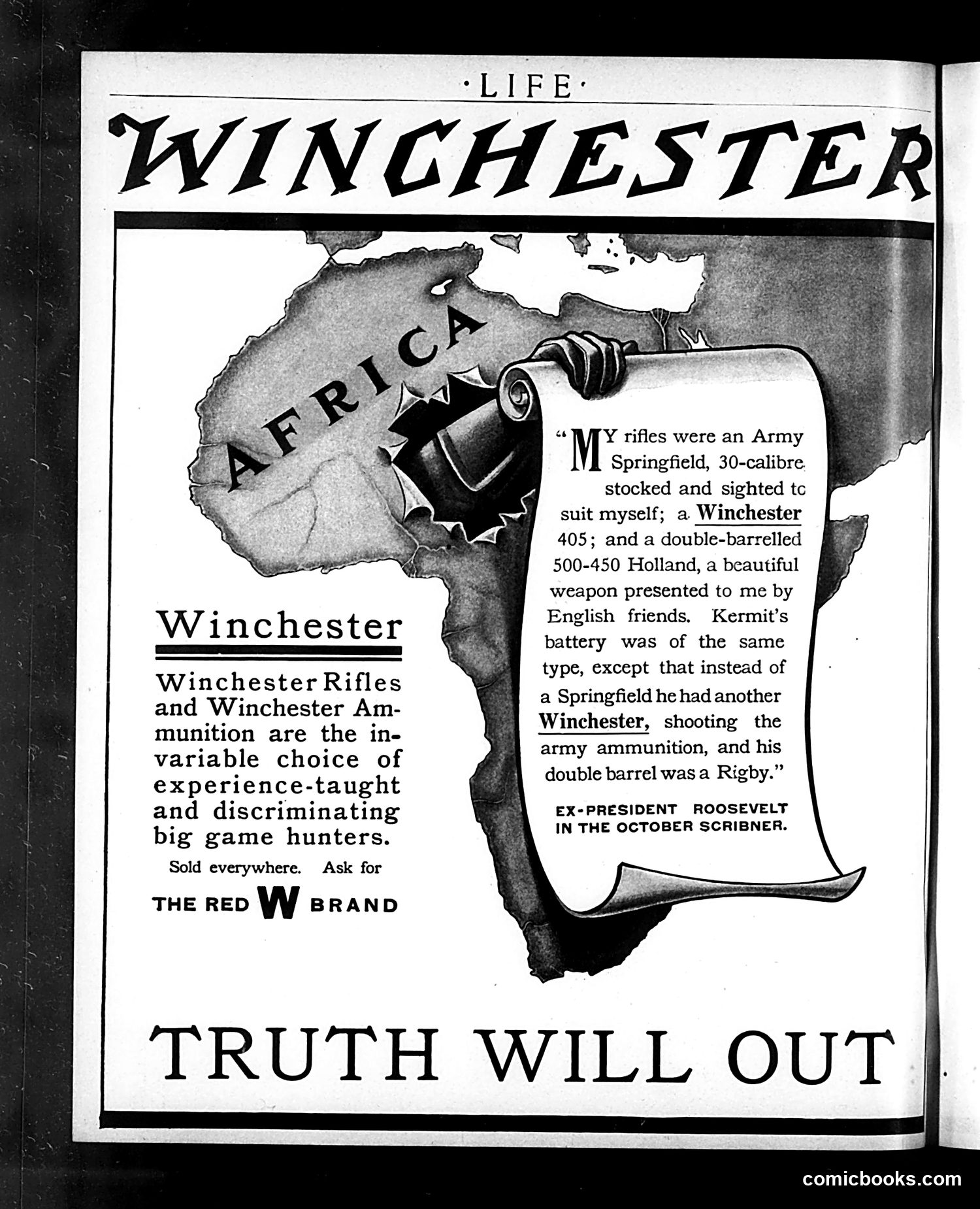
This is primarily **advertising, not satire**. The page promotes Winchester rifles and ammunition using a map of Africa and a fist emerging from the continent. The ad includes a **testimonial from Ex-President Roosevelt** describing his personal firearms collection used during African hunting. Roosevelt mentions an Army Springfield, a Winchester 405 rifle, and a Holland double-barrel shotgun provided by English friends. The visual strategy links Winchester products to Roosevelt's prestige and African big-game hunting expertise. The phrase "Truth Will Out" suggests Winchester rifles are the honest choice for serious hunters. The Africa imagery and Roosevelt's endorsement were likely intended to evoke adventure, colonial exploration, and masculine sporting prowess—marketing appeals common in early 20th-century publications.
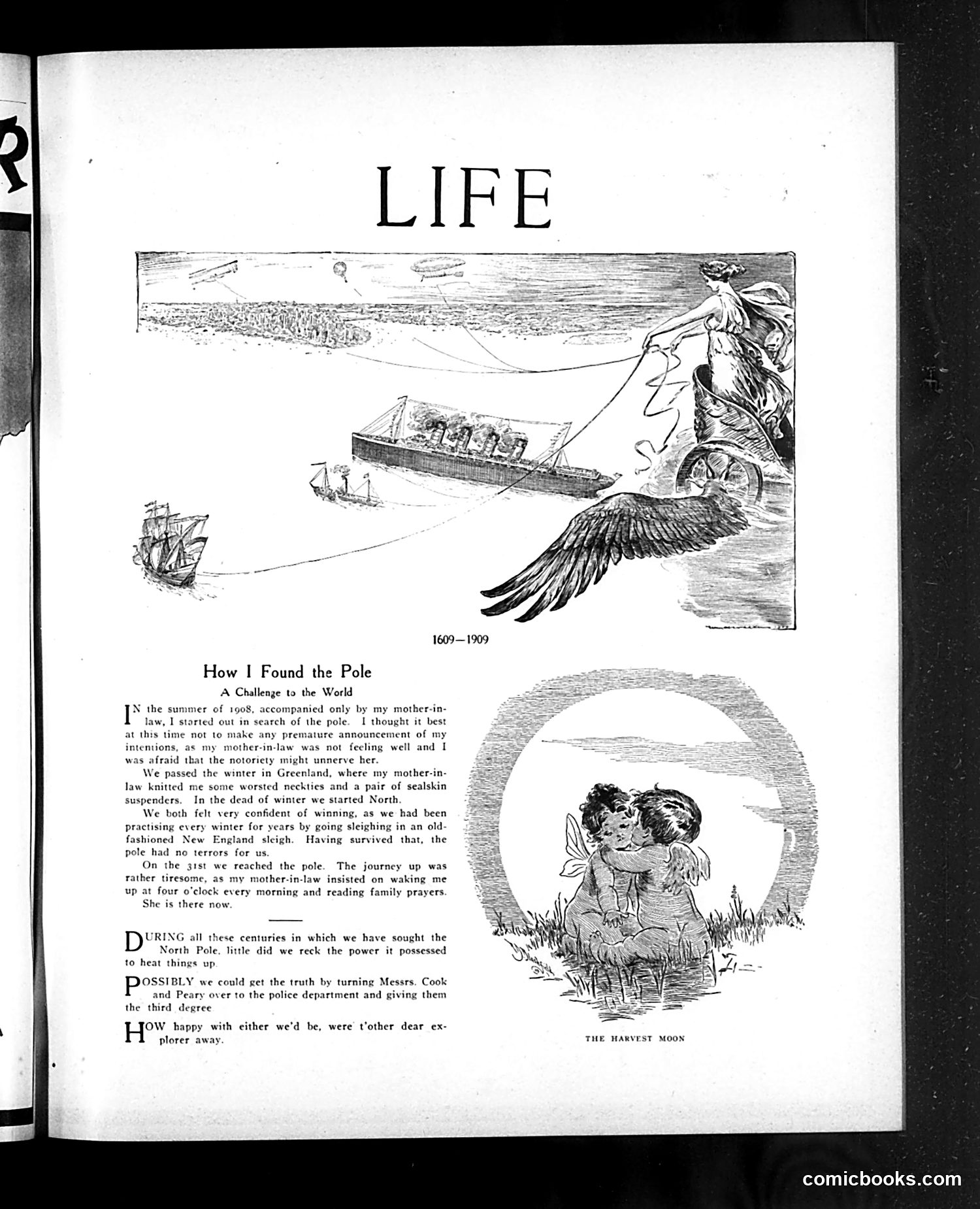
This page appears to be from a satirical account (dated 1609-1909) mocking polar exploration claims. The top illustration shows a winged allegorical figure guiding various ships—likely representing different explorers' competing claims to discovering the North Pole. The article text, titled "How I Found the Pole: A Challenge to the World," describes a 1908 expedition with the author's mother-in-law, mentioning New England sleighs and sled dogs. The tone is deliberately tongue-in-cheek, particularly the line "rather tiresome, as my mother-in-law insisted on waking me up at four o'clock every morning and reading family prayers." The satire appears to mock the era's polar exploration controversies and inflated claims of discovery, while using domestic humor (overbearing in-laws) for comedic effect.
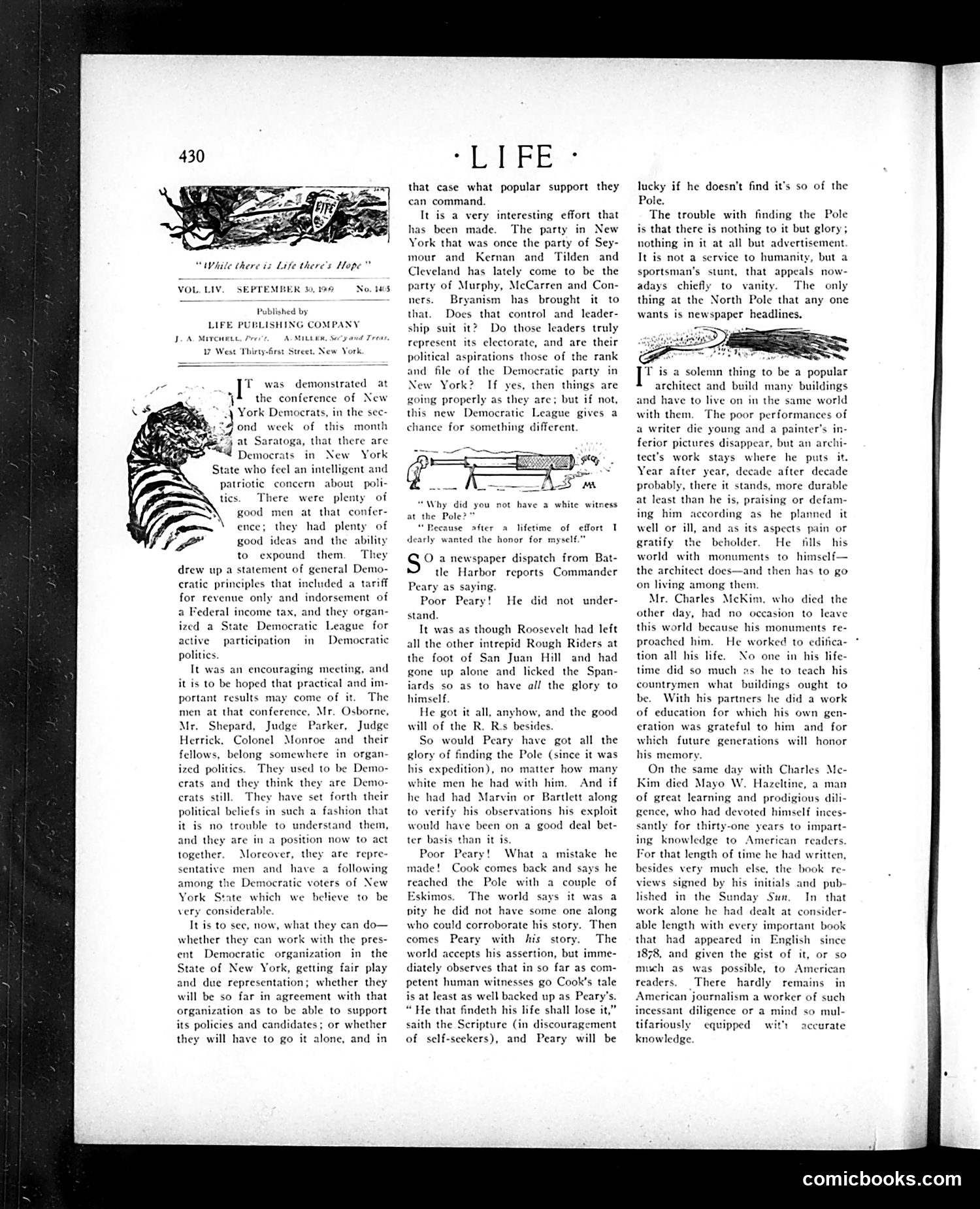
The page contains two editorial cartoons addressing Democratic Party politics in New York State. The **left cartoon** depicts a figure labeled "While there is Life there's Hope" with patriotic imagery, likely commenting on Democratic Party leadership struggles. The **right cartoon** shows what appears to be a construction or surveying scene, titled "Why did you not have a white witness at the Pole?" This references the recent Peary-Cook polar expedition controversy—both explorers claimed discovering the North Pole, with credibility questions arising about their witnesses and evidence. The cartoon satirizes the dispute through the lens of racial bias (mentioning "white witness"), reflecting early-1900s attitudes while mocking the explorers' competing claims. The accompanying text discusses Democratic League organization and party leadership in New York, suggesting internal party conflicts.
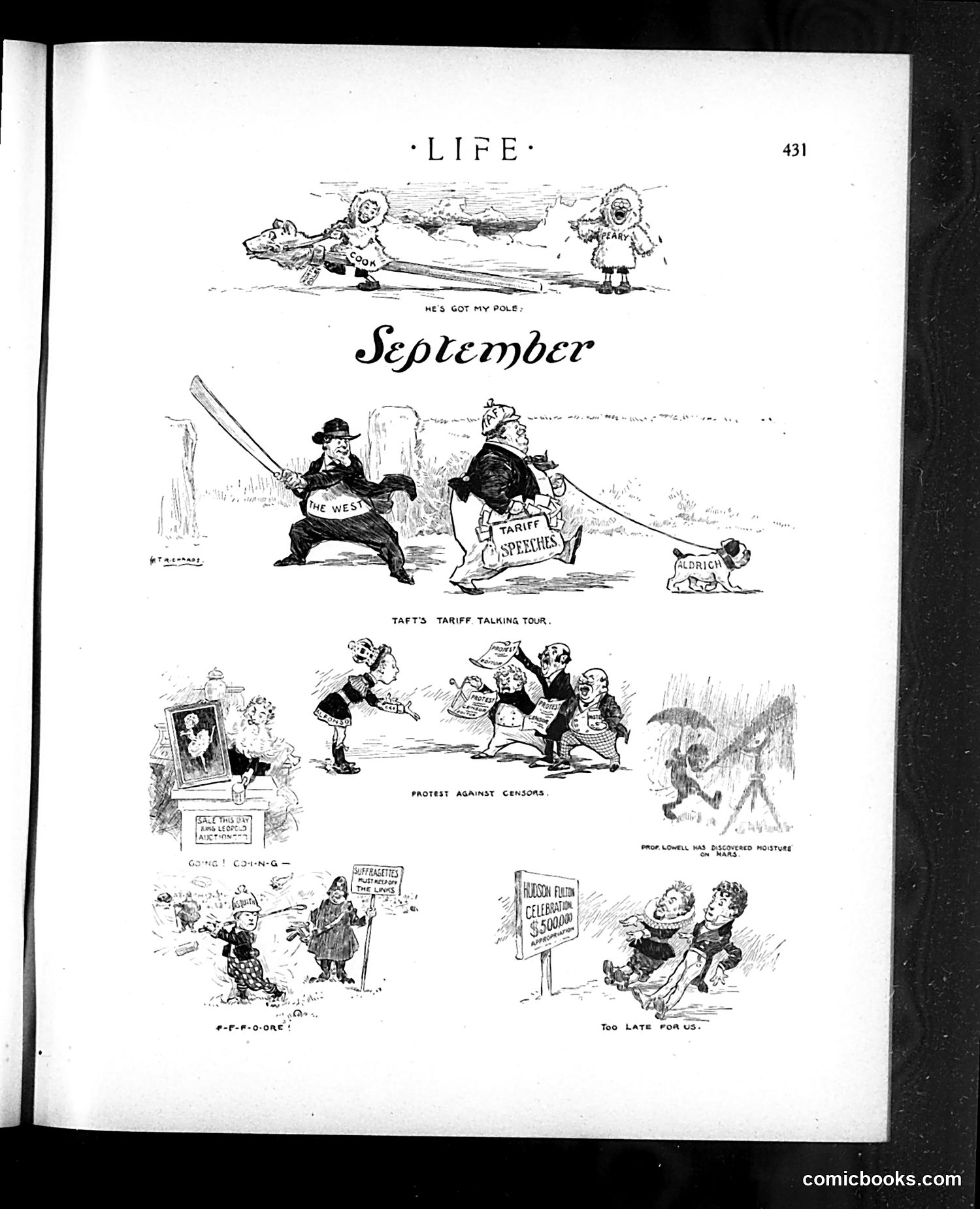
This page collects several September-themed political cartoons. The central cartoon, "Taft's Tariff Talking Tour," depicts President William Howard Taft (labeled "The West") wielding a baseball bat against a figure representing "Tariff Speeches" while another character labeled "Aldrich" is being knocked away. This satirizes Taft's campaign tour promoting his tariff policies. Other panels reference contemporary political controversies: "Protest Against Censors" appears to mock free-speech debates, while "Going Long" likely references political maneuvering. The final cartoon, "Too Late for Us," shows figures apparently excluded from some political development. The cartoons collectively criticize Republican Party leadership and policy positions during what appears to be the Taft administration era (1909-1913).
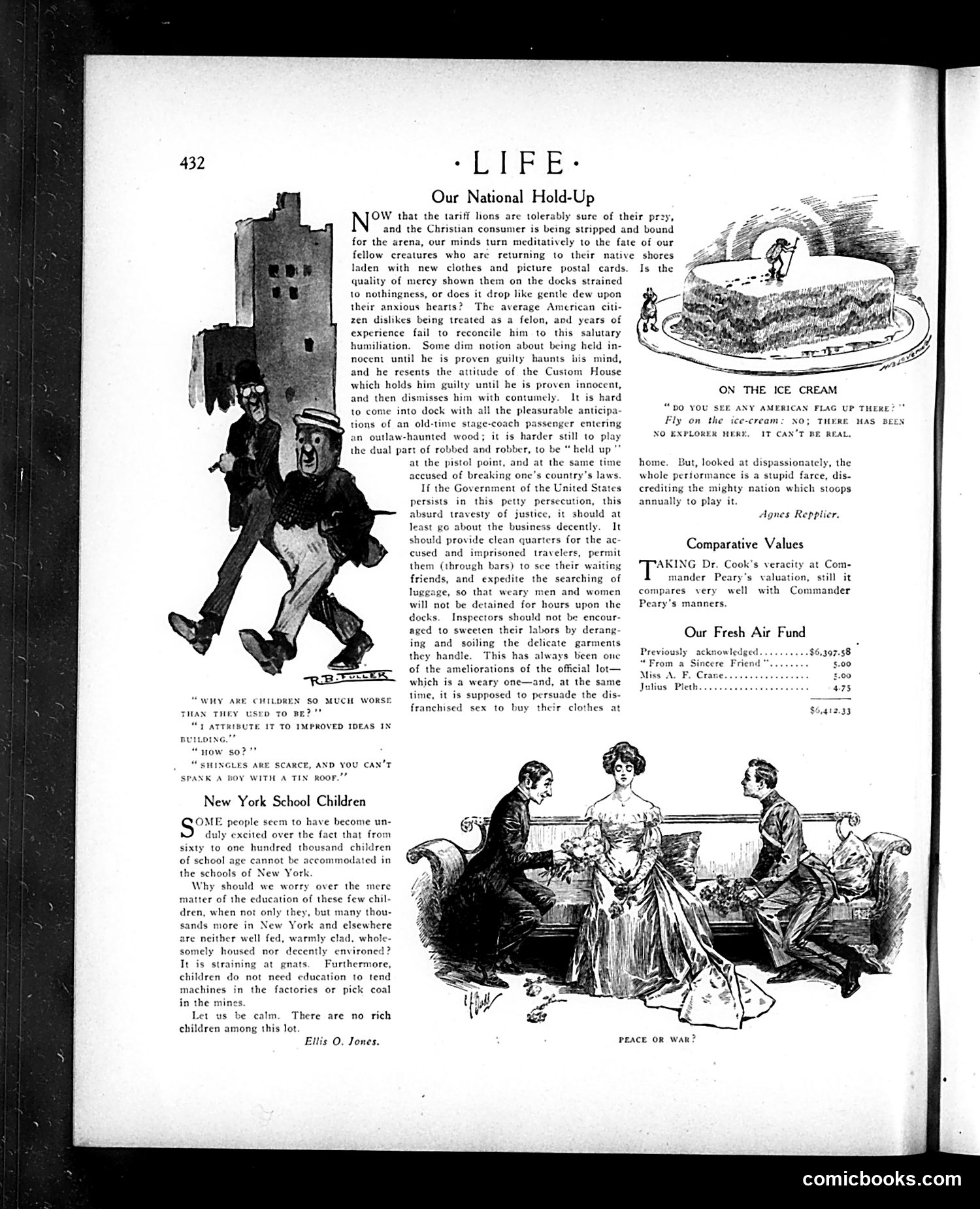
This page contains three distinct pieces of social commentary: 1. **"Our National Hold-Up"** (top left): A political cartoon depicting a figure being robbed at gunpoint, illustrating concerns about returning soldiers being mistreated and detained by customs authorities upon arrival home. The text criticizes the government's failure to treat these men decently. 2. **"On the Ice Cream"** (top right): A small cartoon mocking American patriotic displays, suggesting they're performative rather than genuine. 3. **"New York School Children"** (bottom): An article by Ellis O. Jones criticizing inadequate housing and conditions for New York's poorest schoolchildren, questioning why public concern focuses elsewhere while these children suffer. 4. **"Peace or War?"** (bottom right): An illustration of society women, possibly satirizing their disconnection from serious issues. The page overall critiques social indifference and governmental failures.
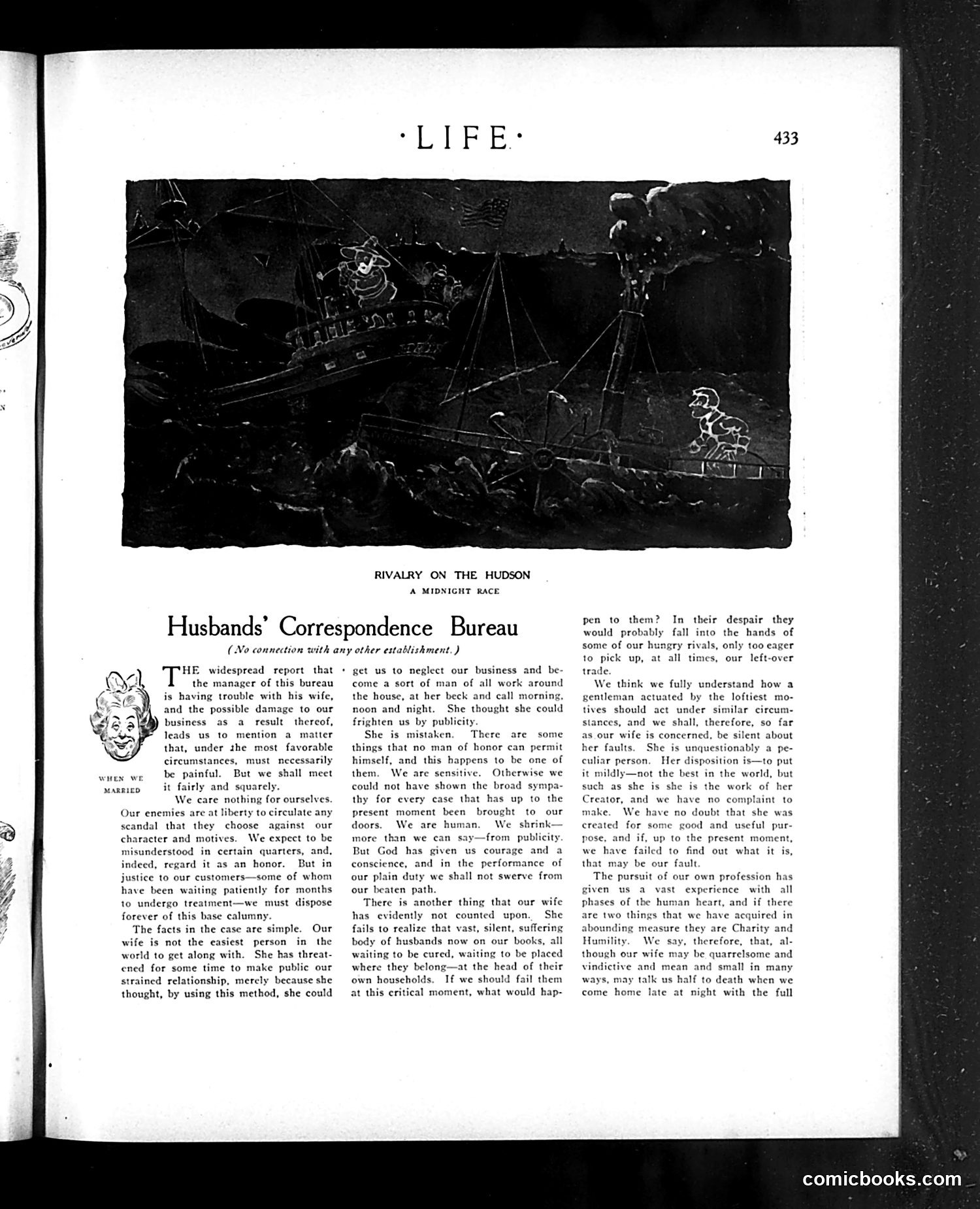
This satirical piece targets husbands who publicly damage their marriages through indiscreet behavior. The bureau's premise—ostensibly offering advice to wronged wives—actually mocks men who create scandals by their conduct toward spouses. The text criticizes husbands who fail to appreciate their wives' silent suffering and sacrifice. It emphasizes virtues like "Charity and Humility," suggesting wives endure mistreatment patiently while husbands neglect their responsibilities. The accompanying illustration ("Rivalry on the Hudson: A Midnight Race") appears to depict a dramatic nighttime boat scene, likely alluding to scandalous public behavior or infidelity. The satire targets middle-class marital hypocrisy—husbands who damage family reputation while expecting wives to suffer quietly without complaint or publicity.
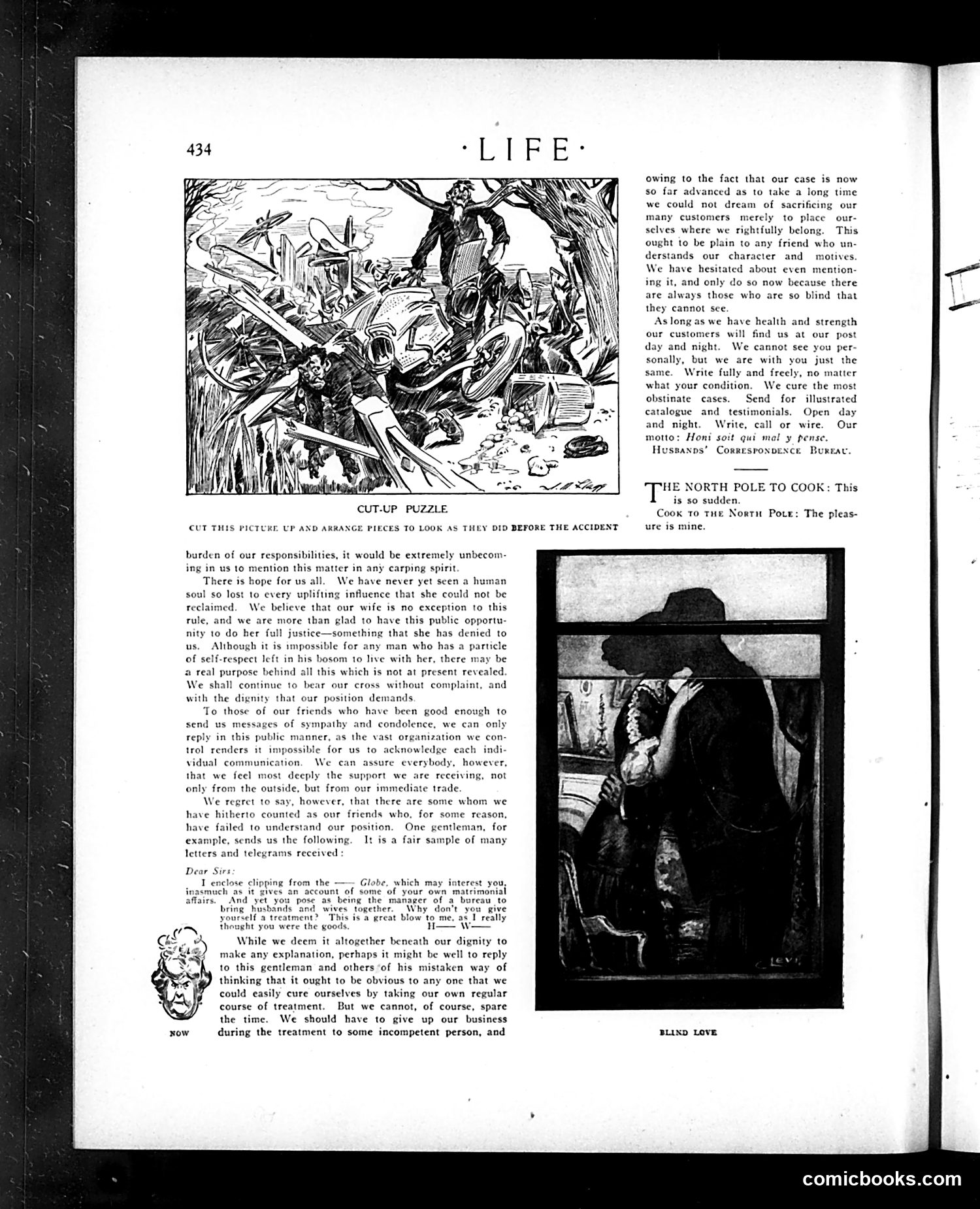
This page contains a "Cut-Up Puzzle" showing a chaotic accident scene with multiple figures and objects scattered about. The instruction reads: "Cut this picture up and arrange pieces to look as they did before the accident." The right side features a photograph titled "Blind Love" showing what appears to be an intimate couple. The bulk of the page is occupied by a lengthy defense letter from the "Husbands' Correspondence Bureau," responding to complaints about the bureau's operations and matrimonial advice. The text addresses accusations regarding their handling of cases and defends their character and motives. Without additional context about specific historical events or individuals referenced in the full letter text, the exact satirical targets remain unclear, though the content appears to mock marriage counseling services and domestic disputes of the era.
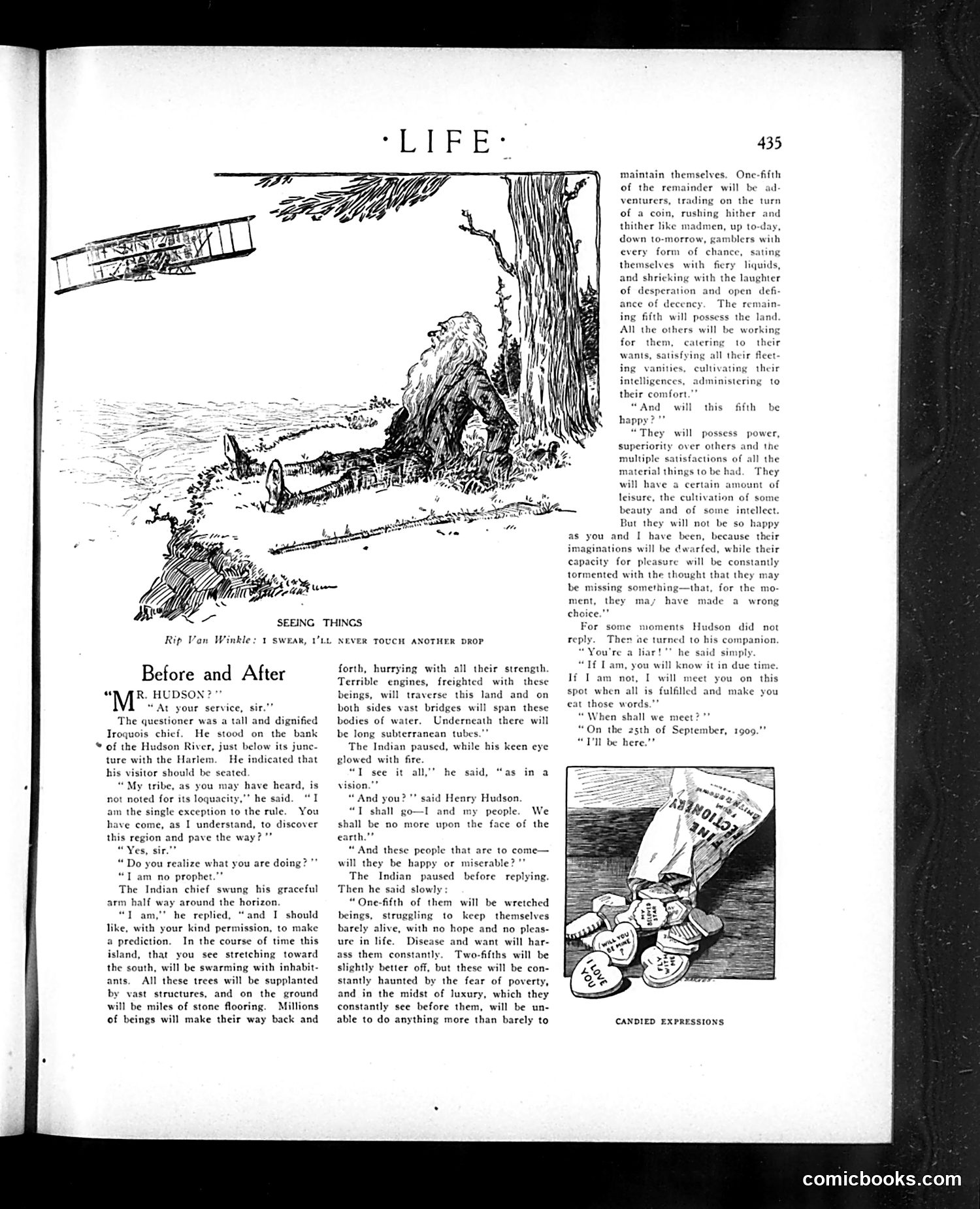
This page presents a dialogue between Henry Hudson (the historical explorer) and an unnamed Native American chief. Hudson describes a utopian future where his discovery will transform the land with "terrible engines, freighted with these beings" and "vast bridges" spanning waterways. The satire contrasts Hudson's grand vision of progress and development with the Indian chief's darker prediction: only one-fifth of future inhabitants will prosper; the rest will struggle with poverty, disease, and want despite visible luxury around them. The cartoon titled "Candied Expressions" (lower right) appears to mock superficial optimism masking underlying despair—reinforcing the page's theme that progress brings inequality and suffering alongside advancement.
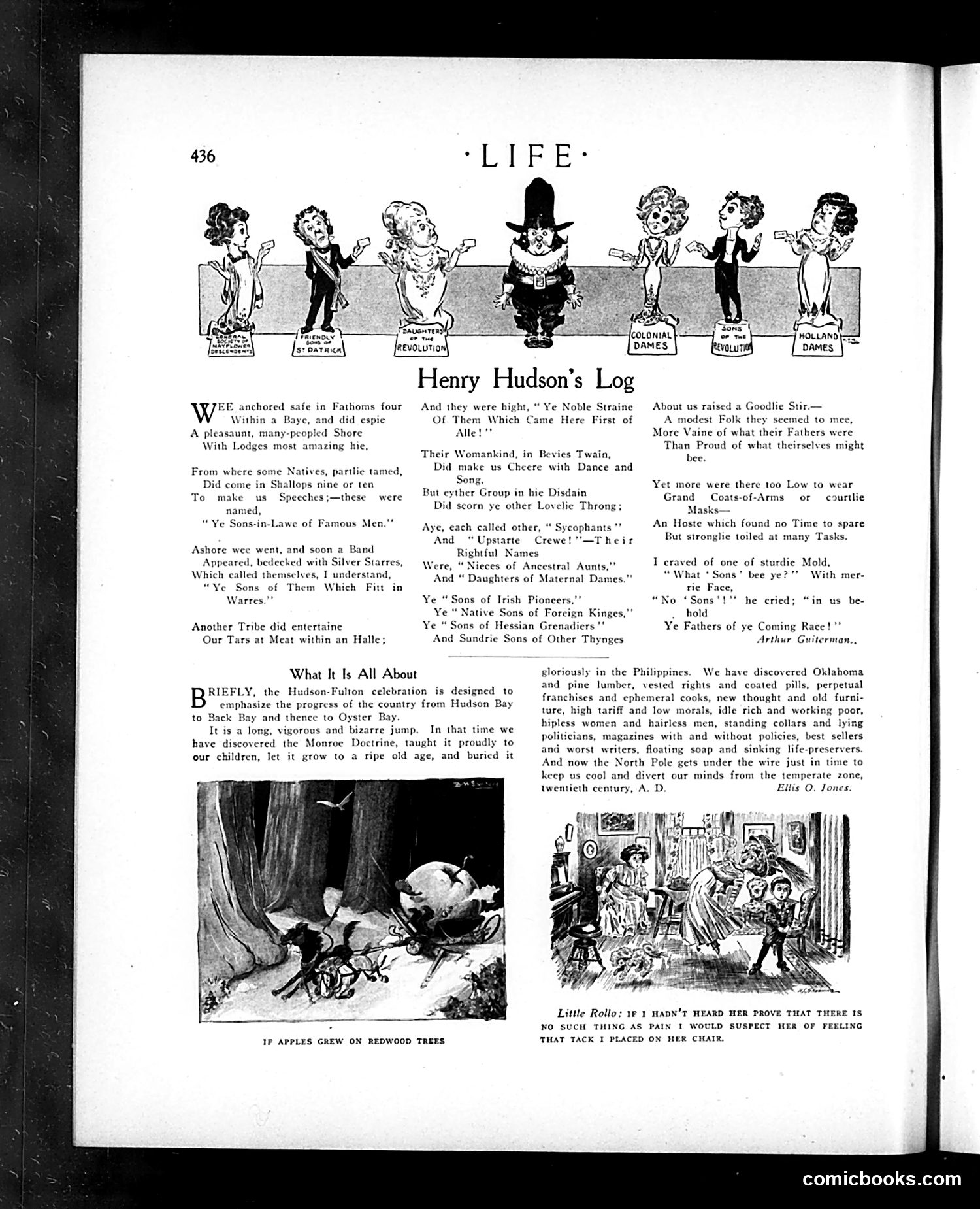
This page satirizes American social hierarchy circa early 20th century. The top illustration shows seven caricatured figures labeled as different social classes—from "Society Dames" to "Colonial Dames" to "Holland Dames"—presented as if Hudson's 17th-century expedition discovered various American social types rather than geographical features. The accompanying poem mockingly suggests these groups represent the "progress" of American civilization from Hudson Bay to modern times. The satire implies that American society's class divisions and pretensions to ancestry (particularly the "Colonial" and "Holland" dame references) are as arbitrary as labeling geographical discoveries. The bottom illustrations humorously depict domestic scenes, reinforcing the joke about society's self-importance. Overall, the piece ridicules American class consciousness and genealogical snobbery.
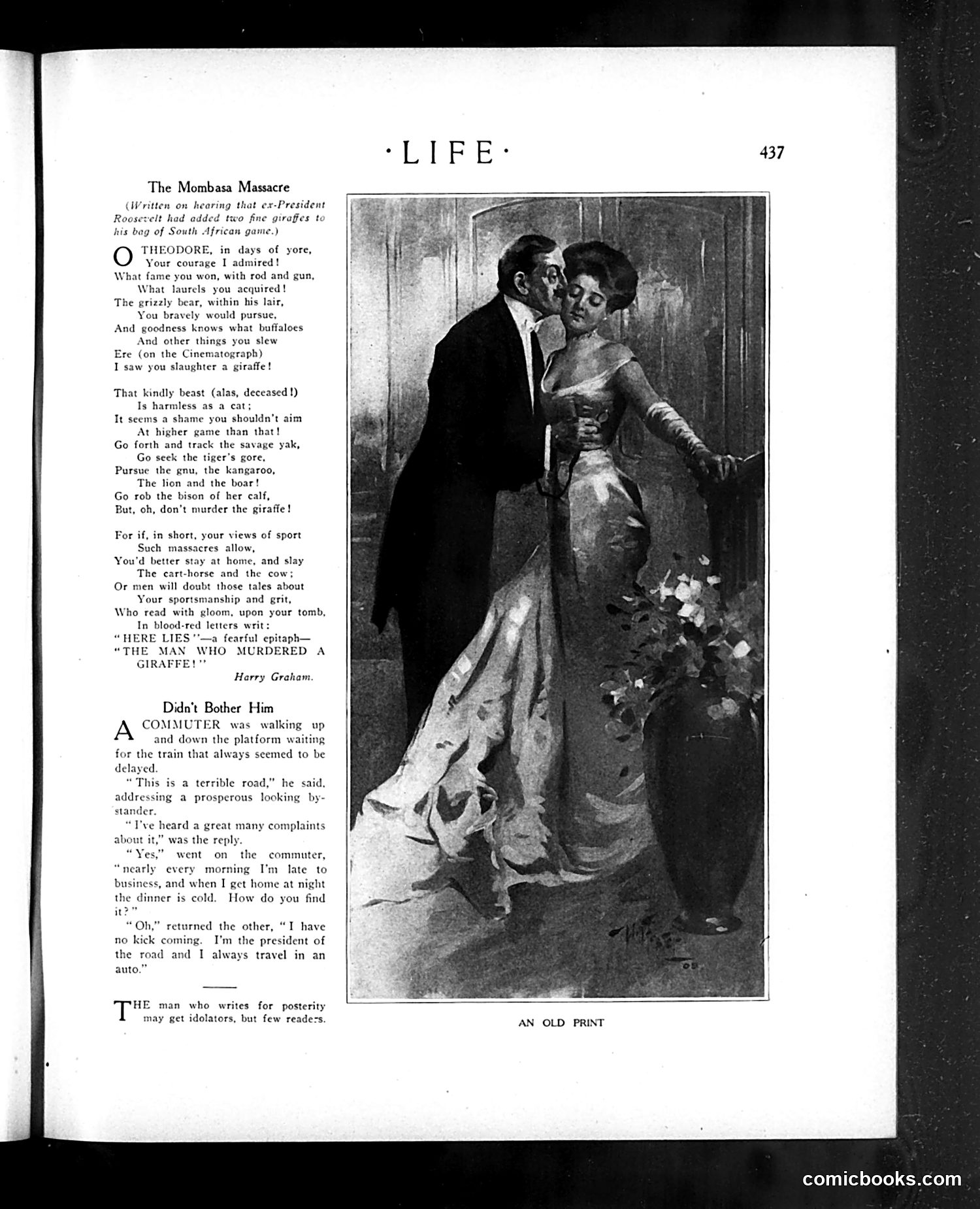
This page contains a satirical poem by Harry Graham criticizing an unnamed ex-President for killing a giraffe during a hunting trip in South Africa. The poem mocks the hunter's claims of "sport" and "courage," arguing that shooting a harmless animal is not honorable—he'd better "slay the cart-horse and the cow" if he wants real sport. The satire culminates in an epitaph: "HERE LIES—a fearful epitaph—THE MAN WHO MURDERED A GIRAFFE!" The accompanying photograph labeled "AN OLD PRINT" appears to show two men examining the dead giraffe, though the image quality makes specific identification difficult. The piece satirizes trophy hunting as cowardly rather than manly, reflecting early 20th-century debates about hunting ethics.
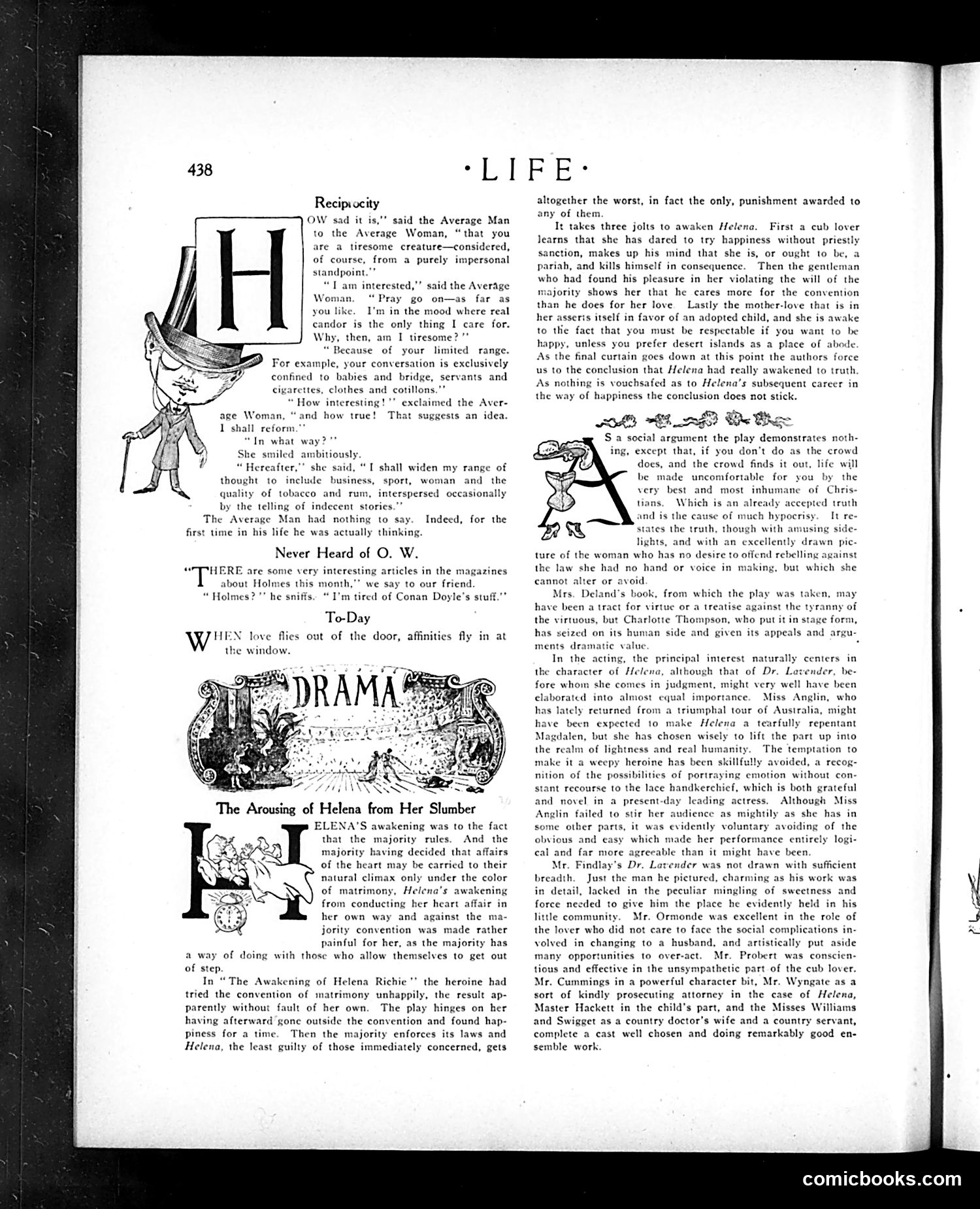
This page contains **two distinct satirical pieces**: ## "Reciprocity" A dialogue mocking gender stereotypes. An Average Man criticizes women for limited conversation (babies, bridge, servants, clothes). The Average Woman retorts that she'll expand her interests to include business, sports, and tobacco—"interspersed occasionally by the telling of indecent stories." The joke: the man, rendered speechless, has never actually *thought* before. The satire targets male hypocrisy—men condemn women's interests while claiming intellectual superiority, yet lack depth themselves. ## "The Arousing of Helena from Her Slumber" A theatrical review of a play (likely Margarethe Deland's "The Awakening of Helena Richie," though not explicitly named). The critic argues the play demonstrates society's cruel enforcement of moral convention: Helena suffers punishment for living outside matrimony, while guilty men escape consequences. The satire critiques social hypocrisy—respectable society punishes women's independence harshly while excusing male behavior, all under the guise of Christian morality. Both pieces expose **double standards** in early 20th-century American social expectations.
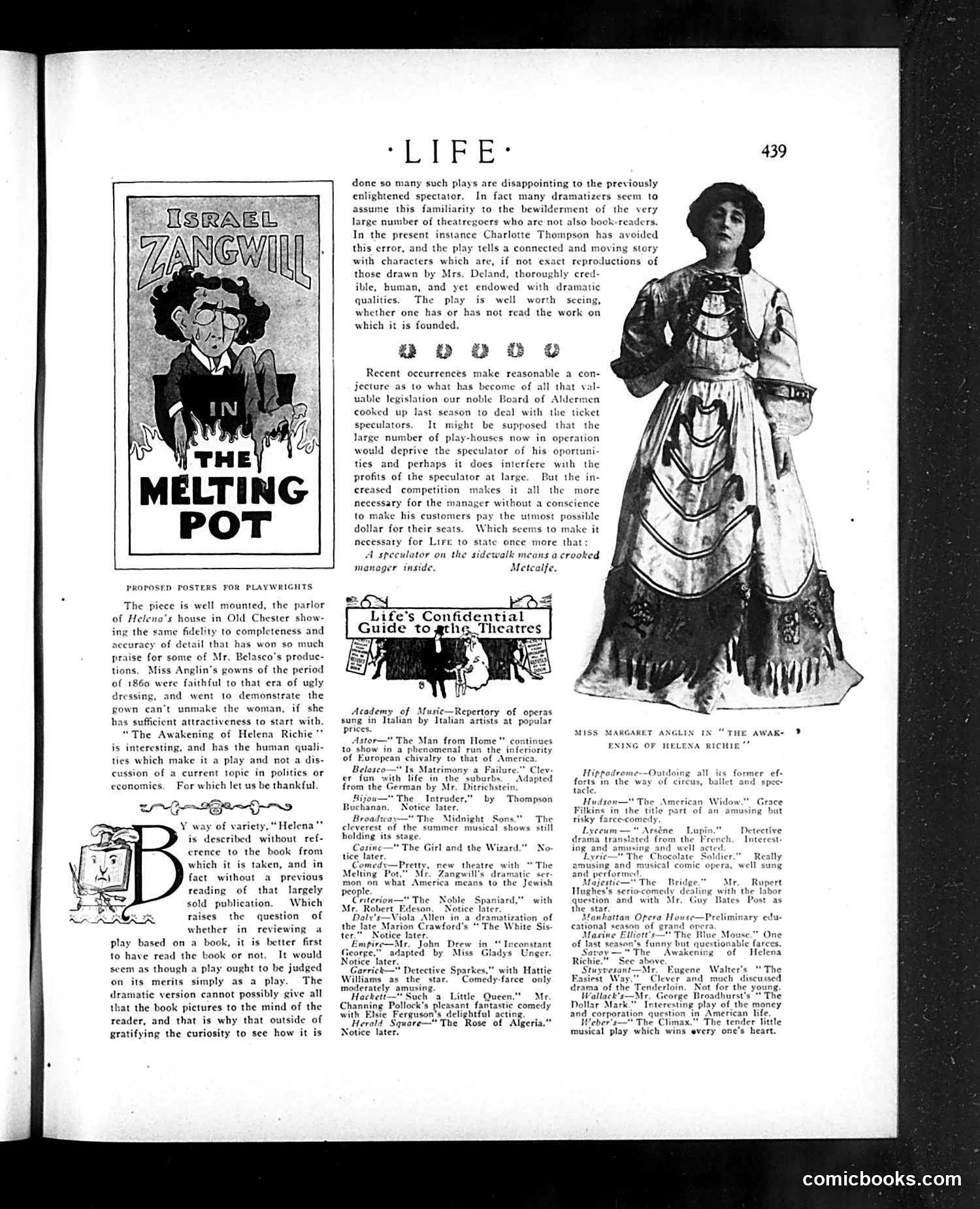
This page from *Life* magazine discusses theatrical adaptations, primarily reviewing "The Awakening of Helena Richie," a stage play based on a Mrs. Deland novel. The left poster advertises Israel Zangwill's "The Melting Pot"—a famous play about Jewish immigration to America. The main satirical point concerns **ticket speculation**. The article argues that despite the city's Board of Aldermen passing legislation against ticket scalpers, the problem persists because theater managers without ethics collude with sidewalk speculators to artificially inflate prices. The famous line: "a speculator on the sidewalk means a crooked manager inside." The cartoon itself appears to be a proposed poster design for playwrights, likely mocking theatrical promotion methods of the era. The page also includes a theater guide listing current productions and their locations, typical of *Life's* coverage of New York City culture.
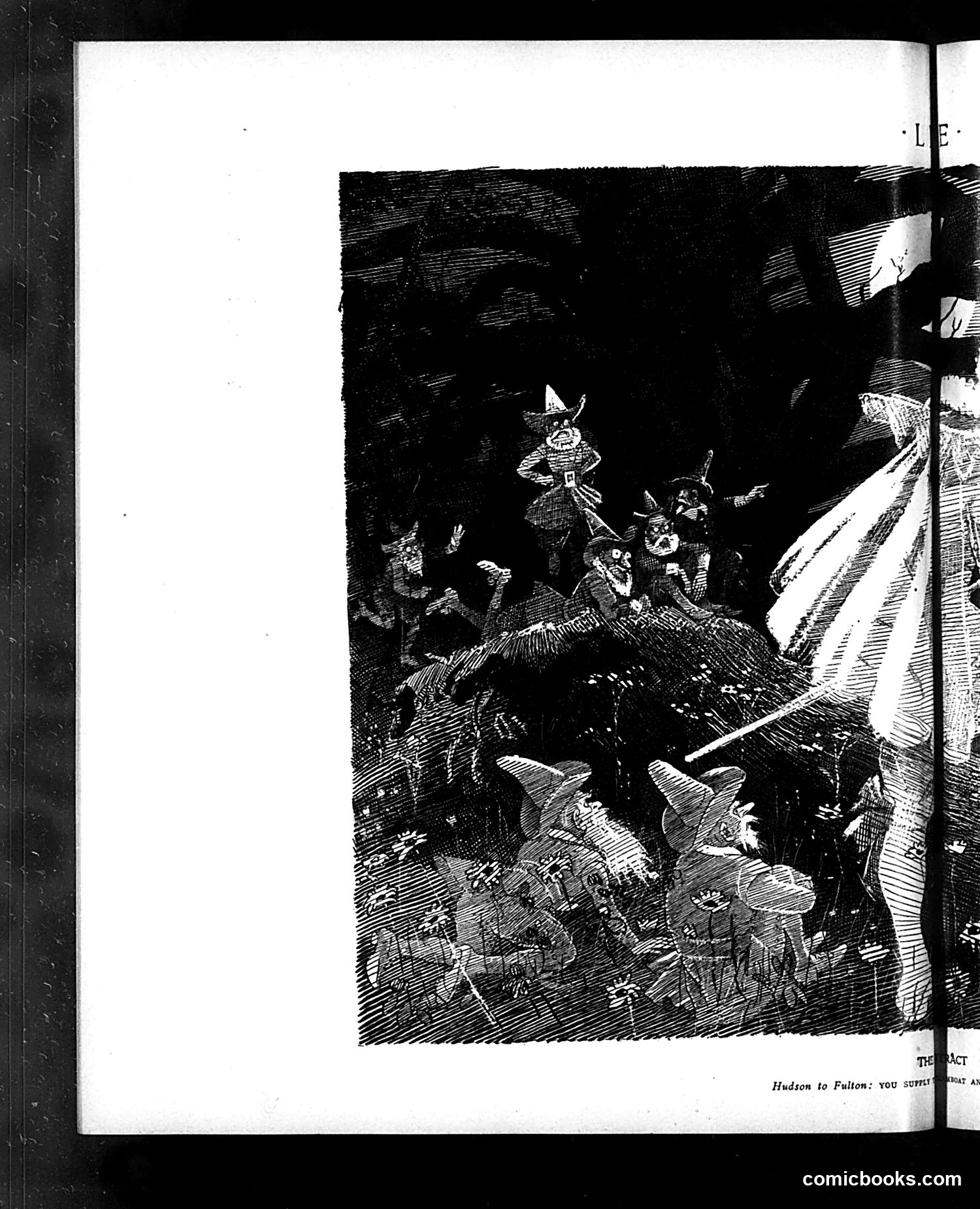
This page contains a black-and-white engraving or woodcut-style illustration depicting what appears to be a dramatic nighttime scene. The caption reads "Hudson to Fulton: you surpassed" (text partially cut off). The image shows figures in period dress, possibly 18th or 19th century, gathered indoors or in a shadowed space, with dramatic lighting effects created by what may be torches or light sources. Some figures appear fantastical or supernatural in character. However, the OCR text is severely corrupted and largely illegible, making it impossible to identify the specific satirical subject, target figures, or political references with confidence. Without readable accompanying text explaining the cartoon's context, I cannot reliably interpret what social or political commentary this illustration intended to convey to its original readers. The reference to "Hudson to Fulton" suggests it may relate to historical exploration or development themes.
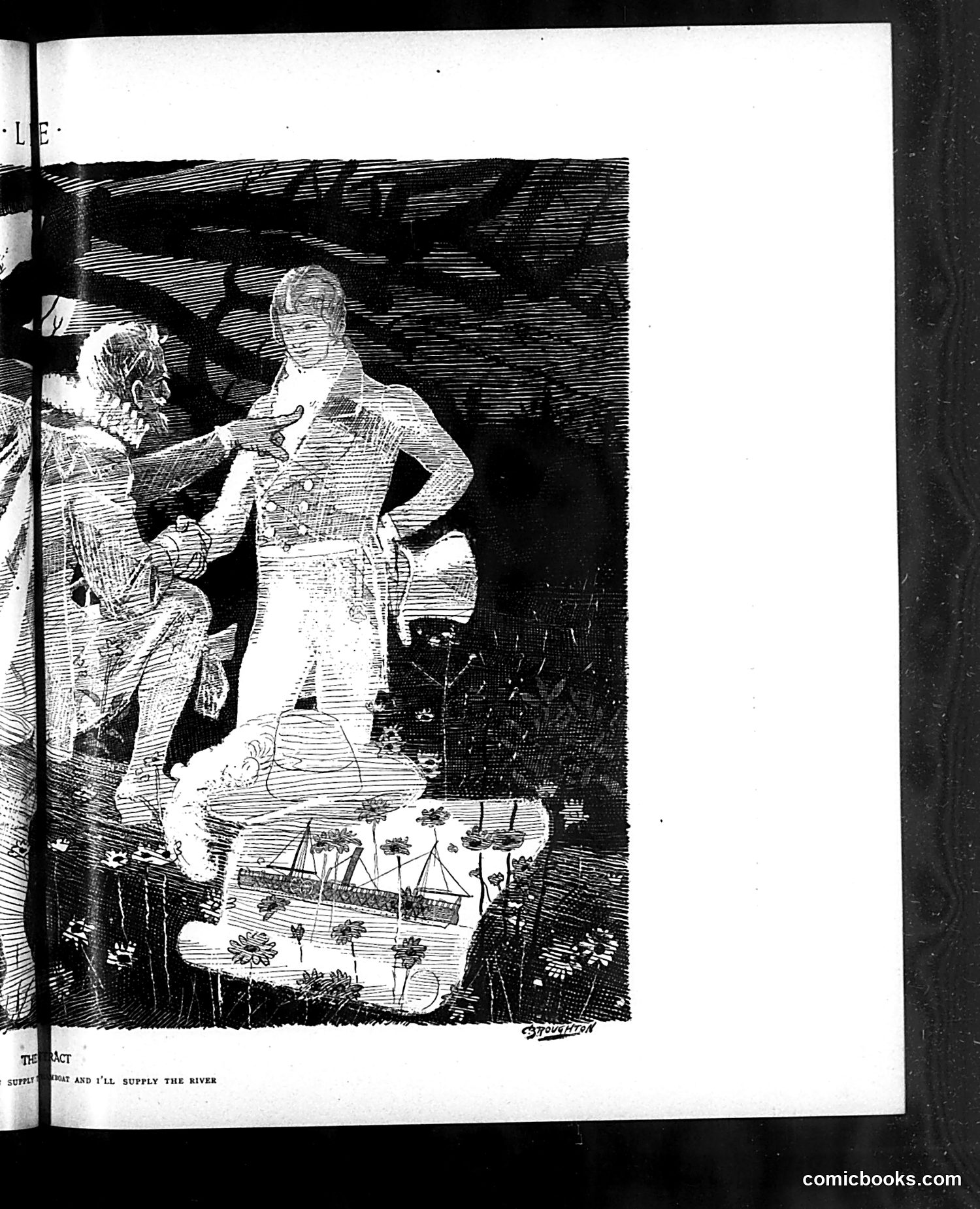
This appears to be a satirical illustration from *Life* magazine showing a scene with two figures examining or presenting what looks like a map or geographical display (possibly depicting a river or waterway with small illustrations of boats and vegetation). The partially visible text at the bottom reads "...AND I'LL SUPPLY THE RIVER," suggesting a dialogue about resource provision or development. Without clearer text or more context, I cannot definitively identify the specific figures or historical reference. The style suggests early-to-mid 20th century political satire, likely commenting on water resources, infrastructure projects, or commercial development. The cartoonist's signature appears present but is not clearly legible to me. **I cannot confidently identify the specific political figures or event being satirized without additional context.**
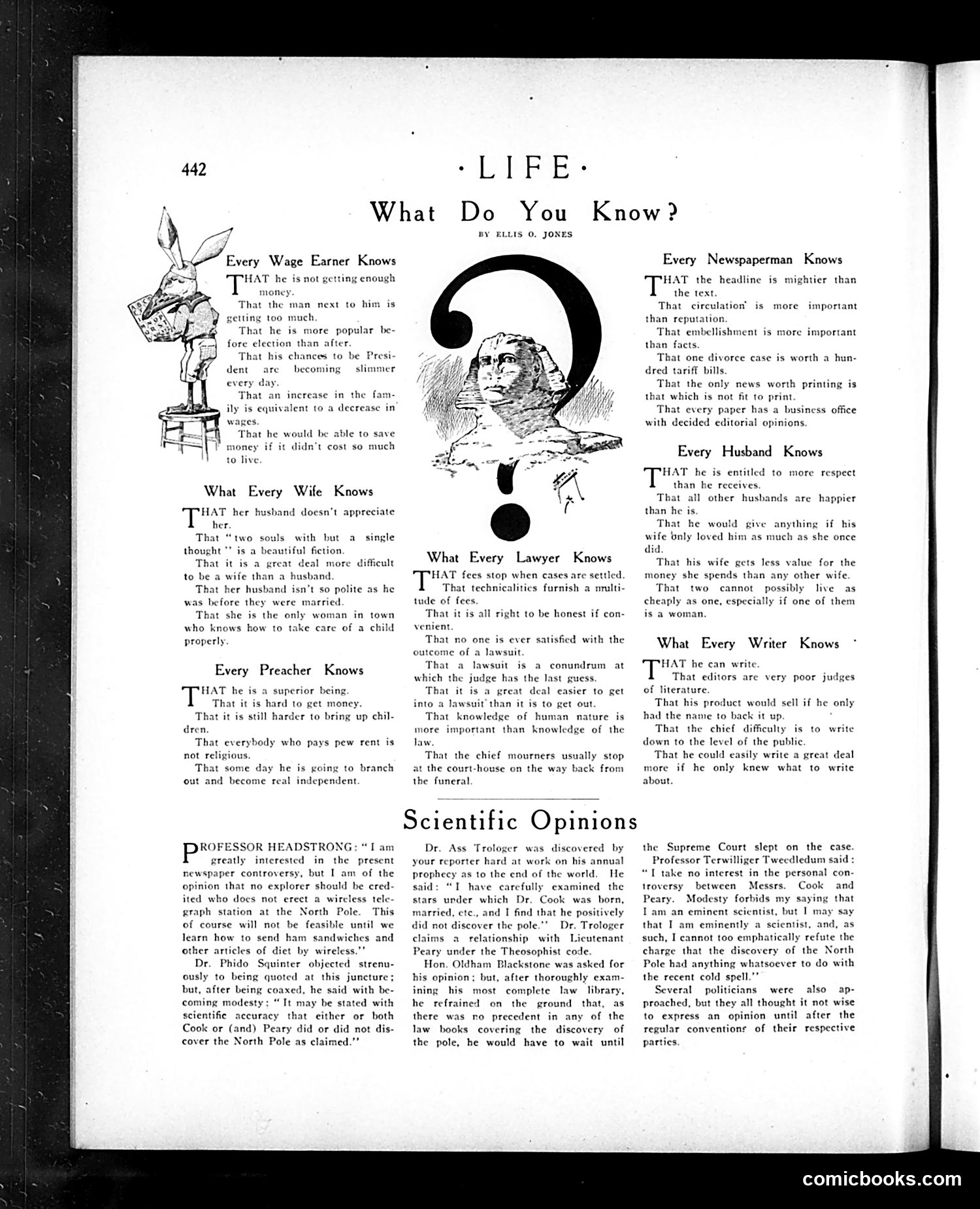
This page presents satirical observations about various professions and relationships, structured as "what [group] knows." The central cartoon features a large question mark with a confused face, illustrating the magazine's skeptical tone. The satire mocks predictable human nature and professional hypocrisy. Wage earners complain about money but spend too much; wives claim superiority but struggle with marriage; preachers claim moral authority while chasing donations; lawyers profit from technicalities; newspapermen sensationalize instead of reporting facts. The "Scientific Opinions" section parodies the contemporary North Pole discovery controversy (Cook vs. Peary), featuring absurd "expert" testimonies from fake authorities like "Professor Headstrong" (who demands wireless telegraph stations) and "Dr. Ass Trologer." The satire ridicules how public figures manufacture credibility through pseudo-scientific nonsense rather than actual evidence. Overall, the page cynically suggests that everyone—regardless of profession or status—operates according to self-interest rather than stated principles.
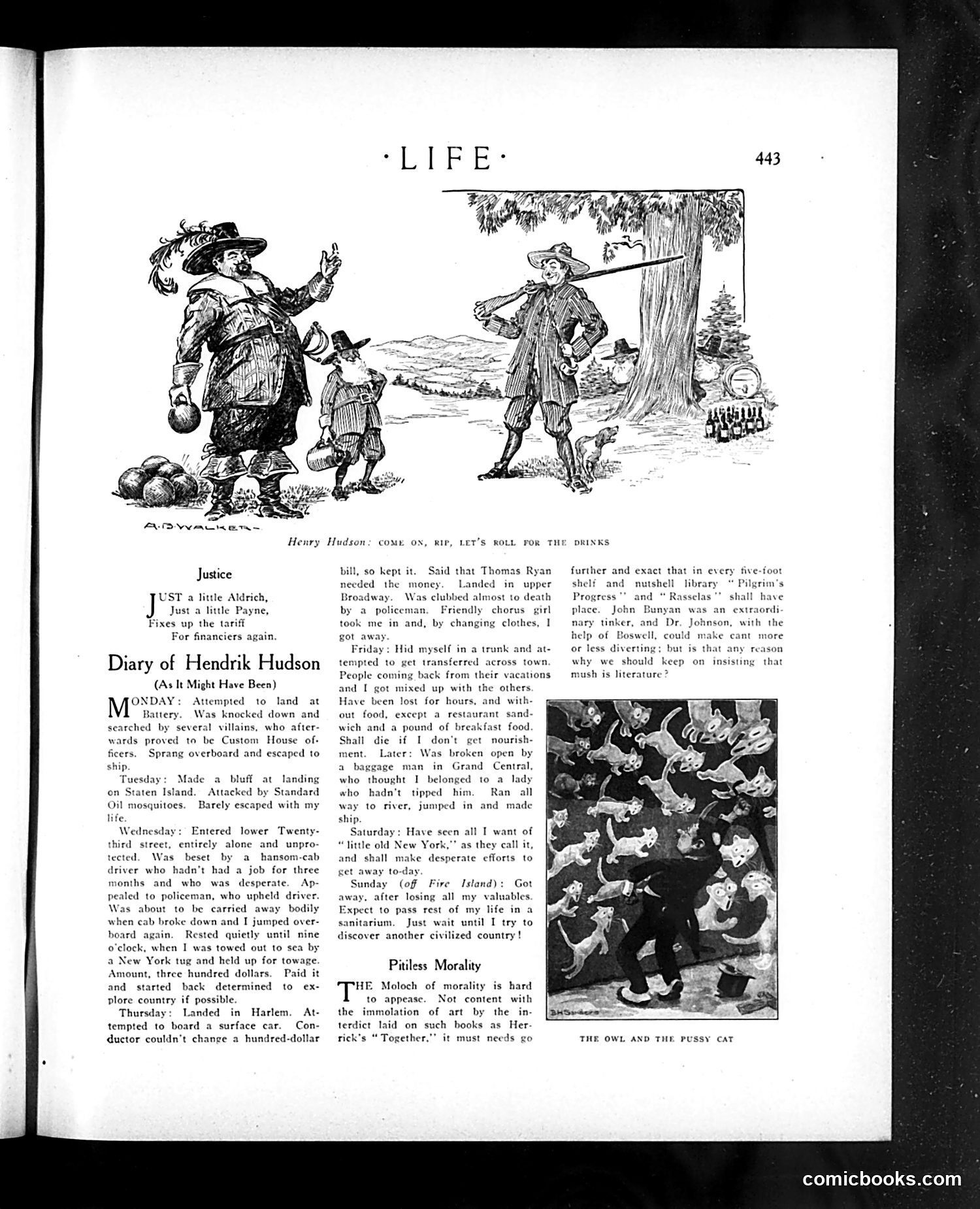
**Top Cartoon:** The "Justice" verse satirizes tariff legislation. "Aldrich" and "Payne" refer to politicians Nelson Aldrich and Sereno Payne, who shaped early 1900s tariff policy. The joke mocks how they manipulated tariffs to benefit wealthy financiers while claiming to serve justice. **Main Feature:** "Diary of Hendrik Hudson" is a satirical pseudo-historical account reimagining explorer Hudson's 1609 arrival in modern New York. It mocks contemporary urban problems—corrupt customs officials, Standard Oil monopolies, desperate cab drivers, rude conductors, and price-gouging. Hudson faces constant exploitation, violence, and chaos, suggesting New York has become a lawless, predatory city worse than colonial wilderness. The satire critiques urban corruption and unchecked capitalism. **"Pitiless Morality":** This brief piece attacks moral censorship, arguing that excessive book banning (referencing "Together" and other works) destroys literature's value. It defends literary merit over puritanical restrictions.
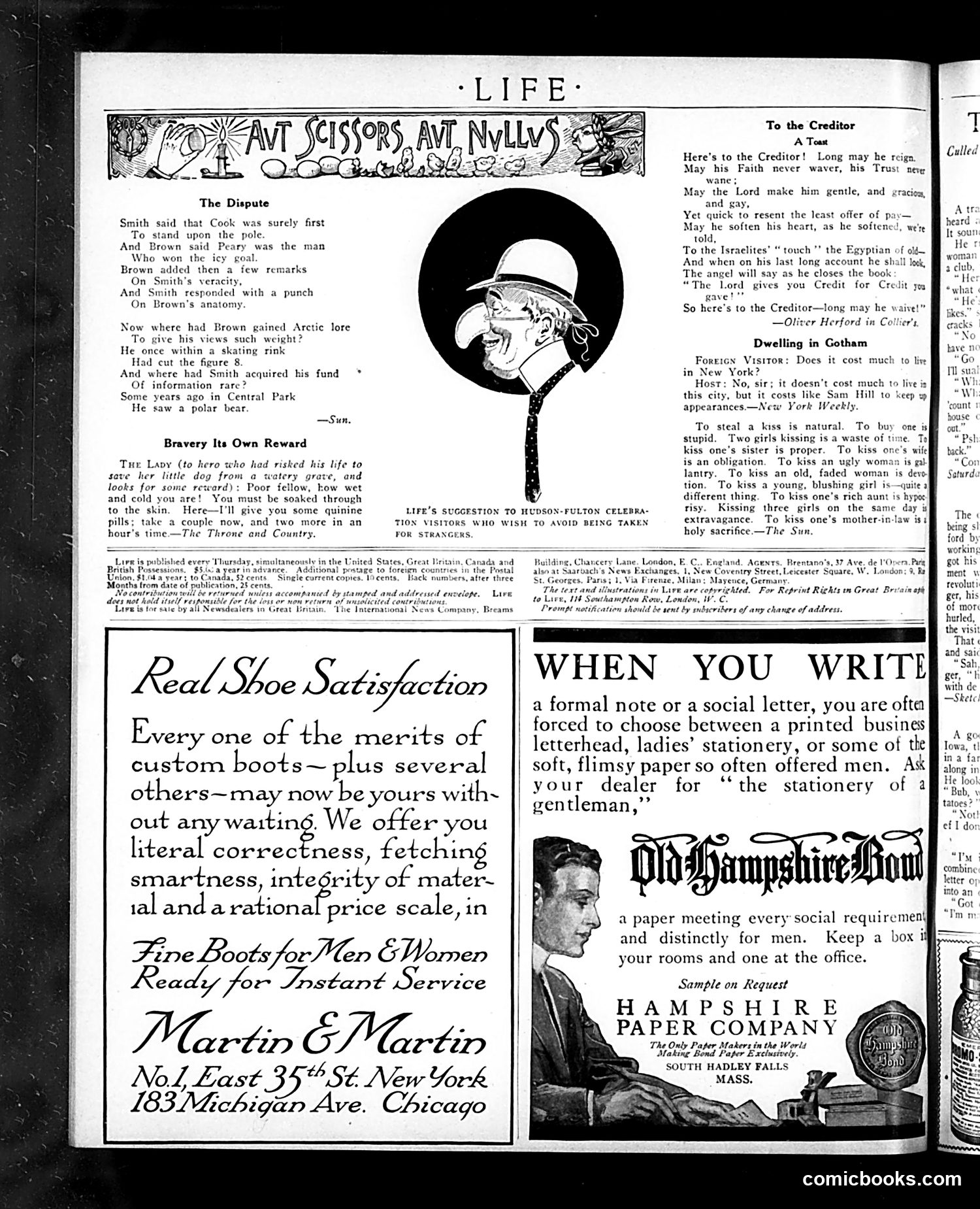
This page from *Life* magazine contains several satirical pieces reflecting early 20th-century concerns: **"The Dispute"** mocks Arctic exploration rivalries of the era—likely referencing the heated competition between explorers like Cook and Peary over who reached the North Pole first (a genuine controversy around 1909). The joke's irony: the argument becomes absurdly physical despite originating from one participant's dubious authority gained from merely seeing a polar bear in Central Park. **"To the Creditor"** satirizes the Victorian merchant-debtor relationship, where creditors extended credit while being reluctant to actually collect payment—presenting this as quasi-noble charity. **"Dwelling in Gotham"** is a simple joke about New York's high cost of living. The remaining pieces offer mild social humor about kissing etiquette and wartime bravery. The advertisements (Martin & Martin boots, Hampshire Paper) represent typical contemporary marketing. Overall, the page reflects pre-WWI American humor: topical references to exploration scandals, gentle mockery of social pretension and financial customs, and commercial messaging—all hallmarks of *Life*'s satirical approach.
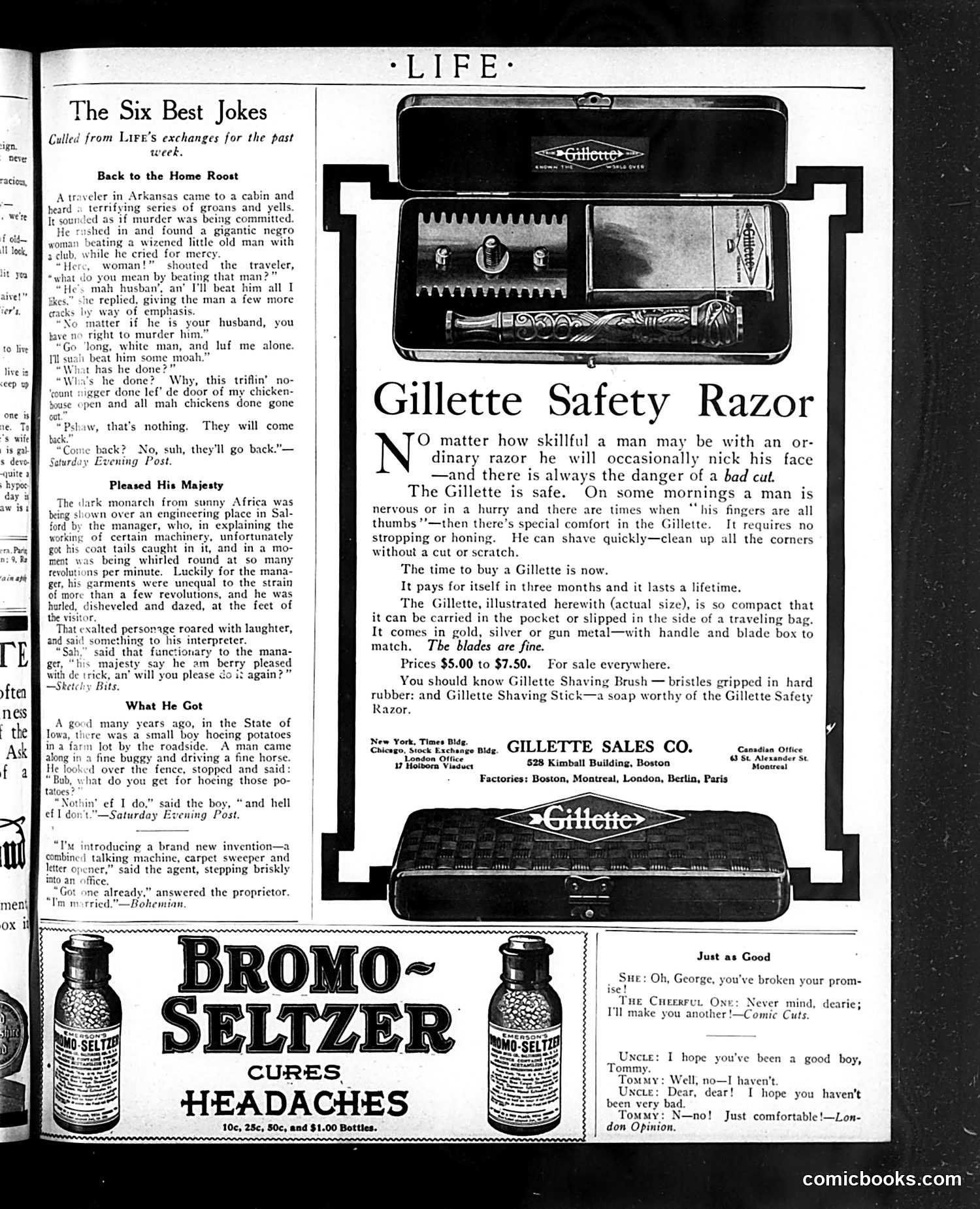
This page contains **humor pieces and advertisements** rather than political cartoons. The content reflects early 20th-century attitudes, including racial stereotypes that would be considered offensive today. **"The Six Best Jokes"** section reprints humorous anecdotes submitted by readers. One joke depicts a Black woman in Arkansas beating her husband, played for comedy through dialect humor and the woman's defiant independence. Another describes an African ruler amused by machinery injuring a white factory manager—the humor relies on racial caricature and a stereotype of "primitive" amusement at white misfortune. **The main advertisement** promotes Gillette Safety Razors, emphasizing convenience and safety for businessmen. The razor's portability suits traveling professionals. **Bottom advertisements** include Bromo-Seltzer for headaches and brief comic exchanges ("Just as Good"). The page illustrates how mainstream American humor of this era casually incorporated racial stereotypes and dialect humor as entertainment. Modern readers encounter dated social attitudes rather than sophisticated satire or political commentary.
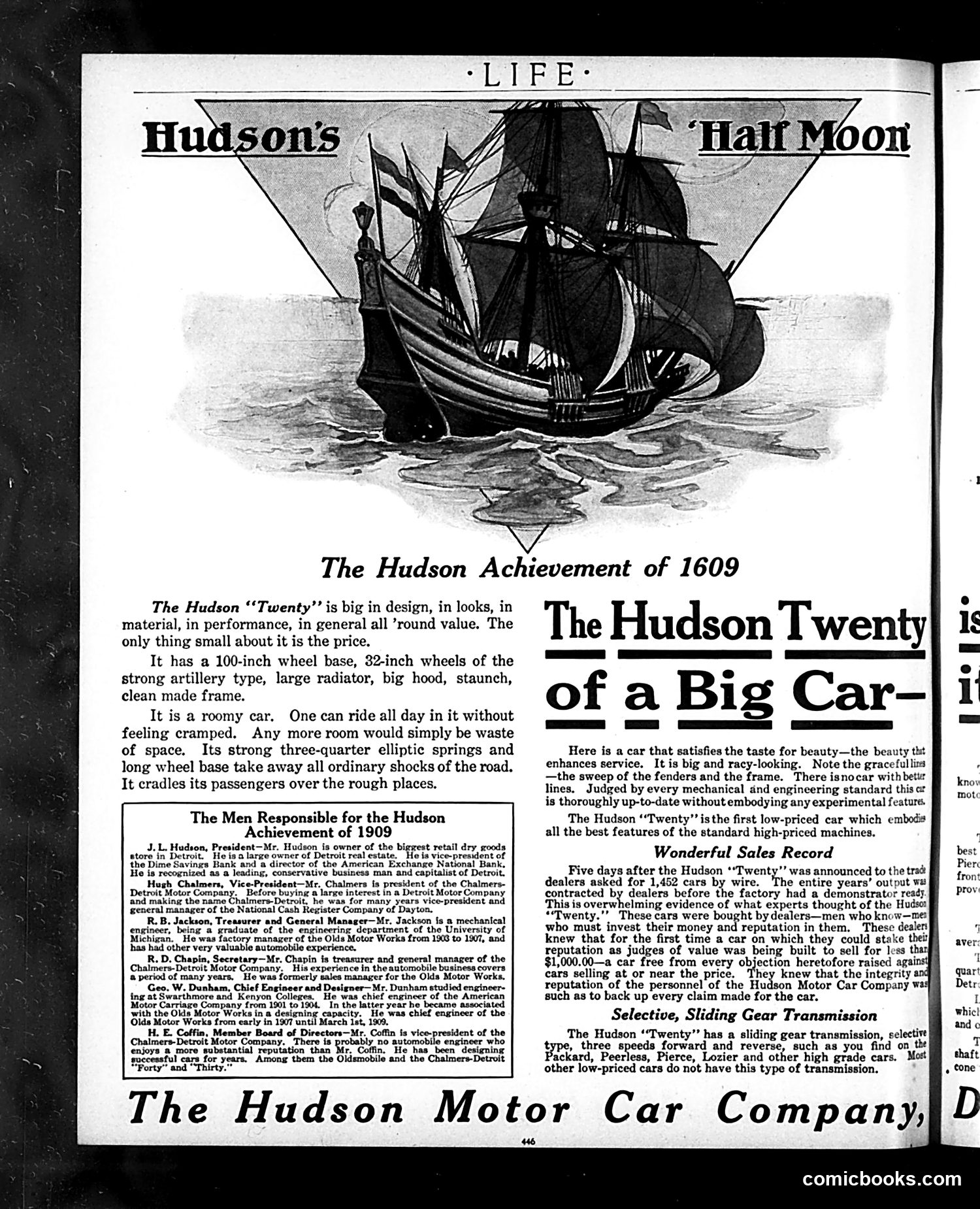
This is primarily an **automobile advertisement**, not political satire. It promotes the Hudson "Twenty" car (1909 model) by emphasizing value—claiming it offers "big car" features at a low price, positioning it as democratizing luxury automotive technology. The naval ship illustration ("Half Moon") is a historical reference to Henry Hudson's 1609 voyage, creating a patriotic American narrative around the car's name and launch date. The page lists the company's leadership—executives from Detroit's business establishment—to establish credibility and conservative financial stewardship. Their credentials (bank directorships, prior success at Olds and Chalmers) suggest stability to potential buyers. The "Wonderful Sales Record" section claims dealers pre-ordered the entire first year's production within days—a marketing tactic emphasizing overwhelming demand and expert confidence. This reflects early-20th-century American consumer culture, when affordable automobiles were revolutionary. There is no satire here; *Life* magazine ran such advertisements alongside editorial content.
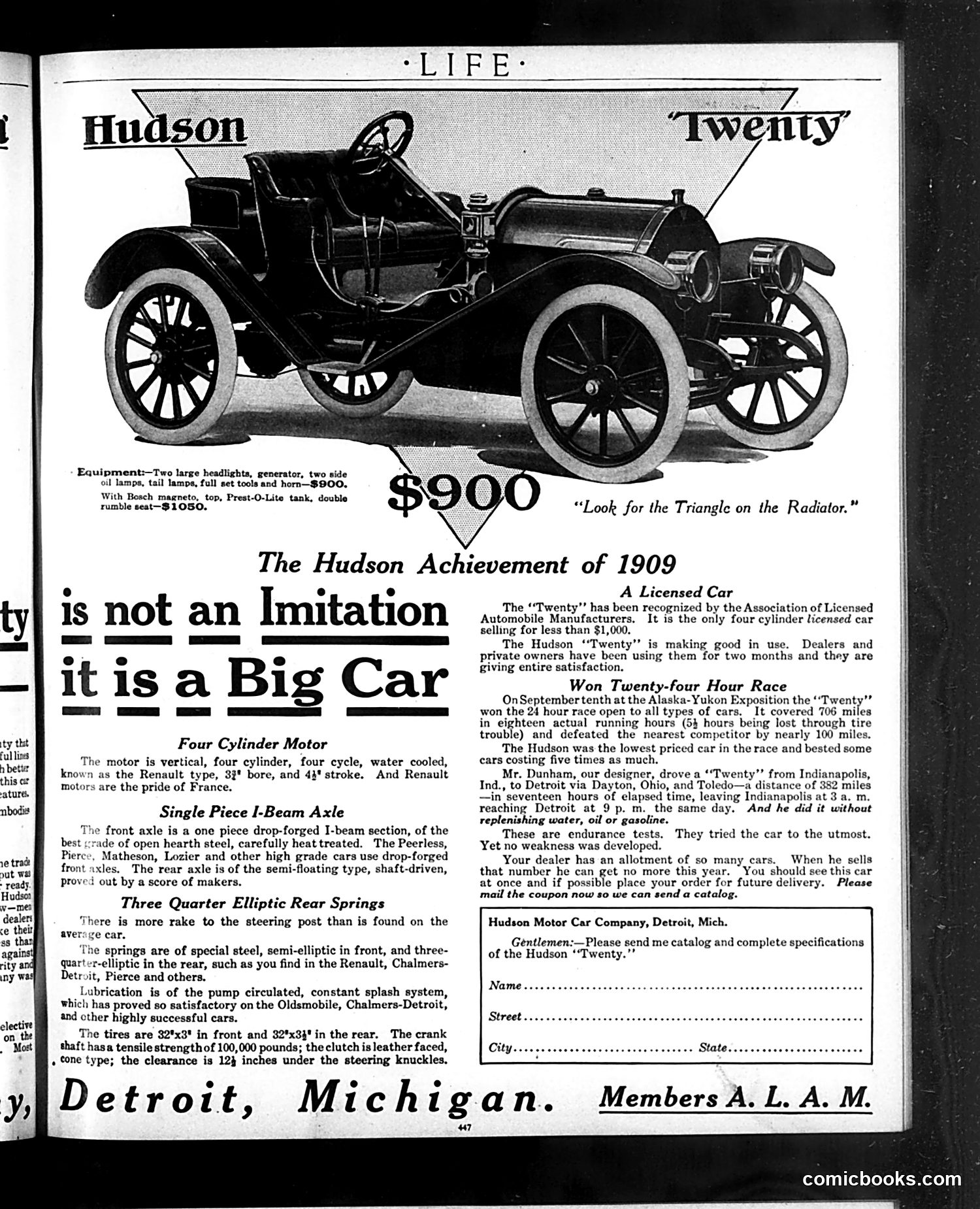
This is **not a political cartoon** — it's a full-page automobile advertisement from Life magazine (circa 1909), disguised as editorial content through satirical framing. The page mocks competitor claims by asserting the Hudson "Twenty" is "not an Imitation" but "a Big Car," positioning it against cheaper vehicles while emphasizing luxury features (headlights, magneto, rumble seat). The ad targets middle-class buyers by highlighting the car's racing victory and long-distance endurance, while listing technical specifications borrowed from prestigious European marques like Renault and Peerless to establish legitimacy. The "Look for the Triangle on the Radiator" tagline functions as brand identification. The scarcity claim—"When he sells that number he can get no more this year"—employs artificial urgency marketing. At $900, it positioned itself as an affordable yet respectable automobile in an emerging mass-market era. This represents early 20th-century automobile industry advertising dressed as journalism.
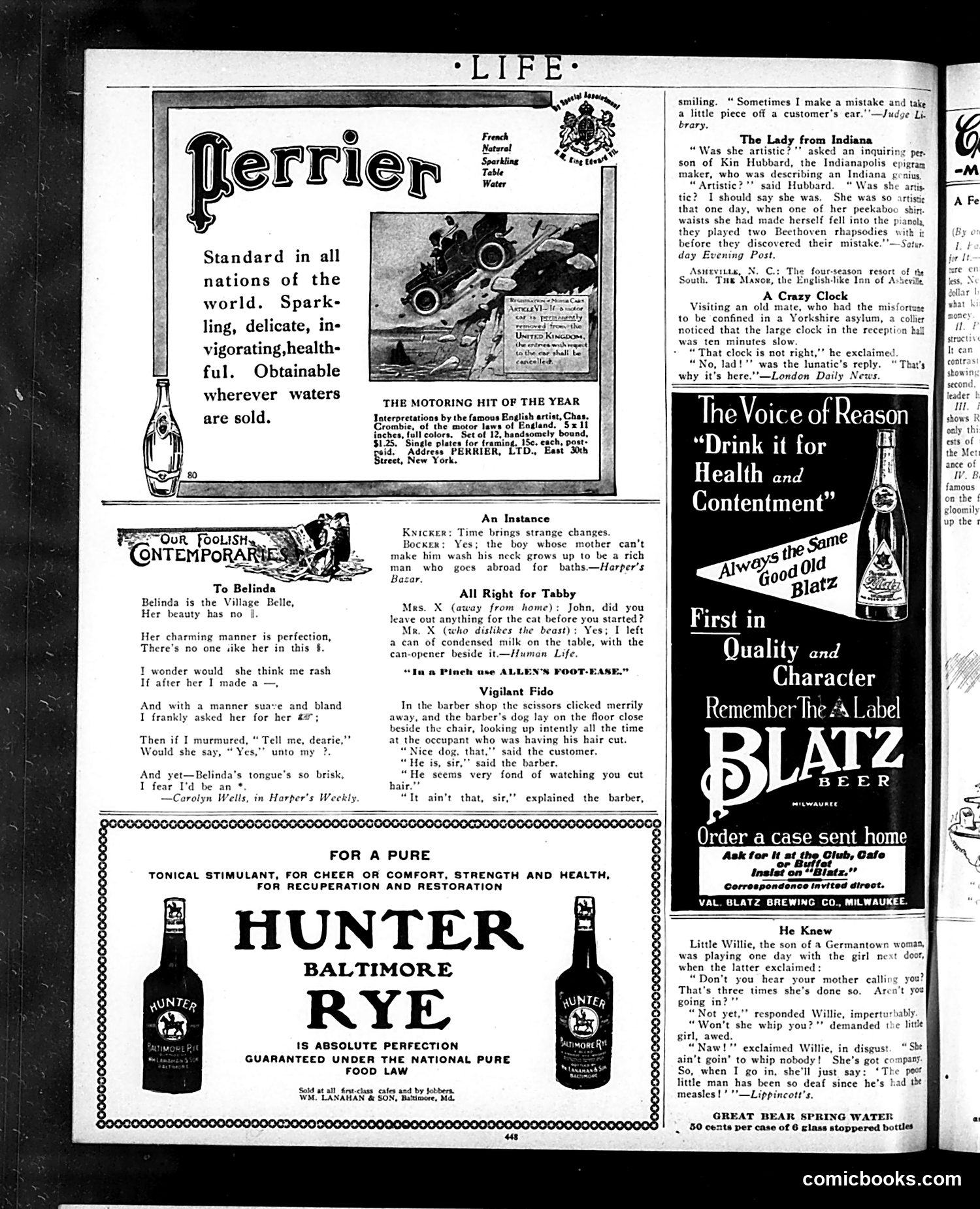
This page is primarily **advertising** interspersed with short humorous anecdotes typical of Life magazine's satirical style. The advertisements promote alcoholic beverages (Perrier water, Blatz Beer, Hunter Rye whiskey) as health tonics—a common marketing practice of the era before Prohibition and FDA regulations. The claims about "health and contentment" reflect early 20th-century attitudes toward alcohol. The brief comic pieces ("Our Foolish Contemporaries," "An Instance," "All Right for Tabby," etc.) are gentle social humor featuring domestic situations and character types: a vain woman ("Belinda"), marriage dynamics, a child's logic. These satirize middle-class behavior and manners. "A Crazy Clock" references an asylum patient—reflecting period attitudes where mental illness was treated as comedic material. The anecdotes reference publications like *Harper's Bazaar* and *Lippincott's*, indicating this was a magazine for educated, affluent readers. The humor is mild and observational rather than pointed political satire—reflecting Life's role as sophisticated, mainstream entertainment for urban professionals.
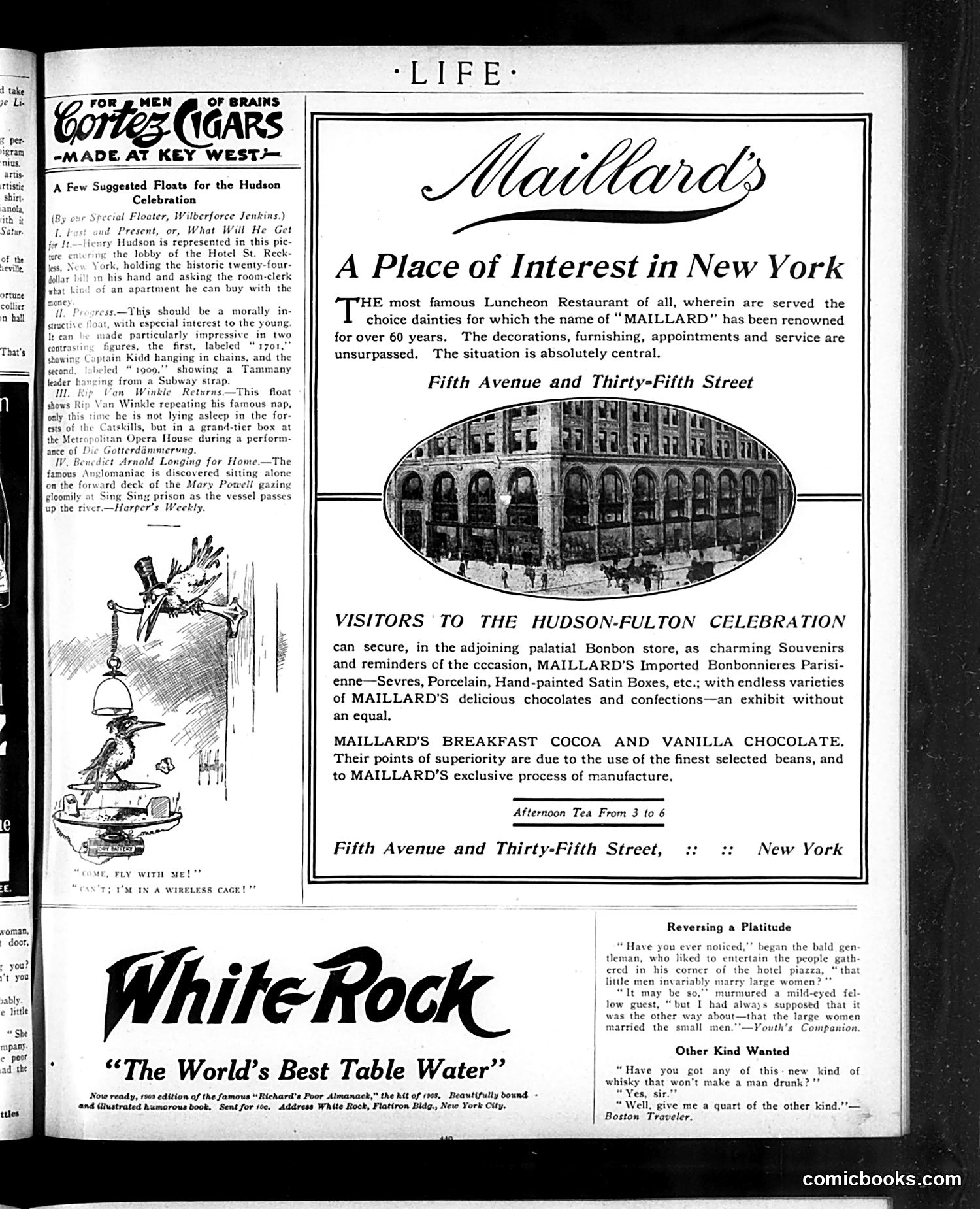
This page combines satirical content about the **Hudson-Fulton Celebration** (a 1909 New York City event commemorating Henry Hudson and Robert Fulton) with period advertisements. The left column presents humorous float ideas by "Wilberforce Jenkins." The satire targets: 1. **Hudson's commercialism**: Hudson holding the deed to Manhattan, asking what profit he'll gain—mocking how the historical figure would view modern real estate values. 2. **Rip Van Winkle**: A sleeping Dutch colonist in an opera box instead of the Catskills—joking about how New York's culture has transformed. 3. **Tammany Hall corruption**: Referenced via "Captain Kidd" (a pirate) and Tammany imagery, suggesting the city's political machine parallels historical villainy. 4. **Benedict Arnold**: Shown depressed watching Sing Sing prison, implying America's traitors regret their choices—dark political humor. The rest consists of advertisements for luxury goods (Maillard's chocolates, White Rock water, Cortez cigars), typical of *Life* magazine's revenue model. The small jokes at bottom are unrelated period humor about gender and alcohol.
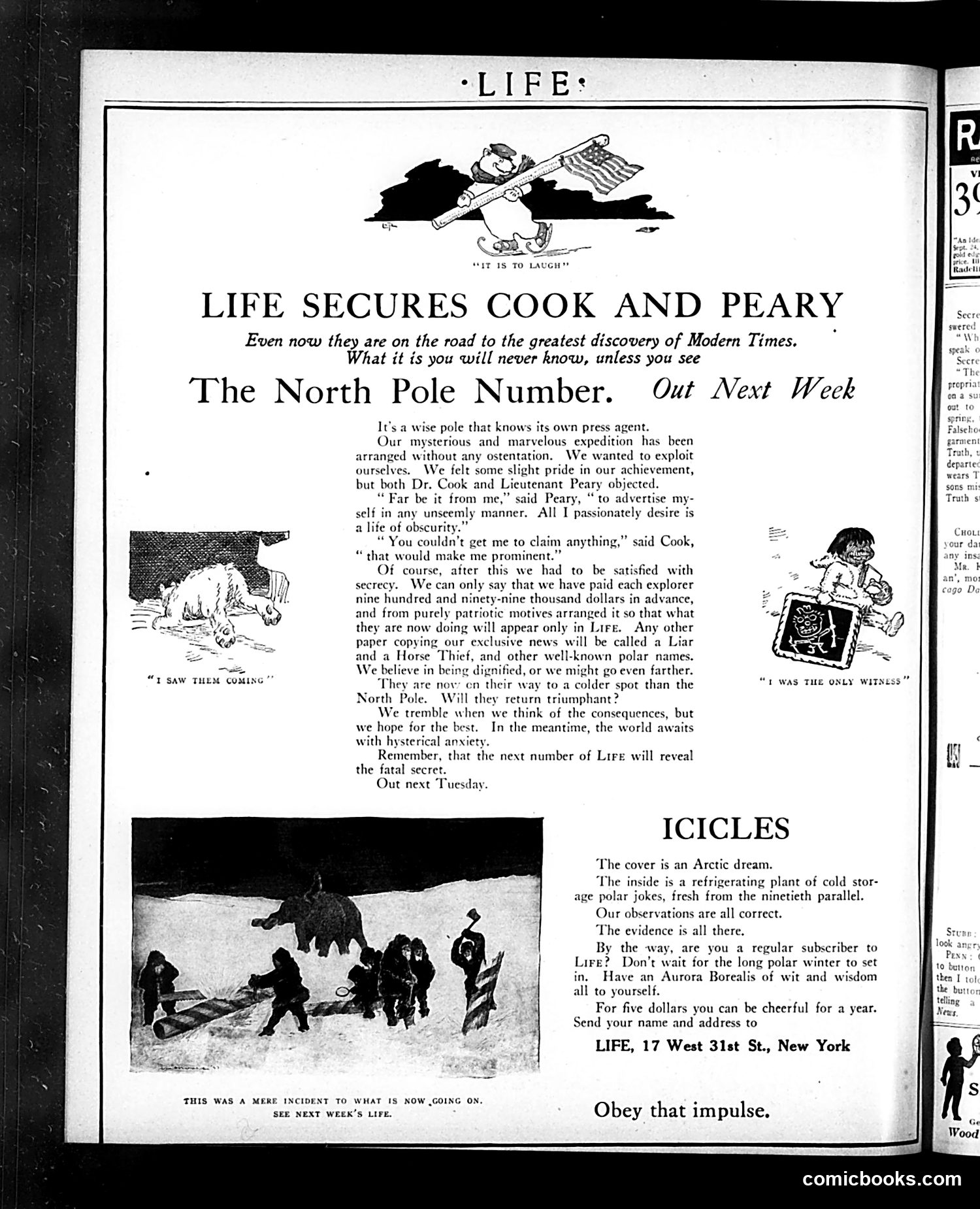
This is a satirical advertisement promoting Life's upcoming "North Pole Number." It mocks the contemporary rivalry between polar explorers Dr. Frederick Cook and Robert Peary, who were competing claims to have reached the North Pole around 1909. The satire works on multiple levels: Life claims to have secured exclusive expedition coverage from both explorers while humorously quoting them denying any desire for publicity or self-promotion—an obvious contradiction given their high-profile competition. The magazine playfully "pays" each explorer "nine hundred and ninety-nine thousand dollars" and threatens to sue any competing publication as a "Liar and a Horse Thief" for copying their exclusive story. The illustrations show arctic scenes and explorers, reinforcing the expedition narrative. The joke is that Life is aggressively promoting its own exclusivity while simultaneously mocking the explorers' false modesty about their achievements and their hunger for recognition and media coverage.
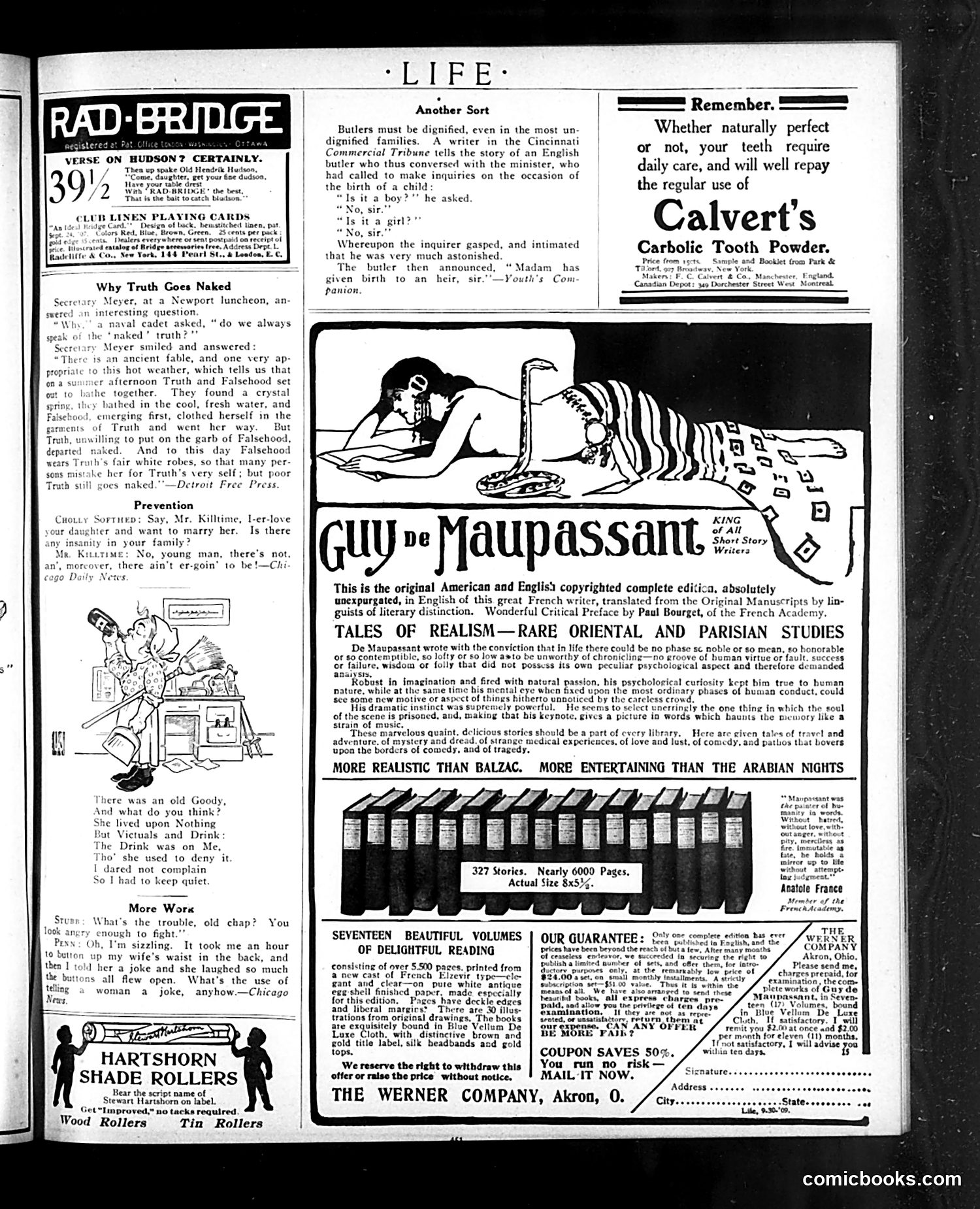
This page contains several short humorous anecdotes typical of *Life* magazine's satirical content, plus advertisements. The main cartoons/jokes include: 1. **"Why Truth Goes Naked"** — A classical fable explaining why Truth appears unadorned while Falsehood dresses elaborately: Truth went swimming, and Falsehood stole her clothes. The joke satirizes how deception is more appealing and successful than honesty. 2. **"Another Sort"** — A brief anecdote mocking formal butler etiquette. When a minister asks an English butler "Is it a boy?" after a birth, the butler responds with excessive formality ("Madam has given birth to an heir, sir"), absurdly elevating domestic news into aristocratic language. The humor lies in class pretension. 3. **"Prevention"** — A father warns a suitor away from his daughter by denying family insanity exists, implying he won't allow the marriage anyway. 4. Several short poems poking fun at marital dynamics and everyday frustrations. The page is largely advertisements for *Guy de Maupassant* books, *Calvert's* tooth powder, and *Hartshorn* shade rollers.
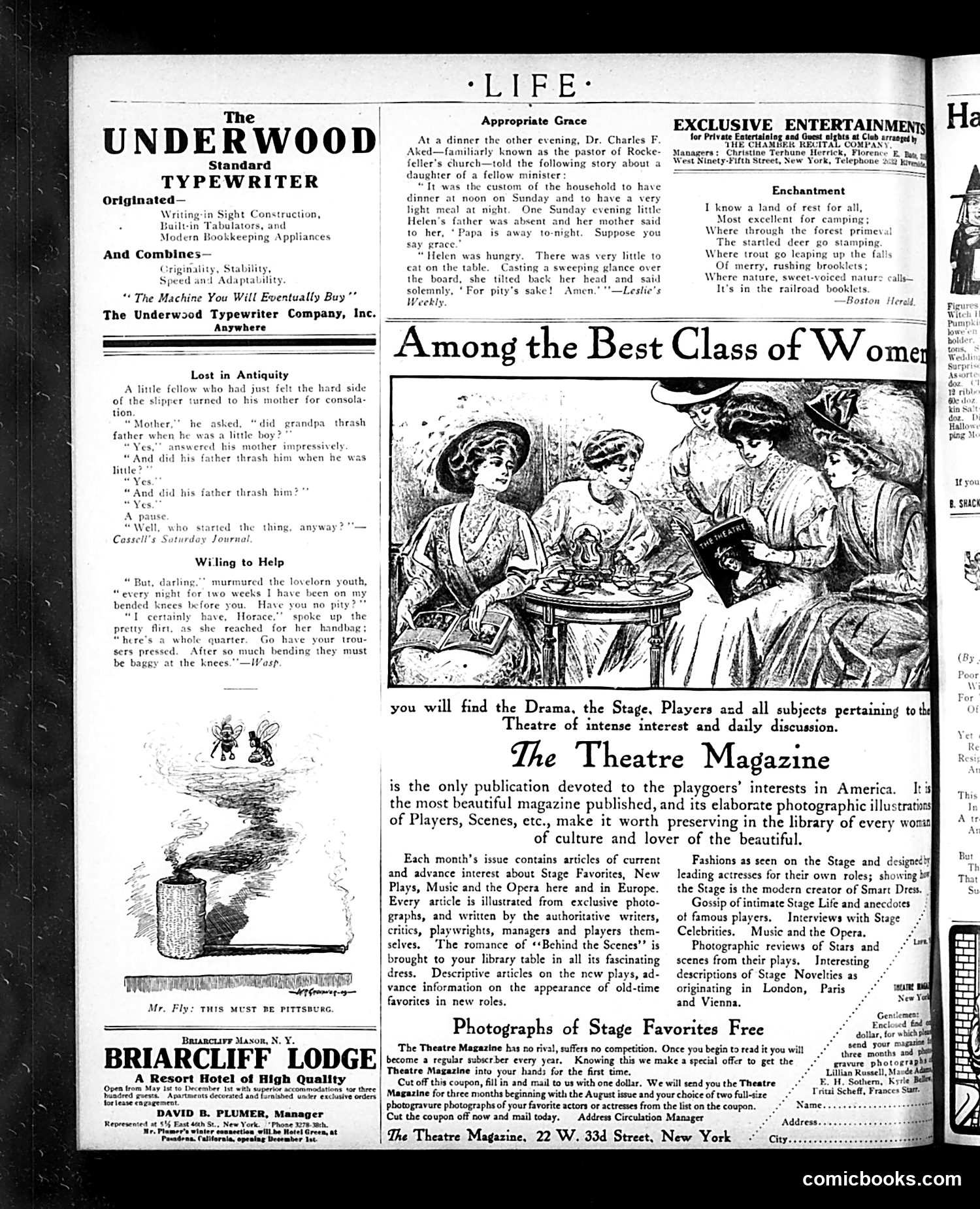
This page is primarily **advertising and light humor**, not political satire. The content includes: **Humorous anecdotes** ("Lost in Antiquity," "Willing to Help"): Brief jokes about domestic life—a child asking which ancestor first invented spanking, and a lovelorn young man whose girlfriend suggests he get his trousers pressed after kneeling so much. These poke gentle fun at courtship customs and family discipline of the era. **"Appropriate Grace"** story: A minister's daughter, hungry at dinner, offers a sarcastic prayer thanking God for her absent father so the family eats light—mild humor about childhood honesty and appetite. **Advertisements**: The Underwood Typewriter, Briarcliff Lodge resort, and The Theatre Magazine dominate the page. The illustration "Among the Best Class of Women" shows fashionable women reading together, likely promoting genteel leisure and culture. The overall tone is **nostalgic, domestic, and class-conscious**—aimed at middle-to-upper-class readers amused by parlor humor and interested in entertainment and modern conveniences.
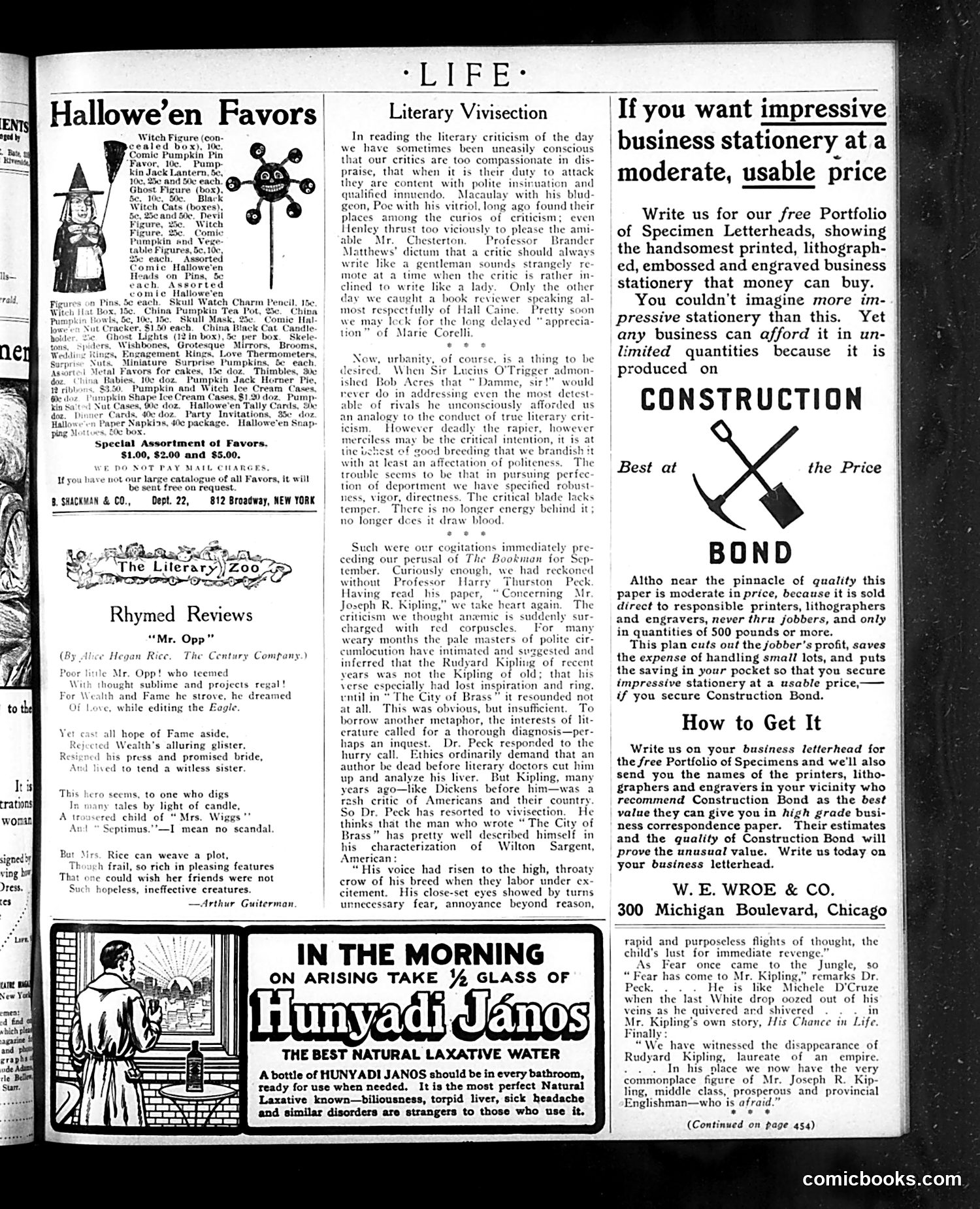
This page is primarily **advertising and literary content**, not political satire. The main sections are: 1. **Hallowe'en Favors advertisement** (left): A catalog listing of novelty party items like witch figures, jack-o'-lanterns, and pumpkin-themed decorations for Halloween parties—typical early 20th-century holiday merchandise. 2. **"Literary Vivisection"** (center): A serious critical essay discussing how book reviewers have become too polite and genteel. The author argues critics should wield sharper, more vigorous analysis like Poe and Henley did, rather than offering bland praise. It references contemporary literary figures like Hall Caine and Rudyard Kipling. 3. **"Rhymed Reviews"** (lower left): A humorous poem reviewing "Mr. Opp" by Alice Hegan Rice. 4. **Business stationery advertisements** (right): Promoting Construction Bond paper and printing services. 5. **Hunyadi Janos advertisement** (bottom): A laxative water product. The page contains **no political cartoons or satire**—it's a typical early-20th-century magazine layout mixing editorial content with advertising.
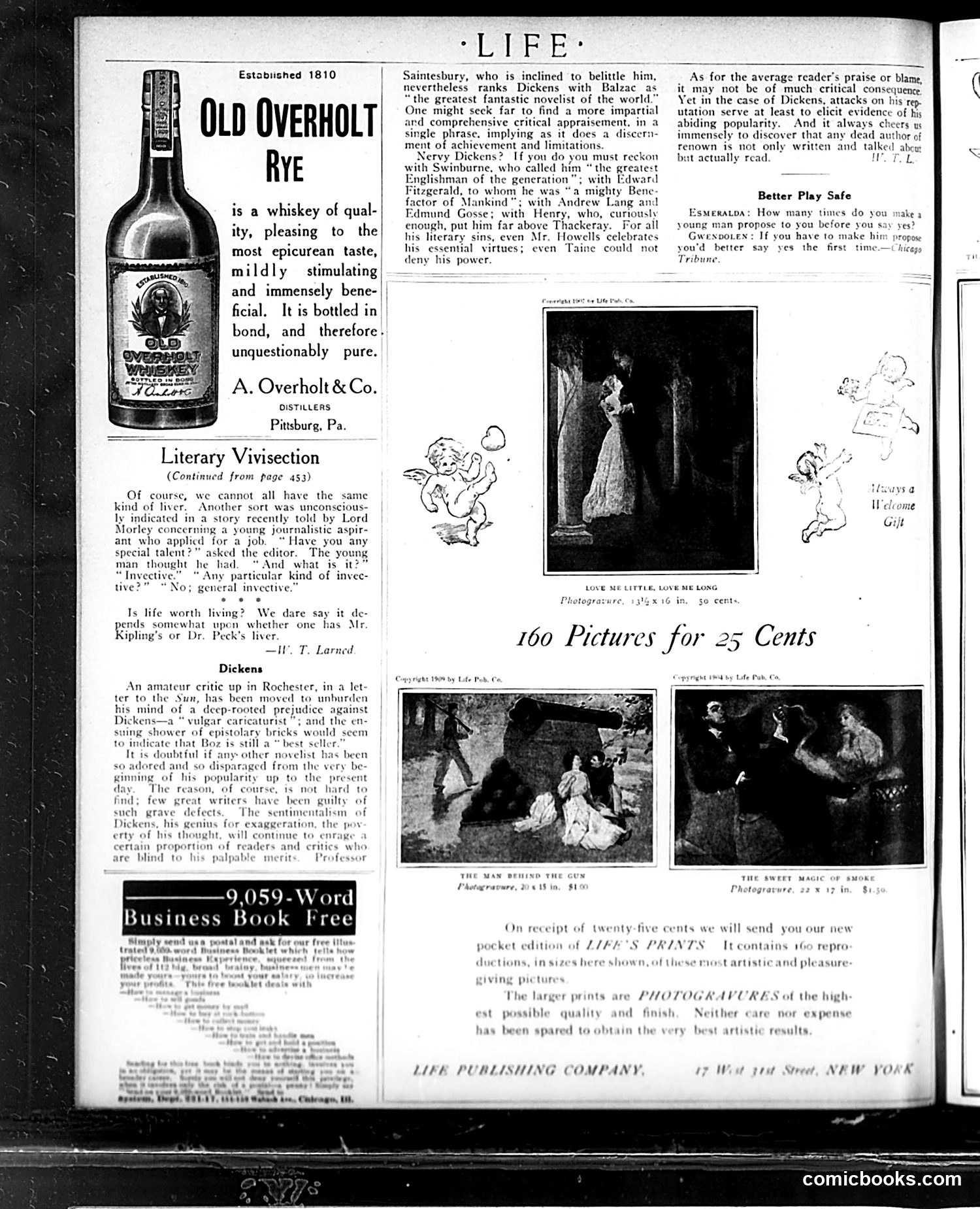
This page primarily contains **literary criticism and advertising** rather than political cartoons. The main content discusses **Charles Dickens**, defending him against an amateur critic from Rochester who called him "a vulgar caricaturist." The article argues Dickens deserves ranking alongside Balzac, citing praise from major literary figures (Swinburne, Fitzgerald, Andrew Lang). The point: Dickens remains genuinely popular and read, not just critically acclaimed—attacks on his reputation actually demonstrate his lasting cultural impact. A small humor section titled "Better Play Safe" contains a brief joke about marriage proposals (a woman should accept the first proposal to avoid repeated rejection). The page is dominated by **advertisements**: Old Overholt Rye whiskey (top left), a "Business Book Free" offer (bottom left), and promotional material for Life's photogravure prints (bottom right, showing theatrical scenes). The content reflects early 20th-century literary debates about Dickens's artistic merit versus popular appeal.
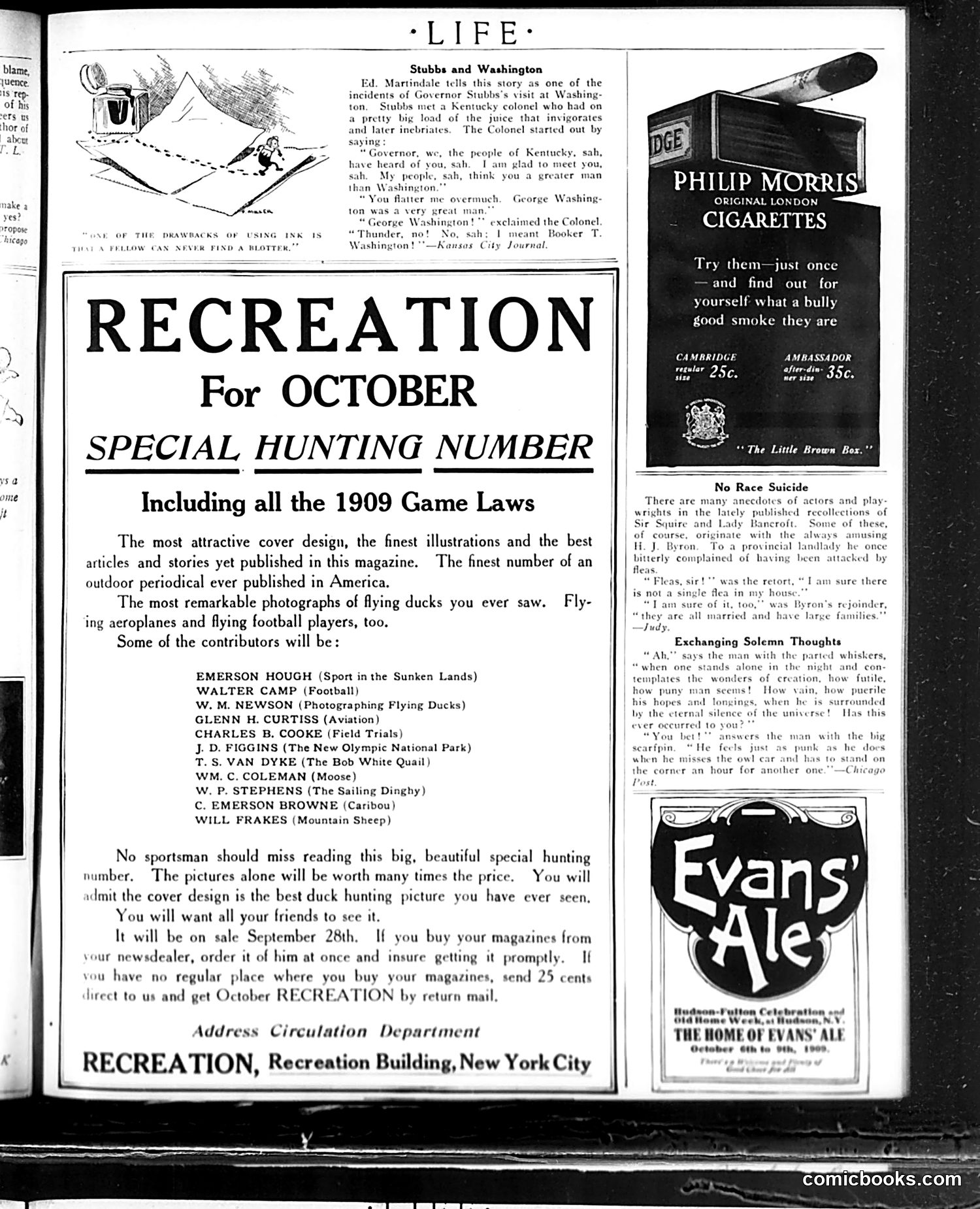
This page is primarily **advertising and promotional content** rather than satirical cartoons. The main elements are: **Top Section - "Stubbs and Washington":** A brief anecdote about Governor Stubbs meeting a drunk Kentucky colonel who compliments Stubbs by comparing him favorably to George Washington, then confuses him with Booker T. Washington. The joke relies on the colonel's intoxication causing him to conflate different prominent figures—likely playing on period stereotypes about Southern gentlemen and alcohol. **Main Content:** Promotion for *Recreation* magazine's October "Special Hunting Number" (1909), featuring contributors like aviation pioneer Glenn Curtiss and football coach Walter Camp. It emphasizes duck photography and outdoor content. **Advertisements:** Philip Morris cigarettes and Evans' Ale dominate the right side—period products now considered harmful or outdated. The small cartoon at top-left about ink and blotters is a minor joke unrelated to the page's main content.
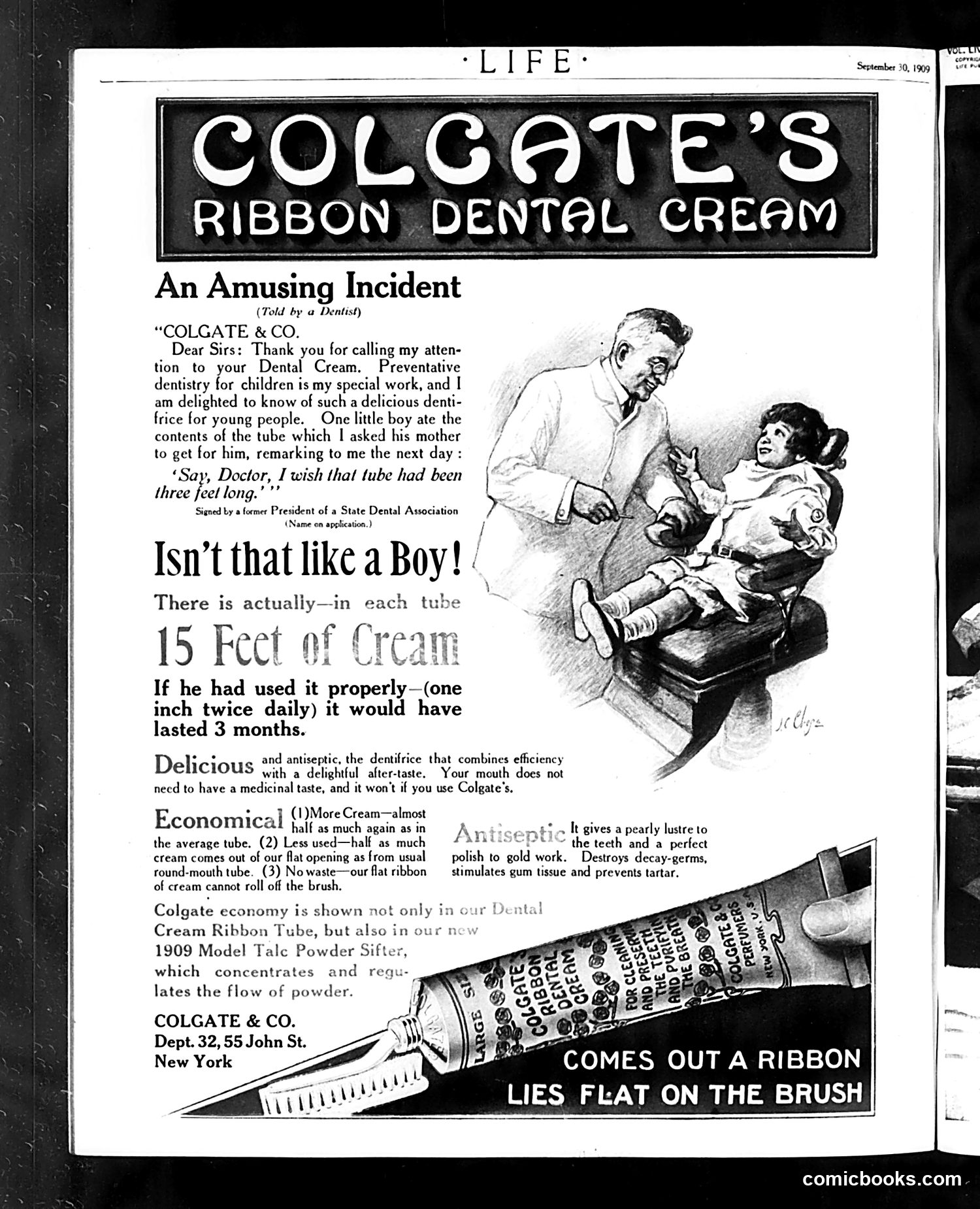
This is primarily a **product advertisement**, not political satire. It uses a humorous anecdote to sell Colgate's Ribbon Dental Cream. The "joke" is that a young boy, given a tube of dental cream to use, ate the entire contents instead of using it properly—and wished the tube had been three feet long. The advertiser presents this as charming proof of how "delicious" their product is ("Isn't that like a Boy!"). The ad then pivots to practical selling points: the ribbon design dispenses efficiently, lasts three months with proper use, and contains 15 feet of cream. The appeal emphasizes that quality dental hygiene products for children should taste good enough to make brushing pleasant. This reflects early-1900s marketing strategy: making dental care appealing to children by emphasizing flavor and product design rather than medicinal taste. The anecdote, whether true or invented, serves as customer testimony from a dental authority.