
Life, 1909-09-30 · page 14 of 32
Life — September 30, 1909 — page 14: what you’re looking at
What you’re looking at
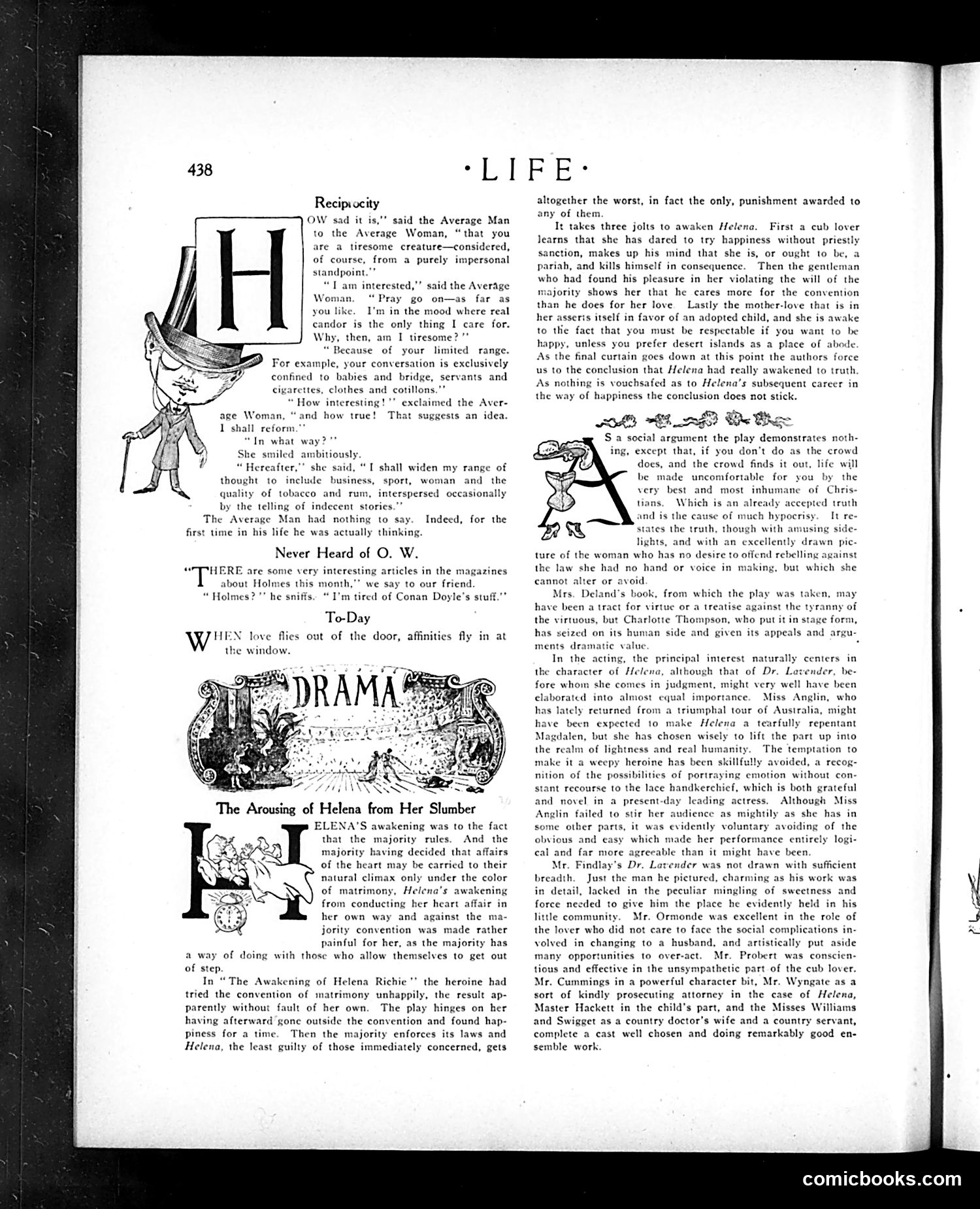
This page contains **two distinct satirical pieces**: ## "Reciprocity" A dialogue mocking gender stereotypes. An Average Man criticizes women for limited conversation (babies, bridge, servants, clothes). The Average Woman retorts that she'll expand her interests to include business, sports, and tobacco—"interspersed occasionally by the telling of indecent stories." The joke: the man, rendered speechless, has never actually *thought* before. The satire targets male hypocrisy—men condemn women's interests while claiming intellectual superiority, yet lack depth themselves. ## "The Arousing of Helena from Her Slumber" A theatrical review of a play (likely Margarethe Deland's "The Awakening of Helena Richie," though not explicitly named). The critic argues the play demonstrates society's cruel enforcement of moral convention: Helena suffers punishment for living outside matrimony, while guilty men escape consequences. The satire critiques social hypocrisy—respectable society punishes women's independence harshly while excusing male behavior, all under the guise of Christian morality. Both pieces expose **double standards** in early 20th-century American social expectations.
📄 Transcribed text from this page (OCR, searchable)
Machine-transcribed from the original scan — historical spelling and the odd misread are preserved.
‘LIFE* Recipiocity OW sad it is,"’ said the Average Man to the Average Woman, “that you are a tiresome creature—considered, of course, from a: purely impersonal standpoint. “Tam interested,”’ said the Average Woman, “Pray go on—as far as you like. I’m in the mood where real candor is the only thing I care for. Why, then, am I tiresome?” “Because of your limited range. For example, your conversation is exclusively confined to babies and bridge, servants and cigarettes, clothes and cotillons.”” “ How interesting!” exclaimed the Aver- age Woman, ind how true! That suggests an idea. 1 shall reform “In what way?" She smiled ambitiously Hereafter,”” she said, “I shall widen my range of thought to include business, sport, woman and the quality of tobacco and rum, interspersed occasionally by the telling of indecent stories.” The Average Man had nothing to say. Indeed, for the t time in his life he was actually thinking. Never Heard of O. W. “ Deere are ¢ very interest articles in the magazines about Holmes this month,”’ we say to our friend, “ Holmes?’ he sniffs. “I'm tired of Conan Doyle’s stuff To-Day HEN love flies out of the door, affinities fly in at window. The Arousing of Helena from Her Slumber ELENA'S awakening was to the fact that the majority rules. And the majority having decided that affairs of the heart may be carried to their natural climax only under the color of matrimony, Helena’s awakening from conducting her heart affair in her own way and against the ma- jority convention was made rather painful for her, as the majority has a way of doing with those who allow themselves to get out of step. In “The Awakening of Helena Richie"? the heroine had tried the convention of matrimony unhappily, the result ap- parently without fault of her own. The play hinges on her having afterward gone outside the convention and found hap- piness for a time. Then the majority enforces its laws and Helena, the least guilty of those immediately concerned, gets altogether the worst, in fact the only, punishment awarded to any of them It takes three jolts to awaken Helena. First a cub lover learns that she has dared to try happiness without priestly sanction, makes up his mind that she is, or ought to be, a pariah, and kills himself in consequence. Then the gentleman who had found his pleasure in her violating the will of the majority shows her that he cares more for the convention than he does for her love Lastly the mother-love that is in her asseris itself in favor of an adopted child, and she is awake to the fact that you must be respectable if you want to be happy, unless you prefer desert islands as a place of abode. As the final curtain goes down at this point the authors force us to the conclusion that Helena had really awakened to truth As nothing is vouchsafed as to Helena’s subsequent career in the way of happiness the conclusion does not stick. Sa social argument the play demonstrates noth- ing, except that, if you don't do as the crowd does, and the crowd finds it out, life will be made uncomfortable for you by the very best and most inhumane of Chris- tians. Which is an already accepted truth and is the cause of much hypocrisy. It re- states the truth, though with aw ing side- lights, and with an excellently drawn pic- ture of the woman who has no desire to offend rebelling again the law she had no hand or voice in making, but which she cannot alter or avoid. Mrs. Deland’s book, from which the play was taken, may have been a tract for virtue or a treatise t the tyranny of the virtuous, but Charlotte Thompson, who put it in stage form, has seized on its human side and given its appeals a argu: ments dramatic value . In the acting, the principal interest naturally centers in the cha: ter of Helena, although that of Dr. Lavender, fore whom she comes in judgment, might very well have been elaborated into almost equal importance. Miss Anglin, who has lately returned from a triumphal tour of Australia, might have been expected to make Helena a tearfully repentant Magdalen, but she has chose to lift the part up into the realm of lightness and real huma: The temptation to make it a weepy heroine has been skillfully avoided, a recog- nition of the possibilities of portraying emotion without con- stant recourse to the lace handkerchief, which is both grateful and novel in a present-day leading actress. Although Miss Anglin failed to stir her jience as ghtily as she has in some other parts, it was evidently voluntary avoiding of the obvious and easy which made her performance entirely logi- cal and far more agreeable than it might have been. Mr. Findlay’s Dr. Lavender was not drawn with sufficient breadth. Just the man he pictured, charming as his work was in detail, lacked in the peculiar mingling of sweetness and force needed to give him the place he evidently held in his little community. Mr. Ormonde was excellent in the role of the lover who did not care to face the social complications in- volved in changing to a husband, and artistically put aside many opportunities to over-act. Mr. Probert was conscien- tious and effective in the unsympathetic part of the cub lover. Mr. Cummings in a powerful character bit, Mr. Wyngate as a sort of kindly prosecuting attorney in the case of Helena, Master Hackett in the child's part, and the Misses Williams and Swigget as a country doctor's wife and a country servant, complete a cast well chosen and doing remarkably good en- semble work. comicbooks.com PL ee