
Life, 1909-09-30 · page 6 of 32
Life — September 30, 1909 — page 6: what you’re looking at
What you’re looking at
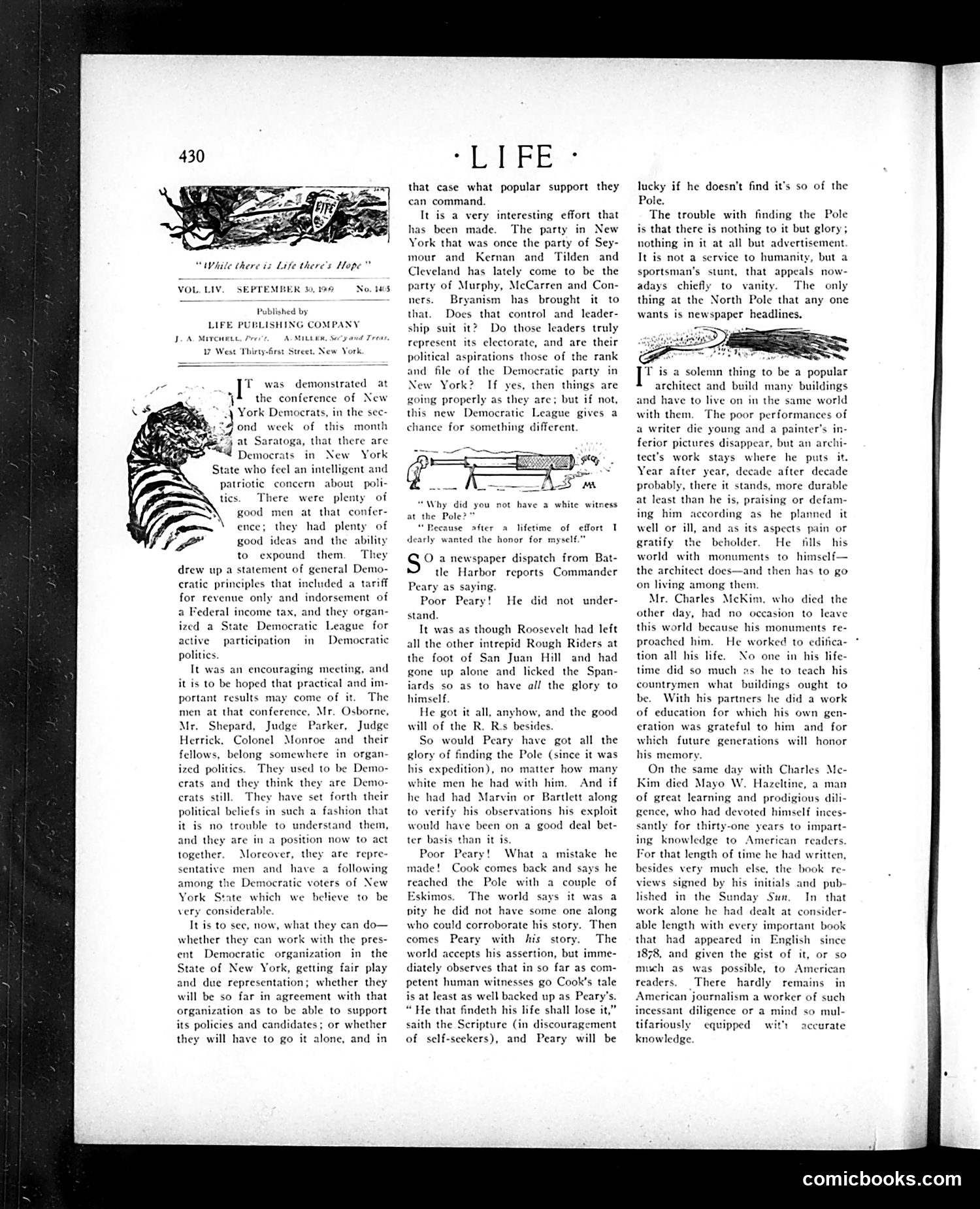
The page contains two editorial cartoons addressing Democratic Party politics in New York State. The **left cartoon** depicts a figure labeled "While there is Life there's Hope" with patriotic imagery, likely commenting on Democratic Party leadership struggles. The **right cartoon** shows what appears to be a construction or surveying scene, titled "Why did you not have a white witness at the Pole?" This references the recent Peary-Cook polar expedition controversy—both explorers claimed discovering the North Pole, with credibility questions arising about their witnesses and evidence. The cartoon satirizes the dispute through the lens of racial bias (mentioning "white witness"), reflecting early-1900s attitudes while mocking the explorers' competing claims. The accompanying text discusses Democratic League organization and party leadership in New York, suggesting internal party conflicts.
📄 Transcribed text from this page (OCR, searchable)
Machine-transcribed from the original scan — historical spelling and the odd misread are preserved.
cis Life there's Hope” No. 105 SEPTEMBER 30, 190 Published by LIFE PUBLISHING COMPANY LL. Pre A. MILLER, See"y and Trews 1 West Thirty-first Street, New York. I was demonstrated at 4 the conference of New ay ork Democrats, in the sec- week of th month j at Saratoga, that there are “4 Democrats in New York State who feel an intelligent and patriotic concern about poli- tics. There were plenty of good men at that confer- ence; they had plenty of good ideas and the ability to expound them. They drew up a statement of general Demo- cratic principles that included a tariff for revenue only and indorsement of a Federal income tax, and they organ- ized a State Democratic League for active participation in Democratic politics. It was an encouraging meeting, and it is to be hoped that practical and im- portant results may come of it. The men at that conference, Mr. Osborne, Mr. Shepard, Judge Parker, Judge Herrick, Colonel Monroe and their fellows, belong somewhere in organ- ized politics. They used to be Demo- crats and they think they are Demo- crats still, They have set forth their political beliefs in such a fashion that it is no trouble to understand them, and they are in a position now to act together. Moreover, they are repre- sentative men and have a following among the Democratic voters of New York State which we very considerable It is to see, now, what they can do— whether they can work with the pres- ent Democratic organization in the State of New York, getting fair play and due representation; whether they will be so far in agreement with that organization as to be able to support its policies and candidates ; or whether they will have to go it alone, and in xg ond believe to be “L-REE + that case what popular support they can command. It is a very interesting effort that has been made. The party in New York that was once the party of Sey- mour and Kernan and Tilden and Cleveland has lately come to be the party of Murphy, McCarren and Con- Bryanism has brought it to Does that control and leader- ship suit it? Do those leaders truly represent its electorate, and are their political aspirations those of the rank nd file of the Der i i New York? If yes, then things are going properly as they are; but if not, this new Democratic League gives a chance for something different. ners. that “Why did you not have a white witness at the Pole?” * Because lifetime of effort 1 dearly wanted the honor for myself.” after a S O a newspaper dispatch from Bat- tle Harbor reports Commander Peary as saying. Poor Peary! He did not under- stand. It was as though Roosevelt had left all the other intrepid Rough Riders at the foot of San Juan Hill and had gone up alone and licked the Span- iards so as to have all the glory to himself. He got it all, anyhow, and the good will of the R. R-s besides. So would Peary have got all the glory of finding the Pole (since it was his expedition), no matter how many white men he had with him. And if he had had Marvin or Bartlett along to verify his observations his exploit would have been on a good deal bet- ter basis than it is. Poor Peary! What a mistak made! Cook comes back and says he reached the Pole with a couple of Eskii The world says it was a pity he did not have some one along who could corroborate his story. Then comes Peary with his story. The world accepts his assertion, but imme- diately observes that in so far as com- petent human witnesses go Cook's tale is at least as well backed up as Peary’s. “ He that findeth his life shall lose it,” saith the Scripture (in discouragement of self-seekers), and Peary will be lucky if he doesn't find it’s so of the Pole. The trouble with finding the Pole is that there is nothing to it but glory; nothing in it at all but advertisement It is not a service to humanity, but a sportsman’s stunt, that appeals now ad: chiefly to vanity. The only thing at the North Pole that any one wants is newspaper headlines. [7 is 2 sotemn thing to be a popular architect and build many buildings and have to live on in the same world with them, The poor performances of a writer die young and a painter's in ferior pictures disappear, but an archi- tect’s work stays where he puts it. Year after year, decade after decade probably, there it stands, more durable at least than he is, praising or defam- ing him according as he planned it well oF ill, and as its aspects pain or gratify the beholder. He fills his world with monuments to himself— the architect does—and then has to go on living among them. Mr. Charles McKim, who died the other day, had no occasion to leave this world because his monuments re- proached him. He worked to edifica tion all his life. No one in his lif time did so much 2s he to teach his countrymen what buildings ought to be. With his partners he did a work of education for which his own gen- eration was grateful to him and for which future generations will honor his memory. On the same day with Charles Me- Kim died Mayo W. Hazeltine, a man of great learning and prodigious dili- gence, who had devoted himself inces- santly for thirty-one years to impart- ing knowledge to American readers For that length of time he had written, besides very much else, the book re- views signed by his initials and pub- lished in the Sunday Sun, In that work alone he had dealt at consider- able length with every important book that had appeared in English 1878, and given the gist of it, or so much as was possible, to American readers, There hardly remains in American journalism a worker of such incessant diligence or a mind so mul- tifariously equipped wit’: accurate knowledge. since comicbooks.com