
A complete issue · 32 pages · 1909
Life — June 17, 1909
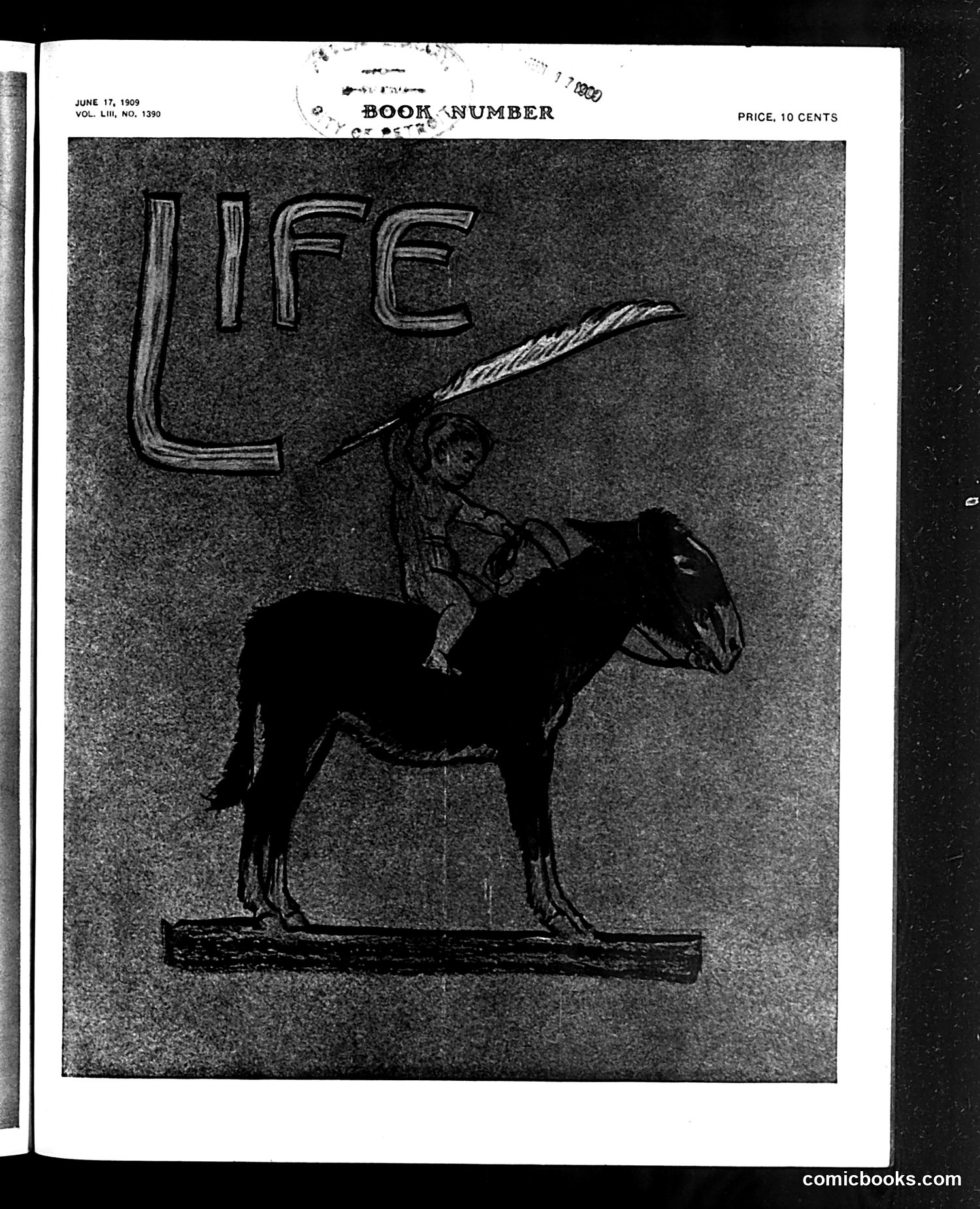
This is the cover of *Life* magazine's "Book Number" issue, priced at 10 cents. The illustration shows a silhouetted figure mounted on a horse, holding what appears to be a feathered quill or pen as a lance—a visual pun combining the cowboy/cavalry imagery with literary symbolism. The design likely satirizes American literature or literary culture of the period, using the "knight errant" trope of the writer as an adventurer. The prominent "LIFE" text and quill-as-weapon suggest commentary on the power or role of satire and journalism itself. Without additional text visible, the specific political target remains unclear, though the artistic approach is typical of *Life*'s irreverent visual commentary on contemporary culture.
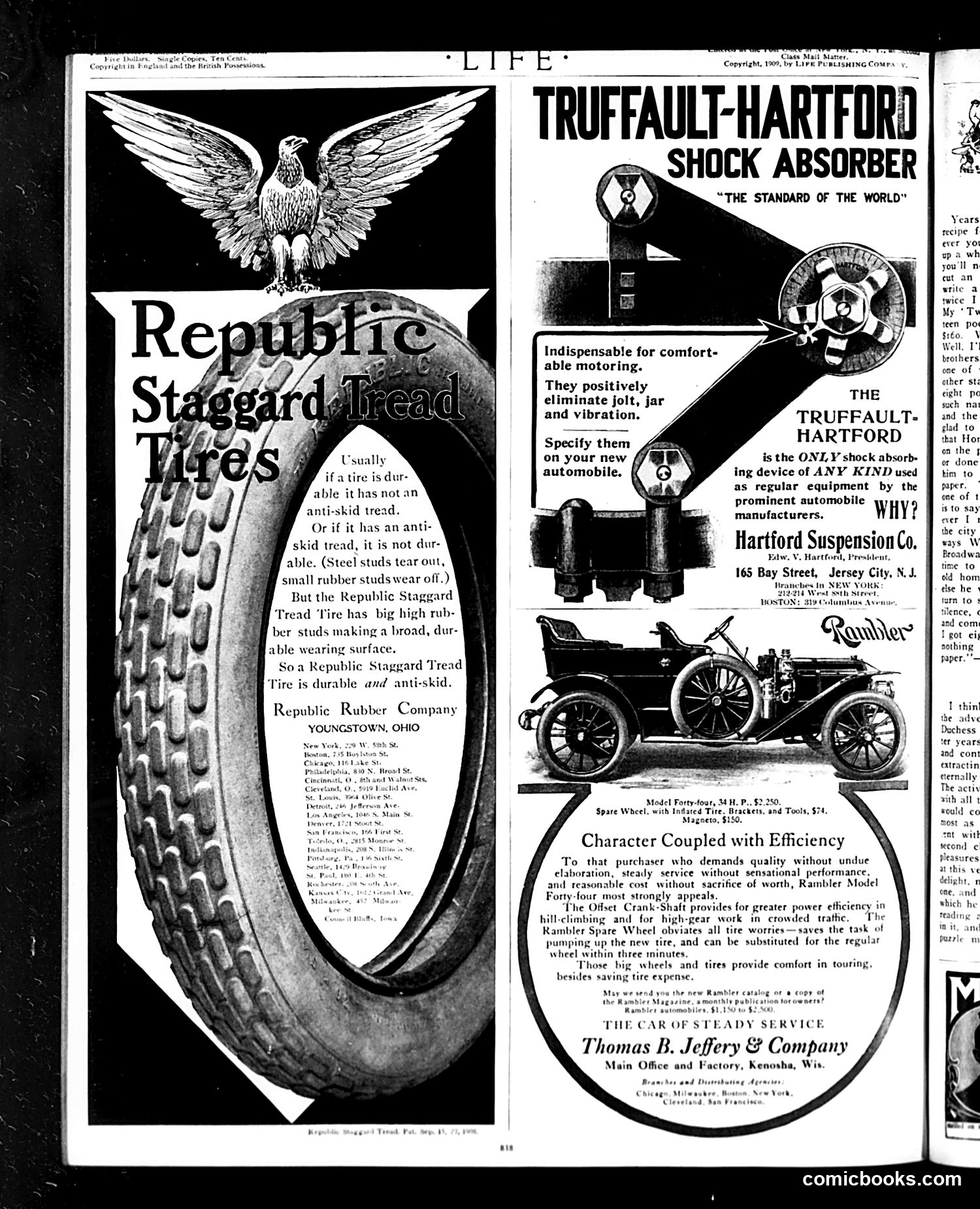
This page contains **primarily advertisements rather than political satire**. The left side features a Republic Rubber Company ad for "Staggard Tread Tires," emphasizing durability and anti-skid properties. The right side showcases two automotive advertisements: a Truffault-Hartford shock absorber ("The Standard of the World") and a Thomas B. Jeffery & Company Rambler automobile advertisement titled "Character Coupled with Efficiency." The only non-commercial element is an eagle with spread wings at the top left, appearing as a patriotic masthead or decorative element rather than satirical commentary. This reflects *Life* magazine's dual nature: while known for satire and humor, it also contained substantial advertising revenue. The content here prioritizes consumer products for the early automotive era over political or social commentary.
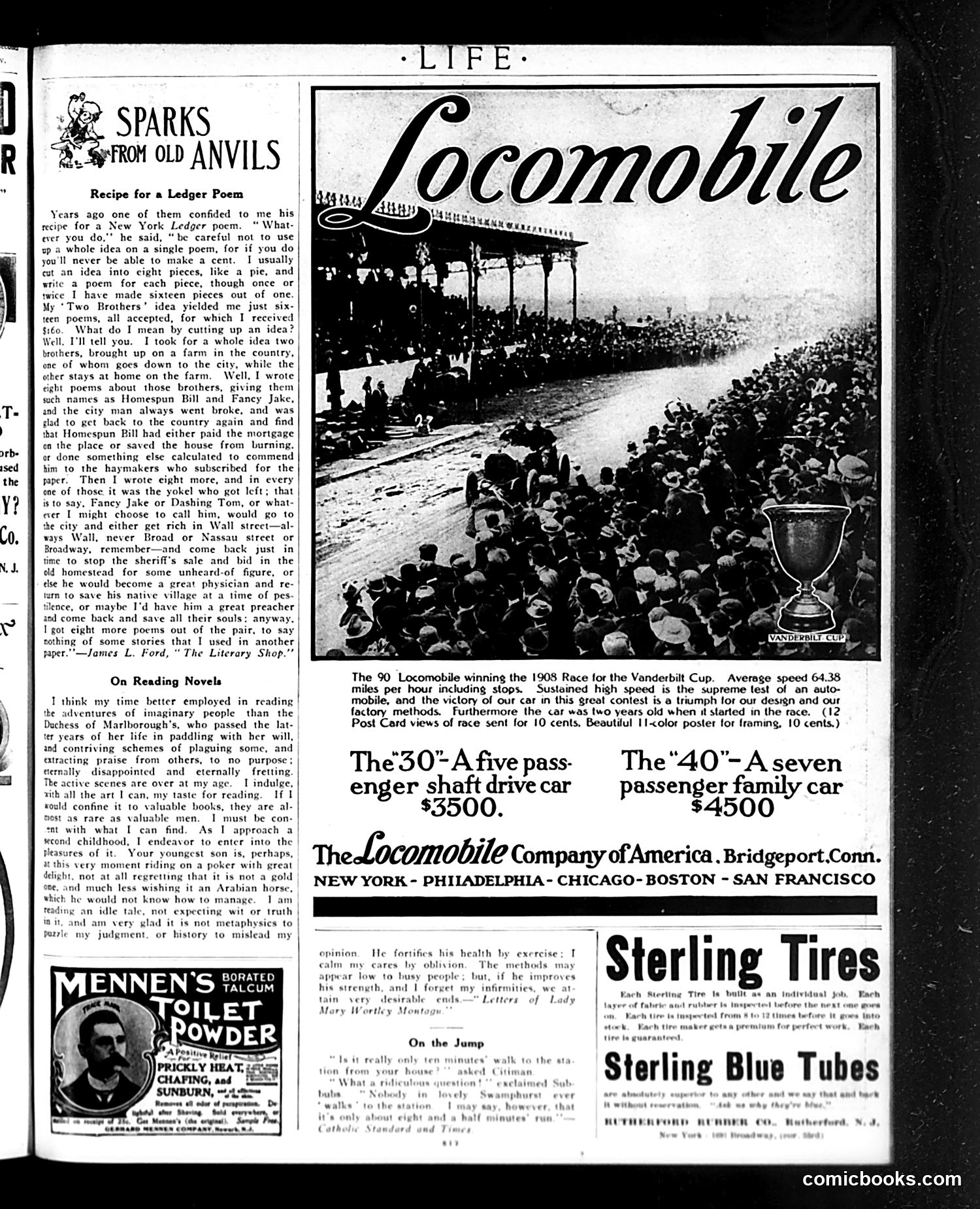
This page is primarily **advertising**, not satire or political commentary. The dominant feature is a large Locomobile automobile advertisement showcasing the company's 1908 Vanderbilt Cup race victory, highlighting their engineering prowess. Two car models are advertised: the 30-passenger shaft-drive car ($3,500) and the 40-passenger family car ($4,500). The left side contains a literary section titled "Sparks from Old Anvils," featuring a poem submission story, and "On Reading Novels," a brief essay about literature appreciation. Supporting advertisements include Mennen's Toilet Powder and Sterling Tires/Blue Tubes. The page reflects early 20th-century consumer culture, emphasizing technological achievement and luxury goods rather than political commentary or satire.
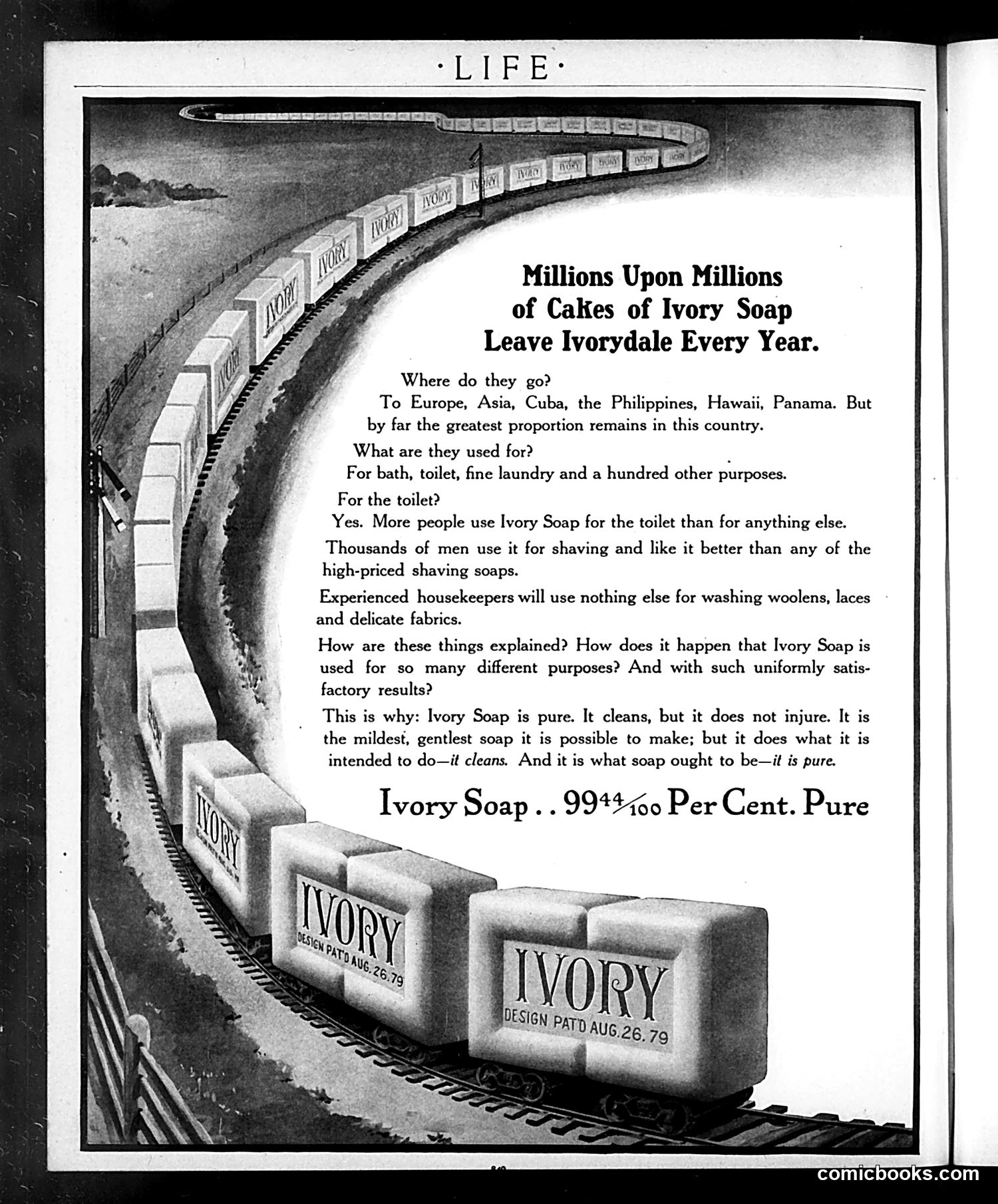
This is **not satire or political commentary**—it's a straightforward product advertisement for Ivory Soap from an early 20th-century Life magazine. The image shows a train laden with soap bars leaving Ivorydale (Procter & Gamble's manufacturing facility) and distributing globally. The ad emphasizes Ivory Soap's purity (99 44/100% pure) and versatility—suitable for bathing, toileting, laundry, shaving, and delicate fabrics. The marketing strategy highlights how one product serves multiple purposes equally well, framing purity as the reason for this universal applicability. The train visualization suggests industrial-scale production and nationwide/worldwide distribution—a modern convenience to celebrate. This represents early advertising copy that appeals to efficiency and reliability rather than aspirational lifestyle.
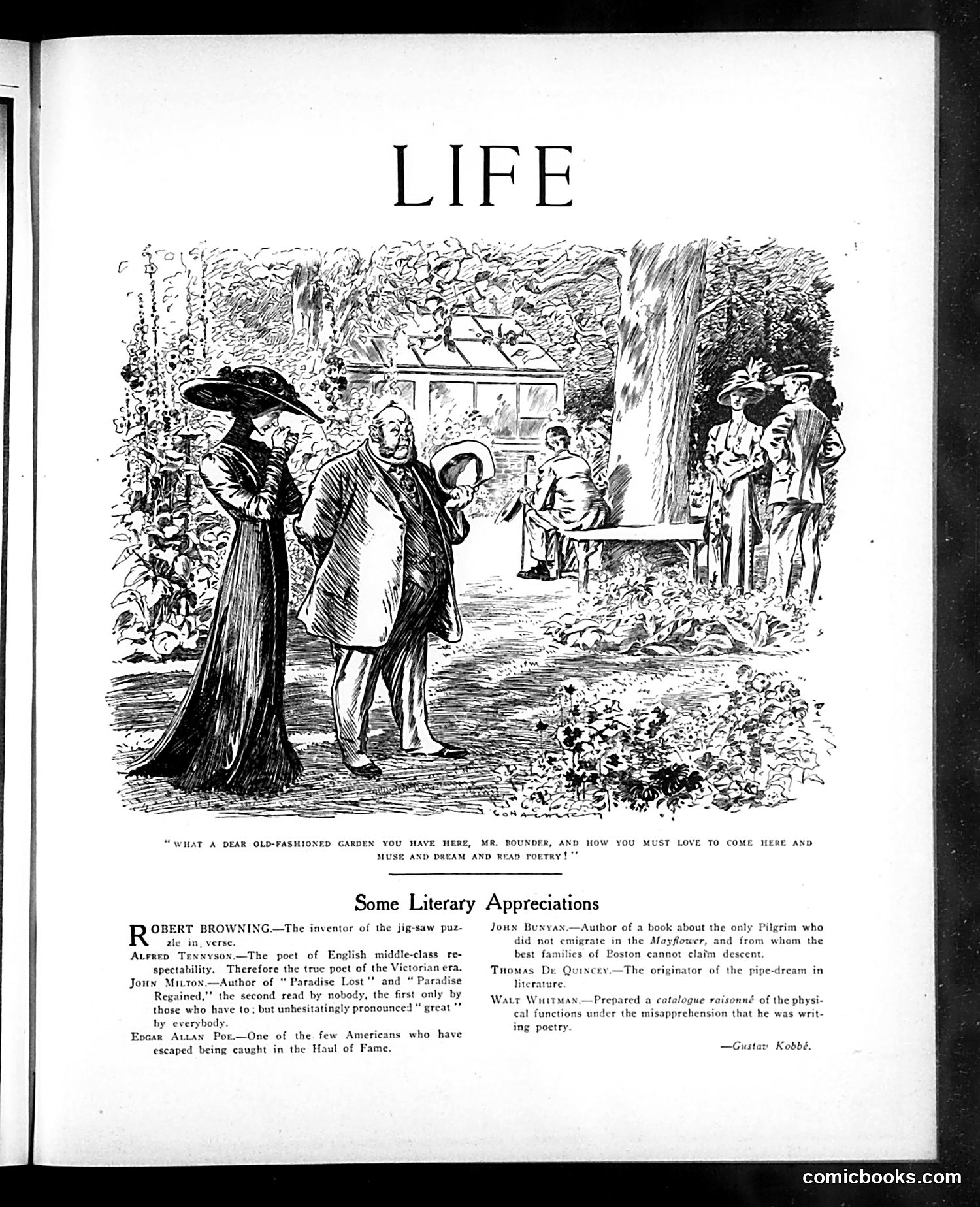
This page features a Victorian-era garden scene with the caption: "What a dear old-fashioned garden you have here, Mr. Rounder, and how you must love to come here and muse and dream and read poetry!" The cartoon appears to be gentle social satire mocking sentimental romanticism about nature and contemplative leisure—suggesting pretentious affectation among the middle or upper classes. The figure "Mr. Rounder" may be a stock character representing someone of means. Below, "Some Literary Appreciations" offers brief, often backhanded critiques of famous authors (Browning, Tennyson, Milton, Poe, etc.), highlighting their flaws or limited appreciation. The satire suggests these revered poets are overrated or misunderstood by contemporary audiences—typical of *Life* magazine's irreverent literary commentary from the late 19th/early 20th century.
The main article discusses college education and scholarship, particularly addressing President Lowell of Harvard's efforts to reform scholarship practices. The piece critiques American colleges for prioritizing money-making and athletic success over genuine intellectual development. The decorative header illustration shows five owl figures in a row—a visual metaphor for scholars or academics, emphasizing wisdom and learning. The political-social satire targets the commercialization of higher education: colleges are criticized for recruiting students as income sources rather than fostering genuine scholarship. The text argues that while benefactors are essential, the tension between organizational maintenance and intellectual mission threatens universities' core purpose. This reflects Progressive Era concerns about institutional integrity amid rapid American industrialization and university expansion.
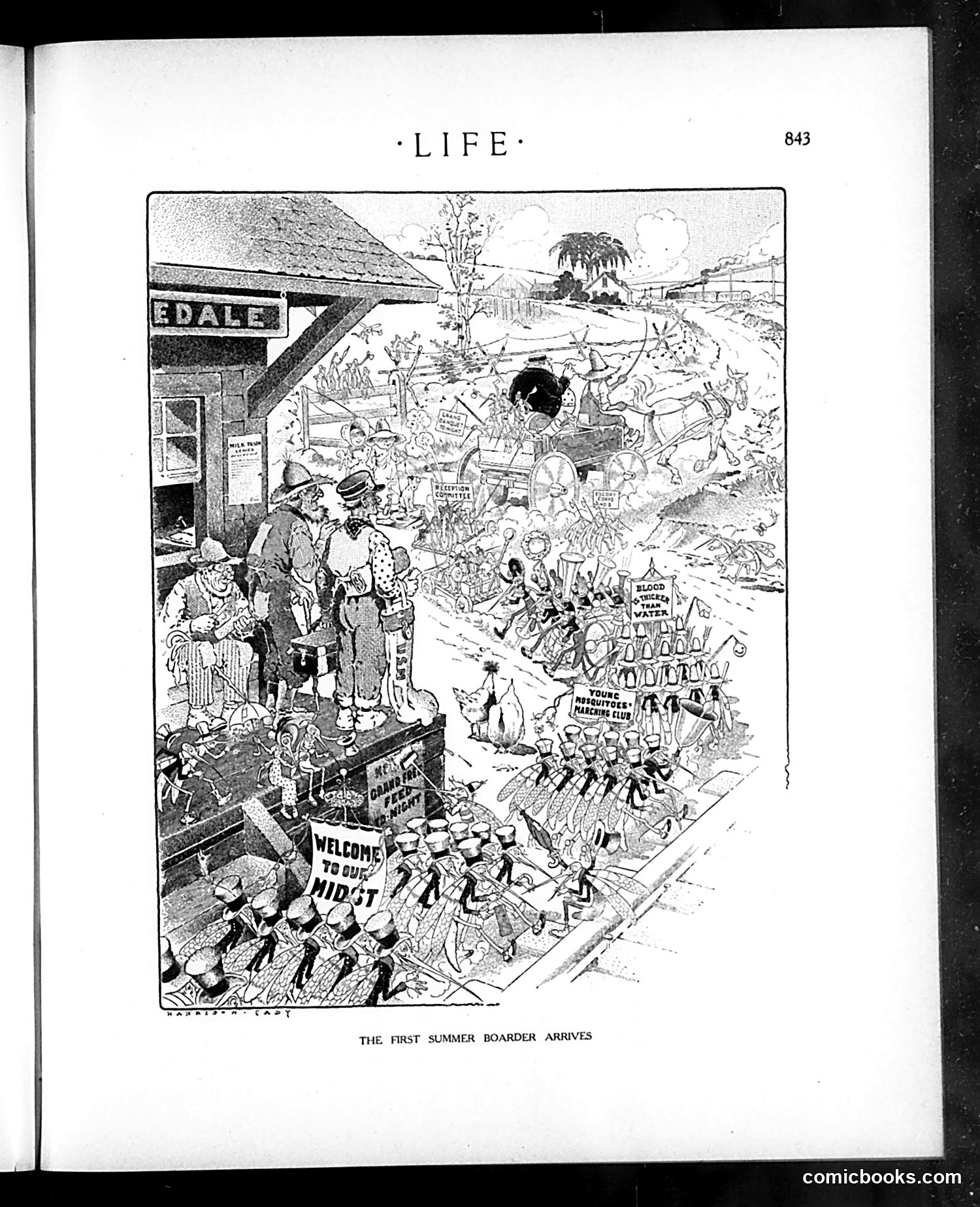
This satirical illustration depicts the chaos of a seaside resort town welcoming its first summer tourist of the season. The cartoon shows an overwhelmed boarding house (marked "EDALE") as the arriving guest is mobbed by townspeople—merchants, service workers, and entertainment vendors—all competing frantically for the visitor's business and money. The joke targets the economic dependence of small resort communities on seasonal tourism. Local businesses desperately pursue the single boarder as if he were a precious resource, suggesting both the towns' financial vulnerability during off-season and their undignified scramble for tourist dollars. Signs reading "WELCOME TO OUR MIDGET" and various commercial establishments illustrate how the entire community's prosperity hinges on these temporary visitors.
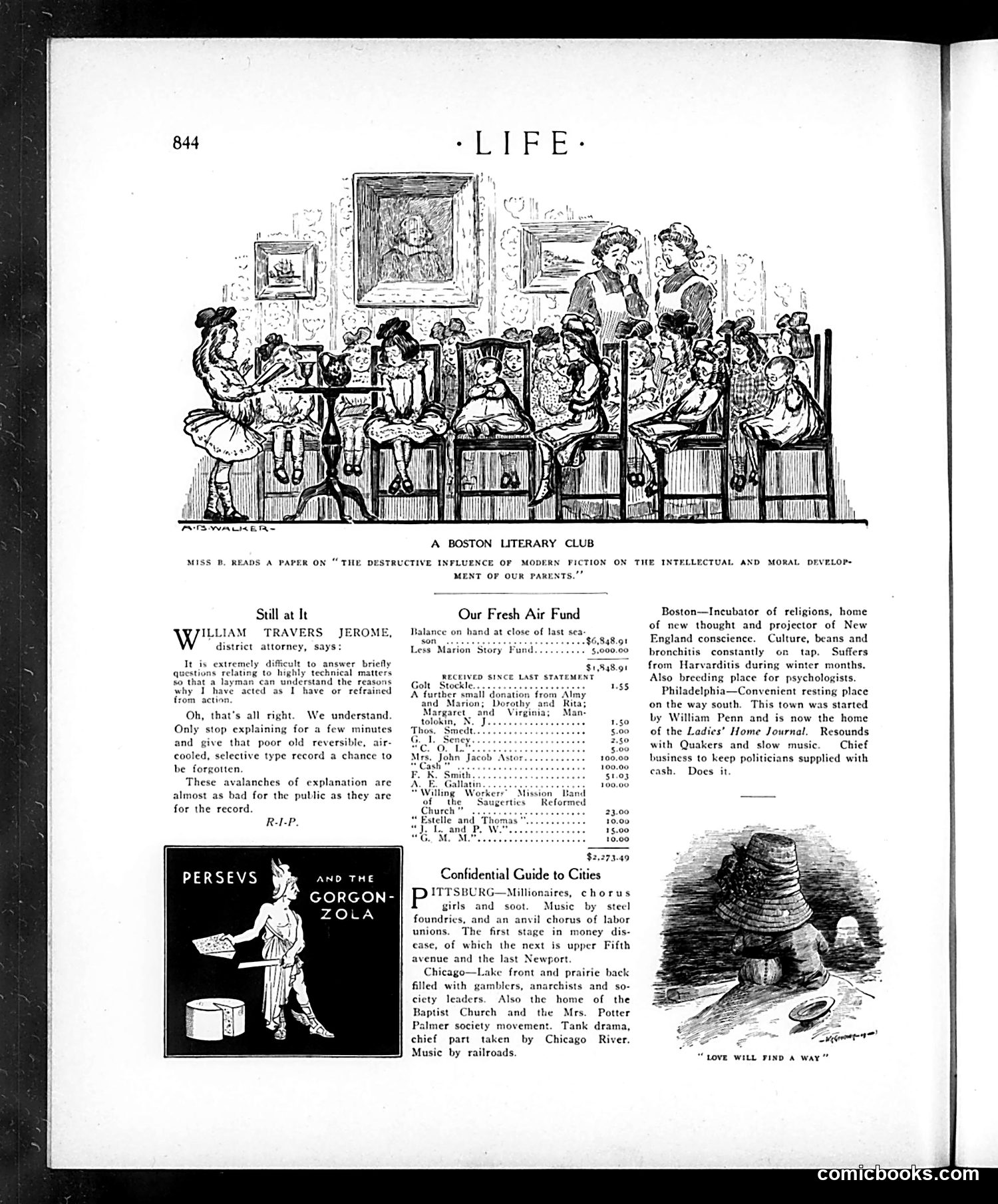
The main illustration depicts "A Boston Literary Club," showing a woman (labeled as "Miss B.") reading a paper to an assembled audience about "the destructive influence of modern fiction on the intellectual and moral development of our parents." The satire is clear: the joke inverts typical moral panic rhetoric. Instead of worrying that modern fiction corrupts *youth*, this group worries it corrupts *parents*—suggesting that adults, not children, are the vulnerable ones susceptible to fiction's influence. This mocks the earnest intellectual pretensions of Boston's literary establishment while satirizing contemporary anxieties about literature's social effects. The accompanying text discusses various charitable fundraising efforts and cultural commentary, typical of Life magazine's satirical social coverage from this era.
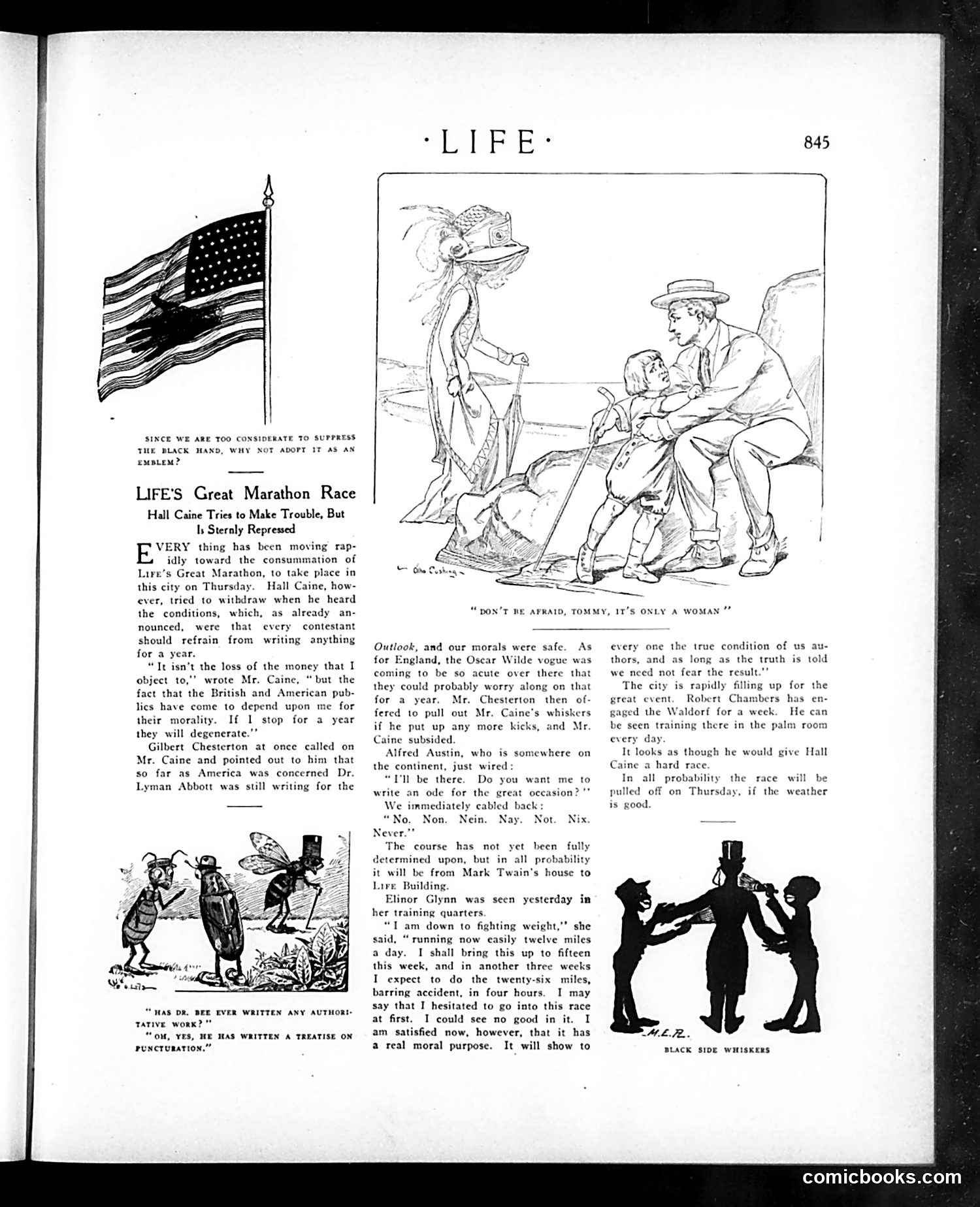
This page satirizes a planned "Great Marathon Race" where Hall Caine (a literary figure) attempted to suppress writing about the "Black Hand"—a name associated with Italian organized crime and extortion threats. The header asks why, if suppressing the Black Hand, they shouldn't adopt it as an emblem. The main cartoon depicts a man and boy, captioned "Don't be afraid, Tommy, it's only a woman," showing a woman in masculine attire. This illustrates contemporary anxiety about women's changing roles and appearances. The lower cartoon, "Black Side Whiskers," is a separate joke about facial hair fashion. The article discusses race logistics and includes quotes suggesting the event's actual occurrence was uncertain, lending the whole piece a mocking tone toward the endeavor's legitimacy.
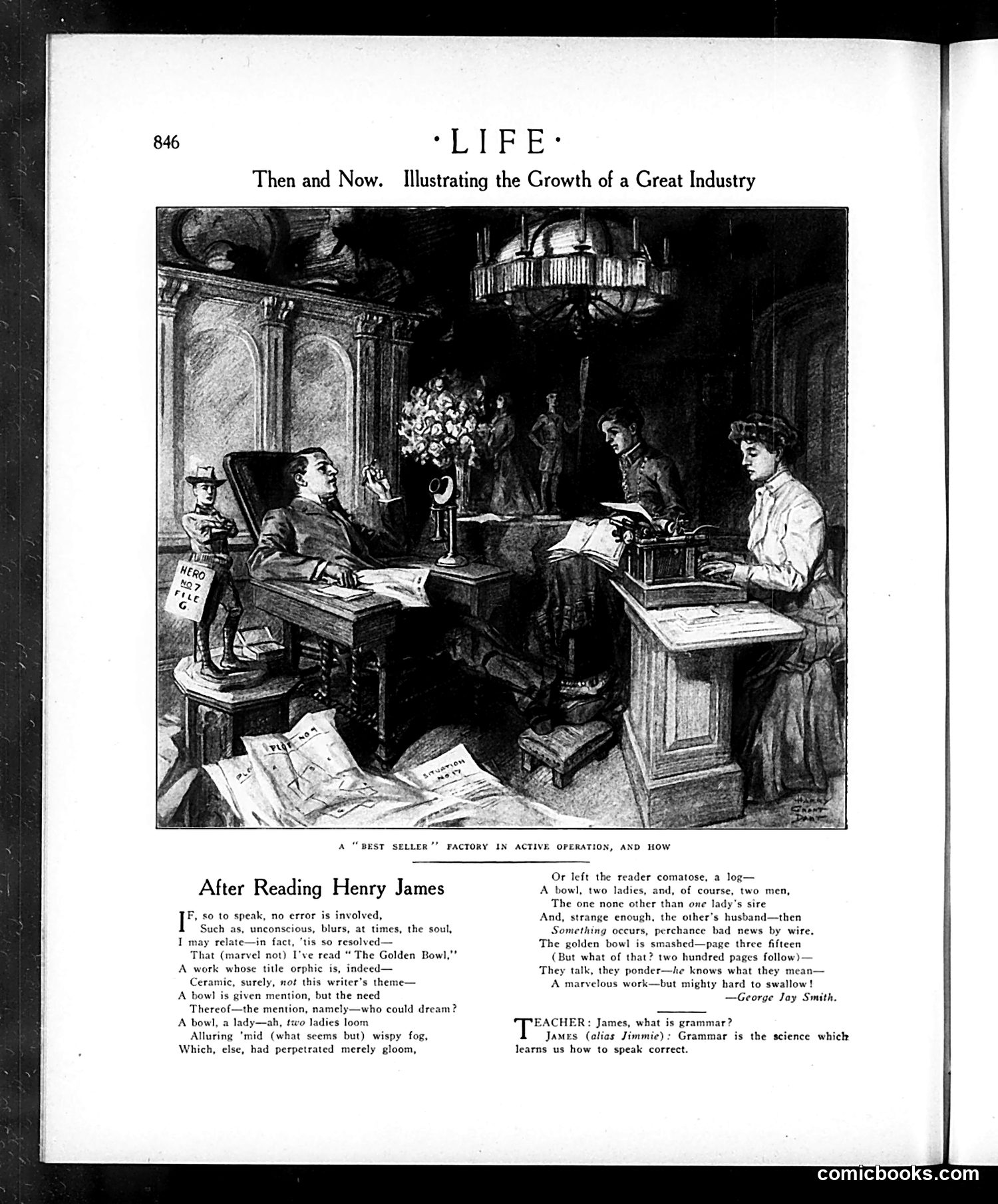
This page from Life magazine presents a satirical illustration titled "A 'Best Seller' Factory in Active Operation," depicting a literary production facility. The cartoon mocks the commercialization of publishing, showing what appears to be an author or editor at a desk with multiple assistants/clerks processing manuscripts and correspondence—suggesting that popular books are manufactured like factory products rather than created through genuine artistic inspiration. The accompanying poem "After Reading Henry James" by George Jay Smith critiques Henry James's writing style, particularly his novel "The Golden Bowl." It humorously complains that James's prose is convoluted and unclear—filled with "blurs," "fog," and complexity—making his work difficult to understand. The satire suggests that even celebrated "serious" literature can be incomprehensible despite its reputation.
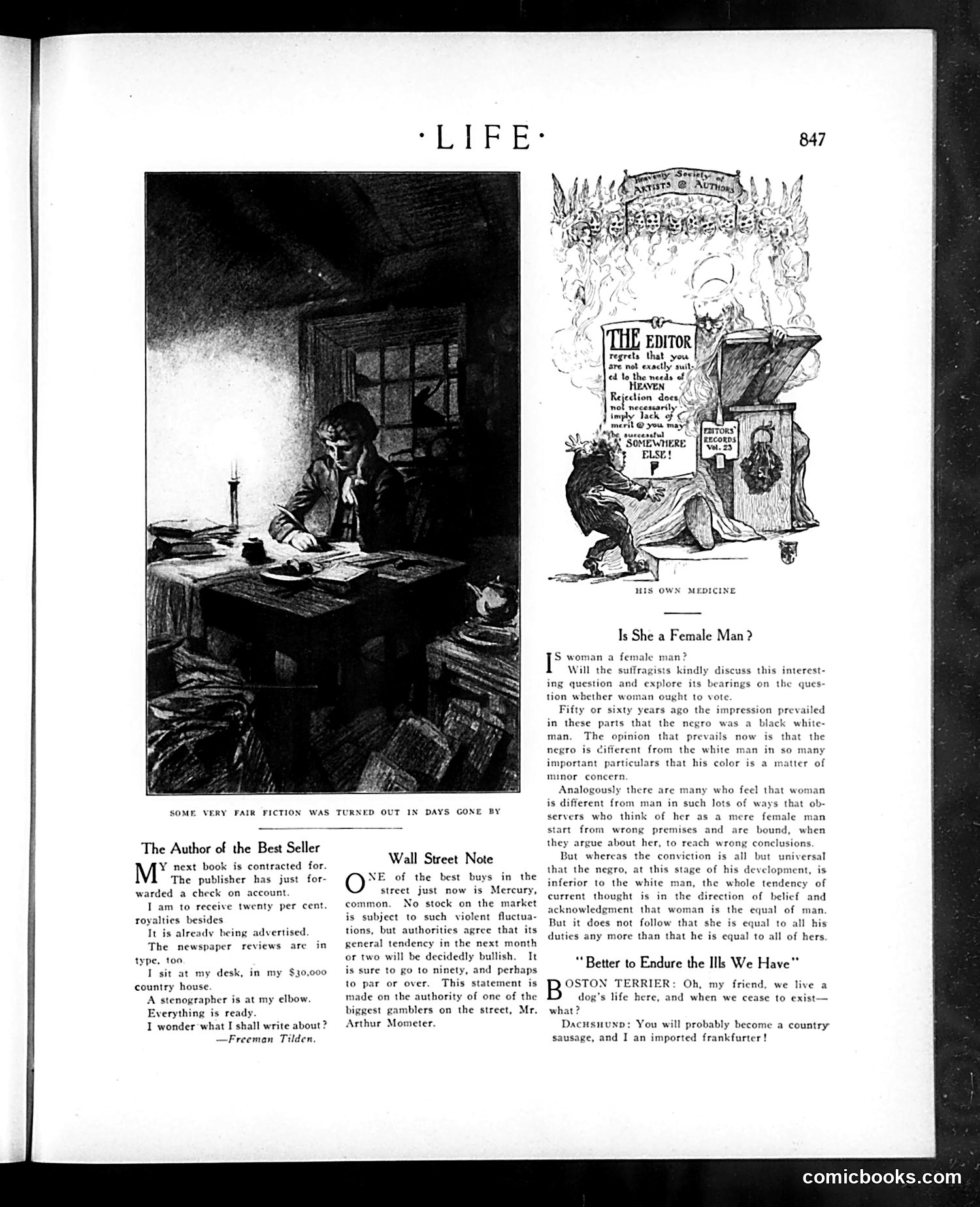
The left illustration shows a writer at his desk by candlelight, captioned "SOME VERY FAIR FICTION WAS TURNED OUT IN DAYS GONE BY." This appears to be nostalgic commentary on older literary practices. The right cartoon titled "HIS OWN MEDICINE" depicts a figure at an "EDITOR" booth rejecting submitted work. The satire targets rejected writers seeking revenge against editors—the rejected party now becomes the rejector, offering the editor his own experience of rejection as "medicine." The text sections discuss whether women are fundamentally different from men, and includes a humorous exchange about a Boston Terrier and Dachshund, using dog breeds as metaphors for national/class identity. The overall page mixes literary commentary with social observation typical of Life's satirical approach.
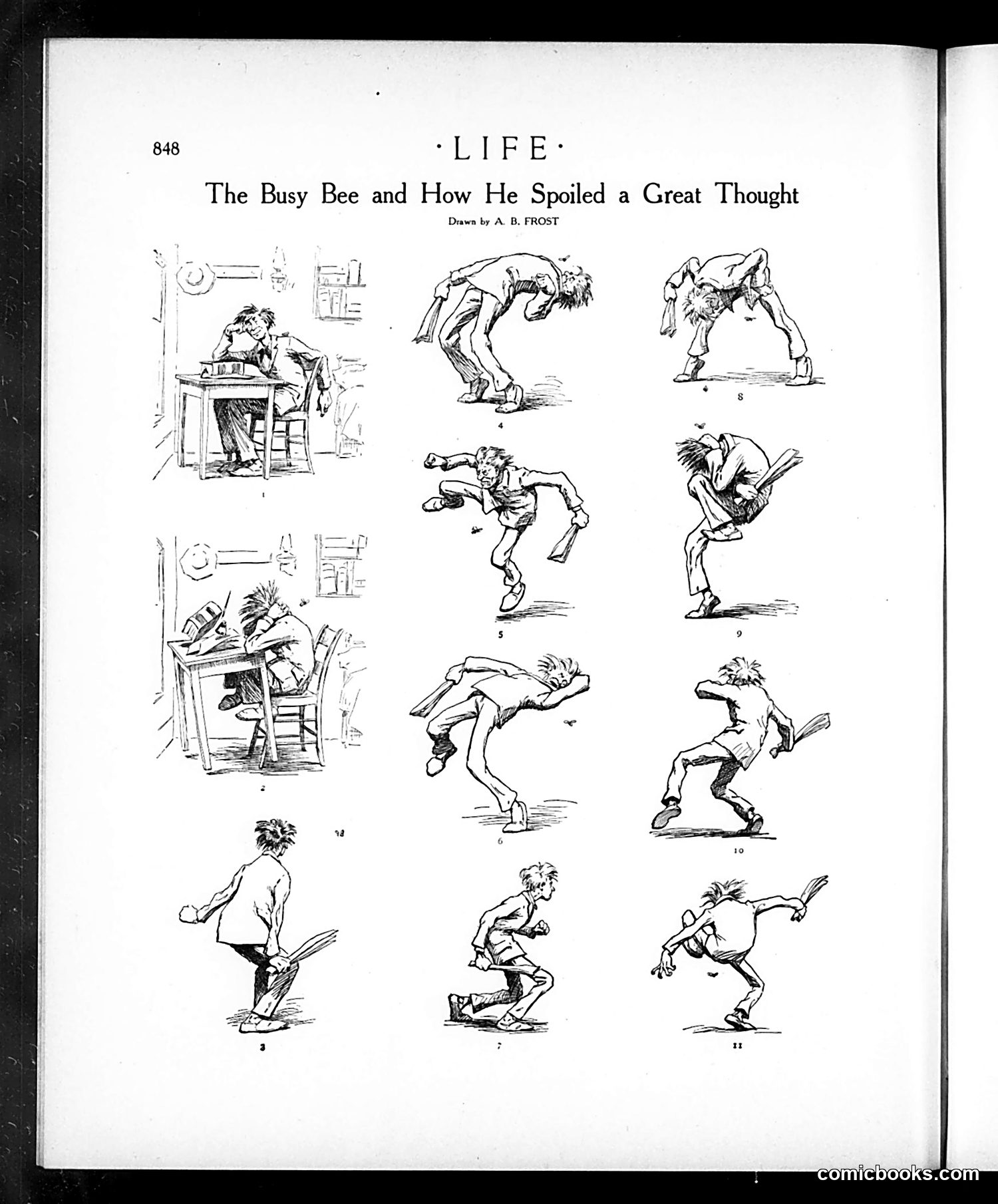
This is a humorous visual sequence drawn by A.B. Frost showing a man at his desk having his concentration repeatedly interrupted by a bee. The cartoon progresses through panels 1-2 (the man working, then swatting at the bee), followed by panels 3-11 depicting increasingly frantic and exaggerated bodily contortions as the man tries to kill or escape the insect—leaping, twisting, falling backward, and adopting absurd poses. The satire mocks how trivial annoyances can completely derail serious intellectual work. The "great thought" of the title is abandoned as physical comedy takes over. It's a relatable commentary on distraction and the gap between aspirations (productive thinking) and reality (being undone by minor nuisances). The exaggerated illustrations emphasize how disproportionately people react to small irritations.
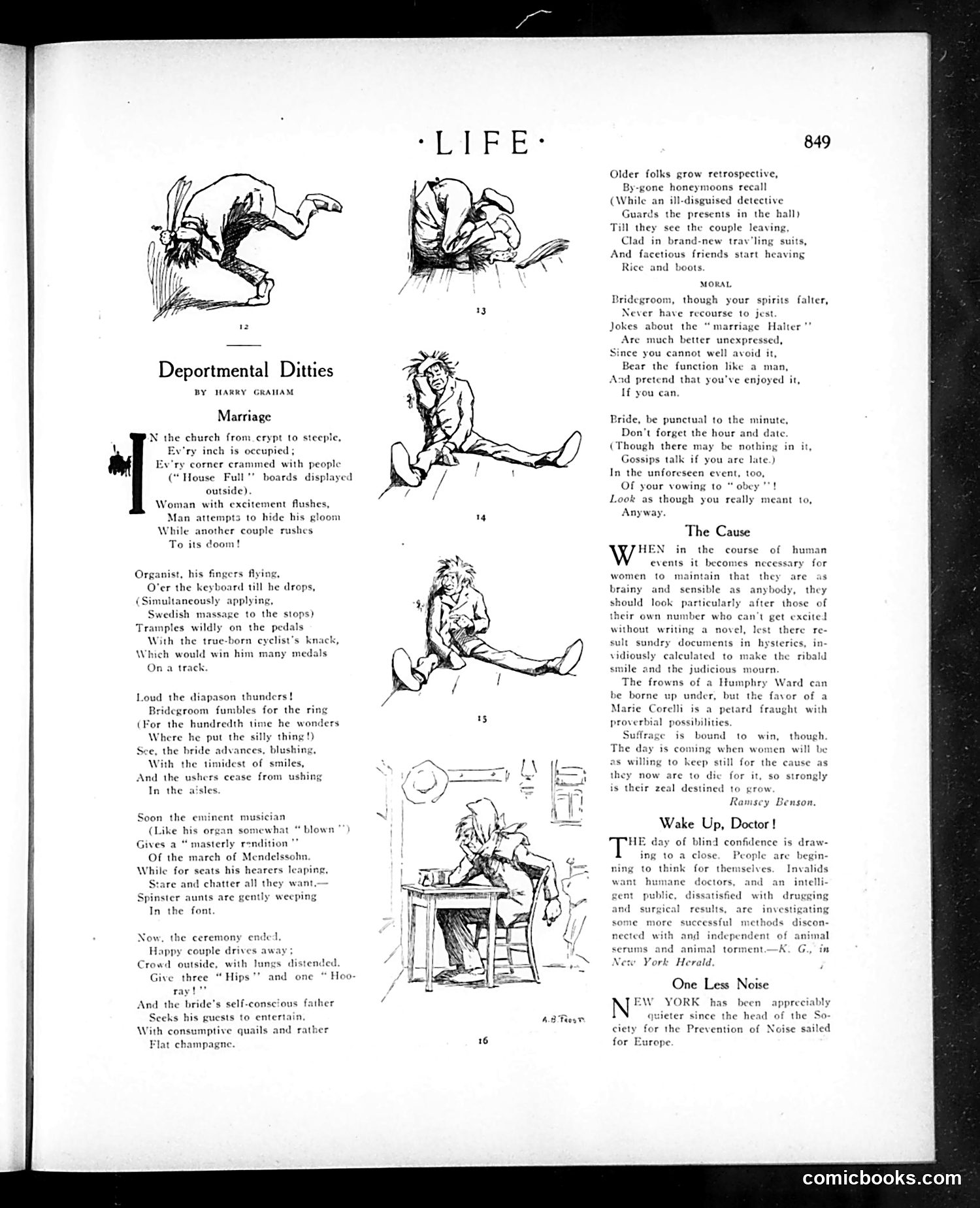
This page presents Harry Graham's humorous poem "Departmental Ditties: Marriage" with accompanying sketches (numbered 12-16) depicting a wedding ceremony's chaos. The satire mocks the elaborate theater of weddings: the cramped church ("Ev'ry inch is occupied"), the organist's dramatic performance, the bride's nervous excitement, the bridegroom's fumbling, and the musician's overwrought rendition of Mendelssohn's march. Graham ridicules both the participants' pretentiousness and the event's rigid formality. The accompanying sketches show comical mishaps—figures in awkward positions suggesting the physical comedy of the ceremony itself. The humor targets the gap between weddings' supposed dignity and their actual messy, undignified reality, a common early-20th-century satirical theme.
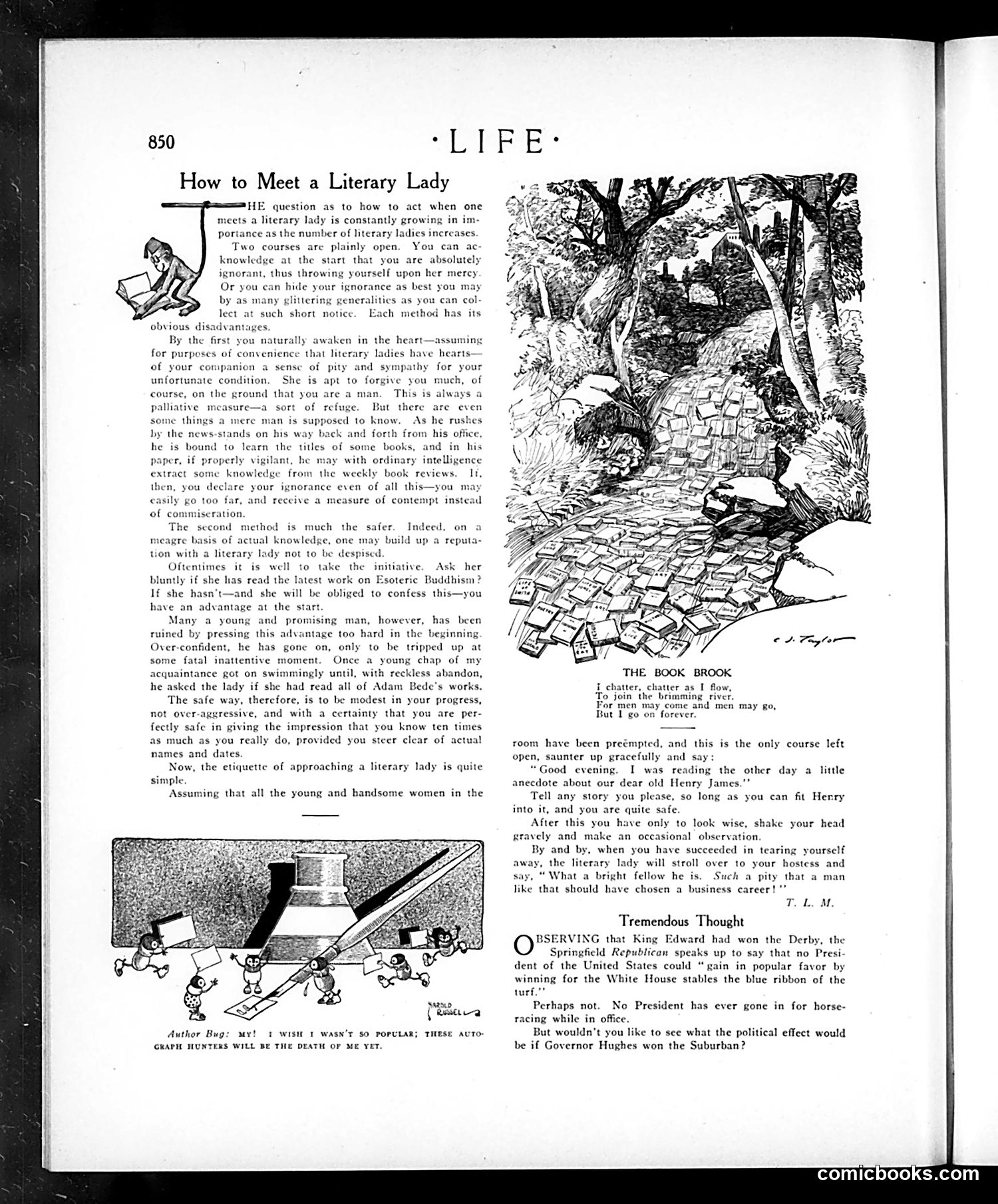
This satirical article mocks the social anxiety men experience when encountering educated women. The piece offers two strategies: admitting ignorance (humiliating but safe) or bluffing with vague literary knowledge (risky but potentially effective). The humor relies on the early-20th-century anxiety about the growing number of "literary ladies"—educated, intellectual women whose increasing prominence unsettled conventional society. The advice is deliberately absurd: mention "Esoteric Buddhism" or drop references to Henry James while avoiding specific dates or titles, then look "wise" and nod occasionally. The accompanying cartoon "Author Bug" depicts a man overwhelmed by autograph-seekers, satirizing both literary pretension and celebrity culture. The "Tremendous Thought" section below jokes that while King Edward VII's racehorses won the Derby, American presidents would lose political credibility by openly gambling on horses—a commentary on differing standards between British royalty and American democratic leadership. The overall tone is lighthearted mockery of masculine insecurity around female intellectualism.
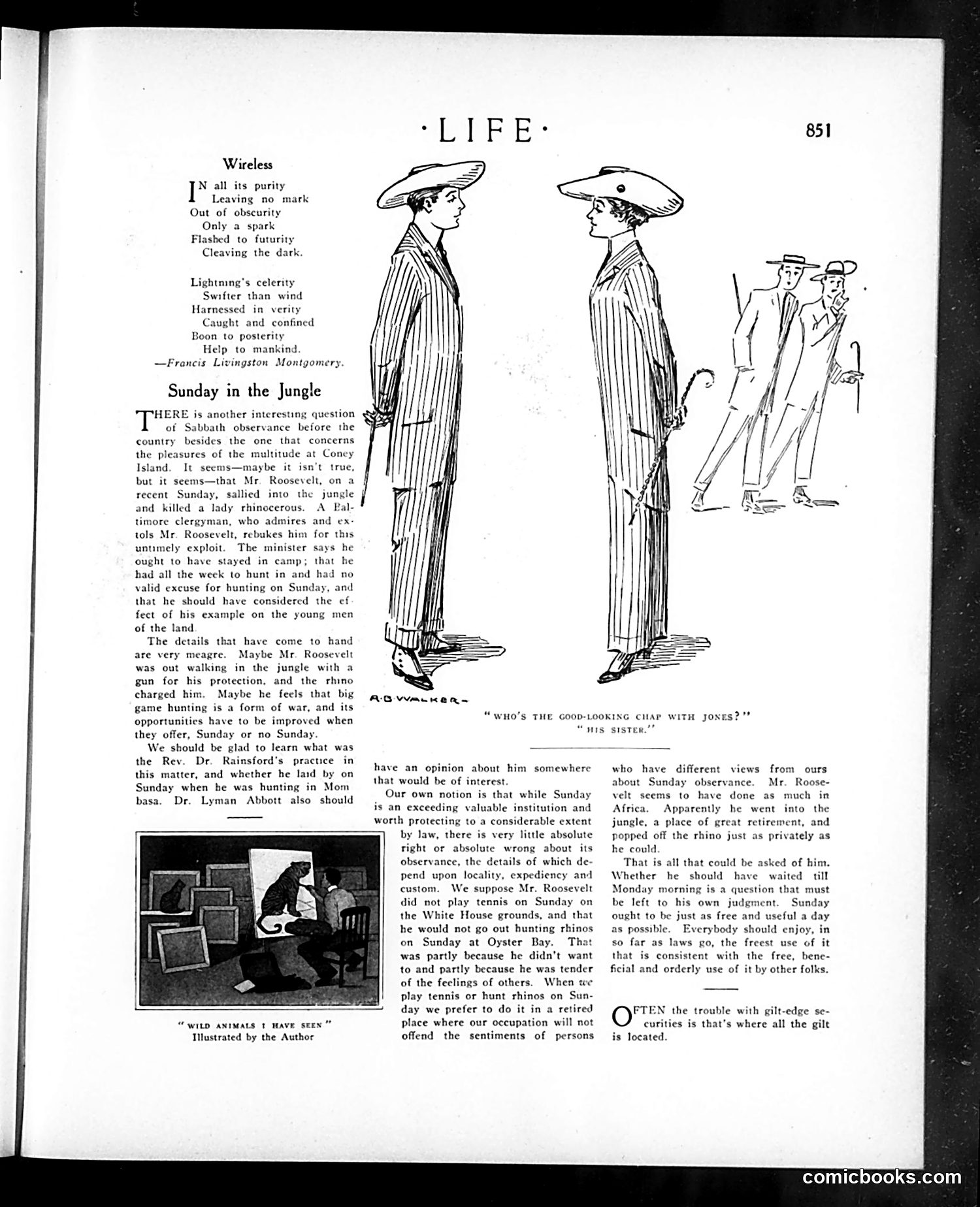
This page satirizes Theodore Roosevelt's 1909-1910 African hunting expedition, specifically controversy over his Sunday rhinoceros hunt. A Baltimore clergyman publicly criticized Roosevelt for killing game on the Sabbath, arguing he should have waited until weekdays and set a better example for young men. **The satire's point:** Life magazine defends Roosevelt while gently mocking the clergyman's rigid moralism. The text argues that Sunday observance matters *socially* (respecting others' sensibilities), not absolutely—Roosevelt hunted in a remote jungle location where he offended no one, making his actions acceptable by practical standards. The cartoon shows two well-dressed men (appearing to be comparing notes), with onlookers in the background. The caption "Who's the good-looking chap with Jones?" suggests casual social observation, mocking how such controversies become fodder for gossip rather than serious moral debate. Life's position: context and discretion matter more than rigid religious rules.
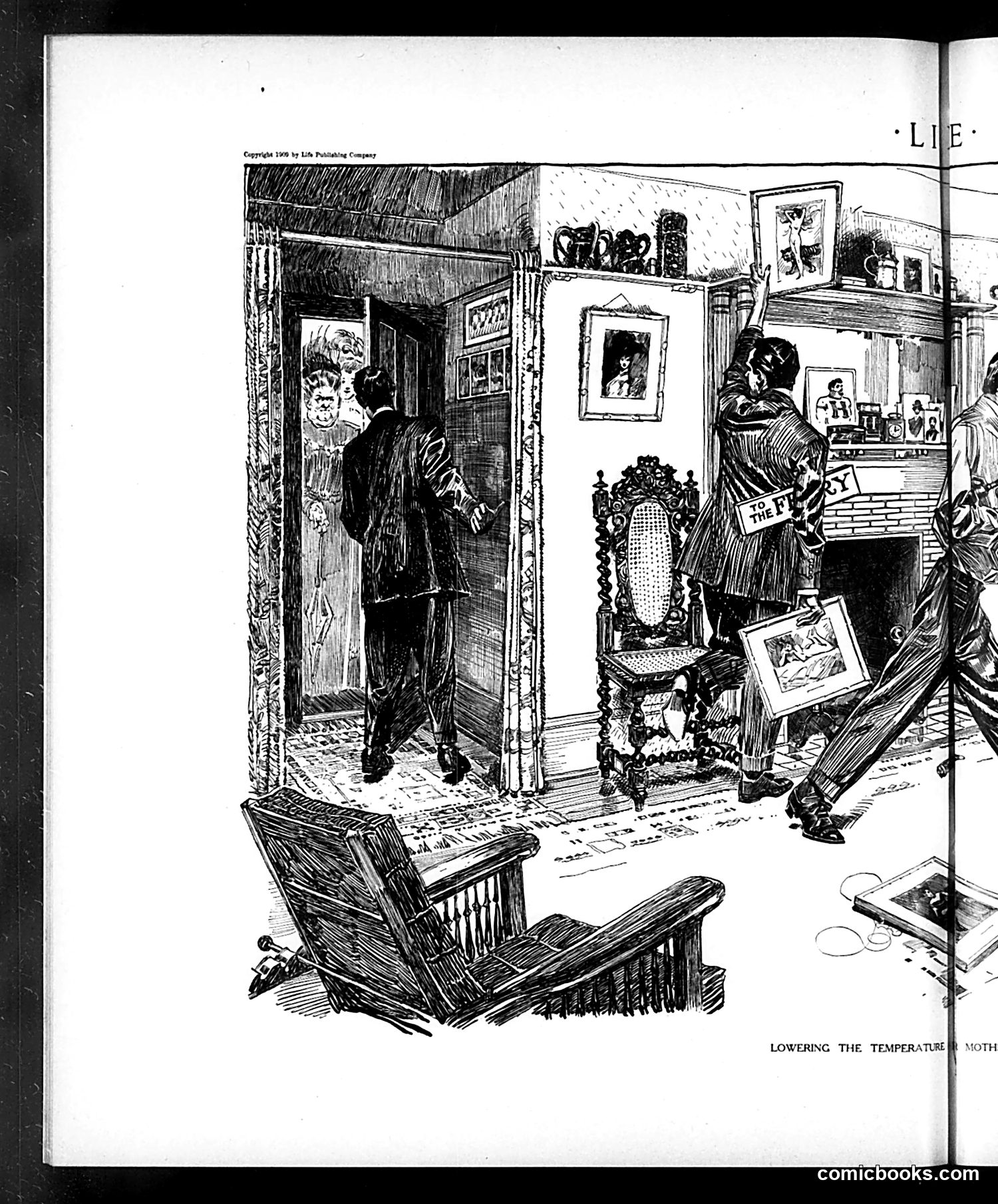
This is a single-panel cartoon titled "Lowering the Temperature of Moth" (visible at bottom). The illustration depicts an interior domestic scene where a man enters through a doorway on the left, while a woman on the right appears to be doing housework or adjusting something. The scene contains period furnishings and framed pictures on walls. The title's pun—"moth" instead of "mouth"—suggests the joke concerns literal temperature control (perhaps air conditioning or heating) applied to an insect, presented as domestic business. Without additional context from the magazine's date or surrounding articles, the specific satirical target remains unclear, though it appears to be social commentary about domestic life, technology, or household management practices of the era. The cryptic OCR text provides no interpretive help.
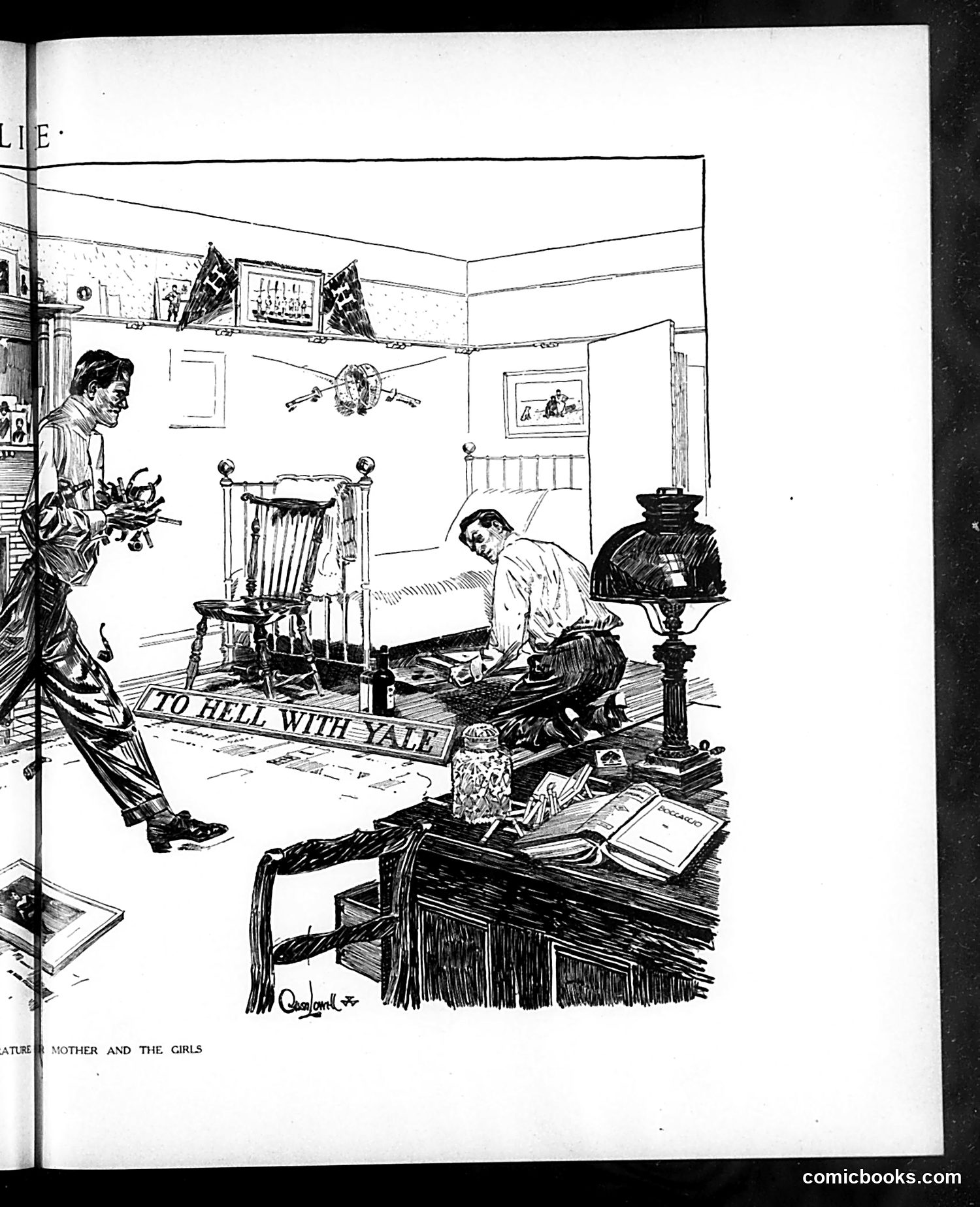
This is a satirical illustration titled "To Hell with Yale," depicting a bedroom scene where a man appears to be studying or working while a woman kneels beside him. The phrase "To Hell with Yale" is prominently displayed on the floor. The cartoon likely satirizes Yale University students or the institution itself, though the exact historical context is unclear without additional page information. The domestic setting and the woman's presence suggest commentary on student life, priorities, or the relationship between academic pursuits and personal relationships. The crude OCR text provides minimal context. Without knowing the publication date or surrounding articles, the specific target of satire—whether Yale's academic standards, student behavior, or social attitudes—remains uncertain.
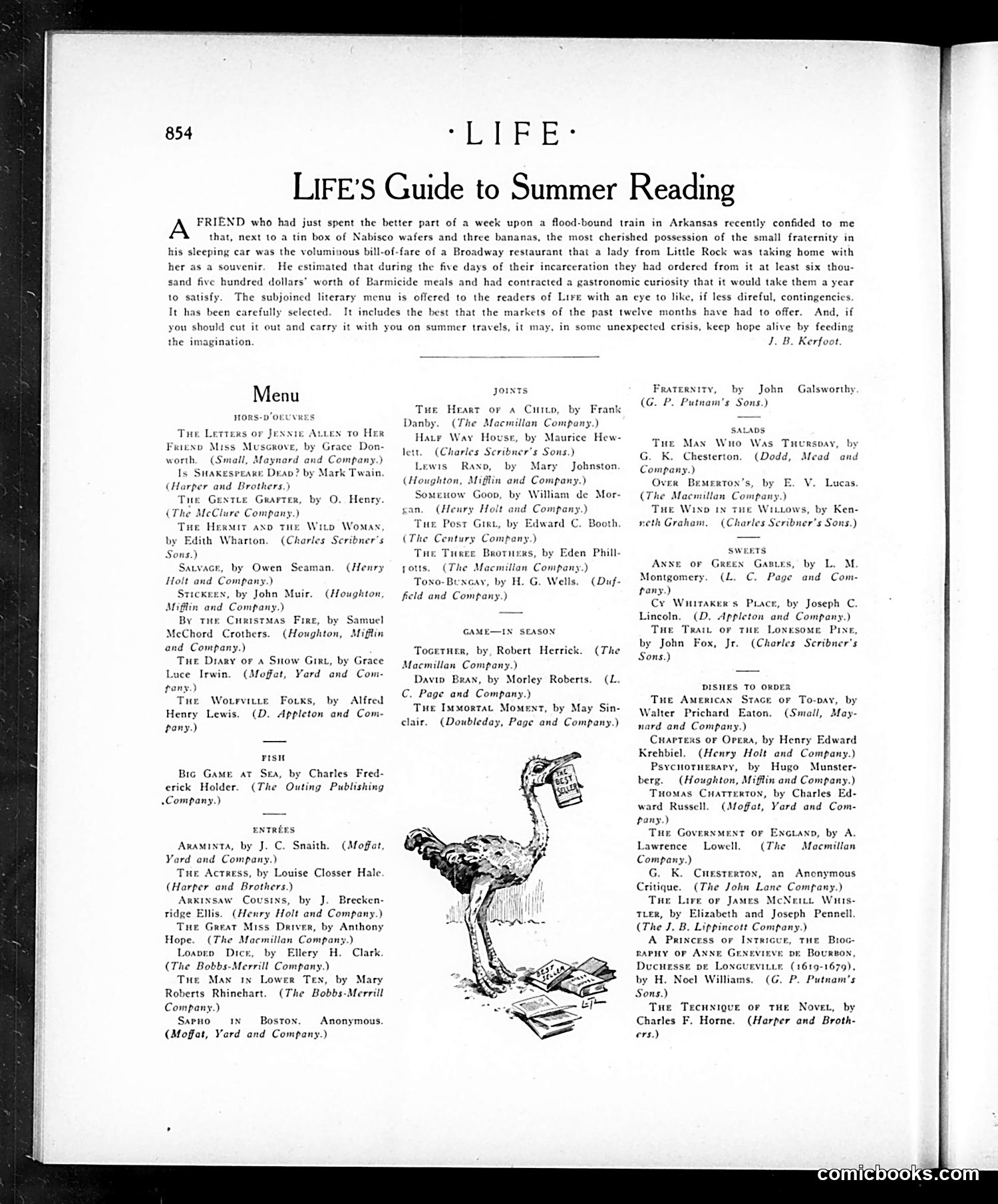
This is a humorous book recommendation list disguised as a restaurant menu. The conceit, explained in the introduction, stems from a friend trapped on a flood-bound Arkansas train who entertained himself by ordering lavishly from the dining car's bill-of-fare—spending thousands on meals during his enforced captivity. The page presents summer reading suggestions organized like a multi-course meal: books are categorized as "Menu," "Fish," "Entrees," "Joints," "Game—In Season," "Salads," "Sweets," and "Dishes to Order." Each entry includes the book title, author, and publisher. The ostrich illustration appears decorative, likely referencing the absurdity of the literary "menu" concept. The satire gently mocks both the friend's excessive dining behavior and offers readers a curated literary selection for summer travel—suggesting good books provide sustenance comparable to food during idle hours. The "carefully selected" list represents "the best that the markets of the past twelve months have had to offer."
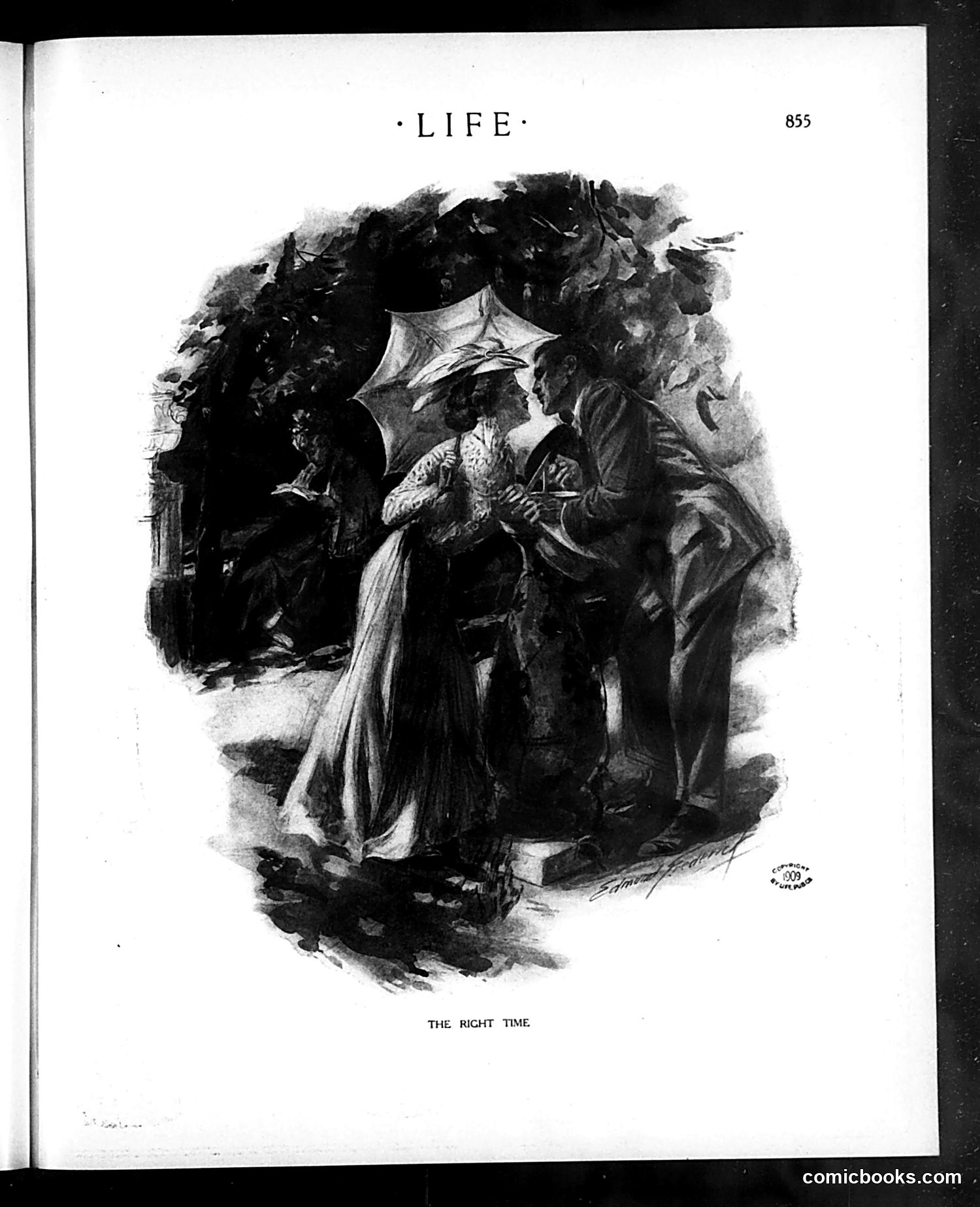
This illustration depicts a romantic scene between a well-dressed man and woman under an umbrella during what appears to be rainy weather. The woman holds a parasol while the man gestures toward her affectionately. The surrounding darkness and atmospheric shading suggest an intimate moment. The caption "The Right Time" suggests satire about courtship and romance—likely commenting on when a man should make romantic advances toward a woman. Given Life magazine's tradition of social satire, this probably mocks Victorian or contemporary dating conventions, the calculation involved in romantic timing, or male assumptions about "opportune moments" for wooing. The stormy weather may symbolize obstacles overcome or the drama of romantic pursuit. Without additional context, the specific social target remains unclear.
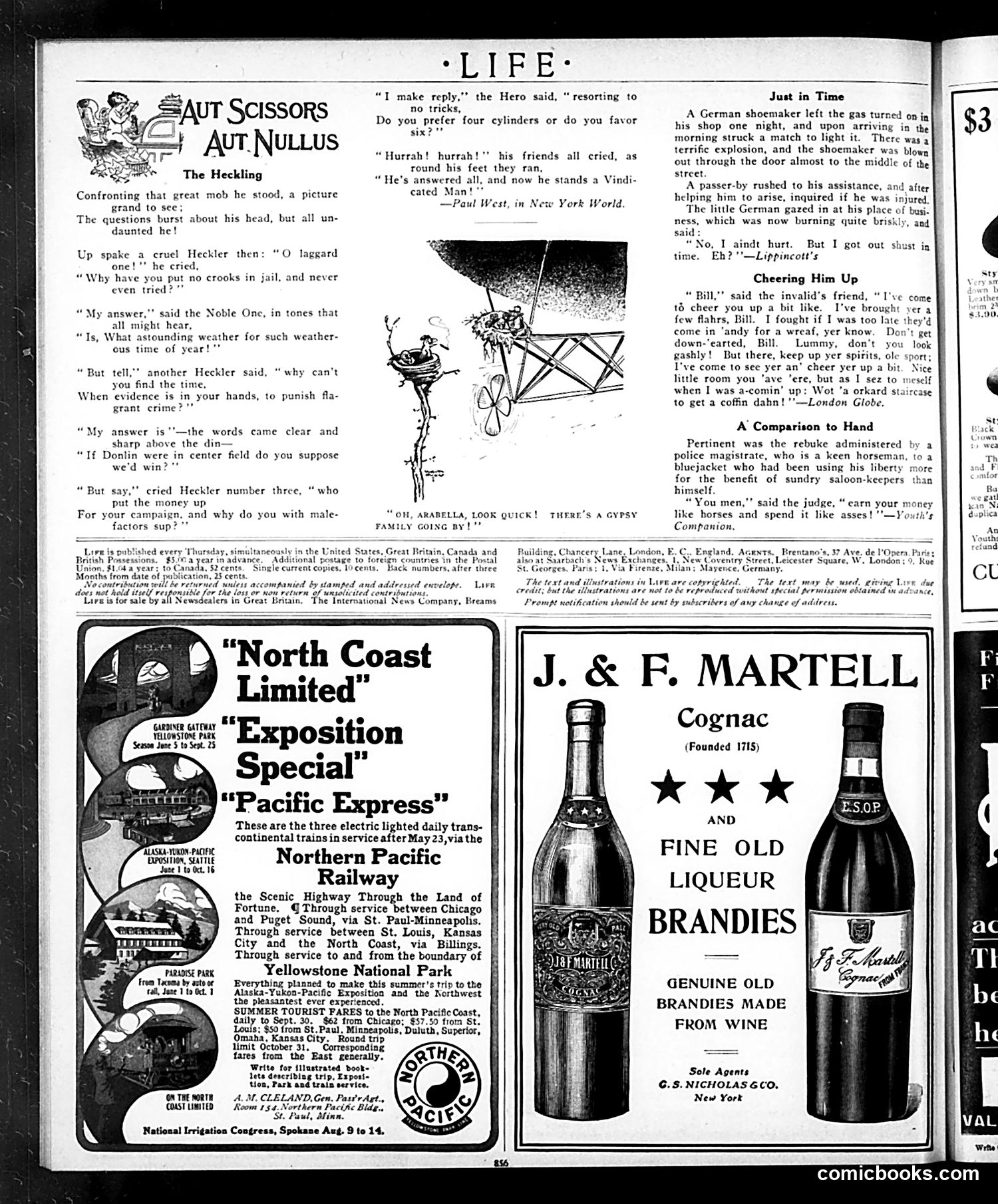
This poem-cartoon satirizes a politician (referred to as "the Noble One" and "the Hero") confronted by hostile hecklers at a public event. The satire depicts three increasingly absurd questions designed to expose the politician's evasiveness: 1. **First heckler**: Demands to know why the politician hasn't jailed criminals 2. **Second heckler**: Asks why he won't address corruption, then pivots to a nonsensical question about car engines (4 vs. 6 cylinders) 3. **Third heckler**: Criticizes campaign funding and fraternizing with criminals The joke: Rather than answer substantive criticism, the politician deflects the second heckler's serious question with an irrelevant one about automobiles—and his supporters cheer him as "Vindicated"! This mocks how politicians evade accountability through misdirection and how their supporters will celebrate such evasion as triumph. The cartoon suggests political discourse has become absurdly performative, where dodging questions passes for leadership.
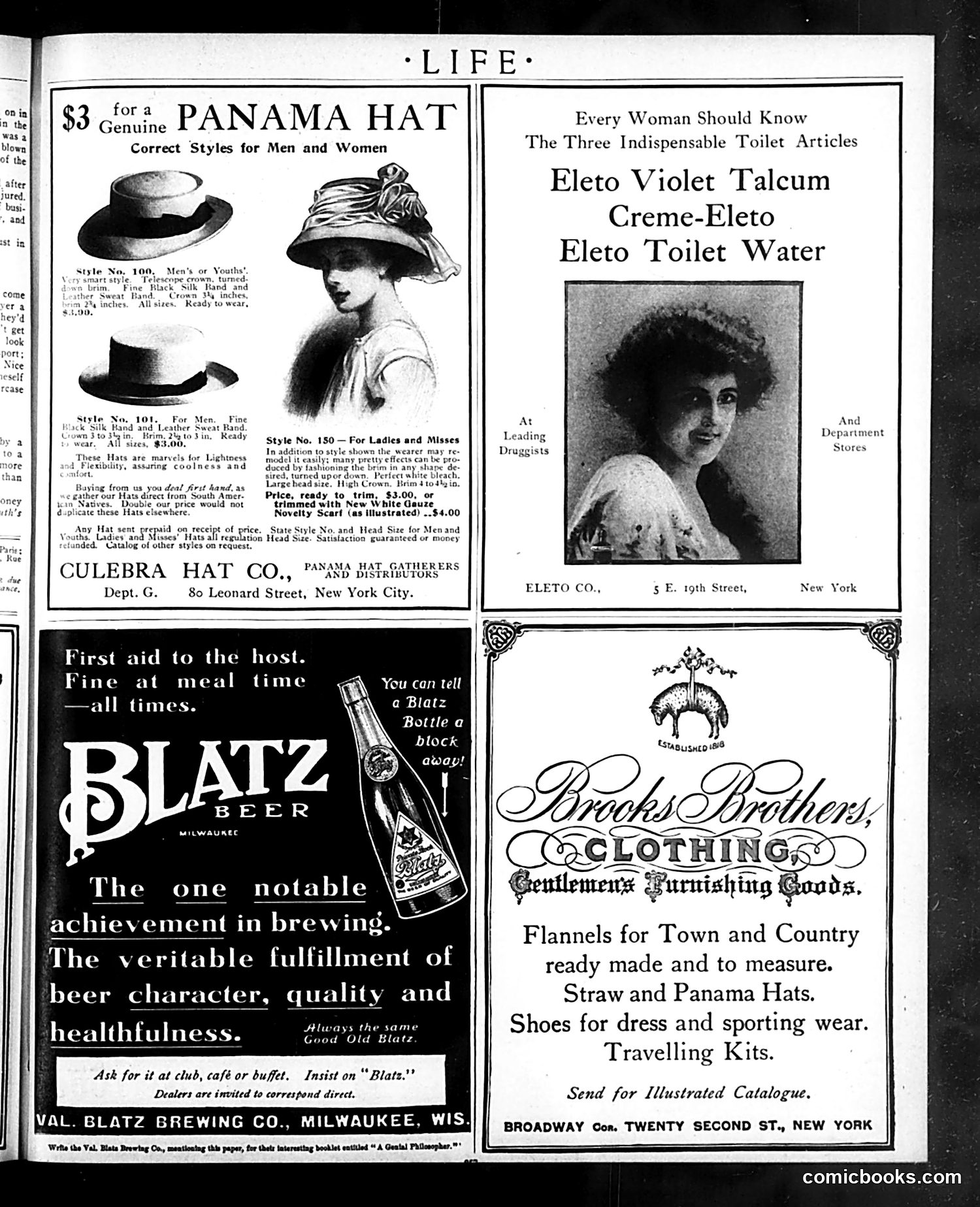
This is **not a cartoon page but an advertisements section** from an early 20th-century issue of Life magazine. The page contains four advertisements: 1. **Culebra Hat Co.** — Selling Panama hats ($3) in "correct styles for men and women," featuring two hat designs with period illustrations 2. **Eleto Co.** — Marketing "three indispensable toilet articles" (talcum powder, creme, toilet water) for women, with a portrait photo 3. **Blatz Beer** — A Milwaukee brewery promoting their product as having superior "character, quality and healthfulness," available at clubs and cafés 4. **Brooks Brothers** — Advertising gentlemen's clothing including flannels, Panama hats, shoes, and travelling kits The page reflects early 1900s consumer culture and gender norms: women's beauty products are emphasized separately from men's practical wear. Panama hats appear prominently across multiple ads, suggesting they were fashionable at this time. Alcohol advertising was legal and mainstream.
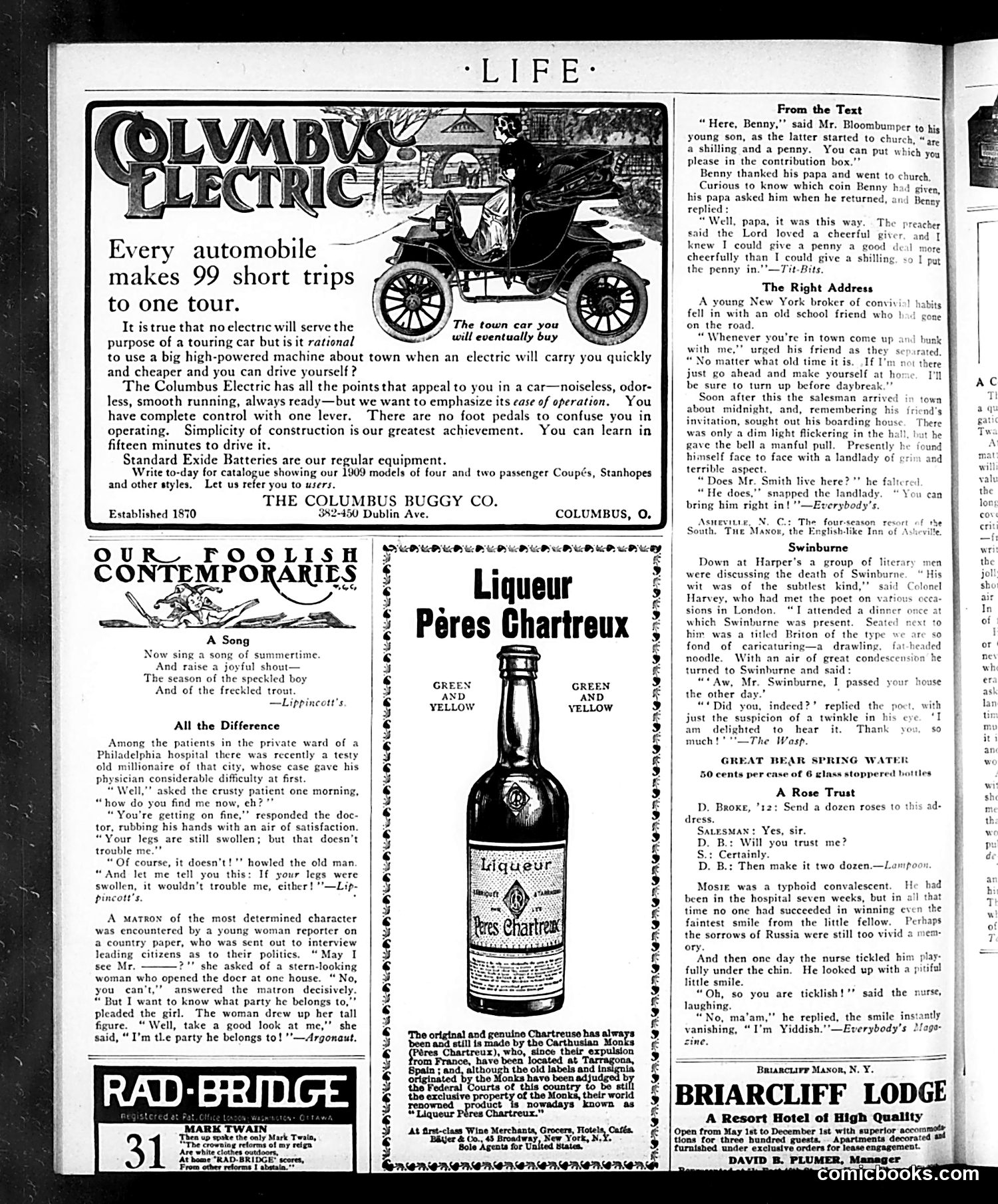
This page is primarily **advertising and light humor**, not political cartooning. The main content consists of: **The Columbus Electric automobile ad** (top): Argues that electric cars are practical for town driving despite lacking touring range. It emphasizes ease of operation and simplicity—marketing points for early 1900s automobiles when driving was still novel and intimidating. **Three brief joke pieces** (middle/bottom): Anecdotal humor from *Lippincott's* and *Argonaut* magazines. These are gentle comedic vignettes about everyday life—a cranky hospital patient, a determined matron defending her husband's independence, and a boy choosing which coin to donate at church. They reflect contemporary social attitudes but lack satirical bite. **Liqueur advertisement** for Pères Chartreux, a French liquor. **Briarcliff Lodge advertisement** (bottom right). The page demonstrates *Life*'s mix of consumer advertising with reprinted humor from other periodicals—typical magazine content of the 1909-era rather than original satirical commentary on current events.
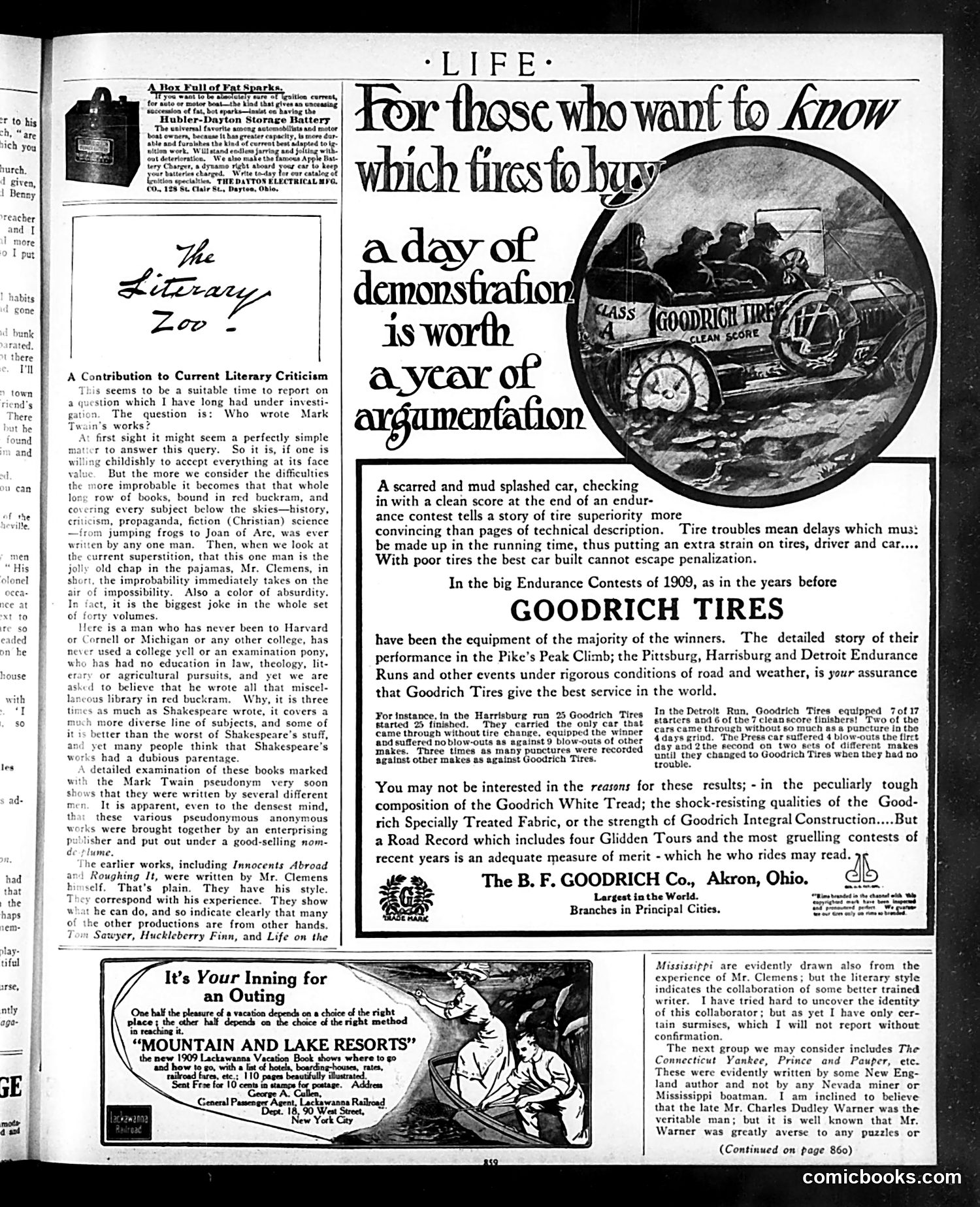
This page contains **advertising and literary criticism**, not political cartoons requiring historical context. The main content is a humorous essay titled "A Contribution to Current Literary Criticism" that satirizes scholarly debates about authorship. The author jokingly questions whether Mark Twain actually wrote his own works, arguing that one uneducated man couldn't have produced such a diverse literary output. The piece playfully suggests multiple authors wrote under the Twain pseudonym—a tongue-in-cheek jab at literary pretension and attribution disputes (similar to real Shakespeare authorship debates). The page is dominated by a **Goodrich Tires advertisement** featuring a race car photo and describing tire performance in 1909 endurance contests like the Pike's Peak Climb and Detroit Endurance Run. This reflects early 20th-century automotive advertising emphasizing durability through competitive racing results. A smaller ad promotes "Mountain and Lake Resorts" via the Lake Shore and Michigan Southern Railway. The content reflects *Life* magazine's mix of satire, essays, and advertisements typical of the period.
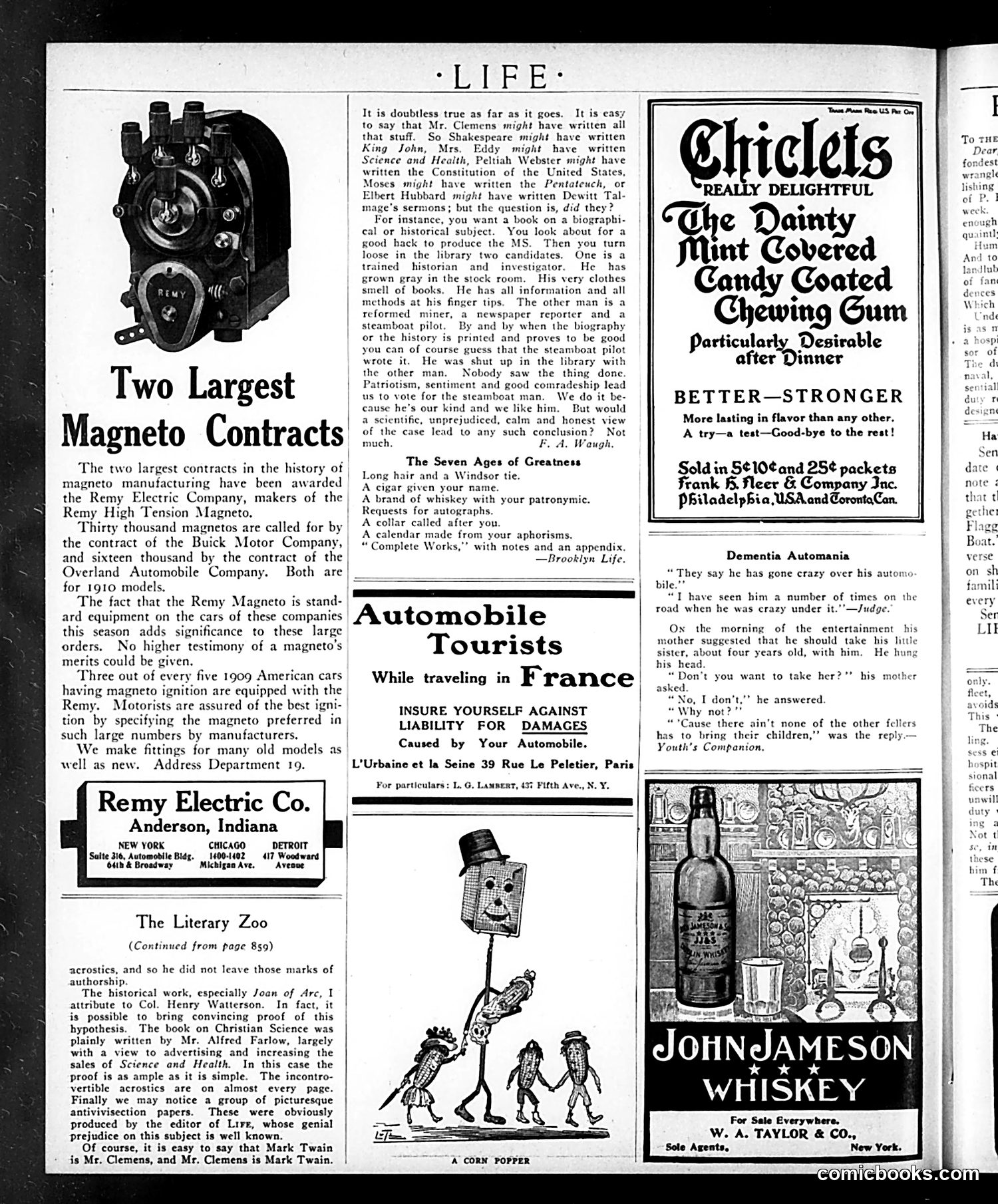
This page is primarily **advertisements and filler content** rather than political satire. The main items are: 1. **Remy Electric Company ad**: Celebrates large magneto contracts with Buick and Overland automobile manufacturers for 1910 models—straightforward industrial advertising. 2. **"The Literary Zoo"**: A humorous essay (continued from previous page) satirizing the attribution of anonymous works to famous authors. It mocks the tendency to guess authorship based on sentiment rather than evidence, using examples like assuming Mark Twain wrote something because it "feels" like him. The satire targets lazy literary criticism. 3. **"The Seven Ages of Greatness"**: A brief comic list mocking how celebrities become commercialized—long hair, branded cigars, whiskey with their names, etc. The remaining content includes tourist automobile insurance advertising and product advertisements (Chiclets gum, John Jameson Whiskey). There are no significant political cartoons on this page—it's a typical early 1910s magazine mix of advertising, light humor, and social commentary.
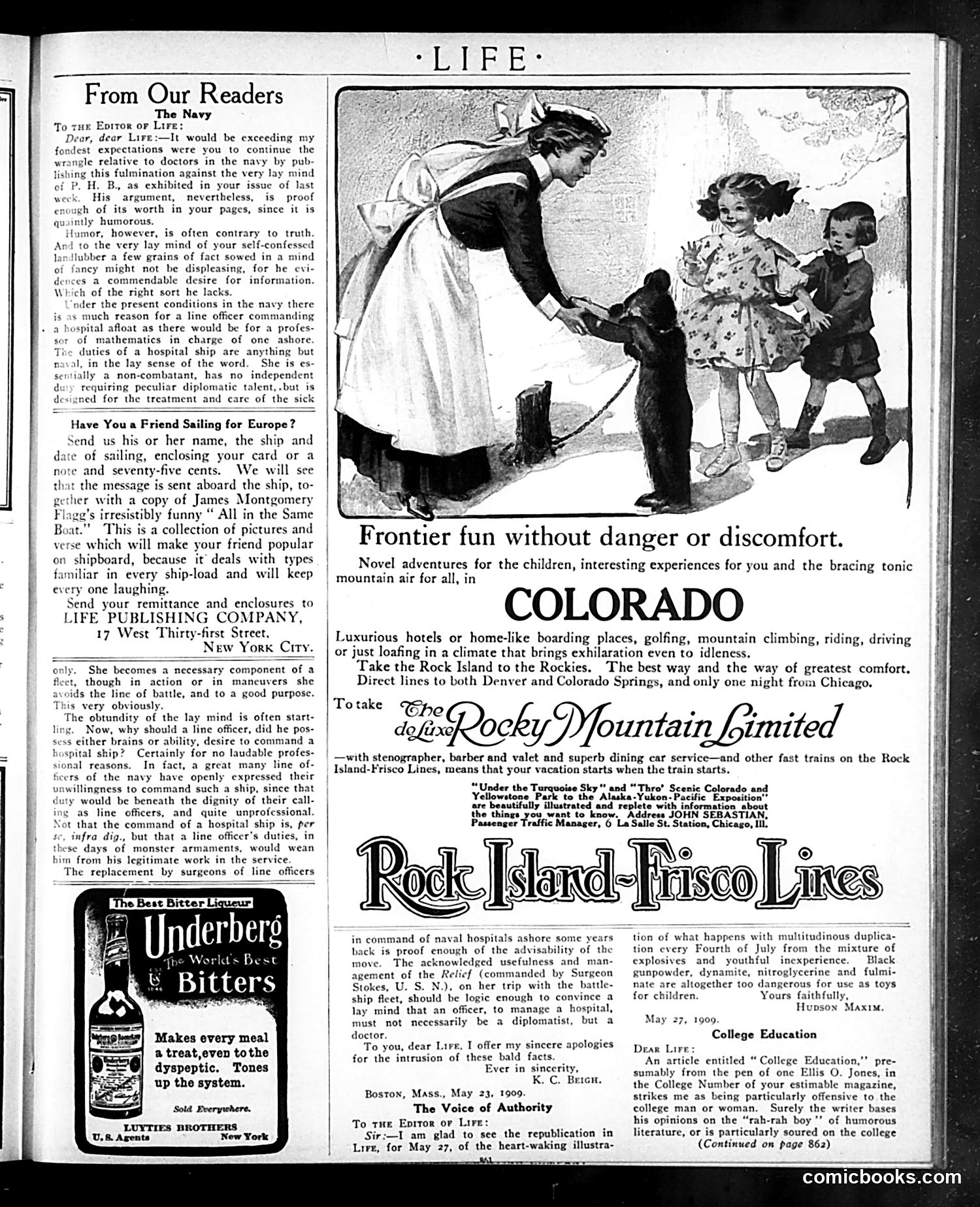
This page is primarily **advertising and reader correspondence**, not political satire. The main content consists of: 1. **Letters to the Editor** debating naval hospital ship command—whether line officers or surgeons should lead them. The writer argues surgeons are more appropriate since hospital ships are non-combatant vessels requiring medical expertise, not naval warfare skills. 2. **A large illustration** showing a nurse with two children, advertising **Colorado tourism** via the Rock Island-Frisco railway lines. The image depicts wholesome frontier recreation ("fun without danger or discomfort"). 3. **Commercial advertisements** for Underberg Bitters and railroad travel services. The page reflects early 1900s concerns about naval administration and the growing American leisure travel industry. No clear political cartoon or satire is present—it's a standard magazine page mixing reader debate with travel promotions.
This page from *Life* magazine (dated May 18, 1909) contains a critical essay attacking college education's disconnect from real social problems. The main text criticizes colleges for ignoring practical issues like tenement housing and corporate crime, while praising exceptions like "Big Bill" Edwards (a Princeton football player turned anti-graft investigator in New York). The author argues colleges teach theory without engaging students in solving actual civic problems—a pointed critique suggesting higher education serves no social purpose. The surrounding advertisements (Dewar's whisky, Allen's Foot-Ease, Irving's pipe, P.B. Lager) are typical period marketing unrelated to the editorial content. The essay's satire targets educated elites as detached from meaningful work, contrasting their theoretical knowledge with the practical accomplishments of college men who actually fight corruption. It's a progressive-era critique of institutional education's failure to produce socially conscious reformers.
This article satirizes pseudo-scientific attempts to explain historical figures' work through medical diagnosis. A Dr. Delacroix has written an academic paper claiming the Renaissance essayist Montaigne's skeptical philosophy resulted from neurasthenia (nervous exhaustion) inherited from his mother's "Semitic strain"—reflecting the anti-Semitic pseudoscience of the era. The piece mocks this reductionism by citing similarly absurd claims: that a chemist's genius came from childhood marsh fever and head injury. The satirist argues that while Montaigne genuinely suffered from stones and illness, attributing his intellectual achievements to medical pathology misses the point—his "sound mind in the unsound body" produced genuine wisdom that healthier writers never achieved. The satire targets the era's fashion for medicalizing and pathologizing intellectual history.
This page is primarily **advertising and book reviews**, not political satire. **The content:** The top features an ad for **Grinnell "Rist-Fit" auto gloves** — ventilated driving gloves marketed as "the coolest" due to perforations. The main section is **"Our Book Reviews (As They Are Did)"** by Ellis Parker Butler — a humorous critique of famous literary works. Butler mockingly dismisses these classics: Noah Webster's *Dictionary* as boring and erotic; John Bunyan's *Pilgrim's Progress* unfavorably compared to Twain; Robert Burns' *Poems* as competent but not truly great poetry; and *The Vicar of Wakefield* as a sentimental romance by "Miss Finnerty" (a pseudonym joke). The satire here is **literary criticism as comedy** — Butler playfully demolishes canonical works using deliberately obtuse logic, pretending they're mediocre. It's gentle mockery of both the books and pretentious literary judgment itself. A **Havoline Oil advertisement** occupies the right side.
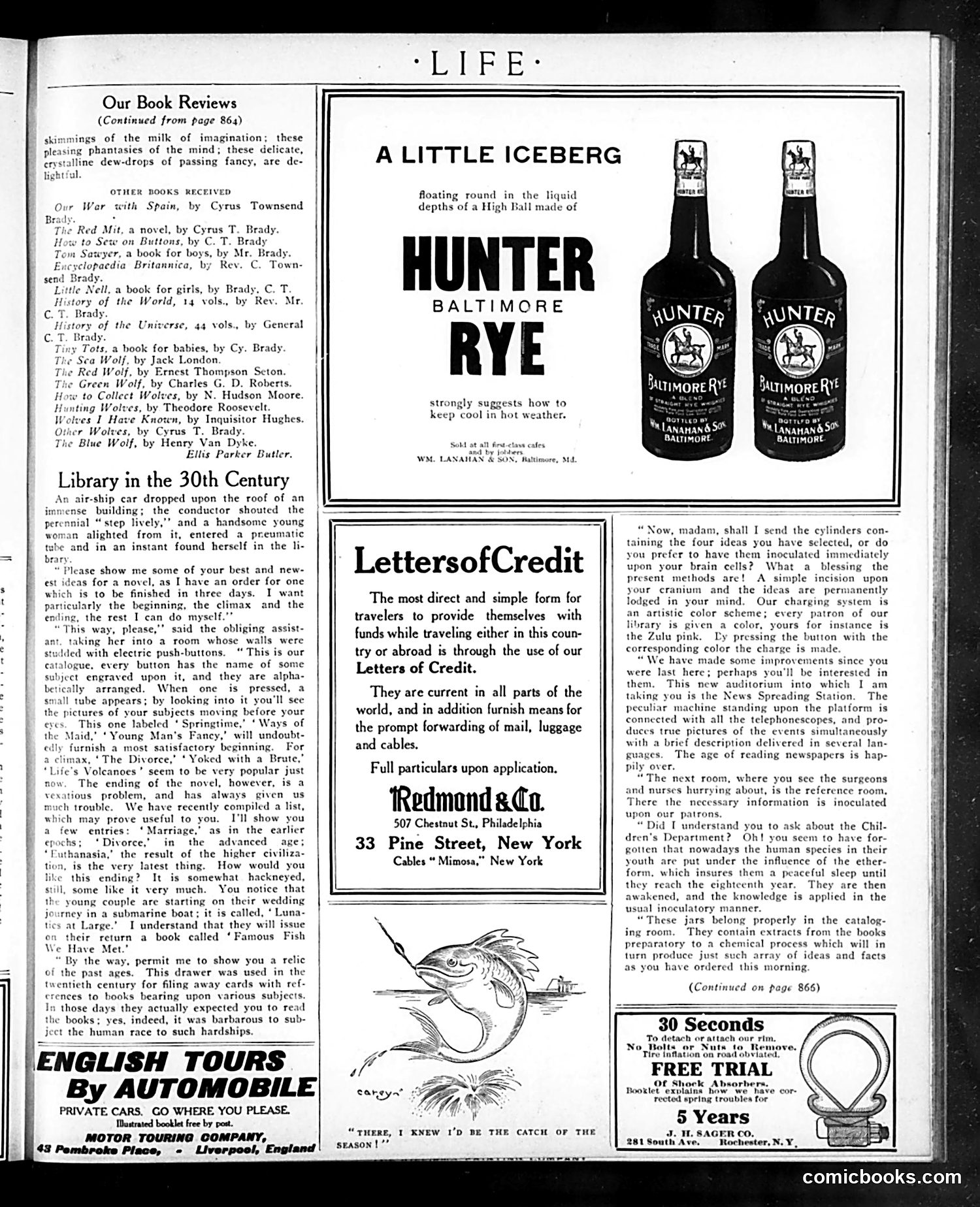
This page is primarily **advertising and book reviews**, not political satire. The main content includes: **"A Little Iceberg" Advertisement**: A Hunter Baltimore Rye whiskey ad humorously suggesting the drink "keeps cool in hot weather" — typical early 20th-century advertising wordplay. **"Library in the 30th Century" Satirical Sketch**: A brief futuristic fantasy where a woman visits a library of the future. The satire mocks emerging technology by imagining ideas delivered via pneumatic tubes and "charging systems" — an exaggerated extrapolation of then-modern conveniences. The joke targets both technological optimism and mass-production culture. **"Letters of Credit" Advertisement**: Redmond & Co. promotes travel financial services. The page reflects early 1900s concerns about rapid mechanization and standardization, humorously imagining how technology might absurdly transform everyday institutions like libraries. The satirical tone is gentle rather than biting.
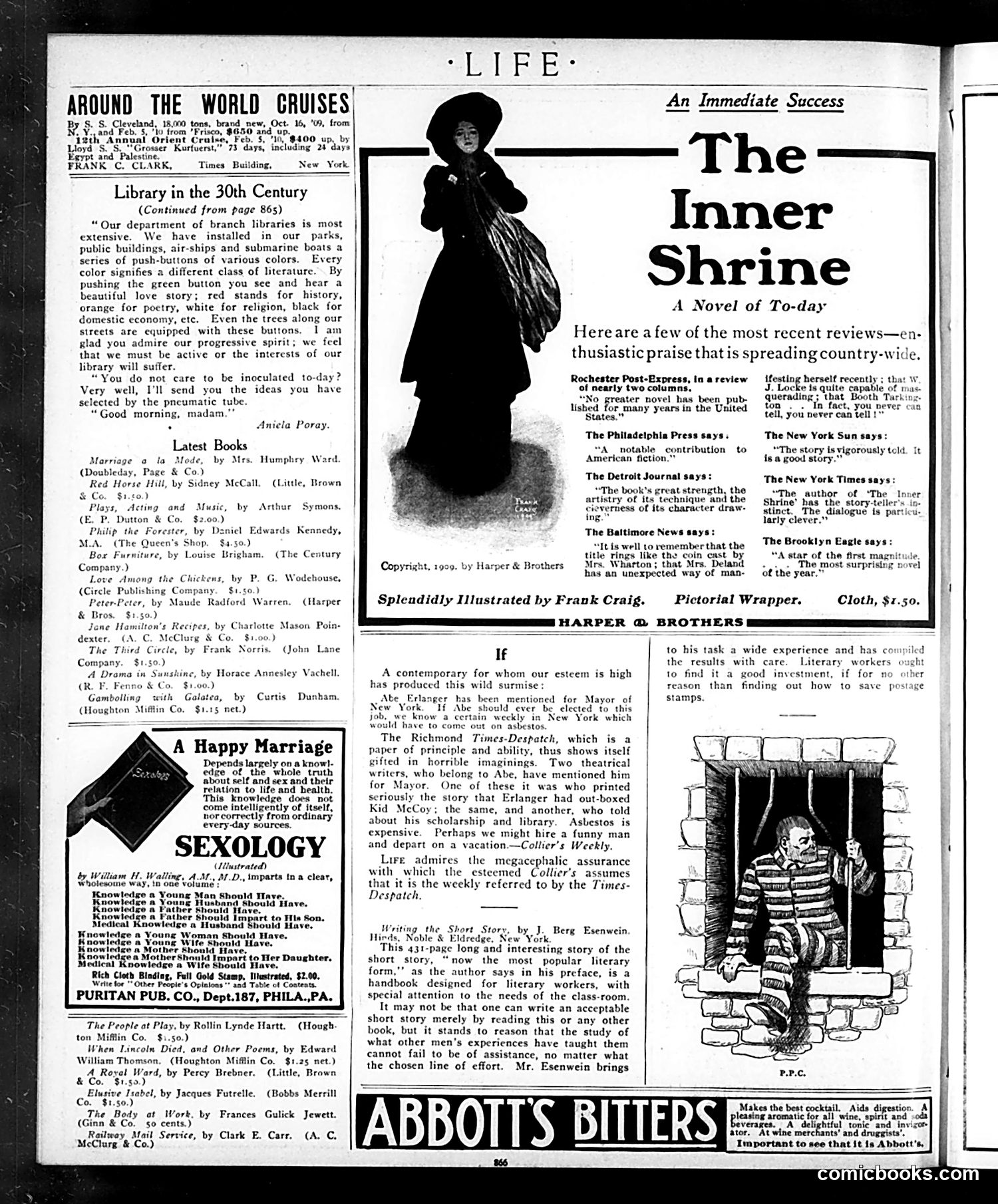
This page from Life magazine (circa 1909) is primarily a **book review and advertising section**, not a political cartoon. The main content features: **"The Inner Shrine"** — a contemporary novel receiving glowing reviews from major newspapers (Rochester Post-Express, Philadelphia Press, Detroit Journal, Baltimore News, etc.). The reviews praise it as exceptional literature with strong character development. **Secondary content** includes: - A satirical piece titled "Library in the 30th Century" imagining futuristic library technology with push-button literature selections and pneumatic tube delivery—a humorous extrapolation of early 1900s technological optimism. - A "Happy Marriage" advertisement for a sex education book ("Sexology"), reflecting Progressive Era frankness about health topics. - Listings of contemporary popular books and cruise advertisements. **No political satire is evident** on this page. It reflects early 20th-century publishing culture, technological optimism, and social attitudes toward education and literature. The humor is gentle and forward-looking rather than pointed social critique.
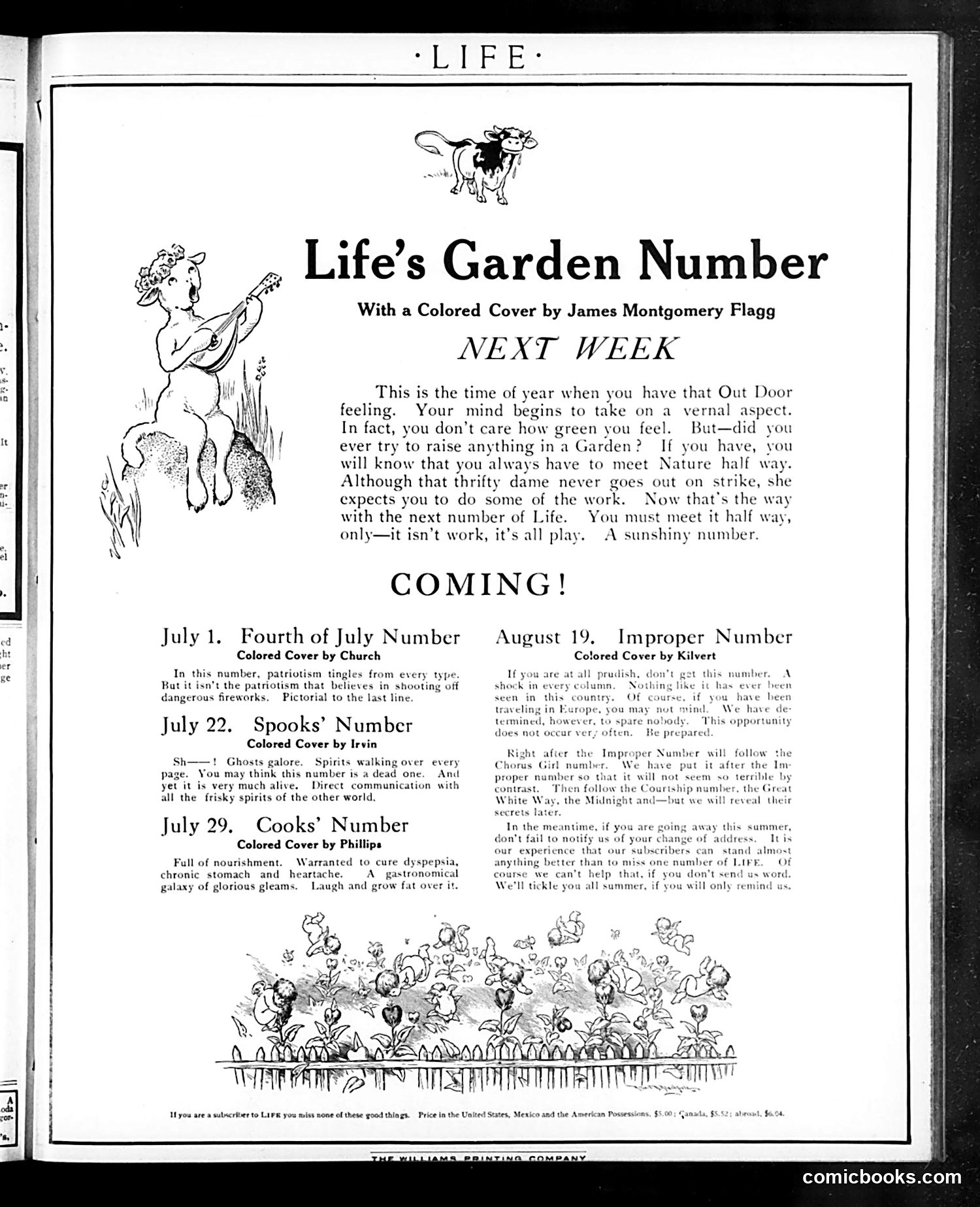
This is a promotional page advertising upcoming special issues of Life magazine. The main cartoon features a cherubic female figure tending a garden—a visual metaphor for Life's upcoming "Garden Number," which will cover spring/summer outdoor themes. The page announces four themed issues: - **Fourth of July Number** (patriotic content) - **Spooks' Number** (ghost/supernatural stories) - **Cooks' Number** (food and gastronomy) - **Improper Number** (likely risqué humor, followed by a "Chorus Girl Number") The text uses playful language comparing Life magazine itself to gardening—readers must "meet it halfway" because producing good content requires effort, just as growing plants does. Each issue features a colored cover by named illustrators (Flagg, Church, Irvin, Phillips, Kilvert), emphasizing Life's status as a premium illustrated publication with renowned artists. This is essentially sophisticated advertising masquerading as editorial content—a common practice in magazines of this era.
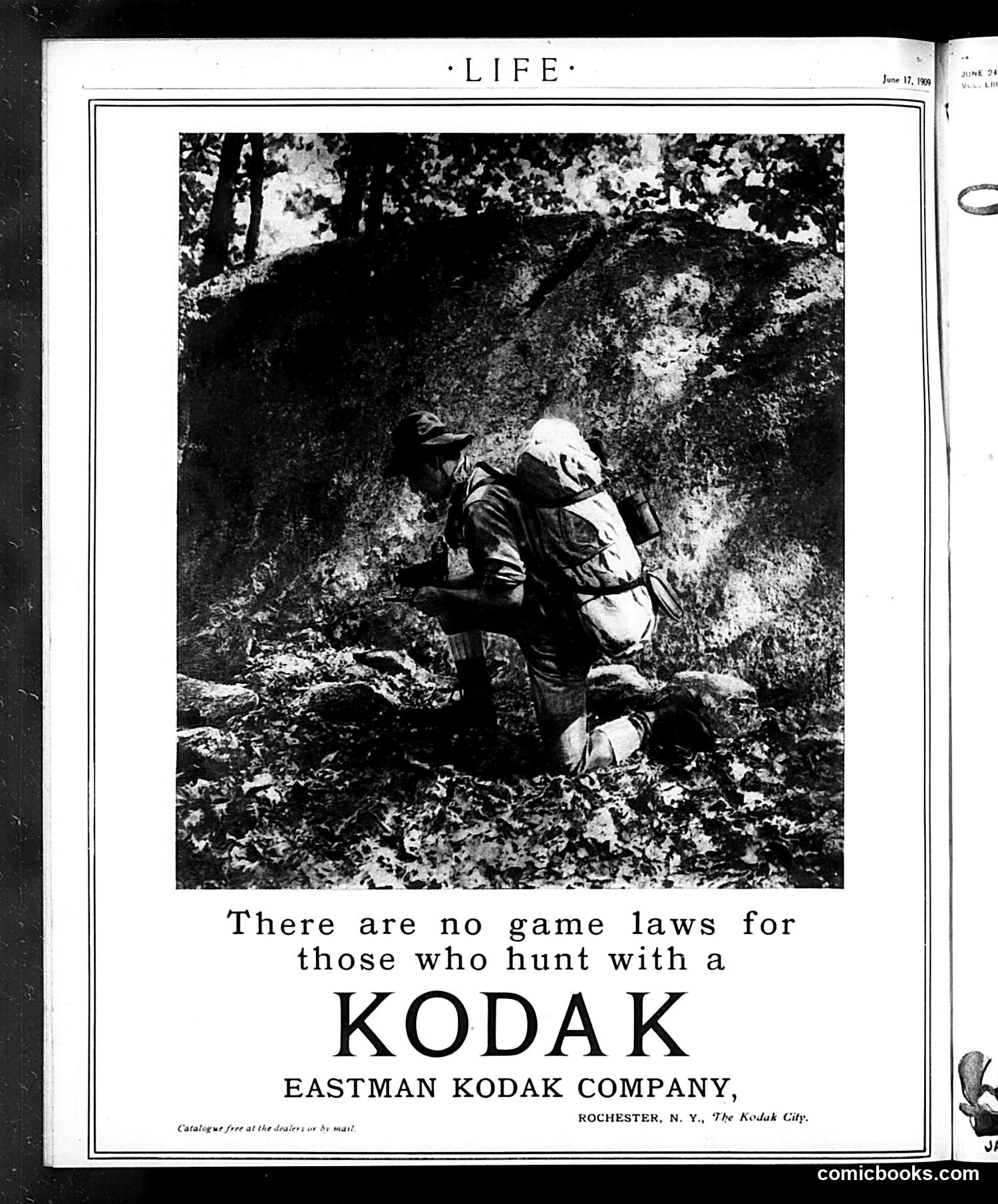
This is a Kodak advertisement rather than a political cartoon. The image shows a man crouched in wilderness terrain, apparently photographing or hunting with a camera. The advertisement's tagline—"There are no game laws for those who hunt with a Kodak"—is a clever pun equating photography with hunting. The joke plays on the idea that photographers "hunt" for images and wildlife shots without legal restrictions that apply to actual hunters. It's promoting Kodak cameras for outdoor/nature photography, suggesting the camera allows unrestricted "hunting" of scenic subjects and wildlife imagery. The message positions photography as an alternative form of sport or adventure, accessible to anyone with a camera.