
Life, 1909-06-17 · page 6 of 32
Life — June 17, 1909 — page 6: what you’re looking at
What you’re looking at
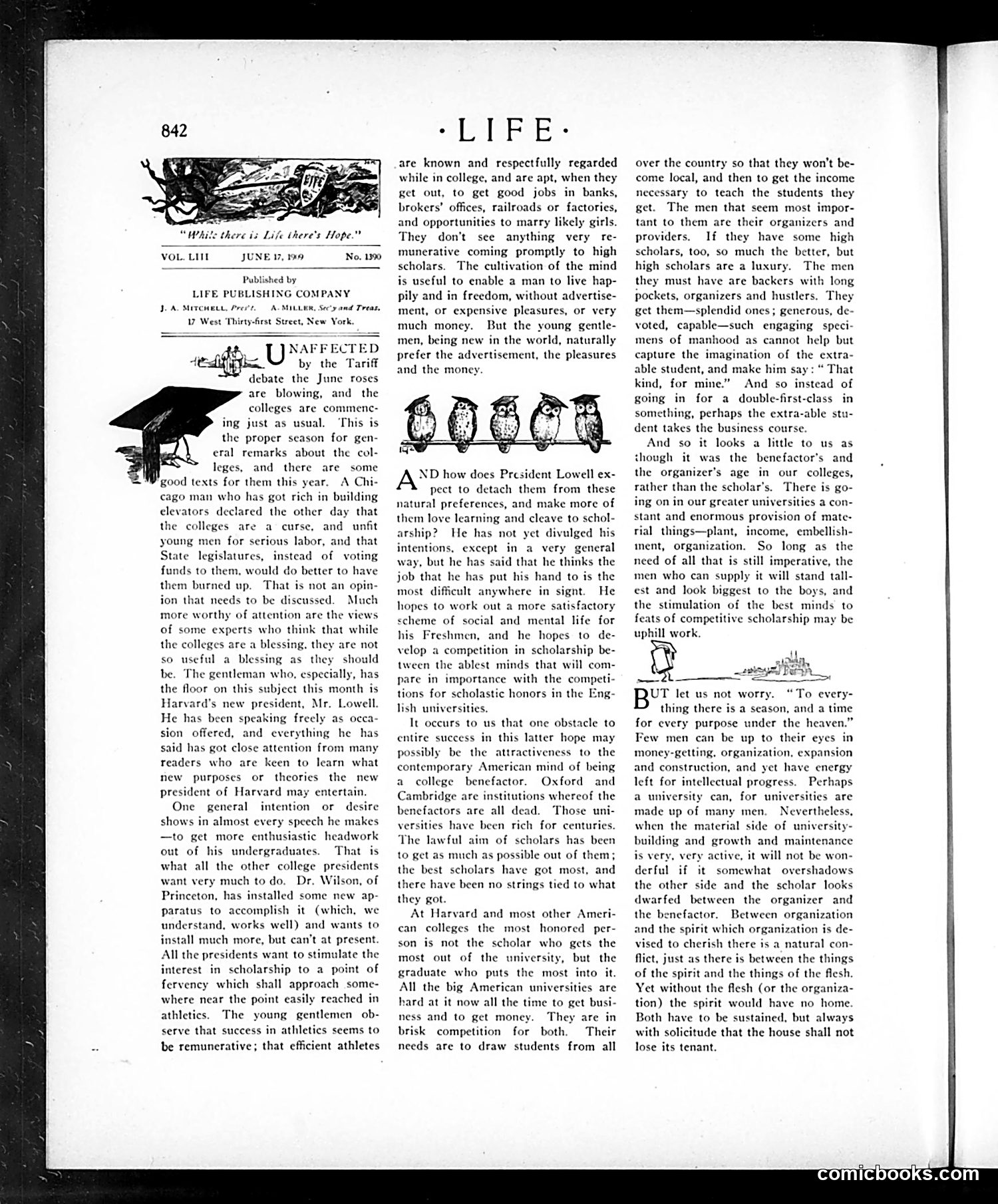
The main article discusses college education and scholarship, particularly addressing President Lowell of Harvard's efforts to reform scholarship practices. The piece critiques American colleges for prioritizing money-making and athletic success over genuine intellectual development. The decorative header illustration shows five owl figures in a row—a visual metaphor for scholars or academics, emphasizing wisdom and learning. The political-social satire targets the commercialization of higher education: colleges are criticized for recruiting students as income sources rather than fostering genuine scholarship. The text argues that while benefactors are essential, the tension between organizational maintenance and intellectual mission threatens universities' core purpose. This reflects Progressive Era concerns about institutional integrity amid rapid American industrialization and university expansion.
📄 Transcribed text from this page (OCR, searchable)
Machine-transcribed from the original scan — historical spelling and the odd misread are preserved.
“White there is Life there's Hope.” No. 1390 VOL. LIL JUNE 17, 199 Published by LIFE PUBLISHING COMPANY JoAL Min A. MILLER, Sec'y and Treas. 17 West Thirty-first Street, New York. LL, Prev U NAFFECTE edie by the Tariff debate the June roses are blowing, and the colleges are commenc- ing just as usual. This is the proper season for gen- eral remarks about the col- leges, and there are some good texts for them this year. A Chi- cago man who has got rich in building elevators declared the other day that the colleges are a curse, and unfit young men for serious labor, and that State legislatures, instead of voting funds to them, would do better to have them burned up. That is not an opin- ion that needs to be discussed. Much more worthy of attention are the views. of some experts who think that while the colleges are a blessing, they are not so useful a blessing as they should be. The gentleman who, especially, has the floor on this subject this month is Harvard's new president, Mr. Lowell. He has been speaking freely as occa- sion offered, and everything he has said has got close attention from many readers who are keen to learn what new purposes or theories the new president of Harvard may entertain. One general intention or desire shows in almost every speech he mal —to get more enthusiastic headwork out of his undergraduate: That is what all the other college presidents want very much to do. Dr, Wilson, of Princeton, has installed some new ap- paratus to accomplish it (which, we understand, works well) and wants to install much more, but can’t at present. All the presidents want to stimulate the interest in scholarship to a point of fervency which shall approach some- where near the point easily reached in athletics. The young gentlemen ob- serve that success in athletics seems to be remunerative; that efficient athletes RSE are known and respectfully regarded while in college, and are apt, when they get out, to get good jobs in banks, brokers’ offices, railroads or factories, and opportunities to marry likely girls. They don't see anything very re- munerative coming promptly to high scholars. The cultivation of the mind is useful to enable a man to live hap- pily and in freedom, without advertise- ment, or expensive pleasures, or very much money. But the young gentle- men, being new in the world, naturally prefer the advertisement, the pleasures and the money ‘\D how does President Lowell ex- pect to detach them from these natural preferences, and make more of them love learning and cleave to schol- arship? He has not yet divulged his intentions, except in a very general way, but he has said that he thinks the job that he has put his hand to is the most difficult anywhere in signt. He hopes to work out a more satisfactory scheme of social and mental life for his Freshmen, and he hopes to de- velop a competition in scholarship be- tween the ablest minds that will com- pare in importance with the competi- tions for scholastic honors in the Eng- lish universities. It occurs to us that one obstacle to entire success in this latter hope may possibly be the attractiveness to the contemporary American mind of being a college benefactor. Oxford and Cambridge are institutions whereof the benefactors are all dead. Those uni- versities ve been rich for centuries. The lawful aim of scholars has been to get as much as possible out of them; the best scholars have got most, and there have been no strings tied to what they got. At Harvard and most other Ameri- can colleges the most honored per- son is not the scholar who gets the most out of the university, but the graduate who puts the most into it. All the big American universities are hard at it now all the time to get bus ness and to get money. They are in brisk competition for both. Their needs are to draw students from all over the country so that they won't be- come local, and then to get the income necessary to teach the students they get. The men that seem most impor- tant to them are their organizers and providers. If they have some high scholars, too, so much the better, but high scholars are a luxury. The men they must have are backers with long pockets, organizers and hustlers, They get them—splendid ones; generous, de- voted, capable—such engaging speci- mens of manhood as cannot help but capture the imagination of the extra- able student, and make him say: “ That kind, for mine.” And so instead of going in for a double-first-class in something, perhaps the extra-able stu- dent takes the business course. And so it looks a little to us as though it was the benefactor’s and the organizer’s age in our colleges, rather than the scholar’s. There is go- ing on in our greater universities a con- stant and enormous provision of mate- rial things—plant, income, embellish- iment, organization. So long as the need of all that is still imperative, the men who can supply it will stand tall- est and look biggest to the boys, and the stimulation of the best minds to feats of competitive scholarship may be uphill work. Bur let us not worry. © every- thing there is a season, and a time for every purpose under the heaven.” Few men can be up to their eyes in money-getting, organization, expansion and construction, and yet have energy left for intellectual progress. Perhaps a university can, for universities are made up of many men. Nevertheless, when the material side of university- building and growth and maintenance is very, very active, it will not be won- derful if it somewhat overshadows the other side and the scholar looks dwarfed between the organizer and the benefactor. Between organization and the spirit which organization is de- ed to cherish there is a natural con- flict, just as there is between the things of the spirit and the things of the flesh. Yet without the flesh (or the organiza- tion) the spirit would have no home. Both have to be sustained, but always with solicitude that the house shall not lose its tenant. comicbooks.com