
A complete issue · 32 pages · 1909
Life — June 10, 1909
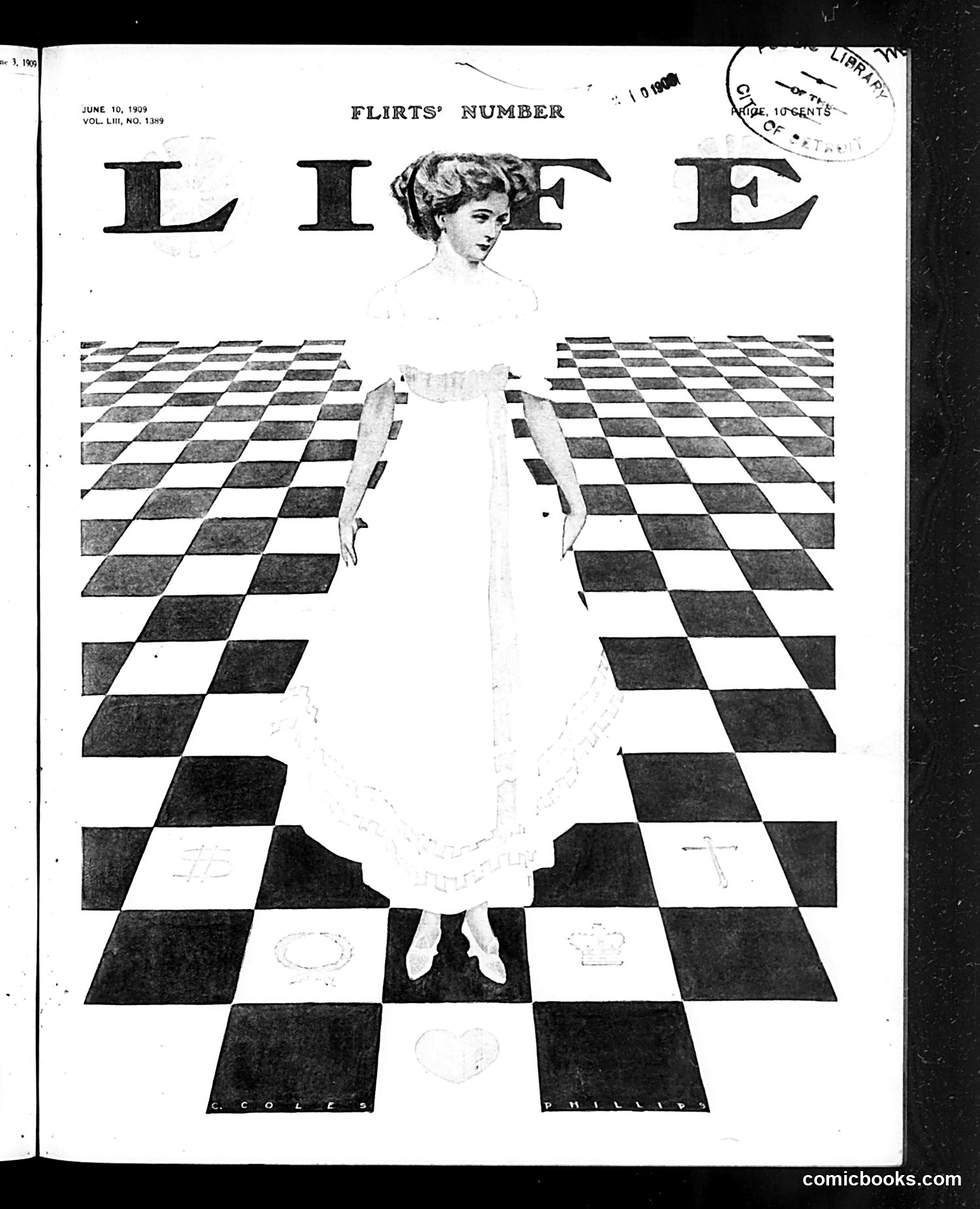
This is a cover illustration for Life's "Flirts' Number" issue. It depicts a woman in an elegant white Edwardian gown standing on a perspective-distorted checkerboard floor, flanked by the words "COLLEGE" and "PHILLIPS" (likely referencing colleges or social institutions). The satire appears to target the social practice of flirting during the Gilded Age. The geometric floor creates an optical illusion of depth, positioning the fashionably-dressed woman as the central subject navigating social spaces—universities and dining establishments represented by the labeled squares. The image mocks or celebrates the contemporary phenomenon of young women engaging in courtship rituals and social flirtation as a leisure activity among the educated classes.
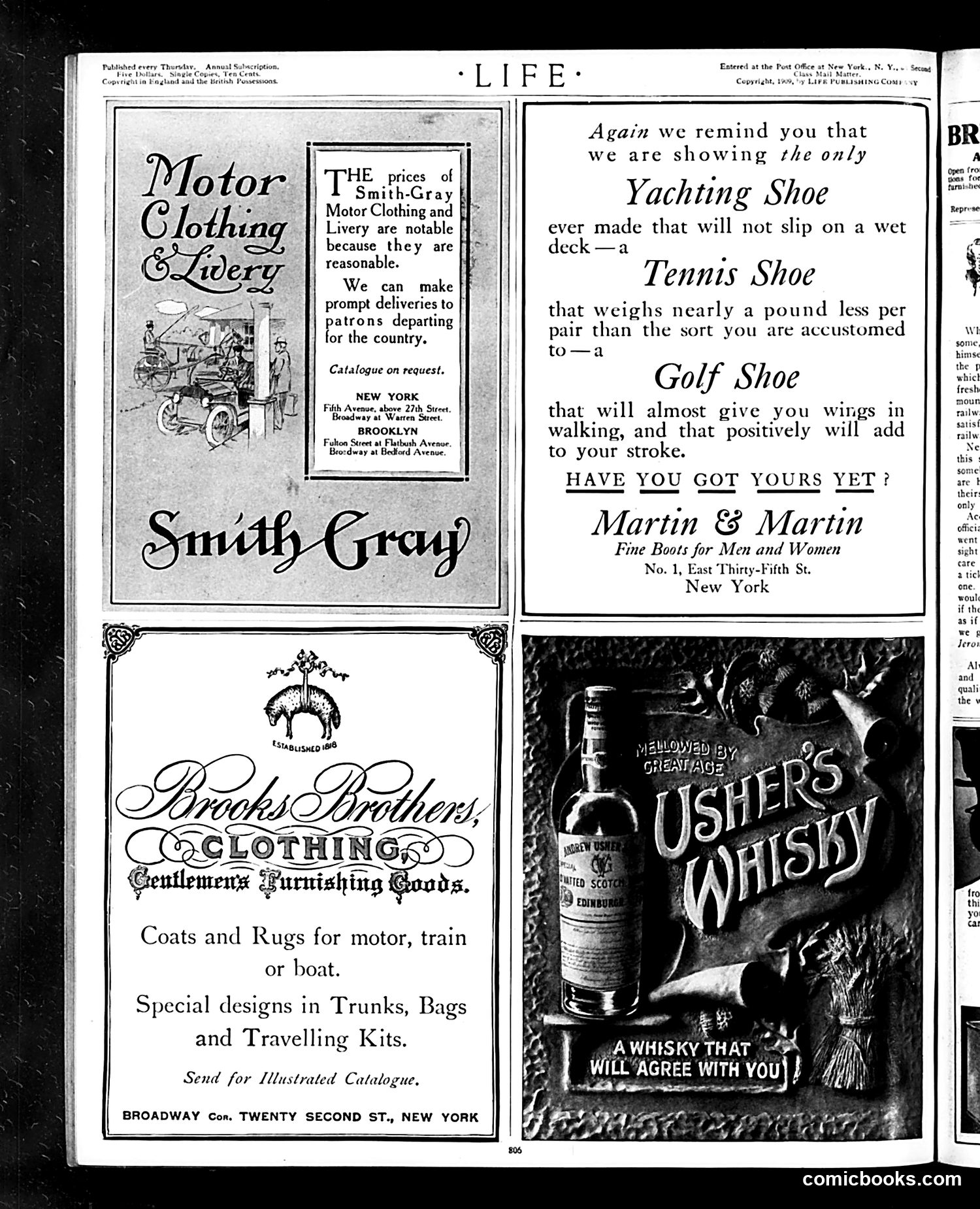
This page contains **four advertisements, not political cartoons**. There is no satirical content to analyze. The ads feature: 1. **Smith-Gray Motor Clothing & Livery** - promoting affordable motorcar attire and delivery services to the countryside 2. **Martin & Martin Fine Boots** - advertising specialized footwear (yachting, tennis, and golf shoes) with claims about performance benefits 3. **Brooks Brothers Clothing** - offering coats, rugs, trunks, and traveling kits for motor, train, or boat travel 4. **Usher's Whisky** - promoting Scottish whisky with the tagline "A Whisky That Will Agree With You" These advertisements reflect early 20th-century consumer culture, emphasizing leisure activities (yachting, golf) and motorcar travel as markers of affluence and modernity.
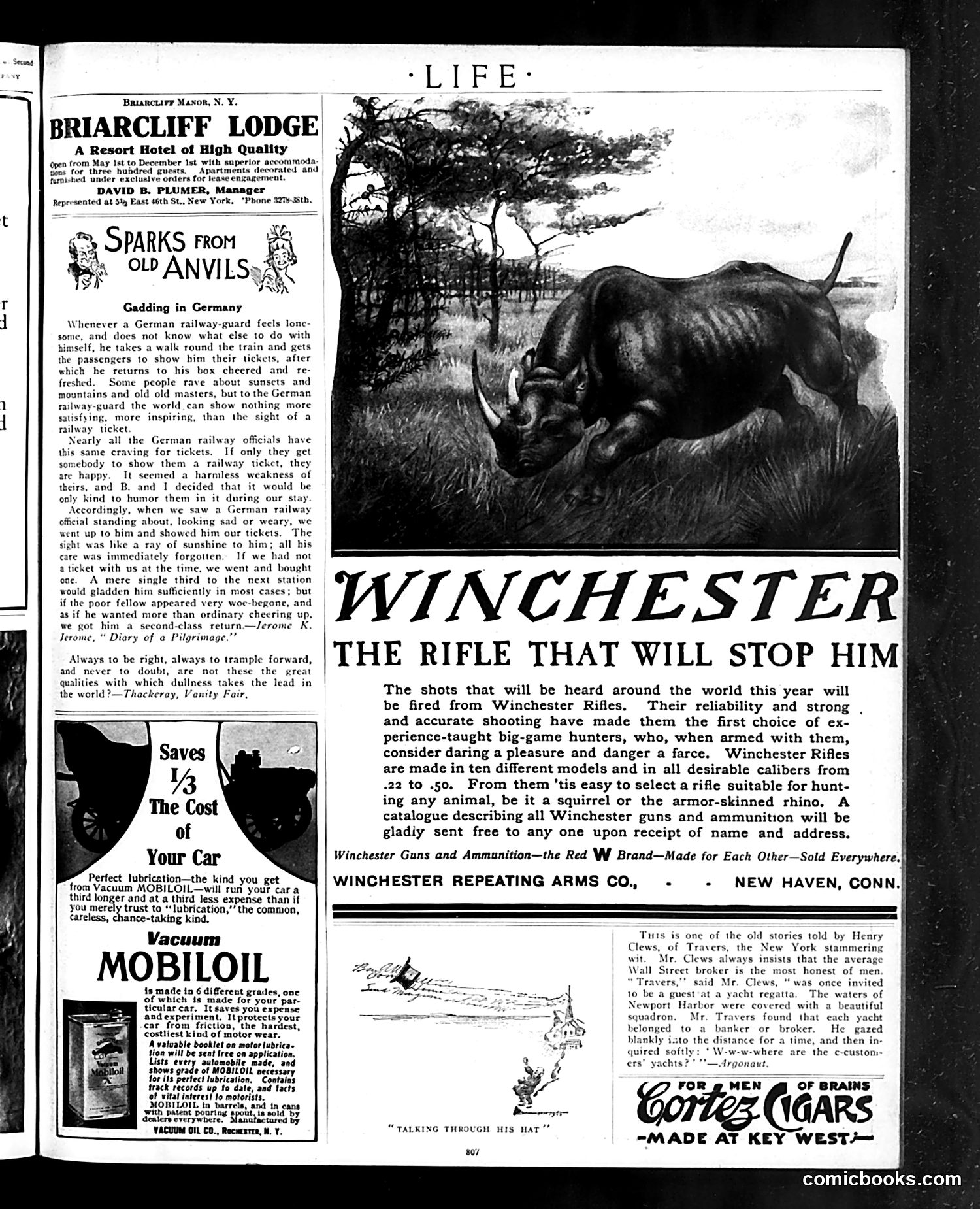
This page is primarily **advertising**, not satire or political commentary. The main content features a large Winchester Rifles advertisement showing a Highland cattle (or similar horned animal) with the tagline "THE RIFLE THAT WILL STOP HIM." The copy emphasizes Winchester's reliability for big-game hunting. Supporting ads include: - **Briarcliff Lodge** (resort hotel) - **Mobiloil** (motor oil) - **Cortez Cigars** (Key West) The only editorial content is a brief anecdote titled "Sparks from Old Anvils" about German railway guards' fondness for collecting tickets—light humor, not political satire. The page reflects early 20th-century commercial magazine content blending minimal editorial material with substantial advertising revenue.
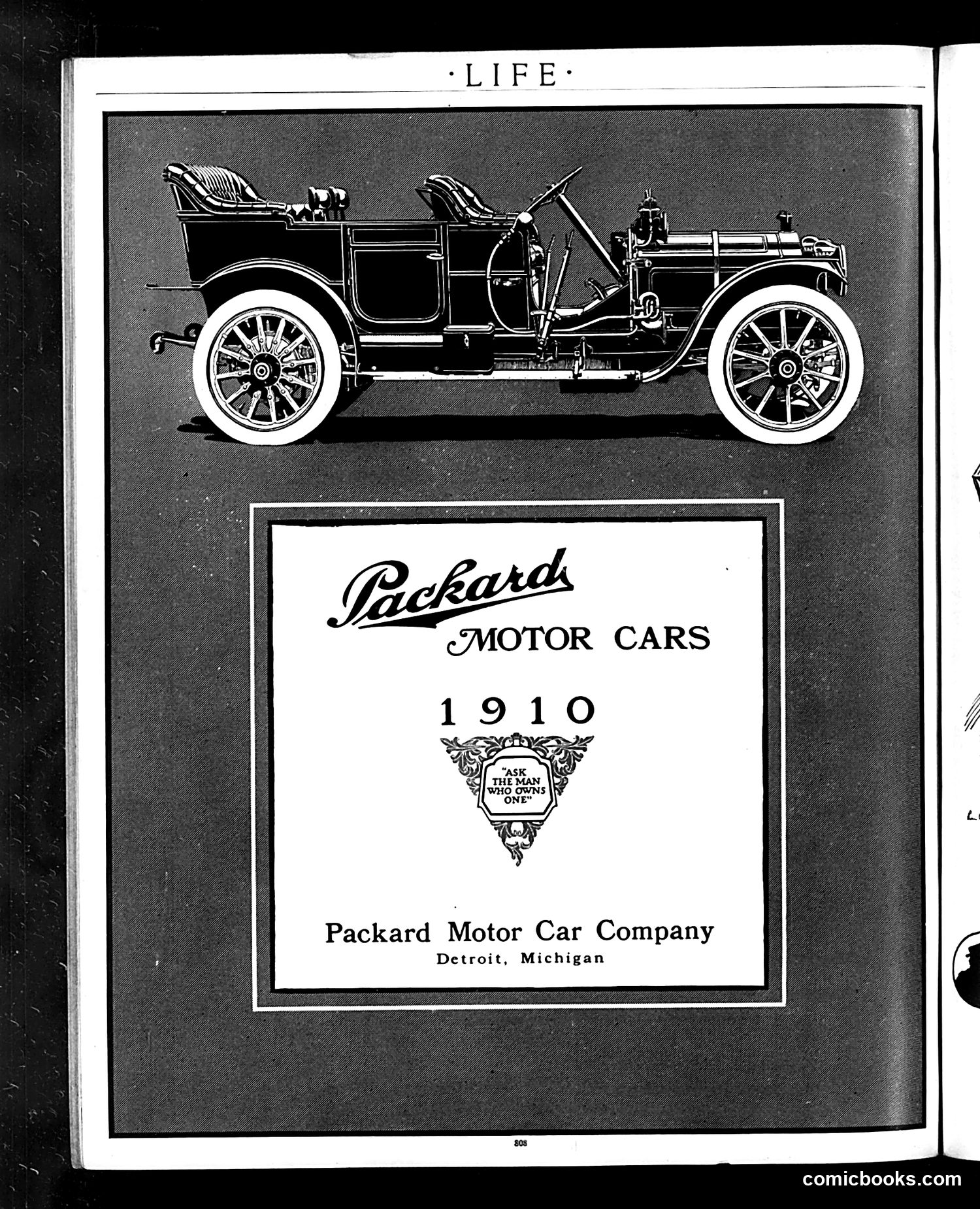
This page is primarily **advertising content**, not political satire. It's a 1910 Packard Motor Car Company advertisement from *Life* magazine, featuring a detailed technical illustration of a Packard automobile in side profile. The advertisement includes the company's tagline "ASK THE MAN WHO OWNS ONE," a marketing slogan emphasizing customer satisfaction and word-of-mouth endorsement. The Packard Motor Car Company was based in Detroit, Michigan, and manufactured luxury automobiles. There is **no political cartoon or satirical content** on this page. It represents straightforward early-automotive-era marketing in a respected American periodical, showcasing the vehicle's engineering and construction details to affluent potential buyers.
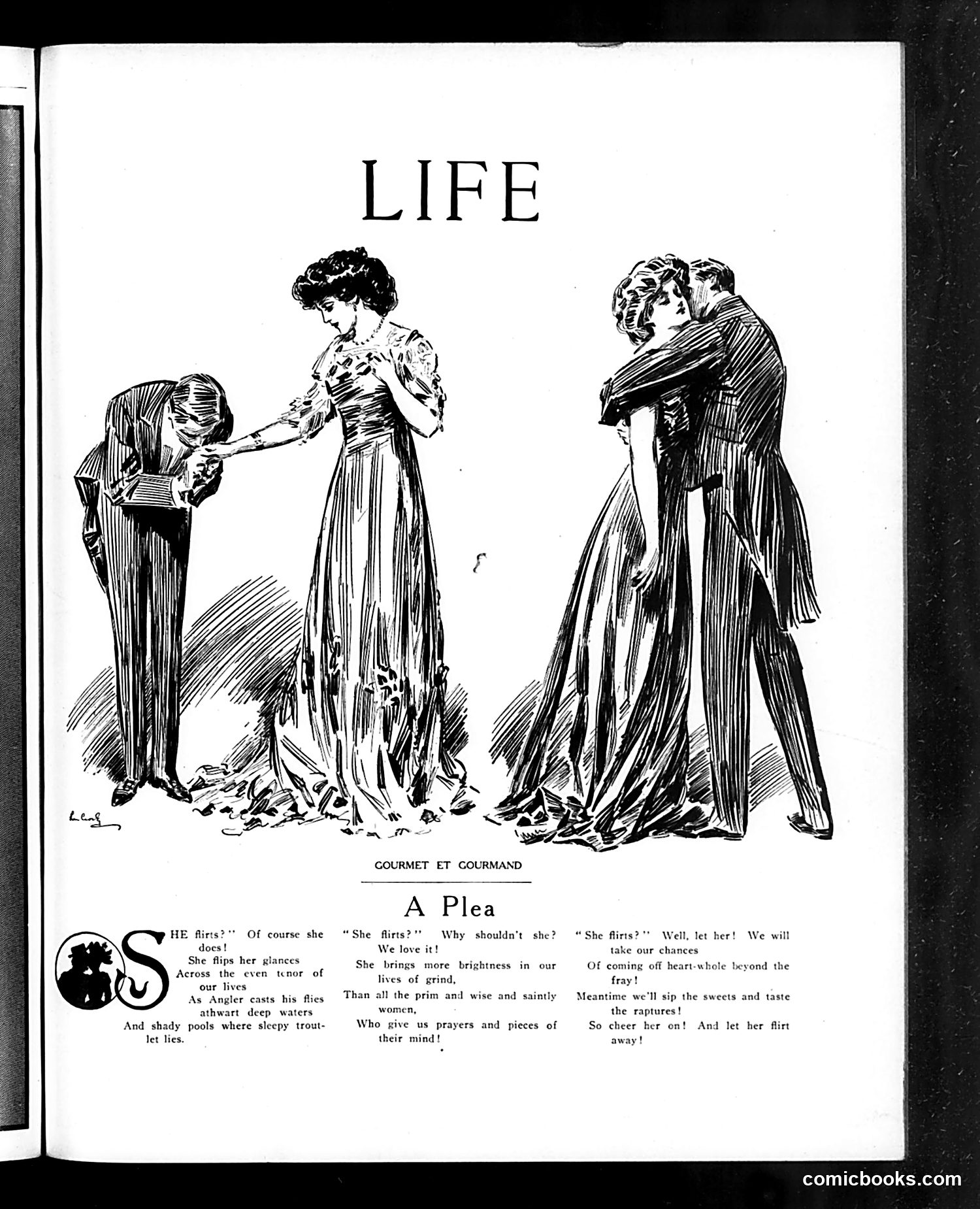
This satirical piece critiques gender roles and marital dynamics of the early 20th century. The illustration shows two scenes: on the left, a man (labeled "Gourmet") courting a woman with flattery; on the right, a woman (labeled "Gourmand") being embraced by a man. The poem "A Plea" argues that women who "flirt" bring brightness to society and should be celebrated rather than condemned. The satire appears to challenge prudish attitudes toward women's behavior, suggesting that society's "prim and wise" moralists unfairly restrict women's freedom and joy. The cartoon advocates for accepting women's natural social vitality, positioning flirtation as harmless and beneficial rather than scandalous—a progressive stance for the era.
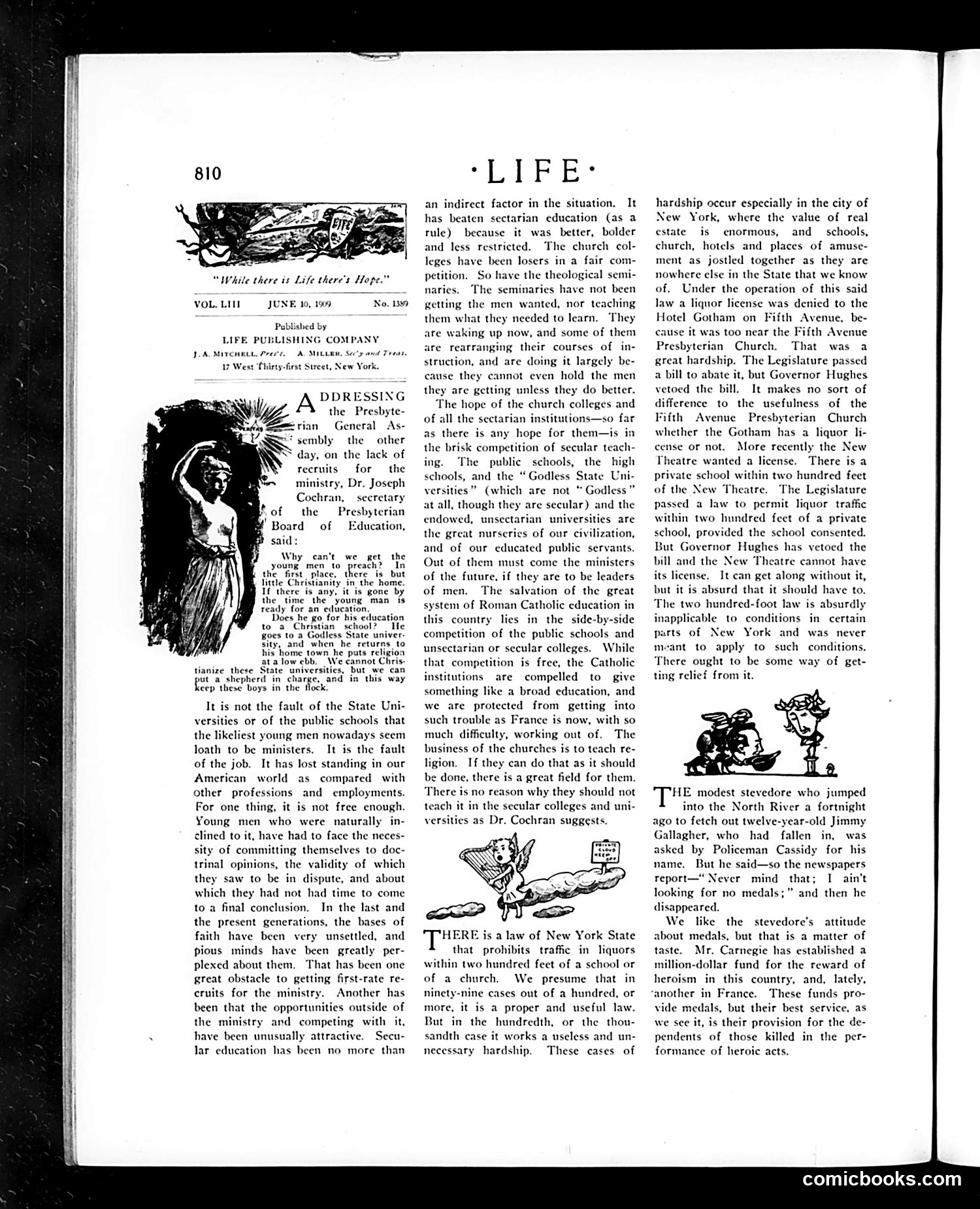
This page contains editorial commentary on American education and Catholic institutions, with two accompanying cartoons. The first cartoon depicts a stern clergyman addressing young men about ministry, illustrating the article's argument that seminaries should better prepare candidates for actual pastoral work rather than abstract doctrine. The second cartoon shows a figure (labeled "THE modest stevedore") who jumped into the North River to rescue a drowning boy. The accompanying text discusses this act of heroism and references Carnegie medals—apparently contrasting with stevedore "Cassidy's" humble, unmedaled rescue with Carnegie's prize system for heroic acts. The broader article critiques sectarian education and argues Catholic institutions should compete with public schools by offering broad secular education alongside religious instruction.
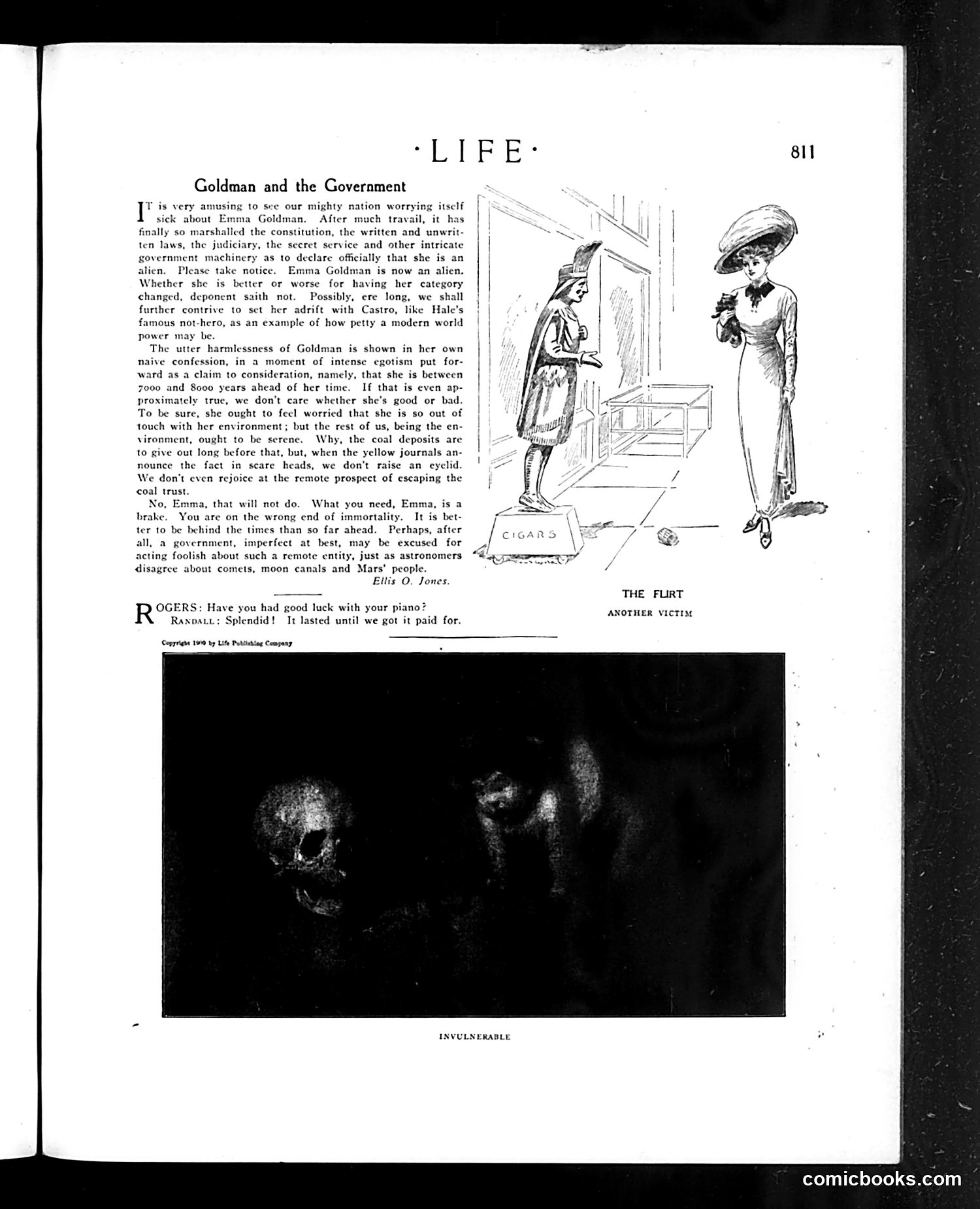
This page contains two distinct pieces of satire: **"Goldman and the Government"** (top article): A commentary on Emma Goldman, the anarchist activist. The text sarcastically notes that after "much travail," the government has officially declared Goldman an alien. The author (Ellis O. Jones) mocks the irony: whether Goldman is "good or bad," the government's concern is simply that she's "out of touch" with her environment. The piece ridicules both Goldman's radicalism and the government's bureaucratic response to her. **"The Flirt" illustration and "Rogers/Randall" joke**: A separate satirical cartoon showing flirtation, paired with a brief joke about piano payments—typical light social humor of the era. **"Invulnerable"** (bottom photo): An unclear dramatic photograph, possibly illustrating another narrative. The Goldman piece reflects early 20th-century anxieties about anarchism and immigration.
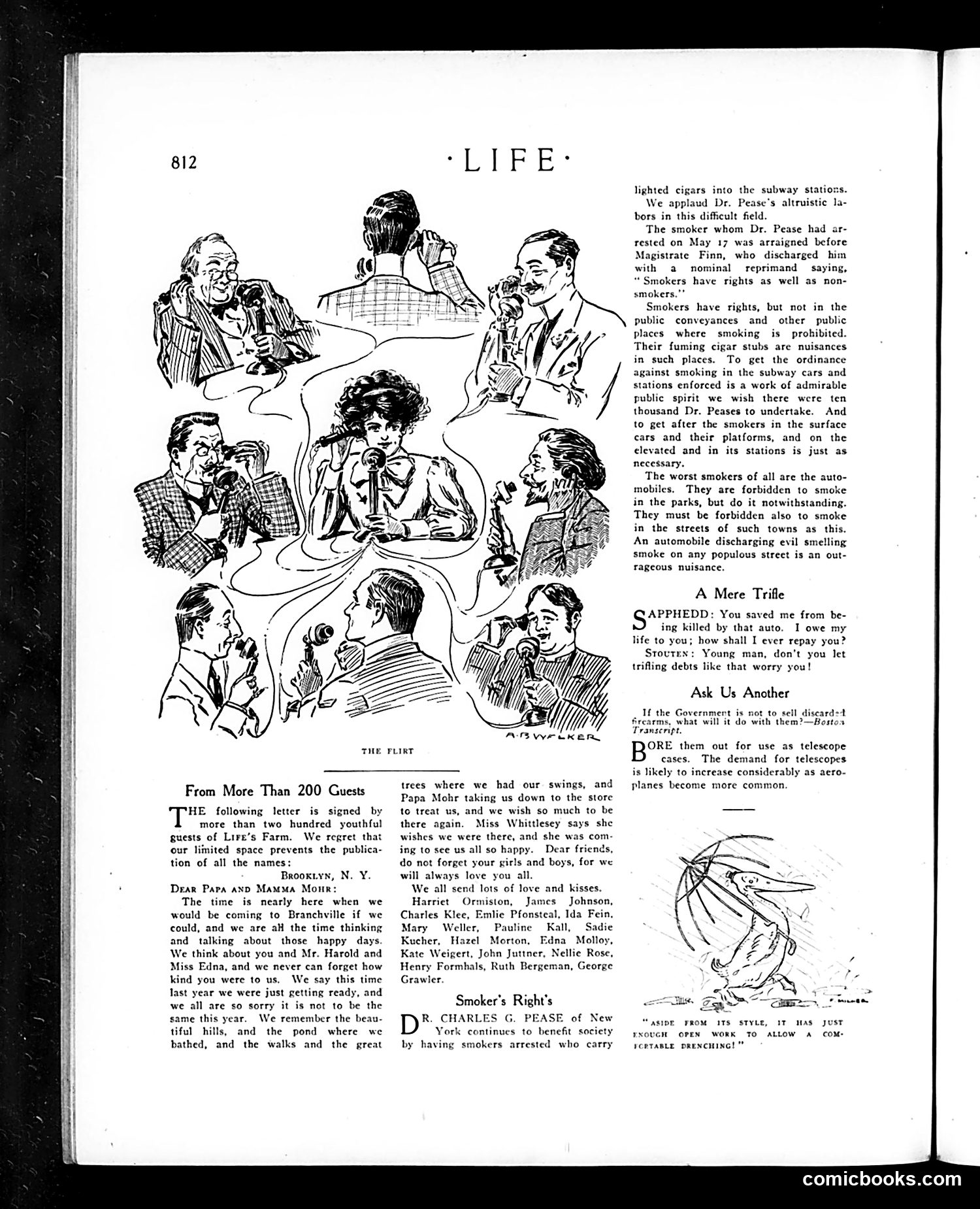
**The Main Cartoon ("The Flirt")** depicts various people smoking cigars in what appears to be a social setting. The accompanying text discusses smoking regulations and Dr. Charles G. Pease's efforts to arrest smokers violating anti-smoking ordinances in New York's subway system. **The Satire's Point:** The cartoon mocks both smokers and anti-smoking crusaders. Text applauds "Dr. Pease's altruistic labors" while simultaneously questioning whether aggressive enforcement against subway smokers is excessive. The piece argues smokers have rights but acknowledges their habit creates public nuisances. **Social Context:** This reflects early 20th-century debates over smoking in public spaces and the tension between individual liberty and public health/comfort—issues that remain relevant today. The page also includes a personal letter from readers and unrelated brief items about automobiles and telescopes.
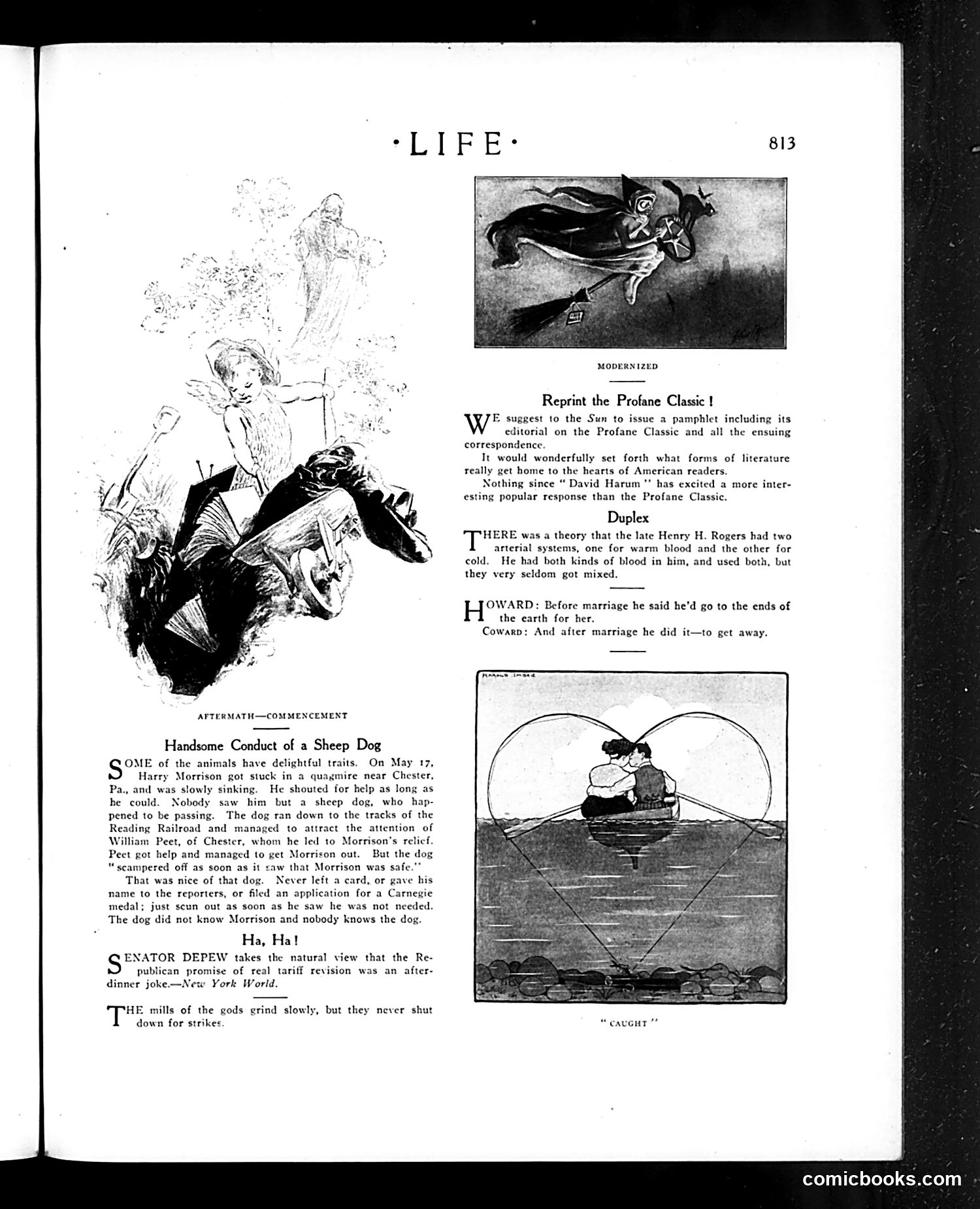
This page contains three distinct pieces of satirical content: 1. **"Modernized" section**: A proposal to reprint a classic work with updated editorial commentary, though specific details aren't clear from the visible text. 2. **"Duplex"**: A brief joke about Henry H. Rogers having "two arterial systems" of blood—one warm, one cold—used selectively. This appears to satirize Rogers as a ruthless businessman, suggesting his nature is fundamentally divided between human warmth and cold calculation. 3. **"Handsome Conduct of a Sheep Dog"**: A humorous anecdote about Harry Morrison stuck in a quagmire near Chester, PA, rescued by a sheep dog that attracted help from William Peel. The joke emphasizes the dog's intelligence and loyalty—it never asked for reward or recognition. The page uses humor to comment on character and morality in business and animal behavior.
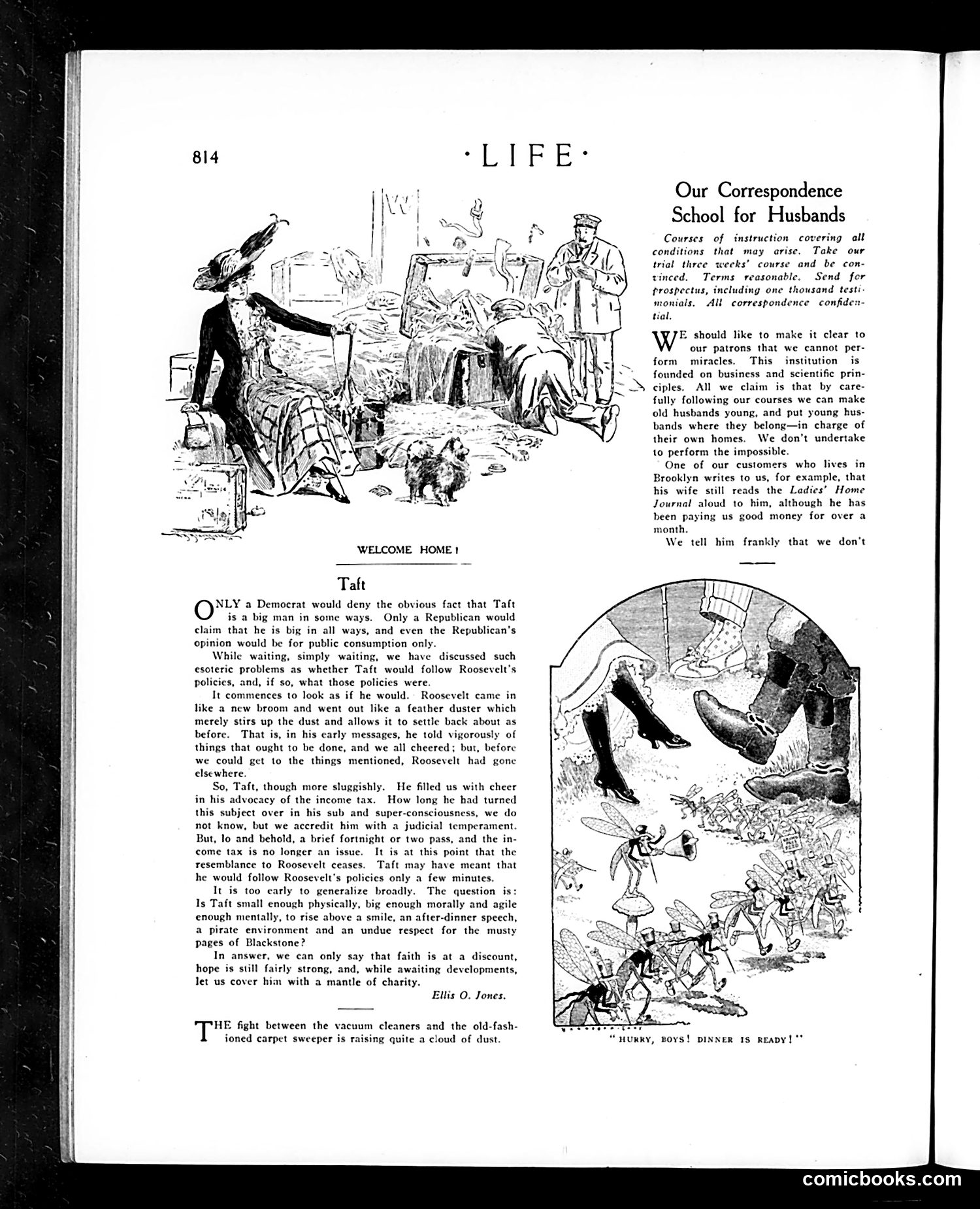
This page contains two distinct items: **"Our Correspondence School for Husbands"** (top right): An advertisement for instructional courses claiming to teach husbands proper behavior through business and scientific principles. The text mockingly notes one customer still has his wife read the *Ladies' Home Journal* to him despite paying for the course—suggesting the school's ineffectiveness. **"Taft"** (center/left): Ellis O. Jones's political commentary comparing William Howard Taft unfavorably to Theodore Roosevelt. The piece suggests Taft is indecisive and ineffectual—a "feather duster" who merely stirs up dust rather than accomplishing Roosevelt's vigorous agenda. It questions whether Taft can adequately lead, ultimately suggesting faith in him requires "charity." The accompanying illustrations depict domestic scenes and appear to support these satirical critiques.
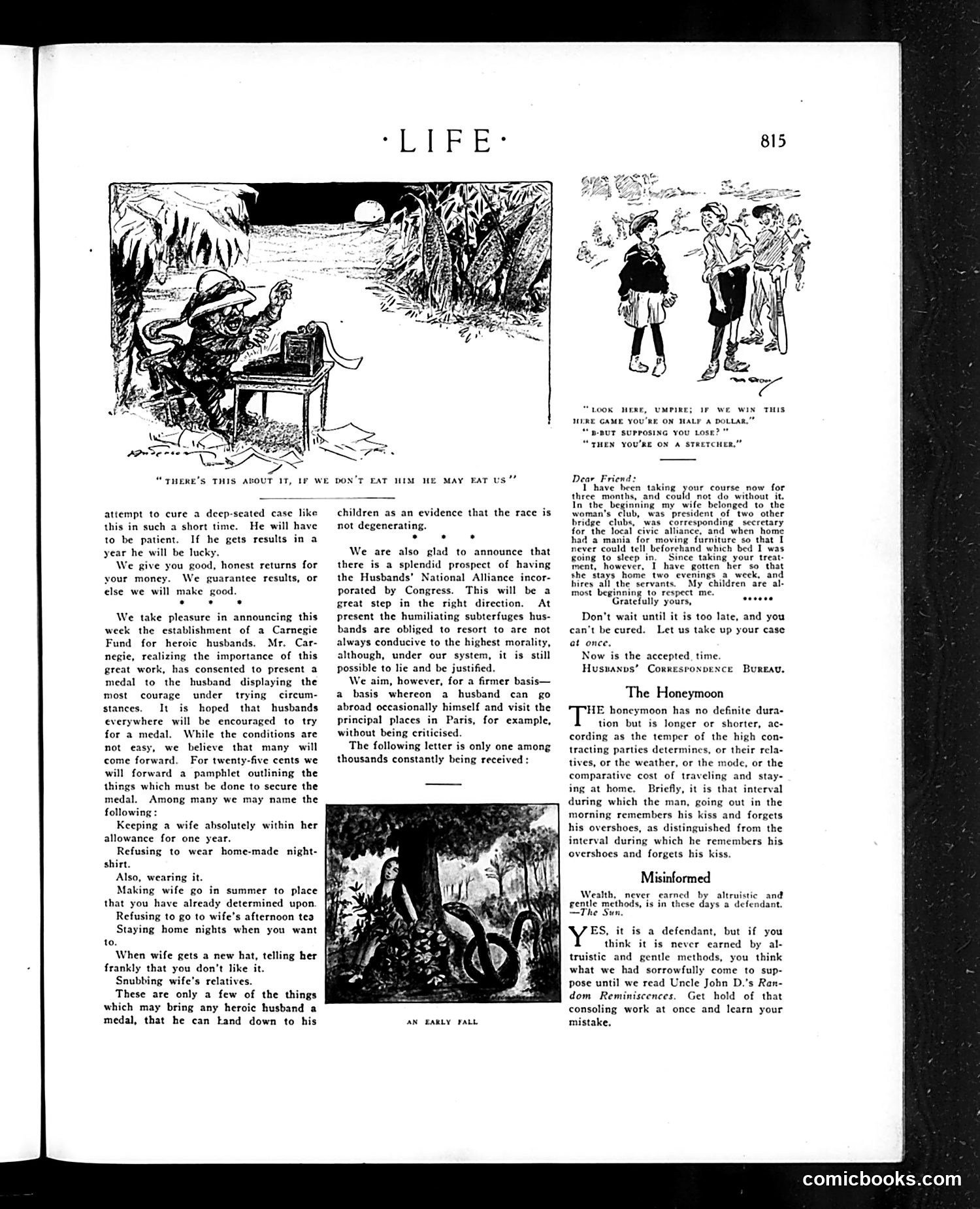
This page contains satirical advice columns rather than political cartoons. The left side includes humorous "tips" for husbands seeking medals—such as having a wife "absolutely wisher her absence for one year" and "snubbing wife's relatives." These mock domestic advice columns, suggesting absurd ways husbands might earn recognition. The right side features a "Honeymoon" section discussing the duration of newlywed bliss, and a "Misinformed" column referencing "Uncle John D's Random Reminiscences," likely satirizing John D. Rockefeller's published memoirs. The cartoons accompanying these sections show period-appropriate domestic and courtship scenes. The overall tone is genteel humor about marriage, domesticity, and American social customs of the era.
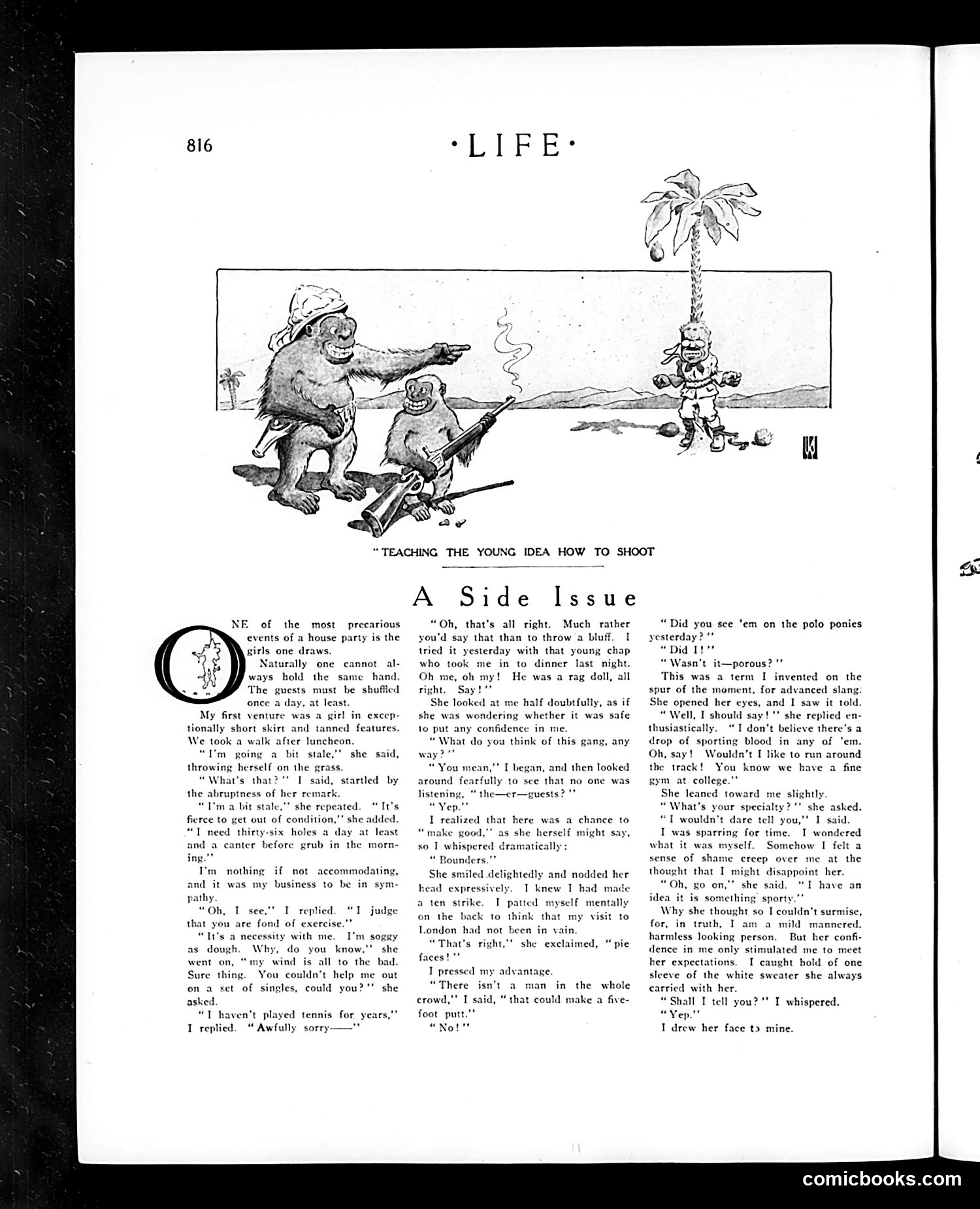
This cartoon satirizes a woman teaching young people (depicted as monkeys/apes) to use firearms in a colonial setting. The title references Alexander Pope's phrase about education ("teaching the young idea how to shoot"), creating ironic wordplay—using "shoot" literally rather than metaphorically. The joke appears to target either: 1. Women's involvement in colonial or military activities (considered unconventional for the era) 2. The absurdity of teaching violence to the inexperienced or unqualified 3. Possibly satirizing imperialist military practices abroad The accompanying story "A Side Issue" discusses romantic entanglements and social expectations. The cartoon's anthropomorphic animals may suggest primitive or uncivilized behavior, though the exact satirical target remains somewhat unclear without additional historical context about the magazine's publication date.
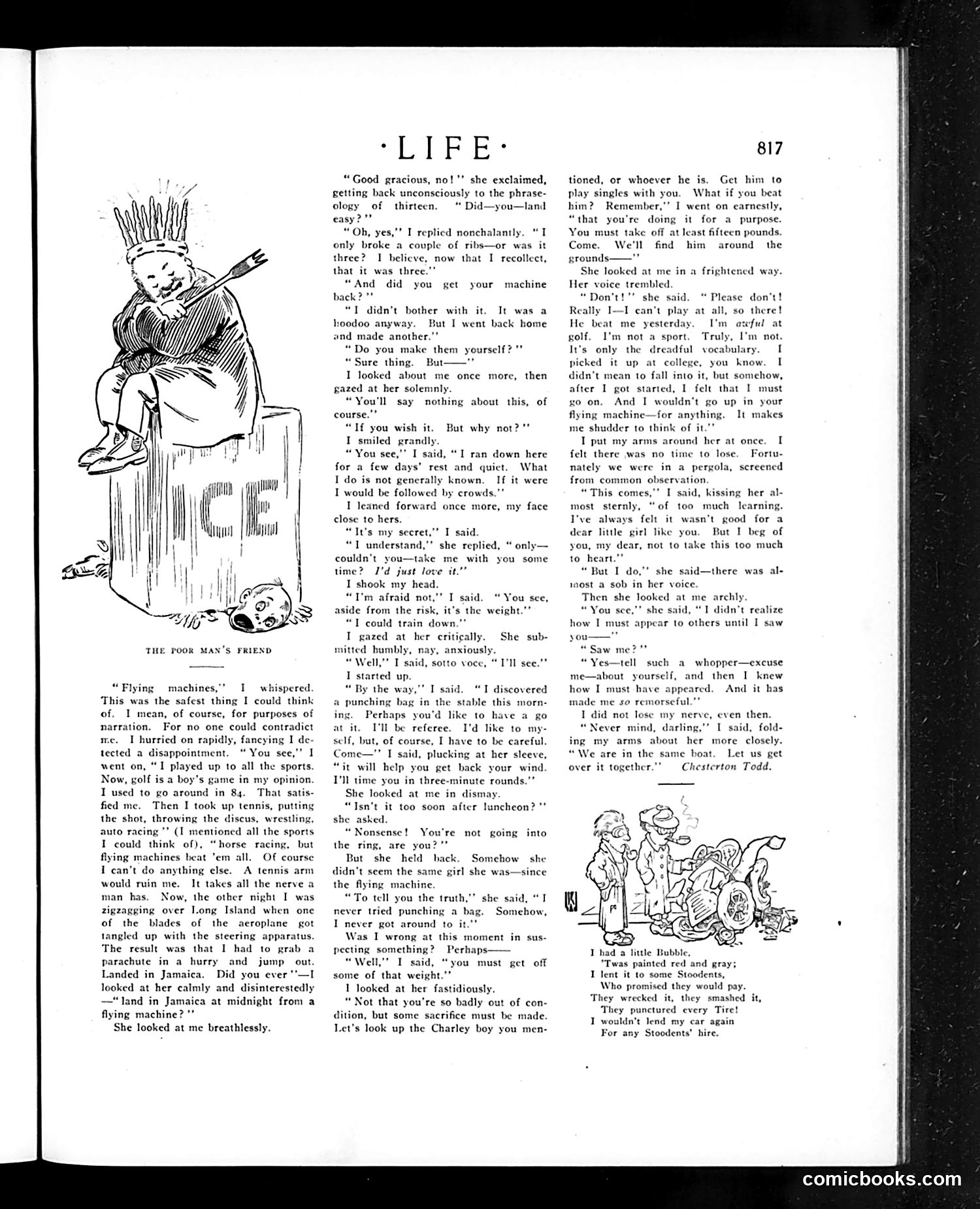
This cartoon depicts a figure wearing a crown and elaborate robes sitting atop a large bag labeled "LIFE," suggesting wealth or privilege. The illustration accompanies a story about flying machines. The satirical point appears to target class disparity: the crowned figure represents wealth or aristocracy literally sitting above ordinary people's concerns (represented by the bag). The story's narrative—involving someone learning to pilot a flying machine and romantic complications—uses the aviation theme as backdrop for social commentary. The title "The Poor Man's Friend" is likely ironic, suggesting that what claims to benefit common people actually serves the wealthy or powerful instead. The exact historical context and specific figures referenced are unclear without additional publication date information.
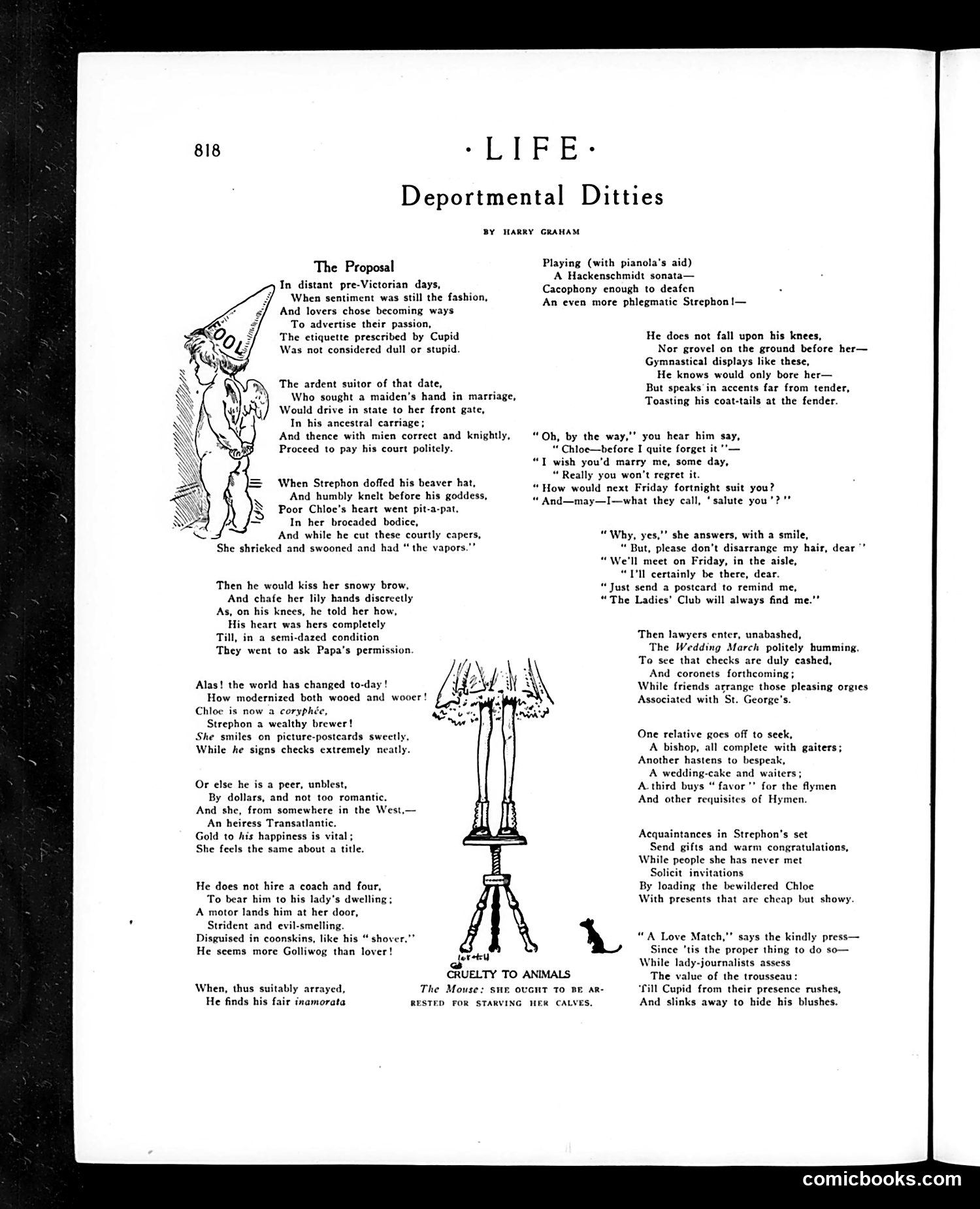
This is a satirical poem contrasting romantic courtship customs of the "pre-Victorian days" with modern (early 20th-century) practice. The humor lies in the contrast between idealized past romance and contemporary materialism. **The Setup:** Traditionally, a gentleman like "Strephon" would dramatically propose to "Chloe" with elaborate courtesy—kneeling, swooning heroines, ancestral carriages, and seeking Papa's permission. **The Modern Reality:** Today's suitors are wealthy brewers or peers, while their partners are chorus girls or American heiresses. Courtship is transactional: he values her money; she values his title. The proposal itself is casual and unromantic—he casually suggests marriage "next Friday fortnight" while toasting his coattails at the fire. **The Satire:** The wedding that follows involves lawyers ensuring financial transactions, relatives scrambling for church officials and catering, and opportunistic acquaintances sending cheap but showy gifts. The press celebrates it as a "Love Match," while Cupid (romantic love itself) "slinks away to hide his blushes." The joke: modern weddings are commercialized spectacles devoid of genuine romance.
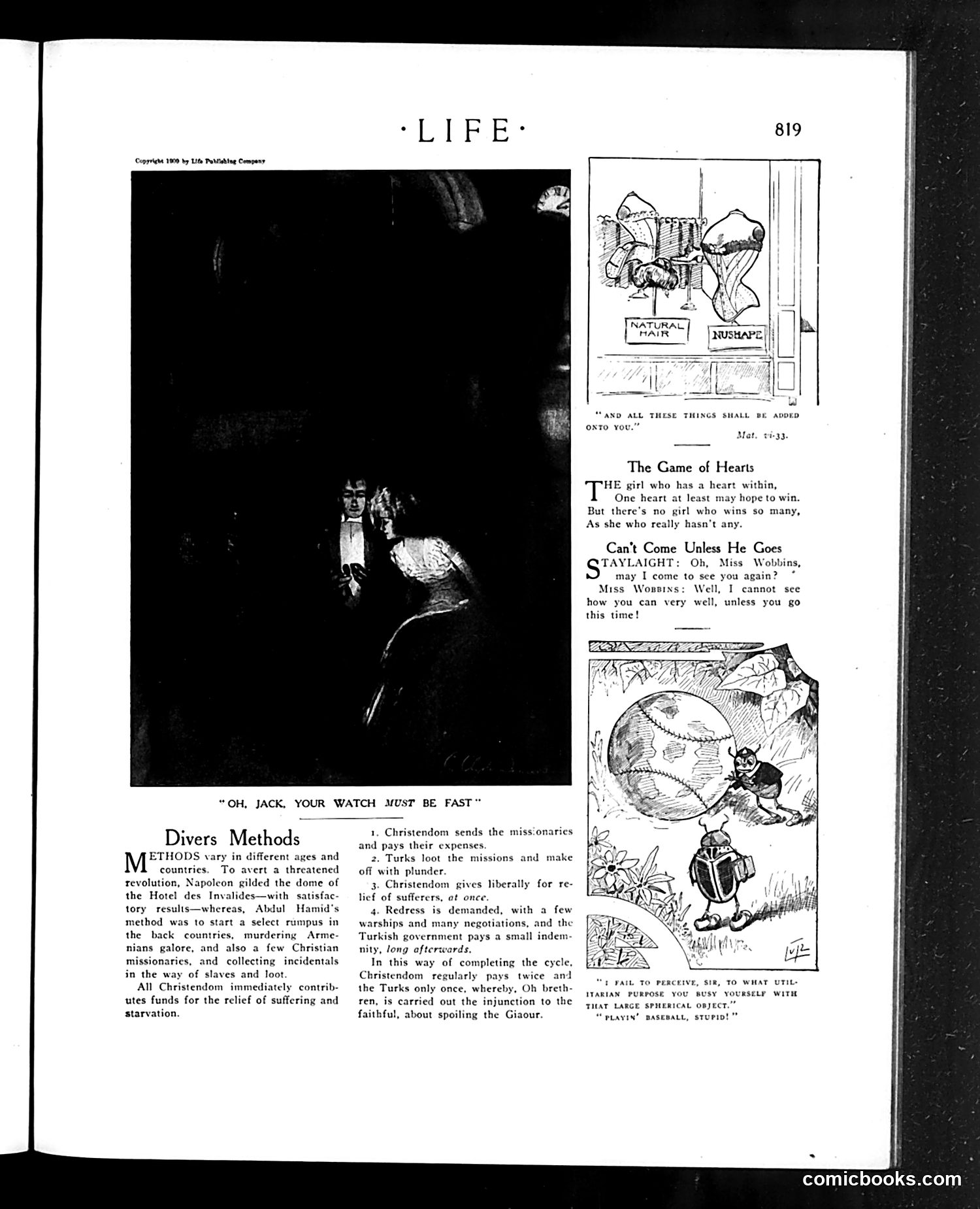
**"Divers Methods"** satirizes Ottoman Empire foreign policy under Abdul Hamid II. The article contrasts Napoleon's approach to preventing revolution (gilding the Invalides dome as a distraction) with the Sultan's strategy: deliberately inciting violence against Armenians and Christian missionaries in remote regions. This triggers humanitarian aid from Western "Christendom," which Turkish forces then plunder. The cycle repeats: the West sends missionaries and relief funds twice, while Turkey profits once—a darkly ironic commentary on how the Sultan manipulates Western Christian charity through deliberate atrocities. The phrase "spoiling the Giaour" (non-Muslim) references Islamic doctrine. The cartoon titled **"Oh, Jack, Your Watch Must Be Fast"** depicts a couple in intimate circumstances, playing on the double meaning of a watch running "fast"—suggesting the woman uses a false excuse to end an unwanted encounter. The other sketches are romantic/social humor about courtship and baseball, unrelated to the political content.
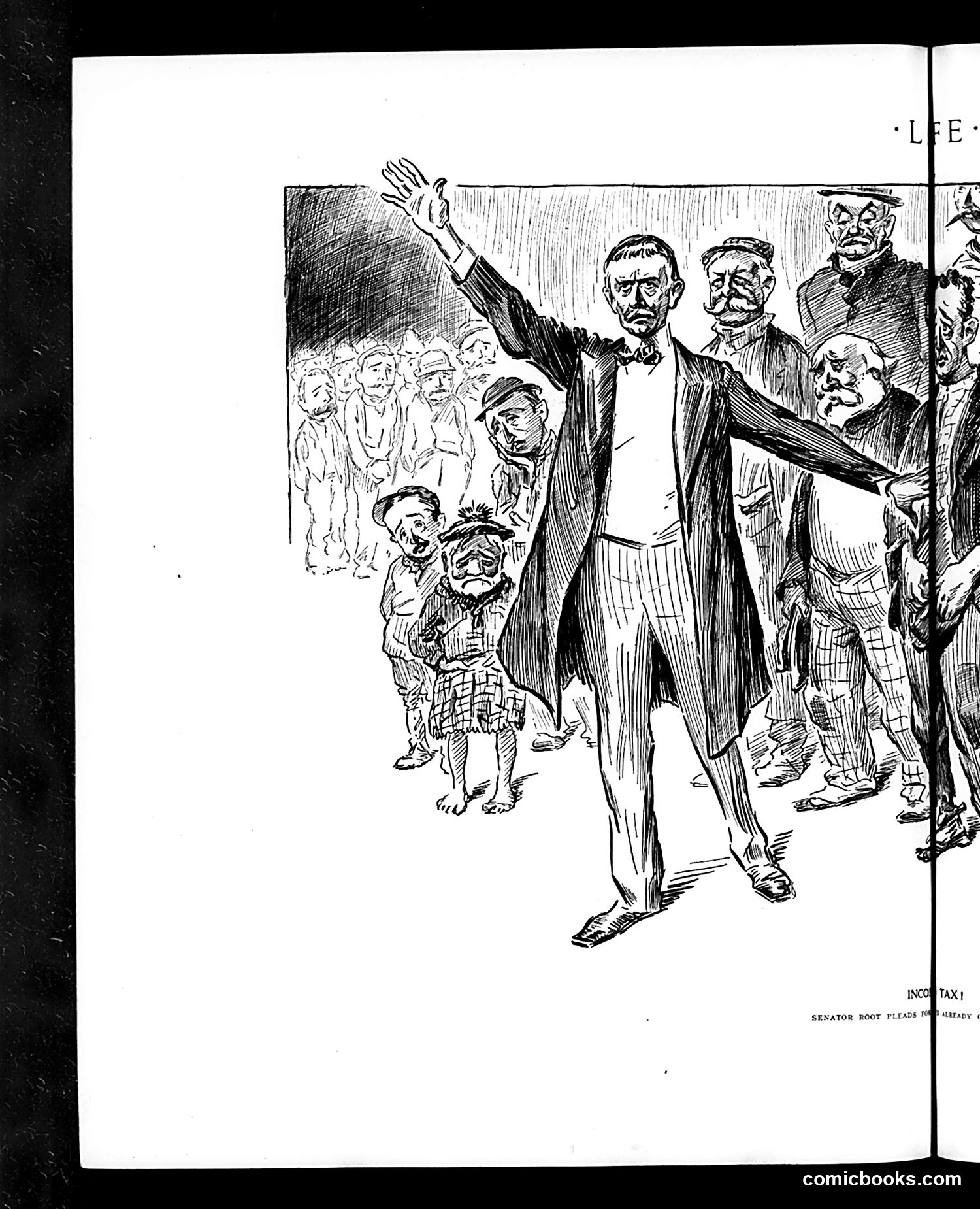
This appears to be a satirical cartoon from *Life* magazine depicting a political scene. A well-dressed man with his arm raised addresses a crowd that includes poor or working-class figures (including children and adults in shabby clothing). Stern-faced officials or politicians stand to the right, observing. The partially visible caption mentions "SENATOR" and "PLEASE" (text is cut off), suggesting this satirizes a senator's political appeal or speech to constituents. The contrast between the eloquent speaker, the watchful officials, and the desperate crowd suggests commentary on political hypocrisy—likely mocking politicians who make grand promises to the poor while serving wealthy interests. The specific senator and historical context remain unclear from the visible text.
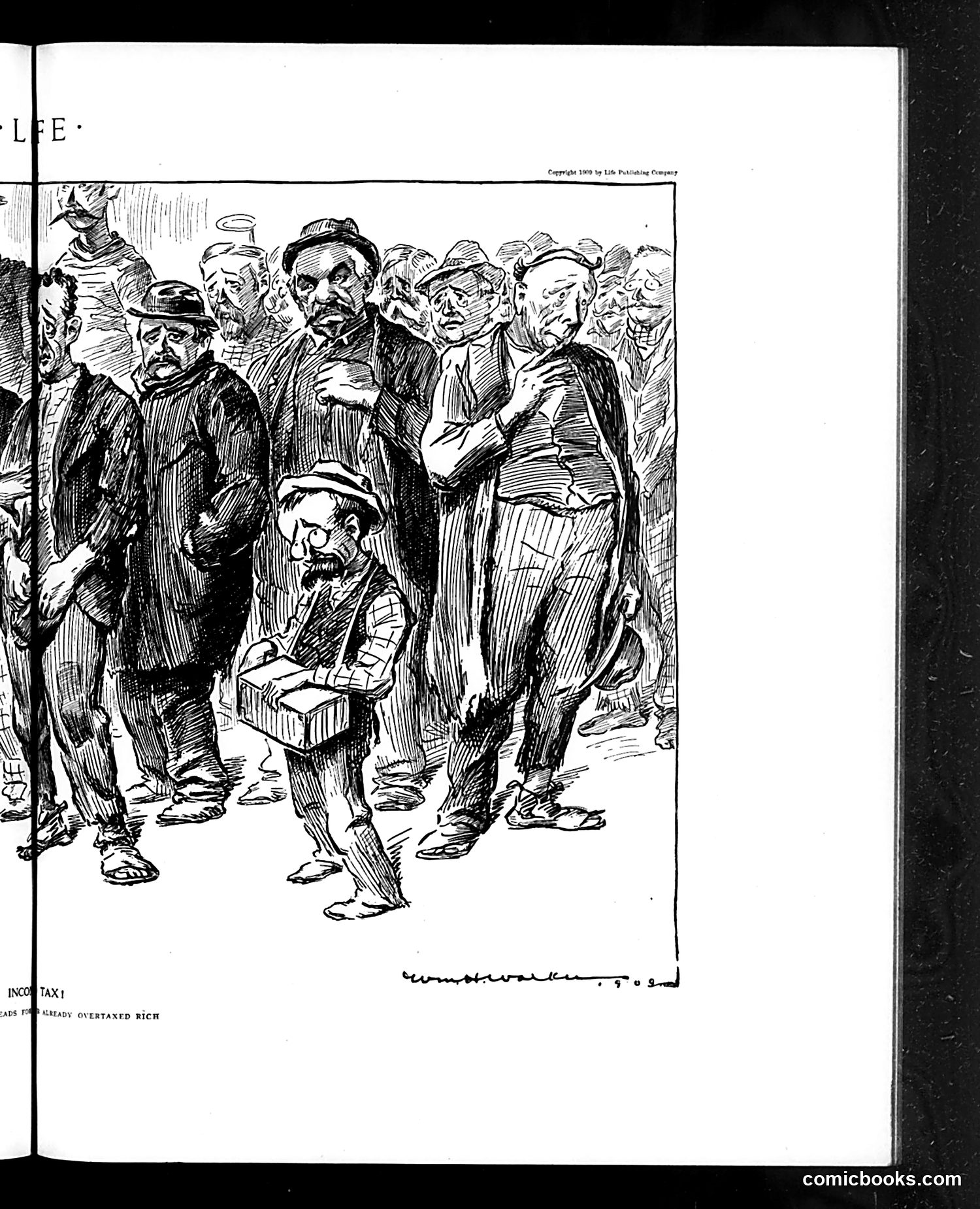
This is a satirical cartoon depicting a crowd of working-class men surrounding a smaller figure holding a box labeled "INCOME TAX." The caption reads "ALREADY OVERTAXED RICH." The satire is clearly ironic: the cartoon shows wealthy or privileged individuals (suggested by their formal dress and hats) claiming they're "already overtaxed," while they literally tower over and surround the common laborer. The humor lies in the contradiction—these figures don't appear overtaxed at all; rather, they appear to be the ones imposing the tax burden. This reflects early-20th-century American political debate over income taxation, wealth inequality, and whether the rich paid their fair share. The cartoon mocks the wealthy's complaints about taxation as disingenuous.
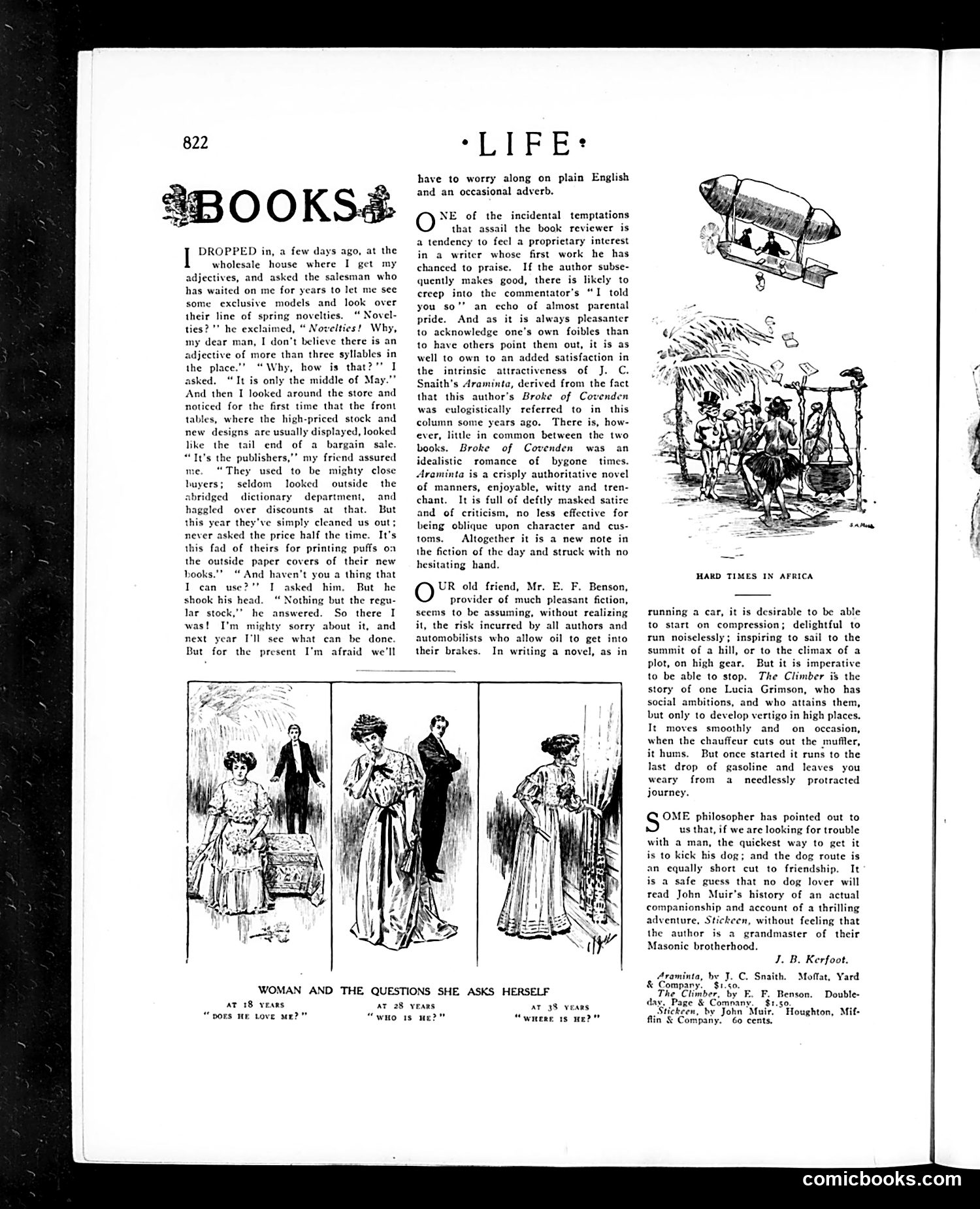
This is a *Life* magazine book review column from the early 1900s. The main illustrated feature—"Woman and the Questions She Asks Herself"—presents a satirical progression of female preoccupations across three life stages: at 18 ("Does he love me?"), at 28 ("Who is he?"), and at 38 ("Where is he?"). The joke reflects period assumptions about women's priorities shifting from romantic pursuit to marriage to abandonment or widowhood. The text discusses contemporary fiction, mentioning authors like J.C. Snaith and E.F. Benson. The opening column sarcastically notes that publishers have exhausted adjectives by using them on book covers—a complaint about commercial marketing practices in publishing that remains recognizable today. The page combines literary criticism with social satire typical of *Life's* blend of intellectual humor and commentary on contemporary manners.
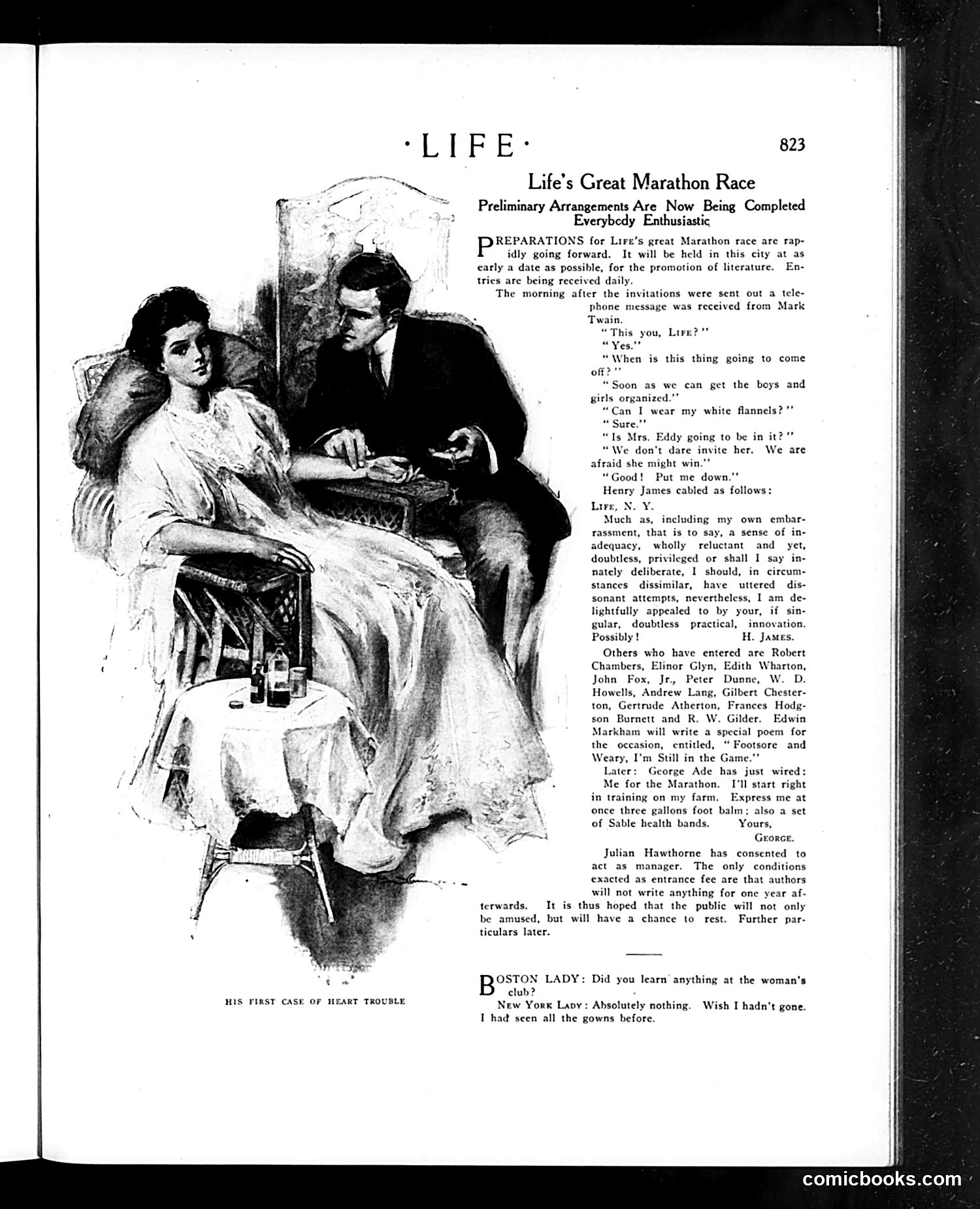
This satire announces a fictional "Marathon Race" organized by *Life* magazine to promote literature. The joke mocks famous American authors by imagining them competing in an actual footrace. The cartoon depicts a man experiencing heart trouble—likely representing an author's anxiety about the event. The text features humorous responses from literary celebrities: Mark Twain eagerly signs up, while Henry James sends a deliberately overwrought cable full of rambling qualifications typical of his prose style. Other notable authors listed include Edith Wharton, George Ade, and Julian Hawthorne. The satire's point: authors are sedentary intellectuals unsuited to physical exertion. A secondary joke suggests that requiring participating authors not to write for a year would benefit the public by sparing them from new books. The bottom anecdote about a Boston Lady and New York Lady mocking women's clubs as shallow fashion shows adds social commentary typical of *Life*'s satirical approach.
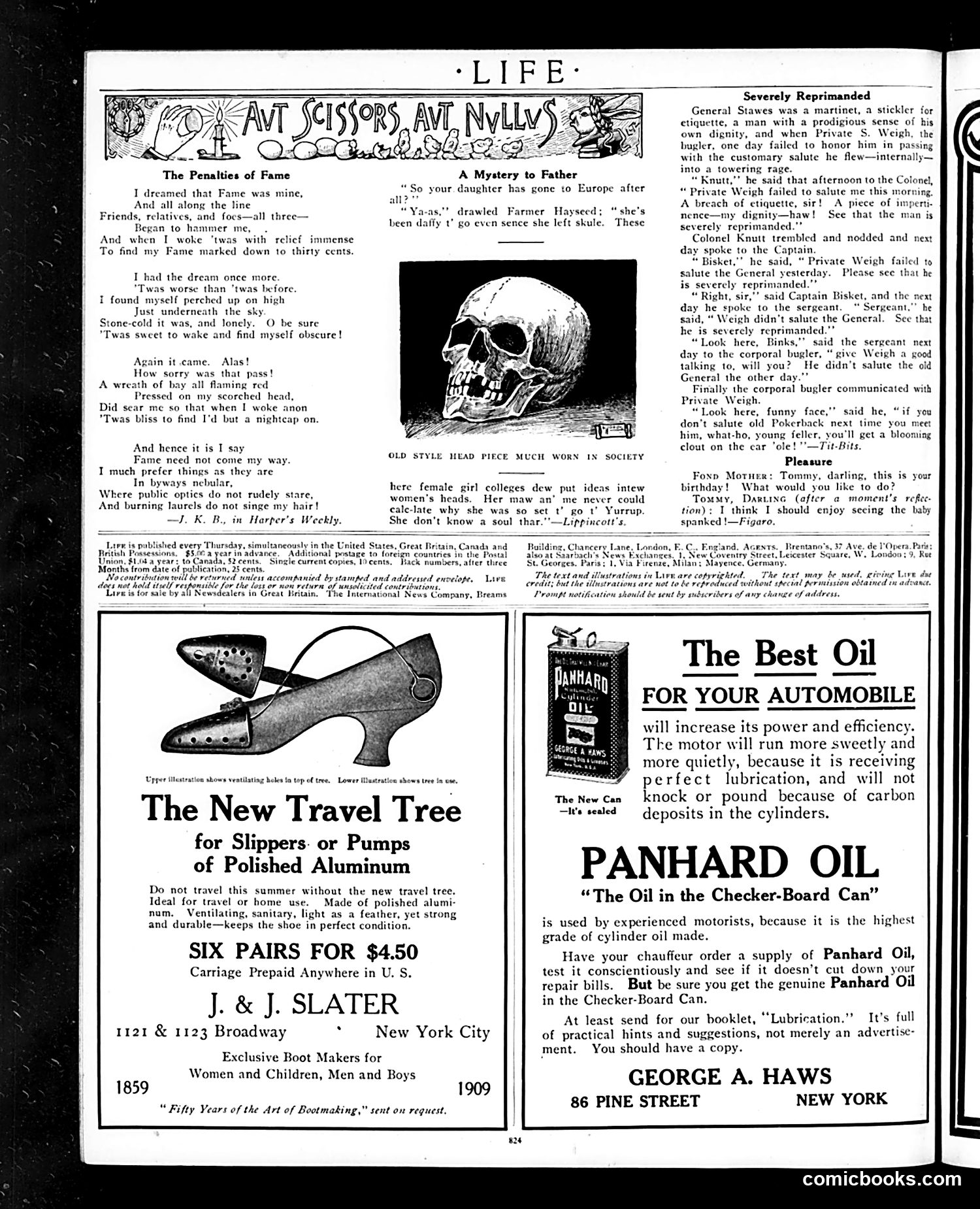
This page contains three satirical pieces targeting early 20th-century social anxieties: **"The Penalties of Fame"** mocks the burdens of celebrity through a dreamer's nightmares—each dream depicts fame as physically and socially painful, relieving him upon waking to obscurity. The satire suggests fame's cost to privacy and dignity. **"A Mystery to Father"** ridicules rural attitudes toward women's education. A farmer dismisses his daughter's European travel as foolish, attributing her ambitions to "female girl colleges" that give women "ideas." The dialect humor emphasizes rural ignorance of women's aspirations. **"Severely Reprimanded"** satirizes military bureaucracy through a chain-of-command comedy. A general's complaint about a private's failure to salute cascades downward, becoming increasingly diluted and absurd, until the corporal threatens physical violence. It mocks rigid hierarchies and how orders lose meaning through layers of authority. All three pieces reflect period anxieties: celebrity culture, women's education, and institutional rigidity—delivered through the era's typical comedic styles of dialect humor and situational irony.
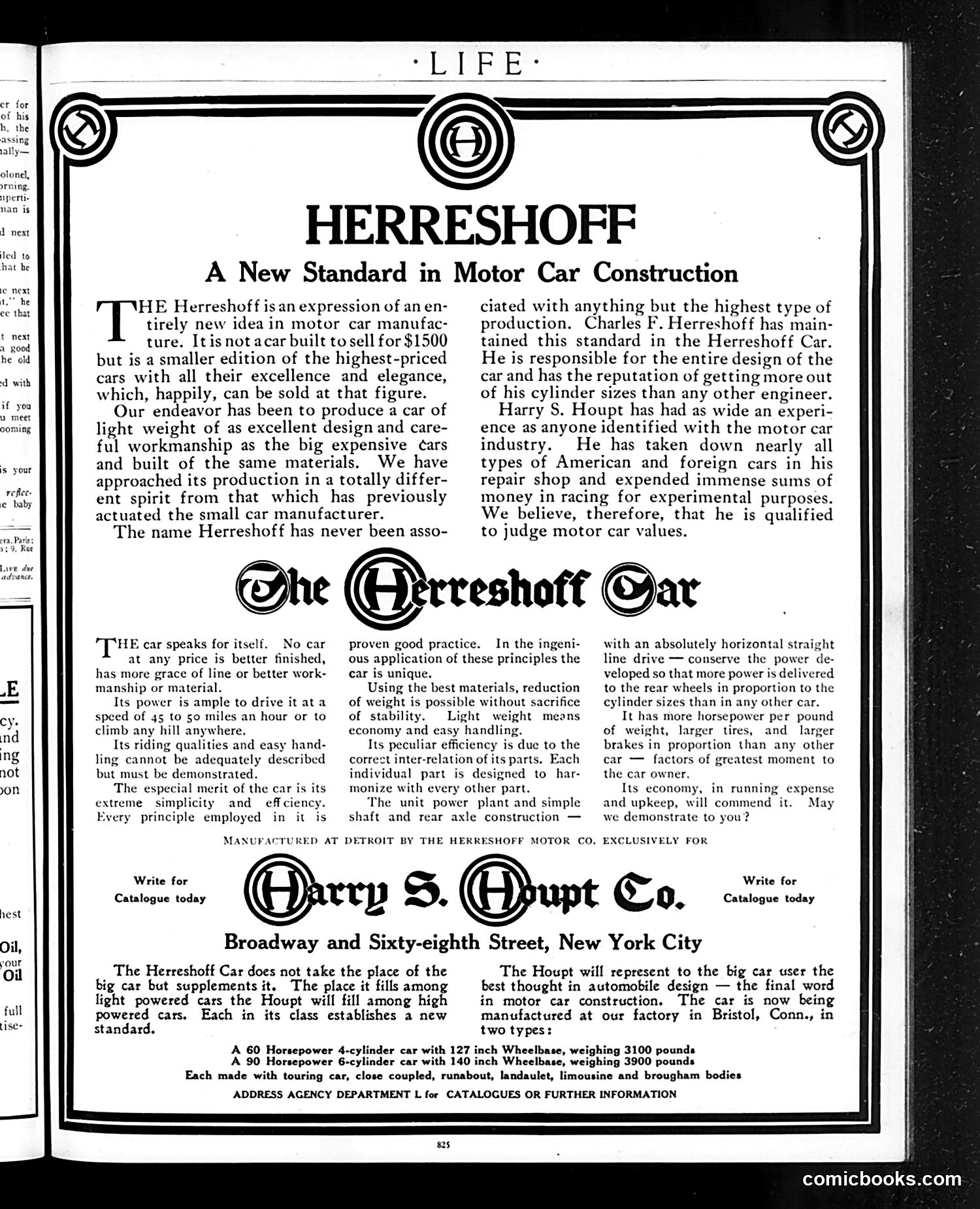
This is **not a cartoon or satire** — it's a straightforward automobile advertisement from Life magazine's early 1900s era. The page promotes the **Herreshoff automobile**, marketed by Harry S. Houpt Co. in New York. It emphasizes that the Herreshoff is a high-quality, lightweight car offering "excellence and elegance" at an affordable price point (around $1,500), rather than being a cheap, poorly-made vehicle. The ad credits designer Charles F. Herreshoff and businessman Harry S. Houpt, claiming Herreshoff's engineering expertise and Houpt's extensive experience with cars give them authority to judge automotive value. The copy stresses innovative design principles: simplicity, efficiency, optimal weight distribution, and superior horsepower-to-weight ratio. This reflects the early automotive market's competitive positioning — companies distinguished themselves through engineering claims and designer reputation rather than mass-production economies of scale. The text targets buyers seeking quality without paying luxury-car prices.
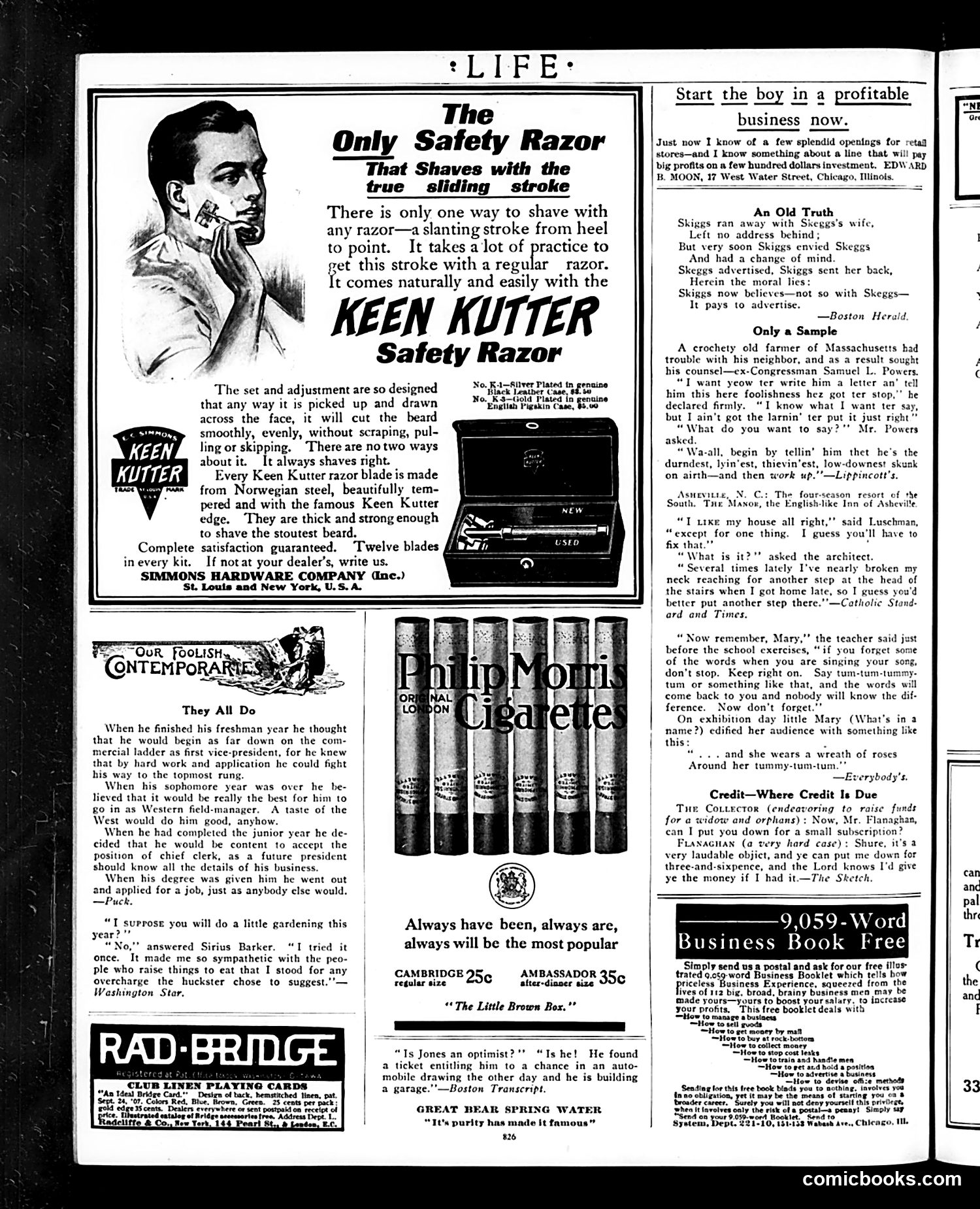
This page is primarily **advertising**, dominated by a large Keen Kutter Safety Razor ad featuring an illustrated man's face demonstrating the shaving stroke. The ad emphasizes the razor's ease of use and quality. The page also contains several **humorous anecdotes**: - "They All Do" satirizes young graduates' inflated career expectations—a freshman expects to start as vice-president, but by graduation accepts any job available, deflating youthful ambition. - "An Old Truth" is a cautionary rhyme about Skiggs and Skeggs (deliberately similar names for comic effect), suggesting infidelity and reconciliation prove advertising's value. - "Only a Sample" humorously depicts a Massachusetts farmer seeking help writing an angry letter, planning to start by calling his neighbor names before "working up"—absurd logic played for laughs. These are light, moralistic vignettes typical of early 20th-century Life magazine's satirical humor targeting contemporary social behavior and attitudes.
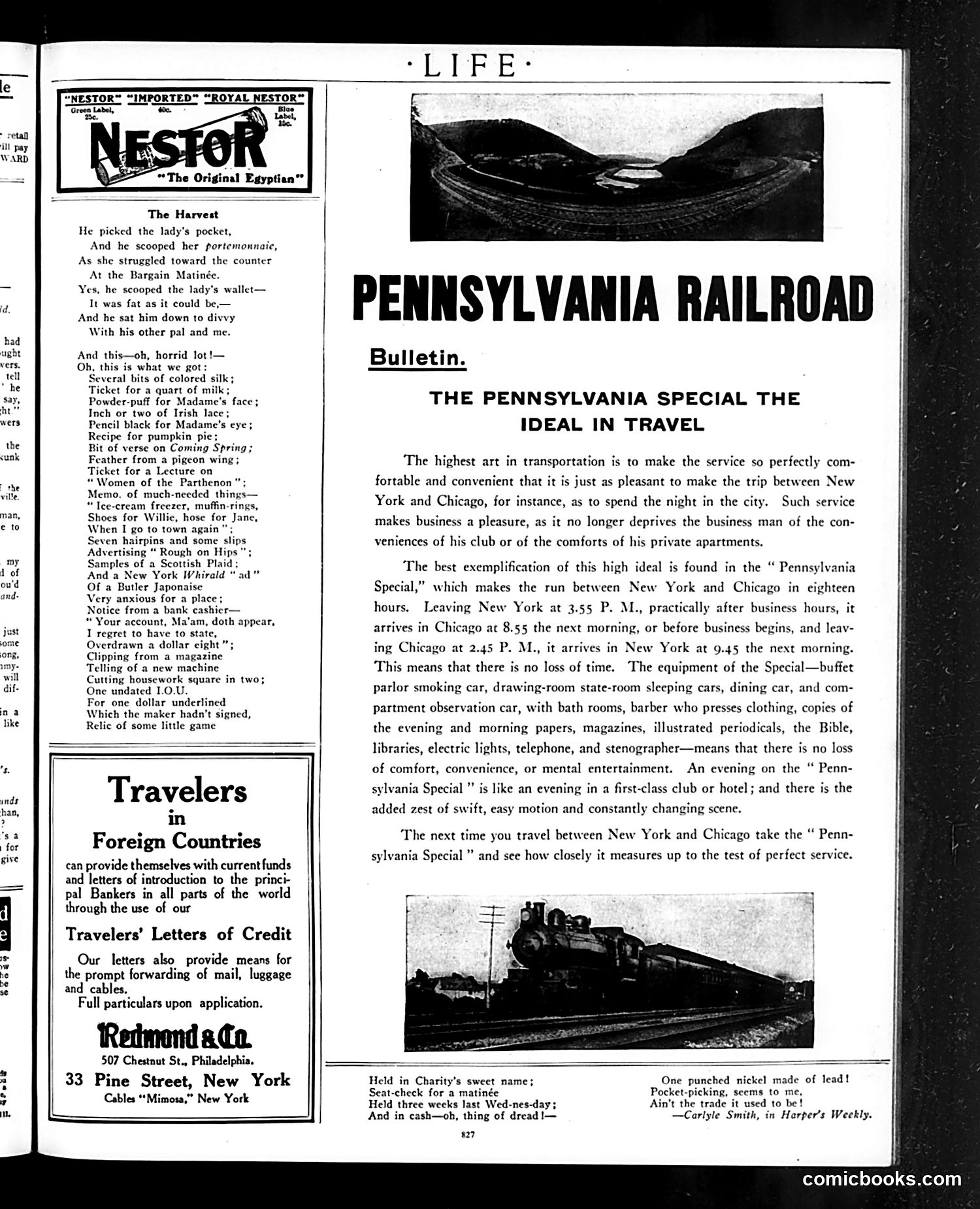
This satirical poem by Carlyle Smith mocks the material emptiness of early 20th-century consumer culture. A pickpocket and his accomplices steal a woman's wallet at a "Bargain Matinée," expecting riches. Instead, they find trivial items: powder, hairpins, advertising clippings, recipe scraps, and an overdrawn bank notice. The joke targets both the theft itself and what it reveals: the victim owns nothing of actual value—only mass-produced consumer goods and promotional materials. The final line ("Ain't the trade it used to be!") suggests pickpocketing is no longer worthwhile because ordinary people possess only cheap, disposable items. The poem satirizes how modern shopping and advertising have reduced personal possessions to worthless trinkets, reflecting Period anxiety about consumer culture's spiritual hollowness. The page's other content (Pennsylvania Railroad advertisement) occupies the right side, presenting an ironic contrast: while "The Harvest" mocks material emptiness, the ad promises comfort and luxury travel.
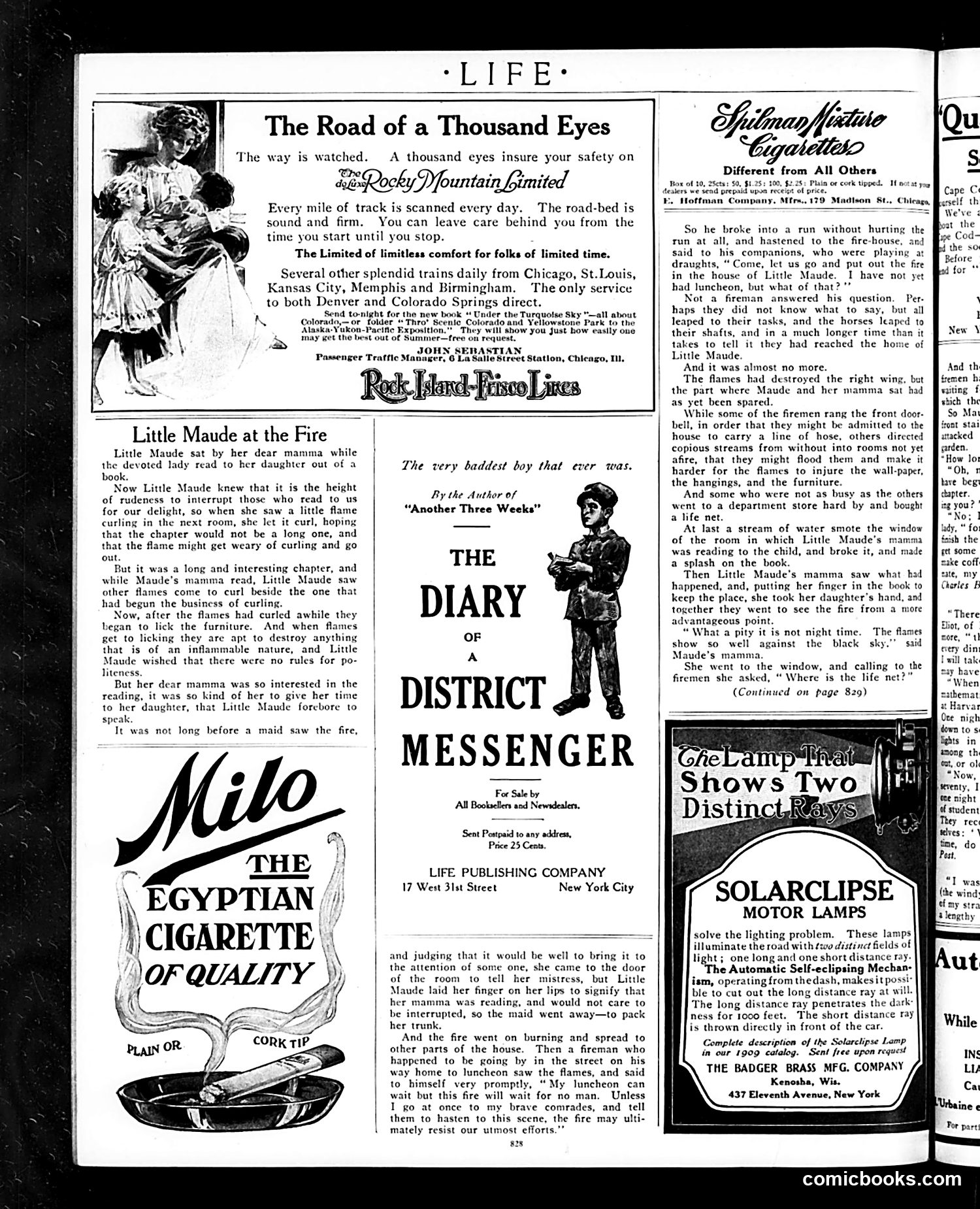
This page contains primarily **advertisements and serialized fiction**, not political satire. The main content is "Little Maude at the Fire," a morality tale satirizing excessive politeness. The story mocks a child so committed to not interrupting her mother's reading that she fails to alert her to an expanding fire. A maid similarly stays silent rather than disturb the reader. The satire targets rigid adherence to social etiquette (not interrupting) over practical necessity—a common theme in early 20th-century humor about Victorian manners. The page also advertises: the Rocky Mountain Limited train, Milo Egyptian cigarettes, "The Diary of a District Messenger" (a serialized novel), and Solareclipse motor lamps. These are standard commercial ads typical of *Life* magazine's revenue model during this era.
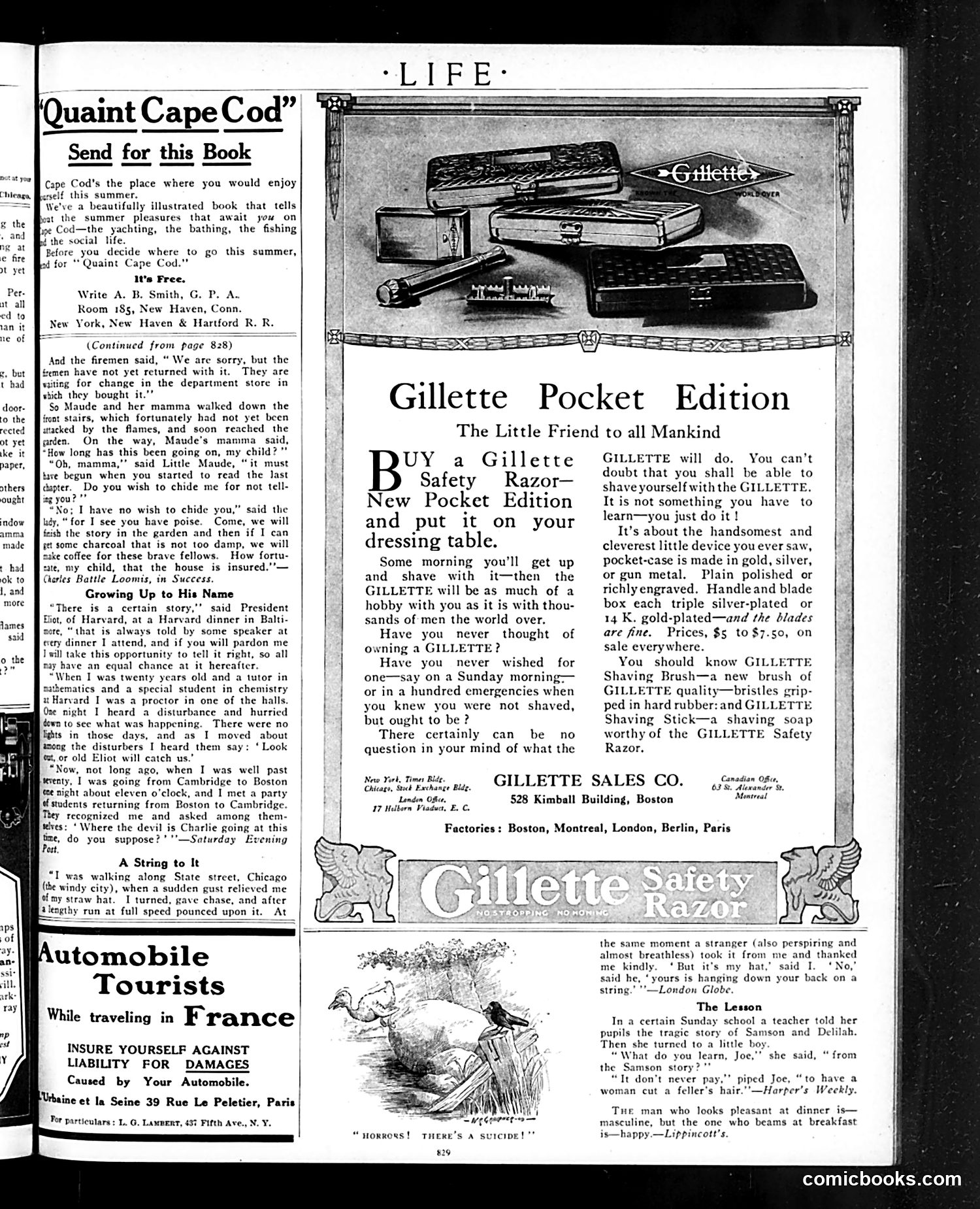
This page is primarily **advertising and serialized fiction**, not political satire. The main content includes: 1. **"Quaint Cape Cod" travel promotion** — a free illustrated book advertisement 2. **Serialized humorous stories** — including "Growing Up to His Name" (an anecdote attributed to Harvard President Eliot about being mistaken for someone else) and "A String to It" (a brief joke about losing a hat in Chicago wind) 3. **Gillette Safety Razor advertisement** — the dominant feature, promoting the new "Pocket Edition" razor as a portable grooming necessity for men 4. **Travel insurance ad** — for automobile liability coverage in France The Gillette ad uses the common early-20th-century marketing strategy of positioning a product as essential to masculine identity and modern convenience. There is **no political cartoon or satire visible** on this page — it represents typical Life magazine content mixing light humor, serialized fiction, and commercial advertising.
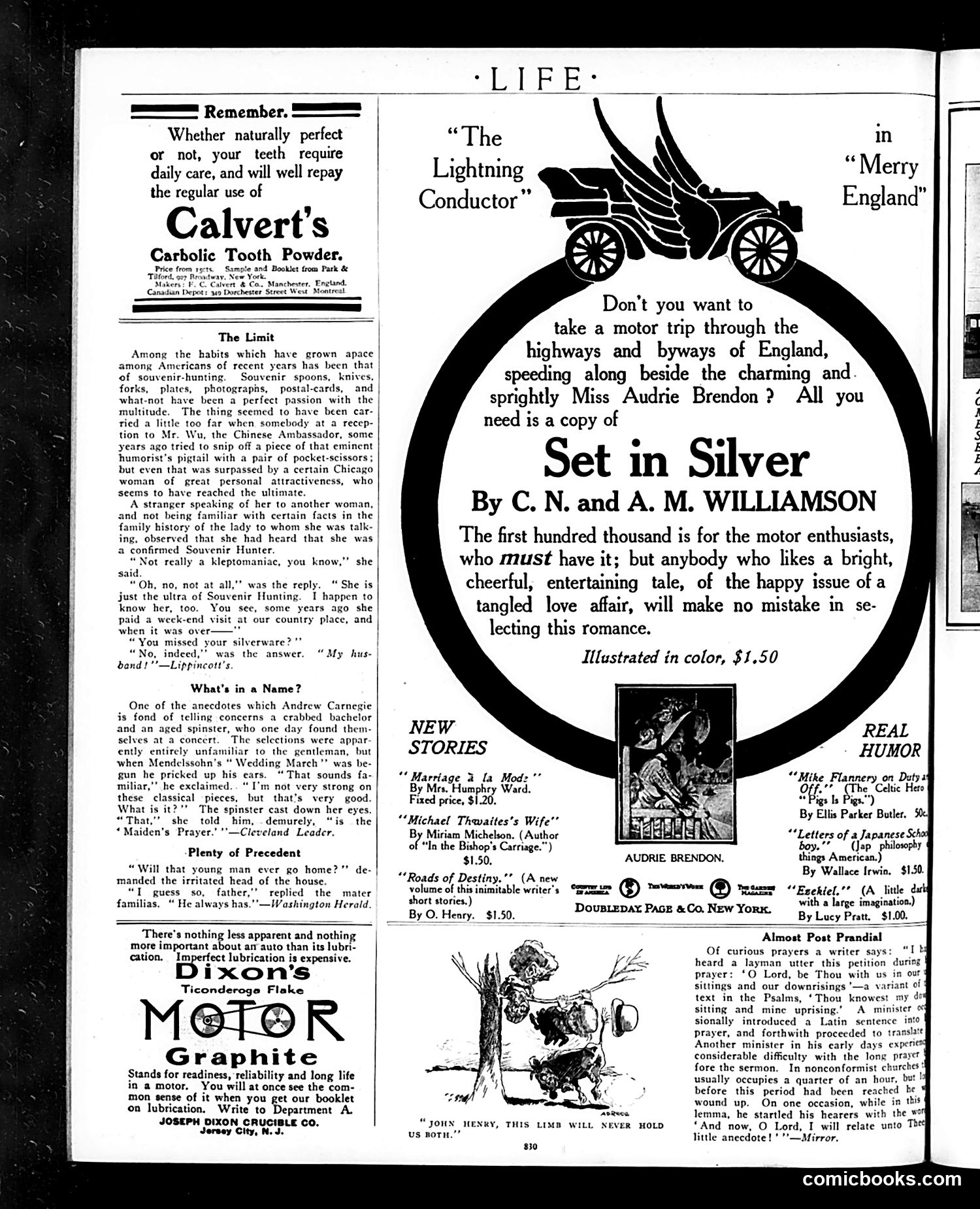
This is primarily an advertising and book review page from *Life* magazine. The main content centers on promoting "Set in Silver" by C.N. and A.M. Williamson—a motor-car romance novel set in England featuring a character named Audrie Brendon. The advertisement promises readers an entertaining tale of love and adventure set against early 1900s English motoring. The sidebar humor pieces are unrelated anecdotes: one mocks a woman compulsively stealing souvenirs (even a Chinese ambassador's pigtail), another plays on misheard classical music titles. A tooth powder ad and motor graphite lubricant ad occupy space. The page reflects early-20th-century magazine culture: automobiles were still novel luxuries, novels about motoring adventures were fashionable entertainment, and *Life* mixed satirical humor with commercial advertisements. No specific political content appears.
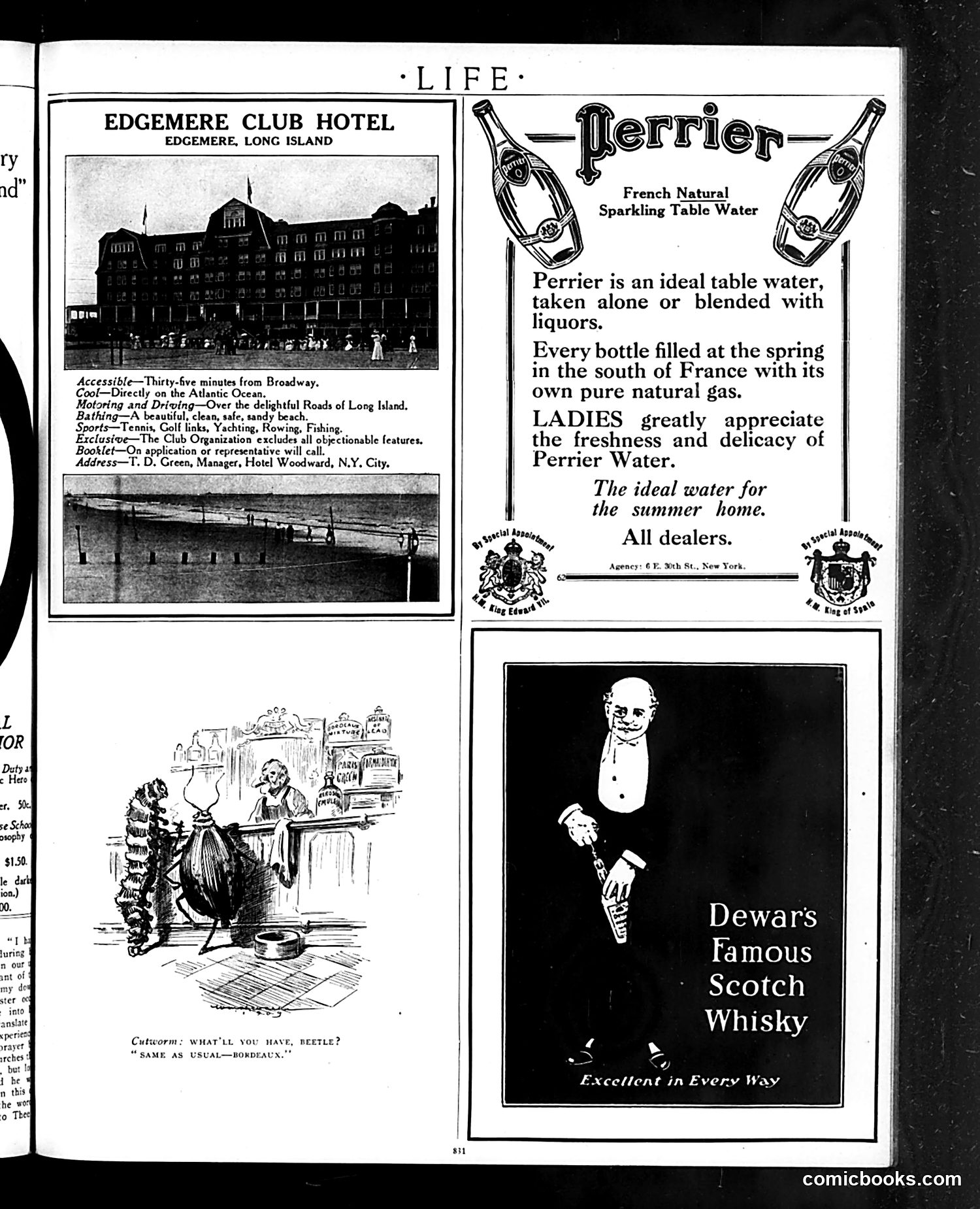
This page contains primarily **advertisements** interspersed with one small cartoon. The cartoon depicts two insects—a cutworm and beetle—at what appears to be a bar, with the cutworm ordering "the same as usual—Bordeaux" (a French wine). This is a **pun on class pretension**: the insects, despite their lowly status, affect sophisticated tastes by ordering expensive French wine rather than simpler fare. The page advertises three products: the **Edgemere Club Hotel** on Long Island (targeting wealthy leisure travelers), **Perrier water** (marketed as refined and particularly appealing to "ladies"), and **Dewar's Scotch whisky**. These ads reflect early 20th-century consumer culture targeting affluent Americans. The cartoon's humor works through **incongruity**—common pests adopting the mannerisms of wealthy diners—a mild satire of social climbing and pretentiousness rather than serious political commentary.
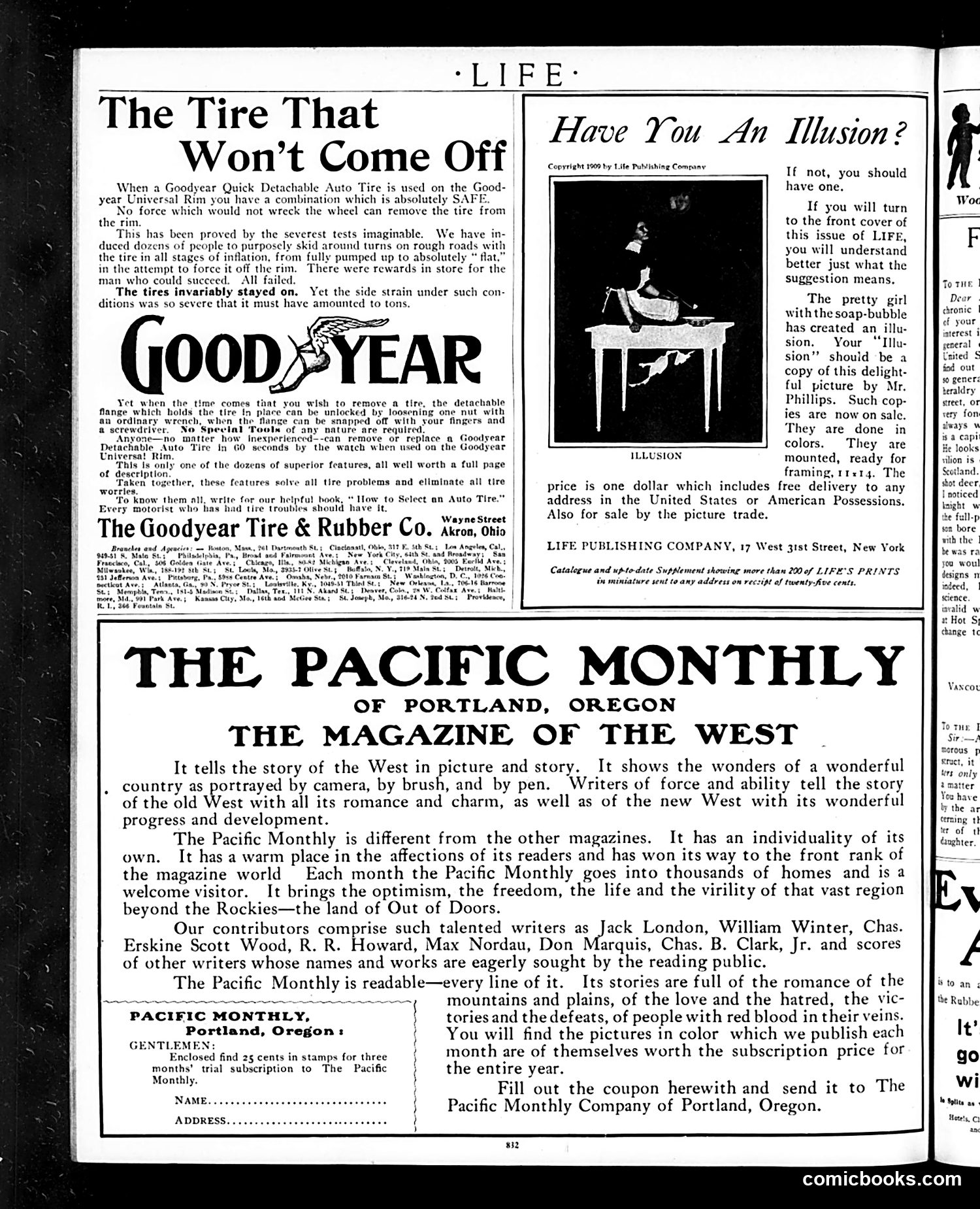
This page contains primarily **advertisements**, not political satire. The main content includes: 1. **Goodyear Tire Ad** (left): Promotes the "Quick Detachable Auto Tire" by emphasizing safety—claiming the tire cannot be forcibly removed from the rim. The text notes they induced people to deliberately skid on rough roads to test durability. This reflects early 1900s automobile culture when tire reliability was a genuine concern. 2. **"Have You An Illusion?" (top right)**: Life Publishing Company advertises a picture by artist Phillips depicting a "pretty girl with soap-bubble"—a visual optical illusion. They're selling prints for one dollar, offering framing options. 3. **The Pacific Monthly Ad** (bottom): Promotes a Portland, Oregon magazine featuring Western stories and contributors like Jack London and Don Marquis. The page is essentially a commercial vehicle—typical for Life magazine, which balanced satirical editorial content with advertising revenue. No political cartoon or satire is present here.
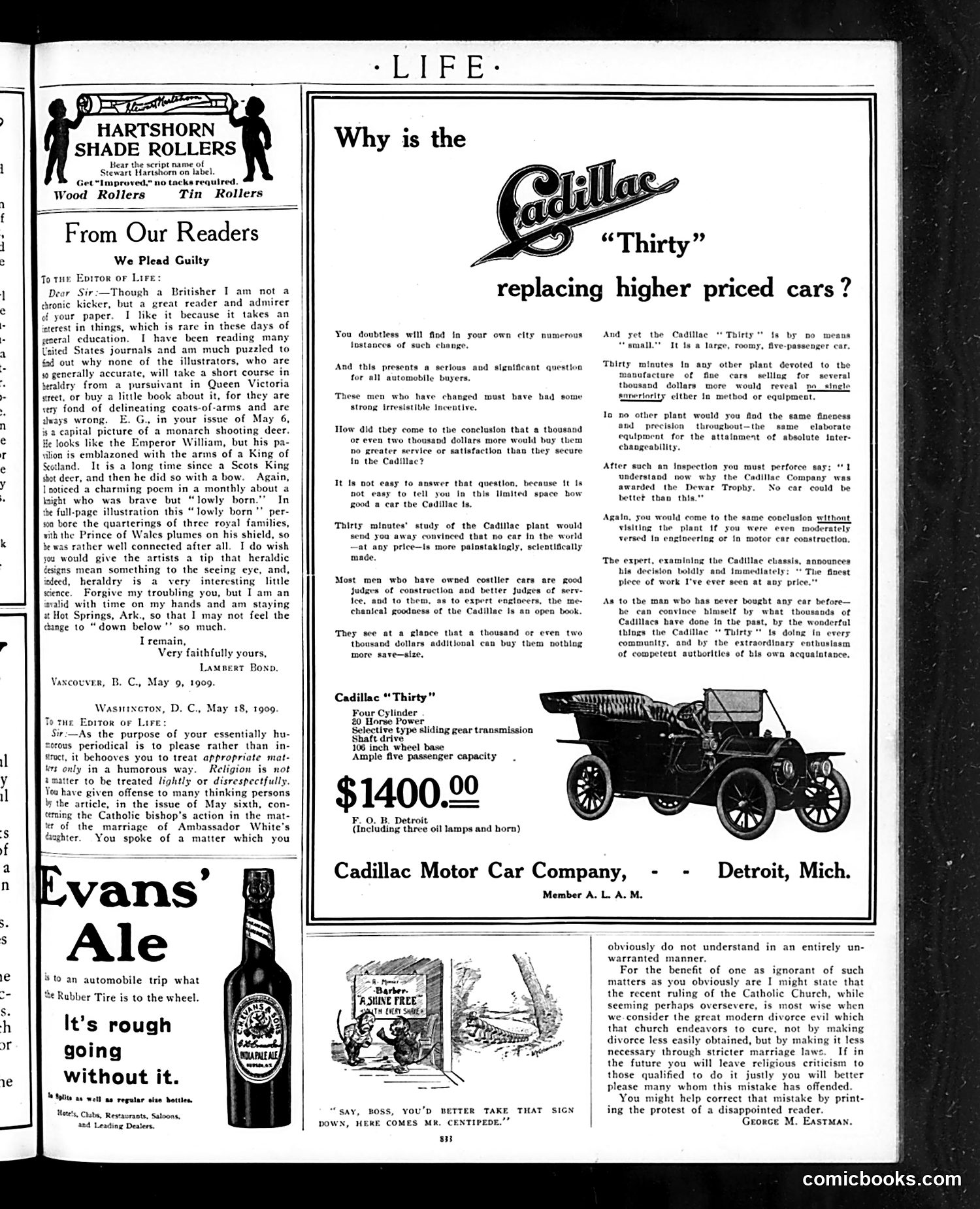
This page combines reader letters and advertising. The dominant feature is a Cadillac automobile advertisement addressing why their "Thirty" model (priced at $1,400) is replacing more expensive cars. The ad argues that wealthy buyers of luxury vehicles have concluded that Cadillac offers equal engineering quality and service without the premium price—essentially claiming that additional cost buys only size, not superiority. The reader letters address unrelated matters: one British reader complains about inaccurate heraldry in Life's illustrations; another criticizes Life for treating religion disrespectfully in an article about a Catholic bishop and Ambassador White's daughter's marriage. The Evans' Ale advertisement suggests ale is essential to automobile trips, paralleling rubber tires to wheels. **For modern readers:** The Cadillac ad reveals early automotive market dynamics—luxury cars were still novel, and manufacturers competed on claims of engineering excellence rather than styling or features. The letters show Life's editorial reach and its readers' concerns about accuracy and decorum.
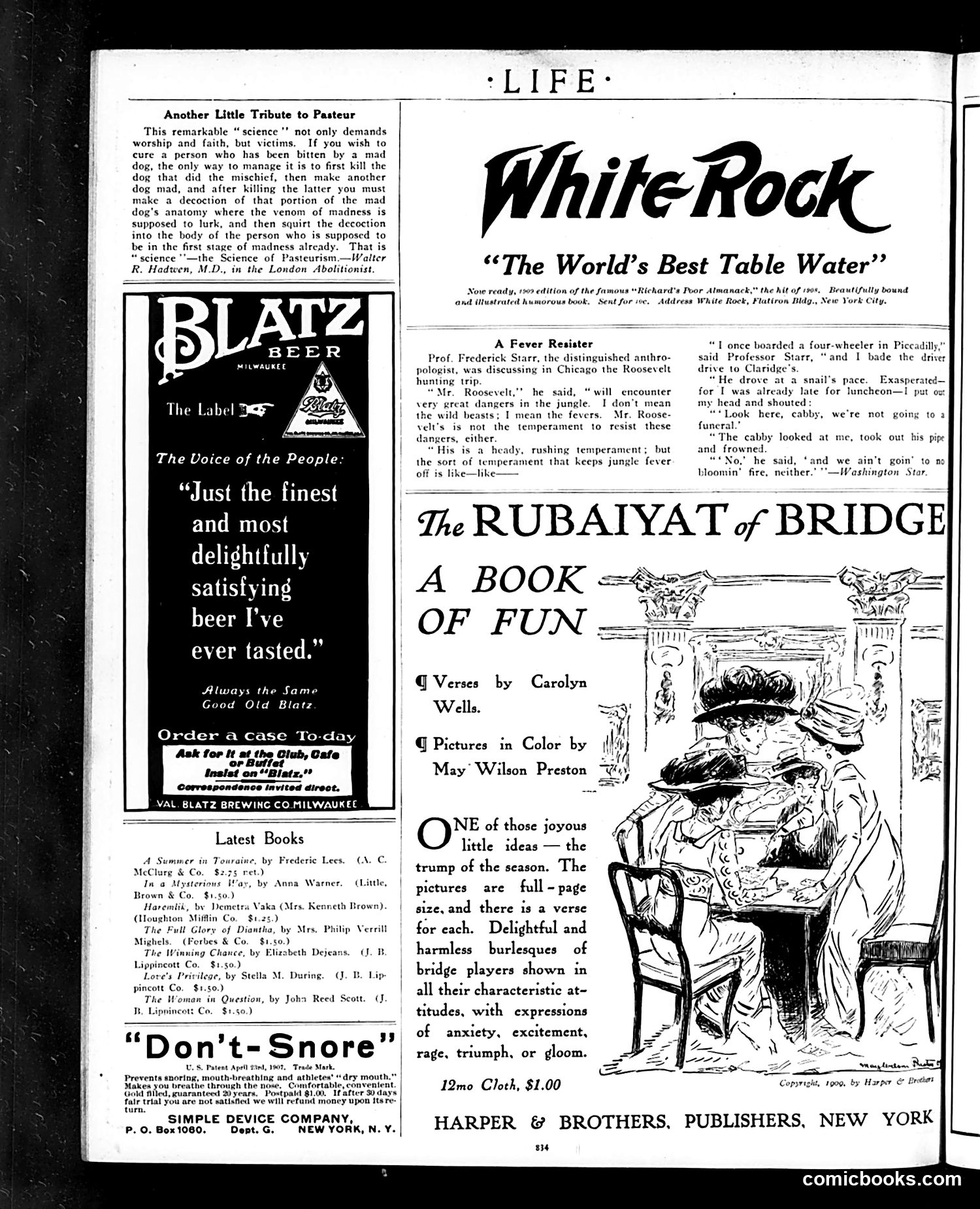
This page is primarily **advertising and book notices** with one substantive satirical article. The main content is "Another Little Tribute to Pasteur," which attacks Louis Pasteur's rabies treatment protocol as pseudoscientific. The author (Walter R. Hadwen, M.D.) sarcastically describes the procedure—killing the mad dog, infecting another dog, then creating a medicinal extract—as absurd "science" requiring blind faith rather than rational understanding. This reflects **anti-vaccination/anti-germ theory sentiment** common among some medical practitioners in the early 1900s who viewed Pasteur's methods with suspicion. The remainder is advertisements (Blatz Beer, White Rock water) and book listings typical of *Life* magazine's format, plus an anecdote about Theodore Roosevelt's upcoming African hunt, joking that his aggressive temperament makes him unsuitable for surviving jungle fever (malaria)—implying patience, not boldness, prevents disease. No political cartoons appear on this page.
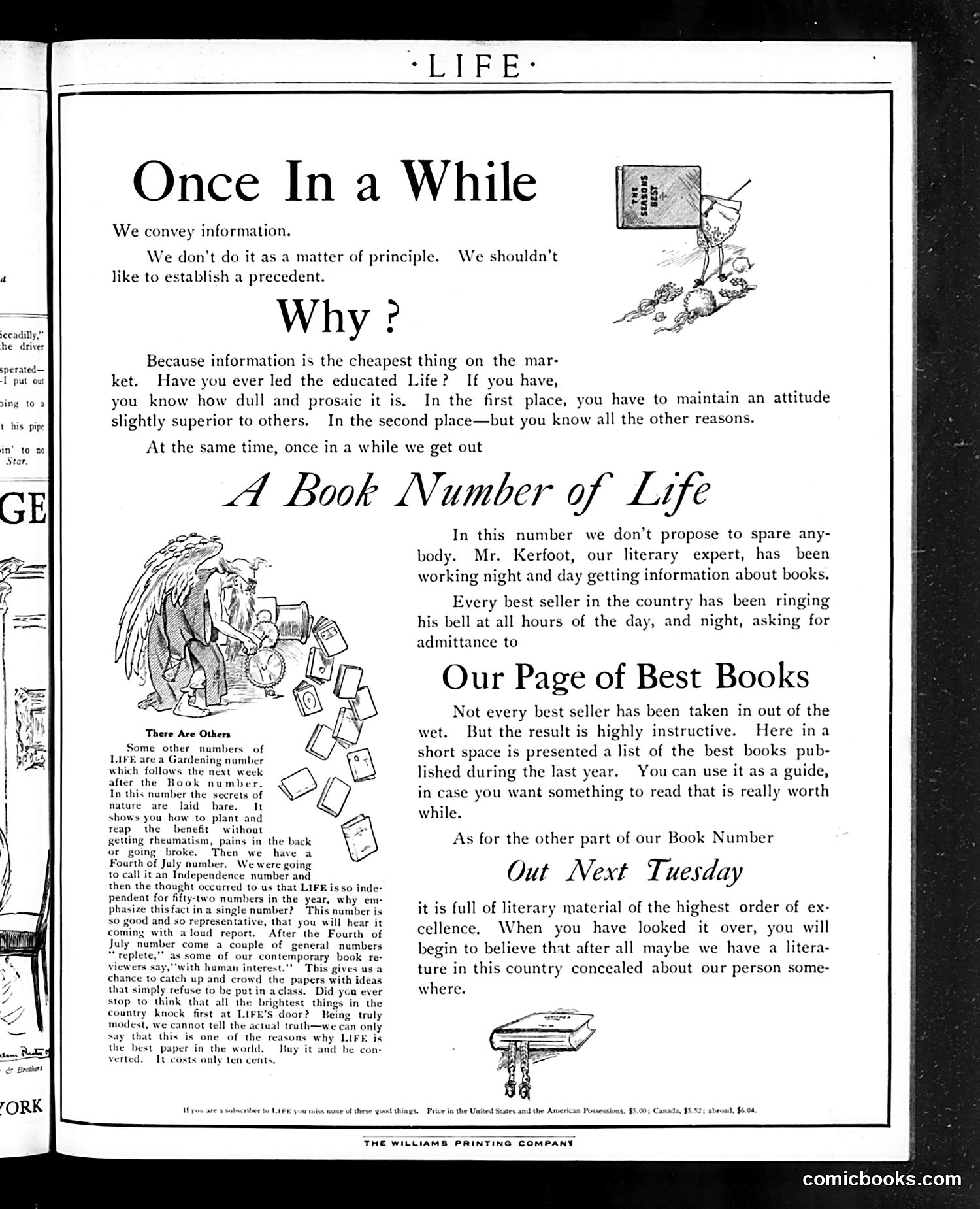
This is a self-promotional editorial page from *Life* magazine announcing upcoming special issues. The satire targets educated pretension and information gatekeeping. **The Joke:** *Life* claims it rarely conveys information to avoid "establishing a precedent," because maintaining an air of superiority requires appearing above such mundane concerns. The sarcasm mocks the affectations of the educated class—those who lead "educated Life" must act bored and superior while knowing nothing interesting. **The Content:** The page announces a "Book Number" featuring bestsellers reviewed by literary expert Kerfoot, plus upcoming special issues on gardening and independence. Illustrations show figures buried under books and scattered reading materials, emphasizing the magazine's role as tastemaker. **The Point:** *Life* positions itself as the arbiter of what educated Americans should read and know, while ironically mocking that very pretension. It's both selling intellectual authority and satirizing those who buy it—typical of *Life's* sophisticated humor targeting its own audience's vanity.
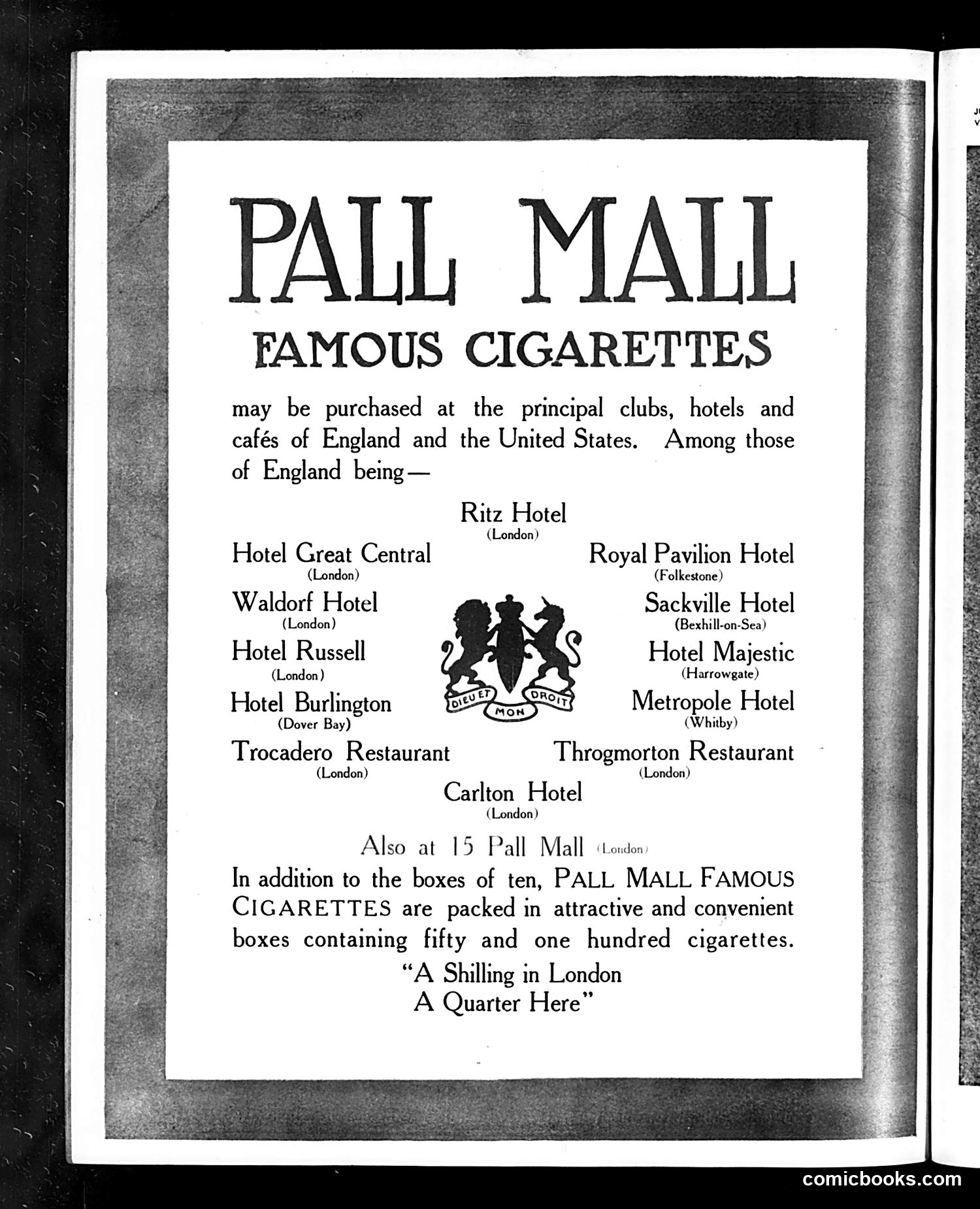
This is a straightforward cigarette advertisement, not satire or political commentary. Pall Mall Famous Cigarettes advertises their availability at prestigious London and English hotels and restaurants (the Ritz, Waldorf, Carlton, etc.), positioning the brand as upscale and cosmopolitan. The heraldic crest in the center appears to be the brand's logo. The ad emphasizes convenient packaging in boxes of ten, fifty, and one hundred cigarettes. The final line—"A Shilling in London / A Quarter Here"—compares British and American pricing, suggesting this Life magazine advertisement targets American readers by noting the product's affordability domestically compared to British prices. This reflects early 20th-century advertising norms when cigarette promotion faced no restrictions and luxury branding emphasized prestigious venues and international availability.