
Life, 1909-06-10 · page 6 of 32
Life — June 10, 1909 — page 6: what you’re looking at
What you’re looking at
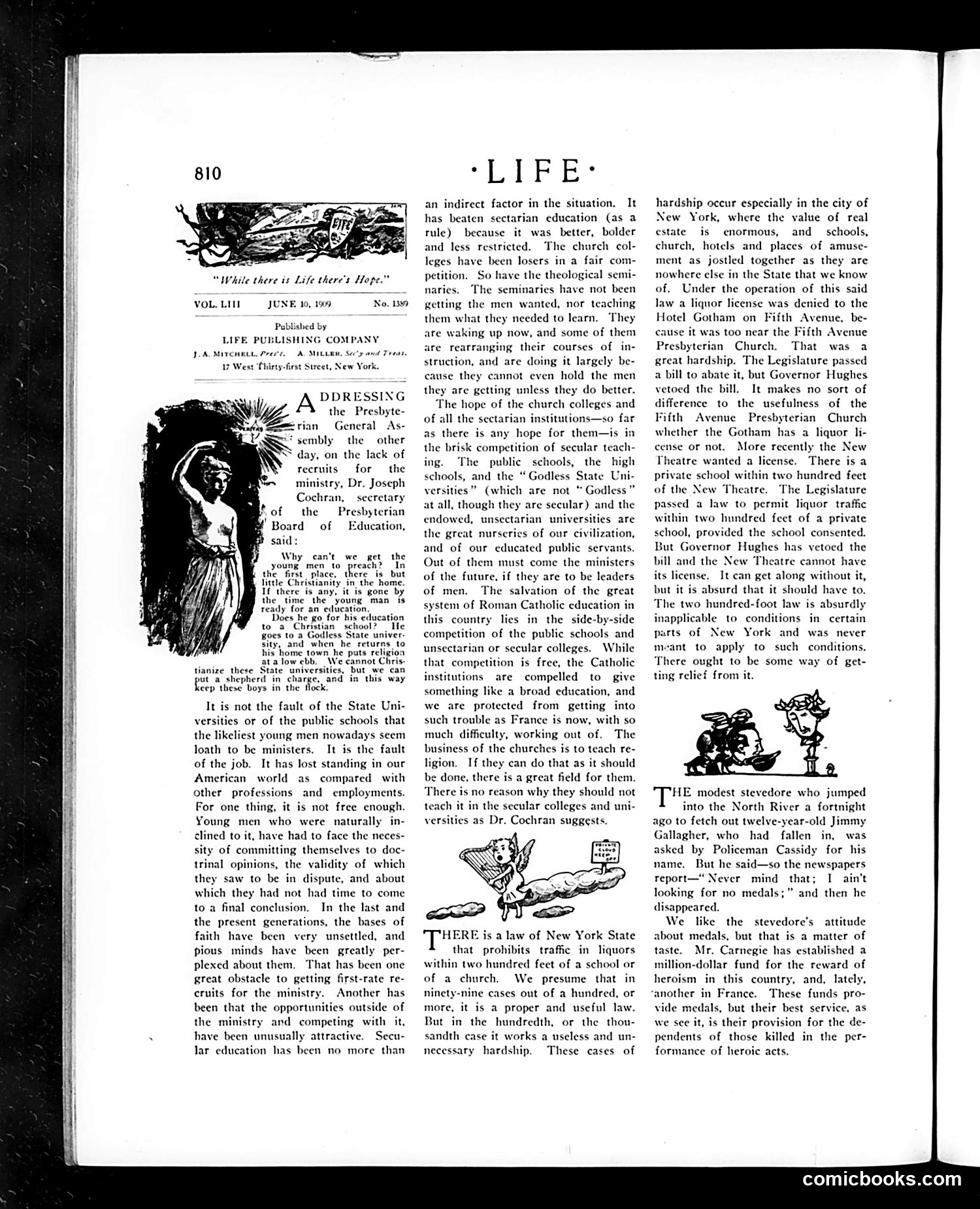
This page contains editorial commentary on American education and Catholic institutions, with two accompanying cartoons. The first cartoon depicts a stern clergyman addressing young men about ministry, illustrating the article's argument that seminaries should better prepare candidates for actual pastoral work rather than abstract doctrine. The second cartoon shows a figure (labeled "THE modest stevedore") who jumped into the North River to rescue a drowning boy. The accompanying text discusses this act of heroism and references Carnegie medals—apparently contrasting with stevedore "Cassidy's" humble, unmedaled rescue with Carnegie's prize system for heroic acts. The broader article critiques sectarian education and argues Catholic institutions should compete with public schools by offering broad secular education alongside religious instruction.
📄 Transcribed text from this page (OCR, searchable)
Machine-transcribed from the original scan — historical spelling and the odd misread are preserved.
VOL. LIL JUNE 10, 199 Published by LIFE PUBLISHING COMPANY A. MILLER, Seep ant Treas, JA MITCHELL Pree. 17 West thirty-first Street, New York. DDRESSING the Presbyte: General As- sembly the other day, on the lack of recruits for the ministry, Dr. Joseph Cochran, {of the Presbyterian "Board of Education, said: Why can't we get the young men to preach? In the first place, there is but little Christianity in the home, If there is any, it is gone by the time the Young man is ready for an education, Does he go for his education to a Christian school? He goes to a Godless State univer- sity, and when he returns to his home town he puts reli ata low ebb. We cannot Chris: tianize these State universi but we can uta shepherd in charge, and in this way ep these boys in the flock. secretary It is not the fault of the State Uni- versities or of the public schools that the likeliest young men nowadays seem loath to be ministers. It is the fault of the job. It has lost standing in our American world as compared with other professions and employments. For one thing, it is not free enough. Young men who were naturally in- clined to it, have had to face the neces- sity of committing themselves to doc- trinal opinions, the validity of which they saw to be in dispute, and about which they had not had time to come to a final conclusion. In the last and the present generations, the bases of faith have been very unsettled, and pious minds have been greatly per- plexed about them. That has been one great obstacle to getting first-rate re- cruits for the ministry. Another has been that the opportunities outside of the ministry and competing with it, have been unusually attractive. Secu- lar education has been no more than *LIFE* an indirect factor in the situation, It has beaten sectarian education (as a rule) because it was better, bolder and less restricted. The church col- leges have been losers in a fair com- petition. So have the theological semi- naries. The seminaries have not been getting the men wanted, nor teaching them what they needed to learn, The are waking up now, and some of them are rearranging their courses of in- struction, and are doing it largely be- cause they cannot even hold the men they are getting unless they do better. The hope of the church colleges and of all the sectarian institutions—so far as there is any hope for them—is in the brisk competition of secular teach- ing. The public schools, the high schools, and the “Godless State Uni- versities” (which are not “Godless” at all, though they are secular) and the endowed, unsectarian universities are the great nurseries of our civilization, and of our educated public servants. Out of them must come the ministers of the future, if they are to be leaders of men. The salvation of the great system of Roman Catholic education in this country lies in the side-by-side competition of the public schools and unsectarian or secular colleges. While that competition is free, the Catholic institutions are compelled to give something like a broad education, and we are protected from getting into such trouble as France is now, with so much difficulty, working out of. The business of the churches is to teach re- ligion. If they can do that as it should be done, there is a great field for them. There is no reason why they should not teach it in the secular colleges and uni- as Dr. Cochran suggests. HERE is a law of New York State that prohibits traffic in liquors within two hundred feet of a school or of a church. We presume that in ninety-nine cases out of a hundred, or more, it is a proper and useful law. But in the hundredth, or the thou- sandth case it works a useless and un- necessary hardship. These cases of ‘another in France. hardship occur especially in the city of New York, where the value of real estate is enormous, and _— schools, church, hotels and places of amuse- ment as jostled together as they are nowhere else in the State that we know of. Under the operation of this said law a liquor license was denied to the Hotel Gotham on Fifth Avenue, be- cause it was too near the Fifth Avenue Presbyterian Church. That was a great hardship. The Legislature passed a bill to abate it, but Governor Hughes vetoed the bill. It makes no sort of difference to the usefulness of the Fifth Avenue Presbyterian Church whether the Gotham has a liquor li- cense or not. More recently the New Theatre wanted a license. There is a private school within two hundred feet of the New Theatre. The Legislature passed a law to permit liquor traffic within two hundred feet of a private school, provided the school consented. But Governor Hughes has vetoed the bill and the New Theatre cannot have its license. It can get along without i but it is absurd that it should have to. The two hundred-foot law is absurdly inapplicable to conditions in certain arts of New York and was never meant to apply to such conditions. There ought to be some way of get- ting relief from it. HE modest stevedore who jumped into the North River a fortnight ago to fetch out twelve-year-old Jimmy Gallagher, who had fallen in, was asked by Policeman Cassidy for his name. But he said—so the newspapers report—“ Never mind that; I ain't looking for no medals;” and then he disappeared. We like the stevedore’s attitude about medals, but that is a matter of taste. Mr. Carnegie has established a million-dollar fund for the reward of heroism in this country, and, lately, These funds pro- vide medals, but their best service, as we see it, is their provision for the de- pendents of those killed in the per- formance of heroic acts. comicbooks.com