
Life, 1909-06-10 · page 18 of 32
Life — June 10, 1909 — page 18: what you’re looking at
What you’re looking at
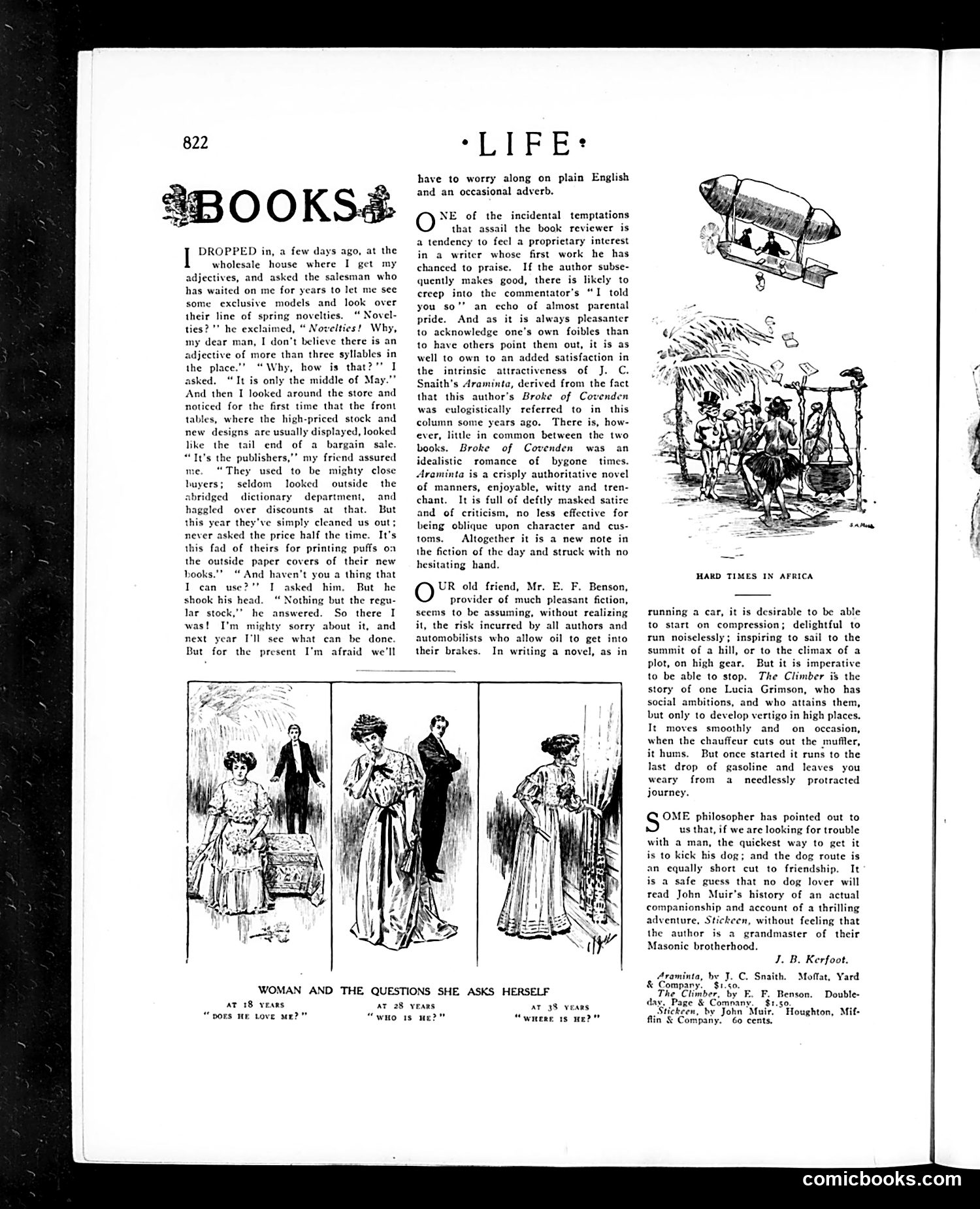
This is a *Life* magazine book review column from the early 1900s. The main illustrated feature—"Woman and the Questions She Asks Herself"—presents a satirical progression of female preoccupations across three life stages: at 18 ("Does he love me?"), at 28 ("Who is he?"), and at 38 ("Where is he?"). The joke reflects period assumptions about women's priorities shifting from romantic pursuit to marriage to abandonment or widowhood. The text discusses contemporary fiction, mentioning authors like J.C. Snaith and E.F. Benson. The opening column sarcastically notes that publishers have exhausted adjectives by using them on book covers—a complaint about commercial marketing practices in publishing that remains recognizable today. The page combines literary criticism with social satire typical of *Life's* blend of intellectual humor and commentary on contemporary manners.
📄 Transcribed text from this page (OCR, searchable)
Machine-transcribed from the original scan — historical spelling and the odd misread are preserved.
822 SBOOKS#& DROPPED in, a few days ago, at the wholesale house where I get my adjectives, and asked the salesman who has waited on me for years to let me see some exclusive models and look over their line of spring novelties. “ Novel- ties?” he exclaimed, “ Novelties!’ Why, my dear man, I don’t believe there is an adjective of more than three syllables in the place.” “Why, how is that?’" I asked. “It is only the middle of May.”’ And then I looked around the store and noticed for the first time that the front tables, where the high-priced stock and new designs are usually displayed, looked like the tail end of a bargain sale. “It's the publishers,” my friend assured me. “They used to be mighty close seldom looked outside the dictionary department, and over discounts at ¢ But buyers; bridged haggled this year they've simply cleaned us out; never asked the price half the time. It’s this fad of theirs for printing puffs on the outside paper covers of their new books."” I can use shook his head “And haven't you a thing that 2" T asked him. But he othing but the regu- he answered. So there I mighty sorry about it, and next year I'll see what can be done. But for the present I’m afraid we'll ‘LIFE have to worry along on plain English and an occasional adverb. O of the incidental temptations that assail the book reviewer is a tendency to feel a proprietary interest in a writer whose first work he has chanced to praise. If the author subse- quently makes good, there is likely to ercep into the commentator's “I told you so’’ an echo of almost parental pride. And as it is always pleasanter to acknowledge one’s own foibles than to have others point them out, it is as well to own to an added satisfaction in the intrinsic attractiveness of J. C. Snaith’s Araminta, derived from the fact that this author’s Broke of Covenden was culogistically referred to in this column some years ago. There is, how- ever, little in common between the two books. Broke of Covenden was an idealistic romance of bygone times. Araminta is a crisply authoritative novel of manners, enjoyable, witty and tren- chant. It is full of deftly masked satize and of criticism, no less effective for being oblique upon character and cus- toms. Altogether it is a new note in the fiction of the day and struck with no hesitating hand. UR old friend, Mr. E. F. Benson, provider of much pleasant fiction, seems to be assuming, without realizing it, the risk incurred by all authors and automobilists who allow oil to get into their brakes. In writing a novel, as in WOMAN AND THE QUESTIONS SHE ASKS HERSELF AT 18 VeEars. “pos He Love mE?” At 28 years “wHo 1s ue?" AT 38 vears “were 1s un?” HARD TIMES IN AFRICA running a car, it is desirable to be able to start on compression; delightful to run noisclessly; inspiring to sail to the summit of a hill, or to the climax of a plot, on high gear. But it is imperative to be able to stop. The Climber is the story of one Lucia Grimson, who has social ambitions, and who attains them, but only to develop vertigo in high places. It moves smoothly and on occasion, when the chauffeur cuts out the mufiler, it hums. But once started it runs to the last drop of gasoline and leaves you weary from a needlessly protracted journey. OME philosopher has pointed out to us that, if we are looking for trouble with a man, the quickest way to get it is to kick his dog; and the dog route is an equally short cut to friendship. It is a safe guess that no dog lover will read John Muir's history of an actual companionship and account of a thrilling adventure, Stickcen, without feeling that the author is a grandmaster of their Masonic brotherhood. J. B. Kerfoot. Araminta, be J. C. Snaith. Moffat, Yard Company, $1760. The Climber, by E. F, Benson. Double- day, Page & Comnany. $1.50. _Stickeen, by John Muir.” Houghton, flin & Company. 60 cents. comicbooks.com