
A complete issue · 20 pages · 1908
Life — August 27, 1908
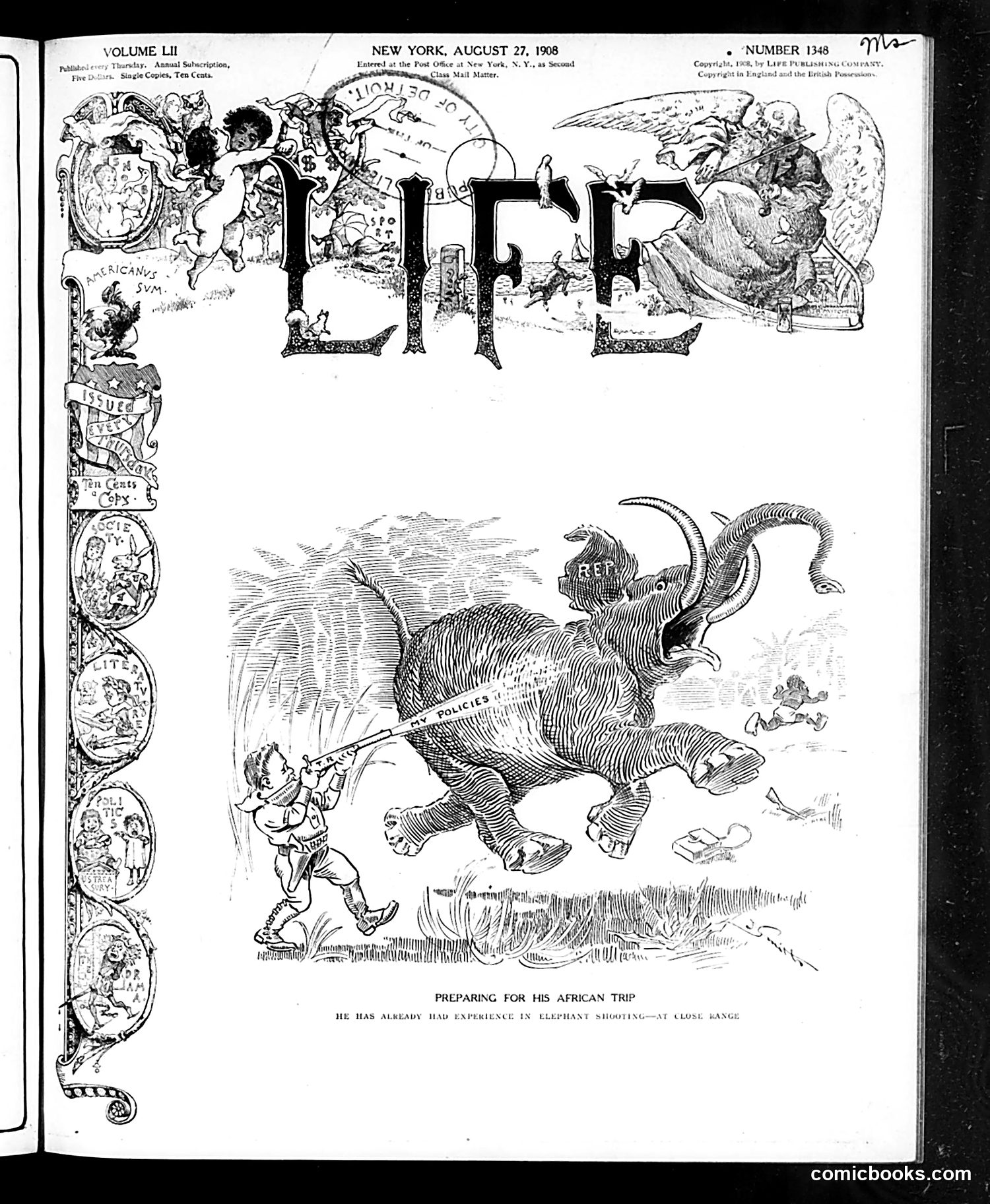
This *Life* magazine cover from August 27, 1908 depicts a man being chased by an elephant labeled "POLICIES." The caption reads "PREPARING FOR HIS AFRICAN TRIP—HE HAS ALREADY HAD EXPERIENCE IN ELEPHANT SHOOTING AT CLOSE RANGE." The cartoon satirizes someone preparing for an African hunting expedition who already has experience with "elephant shooting." The elephant chasing him represents his own "policies"—suggesting he's being pursued or hounded by the consequences of his political decisions. This appears to reference a prominent political figure of 1908, likely President Theodore Roosevelt (known for his hunting expeditions), but the satire specifically mocks how his own policies have become burdensome or threatening to him, even as he pursues new adventures.
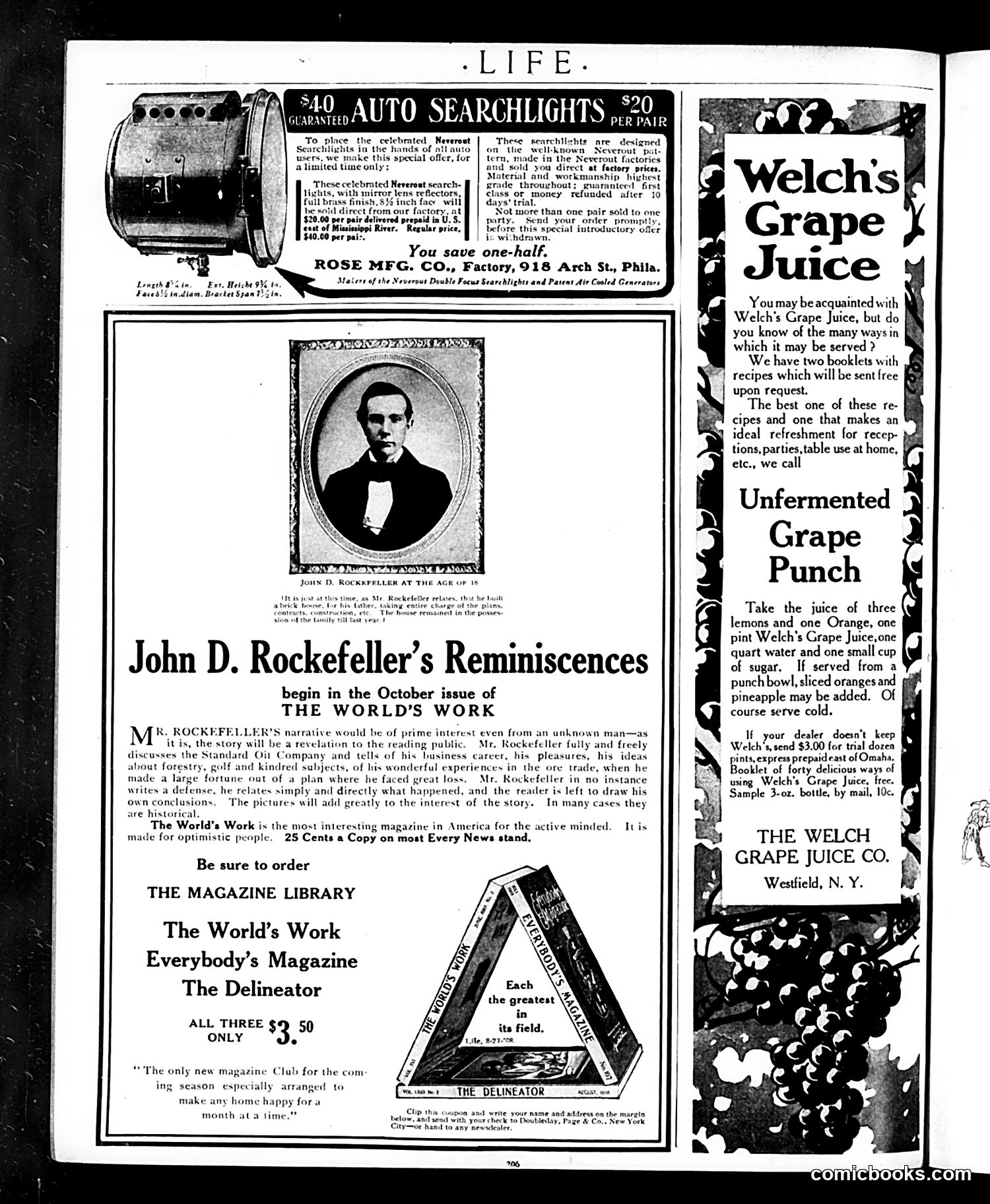
This page is primarily **advertising and editorial content** rather than political satire. The main features are: 1. **Auto Searchlights ad** (top): A product advertisement promoting discounted searchlights from Rose Manufacturing Company in Philadelphia. 2. **John D. Rockefeller feature** (center): An announcement that Rockefeller's reminiscences will appear in *The World's Work* magazine. The accompanying portrait shows Rockefeller in formal attire. The text emphasizes his business acumen and life experiences, presented as historically interesting rather than satirical. 3. **Magazine subscription offer** (lower left): Advertisement for bundled magazine subscriptions. 4. **Welch's Grape Juice advertisement** (right side): A recipe advertisement featuring an "Unfermented Grape Punch" recipe. The page reflects early 20th-century advertising and journalism conventions, with no discernible political cartoon or satire present.
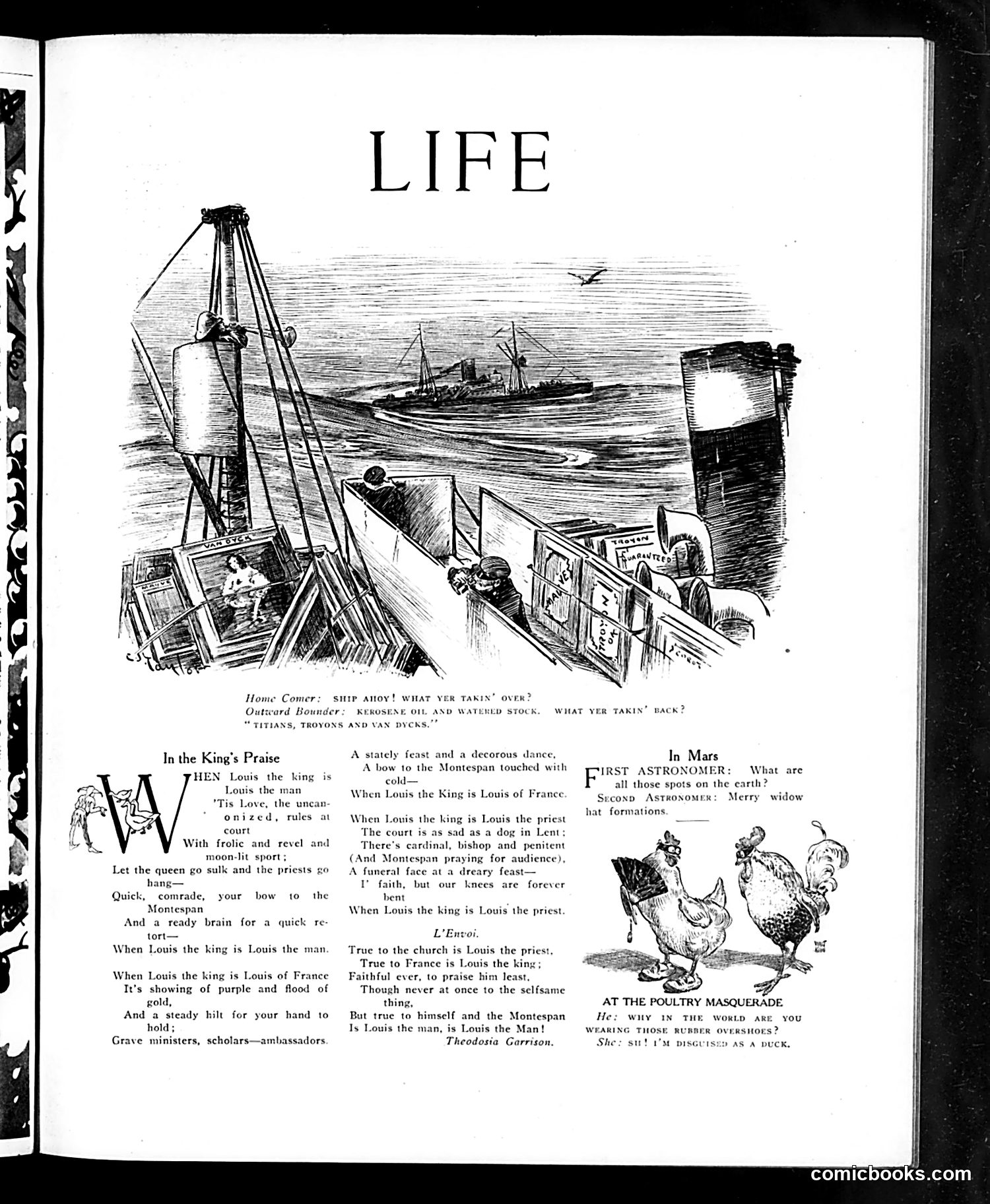
This page satirizes **King Louis of France** through multiple clever jokes. The top illustration depicts dock workers discussing shipping manifest contents—"Home Comers," "Newfoundland Damsels," "Kossuth Oil and Watered Stock"—parodying what the French king allegedly "takes over" when he rules. The poem "In the King's Praise" mockingly celebrates Louis by listing his incompetence: purple floods of gold, empty displays, and incompetent advisors. It contrasts his titles and positions with actual uselessness—he's "Louis the Man" when stripped of royal pretense. The "Poultry Masquerade" cartoon makes a crude visual pun about French decadence or weakness, with roosters discussing rubber overshoes—likely suggesting absurd French fashion or political posturing. The satire targets French royal authority as hollow pageantry masking actual powerlessness.
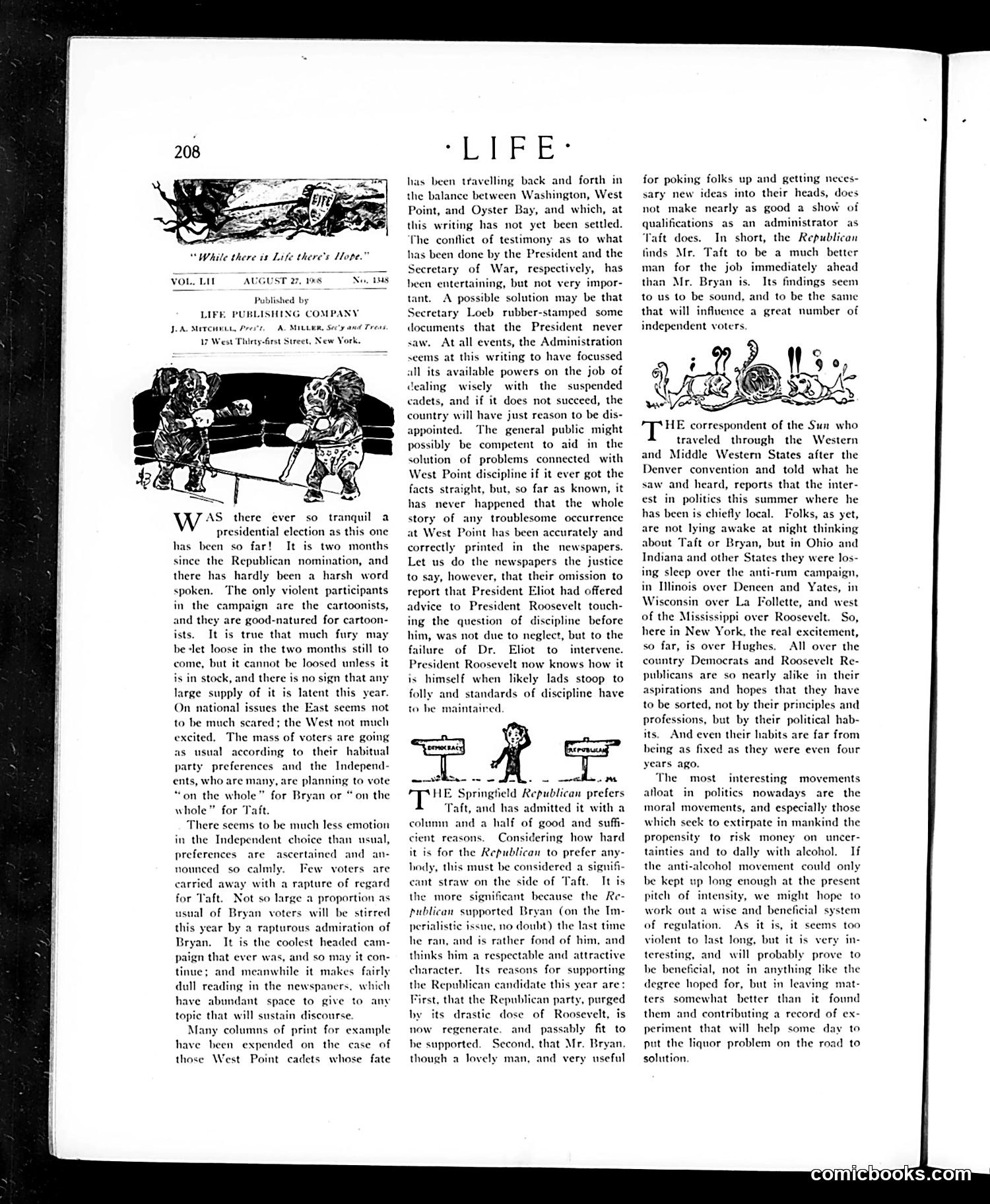
This page discusses the 1908 U.S. presidential election during Theodore Roosevelt's second term. The text analyzes the Republican Party's preference for William Howard Taft as Roosevelt's successor over William Jennings Bryan (the Democratic nominee). The cartoon at top-left depicts two figures in a bathtub, likely satirizing the "hand-picking" of Taft as Roosevelt's chosen heir—a common criticism that Taft was Roosevelt's puppet candidate rather than an independent choice. The page's political argument centers on the Springfield *Republican*'s support for Taft, arguing that despite Bryan being "lovely" and "useful," Taft represents Republican regeneration after Roosevelt's controversial presidency. The underlying message: even Republicans admit Bryan has merit, but party loyalty demands supporting Taft.
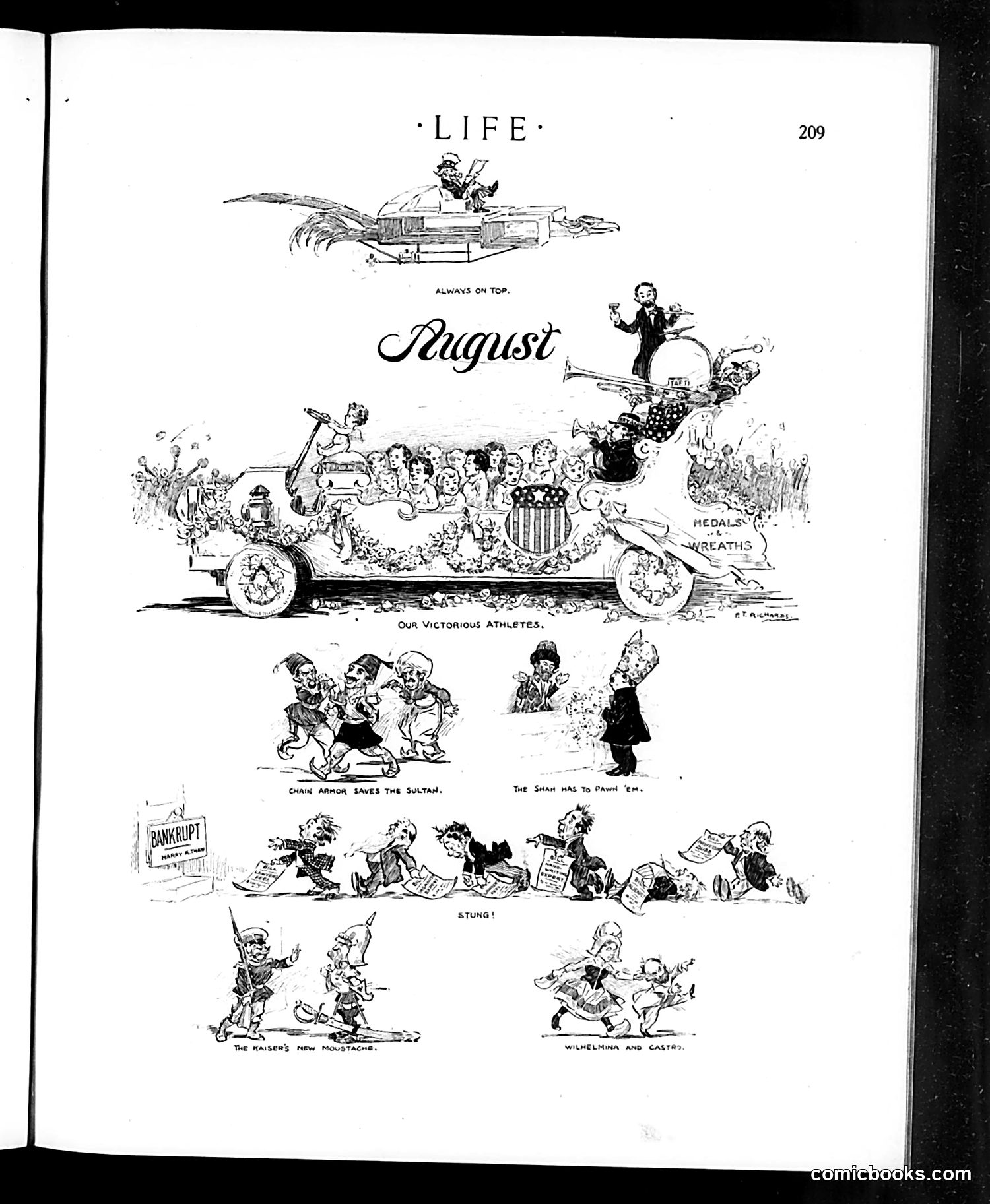
This page presents August-themed satirical cartoons mocking early 20th-century political and social figures. "Always on Top" shows someone maintaining control. The main illustration, "Our Victorious Athletes," depicts Olympic or sporting champions in a decorated vehicle parade. Several panels reference contemporary political events: "Chain Armor Saves the Sultan" and "The Shah Has to Pawn 'Em" appear to mock Middle Eastern rulers facing financial or political difficulties. "Stung!" shows financial/bankruptcy consequences. "The Kaiser's New Moustache" and "Wilhelmina and Castby" reference European royalty, likely German and Dutch figures. The overall tone satirizes politicians, military leaders, and royalty experiencing comeuppance or embarrassment during what appears to be a turbulent international political period.
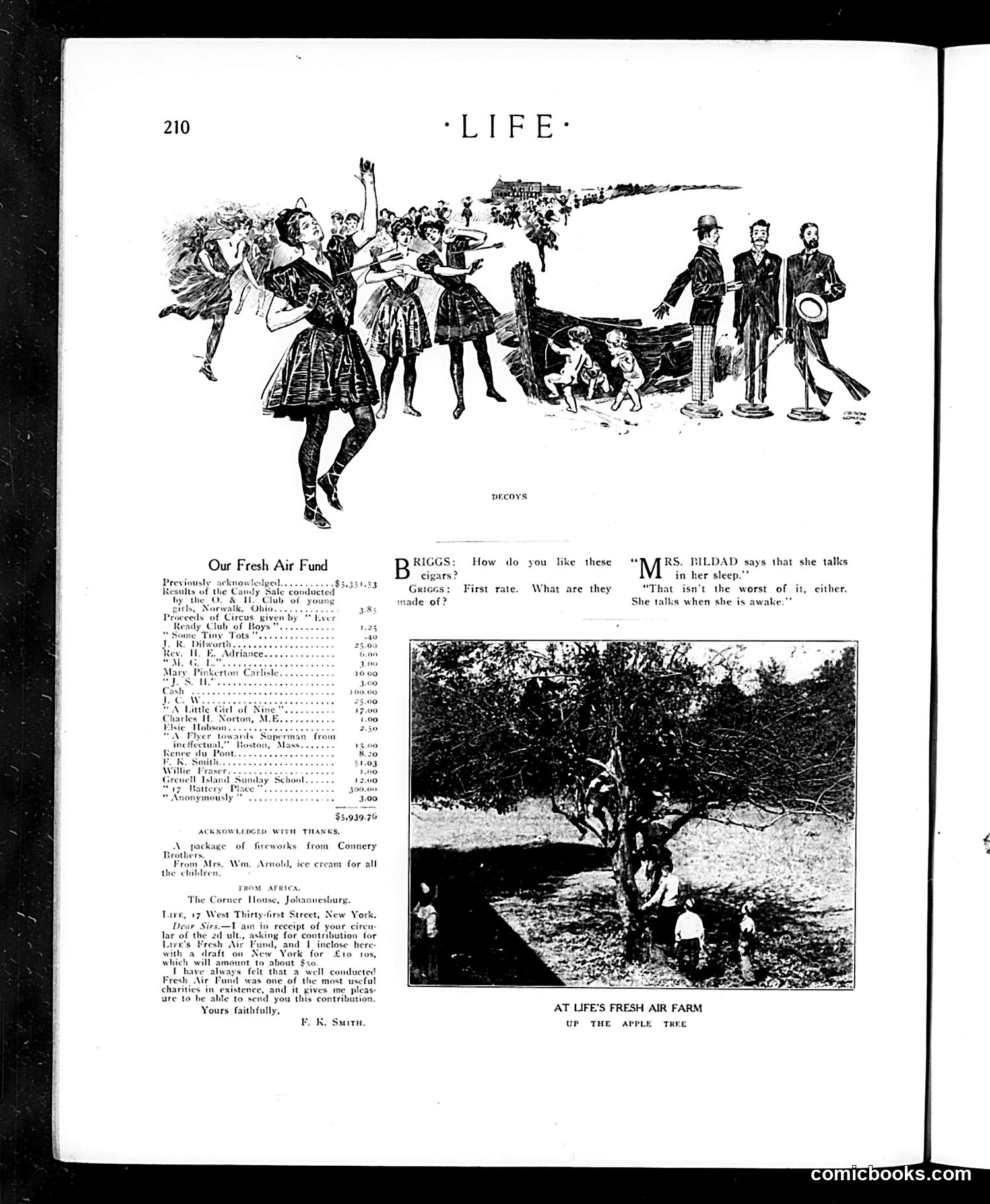
The top illustration titled "DECOYS" depicts a social scene with figures in period dress (appears to be Edwardian era based on clothing styles). The cartoon likely satirizes social pretense or false appearances—the term "decoys" suggests people presenting themselves deceptively in fashionable society. Below is a section called "Our Fresh Air Fund" listing charitable donations, followed by "ACKNOWLEDGED WITH THANKS" mentioning fireworks and ice cream for children from Africa. The bottom photograph, captioned "AT LIFE'S FRESH AIR FARM UP THE APPLE TREE," shows children at what appears to be a recreational facility or charitable program. The page combines satirical social commentary with documentation of contemporary philanthropic efforts, typical of Life's editorial approach mixing humor with progressive causes.
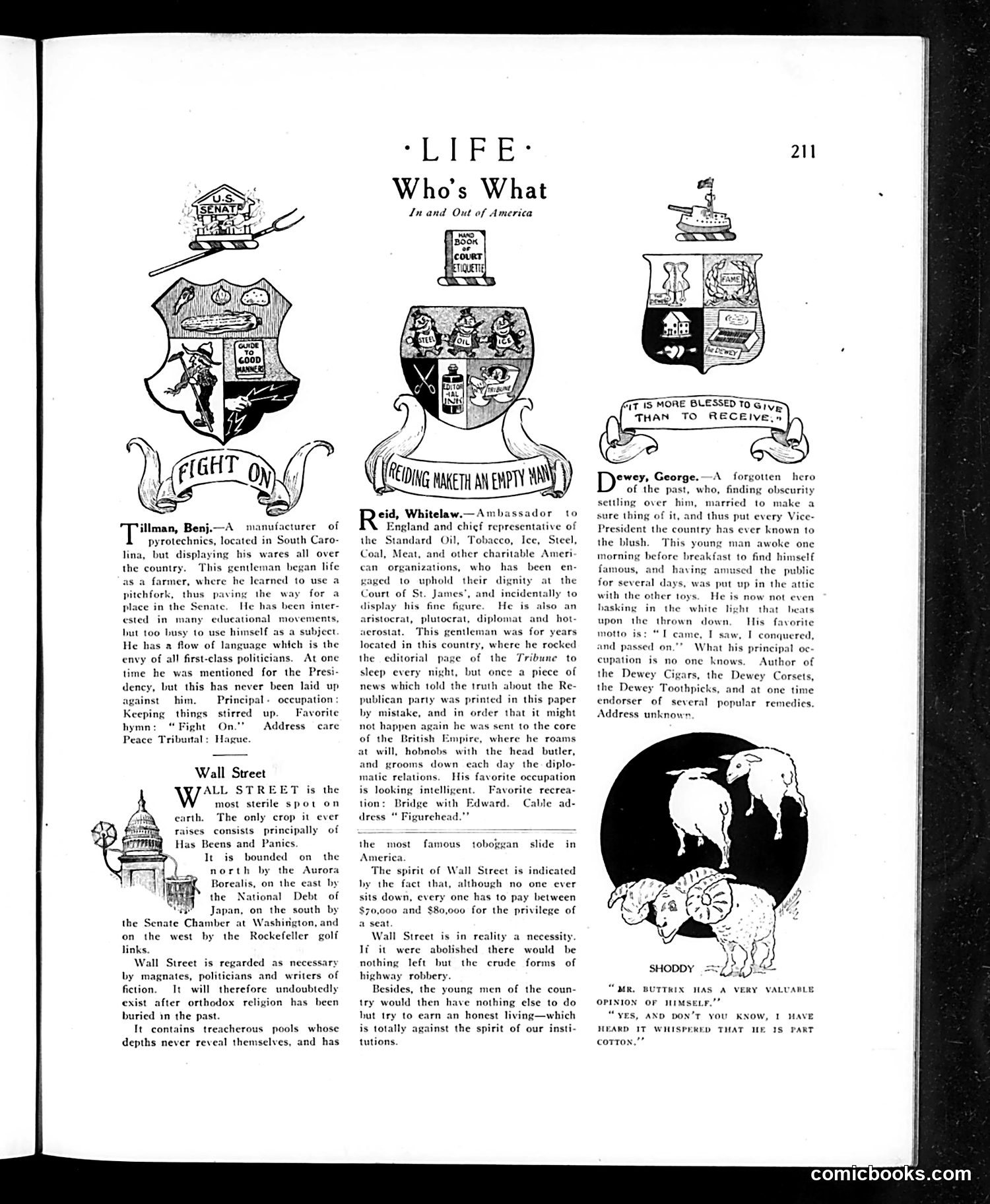
This page contains three satirical profiles under "Who's What": 1. **"Fight On"** - A pyrotechnics manufacturer from South Carolina, depicted as a self-made farmer-turned-businessman who avoided "pitfalls" and achieved Senate consideration. 2. **Reid, Whitelaw** - Described as an ambassador to England and Standard Oil representative, characterized as an aristocrat and diplomat who formerly worked at the *Tribune*. The satire suggests his privileged social position despite his journalistic past. 3. **Wall Street** - The longest entry satirizes Wall Street as "the most sterile spot on earth," claiming it produces only "Has Beens and Panics." The text mocks it as a necessity containing "treacherous pools" and warns it will "undoubtedly exist after orthodoxy has been buried." The accompanying cartoon "Shoddy" depicts a character referencing Mr. Buffin's "valuable opinion," with dialogue about cotton—likely satirizing commercial or political corruption.
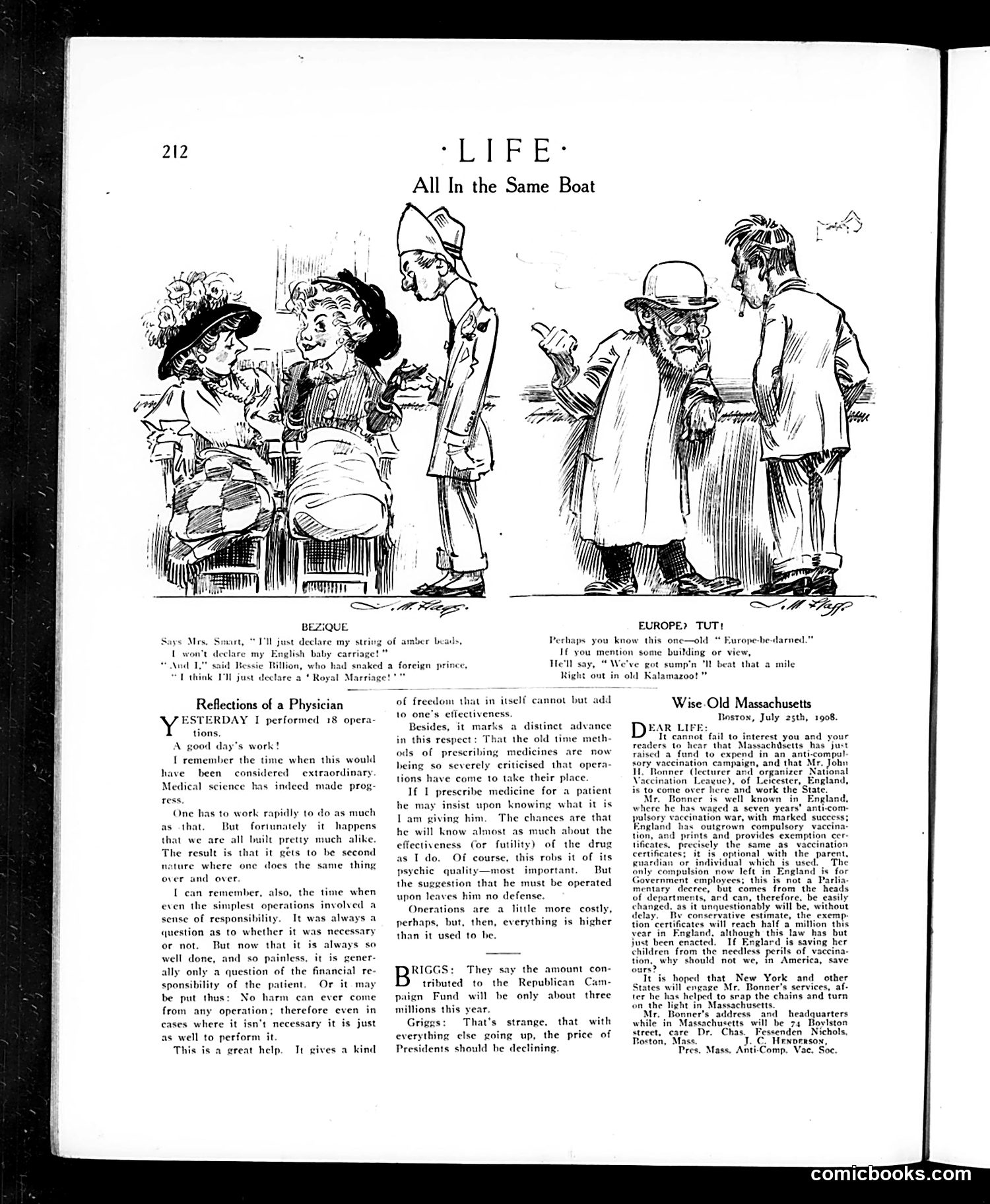
This page contains two satirical cartoons about international relations circa 1908. **Left cartoon ("Bezique"):** Shows wealthy European women discussing marriage prospects, with one boasting about her "English baby carriage" and another mentioning a "foreign prince." The satire targets European aristocratic obsession with status symbols and advantageous marriages. **Right cartoon ("Europe's Tuti"):** Depicts European figures (appearing to represent different nations) discussing colonial or imperial matters, with references to "Kalamazio" (unclear reference). The "same boat" title suggests Europe is united in some common predicament or colonial venture. Both cartoons use caricature to mock European elites for their preoccupations—whether domestic vanity or imperial ambitions—suggesting they're all entangled in similar foolish concerns despite national differences.
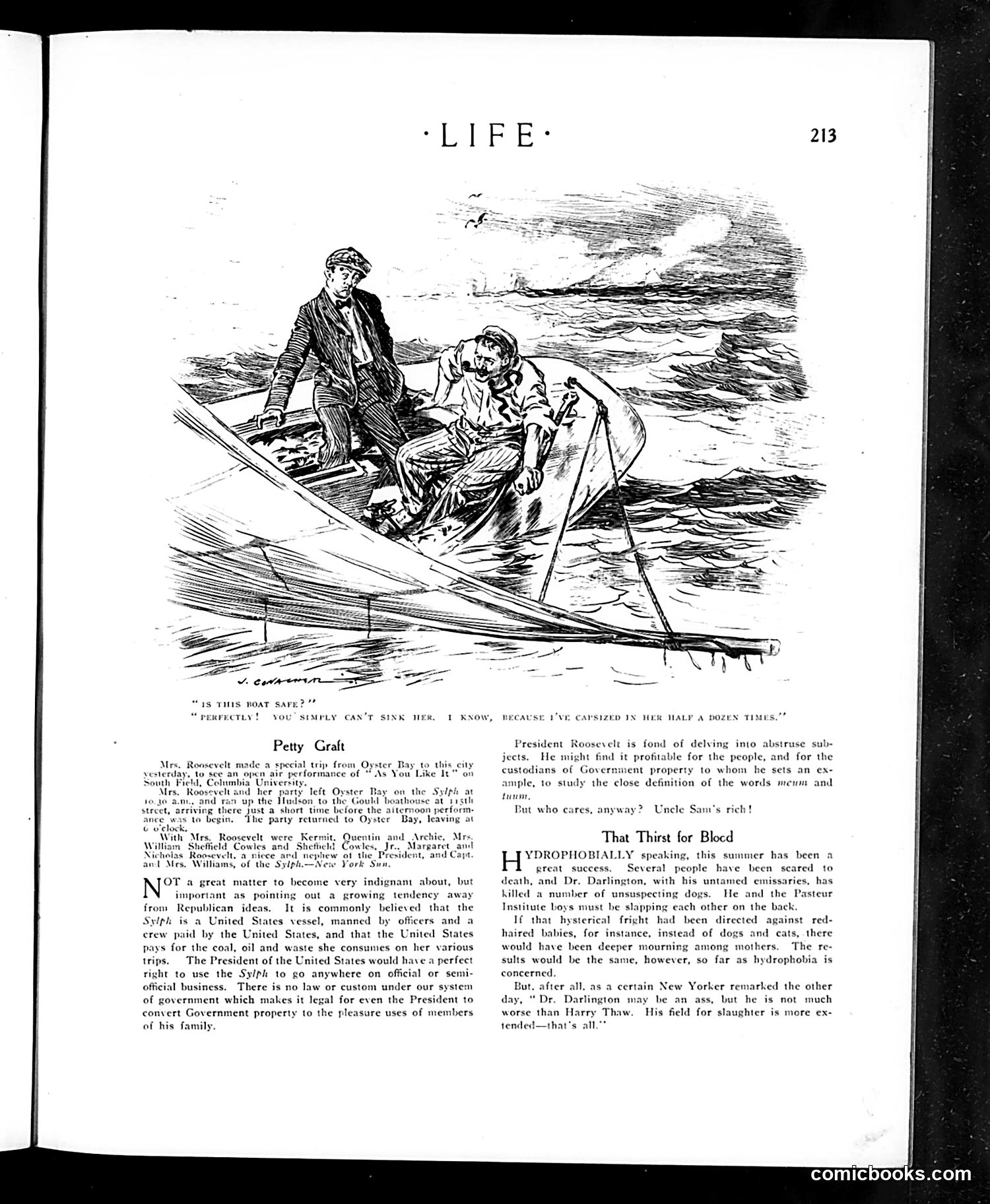
The main cartoon depicts two men in a small boat. The caption reads: "IS THIS BOAT SAFE?" "PERFECTLY! YOU SIMPLY CAN'T SINK HER. I KNOW, BECAUSE I'VE CAPSIZED IN HER HALF A DOZEN TIMES." **What it means:** This is absurdist humor playing on faulty logic—the speaker claims a boat is unsinkable *because* he's repeatedly capsized in it, which proves the opposite point. The joke satirizes overconfident or illogical reassurance. The text below discusses "Petty Graft" and references Mrs. Roosevelt using a presidential yacht (the *Sylph*) for personal trips, with criticism that government property shouldn't be converted for family use. A second article titled "That Thirst for Blood" discusses Dr. Darlington and hydrophobia cases. **Context:** This appears to critique early Roosevelt administration practices regarding government resources.
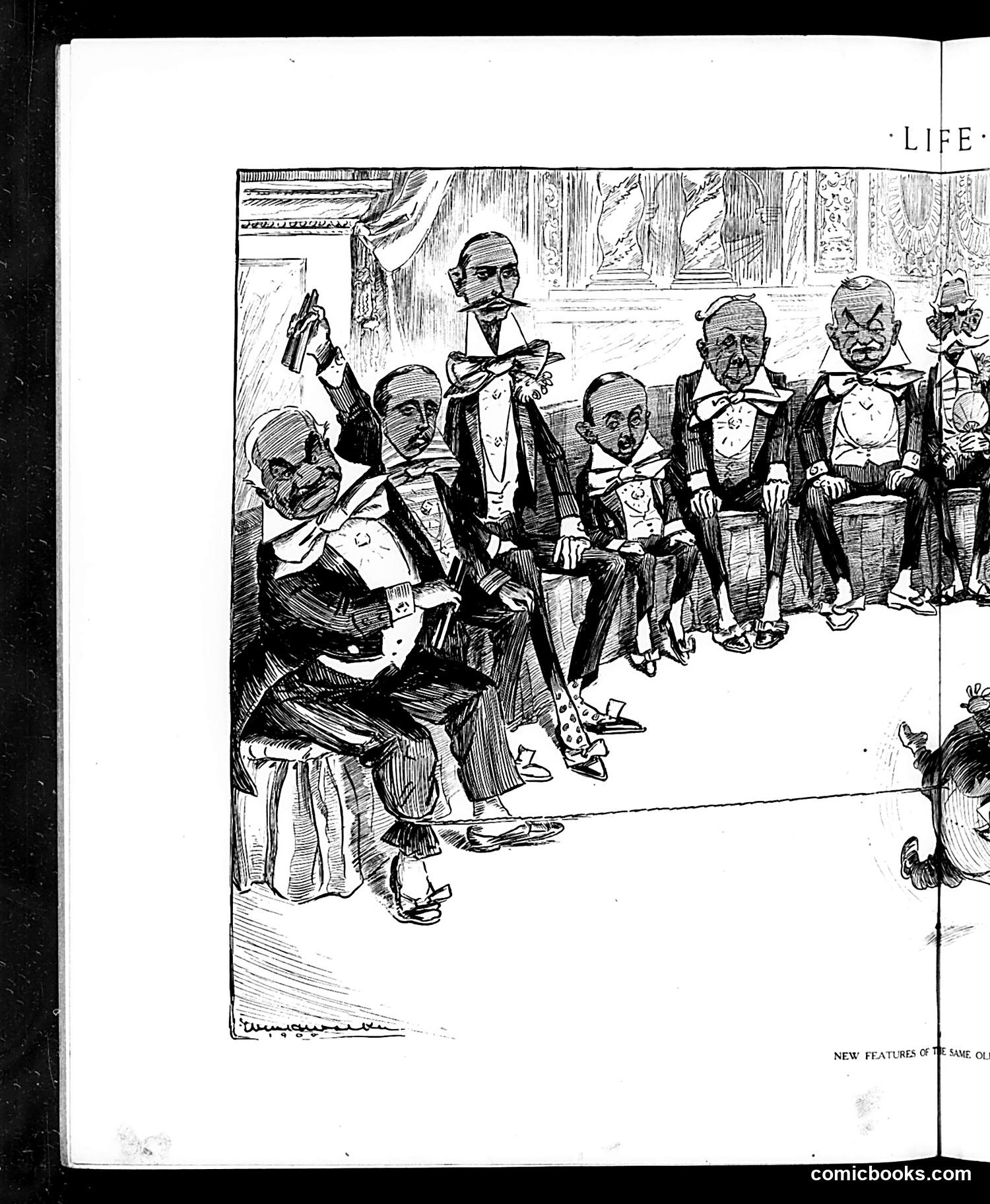
This Life magazine cartoon depicts a formal diplomatic or governmental meeting scene. A figure on the left, dressed in formal attire with a head wrap, appears to be a caricatured foreign dignitary or official, while several men in military uniforms and formal dress stand in a line behind him. The exaggerated facial features and caricature style suggest this is satirizing international relations or diplomatic protocol of the era. The partial text visible reads "NEW FEATURES OF THE SAME OLI[...]" (text cut off), suggesting commentary on continuity or repetition in political/diplomatic matters. Without the complete caption and full OCR text, the specific satirical point—whether mocking diplomatic theater, particular nations' relations, or procedural absurdities—remains unclear from the image alone.
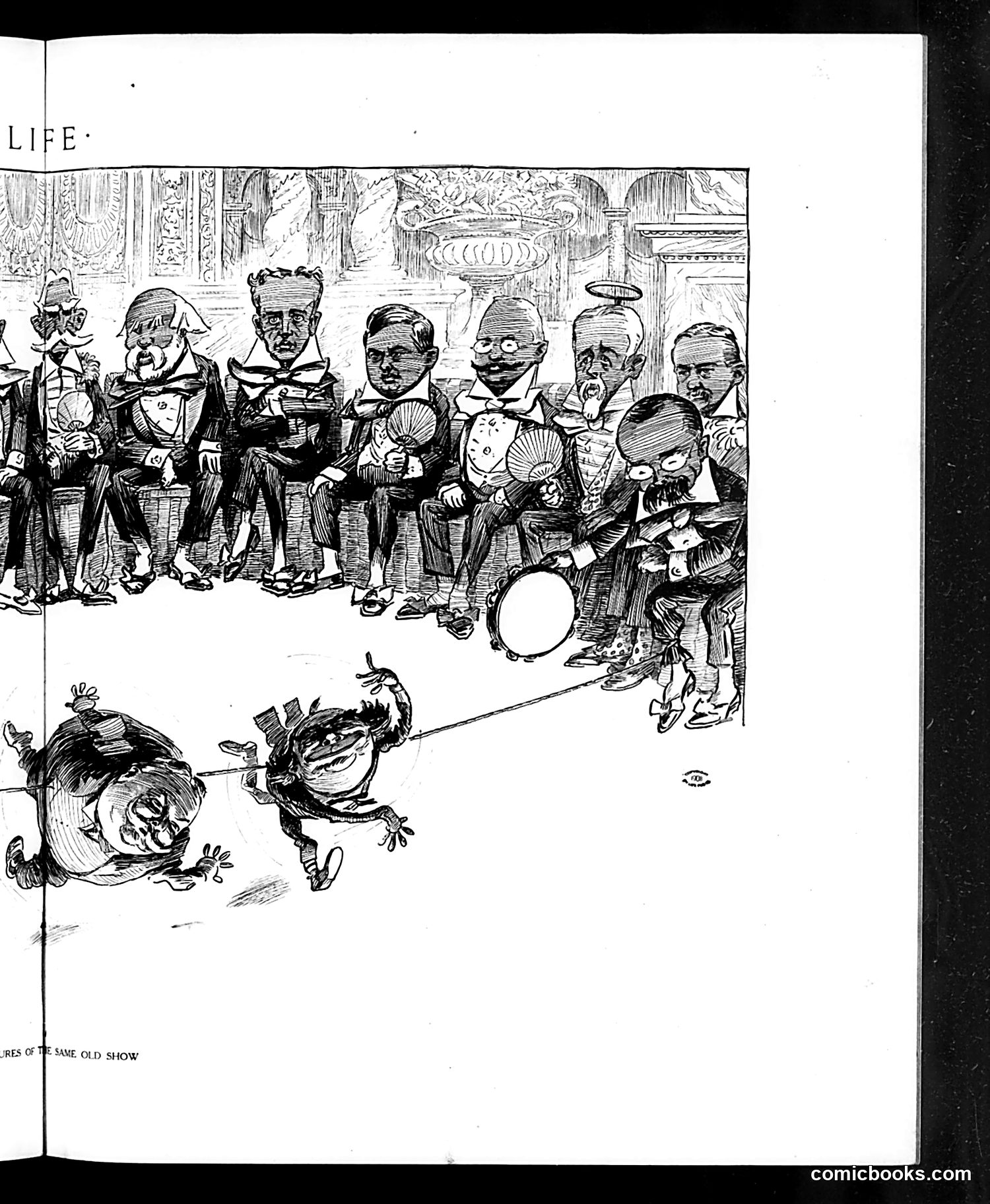
This is a satirical cartoon from *Life* magazine showing a theatrical or performance scene. A row of formally dressed men in suits and top hats sit watching a show, while two grotesque, exaggerated caricatured figures perform below them—appearing to be acrobats or entertainers on a rope or wire. The caption references "the same old show," suggesting this is political satire about repetitive governmental or social performance. The contrast between the dignified observers and the crude performers below implies criticism of those in power watching or tolerating predictable, possibly absurd antics. Without clear date attribution visible, the specific figures and events remain uncertain, though the formal dress and theatrical setup suggest late 19th or early 20th-century American political commentary.
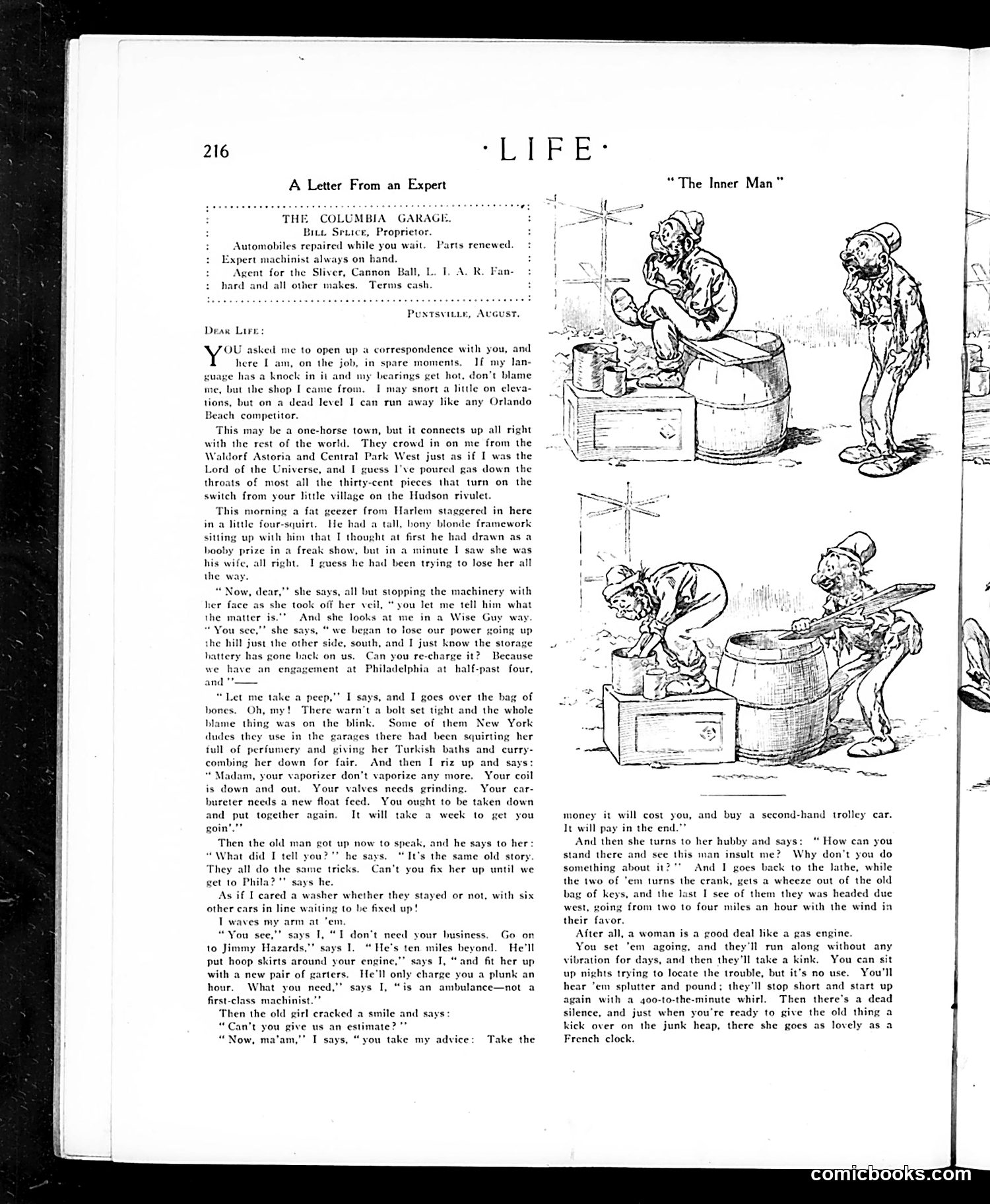
This is a humorous illustrated story about automobile repair, not political satire. The cartoon shows a wife bringing her husband lunch while he works on a car engine at what appears to be a garage or repair shop. The joke centers on the wife's observation that women are like car engines—both need regular maintenance and adjustment. The repeated metaphor compares a woman's temperament to mechanical problems: she "goes out of order," needs her "valves grinding," her "carburetor needs a new float," and requires tune-ups. The humor relies on early 20th-century gender stereotypes portraying women as requiring constant "fixing" and management by men, using automotive language to make the comparison. This reflects the era's attitudes about both cars and gender roles.
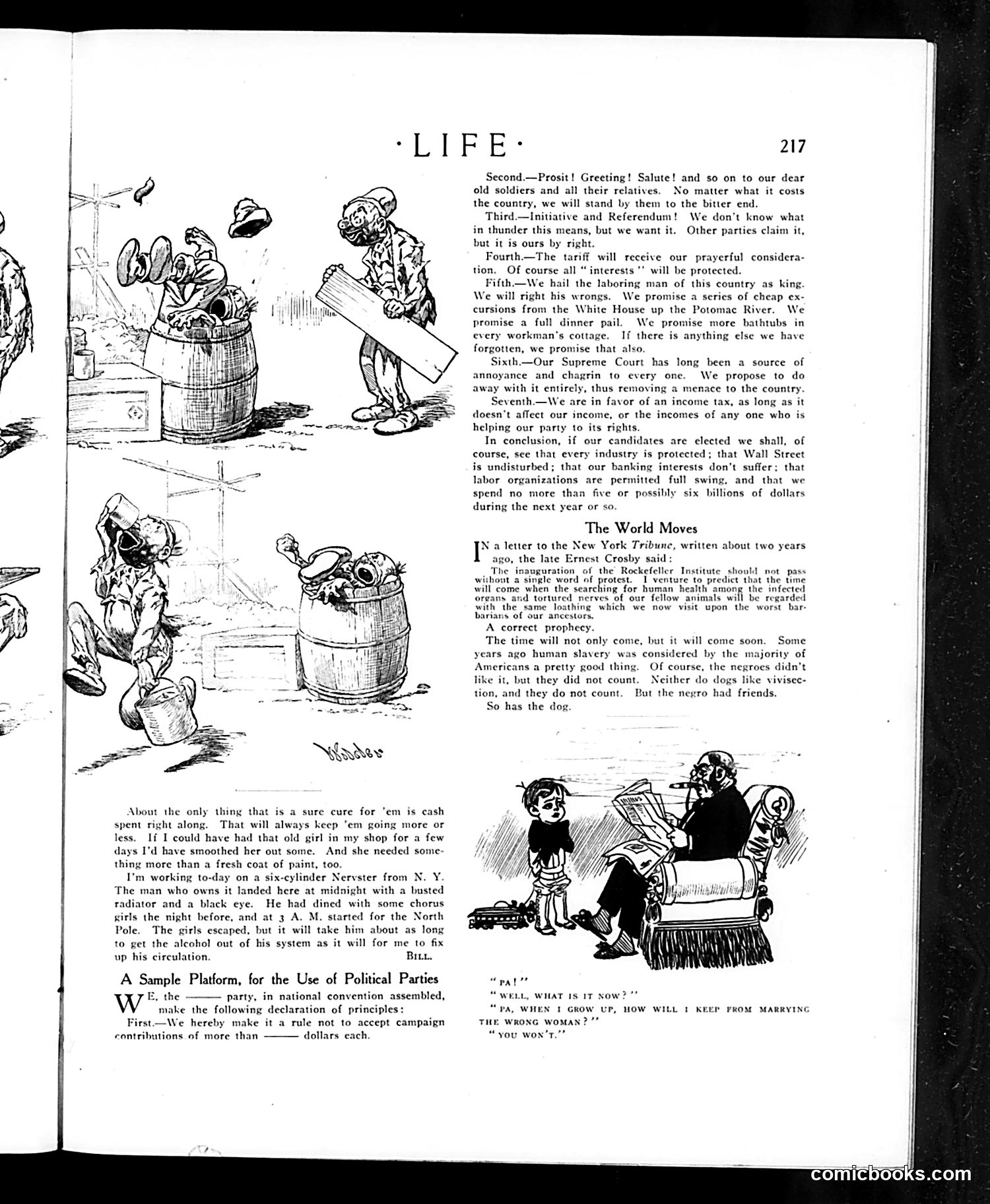
The page contains political satire and commentary. The upper cartoons appear to mock political promises and campaigning, showing figures with various props (barrels, tools) in exaggerated poses—typical Life magazine style lampooning of politicians making grandiose pledges. The section "A Sample Platform, for the Use of Political Parties" satirizes campaign platforms by listing absurd "principles," including accepting only dollar contributions and making vague promises about tariffs, workers' rights, and banking. The bottom cartoon shows adults and a child in a car, with dialogue about preventing the child from "marrying the wrong woman." This appears to satirize parental anxiety and social control, suggesting the impossibility of protecting children from their own choices. Overall, the page mocks both political hypocrisy and rigid social conventions of the era.
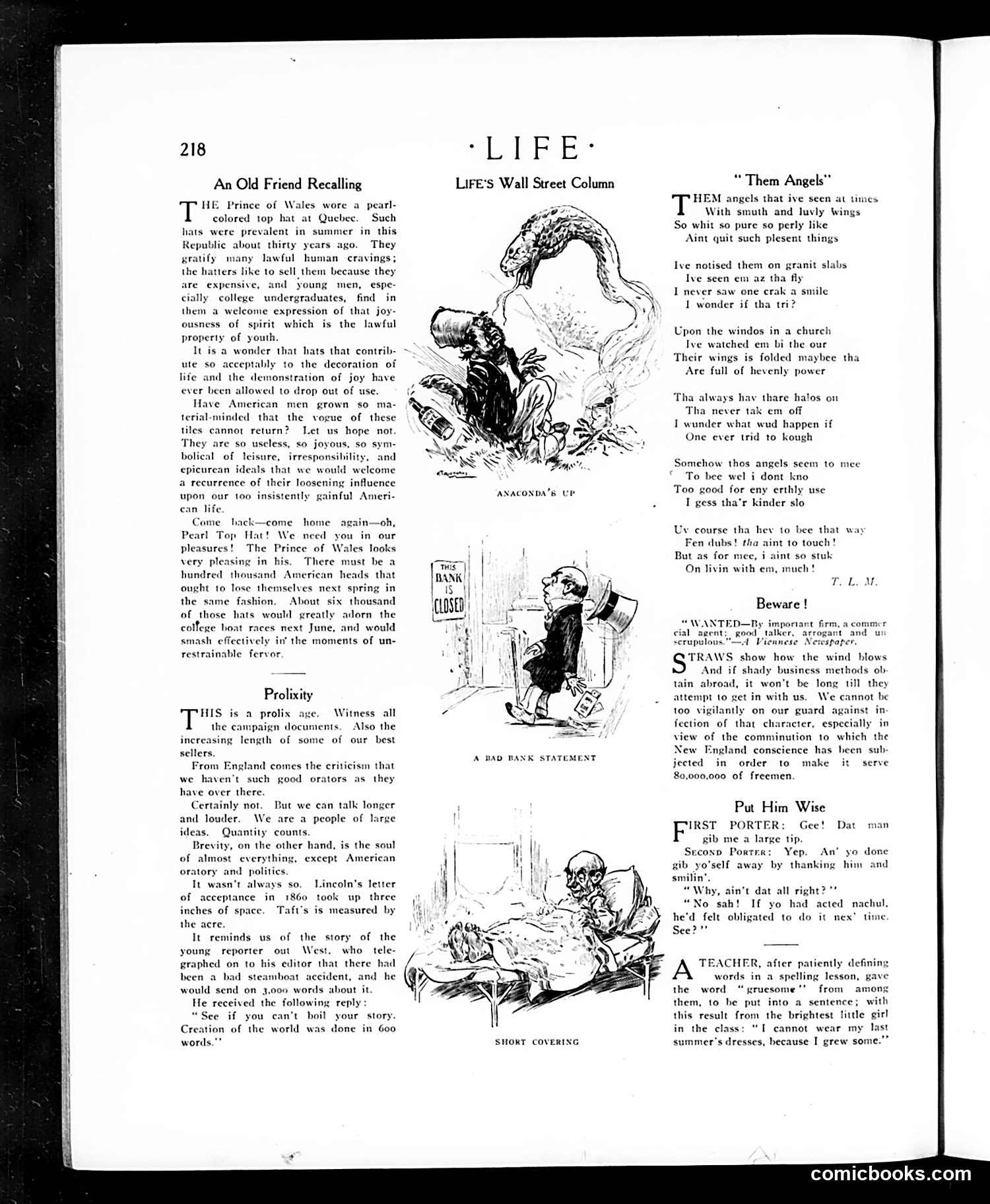
This page contains three satirical pieces typical of early 20th-century American humor: **"An Old Friend Recalling"** nostalgically advocates for pearl-colored top hats, which the Prince of Wales wore at Quebec. The author argues these impractical hats represent joy and leisure—qualities Americans have lost in becoming too materialistic and work-focused. **"Prolixity"** criticizes American verbosity. It contrasts Lincoln's brief 1860 acceptance letter (3 inches) with President Taft's lengthy one (measured "by the acre"), arguing Americans talk longer but less eloquently than the British. A humorous anecdote about a Western reporter illustrates the point: "Creation of the world was done in 600 words." **"Them Angels"** is a dialect poem (phonetically misspelled) about angels being too perfect and remote for earthly enjoyment—a gentle satire on religious idealism. The cartoons show a fashionable man in a straw hat and a banker at his desk, supporting these social commentary themes about American values and pretension.
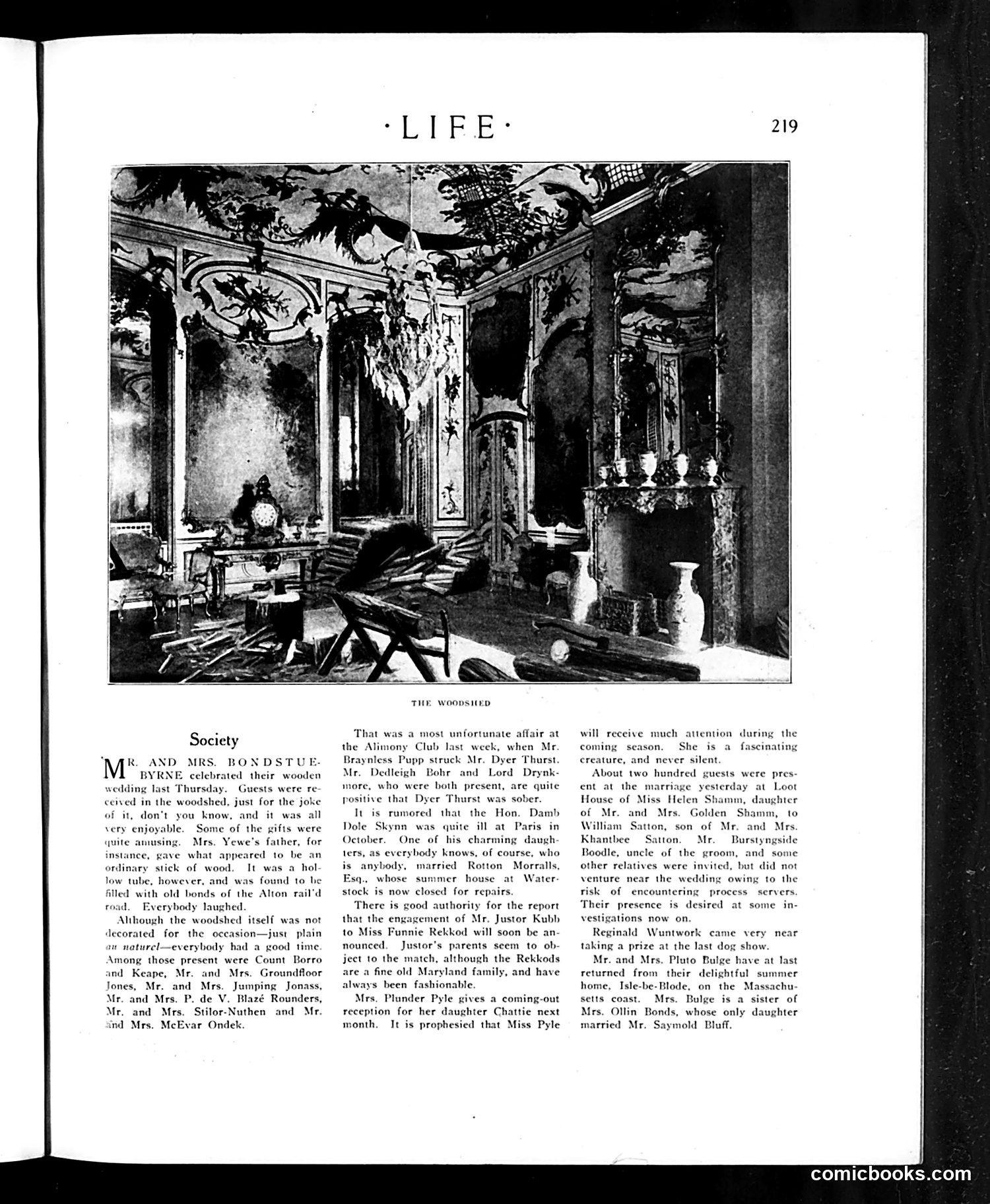
This page is a **society gossip column parody** from Life magazine, mocking high-society reporting and the wealthy elite's pretentious behavior. The image shows an ornate, elegant interior—a stark contrast to the column's headline "The Woodshed," which announces that Mr. and Mrs. Bondstue celebrated their "wooden wedding" in an actual woodshed rather than a fancy venue. The satire works through **absurd character names** (Braynless Pupp, Dyer Thurst, Golden Shamm) and ridiculous situations: a wedding gift of railroad bonds hidden in a hollow stick; guests afraid to attend another wedding due to "process servers" (debt collectors); engagements opposed by parents; and marriages among the perpetually scandal-ridden. The humor targets **society's shallow vanity**—the column breathlessly reports trivial gossip while ignoring genuine social dysfunction: financial instability, legal troubles, and marital discord. For modern readers, it's satire about celebrity/wealthy-person tabloid coverage: breathless tone applied to meaningless drama masking actual problems.
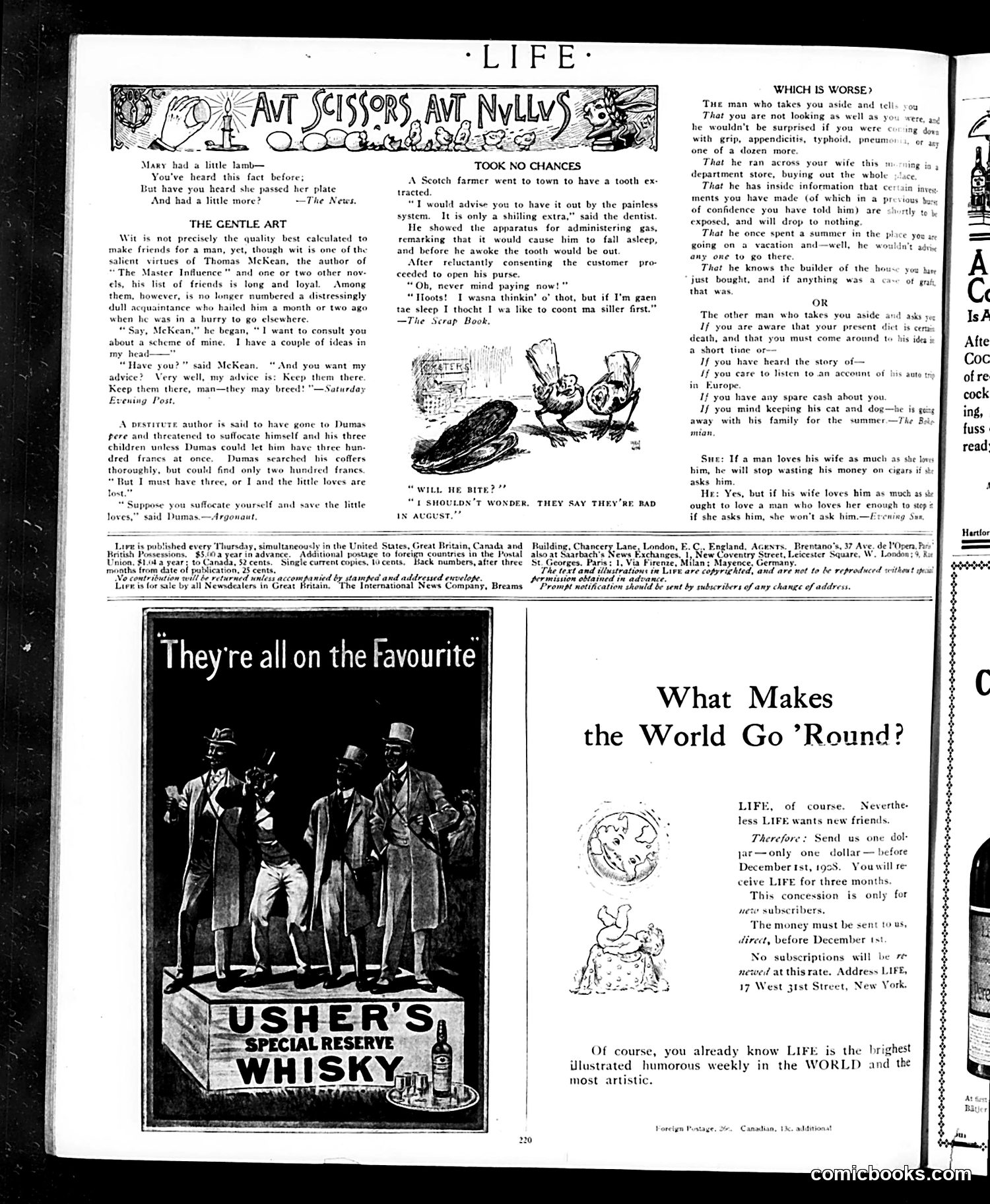
This page contains several brief satirical pieces typical of Life's humor format: **"The Gentle Art"** mocks a dull acquaintance pestering author Thomas McKean for advice. McKean's sharp retort—that the man should keep his ideas "there, man—they may breed!"—implies the ideas are so poor they're better left unborn. The satire targets pretentious social climbers seeking validation from successful people. **"Took No Chances"** depicts a Scottish farmer so cautious about anesthesia that he insists on counting his money before sleeping, fearing he'll be cheated. The humor relies on ethnic stereotyping of Scots as miserly. **"Will He Bite?"** shows two contrasting types of bothersome acquaintances: those who predict your doom with unsolicited warnings, and those who exploit your time and resources. The satire critiques social parasites. The **Usher's Whisky advertisement** below depicts well-dressed gentlemen, typical period advertising imagery. Overall, the page satirizes social annoyances and human folly through brief anecdotes rather than political commentary.
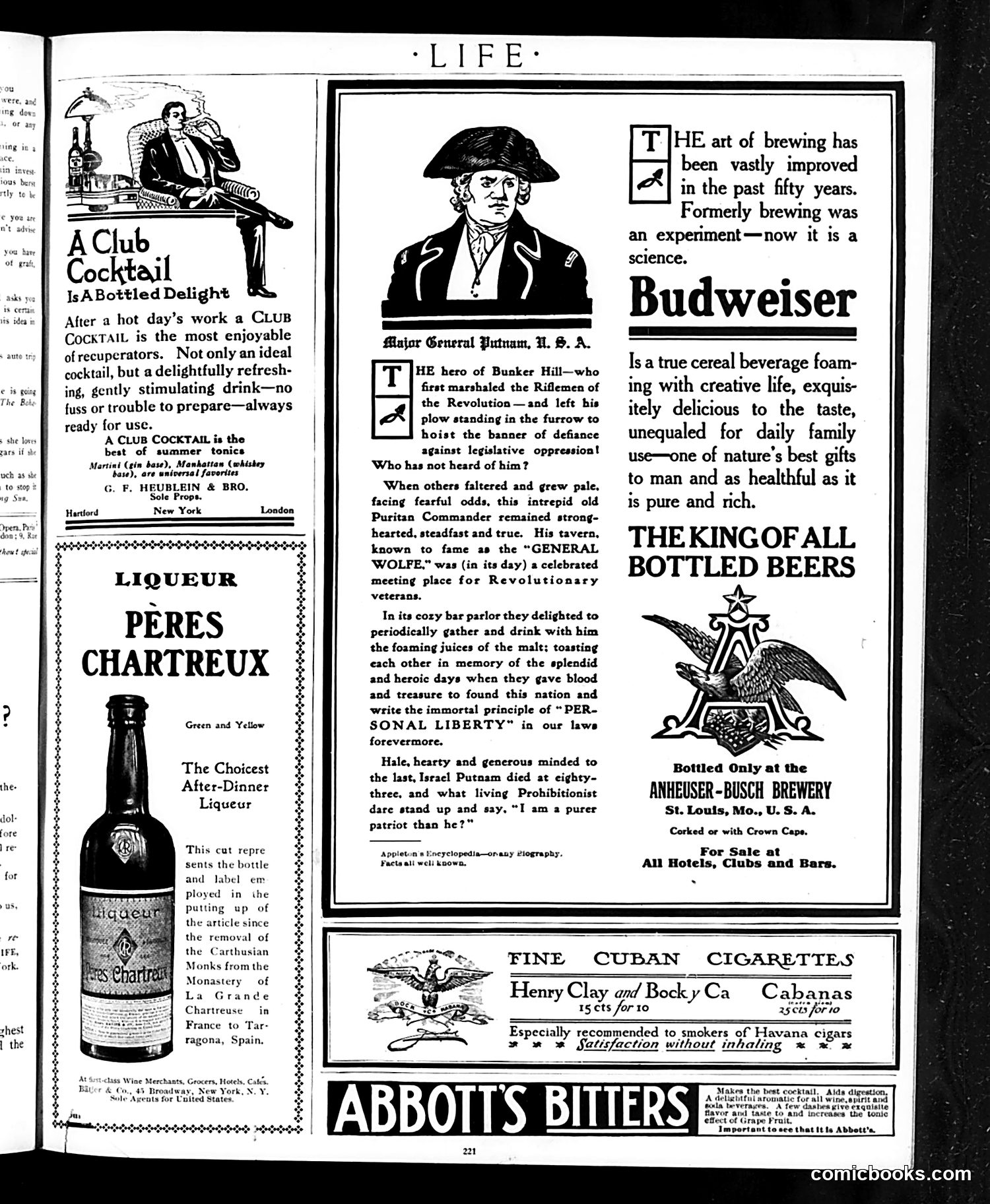
This is primarily a **page of advertisements** from an early 20th-century issue of Life magazine, not a political cartoon. The page contains no satire or jokes requiring historical context. The advertisements promote various alcoholic beverages and cigars—cocktails, liqueur, beer, bitters, and cigarettes. One ad notably uses **Major General Israel Putnam**, a Revolutionary War hero, to market alcohol. The copy appeals to patriotism, describing Putnam's tavern as a gathering place for Revolutionary veterans, then asks: "what living Prohibitionist dare stand up and say, 'I am a purer patriot than he?'" This appears to be **anti-Prohibition propaganda**, using historical patriotism to justify alcohol consumption during the dry-movement era. The Budweiser ad similarly emphasizes beer as healthful and suitable for "daily family use." The page reflects pre-Prohibition America's open marketing of alcohol products.
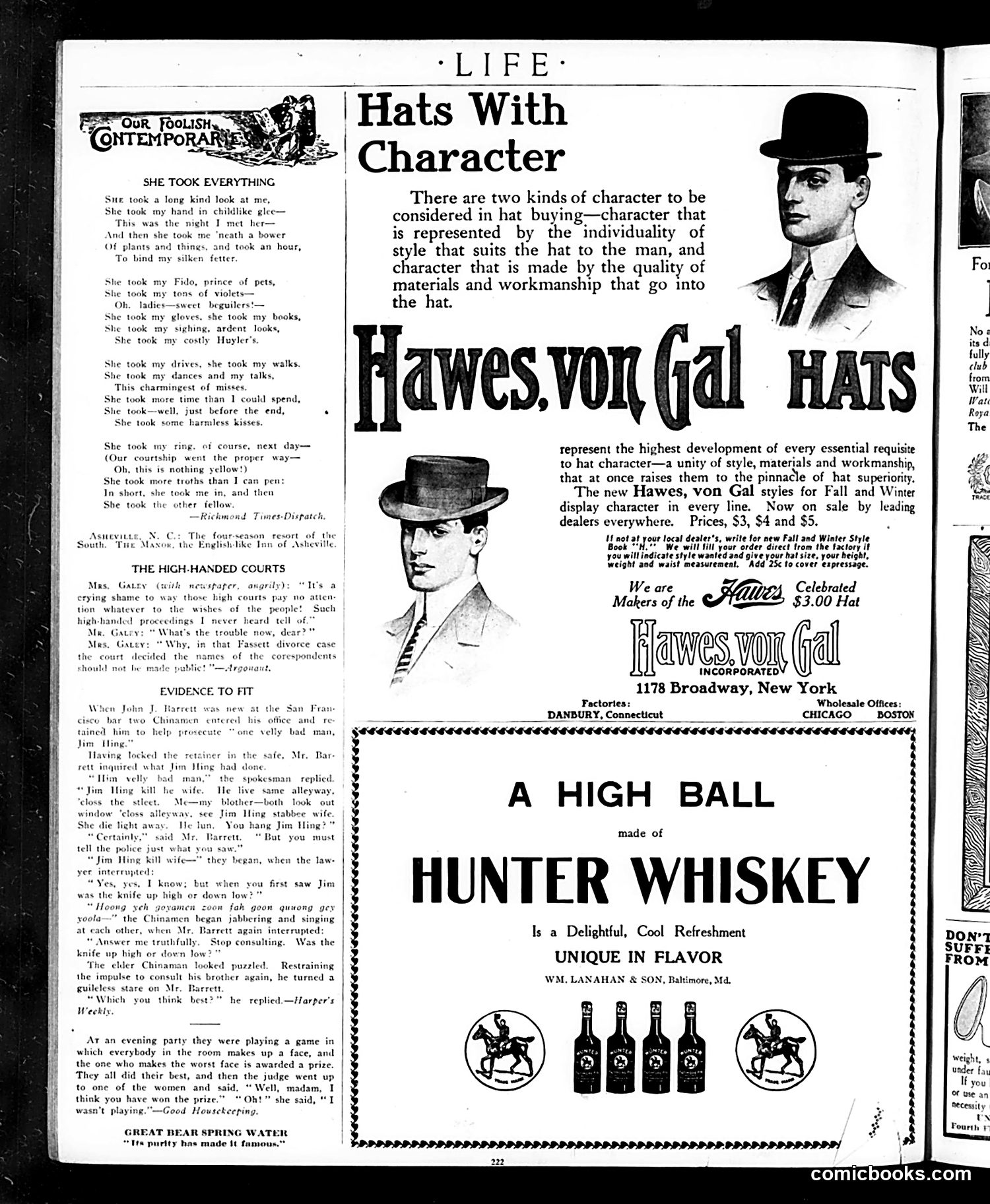
This page contains several distinct elements: a humorous poem, legal satire, and advertisements. **"She Took Everything"** (top left) is a comedic poem about courtship and marriage. The joke: a woman systematically takes the speaker's possessions—his pets, books, time, even "the other fellow" (another suitor)—culminating in her taking "my ring" and marrying him. The humor lies in framing marriage as the woman's ultimate prize after extracting everything else. **"The High-Handed Courts"** satirizes judicial bias. A judge dismisses a woman's complaint about unfair court treatment while committing procedural impropriety himself. The irony: he demonstrates exactly the "high-handed" behavior she criticized. The accompanying "Evidence to Fit" anecdote mocks how judges manipulate testimony—a Chinese witness is led by suggestive questioning rather than allowed to give neutral facts. **Advertisements** dominate the page: Hawes von Gal hats (emphasizing quality materials and "character") and Hunter Whiskey. These are period product placements typical of *Life* magazine's business model. The page reflects early 20th-century concerns about marital dynamics, judicial corruption, and consumer goods.
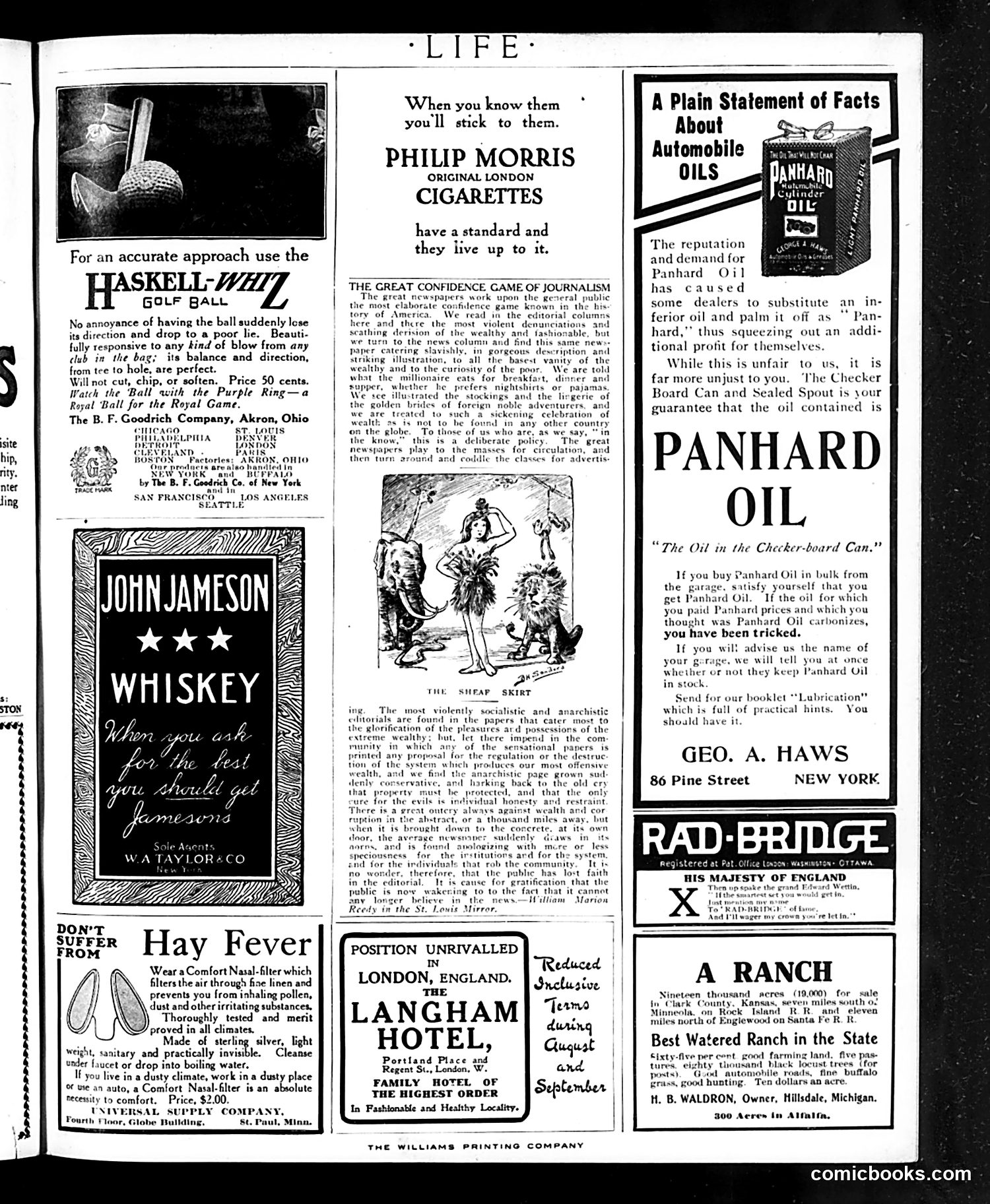
This is primarily an **advertising page** from an early 20th-century issue of Life magazine, with one notable satirical article. ## The Satire: The central piece, "The Great Confidence Game of Journalism," critiques newspaper editorial practices. It argues that newspapers manipulate readers by publishing sensational, violent content for mass circulation while simultaneously catering to wealthy advertisers. The article—attributed to William Marion Reedy of the *St. Louis Mirror*—suggests the public has lost faith in news credibility because papers prioritize profit over truth. The accompanying cartoon depicting "The Shear Skirt" appears to illustrate how papers exploit scandal and fashionable outrage to drive readership. ## The Advertisements: The page features typical early 1900s products: golf balls, whiskey, cigarettes, hay fever filters, automobiles oils, hotels, and ranch land. Notable is Panhard Oil's ad warning against counterfeit products—reflecting period concerns about trademark fraud. The satire represents Life magazine's role as a **critic of American commercial culture and journalistic ethics**, attacking media dishonesty while ironically surrounded by advertisements.
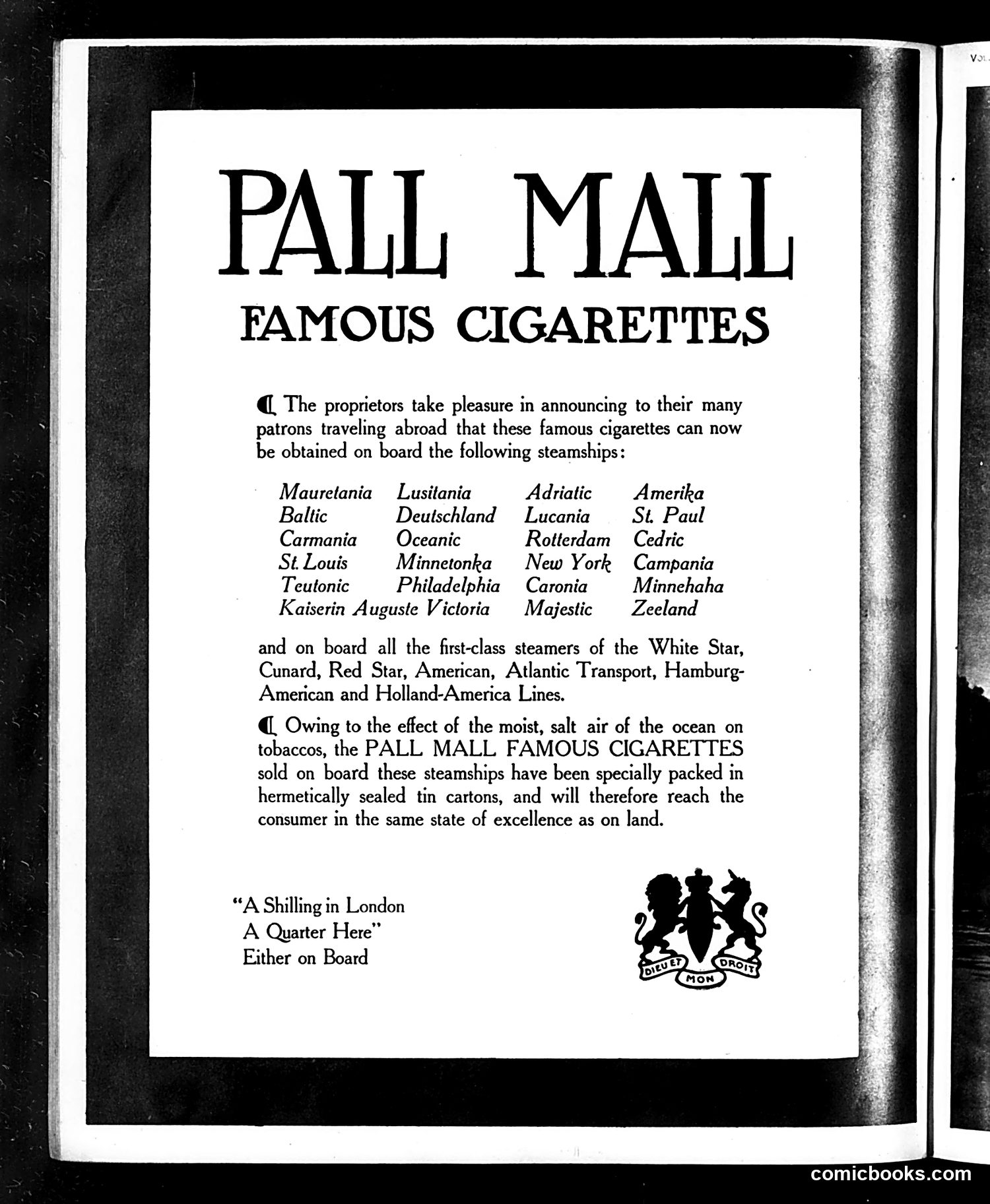
This is a straightforward **advertisement**, not satire or political commentary. Pall Mall cigarettes promotes their availability on luxury transatlantic steamships—major vessels like the *Lusitania* and *Mauretania* serving wealthy travelers between Europe and America. The ad emphasizes prestige by listing prestigious shipping lines (White Star, Cunard, Red Star) and highlights a practical selling point: cigarettes are hermetically sealed in tin to protect them from ocean moisture during transit, arriving in perfect condition. The tagline "A Shilling in London / A Quarter Here" notes the price difference between markets. The coat-of-arms symbol reinforces the product's upscale positioning. This reflects early 20th-century consumer culture when international travel was luxury entertainment for the wealthy, and cigarette smoking was socially acceptable and heavily advertised.