
Life, 1908-08-27 · page 4 of 20
Life — August 27, 1908 — page 4: what you’re looking at
What you’re looking at
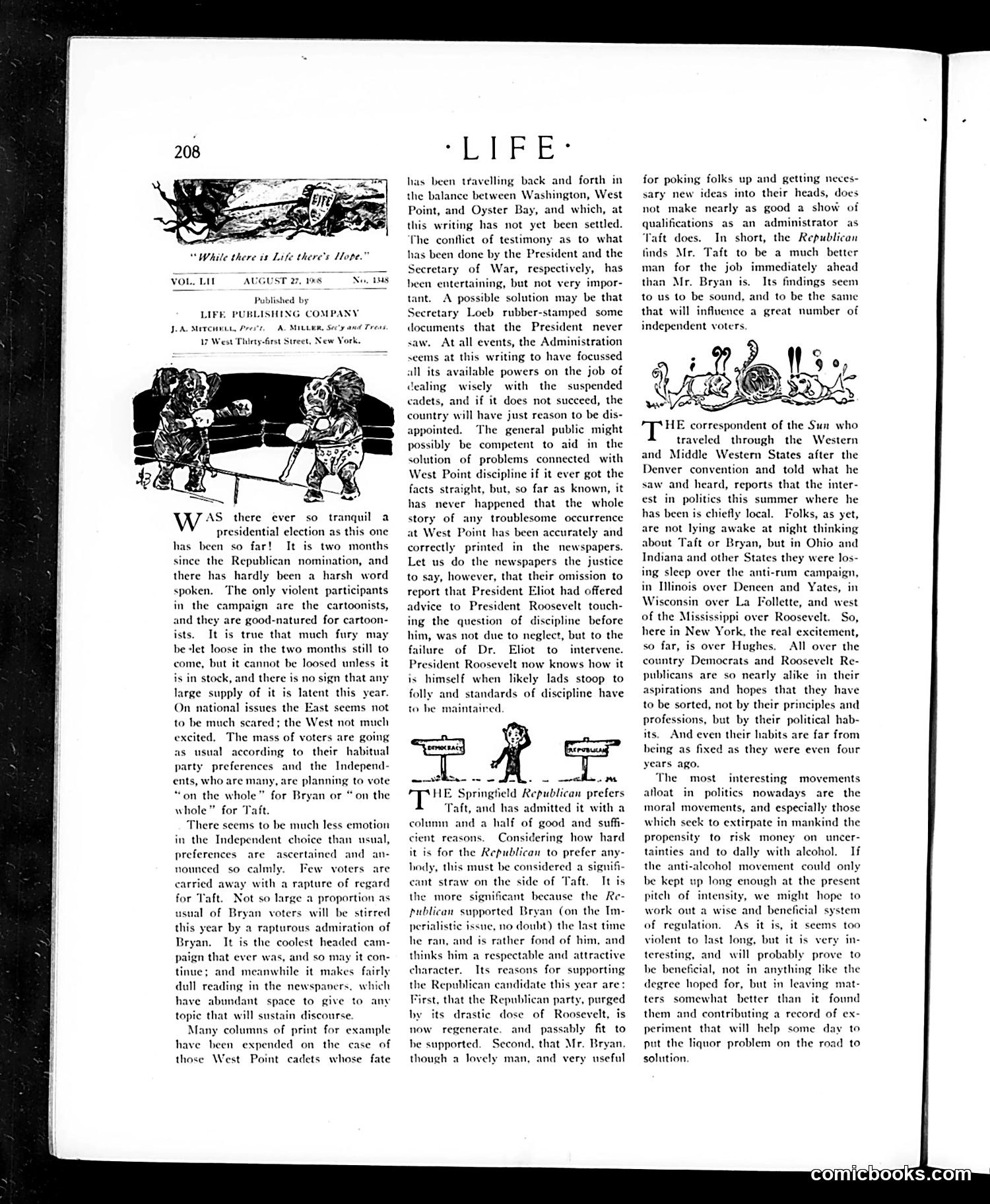
This page discusses the 1908 U.S. presidential election during Theodore Roosevelt's second term. The text analyzes the Republican Party's preference for William Howard Taft as Roosevelt's successor over William Jennings Bryan (the Democratic nominee). The cartoon at top-left depicts two figures in a bathtub, likely satirizing the "hand-picking" of Taft as Roosevelt's chosen heir—a common criticism that Taft was Roosevelt's puppet candidate rather than an independent choice. The page's political argument centers on the Springfield *Republican*'s support for Taft, arguing that despite Bryan being "lovely" and "useful," Taft represents Republican regeneration after Roosevelt's controversial presidency. The underlying message: even Republicans admit Bryan has merit, but party loyalty demands supporting Taft.
📄 Transcribed text from this page (OCR, searchable)
Machine-transcribed from the original scan — historical spelling and the odd misread are preserved.
“While there is Life there's Hobe. UST 27, 198 No. 134s VoL. 1 AU Published by LIFE PUBLISHING COMPANY J.-A. Mitcy 17 West Thirty-first Street, New Y Lt, Pret, A. MILLER, See'y and Treas AS there ever so tranquil a presidential election as this one has been so far! It is two months since the Republican nomination, and there has hardly been a harsh word spoken. The only violent participants in the campaign are the cartoonists, and they are good-natured for cartoon- ists. It is true that much fury may be -let loose in the two months still to come, but it cannot be loosed unless it is in stock, and there is no sign that any large supply of it is latent this year. On national issues the East seems not to be much scared; the West not much excited. The mass of voters are going as usual according to their habitual party preferences and the Independ- ents, who are many, are planning to vote on the whole” for Bryan or “on the whole” for Taft. There seems to be much less emotion in the Independent choice than usual, preferences are ascertained and an- nounced so calmly, Few voters are carried away with a rapture of regard for Taft. Not so large a proportion as usual of Bryan voters will be stirred this year by a rapturous admiration of Bryan. It is the coolest headed cam- paign that ever was, and so may it con- tinue; and meanwhile it makes fairly dull reading in the newspaners. which have abundant space to give to any topic that will sustain discourse. Many columns of print for example have heen expended on the case of those West Point cadets whose fate *L PE: has been travelling back and forth in the balance between Washington, West Point, and Oyster Bay, and which, at this writing has not yet been settled. The conflict of testimony as to what has been done by the President and the Secretary of War, respectively, been entertaining, but not very impor- tant. A possible solution may be that Sceretary Loeb rubber-stamped some documents that the President never saw. Atall events, the Administration seems at this writing to have focussed all its available powers on the job of dealing wisely with the suspended cadets, and if it does not succeed, the country will have just reason to be dis- appointed. The general public might possibly be competent to aid in the solution of problems connected with West Point discipline if it ever got the facts straight, but, so far as known, it has never happened that the whole story of any troublesome occurrence at West Point has been accurately and correctly printed in the newspapers. Let us do the newspapers the justice to say, however, that their omission to report that President Eliot had offered advice to President Roosevelt touch- ing the question of discipline before him, was not due to neglect, but to the failure of Dr. Eliot to intervene. President Roosevelt now knows how it is himself when likely lads stoop to folly and standards of discipline have to he maintained, _— rN... aes THe Springfield Republican prefers Taft, and has admitted it with a column and a half of good and suffi- cient reasons. Considering how hard it is for the Republican to prefer any- hody, this must be considered a signifi- cant straw on the side of Taft. It is the more significant because the Re- publican supported Bryan (on the Tm- perialistic issue, no doubt) the last time he ran, and is rather fond of him, and thinks him a respectable and attractive character. Its reasons for supporting the Republican candidate this year are: First, that the Republican party, purged by its drastic dose of Roosevelt, is now regenerate. and passably fit to he supported. Second. that Mr. Bryan. though a lovely man, and very useful for poking folks up and getting neces- sary new ideas into their heads, does not make nearly as good a show of qualifications as an administrator as Taft does. In short, the Republican finds Mr. Taft to be a much better man for the job immediately ahead than Mr. Bryan is. Its findings seem to us to be sound, and to be the same that will influence a great number of independent voters. HE correspondent of the Sun who traveled through the Western and Middle Western States after the Denver convention and told what he saw and heard, reports that the inter- est in politics this summer where he has been is chiefly local. Folks, as yet, e not lying awake at night thinking about Taft or Bryan, but in Ohio and Indiana and other States they were los- ing sleep over the anti-rum campaign, in Illinois over Deneen and Yates, in Wisconsin over La Follette, and west of the Mississippi over Roosevelt. So, here in New York, the real excitement, so far, is over Hughes, All over the country Democrats and Roosevelt Re- publicans are so nearly alike in their aspirations and hopes that they have to be sorted, not by their principles and professions, but by their political hab- its, And even their habits are far from being as fixed as they were even four years ago. The most interesting movements afloat in politics nowadays are the moral movements, and especially those which seek to extirpate in mankind the propensity to risk money on. uni tainties and to dally with alcohol. If the anti-alcohol movement could only be kept up long enough at the present pitch of intensity, we might hope to work out a wise and beneficial system of regulation. As it is, it seems too violent to last long, but it is very in- teresting, and will probably prove to be beneficial, not in anything like the degree hoped for, but in leaving mat- somewhat better than it found them and contributing a record of ex- periment that will help some day to put the liquor problem on the road to solution. ters