
A complete issue · 24 pages · 1906
Life — October 11, 1906
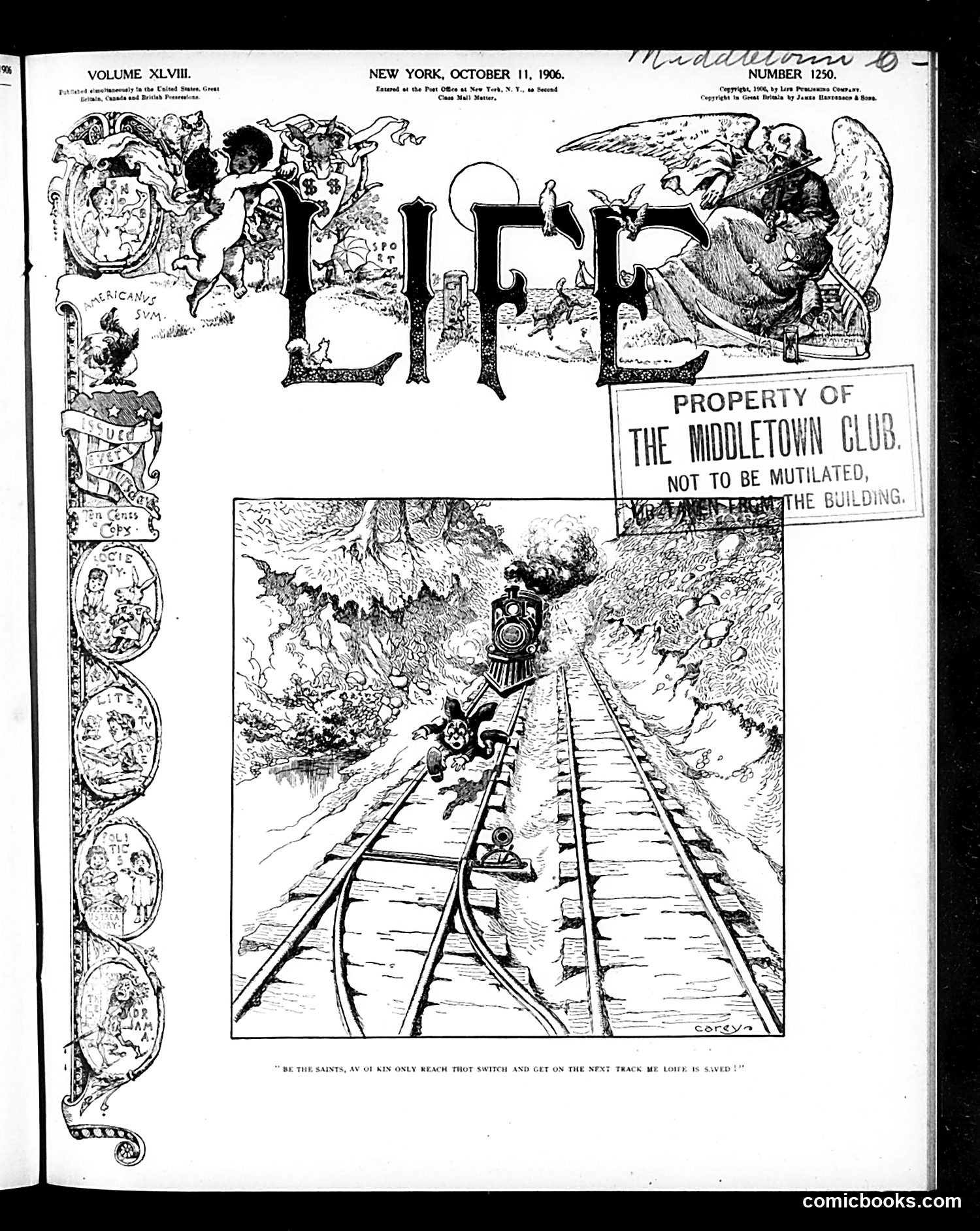
This page features a satirical illustration titled "LIFE" with an elaborate decorative header. The main cartoon depicts a locomotive approaching on railroad tracks through a canyon, with the caption: "BE THE SAINTS, AY OF KIN ONLY REACH THOT SWITCH AND GET ON THE NEXT TRACK, ME LORD IS SAVED!" The illustration appears to be an Irish-dialect joke about railroad safety and divine intervention. The figure on the tracks (drawn with stereotypical Irish characteristics) appeals to saints for help switching tracks to avoid the oncoming train. The decorative left border contains a classical "Americanus Sum" medallion and five circular vignettes with classical scenes, which was typical of Life's ornamental design. The stamp indicates this copy belonged to the Middletown Club library.
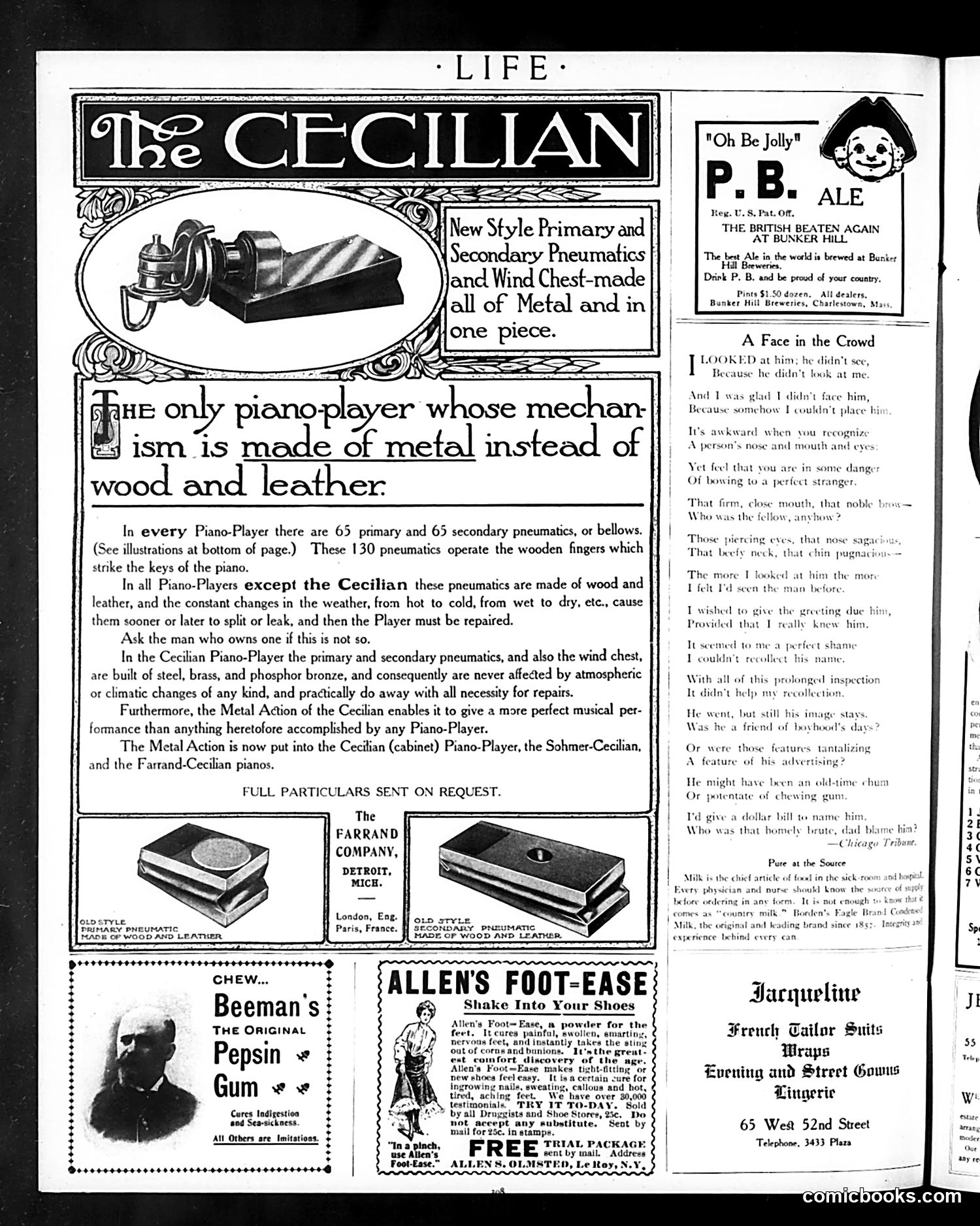
This page contains primarily **advertisements rather than political satire**. The main content advertises The Cecilian piano-player—a mechanical device featuring metal pneumatics instead of wooden ones, marketed as superior and more durable. The sidebar includes a poem titled "A Face in the Crowd" about encountering a stranger, along with ads for P.B. Ale, Beeman's Pepsin Gum, Allen's Foot-Ease powder, and Jacqueline French Tailor Suits. **No political cartoon or satirical content is visible on this page.** It represents a typical early 20th-century magazine layout mixing editorial content with paid advertisements—common practice when advertising subsidized magazine production.
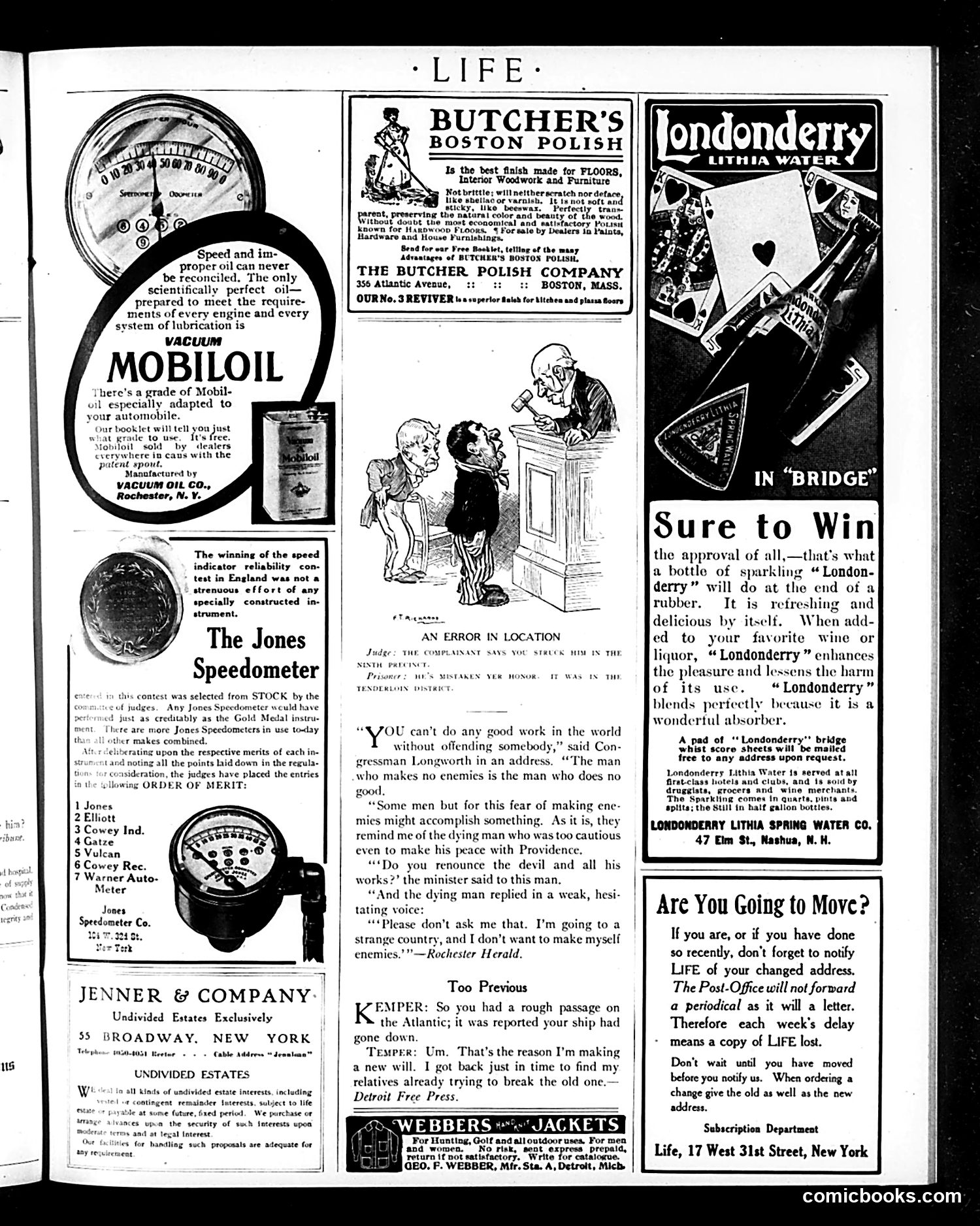
This cartoon depicts a humorous domestic dispute. A judge addresses two men (apparently a husband and complainant), with the caption explaining the judge has made an error: he's struck the wrong man in the nose. The cartoon satirizes judicial incompetence and mistaken identity. The joke relies on the physical comedy of the judge hitting the wrong person—a common slapstick setup. The accompanying text quotes a sermon about making enemies through offense, suggesting the cartoon is commenting on how easily conflicts arise from misunderstandings. The broader satirical point appears to be about the absurdity of legal proceedings and how authority figures can bungle simple matters. This reflects early 20th-century American satirical humor mocking institutional incompetence. The page is otherwise filled with period advertisements (Mobiloil, speedometers, shoe polish).
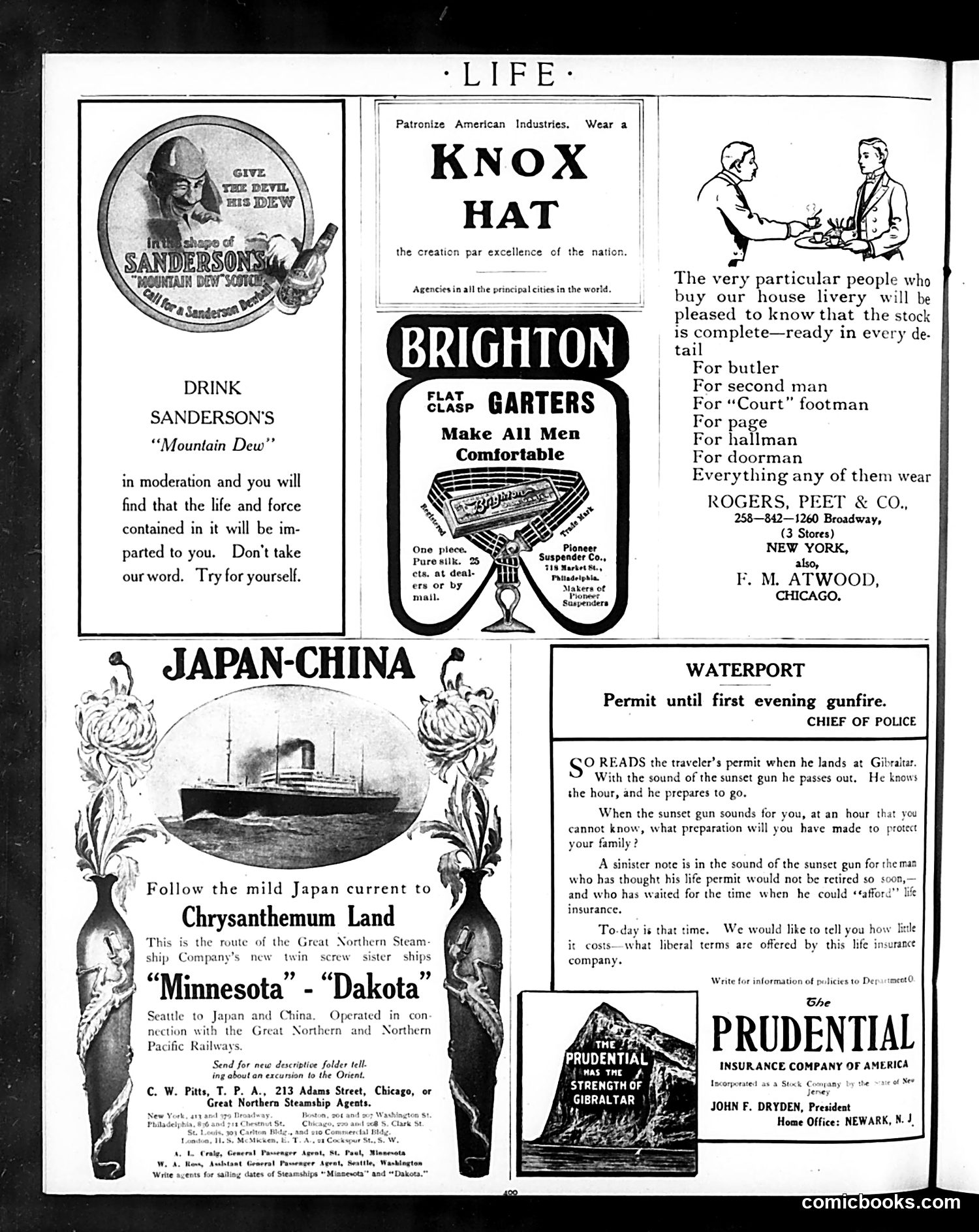
This page is primarily **advertising**, not satirical content. It contains five commercial advertisements from what appears to be an early 20th-century issue: 1. **Sanderson's Mountain Dew** — a beverage ad claiming health benefits 2. **Knox Hat** — promoting American-made hats 3. **Brighton Flat-Clasp Garters** — men's clothing accessories 4. **Japan-China Steamship Line** — advertising passage to "Chrysanthemum Land" via ships Minnesota and Dakota 5. **Prudential Insurance** — offering life insurance with Gibraltar imagery The only potentially notable element is the Japan-China steamship ad, which uses orientalist imagery (chrysanthemums, decorative vases) typical of early 1900s marketing. However, without additional context, I cannot identify specific satire or political commentary on this page—it appears to be straightforward commercial content.
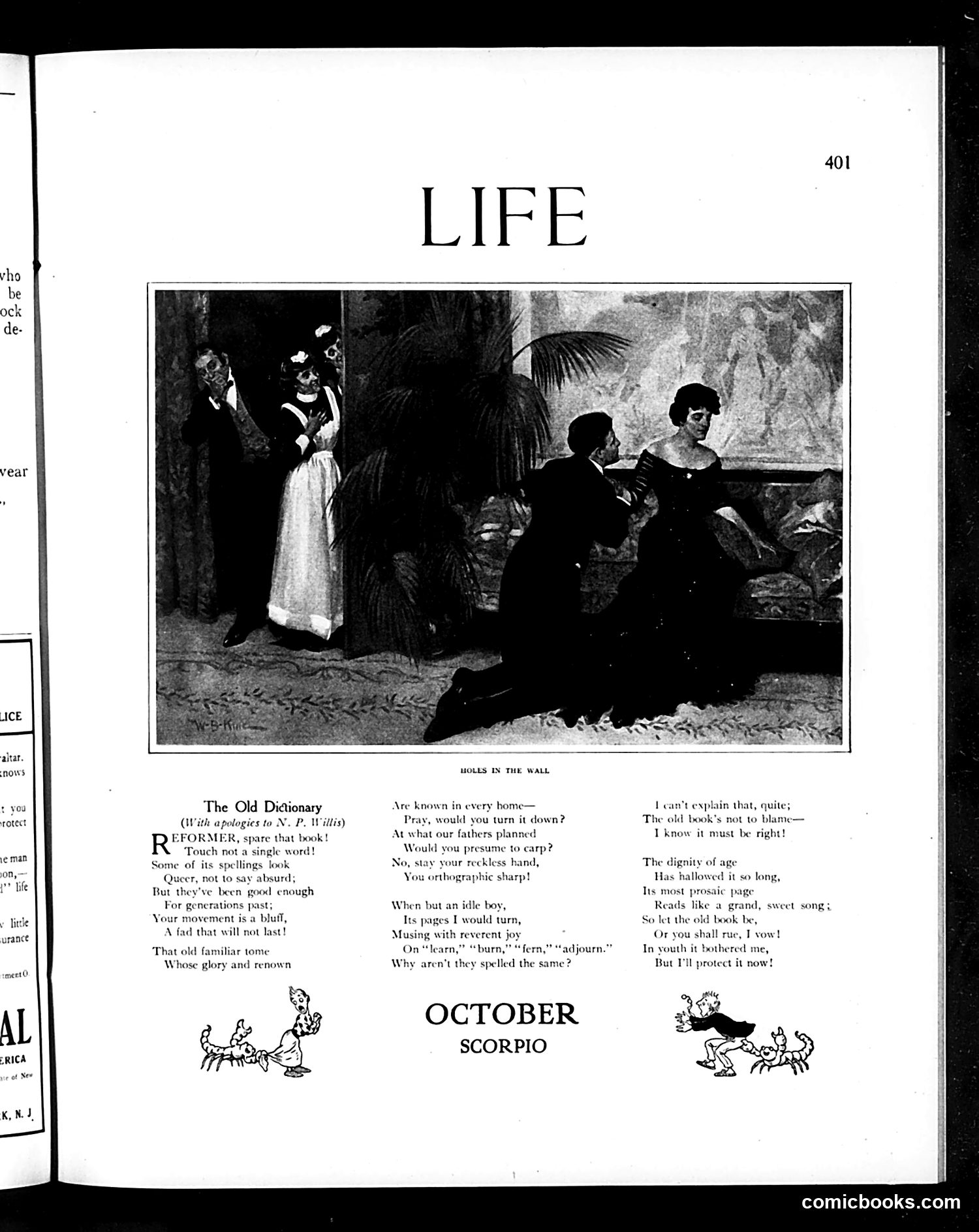
This page features "Holes in the Wall," a satirical poem about an old dictionary. The verse mocks outdated linguistic conventions—specifically, the dictionary's refusal to update spelling or usage to match modern practice. References to "orthographic sharp" and debates over how words "should" be spelled suggest criticism of prescriptive grammar rules that had become obsolete. The accompanying illustration shows well-dressed figures in an interior setting, apparently depicting a social scene related to the poem's theme of generational conflict over tradition versus progress. The bottom section marks October's zodiac sign (Scorpio) with decorative scorpion illustrations. This appears to be a general cultural/social satire rather than political commentary, mocking resistance to linguistic modernization and the stubborn adherence to outdated standards.
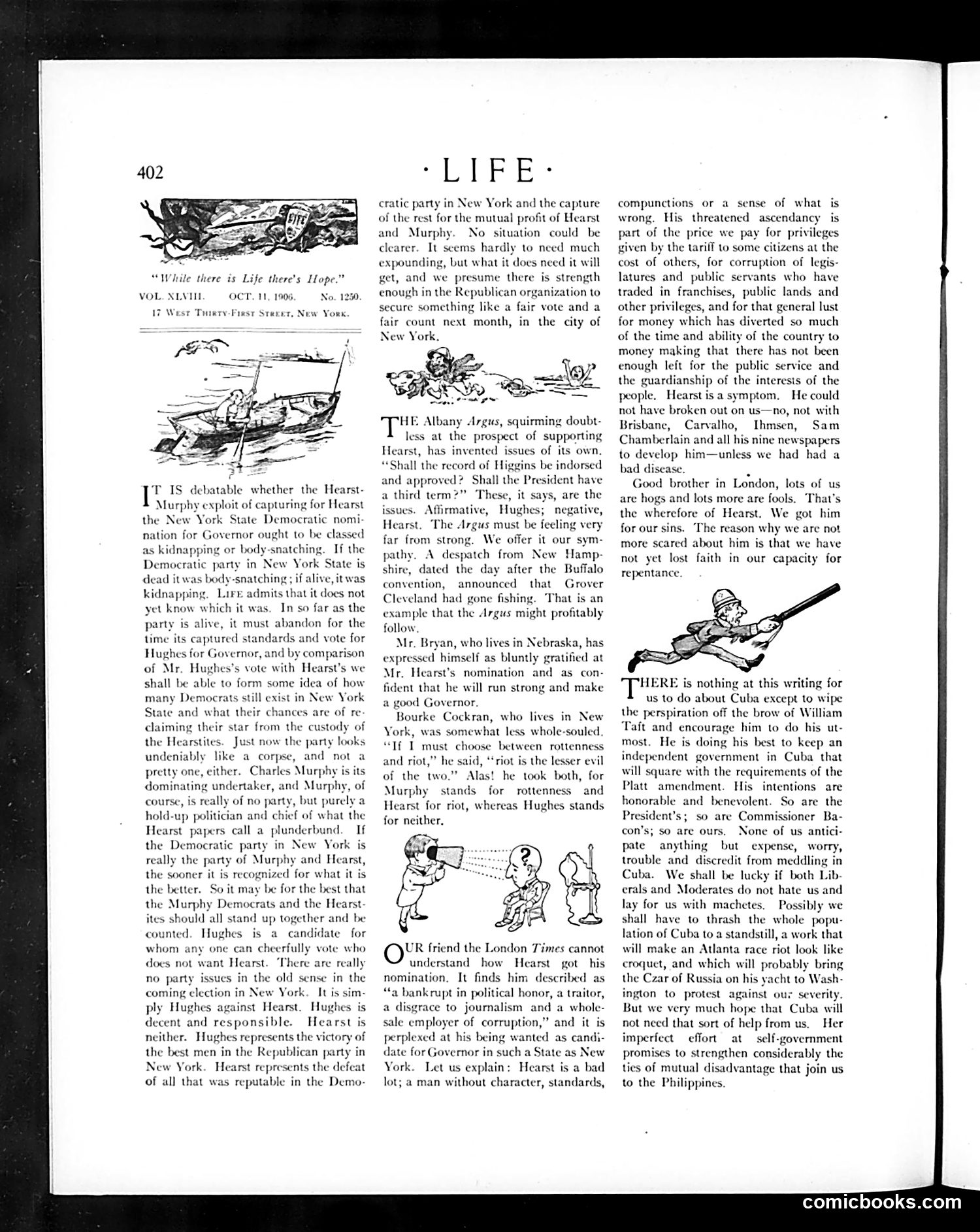
This page critiques William Randolph Hearst's political ambitions and journalistic ethics. The text attacks Hearst as an unprincipled opportunist seeking the Democratic gubernatorial nomination in New York, claiming he lacks genuine political convictions and represents only personal ambition and profit-seeking. The small cartoons (showing figures in conversation) appear to illustrate the absurdity of Hearst's candidacy through dialogue or visual commentary, though the specific details are unclear in reproduction. The piece also discusses Cuba policy and criticizes Hearst for supporting interventionist positions while lacking genuine principle. The overall thrust satirizes Hearst as emblematic of corrupted journalism—using media power for personal political gain rather than public service.
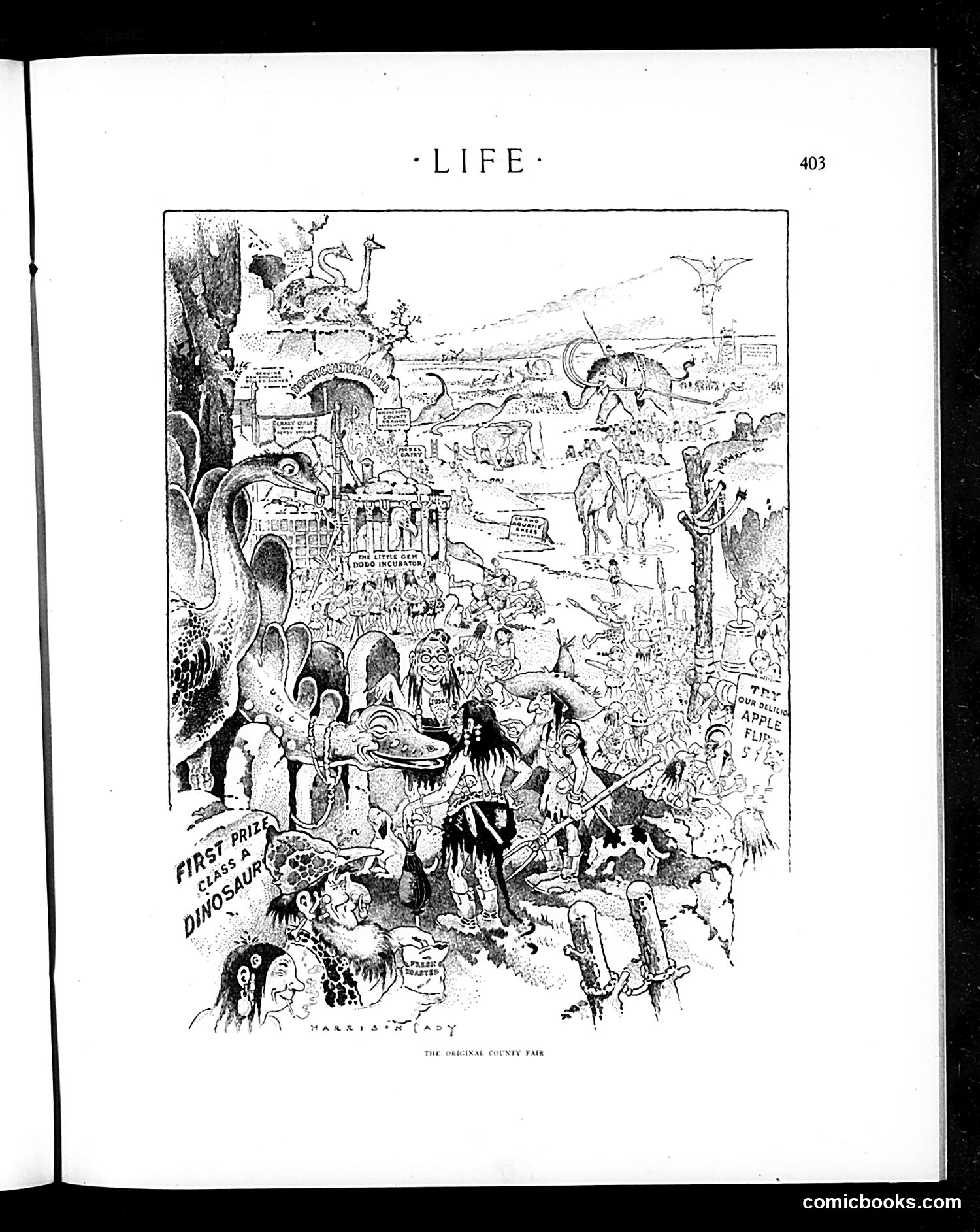
This is a satirical illustration titled "The Original County Fair" depicting a fantastical prehistoric scene. The cartoon shows dinosaurs and primitive humans coexisting at what appears to be an ancient fair or gathering. A prominent banner reads "FIRST PRIZE DINOSAUR" with various labeled exhibits scattered throughout. The satire appears to mock contemporary county fairs by imaginatively presenting them as ancient phenomena, suggesting the concept of competitive exhibitions and prizes existed since prehistoric times. The dense, chaotic composition with numerous small figures, creatures, and labeled sections parodies the overwhelming sensory experience of actual county fairs—their multiplicity of attractions, competitions, and attractions all demanding attention simultaneously. Without additional context about Life magazine's 1920s-era concerns, the specific satirical target remains unclear, though it likely comments on American fair culture or commercialism.
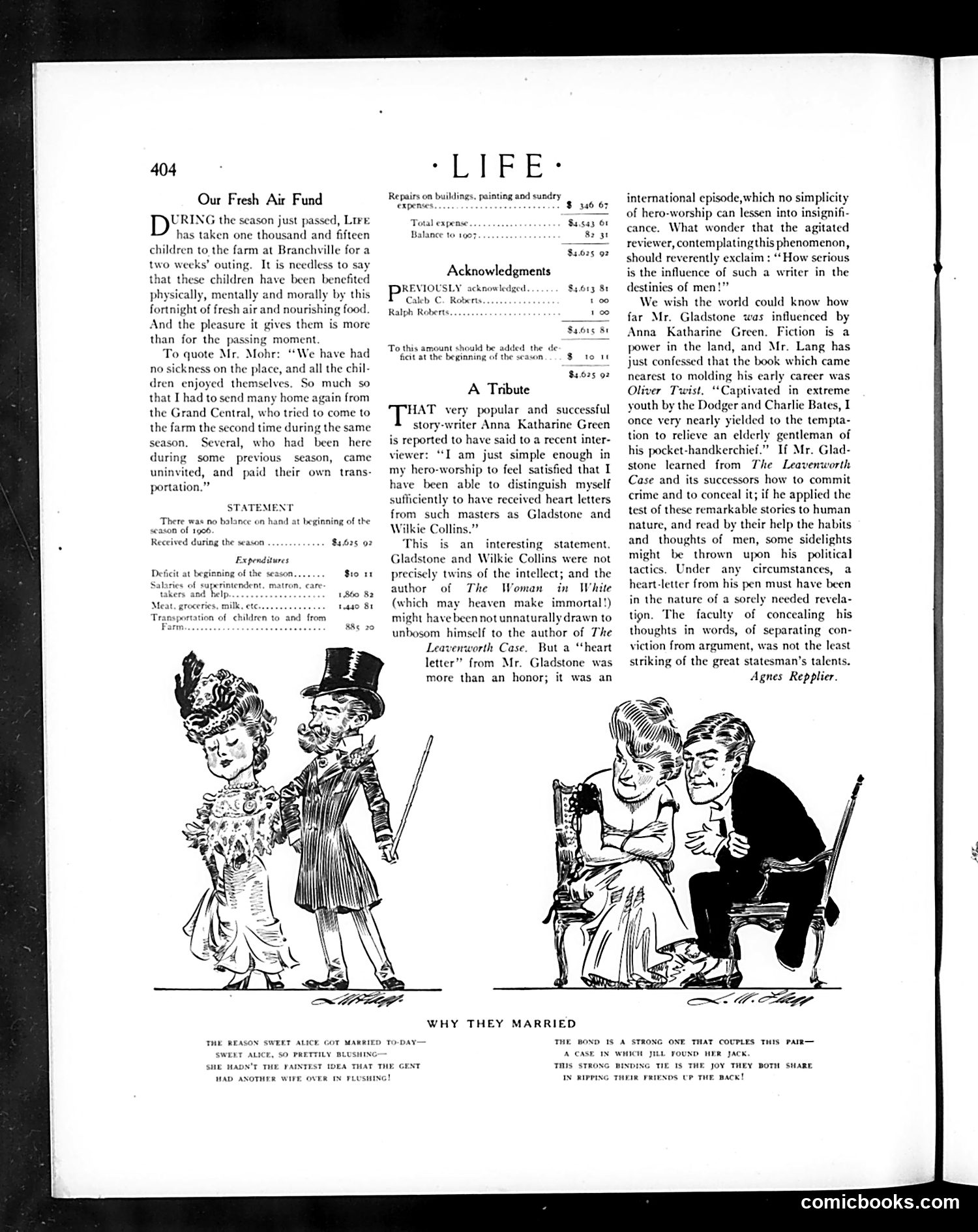
This page contains editorial content and two satirical cartoons titled "Why They Married." The upper sections discuss a "Fresh Air Fund" for children and include acknowledgments and a tribute to author Anna Katharine Green, noting her influence on crime fiction writers like Gladstone and Wilkie Collins. The two cartoon panels at bottom use exaggerated caricature to humorously explain marriage motivations. The left panel shows a wealthy couple—a fashionably dressed woman and a man in formal wear—suggesting marriage based on material advantage. The right panel depicts a simpler couple, implying their bond is emotional connection rather than wealth. The captions beneath emphasize contrasting motivations: one marriage driven by financial incentive ("the gent had another rich wife over in flushing"), the other by genuine affection ("the joy they both share in riffing their friends of the backs").
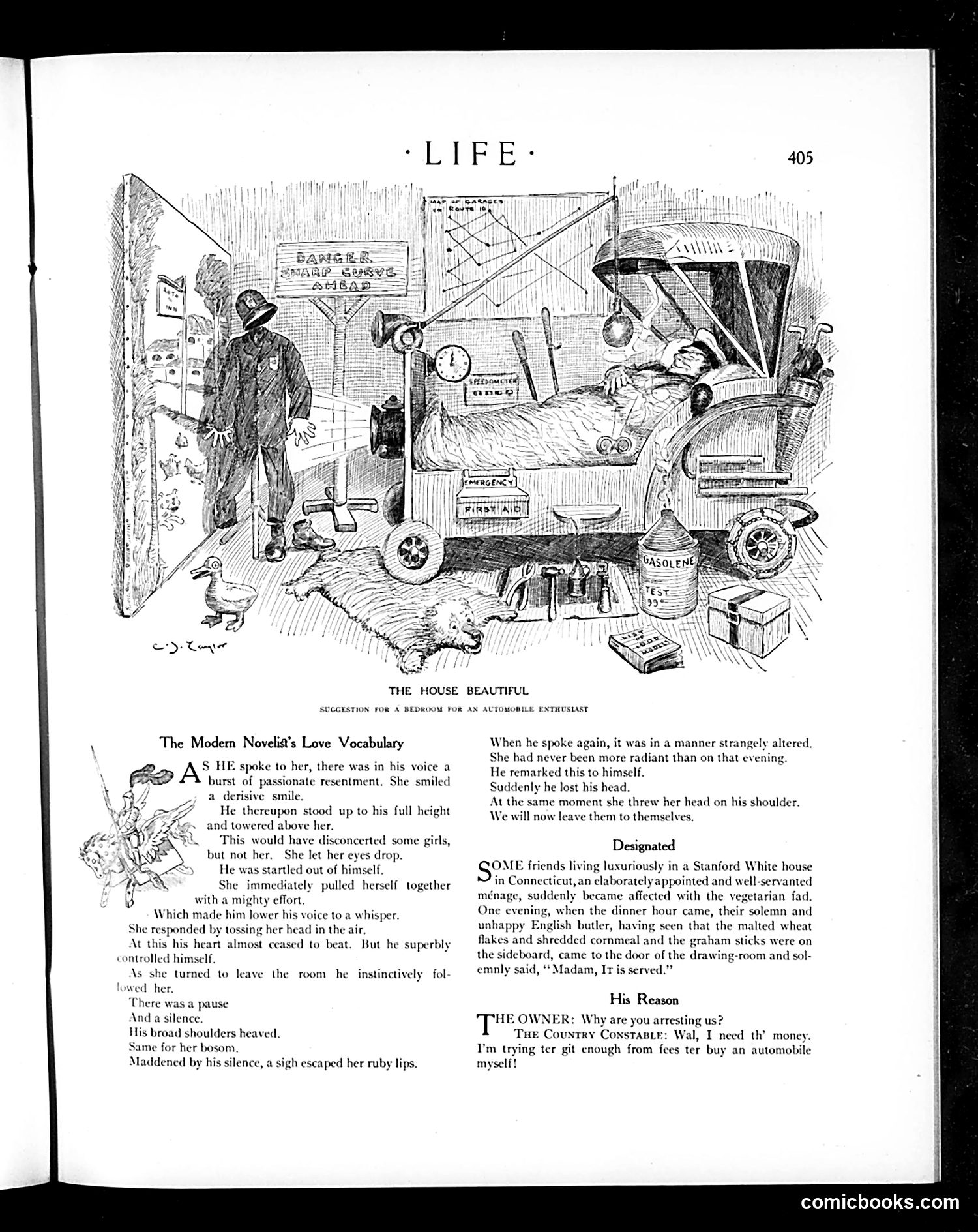
**Top Cartoon: "The House Beautiful"** A satirical illustration subtitled "Suggestion for a Bedroom for an Automobile Enthusiast." The drawing depicts a bedroom completely overtaken by automobile parts, tools, and equipment—bed, nightstands, and storage all integrated with car mechanics. A figure stands in the doorway amid the chaos. The joke mocks wealthy automobile enthusiasts of the early 20th century whose obsession with cars has consumed their domestic life entirely. It's social satire about how new technology and hobbyist passion can dominate and displace normal living. **Lower Content:** Three separate short literary pieces: "The Modern Novelist's Love Vocabulary" (poetic prose), "Designated" (a brief narrative), and "His Reason" (a dialogue joke about a constable arresting someone for trying to steal money for an automobile).
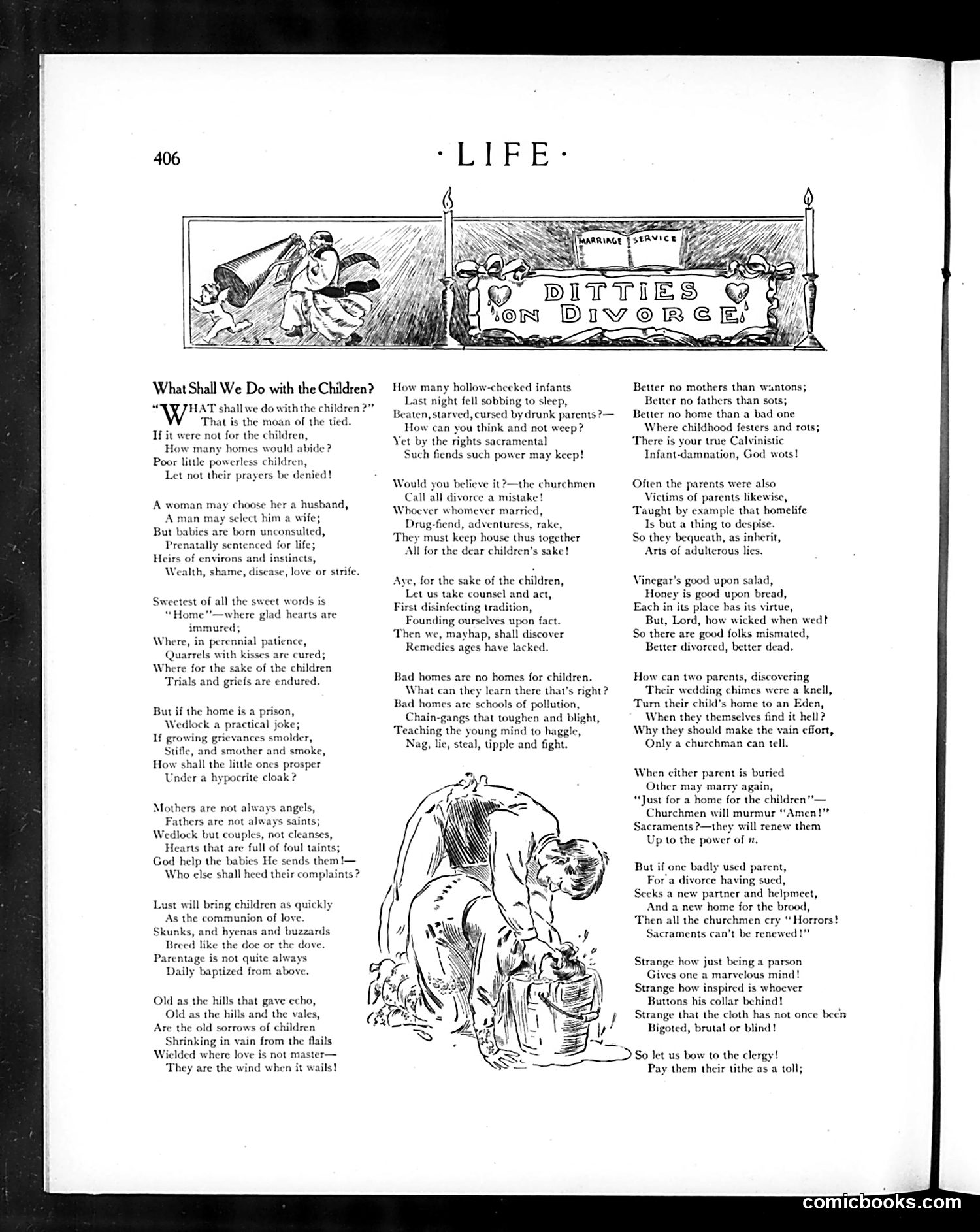
This page satirizes divorce and its effects on children through a poem titled "What Shall We Do with the Children?" The illustrated header shows cherubs with divorce-related imagery, establishing the topic. The satire argues that divorce harms children more than parental imperfection. It critiques the era's growing acceptance of divorce, presenting it as selfish. Key points include: children are "victims of parents likewise," divorce leaves them without stable homes or proper moral instruction, and remarriage offers false solutions since "Sacraments can't be renewed." The central illustration depicts a troubled child, emphasizing emotional damage. The satire ultimately urges clergy to discourage divorce, suggesting financial support ("tithe") is preferable to family dissolution—reflecting conservative Victorian attitudes toward marriage and children's welfare.
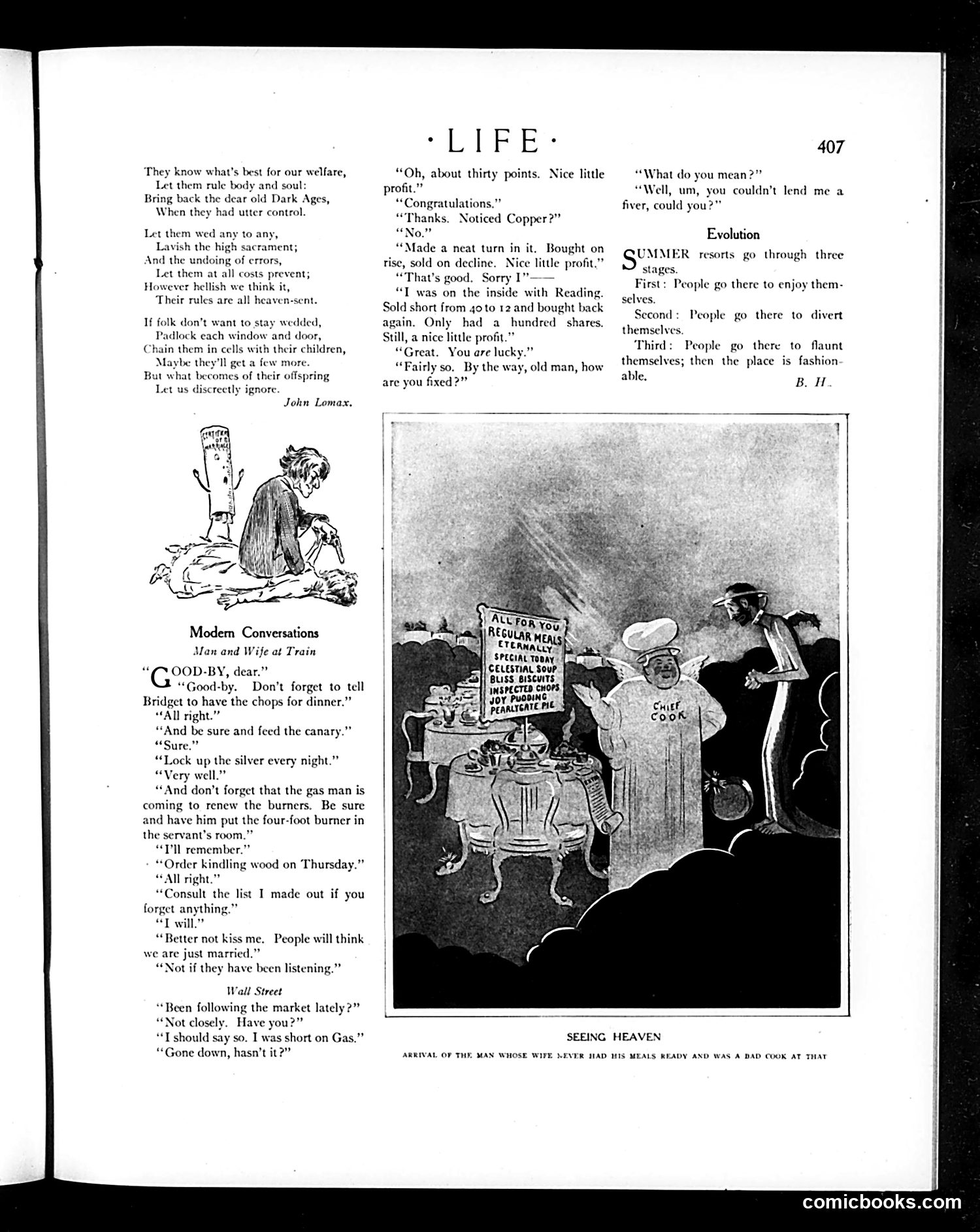
This page contains three distinct satirical pieces: 1. **John Lomax poem** (top left): A verse criticizing those who claim superior knowledge about social welfare while ignoring personal responsibilities—a jab at self-righteous reformers. 2. **"Modern Conversations: Man and Wife at Train"** (middle left): Humorous dialogue where a departing husband gives his wife extensive household instructions (chops, canary, silver, gas burner, kindling, etc.), ending with her sarcastic plea not to kiss publicly. The satire mocks husbands' controlling micromanagement and the assumption that wives need such detailed guidance. 3. **"Seeing Heaven" cartoon** (large right image): Shows a deceased man arriving in heaven, met by St. Peter at a table advertising "All for You" meals. The caption reveals the joke's bitter humor: the man's wife never prepared ready meals, making heaven's food service ironically appealing—satirizing poor domestic cooking.
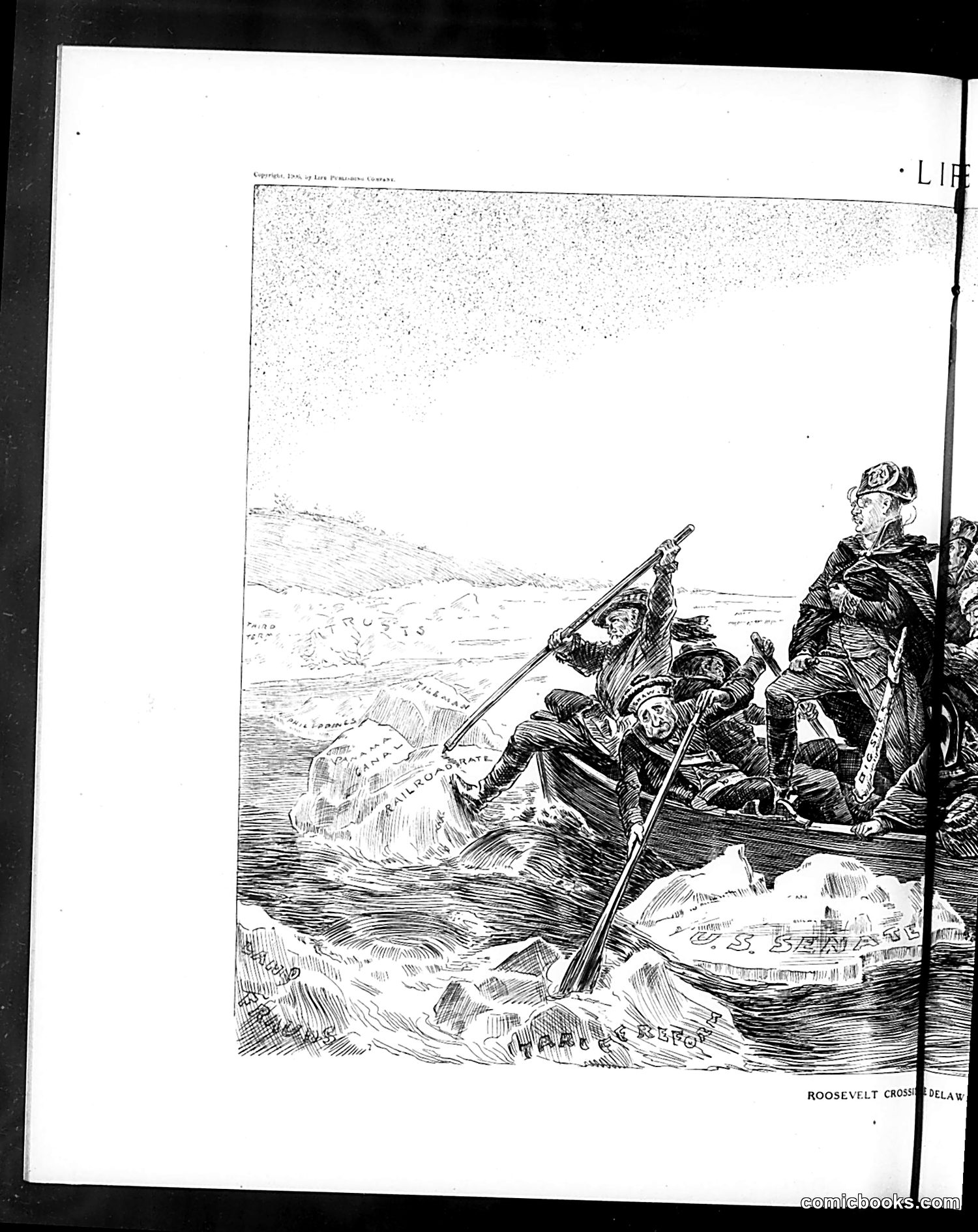
This political cartoon depicts **Theodore Roosevelt crossing the Delaware River**, referencing George Washington's famous 1776 crossing. The engraving shows Roosevelt as a military/political leader with soldiers, mimicking the iconic historical image. The satire likely comments on Roosevelt's **political ambitions or military adventurism** during his presidency (1901-1909) or subsequent career. The reference to Washington's heroic crossing suggests the cartoonist is either **praising Roosevelt as a great leader** following in Washington's footsteps, or **mocking his grandiose self-image** and political posturing. The caption reads "Roosevelt Crosses Delaware," making the historical comparison explicit. Without the publication date visible, the specific political event being referenced remains unclear, though it relates to a significant moment in Roosevelt's public prominence.
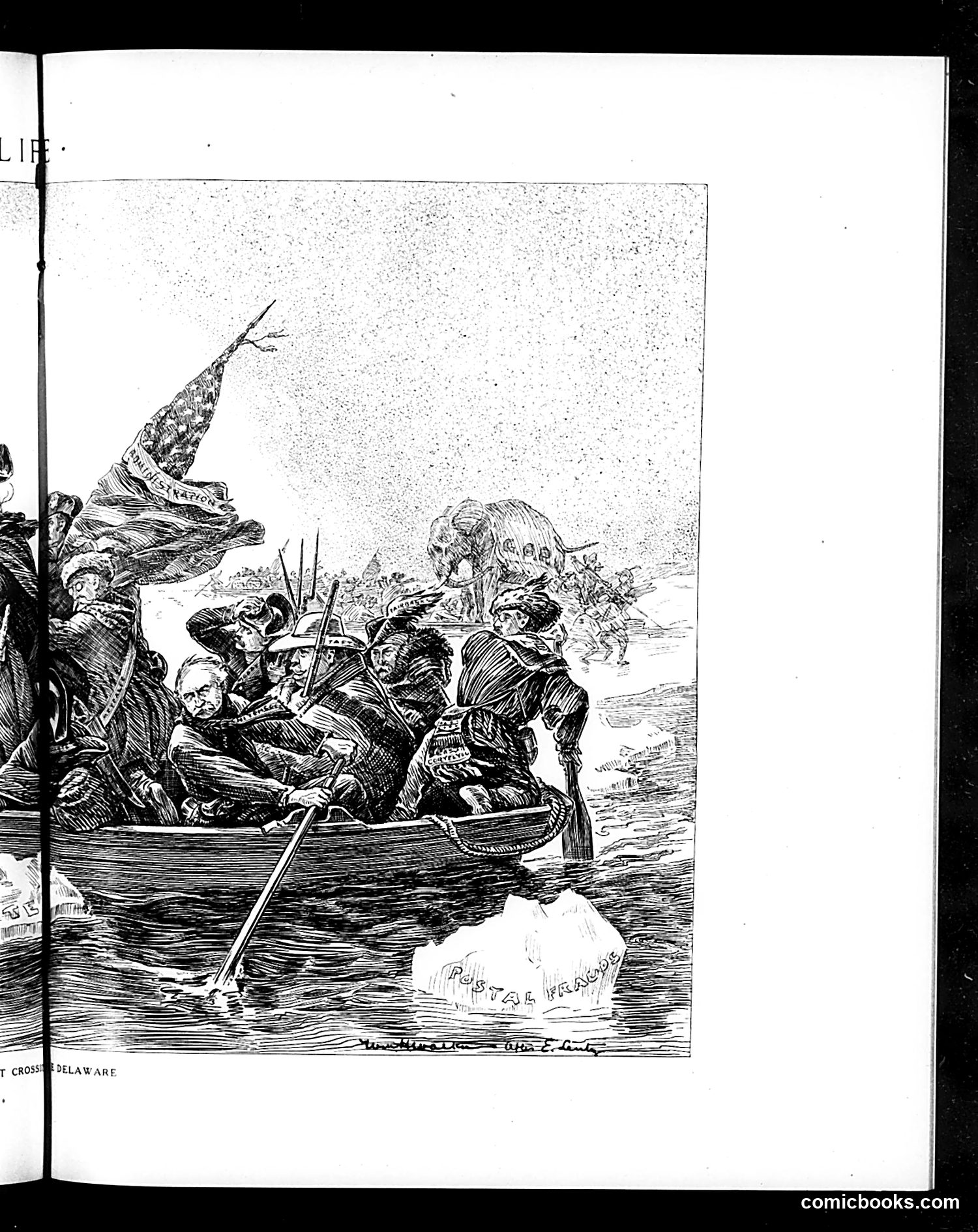
This engraving depicts **Washington Crossing the Delaware**, the famous Revolutionary War scene. The satire appears to be political commentary, likely from the late 19th or early 20th century, repurposing this iconic American image for contemporary critique. The boat contains soldiers in period military dress, with a prominent flag visible. A rock in the water bears text (partially legible as "POSTAL FRAUD" or similar), suggesting the cartoon uses this heroic historical moment to mock current political scandal or corruption. By juxtaposing noble Revolutionary imagery with contemporary malfeasance, Life magazine's cartoonists created ironic commentary—implying modern leaders betrayed founding ideals. The exact scandal referenced is unclear from visible text, but the technique weaponizes patriotic symbolism against government wrongdoing.
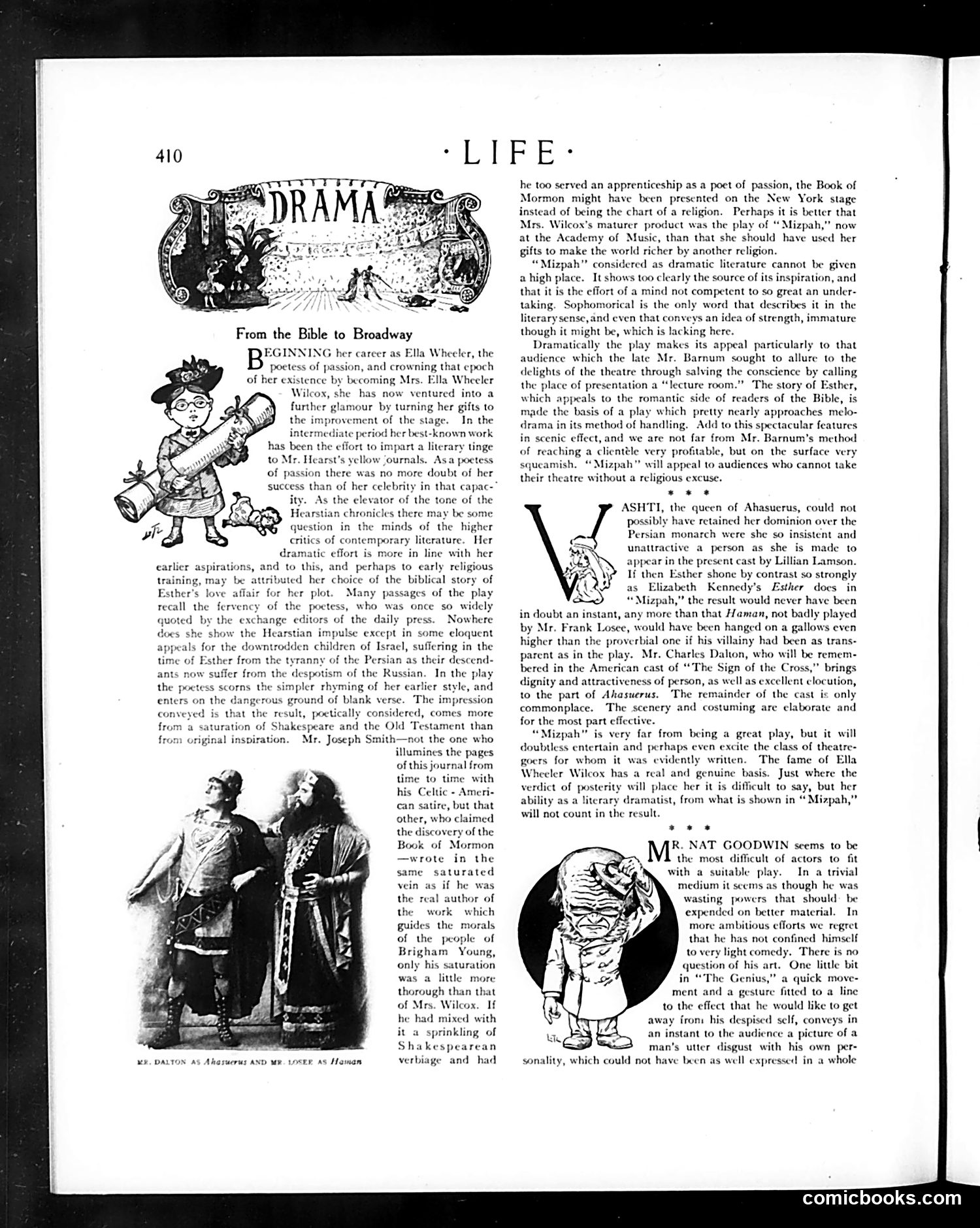
This page reviews Ella Wheeler Wilcox's play "Mizpah," adapted from the biblical Book of Esther. The photograph shows actors Mr. Dalton (as King Ahasuerus) and Mr. Loser (as Haman). Life magazine satirizes Wilcox's career trajectory—from "poetess of passion" to journalist for Hearst's newspapers to playwright—suggesting each phase represented diminishing artistic credibility. The review dismisses "Mizpah" as dramatically incompetent, "sophomoric," and melodramatic, comparing it unfavorably even to Joseph Smith's Book of Mormon. The core satire: Wilcox uses religious subject matter to appeal to audiences seeking moral respectability for theater-going, echoing P.T. Barnum's strategy of marketing entertainment as "lecture rooms" to attract conscience-stricken patrons. The implicit criticism is that the play succeeds commercially through pious packaging rather than genuine artistic merit.
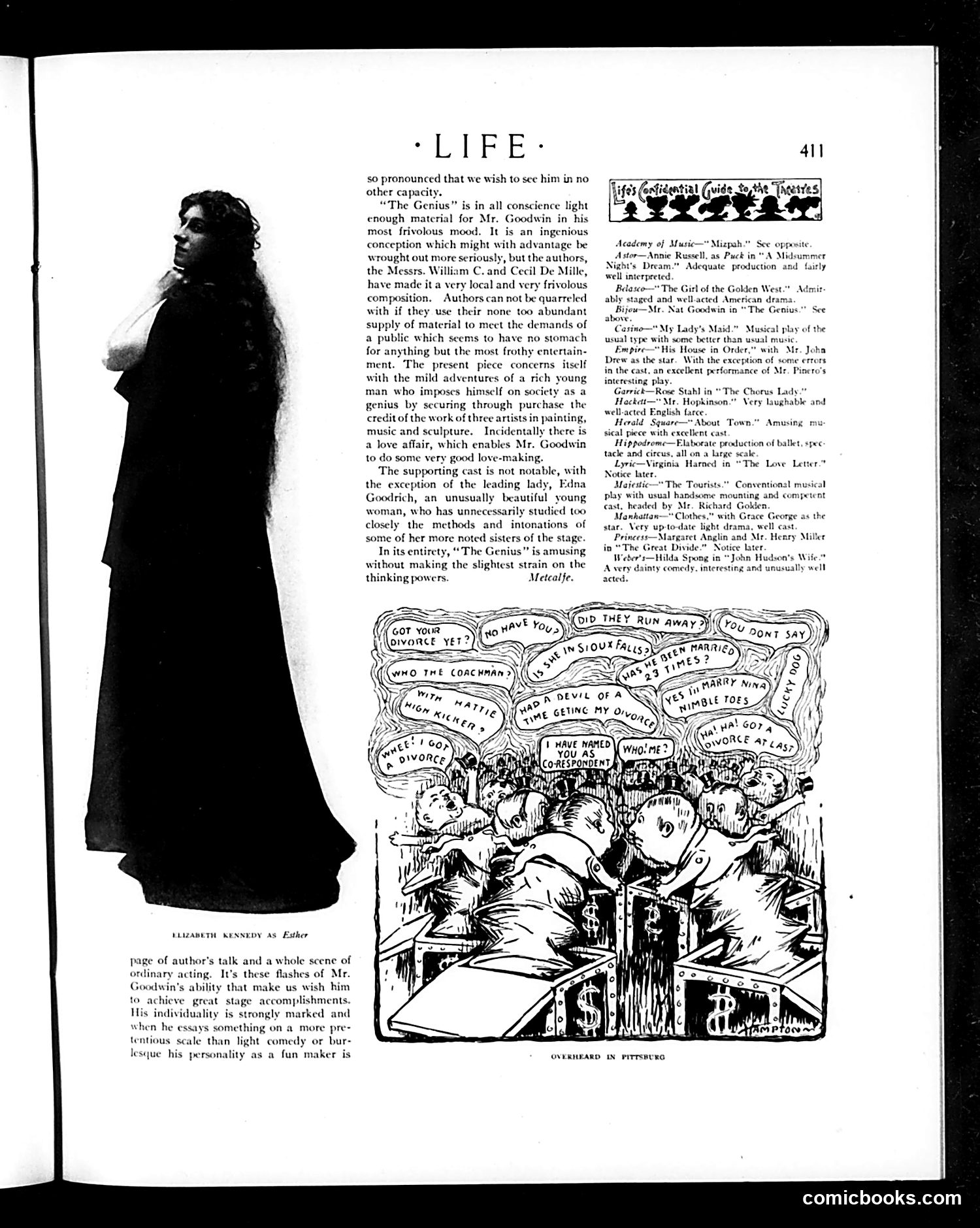
This page reviews a Broadway play called "The Genius" starring Nat Goodwin. The text criticizes the production as lightweight entertainment—a farce about a wealthy man who fraudulently claims credit for artists' work to impress society. The reviewer (Metcalue) finds it amusing but intellectually undemanding, though praising Goodwin's comedic talents and leading lady Edna Goodrich. The cartoon at bottom, captioned "Overheard in Pittsburgh," satirizes contemporary divorce proceedings. Speech bubbles show people gossiping about scandalous marital affairs—mentions of "correspondents" (co-respondents in adultery cases), divorce settlements, and infidelity. This reflects early 1900s society's fascination with high-profile divorce cases, which were public spectacles requiring evidence of infidelity. The cartoon mocks how eagerly ordinary people discussed such scandals, revealing the era's obsession with marital misconduct litigation.
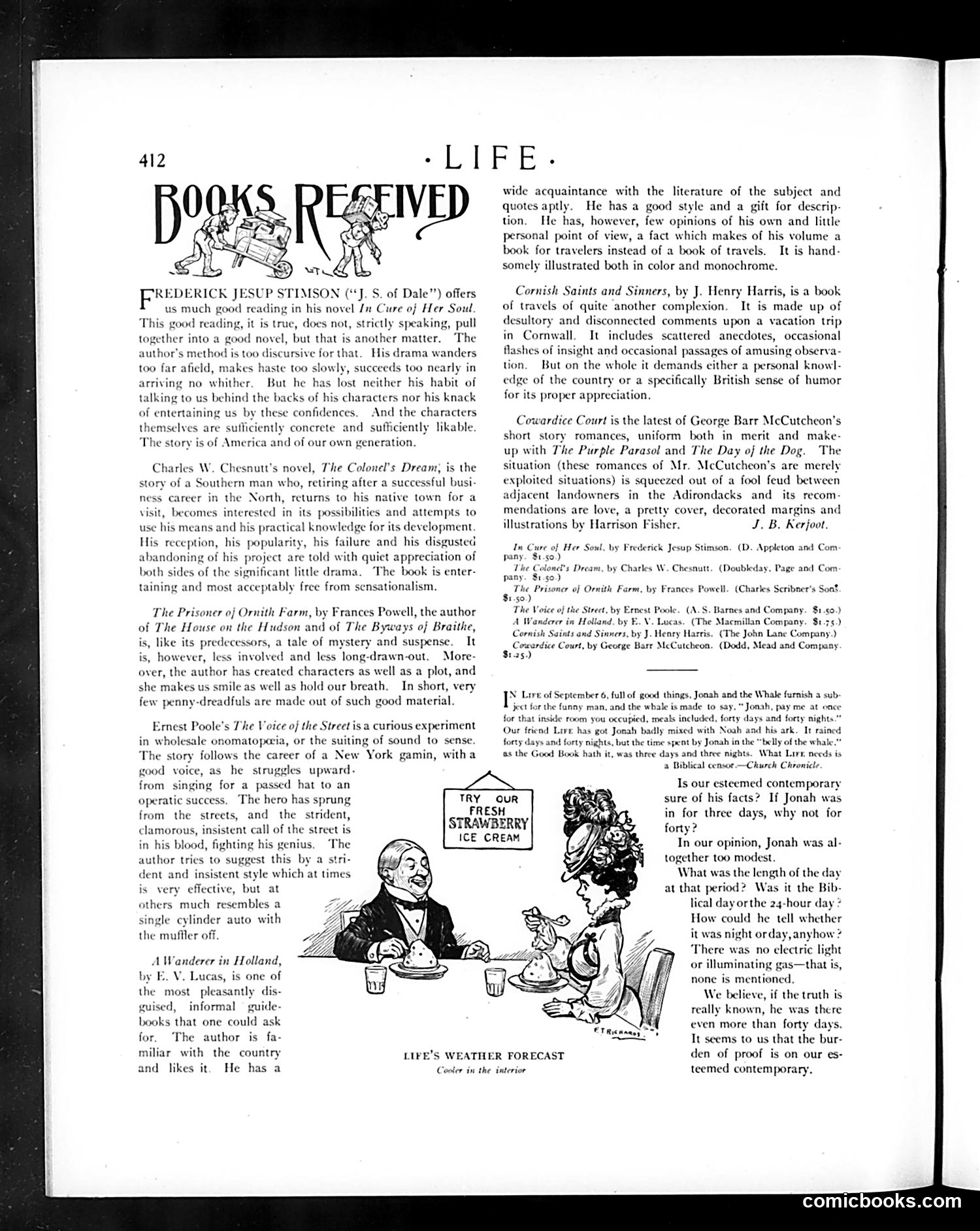
This satirical cartoon appears in Life magazine's "Books Received" section and serves as a humorous visual commentary on contemporary life. The illustration depicts two figures at what appears to be an ice cream parlor—one well-dressed gentleman and a woman—with a sign advertising "Fresh Strawberry Ice Cream." The caption "Life's Weather Forecast" (subtitled "Cooler in the interior") is the joke's pivot point. Rather than an actual meteorological forecast, it's a pun: the "interior" refers to the man's romantic prospects or emotional state growing "cooler" as he sits with the woman, suggesting relationship complications or romantic disappointment ahead. The strawberry ice cream adds to the sweetness-to-coolness contrast. This type of gentle, domestic humor was typical of Life magazine's satirical approach to modern American social situations and romantic entanglements.
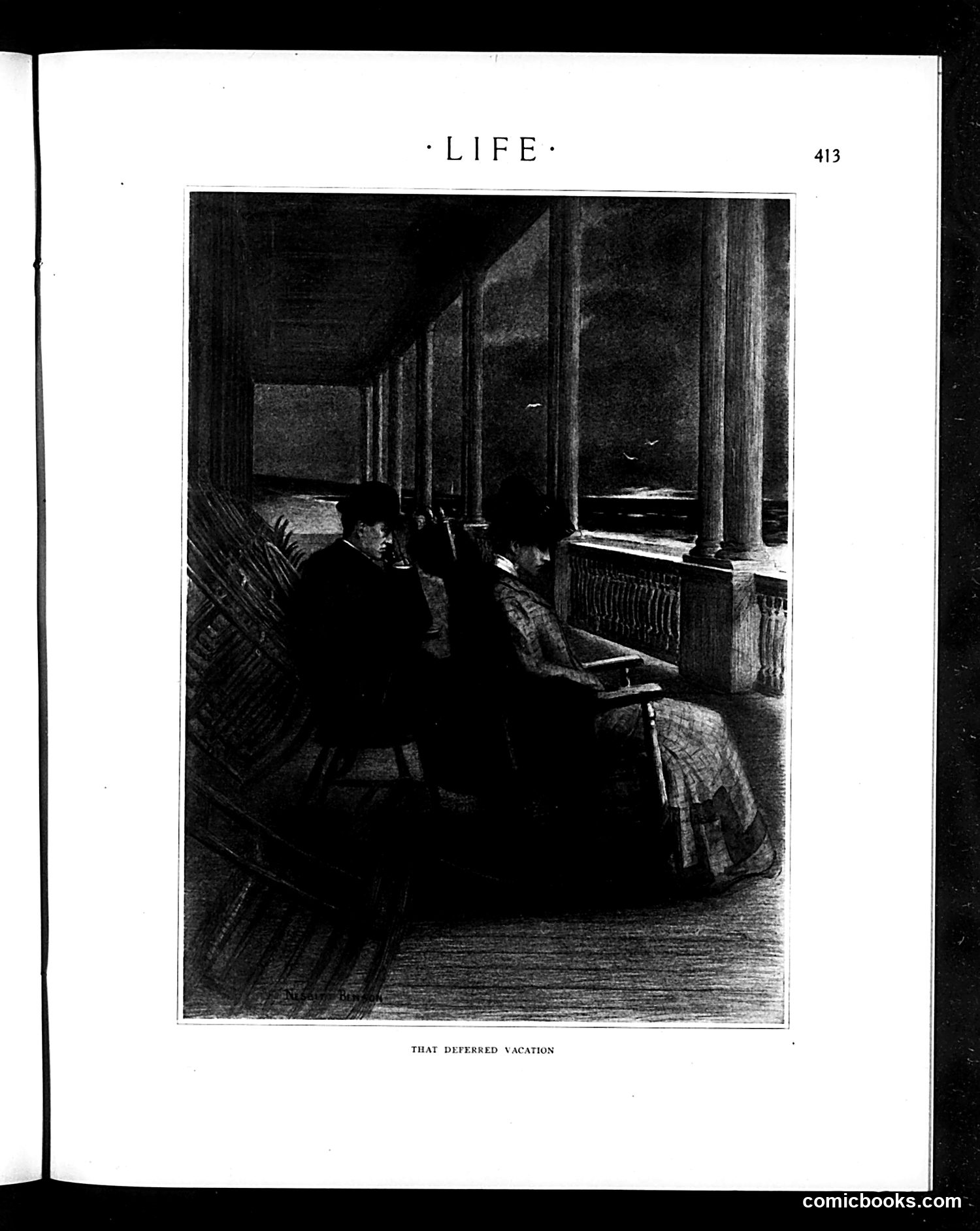
This illustration depicts several people sitting in a covered veranda or colonnade, gazing out through columns toward what appears to be an open landscape or seascape. The title "That Deferred Vacation" suggests satire about postponed travel plans. The darkly-rendered scene, with its contemplative figures looking outward, likely comments on Americans unable to take vacations—possibly due to wartime rationing, economic constraints, or work obligations. The composition emphasizes the gap between desire (the open view) and restriction (the enclosed space). Without additional context about the specific publication date, I cannot identify which historical period's vacation-limiting circumstances this targets, though the artistic style suggests early-to-mid 20th century.
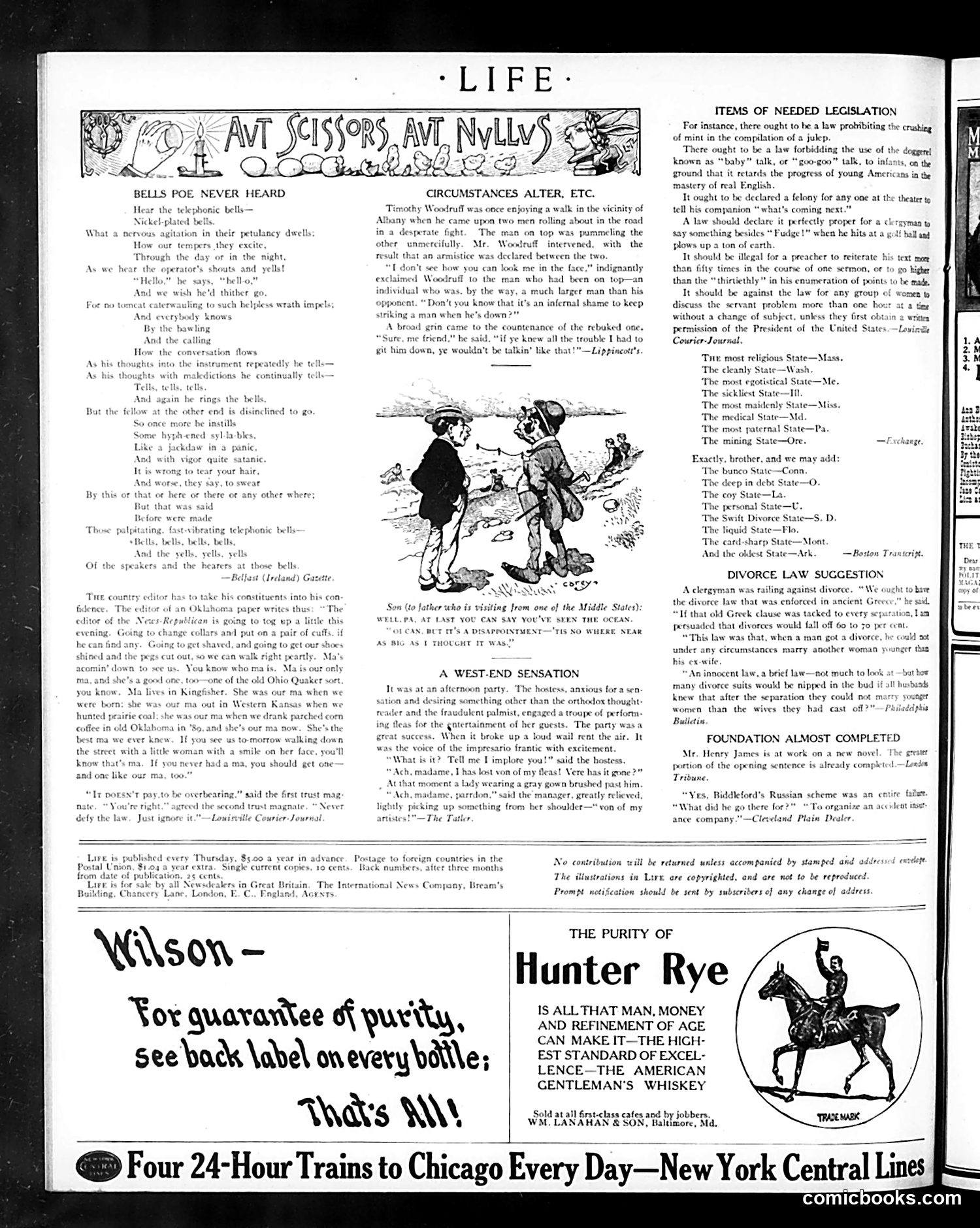
This page from Life magazine contains several satirical pieces targeting American social and political issues of the era: **"Bells Poe Never Heard"** is a humorous poem mocking the proliferation of telephone bells—a modern annoyance that disrupts daily life. **"Circumstances Alter, Etc."** presents an anecdote about Timothy Woodruff intervening in a street fight, satirizing class dynamics and social propriety through the larger man's justified indignation at being struck while down. **"A West-End Sensation"** appears to mock theatrical pretension and elaborate entertainments. **"Items of Needed Legislation"** is a satirical list proposing absurd laws addressing modern social irritations: baby-talk, theater etiquette, sermon repetition, and servant problems—reflecting middle-class anxieties about linguistic standards and social conduct. **"Divorce Law Suggestion"** satirizes both clerical moralizing about divorce and proposes an ancient Greek law preventing remarriage as deterrent, mocking both religious hypocrisy and legislative thinking. The advertisements for Wilson whiskey and New York Central trains frame the page's commercial context.
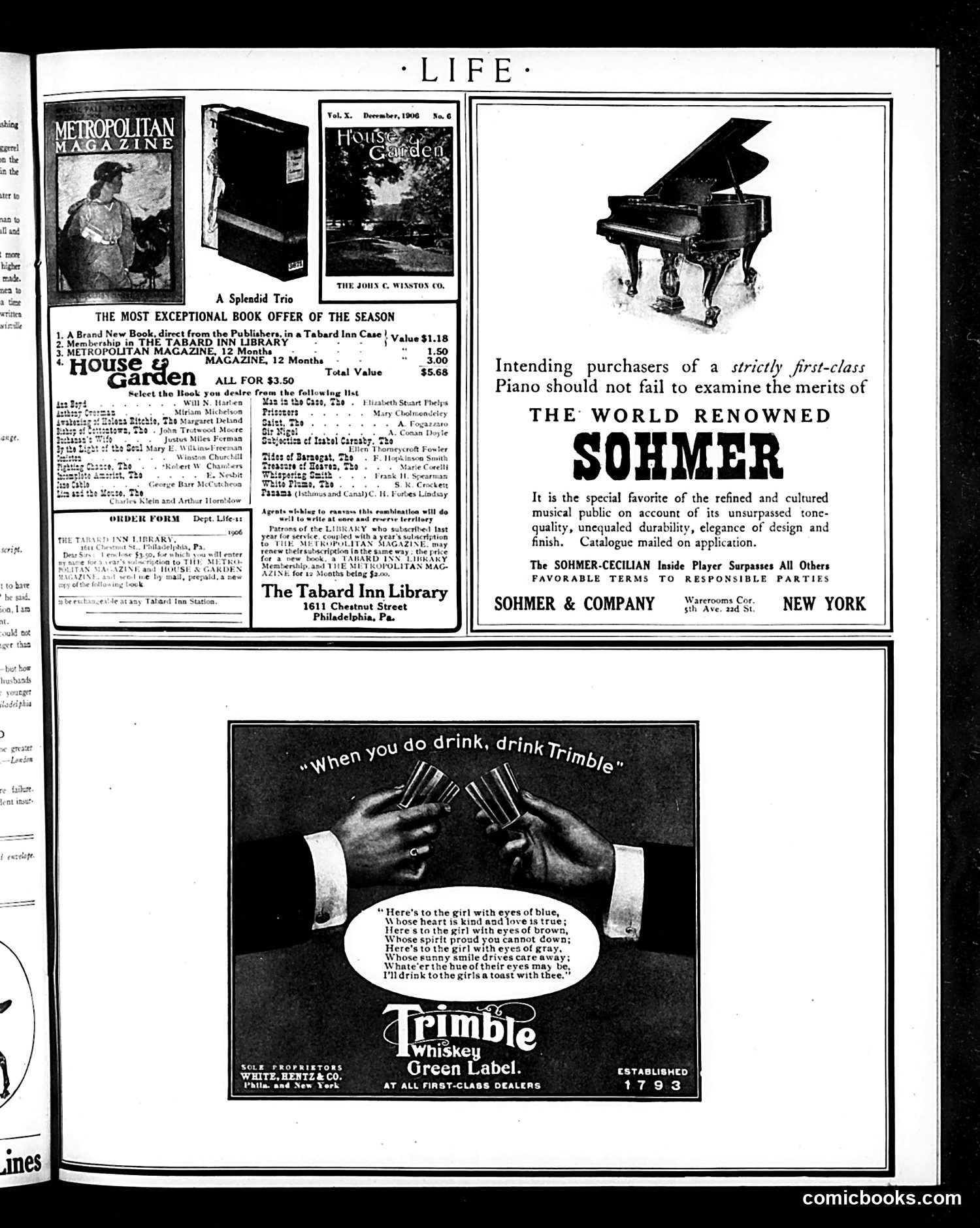
This is primarily an **advertising page** rather than satirical content. The page contains three separate advertisements: 1. **Top left**: A book bundle offer from the Tabard Inn Library, promoting Metropolitan Magazine and House and Garden magazine alongside a new book. 2. **Top right**: A Sohmer piano advertisement targeting wealthy, "refined and cultured" consumers, emphasizing quality and offering favorable payment terms. 3. **Bottom**: A Trimble Whiskey "Green Label" advertisement featuring two men toasting with a romantic verse about girls with different eye colors. The tagline "When you do drink, drink Trimble" promotes the brand as a choice beverage. The whiskey ad is the closest to satirical content, using sentimental romanticism to sell alcohol—a common early 20th-century marketing approach. The overall page reflects period advertising targeting middle-to-upper-class consumers with disposable income for luxury goods and subscriptions.
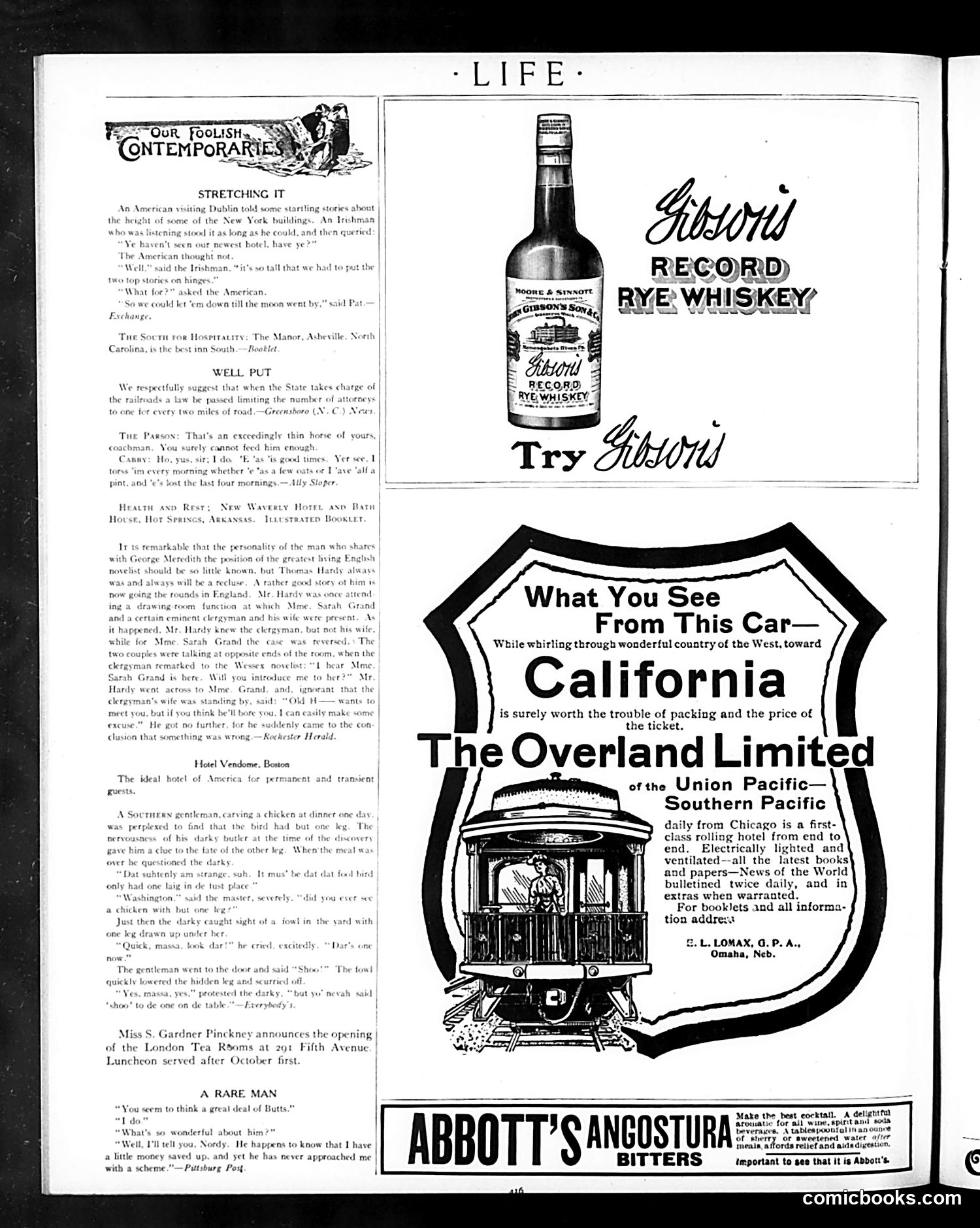
This page from *Life* magazine consists primarily of **short humorous anecdotes** under the "Our Foolishness: Contemporaries" section, interspersed with **advertisements**. The jokes satirize various American social pretensions and absurdities: - "Stretching It" mocks an American tourist in Dublin exaggerating a story's length - "Well Put" jokes about railroad regulation—suggesting lawyers would proliferate if states controlled railroads - "The South for Hospitality" and other brief items poke fun at regional boasting and social conventions - "A Rare Man" jokes about a man's blind devotion to a friend named Butts The **advertisements** (Gilbey's Rye Whiskey, The Overland Limited train, Abbott's Angostura Bitters) represent period luxury goods and travel services. The content reflects early 20th-century American humor: gentle satire of regional pride, immigrant misadventures, social climbing, and male friendship. These are light, domestic jokes rather than political cartoons.
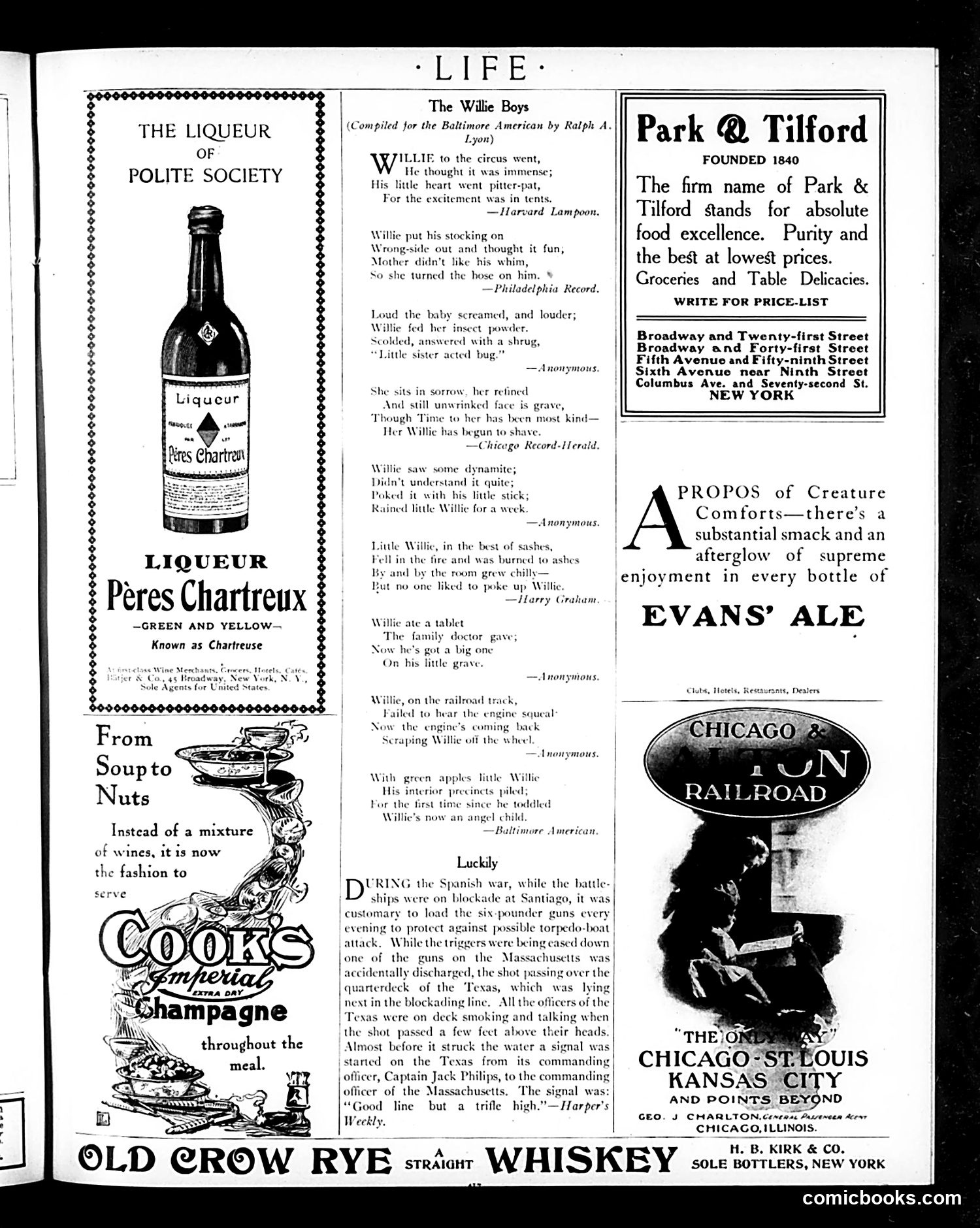
This page features a serialized poem collection titled "The Willie Boys," compiled for the *Baltimore American*. It's a series of darkly comedic short verses about a child named Willie meeting increasingly gruesome fates. The humor is *gallows comedy* — each stanza depicts Willie dying or suffering in absurd ways: getting burned in a fire, struck by a train, poisoned by a tablet, exploding after poking dynamite. The final verses show his mother grief-stricken watching him grow up to shave, then mourn at his grave. This represents **turn-of-the-century American newspaper humor** that relied on morbid, violent jokes about children — content that would be considered deeply inappropriate today. The verses were attributed to various newspapers and humorists, suggesting this was a popular, syndicated form of dark comic entertainment. The page is otherwise filled with period advertisements for liquor, railroads, and food products.
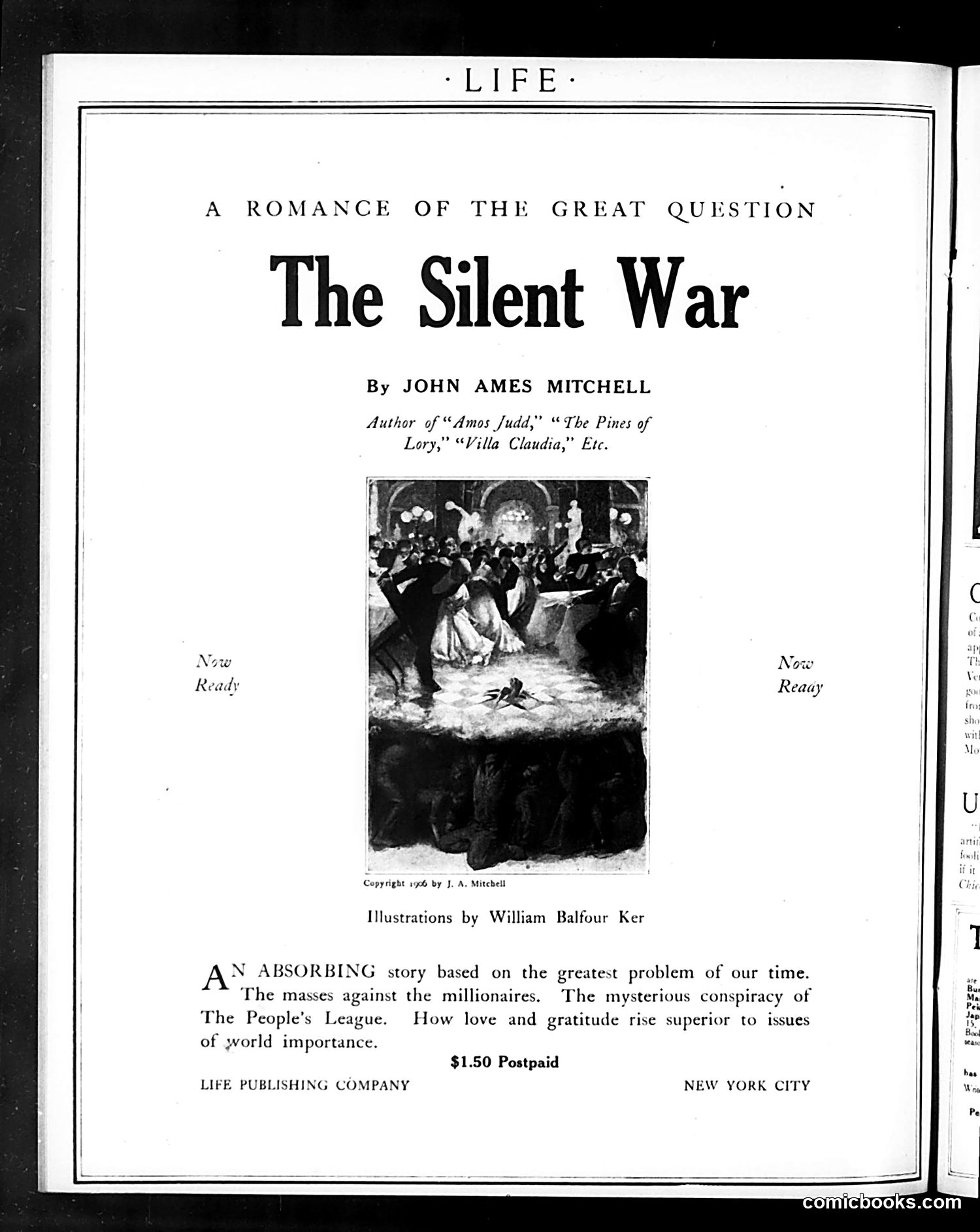
This is a **title page advertisement** for John James Mitchell's novel, not a political cartoon. It's promoting a serialized story appearing in *Life* magazine. The illustration depicts an elegant ballroom scene with formally dressed figures, suggesting high society. The novel's premise addresses class conflict—"the masses against the millionaires"—a central concern of the Progressive Era (early 1900s). The subtitle mentions "The People's League," an apparent reference to contemporary labor or reform movements challenging wealthy elites. The advertisement's framing is somewhat ironic: it promises an "absorbing story" about class struggle while emphasizing that "love and gratitude rise superior to issues of world importance"—suggesting the narrative ultimately prioritizes personal sentiment over radical social change. This reflects *Life*'s satirical sensibility toward both social reformers and the privileged classes. The price ($1.50) and copyright date (1906) indicate this is early-20th-century material addressing anxieties about wealth inequality and social upheaval.
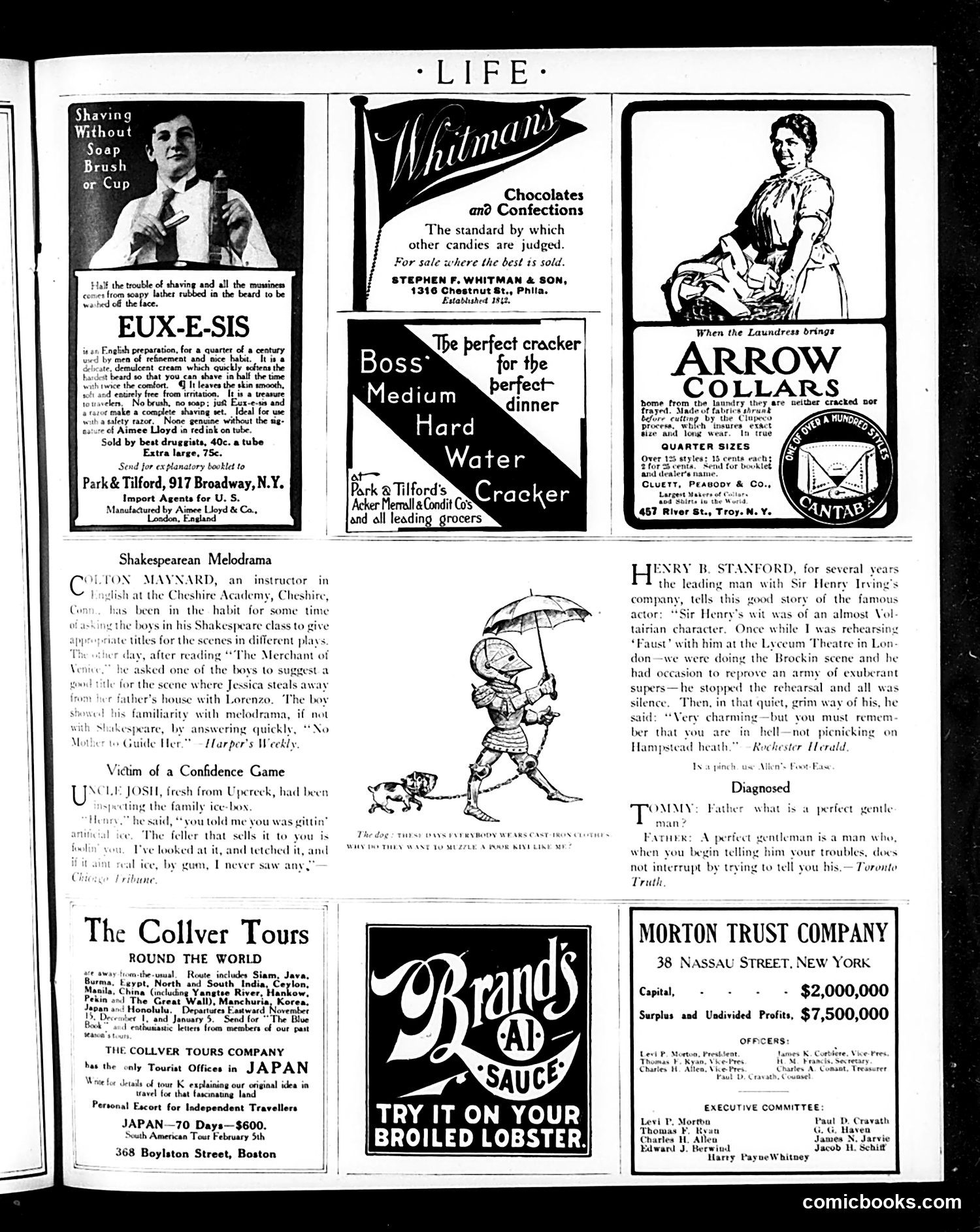
This page is primarily **advertising with ancillary humor content**—typical of early 20th-century Life magazine's mixed format. The advertisements dominate: shaving cream (Eux-E-Sis), chocolates (Whitman), crackers (Boss), collars (Arrow), world tours, and financial services (Morton Trust Company). These are straightforward commercial pitches with no satirical intent. The humor pieces are brief anecdotes: - **"Shakespearean Melodrama"**: A schoolteacher's students mishear "No Muzzle to Guide Her" as a stage direction—a gentle joke about theatrical misunderstanding. - **"Victim of a Confidence Game"**: A rural character (Uncle Josh) is confused by ice delivery terminology, conflating the seller's deception with the product itself—plays on rural/urban cultural gaps. - **"Diagnosed"**: A father defines a gentleman as someone who doesn't interrupt with their own troubles—mild social commentary on conversational etiquette. These are character-driven vignettes rather than political satire. The page reflects Life's early editorial mixture: advertisements funding light, domestic humor pieces with no larger social critique.
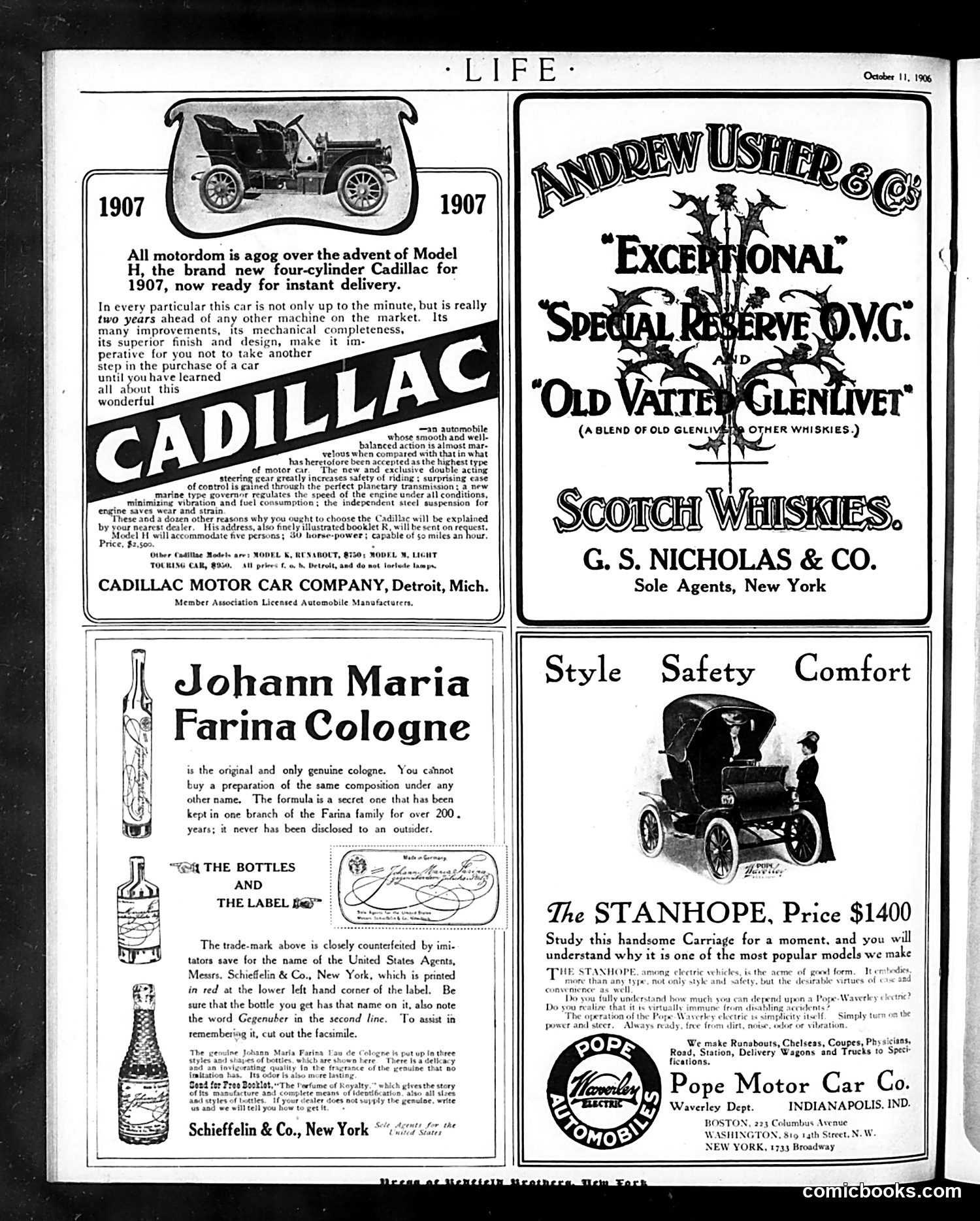
This page contains **no political cartoons or satire**—it is primarily advertising. The page features four product advertisements: 1. **Cadillac Model H automobile** (1907)—promoting a new four-cylinder car as technologically superior to competitors, emphasizing features like steering mechanism and engine efficiency. 2. **Andrew Usher Scotch Whiskies**—advertising three whiskey brands through G.S. Nicholas & Co., New York. 3. **Johann Maria Farina Cologne**—warning against counterfeits while promoting an "original and only genuine" product with a 200-year-old family formula, emphasizing the importance of checking labels and bottle authenticity. 4. **Pope Motor Car Company's Stanhope carriage** (electric vehicle)—highlighting style, safety, and comfort features at $1,400. The page reflects early 1900s consumer culture: automobiles (both gasoline and electric) competing for adoption, luxury goods marketed through heritage claims, and anti-counterfeiting messaging addressing widespread product imitation problems of the era.