
Life, 1906-10-11 · page 10 of 24
Life — October 11, 1906 — page 10: what you’re looking at
What you’re looking at
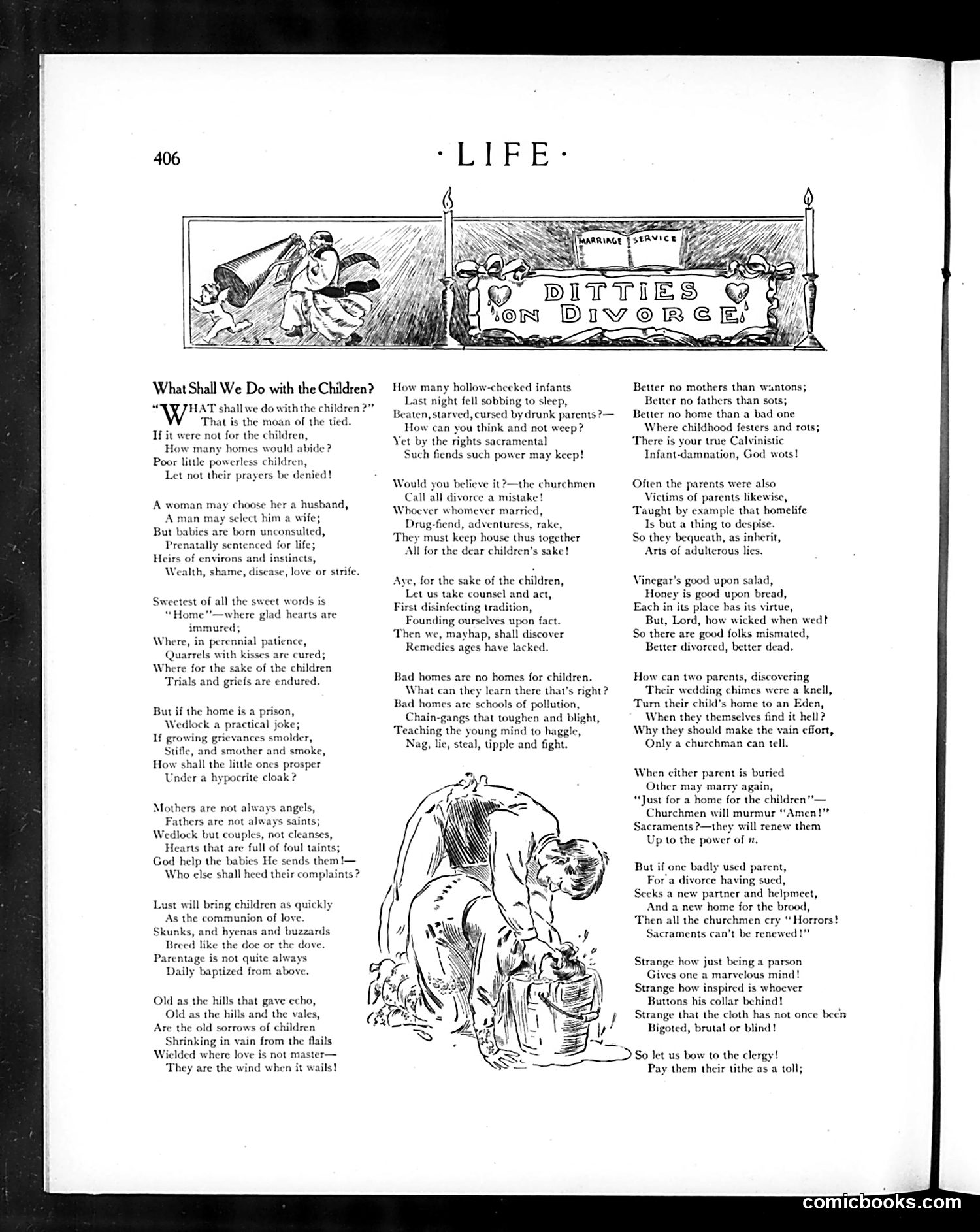
This page satirizes divorce and its effects on children through a poem titled "What Shall We Do with the Children?" The illustrated header shows cherubs with divorce-related imagery, establishing the topic. The satire argues that divorce harms children more than parental imperfection. It critiques the era's growing acceptance of divorce, presenting it as selfish. Key points include: children are "victims of parents likewise," divorce leaves them without stable homes or proper moral instruction, and remarriage offers false solutions since "Sacraments can't be renewed." The central illustration depicts a troubled child, emphasizing emotional damage. The satire ultimately urges clergy to discourage divorce, suggesting financial support ("tithe") is preferable to family dissolution—reflecting conservative Victorian attitudes toward marriage and children's welfare.
📄 Transcribed text from this page (OCR, searchable)
Machine-transcribed from the original scan — historical spelling and the odd misread are preserved.
RRINGE | a seawnce TIES Y DIvORGE ‘What Shall We Do with the Children? “UY HAT shall we do with the children?” That is the moan of the tied. If it were not for the children, How many homes would abide? Poor little powerless children, Let not their prayers be denied! A woman may choose her a husband, elect him a wife re born unconsulted, Prenatally sentenced for life; Heirs of environs and instincts, Wealth, shame, disease, love or strife. Sweetest of all the sweet words is “Home"—where glad hearts are immured; Where, in perennial patience Quarrels with kisses are cured; Where for the sake of the children Trials and gricis are endured. But if the home is a prison, Wedlock a practical If growing grievances smolder, Stifle, and smother and smoke, How shall the little ones prosper Under a hypocrite cloak? Mothers are not always ange Fathers are not always saints; Wedlock but couples, not cleanses, Hearts that are full of foul taints; God help the babies He sends them! Who else shall heed their complaints? Lust will bring children as quickly As the communion of love. Skunks, and hyenas and buzzards Breed like the doc or the dove. Pare is not quite always Daily baptized from above. Old as the hills that gave echo, Old as the hills and the vales, Are the old sorrows of children rinking in vain from the flails Wiclded where love is not master— ‘They are the wind when it wails! Last night fell sobbing to sleep, Beaten, starved, cursed by drunk parents ?— How can you think and not weep? Yet by the rights sacramental Such fiends such power may keep! Would you believe it?—the churchmen Call all divorce a mistake! Whoever whomever married, Drug-fiend, adventures, rake, They must keep house thus together All for the dear children’s sake! Aye, for the sake of the children, Let us take counsel and act, First disinfecting tradition, Founding ourselves upon fact. Then we, mayhap, shall discover Remedies ages have lacked. Bad homes are no homes for children. What can they learn there that’s right? Bad homes are schools of pollution, Chain-gangs that toughen and blight, aching the young mind to haggle, Nag, lie, steal, tipple and fight. Better no mothers than wantons; Better no fathers than sots; Better no home than a bad one Where childhood festers and rots; ‘There is your true Calvinistic Infant-damnation, God wots! Often the parents were also Victims of parents likewise, Taught by example that homelife Is but a thing to despise. So they bequeath, as inherit, Arts of adulterous lies. Vinegar’s good upon salad, Honey is good upon bread, Each in its place has its virtue, But, Lord, how wicked when wedt So there are good folks mismated, Better divorced, better dead. How can two parents, discovering Their wedding chimes were a knell, Tum their child’s home to an Eden, When they themselves find it hell ? Why they should make the vain effort, Only a churchman can tell. When cither parent is buried Other may marry again, “Just for a home for the children"— Churchmen will murmur “Amen!’? Sacraments ?—they will renew them Up to the power of , But if one badly used parent, For a divorce having sued, sa new partner and helpmeet, And a new home for the brood, ‘Then all the churchmen cry “Horrors! Sacraments can’t be renewed !”” Strange how just being a parson Gives one a marvelous mind! Strange how inspired is whocver Buttons his collar behind! Strange that the cloth has not once been Bigoted, brutal or blind! = BD let us bow to the clergy! Pay them their tithe as a toll; comicbooks.com