
Life, 1906-10-11 · page 16 of 24
Life — October 11, 1906 — page 16: what you’re looking at
What you’re looking at
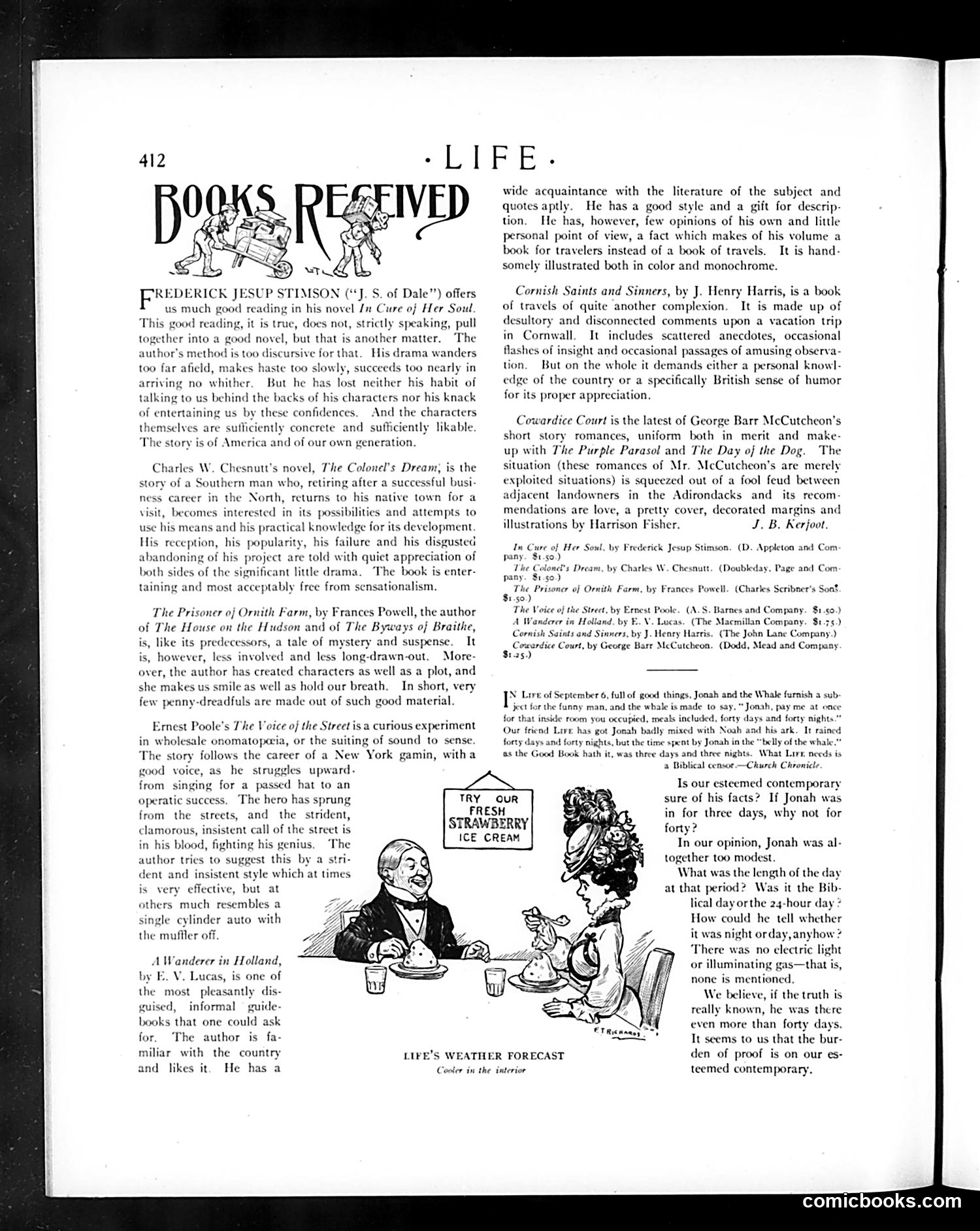
This satirical cartoon appears in Life magazine's "Books Received" section and serves as a humorous visual commentary on contemporary life. The illustration depicts two figures at what appears to be an ice cream parlor—one well-dressed gentleman and a woman—with a sign advertising "Fresh Strawberry Ice Cream." The caption "Life's Weather Forecast" (subtitled "Cooler in the interior") is the joke's pivot point. Rather than an actual meteorological forecast, it's a pun: the "interior" refers to the man's romantic prospects or emotional state growing "cooler" as he sits with the woman, suggesting relationship complications or romantic disappointment ahead. The strawberry ice cream adds to the sweetness-to-coolness contrast. This type of gentle, domestic humor was typical of Life magazine's satirical approach to modern American social situations and romantic entanglements.
📄 Transcribed text from this page (OCR, searchable)
Machine-transcribed from the original scan — historical spelling and the odd misread are preserved.
-LIFE.- DERICK JESUP STIMSON (“‘J. S. of Dale”) offers us much good reading in his novel In Cure of Her Soul ing, pull together into a good novel, but that is another matter. The His drama wande This good reading, it is true, docs not, strictly spe author's method is too discursive for that too far afield, makes haste too slowly, succeeds too nea arriving no whither. But he has lost neither his habit of talking to us behind the backs of his characters nor his knack entertaining us by these confidences. And the characters mselves are sufliciently concrete and sufficiently likable. The story is of America and of our own generation, Charles W. Chesnutt’s novel, The Colonel’s Dream, is the story of a Southern man who, retiring after a successful busi ness career in the North, returns to his native town for a visit, becomes interested in its possibilities and attempts to use his means and his practical knowledge for its development His reception, his popularity, his failure and his disgusted abandoning of his project are told with quiet appreciation of both sides of the significant little drama. The book is enter- taining and most acceptably free from sensationalism. The Prisoner oj Ornith Farm, by Frances Powell, the author of The House on the Hudson and of The Byways of Braithe, is, like its predecessors, a tale of mystery and suspense. It is, however, less involved and less long-drawn-out. More- over, the author has created characters as well as a plot, and she makes us smile as well as hold our breath. In short, very few penny-dreadfuls are made out of such good material. Ernest Poole’s The Voice oj the Street isa curious experiment in wholesale onomatopeia, or the suiting of sound to sense The story follows the career of a New York gamin, witha good voice, as he struggles upward- from singing for a passed hat to an operatic success. The hero has sprung from the streets, and the strident, clamorous, insistent call of the street is in his blood, fighting his genius. The author tries to suggest this by a stri- dent and insistent style which at times is very effective, but at others much resembles a cylinder auto with the muffler off. A Wanderer in Holland, by E. V. Lucas, is one of the most pleasantly dis- guised, informal guide- books that one could ask for. The author is fa- miliar with the country and likes it. He has a TRY OUR FRESH STRAWBERRY ICE CREAM WEATHER FORECAST Cooler in the interior wide acquaintance with the literature of the subject and quotes aptly. He has a good style and a gift for descrip- tion. He has, however, few opinions of his own and little personal point of view, a fact which makes of his volume a book for travelers instead of a book of travel It is hand- somely illustrated both in color and monochrome. Cornish Saints and Sinners, by J. Henry Harris, is a book of travels of quite another complexion. It is made up of desultory and disconnected comments upon a vacation trip in Cornwall. It includes scattered anecdotes, occasional flashes of insight and occasional passages of amusing observa- tion. But on the whole it demands either a personal knowl- edge of the country or a specifically British sense of humor for its proper appreciation, Cowardice Court is the latest of George Barr McCutcheon’s short story roman uniform both in merit and make- up with The Purple Parasol and The Day of the Dog. ‘The situation (these romances of Mr. McCutchcon’s are merely exploited situations) is squeezed out of a fool feud between adjacent landowners in the Adirondacks and its recom- mendations are love, a pretty cover, decorated margins and illustrations by Harrison Fisher. J.B. Kerjoot. In Cure of Her Soul. by Frederick Jesup Stimson. (D. Appletoa and Com pany. $1.50.) The ¢ amt, by Charles W. Chesnutt. (Doubleday, Page and Com. pany The Prisoner of Ornith Farm, by Frances Powell. (Charles Scribner's Sont $1.50.) The Voice oj the Street, by Ernest Poole. (A. S. Barnes and Company. $1.50.) A Wanderer in Holland. by FE. V'. Lucas. (The Macmillan Company. $1.75.) Cornish Saints and Sinners, by J. Henry Harris. (The John Lane Company.) a, Gtmerdice Court, by George Barr McCutcheon. (Dodd, Mead and Company 1.25.) N Lire of September 6, full of good things, Jonah and the Whale furnish a sub- ject for the funny man, and the whale is made to say, "Jonah, pay me at once for that inside room you occupied, meals included, forty days and forty nights Our friend Live has got Jonah badly mixed with Noah and his ark. It rained forty days and forty nights, but the time speat by Jonah in the “belly of the whal as the Good Book hath it, was three days and three nights. What Lirn nceds is a Biblical censor —Church Chronicle Is our esteemed contemporary sure of his facts? If Jonah was in for three days, why not for forty ? In our opinion, Jonah was al- together too modest. What was the length of the day at that period? Was it the Bib- lical day orthe 24-hour day ? How could he tell whether it was night orday, anyhow ? There was no clectric light or illuminating gas—that i none is mentioned, We believe, if the truth is really known, he was there even more than forty 4 It seems to us that the bur- den of proof is on our es- teemed contemporary. comicbooks.com