
Life, 1906-10-11 · page 14 of 24
Life — October 11, 1906 — page 14: what you’re looking at
What you’re looking at
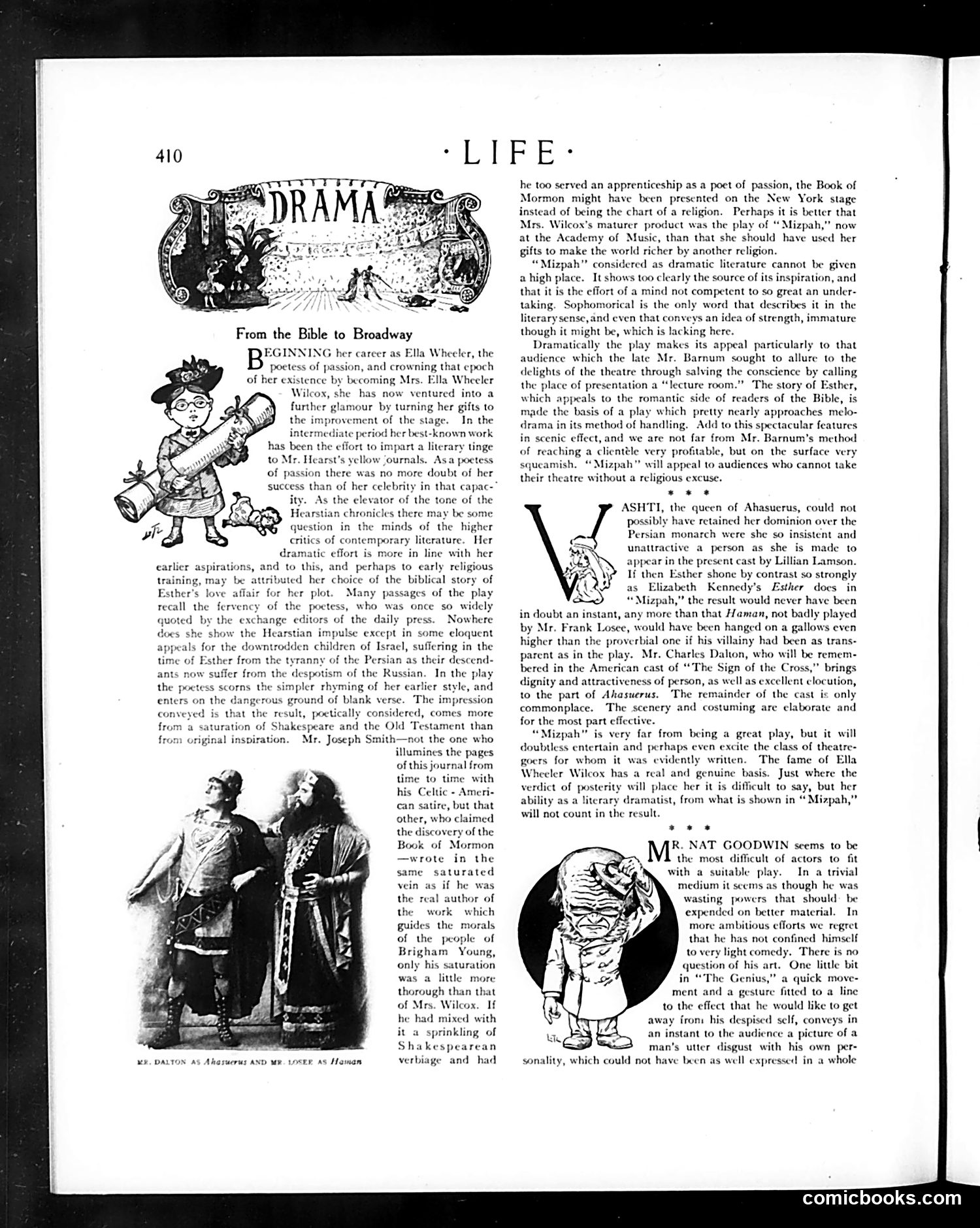
This page reviews Ella Wheeler Wilcox's play "Mizpah," adapted from the biblical Book of Esther. The photograph shows actors Mr. Dalton (as King Ahasuerus) and Mr. Loser (as Haman). Life magazine satirizes Wilcox's career trajectory—from "poetess of passion" to journalist for Hearst's newspapers to playwright—suggesting each phase represented diminishing artistic credibility. The review dismisses "Mizpah" as dramatically incompetent, "sophomoric," and melodramatic, comparing it unfavorably even to Joseph Smith's Book of Mormon. The core satire: Wilcox uses religious subject matter to appeal to audiences seeking moral respectability for theater-going, echoing P.T. Barnum's strategy of marketing entertainment as "lecture rooms" to attract conscience-stricken patrons. The implicit criticism is that the play succeeds commercially through pious packaging rather than genuine artistic merit.
📄 Transcribed text from this page (OCR, searchable)
Machine-transcribed from the original scan — historical spelling and the odd misread are preserved.
He. DALTON AS Ahasuerus AND Me. LOSER AS Haman *LIPE« From the Bible to Broadway GINNING her career as Ella Wheeler, the poetess of passion, and crowning that cpoch of her existence by becoming Mrs. Ella Wheeler Wilcox, she has now ventured into a further glamour by turning her gifts to the improvement of the stage. In the intermediate period her best-known work has been the effort to impart a literary tinge to Mr. Hearst's yellow Journals. Asa poctess of passion there was no more doubt of her success than of her celebrity in that capac- ity. As the elevator of the tone of the Hearstian chronicles there may be some question in the minds of the higher critics of contemporary literature. Her dramatic effort is more in line with her carlicr aspirations, and to this, and perhaps to early religious training, may be attributed her choice of the biblical story of Esther's love affair for her plot. Many passages of the pla: recall the fervency of the poctess, who was once so widely yuoted by the exchange editors of the daily press. Nowhere does she show the Hearstian impulse except in some eloquent appeals for the downtrodden children of Israel, suffering in the time of Esther from the tyranny of the Persian as their descend- ww suffer from the despotism of the Russian. In the play simpler rhyming of her earlier style, and enters on the dangerous ground of blank verse. The impression ants ny the poctess scorns th conveyed is t from a saturation of Shakespeare and the Old Testament than jon. Mr. Joseph Smith—not the one who illumines the pages of this journal from time to time with his Celtic - Ameri- can satire, but that other, who claimed the discovery of the Book of Mormon —wrote in the same saturated vein as if he was real author of work which guides the morals of the people of Brigham Young, only his saturation was a little more thorough than that of Mrs. Wilcox. If he had mixed with it a sprinkling of Shakespearean verbiage and had the result, poetically considered, comes more from original inspira he too served an apprenticeship as a poct of passion, the Book of Mormon might have been presented on the New York stage instead of being the chart of a religion. Perhaps it is better that Mrs. Wilcox’s maturer product was the play of “ Mizpah," now at the Academy of Music, than that she should have used her gifts to make the world richer by another religion. “Mizpah” considered as dramatic literature cannot be given a high place. It shows too clearly the source of its inspiration, and that it is the effort of a mind not competent to so great an under- taking. Sophomorical is the only word that describes it in the literary sense, and even that conveys an idea of strength, immature though it might be, which is lacking here. Dramatically the play makes its appeal particularly to that audience which the late Mr. Barnum sought to allure to the delights of the theatre through salving the conscience by calling the place of presentation a “lecture room.” The story of Esther, which appeals to the romantic side of readers of the Bible, is made the basis of a play which pretty nearly approaches melo- drama in its method of handling. Add to this spectacular features in scenic effect, and we are not far from Mr. Barnum’s method of reaching a clicntéle very profitable, but on the surface very squeamish. “ Mizpah” will appeal to audiences who cannot take their theatre without a religious excuse. see ASHTI, the qucen of Ahasucrus, could not possibly have retained her dominion over the Persian monarch were she so insistent and unattractive a person as she is made to appear in the present cast by Lillian Lamson. Esther shone by contrast so strongly Elizabeth Kennedy's Esther does in “Mizpah,” the result would never have been in doubt an instant, any more than that Haman, not badly played by Mr. Frank Losee, would have been hanged on a gallows even higher than the proverbial one if his villainy had been as trans- parent as in the play. Mr. Charles Dalton, who will be remem- bered in the American cast of “The Sign of the Cross,” brings dignity and attractiveness of person, as well as excellent clocution, to the part of Ahasuerus. ‘The remainder of the cast is only commonplace. The scenery and costuming are claborate and for the most part effective. “Mizpah" is very far from being a great play, but it will doubtless entertain and perhaps even excite the class of theatre- goers for whom it was evidently written. The fame of Ella Wheeler Wilcox has a real and genuine basis. Just where the verdict of posterity will place her it is difficult to say, but her ability as a literary dramatist, from what is shown in “ Mizpah,” will not count in the result. i R. NAT GOODWIN seems to be the most difficult of actors to fit with a suitable play. In a trivial medium it seems as though he was wasting powers that should: be expended on better material. In more ambitious efforts we regret that he has not confined himself to very light comedy. There is no question of his art. One little bit in “The Genius,” a quick move- ment and a gesture fitted to a line to the effect that he would like to get away fron: his despised self, conveys in an instant to the audience a picture of a man’s utter disgust with his own per- sonality, which could not have been as well expressed in a whole comicbooks.com