
A complete issue · 24 pages · 1906
Life — July 12, 1906
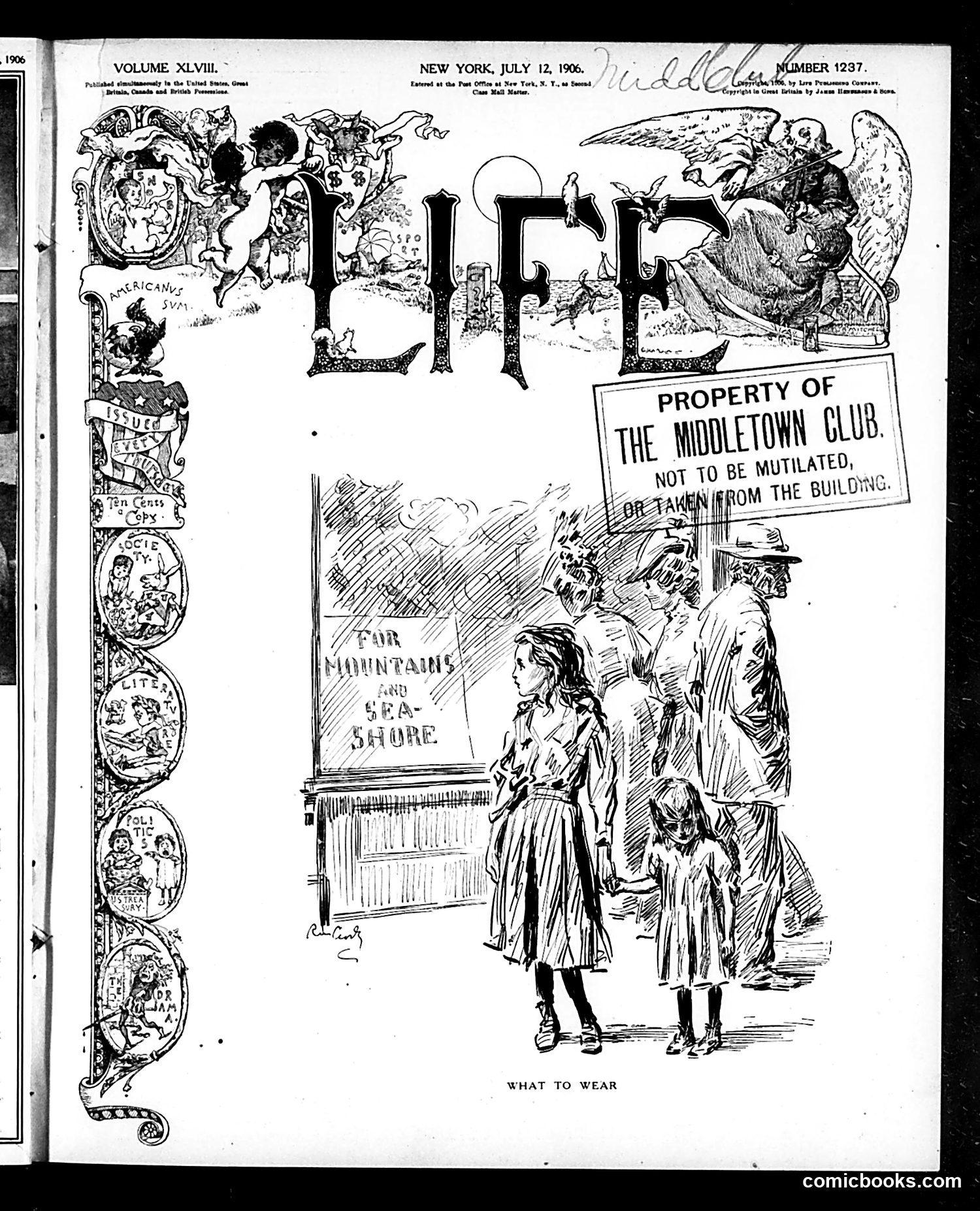
This page from Life magazine (July 12, 1906) features a cartoon titled "What to Wear" showing figures viewing a travel poster advertising "Mountains and Sea-Shore." The main satire appears to concern **appropriate summer vacation clothing**. A woman and child are shown examining the poster while men in hats stand nearby. The caption box warns this is "Property of The Middletown Club" — "Not to be mutilated or taken from the building," suggesting this is a club notice board. The humor likely plays on **practical versus fashionable vacation dress** during the Edwardian era, when women faced strict conventions about proper summer attire for different settings (mountains versus seaside). The ornate left border contains small illustrated vignettes, typical of Life's decorative style. Without additional context about 1906 fashion debates, the specific satirical point remains somewhat unclear.
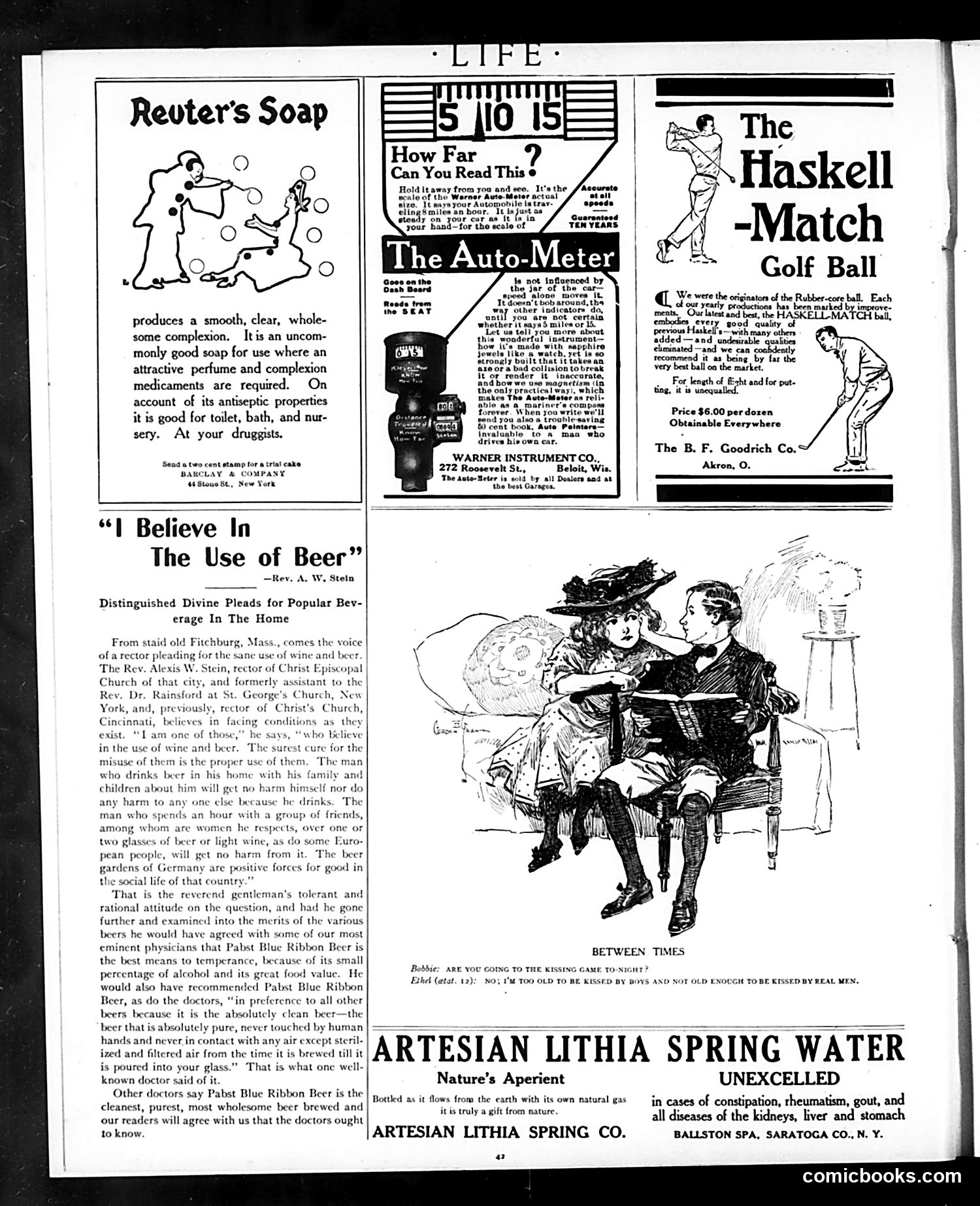
This page is primarily **advertising**, not satire or political commentary. It contains four commercial advertisements: 1. **Reuter's Soap** - promoting complexion benefits 2. **The Auto-Meter** - a vehicle instrument measuring speed and distance 3. **The Haskell-Match Golf Ball** - highlighting rubber-core ball technology 4. **Artesian Lithia Spring Water** - marketed for health benefits There is one editorial piece: **"I Believe In The Use of Beer"** — a column by Rev. A.W. Stiles defending moderate beer consumption on moral and health grounds, citing clergy support and comparing beer's benefits to European traditions. The cartoon illustration labeled "Between Times" shows two men in period dress with a woman, but lacks clear satirical intent — it appears to be generic social commentary accompanying the beer article. This reflects early 20th-century magazine content mixing advertising with lifestyle journalism.
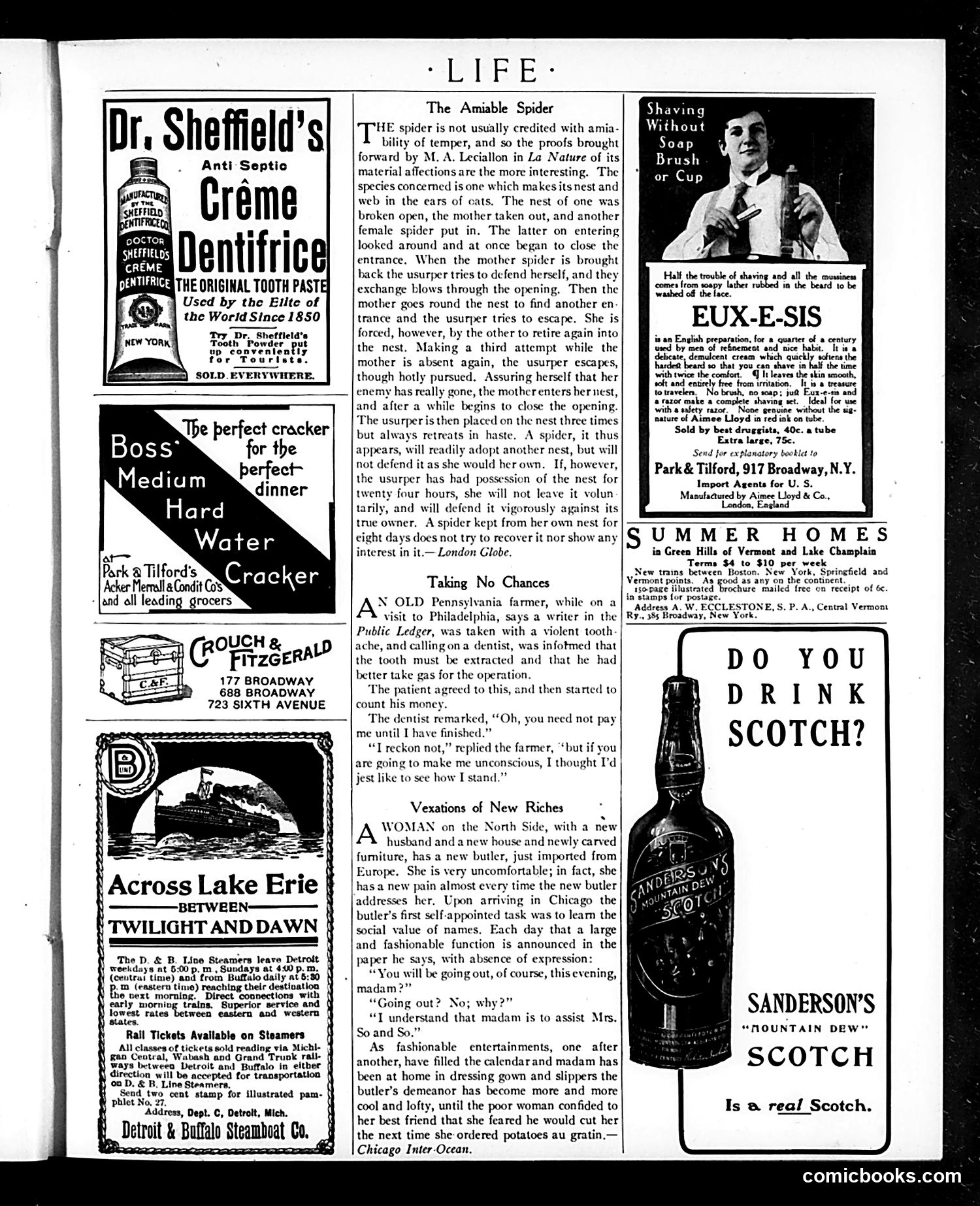
This page is primarily **advertising with light editorial content**. The main pieces are ads for Dr. Sheffield's toothpaste, Boss crackers, luggage, steamship travel, Scotch whisky, and other products. The editorial content consists of three brief **humorous anecdotes** rather than political cartoons: 1. "The Amiable Spider" — a nature story about spider behavior 2. "Taking No Chances" — a joke about a farmer refusing anesthesia at the dentist 3. "Vexations of New Riches" — satirizing newly wealthy people's social anxieties, particularly a woman uncomfortable with her new butler and the social demands of her elevated status The satire targets **upper-class pretension and the discomfort of the newly rich**, a common theme in early 20th-century humor. No specific political figures or events are referenced.
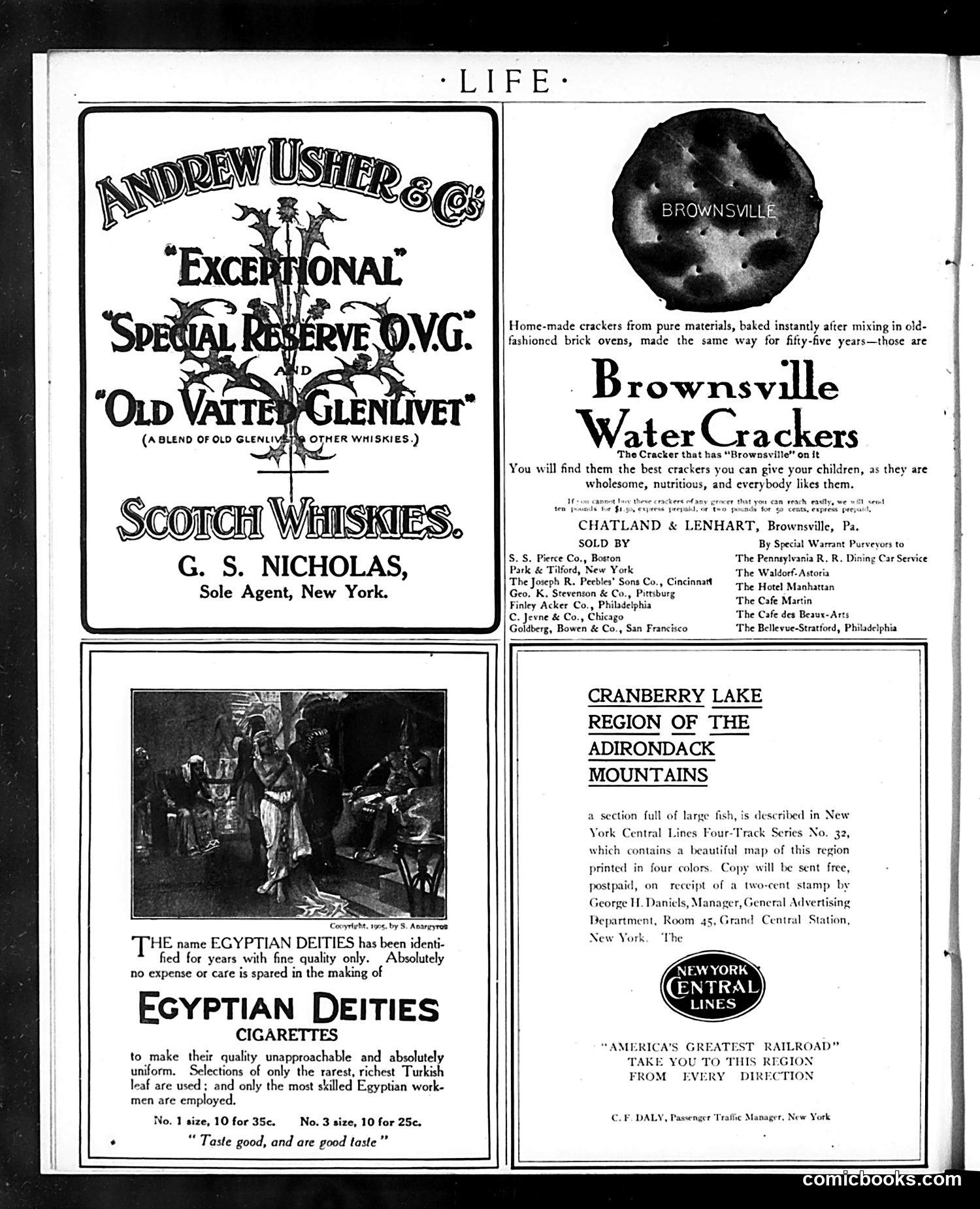
This page is primarily **advertising**, not editorial content or satire. It contains four advertisements: 1. **Andrew Usher & Co. Scotch Whiskies** - promoting their "Exceptional Special Reserve" and "Old Vatted Glenlivet" brands, sold through G.S. Nicholas in New York. 2. **Brownsville Water Crackers** - homemade crackers baked in old-fashioned brick ovens, sold by various distributors including railroad dining car services. 3. **Egyptian Deities Cigarettes** - emphasizing Turkish leaf and Egyptian workmanship, with pricing information (No. 1 size, 10 for 35¢; No. 3 size, 10 for 25¢). 4. **New York Central Lines Railroad** - advertising Cranberry Lake region of the Adirondack Mountains with a free map offer. There is no political satire or cartoon on this page.
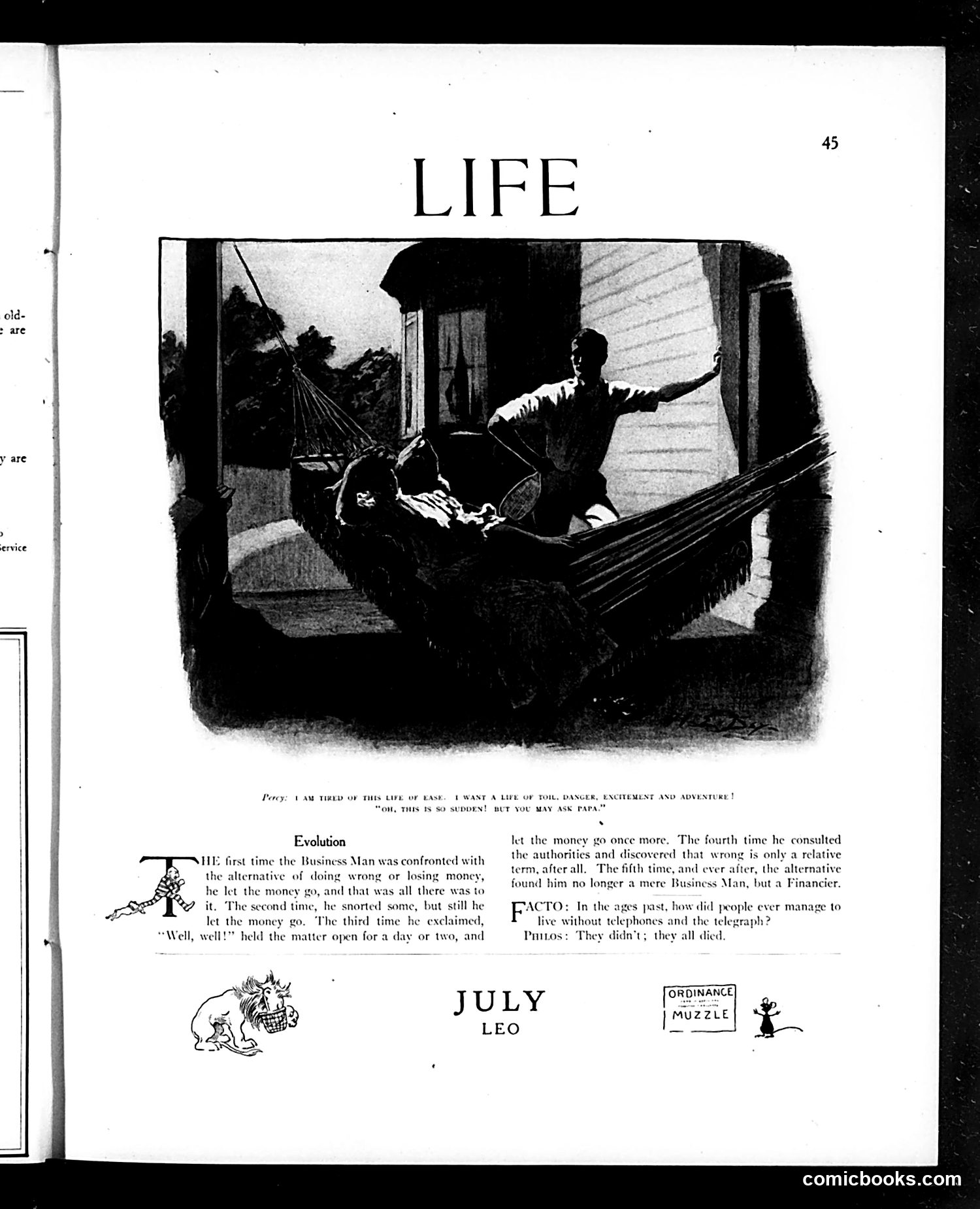
This page from *Life* magazine contains two distinct elements: **Top illustration**: A dramatic scene showing a man in a hammock being attended to by another figure. The caption suggests a conversation about lifestyle choices—the man claims to want "a life of toil, danger, excitement and adventure," but when actually confronted with hardship, he retreats to comfort. **"Evolution" section**: A satirical narrative about a businessman's repeated failures and compromises. He repeatedly loses money through failed ventures, yet keeps trying—each time consulting authorities or making deals. The humor critiques how business ambitions repeatedly fail, forcing compromise. **Bottom**: An astrological forecast for "July" under the zodiac sign "Leo," a regular magazine feature. The satire targets the gap between romantic ideals of adventure and the practical reality of comfort-seeking, and the cyclical disappointments of business enterprise.
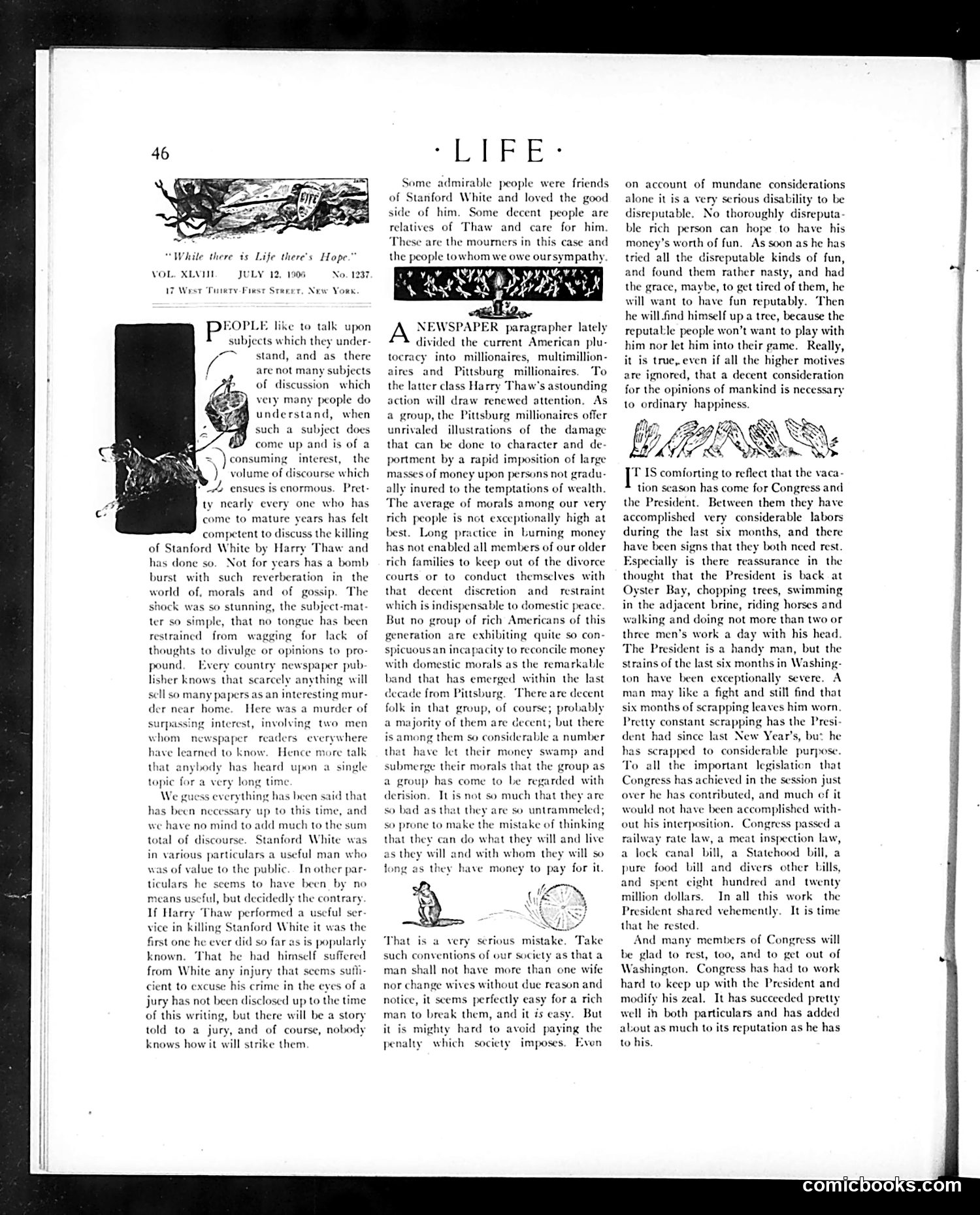
This page discusses **Stanford White's killing by Harry Thaw**, a prominent 1906 scandal. The text debates whether Thaw's murder of the renowned architect was justified, given White's alleged seduction of Thaw's wife. The left illustration shows a person in distress, relating to this notorious case that consumed public discourse. The main satirical point: the article critiques how wealthy Americans discuss morality while engaging in immoral behavior themselves. It specifically mocks Pittsburgh millionaires' "conspicuous incapacity to reconcile money with domestic morals," contrasting their wealth with their inability to maintain ethical standards in marriage and social conduct. The piece argues that disreputable rich people damage society's moral foundation more than their financial crimes alone—a direct social critique of the Gilded Age elite.
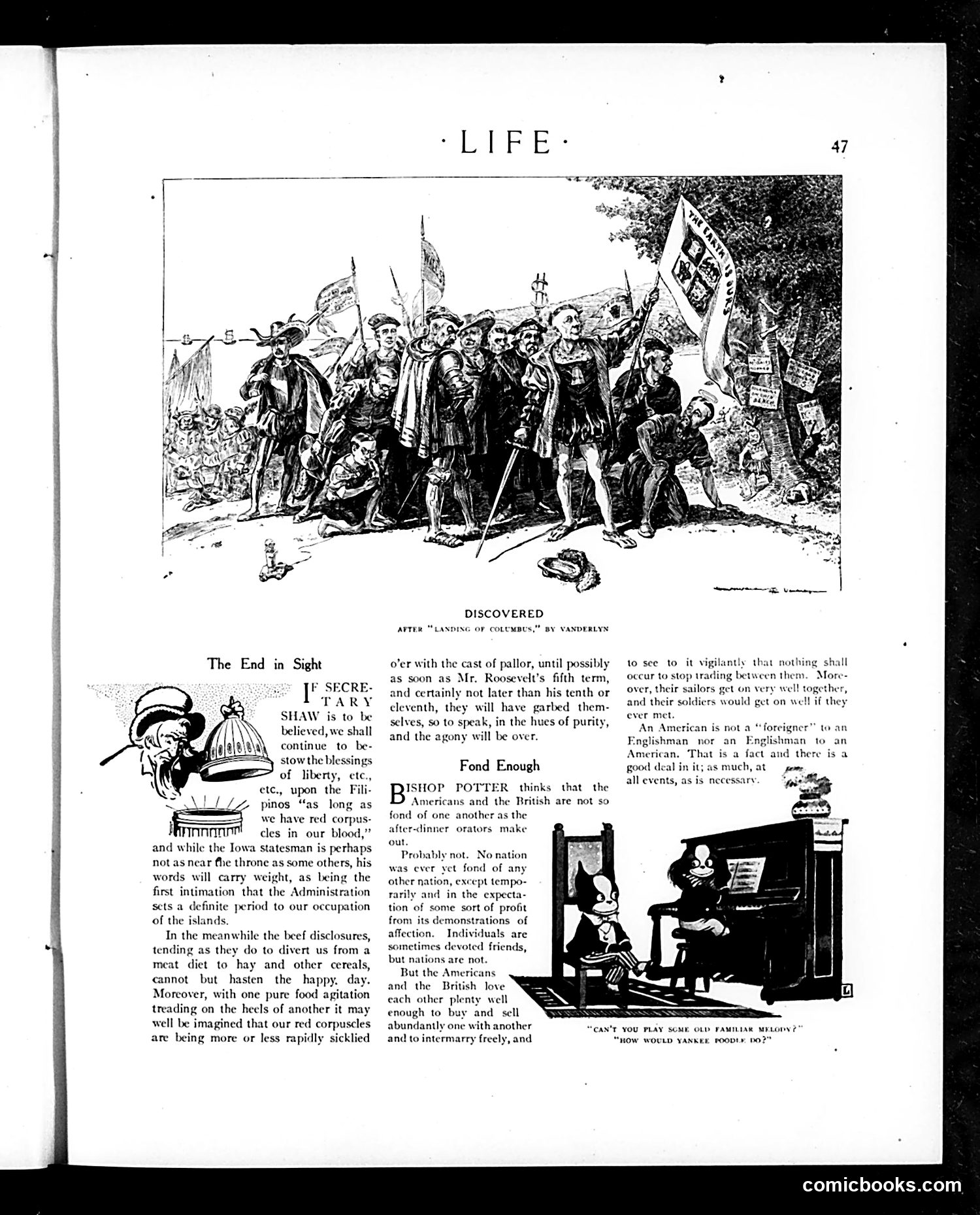
The top engraving depicts a historical scene titled "Discovered after 'Landing of Columbus,' by Vanderllyn" — apparently referencing a famous painting. The accompanying articles discuss post-WWI American-British relations. "The End in Sight" predicts the end of Roosevelt's administration, mentioning his fifth term (unclear which Roosevelt). The text suggests optimism about resolving wartime issues. "Fond Enough" presents Bishop Potter's argument that Americans and British, while individually friendly, are not naturally fond of each other as nations. The cartoon below shows two figures at a piano with the caption "CAN'T YOU PLAY SOME OLD FAMILIAR MELODY?" / "HOW WOULD YANKEE DOODLE DO?" — depicting cultural/musical tension between the nations, suggesting difficulty finding common ground.
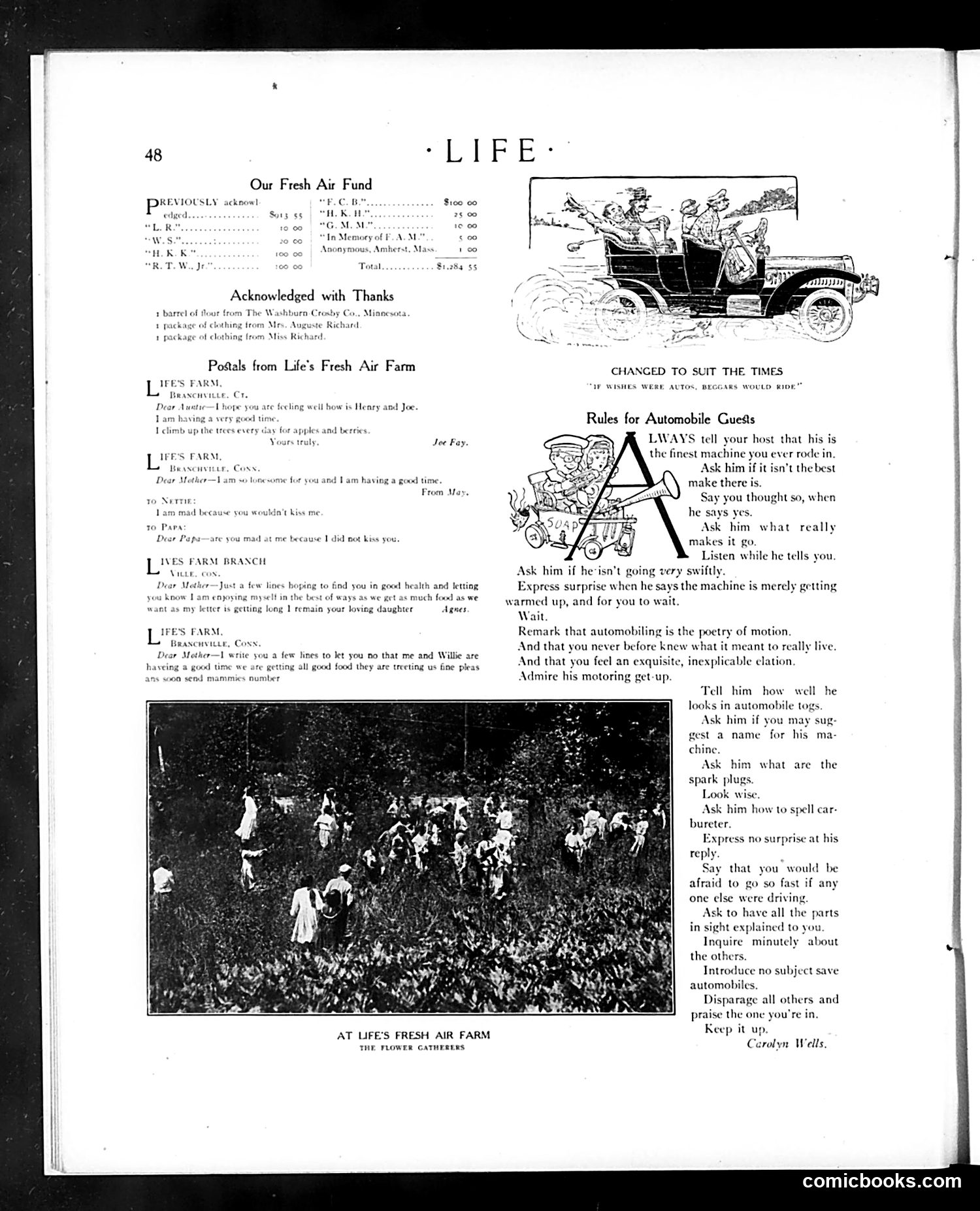
This page combines charitable fundraising with automotive humor. The "Fresh Air Fund" section solicits donations for a program providing outdoor experiences to city children (a real early-20th-century charity). Below are postcards from Life's Fresh Air Farm in Connecticut, showing families' gratitude. The main content is "Rules for Automobile Guests" by Carolyn Wells—satirical etiquette advice for riding in cars. The humor targets early automotive culture: guests should flatter the car, feign ignorance about mechanical details, express amazement at speed, and avoid suggesting safer driving. The accompanying illustration shows an early motorcar full of passengers. The joke reflects period anxieties about automobiles—their novelty, danger, and the owner's pride in them—while gently mocking both automotive enthusiasm and passengers' performative politeness.
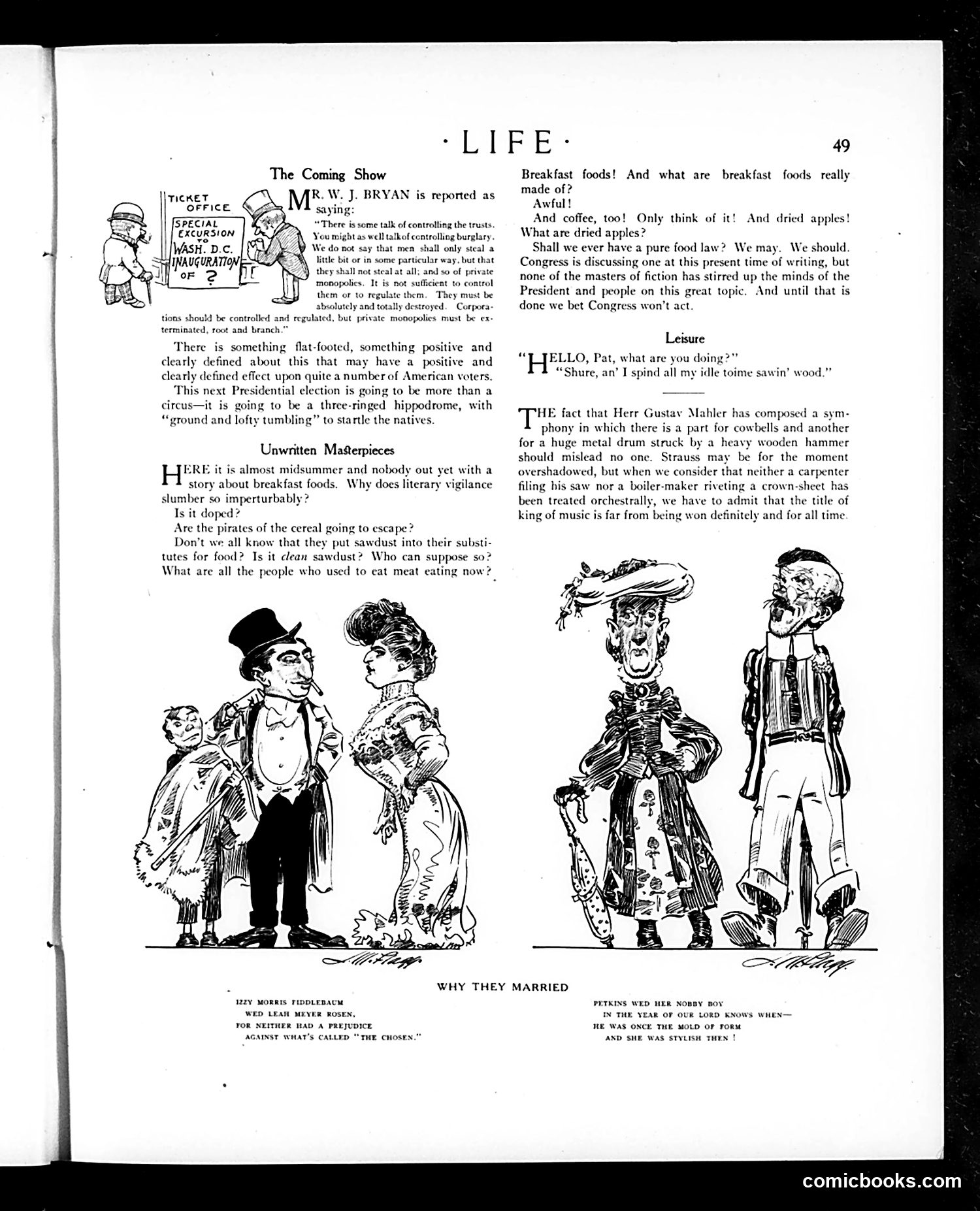
This page contains satirical commentary on early 20th-century American politics and social customs. The top section discusses William Jennings Bryan's views on controlling trusts and monopolies, using humorous illustrations about breakfast foods and Congressional food regulation debates—likely mocking political rhetoric about consumer protection. Below are two cartoon pairs labeled "Why They Married." The left cartoon depicts "Izzy Morris Fiddlebach wed Leah Meyer Rosen" despite prejudice against "the crosses" (interfaith marriage), suggesting satirical commentary on contemporary anti-Semitism and marriage across religious lines. The right cartoon references Gustav Mahler's symphony with unconventional instruments (cowbells, metal drum), joking that such modern classical music could justify any marriage decision. Both cartoons use exaggerated caricature styles typical of the era's satirical art.
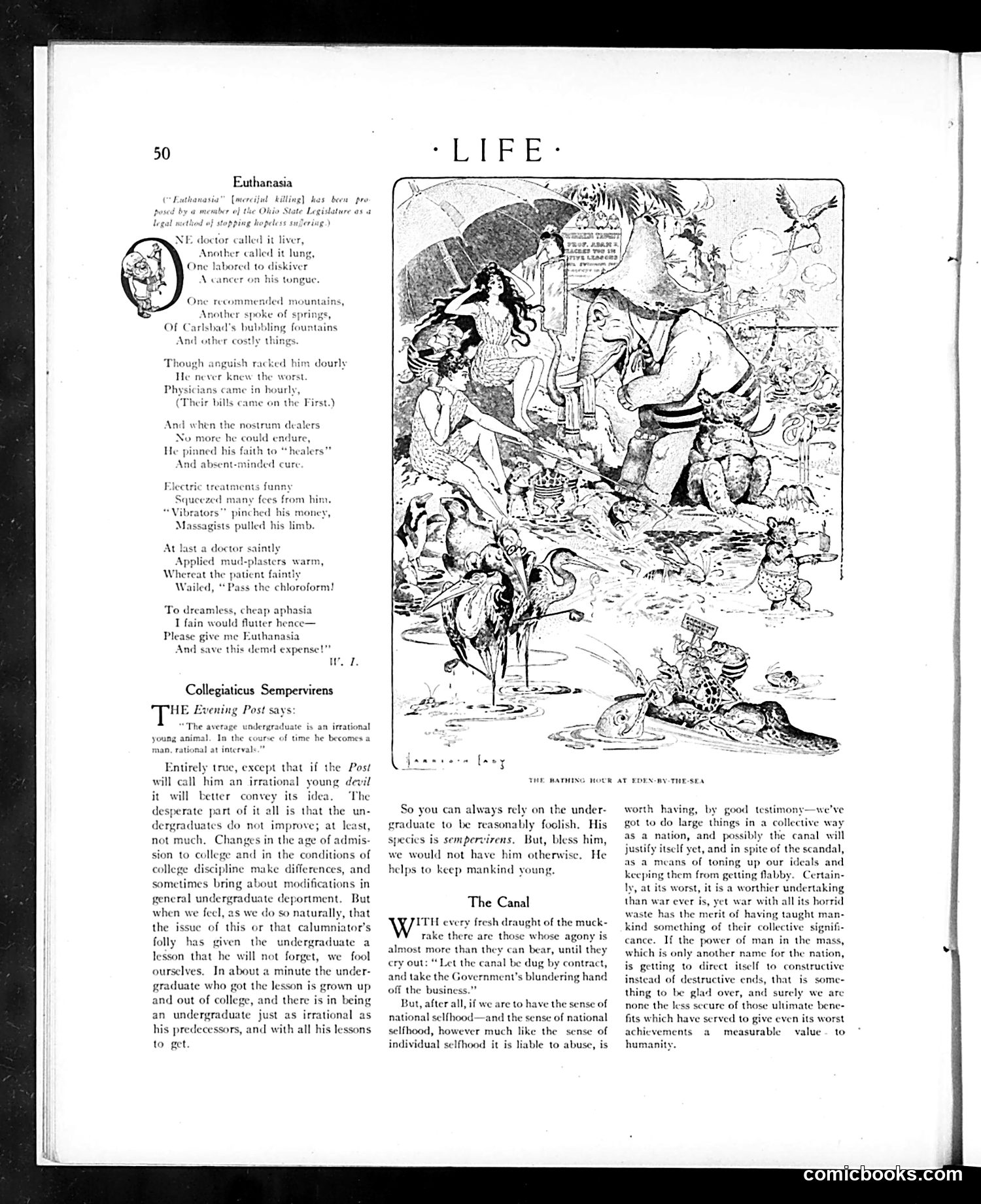
This cartoon satirizes medical quackery and dubious health treatments popular in the early 20th century. The chaotic seaside scene depicts patients seeking cures through various fraudulent methods: electric treatments, vibrators, massages, and mud-plasters. The illustration mocks both the desperate patients willing to try anything and the charlatans exploiting them. The accompanying poem "Euthanasia" expresses exasperation at these ineffective treatments, sarcastically suggesting that death might be preferable to the expensive "cures" on offer. The satire targets the era's widespread medical experimentation on vulnerable, ill people—a commentary on consumer gullibility and the absence of medical regulation. The "Eden by the Sea" title ironically suggests this resort offers salvation when it merely exploits desperation.
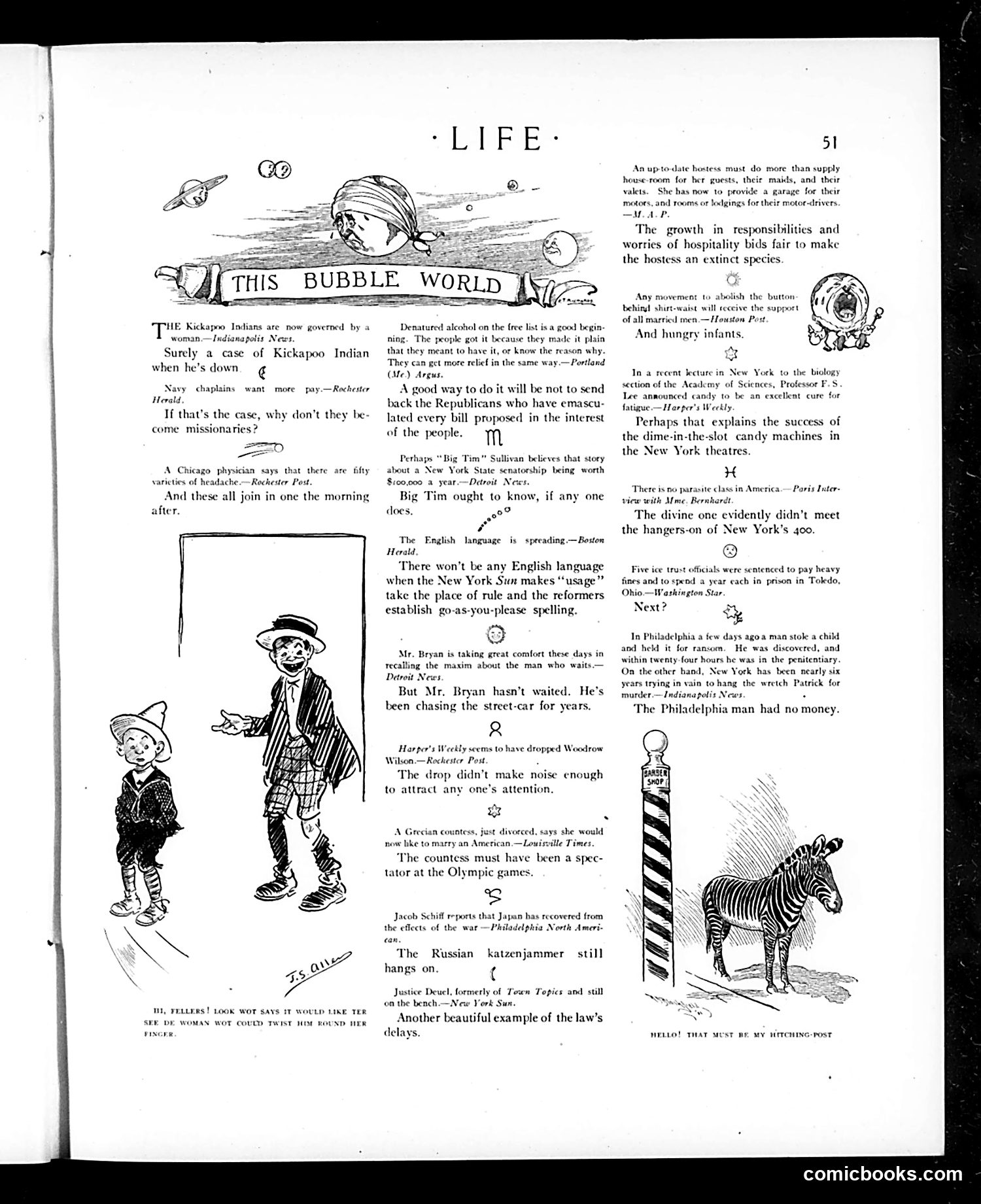
This page collects brief satirical news items and jokes typical of Life's humor section. The main cartoon depicts two figures—a child and an adult in a bowler hat and checkered pants—with the caption "Hi, FELLERS! LOOK OUT SAVE IT WOULD LIKE TEE SEE DE WOMAN WOT COULD TWIST HIM 'ROUND HER FINGER." The surrounding text mockingly reports on various current events: Kickapoo Indians governed by a woman, Republican obstruction in Congress, "Big Tim" Sullivan's political worth, English language decline in New York, Bryan's pursuit of street-cars, and a Philadelphia kidnapping. Each item uses irony to critique contemporary politics, social absurdities, and urban life. The zebra illustration at right remains contextually unclear from visible text.
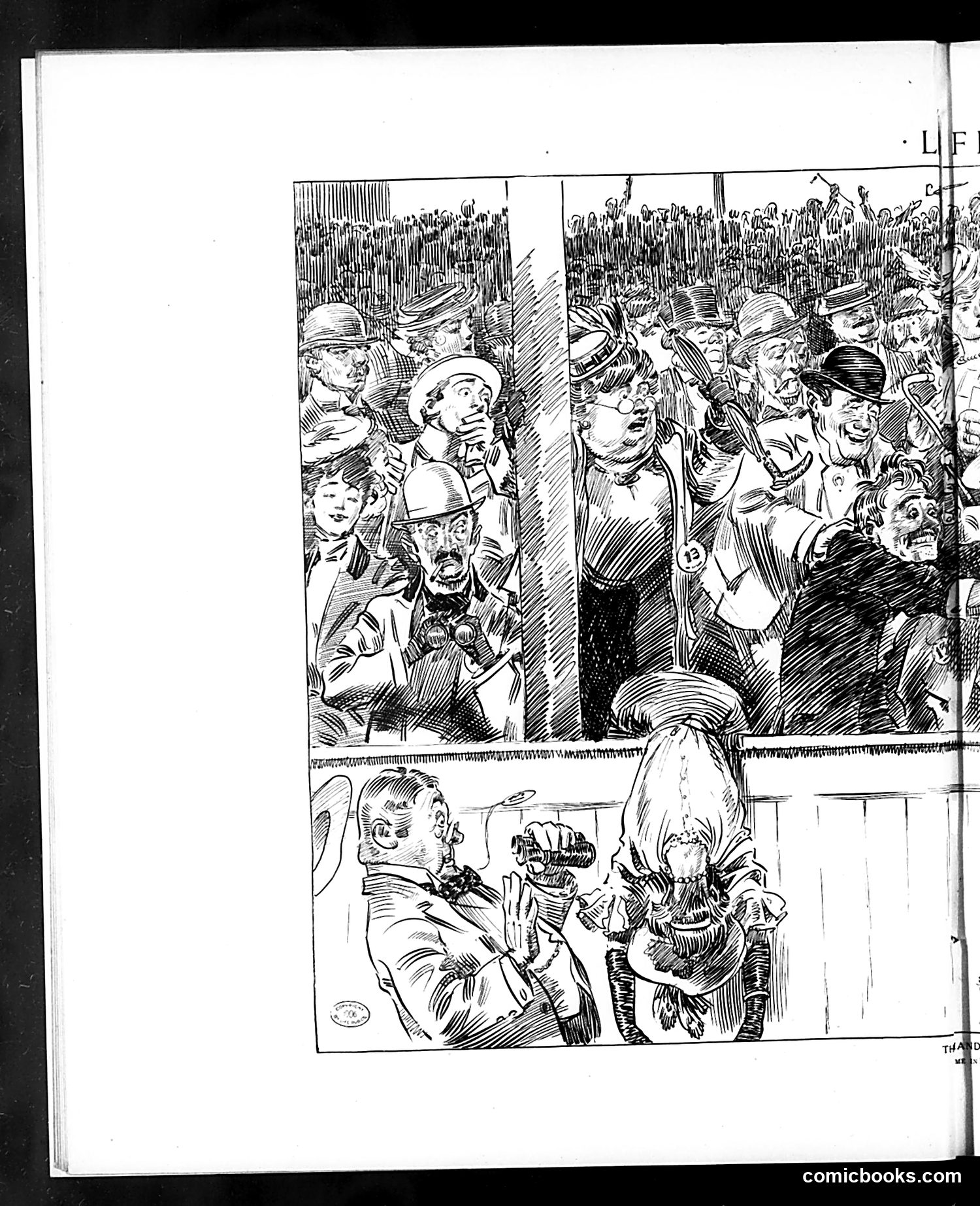
This appears to be a two-panel satirical cartoon from Life magazine depicting a crowded public event or gathering, likely from the early 20th century based on the clothing styles and illustration technique. **Upper panel:** Shows a dense crowd of working-class men and women wearing hats, their expressions suggesting confusion, concern, or agitation. The packed conditions and animated faces suggest social tension or a contentious public moment. **Lower panel:** Depicts what appears to be authority figures (possibly police or officials, identifiable by their distinctive uniforms and headwear) interacting with smaller figures, possibly children or subordinates. Without the complete OCR text or caption visible, I cannot definitively identify the specific political or social event being referenced. The satire likely comments on class relations, crowd control, or public authority, but the precise historical context remains unclear from the image alone.
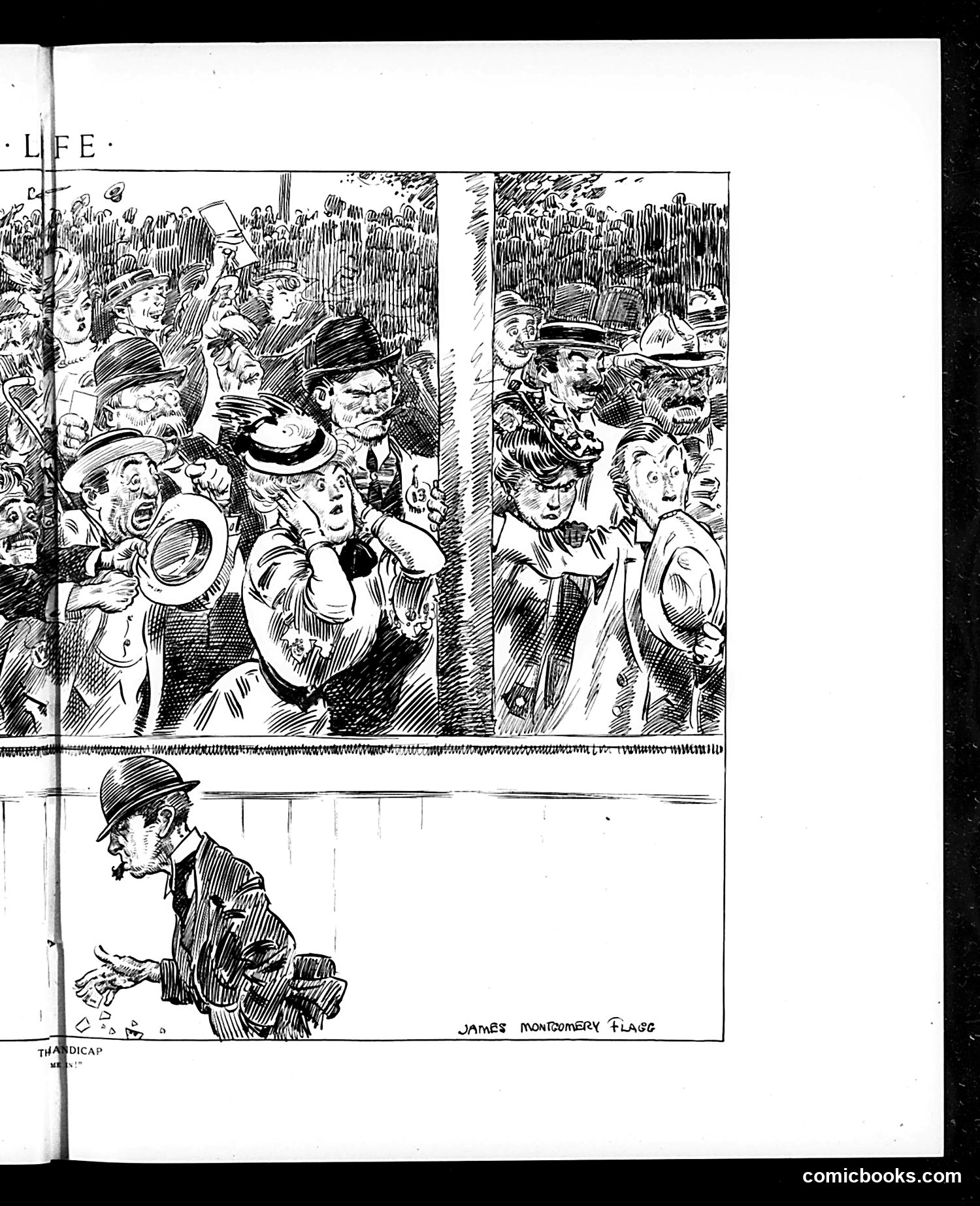
This page from *Life* magazine contains a cartoon by James Montgomery Flagg depicting what appears to be a crowded public gathering or protest scene. The top panels show dense crowds of people wearing hats, rendered in Flagg's characteristic expressive style with exaggerated facial features suggesting agitation or commotion. The bottom panel shows a single figure in a bowler hat and suit, appearing separated or isolated from the crowd above. Without additional caption text visible in the image, the specific political or social event being satirized is unclear. The contrast between the chaotic crowd and solitary figure below likely suggests commentary on individual experience within mass movements or public events, though the exact historical reference cannot be determined from this page alone.
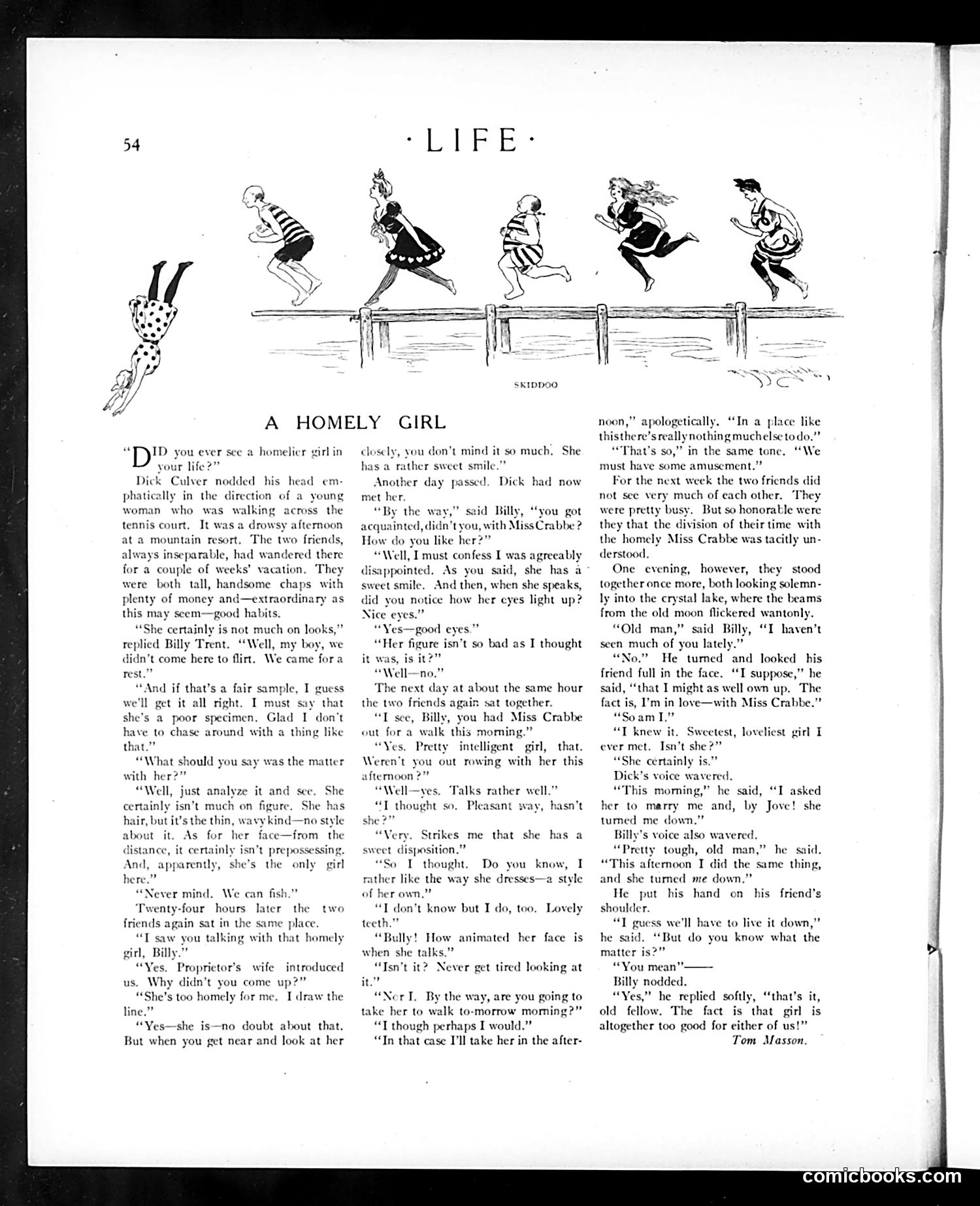
This is a short story with accompanying "Skiddoo" cartoon (showing figures on a fence), not political satire. The narrative follows two wealthy, handsome male friends vacationing at a mountain resort who initially dismiss a young woman as extremely unattractive. Over successive days, each man spends time with "Miss Crabbe" and gradually finds her increasingly appealing—her sweet smile, animated conversation, intelligence, and "sweet disposition" gradually overcome their initial judgment based on appearance. Both men independently fall in love with her. The story's point is romantic irony: the two sophisticated men, who pride themselves on their discernment and taste, are humbled when the "homely girl" rejects marriage proposals from both. The satire targets male superficiality and the lesson that genuine character and personality matter more than conventional beauty—a progressive message for the era, suggesting women's value extends beyond appearance.
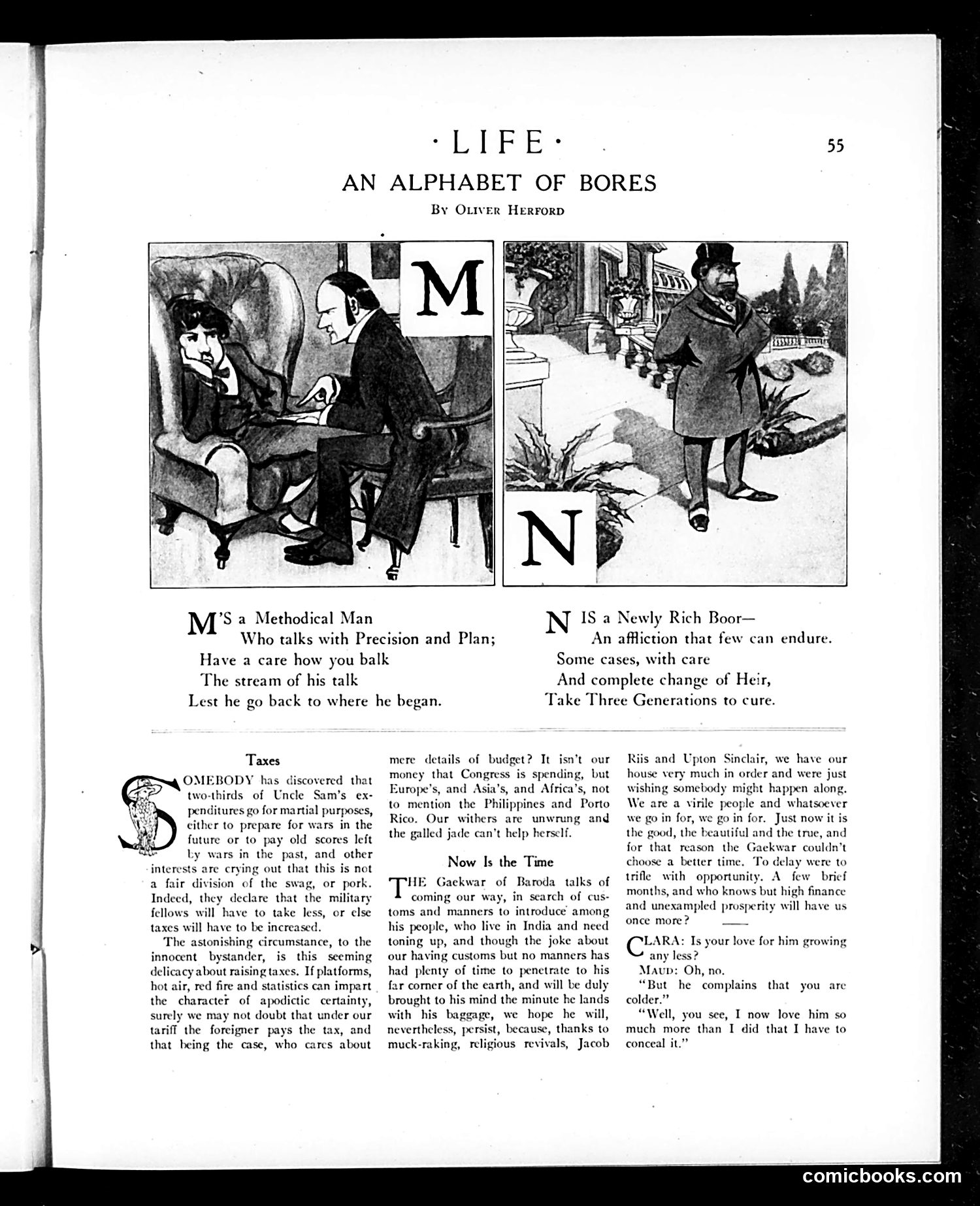
This page presents two illustrated character types from Oliver Herford's satirical alphabet series: **"M" (The Methodical Man)**: A bore who speaks with excessive precision and planning, wearing down his listener with tedious, controlled speech. **"N" (The Newly Rich Boor)**: Depicts the nouveau riche—newly wealthy individuals whose poor manners and social incompetence are portrayed as an affliction requiring "three generations" to cure (the period needed for wealth to breed proper etiquette). The page also includes commentary on **tariffs and taxes**, using ironic logic to mock protectionist trade policy: the author sarcastically claims that since tariffs shift costs to foreigners, Americans needn't worry about government spending. A brief item jokes about **the Gaekwar of Baroda's** (an Indian ruler's) potential visit to America, suggesting recent reforms (muckraking journalism, religious revivals) have temporarily improved American society—though implying such virtue is fleeting. The closing **Clara/Maup dialogue** is a romantic joke about concealing deepening love through coldness.
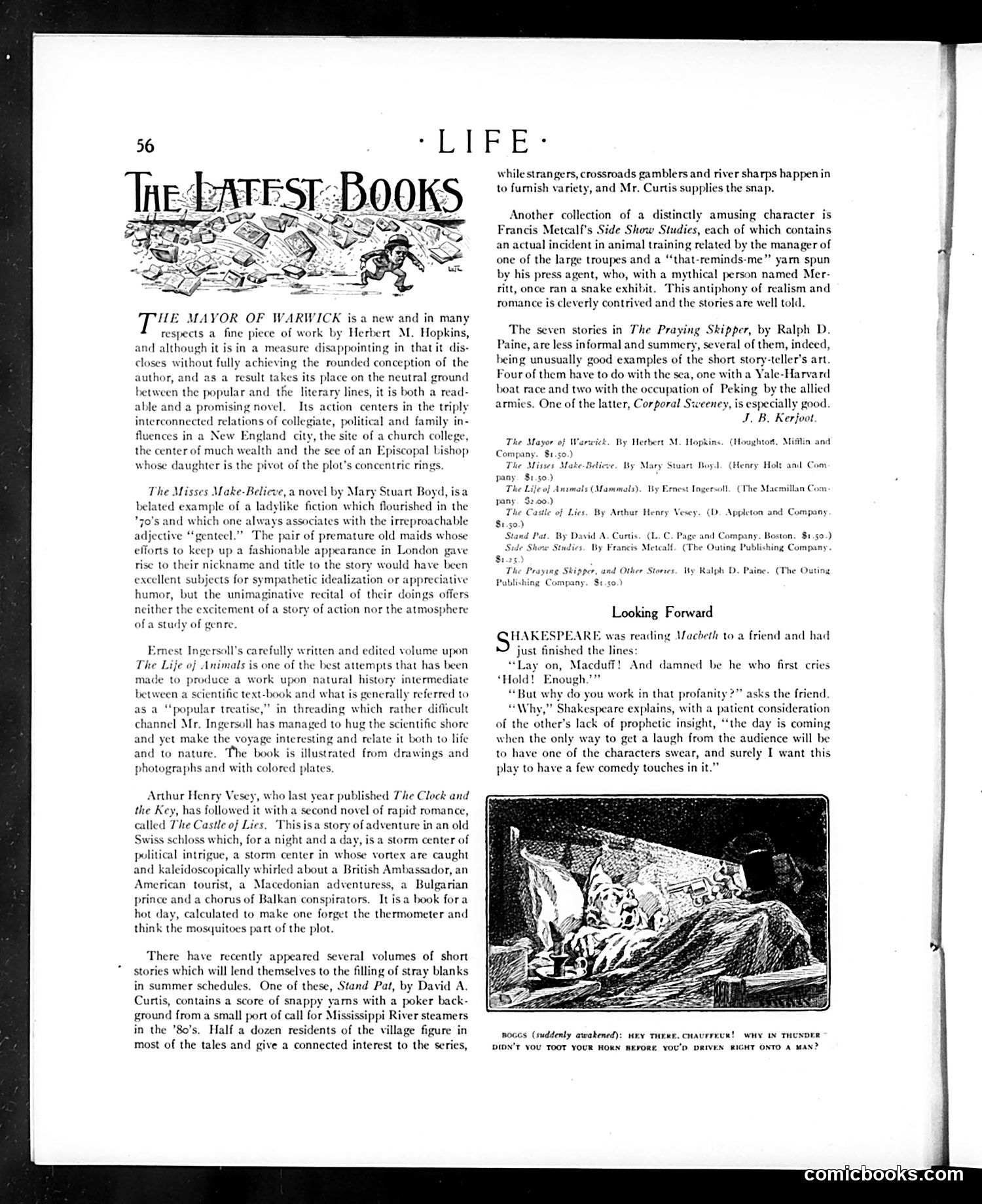
This page is a **book review section**, not a political cartoon. It contains literary criticism of contemporary novels and non-fiction works, with no satirical cartoons or caricatures visible in the main text area. The sole illustration appears at page bottom—a sketch accompanying a Shakespeare anecdote in the "Looking Forward" section. The cartoon shows what appears to be a theatrical scene, with a caption referencing *Macbeth* and containing dialogue about stage comedy. The illustration supports the anecdote about Shakespeare explaining theatrical humor to a friend, but it's incidental to the book reviews above it. The page's purpose is straightforward literary criticism, reviewing works like *The Mayor of Warwick*, *The Misses Make-Believe*, and *The Castle of Lies*—offering educated readers guidance on contemporary fiction and nature writing. There is no discernible satire or political commentary.
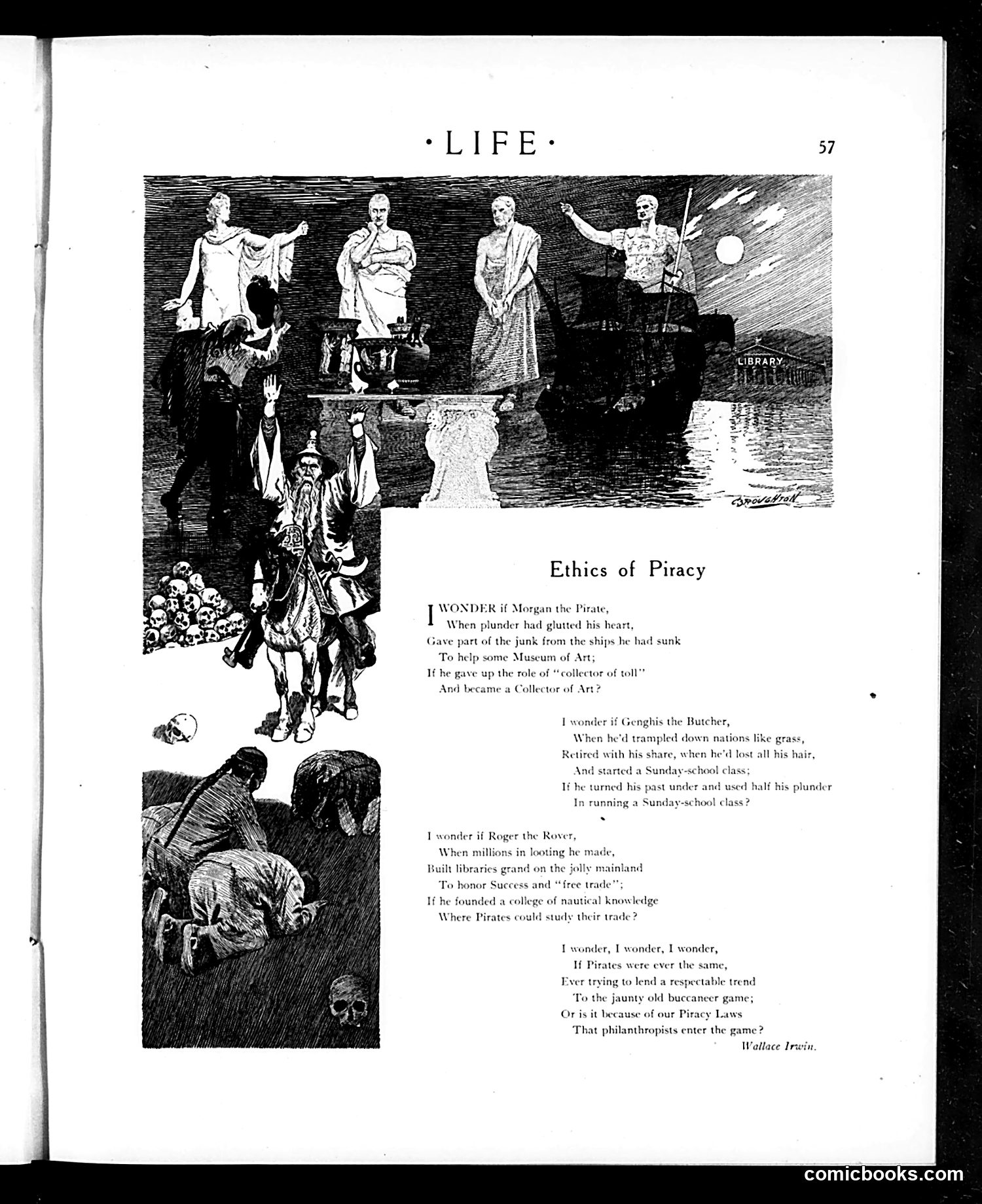
This page presents a satirical poem by Wallace Irwin questioning whether historical pirates—Morgan, Genghis Khan, and "Roger the Rover"—ever became philanthropists or reformers. The accompanying illustrations depict these figures in various scenes. **The satire's point**: Irwin sardonically suggests that famous criminals and conquerors could not have genuinely transformed into respectable benefactors. Instead, he implies that wealthy industrialists and businessmen of his own era, who claim philanthropy and art patronage, are essentially modern-day "pirates" engaging in legalized plunder. **The joke**: The final stanza reveals the sting—modern "philanthropists" enter the game precisely *because* legal piracy laws exist, suggesting their philanthropy is merely a respectable veneer for continued exploitation rather than genuine moral reform. This critiques Gilded Age robber barons using charitable donations to whitewash their reputations and ill-gotten wealth.
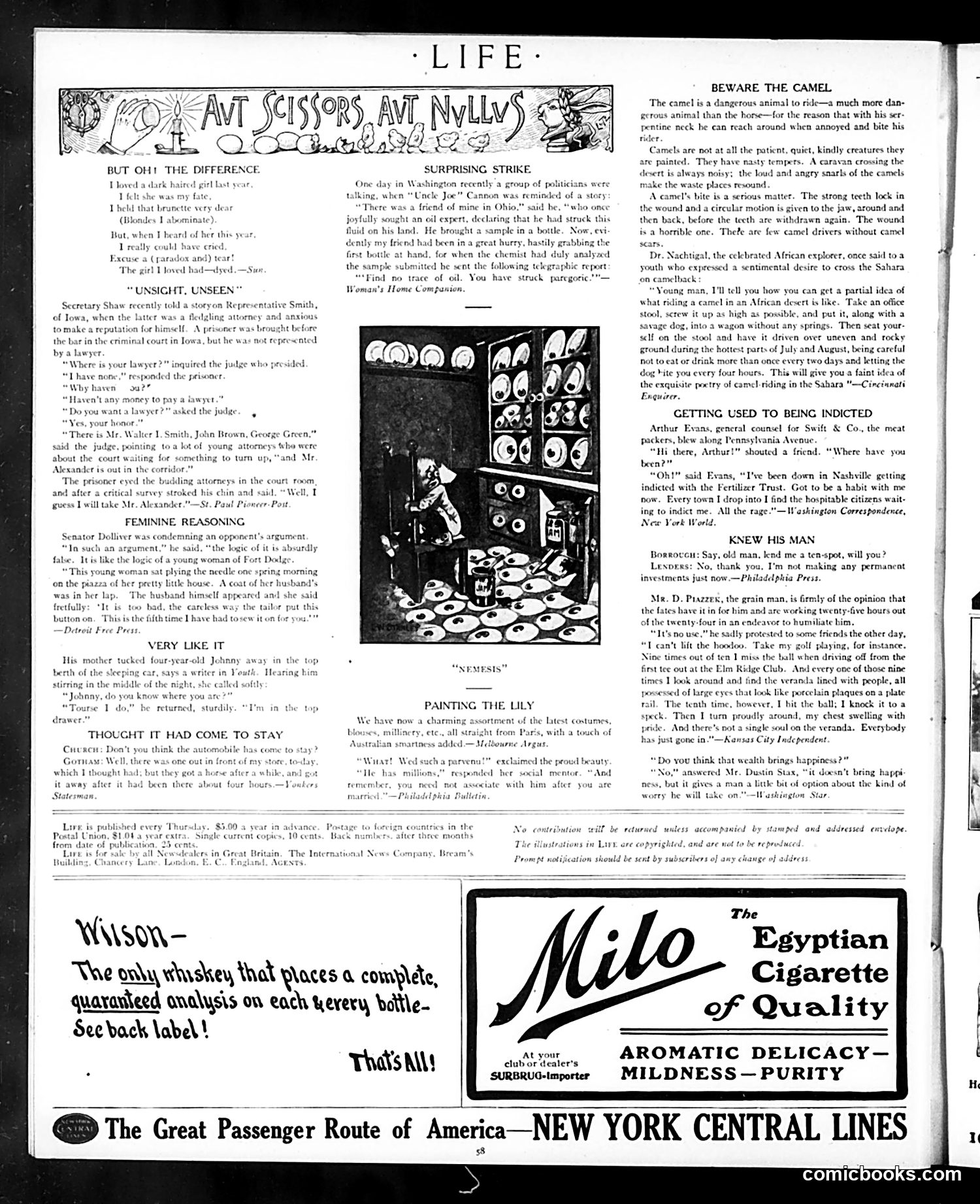
This page contains several brief humorous anecdotes typical of early 20th-century American satirical journalism, plus advertisements. The main content includes: **"Unsight, Unseen"** — A joke about a prisoner selecting his lawyer by name alone from a courtroom, choosing "Mr. Alexander" without seeing him. **"Feminine Reasoning"** — Senator Dolliver's anecdote mocking women's logic: a wife repeatedly sews a button on her husband's coat in the same place, blaming the tailor rather than acknowledging the real problem. **"Beware the Camel"** — A serious cautionary piece about camel bites during African desert travel, describing their dangerous bite mechanism. **"Getting Used to Being Indicted"** — A joke about Arthur Evans, a meat-packer's lawyer, who treats being indicted in different towns as routine/fashionable, reflecting contemporary antitrust litigation against large corporations. The page reflects turn-of-the-century concerns: trust-busting, gender stereotypes, and colonial adventure narratives. Advertisements include Wilson whiskey and Milo cigarettes.
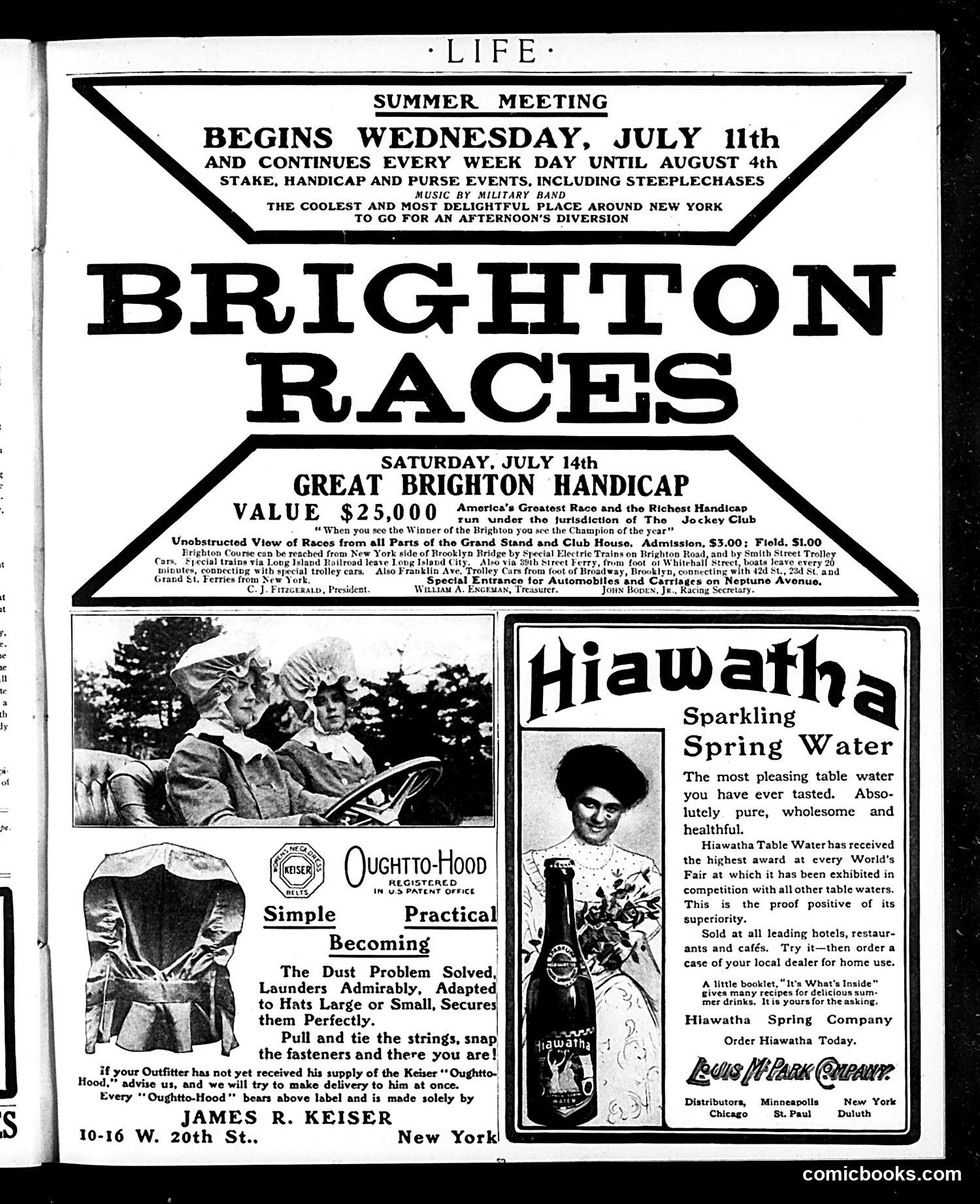
This is primarily a **horse racing advertisement**, not political satire. The page announces Brighton Beach Racetrack's summer meeting (July 11–August 4) and promotes the "Great Brighton Handicap," valued at $25,000 and described as "America's Greatest Race." The imagery shows fashionable spectators enjoying the races—the sport was a major leisure activity for wealthy New Yorkers. Transportation details (Brooklyn Bridge electric trains, ferries) indicate Brighton was a destination requiring travel from Manhattan. The page also contains two consumer product ads: an "Oughtto-Hood" dust cover for hats (solving laundry problems) and Hiawatha Spring Water (claiming World's Fair awards). There is **no political cartoon or satire visible**—this is straightforward period advertising reflecting early 20th-century leisure culture and commercial messaging in a satirical magazine's pages.
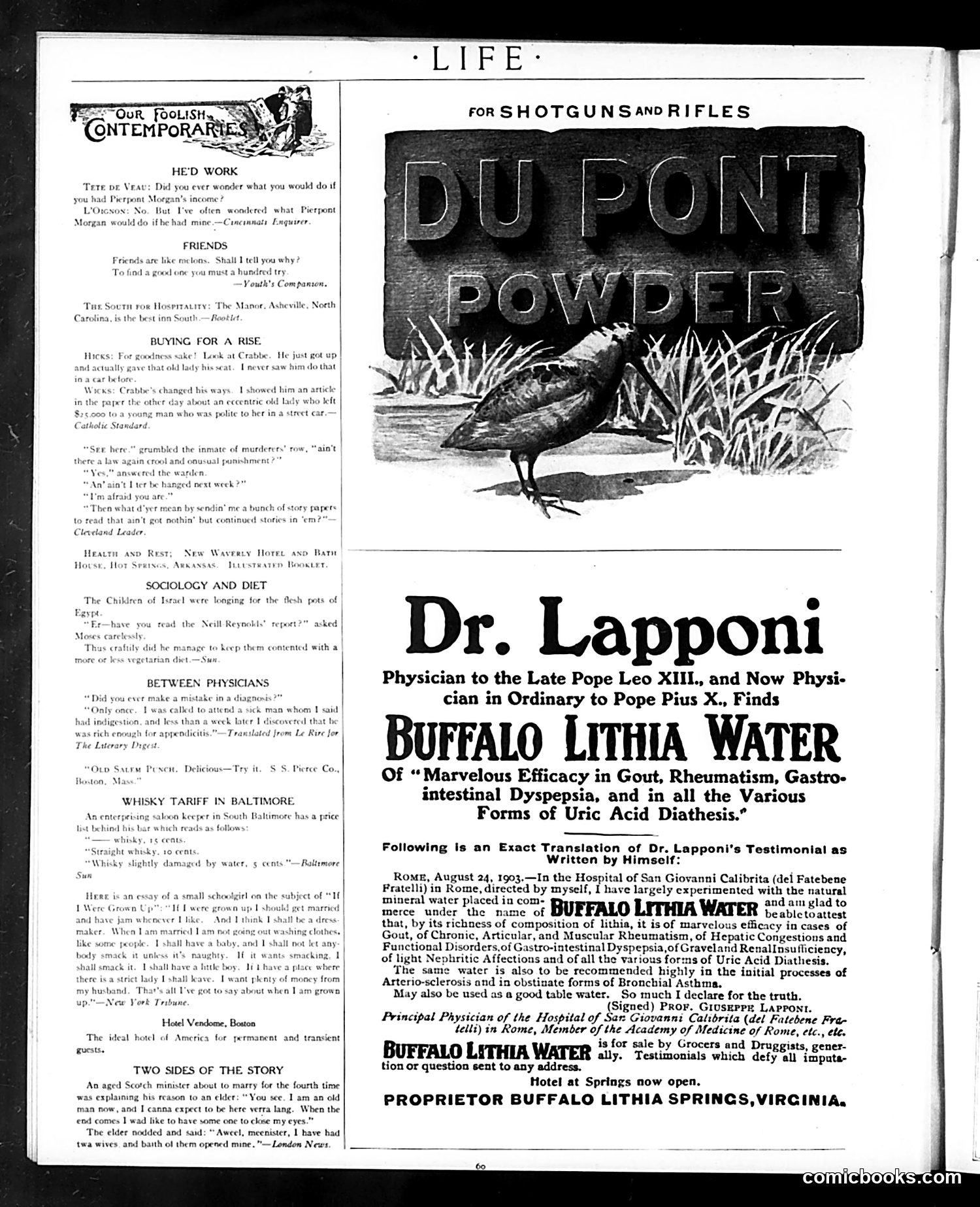
This page from *Life* magazine combines satirical commentary with period advertising. **Left side content:** A collection of brief humorous anecdotes satirizing contemporary American society. Notable jokes include one about J.P. Morgan (the wealthy industrialist), suggesting even his vast fortune couldn't solve basic life problems. Other pieces mock social pretensions, medical practices ("Only once. I was called to attend a sick man..."), and class anxieties (a woman's musings about marriage and wealth). **Right side:** A full-page advertisement for Buffalo Lithia Water, endorsed by "Dr. Lapponi," physician to Pope Leo XIII and Pius X. The ad claims the mineral water cures gout, rheumatism, dyspepsia, and "uric acid diathesis"—typical patent medicine claims of the era. The papal endorsement was meant to convey legitimacy and prestige to American consumers. The juxtaposition reveals early-1900s American culture: satirizing wealthy pretension while simultaneously promoting dubious health products through authority figures.
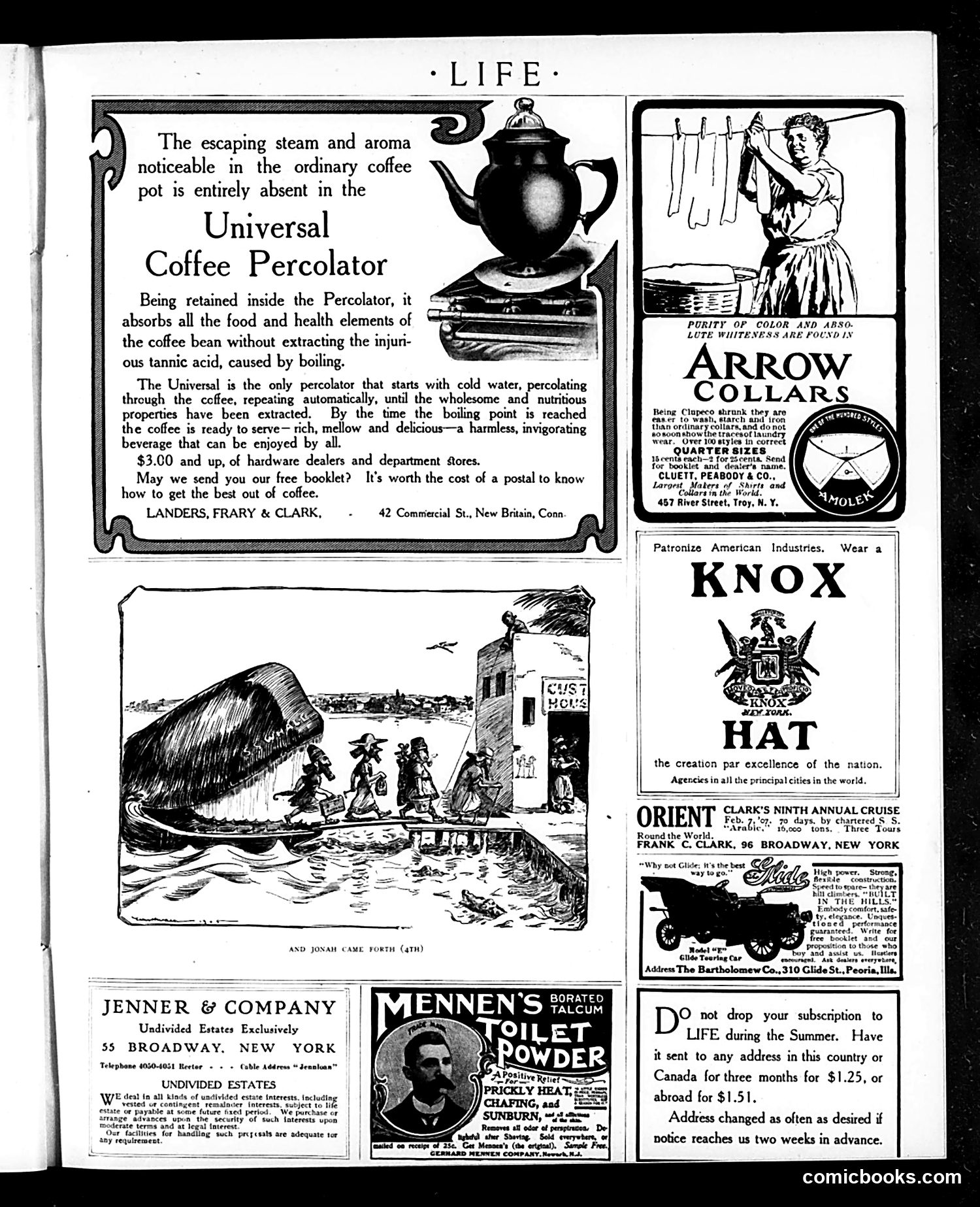
This is primarily an **advertising page** from an early 20th-century issue of Life magazine, with minimal editorial content. The main cartoon—labeled "AND JONAH CAME FORTH"—depicts a biblical reference: it shows a large whale ejecting people onto shore near a "Custom House," evoking the Book of Jonah. The joke likely satirizes immigration or customs procedures of the era, suggesting people are being "expelled" by bureaucratic processes as forcefully as Jonah from the whale. The page is otherwise dominated by product advertisements typical of the period: a Universal Coffee Percolator, Arrow Collars (emphasizing whiteness and purity—language reflecting period racial attitudes), Knox Hats, and various financial services. There's also a subscription notice encouraging readers to maintain their Life subscriptions during summer months. Without knowing the specific historical context or date, the whale cartoon's precise political meaning remains **unclear**, though it appears to reference contemporary anxieties about immigration or government authority.
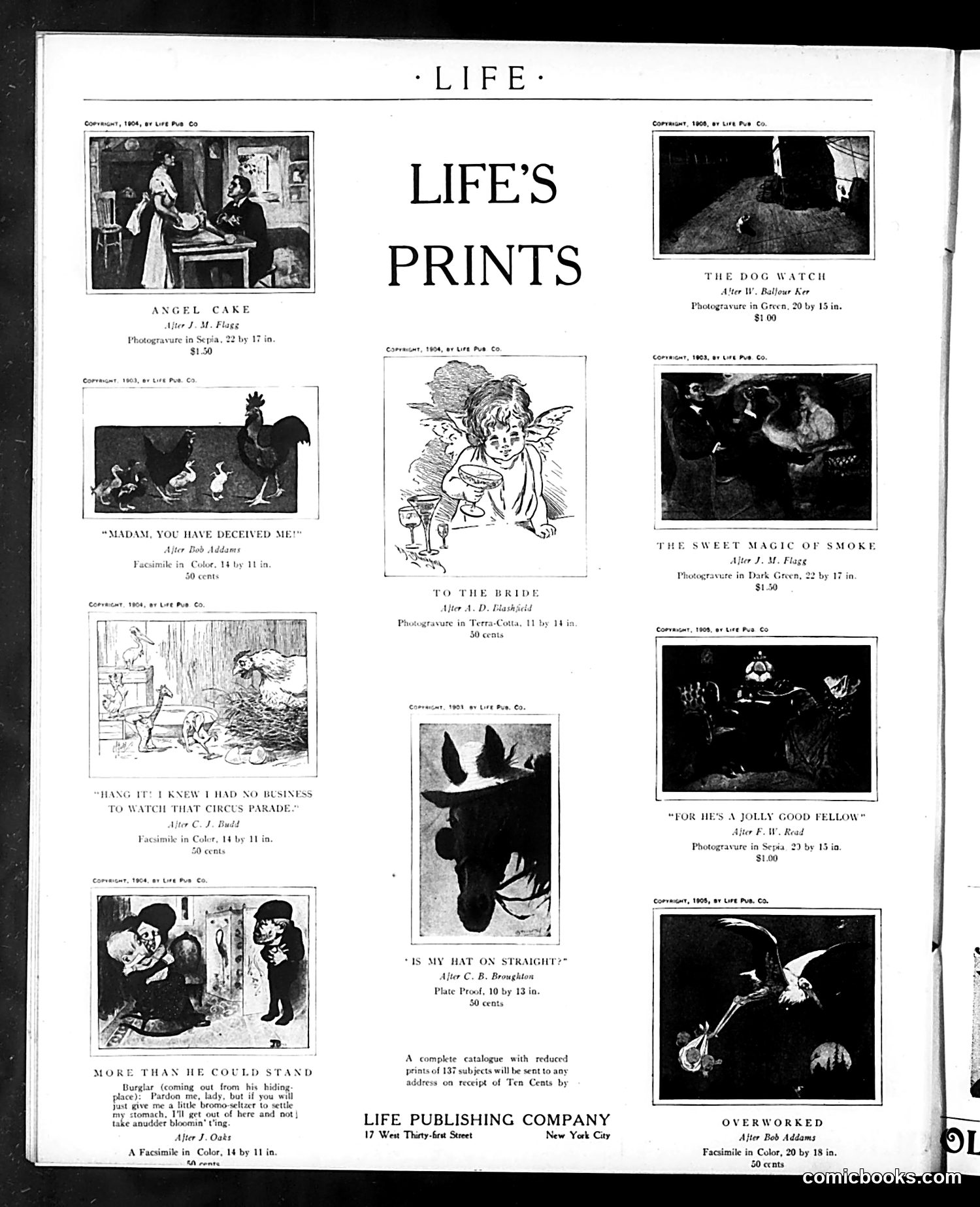
This is primarily a **catalog/advertisement page** from Life Publishing Company showcasing available satirical prints for sale (priced 50 cents to $1.50). Rather than political commentary, it displays humorous domestic and social-observation cartoons typical of early 1900s Life magazine. The prints depict relatable comedic scenarios: a burglar politely requesting indigestion relief mid-robbery ("More Than He Could Stand"), a child's innocent observation about a circus parade, anxious vanity about appearance ("Is My Hat On Straight?"), and working-class exhaustion ("Overworked"). These represent Life's signature style: gentle satire of everyday human behavior and social awkwardness rather than sharp political critique. The page functioned as merchandise, allowing readers to purchase framed reproductions of popular cartoons by artists like J.M. Flagg and C.J. Budd. It's essentially a *gift catalog* page marketing prints to middle-class subscribers.
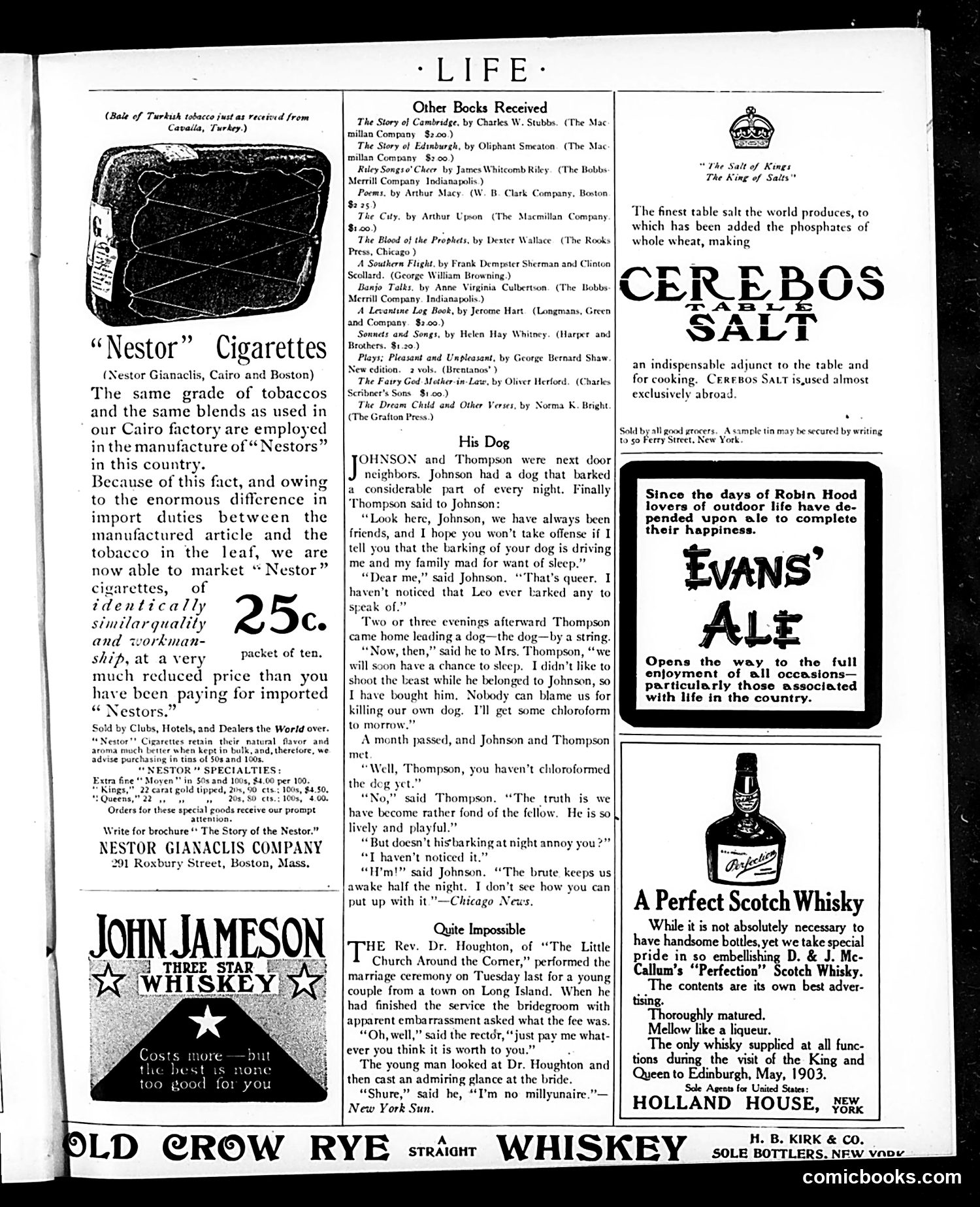
This page is primarily **advertising**, with one satirical story mixed in. The main content is a humorous anecdote titled "His Dog" about neighbors Johnson and Thompson. Johnson's dog barks nightly, disturbing Thompson's sleep. When Johnson dismisses the complaint, Thompson buys the dog himself—planning to chloroform it. The joke's point: Thompson found a clever loophole to kill the annoying dog by making it his own property first, avoiding blame. It's a dark humor piece about neighborly conflict and petty revenge. The page is otherwise dominated by product advertisements for **Nestor Cigarettes** (emphasizing Egyptian tobacco imported cheaply), **John Jameson Whiskey**, **Cerebos Salt** (with added wheat phosphates), and **Evans Ale** (marketed to outdoor enthusiasts). These reflect early 1900s consumer culture and product marketing conventions. The "Other Books Received" section lists recent publications, including works by George Bernard Shaw.
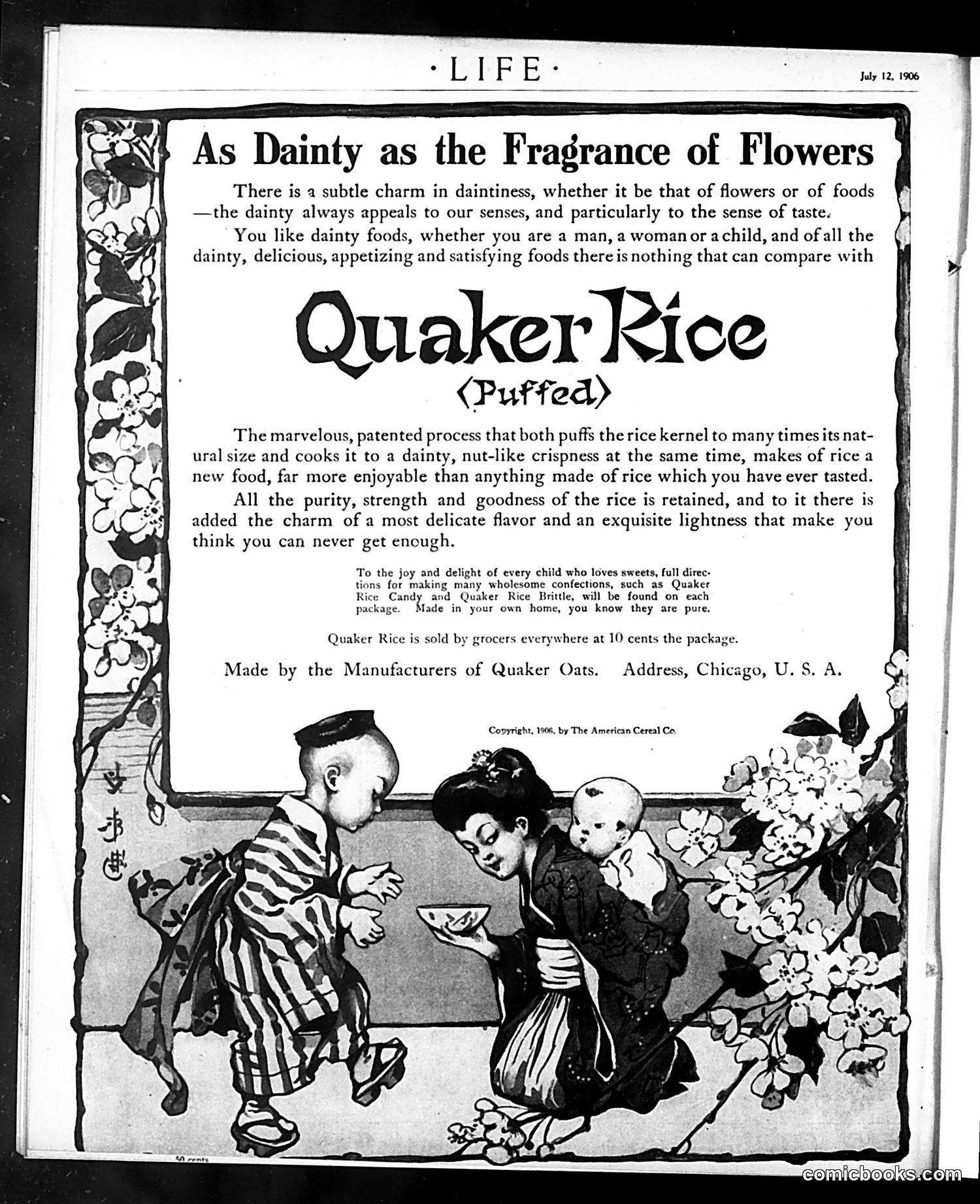
This is primarily a **product advertisement**, not political satire. It's a 1906 ad for Quaker Rice (Puffed), published in *Life* magazine. The page features three children in vintage clothing playing or dancing among flowers, illustrating the ad's central metaphor: that Quaker Rice is as delicate and appealing as flower fragrance. The visual aims to associate the product with innocence, daintiness, and childhood pleasure. The ad emphasizes the novelty of the puffing process (patented technology), purity, and affordability (10 cents). It notably appeals to **three demographics**: men, women, and children—reflecting early 1900s marketing strategy. The mention of homemade candy recipes ("Quaker Rice Candy") suggests the product's versatility for domestic food preparation. This represents typical *Life* magazine advertising of the era, where cereal companies used whimsical imagery and flowery language to market processed foods as wholesome and modern innovations.