
Life, 1906-07-12 · page 7 of 24
Life — July 12, 1906 — page 7: what you’re looking at
What you’re looking at
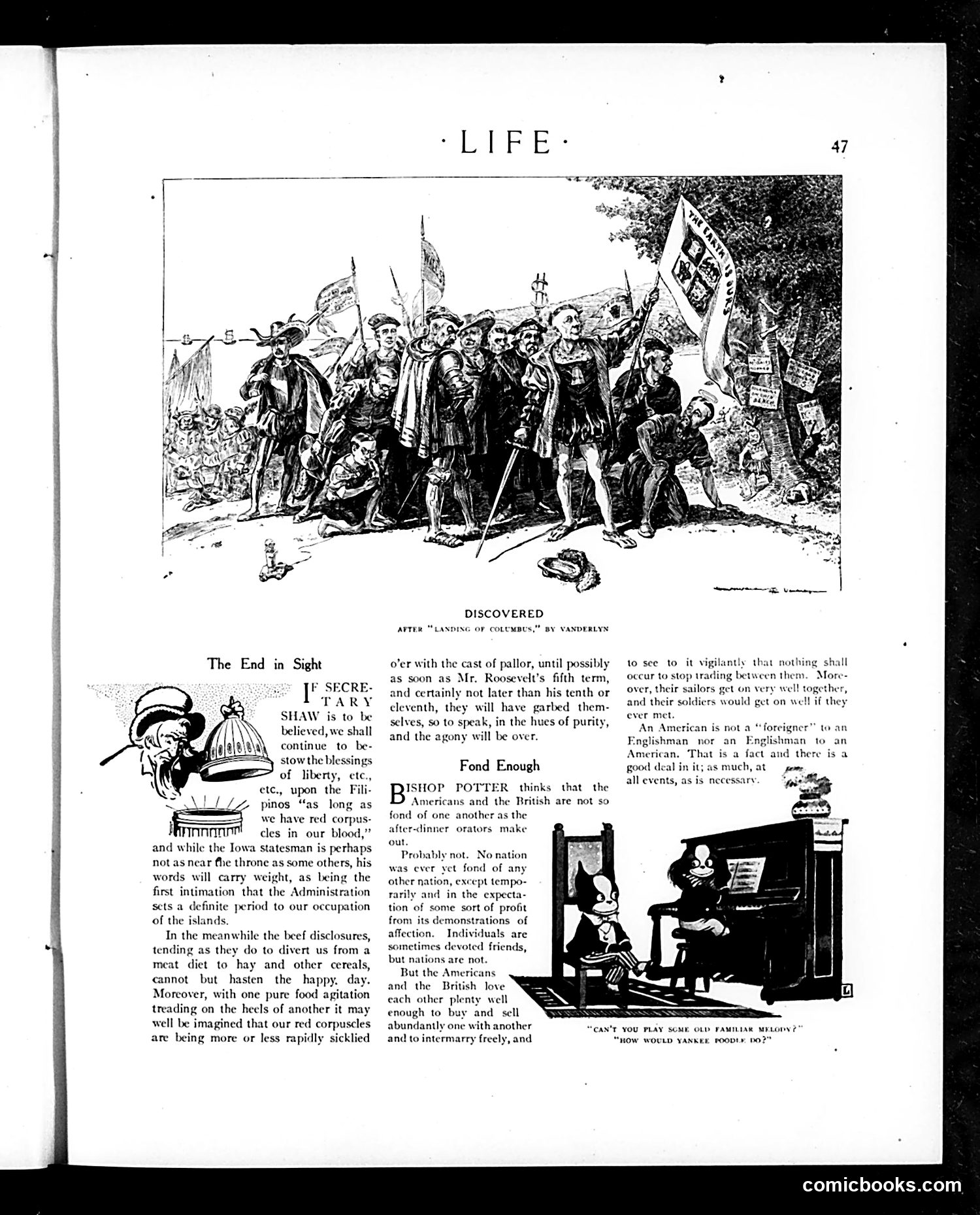
The top engraving depicts a historical scene titled "Discovered after 'Landing of Columbus,' by Vanderllyn" — apparently referencing a famous painting. The accompanying articles discuss post-WWI American-British relations. "The End in Sight" predicts the end of Roosevelt's administration, mentioning his fifth term (unclear which Roosevelt). The text suggests optimism about resolving wartime issues. "Fond Enough" presents Bishop Potter's argument that Americans and British, while individually friendly, are not naturally fond of each other as nations. The cartoon below shows two figures at a piano with the caption "CAN'T YOU PLAY SOME OLD FAMILIAR MELODY?" / "HOW WOULD YANKEE DOODLE DO?" — depicting cultural/musical tension between the nations, suggesting difficulty finding common ground.
📄 Transcribed text from this page (OCR, searchable)
Machine-transcribed from the original scan — historical spelling and the odd misread are preserved.
* LIPS The End in Sight Ik SECRE- TARY SHAW is to be believed, we shall continue to be- stow the blessings of liberty, ete, ete.,, upon the Fili- t// pinos “as long as we have red corpus: HEnnmnmare! ces in our blood,” and while the Iowa statesman is perhaps not as near fhe throne as some others, his words will carry weight, as being the first intimation that the Administration sets a definite period to our occupation. of the islands. In the meanwhile the beef disclosures, tending as they do to divert us from a meat diet to hay and other cereals, cannot but hasten the happy, day. Moreover, with one pure food agitation treading on the heels of another it may well be imagined that our red corpuscles are being more or less rapidly sicklied DISCOVERED APTER “LANDING OF COLUMBUS,” BY VANDERLYN o'er with the cast of pallor, until possibly as soon as Mr. Roosevelt’s fifth term, and certainly not later than his tenth or eleventh, they will have garbed them- selves, so to speak, in the hues of purity, and the agony will be over. Fond Enough ISHOP POTTER thinks that the sand the British are not so nother as the Ameri fond of one after-dinner orators make out. Probably not. No nation was ever yet fond of any other nation, except tempo- rarily and in the expecta- tion of some sort of profit from its demonstrations of affection. Individuals are sometimes devoted friends, but nations are not. But the Americans and the British love cach other plenty well enough to buy and. sell abundantly one with another and to intermarry freely, and “CAN'T YOU PLAY SOME OLD FAMILIAR ADA “HOw WOULD YANKEE FOODLY po?” to sce to it vigilantly that nothing shall occur to stop tra over, their sailors get on very well togethe and their soldiers would get on well if they met n American is not a “foreigner” to an Englishman nor an Englishman to an American, That is a fact and th good deal in it; as much, at seme all events, as is necessary ing between them. More- comicbooks.com