
Life, 1906-07-12 · page 10 of 24
Life — July 12, 1906 — page 10: what you’re looking at
What you’re looking at
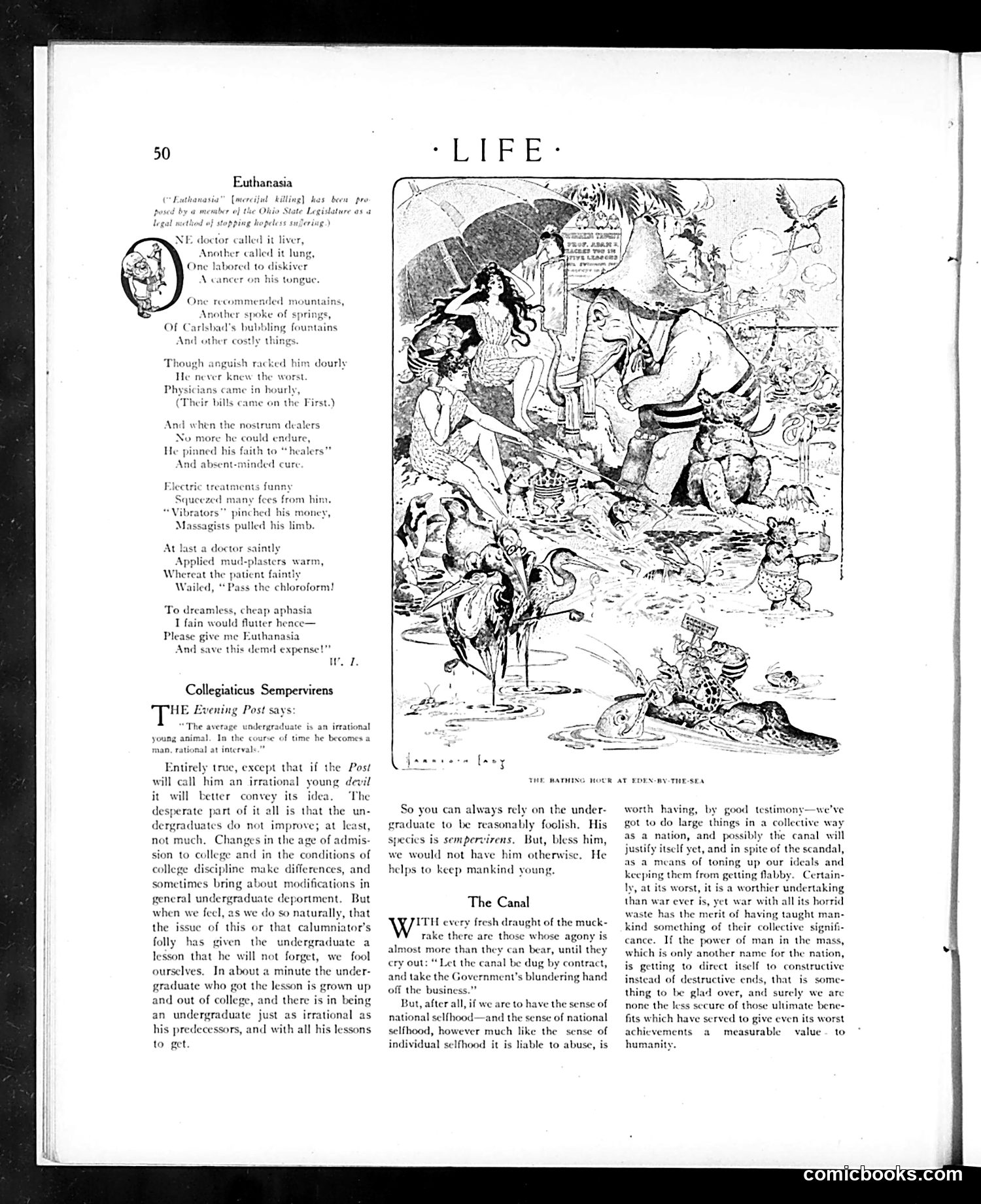
This cartoon satirizes medical quackery and dubious health treatments popular in the early 20th century. The chaotic seaside scene depicts patients seeking cures through various fraudulent methods: electric treatments, vibrators, massages, and mud-plasters. The illustration mocks both the desperate patients willing to try anything and the charlatans exploiting them. The accompanying poem "Euthanasia" expresses exasperation at these ineffective treatments, sarcastically suggesting that death might be preferable to the expensive "cures" on offer. The satire targets the era's widespread medical experimentation on vulnerable, ill people—a commentary on consumer gullibility and the absence of medical regulation. The "Eden by the Sea" title ironically suggests this resort offers salvation when it merely exploits desperation.
📄 Transcribed text from this page (OCR, searchable)
Machine-transcribed from the original scan — historical spelling and the odd misread are preserved.
Euthanasia SE doctor called ther called \ cancer on “1 mountai Another spoke o! OF Carlsbad's bubbling One recor Though anguish racked hin He never knew th bills cal n the First.) And when the nostrum dealers, re he cou ned his Squcezed many fees * pinched his money pulled his limb To dreamless, cheap aphasia I fain would flutter Please give me Euthanasia And save this demd expense w, Collegiaticus Sempervirens ening Post says ‘The average undergraduate is an irrational ¢ of time he becomes a Entirely true, except that if the Post will call him an irrational young devil i fhe desperate part of it all is that the un- dergraduatcs do not improve; at least, not much, Changes in the age of admis- sion to college and in the conditions of college discipline make difference nd sometimes bring about modifications in general undergraduate deportment. But when we fecl, 2s we do so naturally, that the issue of this or that calumniator’s folly has given the undergraduate a lesson that he will not forget, we fool ourselves. In about a minute the under- graduate who got the lesson is grown up and out of college, and there is in being an undergraduate just as irrational as his predecessors, and with all his lessons. to get. THE HATING HOUR AT EDEN RY-THE-SEA So you can always graduate to be reaso rely on the under- ably foolish, His species is sempervirens. But, bless him, we would not have him otherwise. He helps to keep mankind young, The Canal ITH every fresh draught of the muck- rake there are those whose agony is almost more than they can bear, until they cry out: “Let the canal be dug by contract, and take the Government's blundering hand off the business But, after all, if we are to have the sense of national selfhood—and the sense of national selfhood, however much like the sense of individual selfhood it is liable to abuse, is worth having, by good. testimon: got to do large things in a collective way as a na and possibly the canal will justif and in spite of the scandal, as a means of toning up our ideals and keeping them from getting flabby. Certain- ly, at its worst, it is a worthier undertaking than war ever is, yet war with all its horrid waste has the merit of having taught man- kind something of their collective signifi- cance. If the power of man in the mass, which is only another name for the nation, is getting to direct itself 10 constructive instead of destructive ends, that is some- thing to be glad over, and surely we are none the less secure of those ultimate bene- fits which have served to give even its worst value. to achievements a measurable humanity