
Life, 1906-07-12 · page 16 of 24
Life — July 12, 1906 — page 16: what you’re looking at
What you’re looking at
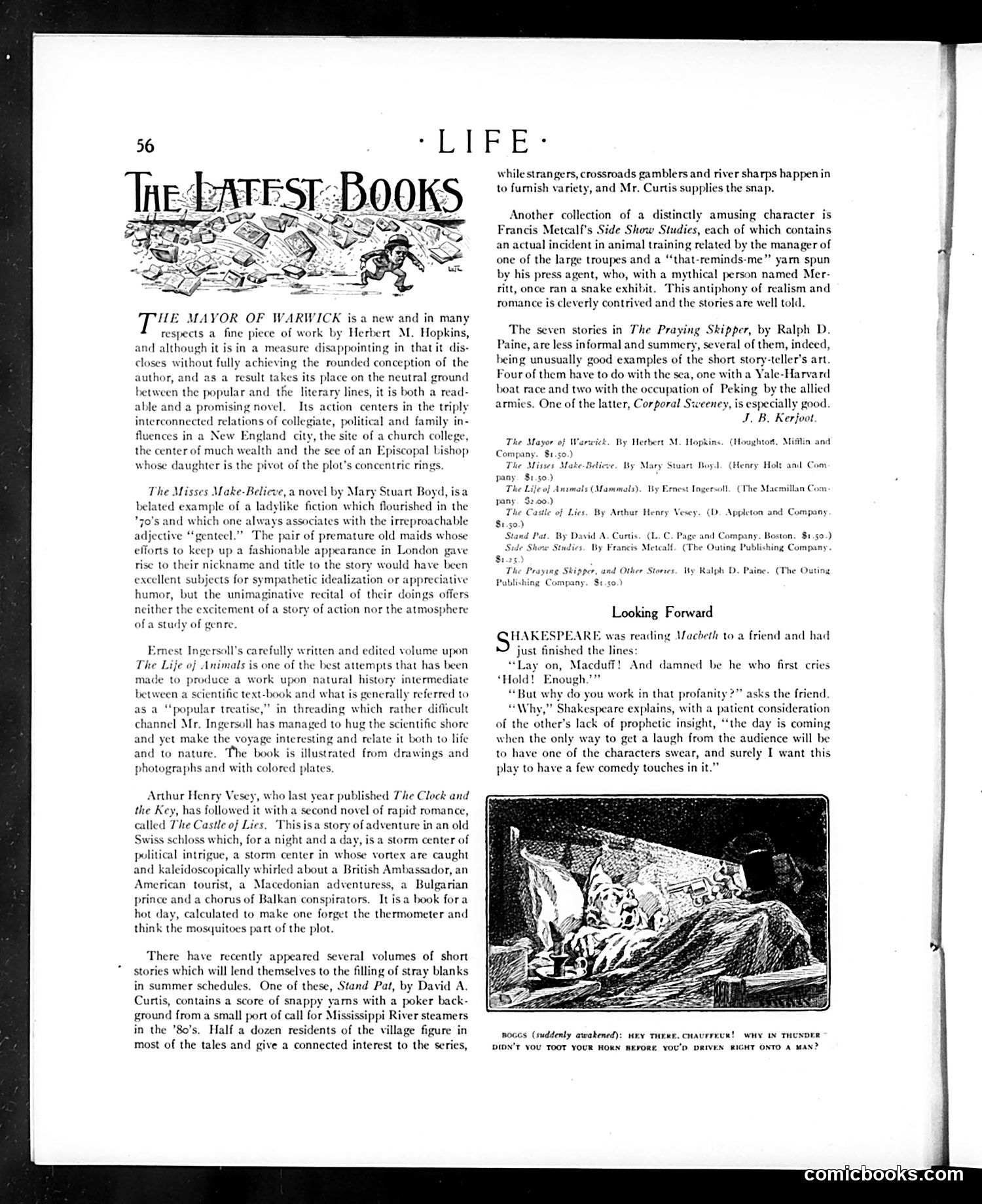
This page is a **book review section**, not a political cartoon. It contains literary criticism of contemporary novels and non-fiction works, with no satirical cartoons or caricatures visible in the main text area. The sole illustration appears at page bottom—a sketch accompanying a Shakespeare anecdote in the "Looking Forward" section. The cartoon shows what appears to be a theatrical scene, with a caption referencing *Macbeth* and containing dialogue about stage comedy. The illustration supports the anecdote about Shakespeare explaining theatrical humor to a friend, but it's incidental to the book reviews above it. The page's purpose is straightforward literary criticism, reviewing works like *The Mayor of Warwick*, *The Misses Make-Believe*, and *The Castle of Lies*—offering educated readers guidance on contemporary fiction and nature writing. There is no discernible satire or political commentary.
📄 Transcribed text from this page (OCR, searchable)
Machine-transcribed from the original scan — historical spelling and the odd misread are preserved.
LIFE TH! MAYOR OF WARWICK isa new and in many respects a fine piece of work by Herbert M. Hopkins, and although it is in a measure disappointing in thatit di closes without fully achieving the rounded conception of the sa result takes its place on the neutral ground ry lines, it is both a read- ple and a promising novel. Its action centers in the triply interconnected relations of collegiate, political and family in- fluences in a New England city, the site of a church college, the center of much wealth and the see of an Episcopal bishop ¢ pivot of the plot's concentric rings. author, and between the popular and the lite whose daughter is The Misses Make-Believe, a novel by Mary Stuart Boyd, belated example of a ladylike fiction which flourished in the nd which one always associates with the irreproachable adjective “gentecl.” The pair of premature old maids whose efforts to keep up a fashionable appearance in London gave rise to their nickname and title to the story would have been excellent subjects for sympathetic idealization or appreciative humor, but the unimaginative recital of their doings offers neither the excitement of a story of action nor the atmosphere ofa study of genre. Emest Ingersoll’s carefully written and edited volume upon The Lije oj Animals is one of the best attempts that has been made t duce a work upon natural history intermediate between a scientific text-book and what is generally referred to as a “popular treatise,” in threading which rather difficult channel Mr. Ingersoll has managed to hug the scientific shore and yet make the voyage interesting and relate it both to life and to nature. The book is illustrated from drawings and photographs and with colored plates. Arthur Henry Vesey, who last year published The Clock and the Key, has followed it with a second novel of rapict romance, called The Castle of Lies. Thisisa story of adventure in an old Swiss schloss which, for a night and a day, isa storm center of political intrigue, a storm center in whose vortex are caught and kaleidoscopically whirled about a British Ambassador, an American tourist, a Macedonian adventuress, a Bulgarian prince and a chorus of Balkan conspirators, It isa book fora hot day, calculated to make one forget the thermometer and think the mosquitoes part of the plot. There have recently appeared several volumes of short stories which will lend themselves to the filling of stray blanks in summer schedules. One of these, Stand Pat, by David A Curtis, contains a score of snappy yarns with a poker back- ground from a small port of call for Mississippi River steamers in the ’80’s. Half a dozen residents of the village figure in most of the tales and give a connected interest to the series, while strangers, crossroads gamblers and river sharps happen in to furnish variety, and Mr. Curtis supplies the snap. Another collection of a distinctly amusing character is Francis Metcalf’s Side Show Studies, each of which contains an actual incident in animal training related by the manager of one of the large troupes and a “that-reminds-me” yam spun by his press agent, who, with a mythical person named Mer- ritt, once ran a snake exhibit. This antiphony of realism and romance is cleverly contrived and the stories are well told. The seven stories in The Praying Skipper, by Ralph D. Paine, are less informal and summery, several of them, indeed, being unusually good examples of the short story-teller’s art. Four of them have to do with the sea, one with a Yale-Harvard boat race and two with the occupation of Peking by the allied armies. One of the latter, Corporal Sweeney, is especially good J.B. Kerjoot The Mayor of Warwick. By Herbert M. Hopkins. (Houghton, Mifitin and Company. $1.50.) The Misses Make-Beticve. By Mary Stuart Boys pany. $1.50 The Life of Antmals (Mammals). Iby Ernest Ingersoll. (The Macmillan Com pany. $2.00.) The Castle of Lies. By Arthur Henry Vesey. (D. Appleton and Company $1.50.) Stand Pat. By David A. Curtis, (LC. P dies. By Francis Metea Henry Holt and Com and Company. Boston. $1.59.) (The Outing Publishing Company Shipper, and Other Stories. By Ralph D. Paine. (The Outing Publishing Company. $t.s0.) Looking Forward HAKESPEARE was reading Macbeth to a friend and had just finished the lines: “Lay on, Macduff! And damned be he who first cries ‘Hold! Enough.’ “But why do you work in that profanity ?” asks the friend “Why,” Shakespeare explains, with a patient consideration of the other's lack of prophetic insight, “the day is coming when the only way to get a laugh from the audience will be to have one of the characters swear, and surely I want this play to have a few comedy touches in it.” soces (suddenly awakened): wny THERE. CHAUFrEUK! WHY IN THUNDER DIDN'T YOU TOOT YOUR HOKN BEFORE YOU'D DRIVEN RIGHT ONTO A MAN?