
A complete issue · 24 pages · 1906
Life — February 8, 1906
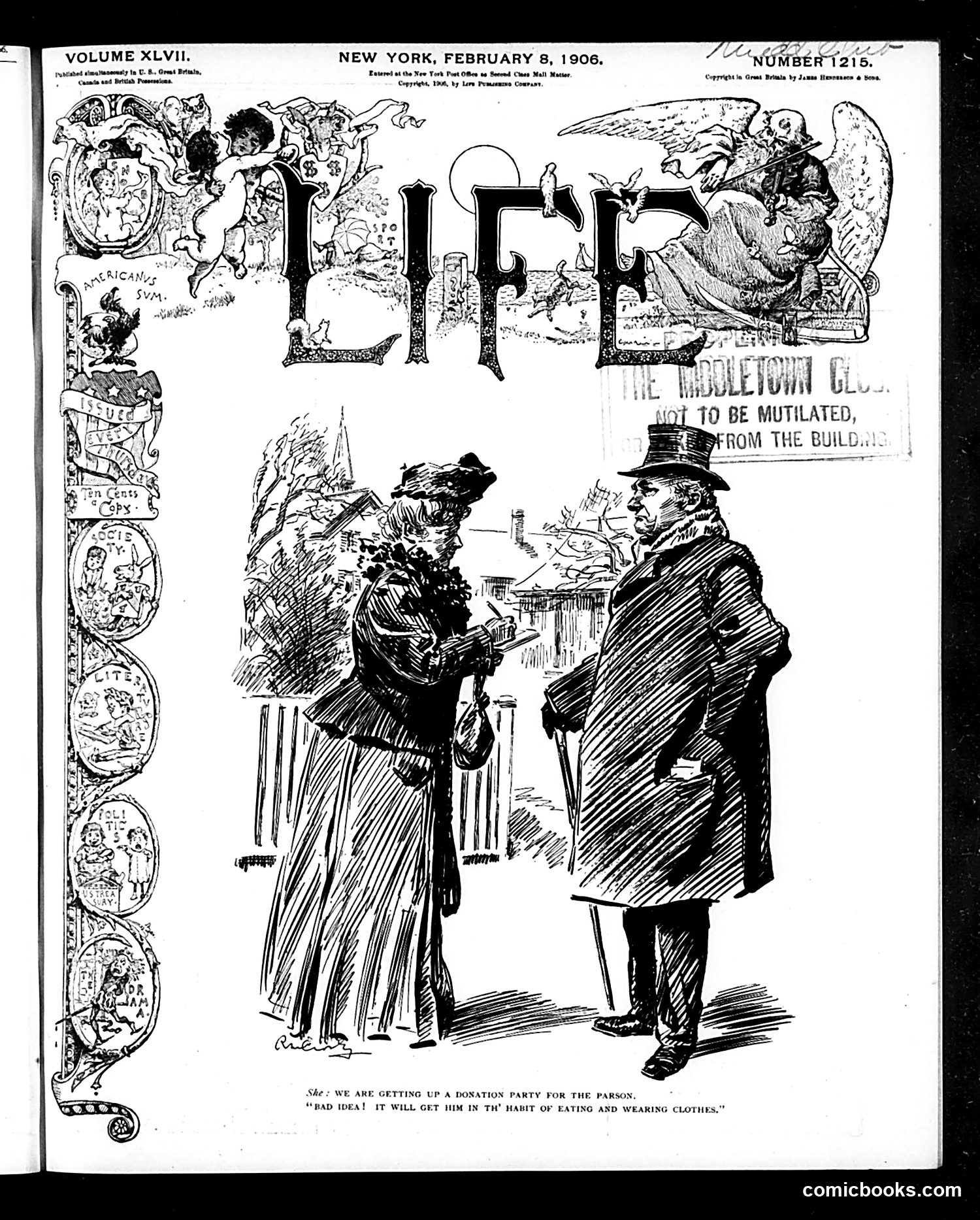
This satirical cartoon depicts two well-dressed gentlemen in conversation. The caption reads: "We are getting up a donation party for the parson. 'Bad idea! It will get him in th' habit of eating and wearing clothes.'" The joke mocks the financial struggles of parish clergy in the early 1900s. The cartoon suggests that clergymen were so poorly compensated that they rarely received adequate food or clothing—implying their congregations' donations were inadequate or inconsistent. By joking that helping the parson might create a "habit" of basic sustenance and dress, it satirizes both clerical poverty and the apparent reluctance of wealthy parishioners to properly support their spiritual leaders. The cartoon criticizes the gap between religious institutions' expectations and their actual financial support of clergy.
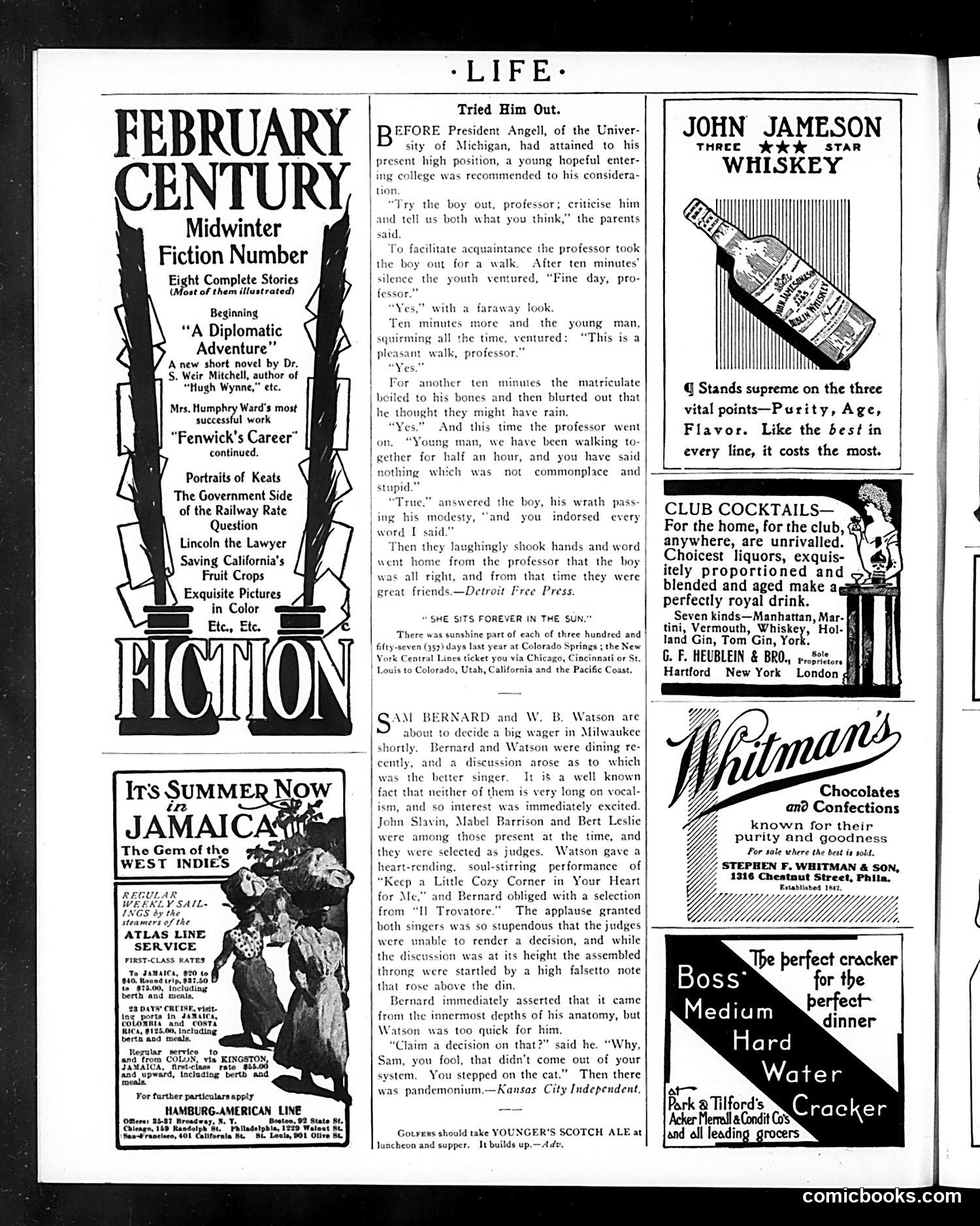
This short story excerpt depicts a humorous exchange between a university professor and a young man applying for admission. The professor subjects the boy to a "test walk," remaining silent for extended periods while critiquing his conversation skills, physical appearance, and intellectual capability. The satire targets early 20th-century academic pretension—the professor's pompous evaluation methods and harsh judgments about the boy's commonplace observations. When the boy finally speaks freely, the professor dismisses his remarks as stupid, then contradicts himself by praising the same observations when repeated back by someone else. The joke exposes academic arrogance and the arbitrary nature of professorial judgment, likely resonating with readers frustrated by institutional gatekeeping.
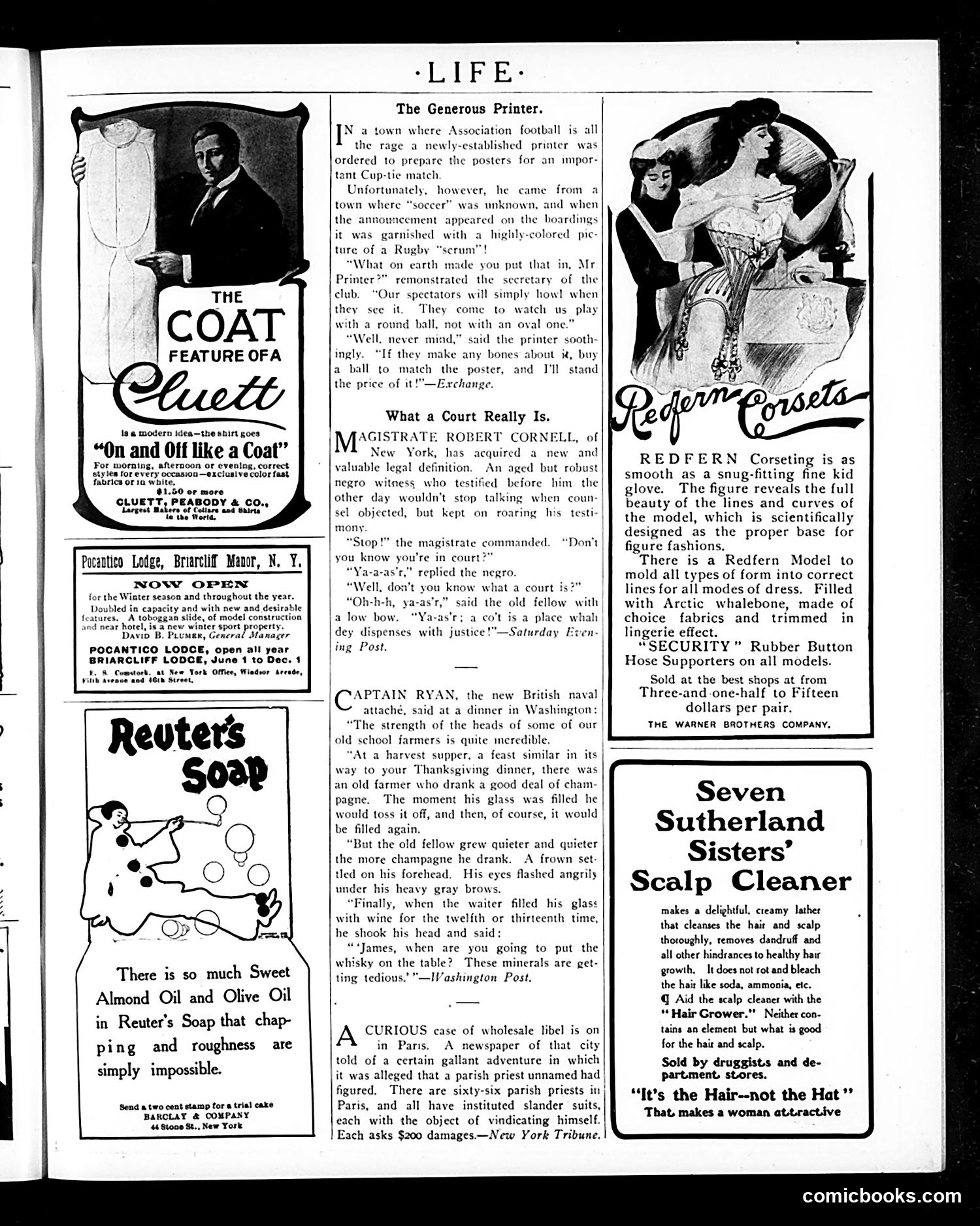
This page is primarily **advertising**, with three main comic anecdotes in the center column. The title story "The Generous Printer" satirizes a printer's naive assumption about sports. Ordered to create a football Cup-tie poster, the printer—from a town where soccer is unknown—mistakenly illustrates a Rugby "scrum" instead. The joke hinges on the printer's ignorant generosity in offering to correct the error cheaply, fundamentally misunderstanding what sport he's advertising. The surrounding anecdotes mock British institutional confusion: a magistrate unfamiliar with legal terminology, and a naval officer baffled by basic table etiquette. These brief humor pieces ridicule upper-class incompetence and miscommunication rather than targeting specific individuals or political events. The page otherwise features period advertisements for corsets, soap, and hair products.
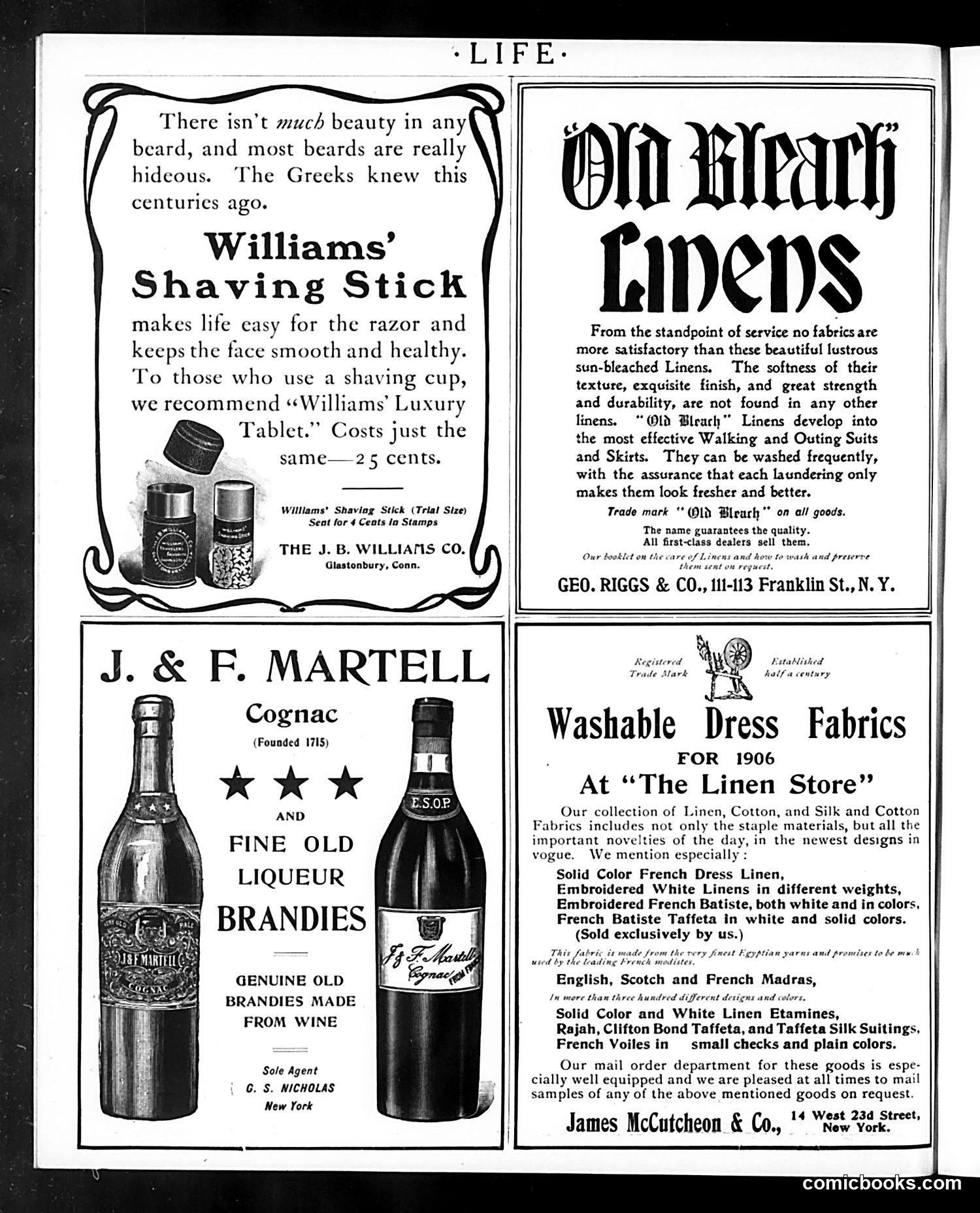
This is primarily an **advertising page**, not satirical content. It contains four product advertisements from the early 1900s: 1. **Williams' Shaving Stick** — uses a classical argument (citing ancient Greek preferences) to dismiss beards as ugly, marketing their shaving product as the solution for a smooth, healthy face. 2. **"Old Bleach" Linens** — emphasizes durability and practicality of sun-bleached linens for clothing and household use. 3. **J. & F. Martell Cognac** — advertises brandy and liqueurs, highlighting the product's founding date (1715). 4. **Washable Dress Fabrics** — promotes practical, machine-washable textiles for 1906 women's fashion, including linens, cottons, and silks in various styles. The page reflects early 20th-century consumer culture and manufacturing confidence.
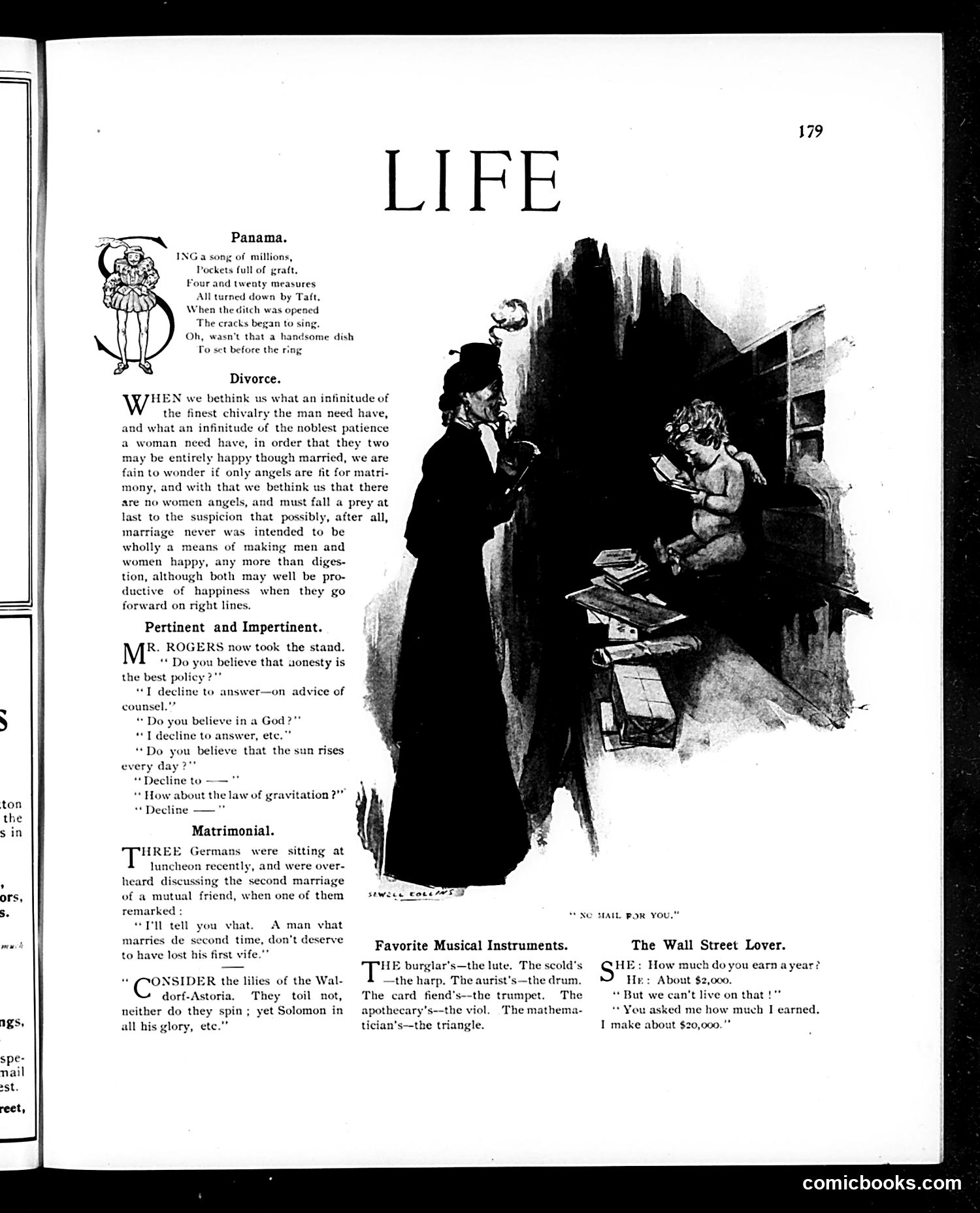
This page from *Life* magazine contains several satirical sections mocking social conventions of the era: **"Panama"** jokes about the Panama Canal's construction costs and engineering. **"Divorce"** presents philosophical commentary on marriage's failures, suggesting neither gender finds happiness in matrimony—a critique of the institution itself rather than individuals. **"Pertinent and Impertinent"** shows Mr. Rogers declining to answer straightforward questions about honesty, God, and science, satirizing evasiveness or hypocrisy in public figures. The illustration depicts what appears to be a legal or business transaction between a well-dressed man and a younger person, likely accompanying one of these satirical pieces about marriage dissolution or financial matters. **"The Wall Street Lover"** jokes about income disparity in relationships, where a man earning $2,000 claims he cannot afford living expenses that his partner making $20,000 manages easily—mocking male financial pretense or dependence.
This page presents an editorial essay on divorce, not political cartoons. The text argues that divorce, while concerning to some clergy, serves a legitimate social function by providing an "incomplete remedy" for failed marriages. The small decorative illustrations are generic vignettes rather than specific caricatures—they depict abstract figures of couples and children to illustrate marital and domestic themes. The essay's main point appears to be defending divorce as preferable to trapping people in unhappy marriages. It counters religious opposition by suggesting that good people sometimes make bad marriages, and that divorce protects children and society better than forced cohabitation. The satire is gentle and editorial in nature, targeting institutional hypocrisy rather than specific individuals or events.
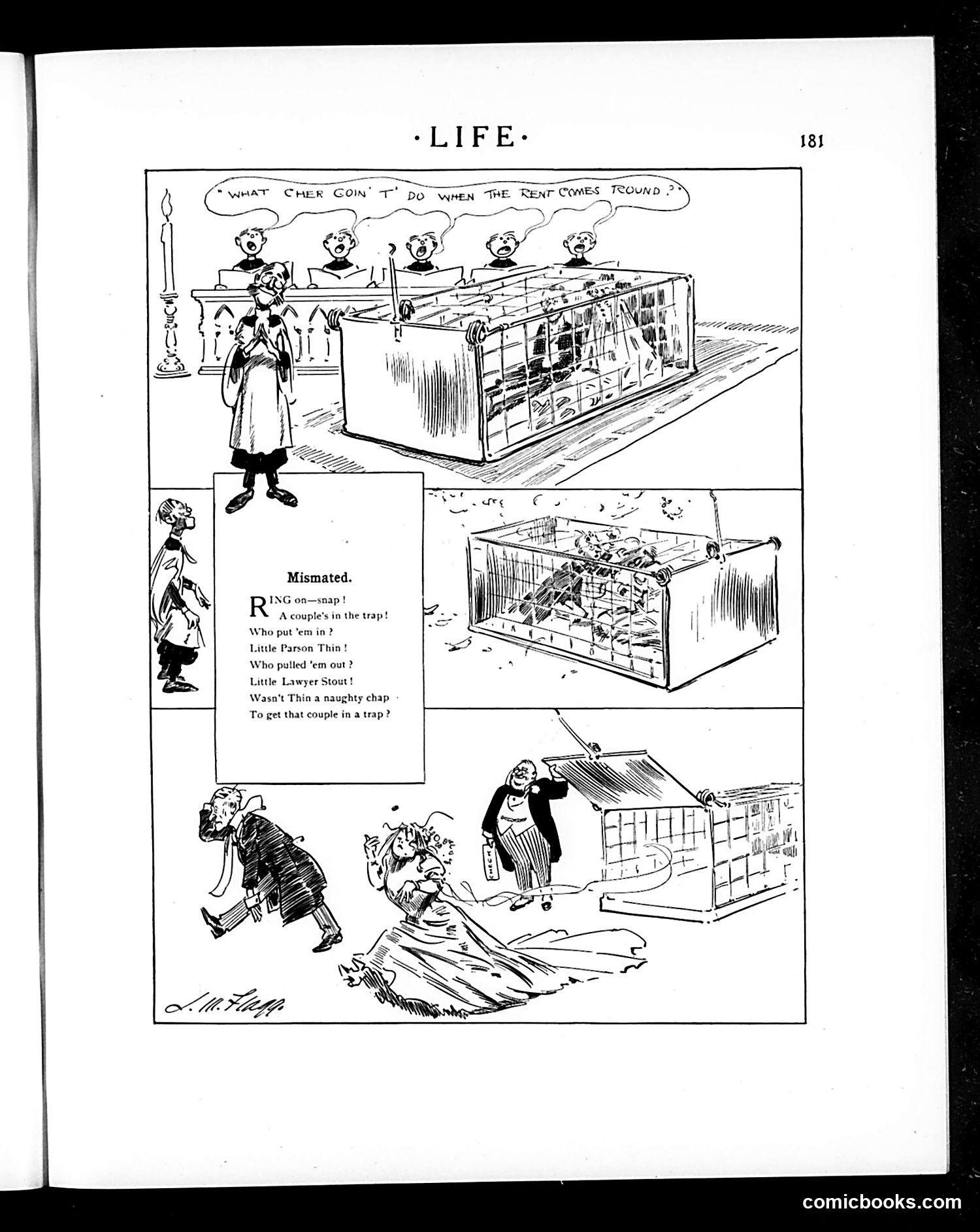
This cartoon satirizes landlord-tenant conflict, specifically the difficulty of collecting rent. The top panel shows a landlord asking anxiously "What cher goin' t' do when the rent comes round?" to five worried tenants huddled on the roof. The poem "Ring-on-snap!" mocks various debtors: "Little Parson Thin," "Little Lawyer Stout," and others who evade rent by hiding or disappearing. The final couplet suggests collecting rent was nearly impossible—"Wasn't this a naughty chap / To get that couple in a trap?" The bottom panels depict the landlord's futile chase, shown being dragged away and struggling with an escaping tenant. The cartoon critiques housing instability and the adversarial landlord-tenant relationship of the era, likely reflecting post-WWI economic hardship and housing shortages.
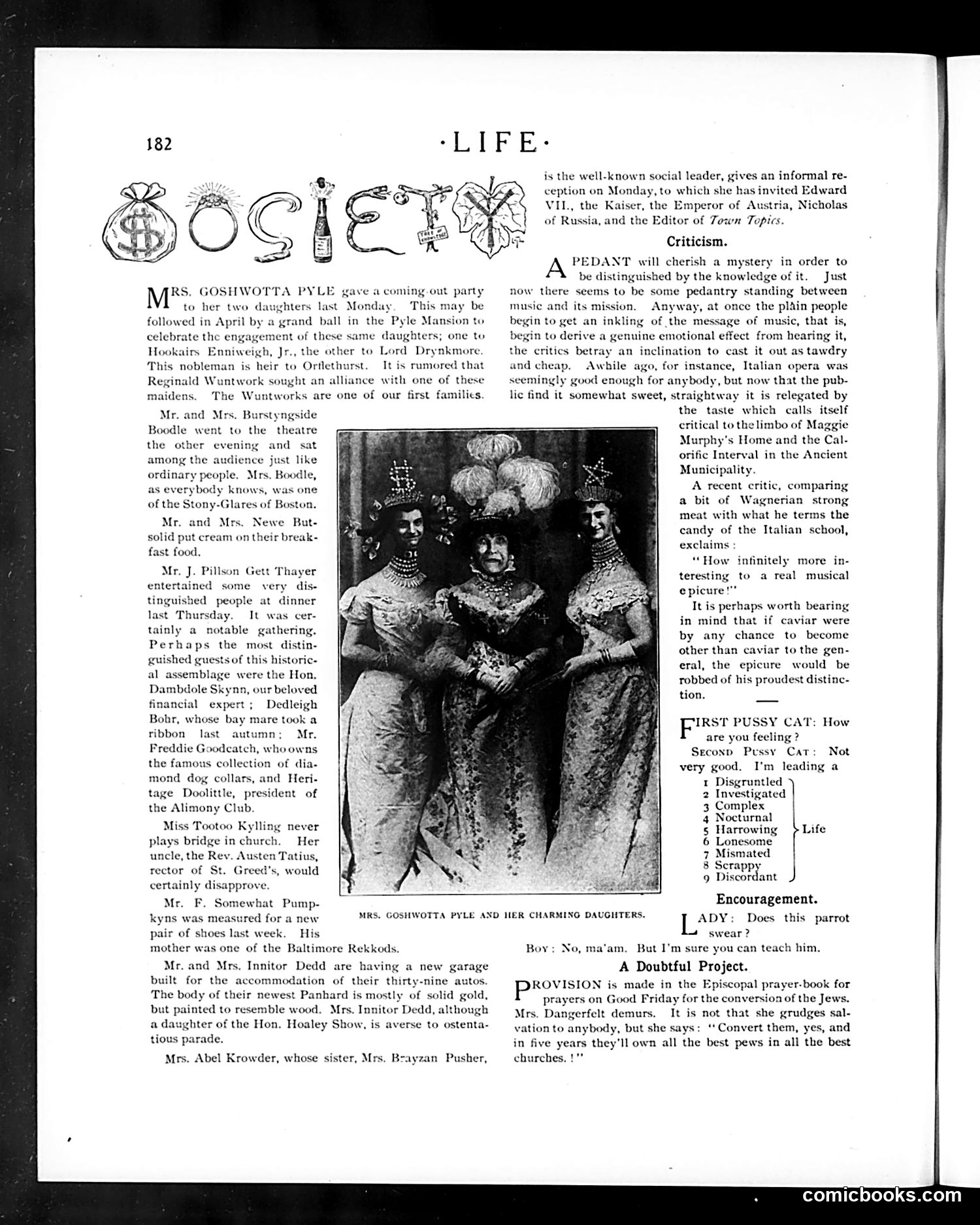
This page contains **society gossip and humorous commentary** rather than political cartoons. The central photograph shows "Mrs. Goshwotta Pyle and Her Charming Daughters" at what appears to be a formal social gathering. The text includes satirical **social commentary**: observations about wealthy families, their entertainments, and pretensions. There's a "Criticism" section mocking pedantry in music appreciation, comparing Italian opera to "Maggie Murphy's Home" and using obscure musical references to ridicule overly intellectual aesthetic judgment. The "First Pussy Cat" dialogue is a humorous exchange where a cat lists emotional complaints ("Investigated / Complex / Nocturnal"). The page reflects **turn-of-century American magazine satire** targeting upper-class social life and intellectual affectation rather than specific political figures.
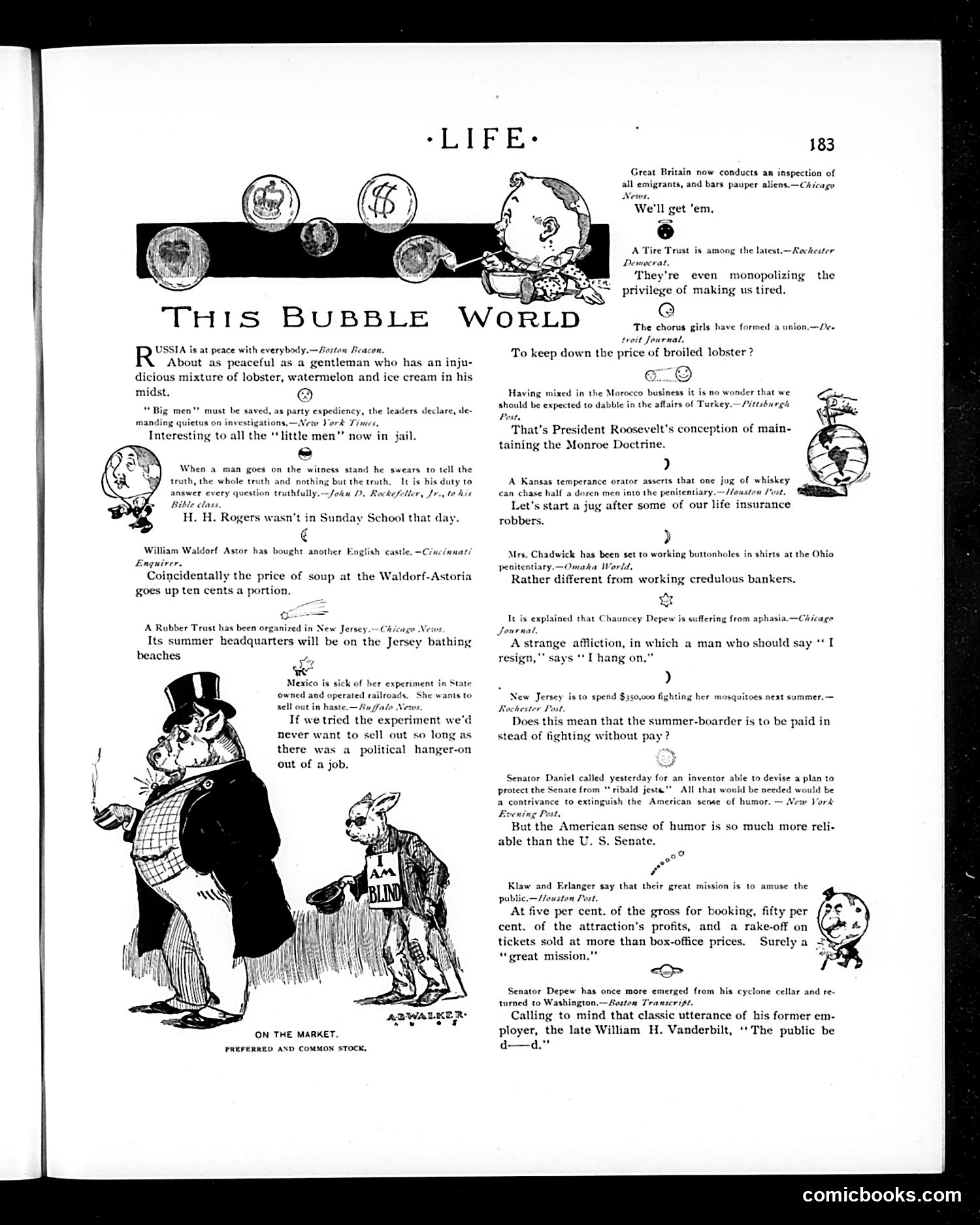
This page satirizes early 20th-century American politics and social issues through brief quips and illustrations. The main cartoon, titled "On the Market: Preferred and Common Stock," depicts a portly capitalist figure in top hat negotiating with a smaller figure, likely representing ordinary workers or the public—a commentary on economic inequality and power imbalance. The text snippets mock various targets: monopolies ("they're even monopolising the privilege of making us tired"), politicians (references to Roosevelt and the Monroe Doctrine), and government inefficiency (the Senate's inability to address problems). The "bubble world" title suggests these are inflated, fragile issues—economic bubbles, political posturing, or social absurdities about to burst. The overall tone is cynical about American capitalism and governance.
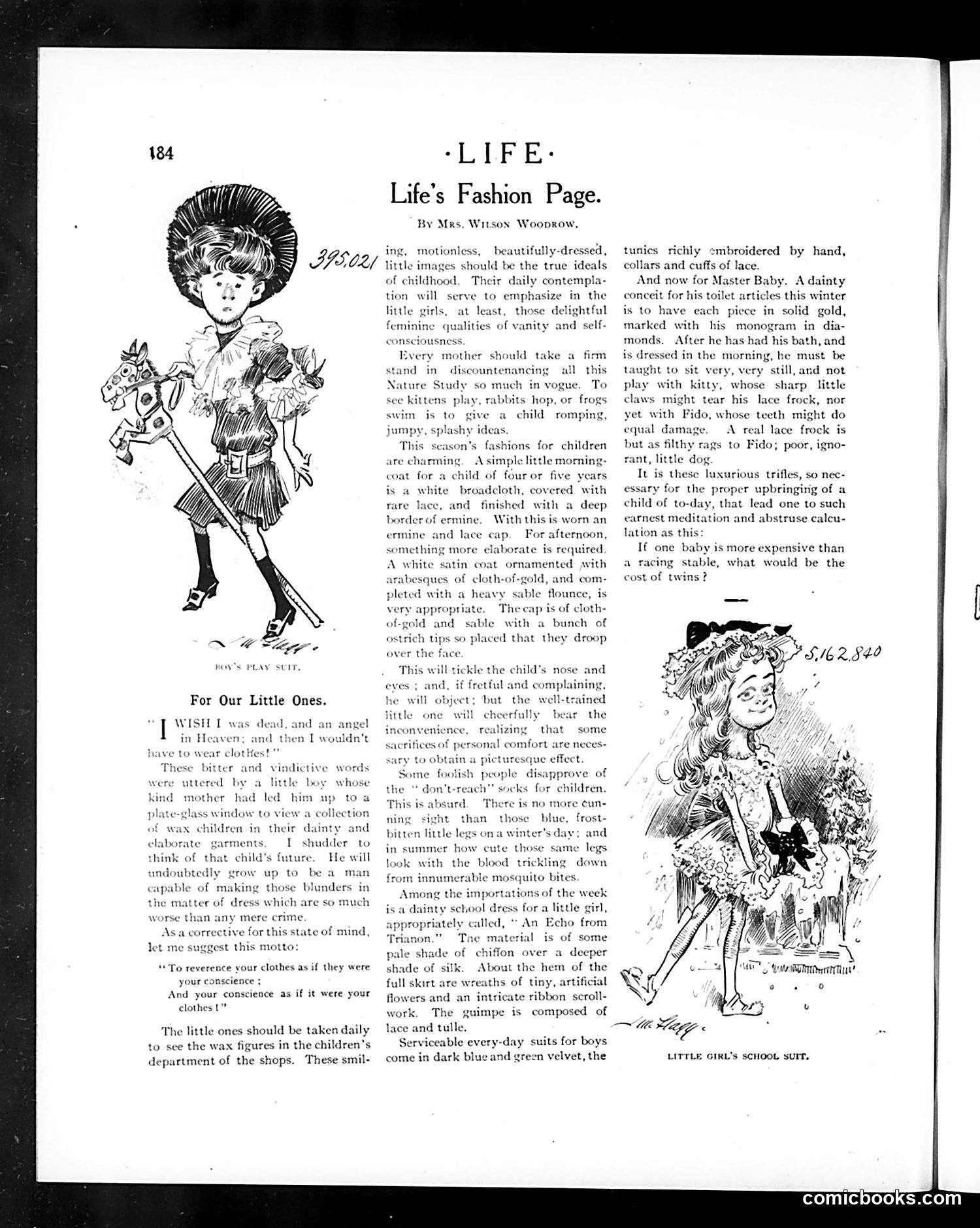
This is a fashion advice column by Mrs. Wilson Woodrow addressing children's clothing trends. The page features two illustrations of children's outfits: 1. **"Boy's Play Suit"** - depicts a child in casual play clothes 2. **"Little Girl's School Suit"** - shows a girl in an elaborate dress The text critiques excessive ornamentation in children's fashion, particularly the "Nature Study" trend. Woodrow advocates for practical, simple children's clothing over elaborate decorative styles then fashionable. She argues that overly fancy dress restricts children's movement and natural play, warning mothers against prioritizing appearance over comfort and functionality. The column uses gentle satire to mock the era's tendency toward over-dressing children in impractical finery, advocating instead for sensible, age-appropriate garments suited to actual childhood activities.
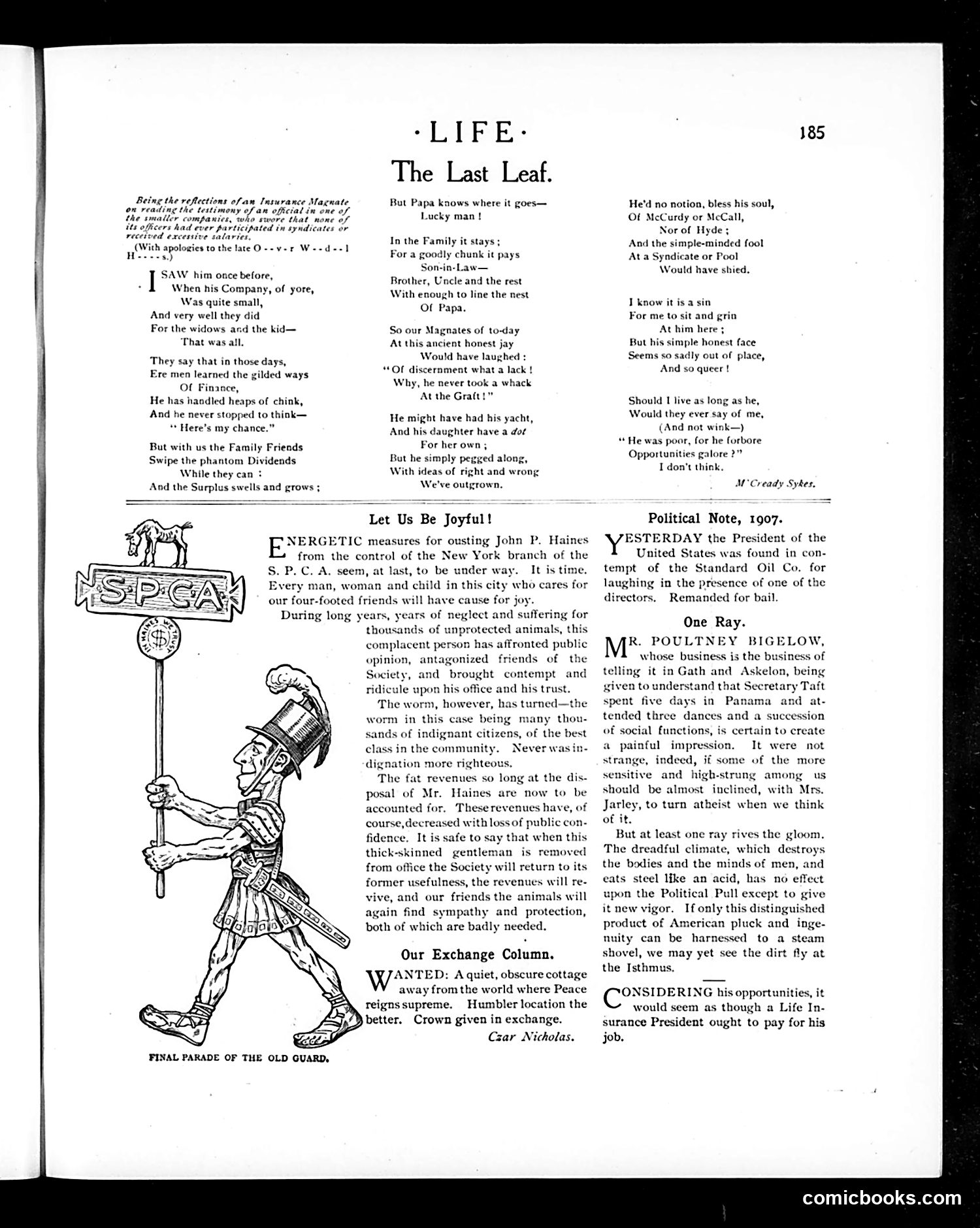
The cartoon depicts a skeletal, decrepit soldier in classical Roman armor, labeled as the "Final Parade of the Old Guard." This appears to reference Napoleon's Imperial Guard—historically, the elite veteran troops who made their last stand during Napoleon's downfall. In 1897 context, this likely satirizes aging political or military figures clinging to outdated power. The skeletal imagery emphasizes their irrelevance and approaching obsolescence. The page also contains "Let Us Be Joyful!" addressing John P. Haines's removal from the SPCA, and "Political Note, 1897" discussing President Cleveland and Standard Oil—suggesting the cartoon mocks establishment figures resistant to modern reform movements of the Progressive Era.
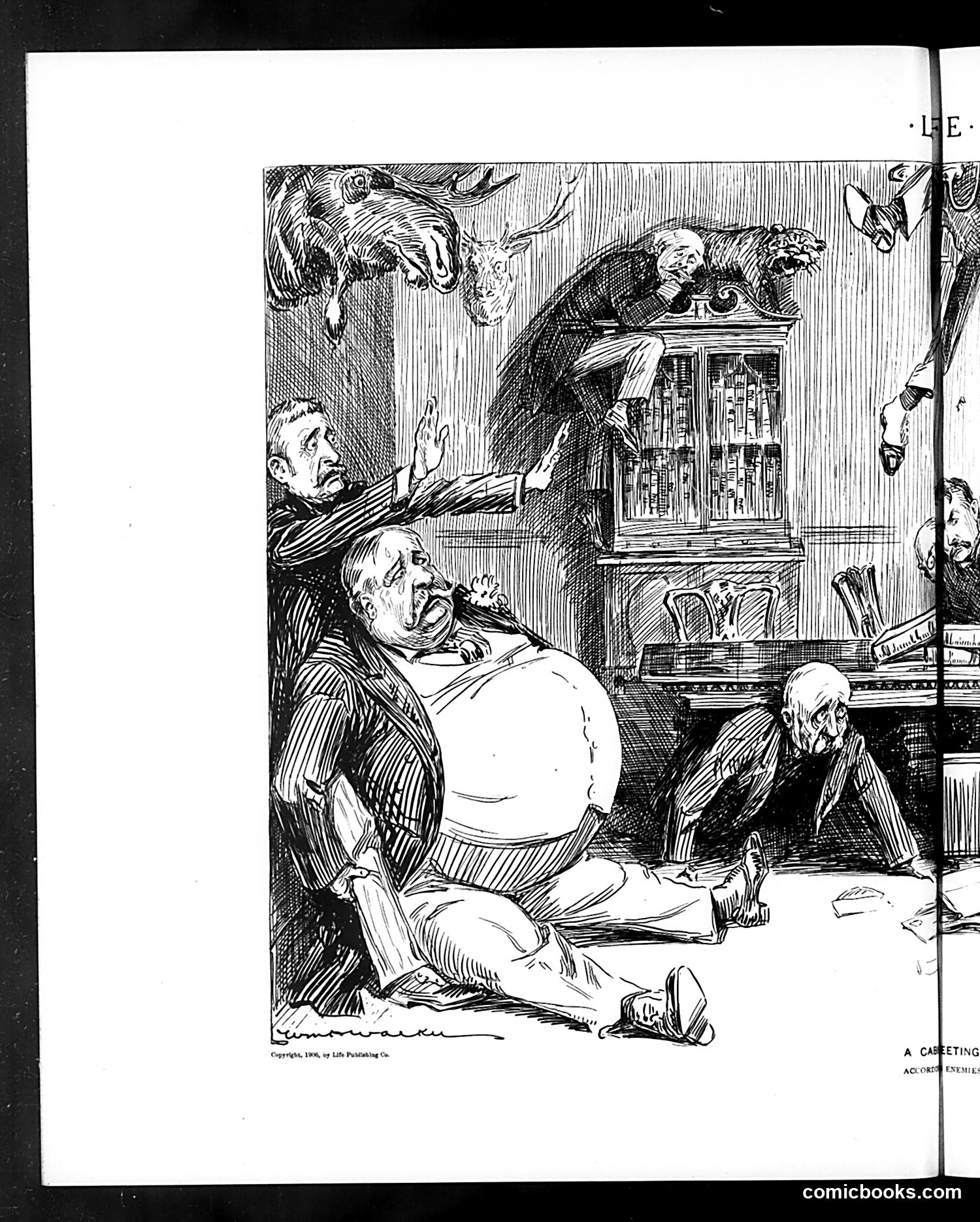
This appears to be a satirical cartoon from *Life* magazine (copyright 1904, U.S. Life Publishing Co., based on the visible credit). The image depicts what looks like a "carpeting" or scolding scene—a supervisor or authority figure berating subordinates in an office setting. One large man sits on the floor looking distressed while being lectured by a standing figure; other men observe from a desk nearby. The title mentions "A CARPETING" and "ACCORDS ENEMIES," suggesting this depicts a workplace confrontation or disciplinary meeting. The satirical angle likely mocks bureaucratic hierarchy, office politics, or the humiliation of public rebuke. Without clearer text identifying the specific figures or political context, the precise targets of the satire remain unclear, though it appears to comment on workplace power dynamics of the Edwardian era.
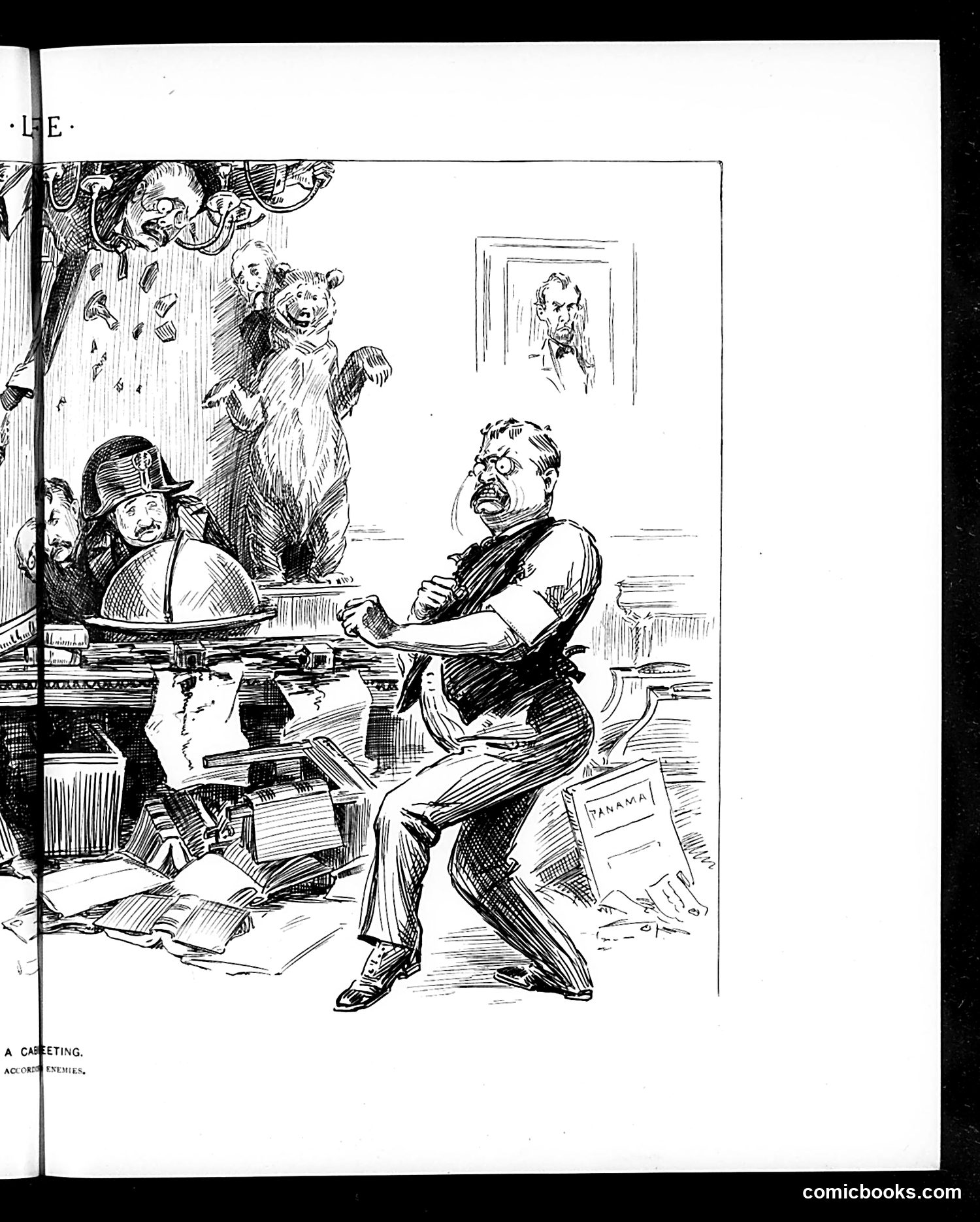
This political cartoon titled "A Carpeting" (likely referring to a harsh reprimand) depicts a confrontation in what appears to be an office setting. A man seated at a desk, apparently in a position of authority, is being sternly addressed by another figure. Papers labeled "Panama" are scattered on the floor around the desk. The cartoon likely satirizes a political or diplomatic dispute involving Panama—possibly relating to the Panama Canal controversy or American involvement in Panama during the early 20th century. The "carpeting" suggests the seated official is receiving a scolding for his handling of the Panama situation. The caricatured figures and exaggerated expressions are typical of Life magazine's satirical style, though without additional historical context visible on this page, the specific officials and exact situation remain unclear.
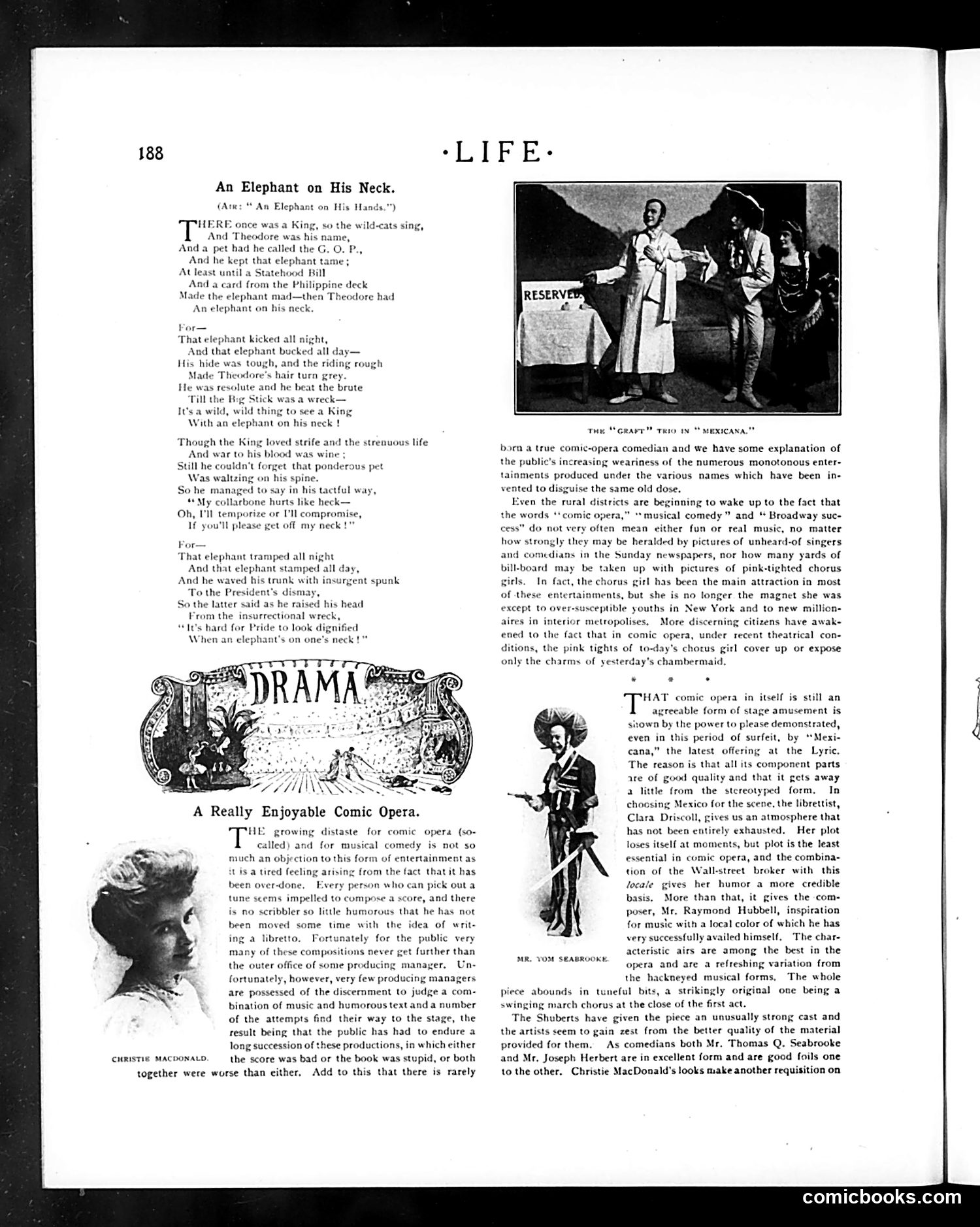
This poem satirizes President Theodore Roosevelt's struggle with the Republican Party (the "G.O.P." elephant). The "elephant" represents Roosevelt's own political party, which he cannot control despite his famous "big stick" approach to power. The joke centers on Roosevelt's predicament: he championed vigorous action ("strenuous life"), yet finds himself unable to manage his party's demands—specifically regarding statehood bills and Philippine policy. His solution is humiliating compromise ("temporize or compromise"), forcing the proud president to swallow his pride. The final image—a dignified king unable to appear dignified with an elephant on his neck—mocks Roosevelt's loss of control and forced political flexibility. The satire suggests that even the most resolute leader cannot dominate his own party machinery. The accompanying review of "Mexicana" (a comic opera) is unrelated content.
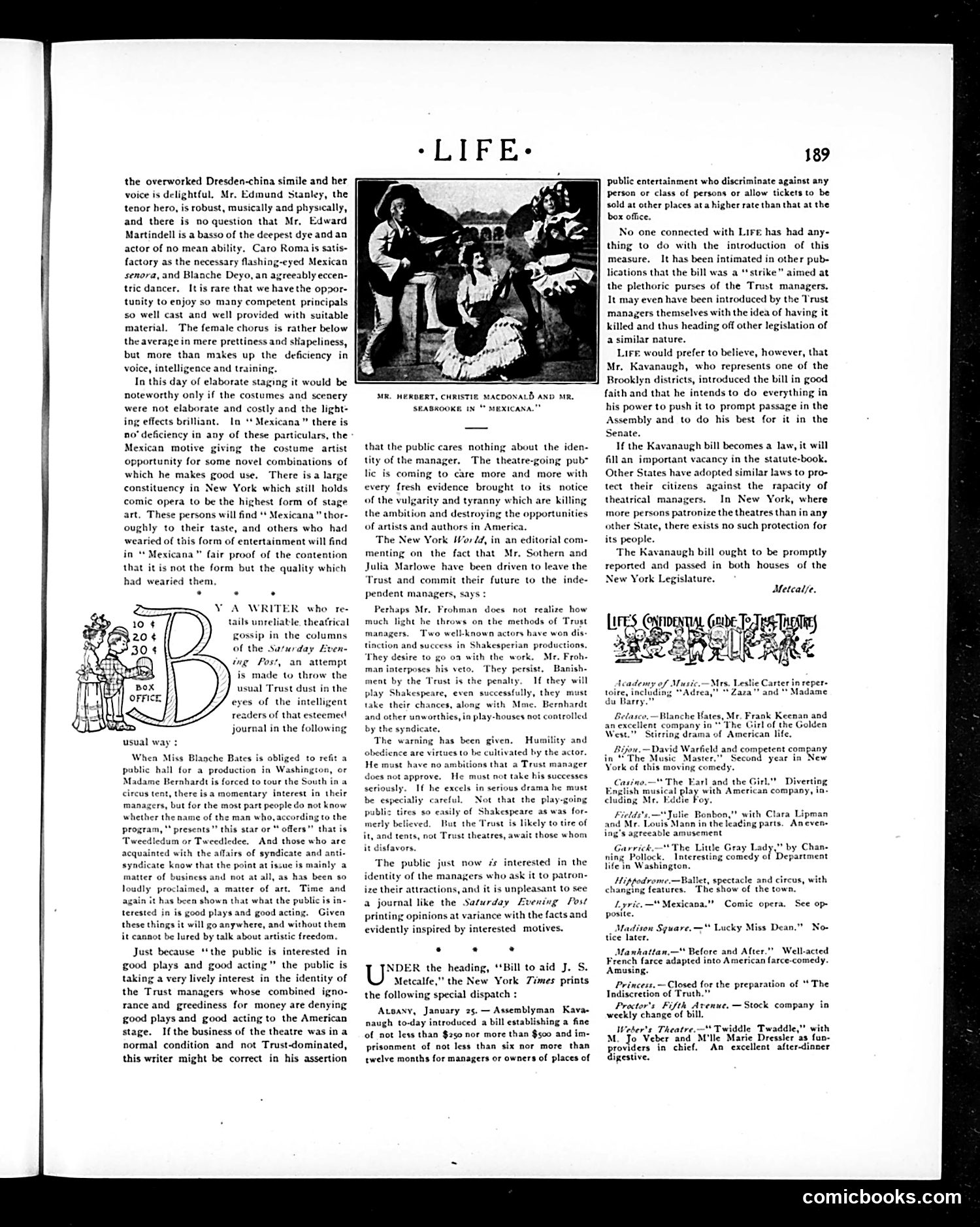
This page criticizes the theatrical **Trust** — a monopolistic syndicate controlling American theater that the text portrays as artistically stifling and commercially exploitative. The accompanying image shows a scene from "Mexicana," a comic opera being reviewed favorably. However, the article's true focus is the Trust's control over theaters and artists. The text argues that prominent actors like Sothern and Julia Marlowe were forced to leave the Trust system to pursue independent management, suggesting the syndicate prioritizes profit over artistic quality and crushes creative ambition. A smaller boxed section highlights a satirical "gossip" column pointing out that audiences don't actually care who *manages* a production—they want good plays and acting. The writer counters this: the public *does* care increasingly about management identity because the Trust's greed and "vulgarity" actively prevent quality theater from reaching American stages. This reflects early 1900s anti-monopoly sentiment and growing pressure on the theatrical syndicate.
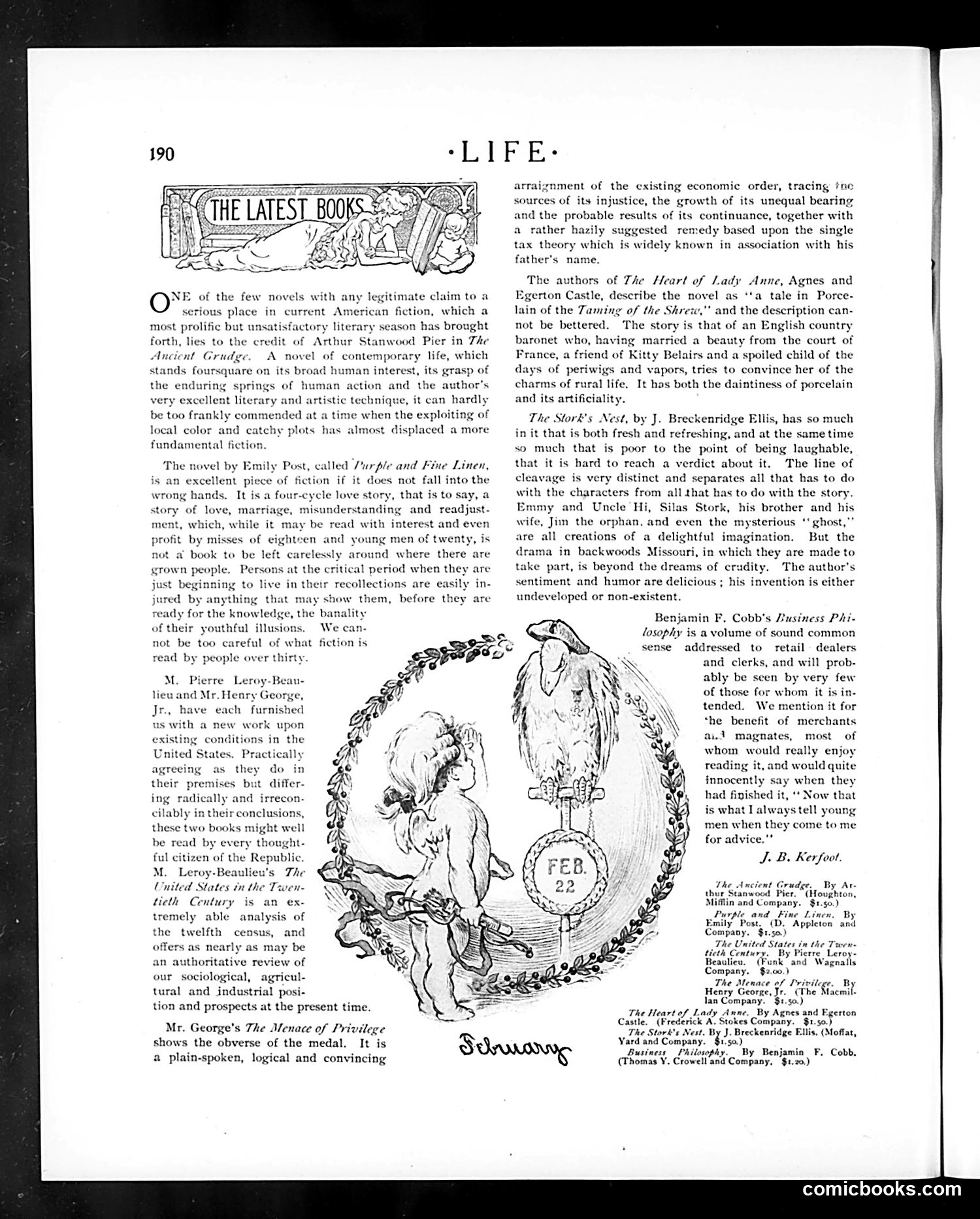
This page is primarily a **book review section** titled "The Latest Books," not a political cartoon. The decorative illustration shows a cherub or putto figure holding a calendar marked "FEB. 22" (George Washington's birthday), surrounded by laurel wreaths—a patriotic seasonal ornament rather than satirical commentary. The text reviews contemporary American novels and non-fiction works from the early 1900s. Notable mentions include: - **Arthur Stanwood Pier's novel** praised for serious literary merit - **Emily Post's "Purple and Fine Linen"**—humorously cautioned as unsuitable reading for "grown people," suggesting it contains risqué content - **Two contrasting economic analyses**: one on U.S. census data, the other (apparently by Henry George Jr.) critiquing economic inequality and privilege The satire is mild and embedded in the literary criticism itself—particularly the dry warning about Post's novel being too scandalous for mature readers, inverting typical concerns about youth exposure to improper material. This is primarily **book advertising and criticism**, not political satire.
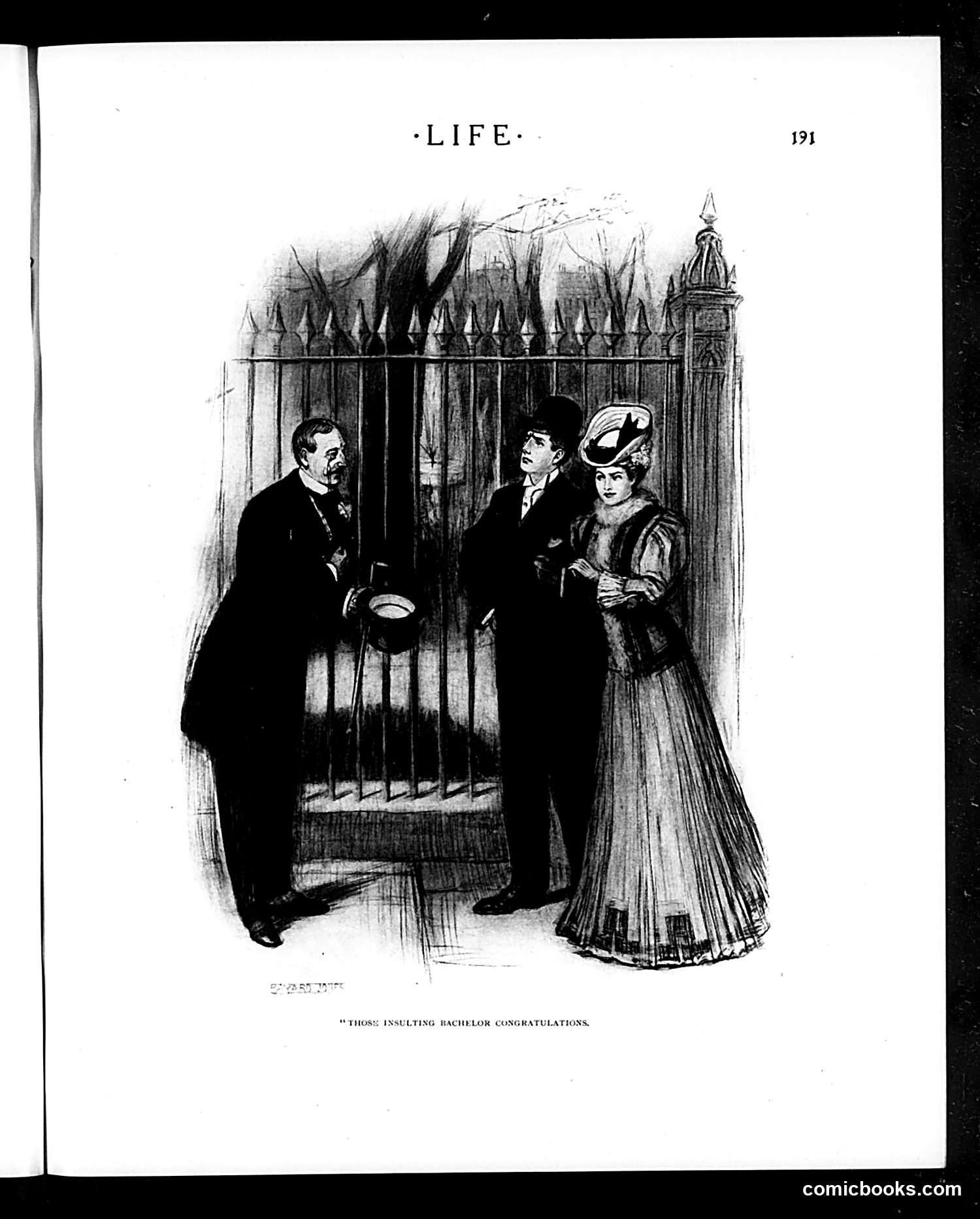
This Life magazine cartoon satirizes insincere social etiquette. Three men in formal dress stand outside an ornate iron gate (likely a mansion or exclusive club), with one man center-stage appearing to offer congratulations to a bachelor on the right. A elegantly dressed woman observes. The joke mocks the hollow formality of "bachelor congratulations"—apparently a social custom where men offer perfunctory well-wishes before a wedding that the speaker views as unfortunate or burdensome. The woman's presence suggests these congratulations are delivered insincerely, perhaps suggesting marriage is something to be pitied rather than celebrated. The cartoon ridicules both the artificial politeness of upper-class society and negative attitudes toward matrimony.
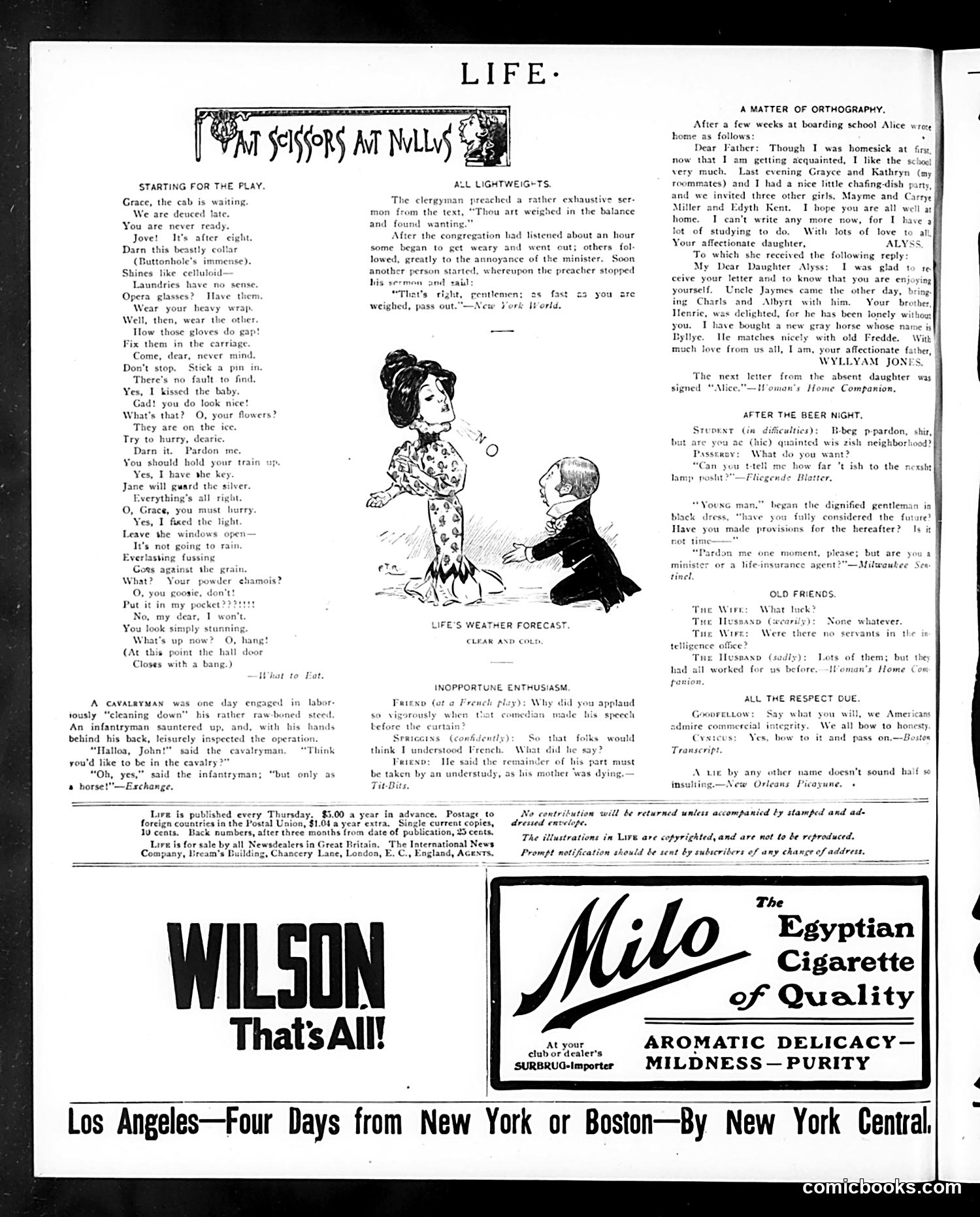
This page contains several comic sketches satirizing early 20th-century social life: **"Starting for the Play"** depicts a couple's chaotic preparation for the theater—a series of domestic complaints and fussy adjustments that humorously capture middle-class anxiety about appearing proper in public. **"Life's Weather Forecast"** is a brief visual joke about a woman's changing appearance. **"Inopportune Enthusiasm"** mocks pretension: a Frenchman applauds a Spanish comedy vigorously to appear cultured, though he admits he doesn't understand French—satirizing false sophistication. **"A Matter of Orthography"** is the longest piece, humorously contrasting a boarding-school daughter's affected spelling ("Grayce," "Mayme," "Albyrt") with her father's matching response in equally tortured orthography ("Wyllyam," "Lyllye," "Fredde"). The joke targets affectation among the newly genteel middle class. Minor pieces mock drunkenness and pretension. The page exemplifies *Life* magazine's role satirizing contemporary manners and social climbing among American middle-class readers.
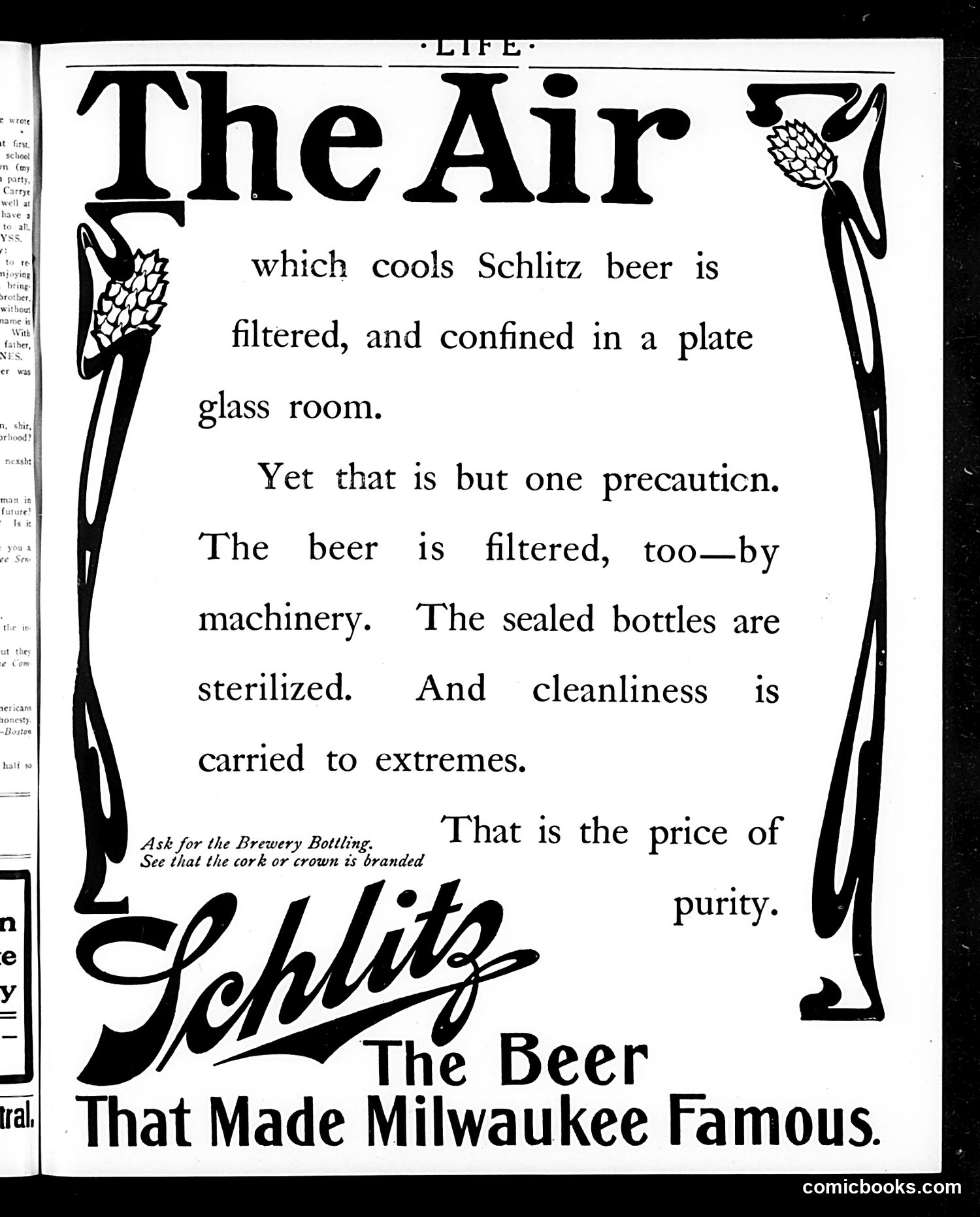
This is a **Schlitz beer advertisement**, not a political cartoon. It promotes Schlitz beer—"The Beer That Made Milwaukee Famous"—by emphasizing the brewery's sanitation practices as a selling point. The page highlights multiple cleaning steps: air filtration in a glass room, mechanical beer filtering, bottle sterilization, and extreme cleanliness standards. The tagline "That is the price of purity" frames rigorous hygiene as a premium quality justifying the product's reputation. The decorative hop illustrations frame the text, reinforcing the beer's ingredients. A note instructs consumers to verify authenticity by checking that "the cork or crown is branded." For modern readers: this reflects early-20th-century marketing emphasizing industrial hygiene as a novel luxury, appealing to consumers concerned about product safety—a significant selling point before modern food safety regulations existed.
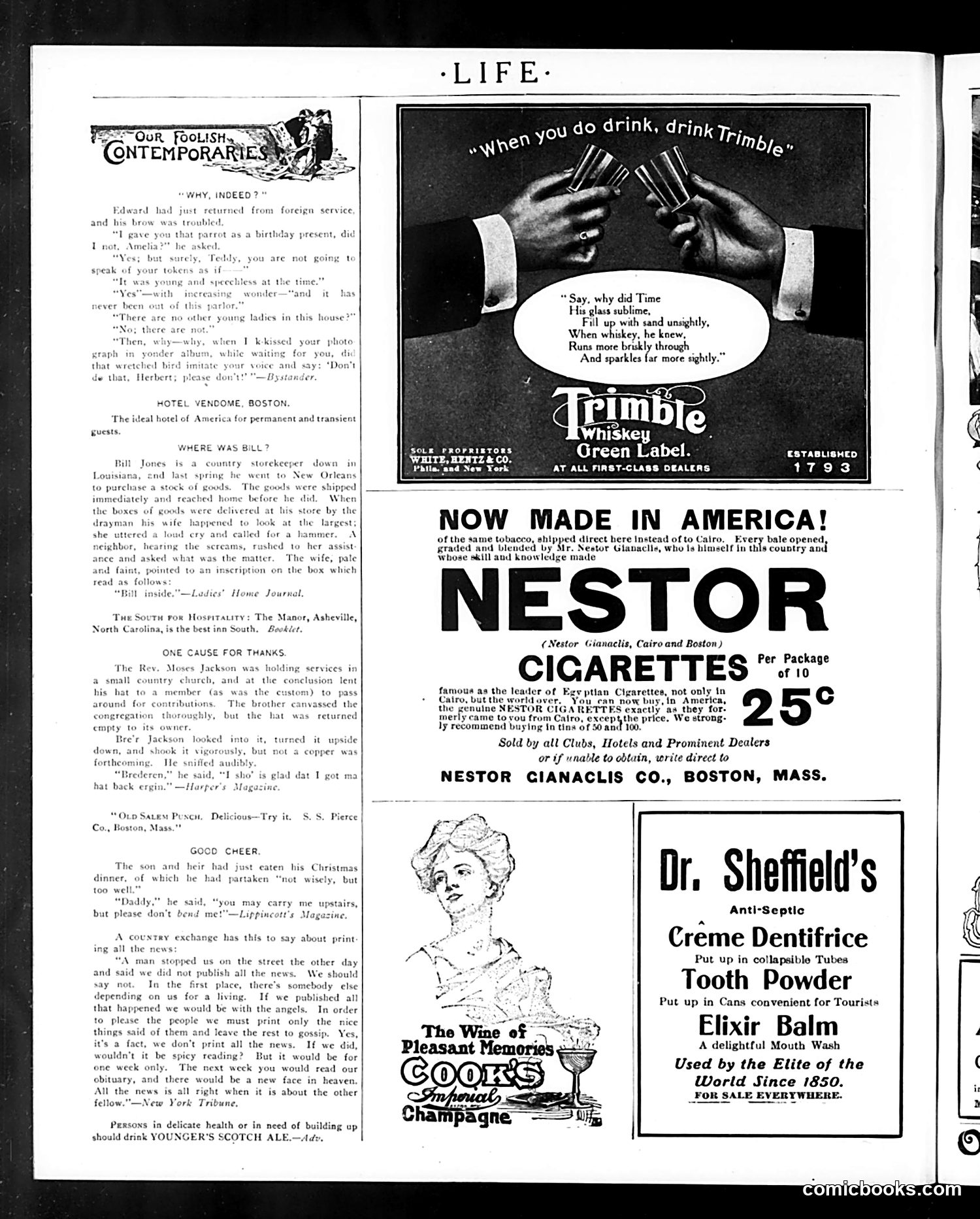
This page is primarily **advertising and humorous anecdotes** rather than political satire. The content includes: **Main Advertisement:** Nestor Cigarettes, now manufactured in America instead of Cairo. The copy emphasizes patriotic manufacturing and quality control by "Mr. Nestor Gianaclis," positioning Egyptian-origin tobacco as legitimately American-made. **Supporting Ads:** Trimble Whiskey and Dr. Sheffield's dental products appeal to upper-class consumers. **Humorous Sections:** Short anecdotes labeled "Our Foolish Contemporaries" mock everyday absurdities—a storekeeper's wife confused by a box label, a pastor's financial mishap, newspaper ethics debates about publishing gossip. **The Satire:** Light social comedy targeting middle-class mishaps and provincial behavior, typical of Life's gentle mockery. No specific political figures or events are referenced; the humor derives from relatable domestic situations and consumer confusion. The page reflects early 1900s American life priorities: consumption, propriety, and self-improvement through products.
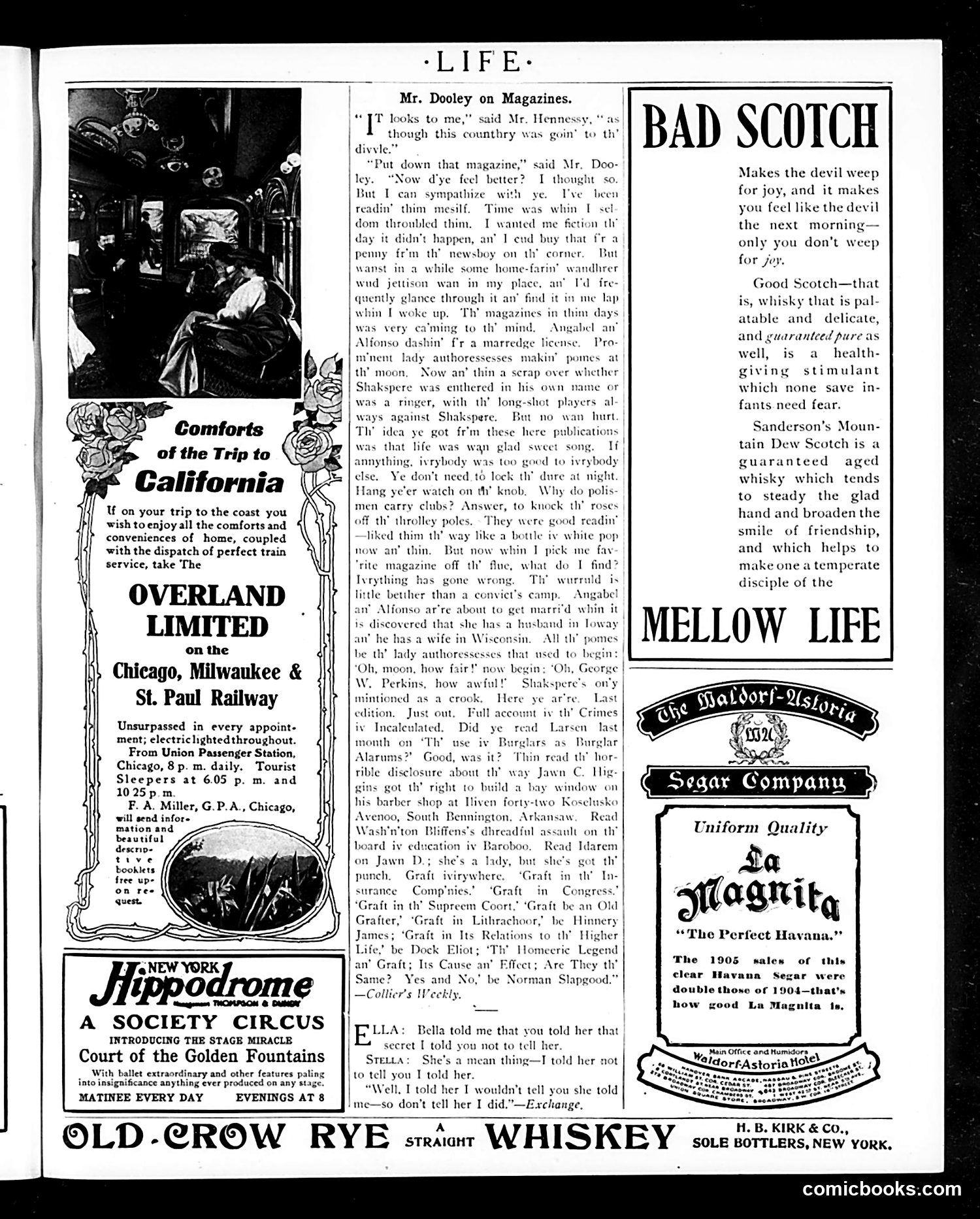
This page contains two main elements: a satirical dialogue and period advertisements. **"Mr. Dooley on Magazines"** is the featured satire. Mr. Dooley (a popular Irish-American character known for social commentary) converses with Mr. Hennessy about how magazine content has changed. Dooley recalls when magazines contained harmless fiction and light entertainment. Now, he complains, they're filled with "graft" (corruption) exposés—scandals involving politicians, judges, and public figures. The joke: magazines have shifted from escapist comfort to relentless muckraking journalism. Readers once wanted pleasant distraction; now every story details wrongdoing. Dooley sardonically notes this makes life seem like "a convict's camp." This reflects the Progressive Era's muckraking journalism boom (early 1900s), when magazines published investigative pieces on institutional corruption. The page includes period whiskey and railroad advertisements, typical of *Life* magazine's revenue model.
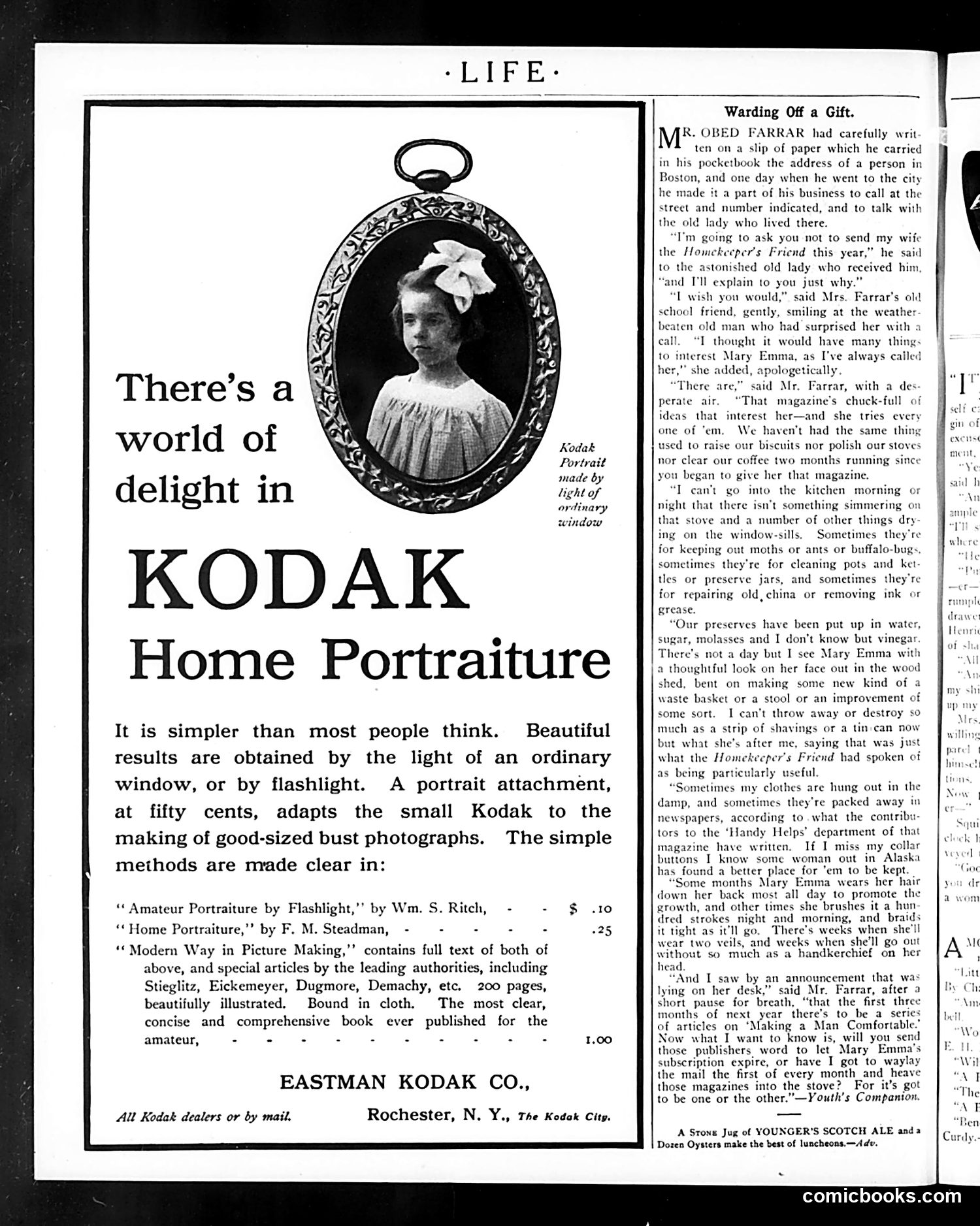
This page contains a **Kodak camera advertisement** (left) and a **humorous short story** (right) titled "Warding Off a Gift." The story satirizes the obsessive homemaker culture of the era. Mr. Obed Farrar visits an old family friend to *request she stop sending his wife* a magazine called *The Homekeeper's Friend*. His complaint: the magazine's endless domestic advice tips have made his wife Mary Emma impossibly busy and neurotic. She constantly experiments with kitchen projects, preserve-making, laundry techniques, hair treatments, and household repairs—all inspired by the magazine's "Handy Helps" department. She repurposes trash, rewrites domestic routines monthly, and obsesses over trivial home improvements. Farrar's exasperation is the joke: the magazine meant to *help* homemakers has instead made domestic life chaotic and exhausting. The satire mocks both the prescriptive women's magazines of the era and the impossible standards they created for housewives, suggesting that "helpful" advice could become burdensome compulsion.
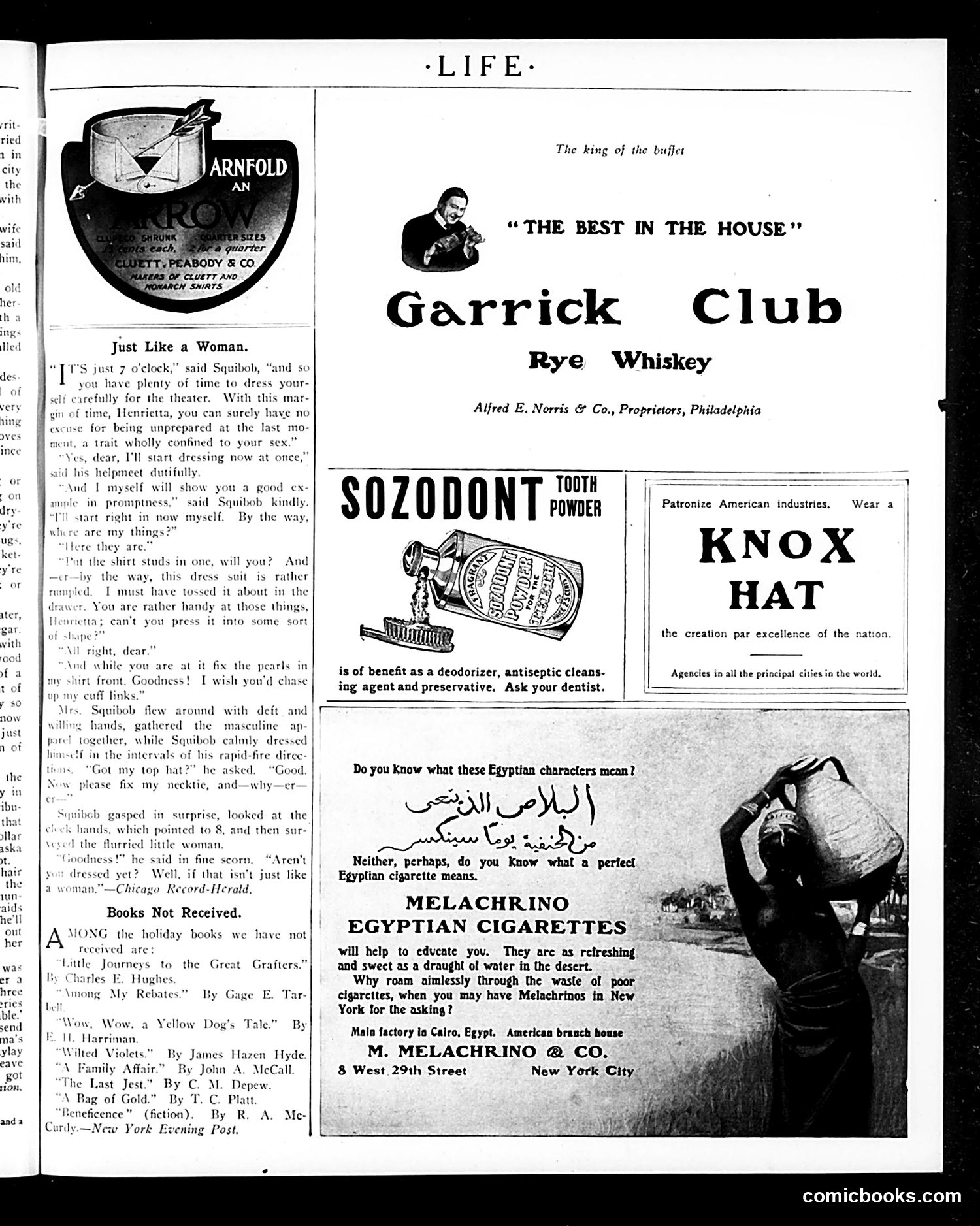
This page combines satirical content with period advertising, circa early 1900s. **"Just Like a Woman" Cartoon:** The humor mocks gender stereotypes. Squibob lectures his wife about punctuality, claiming men are naturally prompt. Yet when preparing for theater, he demands she fix his shirt studs, press his suit, and arrange his cuff links—revealing men depend entirely on women's labor while taking credit for efficiency. The satire exposes the hypocrisy of masculine superiority claims. **"Books Not Received" Section:** Political satire listing fake book titles mocking prominent figures. "Little Journeys to the Great Grafters" by Charles E. Hughes and "Amongst My Rebates" by Gage E. Tarbell reference real corruption scandals. References to James Hazen Hyde and John A. McCall mock wealthy financiers of the era. The joke: these men caused such public outrage that their "memoirs" are sarcastically "not received"—nobody wants them. **Advertisements:** Standard period products (Sozodont toothpowder, Knox hats, Melachrino cigarettes, Garrick Club whiskey) fill remaining space, typical of Life's business model.
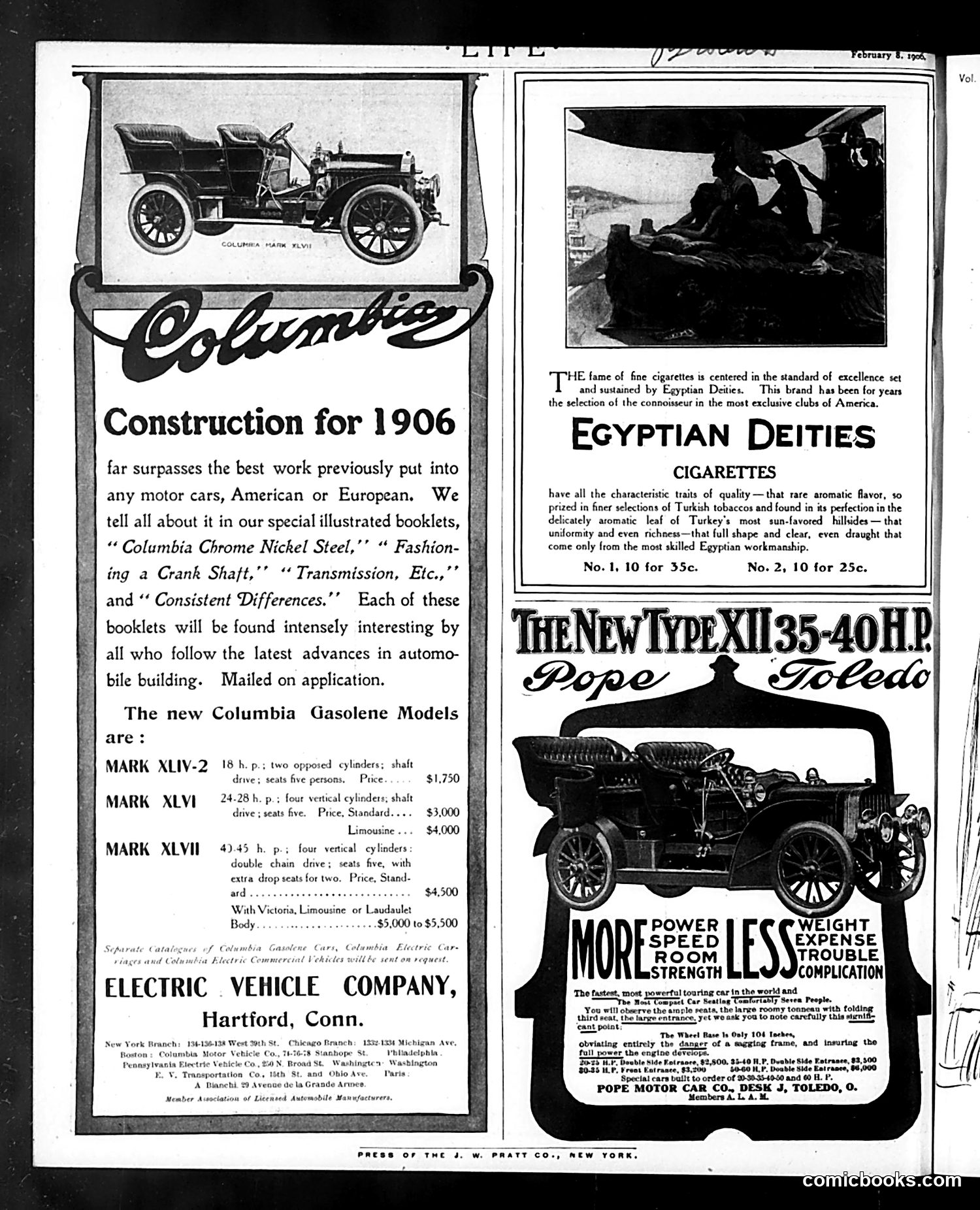
This page is primarily **advertising**, not political satire. It contains three separate product advertisements for early automobiles and cigarettes—vehicles no cartoons to analyze. The ads showcase emerging early-1900s technology: 1. **Columbia automobiles** (top left)—Electric Vehicle Company promoted their 1906 gasoline models with Roman numeral designations (Mark XLIV-2, XLVI, XLVII), emphasizing modern engineering features like "Chrome Nickel Steel" and offering luxury bodies ranging from $1,750 to $5,500. 2. **Egyptian Deities cigarettes** (top right)—marketed as premium Turkish tobacco, positioned as the choice of "connoisseurs" in "exclusive clubs of America." 3. **Pope-Toledo automobiles** (bottom right)—another motorcar maker highlighting engineering advantages: "More Power, Less Weight, More Speed, Less Trouble." The page reflects the **rapid automotive innovation of the early 1900s**, when automobiles competed on technical specifications and luxury positioning. There is no satirical content visible here.