
Life, 1906-02-08 · page 16 of 24
Life — February 8, 1906 — page 16: what you’re looking at
What you’re looking at
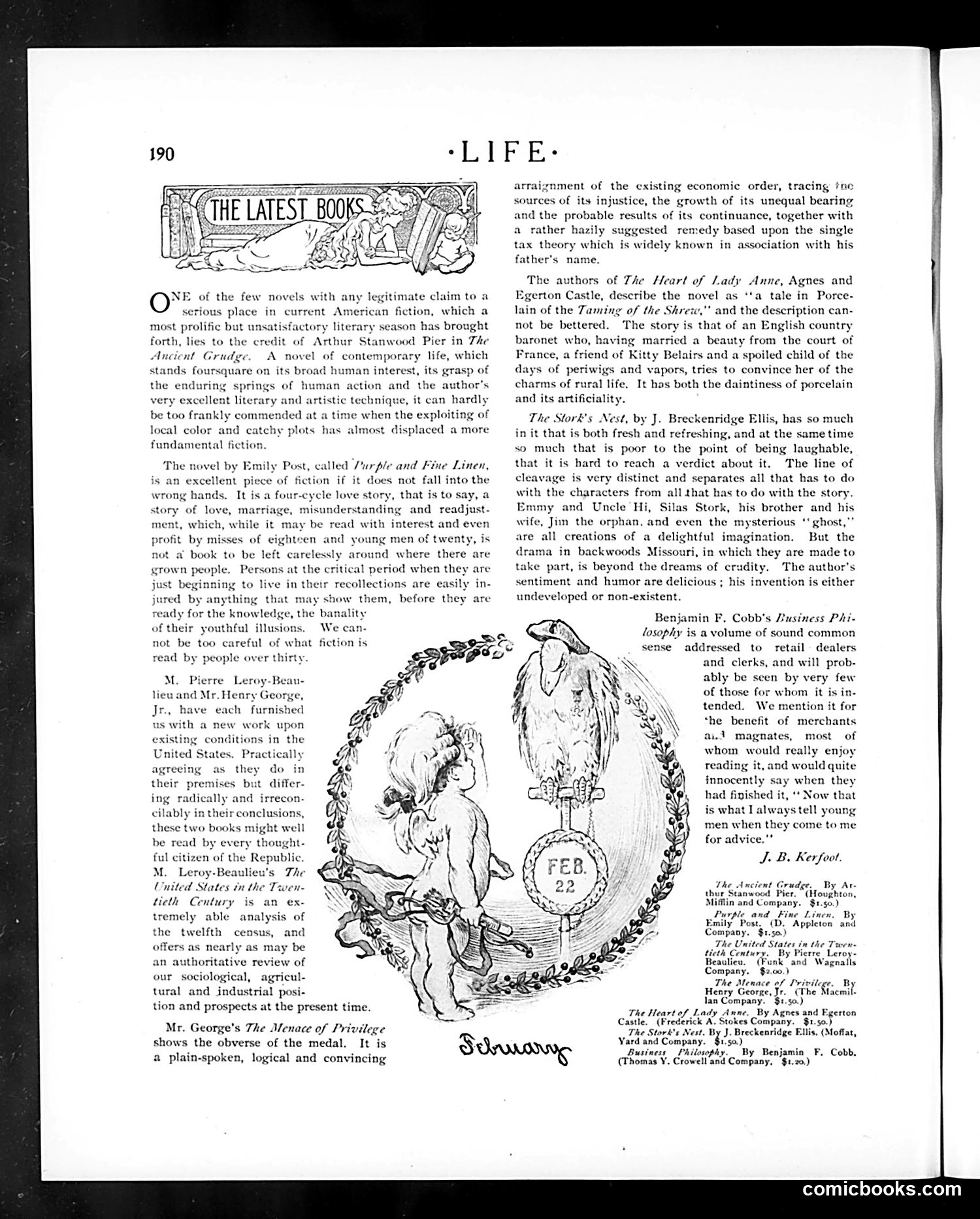
This page is primarily a **book review section** titled "The Latest Books," not a political cartoon. The decorative illustration shows a cherub or putto figure holding a calendar marked "FEB. 22" (George Washington's birthday), surrounded by laurel wreaths—a patriotic seasonal ornament rather than satirical commentary. The text reviews contemporary American novels and non-fiction works from the early 1900s. Notable mentions include: - **Arthur Stanwood Pier's novel** praised for serious literary merit - **Emily Post's "Purple and Fine Linen"**—humorously cautioned as unsuitable reading for "grown people," suggesting it contains risqué content - **Two contrasting economic analyses**: one on U.S. census data, the other (apparently by Henry George Jr.) critiquing economic inequality and privilege The satire is mild and embedded in the literary criticism itself—particularly the dry warning about Post's novel being too scandalous for mature readers, inverting typical concerns about youth exposure to improper material. This is primarily **book advertising and criticism**, not political satire.
📄 Transcribed text from this page (OCR, searchable)
Machine-transcribed from the original scan — historical spelling and the odd misread are preserved.
LP Ee O* = of the few novels with any legitimate claim to a serious place in current American fiction, which a isf. y y season has brought Arthur Stanwood Pier in The 1 of contemporary life, which n interest, its grasp of the enduring springs of human action and the author's very excellent literary and artistic technique, it can hardly most prolific forth, lies to the credit Ancient Grudge. An stands foursquare on its broad hur be too frankly commended at a time when the exploiting of local color and catchy plots has almost displaced a more fundamental fiction. The novel by Emily Post, called Purple and Fine Linen, n excellent piece of fiction if it does not fall into the wrong hands. It is a four-cycle love story, that is to say, a story of love, marriage, misunderstanding and readjust- which, while it may be read with interest and even profit by misses of eighteen and young men of twenty, is not a book to be left carelessly around where there are grown people. Persons at the critical period when they are to live in their recollections are easily in- inything that may show them, before the he knowledge, the ba youthful illusions, We not be too careful of what fiction is read by people M. lieu and Mr. Henry ( Jr, have each fi us with a new work upon existing conditions in the United States. Practically ng as they do in their premises b differ- ing radically and irrecon- cilably in their conclusions, these two books might well be read by every thought- ful citizen of the Republic. M. Leroy-Beaulieu'’s The United States in the Twe tieth Century is an ex- tremely able analysis of the twelfth census, and offers as nearly as may be an authoritative review of our sociological, agricul- tural and industrial posi- tion and prospects at the present time. Mr. George's The Menace of Privilege shows the obverse of the medal. It is a plain-spoken, logical and convincing nment of the existing economic order, tracing fine sources of its injustice, the growth of its unequal bearing and the probable results of its continuance, together with a rather hazily suggested remedy based upon the single theory which is widely known in association with his father’s name. The authors of The Heart of Lady Anne, Agnes and Egerton Castle, describe the novel as ‘ta tale in Porce- lain of the Taming of the Shrew,’ and the description can- not be bettered. The story is that of an English country baronet who, having marricd a beauty from the court of nee, a friend of Kitty Belairs and a spoiled child of the days of periwigs and vapors, tries to convince her of the charms of rural life. and its artificiality. It has both the daintiness of porcelain The Stork's Nest, by J. Breckenridge Ellis, has so much in it that is both fresh and refreshing, and at the same time so much that is poor to the point of being laughable, that it is hard to reach a verdict about it. The line of cleavage is very distinct and separates all that has to do with the characters from all that has to do with the story. Emmy and Uncle Hi, Silas Stork, his brother and his wife, Jim the orphan, and even the mysterious ‘ ghost,”’ are all creations of a delightful imagination. But the drama in backwoods Missouri, in which they are made to take part, is beyond the dreams of crudity. ‘The author's sentiment and humor are delicious ; his invention is either undeveloped or non-existent. Benjamin F, Cobb's 2usiness Phi- losophy is a volume of sound common sense addressed to retail dealers and clerks, and will prob- ably be seen by very few of those for whom it is i tended. We mention it for ‘he benefit of merchants 1 magnates, most of whom would really enjoy reading it, and would quite innocently say when they had finished it, ‘ow that is what I always tell young men when they come to me for advice."” J. B. Kerfoot. The Ancient Grudge. By Ate thur Stanwood Pier. (Houghton, Mifflin and Company. $1.50.) Purple and Fine Linen. By Emily Post, (D. Appleton and Company. $1.50.) The United States in the Twen- ticth Century. By Pierre, Leroy= Beaulieu. (Funk and Wagnalls Company. $2.00.) The Menace of Privilege. B Henry George, Jr. (The Macmi lan Company. ' $1.50.) The Heart of Lady Anne. By Agnes and Egerton Castle. (Frederick A. Stokes Company. $1.50.) The Stork's Nest. By J. Breckenridge Ellis. (Moffat, Yard and Company. $1.50.) Business Philosophy. By Benjamin F, Cobb, (Thomas Y. Crowell and Company, $1.20.) comicbooks.com