
Life, 1906-02-08 · page 15 of 24
Life — February 8, 1906 — page 15: what you’re looking at
What you’re looking at
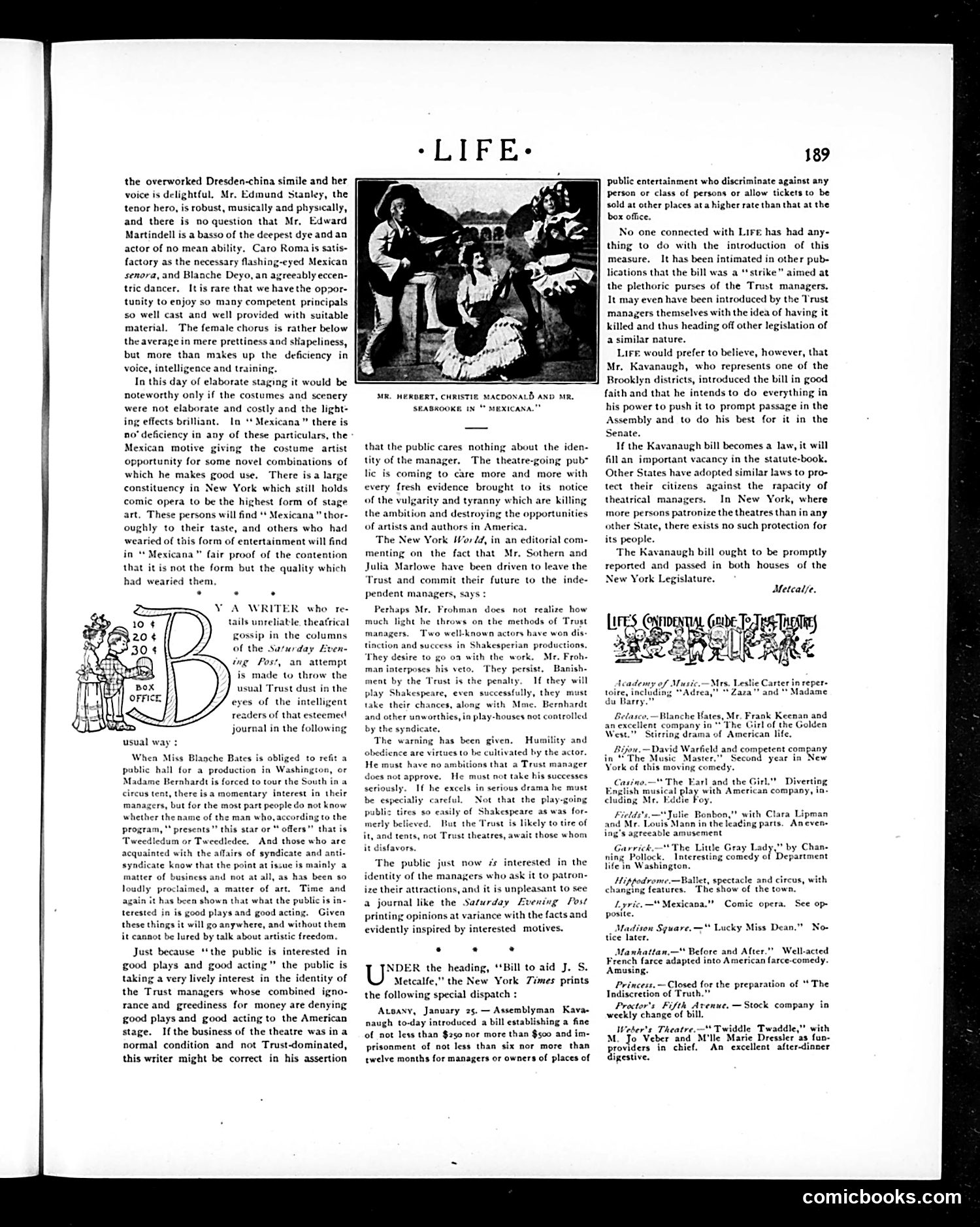
This page criticizes the theatrical **Trust** — a monopolistic syndicate controlling American theater that the text portrays as artistically stifling and commercially exploitative. The accompanying image shows a scene from "Mexicana," a comic opera being reviewed favorably. However, the article's true focus is the Trust's control over theaters and artists. The text argues that prominent actors like Sothern and Julia Marlowe were forced to leave the Trust system to pursue independent management, suggesting the syndicate prioritizes profit over artistic quality and crushes creative ambition. A smaller boxed section highlights a satirical "gossip" column pointing out that audiences don't actually care who *manages* a production—they want good plays and acting. The writer counters this: the public *does* care increasingly about management identity because the Trust's greed and "vulgarity" actively prevent quality theater from reaching American stages. This reflects early 1900s anti-monopoly sentiment and growing pressure on the theatrical syndicate.
📄 Transcribed text from this page (OCR, searchable)
Machine-transcribed from the original scan — historical spelling and the odd misread are preserved.
the overworked Dresden-china simile and her voice is delightful, Mr. Edmund Stanley, the tenor hero, is robust, musically and physically, and there is no question that Mr, Edward Martindell is a basso of the deepest dye and an. actor of no mean ability, Caro Roma is satis- factory as the necessary flashing-eyed Mexican senora, and Blaache Deyo, an agreeably eccen- tric dancer. It is rare that we have the oppor- tunity to enjoy so many competent principals so well cast and well provided with suitable material. The female chorus is rather below the average in mere prettiness and sHapeliness, but more than makes up the deficiency in voice, intelligence and training. In this day of elaborate staging it would be noteworthy only if the costumes and scenery were not elaborate and costly and the light= ing effects brilliant. In ‘ Mexicana” there is no’ deficiency in any of these particulars, the Mexican motive giving the costume artist opportunity for some novel combinations of which he makes good use, There isa large constituency in New York which still holds comic opera to be the highest form of stage art, These persons will find ‘+ Mexicana" thor- oughly to their taste, and others who had wearied of this form of entertainment will find in “ Mexicana” fair proof of the contention that it is not the form but the quality which had wearied them, . . . YA WRITER who te- tails unreliatle. theatrical gossip in the columns of the Su/urday Even- ing P an attempt is made to throw the usual Trust dust in the eyes of the intelligent readers of that esteemed journal in the following usual way : When Miss Blaoche Bates is obliged to refit a public hall for a production in Was! Madame Bernhardt is forced to tour the South in a circus tent, there is a momentary interest in their managers, but for the most part people do not know whether the name of the man who, according to the “* presents’? this star or“ offers” that is And those who are progra Tweedledum or Tweedledee, acquainted with the affairs of syndicate and anti- syndicate know that the point at issue is mainly a matter of business and not at all, as has been so loudly proclaimed, a matter of art. Time and again it has been shown that what the public is in- terested in is good plays and good acting. Given these things it will go anywhere, and without them it cannot be lured by talk about artistic freedom. Just because the public is interested in good plays and good acting" the public is taking a very lively interest in the identity of the Trust managers whose combined igno- rance and greediness for money are denying good plays and good acting to the American stage. If the business of the theatre was in a normal condition and not Trust-dominated, this writer might be correct in his assertion MR. MERDERT, CHRISTIZ MACDONALD AND MR. SEABROOKE IN" MEXICANA.” that the public cares nothing about the ide tity of the manager. The theatre-going pub" lic is coming to care more and more with every fresh evidence brought to its notice of the vulgarity and tyranny which are killi the ambition and destroying the opportunities of artists and authors in America. ‘The New York Word, in an editorial com- menting on the fact that Mr, Sothern and Julia Marlowe have been driven to leave the Trust and commit their future to the inde- pendent managers, says : Perhaps Mr. Frohman does not realize how much light he throws on the methods of Trust Two well-known actors have won di success in Shakesperian productions. hey desire to go oa with the work. Mr. Froh- man i They persist. Banish- ment by the Trust is the penalty. If they will play Shakespeare, even successfully, they must take their chances, along wit! - Bernhardt ther unworthies, in play-houses not controlled, poses his veto, and by the syndicate. ity and ence are virtues to be cultivated by the actor. bitions that a Trust manager He must not take his successes rama he must ¢ have no al does not approve, seriously. be careful If he excels in serious Not that the play-going publi ires so easily of Shakespeare as was for- merly believed. Rut the Trust is likely to tire of it, and tents, not Trust theatres, await those whom it disfavors. The public just now #s interested in the identity of the managers who ask it to patron ize their attractions, and it is unpleasant to see a journal like the Saturday Evening Fost printing opinions at variance with the facts and evidently inspired by interested motives. NDER the heading, ‘Bill to aid J. S. Metcalfe,” the New York Zimes prints the following special dispatch : Atoaxy, January 2s.— Assemblyman Kavae naugh to-day introduced a bill establishing a fine of not less than $250 nor more than $500 and im- prisonment of not less than six nor more than twelve months for managers or owners of places of 189 public entertainment who discriminate against any person or class of persons or allow tickets to be sold at other places at a higher rate than that at the box office. No one connected with Lire has had any- thing to do with the introduction of this measure, It has been intimated in other pub- lications that the bill was a ‘* strike” aimed at the plethoric purses of the Trust managers. It may even have been introduced by the Trust managers themselves with the idea of having it killed and thus heading off other legislation of a similar nature. Lire: would prefer to believe, however, that Mr. Kavanaugh, who represents one of the Brooklyn districts, introduced the bill in good faith and that he intends to do everything in his power to push it to prompt passage in the Assembly and to do his best for it in the Senate. If the Kavanaugh bill becomes a law, it will fill an important vacancy in the statute-book. Other States have adopted similar laws to pro- tect their citizens against the rapacity of theatrical managers. In New York, where more persons patronize the theatres than in any other State, there exists no such protection for its people. ‘The Kavanaugh bill ought to be promptly reported and passed in both houses of the New York Legislature. Metcalfe. fax IFES ( \IDEN iL. GDIDE Te Ah Mrs. Leslie Carter in reper toire, including ““Adrea,” “Zaza” and * Madame du Barry.” Belasco. —Blanche Vates, Mr. Frank Keenan and an excellent company in” lof the Golden West.” Stirring drama of American life, Bijou. — David Warfield and competent co in The Music Master,” Second year York of this moving comedy. Casino.—" The Earl and the G Dive English musical play with American company, cluding Mr. ‘oy. Fietds's, ulie Bonbon,’ and Mr. Louis Mann in the leading parts. s agreeable amusement Little Gray Lady, Interesting comedy of De life in Washington. Hippodronre.—Ballet, spectacle and circus, with ch Ha pes features. The show of the town, Lyric. — Mexicana.” See op- posite. Madison Square.“ Lucky Miss Dean.” No- tice later. Manhattan.—" Before and After."” Well-acted French farce adapted into American farce-comedy. Amusing. Princess. —Closed for the preparation of “The Indiscretion of Truth.” Proctor's Fifth Avenue, — Stock company in weekly change of bill, Weber's Theatre.—" Twiddle Twaddle,” with M. Jo Veber and M'lle Marie Dressler ‘as fun- providers in chief, An excellent after-dinner digestive. with Clara Lipman Aneven+ * by Chan- tment Comic opera. comicbooks.com