
A complete issue · 24 pages · 1906
Life — January 25, 1906
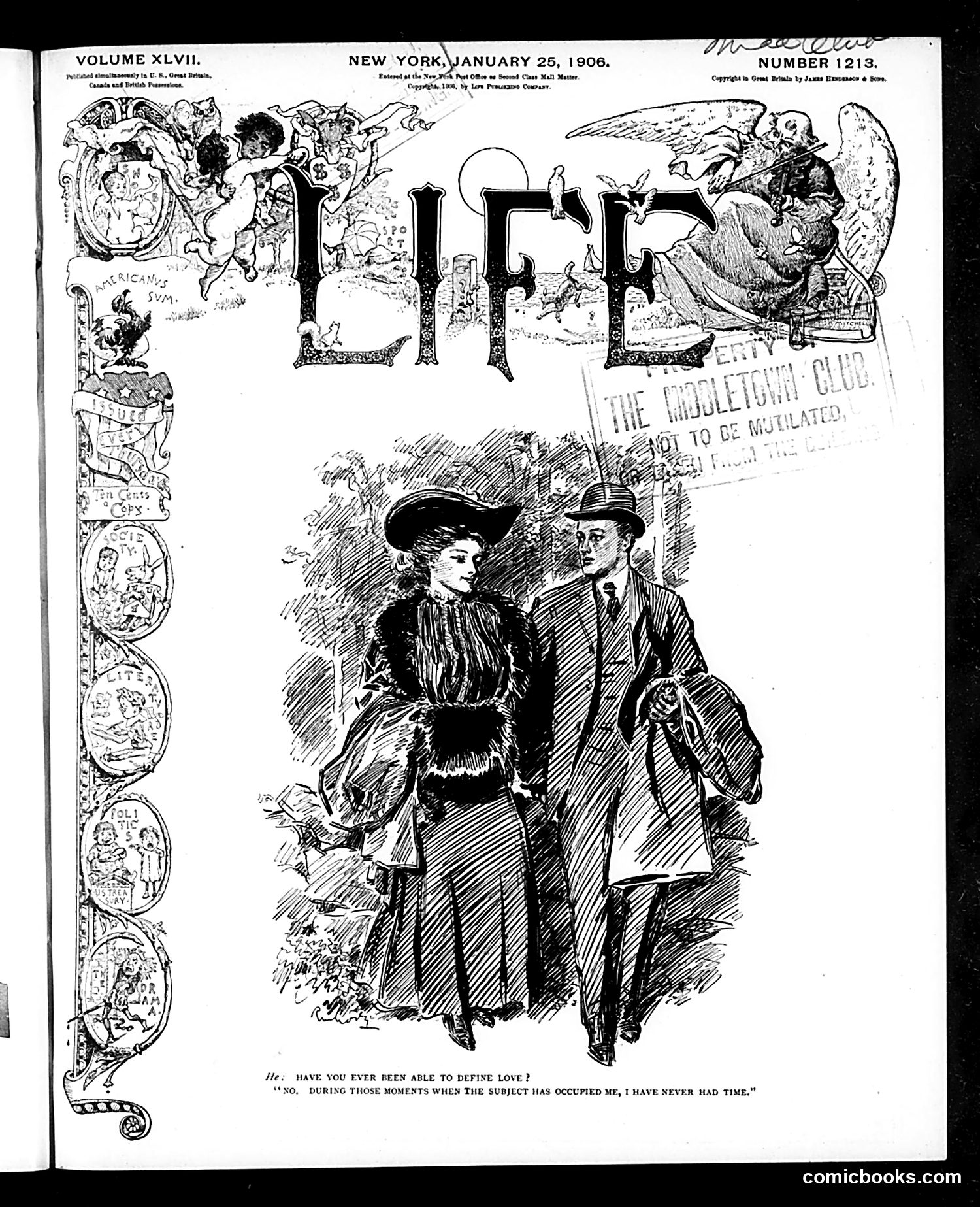
This is the cover of *Life*, a prominent American satirical magazine. The main illustration shows a well-dressed couple—a woman in fashionable Edwardian attire with a large hat, and a man in a suit and bowler hat—walking together. The caption reads: "HE: HAVE YOU EVER BEEN ABLE TO DEFINE LOVE? / 'NO. DURING THOSE MOMENTS WHEN THE SUBJECT HAS OCCUPIED ME, I HAVE NEVER HAD TIME.'" This is romantic/philosophical satire typical of the era, poking fun at intellectualized discussions of love versus its actual emotional experience. The joke suggests that when one is actually in love, there's no opportunity for abstract philosophical debate—one is too caught up in the experience itself. It's gentle social commentary on the gap between theory and practice in matters of the heart.
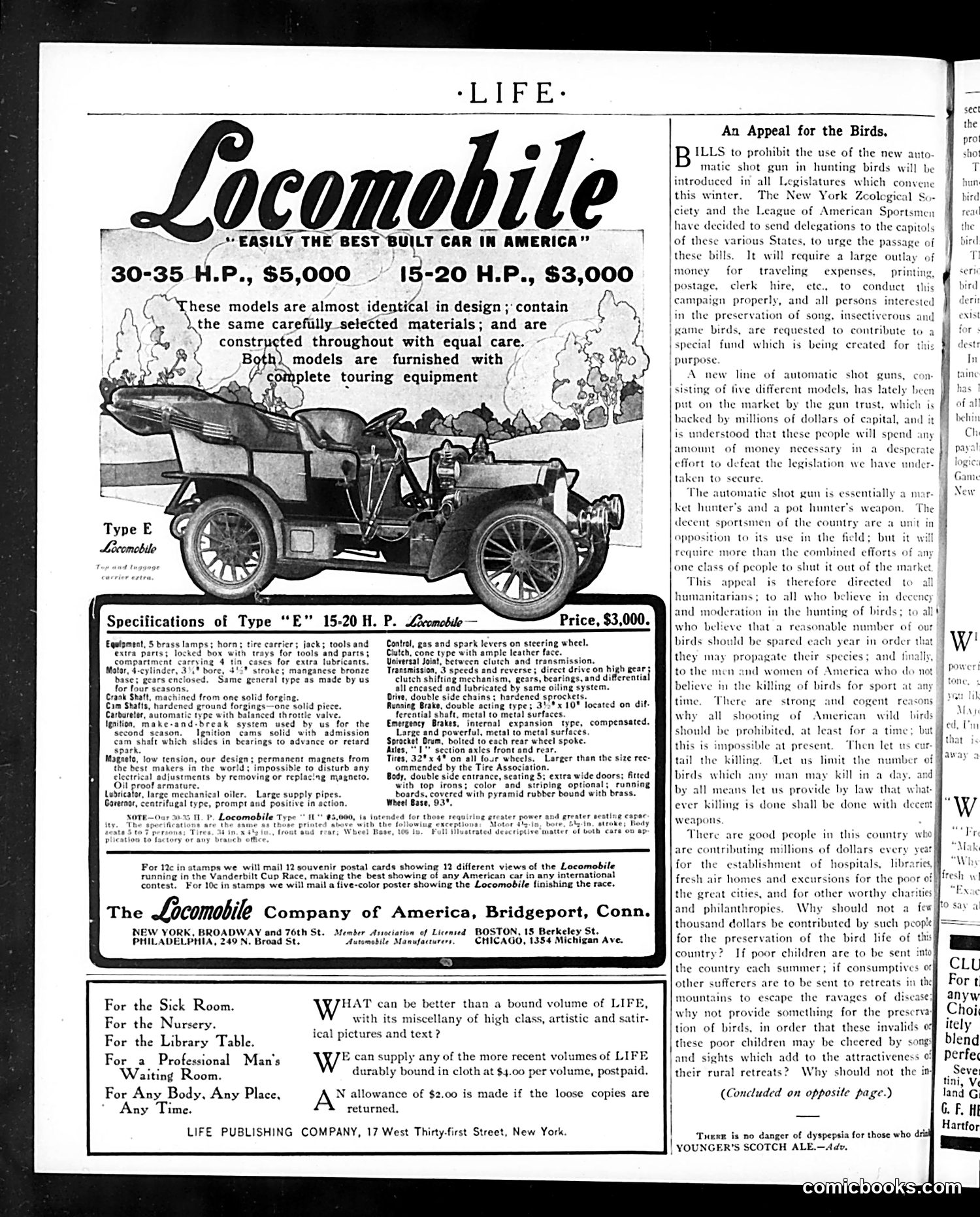
This page contains primarily **advertisements** rather than editorial cartoons or satire. The dominant content is a Locomobile automobile ad (30-35 H.P. and 15-20 H.P. models), featuring a detailed illustration of an early 1900s touring car and technical specifications. The right column contains an editorial piece titled "An Appeal for the Birds," advocating for legislation to prohibit automatic shotguns in bird hunting. The text argues that reasonable limits on bird killing are necessary and appeals to humanitarian sensibilities. The lower section advertises **Life magazine itself**—promoting bound volumes and subscriptions. No political cartoons or caricatures appear on this page. The content reflects early 20th-century American consumer culture and conservation concerns, not satirical commentary.
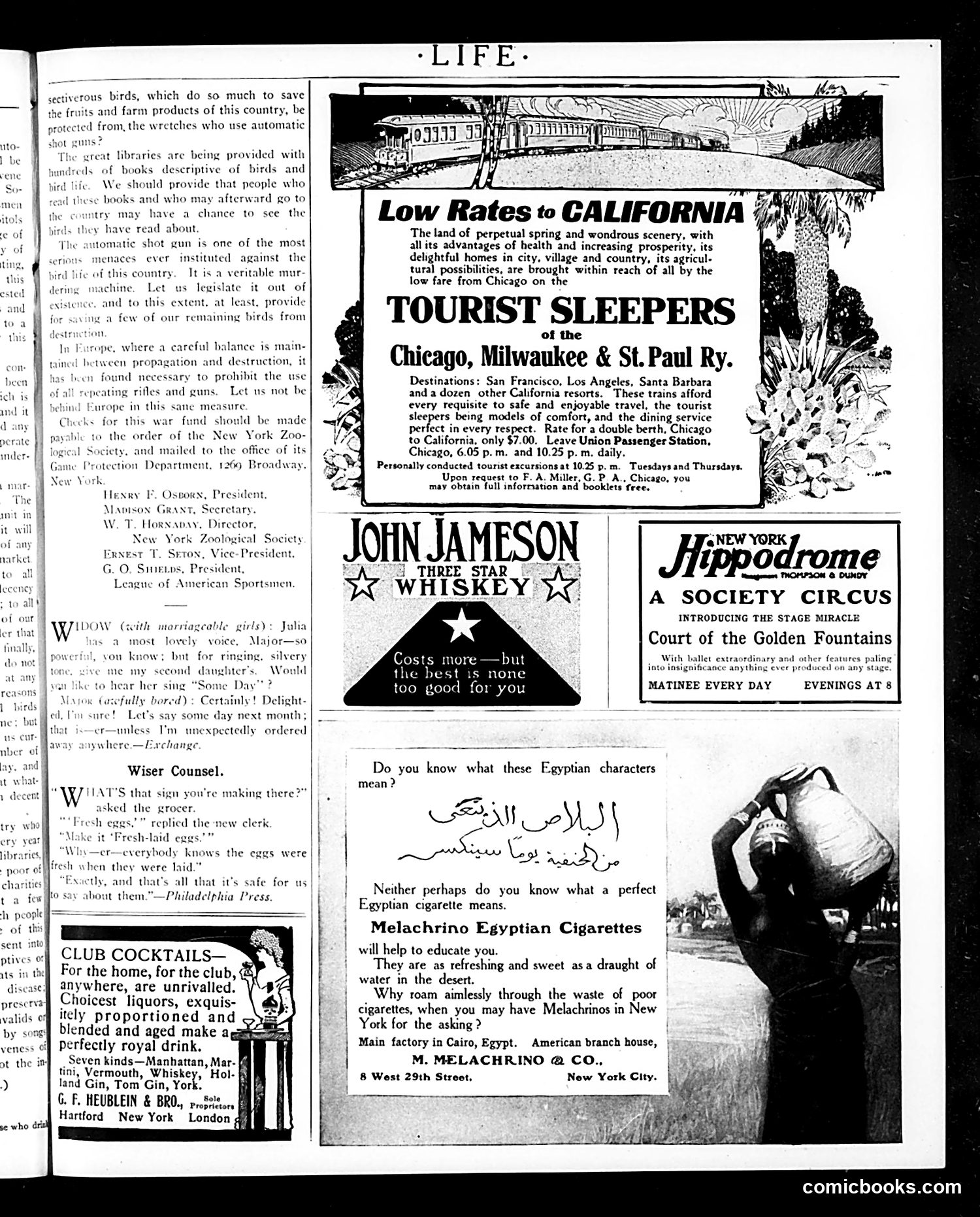
This page is **primarily advertising** with minimal editorial content. The ads include: - **Tourist Sleepers** to California via Chicago, Milwaukee & St. Paul Railway - **John Jameson Three Star Whiskey** ("Costs more—but the best is none too good for you") - **New York Hippodrome** circus advertisement - **Malachrino Egyptian Cigarettes** with text claiming they're "refreshing and sweet as a draught of water in the desert" - **Club Cocktails** by C.F. Heubler & Bro. There is one brief editorial joke titled "Wiser Counsel" about fresh eggs at a store—a simple wordplay with no political significance. The Egyptian cigarettes ad is notable for its orientalist marketing, though this reflects period commercial practice rather than satire. Overall, this is a **commercial page with minimal satirical content**.
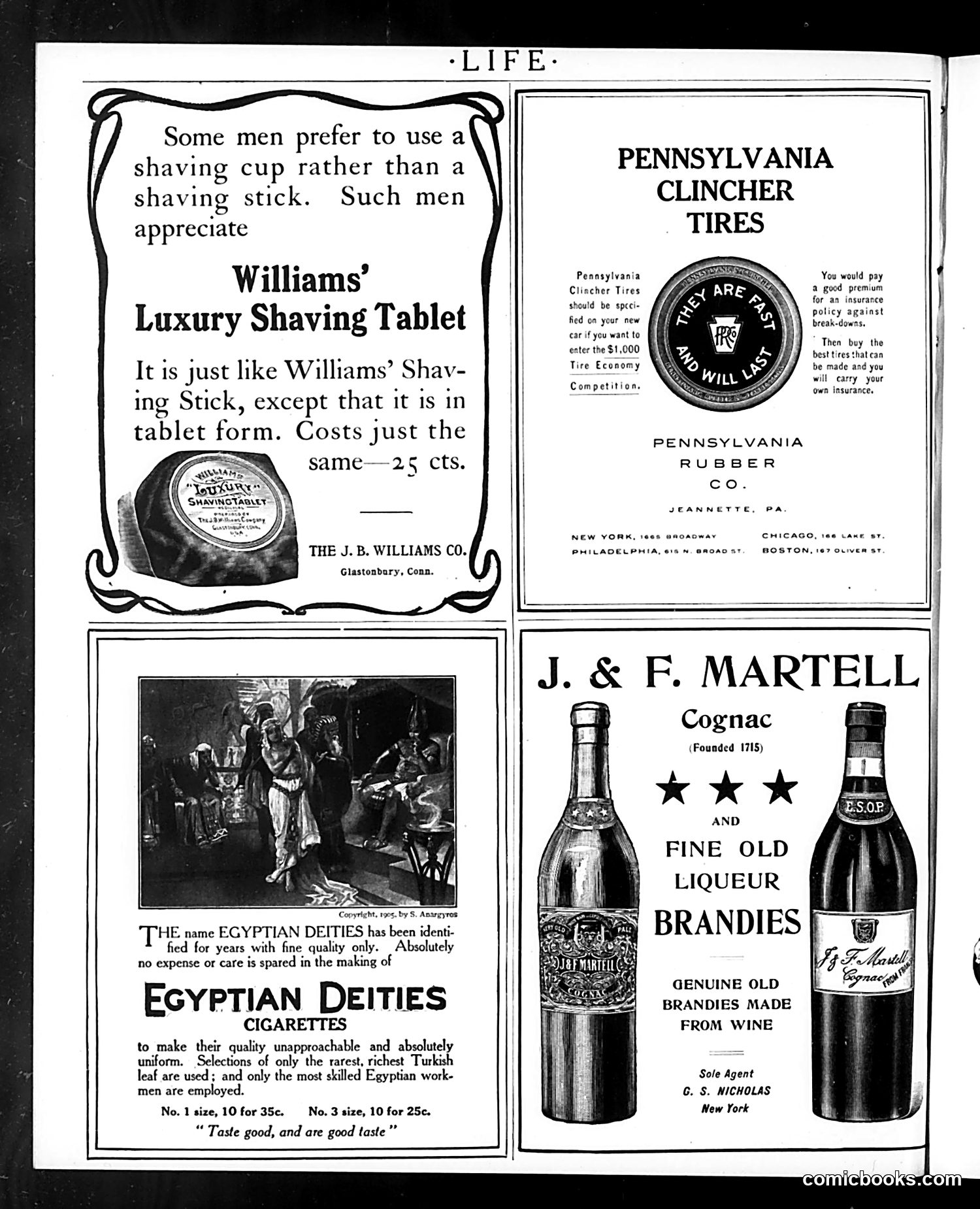
This page consists primarily of **advertisements rather than satirical content**. The four ads shown are: 1. **Williams' Luxury Shaving Tablet** — marketed to men preferring shaving cups over sticks, costs 25 cents 2. **Pennsylvania Clincher Tires** — emphasizing durability ("They are best and will last") 3. **Egyptian Deities Cigarettes** — highlighting quality Turkish tobacco and Egyptian labor, with pricing info 4. **J. & F. Martell Cognac** — advertising brandy and liqueur, founded 1715 The only visual element approaching illustration is a historical engraving accompanying the cigarette ad, depicting an Egyptian scene (likely generic, not satirical). There are **no political cartoons or social satire** on this page. It's a straightforward commercial advertising section from *Life* magazine.
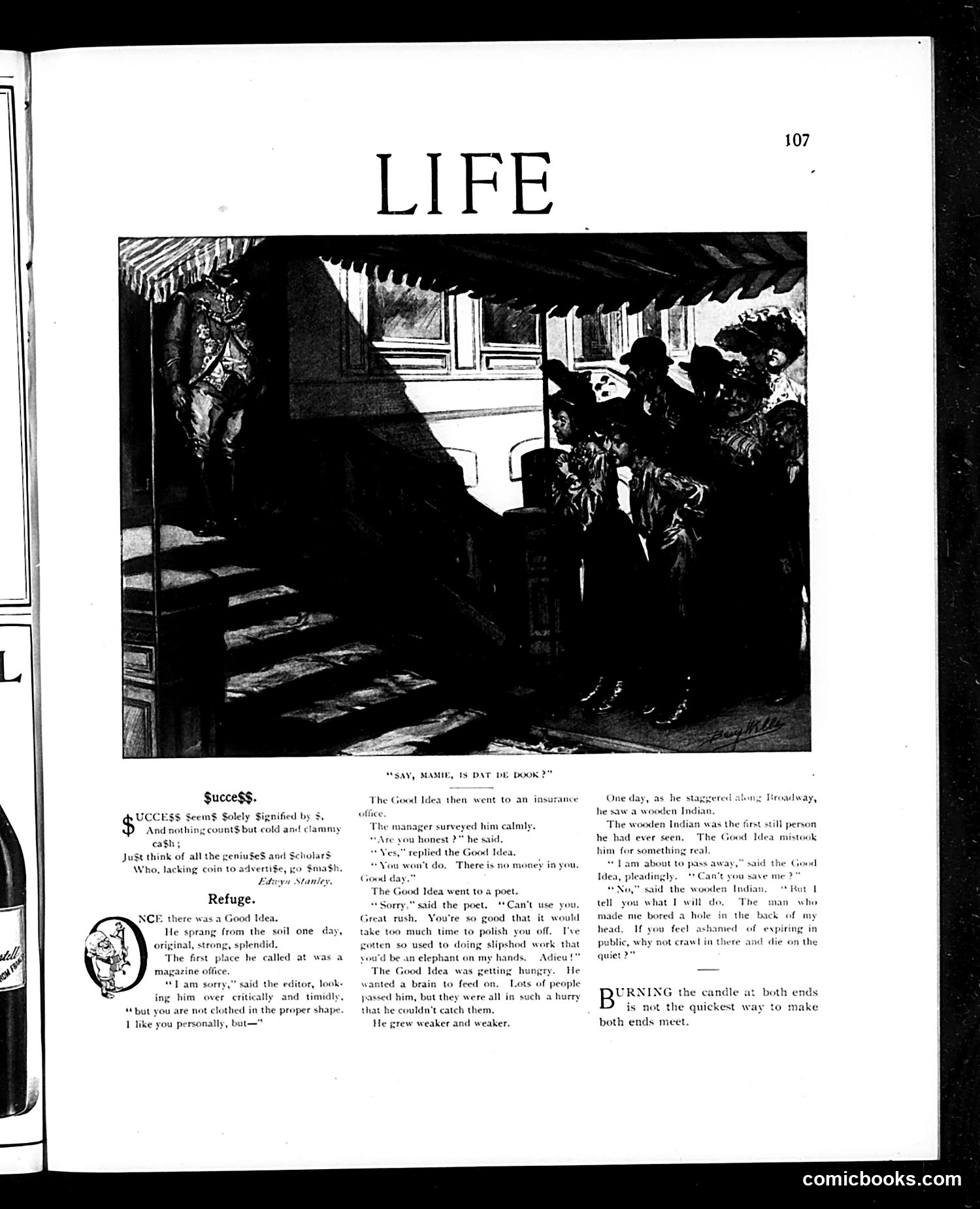
This page from *Life* magazine (page 107) contains three separate pieces of satirical content: 1. **"Say, Mamie, Is Dat De Door?"** - An illustration depicting what appears to be a social scene with figures in silhouette, though the specific reference is unclear from the image alone. 2. **"Success"** - A brief satirical poem mocking the pursuit of success, suggesting that achieving it requires compromising one's principles and integrity—"lacking coin to advertise, go smash." 3. **"Refuge"** - A longer narrative about a "Good Idea" that bounces between various establishments (magazine, poet, insurance office) seeking acceptance, only to be rejected repeatedly. The satire critiques how creative or unconventional ideas find no welcome in practical, commercial institutions. 4. **"Burning the candle at both ends"** - A philosophical observation about unsustainable living practices. The overall theme appears to criticize institutional resistance to innovation and the compromises required for worldly success.
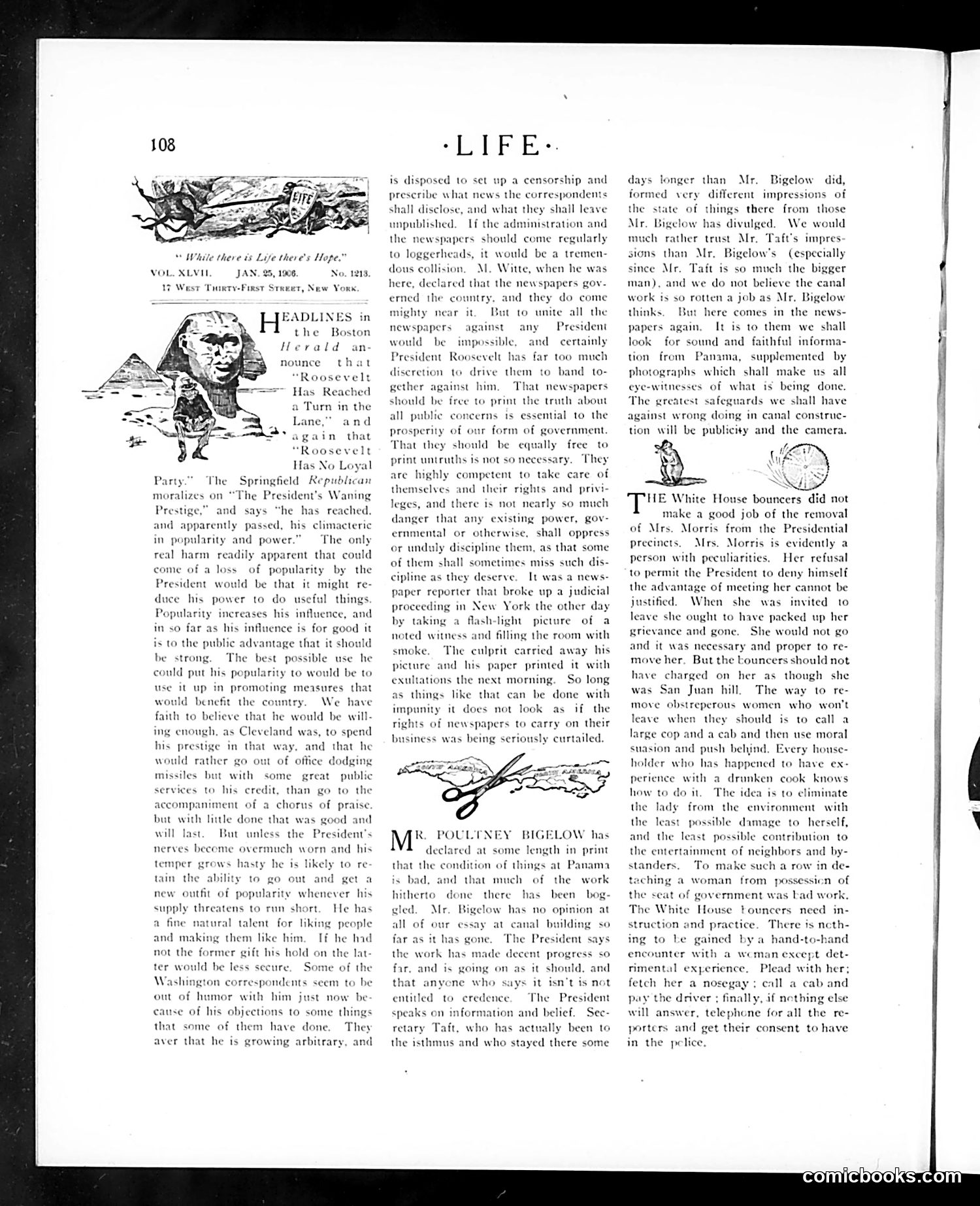
This page contains political commentary about President Roosevelt's relationship with the press. The text discusses Roosevelt's recent actions regarding newspaper censorship and presidential precincts, criticizing Mrs. Morris (appears to be a White House figure) for refusing to permit the President to downhimself the advantage of meeting her cannot be justified. The main cartoon (left) depicts a caricatured figure labeled "Roosevelt Has Reached a Turn in the Lane, and again in that Roosevelt Has No Local Party" — satirizing Roosevelt's political standing and popularity shifts. The commentary argues Roosevelt wields too much discretionary power over newspapers and that popularity shouldn't determine governmental authority. The piece defends press freedom as essential to democratic governance, criticizing executive overreach in controlling information flow and public perception.
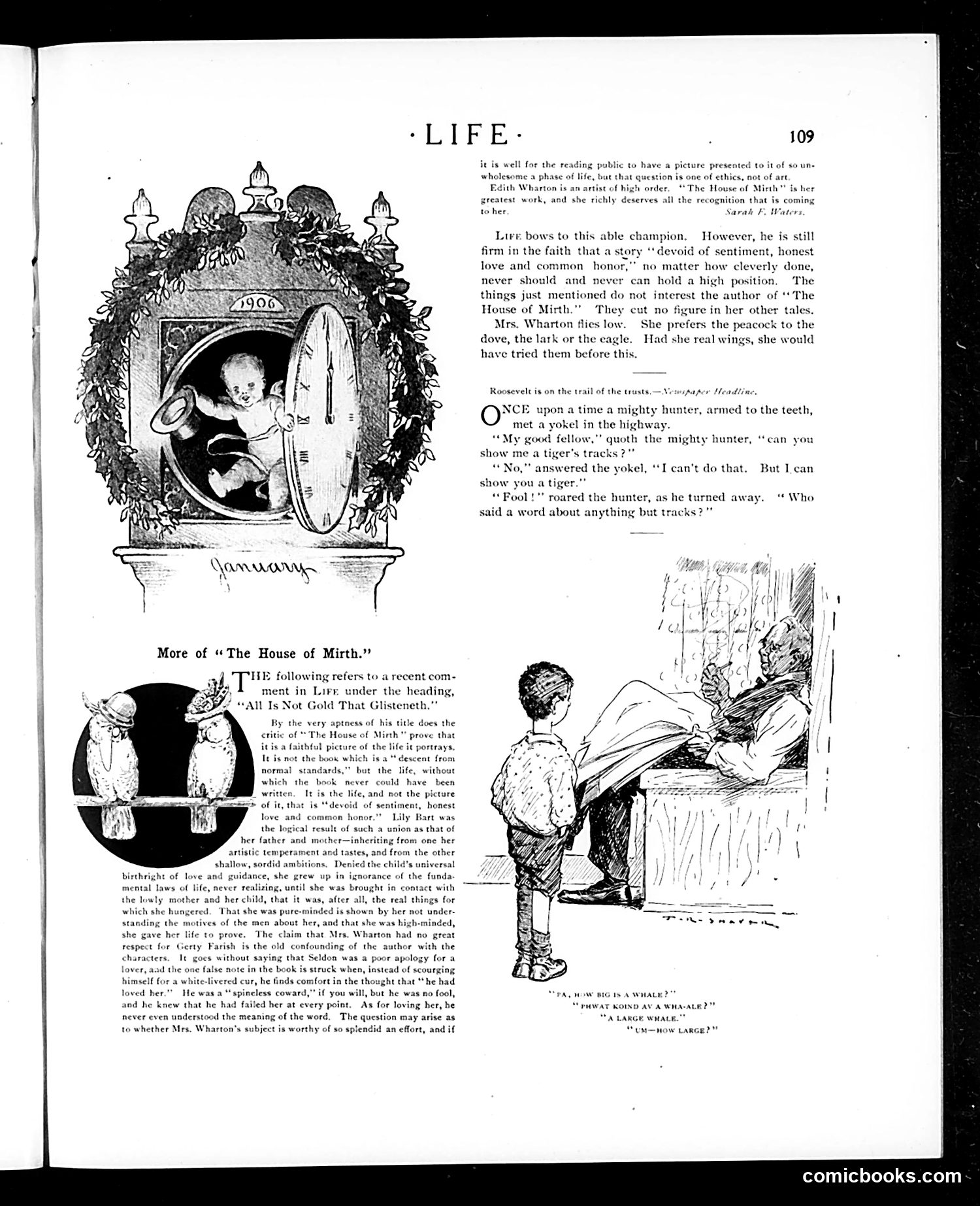
This page critiques Edith Wharton's novel "The House of Mirth." The top illustration depicts a cherub or cupid figure emerging from an ornate frame, symbolizing the book's themes of love and birth. The main text defends the novel against critics who claimed it was "not gold but glisteneth"—appearing valuable but lacking substance. The author argues Wharton deserves recognition for creating high-quality literature that honestly portrays life without sentimentality. The lower illustration shows a boy discovering a whale, accompanying a dialogue about mistaken identity and expectations—likely a metaphor for how readers misinterpret the novel's actual content and meaning. The satire targets literary snobs who dismiss serious fiction unfairly.
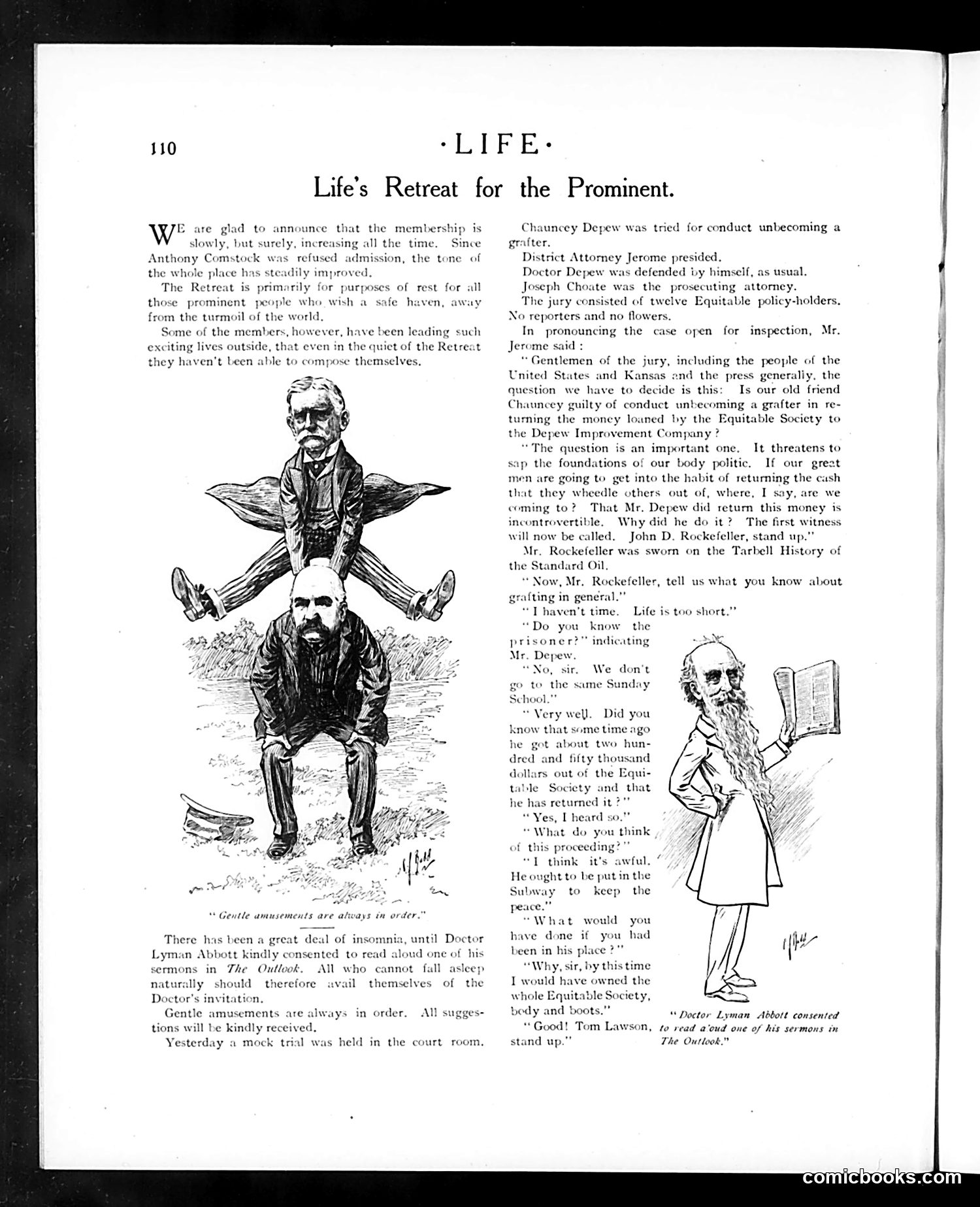
This page satirizes a trial involving **Chauncey Depew**, a prominent railroad executive, who faces charges of "conduct unbecoming a grafter." The cartoon depicts the social hypocrisy of prominent men: Depew allegedly returned money to the Equitable Society that he'd previously obtained, raising the question of whether this constitutes guilt or innocence. The satire's point: wealthy, connected figures like **John D. Rockefeller** are questioned about grafting (corruption) but face minimal consequences. The cartoon shows them as literally parasitic—depicted as grotesque figures feeding off society. The mock trial and Doctor Lyman Abbott's role suggest Life magazine is mocking both the trial's absurdity and the immunity of the wealthy elite from genuine accountability.
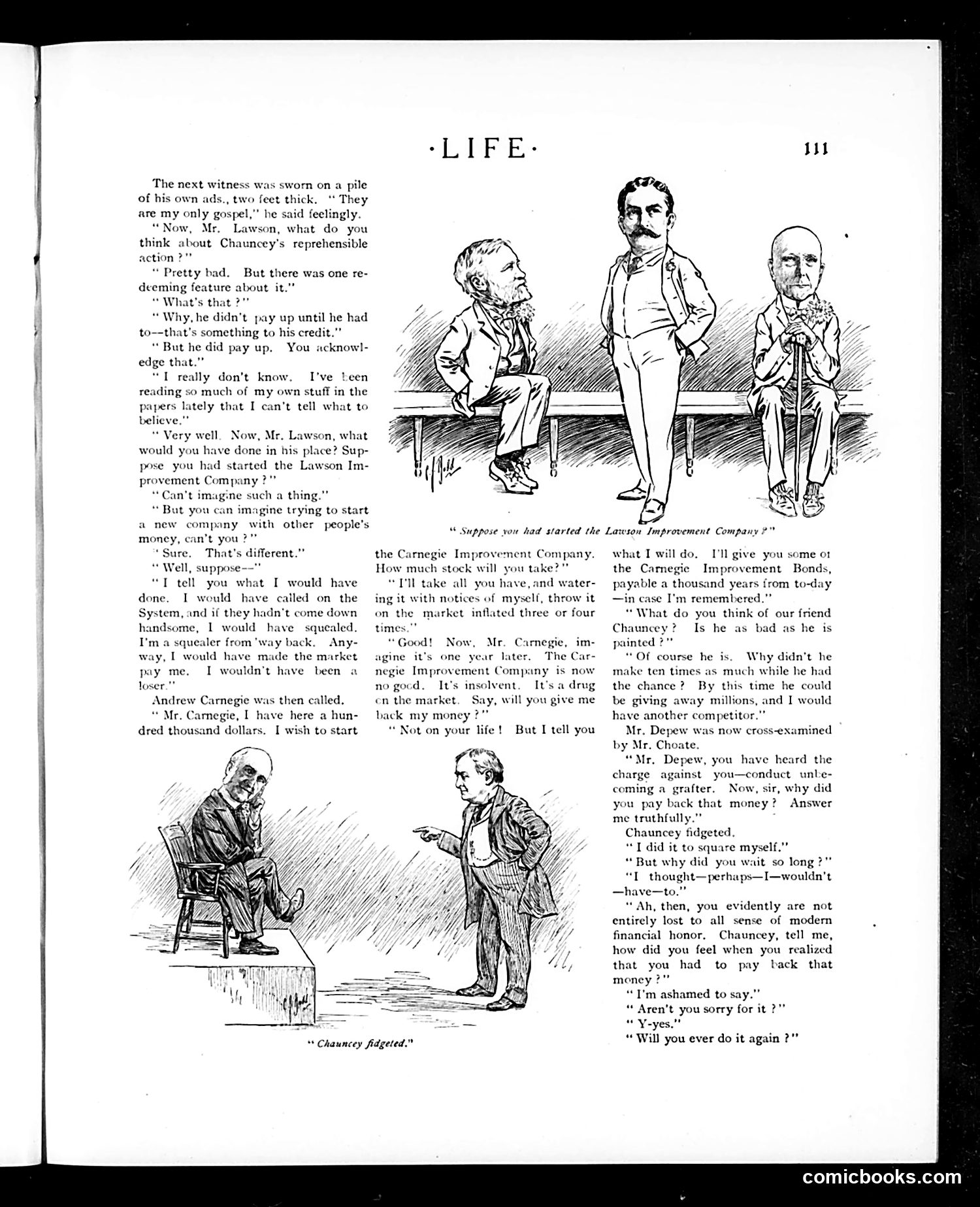
This page satirizes a financial fraud scheme. The dialogue reveals that witness "Lawson" testified about the "Carnegie Improvement Company"—apparently a stock swindle where promoters collected investor money but never actually started the business. The key figures appear to be Andrew Carnegie (the famous industrialist) and someone named Chauncey, who is cross-examined about why he delayed repaying embezzled funds. His excuse—that he "thought perhaps wouldn't have to"—exposes the fraud's cynicism. The cartoons show caricatured men in various poses of guilt and evasion. The satire mocks both the scheme itself and the legal proceedings attempting to expose it, suggesting widespread financial corruption among prominent businessmen of the era.
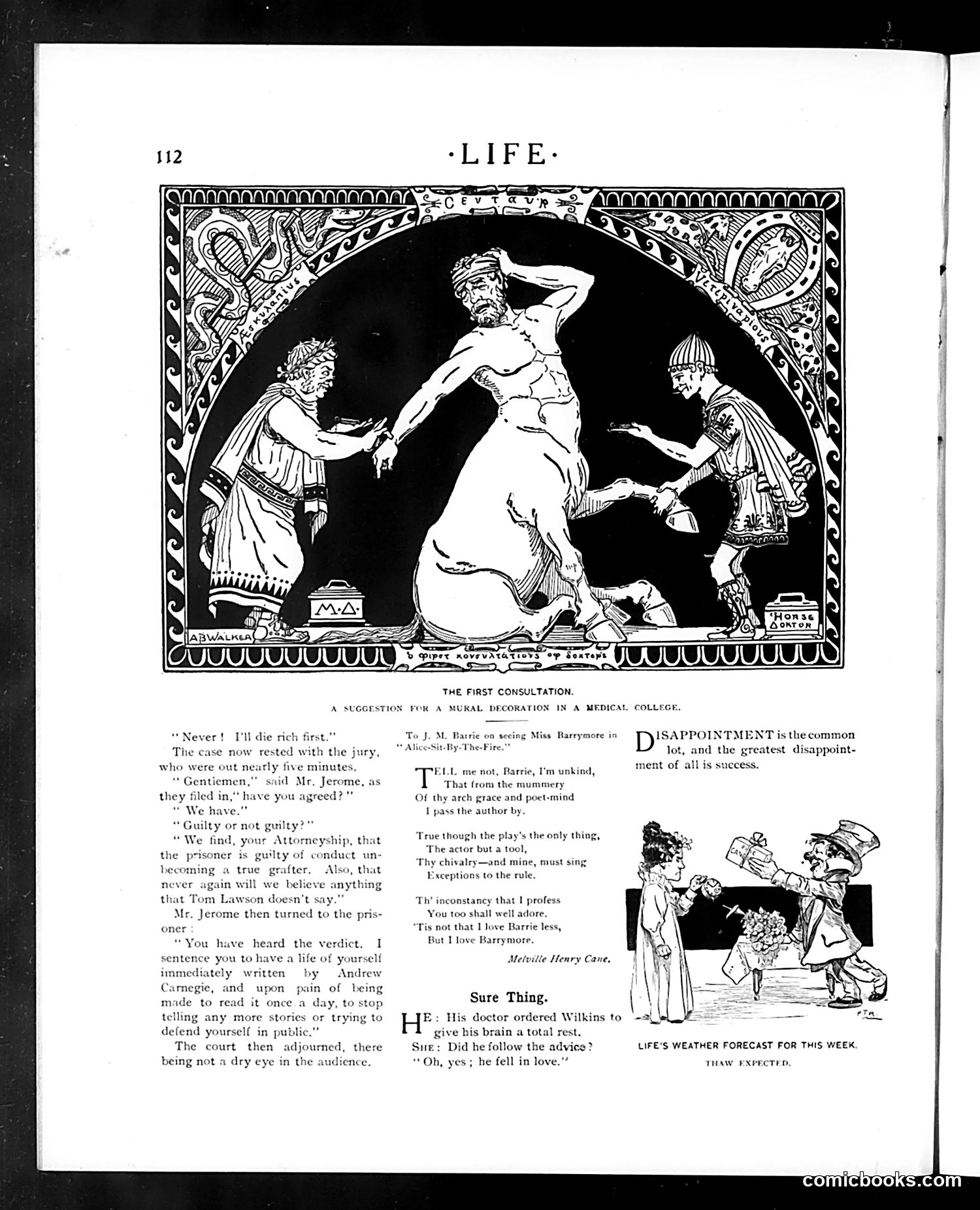
The main illustration depicts "The First Consultation"—a satirical suggestion for a mural in a medical college. It shows a centaur (half-man, half-horse) being examined by two robed figures, likely representing classical physicians or healers. The joke appears to satirize medical practice by presenting an absurd mythological patient, mocking either the state of medical knowledge or the pretensions of medical institutions. Below are lighter humor pieces: a dialogue about legal disappointment, a quote from J.M. Barrie about theatrical performance, and a brief joke titled "Sure Thing" about medical advice leading to romantic mishap. A cartoon labeled "Life's Weather Forecast for This Week" shows period-dressed figures with an umbrella. The overall tone is typical of early Life magazine's sophisticated, literary humor.
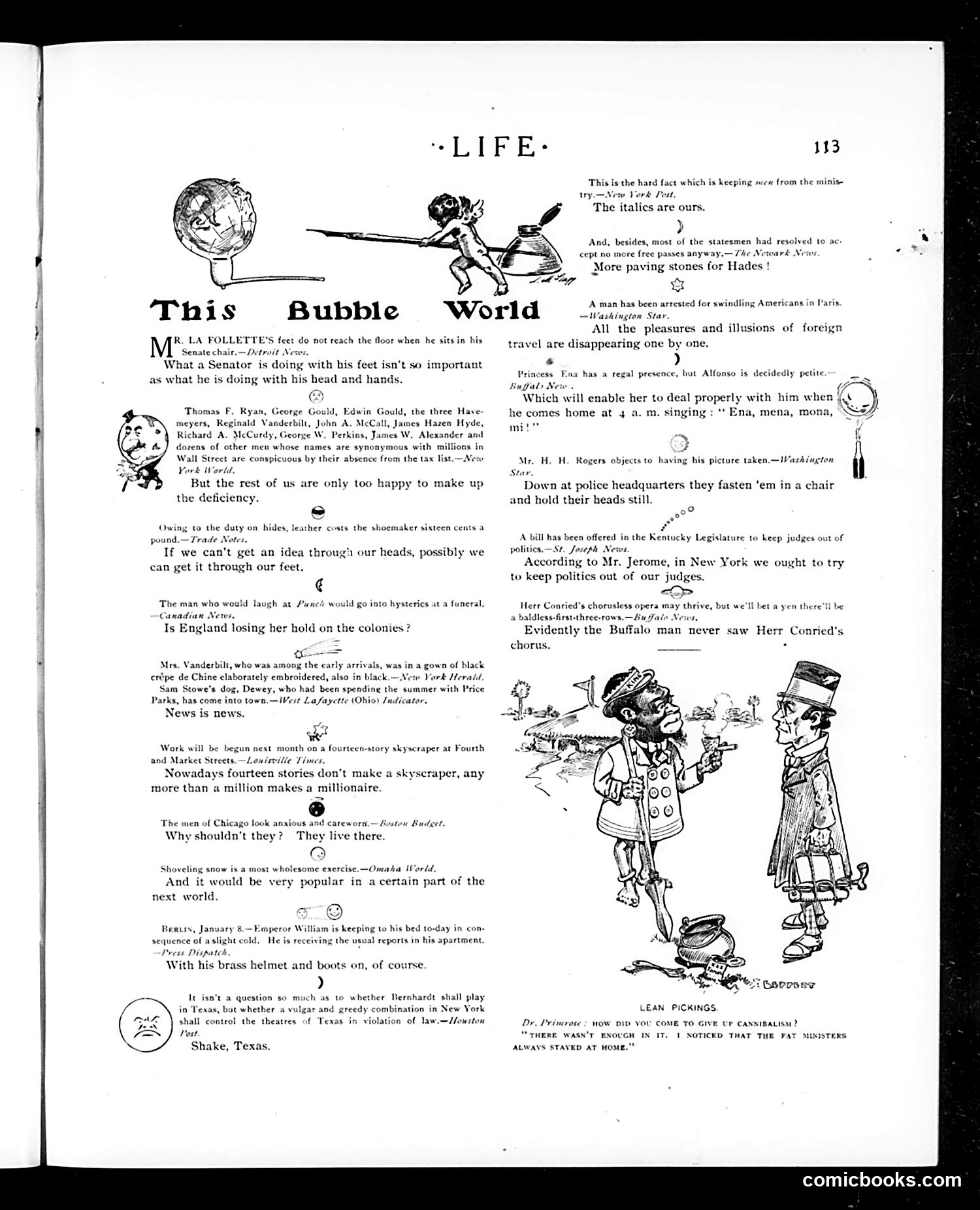
This page satirizes early 20th-century American politics and society through brief commentary items and illustrations. The main cartoon depicts two caricatured figures labeled "Lean Packings" discussing capitalism and fat ministers staying home—likely critiquing wealth inequality and religious hypocrisy during the Progressive Era. Other items mock various targets: Senator Follette's physical stature, European travel pretensions, police brutality, opera impresario Herr Conried, and skyscraper construction. The "bubble world" title suggests these are frivolous concerns disconnected from reality. The opening section ("M. R.A. FOLLETTE'S feet...") appears to mock Progressive reformer Robert La Follette, while other references target contemporary politicians and social figures through wordplay and visual caricature, typical of Life's satirical approach to 1910s-era American society.
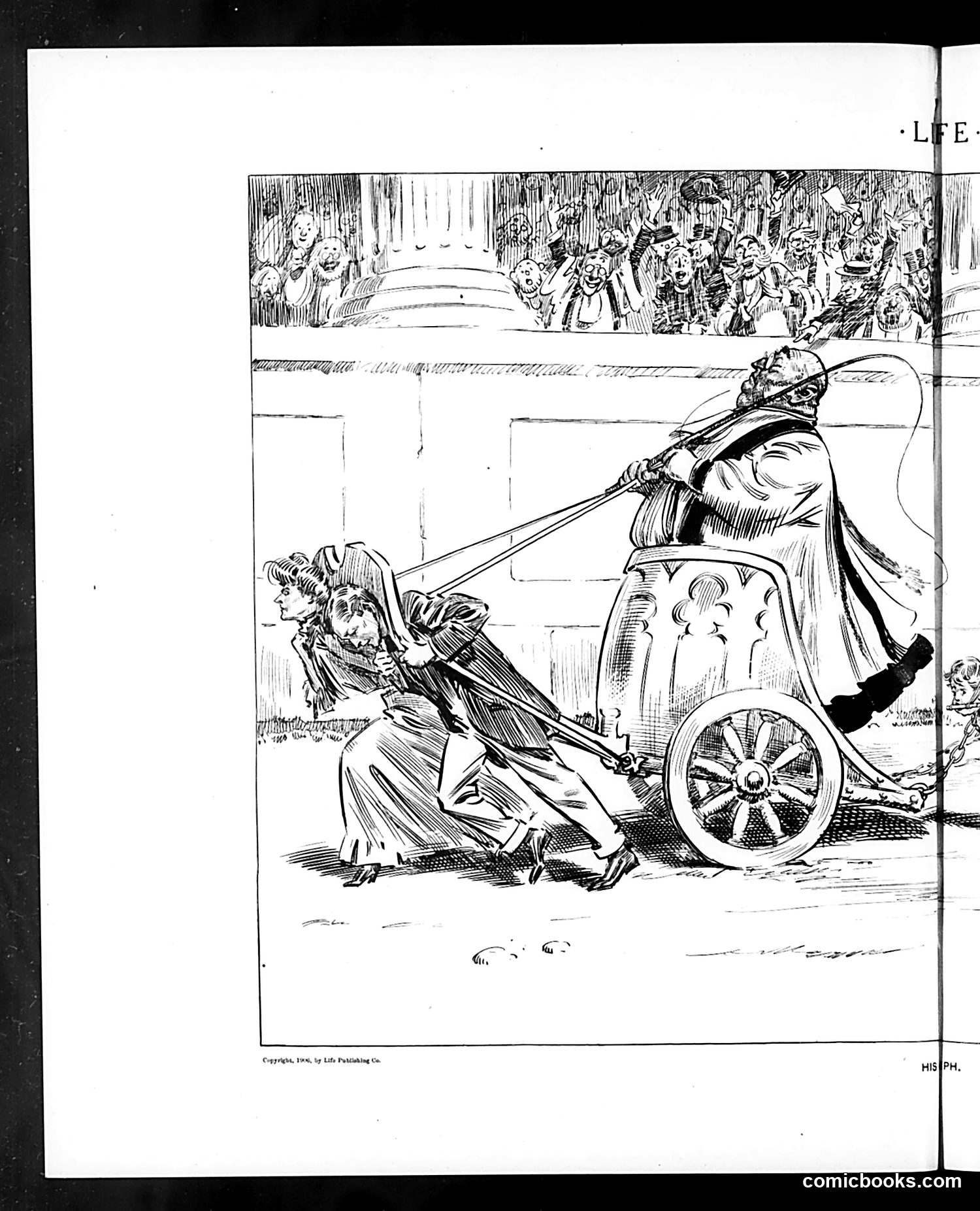
This is a satirical cartoon from Life magazine (copyright 1908, per the footer). The image depicts a woman struggling to push a large baby carriage while a man in formal dress and cape pulls it in the opposite direction with a long pole—a visual metaphor for conflicting domestic authority. The cartoon likely satirizes contemporary gender and marital relations, showing the physical and emotional "tug-of-war" between spouses over household management and decision-making. The woman's straining effort contrasts with the man's commanding posture, suggesting commentary on male dominance in marriage during the early 1900s. Spectators visible in the background appear amused, indicating the public nature of domestic disputes. The humor derives from depicting marital conflict as literal physical comedy.
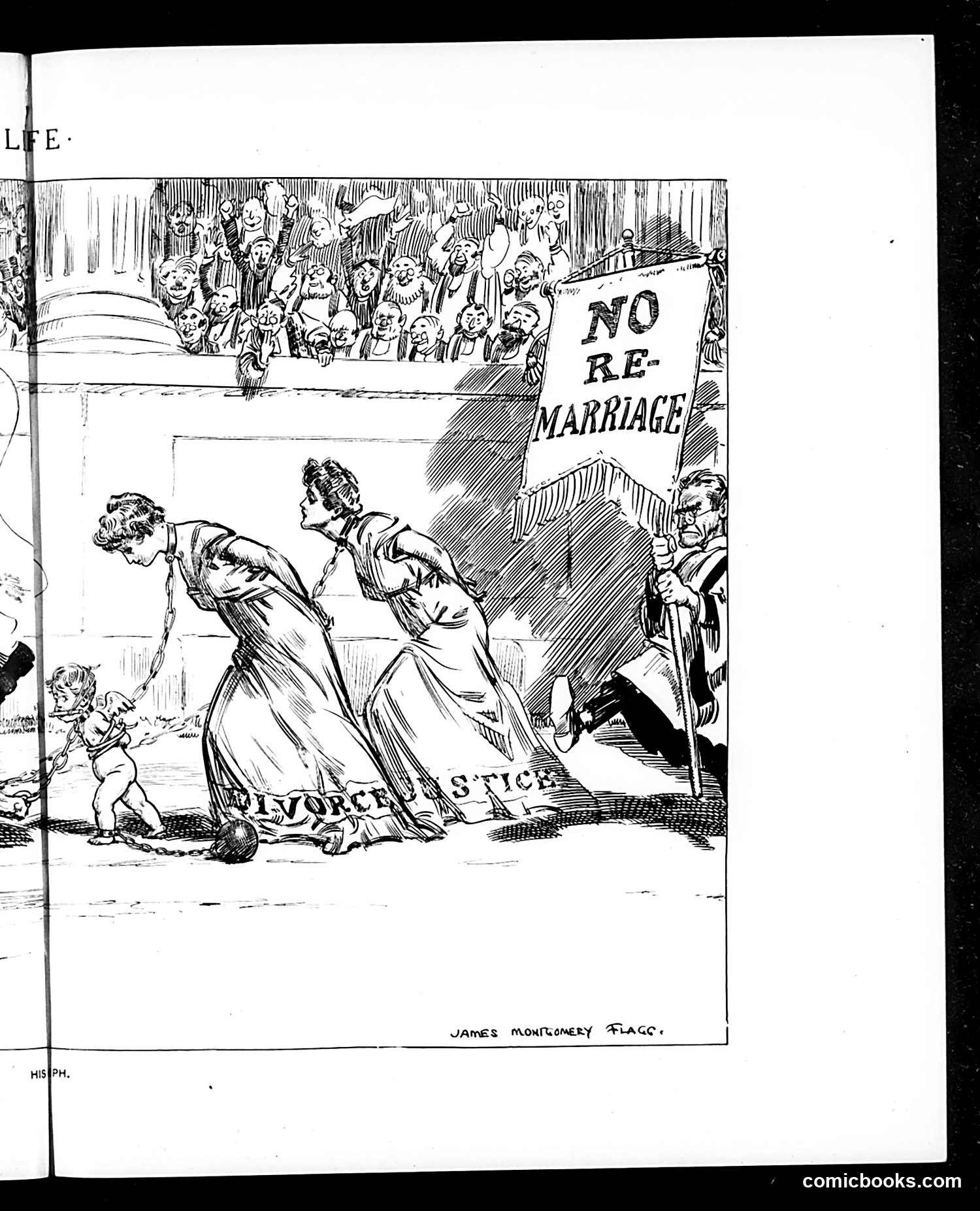
This James Montgomery Flagg cartoon satirizes marriage reform debates of the early 20th century. Two women appear to be fleeing from or rejecting marriage, as indicated by the "NO RE-MARRIAGE" sign held by observers above. The phrase "CLING TO ME STICK" appears partially visible, possibly referencing an old saying about marriage being inescapable. The crowd in the gallery watching from above suggests public interest in women's marital choices—a contemporary controversy as women increasingly demanded legal rights and independence. The cartoon likely mocks either women rejecting remarriage after divorce, or critiques societal pressure regarding women's matrimonial obligations. The work reflects Life magazine's satirical treatment of progressive social movements challenging traditional marriage expectations during this reform-minded era.
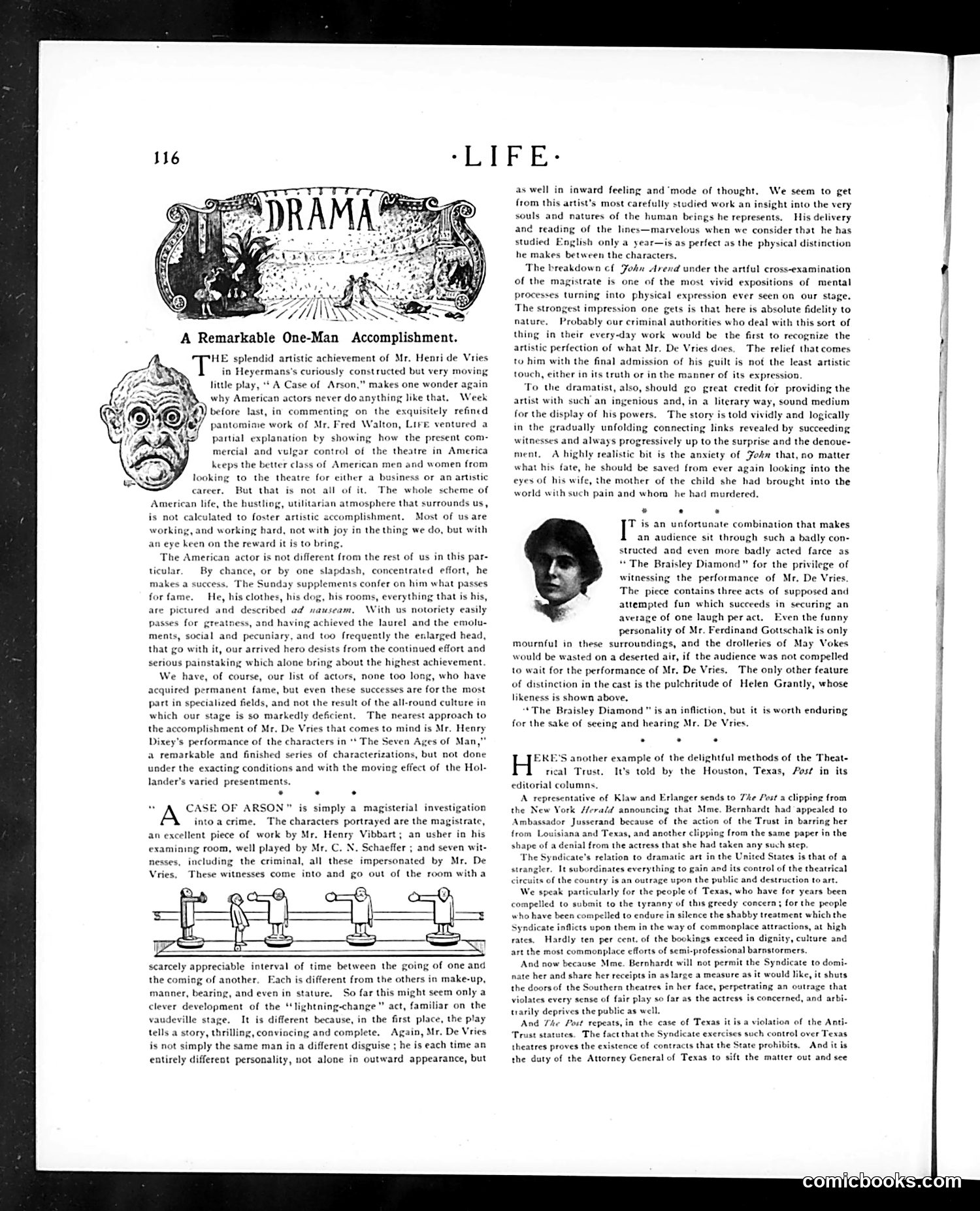
This page praises Henri de Vries, a Dutch actor, for his remarkable performance in "A Case of Arson," a play by Heyermans. De Vries plays multiple characters—a magistrate, a criminal, witnesses—each with distinct personalities, not merely different costumes. The critic marvels that de Vries achieves this despite studying English for only one year. The article critiques American theatrical culture, arguing that commercial pressures and America's utilitarian ethos discourage serious artistic commitment. Unlike de Vries's sustained, painstaking craft, American actors pursue quick fame through Sunday newspaper publicity, then rest on their laurels rather than continuing rigorous development. The small illustration shows de Vries's face in different expressions, visually demonstrating his character-shifting ability.
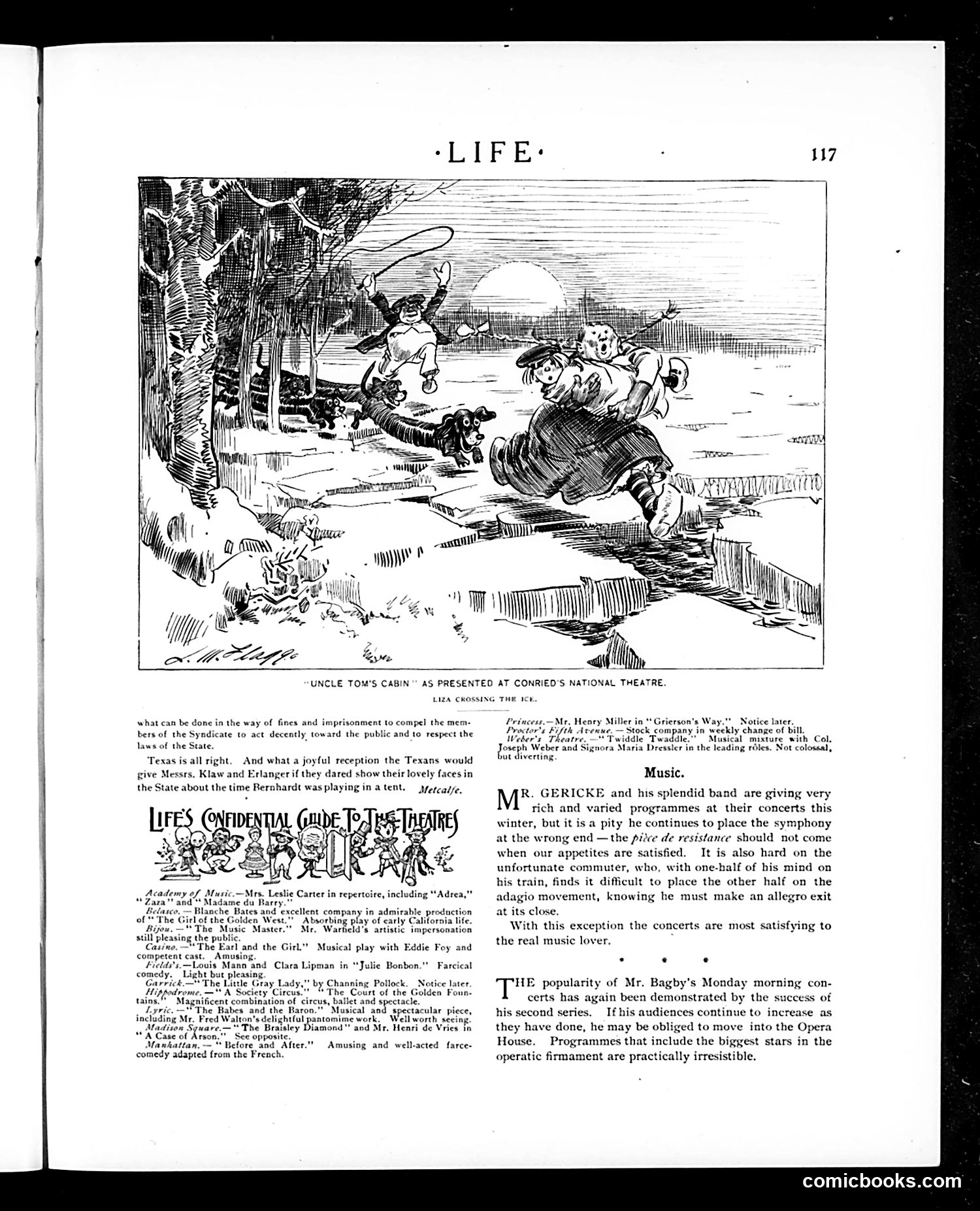
The illustration depicts a scene from a theatrical production of *Uncle Tom's Cabin*, specifically the famous "Liza Crossing the Ice" sequence where the enslaved character Eliza flees across a frozen river. The sketch shows period costume and dramatic action typical of late 19th-century stage adaptations. The accompanying text discusses theater reviews and management issues. Notably, it references **Klaw and Erlanger**, theatrical syndicates being criticized for treating the public disrespectfully and violating state laws. The writer sarcastically suggests Texans would give them a hostile reception, alluding to an incident involving actress Sarah Bernhardt performing in a tent—likely referencing a dispute over theater monopolies and exploitation. The page satirizes theatrical syndicate power and calls for legal action against their unethical practices toward audiences and performers.
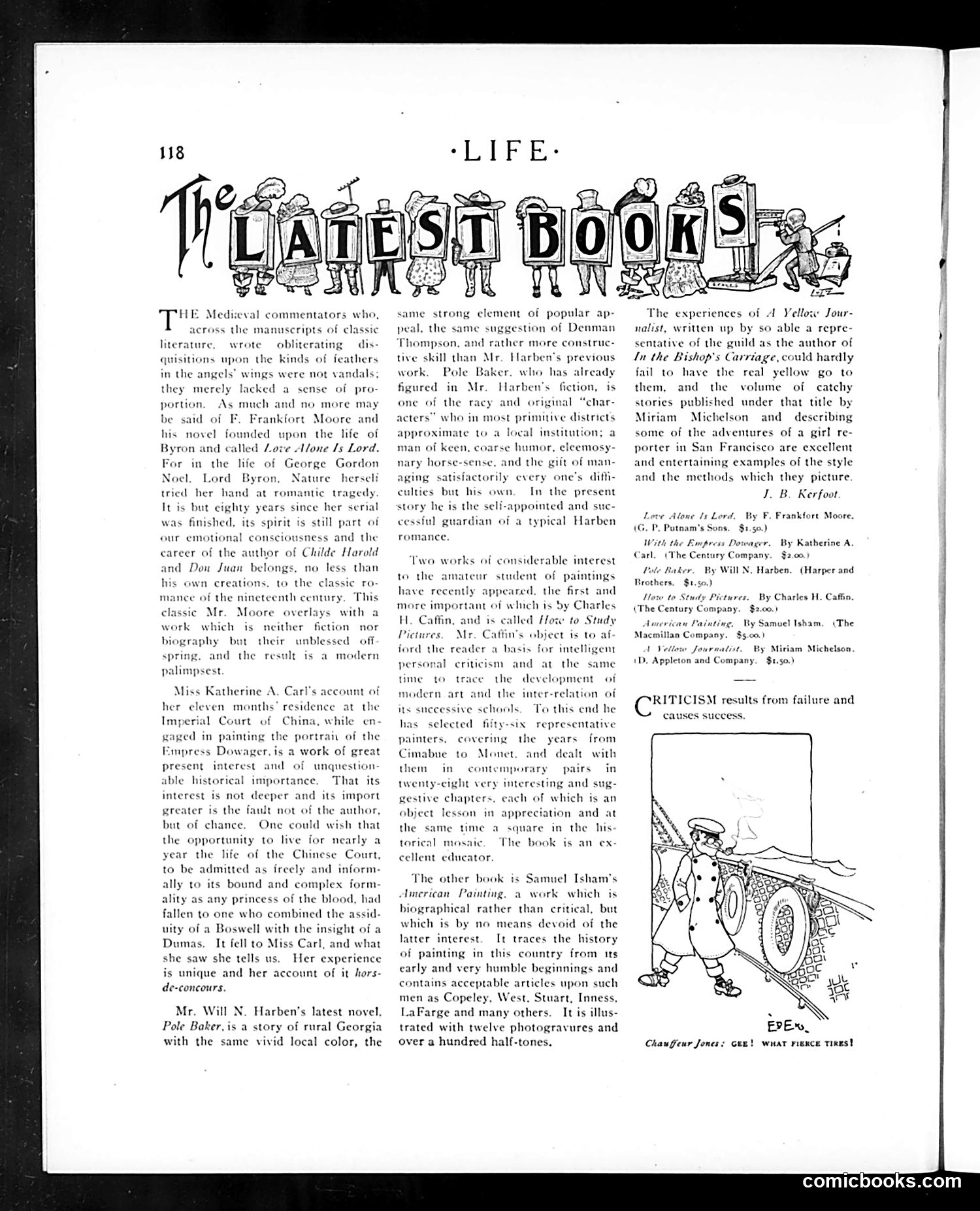
This is a book review section from *Life* magazine (page 118), discussing five recent literary works. The main content is text-based criticism rather than political satire. The reviews cover: - *Love Alone Is Lord* by F. Frankfort Moore (about Byron's life) - Katherine A. Carl's memoir of her time at the Chinese Imperial Court - Will N. Harben's novel *Pole Baker* (rural Georgia fiction) - Charles H. Caffin's *How to Study Pictures* (art instruction) - Samuel Isham's *American Painting* (art history) The single cartoon at bottom right shows a figure ("Gee! what fierce tires!") examining or commenting on a wheel—its meaning is unclear without additional context, though it may be an unrelated humorous illustration typical of *Life's* mixed content format. The reviews are literary criticism rather than satire, emphasizing merit and historical importance of the works discussed.
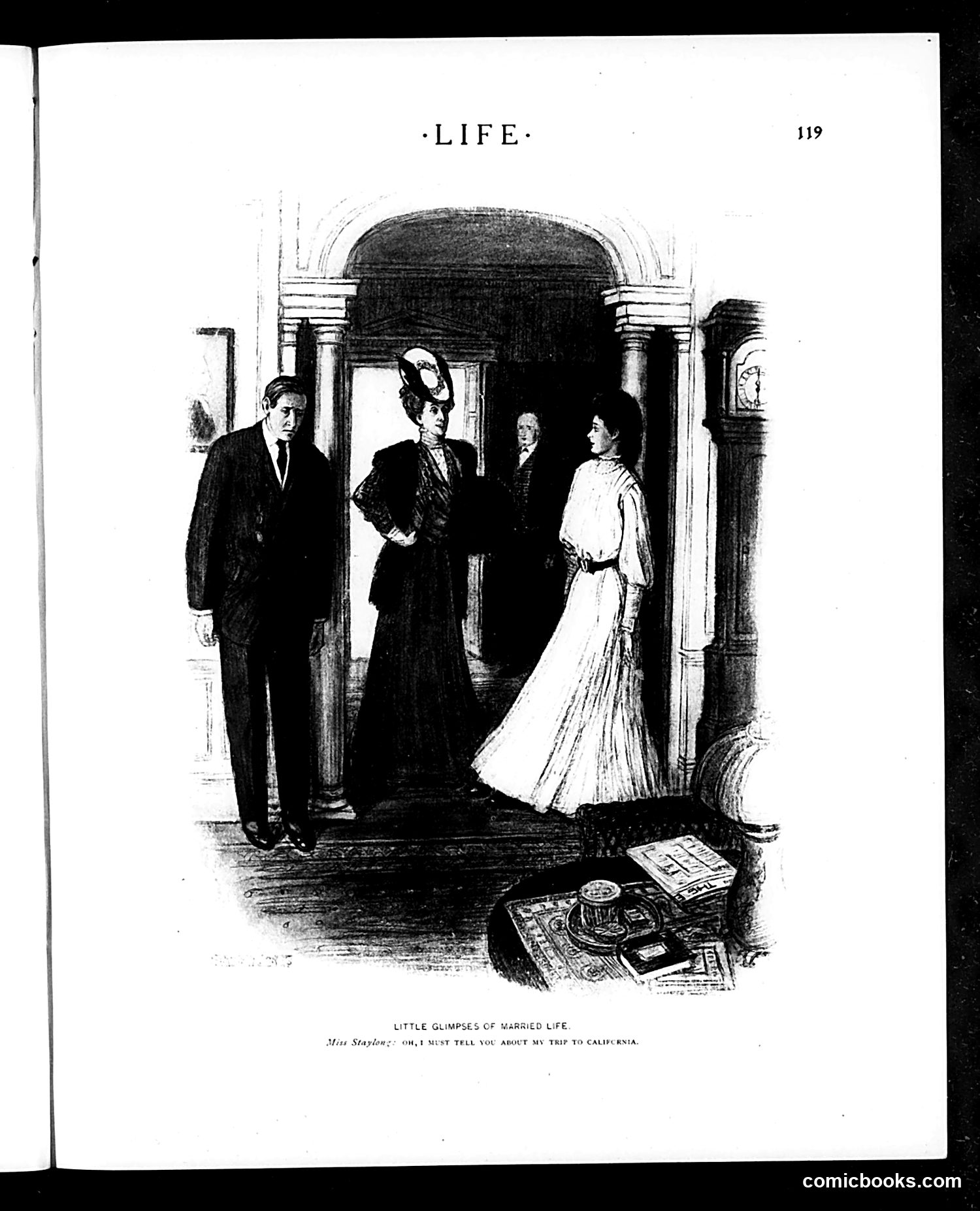
This is a satirical cartoon from Life magazine titled "Little Glimpses of Married Life." It depicts a social scene where a woman (Miss Staylows) is eager to tell another woman about a trip to California. The humor targets a recognizable social type: the wife who monopolizes conversation with tedious travel anecdotes. The cartoon satirizes early 20th-century domestic etiquette and gender dynamics—specifically, how married women of leisure would inflict lengthy, self-absorbed vacation stories on their social acquaintances. The gentleman on the left and the trapped listeners suggest the discomfort caused by her chattiness. The scattered items on the floor (luggage, travel accessories) reinforce the trip's prominence in her mind. The joke reflects period anxieties about women's increasing social independence and consumer culture, mocking the nouveau riche tendency to broadcast leisure travel.
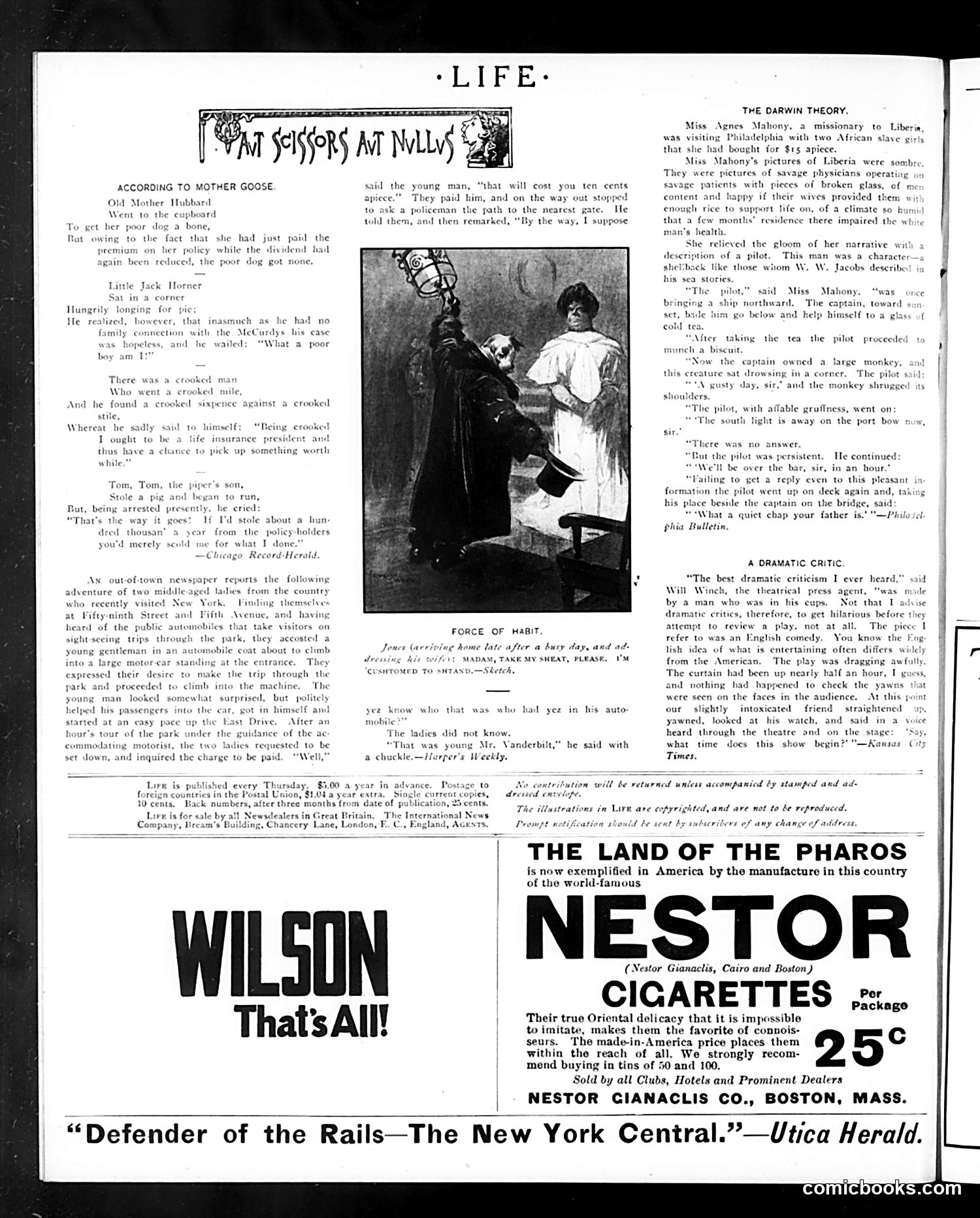
This page contains several satirical pieces mocking social pretension and moral hypocrisy: **"According to Mother Goose"** adapts nursery rhymes to critique insurance fraud. A crooked man rationalizes theft as "life insurance," while Tom the pig-stealer wishes he'd stolen more valuable goods to justify his sentence. The satire targets dishonest policyholders. **"Force of Habit"** jokes about two country ladies visiting New York who mistake a taxi driver for a tour guide, revealing urban gullibility. **"The Darwin Theory"** ridicules missionary work, showing Miss Mahony's depressing photos of Liberia (with enslaved people) being used unconvincingly to prove evolutionary theory. **"A Dramatic Critic"** mocks theater critics, praising a man who fell asleep and thus avoided a bad play—suggesting silence is the best criticism. The page reflects early 20th-century American attitudes toward insurance fraud, tourists, colonial Africa, and theatrical pretension.
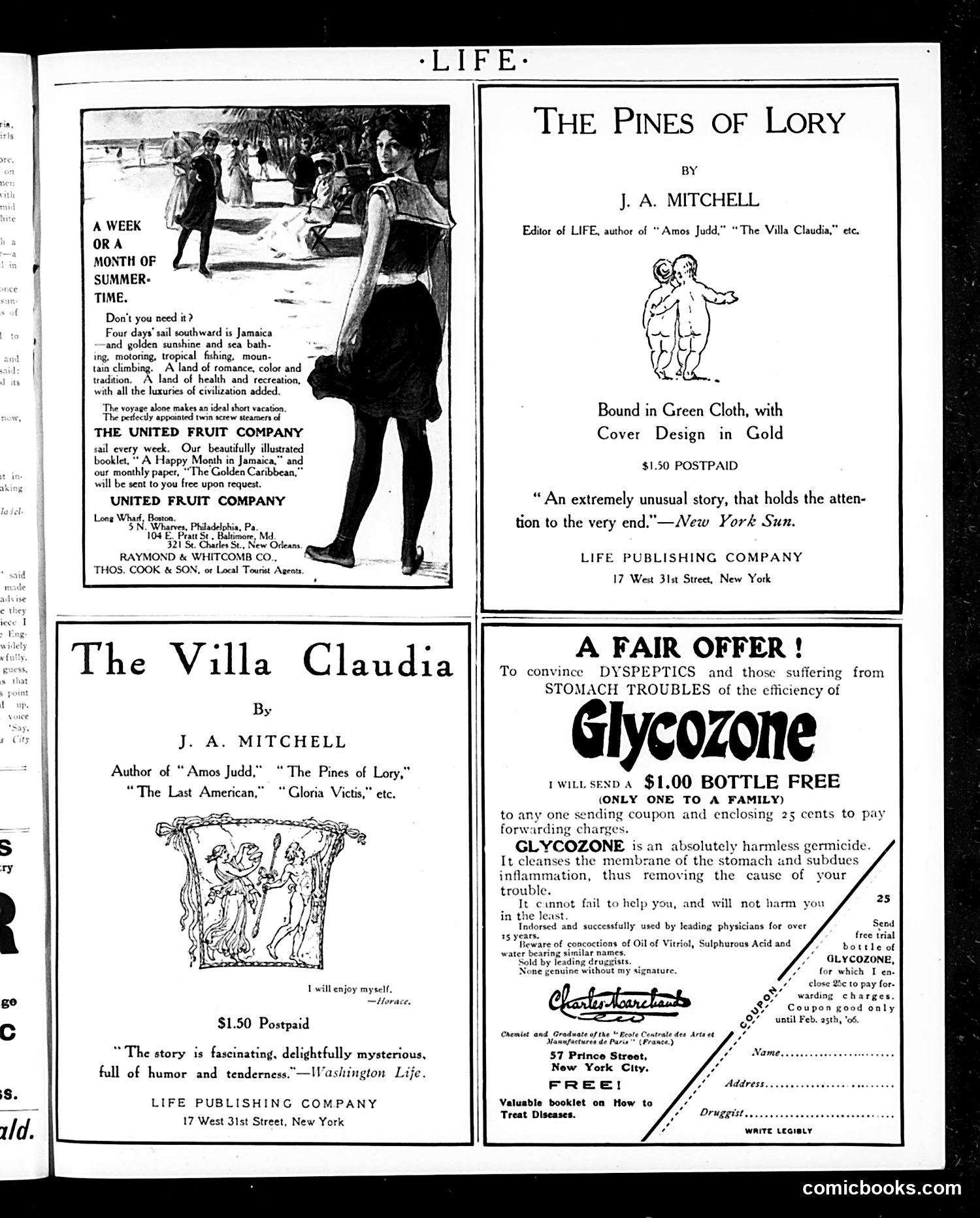
This is primarily an **advertising page** from Life magazine, not a satirical cartoon page. It contains four advertisements: 1. **United Fruit Company** — promotes Jamaica vacations via steamship, emphasizing tropical leisure and "luxuries of civilization" 2. **Two books by J.A. Mitchell** (Life's editor) — *The Pines of Lory* and *The Villa Claudia*, advertised as fiction with positive reviews 3. **Glycozone patent medicine** — claims to cure dyspepsia and stomach troubles; offers a free $1.00 bottle. The ad includes a signature from the chemist-manufacturer in Paris, a common marketing tactic of the era to suggest European scientific legitimacy The **Glycozone ad is the most revealing historically**: it represents the unregulated patent medicine industry of the early 1900s. Such products made extraordinary health claims without FDA oversight (the FDA wasn't established until 1906). The free-sample strategy and vague "germicide" claims are typical of the era's dubious medical marketing that Life magazine itself often satirized editorially.
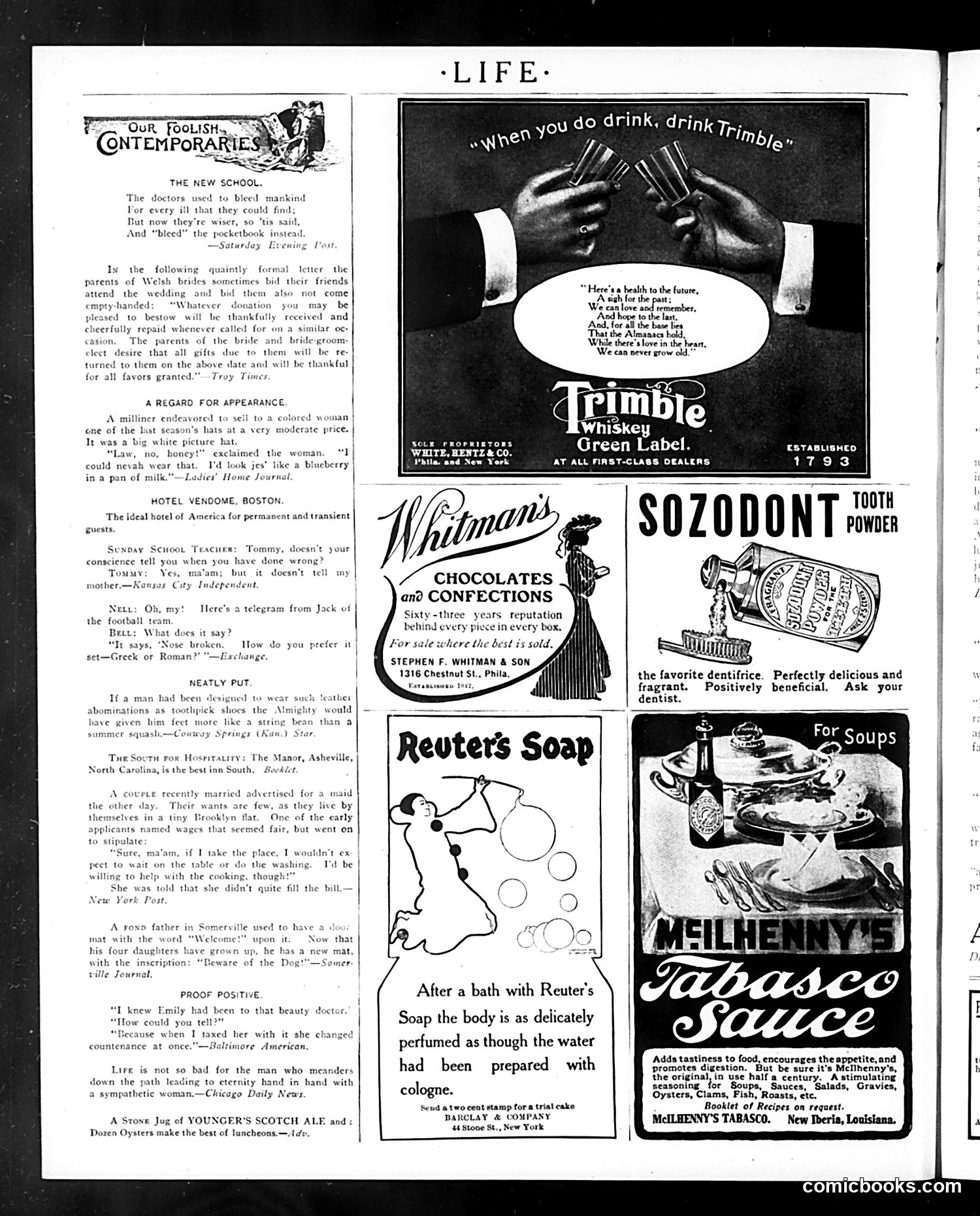
This page from Life magazine combines satirical commentary with period advertisements. The left column features "Our Foolish Contemporaries"—short humorous anecdotes mocking social pretensions and human folly: - "The New School" satirizes doctors who now financially exploit patients rather than bleed them medically - "A Regard for Appearance" ridicules a milliner's snobbery toward a Black customer - Other brief items mock weddings, teachers, and social affectation The right side displays contemporary ads for Trimble Whiskey, Sozodont toothpowder, Reuter's Soap, and Meilhenny's Tabasco sauce—typical early 20th-century products. **Context for modern readers:** This reflects Life's core mission: satirizing American social hypocrisy, class pretension, and commercial excess through brief, pointed anecdotes. The ads themselves become part of the satirical landscape, representing the consumer culture being gently mocked.
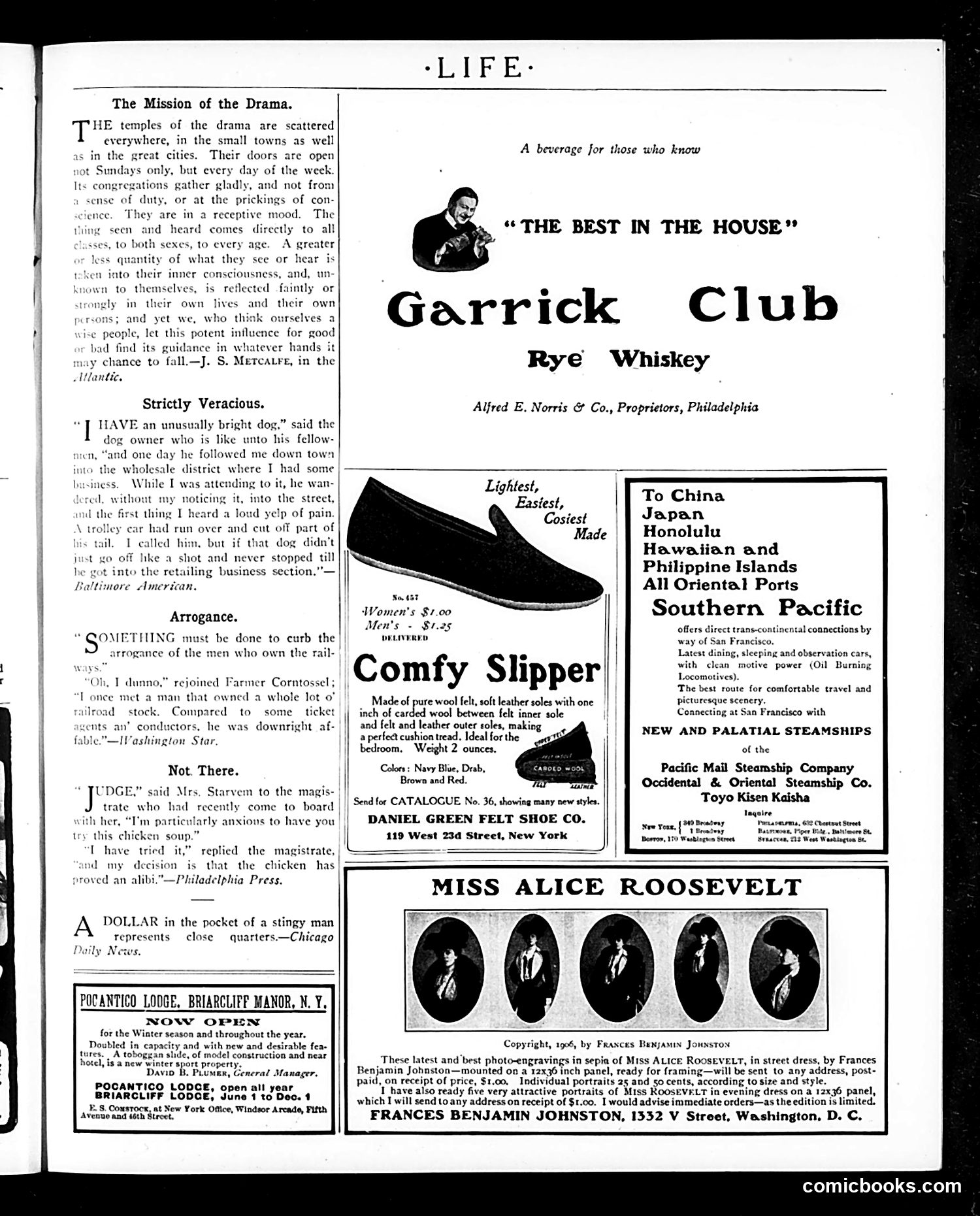
This is primarily an **advertising page** with scattered short humorous anecdotes in the margins, typical of early-1900s Life magazine format. The page contains no political cartoons. The main feature is commercial advertising for luxury goods (Garrick Club whiskey, Daniel Green felt slippers, shipping lines to Asia) interspersed with brief joke columns about mundane topics: a dog following its owner to retail district; a man comparing railroad stockholders to railroad conductors; a magistrate declaring chicken soup an alibi for poor cooking. The only photograph is of **Miss Alice Roosevelt** (identified in caption) in five poses wearing a street dress—this appears to be a fashionable celebrity endorsement or display, likely from 1905 based on copyright dates visible. The humor is gentle, domestic, and non-political. These anecdotes reflect era-typical concerns: social class pretensions, pet behavior, and domestic life. No satire or political content is evident.
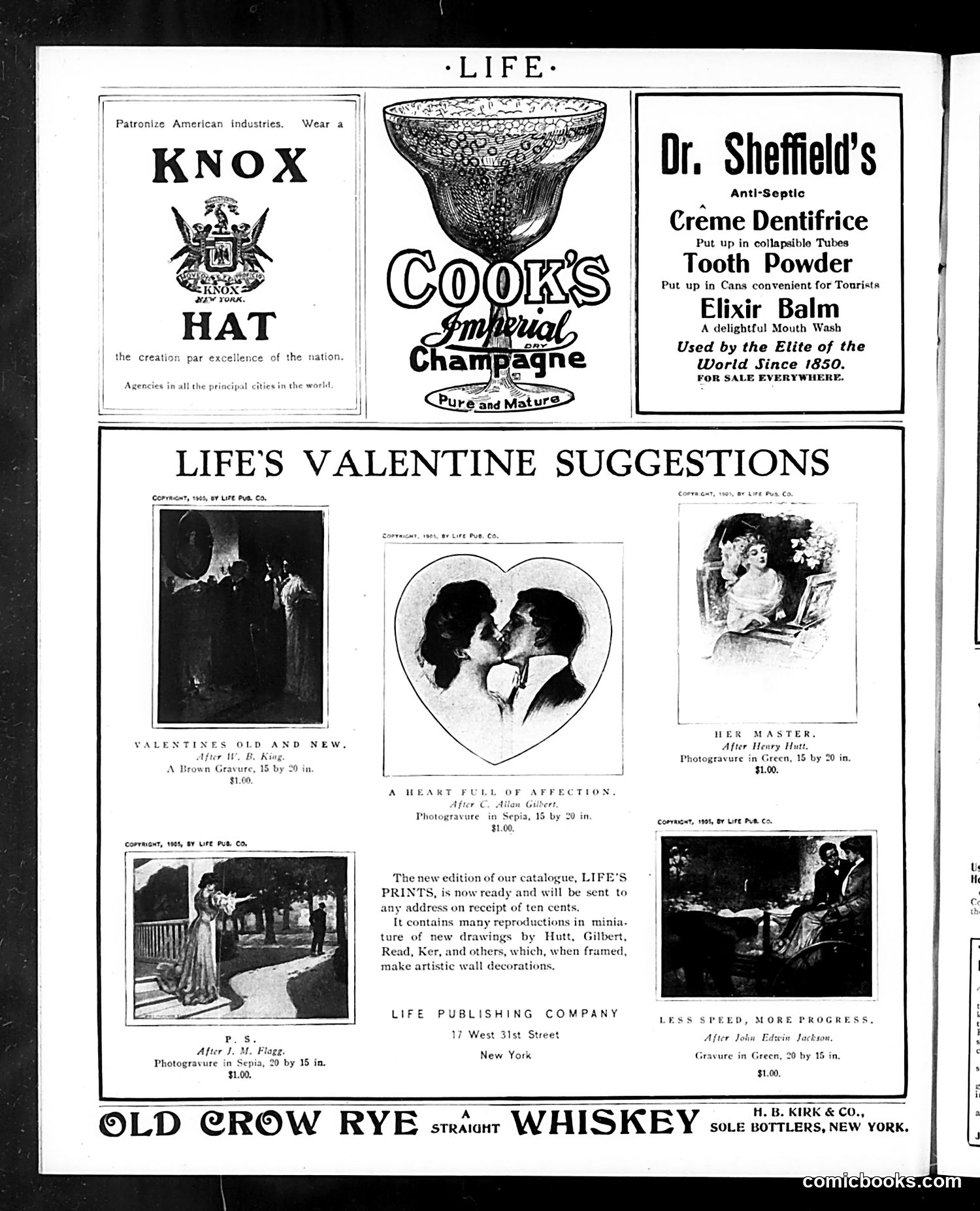
This page is **primarily advertising**, not political satire. It features: **Top advertisements**: Knox Hat (promoting American manufacturing), Cook's Imperial Champagne, and Dr. Sheffield's dental products. **Main content**: "Life's Valentine Suggestions"—a catalog of framed photogravures available for purchase, priced at $1.00 each. These are reproductions of romantic and sentimental artwork by named illustrators (Hutt, Gilbert, Read, Jackson) suitable as Valentine's Day gifts or wall decorations. **Notable detail**: The page emphasizes that Life Publishing Company sells art prints "when framed, make artistic wall decorations"—targeting middle-class consumers seeking affordable home décor. **Bottom**: An Old Crow Whiskey advertisement. The Valentine suggestions themselves depict conventional romantic scenes—couples and affectionate moments—reflecting early 20th-century sentimental tastes. This is a commercial publication page, not editorial content with satirical intent.
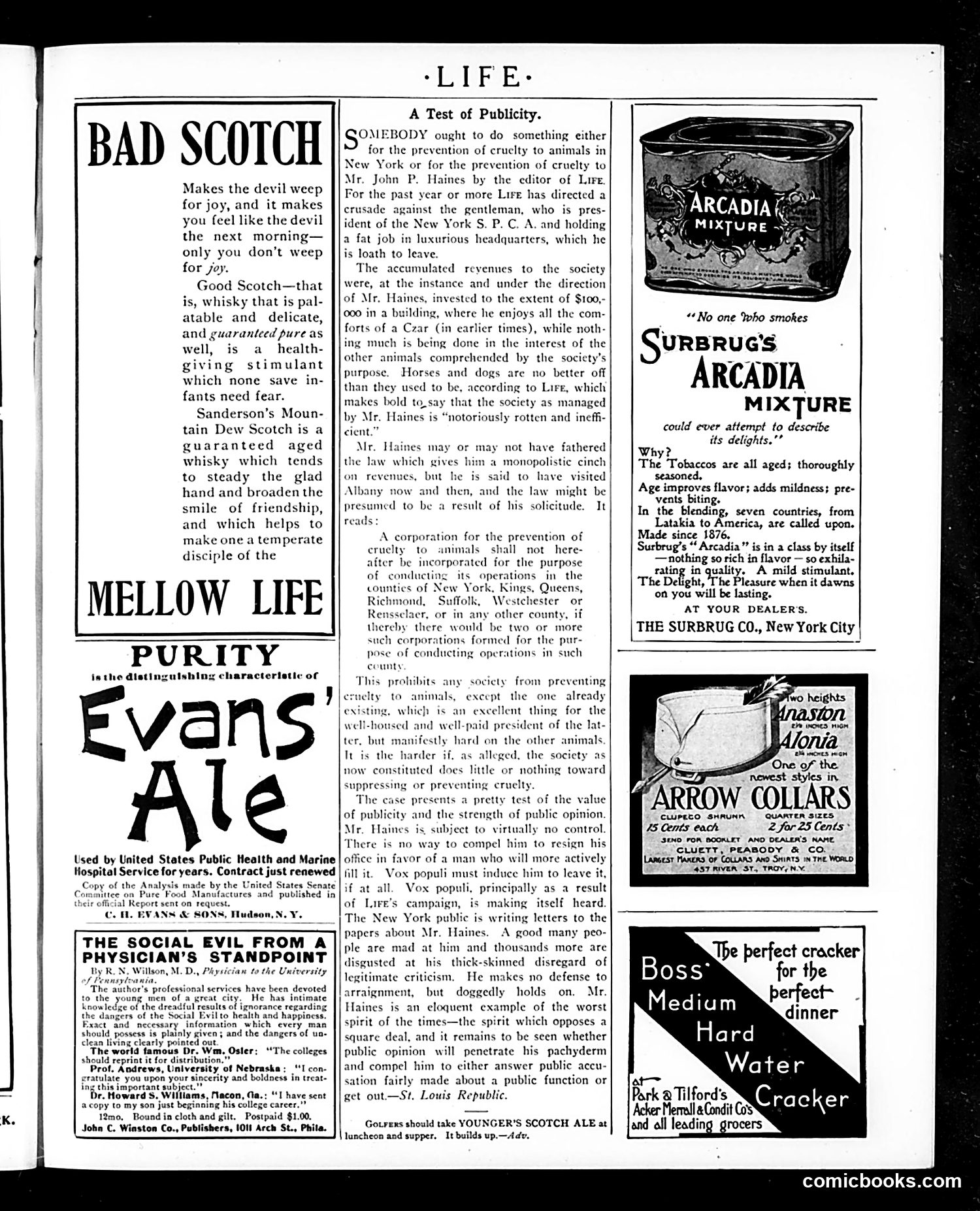
This page contains **primarily advertisements** interspersed with editorial content. The main satirical piece is "A Test of Publicity," which attacks John P. Haines, president of the New York S.P.C.A. (animal welfare organization). Life's editor accuses Haines of: - Mismanaging the society's $100,000 building investment while neglecting actual animal welfare work - Operating a "notoriously rotten and inefficient" organization - Securing a monopoly law preventing competing animal-protection societies in New York counties—benefiting himself financially while harming animals The piece sarcastically calls this "a pretty test of the value of publicity and the strength of public opinion," suggesting Life's campaign against Haines will expose corrupt institutional leadership. The surrounding ads (Scotch whisky, Evans Ale, tobacco) and a medical text about "Social Evil" are typical period advertising unrelated to the satire.
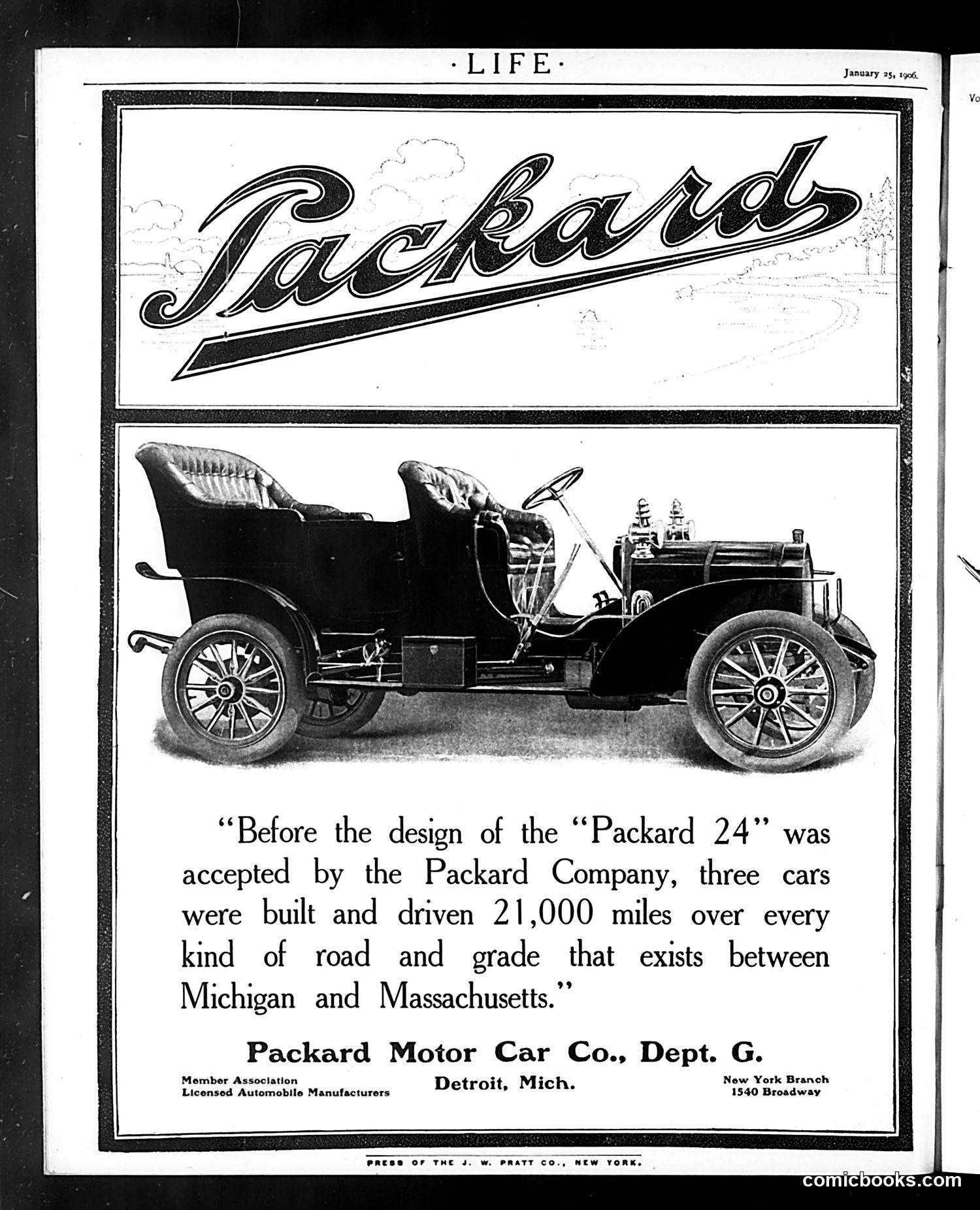
This is a **product advertisement**, not a political cartoon. It promotes the Packard 24 automobile from the Packard Motor Car Company (Detroit). The ad makes a marketing claim: before officially releasing the car's design, the company built and tested three prototypes by driving them 21,000 miles across varied terrain between Michigan and Massachusetts. The point is to establish **reliability and quality assurance**—the car has been rigorously tested under real-world conditions before customers could buy it. This was a common early-automotive advertising strategy: demonstrating durability and engineering care to reassure buyers in an era when automobiles were still relatively new and unreliable. The imagery shows a side-view of the touring car, typical for automotive advertisements of this period (January 1906).