
Life, 1906-01-25 · page 14 of 24
Life — January 25, 1906 — page 14: what you’re looking at
What you’re looking at
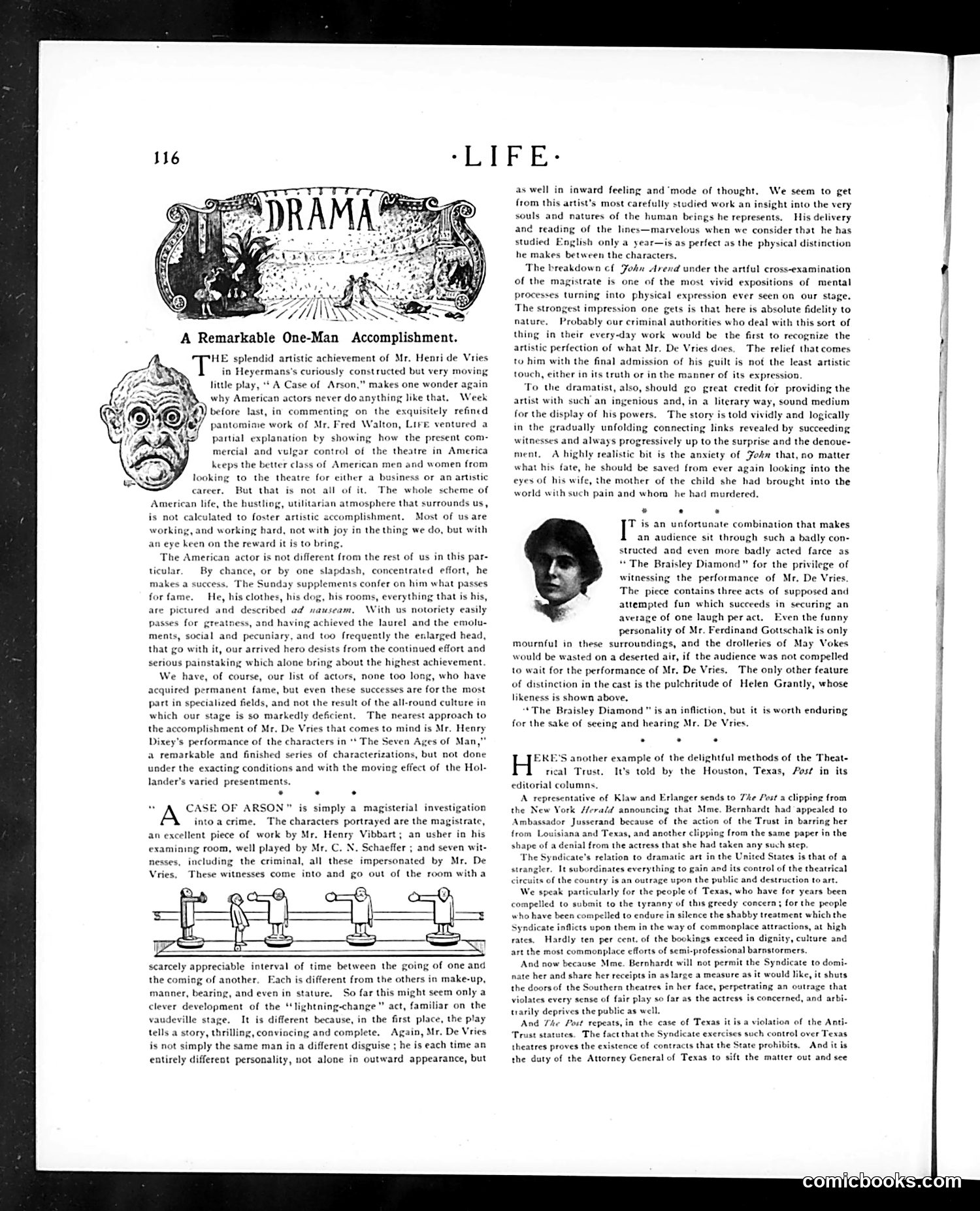
This page praises Henri de Vries, a Dutch actor, for his remarkable performance in "A Case of Arson," a play by Heyermans. De Vries plays multiple characters—a magistrate, a criminal, witnesses—each with distinct personalities, not merely different costumes. The critic marvels that de Vries achieves this despite studying English for only one year. The article critiques American theatrical culture, arguing that commercial pressures and America's utilitarian ethos discourage serious artistic commitment. Unlike de Vries's sustained, painstaking craft, American actors pursue quick fame through Sunday newspaper publicity, then rest on their laurels rather than continuing rigorous development. The small illustration shows de Vries's face in different expressions, visually demonstrating his character-shifting ability.
📄 Transcribed text from this page (OCR, searchable)
Machine-transcribed from the original scan — historical spelling and the odd misread are preserved.
A Remarkable One-Man Accomplishment. HE splendid artistic achievement of Mr. Henri de Vries in Heyermans’s curiously constructed but very moving little play, “A Case of Arson,” makes one wonder again why American actors never do anything like that, Week }) before last, in commenting on the exquisitely refined pantomime work of Mr. Fred Walton, Lire ventured a partial explanation by showing how the present com- mercial and vulgar control of the theatre in America keeps the better class of American men and women from looking to the theatre for either a business or an artistic career. But that is not all of it. The whol n atmosphere that surrounds us, American life, the bustliog, utilitar is not calculated to foster artistic accomplishment. Most of us are working, and working hard, not with joy in the thing we do, but with an eye keen on the reward it is to bring. The American actor is not different from the rest of us in this par ticular. By chance, or by one slapdash, concentrated effort, he makes a success, The Sunday supplements confer on him what passes for fame, He, his clothes, his dog, his rooms, everything that is his, are pictured and described ad nauseam, With us notoriety easily passes for greatness, and having achieved the laurel and the emolu- ments, social and pecuniary, and too frequently the enlarged head, that go with it, our arrived hero desists from the continued effort and serious painstaking which alone bring about the highest achievement We have, of course, our list of actors, none too long, who have acquired permanent fame, but even these successes are for the most part in specialized fields, and not the result of the all-round culture which our stage is so markedly deficient, The nearest approach to the accomplishment of Mr. De Vries that comes to mind is Mr. Henry Dixey's performance of the characters in * The Seven Ages of Man,” a remarkable and finished series of characterizations, but not done under the exacting conditions and with the moving effect of the Hol- lander’s varied presentments. ” ASE OF ARSON” is simply a magisterial investigation an excellent piece of work by Mr, Henry Vibbart ; an usher in his examining room, well played by Mr. C. N. Schaeffer ; and seven wit nesses, including the criminal, all these impersonated by Mr. De Vries, These witnesses come into and go out of the room witha ion scarcely appreciable interval of time between the going of one and the coming of another. Each is different from the others in make-up, manner, bearing, and even in stature. So far this might seem only a clever development of the ‘“lightning-change" act, familiar on the vaudeville stage. It is different because, in the first place, the play thrilling, convincing and complete. Again, Mr. De Vries each time an tellsa is not simply the same man in a different disguise ; he entirely different personality, not alone in outward appearance, but *-LIFE- as well in inward feeling and ‘mode of thought, We seem to get from this artist's most carefully studied work an insight into the very souls and natures of the human beings he represents. His delivery and reading of the lines—marvelous when we consider that he has studied English only a year—is as perfect as the physical distinction he makes between the characters, ‘The breakdown cf John Arend under the artful cross-examination of the magistrate is one of the most vivid exposi jons of mental processes turning into physical expression ever seen on our stage. The strongest impression one gets is that here is absolute fidelity to nature, Probably our criminal authorities who deal with this sort of thing in their every-day work would be the first to recognize the artistic perfection of what Mr. De Vries does. The relief that comes to him with the final admission of his guilt is not the least artistic touch, either in its truth or in the manner of its expression. To the dramatist, also, should go great credit for providing the artist with such’ an ingenious and, in a literary way, sound medium for the display of his powers. The story is told vividly and logically in the gradually unfolding connecting links revealed by succeeding witnesses and always progressively up to the surprise and the denoue- ment. A highly realistic bit is the anxiety of Yorn that, no matter what his fate, he should be saved from ever again looking into the eyes of his wife, the mother of the child she had brought into the world with such pain and whom he had murdered, . . . T is an unfortunate combination that makes an audience sit through such a badly con- structed and even more badly acted farce 3s The Braisley Diamond” for the privilege of witnessing the performance of Mr, De Vries The piece contains three acts of supposed and attempted fun which succeeds in securing an average of one laugh per act. Even the funny personality of Mr. Ferdinand Gottschalk is only mournful in these surroundings, and the drolleries of May Vokes would be wasted on a deserted air, if the audience was not compelled to wait for the performance of Mr. De Vries, ‘The only other feature of distinction in the cast is the pulchritude of Helen Grantly, whose likeness is shown above, ‘The Braisley Diamond" is an infliction, but it is worth enduring for the sake of seeing and hearing Mr. De Vries. RE’S another example of the delightful methods of the Theat rical Trust. It’s told by the Houston, Texas, Fost in its editorial columns. A representative of Klaw and Erlanger sends to The Pest a clipping from the New York Herald announcing that Mme, Bernhardt had appealed to Ambassador Jusserand because of the action of the Trust in barring her from Louisiana and Texas, and another clipping from the same paper in the shape of a denial from the actress that she had taken any such step. The Syndicate’s relation to dramatic art in the United States is that of a It subordinates everything to gain and its control of the theatrical circuits of the country is an outrage upon the public and destruction to art. We speak particularly for the people of Texas, who have for years been apelled to submit to the tyranny of this greedy concern; for the people o have been compelled to endure in silence the shabby treatment which the Syndicate inflicts upon them in the way of commonplace attractions, at high rates. Hardly ten per cent. of the bookings exceed in dignity, culture and art the most commonplace efforts of semi-professional barnstormers. And now because Mme. Bernhardt will not permit the Syndicate to domi- nate her and share her receipts in as large a measure as it would like, it shuts the doors of the Southern theatres in her face, perpetrating an outrage that violates every sense of fair play so far as the actress is concerned, and arbi- trarily deprives the public as well. And The Post repeats, in the case of Texas it is a violation of the Anti- ‘Trust statutes. The fact that the Syndicate exercises such control over Texas theatres proves the existence of contracts that the State prohibits. And it the duty of the Attorney General of Texas to sift the matter out and see