
Life, 1906-01-25 · page 16 of 24
Life — January 25, 1906 — page 16: what you’re looking at
What you’re looking at
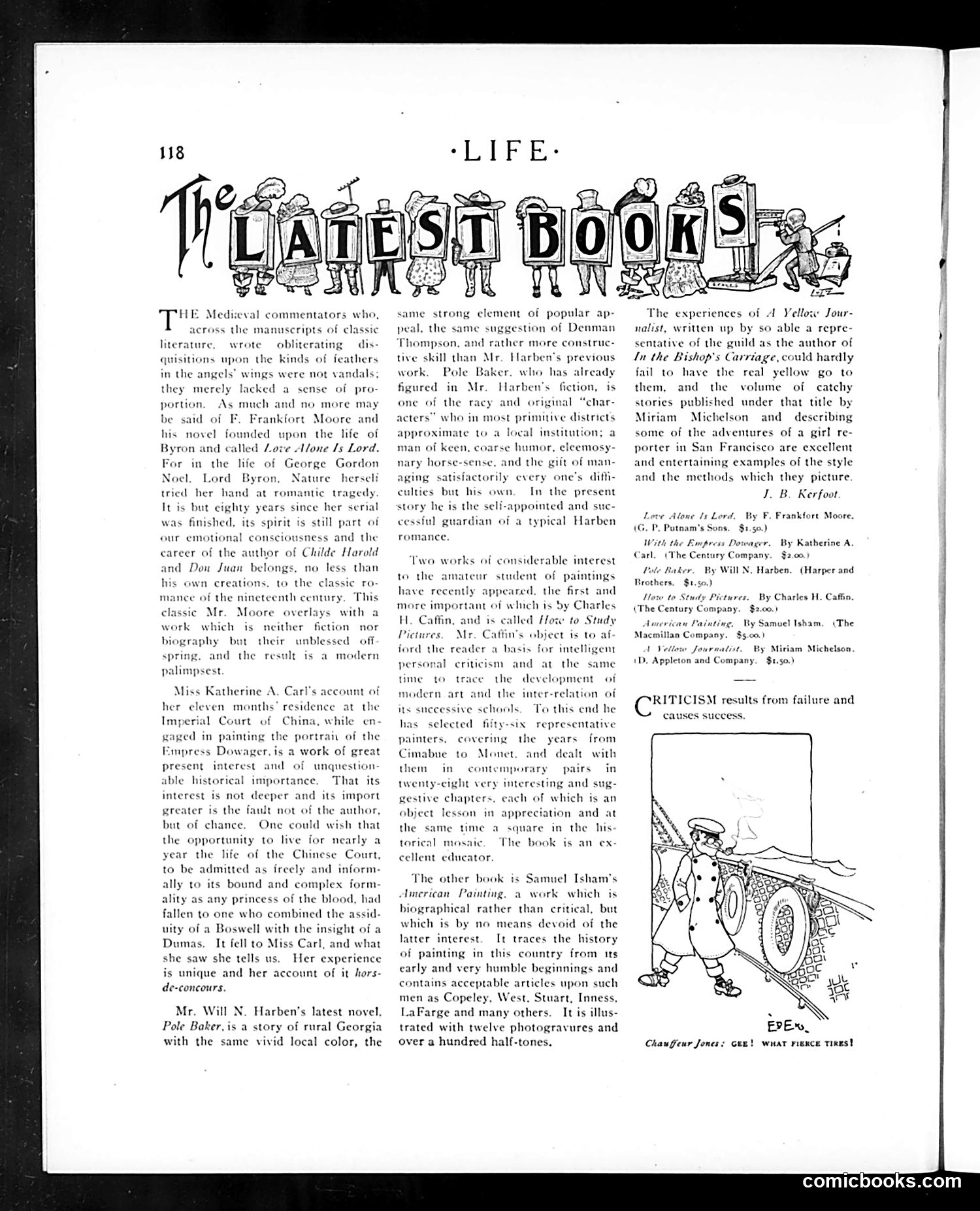
This is a book review section from *Life* magazine (page 118), discussing five recent literary works. The main content is text-based criticism rather than political satire. The reviews cover: - *Love Alone Is Lord* by F. Frankfort Moore (about Byron's life) - Katherine A. Carl's memoir of her time at the Chinese Imperial Court - Will N. Harben's novel *Pole Baker* (rural Georgia fiction) - Charles H. Caffin's *How to Study Pictures* (art instruction) - Samuel Isham's *American Painting* (art history) The single cartoon at bottom right shows a figure ("Gee! what fierce tires!") examining or commenting on a wheel—its meaning is unclear without additional context, though it may be an unrelated humorous illustration typical of *Life's* mixed content format. The reviews are literary criticism rather than satire, emphasizing merit and historical importance of the works discussed.
📄 Transcribed text from this page (OCR, searchable)
Machine-transcribed from the original scan — historical spelling and the odd misread are preserved.
HE Medieval commentators who, across the manuscripts of classic literature, wrote obliterating — dis- quisitions upon the kinds of feathers in the angels’ wings were not vandals; they merely lacked a sense of pro- portion. As much and n more may be said of F. Frankfort Moore and his novel founded upon the life of Byron and called Love Alone Is Lord. For in the life of George Gordon cl, Lord Byron, Nature herseli tried her hand at romantic tragedy It is but eighty years since her serial was finished, its spirit is still part of our emotional consciousness and the career of the author of Childe Harold and Don Juan belongs, no less than his own creations. to the classic ro- mance of the nineteenth century. This classic Mr. Moore overlays with a work which is neither fiction nor biography but their unblessed off and the result is a modern spr palimpsest Miss Katherine A. Carl's a her eleven months’ residence at the Imperial Court of China, while en- ount of gaged in painting the portrait of the »wager. is a work of great nterest and of unquestion- Empress present able historical importance. That its interest is not deeper and its import greater is the faut not of the author, but of chance. One could wish that the opportunity to live for nearly a year the life of the Chinese Court, to be admitted as freely and inform- ally to its bound and complex form- ality as any princess of the blood, had fallen to one who combined the assid- uity of a Boswell with the insight of a Dumas. It fell to Miss Carl, and what she saw she tells us. Her experience is unique and her account of it hors- de-concours. Mr. Will N. Harben’s latest novel, Pole Baker, is a story of rural Georgia with the same vivid local color, the same strong element of popular ap- I, the same suggestion of Denman Thompson, and rather more construc- tive skill than Mr. Harben's previous work. Pole Baker. who has already figured in Mr. Harben's fiction, is ne of the racy and original “char- acters” who in most primitive districts approximate to a man of keen, coarse humor, eleemosy- local institution; a nary horse-sense, and the gilt of man- s difh- In the present story he is the seli-appointed and stc- dian of a typical Harben aging satisfactorily every on culties but his own cessful gua romance. lwo works of considerable interest to the amateur student of paintings have recently appeared. the first and more important of which is by Charles H. Caffin, and is called How to Study Pictures, Mr. Cattin’s object is ford the reader a basis for inte personal criticism and at the time to trace the development oi modern art and the inter-relation of Is, this end he yesix. representative its successive sche ha inters, covering the years from Cimabue to Monet, and dealt with them in contemporary pairs in selected twenty-cight very interesting and sug- gestive chapters, each of which is an object lesson in appreciation and at the same time a square in the his torical mosaic. The book is an ex- cellent educator. The other book is Samuel Isham’s American Painting. a work which is biographical rather than critical, but which is by no means devoid of the latter interest. It traces the history of painting in this country from its early and very humble beginnings and contains acceptable articles upon such men as Copeley, West, Stuart, Inness, LaFarge and many others. It is illus- trated with twelve photogravures and over a hundred half-tones, The experiences of A Yellow Jour- nalist, written up by so able a repre- sentative of the guild as the author of In the Bishop's Carriage, could hardly fail to have the real yellow go to them, and the volume of catchy stories published under that title by Miriam) Michelson and describing some of the adventures of a girl re- porter in San Francisco are excellent and entertaining examples of the style and the methods which they picture J. B. Kerfoot. lone Is Lord, By F. Frankfort Moore. (G. P, Putnam's Sons. $1.50.) With the Empress Dowager. By Katherine A. Carl. (The Century Company. $2.00.) Vole Baker, Wy Will N, Harben. (Harper and Brothers. $1.50.) How to Study (The Century Com victures, By Charles H. Caf. y. $2.00.) American Painting, By S Mace 1 Vettow Jourmatist. By Miriam Michelson 1D, Appleton and Company. $1.50.) (The Han Company. $5.00.) RITICISM results from failure and causes success. Chauffeur Jones: Gee! wuart rience tines! ] i | | | | | | comicbooks.com