
Life, 1906-01-25 · page 7 of 24
Life — January 25, 1906 — page 7: what you’re looking at
What you’re looking at
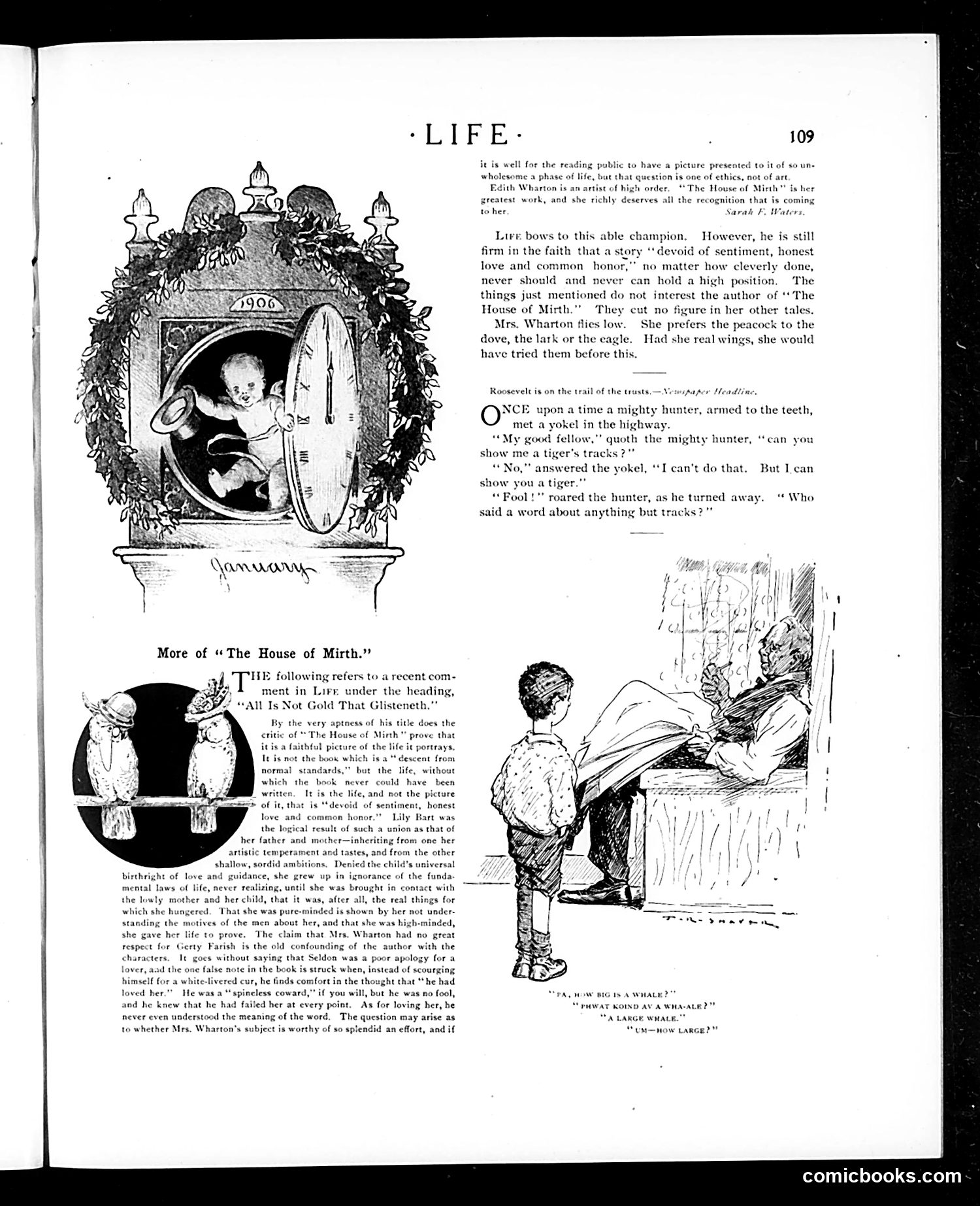
This page critiques Edith Wharton's novel "The House of Mirth." The top illustration depicts a cherub or cupid figure emerging from an ornate frame, symbolizing the book's themes of love and birth. The main text defends the novel against critics who claimed it was "not gold but glisteneth"—appearing valuable but lacking substance. The author argues Wharton deserves recognition for creating high-quality literature that honestly portrays life without sentimentality. The lower illustration shows a boy discovering a whale, accompanying a dialogue about mistaken identity and expectations—likely a metaphor for how readers misinterpret the novel's actual content and meaning. The satire targets literary snobs who dismiss serious fiction unfairly.
📄 Transcribed text from this page (OCR, searchable)
Machine-transcribed from the original scan — historical spelling and the odd misread are preserved.
-LIFE- 109 ie is well for the re c presented to it of $0 une wholesome a phasi ; 3 of ethics, not of Edith Wha: ° “The House of Mirtt greatest work, an richly deserves all the re jon that is co to her Sarah F, Waters Lire bows to this able champion. However, he is still firm in the faith that a story ‘devoid of sentiment, honest love and common honor,”” no matter how cleverly done, never should and never can hold a high position, ‘The things just mentioned do not interest the House of Mirth."". They cut no figure in her othe Mrs. Wharton flies low. She prefers the peacock to the dove, the lark or the eagle. Had she real wings, she would have tried them before this. Roosevelt is on the trail of the trusts, —Verspaper Headline, O + upon a time a mighty hunter, armed to the teeth, met a yokel in the highw “My good fellow,” quoth the mighty hunter, “can you show me a tiger's tracks?" “No,” answered the yokel, ‘I can't do that. But Lean show you a tiger.” ‘Fool !"' roared the hunter, as he turned away. ‘* Who said a word about anything but tracks?” More of “The House of Mirth.” IIE following refers to a recent com- ment in Lire under the heading All Is Not Gold That Glisteneth, Ry the very aptness of his title does the critic of " The House of Mirth prove that it is a faithful picture of the life it portrays. isa “descent from but the life, wi which the book never could have been nd not the picture honest n ignorance ing, until she was brought in contact w y mother and her child, that it was, after all, the real which she hungered. That she was pure-minded is shown by her not under- ing the motives of the men about her, and that she was high-minded, gave her life to prove. The claim that Mrs. Wharton had no great respect for Gerty Farish is the old confounding of the author with the characters. It goes without saying that Seldon was a poor apology for a book is struck when, instead of scourging himself for a white-livered cur, he finds comfort in the thought that “he had loved her.” He was a “spineless coward,” if you will, but he was no fool, 1 1S A WHALE?” and he knew that he h. her at every point. As for loving her, he S mOWAT KOIND AV A WHALER” never even understood the meaning of the word. The question may arise as “A LARGE WHALE.” to whether Mrs. Wharton's subje worthy of so splendid an effort, and if Mow LARGE?" comicbooks.com