
Life, 1906-01-25 · page 6 of 24
Life — January 25, 1906 — page 6: what you’re looking at
What you’re looking at
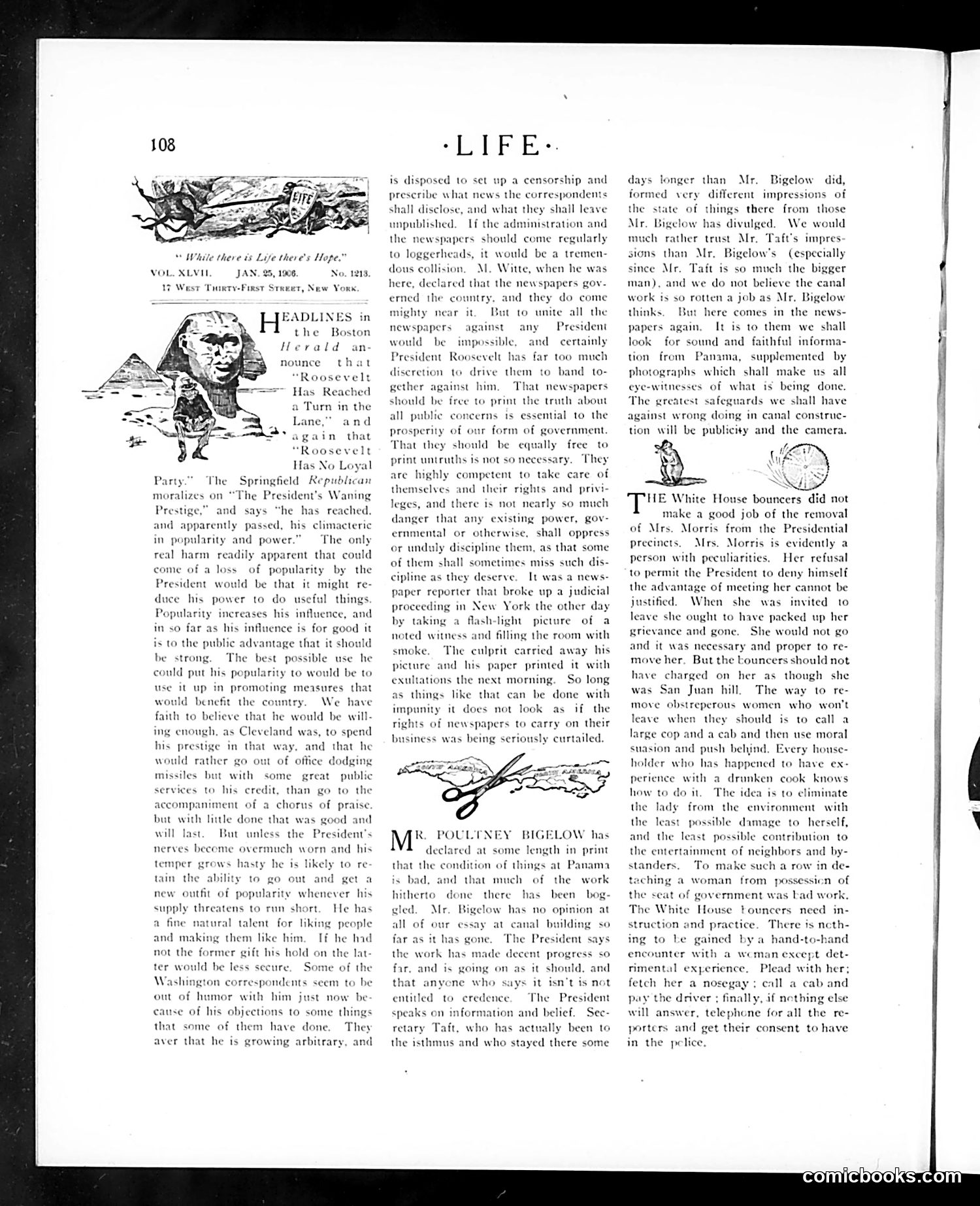
This page contains political commentary about President Roosevelt's relationship with the press. The text discusses Roosevelt's recent actions regarding newspaper censorship and presidential precincts, criticizing Mrs. Morris (appears to be a White House figure) for refusing to permit the President to downhimself the advantage of meeting her cannot be justified. The main cartoon (left) depicts a caricatured figure labeled "Roosevelt Has Reached a Turn in the Lane, and again in that Roosevelt Has No Local Party" — satirizing Roosevelt's political standing and popularity shifts. The commentary argues Roosevelt wields too much discretionary power over newspapers and that popularity shouldn't determine governmental authority. The piece defends press freedom as essential to democratic governance, criticizing executive overreach in controlling information flow and public perception.
📄 Transcribed text from this page (OCR, searchable)
Machine-transcribed from the original scan — historical spelling and the odd misread are preserved.
“White there is Life there's Hope.” VOL. XLVIL JAN, 17 West Tranty-Finst Street, New Yor, 25, 1906. No. 1213, ert EADLINES in Va . H the Boston Herald an nounce that Roosevelt Has Reached a Turn in the Lane,” and again that “Roosevelt Has No Loy: Party.” The Springfield Repudlicas moralizes on “The President's Waning Presti and says “he has reached and apparently passed, his climacteric in popularity and power.” The only real harm readily apparent that could come of a loss of popularity by the President would be that it might re- duce his power to do useful things. Popt ity increases his influence, and in so far as his influence is for good it Id The best possible use he is to the public advantage that it she be strong, could put his popularity to would be to use it up in promoting measures that ald benefit the country. We have faith to believe that he would be will- ing cnough, as Cleveland was, to spend J that he would rather go out of office dodging public services to his credit, than go to the his prestige in that wa: missiles but with some ¢ accompaniment of a chorus of praise. but with little done that wa But unless the President's good and will last nerves become overmuch worn and his temper rows hasty he is likely to re tain the ability to go out and get a sla supply threatens to run short. He has new outfit of pop ty whenever his a fine natural talent for liking people and making them like him. If he had not the former gift his hold on the lat- ter would be less secure. me of the Washi out of humor with him just now be ton correspondents seem to be ns to some things cause of his objectic n have done. They is growing arbitrary, and that some of the aver that he *LIFE-:. is disposed to set up a censorship and prescribe what news the correspondents shall disclose, and what they shall leave unpublished. If the administration and the newspapers should come regularly to loggerheads, it would be a tremen- dous collision. M. Witte, when he was here, declared that the newspapers gov- 1 . and they do come ered the countr: at to unite all the mighty near it. Bi newspapers against’ any — President would) be impossible, and certainly President Roosevelt has far too much discretion to drive them to band to- gether against him, That newspapers should be free to print the truth about all public concerns is essential to the prosperity of our form of government. That they should be equally free to ssary. They print untruths is not so nece are highly competent to take care of themselves and their rights and_privi- leges, and there is not nearly so much nger that any existing power, gov- al or otherwise, shall oppress ernmen| or unduly discipline them, as that some of them shall sometimes miss such dis- cipline as they deserve. It was a news- t broke up a judicial proceeding in New York the other day taking a flash-light picture of a paper reporter t noted witness and filling the room with smoke. The culprit carried away his picture and his paper printed it with exultations the next morning. So long as things like that can be done with impunity it does not look as if the rights of newspapers to carry on their business was being seriously curtailed M* POULTNEY BIGELOW has declared at some length in print ings at Panama that the condition of 1 is bad, and that much of the work hitherto done there has been bog- gled. Mr. Bigelow has no opinion at all of our essay at canal building so far as the work has made decent progress so far. and is going on as it should, and that anyone who says it isn’t is not entitled to credence. The President formation and belief. Sec- retary Taft, who has actually been to yed there some it has gone, The President says speaks on the isthmus and who s! days longer than Mr. Bigelow did, formed very different impressions of the state of things there from those Mr. Bigelow has divulged. We would much rather trust Mr, Taft's impres sions than Mr. Bigelow’s (especially since Mr. Taft is so much the bigger man), and we do not believe the canal work is so rotten a job as Mr. Bigelow thinks. But here comes in the news- papers again, It is to them we shall look for sound and faithful informa- tion from Panama, supplemented by ph eye-witnesses of what is being done. The greatest safeguards we shall have gainst wrong doing in canal construc n will be publicity and the camera. graphs which shall make us all a ti HE White House bouncers did not make a good job of the removal of Mrs. Morris from the Presidential precincts. Mrs. Morris is evidently a person with peculiarities, Her refusal to permit the President to deny himself the advantage of meeting her cannot be justified. When she was invited to leave she ought to have packed up her grievance and gone. She would not go and it was necessary and proper to re- move her. But the ouncers should not have charged on her as though she was San Juan hill, The way to re- move obstreperous women who won't leave when they should is to call a large cop and a cab and then use moral on and push behind, Every house- holder who has happened to have perience with a drunken cook knows how to do it, The idea is to climinate the lady from the environment with the least possible damage to herself, and the least possible contribution to the entertainment of neighbors and hy- To make such a row in de- taching a woman from possessicn of the seat of government was bad work, The White House touncers need in- standers, struction and practice. There is neth- ing to Le gained bya hand-to-hand encounter with a weman except det- rimental experience, Plead with her; fetch her a nosegay ; call a cab and pay the driver ; finally, if nothing else will answer, telephone for all the re- porters and get their consent to have in the pelice. j |