
A complete issue · 26 pages · 1906
Life — January 11, 1906
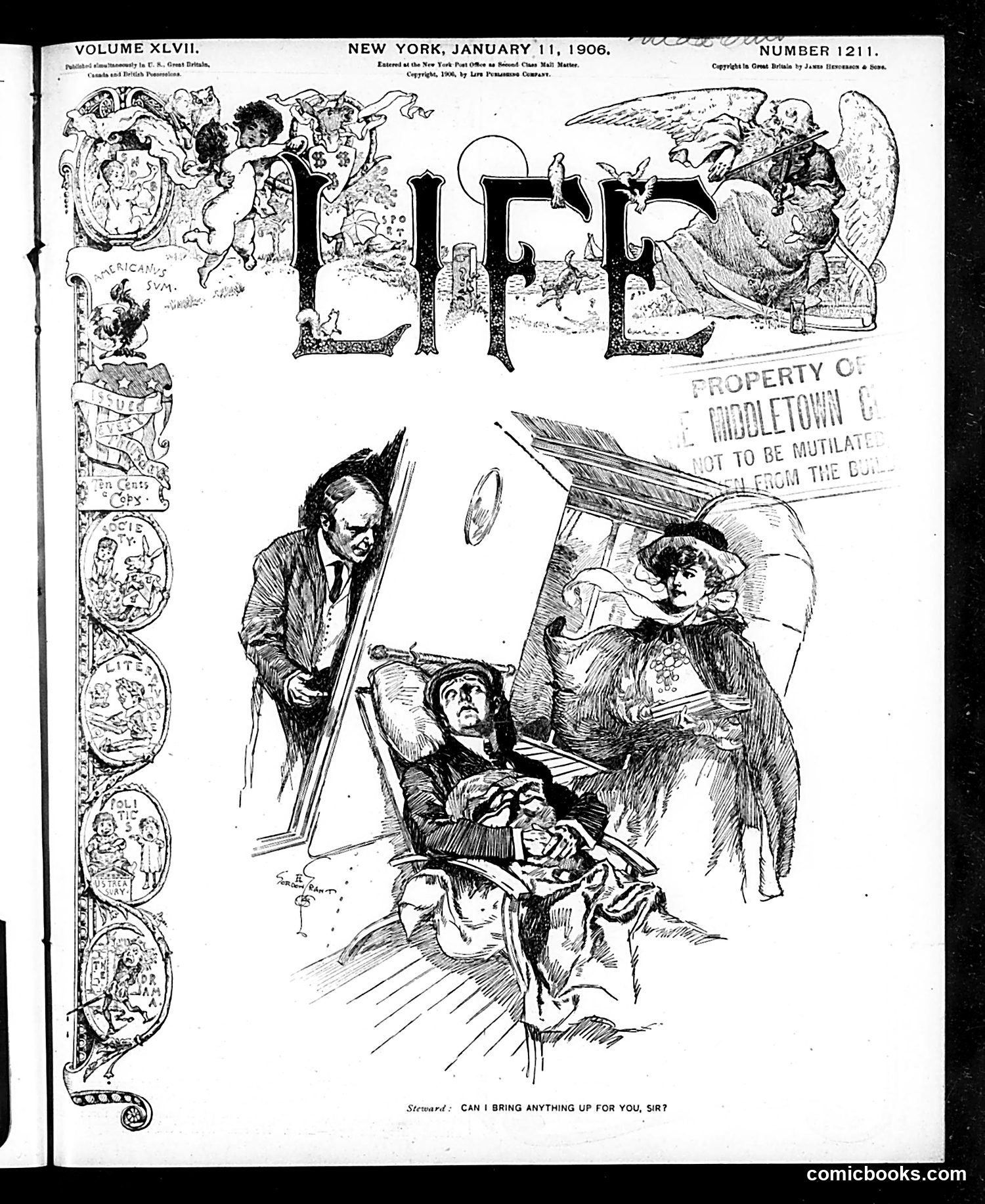
The main cartoon depicts a ship's steward asking an apparently seasick passenger, "CAN I BRING ANYTHING UP FOR YOU, SIR?" The humor relies on a crude double entendre—the steward's innocent offer to fetch something is undercut by the passenger's evident nausea, making the question seem tactless or darkly comic. The page's decorative borders and ornamental header illustrations are typical of Life's design from this era. Without additional context about specific political figures or events from January 1906, the cartoon appears to be general satire about shipboard discomfort rather than commentary on particular historical figures or events. The style and printing are consistent with Life's early-twentieth-century satirical humor.
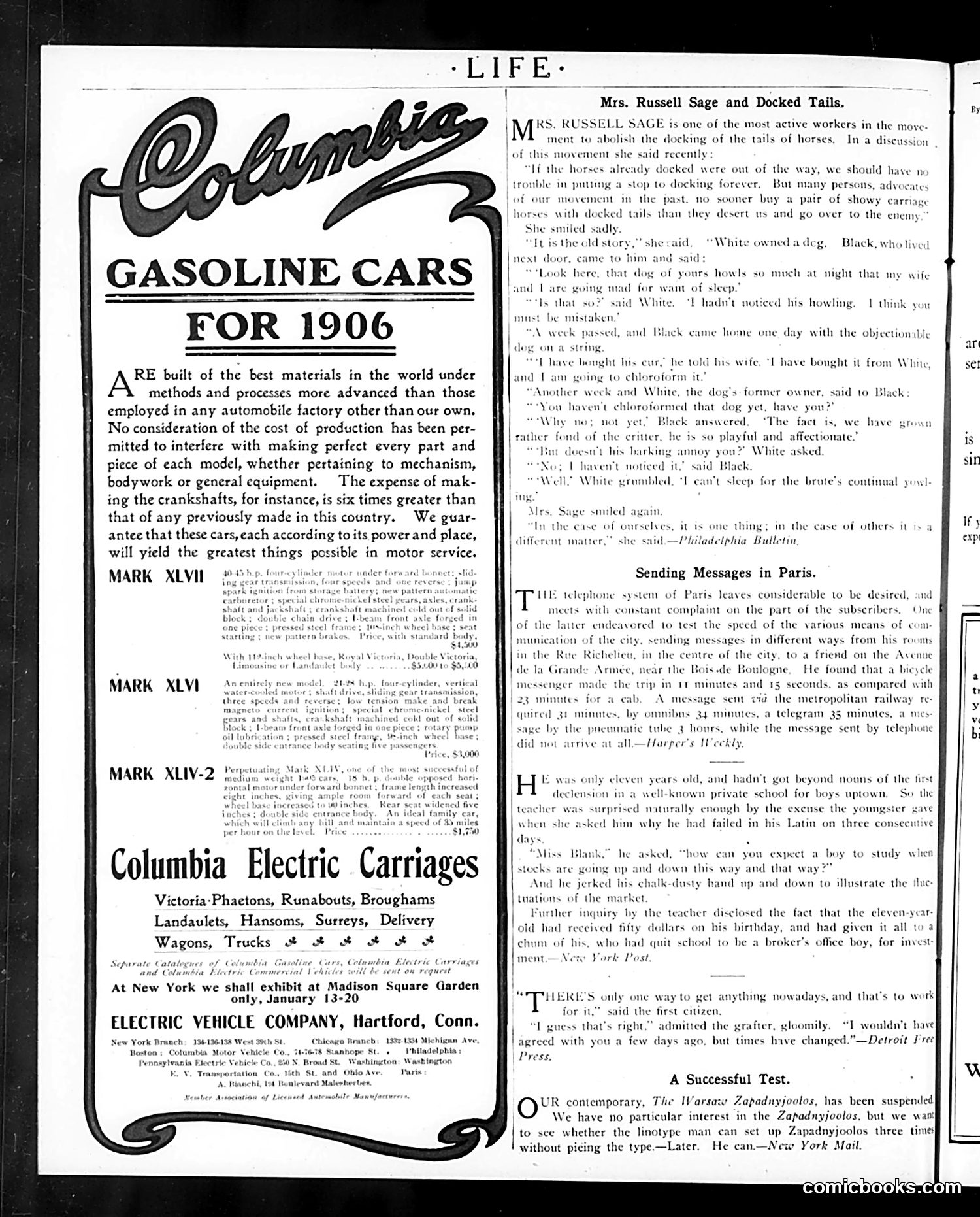
This page contains **primarily advertisements** rather than political cartoons or satirical content. The left side features **Columbia brand gasoline cars and electric carriages** (1906 models), advertising their quality construction and performance. Below that are listings for specific models: Mark XLVII, Mark XLVI, and Mark XLIV, emphasizing their advanced engineering. The right side contains three **short humorous anecdotes** about everyday situations: Mrs. Russell Sage discussing docked horse tails, a story about telephone communication in Paris, and an anecdote about an eleven-year-old boy's Latin studies. These are lighthearted social observations rather than political satire. The final item, "A Successful Test," briefly mentions *The Wayzata Zapudnyjoolas* in humorous context. This reflects early 1900s *Life* magazine content: mixing advertisements with gentle social humor rather than sharp political commentary.
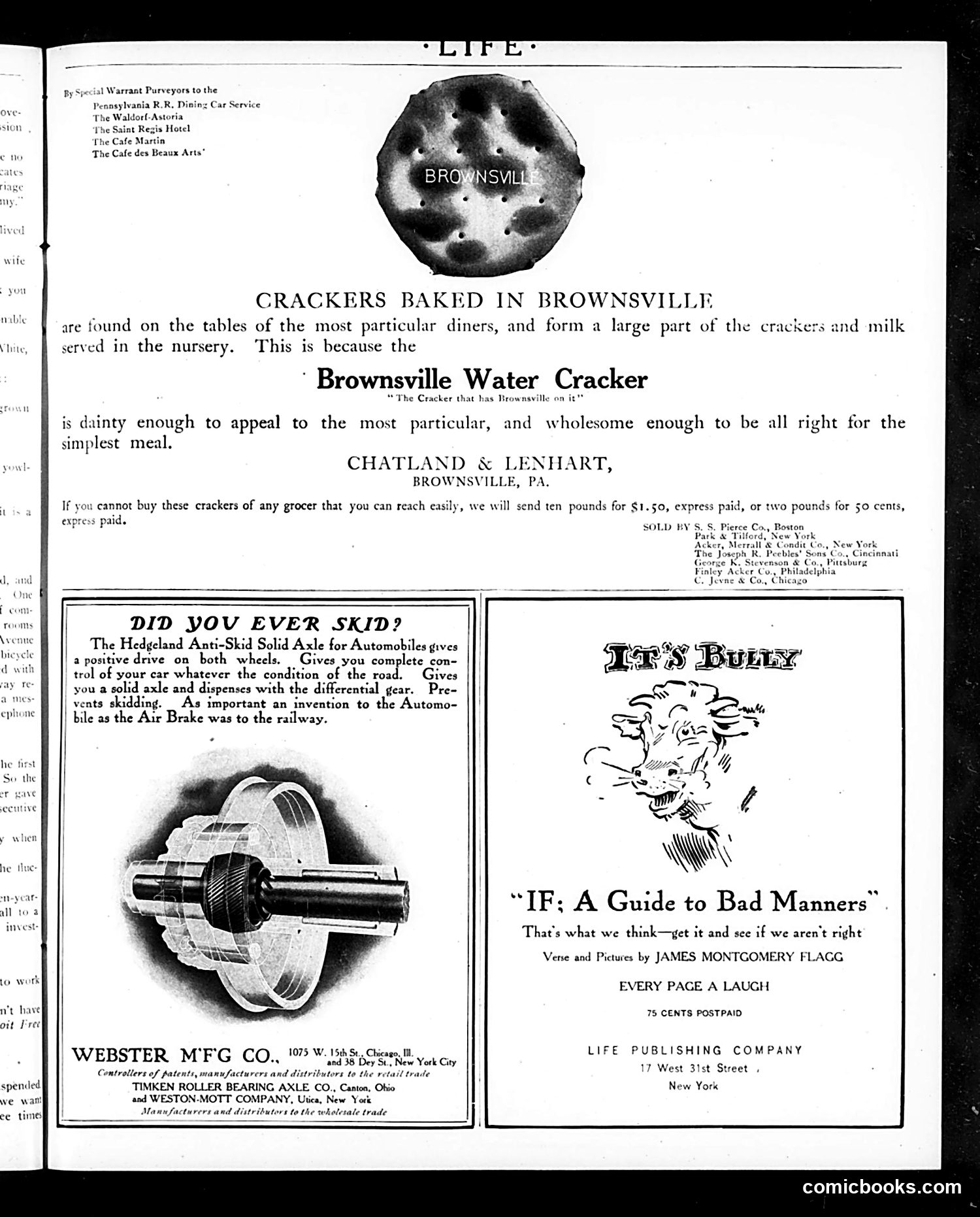
This page is primarily **advertising**, not political satire. It contains three commercial advertisements from the early 20th century: 1. **Brownsville Water Crackers** — promoting a local Pennsylvania cracker brand as refined enough for "particular diners" yet wholesome for nurseries and simple meals. 2. **Hedgeland Anti-Skid Solid Axle** — an automobile safety device preventing skidding, positioned as revolutionary as the air brake. 3. **"If: A Guide to Bad Manners"** — a humorous book by James Montgomery Flagg about etiquette violations, marketed as comedy ("every page a laugh"). The page reflects early 1900s consumer culture, emphasizing product quality, automotive innovation, and humor publications. There is no political cartoon or satirical content present.
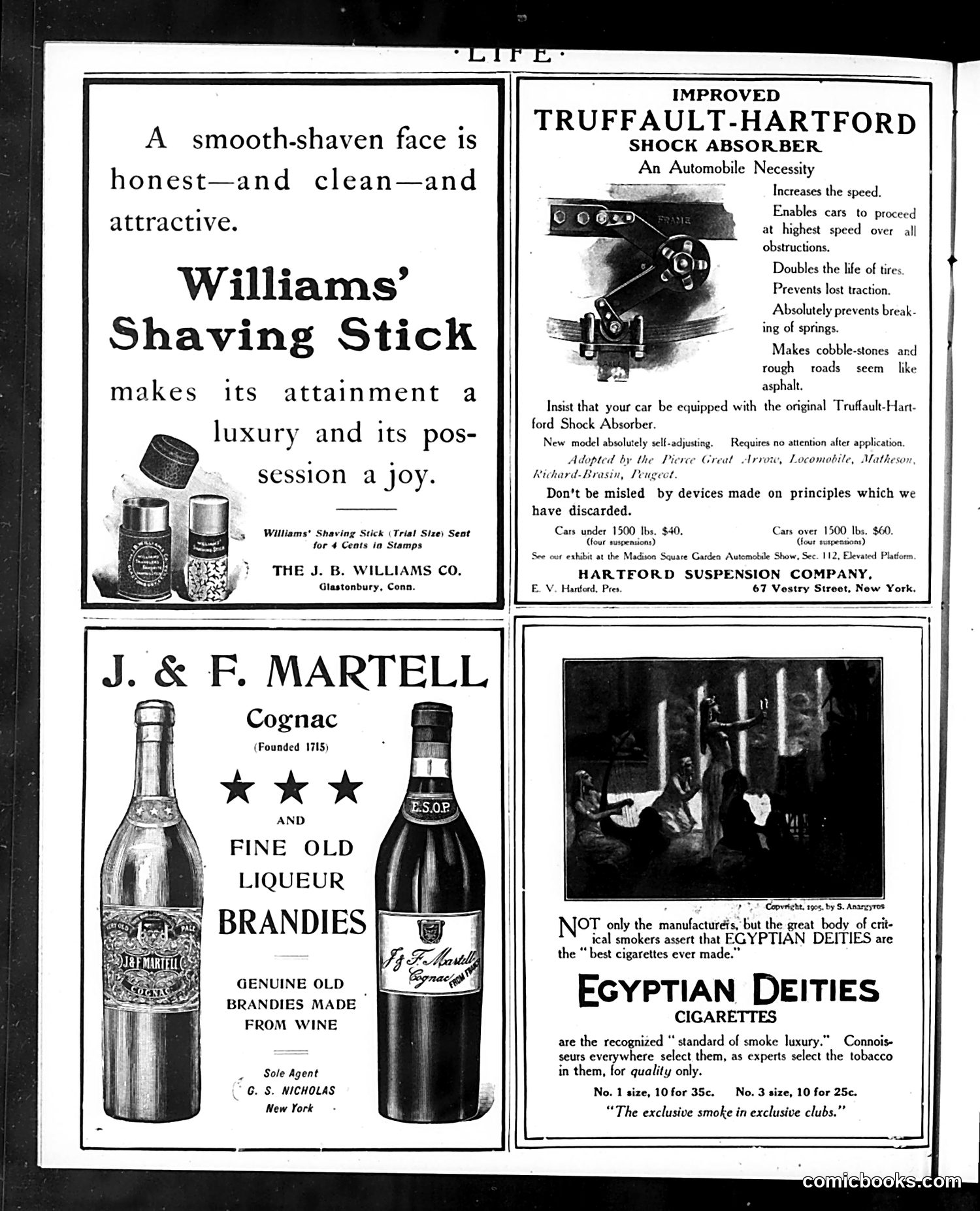
This page from *Life* magazine consists entirely of **advertisements**, not political cartoons or satire. There are four distinct ads: 1. **Williams' Shaving Stick** (upper left): Promotes grooming products, claiming a smooth-shaven face is "honest" and "attractive." 2. **Truffault-Hartford Shock Absorber** (upper right): An automobile accessory ad listing performance benefits. 3. **J. & F. Martell Cognac** (lower left): Advertises French brandy, founded 1715. 4. **Egyptian Deities Cigarettes** (lower right): Features an image of what appears to be people in an exotic setting, marketing cigarettes as a "standard of smoke luxury." No satire, political commentary, or cartoon content is present on this page.
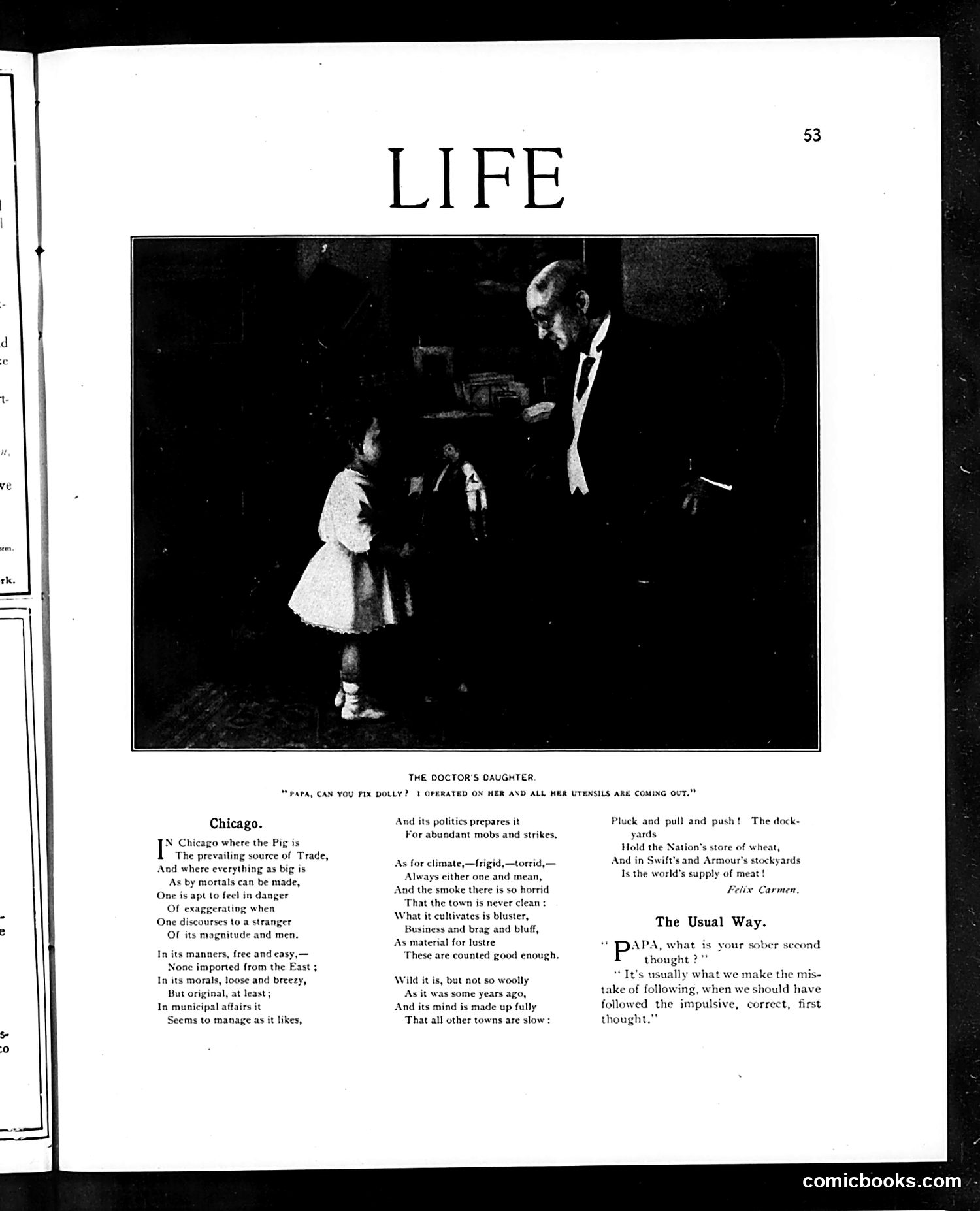
**The Image:** A well-dressed man in formal attire bends toward a small child in a white dress, with the caption: "PAPA, CAN YOU FIX DOLLY? I OPERATED ON HER AND ALL HER UTENSILS ARE COMING OUT." This appears to be a humorous domestic scene playing on the contradiction between a child's innocent medical play and actual surgical consequences—satirizing either parental incompetence or the child's mimicry of her father's profession. **"Chicago" Poem:** The accompanying verse critiques Chicago's political corruption, filthy conditions, and moral degradation. It references "the Pig" (likely meaning the city's livestock industry), "municipal affairs," and describes the town as "loose and breezy, but original, at least." **"The Usual Way":** A brief dialogue satirizing workplace inefficiency—following impulse before careful consideration.
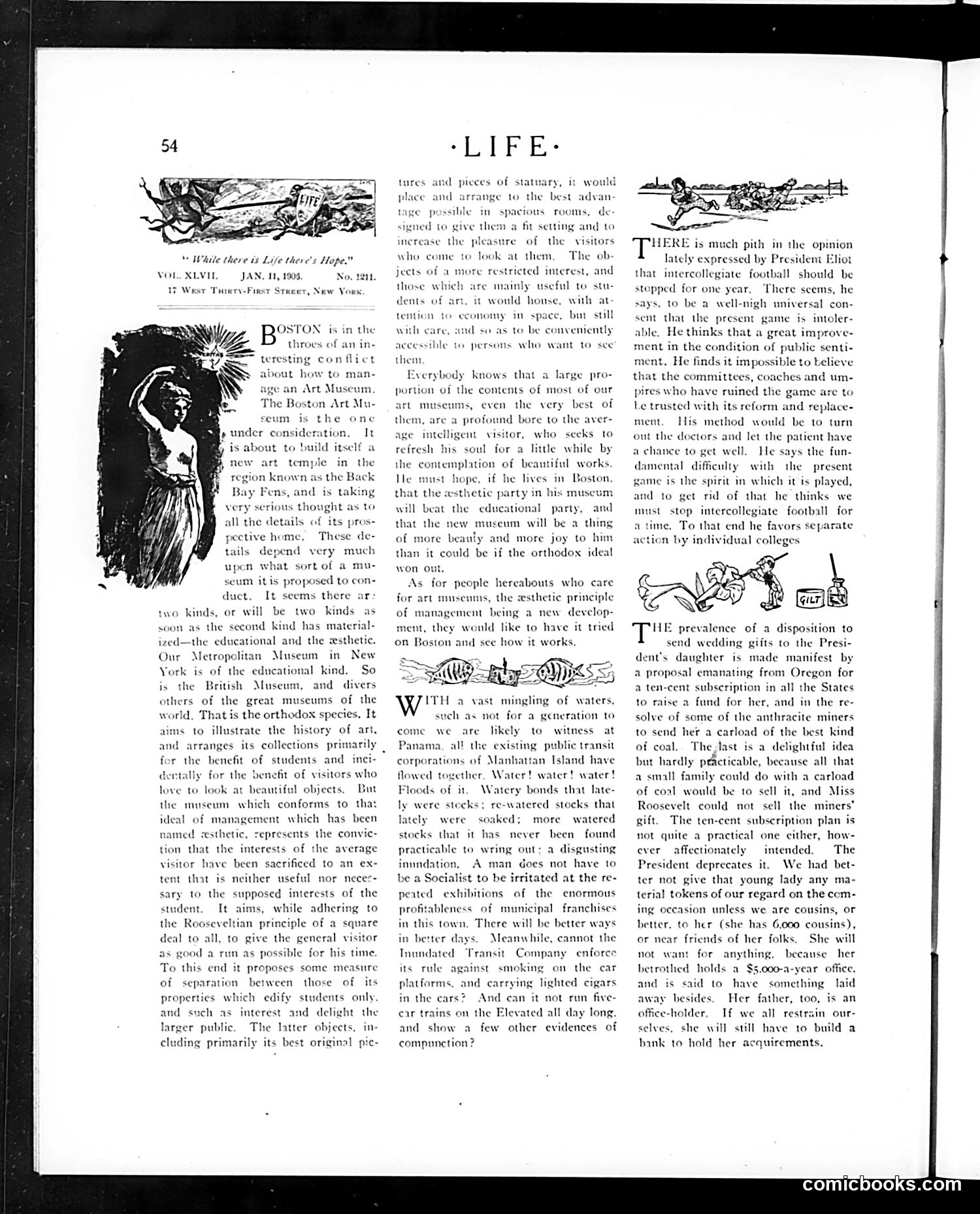
This page contains two distinct sections: **Left Column:** Features an editorial about Boston's proposed new art museum. The accompanying illustration shows a classical figure (likely representing Art or Culture) in a dramatic pose. The text discusses museum management philosophy and educational value. **Right Column:** Contains commentary on President Eliot's criticism of intercollegiate football, arguing the game is "intolerable" and should be stopped. The author defends football, suggesting reform rather than elimination. A secondary item discusses a proposal for a ten-cent subscription fund to send wedding gifts to the President's daughter—apparently a satirical criticism of this public gift-giving scheme. The illustrations throughout use classical and allegorical imagery typical of early-20th-century satirical magazines, though specific figure identities are unclear without additional context.
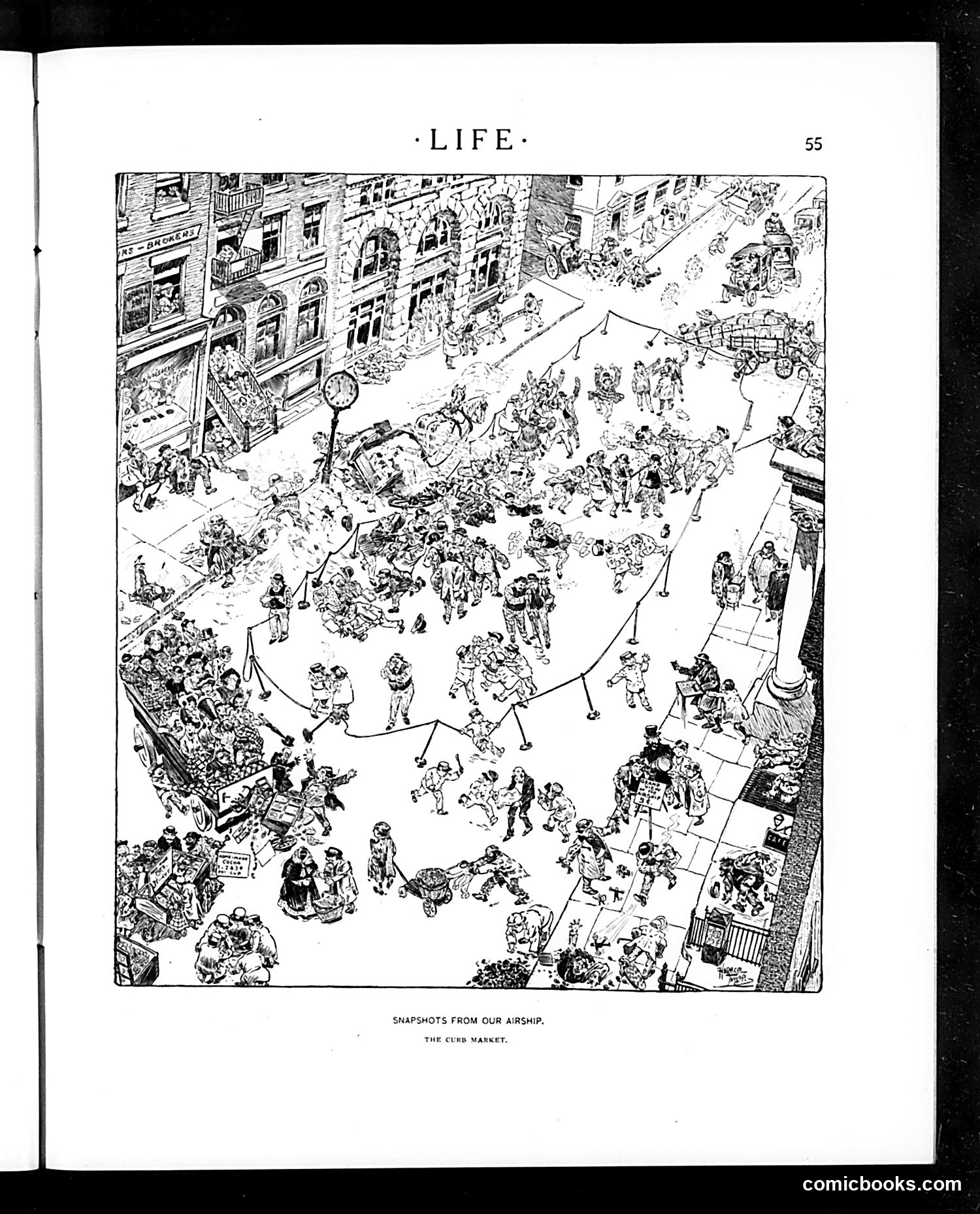
This is a bird's-eye view illustration titled "Snapshots from Our Airship," depicting a bustling urban market scene from above. The work satirizes the Curb Market—likely New York's outdoor financial trading area where stocks were bought and sold on the street. The aerial perspective shows hundreds of tiny figures, wagons, buildings, and market activity compressed into one chaotic scene. The satire appears to mock the frenzied, disorganized nature of street-level financial trading and the crowds it attracts. By presenting this economic activity from a detached, overhead viewpoint, the artist emphasizes the absurdity and ant-like frenzy of the marketplace—suggesting both the scale and the somewhat chaotic, undignified nature of public financial speculation.
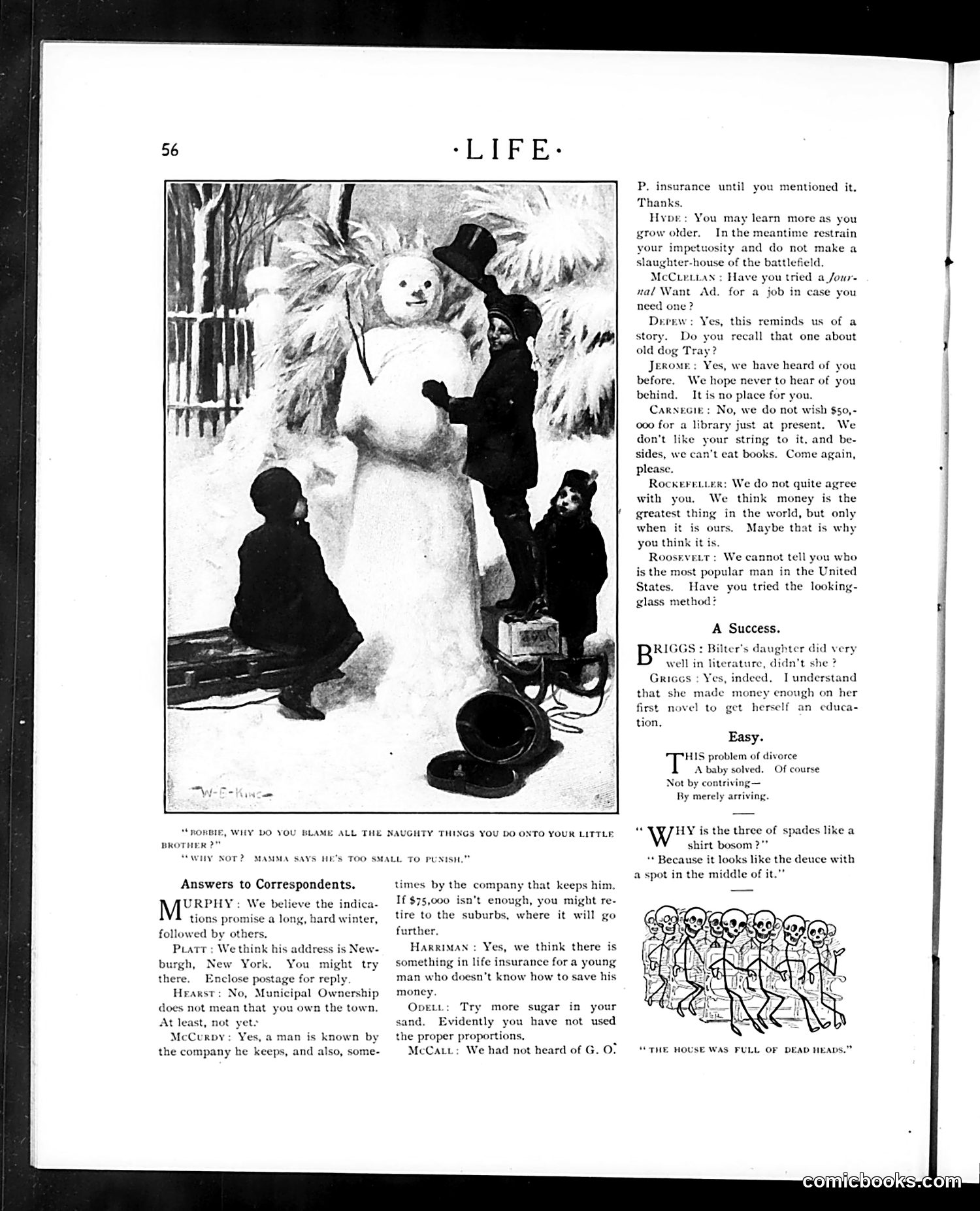
The main illustration depicts three figures in formal dress building a large snowman. The caption reads: "Robbie, why do you blame all the naughty things you do onto your little brother?" / "Why not? Mamma says he's too small to punish." This is a joke about childhood behavior—a child conveniently blames his younger sibling for misbehavior because the little brother cannot be disciplined for it. The humor relies on the child's cynical logic exploiting parental leniency toward smaller children. The "Answers to Correspondents" section below addresses various readers' questions about life matters, including topics like municipal ownership, life insurance, and personal finance advice. These appear to be genuine advice columns typical of the era's satirical magazines.
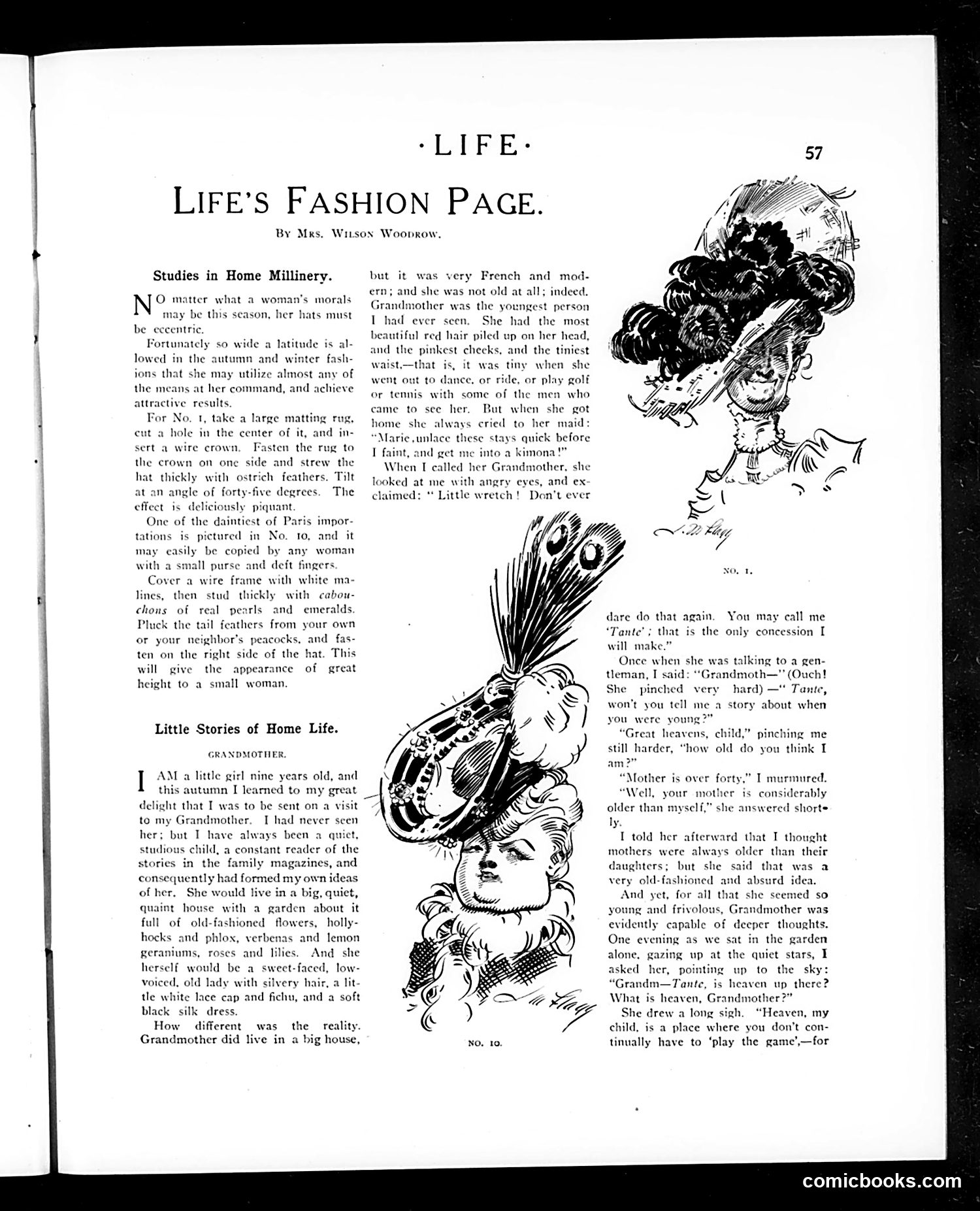
This page from *Life* magazine presents "Life's Fashion Page" by Mrs. Wilson Woodrow, combining fashion advice with a domestic narrative. The two illustrated sketches (numbered 1 and 10) show elaborate women's hats adorned with feathers—apparently peacock plumes based on the design. The "Studies in Home Millinery" section provides DIY hat-making instructions, suggesting women could construct fashionable headwear themselves using wire frames and real feathers. The accompanying story, "Little Stories of Home Life: Grandmother," presents a sentimental anecdote about visiting an elderly relative, contrasting the grandmother's old-fashioned values with modern attitudes. The satire appears gentle rather than sharp—mocking neither the fashion trends nor generational differences severely, but rather celebrating domestic life and women's domestic creativity as *Life* magazine typically did for its middle-class readership.
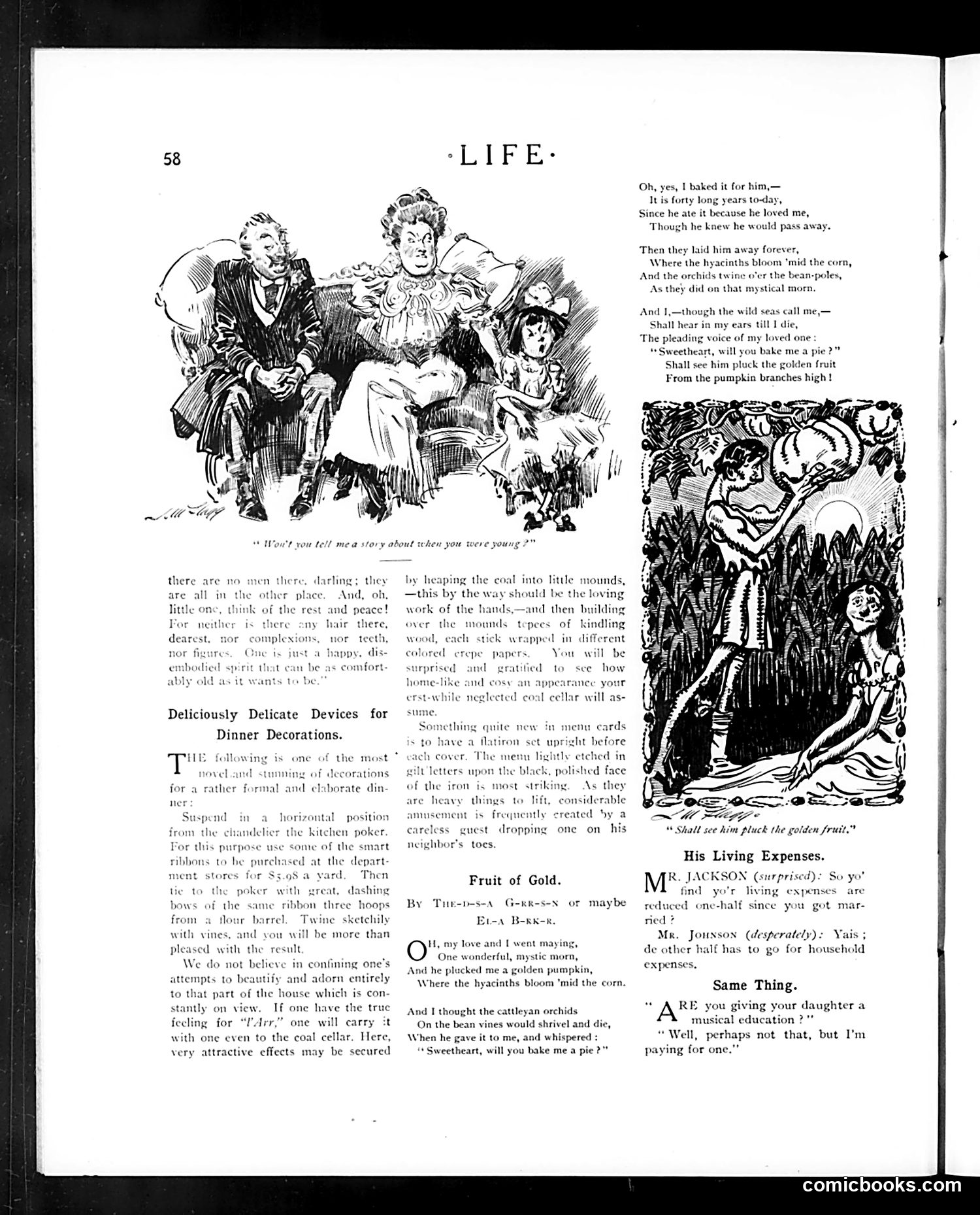
This page contains **humor and advice columns** rather than political cartoons. The top illustration shows a domestic scene with adults and children, accompanying a sentimental poem about a mother baking a pie for her son forty years ago—a nostalgic piece about maternal love and memory. Below are three separate humor sections: "Deliciously Delicate Devices for Dinner Decorations" (offering ribbon and coal-cellar decor suggestions), "Fruit of Gold" (a poem about hyacinths and orchids), and two brief dialogue jokes about marriage expenses. The content reflects **turn-of-century domestic humor** aimed at middle-class readers, focusing on household matters, sentimentality, and light marital comedy rather than political satire. The artistic style and typography are characteristic of early 1900s American humor magazines.
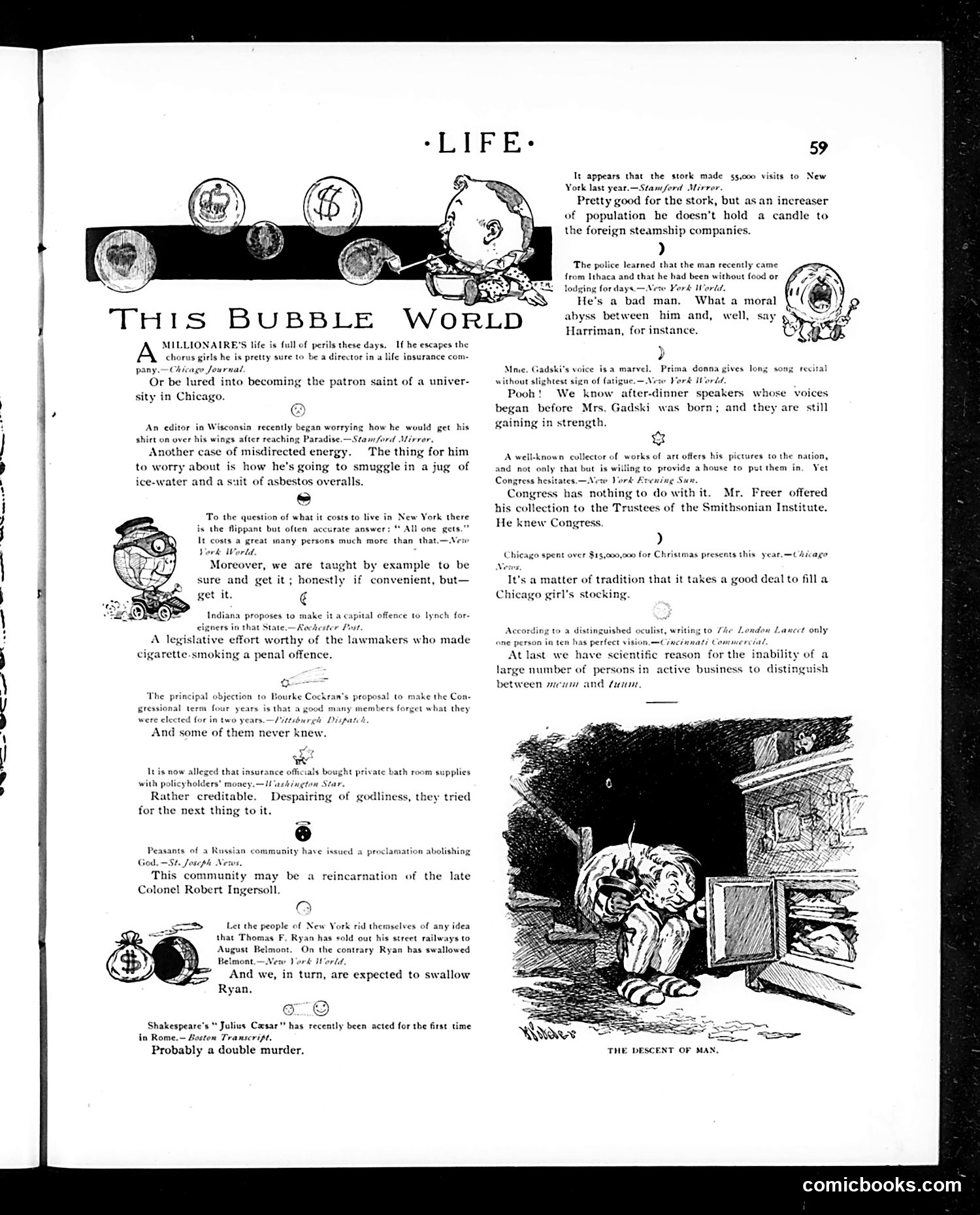
This page satirizes the excesses and absurdities of Gilded Age wealth and business. The main cartoon depicts a wealthy man whose head is literally a bubble containing coins and financial symbols—a visual metaphor for how fragile wealth built on speculation actually is. The text collects brief satirical observations about contemporary issues: Chicago millionaires' wasteful spending, politicians who forget campaign promises, insurance fraud schemes, Russian radicals, and Thomas F. Ryan's monopolistic control of New York's streetcar systems. The phrase "bubble world" suggests that the entire economic system rests on unsustainable speculation. The smaller illustration at bottom, "The Descent of Man," appears to show moral decline. The satire critiques both wealthy elites and corrupt institutions of the era.
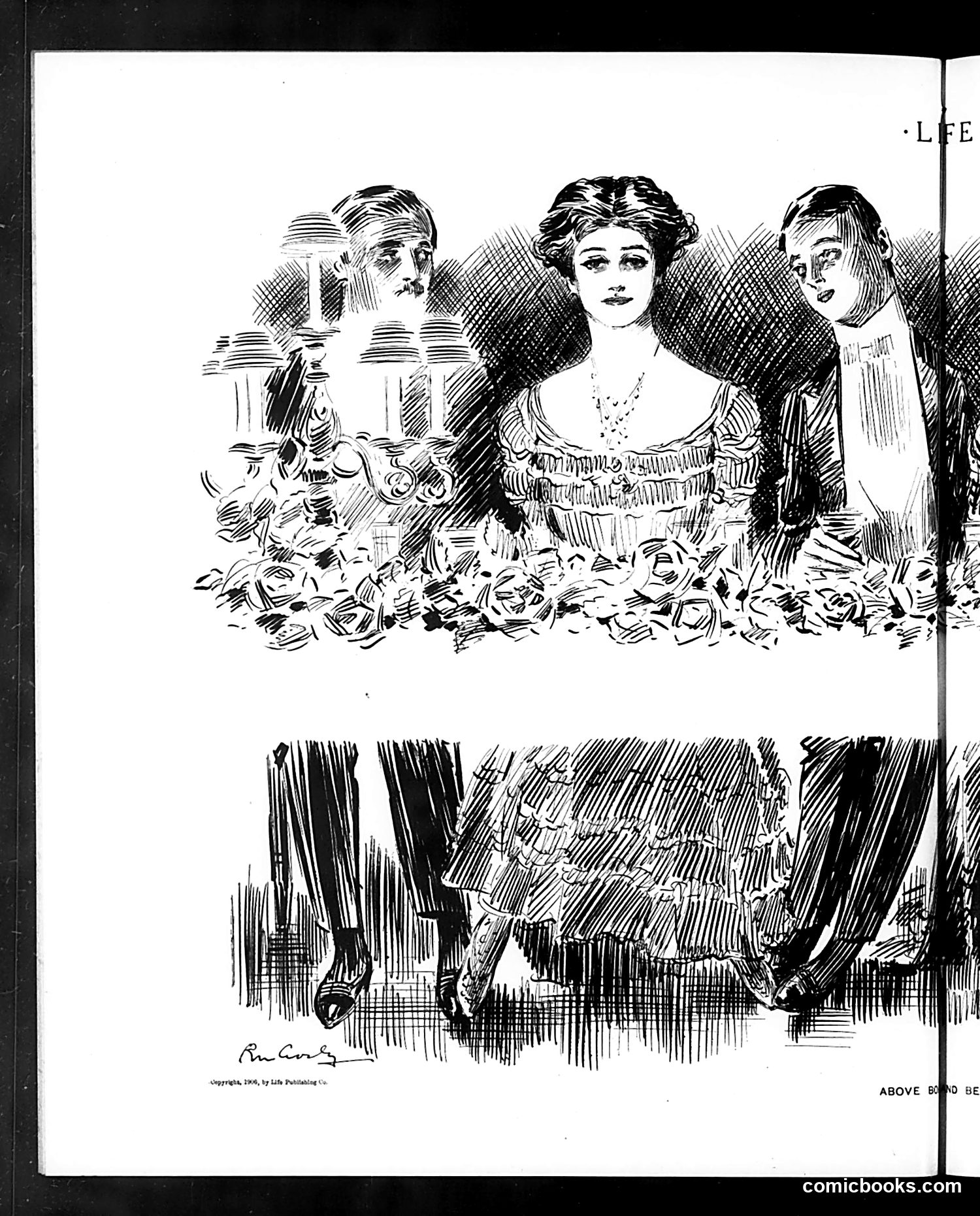
This page contains two satirical illustrations from *Life* magazine (copyright 1908, per the visible text). The **top illustration** depicts three elegantly dressed women standing above a pile of roses, with candelabras behind them. This appears to satirize wealthy or fashionable women and their consumption of luxury goods—the roses likely representing extravagance or romantic indulgence. The **bottom illustration** shows three figures in what appears to be an intimate or flirtatious social scene, with detailed cross-hatching suggesting a more scandalous or morally questionable scenario. Without clearer context or captions, I cannot definitively identify which specific political figures or social commentary these target. The artwork style and subject matter suggest satire of early 20th-century high society, wealth disparity, or gender relations, but the precise referenced events remain unclear from the visible text alone.
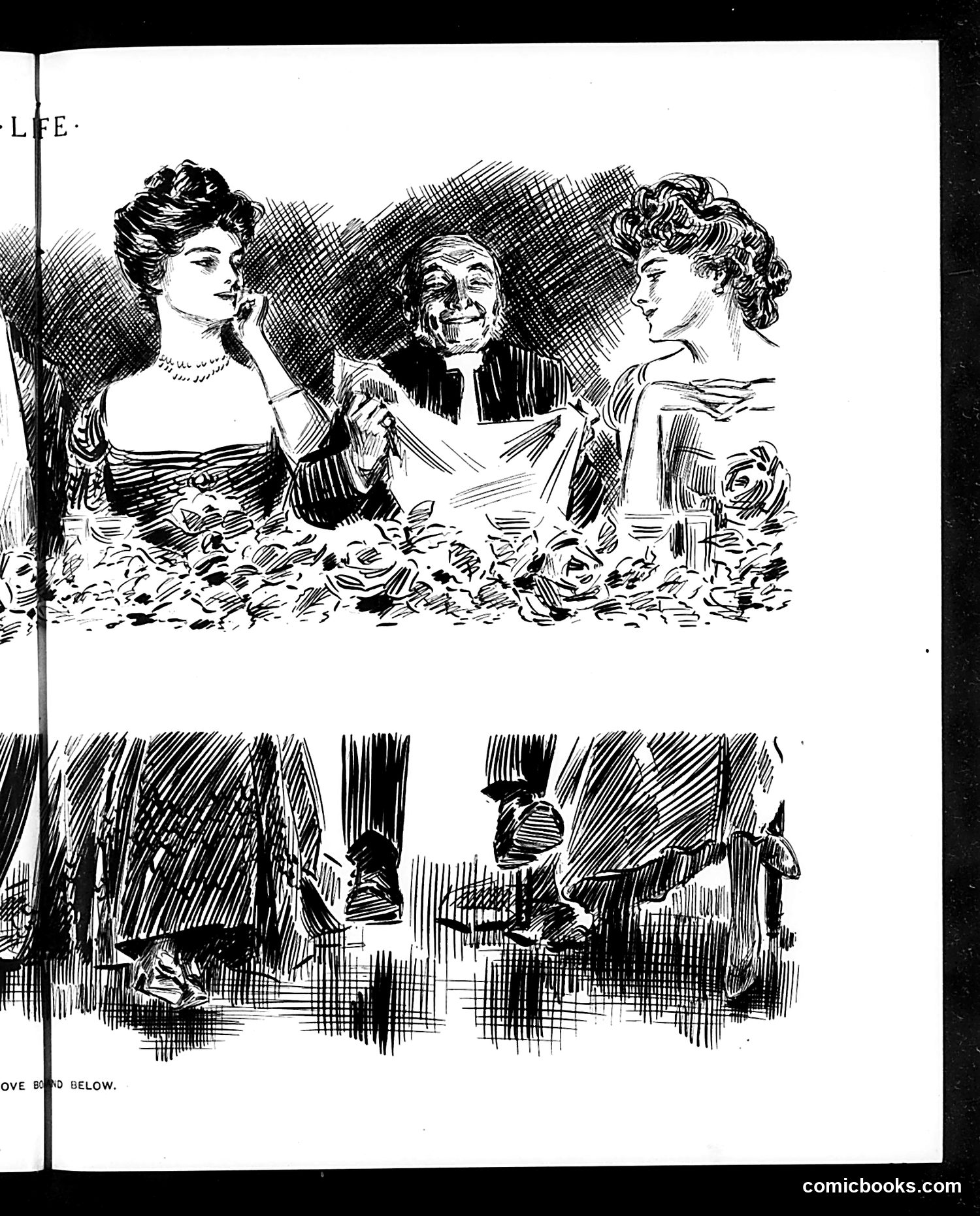
This page contains two satirical sketches from *Life* magazine. The top illustration depicts three elegantly dressed figures (two women and a man in center) surrounded by roses, suggesting a romantic or theatrical scene. The man's exaggerated facial features and central positioning indicate he's the subject of satire. The bottom sketch shows what appears to be a domestic or social interior scene with multiple figures in period dress. However, without legible caption text or byline information visible in this image, I cannot definitively identify the specific figures being caricatured, the particular social commentary intended, or the historical context being satirized. The OCR text provided ("LIFE" and "OVE REDO BELOW") appears incomplete or garbled, preventing accurate interpretation of the satire's target or message.
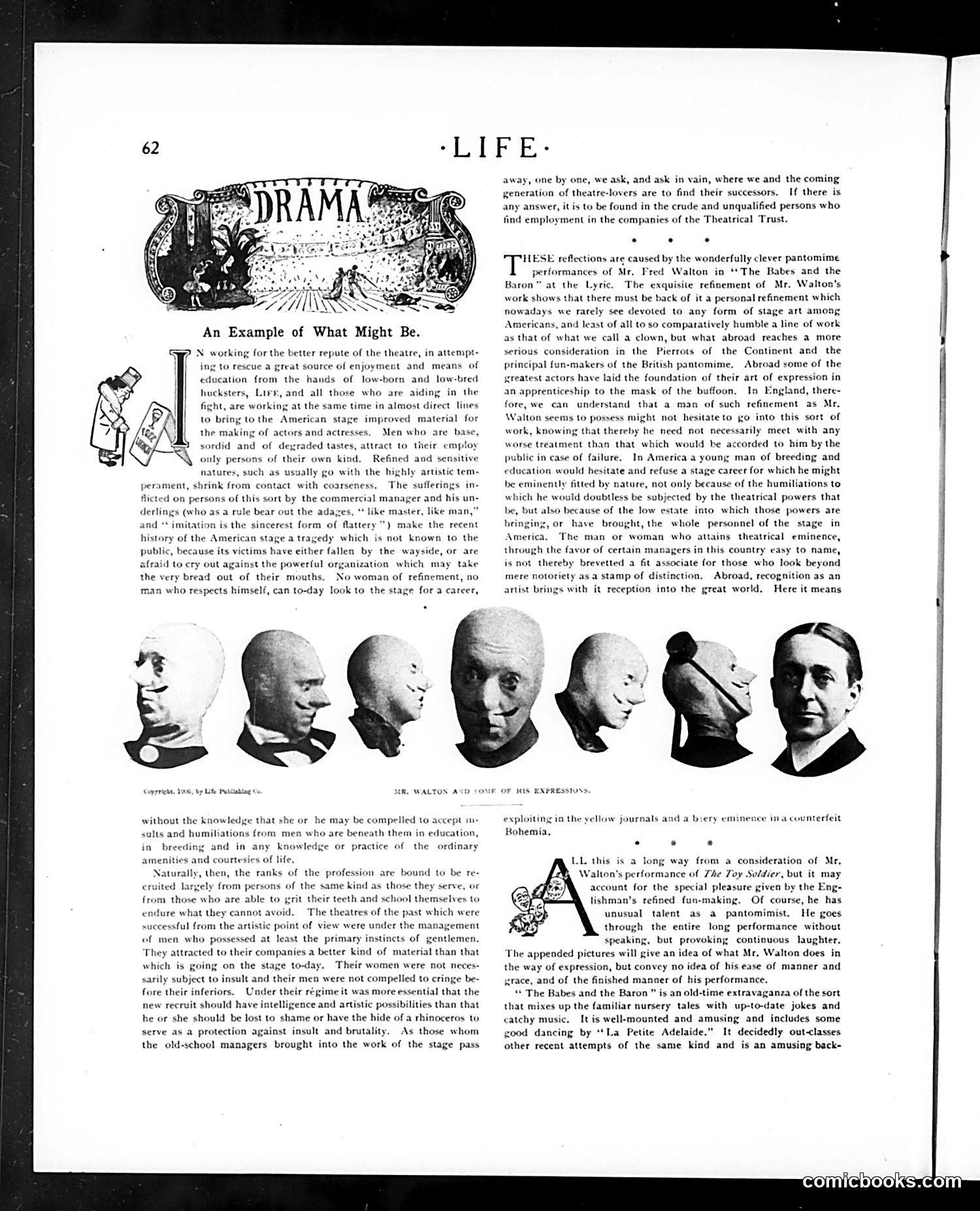
This page critiques the American theater industry's decline in artistic standards. The article praises pantomimist Fred Walton's performance in "The Babes and the Baron" at the Lyric Theatre, using him as an example of refined artistry increasingly absent from American stages. The central complaint targets the "Theatrical Trust"—a powerful monopoly controlling American theater that allegedly recruits only crude, unqualified performers willing to endure degrading conditions from coarse managers. The author contrasts this with European traditions (particularly British pantomime) where clowning receives serious artistic respect and refined gentlemen could pursue theater without shame or humiliation. The seven profile portraits below show Walton's expressive pantomime faces, illustrating his sophisticated technique. The satire's point: American theater's commercialization has driven away talented, educated performers, leaving only those with no alternative options—a vicious cycle damaging the industry's artistic legitimacy.
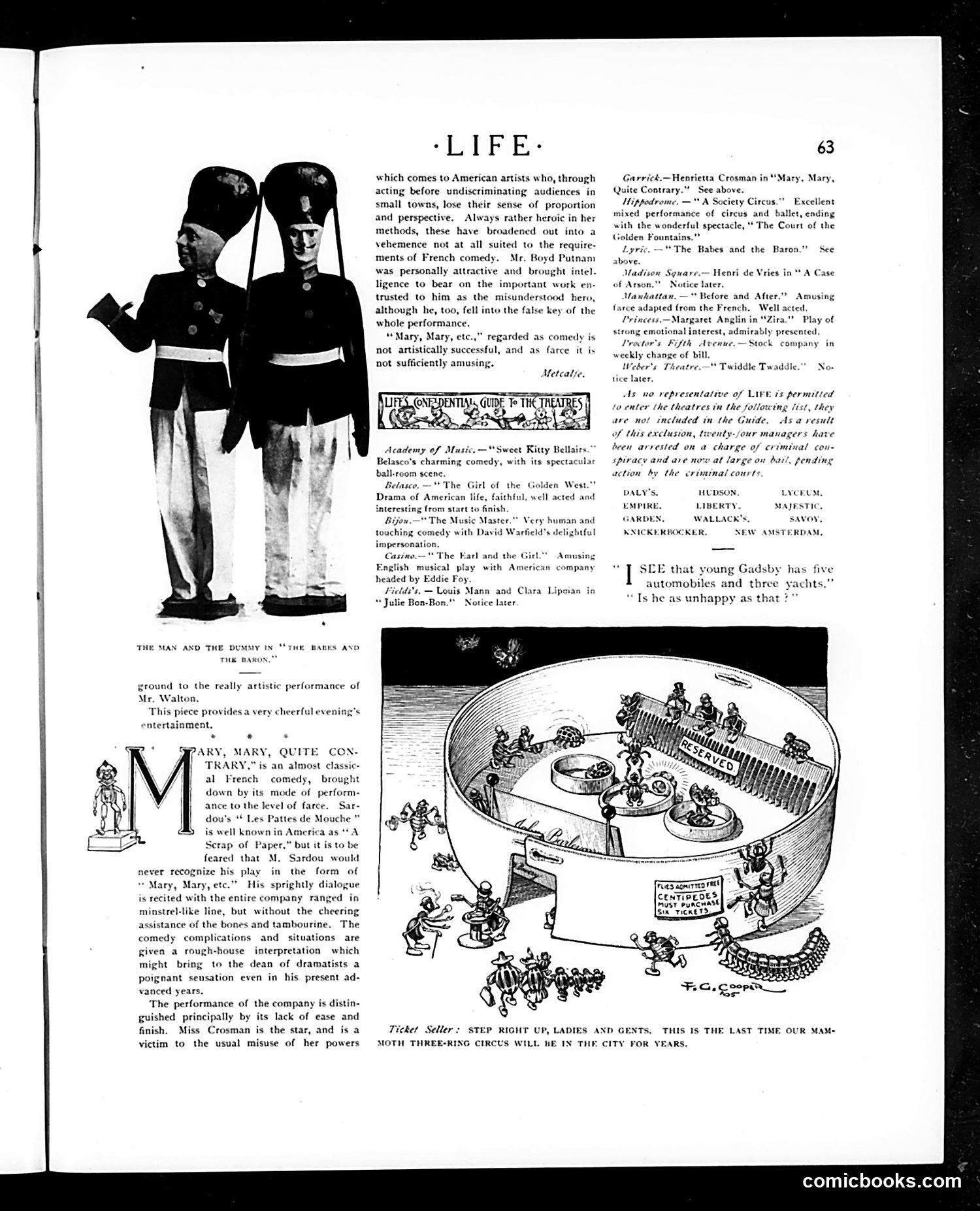
This page reviews theatrical productions in early 1900s New York. The top photograph shows "The Man and the Dummy" from "The Babes and the Baron," featuring an actor posing with a ventriloquist's dummy—a visual gag illustrating the entertainment's slapstick nature. The main critique concerns actress Henrietta Crosman in "Mary, Mary, Quite Contrary," adapted from French playwright Sardou's work. Life satirizes how American performers, especially touring small towns, lose artistic refinement and resort to "rough-house interpretation" and exaggerated physical comedy unsuited to French dramatic style. The magazine mocks the company's minstrel-like staging and misuse of talented performers. The bottom illustration depicts a circus ringmaster—a humorous commentary on theatrical excess. The caption jokes about this being "the last time" the circus visits, a typical carnival come-on. The page also lists theaters refusing Life's critics entry, sardonically noting those managers face criminal conspiracy charges.
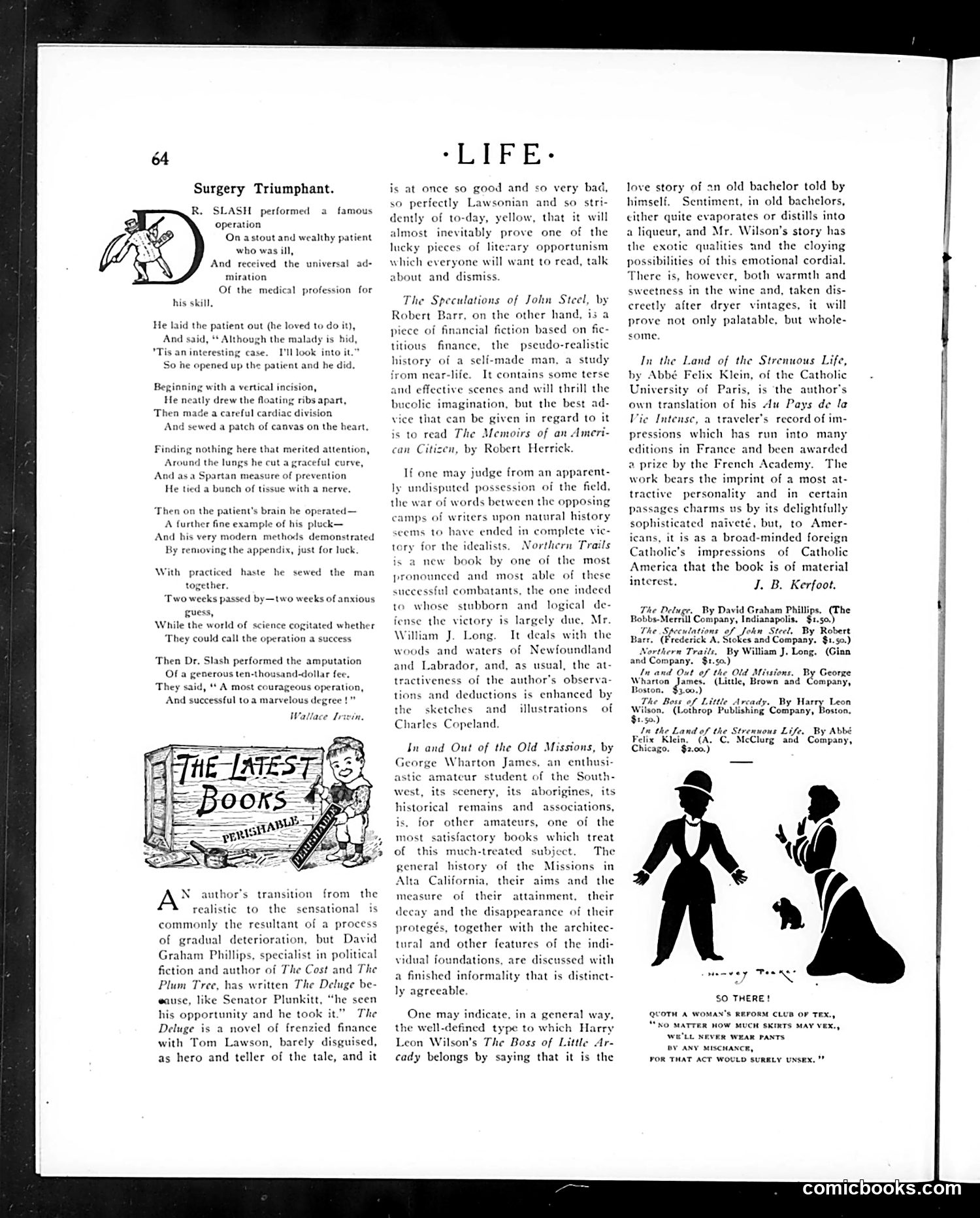
This page contains a humorous poem satirizing incompetent or opportunistic surgeons. "Dr. Slash" performs unnecessary procedures on a wealthy patient—making dramatic incisions, removing organs, operating on the brain, and extracting the appendix "just for luck"—finding nothing actually wrong. The satire's climax reveals the real "operation": extracting a massive ten-thousand-dollar fee. The joke targets doctors who exploit wealthy patients through needless surgery justified by pseudo-scientific reasoning. The poem's mock-heroic tone ("marvelous degree") emphasizes how the medical profession celebrates surgical audacity regardless of actual medical necessity. This reflects Progressive Era anxieties about professional exploitation and the gap between scientific pretense and actual patient benefit. The accompanying book reviews discuss financial manipulation and realistic versus sensational literature, suggesting contemporary concerns about fraud across professions.
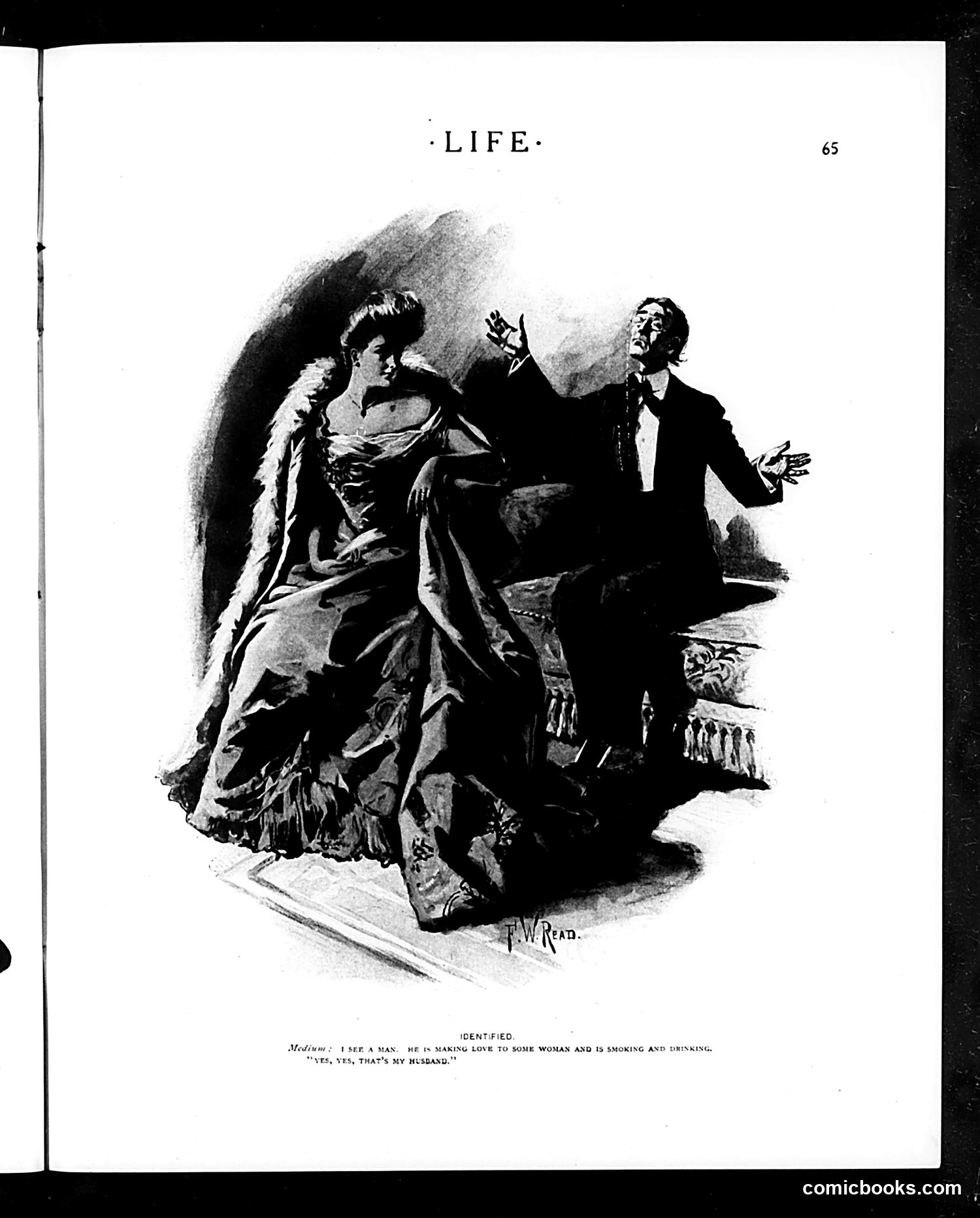
This cartoon satirizes infidelity and male behavior. A woman with large feathered wings (suggesting she's a spiritualist medium or ghost) identifies a man to another woman. The man is depicted making romantic advances toward a third woman while smoking and drinking. The joke relies on the wife's resigned response—"Yes, yes, that's my husband"—suggesting she's unsurprised by his philandering despite his obvious misbehavior. The satire targets both the husband's brazen unfaithfulness and the wife's apparent acceptance of it. The supernatural framing (the winged figure) may reference spiritualism's popularity in the era, though the primary point is social commentary on marriage dynamics and male moral failings among the upper classes, indicated by the formal dress and setting.
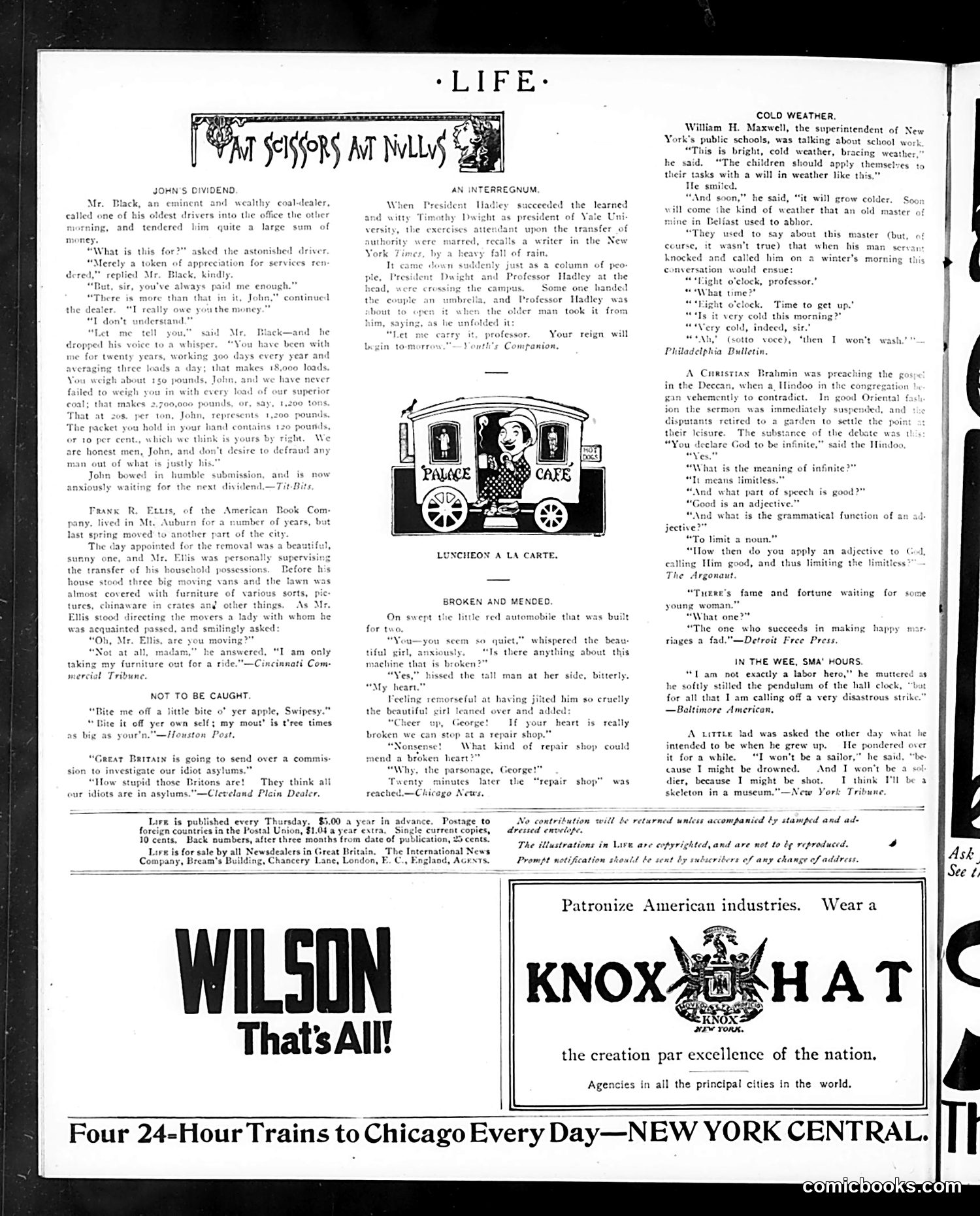
This page from *Life* magazine contains several short satirical anecdotes and jokes typical of the publication's humor style. The main cartoons/stories include: 1. **"John's Dividend"** — A wealthy coal-dealer rewards his honest driver with a bonus, recognizing his integrity. The joke plays on working-class virtue being rewarded. 2. **"An Interregnum"** — A brief anecdote about President Hadley's inaugural ceremony at Yale being disrupted by rain, with a professor's umbrella joke about his "reign." 3. **"Luncheon à la Carte"** and **"Broken and Mended"** — Romantic comedies: one about a mechanical palace cake vendor; another about a couple in an automobile where the boy's "broken heart" is humorously "repaired" at a parsonage (marriage/proposal joke). The page also includes advertisements (Wilson brand, Knox Hat) and brief humorous quotes about cold weather and religious debate. The humor is genteel, wordplay-heavy, and reflects early 20th-century American attitudes toward class, courtship, and propriety.
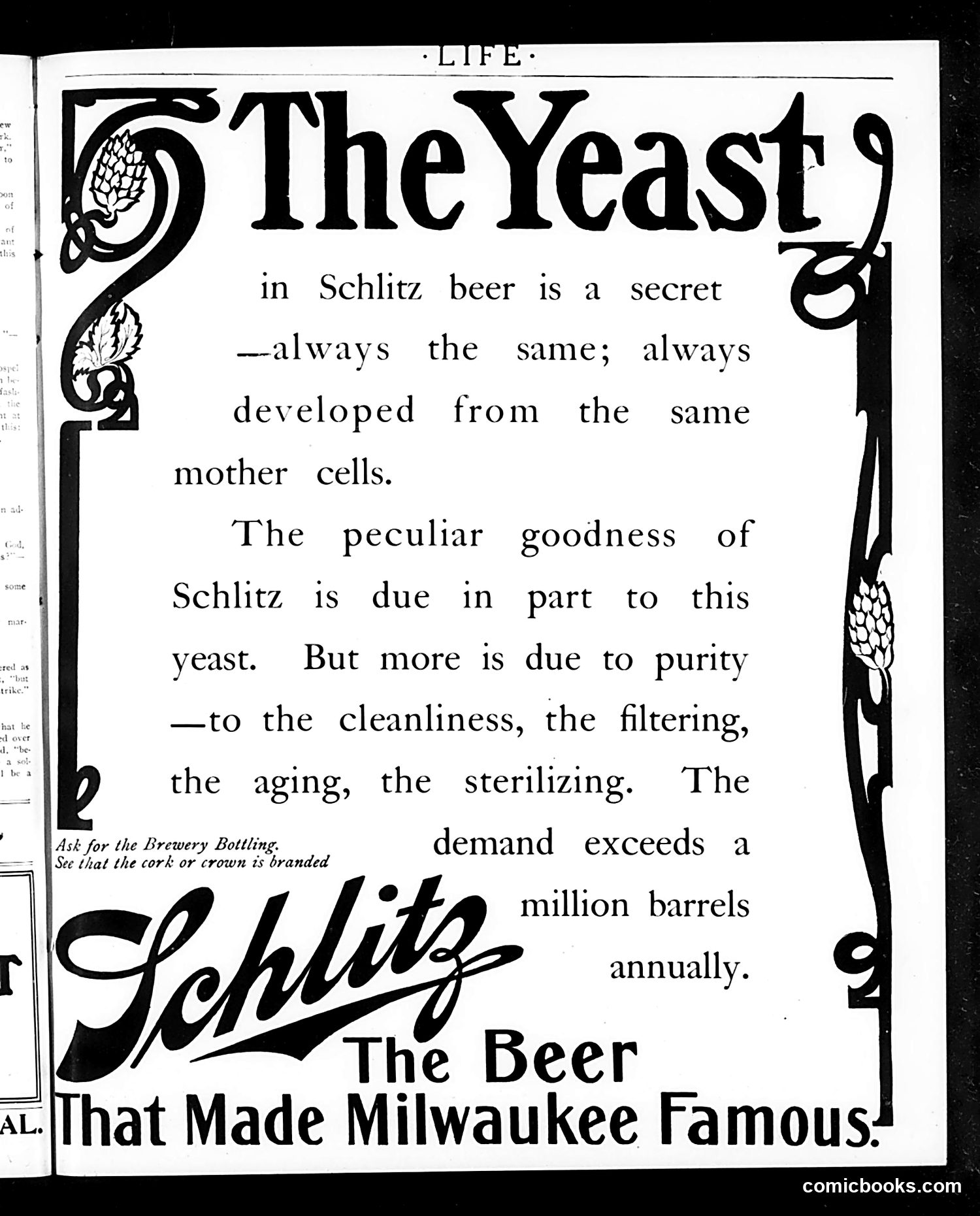
This page is primarily **advertising**, not satire or political commentary. It's a Schlitz beer advertisement from Life magazine. The ad promotes Schlitz as "The Beer That Made Milwaukee Famous" by emphasizing scientific legitimacy and purity—key selling points in early 20th-century beer marketing. The text highlights the proprietary yeast strain ("always the same; always developed from the same mother cells") and rigorous manufacturing processes (filtering, aging, sterilizing). The decorative hop vine borders frame the message professionally. The instruction to "Ask for the Brewery Bottling" and verify the branded cork/crown suggests consumers should demand authentic products, likely addressing concerns about counterfeit or inferior beer in circulation. The claim of demand exceeding "a million barrels annually" asserts market dominance. This reflects the era when Milwaukee was genuinely America's brewing capital, and advertising emphasized industrial scale and scientific processes to build consumer trust and distinguish premium brands.
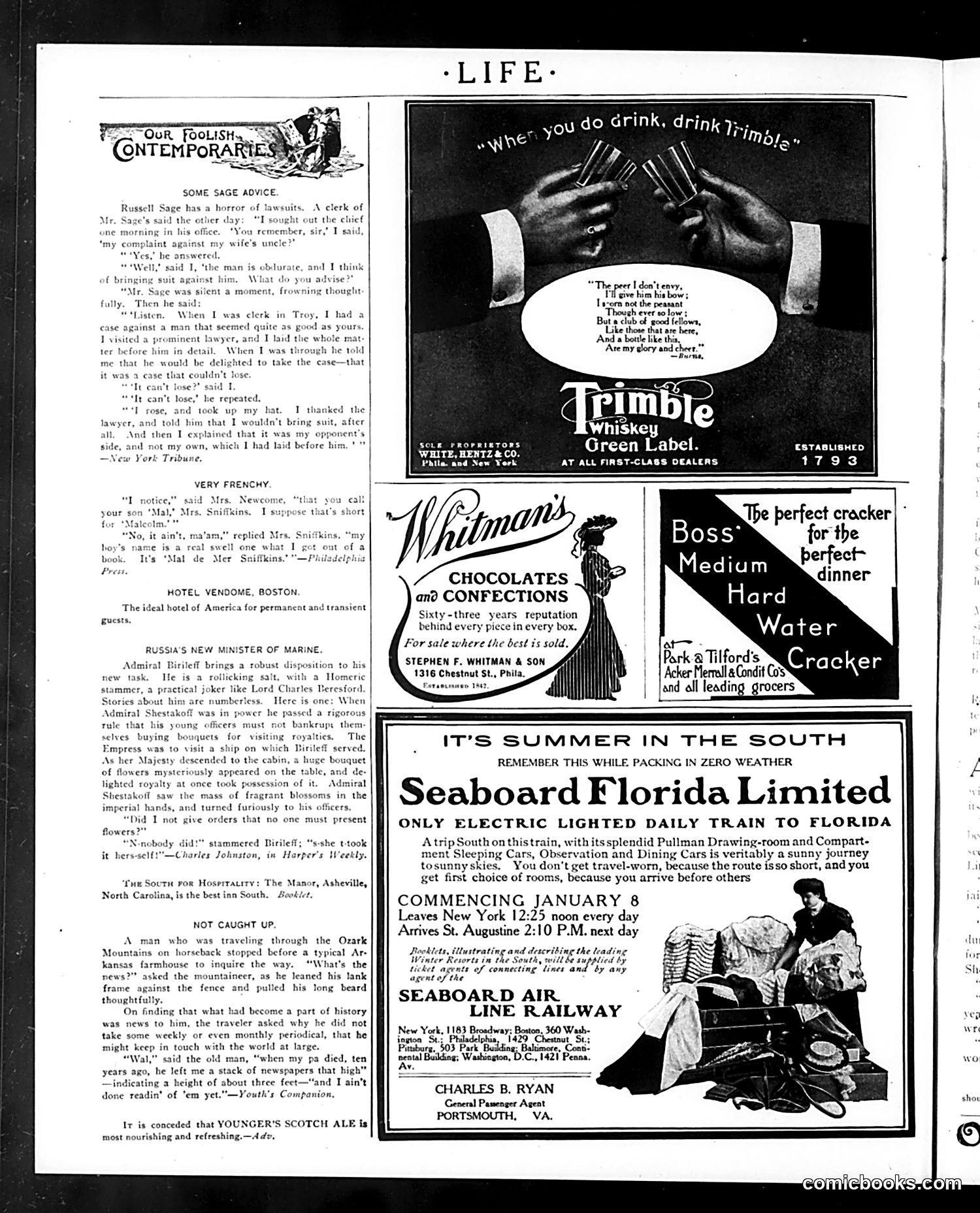
This page mixes satirical commentary with period advertisements, typical of early 20th-century Life magazine. **The Satirical Content:** The left column contains three brief humorous anecdotes under "Our Foolish Contemporaries"—a regular Life feature mocking contemporary figures and behaviors. These include a story about Russell Sage (a notorious financier) and his legal advice, a French-influenced naming convention joke, and a story about Admiral Birileff (Russia's new Minister of Marine) imposing discipline on officers. The final anecdote mocks an Ozark mountaineer too behind on current events to read newspapers. **The Advertisements:** The page is dominated by period ads: Trimble Whiskey, Whitman's Chocolates, Boss Hard Water Crackers, and the Seaboard Florida Limited railway. These represent typical luxury consumer goods marketed to Life's affluent readership. **Historical Context:** The references to Russian naval authority and Ozark backwardness reflect common early 1900s stereotypes. The satirical thrust targets both the wealthy elite and rural ignorance—Life's typical targets.
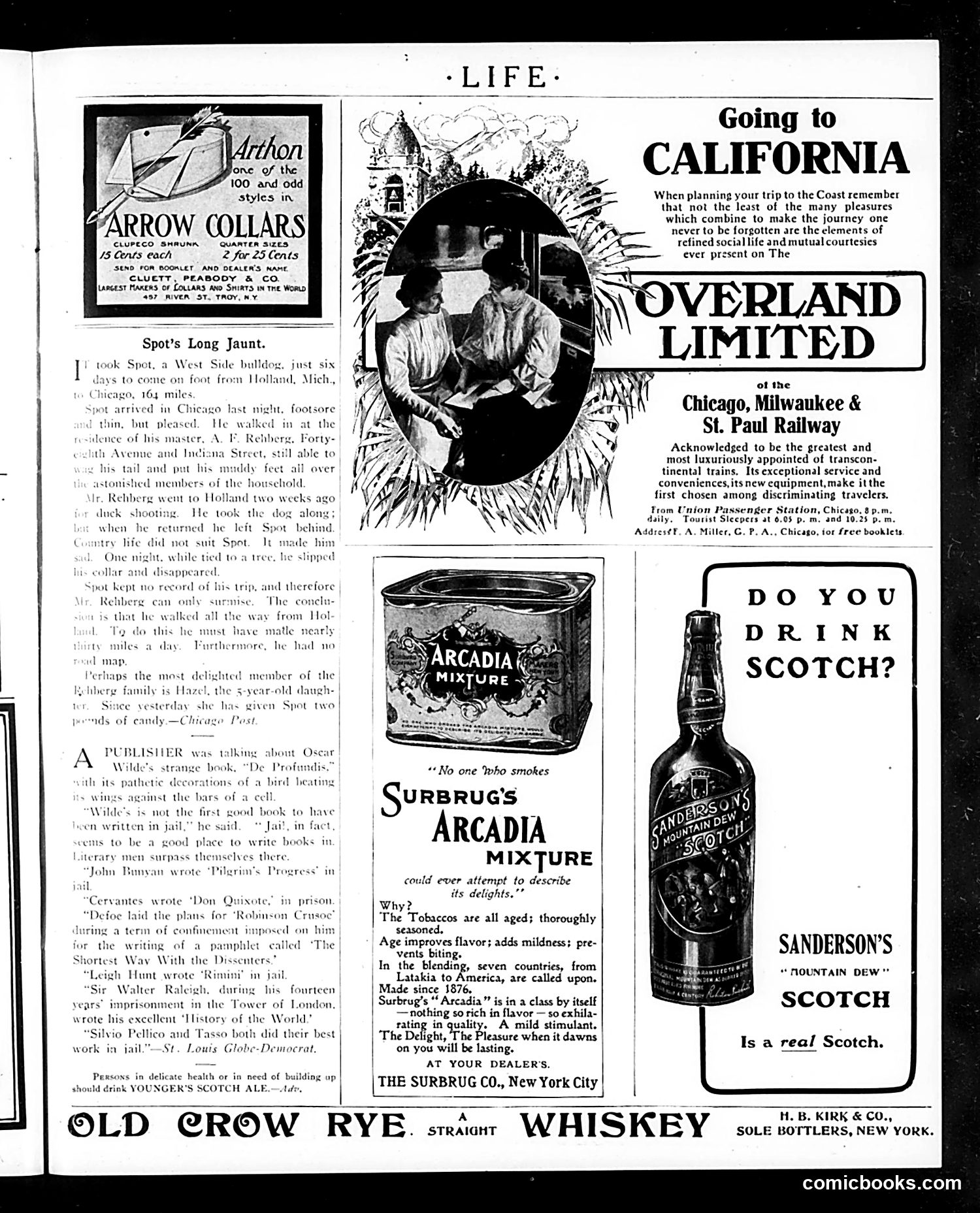
This page is primarily **advertising** rather than satirical content, featuring multiple product promotions typical of early 20th-century magazines. The main editorial content is "Spot's Long Jaunt," a humorous anecdote about a bulldog who walked six days from Holland, Michigan to Chicago (164 miles). The joke rests on the implausibility: the dog arrived tired but alive, yet kept no record and presumably walked ~30 miles daily—presented as absurd without explanation, a deadpan style common to Life's humor. A brief commentary discusses how great literature was written in jail, citing Oscar Wilde's *De Profundis* and referencing Cervantes, Bunyan, and others. This reflects contemporary fascination with Wilde's imprisonment (1895) and romantic notions of artistic suffering. The advertisements promote Arrow Collars, the Chicago, Milwaukee & St. Paul Railway's "Overland Limited," Surbrug's Arcadia tobacco mixture, Old Crow Rye whiskey, and Sanderson's Scotch—products marketed to affluent male readers of this period.
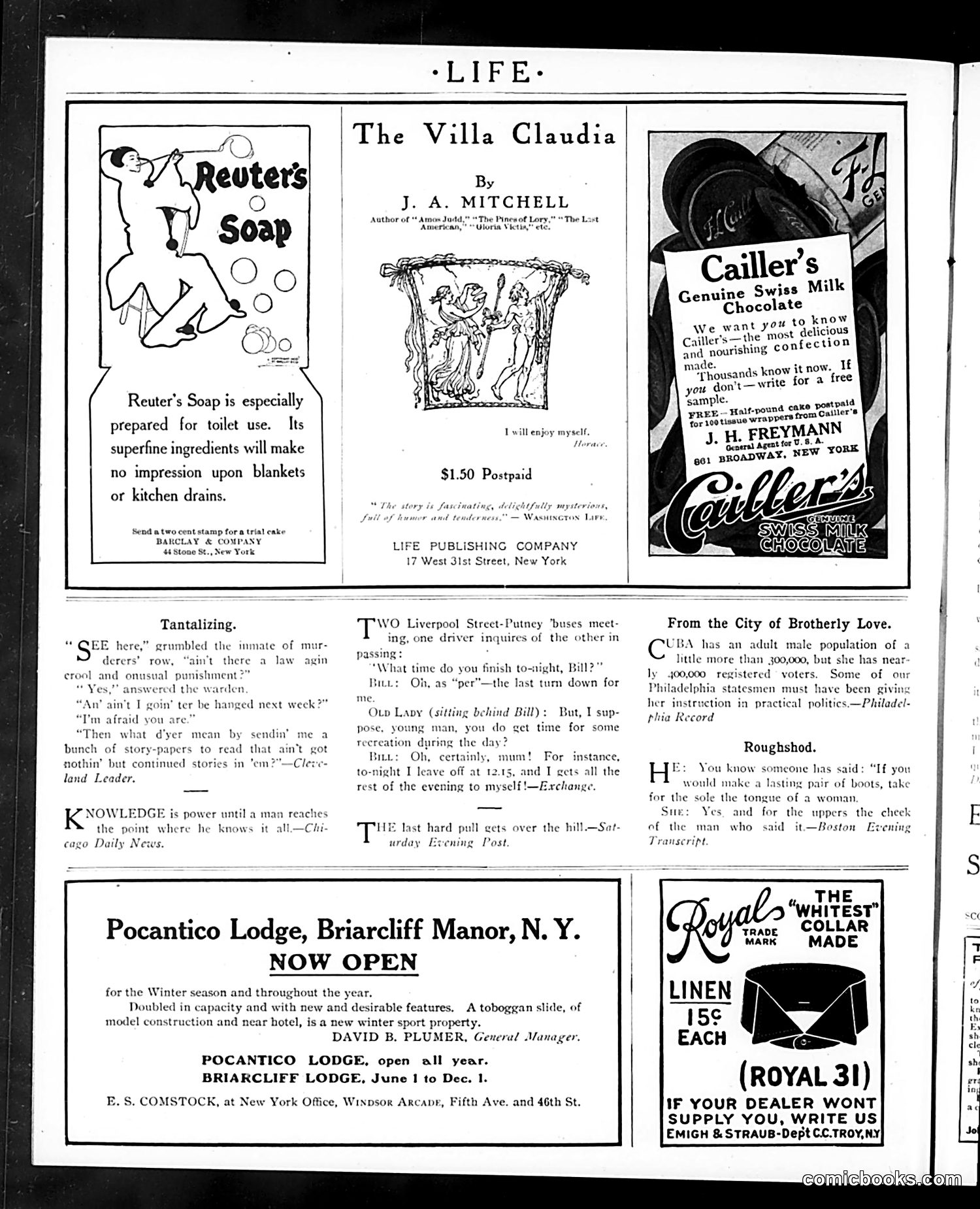
This page consists primarily of **advertisements and short humor anecdotes** rather than political cartoons. **The brief jokes** satirize bureaucratic and social absurdities: - **"Tantalizing"**: A prisoner complains about receiving serialized story magazines instead of execution—mocking the cruelty of suspenseful reading to the condemned. - **"Two Liverpool Street-Putney Buses"**: A bus driver claims he finishes work at the "last turn down," but then admits he works until 12:15 a.m. and has "all the evening to himself"—exposing transparent dishonesty about working hours. - **"Cuba voter fraud"**: A Philadelphia Record item jokes that Cuba has more registered voters (400,000) than adult males (300,000), satirizing election integrity issues. - **"Roughshod"**: A crude joke about women's inferiority using anatomical metaphors. The remaining content consists of **period advertisements** for soap, chocolate, lodges, and collars. The page lacks sophisticated political satire—it reflects Life's lighter, anecdotal humor style of this era.
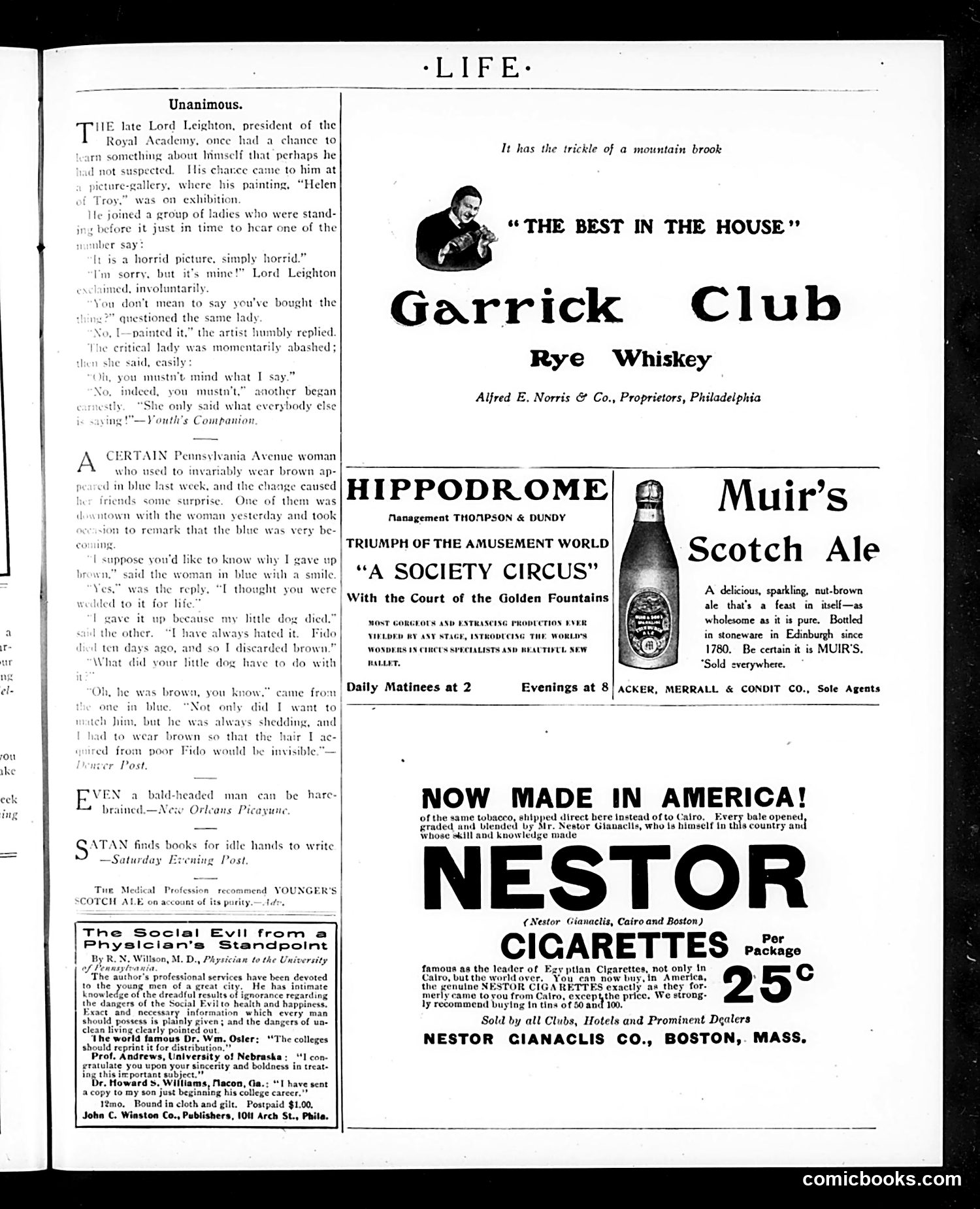
This page from *Life* magazine consists primarily of **advertisements and short humor pieces** rather than political cartoons. The main content includes: **Humorous anecdotes** at left: Stories about Lord Leighton (president of the Royal Academy) and a Pennsylvania woman's wardrobe change—light social satire about vanity and embarrassment. **Advertisements** dominating the right side: Garrick Club Rye Whiskey ("The Best in the House"), Hippodrome theater ("A Society Circus"), Muir's Scotch Ale, and **Nestor Cigarettes** (prominently advertised as "Now Made in America!" despite originating in Cairo). **Editorial content** at bottom: An article titled "The Social Evil from a Physician's Standpoint" addressing venereal disease and sexual health—presented as serious public health education endorsed by medical authorities. The page reflects early 20th-century American advertising practices and social attitudes, mixing frivolous society humor with earnest health warnings, alongside product marketing.
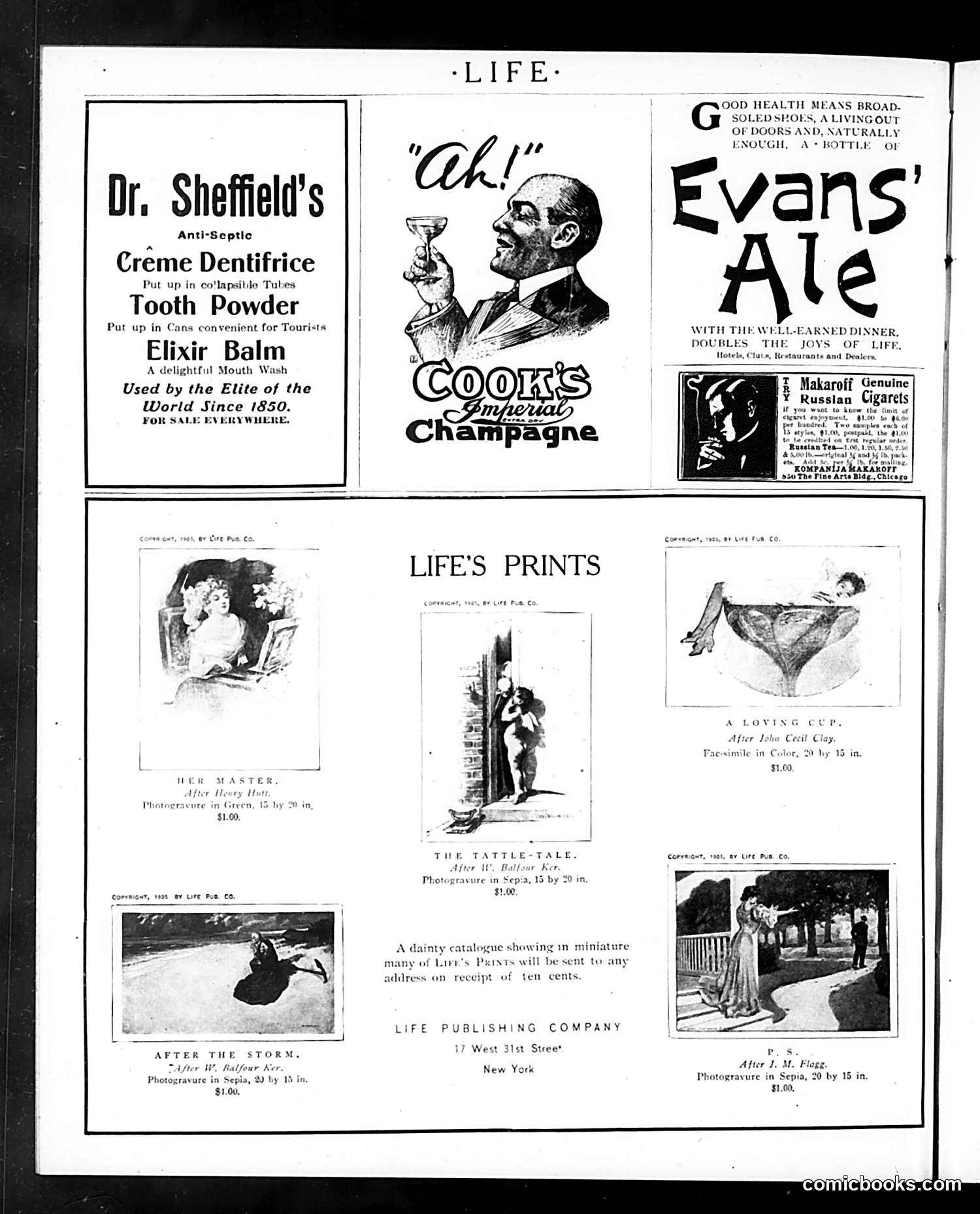
This is primarily an **advertising and product catalog page** from Life magazine, not a political cartoon. The top section features three advertisements: Dr. Sheffield's dental products (toothpaste, powder, mouth wash), Cook's Imperial Champagne (with a man saying "Ah!"), and Evans' Ale, with a sidebar ad for Russian cigarettes. The lower section promotes **Life's Prints**—fine art photogravures available for purchase. These are reproductions of paintings or drawings, priced at $1.00-$1.00 each, by artists including Henry Haas ("Her Masters"), W. Balfour Ker ("The Tattle-Tale" and "After the Storm"), John Cecil Clay ("A Loving Cup"), and J.M. Flagg ("P.S."). The Life Publishing Company offered a catalog of these prints for ten cents. This represents Life's diversification beyond satire into luxury goods and fine art marketing—targeting wealthy readers with disposable income.
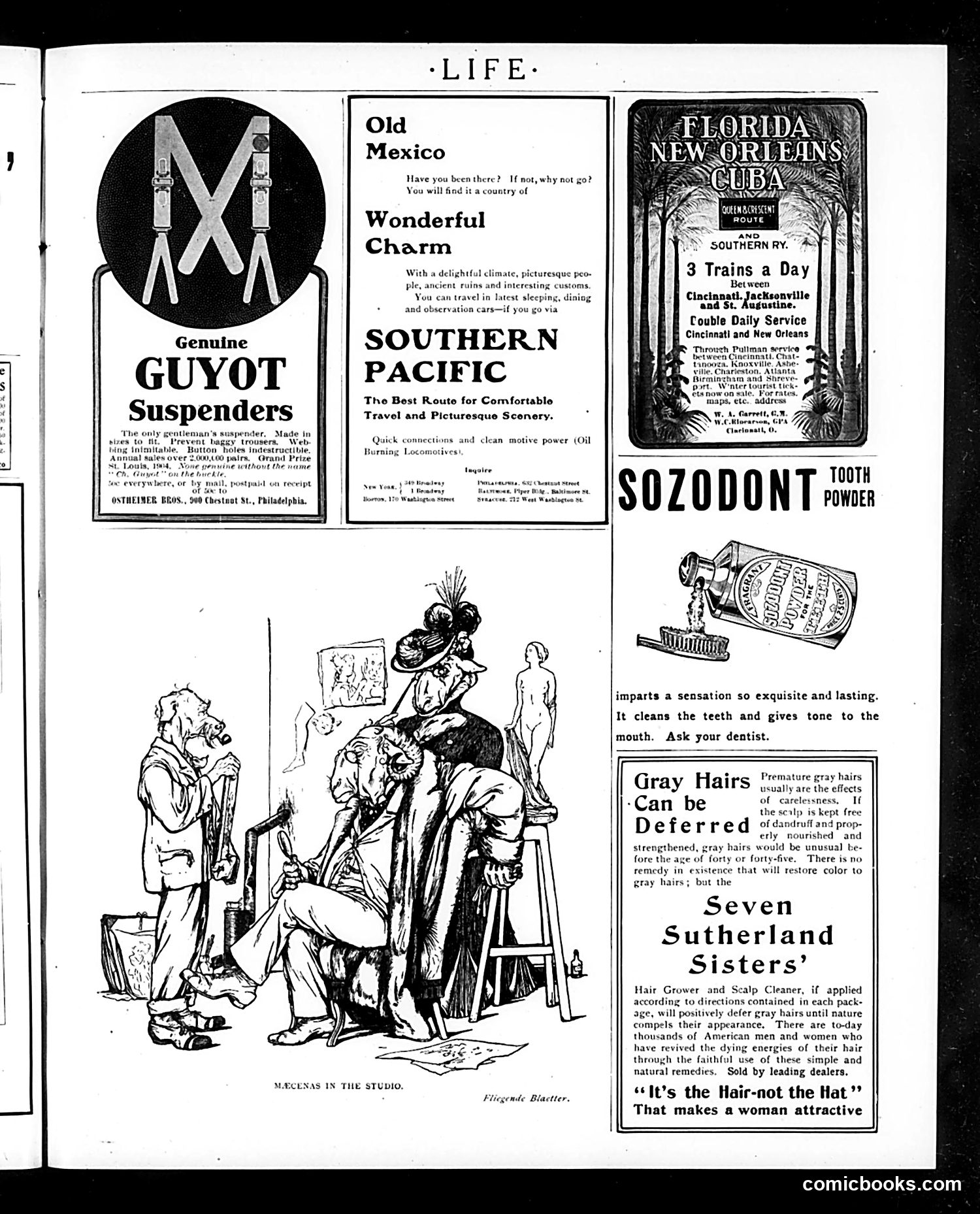
This page is primarily **advertising**, not political satire. The main content features Victorian-era product advertisements typical of early 20th-century publications. The central illustration titled "Maecenas in the Studio" (credited to *Fliegende Blätter*, a German publication) depicts art patrons or wealthy collectors observing artists at work—a generic scene about artistic patronage rather than topical satire. The advertisements include: - **Guyot Suspenders** (men's clothing) - **Southern Pacific Railway** (travel to Mexico and the American South) - **Sozodont Tooth Powder** (dental hygiene) - **Seven Sutherland Sisters' Hair Grower** (hair treatment for premature graying) These ads reflect contemporary consumer concerns: proper grooming, leisure travel, and addressing aging. The "gray hair" ad notably reflects period anxieties about maintaining youthful appearance. The tagline "It's the Hair-not the Hat" emphasizes personal grooming over fashion accessories. The page demonstrates how Life mixed editorial content with revenue-generating advertisements.
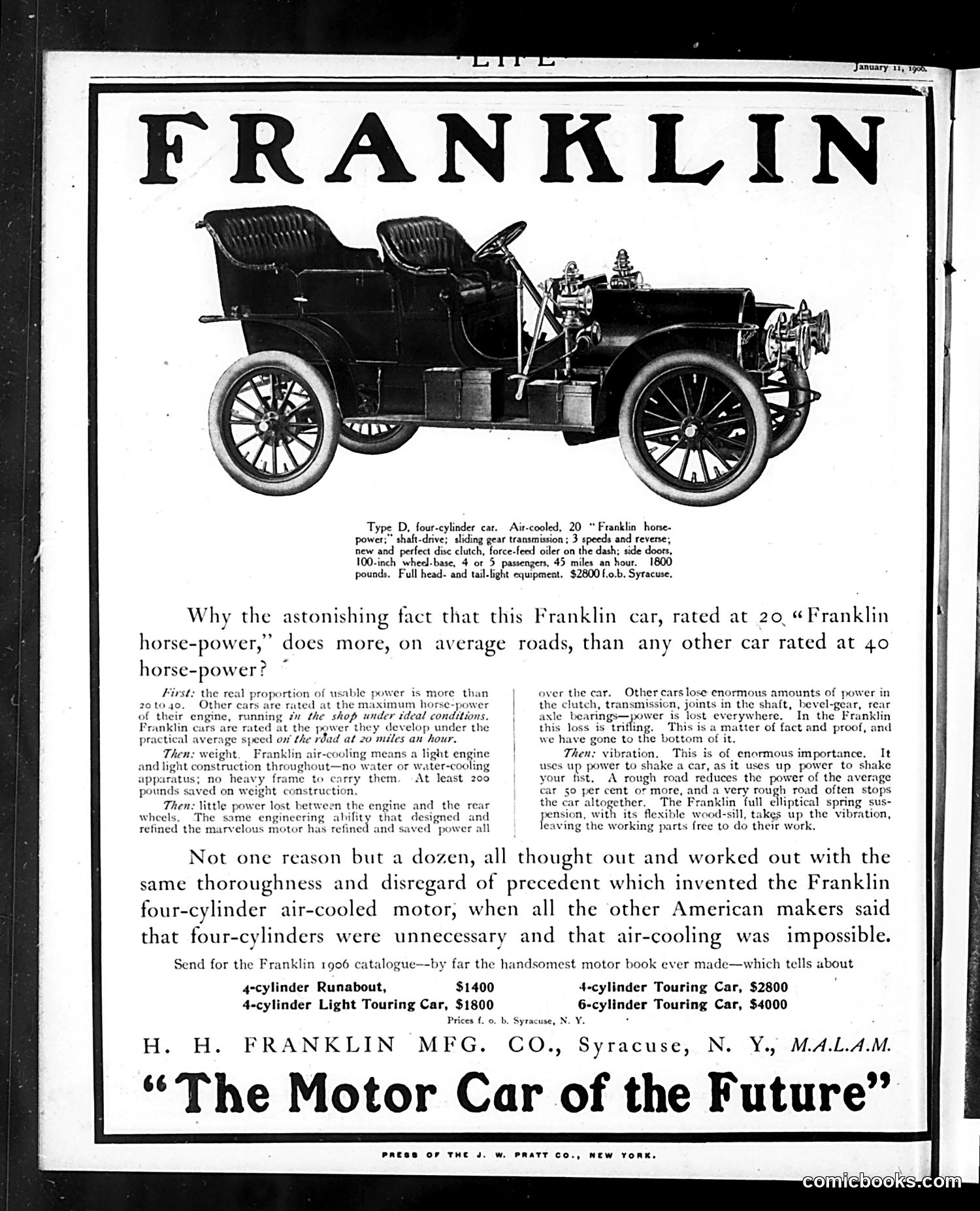
This is **not a political cartoon or satire**—it's a straightforward automobile advertisement from *Life* magazine (January 11, 1906). The page promotes the Franklin automobile's technical superiority, particularly its 20-horsepower air-cooled four-cylinder engine. The ad argues that Franklin cars outperform competitors rated at 40 horsepower because they waste less power through friction in transmissions, clutches, and other mechanical systems. Key selling points emphasized: - Lightweight construction (air-cooling eliminated heavy water-cooling apparatus) - Efficient power delivery - Superior suspension design reducing vibration losses - Innovative engineering that other manufacturers initially dismissed as impossible The tagline "The Motor Car of the Future" reflects early automotive industry competition. The ad positions Franklin as technically superior through engineering ingenuity rather than raw horsepower—a marketing strategy common in the pioneering automobile era when standardization hadn't yet occurred.