
Life, 1906-01-11 · page 14 of 26
Life — January 11, 1906 — page 14: what you’re looking at
What you’re looking at
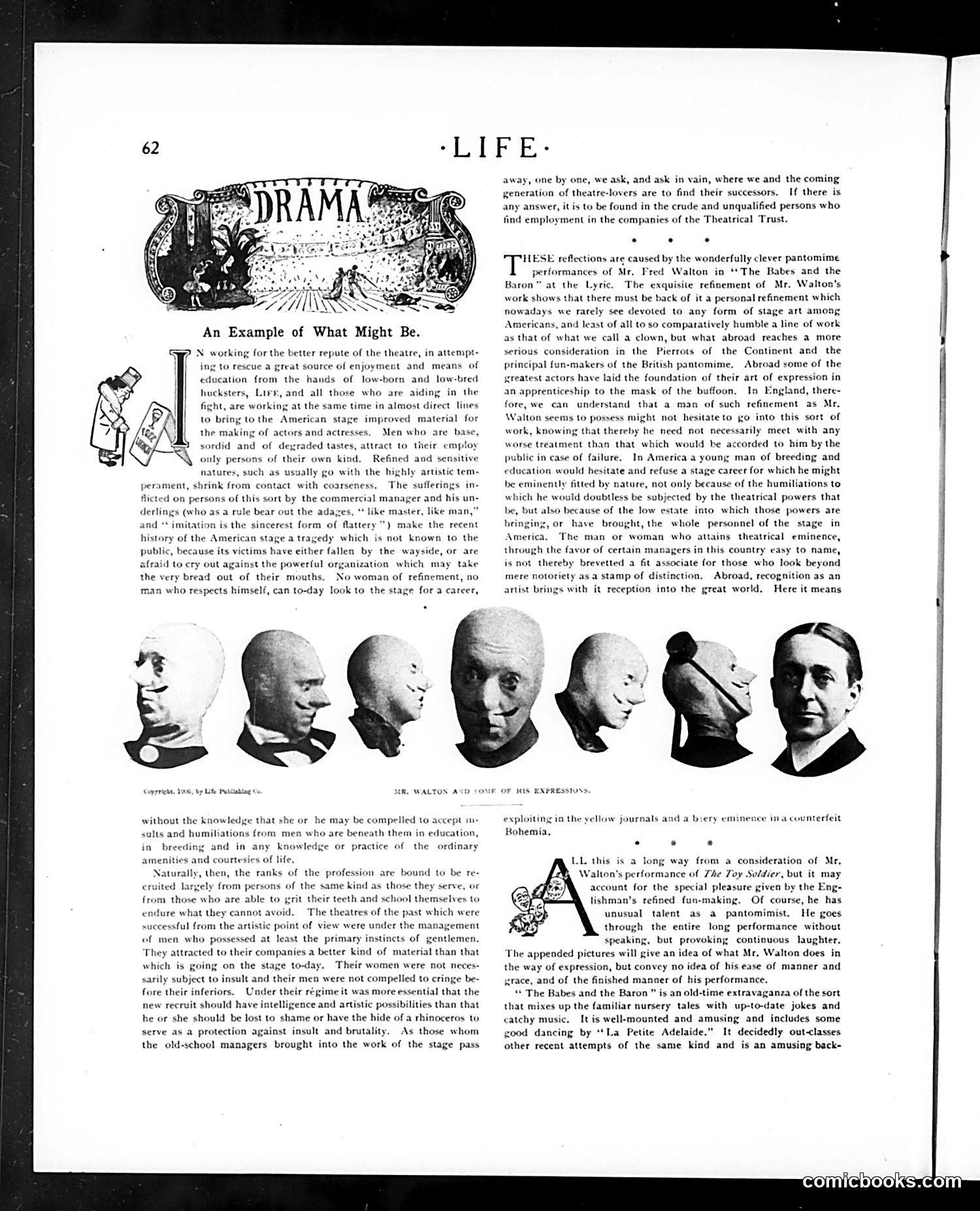
This page critiques the American theater industry's decline in artistic standards. The article praises pantomimist Fred Walton's performance in "The Babes and the Baron" at the Lyric Theatre, using him as an example of refined artistry increasingly absent from American stages. The central complaint targets the "Theatrical Trust"—a powerful monopoly controlling American theater that allegedly recruits only crude, unqualified performers willing to endure degrading conditions from coarse managers. The author contrasts this with European traditions (particularly British pantomime) where clowning receives serious artistic respect and refined gentlemen could pursue theater without shame or humiliation. The seven profile portraits below show Walton's expressive pantomime faces, illustrating his sophisticated technique. The satire's point: American theater's commercialization has driven away talented, educated performers, leaving only those with no alternative options—a vicious cycle damaging the industry's artistic legitimacy.
📄 Transcribed text from this page (OCR, searchable)
Machine-transcribed from the original scan — historical spelling and the odd misread are preserved.
*-LIFE:- An Example of What Might Be. Gyr N working for the better repute of the theatre, in attempt ing to rescue a great source of enjoyment and means of education from the hands of low-born and low-bred hucksters, Lire, and all those who are aiding in the fight, are working at the same time in almost direct lines to bring to the American stage improved material for Men who are bas: to their employ the making of actors and actresses. sordid and of deyraded tastes, attra ly persons of their own kind. Refined and sensitive natures, such as usually go with the highly artistic tem- perament, shrink from contact with coarseness, The sufferings cted on persons of this sort by the commercial manager and his un- derlings (who as a rule bear out the adazes, * like master, like man,” and ** imitation is the sincerest form of flattery n stage a tragedy which is not known to the public, because its victims have either fallen by the wayside, or are afraid to cry out against the powerful organization which may take the very bread out of t man who respects himself, can to-day look to the stage for a career, ) make the recent history of the Amer ir mouths, No woman of refinement, no Capri 1000, by Lite Putiabing ¢ WALTON ASD without the knowley sults and humiliations from men w ¢ that she or he may be compelled to ace p> are beneath them in education, in breeding and in any knowledge or practice of the ordinary amenities and courtesies of life. Naturally, then, the ranks of the profession are bound to be re- cruited largely from persons of the same kind as those they serve, or from those wh endure what they cannot avoid. t their teeth and school themselves to The theatres of the past which were of view were under the management are able to successful from the artistic poi of men who possessed at least the primary instincts of gentlemen, ‘They attracted to their companies a better kind of material than that which is going on the stage to-day, Their women were not neces- sarily subject to insult and their men were not compelled to cringe be- fore their inferiors. Under their régime it was more essential that the new recruit should have intelligence and artistic possibilities than that he or she should be lost to shame or have the hide of a rhinoceros to serve as a protection against insult and brutality. As those whom the old-school managers brought into the work of the stage pass away, one by one, we ask, and ask in vain, where we and the coming. generation of theatre-lovers are to find their successors. If there is any answer, it is to be found in the crude and unqualified persons who find employment in the companies of the Theatrical Trust. HESE reflections are caused by the wonderfully clever pantomime performances of Mr, Fred Walton in ‘The Babes and the Baron” at the Lyric. The exquisite refinement of Mr. Walton's work shows that there must be back of it a personal refinement which nowadays we rarely see devoted to any form of stage art among Americans, and least of all to so comparatively humble a line of work as that of what we call a clown, but what abroad reaches a more serious consideration in the Pierrots of the Continent and the principal fun-makers of the British pantomime. Abroad some of the Kreatest actors have laid the foundation of their art of expression in an apprenticeship to the mask of the buffoon, In England, there fore, we can understand that a man of such refinement as Mr. Walton seems to possess might not hesitate to go into this sort of work, knowing that thereby he need not necessarily meet with any worse treatment than that which would be accorded to him by the public in case of failure. education would hesitate and refuse a stage career for which he might be eminently fitted by nature, not only because of the humiliations to In America a young man of breeding and which he would doubtless be subjected by the theatrical powers that be, but also because of the low estate into which those powers are bringing, or have brought, the whole personnel of the stage in America, The man or woman who attains theatrical eminence, through the favor of certain managers in this country easy to name, is not thereby brevetted a fit associate for those who look beyond mere notoriety asa stamp of distinction, Abroad, recognition as an artist brings with it reception into the great world, Here it means OUF OF HIS EXPRESSIONS. exploiting ia the yellow journals and a brery eminence in ac Bohemia, . . . LL this is a long way from a consideration of Mr, The Toy Soldier, but it may account for the special pleasure given by the Eng- lishman’s refined fun-making. Of course, he has unusual talent as a pantomimist, He goes through the entire long performance without speaking, but provoking continuous laughter. ppended pictures will give an idea of what Mr. Walton does in the way of expression, but convey no idea of his ease of manner and xrace, and of the finished manner of his performance. “ The Babes and the Baron ” is an old-time extravaganza of the sort that mixes up the familiar nursery tales with up-to-date jokes and catchy music, It is well-mounted and amusing and includes some good dancing by ‘La Petite Adelaide.” It decidedly out-<lasses other recent attempts of the same kind and is an amusing back- Walton's performance