
Life, 1906-01-11 · page 16 of 26
Life — January 11, 1906 — page 16: what you’re looking at
What you’re looking at
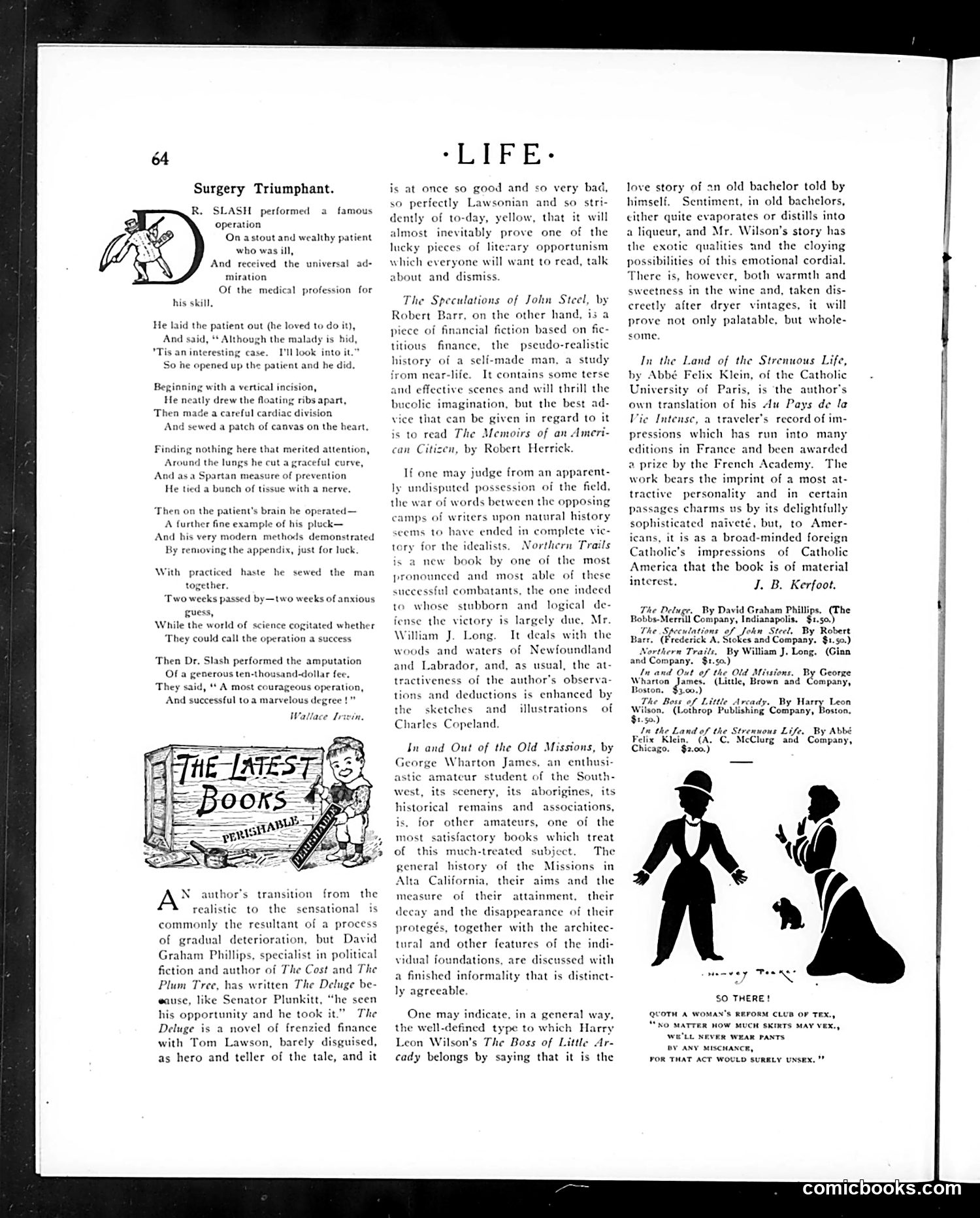
This page contains a humorous poem satirizing incompetent or opportunistic surgeons. "Dr. Slash" performs unnecessary procedures on a wealthy patient—making dramatic incisions, removing organs, operating on the brain, and extracting the appendix "just for luck"—finding nothing actually wrong. The satire's climax reveals the real "operation": extracting a massive ten-thousand-dollar fee. The joke targets doctors who exploit wealthy patients through needless surgery justified by pseudo-scientific reasoning. The poem's mock-heroic tone ("marvelous degree") emphasizes how the medical profession celebrates surgical audacity regardless of actual medical necessity. This reflects Progressive Era anxieties about professional exploitation and the gap between scientific pretense and actual patient benefit. The accompanying book reviews discuss financial manipulation and realistic versus sensational literature, suggesting contemporary concerns about fraud across professions.
📄 Transcribed text from this page (OCR, searchable)
Machine-transcribed from the original scan — historical spelling and the odd misread are preserved.
Surgery Triumphant. R. SLASH performed a operation On astout and wealthy patient who was ill, And received the universal ad- miration famous Of the medical profession for his skill, He laid the patient out (he loved to do it), And said, “ Although the malady is hid, Tl look into it.” So he opened up the patient and he did, ‘Tis an interesting case. Beginning with a vertical incision, He neatly drew the floating ribs apart, Then made a careful cardiac division And sewed a patch of canvas on the heart, Finding nothing here that merited attentic Around the lungs he cut a graceful curve, And asa Spartan measure of prevention He tied a bunch of tissue with a nerve, ‘Then on the patient's brain be operated— A further fine example of his pluck— And his very modern methods demonstrated By removing the appendix, just for luck. With practiced together. haste he sewed the man Two weeks passed by—two weeks of anxious guess, While the world of science cogitated whether ‘They could call the operation a success Then Dr. Slash performed the amputation Of a generous ten-thousand-dollar fee, They said, A most courageous operation, And successful toa marvelous degree !"" Wallace Irvin, from the A* author's transition realistic to the sensational is commonly the resultant of a process of gradual deterioration, but David Graham Phillips, specialist in political fiction and author of The Cost and The Plum Tree, has written The Deluge be- eause, like Senator Plunkitt, “he seen his opportunity and he took it.” The Deluge is a novel of frenzied finance with Tom Lawson, barely disguised, as hero and teller of the tale, and it “LIFE: is at once so good and so very bad, so perfectly Lawsonian and so stri- dently of to-< ellow, that it will almost inevitably prove one of the lucky pieces of literary opportunism which everyone will want to read, talk about and dismiss. The Speculations of John Steel, by Robert Barr, on the other hand, is a piece of financial fiction based on fic- the history of a seli-made man, a study from near-life. It contains some terse and effective scenes and will thrill the bucolic imagination, but the best ad- vice that can be given in regard to it d The Memoirs of an Ameri- 1 Citizen, by Robert Herrick. titious finance, pseudo-realistic If one may judge from an apparent- ly undisputed possession of the field, the war of words between the opposing camps of writers upon natural history seems to have ended in complete vic- tory for the idealists. Northern Trails s a new book by one of the most pronounced and most able of these successful combatants, the one indeed to whose stubborn and logical de- iense the victory is largely due, Mr. William J. It deals with the woods and waters of Newfoundland and Labrador, and, as usual, the at- tractiveness of the author’s observa- tions and deductions is enhanced by the sketches and illustrations of Charles Copeland Long In and Out of the Old Missions, by George Wharton James, an enthusi- istic amateur student of the South- west, its scenery, its aborigines, its historical remains and associations, is, for other amateurs, one of the most satisfactory books which treat of this much-treated subject. The general history of the Missions in Alta California, their aims and the of their attainment, their ecay and the disappearance of their protegés, together with the architec- tural and other features of the indi- vidual foundations, are discussed with a finished informality that is distinet- ly agreeable. One may indicate, in a general way, the well-defined type to which Harry Leon Wilson's The Boss of Little Ar- cady belongs by saying that it is the love story of an old bachelor told by himself. Sentiment, in old bachelors, cither quite evaporates or distills into a liqueur, and Mr. Wilson’s story has the exotic qualities and the cloying possibilities of this emotional cordial. There is, however, both warmth and sweetness in the wine and, taken dis- creetly after dryer vintages, it will prove not only palatable, but whole- some. In the Land of the Strenuous Life, by Abbé Felix Klein, of the Catholic iversity of Paris, is the author's own translation of his Au Pays de la Vie Intense, a traveler's record of im- pressions which has run into many editions in France and been awarded a prize by the French Academy. The work bears the imprint of a most at- tractive personality and in’ certain passages charms us by its delightfully sophisticated naiveté, but, to Amer- icans, it is as a broad-minded foreign Catholic’s impressions of Catholic America that the book is of material interest J. B. Kerfoot. The Detuge. By David Graham Phillips, (The Robbs-Merrill Company, Indianapolis, $1.50.) The Speculations of John Steet, By Robert Bart. (Frederick A. Stokes and Company. §1.50.) Northern Trait, By William J. Long. (Ginn and Company. $1.50.) In and Out of the Old Missions. Wharton James. Boston. $3.00.) The Boss of Little Arcady. By Harry Leon Wilson, (Lothrop Publishing Company, Boston, $1.50.) In the Land of the Felix Klein. Chicago. By George (Little, Brown and Company, trenuons Life, By Abbé (A.C. McClurg ‘and’ Company, $2.00.) menvey Tee SO THERE! QUOTH A WOMAN'S REFORM CLUB OF TRX., “No MATTRR HOW MUCH SKIRTS MAY VEX., WE'LL NEVER WEAR PANTS BY ANY SISCHANCE, YOR THAT ACT WOULD SURELY UNSEX. comicbooks.com