
A complete issue · 22 pages · 1905
Life — November 23, 1905
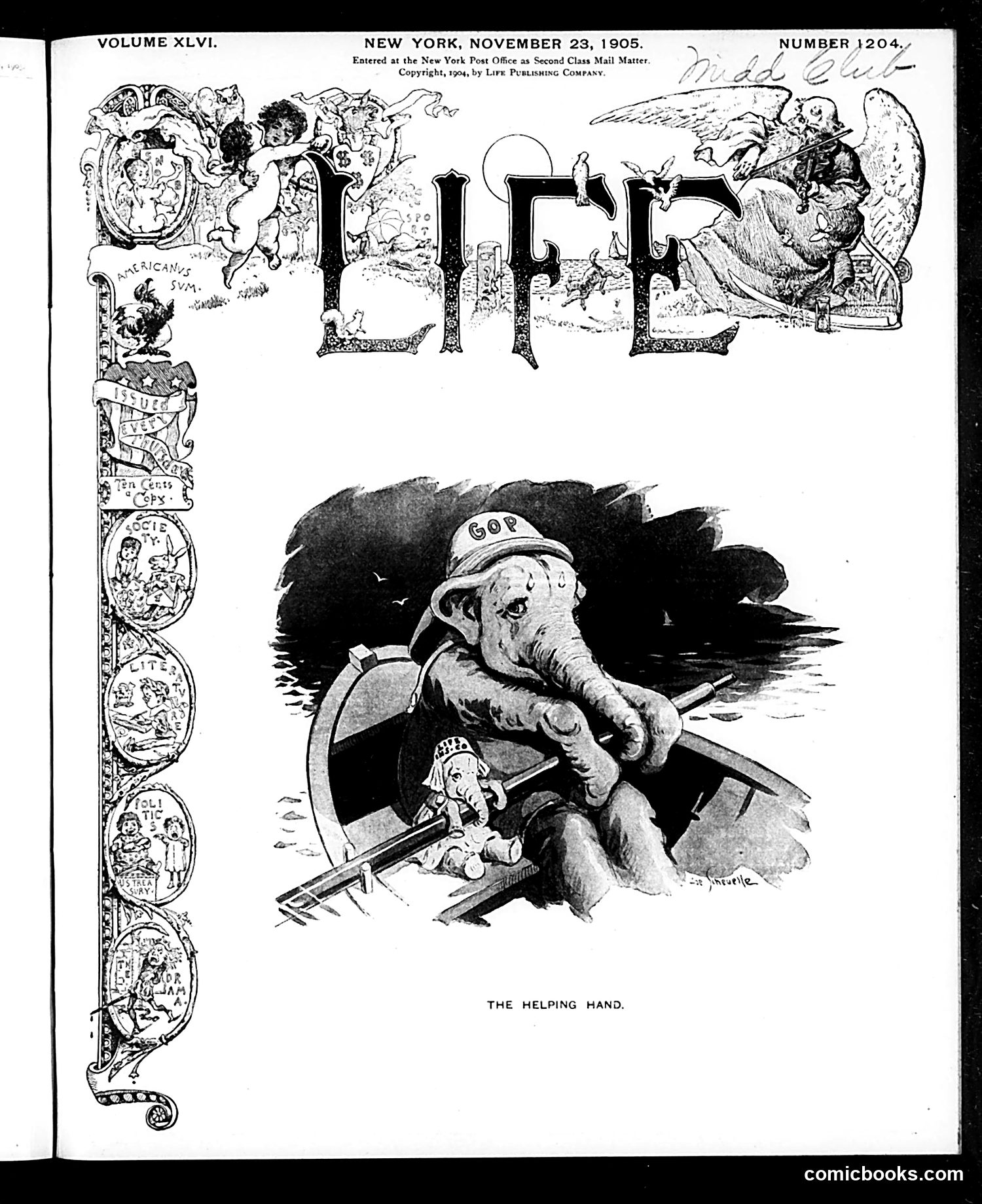
This political cartoon depicts an elephant wearing a "GOP" (Republican Party) cap, rowing a small boat containing a tiny figure labeled "ROOSEVELT." The caption reads "The Helping Hand." The image satirizes President Theodore Roosevelt's relationship with the Republican Party establishment. The elephant—the traditional Republican symbol—appears to be providing assistance to Roosevelt, who is depicted as small and dependent. This likely comments on how party machinery supported Roosevelt's political objectives, or conversely, suggests Roosevelt's reliance on Republican Party apparatus for his agenda. The ornate decorative border indicates this was Life magazine's cover or feature illustration. The satire reflects contemporary debates about Roosevelt's independence versus his ties to Republican leadership during his presidency (1901-1909).
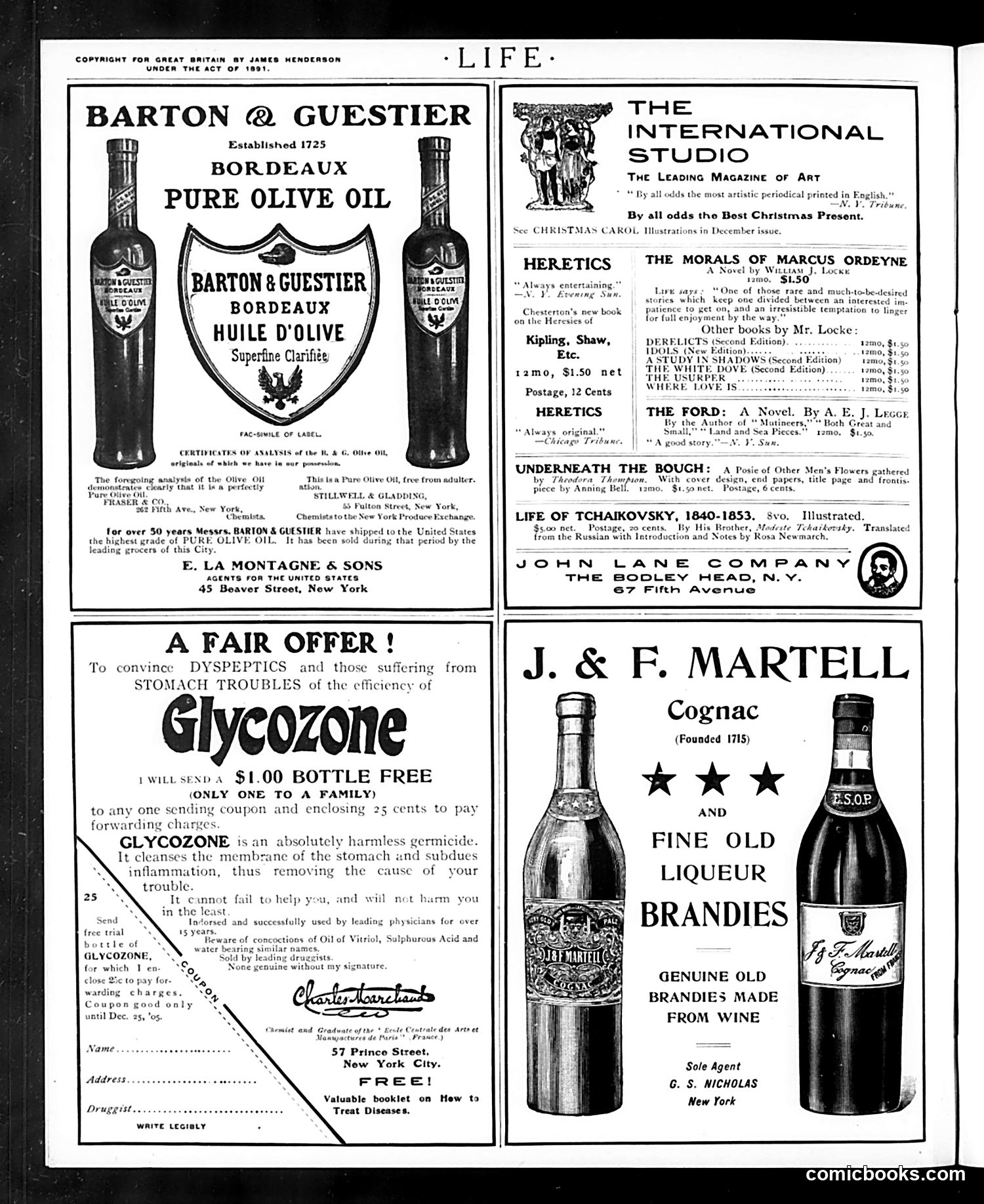
This page is **primarily advertisements**, not satirical content. It contains four distinct ads from the early 20th century: 1. **Barton & Guestier** — Bordeaux olive oil, established 1725 2. **The International Studio** — An art magazine advertising Christmas illustrations and book reviews 3. **Glycozone** — A patent medicine claiming to treat "stomach troubles" and other ailments; offers a free $1 bottle 4. **J. & F. Martell** — Cognac and brandy advertisement The only potentially satirical element is the **Glycozone ad**, which makes dubious health claims typical of turn-of-the-century "cure-all" medicines—products modern readers would recognize as fraudulent patent medicines. The ad's promise of curing inflammation and digestive issues reflects an era before FDA regulation of medical claims. Otherwise, this is a straightforward commercial page reflecting early 1900s advertising practices and consumer products.
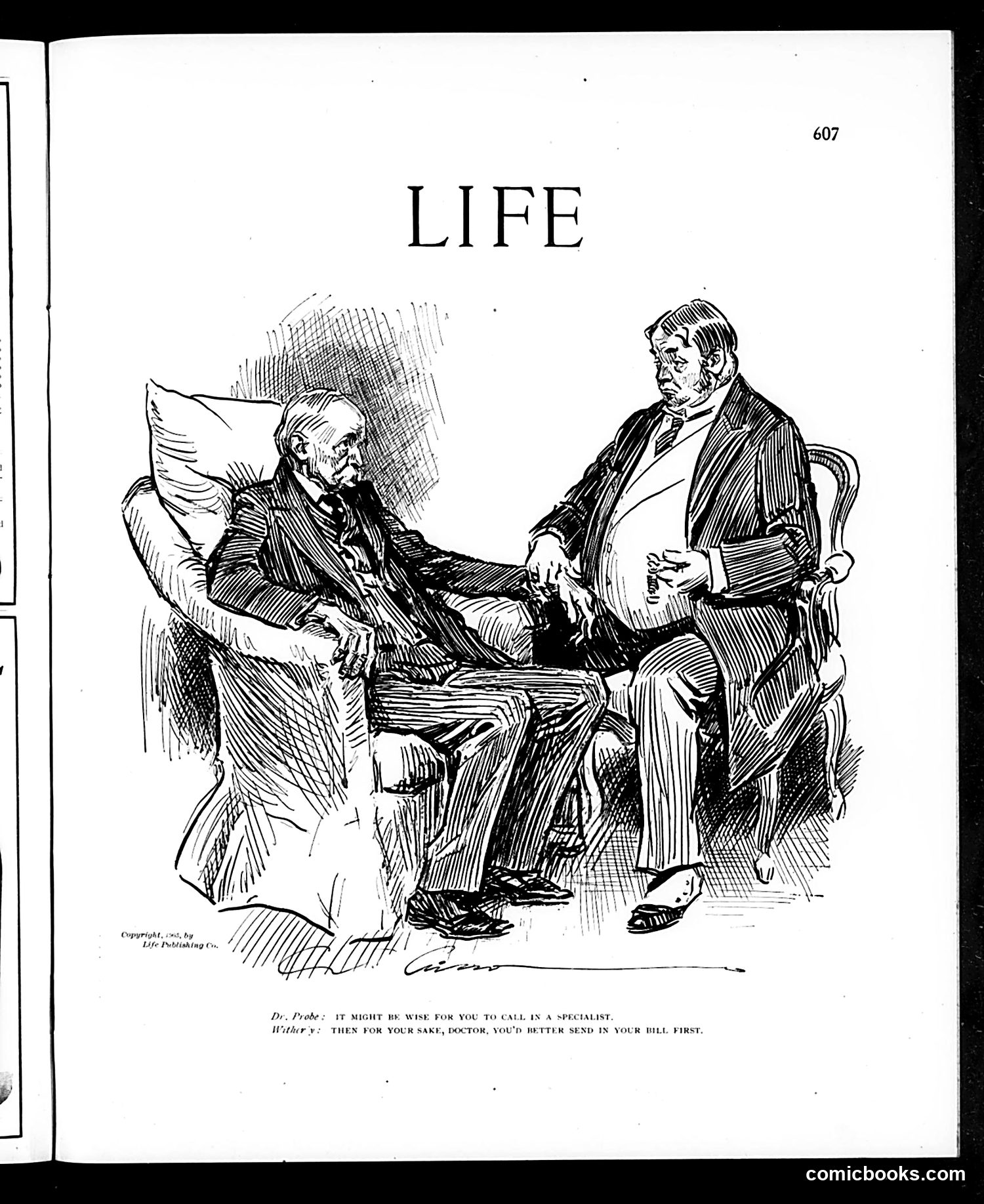
This cartoon depicts two well-dressed men in conversation. The caption reads: **Dr. Drake:** "IT MIGHT BE WISE FOR YOU TO CALL IN A SPECIALIST." **Wilbur:** "THEN FOR YOUR SAKE, DOCTOR, YOU'D BETTER SEND IN YOUR BILL FIRST." The satire targets medical billing practices of the era. Dr. Drake suggests consulting a specialist, but "Wilbur" (the patient) sarcastically implies that doctors rush to bill patients before treatment—suggesting the doctor should collect payment immediately rather than risk non-payment after referral to another physician. It's a commentary on physicians' aggressive debt collection and financial priorities over patient care, satirizing both medical economics and doctors' reputation for prioritizing fees.
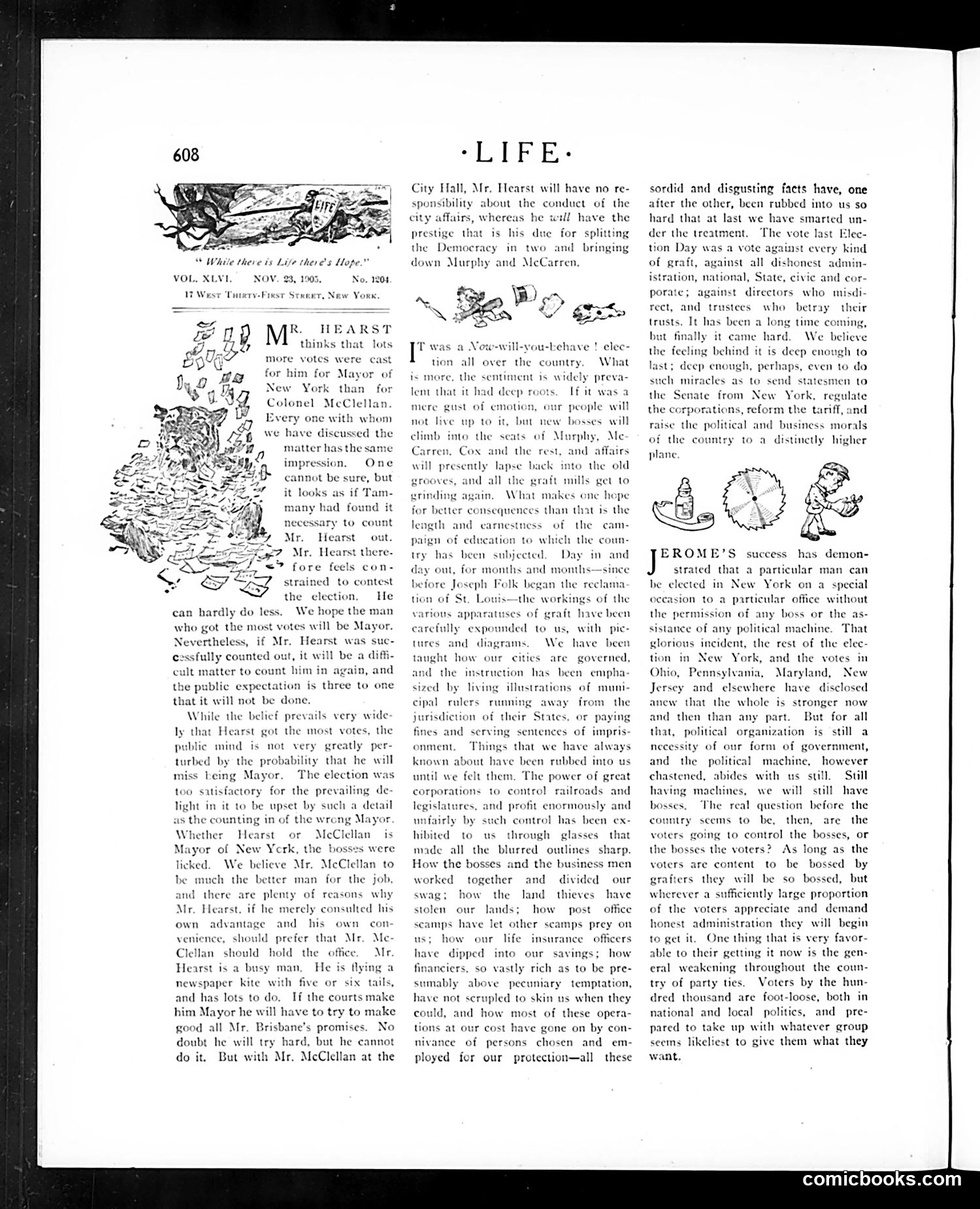
This page from *Life* magazine (Vol. XLVI, Nov. 23, 1905) features an editorial by Mr. Hearst criticizing the recent New York mayoral election. The main cartoon depicts Hearst as a disheveled, chaotic figure—suggesting his political ambitions were messy and unsuccessful. The text attacks Colonel McClellan's victory as Mayor, with Hearst arguing McClellan lacks integrity. Hearst contends that despite losing, his candidacy exposed widespread corruption in city governance—graft, corporate control of railroads, and dishonest administration. The satire targets Hearst's characteristic style: running for office on an anti-corruption platform while being portrayed as a disorganized, self-serving politician. The cartoon's visual chaos mirrors the editorial's complaint that New York's political machinery is fundamentally broken, controlled by bosses rather than serving the public interest.
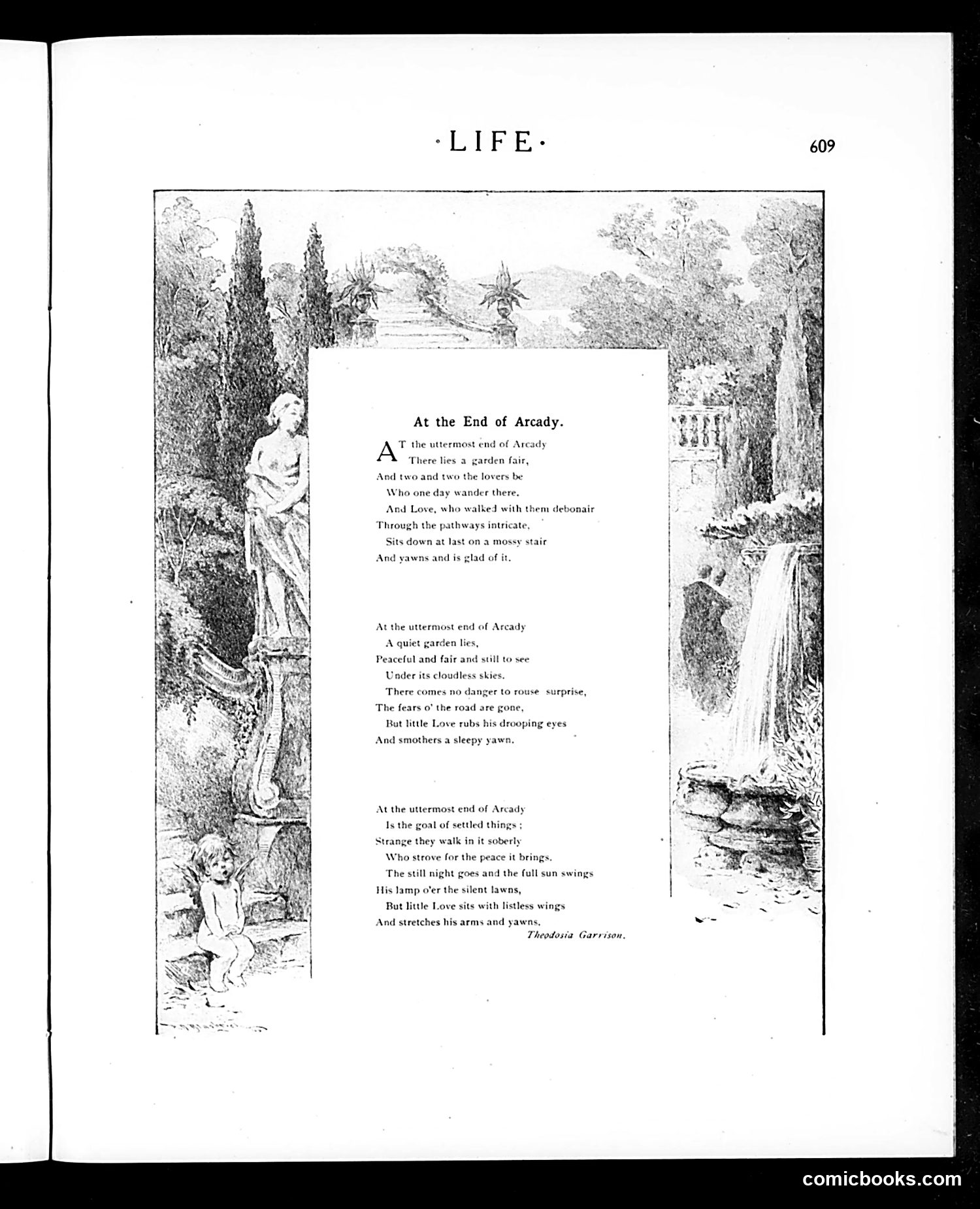
This page features a poem by Theodora Garrison illustrated with romantic garden imagery. The verses describe an idealized, peaceful garden retreat called "Arcady" (a classical reference to an idyllic pastoral paradise). The accompanying illustrations show cherubic figures and classical statuary within lush grounds. The content appears purely literary and artistic rather than political satire. The poem celebrates quietude, love, and natural beauty—themes typical of Life magazine's cultural and aesthetic content. The romantic, escapist subject matter likely appealed to early 20th-century readers seeking respite from industrial modernity. No specific political figures or contemporary events are referenced. This represents Life's genteel literary side rather than its famous satirical commentary.
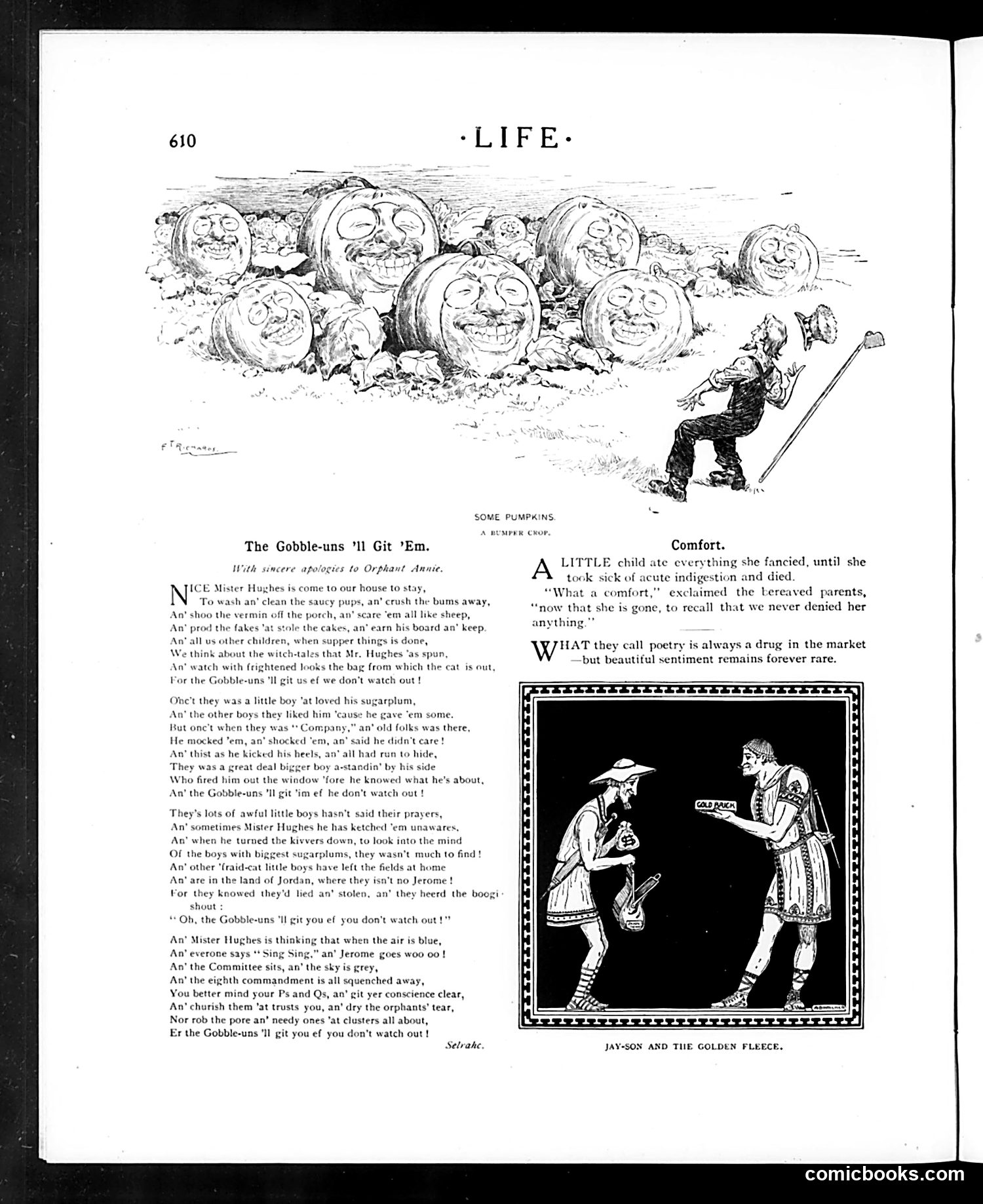
**Top Cartoon - "Some Pumpkins: A Bumper Crop":** A figure with a tool confronts a patch of grinning jack-o'-lantern pumpkins. The title suggests an abundance or "bumper crop" of something undesirable. The carved, laughing faces likely represent political opponents or foolish figures the artist mocks. Without clearer context on the specific date and political situation, the precise target remains unclear, though the satire treats these "pumpkins" as numerous but contemptible. **Poem - "The Gobble-uns 'll Git 'Em":** This appears to be a humorous verse (possibly satirizing James Whitcomb Riley's style) about mischievous boys and Mr. Hughes, warning of consequences for bad behavior. **Right Panel - "Jay-son and the Golden Fleece":** A classical mythology parody, though the specific satirical target isn't evident from the image alone. The page primarily contains literary and illustrative humor rather than direct political commentary.
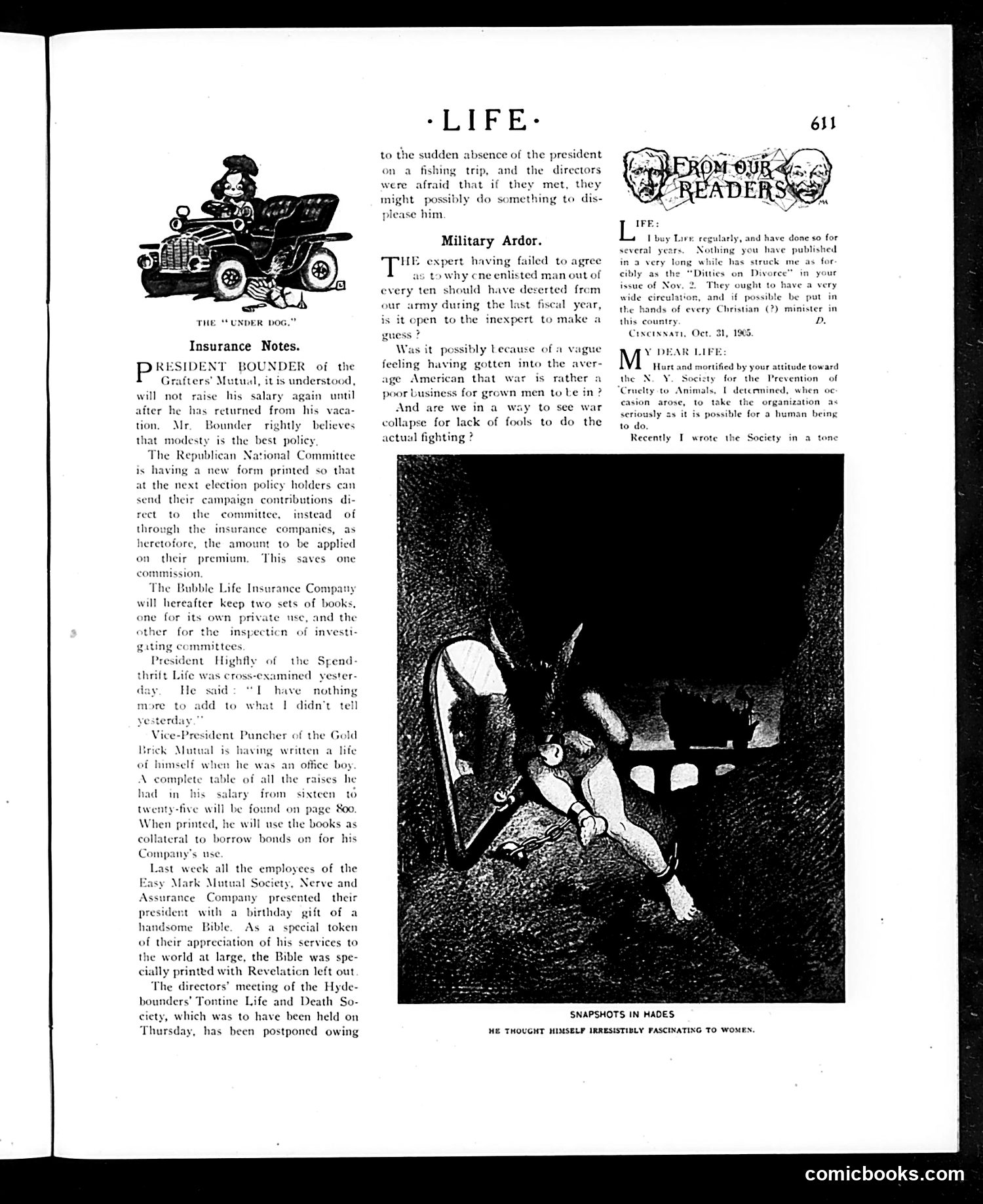
The top cartoon titled "The 'Four-Hour'" depicts an early automobile with a driver, satirizing the brief duration of a new car model or automotive trend—likely mocking either poor engineering or the rapid obsolescence of early automotive designs. The bottom image, captioned "Snapshots in Hades" with subtitle "He thought himself irresistibly fascinating to women," shows a figure in classical underworld setting. This appears to be moral satire about masculine vanity, suggesting that a man's inflated self-regard regarding his appeal to women will be exposed or judged in the afterlife. The darkly comic tone is characteristic of *Life* magazine's satirical approach to social behavior and male pretension.
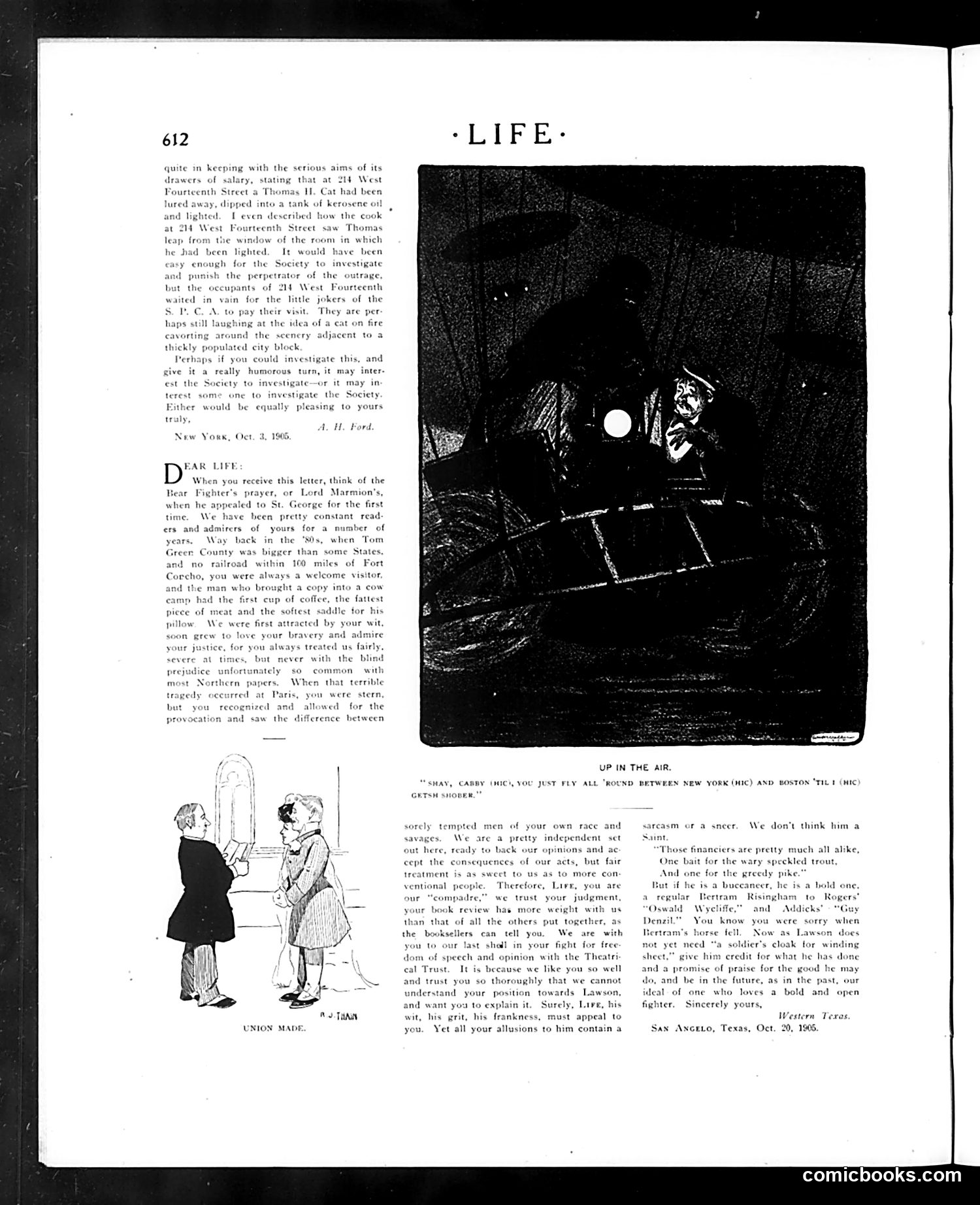
This page contains two distinct items: **Top Letter Section**: A reader's complaint about the S.P.C.A. (Society for the Prevention of Cruelty to Animals) investigating a cat incident at 214 West Fourteenth Street, New York. The writer sarcastically suggests investigating the S.P.C.A. itself instead, implying the organization was overly zealous or misdirected in its animal welfare efforts. **Bottom Cartoon ("Union Made")**: A simple line drawing showing two women in conversation, likely commenting on labor union issues or solidarity. The caption reference to "Union Made" suggests commentary on unionization, possibly of workers or manufacturing. **Top Photo**: An atmospheric nighttime image captioned "Up in the Air," showing what appears to be an aerial perspective with a moon visible. The page reflects early 1900s American concerns about animal welfare organizations and labor issues.
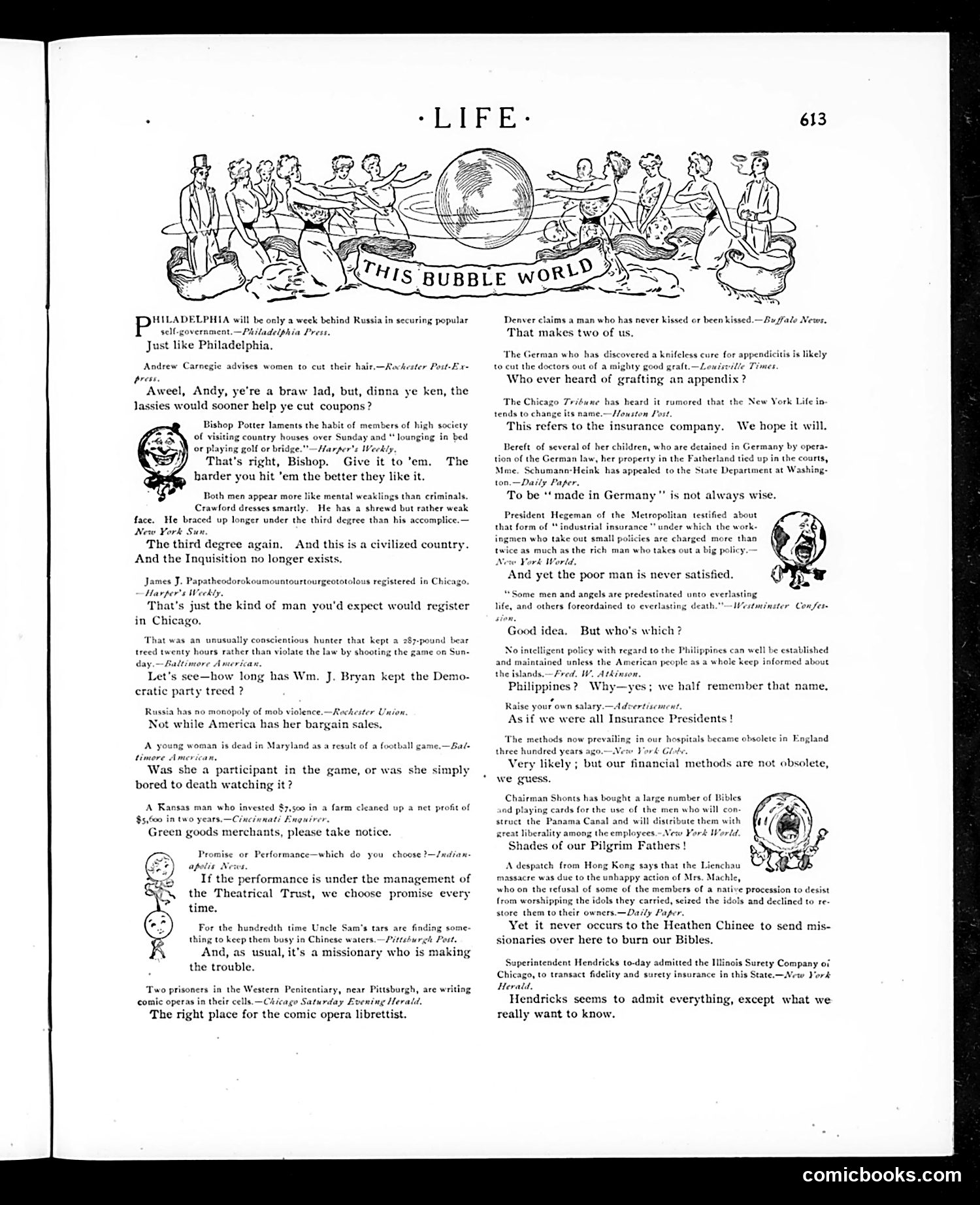
This page contains satirical commentary on contemporary issues, predominantly through text rather than visual cartoons. The content critiques various topics: **Main Targets:** - Philadelphia's municipal government (compared unfavorably to Russia) - Bishop Potter's concerns about wealthy society members and moral decay - James J. Hill's railroad monopoly practices - President Hageman's testimony about "industrial insurance" policies - U.S. Philippines policy - Hospital administration methods in England **Satirical Approach:** The magazine employs irony and sarcasm, presenting absurd statements (like suggesting Philadelphia is worse than Russia) to highlight perceived social problems. References to "comic opera," unsatisfactory insurance practices, and missionary work suggest early 1900s Progressive Era critiques of institutional failures and economic inequality. The small illustration showing people around a globe labeled "This Bubble World" reinforces themes of societal fragility and illusion.
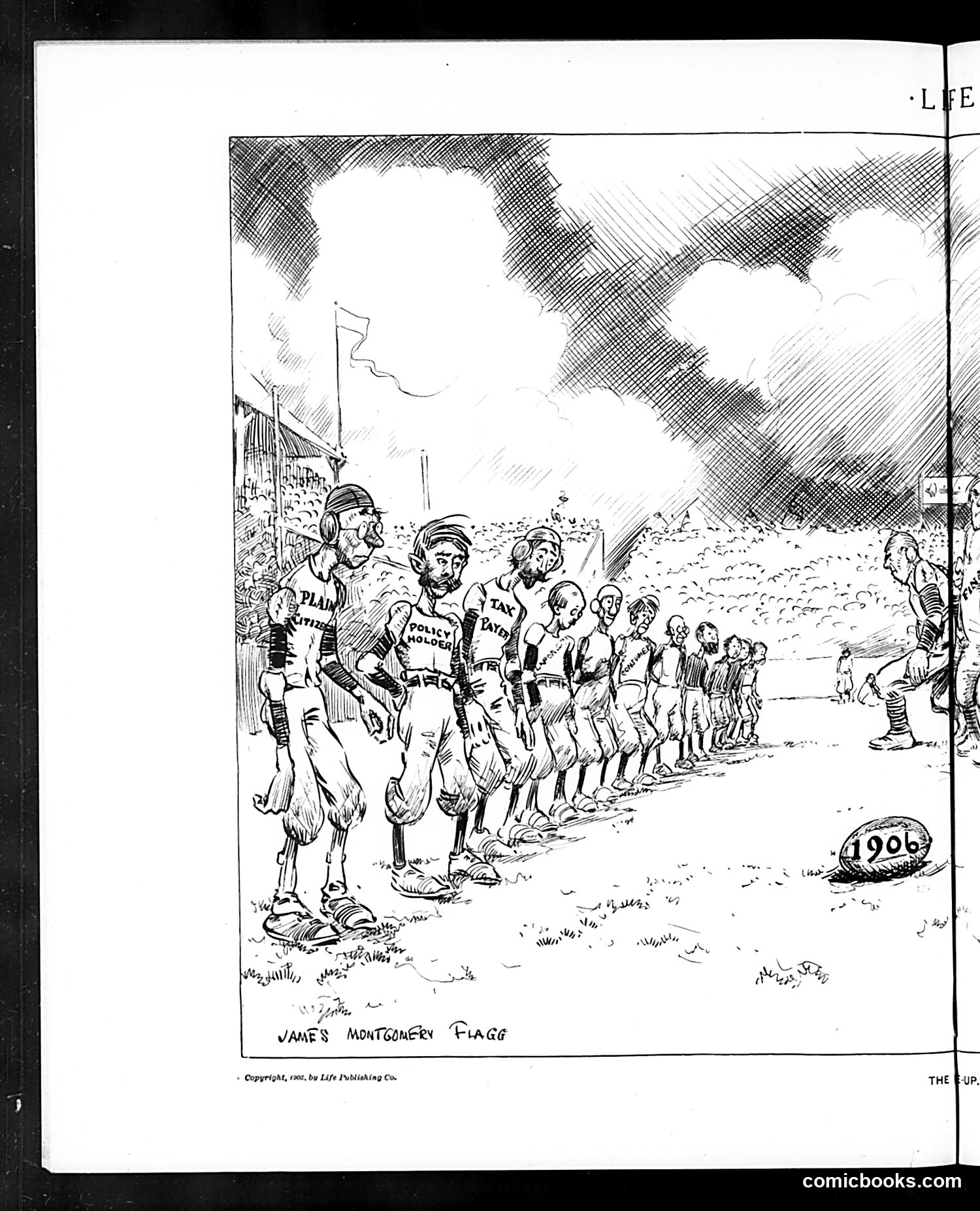
This 1906 cartoon by James Montgomery Flagg depicts a baseball team in uniforms labeled "PLAIN" and "POLICY," lined up on a field. The image appears to be satirizing political or institutional leadership, using baseball as a metaphor for American governance or public administration. The figures wear military-style helmets alongside baseball uniforms, suggesting a blend of martial discipline with sport—possibly critiquing how political organizations operate with rigid hierarchy. The date "1906" visible in the corner anchors this to the Progressive Era, when Life magazine frequently used sports metaphors to comment on politics, reform movements, and institutional competence. Without additional caption text visible, the specific target remains unclear, though the regimented "team" setup suggests commentary on organizational structure or political alignment.
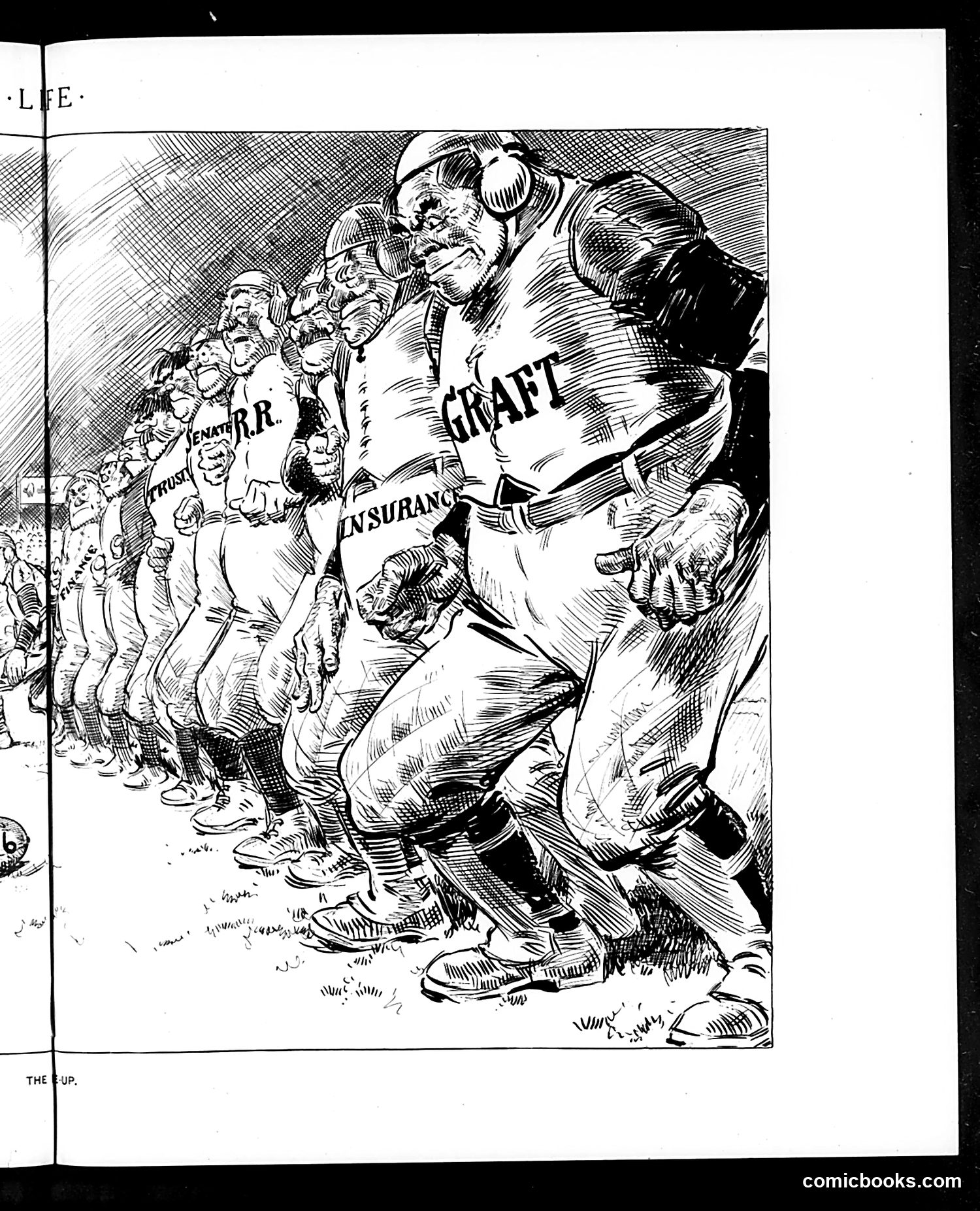
This satirical cartoon depicts corporate monopolies or trusts as bloated, powerful figures wearing labels including "TRUST," "R.R." (Railroad), "INSURANCE," and "DRAFT." A line of smaller, ordinary citizens trails behind these large figures, suggesting exploitation or control by big business. The cartoon likely criticizes early 20th-century corporate concentration and monopolistic practices—major political issues of the Progressive Era. The "DRAFT" reference suggests military conscription, possibly linking corporate power to wartime profiteering or government favoritism toward big business. The composition emphasizes the vast power disparity: enormous corporate figures tower over vulnerable citizens, visualizing the complaint that ordinary Americans were powerless against entrenched financial interests. This reflects contemporary Progressive Era anxieties about monopolies and corporate influence on government.
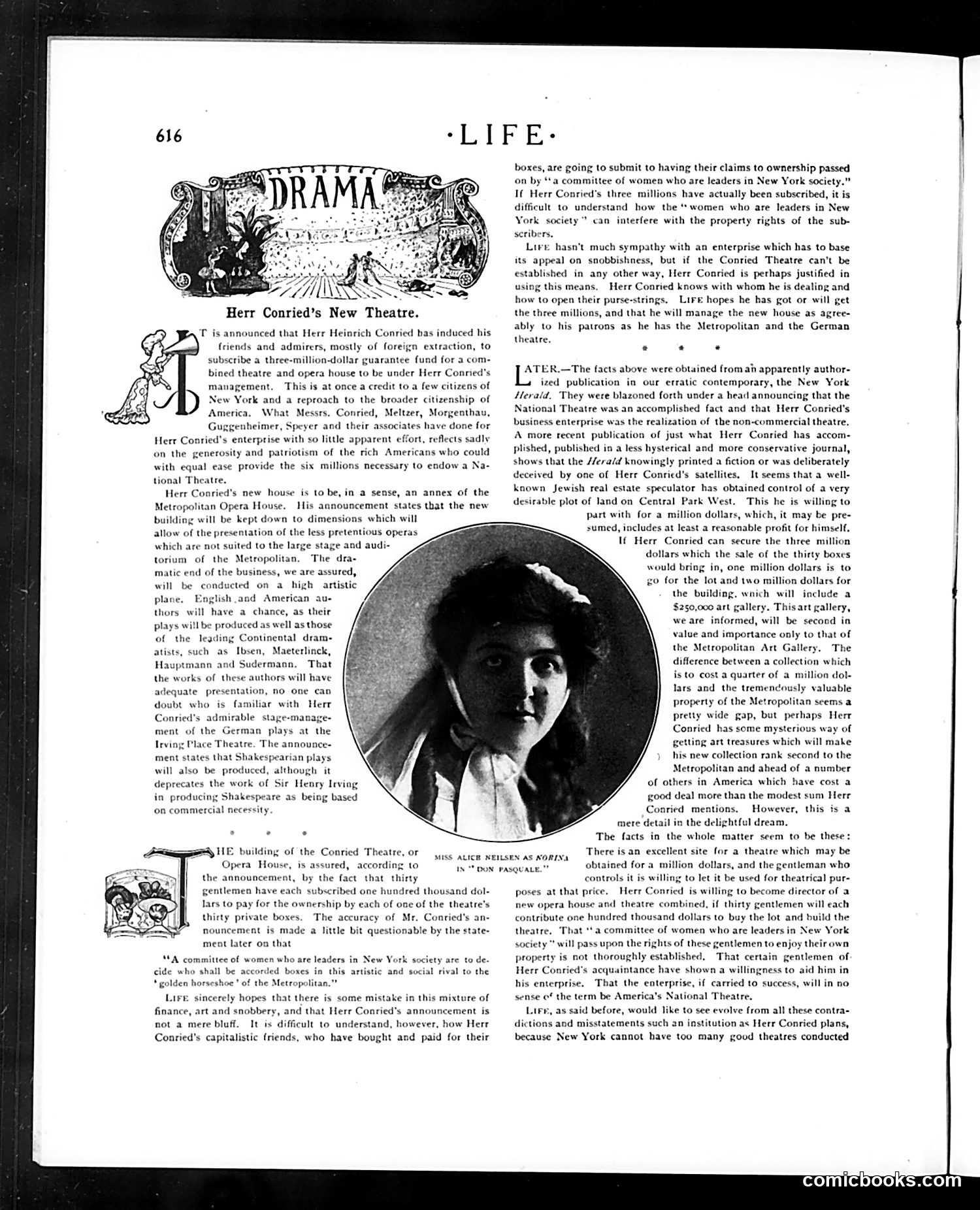
This page discusses Heinrich Conried's plan to build a new theater in New York. The decorative header features a "DRAMA" banner with theatrical imagery. The article describes Conried's ambition to establish a combined theater and opera house, noting he seeks funding from wealthy New York patrons. A portrait photograph (labeled "MISS ALICE NIELSEN AS NORMA IN DON PASQUALE") appears to illustrate theatrical talent. The satire targets the financing scheme: Conried is soliciting thirty gentlemen to each contribute one thousand dollars, promising they'd collectively own the theater. Life expresses skepticism about whether this enterprise genuinely represents "America's National Theatre" or merely Conried's commercial venture. The piece gently mocks both Conried's grandiose ambitions and wealthy New Yorkers' susceptibility to such appeals.
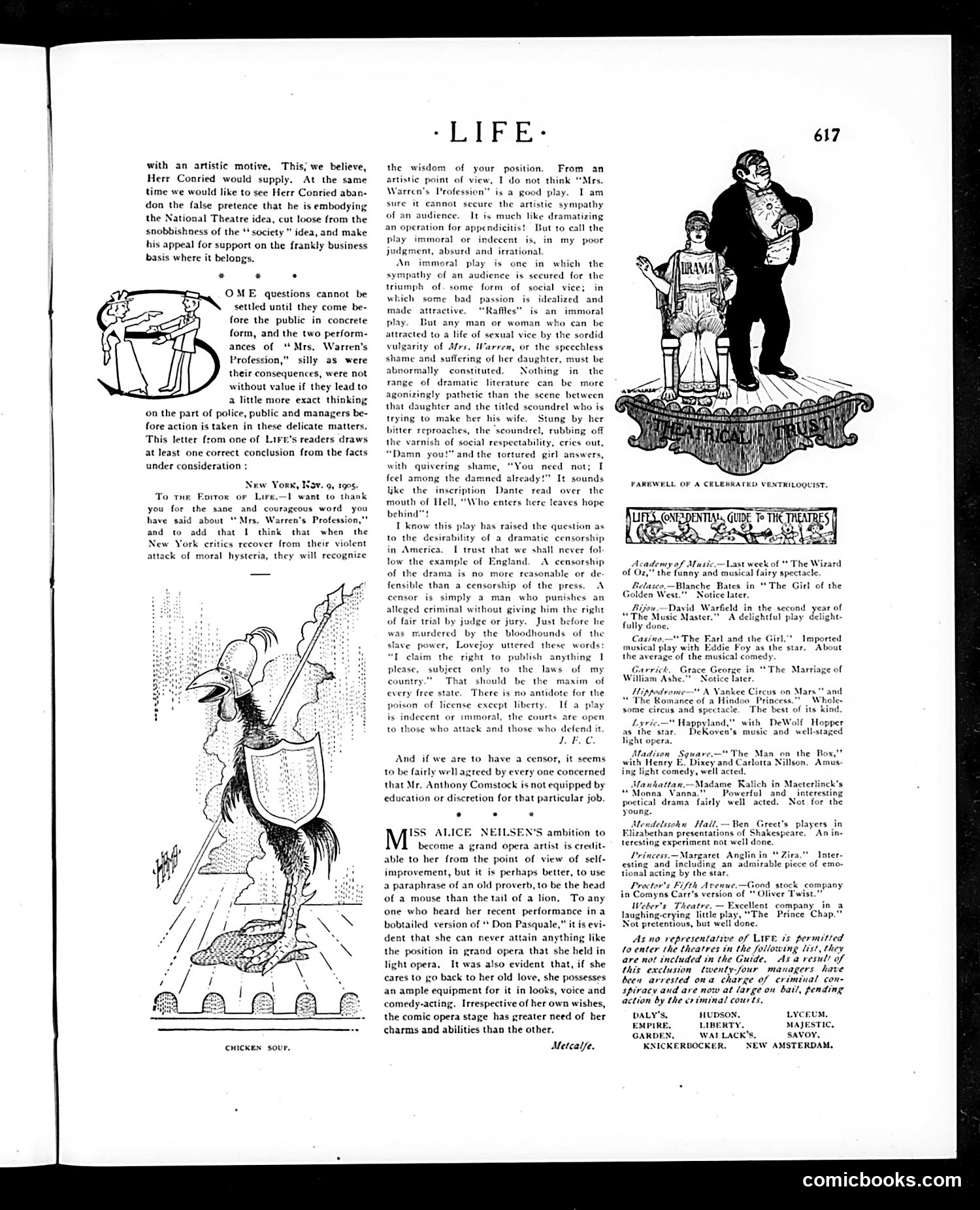
This page contains theatrical reviews and criticism rather than political cartoons. The main illustrations are: 1. **"Farewell of a Celebrated Ventriloquist"** (top right): A caricatured ventriloquist figure with an exaggerated nose performing with a dummy labeled "DRAMA," satirizing theatrical performance quality. 2. **"Chicken Soup"** (bottom left): An illustration of someone in what appears to be a bathtub or large pot, likely a joke about the theatrical/entertainment world's clichés. The text discusses Mrs. Warren's Profession, debating theatrical censorship in America and whether plays depicting social vices should be prohibited. The author argues against dramatic censorship, comparing it to other freedoms. The page also reviews recent theatrical productions including opera and Shakespeare performances.
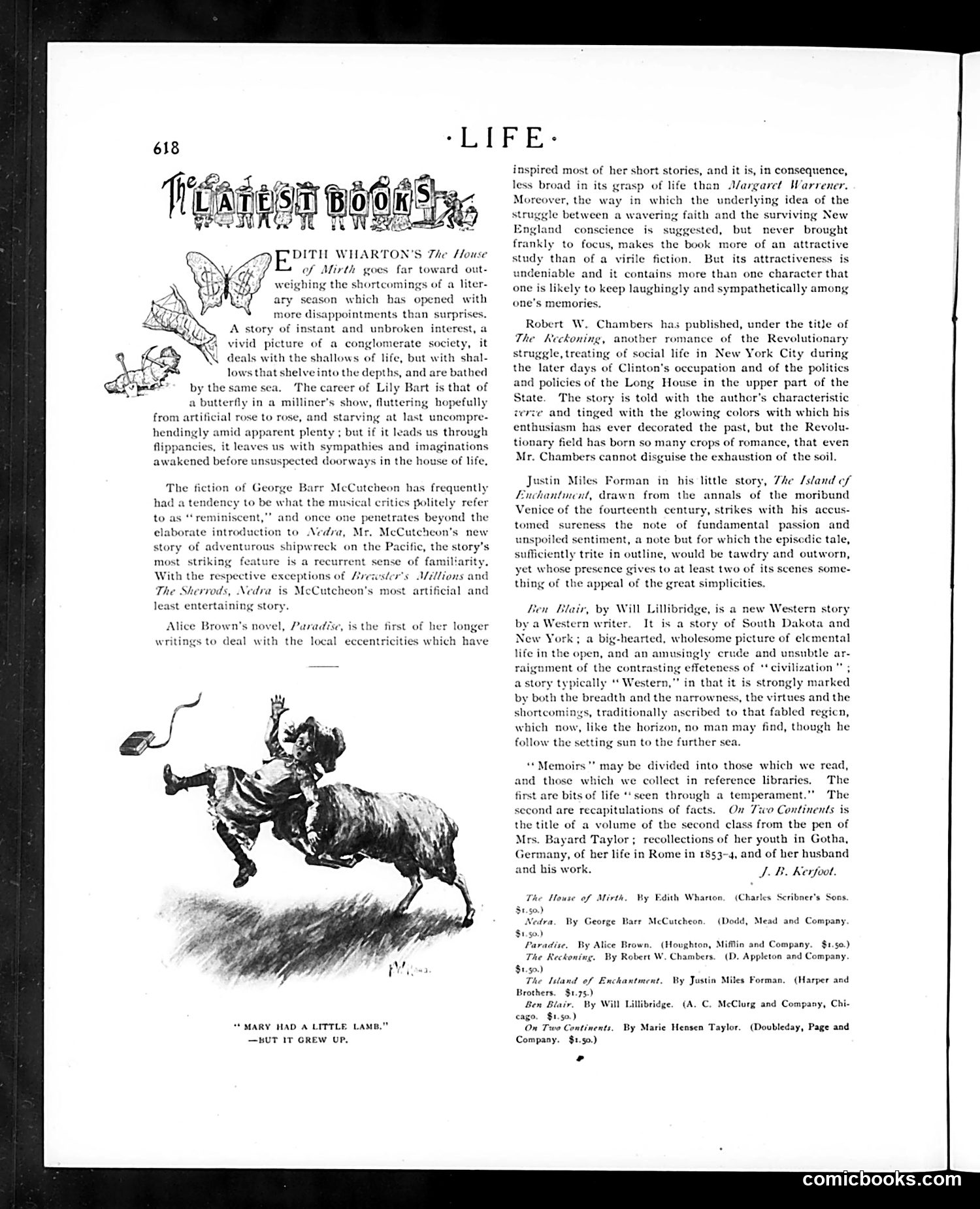
This page from *Life* magazine (a satirical publication, not the photojournalism magazine of later decades) reviews several contemporary novels. The cartoon caption—"MARY HAD A LITTLE LAMB, BUT IT GREW UP"—accompanies an illustration of a grown sheep bucking wildly, likely satirizing how childhood innocence transforms into chaotic adulthood. The reviews discuss literary works by prominent early-20th-century authors including Edith Wharton's *The House of Mirth*, George Barr McCutcheon's *Nedra*, and others. The critics praise Wharton's novel while expressing skepticism about McCutcheon's tendency toward derivative storytelling and exhausted subject matter (the Revolutionary War having been "mined" by too many romance writers). The tone is sophisticated literary criticism aimed at educated readers familiar with contemporary fiction and cultural debates about artistic merit versus commercial appeal.
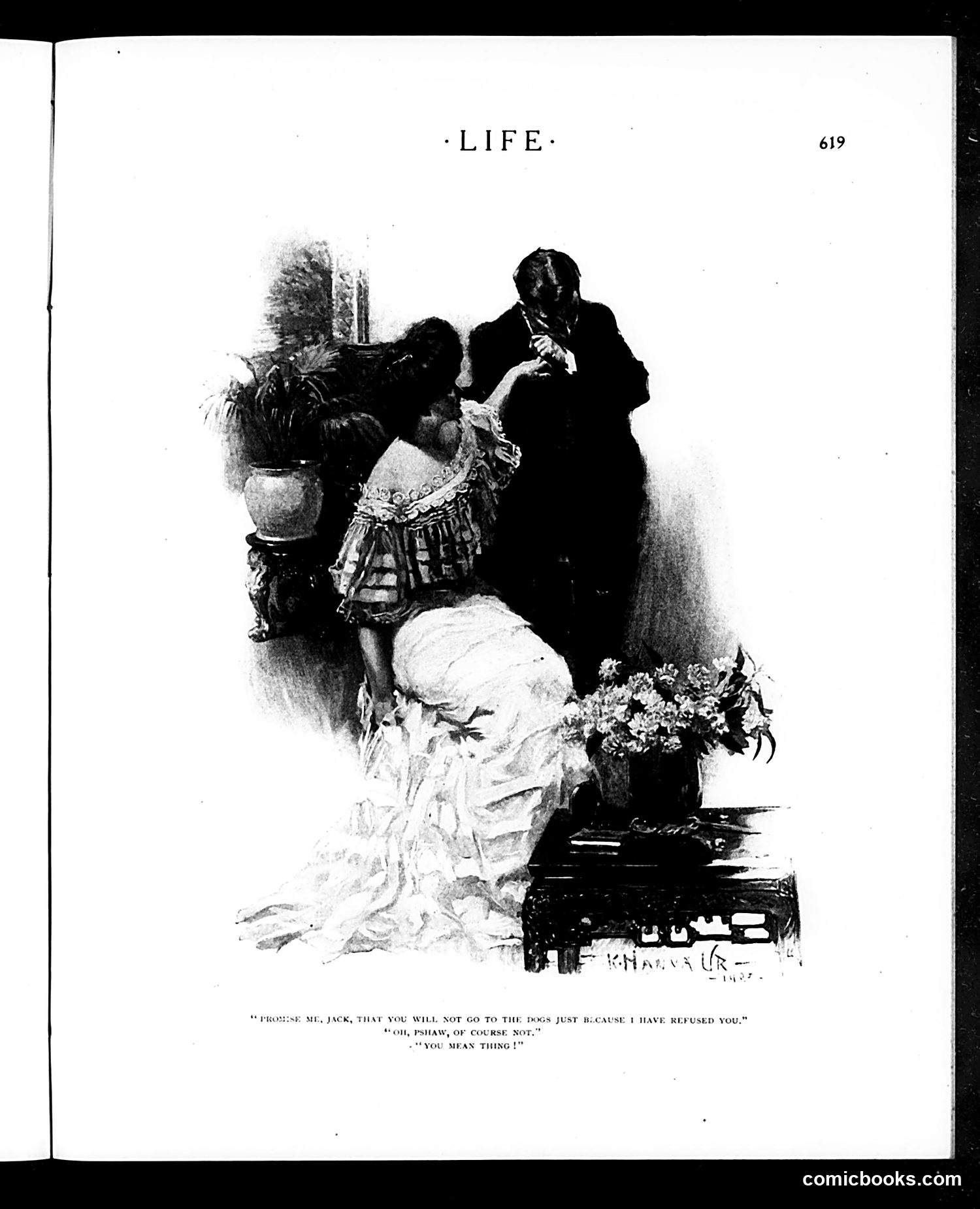
This is a satirical illustration depicting a romantic quarrel between a well-dressed couple. The woman, in an elegant white wedding or formal dress, has apparently rejected the man's proposal or romantic advances. She extracts a promise that he won't "go to the dogs" (degenerate or ruin himself) due to her refusal. His casual response—"of course not"—suggests indifference to her rejection, which she finds insulting. Her final retort, "You mean thing!", expresses mock outrage at his apparent lack of concern for her decision. The satire targets both romantic pretension and gender dynamics of the era, mocking the melodramatic expectations women might have about their romantic power over men, while also poking fun at male emotional detachment. The cartoon plays on period conventions of courtship and wounded pride.
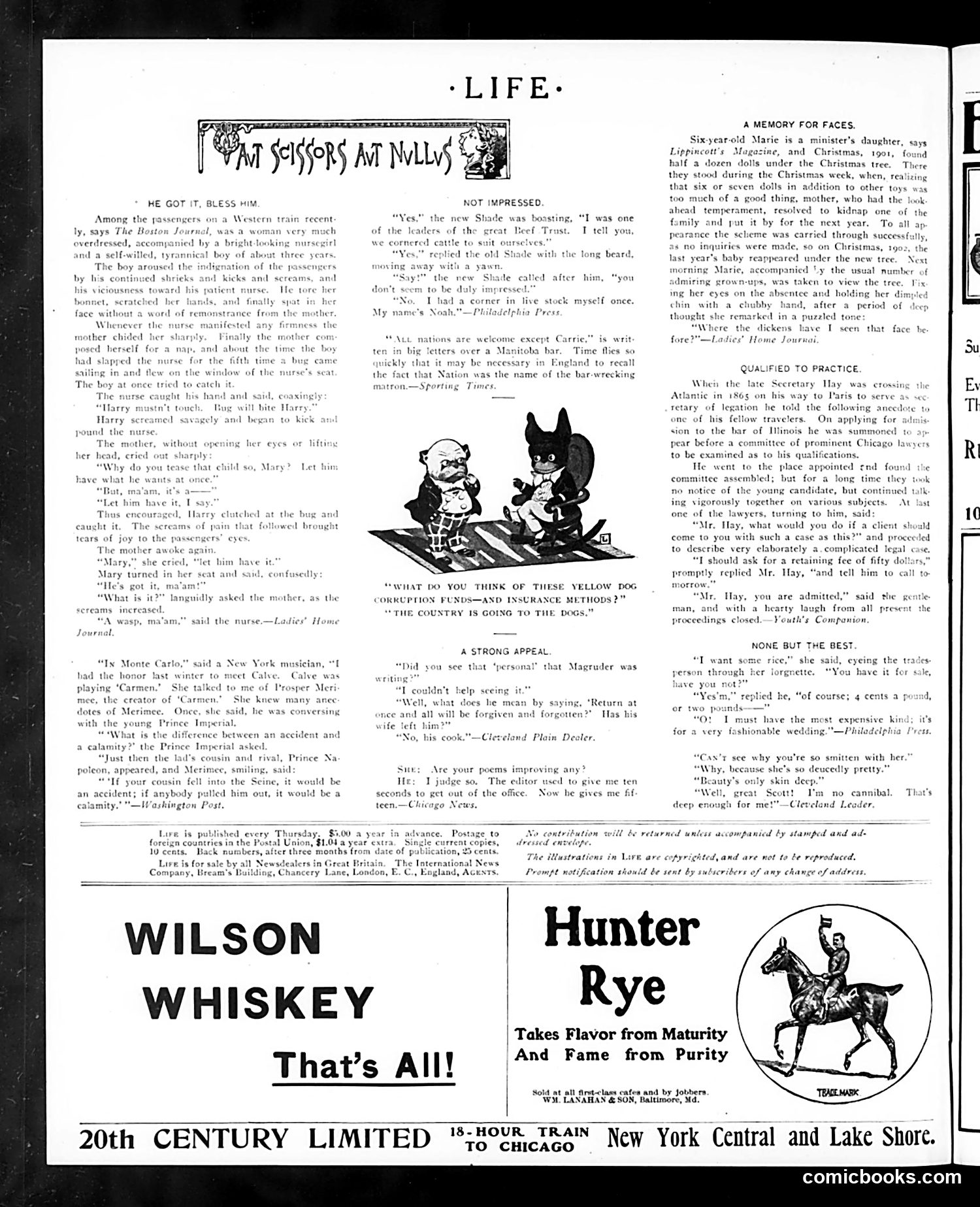
This page from *Life* magazine contains several humorous anecdotes and satirical commentary typical of early 1900s American humor: **Main Cartoon:** The illustration shows two figures (appearing to be politicians or public figures) discussing "yellow dog corruption funds and insurance methods," with one responding "the country is going to the dogs." This references the era's widespread scandals involving corporate corruption and insurance fraud—major Progressive Era concerns. **Anecdotes:** The page features several short stories mocking human vanity and pretension: a spoiled child, a boastful train passenger exaggerating his business importance, and Secretary of State John Hay's encounter with Chicago lawyers testing his qualifications. These reflect *Life*'s satirical focus on American social behavior. **Advertisements:** Wilson Whiskey and Hunter Rye ads appear at bottom—typical period alcohol marketing. The overall tone is lighthearted social satire rather than sharp political critique, targeting everyday human foibles and contemporary business scandals.
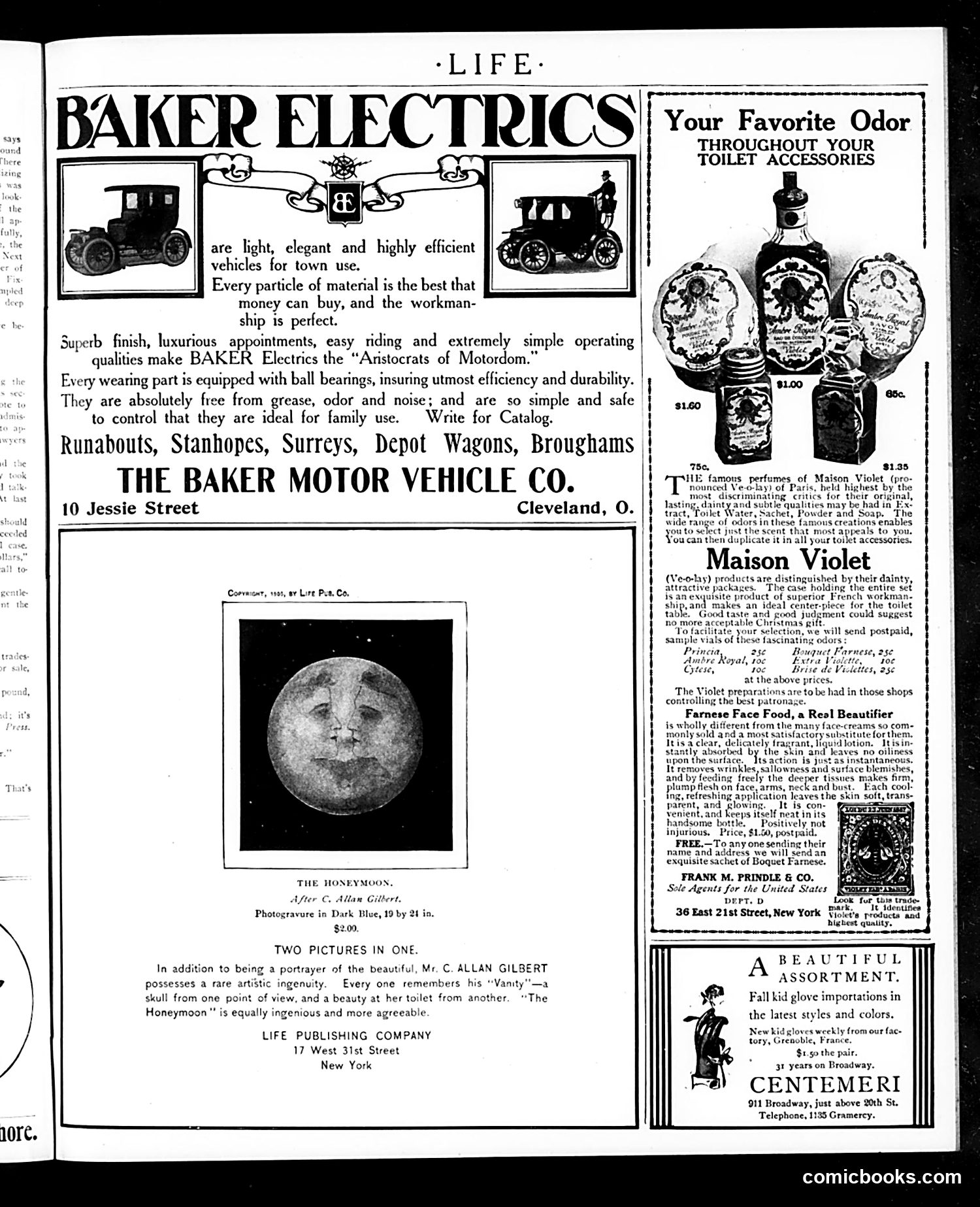
This is primarily an **advertising page** rather than satirical content. It features: **Main Content:** - A Baker Motor Vehicle Company advertisement showcasing early electric automobiles ("Aristocrats of Motordom"), positioned as luxury town cars - A reproduction of C. Allan Gilbert's artwork "The Honeymoon"—described as a clever dual-image picture (like his famous "Vanity" skull/beauty composite) **Social Context:** The page reflects early 1900s consumer culture. Electric cars were marketed as refined, odor-free alternatives to gasoline vehicles—appealing to wealthy urbanites. The supporting advertisements (Maison Violet perfume, Centemeri gloves, face cream) target affluent consumers, particularly women, emphasizing luxury French products. **The Gilbert artwork** uses optical illusion—viewing it differently reveals two scenes, though the specific imagery isn't clear in this reproduction. There is **no political satire** visible here; this is commercial content aimed at Life's upscale readership.
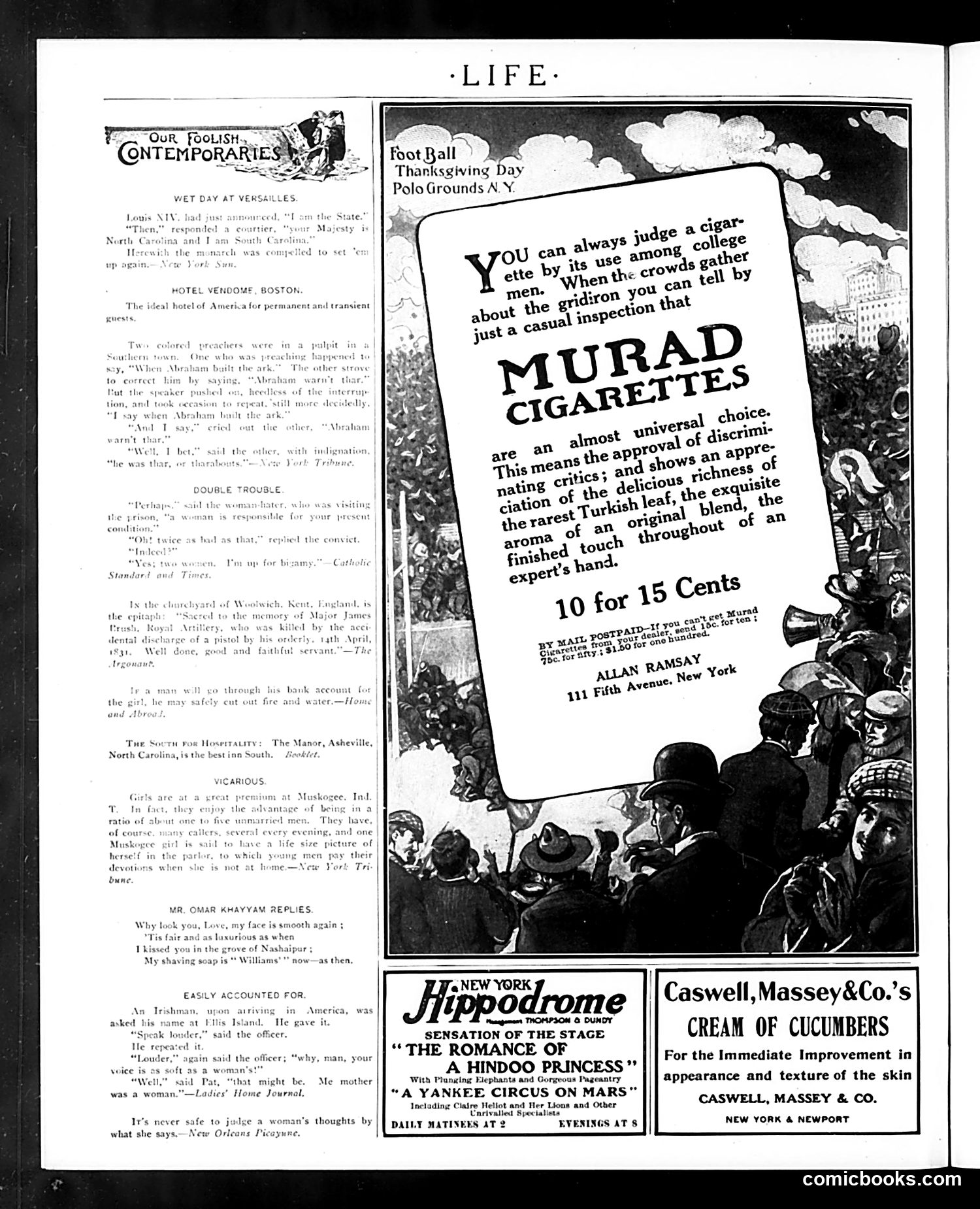
This page mixes satirical commentary with period advertising. The left column contains humorous anecdotes labeled "Our Foolish Contemporaries"—brief social jokes poking fun at everyday absurdities (a wet day at Versailles, hotel confusion, preacher mishaps). These mock human folly without targeting specific individuals. The dominant right-side advertisement for **Murad Cigarettes** reflects early 20th-century marketing before smoking health risks were widely acknowledged. It claims cigars signal "discrimination" and "appreciation," using pseudo-intellectual language to sell tobacco to educated men. Below are ads for the Hippodrome theater (featuring exotic spectacles like "A Hindoo Princess") and Caswell, Massey & Co.'s "Cream of Cucumbers" beauty product—typical period consumer goods. The page reflects pre-WWI American life: casual ethnic stereotyping ("Hindoo"), unregulated tobacco marketing, and status-conscious consumerism. The "foolish contemporaries" section gently satirizes everyday social pretension rather than political figures.
This page is **primarily advertisements** interspersed with brief humorous anecdotes, typical of early 20th-century Life magazine format. **The jokes** are genteel social humor: - "She Knew Him": A lady admits she knows the architect of the church's nave (a pun—"nave" sounds like "knave") - A Chicago man forges a laundry check - A wealthy man condescends to a poor acquaintance, claiming poverty no longer excuses social inferiority - A farmer on a train, annoyed by a lady's lavender salts masking a glue factory's stench, demands she cork her bottle **The advertisements** include whiskey (Gibsons, Old Crow, Sanderson's Mountain Dew), ale, and transportation. Notably, whiskey is marketed "for the use of invalids and Connoisseurs"—reflecting pre-Prohibition era attitudes where alcohol held medicinal legitimacy. The page contains no political cartoons or caricatures. It's a snapshot of genteel American commercial culture and gentle, class-conscious humor from the early 1900s.
This page is primarily **advertisements** interspersed with short humor pieces, typical of Life magazine's format. The notable content includes: **"Queer Uses of the Telephone"** — A satirical piece mocking clergy who used telephones to deliver sermons and prayers remotely, treating the new technology as a substitute for in-person spiritual guidance. The humor mocks both the novelty of telephone technology and overzealous evangelists. **"Where It Belonged"** — A brief joke about an amateur female writer submitting a story to a magazine. When rejected, the editor sarcastically advises her to put the manuscript "with the other irons in the fire"—a dismissive put-down suggesting her writing belongs in the fireplace, not in print. This reflects period attitudes about women's intellectual contributions. The remaining content consists of advertisements for financial services (banks, trust companies), consumer goods (soap, water crackers, coats, collars), reflecting the magazine's business-focused readership and the commercial landscape of early 20th-century America.
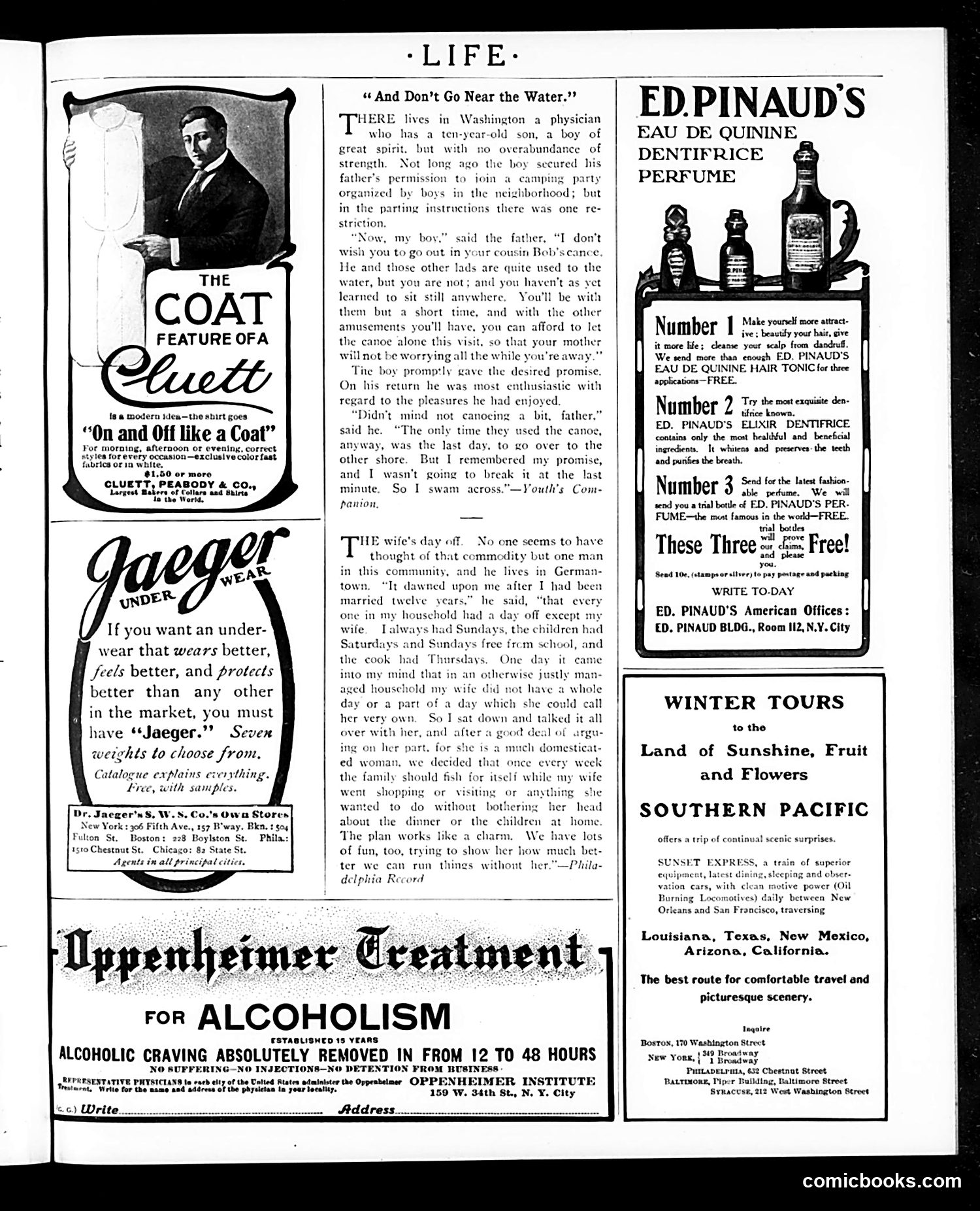
This page contains three distinct elements: a moral anecdote, humorous domestic stories, and period advertisements. **The Main Cartoon/Stories:** The page features two short humorous narratives typical of *Life*'s content: 1. **"And Don't Go Near the Water"** - A father's cautionary tale about a sickly ten-year-old boy who promises not to canoe despite peer pressure. The boy keeps his word by swimming across a river instead, demonstrating obedience and character. 2. **"The Wife's Day Off"** - A Germantown man realizes after twelve years of marriage that his wife has no day off, unlike everyone else in the household. He gives her one weekly day of complete freedom, improving their marriage. **The Point:** These are gentle, moralistic stories emphasizing family values, parental wisdom, and domestic compromise—typical of early 20th-century *Life* magazine's satirical but ultimately wholesome humor. **The Advertisements:** The surrounding ads (Cluett shirt, Jaeger underwear, Ed. Pinaud's perfume/hair tonic, Oppenheimer alcoholism treatment, Southern Pacific railroad tours) reflect period consumer culture and medical claims that would be considered dubious today.
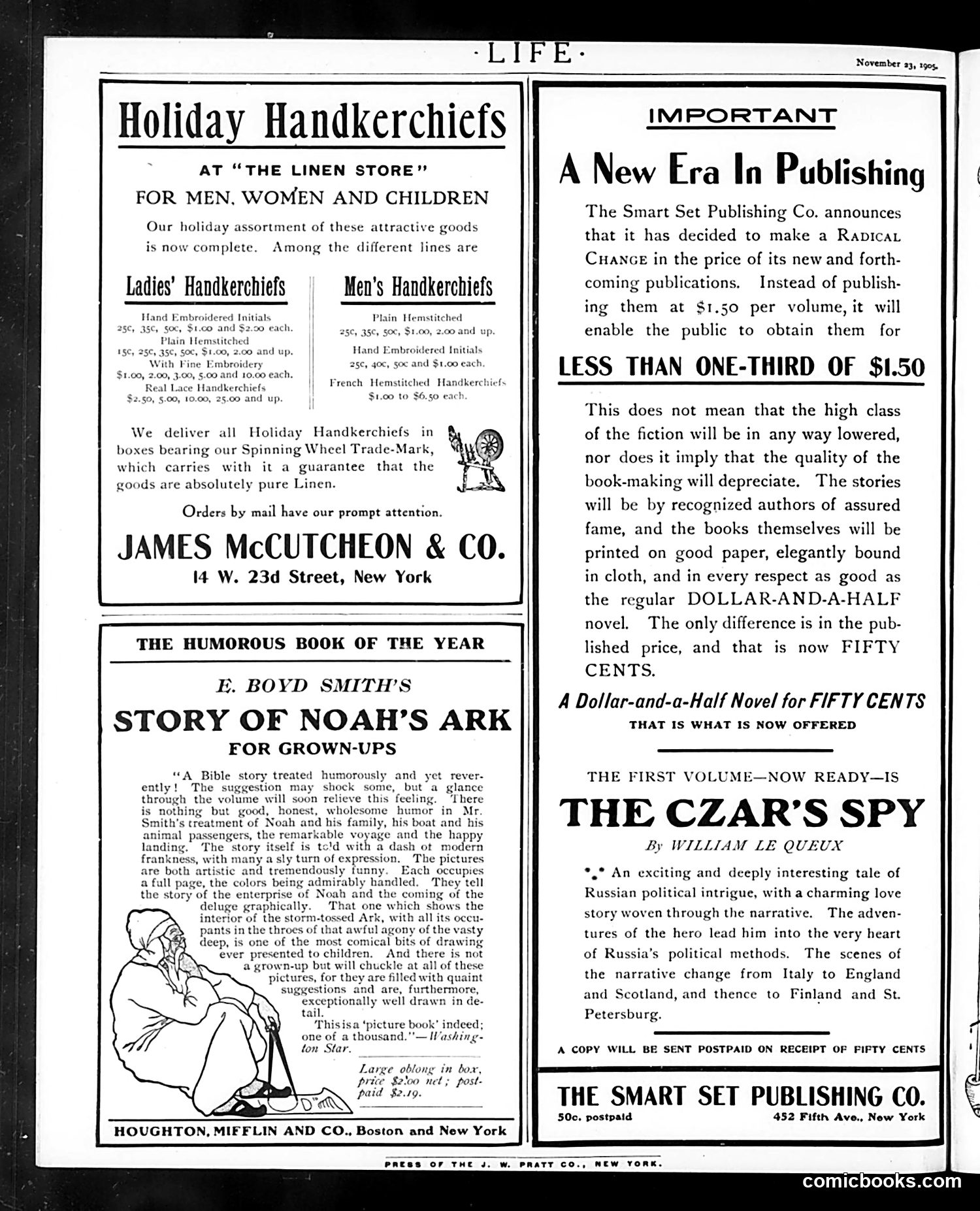
This page is primarily **advertising**, not satire or political commentary. It contains three main advertisements: 1. **James McCutcheon & Co.** sells luxury holiday handkerchiefs for men, women, and children, emphasizing pure linen quality and mail delivery. 2. **E. Boyd Smith's *Story of Noah's Ark* (for grown-ups)** — a humorous illustrated book treating the Biblical flood narrative comedically. The small cartoon shows a figure examining the ark's interior. The ad claims it's witty, wholesome humor appreciated even by *Washington Star* critics. 3. **The Smart Set Publishing Co.** announces a radical pricing shift: selling quality novels by "recognized authors" at **fifty cents instead of $1.50**—democratizing access to respectable fiction. Their first release is *The Czar's Spy* by William Le Queux, a spy thriller involving Russian political intrigue. The page reflects early-1900s consumer culture and the publishing industry's effort to expand readership through affordable pricing—a genuinely newsworthy business development for the era.