
Life, 1905-11-23 · page 12 of 22
Life — November 23, 1905 — page 12: what you’re looking at
What you’re looking at
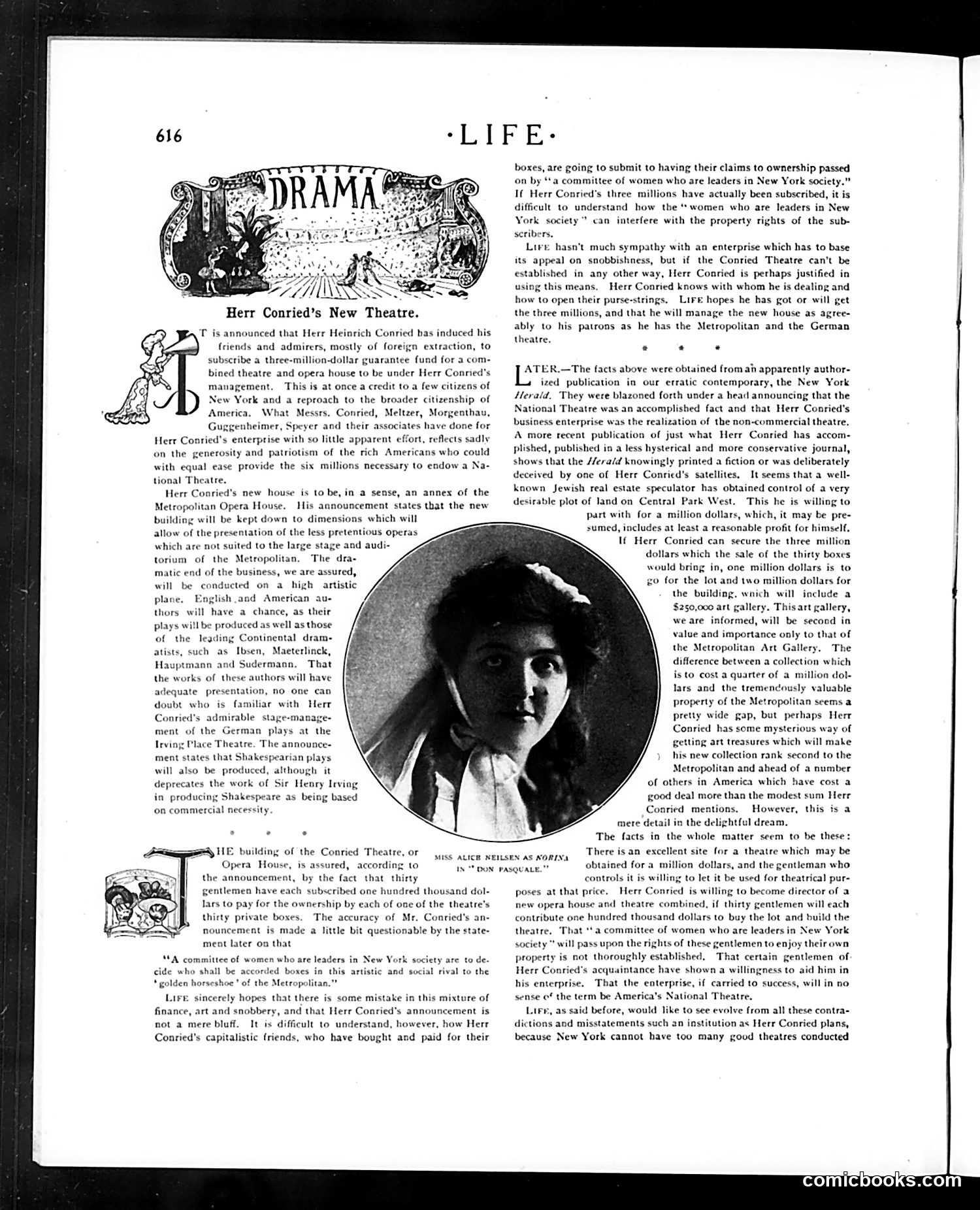
This page discusses Heinrich Conried's plan to build a new theater in New York. The decorative header features a "DRAMA" banner with theatrical imagery. The article describes Conried's ambition to establish a combined theater and opera house, noting he seeks funding from wealthy New York patrons. A portrait photograph (labeled "MISS ALICE NIELSEN AS NORMA IN DON PASQUALE") appears to illustrate theatrical talent. The satire targets the financing scheme: Conried is soliciting thirty gentlemen to each contribute one thousand dollars, promising they'd collectively own the theater. Life expresses skepticism about whether this enterprise genuinely represents "America's National Theatre" or merely Conried's commercial venture. The piece gently mocks both Conried's grandiose ambitions and wealthy New Yorkers' susceptibility to such appeals.
📄 Transcribed text from this page (OCR, searchable)
Machine-transcribed from the original scan — historical spelling and the odd misread are preserved.
Herr Conried’s New Theatre. T is announced that Herr Heinrich Conried bas induced his friends and admirers, mostly of foreign extraction, to subscribe a three-million-dollar guarantee fund for a com- bined theatre and opera house to be under Herr Conried’s management. This is at once a credit to a few citizens of New York and a reproach to the broader citizenship of America, What Messrs. Conried, Meltzer, Morgenthau, Guggenheimer, Speyer and their associates have done for Herr Conried’s enterprise with so little apparent effort, reflects sadly on the generosity and patriotism of the rich Americans who could with equal ease provide the six millions necessary to endow a Na- tional Theatre. Herr Conried’s new house is to be, in a sense, an annex of the Metropolitan Opera House. His announcement states that the new building will be kept down to dimensions which will allow of the presentation of the less pretentious operas which are not suited to the large stage and audi- torium of the Metropolitan, The dra- matic end of the business, we are assured, will be conducted on a high artistic plane. English and American aus thors will have a chance, as their plays will be produced as well as those of the leading Continental dram- Maeterlinck, Hauptmann and Sudermann, That the works of these authors will have adequate presentation, no one can atists, such as. Ibsen, doubt who is familiar with Herr Conried’s admirable stage-man; ment of the German plays at the Irving Place Theatre. The announces ment states that Shakespearian plays will also be produced, although it deprecates the work of Sir Henry Irving in producing Shakespeare as being based ‘on commercial necessity YHE building of the Conried Theatre, or Opera House, is assured, according to the announcement, by the fact that thirty gentlemen have each subscribed one hundred thousand dol- lars to pay for the ownership by each of one of the theatre's thirty private boxes, The accuracy of Mr. Conried’s an- nouncement is made a little bit questionable by the state- ment later on that “*A committee of women who are leaders in New Y. cide who shall be acco: ic and social rival to the society are to de- d boxes in this ar olden horseshoe ' of the Metropolitan.” Lire sincerely hopes that there is some mistake in this mixture of finance, art and snobbery, and that Herr Conried’s announcement is not a mere bluff. It is difficult to understand, however, how Herr Conried’s capitalistic friends, who have bought and paid for their MISS ALICE NEILSEN AS NORINA SN “DON PASQUALE.” boxes, are going to submit to having their claims to ownership passed on by ‘a committee of women who are leaders in New York society.” If Herr Conried’s three millions have actually been subscribed, it is difficult to understand how the “women who are leaders in New York society” can interfere with the property rights of the sub- scribers, Lire. hasn't much sympathy with an enterprise which has to base its appeal on snobbishness, but if the Conried Theatre can’t be established in any other way, Herr Conried is perhaps justified in using this means. Herr Conried knows with whom he is dealing and how to open their purse-strings. LIre hopes he has got or will get , and that he will manage the new house as agree- ably to his patrons as he has the Metropolitan and the German theatre, the three millio TER.—The facts above were obtained from ah apparently author- ized publication in our erratic contemporary, the New York Herald, They were blazoned forth under a head announcing that the National Theatre was an accomplished fact and that Herr Conried's business enterprise was the realization of the non-commercial theatre. A more recent publication of just what Herr Conried has accom- plished, published in a less hysterical and more conservative journal, shows that the //era/d knowingly printed a fiction or was deliberately deceived by one of Herr Conried’s satellites, It seems that a well known Jewish real estate speculator has obtained control of a very desirable plot of land on Central Park West. This he is willing to part with for a million dollars, which, it may be pre= sumed, includes at least a reasonable profit for himself, I Herr Conried can secure the three million dollars which the sale of the thirty boxes would bring in, one million dollars is to <0 for the lot and two million dollars for the building, wich will include a $250,000 art gallery. This art gallery, we are informed, will be secood in value and importance only to that of the Metropolitan Art Gallery. The difference between a collection which is to cost a quarter of a million dol- lars and the tremendously valuable property of the Metropolitan seems a pretty wide gap, but perhaps Herr Conried has some mysterious way of getting art treasures which will make his new collection rank second to the Metropolitan and ahead of a number of others in America which have cost a good deal more than the modest sum Herr Conried mentions. mete detail in the delightful dream, The facts in the whole matter seem to be these: There is an excellent site for a theatre which may be obtained fora million dollars, and the gentleman who controls it is willing to let it be used for theatrical pur- However, this is a poses at that price. Herr Conried is willing to become director of a new opera house and theatre combined, if thirty gentlemen will each contribute one hundred thousand dollars to buy the lot and build the theatre. That ‘1a committee of women who are leaders in New York society" will pass upon the rights of these gentlemen to enjoy theirown property is not thoroughly established, That certain gentlemen of Herr Conried’s acquaintance have shown a willingness to aid him in his enterprise. That the enterprise, if carried to success, will in no sense of the term be America’s National Theatre, Lire, as said before, would like to see evolve from all these contra- dictions and misstatements such an institution as Herr Conried plans, because New York cannot have too many good theatres conducted