
Life, 1905-11-23 · page 14 of 22
Life — November 23, 1905 — page 14: what you’re looking at
What you’re looking at
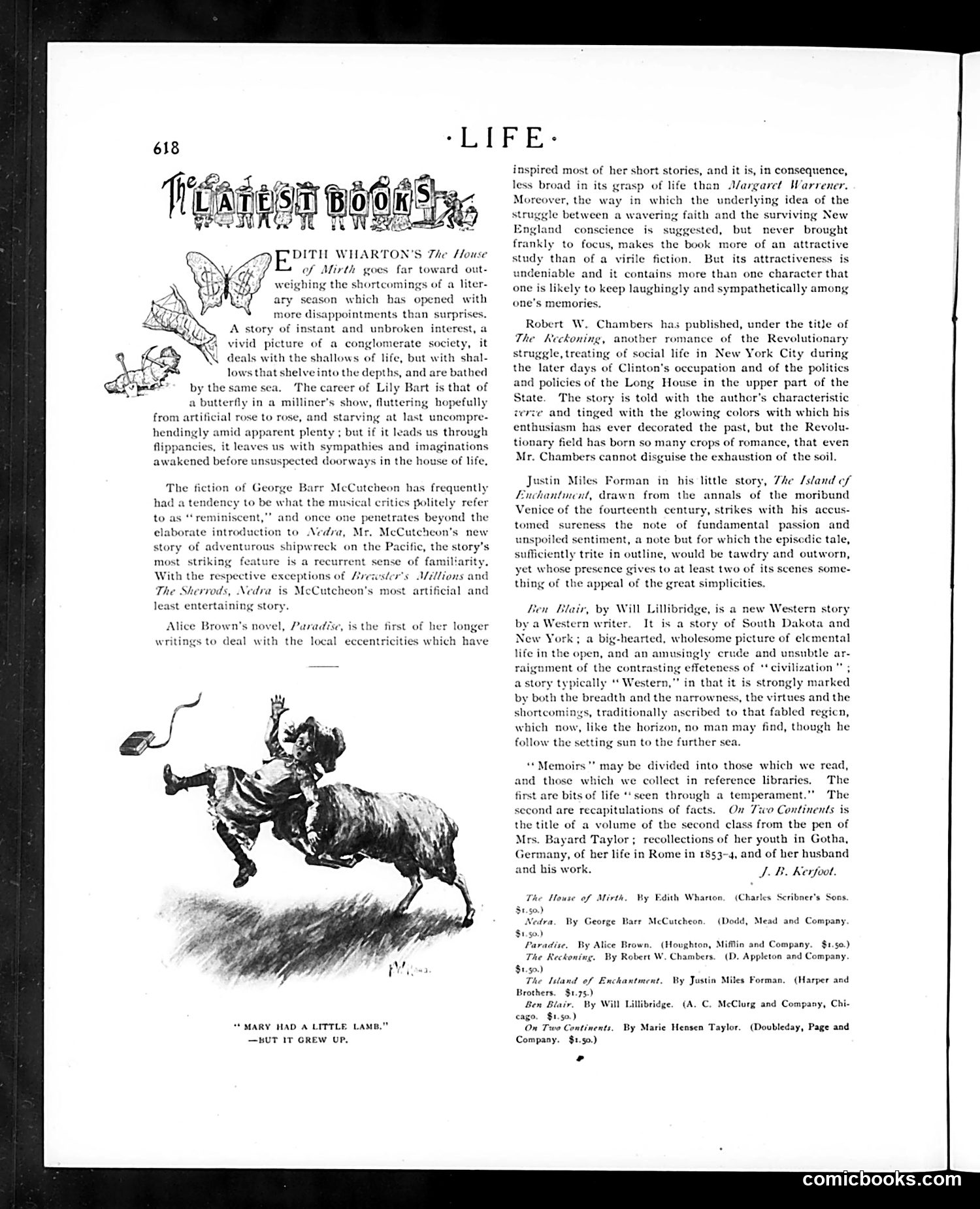
This page from *Life* magazine (a satirical publication, not the photojournalism magazine of later decades) reviews several contemporary novels. The cartoon caption—"MARY HAD A LITTLE LAMB, BUT IT GREW UP"—accompanies an illustration of a grown sheep bucking wildly, likely satirizing how childhood innocence transforms into chaotic adulthood. The reviews discuss literary works by prominent early-20th-century authors including Edith Wharton's *The House of Mirth*, George Barr McCutcheon's *Nedra*, and others. The critics praise Wharton's novel while expressing skepticism about McCutcheon's tendency toward derivative storytelling and exhausted subject matter (the Revolutionary War having been "mined" by too many romance writers). The tone is sophisticated literary criticism aimed at educated readers familiar with contemporary fiction and cultural debates about artistic merit versus commercial appeal.
📄 Transcribed text from this page (OCR, searchable)
Machine-transcribed from the original scan — historical spelling and the odd misread are preserved.
“LIFE: Beir WHARTON'S The House of Mirth goes far toward out- weighing the shortcomings of a liter- ary season which has opened with more disappointments than surprises. A story of instant and unbroken interest, a vivid picture of a conglomerate society, it deals with the shallows of life, but with sha lows that shelve into the depths, and are bathed by the same sea. The career of Lily Bart is that of a butterfly in a milliner’s show, fluttering hopefully from artificial rose to rose, and starving at last uncompre- hendingly amid apparent plenty ; but if it leads us through flippancies, it leaves us with sympathies and imaginations awakened before unsuspected doorways in the house of life, xe Barr McCutcheon has frequently had a tendency to be what the musical critics politely refer to as “reminiscent,” and once one penetrates beyond the elaborate introduction to Vedra, Mr. McCutcheon’s new story of adventurous shipwreck on the Pacific, the story's most striking feature is a recurrent sense of familiarit With the respective exceptions of Brewster's Millions and The Sherrods, Nedra is McCutcheon's most artificial and least entertaining sto Alice Brown's novel, Paradise, is the first of her longer “MARY HAD A LITTLE LAMB,” HUT IT GREW UP. inspired most of her short stories, and it is, in consequence, less broad in its grasp of life than Jargaret Warrener, Moreover, the way in which the underlying idea of the struggle between a wavering faith and the surviving New England conscience is suggested, but never brought frankly to focus, makes the book more of an attractiv study than of a virile fiction. But its attractiveness is undeniable and it contains more than one character that s likely to keep laughingly and sympathetically among one’s memories, Robert W. Chambers has published, under the title of The Neckoning, another romance of the Revolutionary struggle, treating of social life in New York City during the later days of Clinton's occupation and of the politics and policies of the Long House in the upper part of the State. The story is told with the auther’s characteristic and tinged with the glowing colors with which his enthusiasm has ever decorated the past, but the Revolu- tionary field has born so many crops of romance, that ev Mr. Chambers cannot disguise the exhaustion of the soil. Justin Miles Forman in his little story, Zhe /sland ¢ Luchantiuent, drawn from the annals of the moribund Venice of the fourteenth century, strikes with his accus- tomed sureness the note of fundamental passion and unspoiled sentiment, a note but for which the episedic tale, sufficiently trite in outline, would be tawdry and outworn, yet whose presence gives to at least two of its scenes som: thing of the appeal of the great simplicitie: Ben Blair, by Will Lillibridge, is a new Western story by a Western writer. It is a story of South Dakota and New York; a big-hearted, wholesome picture of elemental life in the open, and an amusingly crude and unsubtle ar- raignment of the contrasting effeteness of ** civilization a story typically “Western,” in that it is strongly marked by both the breadth and the narrowness, the virtues and the shortcomings, traditionally ascribed to that fabled regicn, which now, like the horizon, no man may find, though he follow the setting sun to the further sea. ‘*Memoirs " may be divided into those which we read, and those which we collect in reference libraries. The first are bits of life ‘seen through a temperament."”) The second are recapitulations of facts. On Tio Continents is the title of a volume of the second class from the pen of Mrs. Bayard Taylor; recollections of her youth in Gotha, Germany, of her life in Rome in 1853-4, and of her husband and bis work. J.B. Kerfoot. The House of Mirth. Wy Edith Wharton. 50.) Nedra $1.50.) radise. By Alice Brown, (Hovghton, Mifflin and Company. The Reckoning. By Robert W. Chambers. $1.50.) The Istand of Enchantment. By Justin Miles Forman, (Harper and Brothers. $1.75.) Ben Blair. By Will Lillibridge. (A, C. McClurg and Company, Chi- cago. $1.50.) On Two Continents, By Marie Hensen Taylor. (Doubleday, Page and Company. $1.50.) (Charles Scribner's Sons By George Barr McCutcheon. (Dodd, Mead and Company $1.50.) (D. Appleton and Company. ° comicbooks.com