
A complete issue · 26 pages · 1905
Life — November 9, 1905
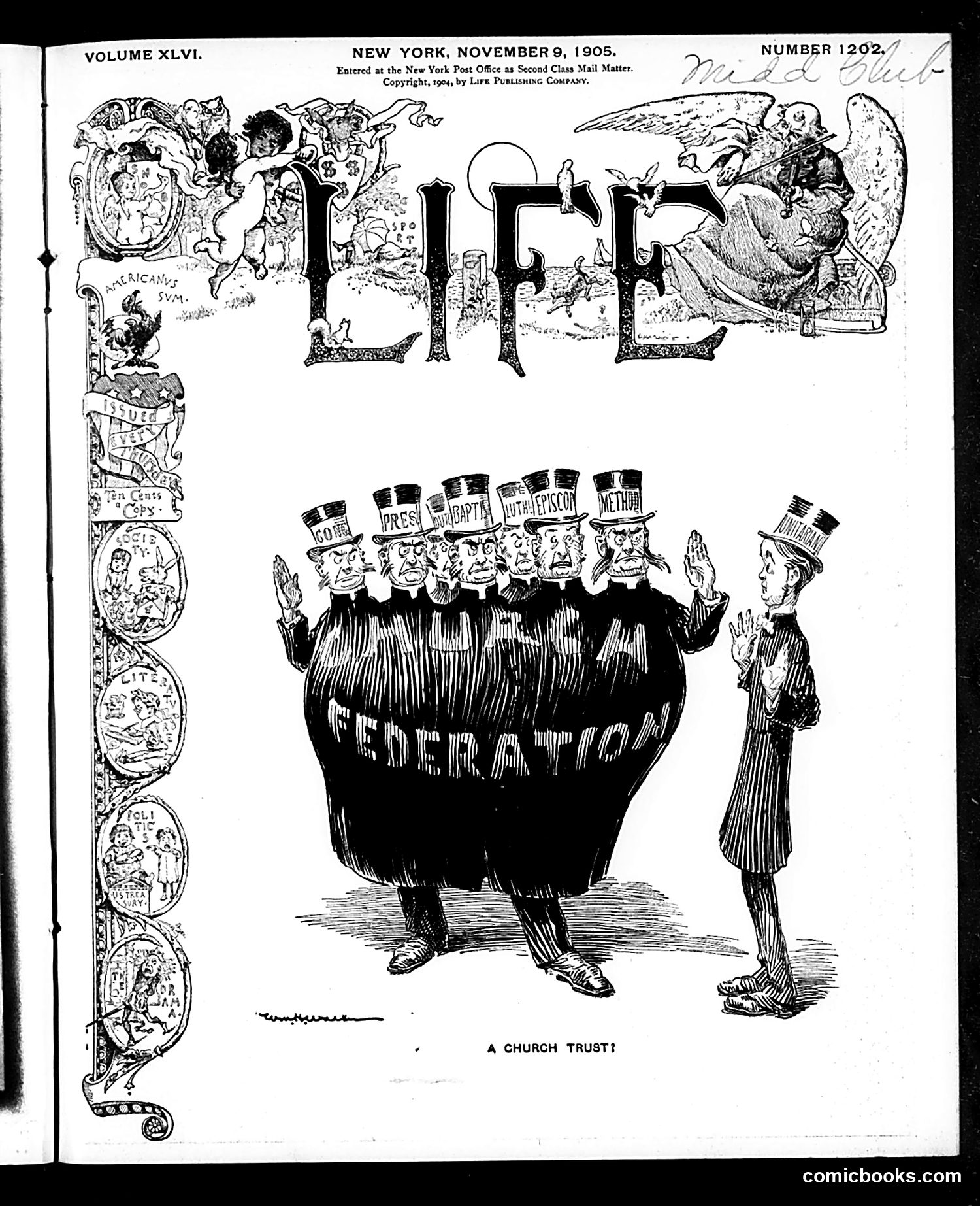
This political cartoon satirizes wealthy church leaders as a corrupt monopoly or "trust"—the era's term for anti-competitive business cartels. Seven clergy figures wearing tall hats labeled with different denominations (Presbyterian, Baptist, Methodist, etc.) are depicted as a single massive entity labeled "FEDERATION," suggesting they've combined to form a unified power bloc. The small figure on the right appears to represent the average citizen or independent observer, gesturing in alarm. The satire criticizes mainline Protestant churches for consolidating institutional power and wealth, equating their coordination with the robber-baron business practices Americans feared. This reflects early 1900s tensions between institutional religion and concerns about concentrated power in American society.
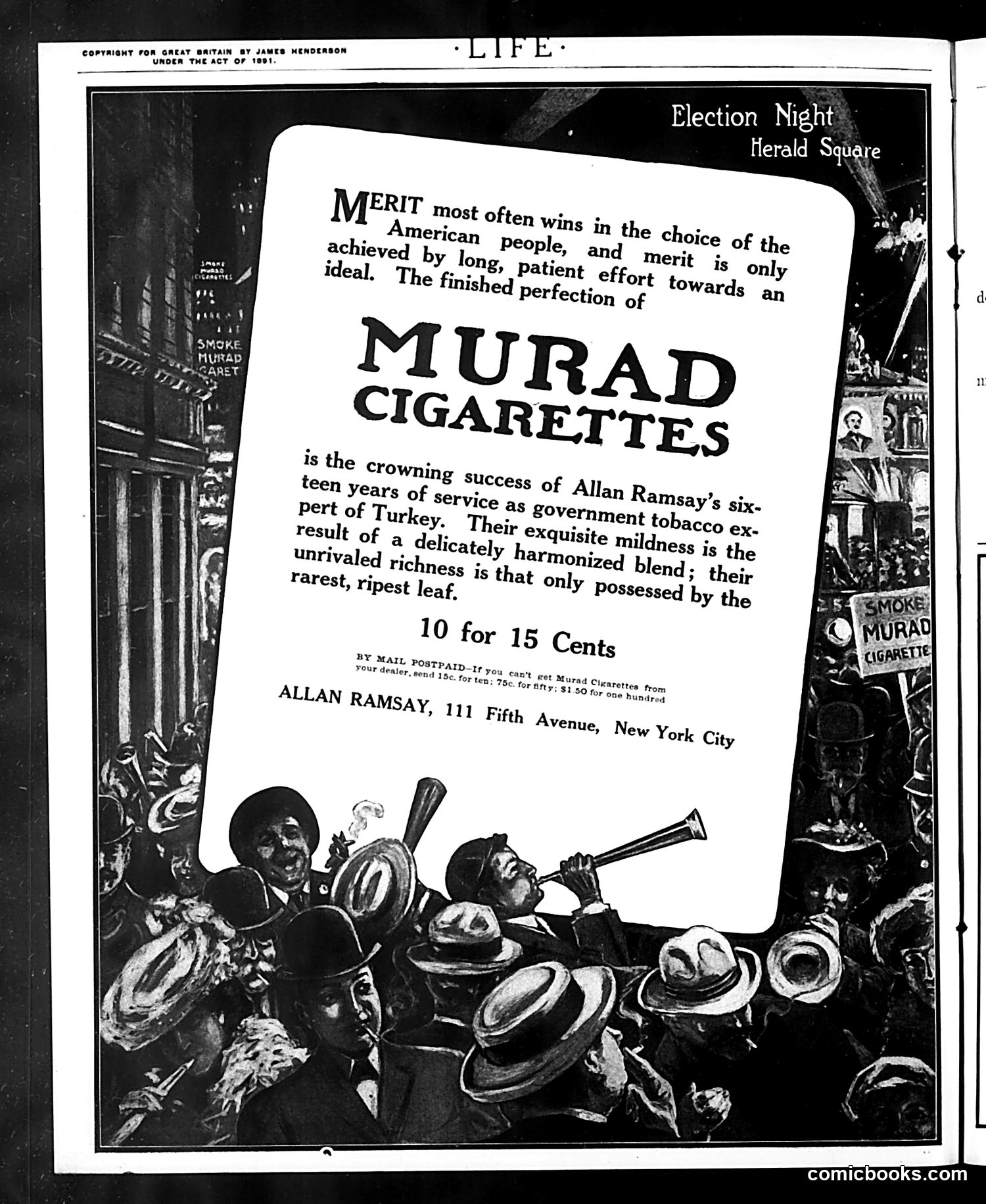
This is a **cigarette advertisement**, not political satire. The page features a Murad Cigarettes ad set in Herald Square on "Election Night," showing a crowd of men in hats gathered around a celebratory scene. The ad uses the election theme metaphorically: just as "merit most often wins in the choice of the American people," Murad claims merit wins consumer preference. The crowded scene depicts citizens celebrating election results, with one man looking through a telescope—possibly suggesting anticipation or observation. The advertisement emphasizes Murad's quality: "delicately harmonized blend" of Turkish tobacco, positioning smoking as a refined, meritorious choice. The price is listed as "10 for 15 Cents," with mail-order details for Allan Ramsay in New York City. This reflects early 20th-century advertising that linked consumer products to civic values and patriotism.
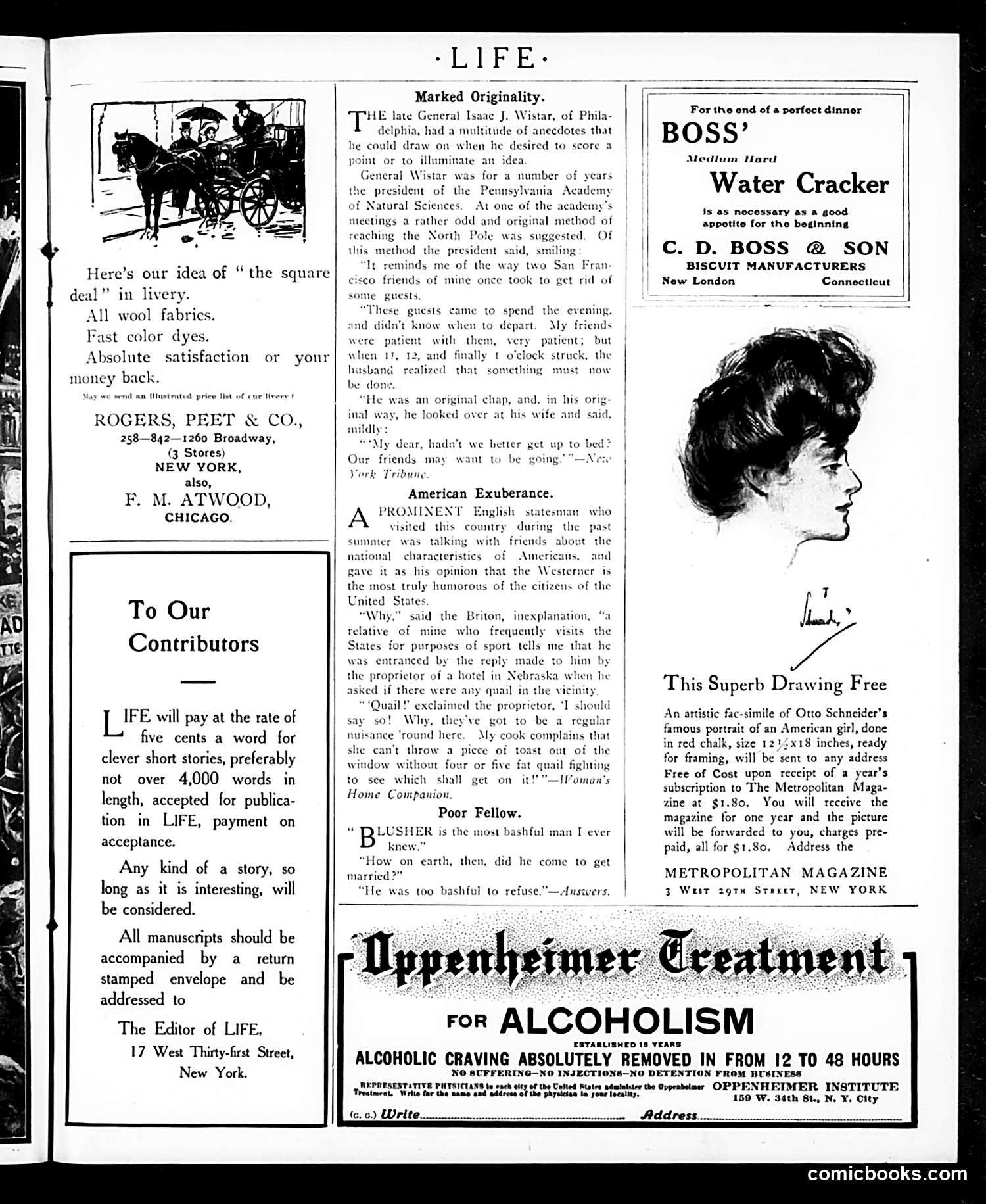
This page consists primarily of **advertisements and editorial notices** rather than political satire or comics. The main content includes: 1. **Livery service ad** (top left): A horse-drawn carriage illustration promoting Rogers, Peet & Co.'s "square deal" in wool fabrics with guaranteed color and satisfaction. 2. **Editorial notice**: Life magazine soliciting short stories from contributors at five cents per word, with submission guidelines. 3. **Portrait drawing offer**: An advertisement for a free Otto Schneider portrait with Metropolitan Magazine subscription. 4. **Oppenheimer Treatment ad** (bottom): A dubious medical advertisement claiming to treat alcoholism by removing "craving" in 12-48 hours—a typical example of early 20th-century quack medicine marketing. The page reflects early 1900s consumer culture and medical pseudoscience rather than political commentary.
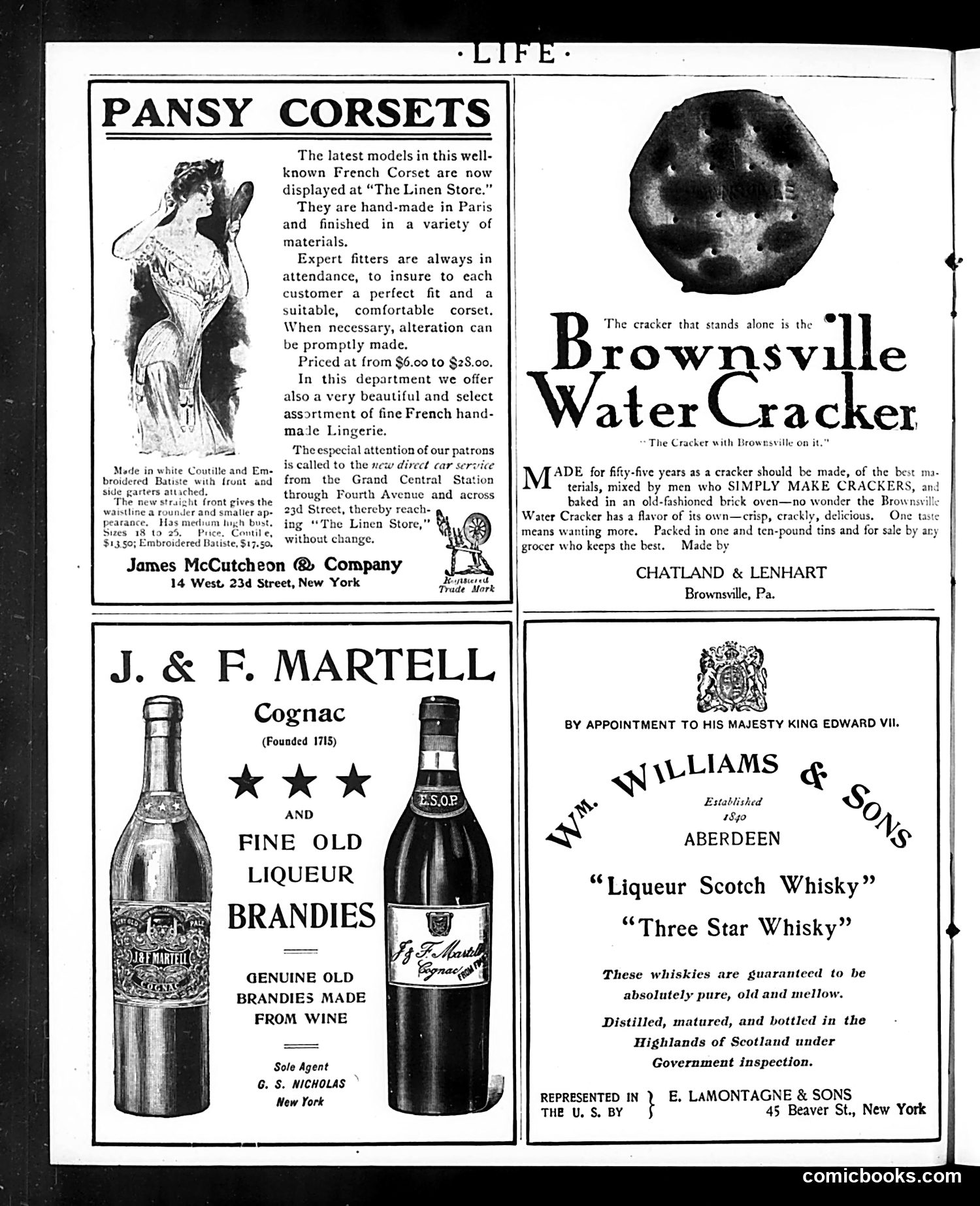
This page is **primarily advertising**, not satirical content. It contains four product advertisements from the early 20th century: 1. **Pansy Corsets** — French corsets sold at "The Linen Store," hand-made in Paris, priced $6-$28, with expert fitters available 2. **Brownsville Water Cracker** — A food product made by Chatland & Lenhardt in Pennsylvania, emphasizing traditional brick-oven baking methods 3. **J. & F. Martell Cognac** — French brandy advertisement featuring three-star and VSOP varieties, sold through G.S. Nicholas in New York 4. **Wm. Williams & Sons** — Scottish whisky distiller (established 1890) advertising "Liqueur Scotch Whisky" and "Three Star Whisky," represented in the U.S. by E. LaMontagne & Sons No political satire or cartoons appear on this page—it's a standard advertising layout typical of early-1900s Life magazine.
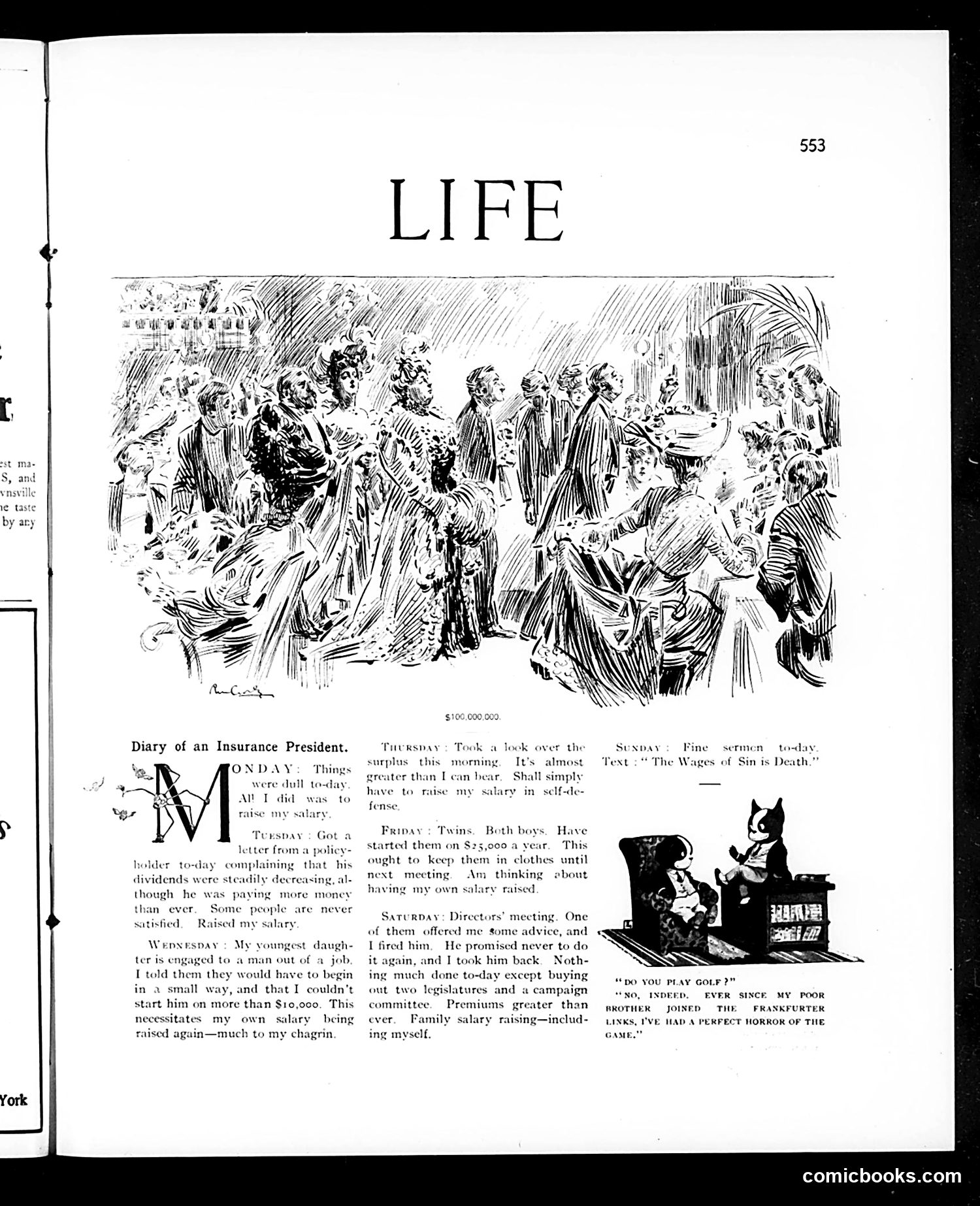
The main illustration depicts a formal social gathering, likely a high-society event or reception. Below it, the "Diary of an Insurance President" satirizes corporate greed through a week's entries where the narrator obsesses over raising his salary despite already earning substantial income and paying employees meager wages ($25,000 annually for twin sons). The satire escalates absurdly—he raises salaries "in self-defense" and involves himself in political corruption (buying "two legislatures and a campaign committee"). The accompanying cartoon shows a cat reading, captioned about golf and a "poor brother" joining "frankfurter links," mocking upper-class leisure pursuits versus working-class struggles. Both pieces critique 1920s-era executive excess, income inequality, and corporate moral bankruptcy during an era of significant economic disparity.
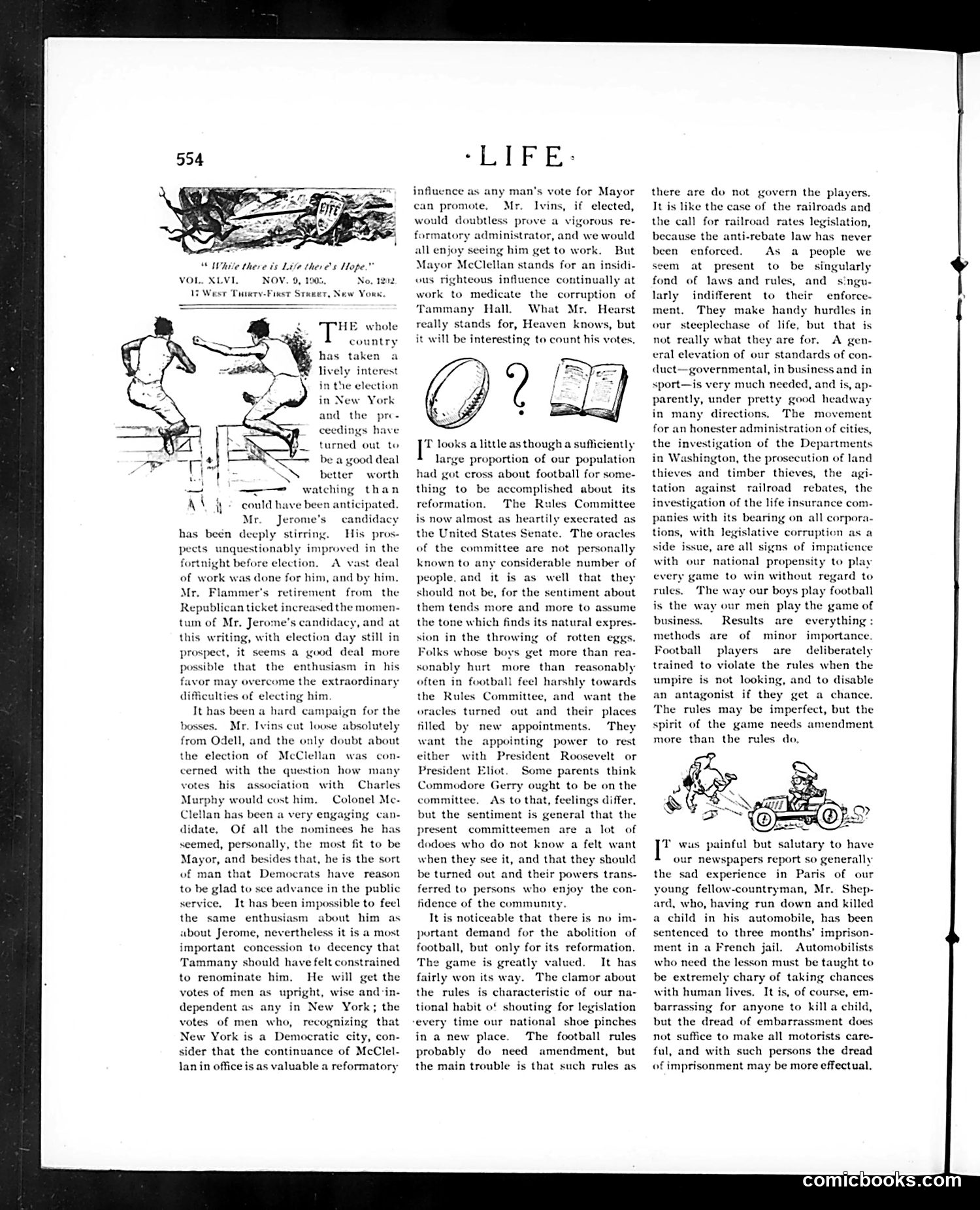
This *Life* magazine page (November 9, 1902) contains editorial commentary on New York elections, particularly regarding candidate selection and the influence of political figures like Mr. Jerome and Mr. Ivins. The cartoon at top left shows two figures in athletic/wrestling poses, illustrating the contentious political struggle. The text discusses concerns about political corruption, administrative fitness, and the "Tammany Hall" machine—the Democratic political organization notorious for graft. The lower cartoon depicts figures with an early automobile, likely satirizing modern progress or speed in political maneuvering. The overall tone criticizes political manipulation, the power of party machines over actual governance, and questions whether elected officials will genuinely serve the public interest rather than factional interests.
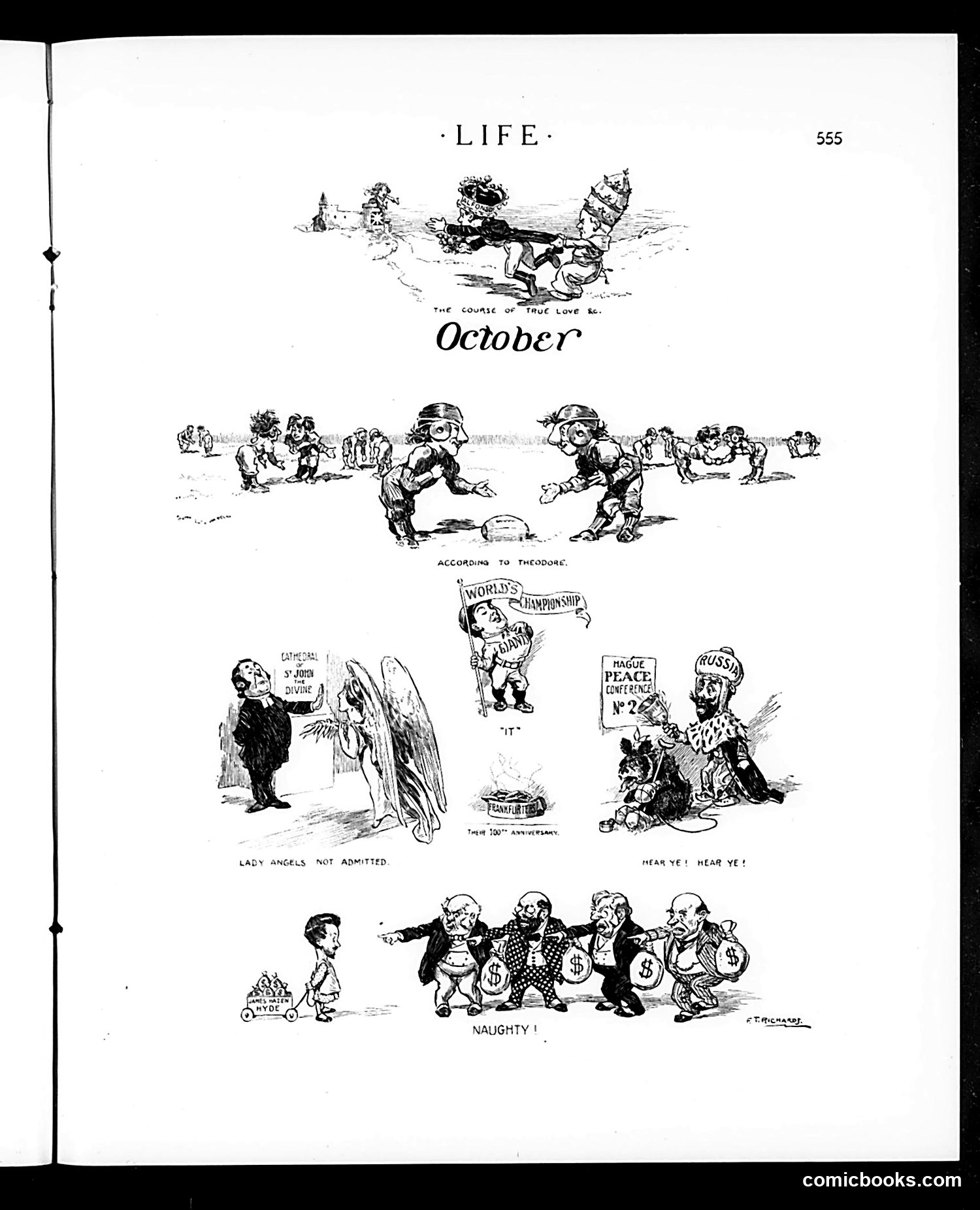
This page presents October-themed satirical cartoons. The top shows children engaged in "true love," while the middle section depicts baseball ("According to Theodore"), referencing Theodore Roosevelt's known enthusiasm for sports. Lower cartoons address contemporary issues: "Lady Angels Not Admitted" appears to critique religious hypocrisy; "World's Championship" likely refers to boxing or sports; the "Hague Peace Conference No. 2" cartoon satirizes international diplomacy efforts; and "Hear Ye! Hear Ye!" accompanies what appears to be political commentary. The bottom cartoon, labeled "Naughty!" shows figures with money bags, apparently criticizing financial corruption or wealthy profiteering—a common Progressive Era target. The cartoons reflect early 1900s American social and political concerns through humorous visual commentary.
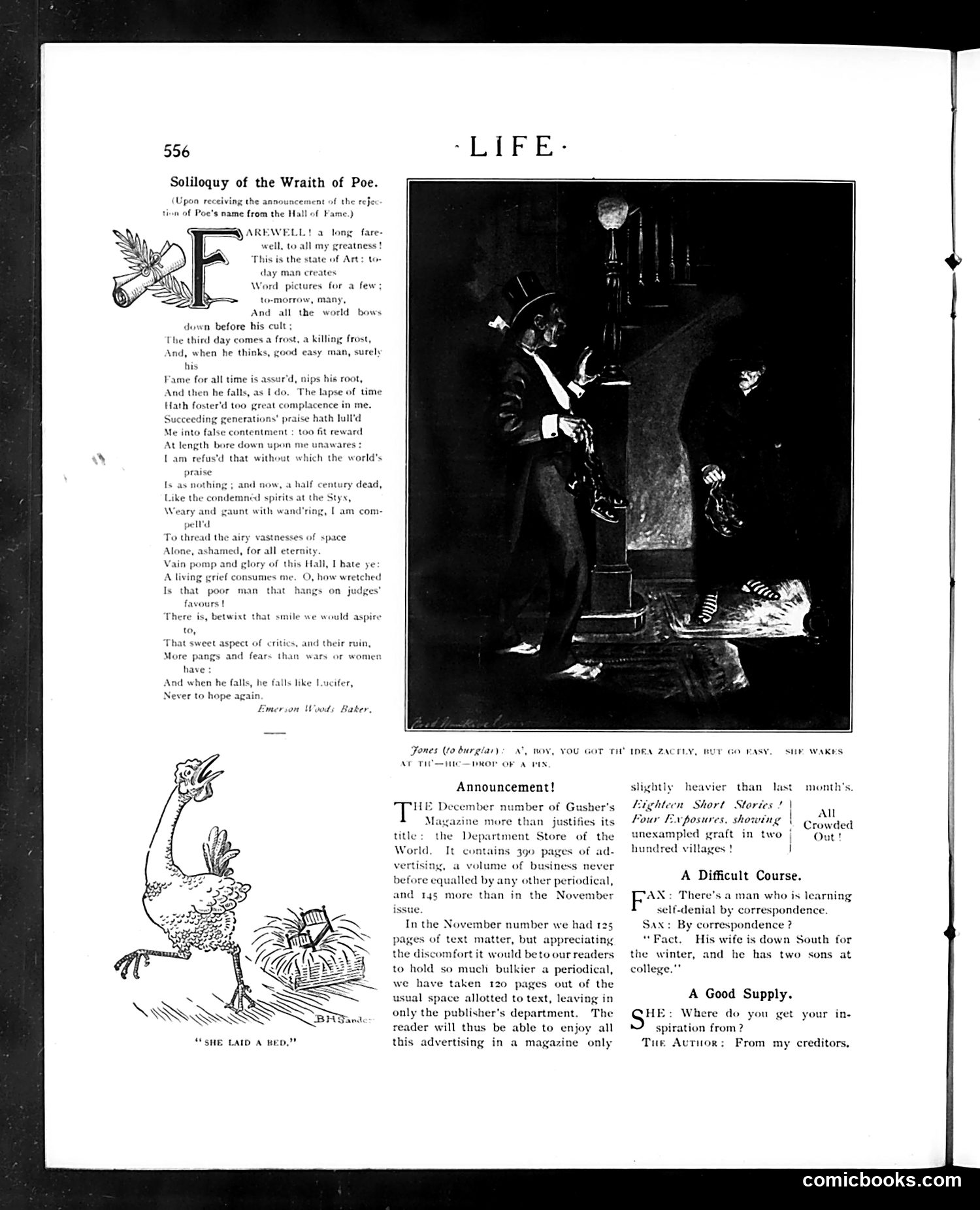
This page from *Life* magazine contains a literary piece titled "Soliloquy of the Wraith of Poe" attributed to Emerson Wood, Baker—a melancholic monologue by Edgar Allan Poe's ghost lamenting his lack of recognition and worldly success. The wraith complains about being forgotten, mocked by critics, and overshadowed by more commercially successful writers. The accompanying illustration shows a dark, theatrical scene of a ghostly figure in what appears to be a Gothic setting, visualizing Poe's spectral presence. Below is an "Announcement" about *Gusher's* Magazine's December issue, followed by three brief comedic dialogues ("A Difficult Course," "A Good Supply") featuring typical turn-of-the-century humor about correspondence courses, family situations, and financial troubles.
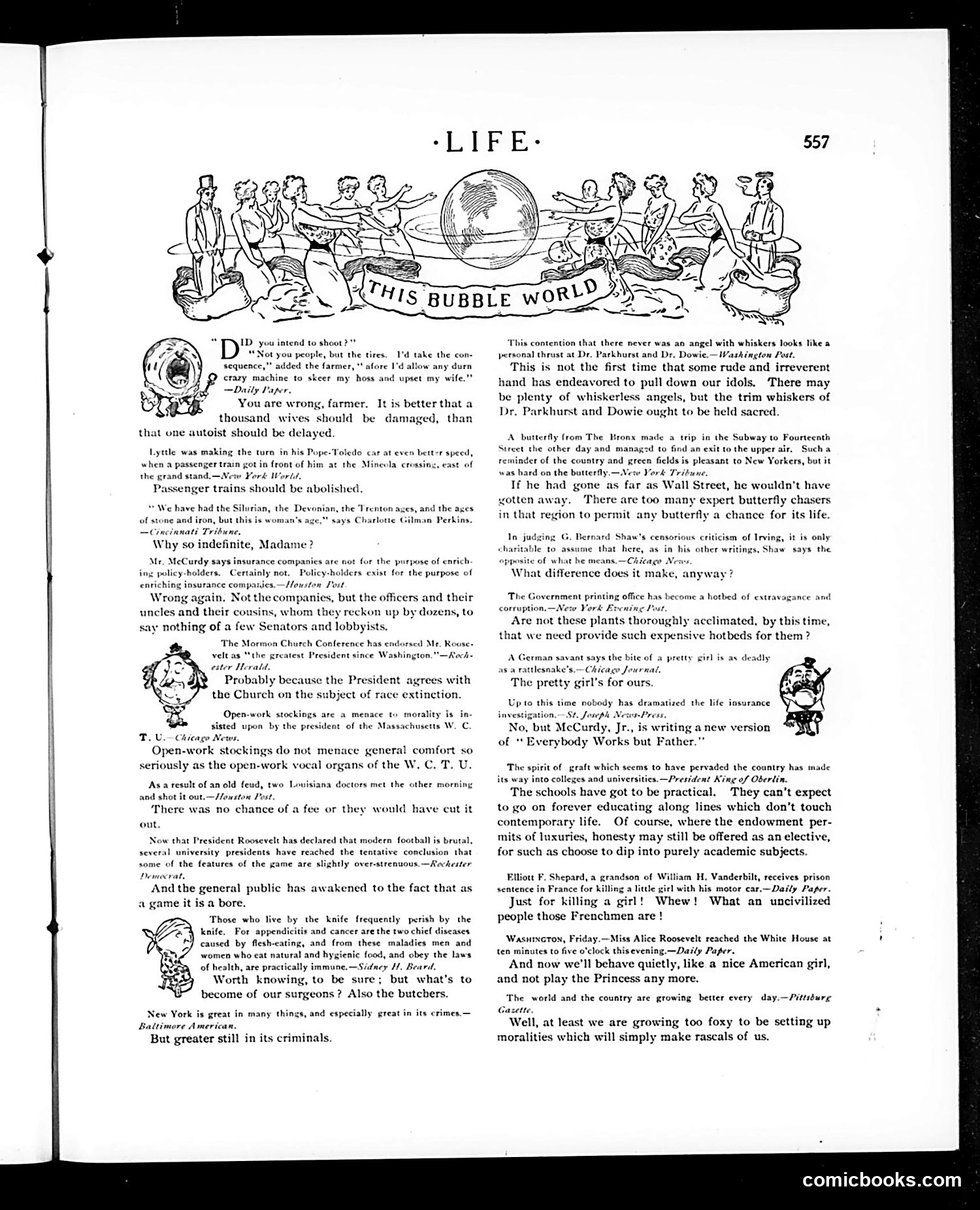
The header illustration depicts figures around a large bubble labeled "THIS BUBBLE WORLD," satirizing society's fragility and illusions. The page contains several brief satirical commentaries on contemporary issues: - **Football brutality**: Criticism of President Roosevelt endorsing football despite its dangerous nature, calling it hypocritical - **Life insurance**: Mocking McCurdy Jr.'s efforts to dramatize life insurance investigations - **Government waste**: The printing office criticized for "extravagance and corruption" - **School curriculum**: Concern that universities are becoming corrupted by wealth and losing academic focus - **Capital punishment**: A note about a girl executed in France - **Social morality**: Closing commentary warns against establishing hypocritical moral standards The overall tone is skeptical of authority figures and institutions failing to live up to their stated principles.
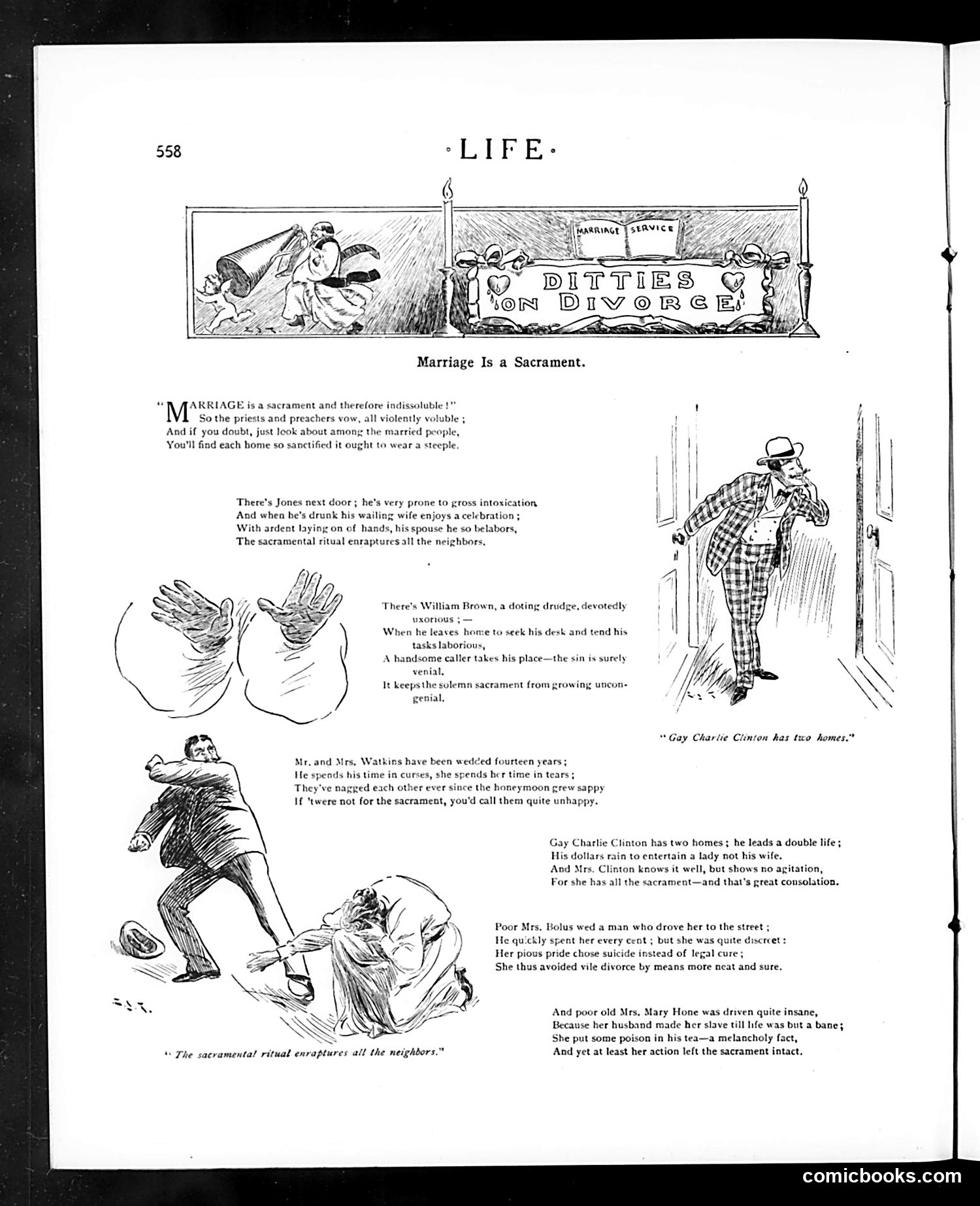
This satirical piece mocks the Catholic doctrine that marriage is a sacred, indissoluble sacrament. The cartoons illustrate married couples in domestic conflict: fighting, drinking, and generally miserable—yet bound together religiously. The satire's point: if marriage is truly sacred and unbreakable, then unhappy or abusive spouses are trapped. Examples include a wife enduring her husband's drunken behavior, a man beating his wife, and Mrs. Mary Hone, driven "quite insane" by her enslaved husband, who resorts to poisoning his tea rather than obtain a divorce. The critique targets both the Catholic teaching and the legal system denying divorce, trapping people—especially women—in destructive marriages. The "sacrament" becomes absurdly cruel rather than holy.
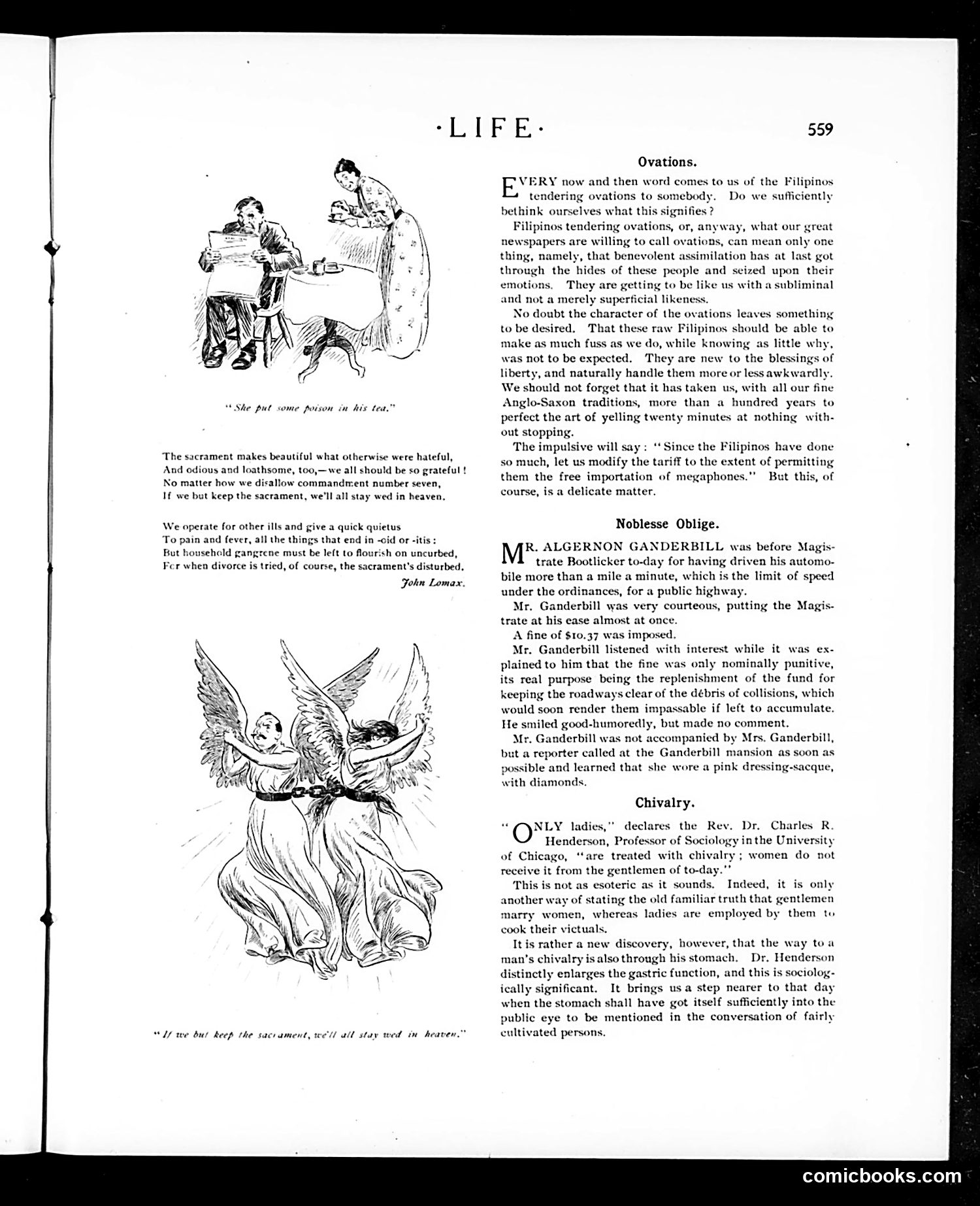
This page contains three distinct satirical pieces: 1. **"Ovations"** (top): Critiques Filipino gestures of gratitude as superficial mimicry of Anglo-Saxon customs. The text suggests Filipinos are clumsily adopting Western etiquette without understanding its deeper meaning—a commentary on cultural assimilation during American colonial period in the Philippines. 2. **"Noblesse Oblige"** (middle): Mocks wealthy motorist Mr. Algernon Ganderbill's speeding fine. The satire targets aristocratic entitlement, suggesting the wealthy view traffic laws as mere formalities while claiming charitable justifications. 3. **"Chivalry"** (bottom): Reports Professor Charles Henderson's sociological claim that men's chivalry toward women extends to gastric consideration—suggesting men show care through food/hospitality rather than genuine respect. The satire questions whether "chivalry" is authentic virtue or performative theater.
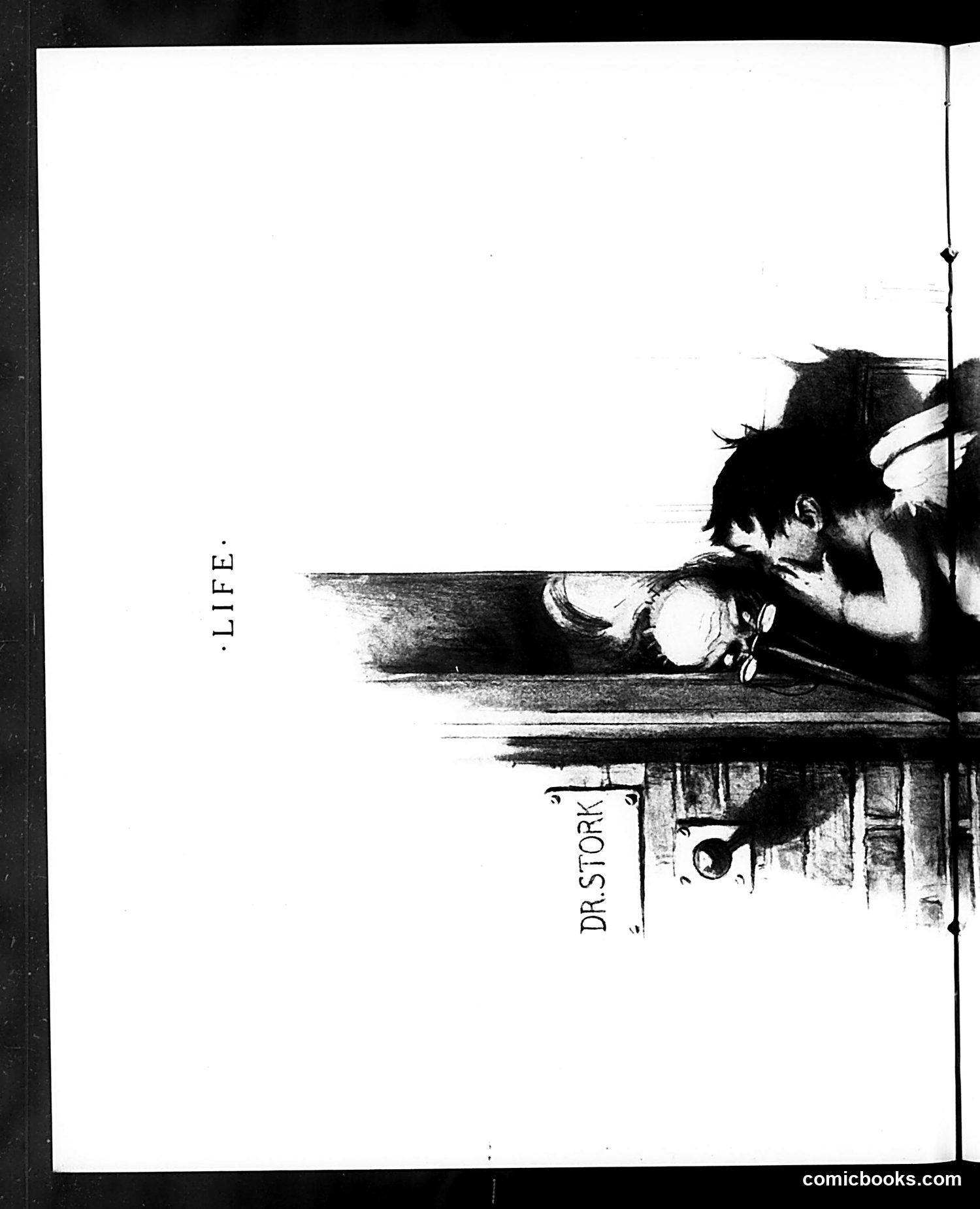
This appears to be a title page or section divider from *Life* magazine featuring the heading "LIFE" on the left and "DR. STORR" on the right, with an illustration positioned sideways (rotated 90 degrees). The image shows a figure in dark clothing leaning over what appears to be a desk or table, rendered in black and white sketchy style typical of early-to-mid 20th century satirical illustration. The artistic technique and composition suggest this is introducing a character or section, likely "Dr. Storr" based on the text. Without additional context about who Dr. Storr was or what issue this is from, I cannot definitively explain the satirical point or identify the specific figure being caricatured. The page appears to be introducing content rather than presenting a complete cartoon with clear political commentary.
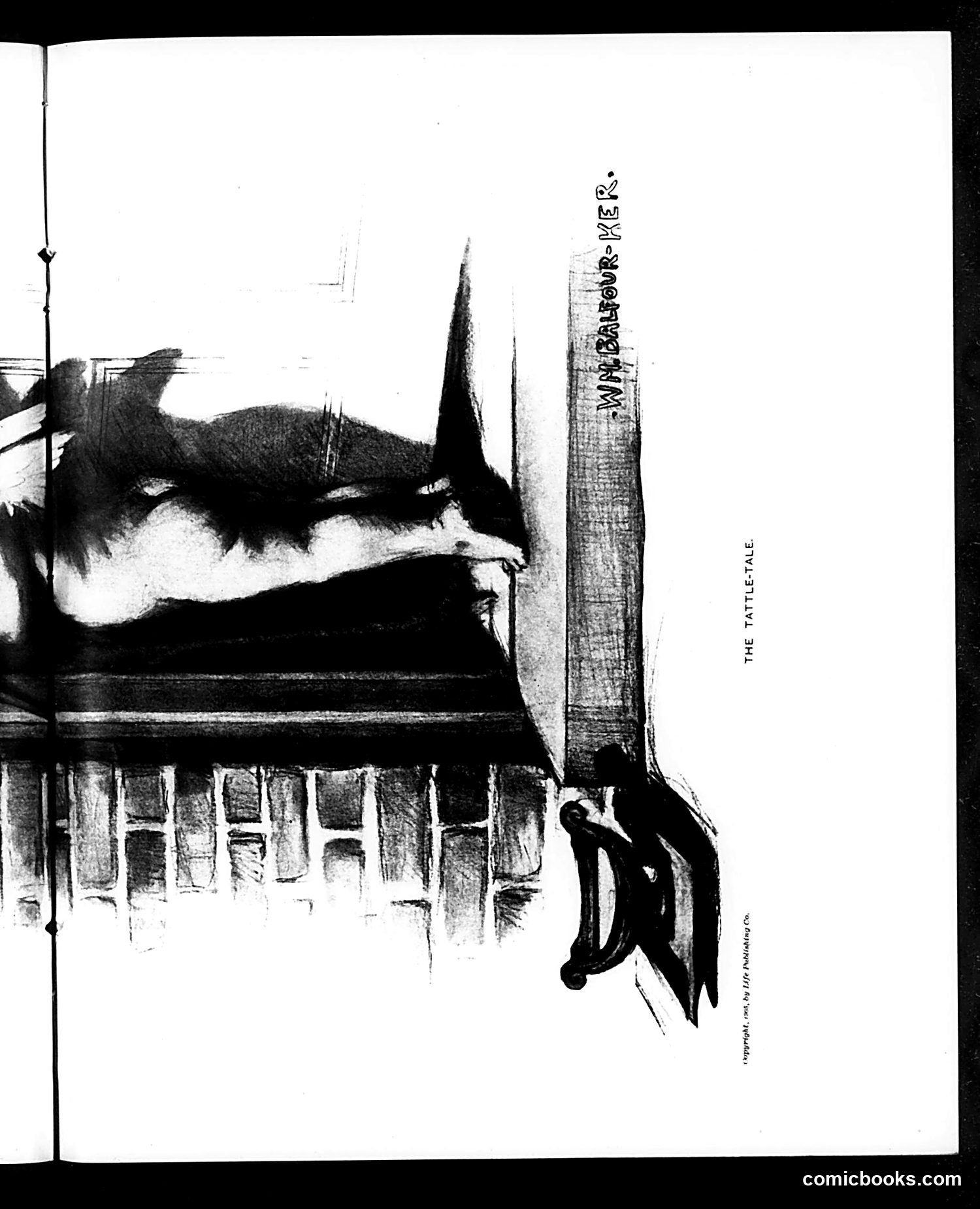
This appears to be a title page or section divider from *Life* magazine featuring a satirical illustration. The image shows a figure in dark clothing operating or climbing what resembles a tall, pointed structure or building with spires. The composition suggests commentary on urban development or architectural ambition. The text "THE TITLE-PAGE" appears on the right margin, indicating this serves as an introductory illustration. However, without clearer identifying details, specific date, or accompanying article text, I cannot definitively identify which political figure or social commentary this targets. The architectural imagery and the figure's dynamic pose suggest critique of urban construction or development trends popular during early-to-mid 20th century America, but the precise satirical point remains unclear from this image alone.
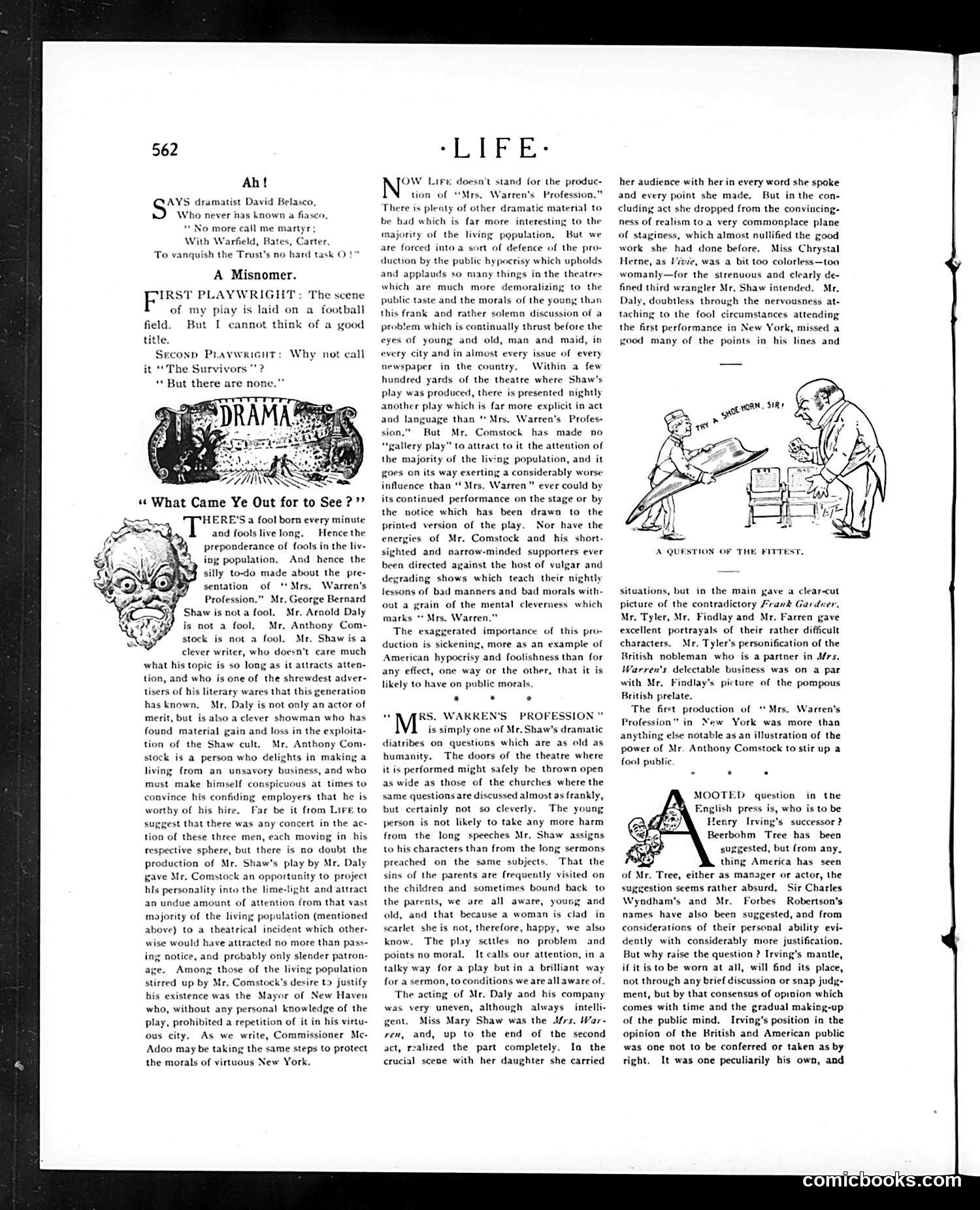
This page discusses the 1905 controversy over George Bernard Shaw's play *Mrs. Warren's Profession*, which depicts a woman's involvement in sex work. The satirical commentary identifies three key figures: **George Bernard Shaw** — the clever Irish playwright who wrote provocative material for attention. **Arnold Daly** — the actor-manager who produced the play, profiting from the publicity. **Anthony Comstock** — the notorious moral crusader who led efforts to suppress "obscene" materials. Life's satire targets **Comstock's hypocrisy**: he vigorously attacked Shaw's intellectual examination of prostitution while ignoring more explicit, morally corrupting theatrical productions playing nearby. The magazine argues Comstock manufactured outrage to justify his existence and salary, while simultaneously acknowledging Shaw was a shrewd publicist who benefited from the scandal. The page satirizes how moral panic (involving New York's Mayor and Police Commissioner) creates unwarranted attention for art, while genuinely degrading entertainment escapes censorship.
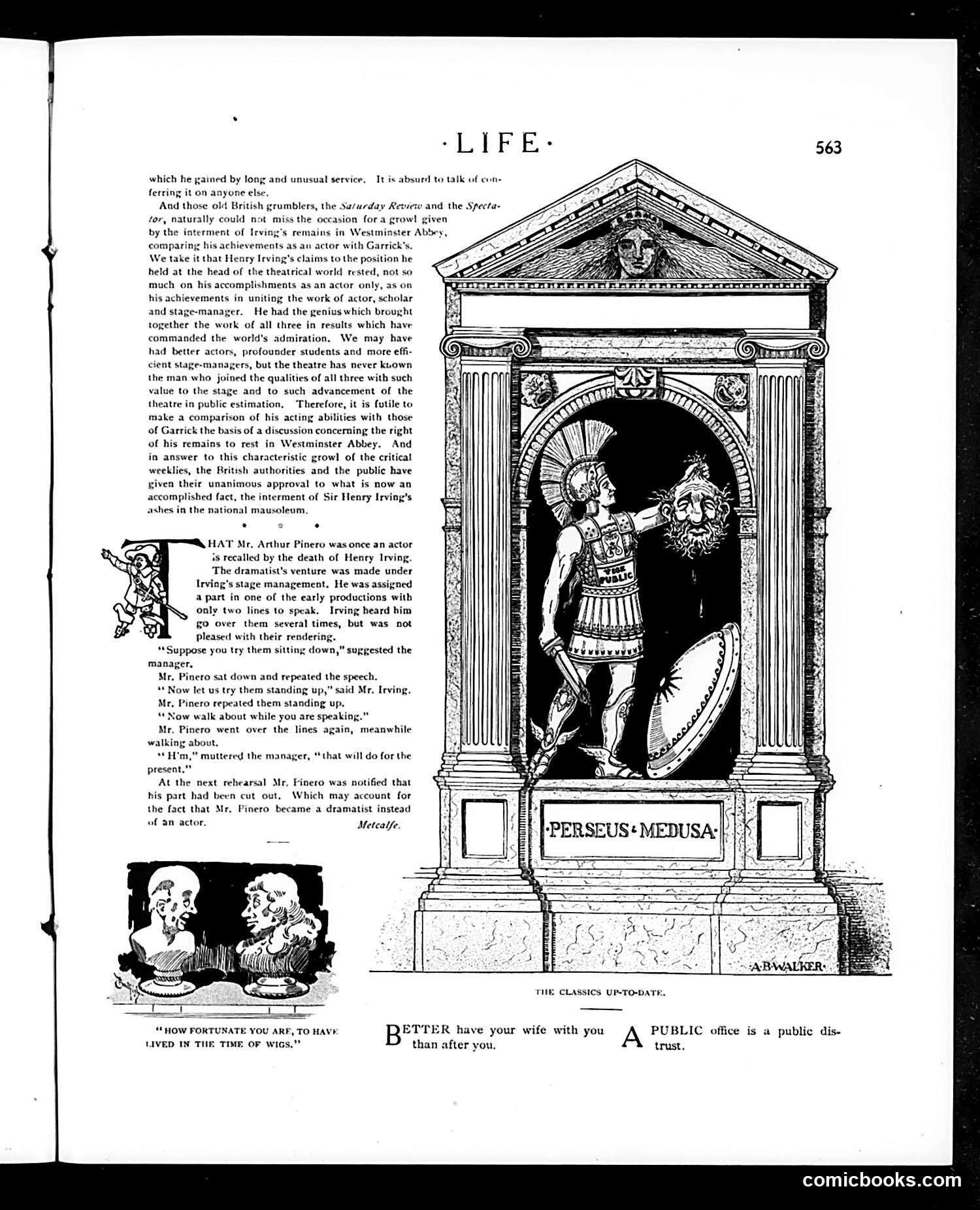
This page discusses **Sir Henry Irving's recent burial in Westminster Abbey**—a major cultural event. The main text defends Irving's honor against British critics (the *Saturday Review* and *Spectator*) who questioned whether an actor deserved Westminster Abbey burial. Life argues Irving's genius lay not merely in acting but in uniting actor, scholar, and stage-manager roles, advancing theatre itself. The **Arthur Pinero anecdote** illustrates Irving's exacting directorial standards: Pinero, a young actor in Irving's company, was given minimal lines. Irving made him repeat them sitting, standing, and walking—then cut the part entirely. The joke: Pinero's failure as an actor led him to become a successful dramatist instead. The small illustration captioned "How Fortunate You Are, to Have Lived in the Time of Wigs" appears to be period humor unrelated to the main content. The aphorisms at bottom ("Better have your wife with you than after you" and "A public office is a public distrust") are typical Life magazine witticisms.
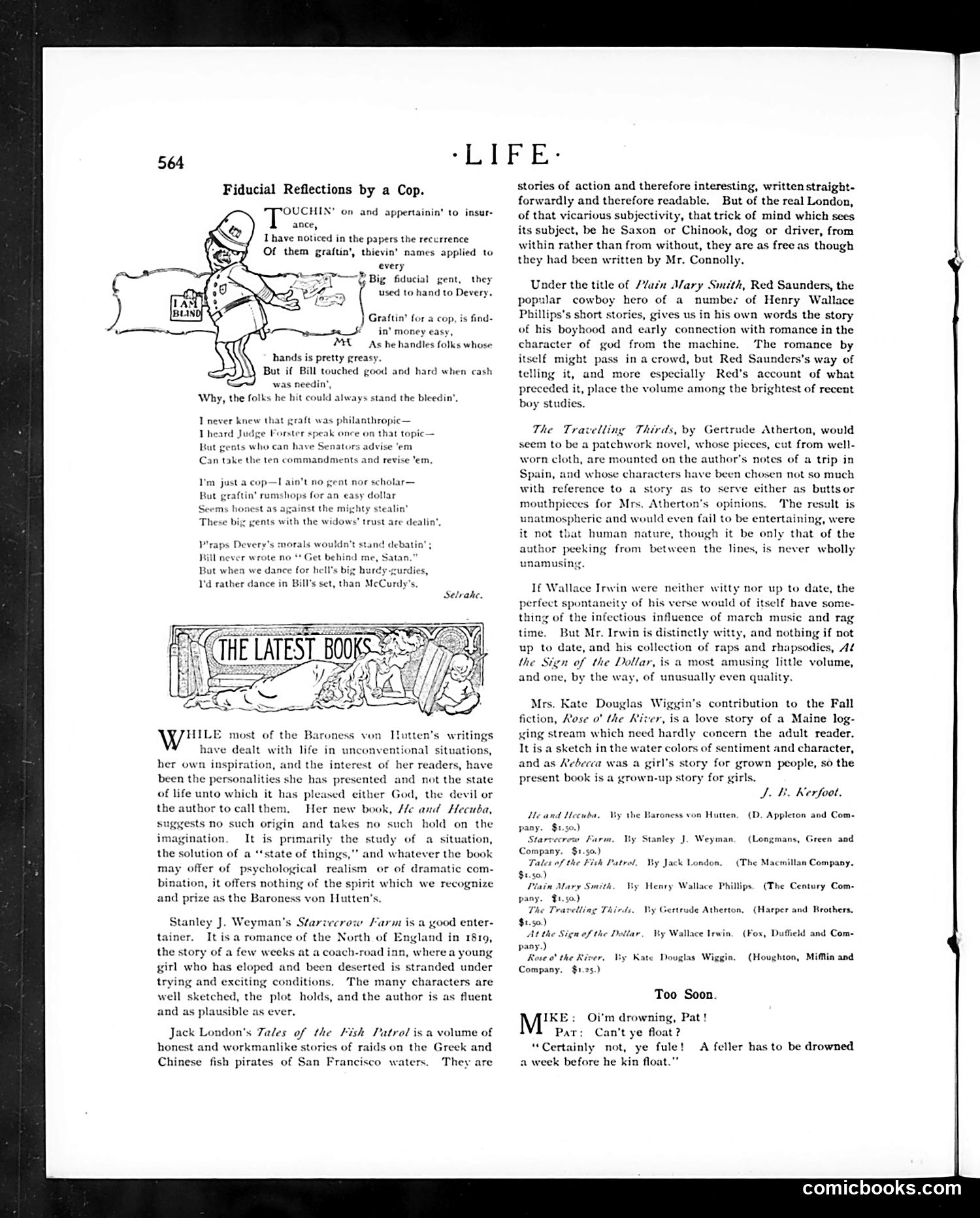
This cartoon satirizes police corruption in early 1900s New York City. The officer-narrator uses crude vernacular to defend petty graft (bribery and extortion from businesses) as morally superior to the large-scale financial crimes of wealthy men. The reference to "Big fiducial gent" and "Devery" likely alludes to **Police Chief William S. Devery**, notorious for tolerating widespread corruption. The cop's logic—that shaking down saloonkeepers for "easy dollars" is "honest as against the mighty stealin'" by wealthy financiers—mocks the hypocrisy of criminalizing small corruption while ignoring elite wrongdoing. The cartoon satirizes both corrupt police and the public's acceptance of petty graft as inevitable urban vice. The title "Fiducial Reflections" (fiduciary = financial trust) drips with irony, as the speaker reveals no actual financial ethics whatsoever.
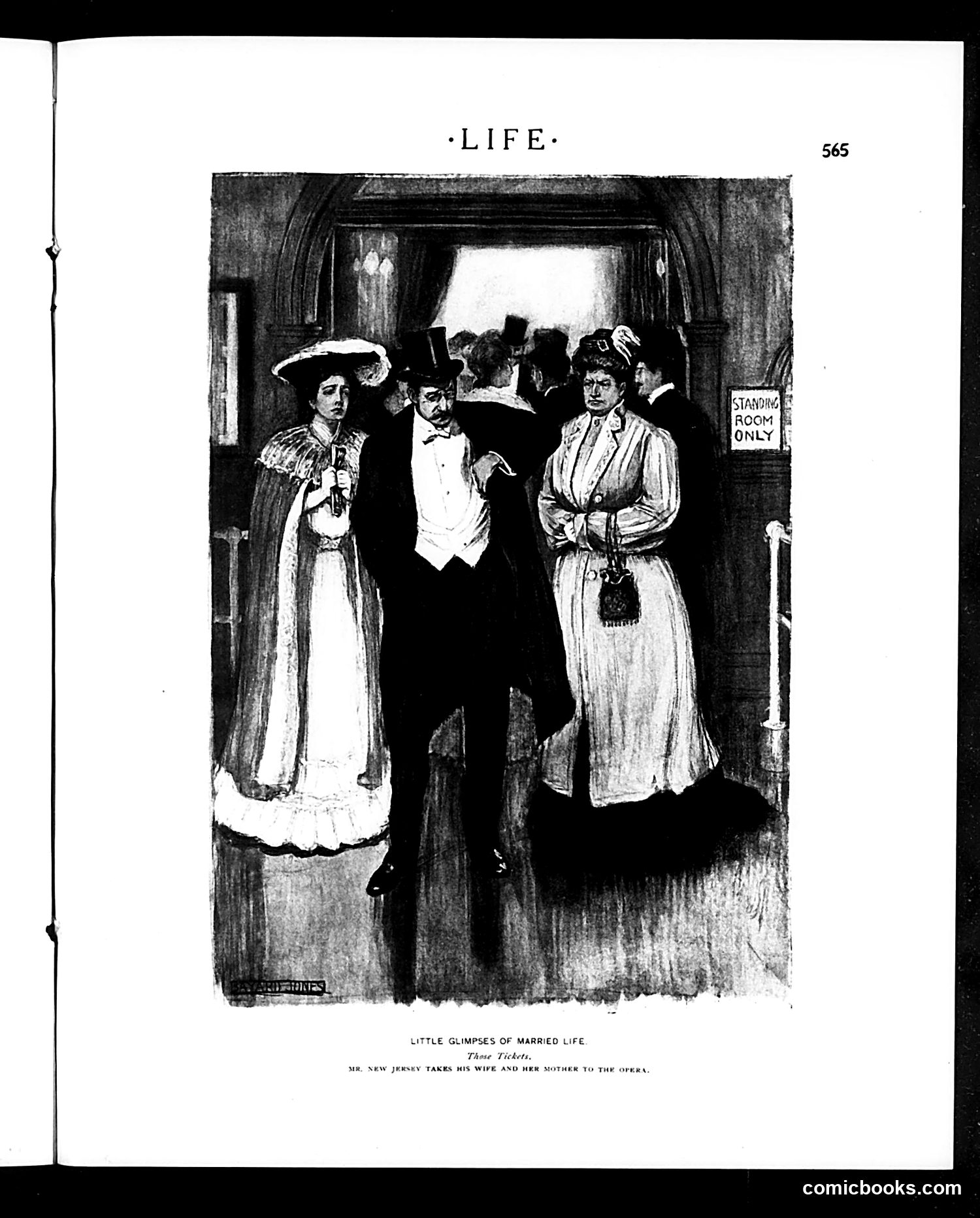
This satirical cartoon depicts a common domestic scenario from the early 20th century. A man in formal evening wear stands between two women—his wife and her mother—outside what appears to be an opera house (note the "Standing Room Only" sign). The caption jokes that he's taken both of them to the opera. The humor targets married men of the era, suggesting the domestic obligation and expense of entertaining not just one's spouse but her mother as well. The cramped "standing room only" condition implies he could only afford the cheapest tickets, adding financial strain to the social burden. This reflects period attitudes about marriage as a man's responsibility and mothers-in-law as intrusive, costly fixtures in married life—themes common to Life magazine's satirical domestic humor.
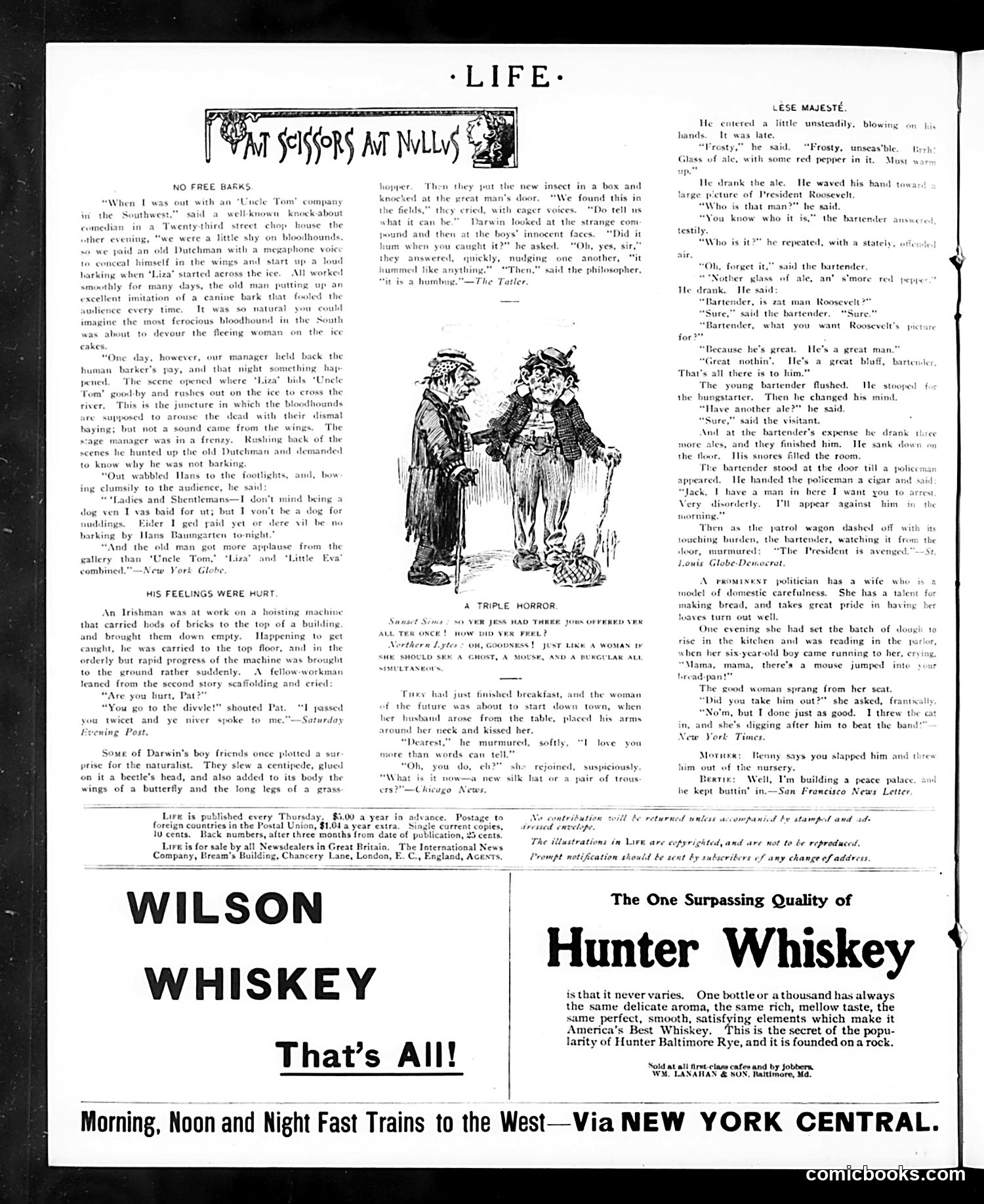
This page contains several separate humorous pieces, not a unified political cartoon. **Main content:** "I'm Scissors An' Nullus" and other short anecdotes illustrating working-class characters and their foibles. The largest story involves a theater manager's trick using a bloodhound and a German immigrant ("Hans Baumgarten") to generate applause—a simple vaudeville-era comedy bit with no political meaning. **The Roosevelt reference:** One brief anecdote shows a drunk patron asking a bartender about a picture of President Theodore Roosevelt on the wall. The joke is that the bartender treasures it simply because "he's great"—offering no deeper explanation. This appears to be gentle ribbing of Roosevelt's celebrity status rather than sharp satire. **Bottom advertisements:** Wilson Whiskey and Hunter Whiskey ads (noting Prohibition was approaching in 1913, making these particularly notable). The page is primarily **entertainment and advertising** rather than political satire. Any political content is mild and surface-level.
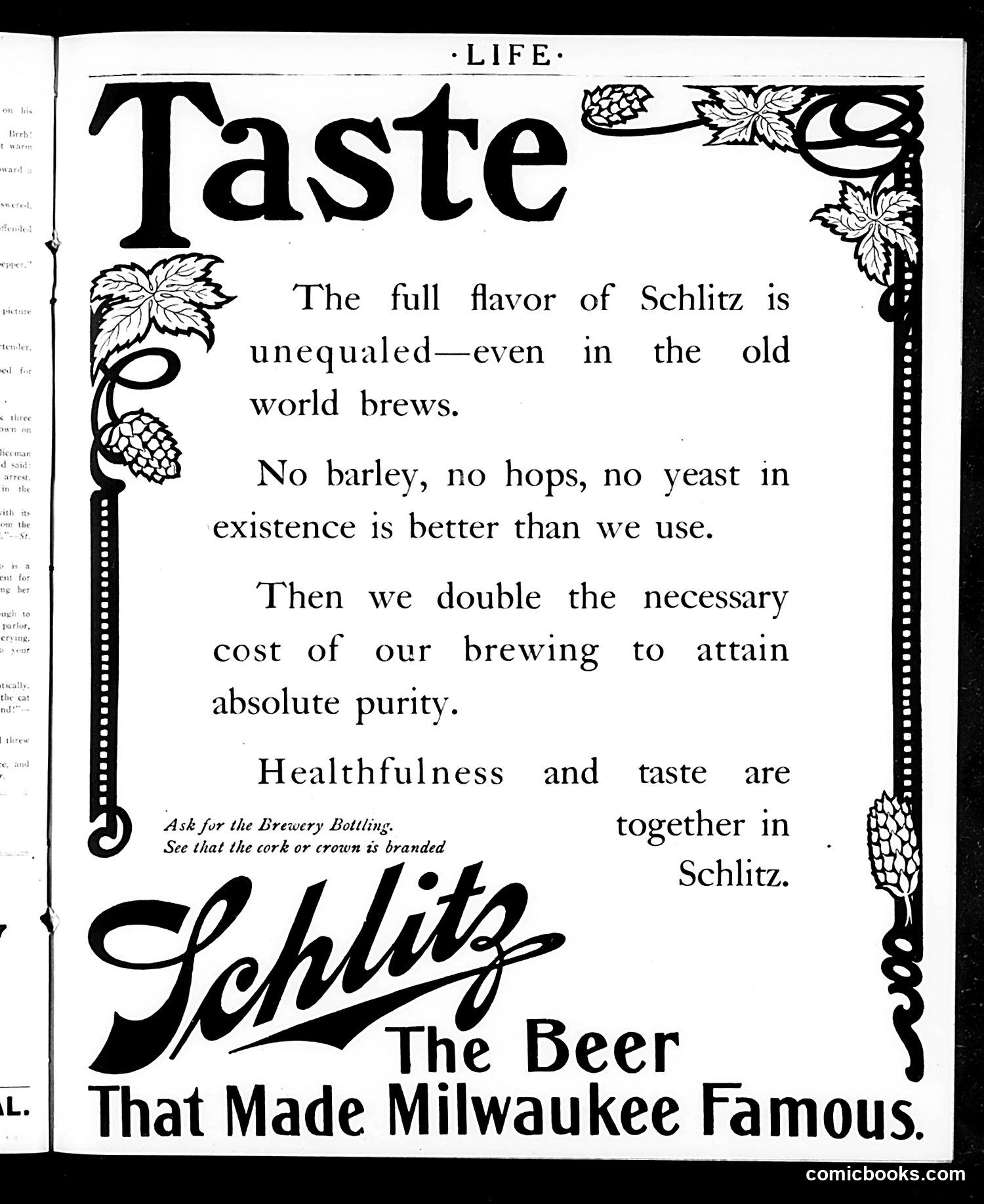
This is a **full-page advertisement**, not satire or political commentary. It promotes Schlitz beer, "The Beer That Made Milwaukee Famous." The ad makes quality claims typical of early 20th-century brewing advertisements: superior ingredients (barley, hops, yeast), doubled production costs for "absolute purity," and the combination of "healthfulness and taste." The decorative border features hops and vines, common design elements for beer advertising of this era. The instruction to "Ask for the Brewery Bottling" and verify the cork or crown is branded reflects concerns about counterfeit products—a genuine issue when beer distribution was less regulated. The emphasis on purity likely references the pre-Prohibition era (before 1920) when breweries competed partly on hygiene and quality standards. This represents straightforward advertising rather than satirical content from *Life* magazine.
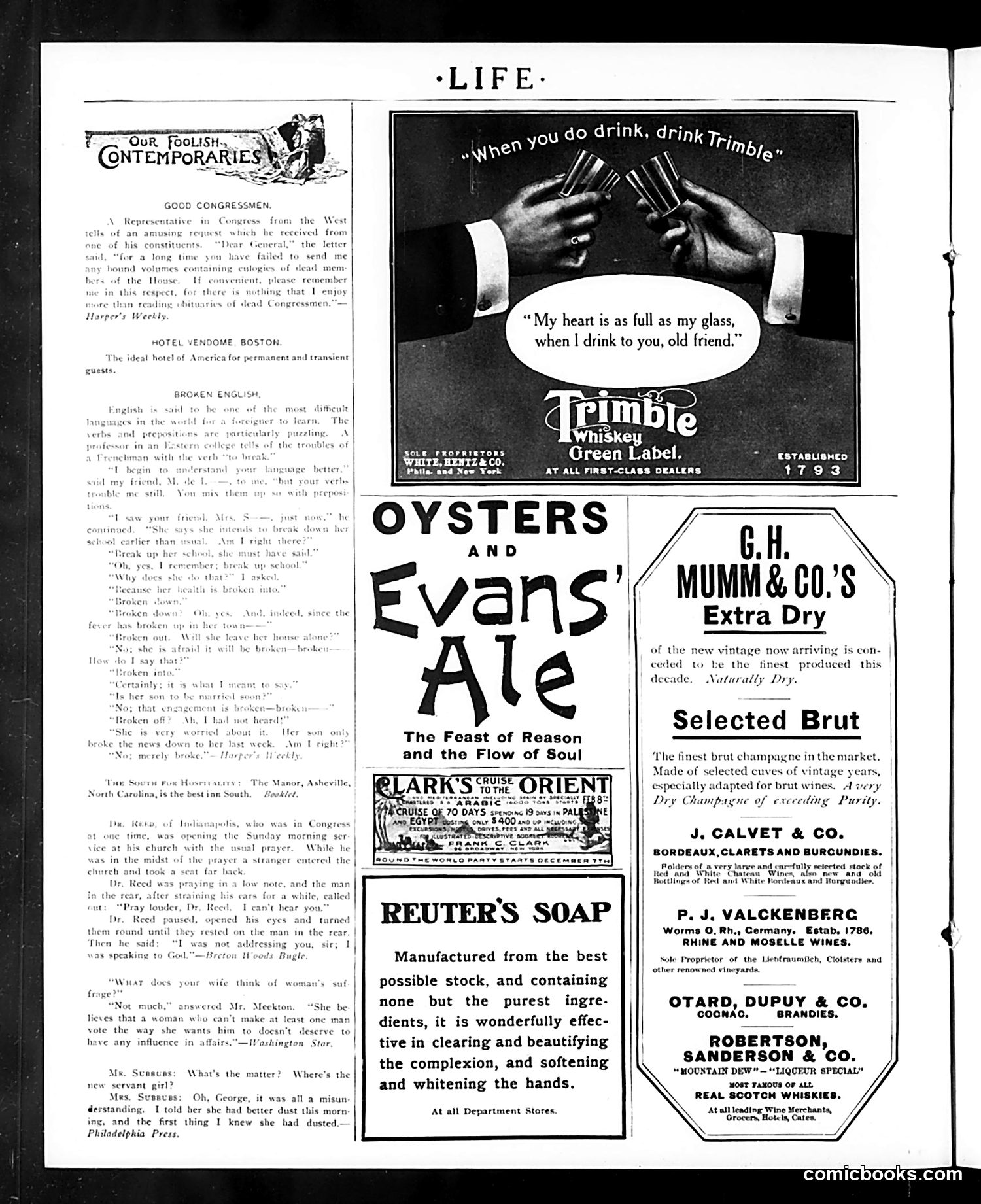
This page is primarily **advertising and humor content** rather than political satire. The layout features: **Main Advertisement:** A Trimble Whiskey ad (top right) showing two men toasting, emphasizing social bonding through drinking—a common early 20th-century marketing approach. **Humor Section:** "Our Foolish Contemporaries" (top left) presents brief comedic anecdotes mocking social conventions and marital dynamics, including jokes about wives, servants, and church etiquette. These are light satirical observations of middle-class life rather than political commentary. **Remaining Content:** The page is dominated by liquor and champagne advertisements (Evans' Ale, Mumm & Co., Calvet, Valckenberg, etc.)—reflecting the pre-Prohibition era when such advertising was standard in mainstream magazines. The page illustrates Life's dual function: mixing satirical humor about everyday social follies with commercial advertising, typical of American magazines in this period (appears to be early 1900s based on style and language).
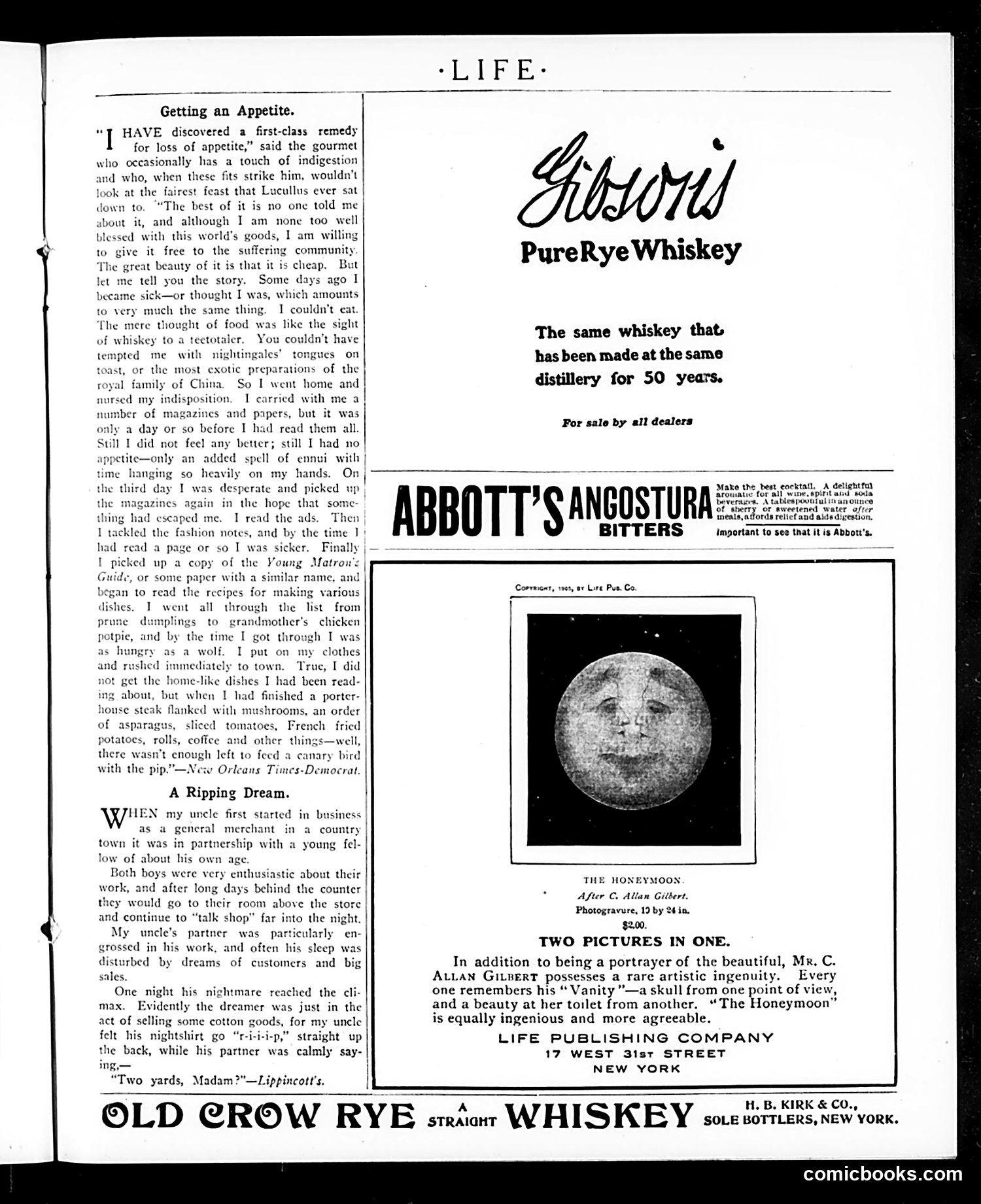
This page contains three humorous anecdotes and several advertisements, typical of Life magazine's early 20th-century format. **"Getting an Appetite"** tells of a man who lost his appetite due to illness. Reading cooking recipes in magazines paradoxically restored his hunger, sending him to a restaurant for a lavish meal. The joke: reading about food cured what food itself could not. **"A Ripping Dream"** humorously depicts a merchant's partner so absorbed in work that he dreams of sales while sleeping. During the nightmare, his nightshirt tears as he unconsciously gestures while saying "Two yards, Madam?" The humor lies in his sleepwalking sales pitch physically affecting reality. The page also advertises whiskey products (Gibbons Pure Rye, Abbott's Angostura Bitters, Old Crow Rye) and features an art print titled "The Honeymoon" by C. Allan Gilbert—described as optically clever like his famous "Vanity" artwork (a skull/beauty double image). These pieces reflect period humor emphasizing food, commerce, and domestic life, alongside alcohol advertising (then unregulated).
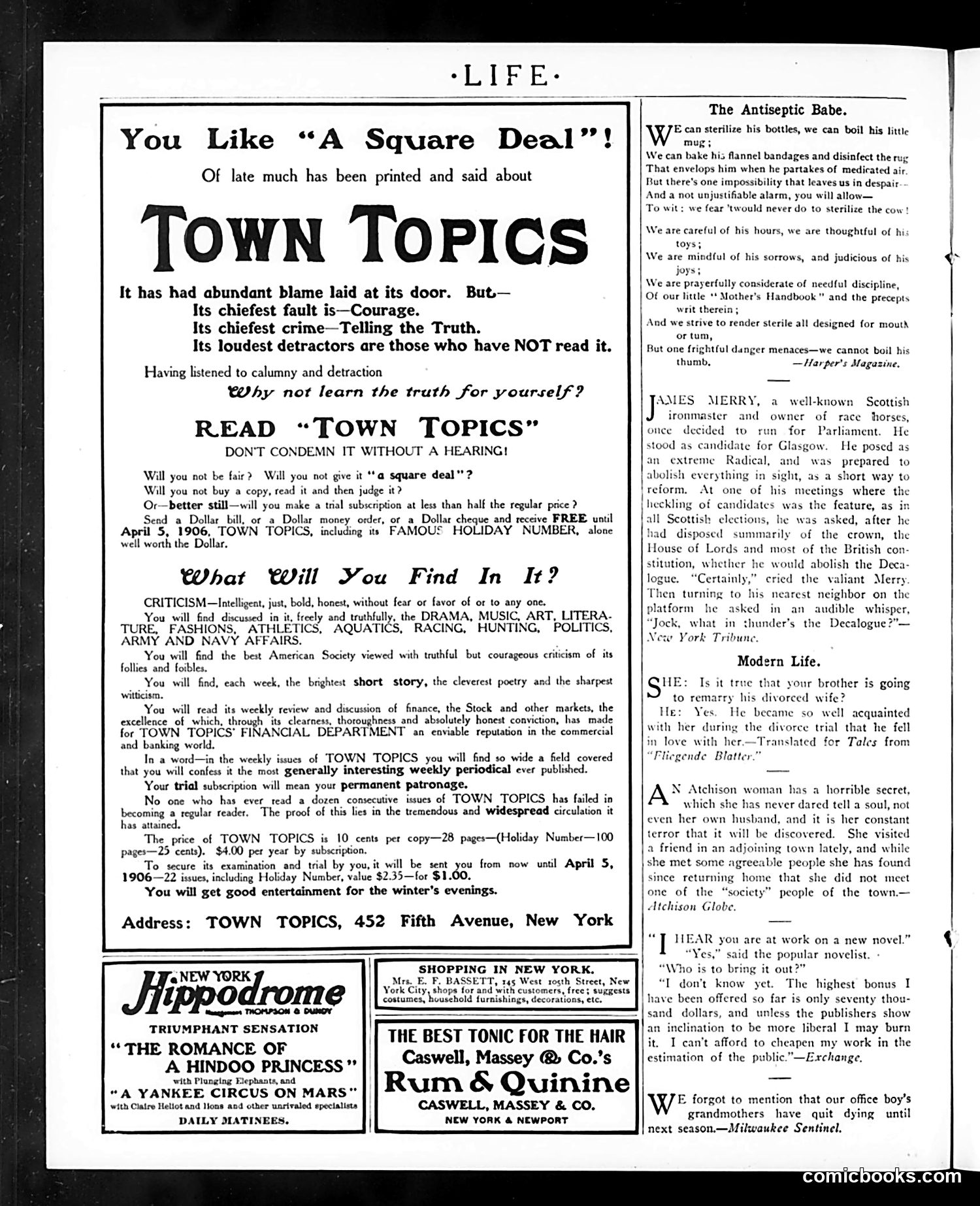
This page is primarily a **subscription advertisement** for *Town Topics*, a weekly satirical magazine, using Theodore Roosevelt's "Square Deal" slogan as a hook. The ad argues readers shouldn't condemn the publication without reading it—demanding fair treatment, ironically, for a publication known for gossip and scandal. The right column contains short humor pieces typical of *Life* magazine's social satire: - **"The Antiseptic Babe"** mocks the early-1900s obsession with germ theory and sterilization in child-rearing. The joke: parents can sterilize everything except the cow providing the milk—highlighting the absurdity of obsessive hygiene when basic sanitation remained uncontrolled. - **"Modern Life"** contains brief anecdotes about social hypocrisy: a woman hiding a friend's affair, a novelist worried about publisher payments. The page reflects Progressive Era anxieties about health, propriety, and honesty—themes *Town Topics* itself exploited through society gossip and criticism. The advertisements (Hippodrome theater, hair tonic) are period-typical.
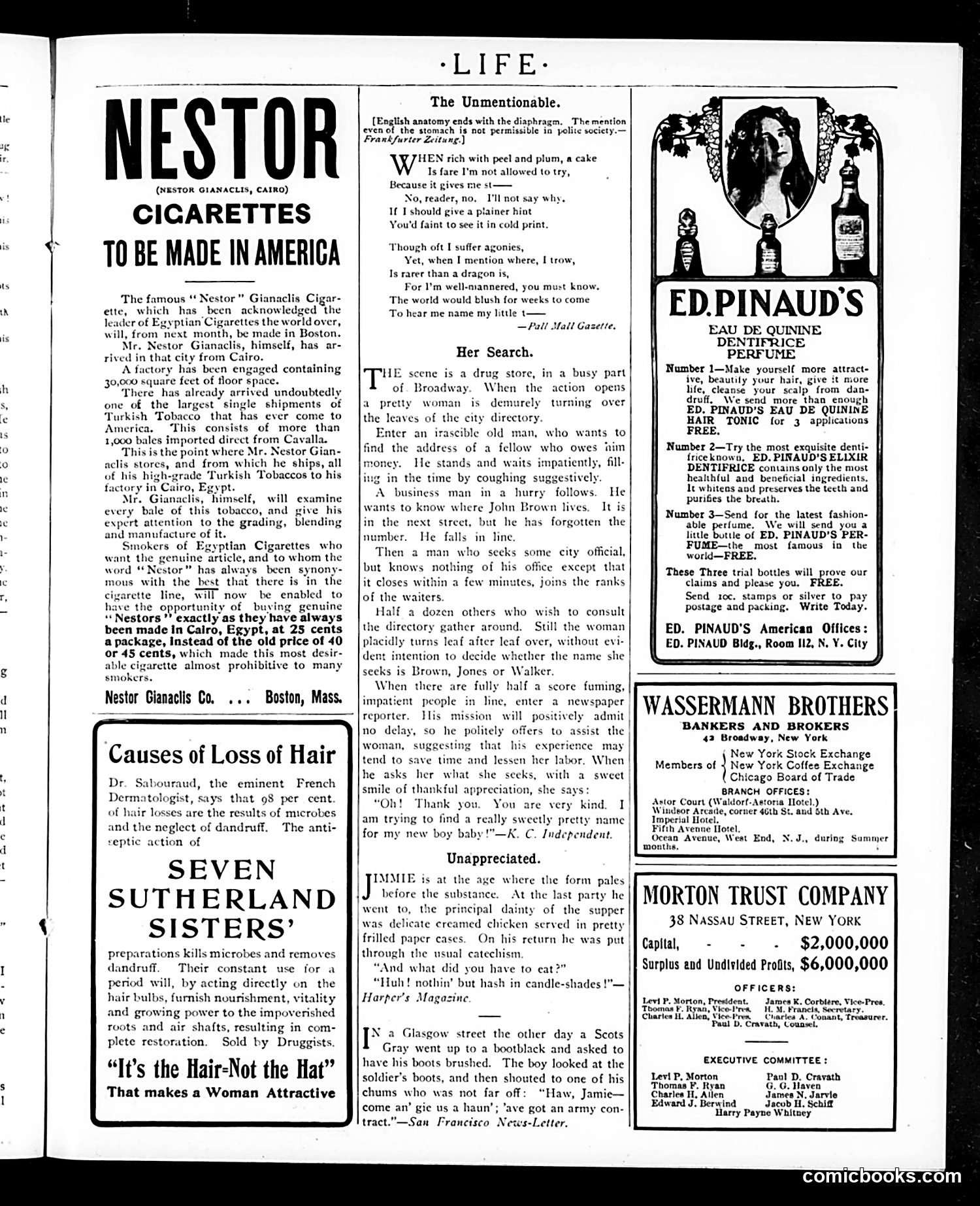
This page is primarily **advertising and light satire**, typical of early 20th-century Life magazine. The main content includes: **"The Unmentionable"** — A humorous poem satirizing Victorian prudishness about bodily functions. The joke is that polite society forbids mentioning the stomach and digestive processes; the poem coyly alludes to these taboo topics while maintaining artificial politeness, poking fun at absurd social etiquette. **"Her Search"** — A satirical sketch about a woman monopolizing a public directory in a drugstore, obstructing impatient men trying to find addresses. The humor lies in depicting her as deliberately slow and inconsiderate. **Advertisements** dominate: Nestor Cigarettes (Egyptian brand now made in America), Seven Sutherland Sisters hair treatment, and Ed. Pinaud's cosmetics/dentifrice. The page reflects period concerns: hair loss remedies, cigarette quality, and Victorian social conventions around propriety. The satire is gentle and domestic rather than political.
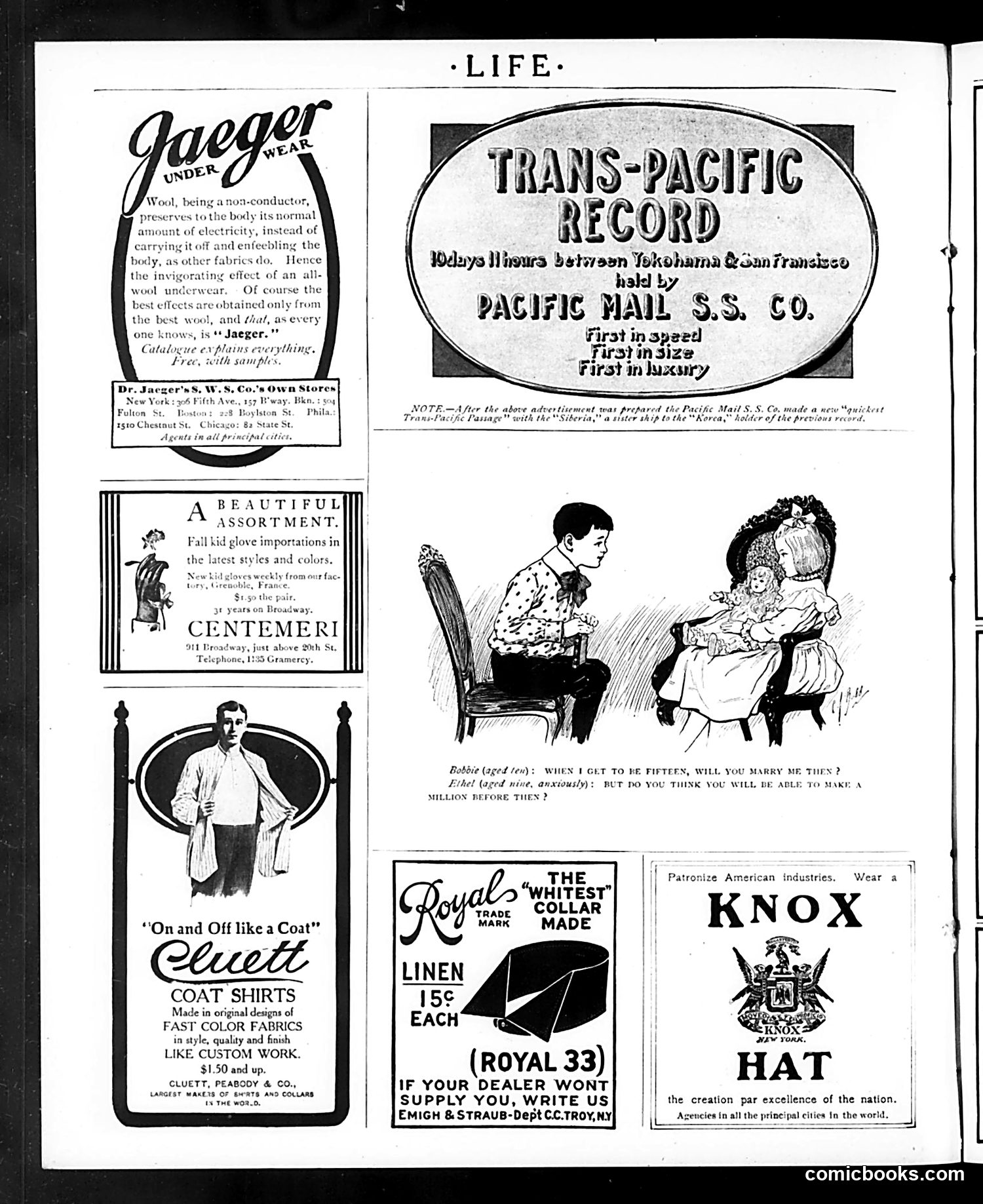
This is primarily a **commercial advertising page** from an early 20th-century Life magazine, with one small satirical cartoon. The main content consists of product advertisements for Jaeger wool underwear, gloves, dress shirts, collars, linen products, and Knox hats—typical period marketing emphasizing quality and American manufacture. The **sole cartoon** (center-right) depicts a romantic exchange between two children: a boy (Bobbie, age 10) proposes marriage to a girl (Ethel, age 9). Her anxious response—"But do you think you will be able to make a million before then?"—is the joke. It satirizes **mercenary attitudes in marriage and courtship**, suggesting that even children have absorbed the era's materialistic values. The humor targets both the child's precocious materialism and, implicitly, adult society's obsession with wealth as a marriage prerequisite. This reflects turn-of-the-century social anxieties about commercialism and changing courtship norms.
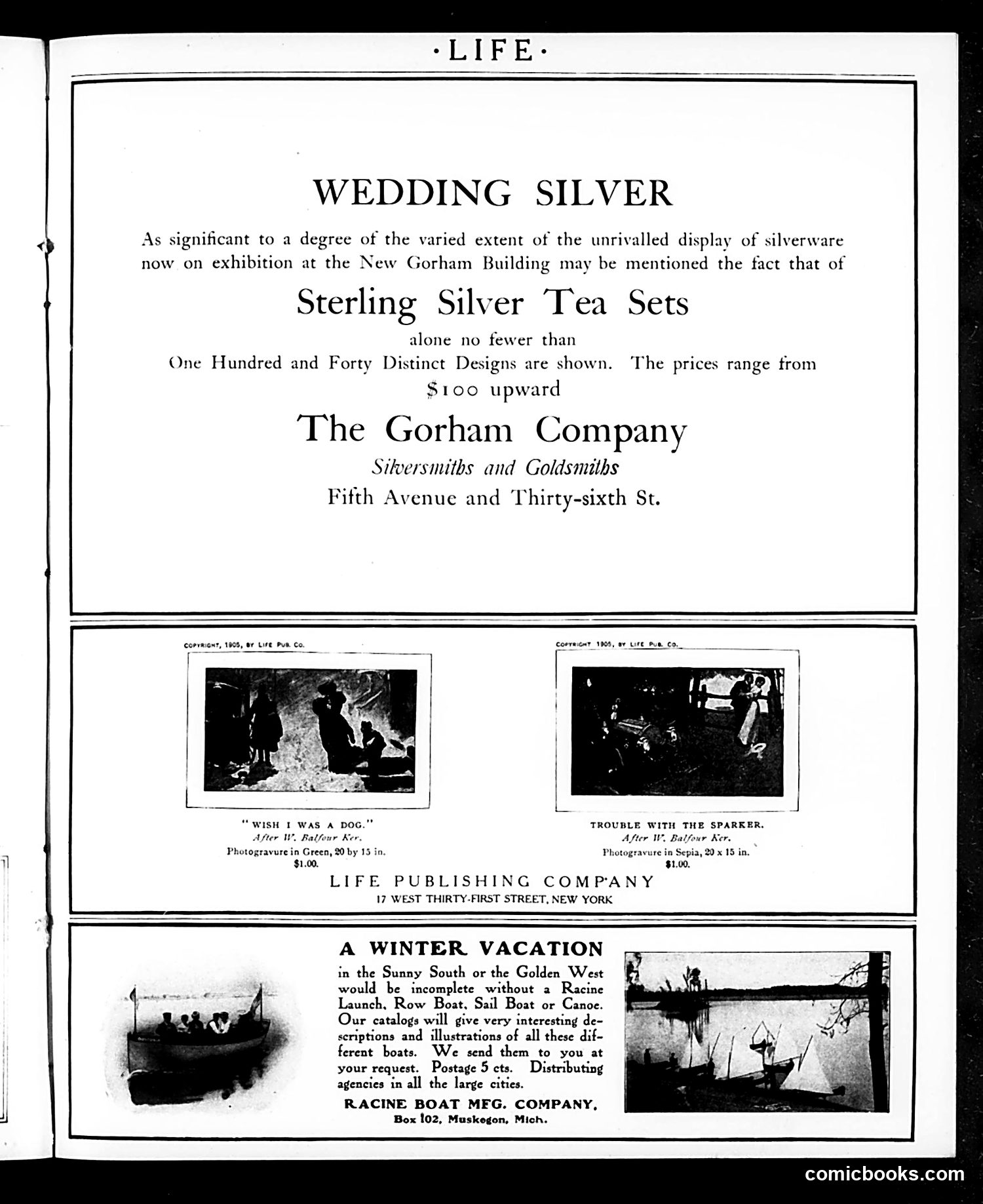
This page is primarily **advertising**, not satirical content. It contains three distinct ads: 1. **Gorham Company** (top): Promotes sterling silver tea sets for weddings, emphasizing 140 designs at $100+. Targets affluent consumers planning weddings. 2. **Life Publishing Company** (middle): Advertises two photogravure prints by W. Balfour Kerr—"Wish I Was a Dog" and "Trouble with the Sparker"—both $1.00. The titles suggest domestic comedy scenes, typical of early 20th-century humor art. 3. **Racine Boat Manufacturing** (bottom): Markets leisure boats for winter vacations in the American South and West, emphasizing catalog availability. The page reflects **Gilded Age consumer culture**: luxury goods (silverware, art prints) and leisure activities marketed to the wealthy. There is no political satire visible—this represents straightforward commercial advertising from Life's revenue model.
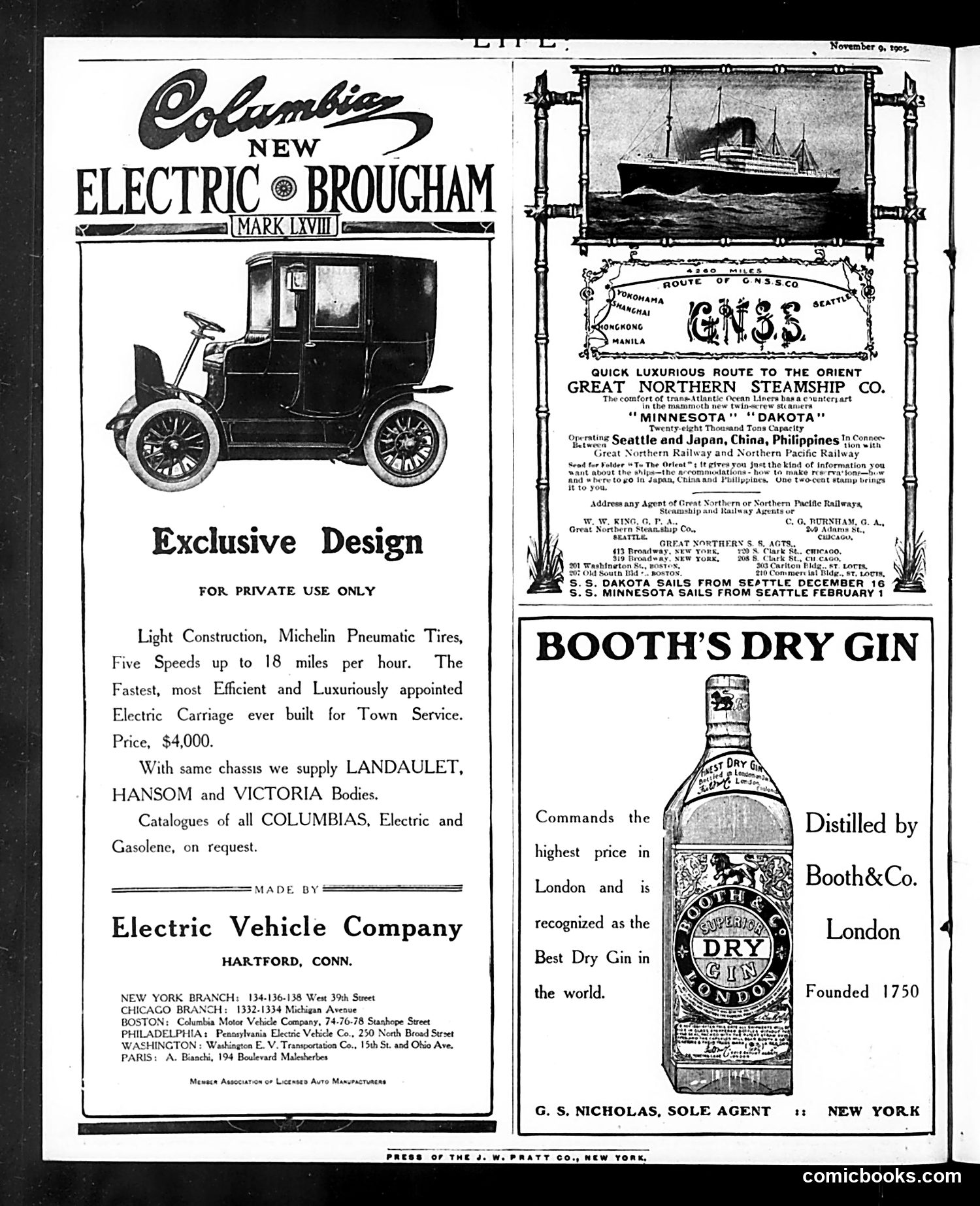
This page contains **no political cartoon or satire**—it is primarily **advertisements**. The left side advertises the Columbia Electric Brougham (Mark LXVIII), an electric carriage priced at $4,000, marketed as "the Fastest, most Efficient and Luxuriously appointed Electric Carriage ever built for Town Service." This reflects early 1900s enthusiasm for electric vehicles as alternatives to gasoline cars. The top right advertises Great Northern Steamship Company's trans-Pacific liners connecting Seattle to Japan, China, and the Philippines—reflecting America's commercial expansion into Asian markets following the Spanish-American War. The bottom right promotes Booth's Dry Gin, a London distillery founded 1750, claiming it commands "the highest price in London and is recognized as the Best Dry Gin in the world." All three ads target wealthy consumers; the electric carriage and steamship travel particularly suggest luxury leisure and commercial opportunities for the affluent readers of Life magazine.