
Life, 1905-11-09 · page 16 of 26
Life — November 9, 1905 — page 16: what you’re looking at
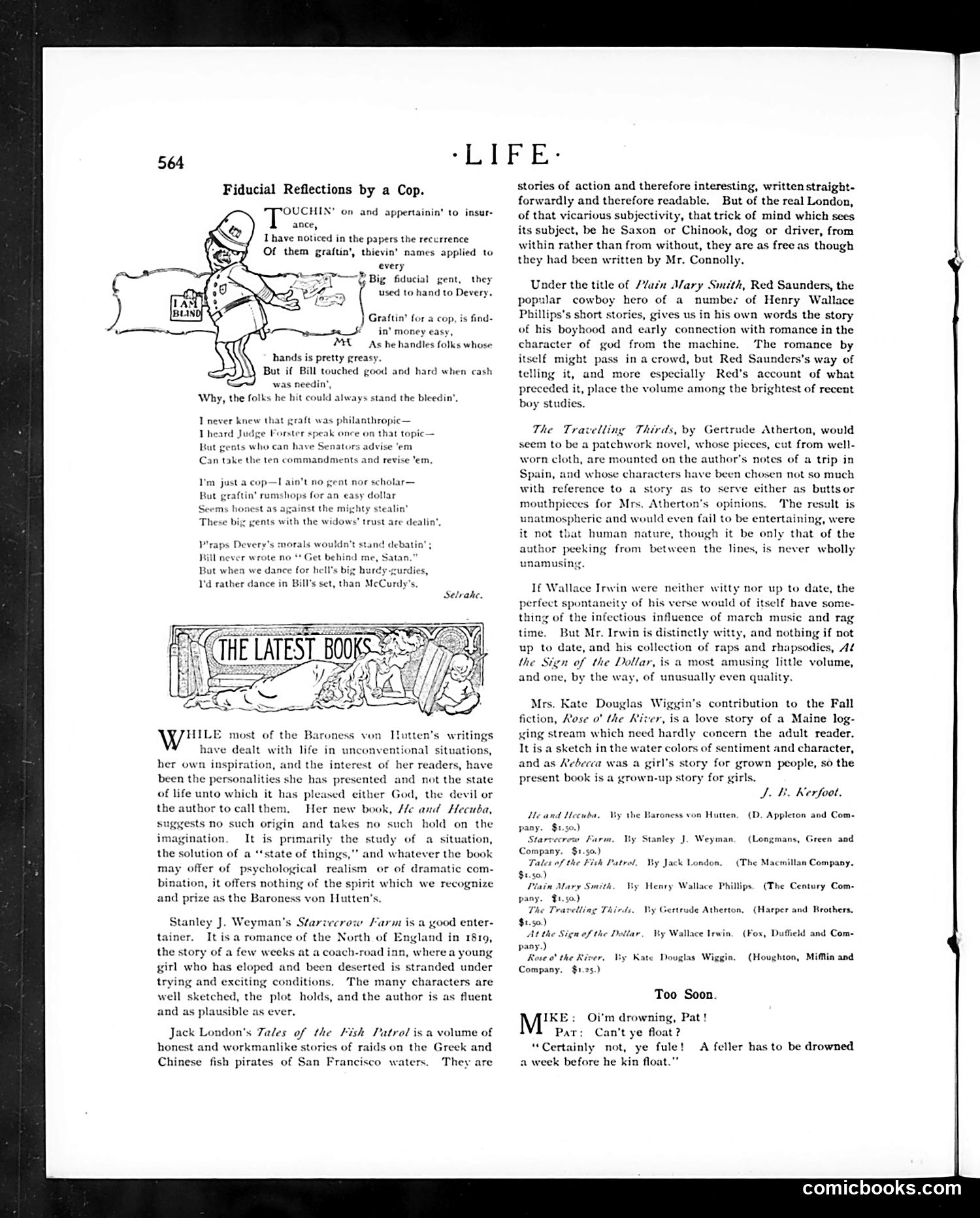
What you’re looking at
This cartoon satirizes police corruption in early 1900s New York City. The officer-narrator uses crude vernacular to defend petty graft (bribery and extortion from businesses) as morally superior to the large-scale financial crimes of wealthy men. The reference to "Big fiducial gent" and "Devery" likely alludes to **Police Chief William S. Devery**, notorious for tolerating widespread corruption. The cop's logic—that shaking down saloonkeepers for "easy dollars" is "honest as against the mighty stealin'" by wealthy financiers—mocks the hypocrisy of criminalizing small corruption while ignoring elite wrongdoing. The cartoon satirizes both corrupt police and the public's acceptance of petty graft as inevitable urban vice. The title "Fiducial Reflections" (fiduciary = financial trust) drips with irony, as the speaker reveals no actual financial ethics whatsoever.
📄 Transcribed text from this page (OCR, searchable)
Machine-transcribed from the original scan — historical spelling and the odd misread are preserved.
*-LIFE- Fiducial Reflections by a Cop. OUCHIN’ on and appertainin’ to insur- ance, T have noticed in the papers the recurrence Of them graftin’, thievin’ names applied to every Tap ——B Big fiducial gent, they used to hand to Devery. Graftin’ for a cop, is find- in’ money easy As he handles folks whose hands is pretty greasy. But if Bill touched good and hard when cash was needin’, Why, the folks he hit could always stand the bleedin’, graft was philanthropie— ak once on that topie— T never knew that Theard ' But ¢ Can take the ten commandments ised revi: ts who can have I'm just a cop—l ain't no gent nor scholar— But graftin’ rumshops for an easy dollar Seems honest as against the These big gents with the widows* ty stealin’ trust are dealin’, debatin’ ; ¢, Satan.” Praps Devery's morals woulda’ Rill never wrote no beh we dance for hell's bi er dance in Bill's set, thar But whe: Vd rat! McCurdy’s. Paw aa at CHE a i oy % Roe HILE most of the Baroness v have dealt with life in uncon her own inspiration, and the interest of her readers, been the personalities she has presented and not the state of life unto which it has pleased either God, the devil or the author to call them, Her new book, //e and Hecuba, sugyests no such origin and takes no such hold on the imagination. It is primarily the study of a situation, the solution of a ‘state of things,"’ and whatever the book may offer of psychological realism or of dramatic com- bination, it offers nothing of the spirit which we recognize and prize as the Baroness von Hutten’s. Hutten's writings ventional situations, Stanley J. Weyman’s Starvverow Farm is a good enter- tainer. It isa romance of the North of England in 1819, the story of a few weeks at a coach-road inn, where a young girl who has eloped and been deserted is stranded under trying and exciting conditions. ‘The many characters are well sketched, the plot holds, and the author is as fluent and as plausible as ever. Jack London's Tales of the Fish Patrol is a volume of honest and workmanlike stories of raids on the Greek and Chinese fish pirates of San Francisco waters. They are stories of action and therefore interesting, written straight- forwardly and therefore readable, But of the real London, of that vicarious subjectivity, that trick of mind which sees. its subject, be he Saxon or Chinook, dog or driver, from within rather than from without, they are as free as though they had been written by Mr. Connolly, Under the title of /¥ain Mary Smith, Red Saunders, the popular cowboy hero of a number of Henry Wallace Phillips's short stories, gives us in his own words the story of his boyhood and early connection with romance in the character of god from the machine. The romance by itself might pass in a crowd, but Red Saundcrs's way of telling it, and more especially Red's account of what preceded it, place the volume among the brightest of recent boy studies. The Travelling Thirds, by Gertrude Atherton, would seem to be a patchwork novel, whose pieces, cut from well- worn cloth, are mounted on the author's notes of a trip in Spain, and whose characters have been chosen not so much with reference to a story as to serve either as buttsor ‘The result is unatmospheric and would even fail to be entertaining, were it not that human nature, though it be only that of the author peeking from between the lines, is never wholly unamusing mouthpieces for Mrs, Atherton's opinions. If Wallace Irwin were neither witty nor up to da perfect spontaneity of his verse would of itself have some- thing of the infectious influence of march music and rag time. But Mr. Irwin is distinctly witty, and nothing if not up to date, and his collection of raps and rhapsodies, Ad the Sign of the Dollar, is a most amusing little volume, and one, by the way, of unusually even quality. Mrs. Kate Douglas Wigyin’s contribution to the Fall on, Rose o' the River, is a love story of a Maine log- wing stream which need hardly concern the adult reader. It is a sketch in the water colors of sentiment and character, and as Aebecca was a girl’s story for grown people, so the present book is a grown-up story for girls. J.B. Kerfoot. Me and Hecuba. pany. $2.50.) Starvecrow Farm Company. $1.50.) Tales of the Fish Patrol, $1.50) Plain Mary Smith ) Ming Thirds, By the Baroness von Hutten. (D, Appleton and Com- By Stanley J. Weyman. (Longmans, Green and y Jack London, (The Macmillan Company. Hy Henry Wallace Phillips. (The Century Com- Gertrude Atherton, (Harper and Brothers, At the Sign of the Dollar pany.) Rose 0! the River, Company. $1.25.) Ry Wallace Irwin, (Fox, Duffield and Com- Ky Kate Douglas Wiggin. (Houghton, Mi Min and Too Soon. IKE: Oi'm drowning, Pat! Pat: Can't ye float? Certainly not, ye fule! a week before he kin float.” A feller has to be drowned comicbooks.com