
Life, 1905-11-09 · page 6 of 26
Life — November 9, 1905 — page 6: what you’re looking at
What you’re looking at
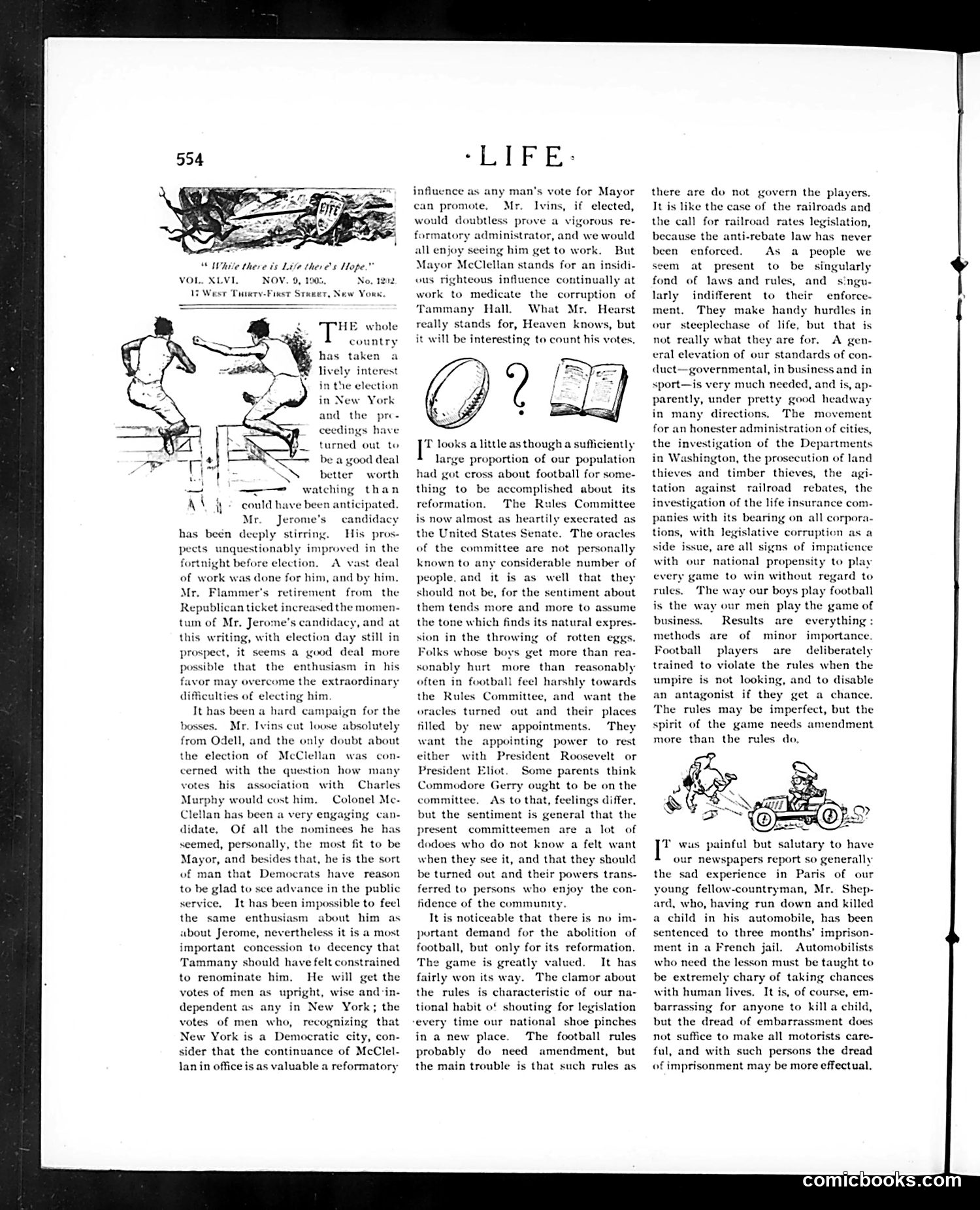
This *Life* magazine page (November 9, 1902) contains editorial commentary on New York elections, particularly regarding candidate selection and the influence of political figures like Mr. Jerome and Mr. Ivins. The cartoon at top left shows two figures in athletic/wrestling poses, illustrating the contentious political struggle. The text discusses concerns about political corruption, administrative fitness, and the "Tammany Hall" machine—the Democratic political organization notorious for graft. The lower cartoon depicts figures with an early automobile, likely satirizing modern progress or speed in political maneuvering. The overall tone criticizes political manipulation, the power of party machines over actual governance, and questions whether elected officials will genuinely serve the public interest rather than factional interests.
📄 Transcribed text from this page (OCR, searchable)
Machine-transcribed from the original scan — historical spelling and the odd misread are preserved.
“ While there is Life there's Hope.” VOL. > DV. 9, 1903, No. st Street, New Yous. whole country taken a lively interest in the election in New York and the eedings have pre- turned out to be a good deal better worth watching than could have been anticipated. Mr. Jerome’s candidacy has been deeply stirring. His pros- pects unquestionably improved in the eelection, A vast deal one for him, and by him. from the fortnight be: of work was ¢ Mr. Flammer’s retirement Republican ticket increased the momen- tum of Mr. Jerome’s candidacy, and at this writing, with election day still in prospect, it seems a good deal more possible that the enthusiasm in his favor ma ercome the extraordinary i ies of electing him s been a hard campaign for the sses. Mr. Ivins cut loose absolutely from Odell, and the only doubt about the election of McClellan cerned with the question how many votes his association with Charles Murphy would cost him. Colonel Me- Clellan has been a very engaging cu didate. Of all the nominees he has seemed, personally, most fit to be Mayor, and besides that, he is the sort of man that Democrats have reason to be glad to sce advance in the public It has been impossible to feel jasm about him as ttheless it is a most was con- about Jerome, ne important concession to decency that Tammany should have felt constrained to renominate him. He will get the votes of men as upright, wise and-in- dependent as any in New York; the votes of men who, recognizing that New York is a Democratic city, con- sider that the continuance of McClel- lan in office is as valuable a reformatory ‘LIFE: influence as any man's vote for Mayor n promote, Mr. Ivins, if elected, would doubtless prove a vigorous re- formatory administrator, and we would him get to work. But Mayor McClellan stands for an insidi- ous righteous influence continually at work to medicate the corruption of Tammany Hall. What Mr. Hearst really stands for, He but ill be interesting to count his votes, n know: alittle asthough a sufficiently proportion of our population had got cross about football for some- thing to be accomplished about its reformation. The Rules Committee is now almost as heartily execrated as the United States Sena’ The oracles of the committee are not personally known to any considerable number of people. and it is as well that they should not be, for the sentiment about them tends more and more to assume the tone which finds its natural expres sion in the throwing of rotten eggs. Folks whose boys get more than rea- sonably hurt more than reasonably often in football feel harshly towards the Rules Committee, and want the oracles turned out and their places filled by new appointments. ‘Th want the appointing power to rest either with President Roosevelt or President Eliot. Some parents think Commodore Gerry ought to be on the committee. As to that, feelings differ, but the sentiment is general that the present committeemen a lot of dodoes who do not know a felt want when they see it, and that they should be turned out and their powers trans- ferred to persons who enjoy the con- fidence of the community It is noticeable that there is no im- portant demand for the abolition of football, but only for its reformation. ‘The game is greatly valued. It has fairly won its way, The clamor about the rules is characteristic of our na- tional habit of shouting for legislation every time our national shoe pinches in a new place. The football rules probably do need amendment, but the main trouble is that such rules as are there are do not govern the players. It is like the case of the railroads and he call for railroad rates legislation, because the anti-rebate Jaw has never been enforced. As a people we seem at present to be singularly fond of laws and rules, and singu- larly indifferent to their enforce- ment. They make handy hurdles in our steeplechase of life, but that is not really what they are for. A gen- eral elevation of our standards of con- duct—governmental, in business and in sport—is very much needed, and i parently, under pretty good headway in many directions. The movement for an honester administration of cities, the investigation of the Departments in Washington, the prosecution of land thieves and timber thieves, the tation against railroad rebates, the investigation of the life insurance com. panies with its bearing on all corpora- tions, with legislative corruption side issue, are all signs of im with our national propensity to play every game to win without regard to rules. ‘The way our boys play football is the way our men play the game of business. Results are everything : methods are of minor importance Football players are deliberately trained to violate the rules when the umpire is not looking, and to disable an agonist if they get a chance. The rules may be imperfect, but the spirit of the game needs amendment more than the rules do, alutary to have r was painful but our newspapers report so generally the sad experience in Paris of our young fellow-countryman, Mr. Shep- ard, who, having run down and killed a child in his automobile, has been sentenced to three months’ imprison- ment in a French jail. Automobilists who need the lesson must be taught to be extremely chary of taking chances with human lives. It is, of course, em- barrassing for anyone to kill a child, but the dread of embarrassment does not suffice to make all motorists care- ful, and with such persons the dread of imprisonment may be more effectual. comicbooks.com