
A complete issue · 24 pages · 1905
Life — August 24, 1905
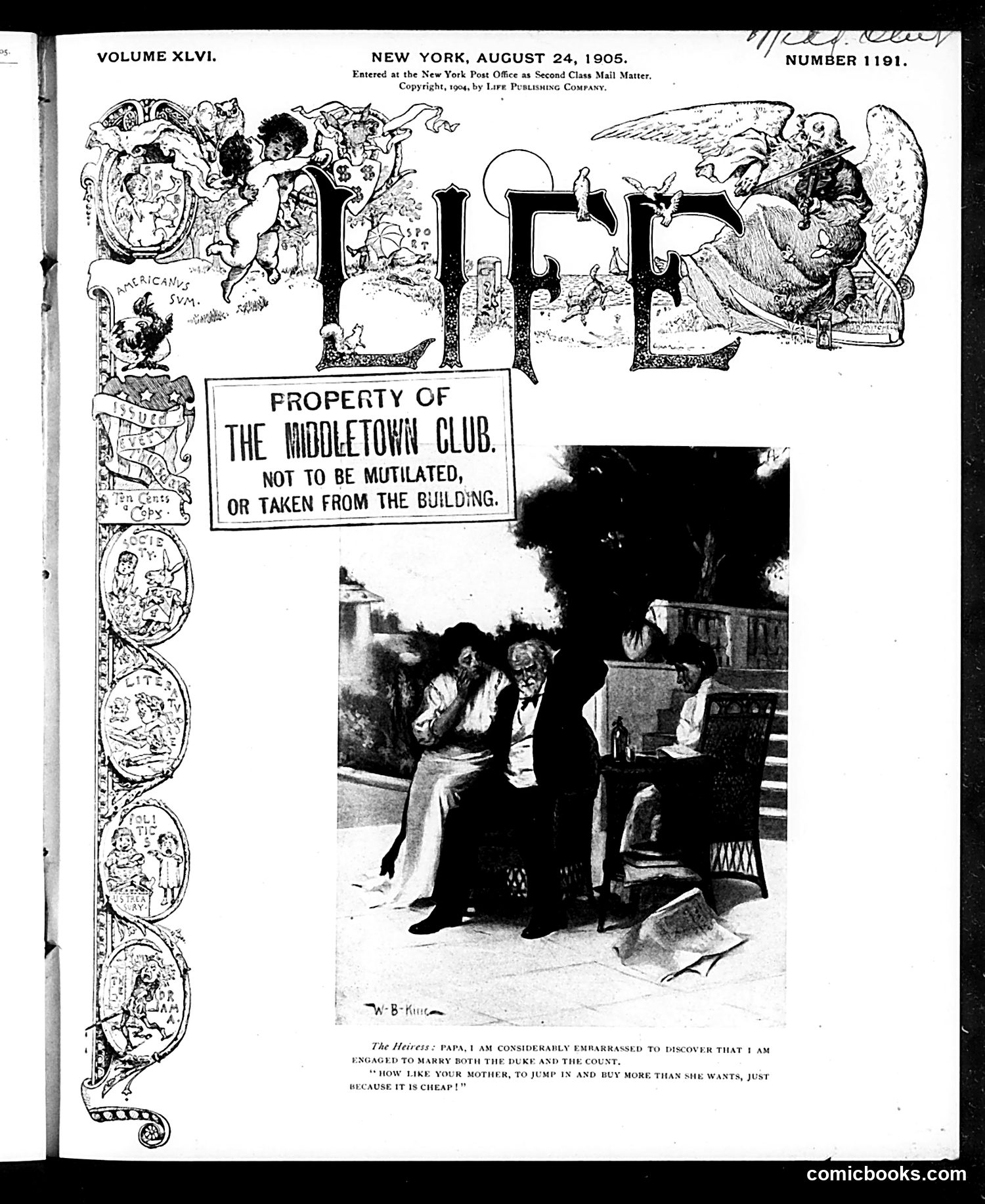
This page satirizes wealthy women's excessive spending habits. The main cartoon depicts a society woman telling her fiancé that she's engaged to marry both a duke and a count—then boasts she'll "jump in and buy more than she wants, just because it is cheap!" The joke targets the contradiction in wealthy women's logic: despite having substantial means, they compulsively overspend on unnecessary items simply because goods are discounted. The satire mocks both female consumerism and the social climbing of marrying European nobility (the duke and count). The ornate left border and elaborate masthead featuring cherubs and classical imagery emphasize Life's satirical, high-culture pretensions, which frames the joke as social commentary on the excesses of America's wealthy class during the Gilded Age.
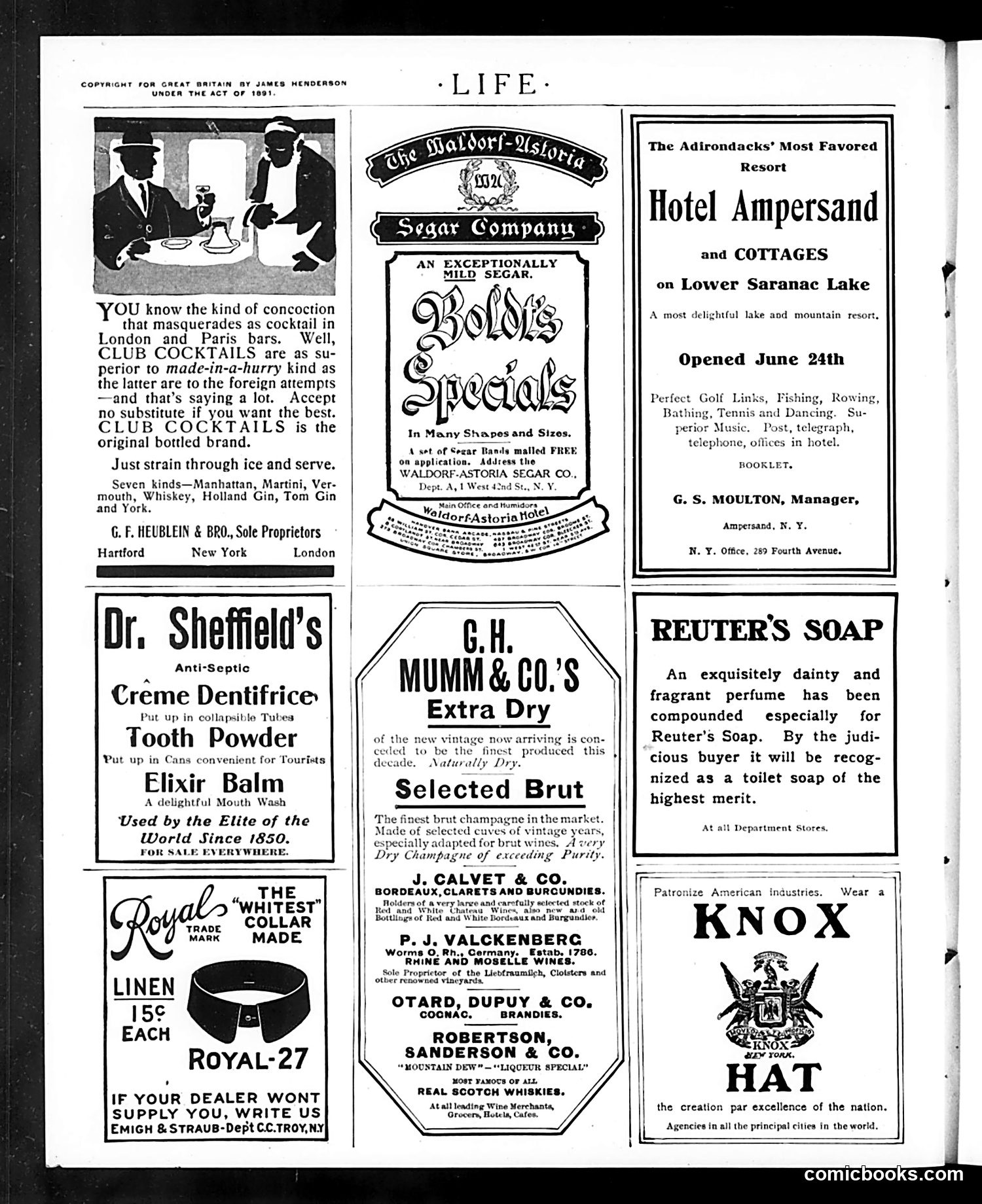
This page is primarily **advertising**, not political satire. The small cartoon in the upper left depicts two men in formal attire at what appears to be a bar or restaurant—one seated, one standing as a waiter or server. The accompanying text promotes "Club Cocktails," a bottled cocktail brand, claiming it's superior to homemade versions served in London and Paris bars. The joke is straightforward: the product offers convenience and quality comparable to upscale establishments. There's no political commentary or caricature of identifiable figures. The remainder of the page contains various product advertisements typical of early 20th-century Life magazine: champagne, soap, collars, hats, and a hotel resort. These are standard commercial promotions with no satirical content.
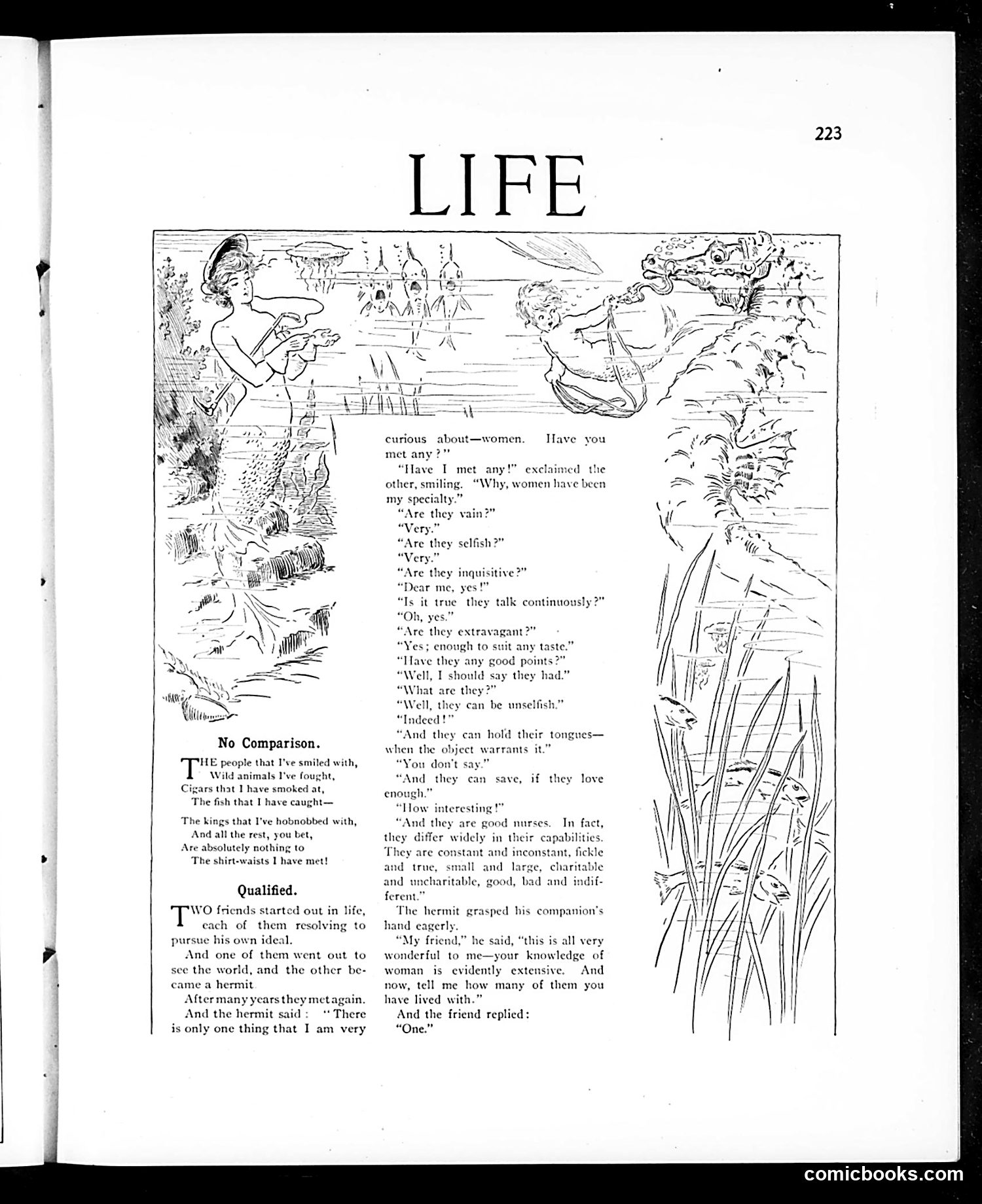
This page contains two prose pieces with accompanying illustrations rather than political cartoons: **"No Comparison"** presents a humorous poem about a man comparing his romantic conquests—cigars smoked, fish caught, and kings hunted—to "shirt-waists" (women's blouses, period slang for women). The joke is the absurdity of comparing romantic interests to inanimate objects or animals. **"Qualified"** tells an anecdotal story about two friends: one becomes a hermit, the other travels. Upon reuniting, the hermit claims expertise in women based on limited experience, having "lived with" only one woman. The satire mocks men's presumption of understanding women while having minimal actual interaction with them. Both pieces satirize early 20th-century male attitudes toward women—treating them as conquests while remaining fundamentally ignorant about them.
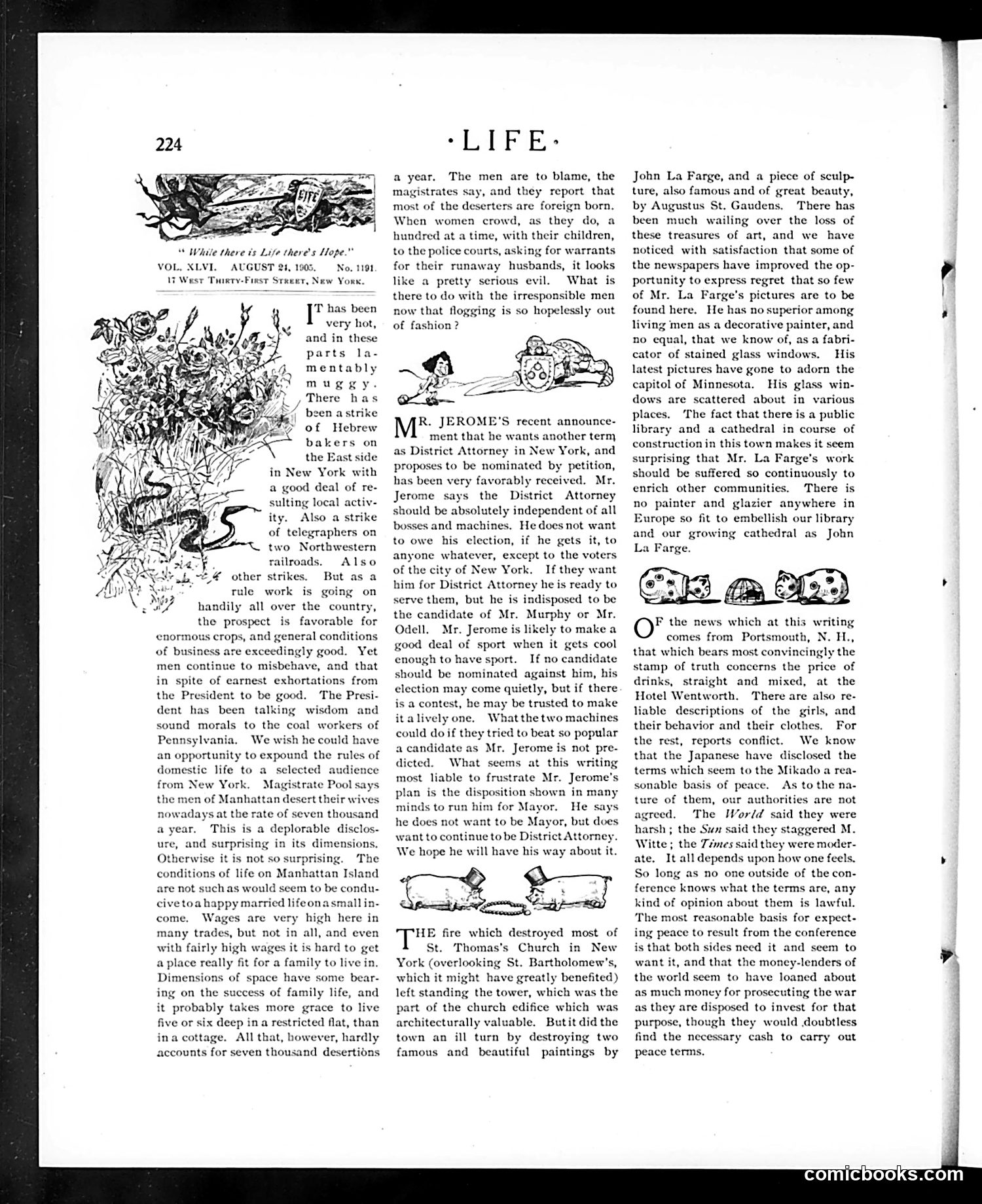
This page contains three illustrated vignettes satirizing contemporary social issues rather than specific political figures. The top-left cartoon depicts **Hebrew bakers on New York's East Side**, mocking their labor disputes and strike activity on two northeastern railroads. The satire targets the working conditions and labor unrest of immigrant workers. The bottom cartoon references **the 1911 fire that destroyed St. Thomas's Church in New York**, which destroyed valuable artistic paintings and sculptures. The satire appears to criticize the loss of culturally important artwork. The right column discusses **Mr. Jerome's potential run for District Attorney**, satirizing local political ambitions and machine politics in New York City. The page primarily engages with local New York labor, cultural, and political controversies rather than national affairs.
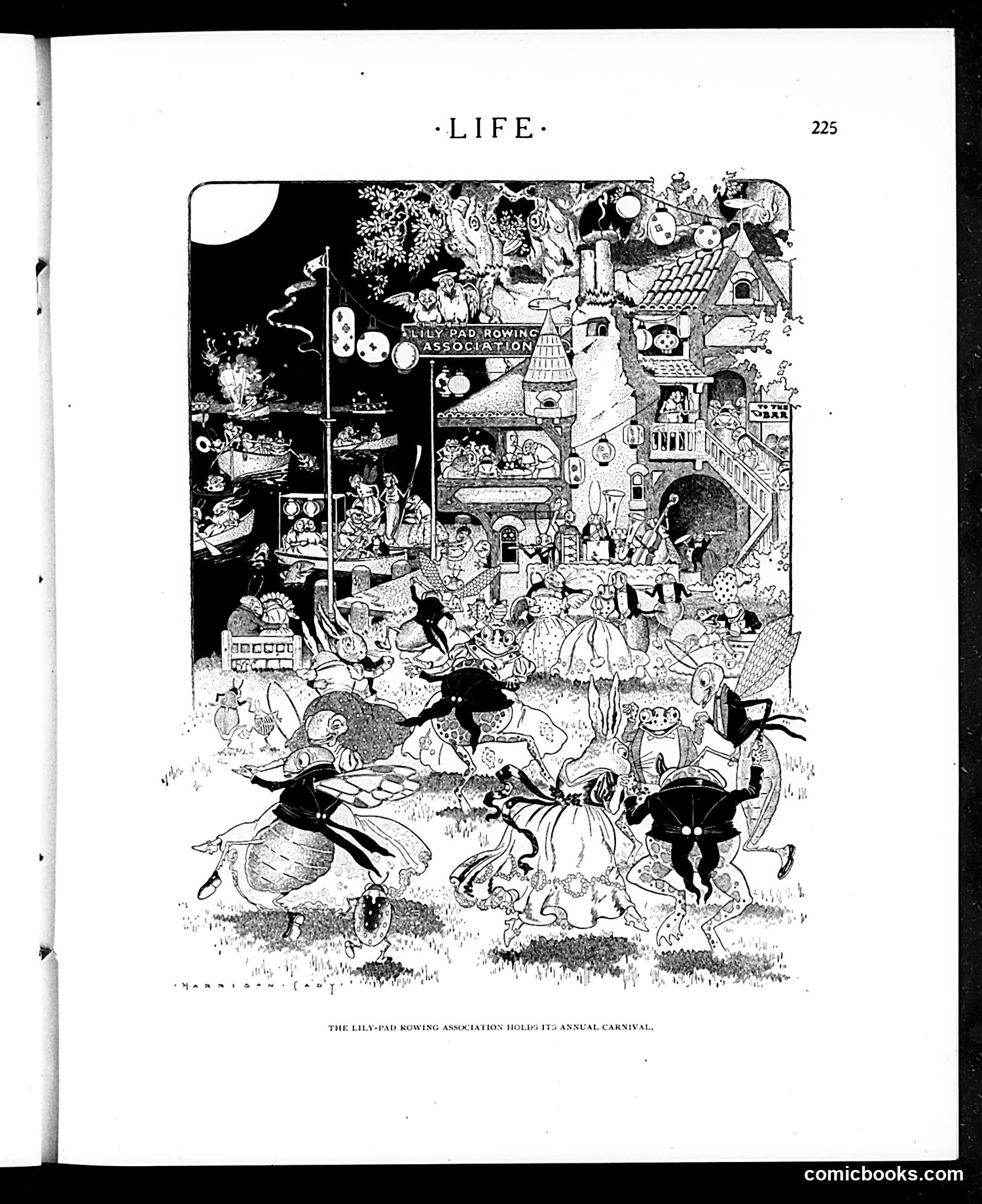
This is a whimsical illustration from *Life* magazine (page 225) depicting "The Lily-Pad Rowing Association Holds Its Annual Carnival." The cartoon shows an elaborate fantastical scene with anthropomorphic creatures—frogs, insects, and other animals—engaged in various carnival activities around a fanciful castle or structure. Figures in the foreground appear to be dancing or performing, while the detailed background contains numerous small vignettes of entertainment and merrymaking. This is likely a humorous, non-political piece of decorative satire typical of *Life*'s lighter content—playful illustration rather than topical commentary. The "Lily-Pad Rowing Association" appears to be a fictional organization used as framing for imaginative visual storytelling. The intricate detail and abundance of small characters suggest it's meant primarily as whimsical entertainment rather than social or political critique.
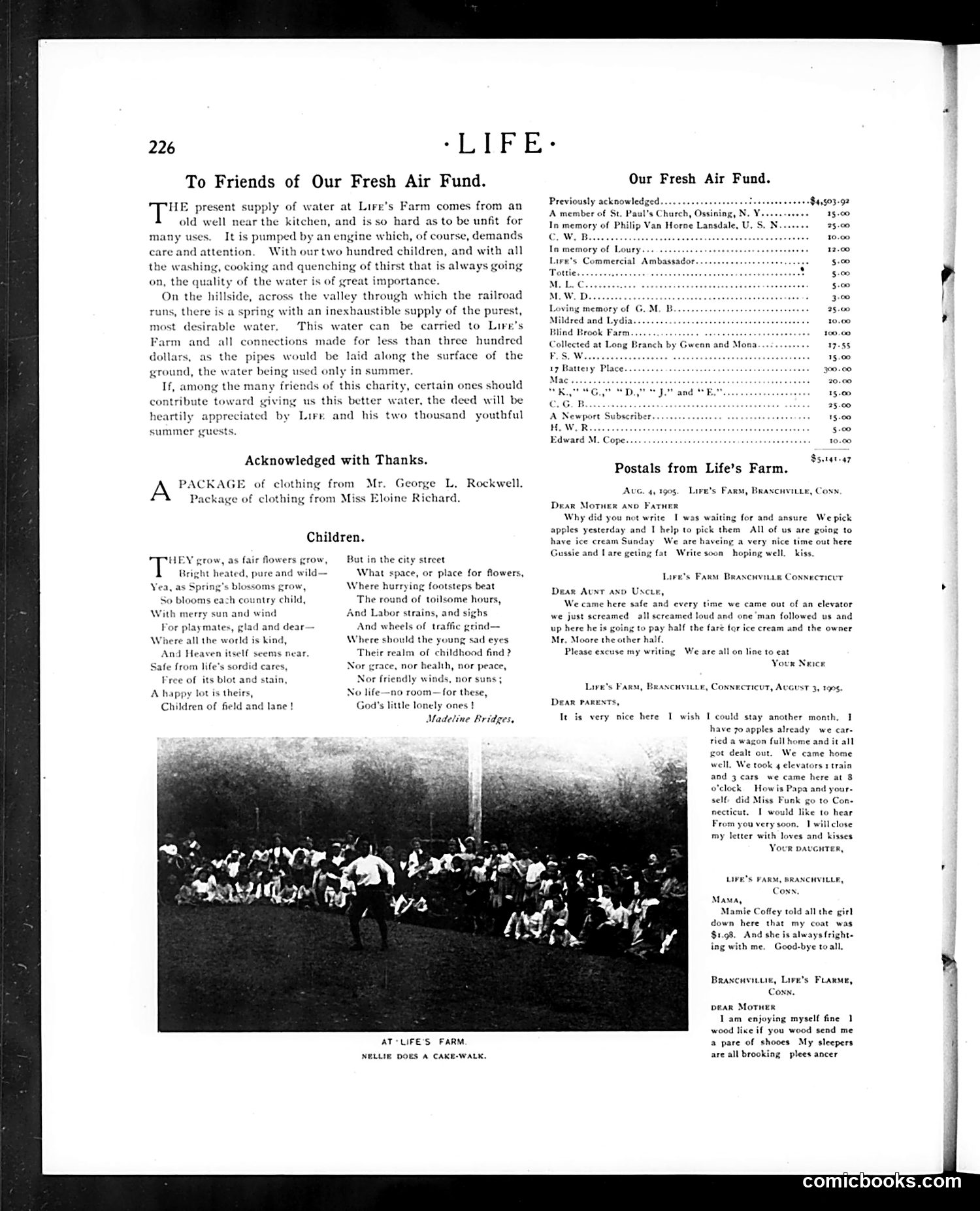
This page documents **Life's Farm in Branchville, Connecticut**, a charitable initiative providing summer respite for urban children. The large photograph shows "Nellie Does a Cake-Walk"—children and adults gathered outdoors at the farm. The page combines fundraising appeals ("To Friends of Our Fresh Air Fund") with donor acknowledgments and pastoral poetry celebrating country life for children ("They grow, as fair flowers grow, / High heads, pure and place for flowers"). The postcards section contains letters from visitors praising the farm's hospitality and wholesome environment. This represents **early 20th-century Progressive-era philanthropy**, addressing urban poverty through rural recreational access—a common solution among affluent reformers to improve children's health and morality through nature exposure.
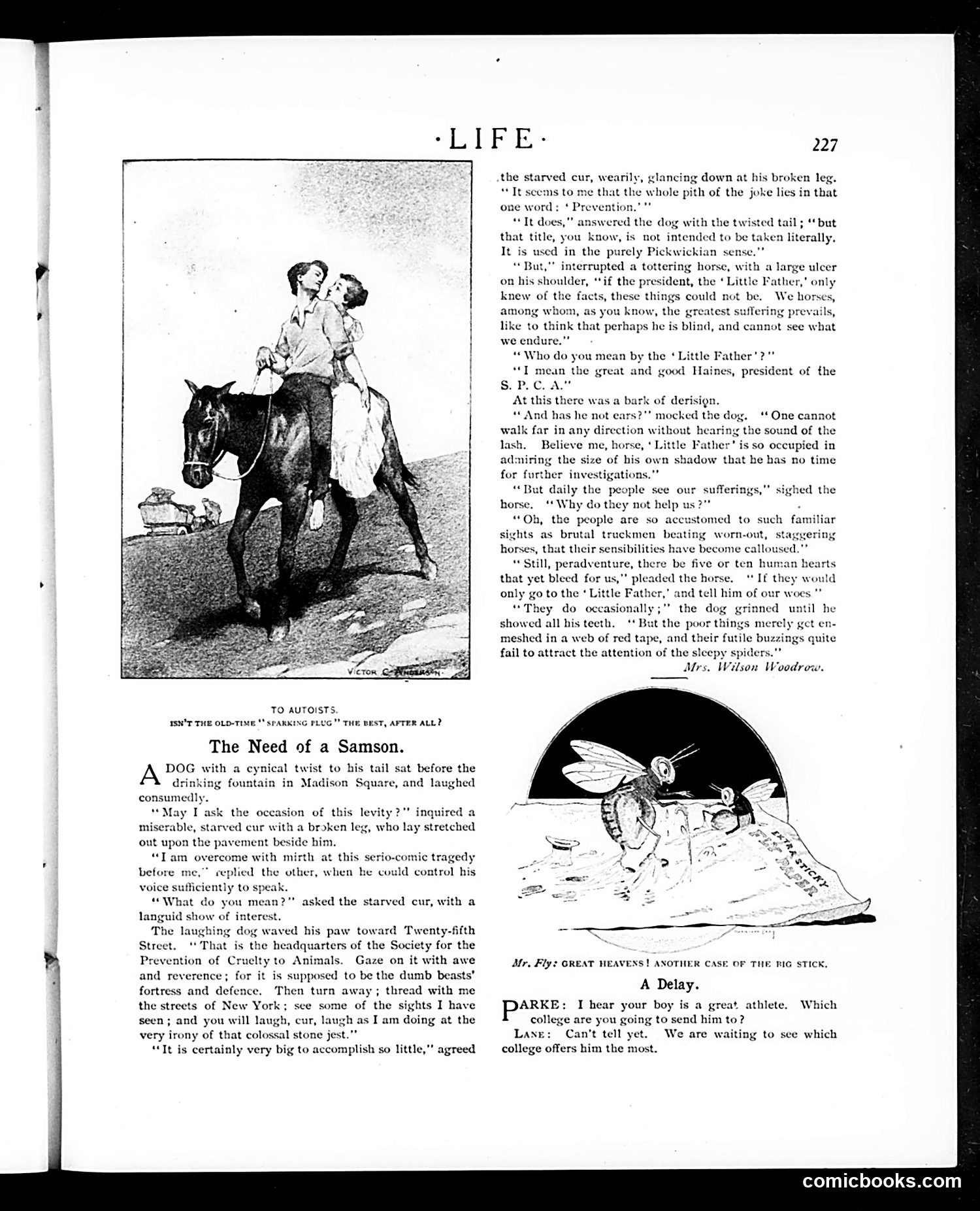
This page contains two satirical pieces about animal welfare and social commentary. The main cartoon depicts a cynical dog at a fountain in Madison Square mocking a starved cur with a broken leg. The dog represents the S.P.C.A. (Society for the Prevention of Cruelty to Animals), personified as "the Little Father" or President Haines. The satire criticizes the organization's ineffectiveness: while the S.P.C.A. exists as a "fortress and defence," animals still suffer visibly on city streets. The dialogue suggests the organization is so occupied with its own importance that it ignores daily animal brutality—brutal truckmen beating exhausted horses—while the wounded animals languish unheard. The point: the S.P.C.A. needs a "Samson" (strong leader) to actually enforce animal protection rather than merely exist as an institution.
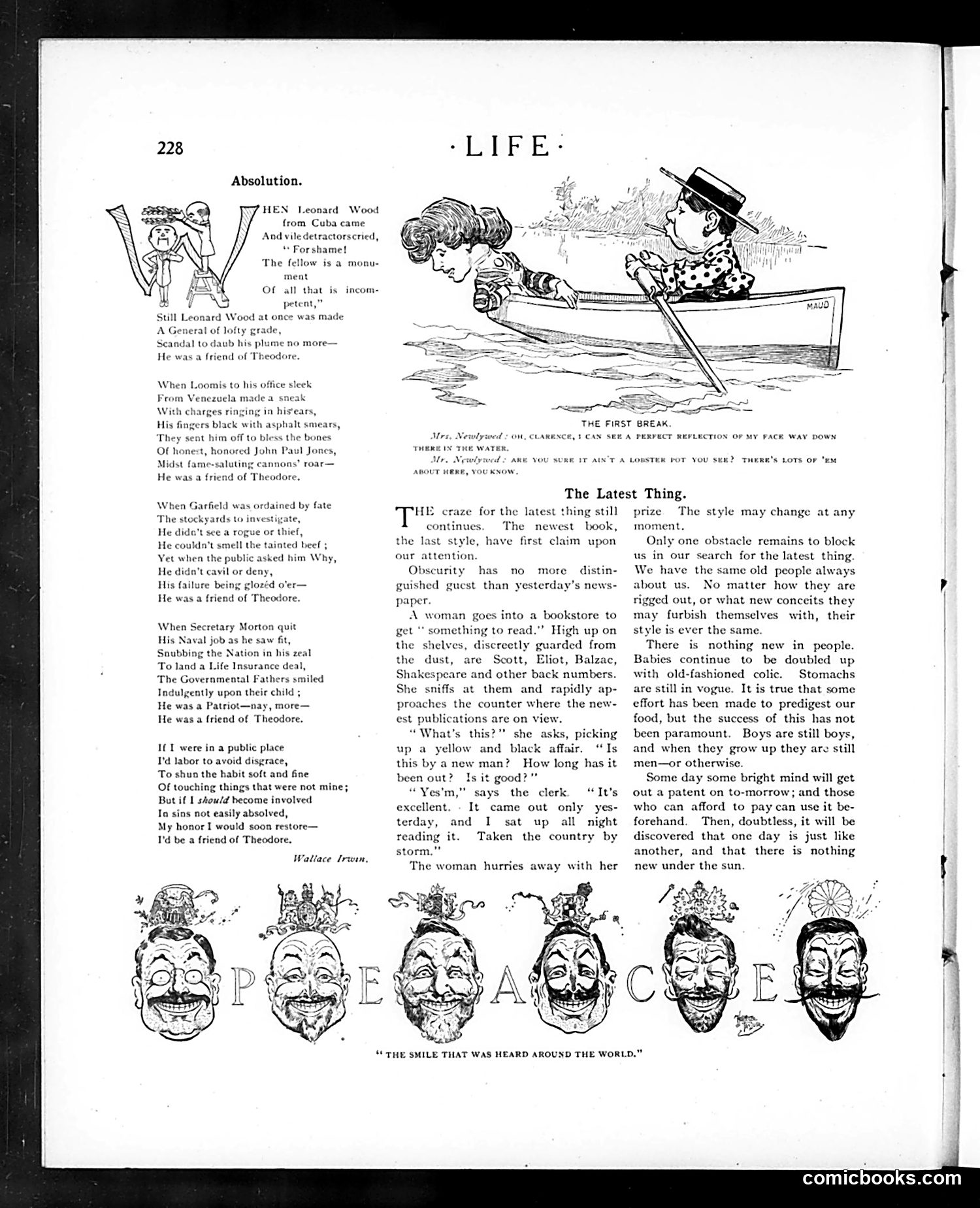
This Life magazine page satirizes early 20th-century American politics. The "Absolution" poem mocks several public figures who escaped scandal through convenient circumstances or reinvention: - **Leonard Wood** (Cuba commander) gained promotion despite controversies - **Loomis** (unclear which figure) became a general despite past scandals - **Garfield** (likely Secretary of War) avoided investigation - **Secretary Morton** escaped criticism through political protection The piece suggests these men received undeserved absolution from consequences. "The Latest Thing" critiques society's obsession with novelty and fashion trends, arguing that human nature never truly changes—people simply dress up old behaviors in new styles. The bottom cartoon showing smiling faces labeled "PEACE" appears to mock the contradiction between pleasant appearances and underlying reality.
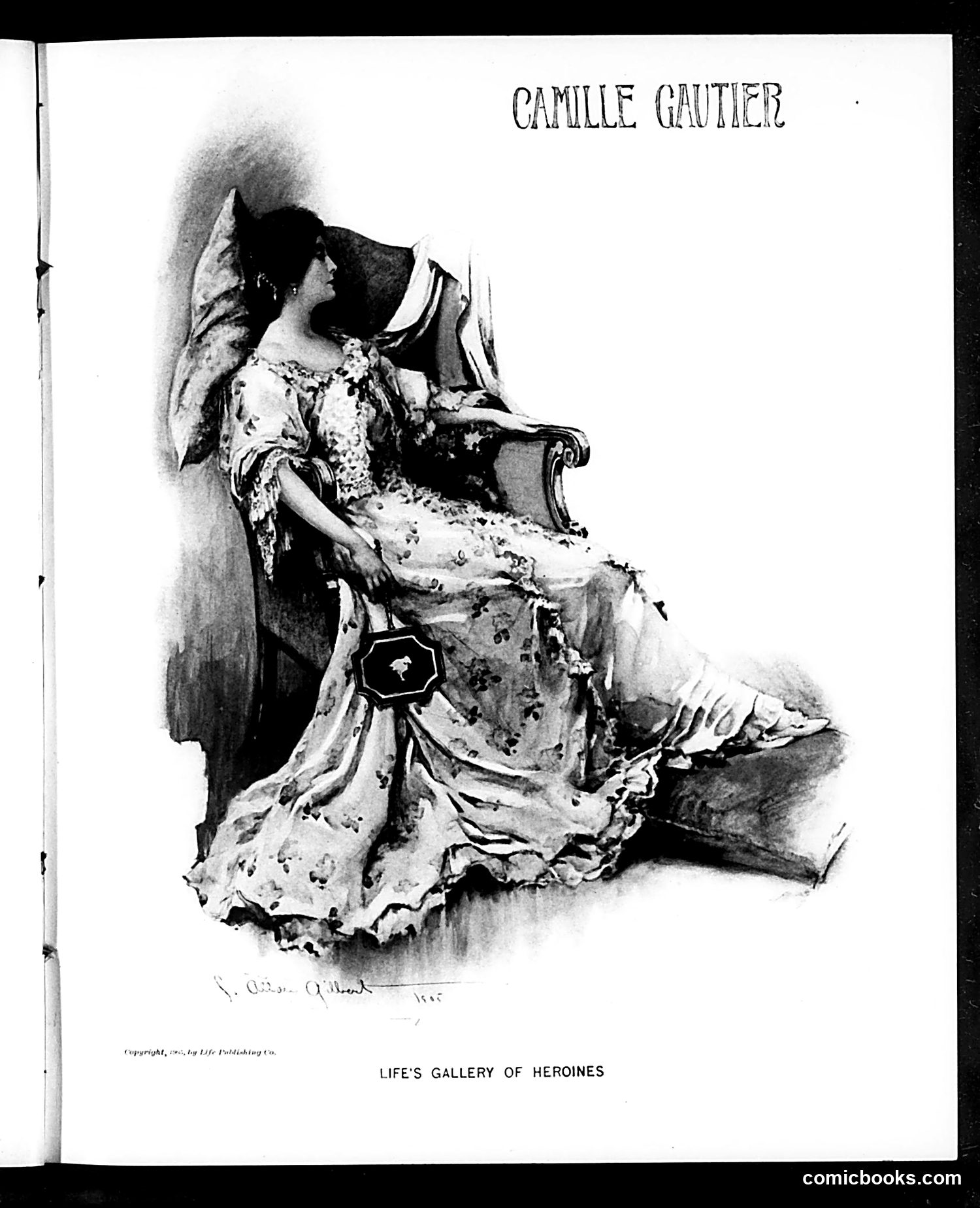
This page from Life magazine's "Gallery of Heroines" features a portrait illustration of **Camille Gautier**, identified by the text at top. The artwork shows a woman in an elegant, ornate gown reclining in a chair, rendered in a romanticized sketch style typical of early 20th-century magazine illustration. Without additional context from the magazine issue, the specific identity and significance of Camille Gautier remains unclear. The "Gallery of Heroines" series likely profiled notable women of the era—possibly actresses, society figures, or public personalities—though the satirical intent (if any) of including this particular subject is not evident from the image alone. The illustration's flattering, theatrical presentation suggests she was considered culturally significant enough to warrant feature coverage.

I can see this is a blank or nearly blank page from what appears to be a historical publication. The page shows mostly white space with dark borders on the left and right edges, and there is a "comicbooks.com" watermark visible at the bottom right. Without visible cartoon imagery, text content, or illustrations on the actual page itself, I cannot identify any political figures, social references, or satirical commentary. This appears to be either a blank page, a title page, an advertisement page without visible content in this scan, or a page where the actual content did not reproduce clearly in this image. To provide meaningful analysis of the satire and historical context, I would need a page where the cartoon or text is actually visible.
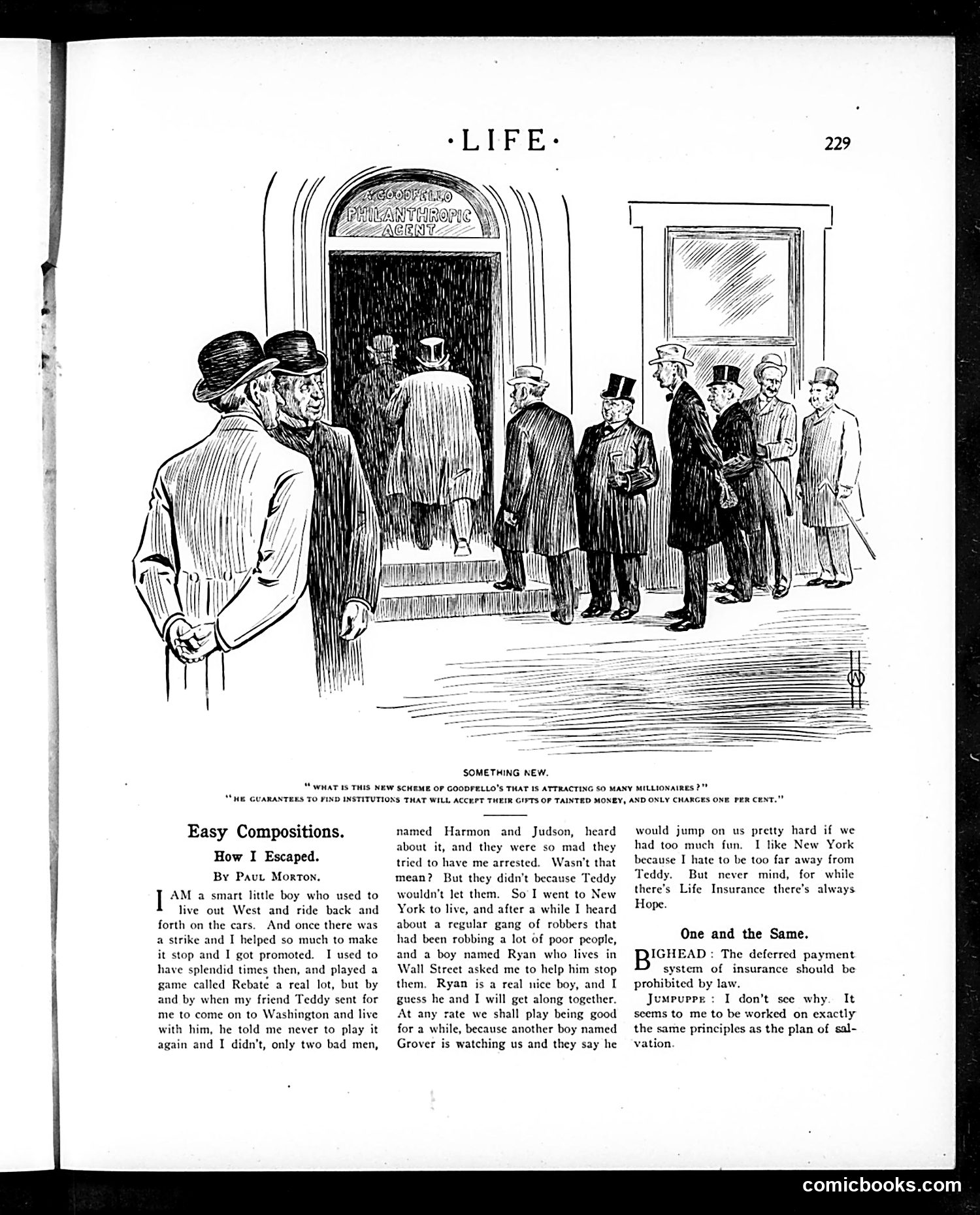
The cartoon depicts well-dressed men (wearing top hats) entering what appears to be the "Goodfello Philanthropic Agency." The caption reads: "What is this new scheme of Goodfello's that is attracting so many millionaires? He guarantees to find institutions that will accept their gifts of tainted money, and only charge per cent." **The satire:** This mocks wealthy industrialists seeking to launder questionable fortunes through charitable donations. "Goodfello" appears to be a fictional intermediary offering to help rich men donate "tainted money" (ill-gotten gains) to institutions, legitimizing their wealth through philanthropy. The joke critiques both corrupt millionaires and charities willing to accept morally questionable donations, suggesting respectability could be purchased.
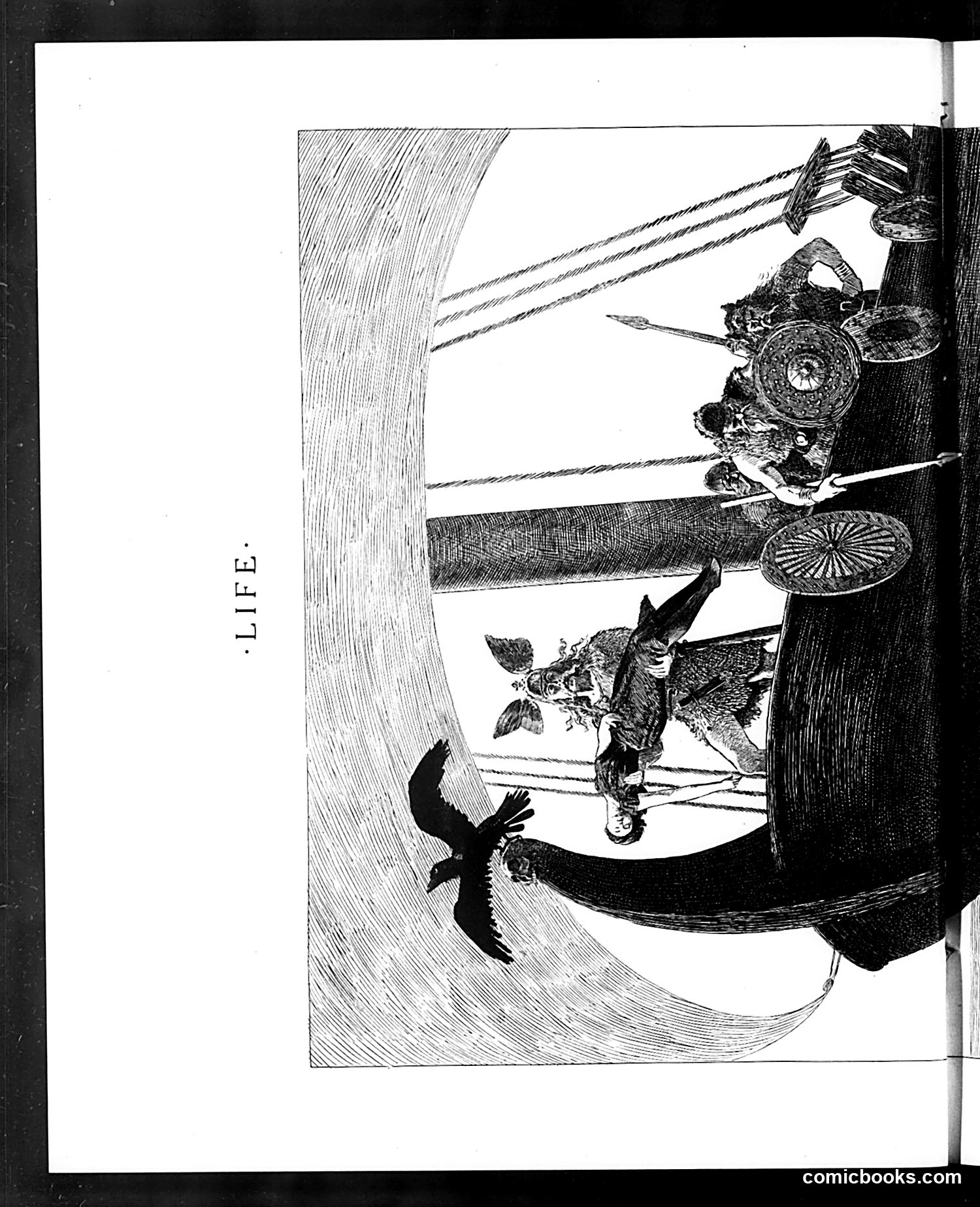
This page appears to be a title page or section header for *Life* magazine, featuring the word "LIFE" printed vertically on the left margin. The illustration itself depicts a whimsical scene with various creatures and objects arranged in what seems to be a satirical composition. The image shows what appears to be a gnome or dwarf figure, several birds (including what looks like a crow or raven), various household or decorative items, and natural elements like foliage. The style is characteristic of early-to-mid 20th century satirical illustration. However, without additional context text visible on this page or knowledge of the specific issue date, I cannot definitively identify the political or social references this illustration intends to satirize. The symbolic meaning and intended commentary remain unclear from the image alone.
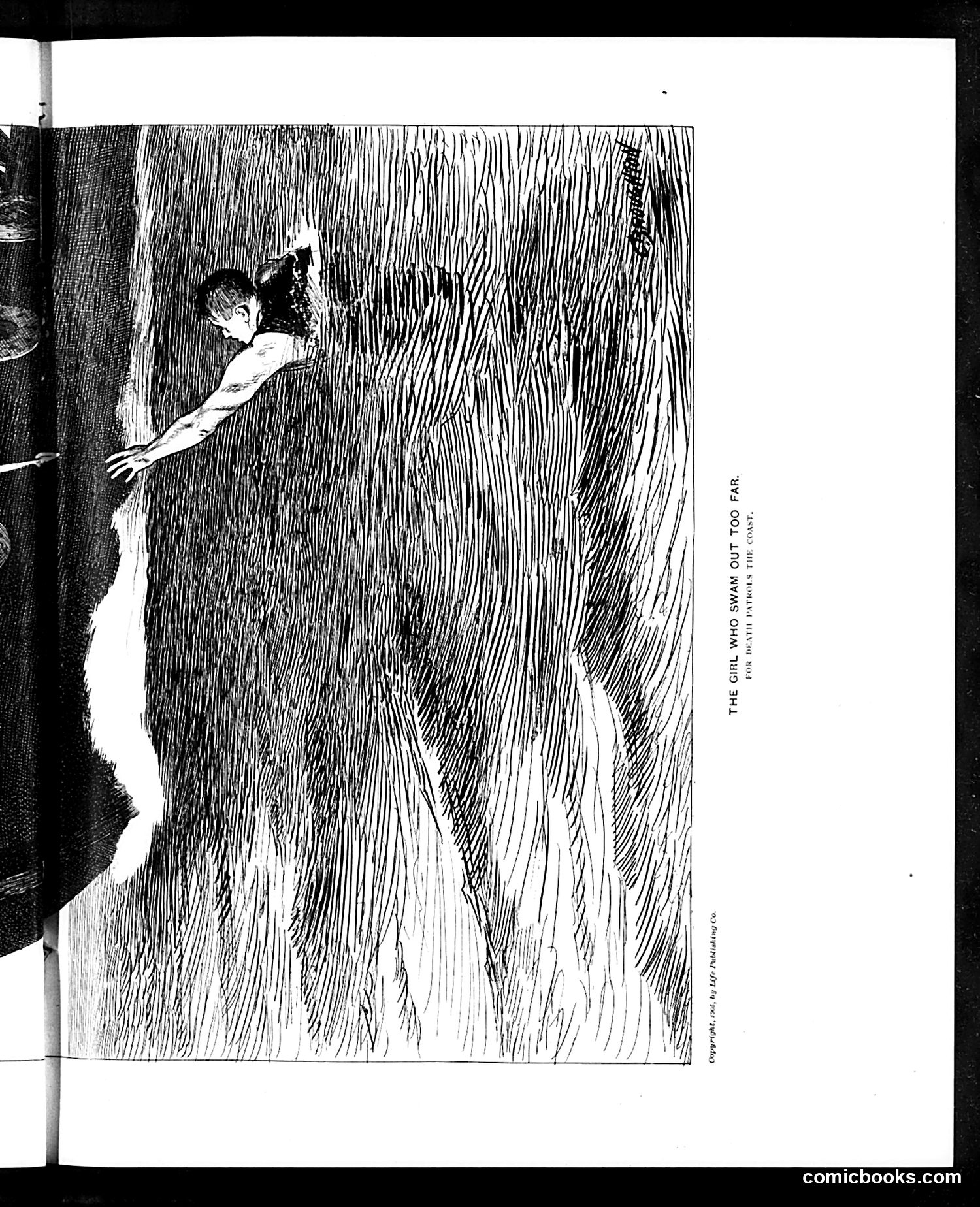
This appears to be a satirical illustration titled "The Girl Who Swam Out Too Far," showing a figure struggling in turbulent water with one arm extended upward in distress. The image likely uses drowning as a metaphor for social or political peril, a common satirical device in Life magazine. Without additional context from the magazine issue, the specific identity of "the girl" and what she represents—whether a political figure, social movement, or commentary on women's behavior or social norms—cannot be definitively stated from the image alone. The artistic style employs dramatic cross-hatching to convey danger and desperation, typical of Life's visual approach to social commentary during the early-to-mid 20th century.
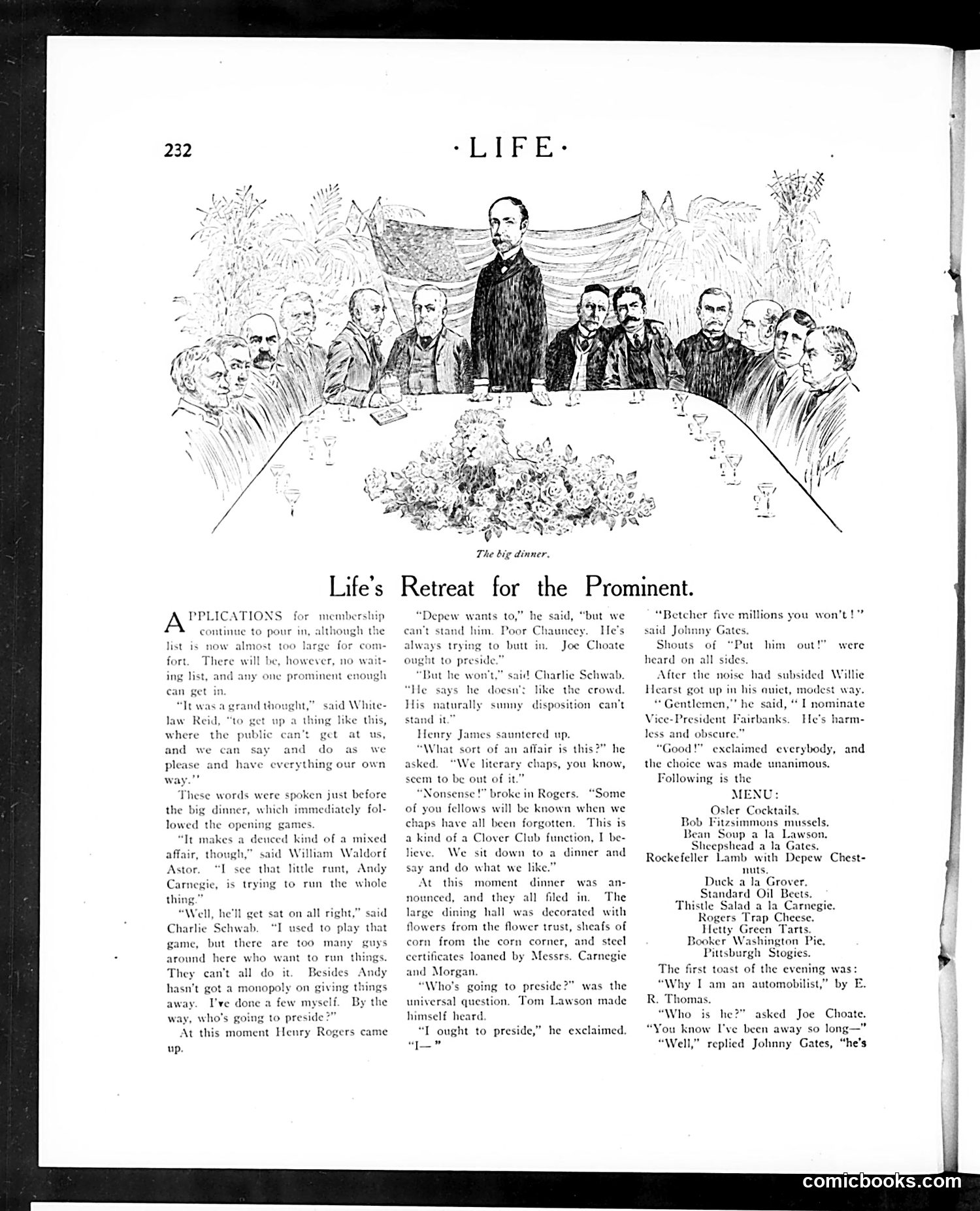
This 1902 *Life* magazine piece satirizes a exclusive dinner gathering of America's most wealthy and powerful industrialists and public figures. The cartoon depicts them debating who should preside, humorously presenting tensions among the elite. **Identifiable figures include:** Andrew Carnegie, Henry Rogers (Standard Oil), William Waldorf Astor, Chauncey Depew (railroad executive), Joe Choate (lawyer), and references to Tom Lawson, William McKinley, and others. The guest list also includes William Osler (physician), Henry James (writer), and J.P. Morgan. **The satire's point:** These titans of industry and finance—monopolists, railroad barons, and trust magnates—gather in an exclusive "Clover Club" setting where they control public discourse and policy, away from public scrutiny. The menu mockingly names dishes after controversial figures and industries (Osler Cocktails, Standard Oil dressing, Carnegie/Morgan certificates). The joke is that America's most powerful men operate within insulated circles, immune to ordinary rules and accountability.
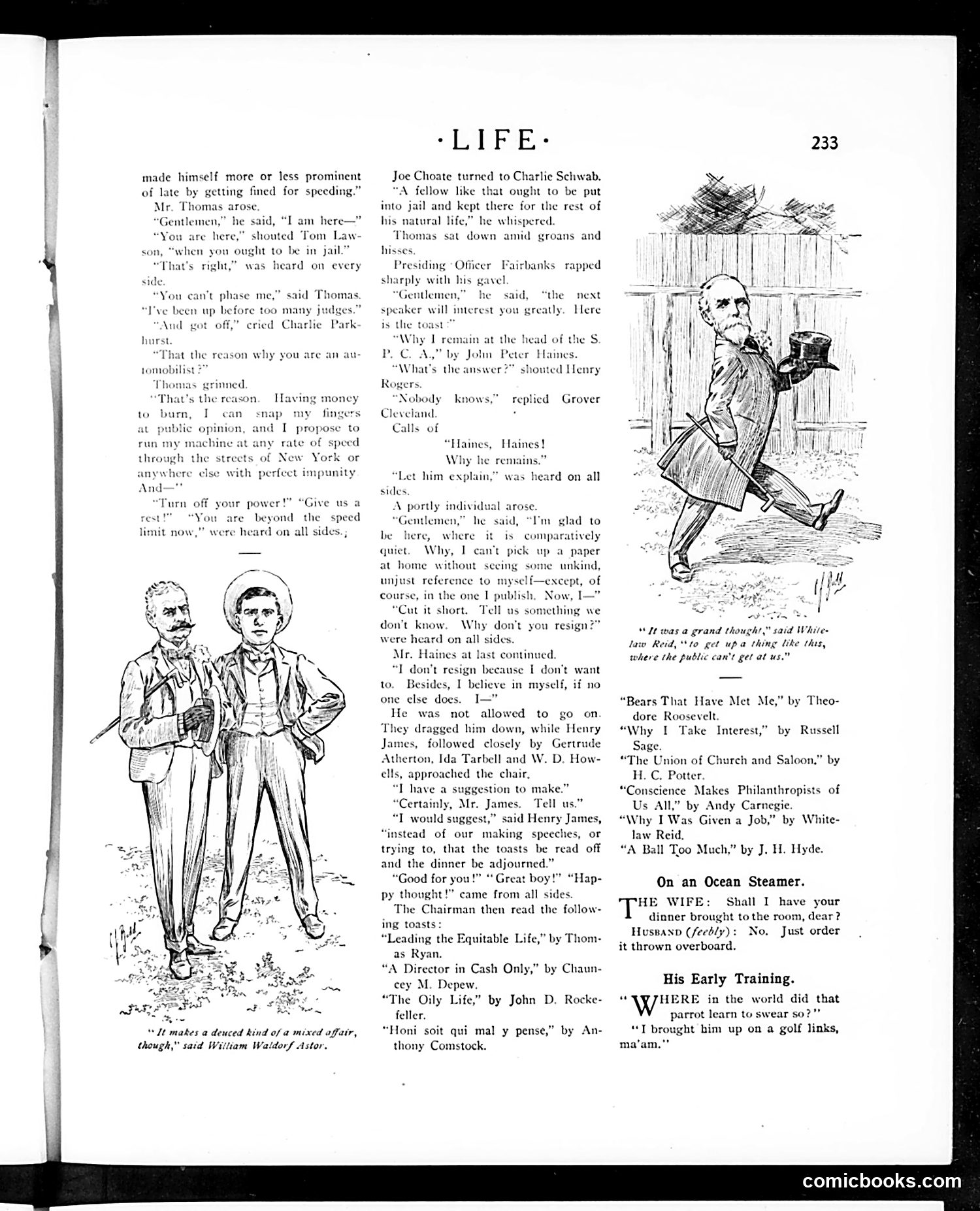
This page satirizes wealthy industrialists and public figures of the Gilded Age through a mock dinner where prominent men defend themselves against criticism. **The Main Cartoon:** Shows two men in formal dress, likely representing wealthy businessmen being mocked at a private gathering. **The Context:** The text describes a dinner where figures like Joe Choate, Charlie Schwab, and John Peter Haines (head of the S.P.C.A.) attempt to justify their controversial behavior to an audience that constantly heckles them. A man who "ought to be in jail" speaks about speeding through New York streets with "perfect impunity"—mocking wealthy elites' ability to evade consequences ordinary citizens faced. **The Satire's Point:** Life ridiculed how rich industrialists (Rockefeller, Carnegie, Depew) and society figures operated above the law and public scrutiny. The "toasts" listing their hypocrisies—"A Director in Cash Only," "The Oily Life"—mock their dubious wealth sources and moral compromises. Whitelaw Reid's closing quip, "where the public can't get at us," crystallizes the joke: the wealthy operating in secret, beyond public accountability.
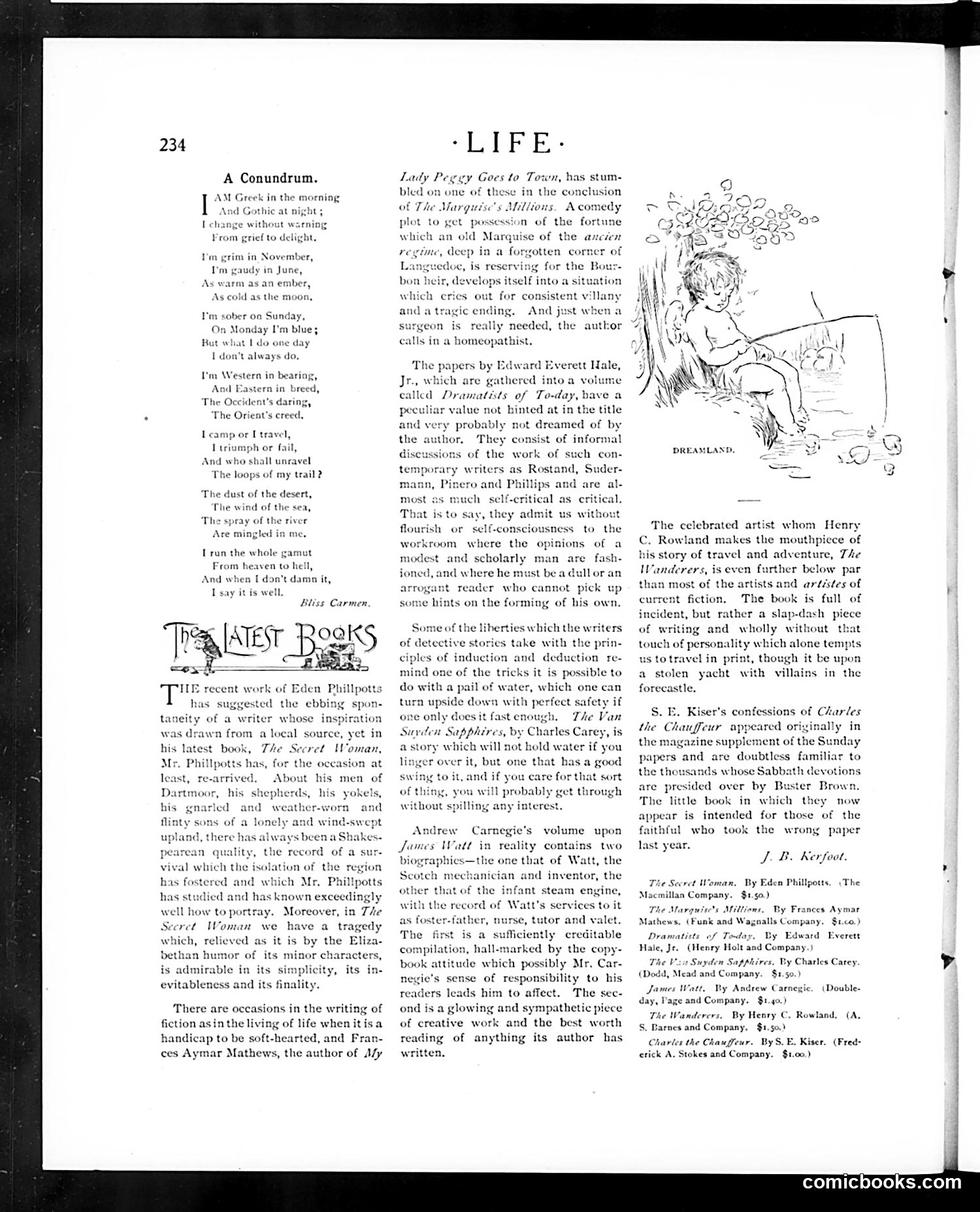
This page from *Life* magazine contains a poem titled "A Conundrum" (credited to Bliss Carman) alongside literary reviews. The poem uses paradoxes and contradictions to describe something that shifts between opposites—Greek yet Gothic, grim yet bright, Eastern yet Western philosophy. The reviews discuss contemporary fiction, including works by Eden Phillpotts and analyses of playwrights by Edward Everett Hale Jr. There's also commentary on Charles Carey's detective story and Andrew Carnegie's biography of James Watt. The illustration labeled "Dreamland" shows a child in nature, likely accompanying the whimsical tone of the conundrum poem. The page represents typical *Life* magazine content: combining literary satire and book criticism with illustrated poetry for educated readers interested in contemporary American and European literature.
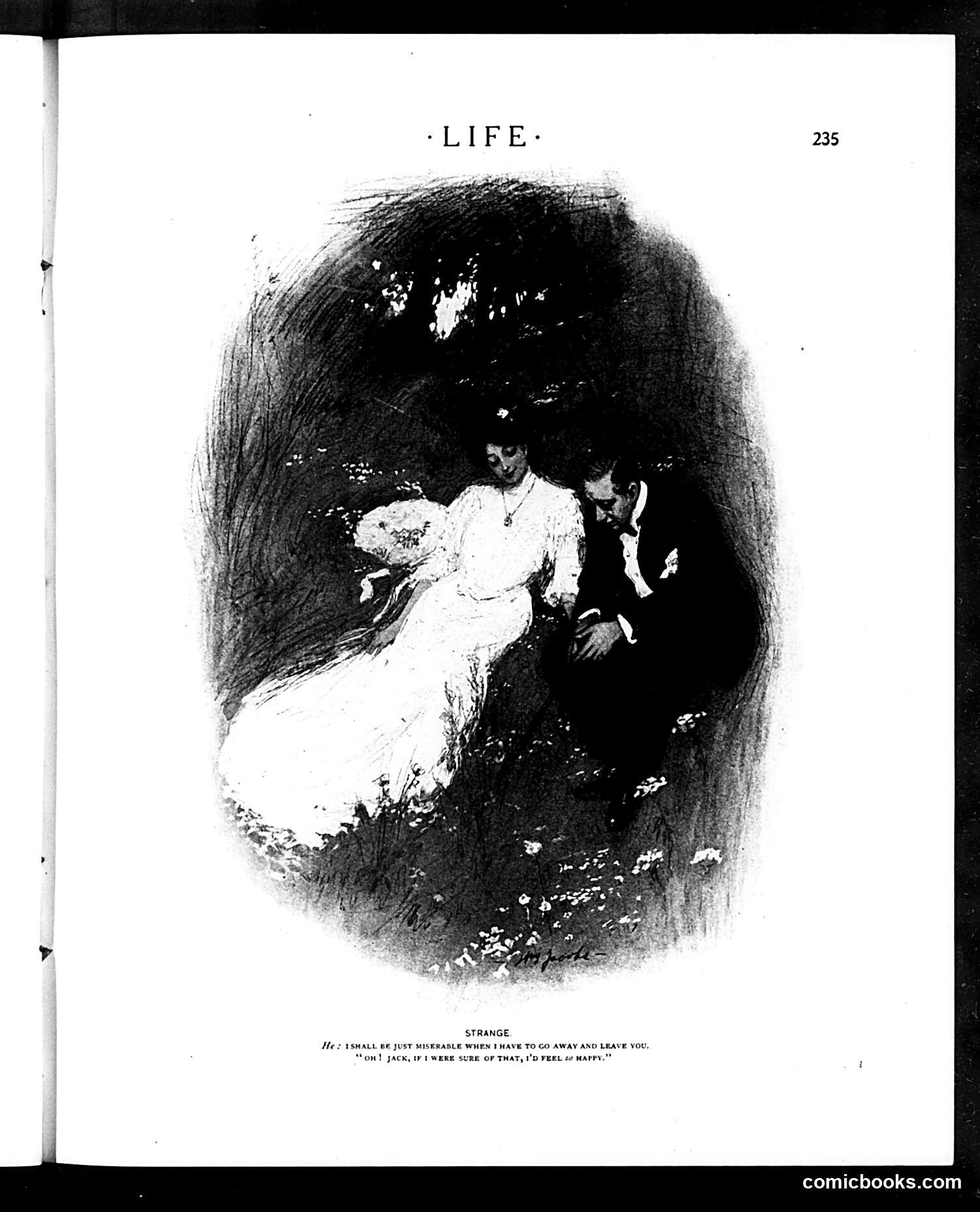
This is a romantic/domestic humor cartoon from Life magazine. It depicts a couple in what appears to be a dramatic nighttime scene—a woman in a white dress and a man in dark clothing, rendered in moody charcoal-style illustration. The joke hinges on a reversal of romantic sentiment. The man expresses sadness about leaving the woman, but she responds sarcastically: if she were *certain* he'd actually be miserable without her, she'd be happy. Her quip implies doubt about his devotion—she's suggesting he may not be as genuinely attached as he claims. The title "Strange" likely refers to the peculiar (and pointed) nature of her response—turning what should be a tender moment into a dig at relationship authenticity. This reflects early 20th-century satirical humor about courtship and gender dynamics.
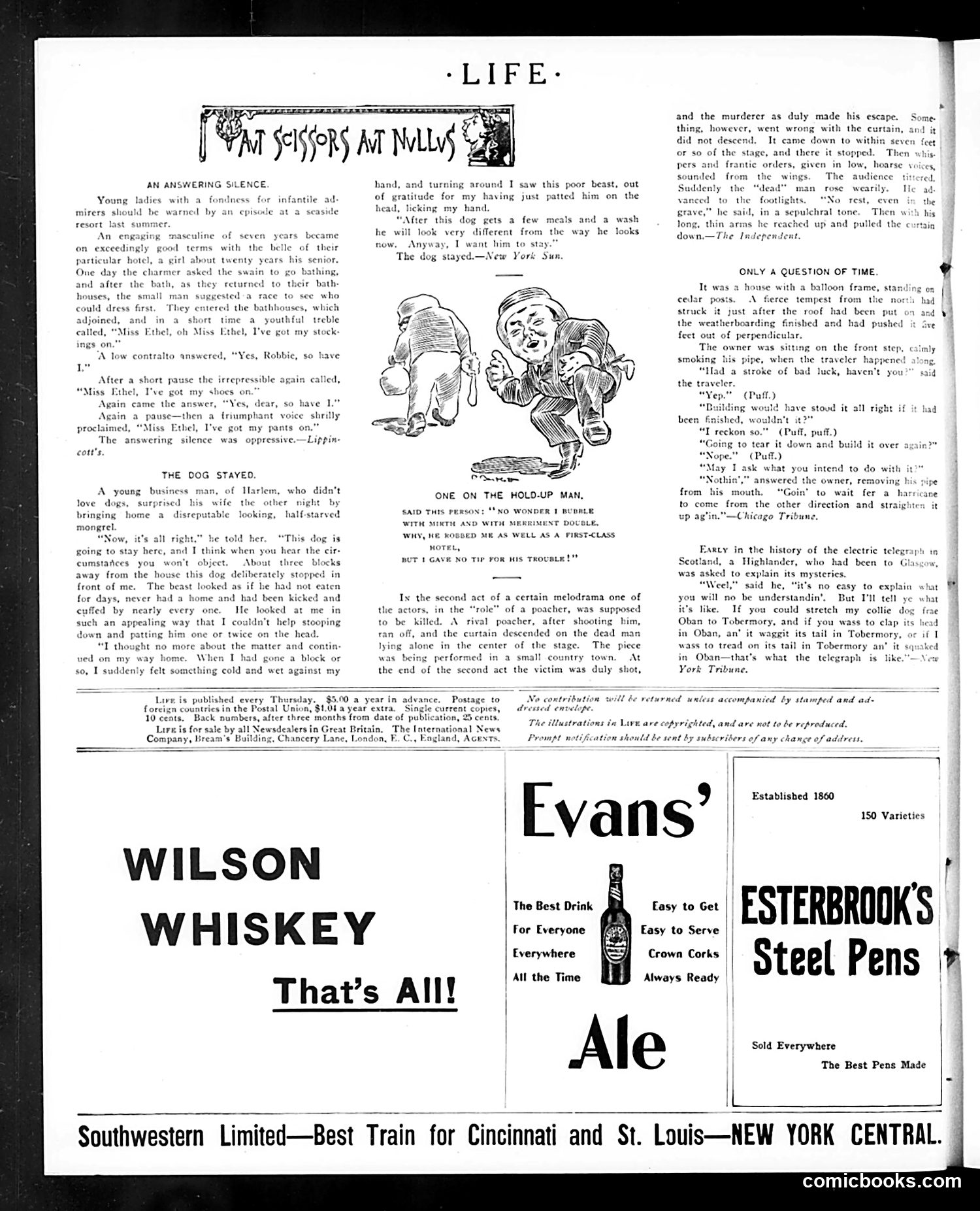
This page contains three brief humorous anecdotes satirizing social awkwardness and human folly: **"An Answering Silence"**: A young boy races a twenty-year-old woman to dress after swimming. He cheerfully announces each item of clothing he's put on, culminating in "I've got my pants on!"—met with the woman's mortified silence. The joke relies on the innocent boy's obliviousness to the social impropriety of discussing undergarments. **"The Dog Stayed"**: A Harlem businessman brings home a starving stray dog, explaining it followed him home pathetically. His wife accepts it after hearing the sentimental story—only for the punchline to reveal he never actually told her why he kept it. **"One on the Hold-Up Man"** and other brief pieces use similar surprise-ending humor about everyday situations. The satire targets Victorian-era social conventions, human sentimentality, and the gap between expectation and reality. These are gentle, family-friendly jokes typical of early-20th-century American humor magazines, surrounded by period advertisements for whiskey, ale, and steel pens.
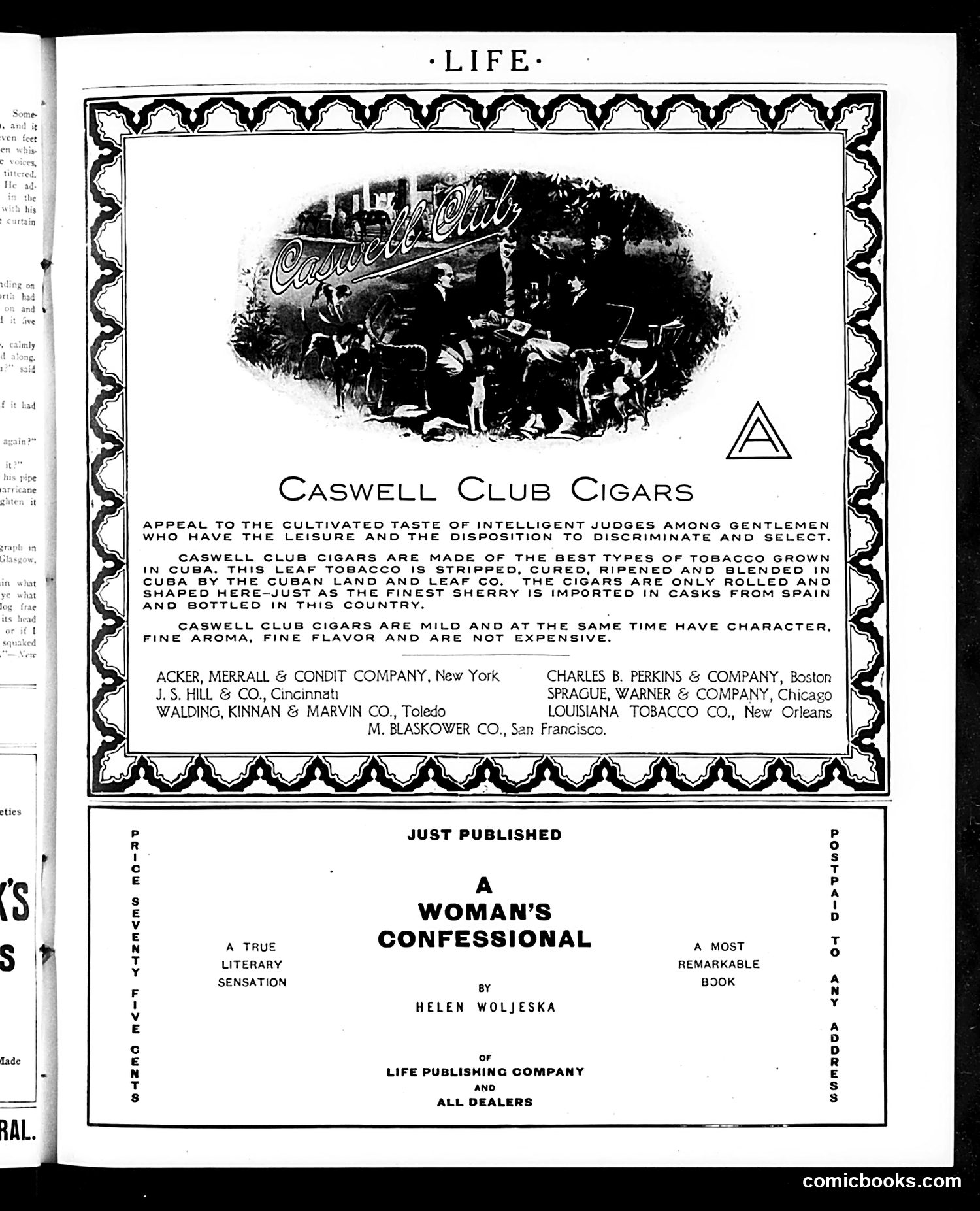
This page consists primarily of **advertisements** rather than satirical cartoons. The top ad promotes **Caswell Club Cigars**, targeting wealthy gentlemen by emphasizing exclusivity, refined taste, and Cuban tobacco. It's a straightforward luxury goods advertisement positioned as appealing to "intelligent judges" with "leisure" and "disposition to discriminate." Below is an advertisement for a book titled **"A Woman's Confessional"** by Helen Woljeska, published by Life Publishing Company. It's marketed as "a true literary sensation" and "a most remarkable book." There is **no political satire or cartoon visible** on this page. The decorative border frames are typical of early 20th-century magazine design. The content reflects period advertising conventions: cigars marketed to elite male consumers, and a sensationalized women's memoir pitched as scandalous reading material—both common commercial strategies of the era.
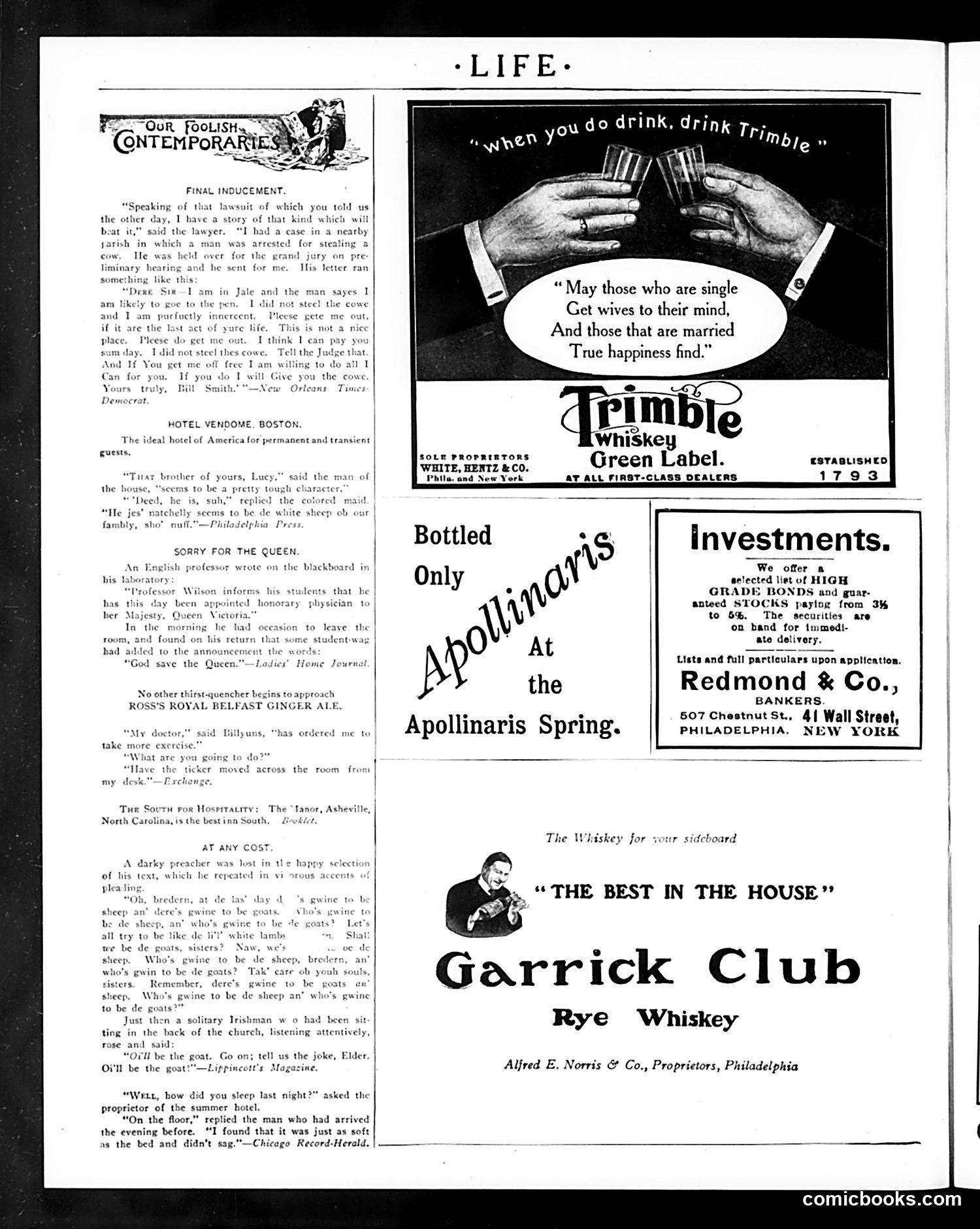
This page is primarily **advertising**, with brief humorous anecdotes ("Our Foolish Contemporaries") serving as filler content typical of early Life magazine format. The ads promote **alcoholic beverages** (Trimble Whiskey, Garrick Club Rye, Ross's Ginger Ale, Apollinaris water) and financial services (Redmond & Co. bankers). The Trimble ad features a moralizing verse about marriage, while others use genteel imagery. The text snippets are era-appropriate humor: a lawyer's letter written in fractured English; a professor's gaffe about the Queen; racial dialect jokes from a Black preacher; an Irishman's confusion. These reflect the casual prejudices of the period but lack political content. The Hotel Vendome Boston advertisement emphasizes permanence and transience—appealing to both long-term residents and travelers. Overall, this appears to be a standard **turn-of-century magazine page blending light entertainment with commercial promotion**, with no significant political satire or cartoon commentary visible.
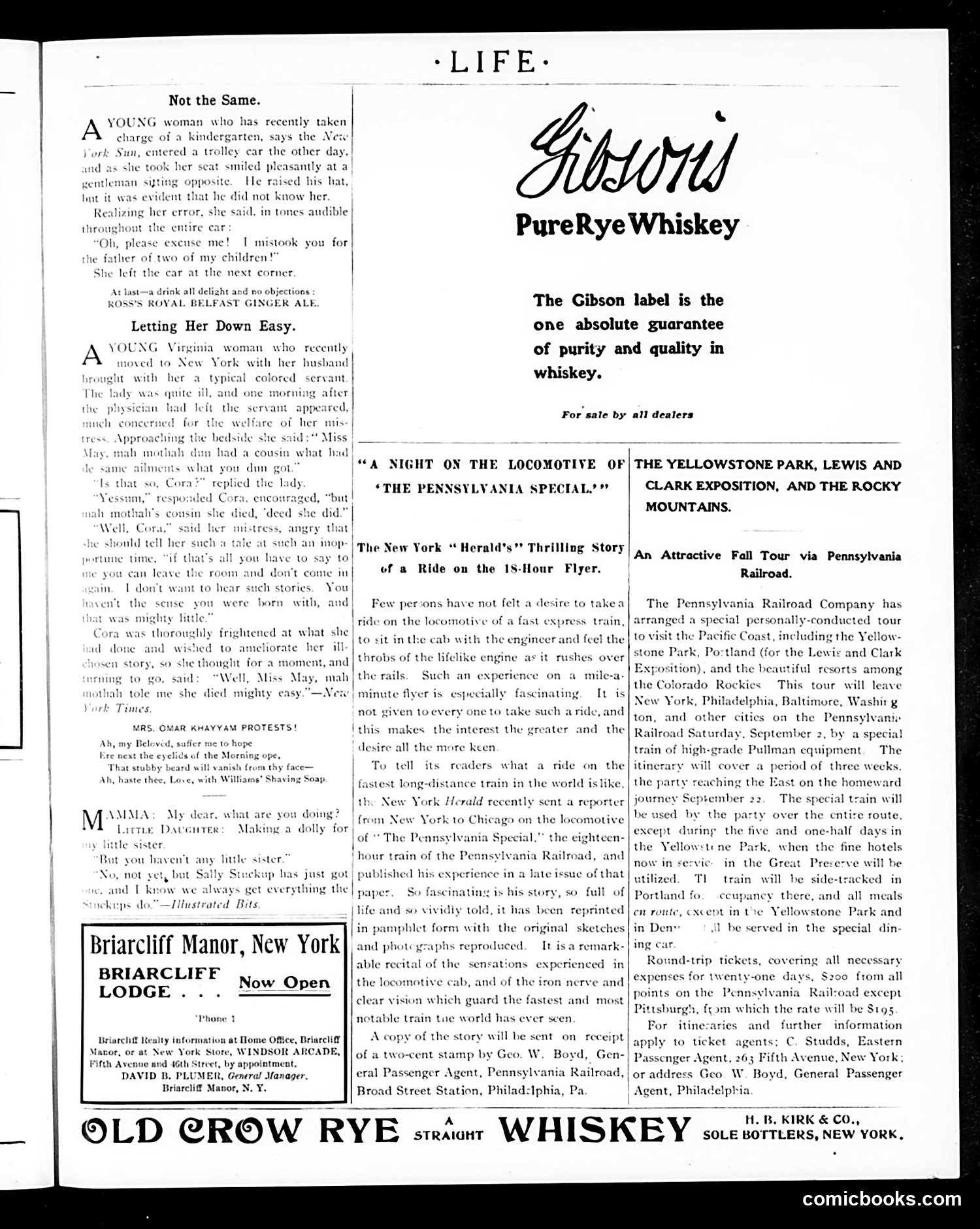
This page from *Life* magazine is primarily **advertising and travel promotion**, not satirical commentary. The content includes: **Humorous anecdotes** (top left): Three brief comedic stories about social awkwardness—a kindergarten teacher mistaking a trolley passenger for someone else, a Southern woman's servant misunderstanding her employer's concern, and a child's innocent logic about siblings. **Advertisements**: Gibson's Pure Rye Whiskey, Old Crow Rye Whiskey, and Briarcliffe Lodge (a New York resort). **Travel promotion**: A substantial article about the *Pennsylvania Special* train, describing a *New York Herald* reporter's thrilling locomotive ride from New York to Chicago. The Pennsylvania Railroad Company advertises a fall tour to Yellowstone Park, Lewis and Clark Exposition, and the Rocky Mountains, departing September 2. The page reflects early 1900s American leisure culture—combining light domestic humor with appeals to affluent travelers interested in seeing the American West's natural wonders and recent expositions.
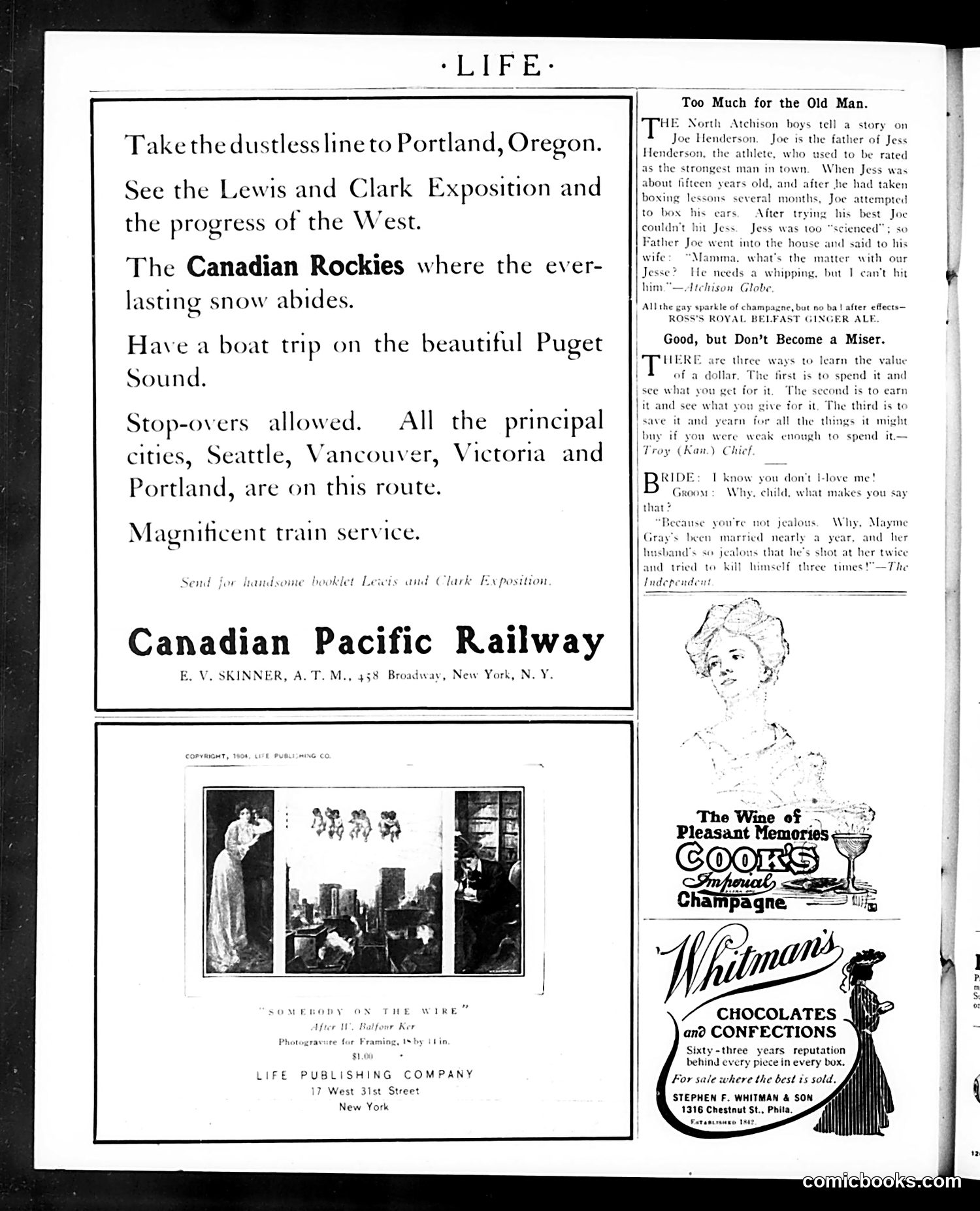
This page mixes **travel advertising** with **humor columns**. The upper half features a **Canadian Pacific Railway advertisement** promoting scenic routes to Portland, Oregon—highlighting the Lewis and Clark Exposition, Canadian Rockies, and Puget Sound with "magnificent train service." This targets affluent travelers interested in Western expansion and tourism. The right column contains three brief **humorous anecdotes**: 1. **"Too Much for the Old Man"**: A father admits he cannot physically discipline his boxing-trained son, depicting generational role reversal—the son has become too strong. 2. **"Good, but Don't Become a Miser"**: Advice about spending money wisely rather than hoarding it. 3. **Bride-Groom dialogue**: A bride questions her groom's love, hinting at jealousy over a rival (Mayme Gray). These satirize domestic life and relationships. The page also includes advertisements for **Coors champagne**, **Whitman's chocolates**, confirming this targets middle-to-upper-class readers of early 1900s America.
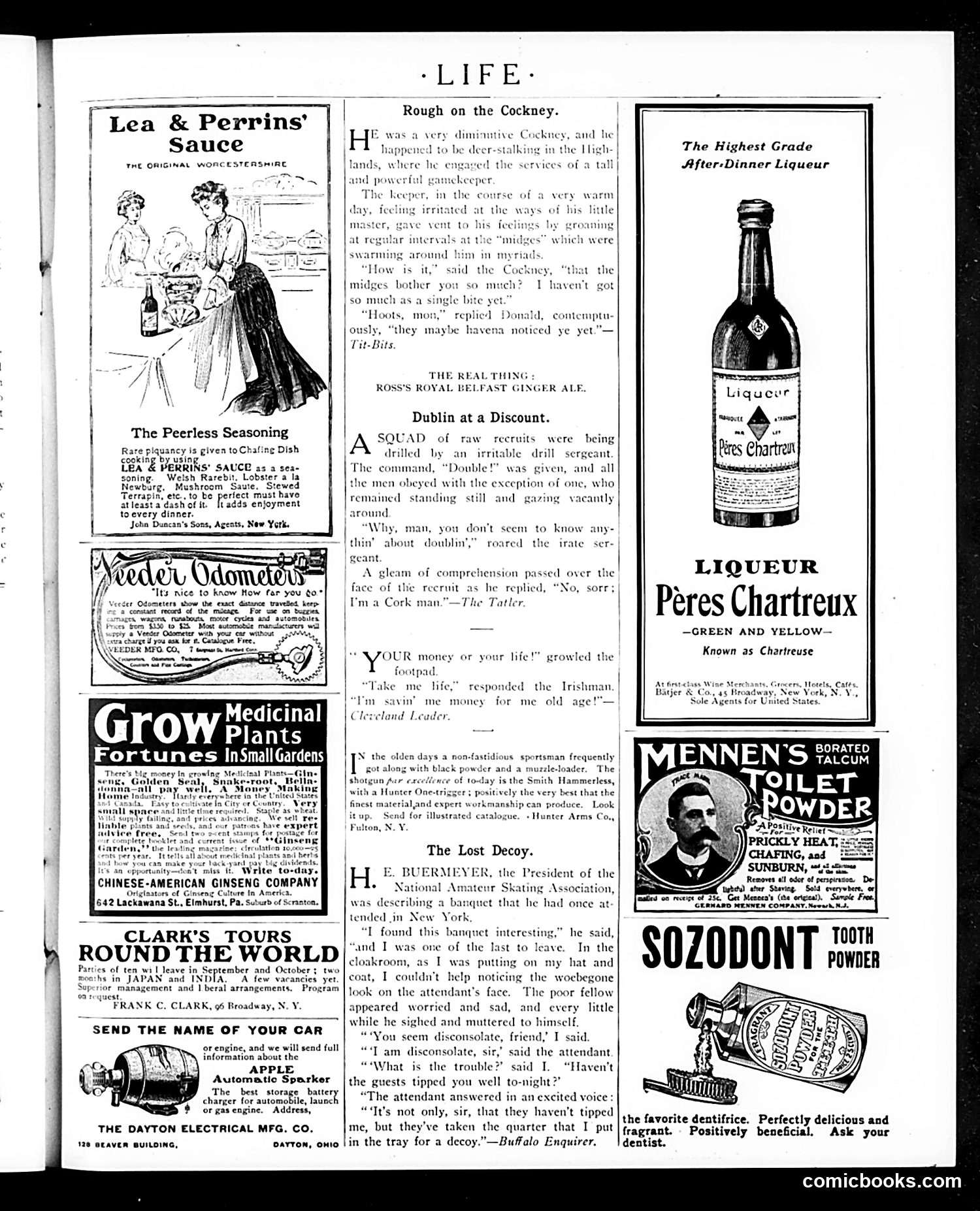
This page from *Life* magazine combines satirical stories with period advertisements. The main content consists of three humorous anecdotes: 1. **"Rough on the Cockney"**: A brief exchange mocking a diminutive Cockney (working-class Londoner) who complains about midges while serving a tall gamekeeper—satirizing class pretension and physical disparities. 2. **"Dublin at a Discount"**: A joke about Irish military recruits, where a soldier claims to be a "Cork man" to explain his confusion during drill commands—playing on Irish stereotypes. 3. **"The Lost Decoy"**: An anecdote about a wealthy banquet where a sad servant admits guests have stolen his tip money (a "decoy"—bait left intentionally). The joke mocks the hypocrisy of wealthy attendees. The advertisements—for Lea & Perrins sauce, ginger ale, medicinal plants, and various products—represent typical early 20th-century marketing. The page reflects *Life*'s satirical approach to social class, ethnicity, and contemporary manners through gentle, period-appropriate humor.
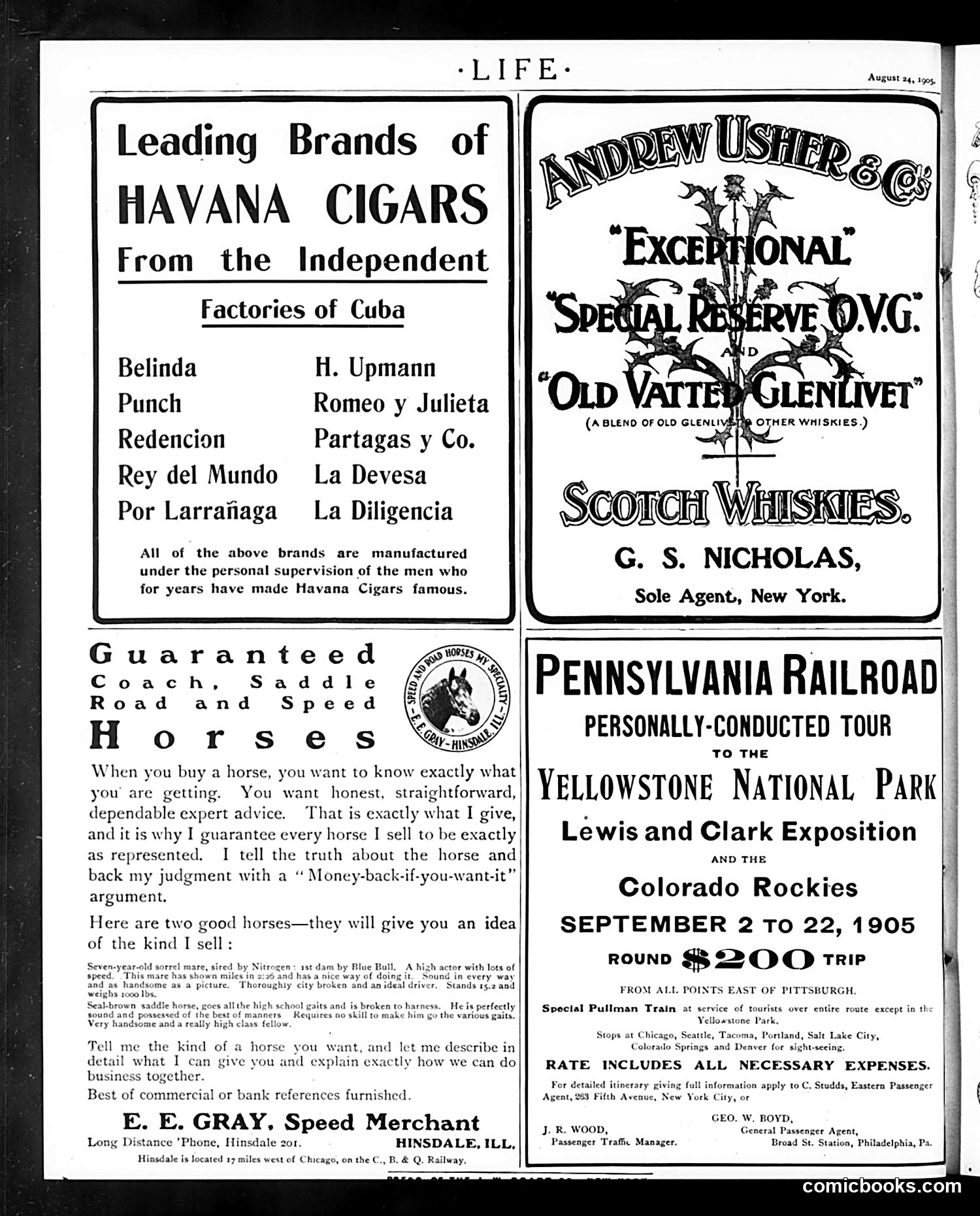
This page is **primarily advertisements**, not satirical content. It contains four commercial ads: 1. **Havana Cigars** – Lists Cuban cigar brands available through G.S. Nicholas in New York, emphasizing quality and personal supervision by experienced manufacturers. 2. **Andrew Usher & Co. Scotch Whisky** – Advertises three whisky products (Exceptional, Special Reserve O.V.G., Old Vatted Glenlivet) through New York agent. 3. **E.E. Gray Horse Sales** – A Hinsdale, Illinois merchant guarantees quality horses with "money-back" assurance, emphasizing honest expert advice and references. 4. **Pennsylvania Railroad Tour** – Promotes a $200 round-trip personally-conducted tour to Yellowstone National Park, the Lewis and Clark Exposition, and Colorado Rockies (September 2-22, 1905), all-inclusive pricing. The page reflects 1905 consumer culture: luxury imports, leisure travel, and professional expertise as selling points.