
Life, 1905-08-24 · page 4 of 24
Life — August 24, 1905 — page 4: what you’re looking at
What you’re looking at
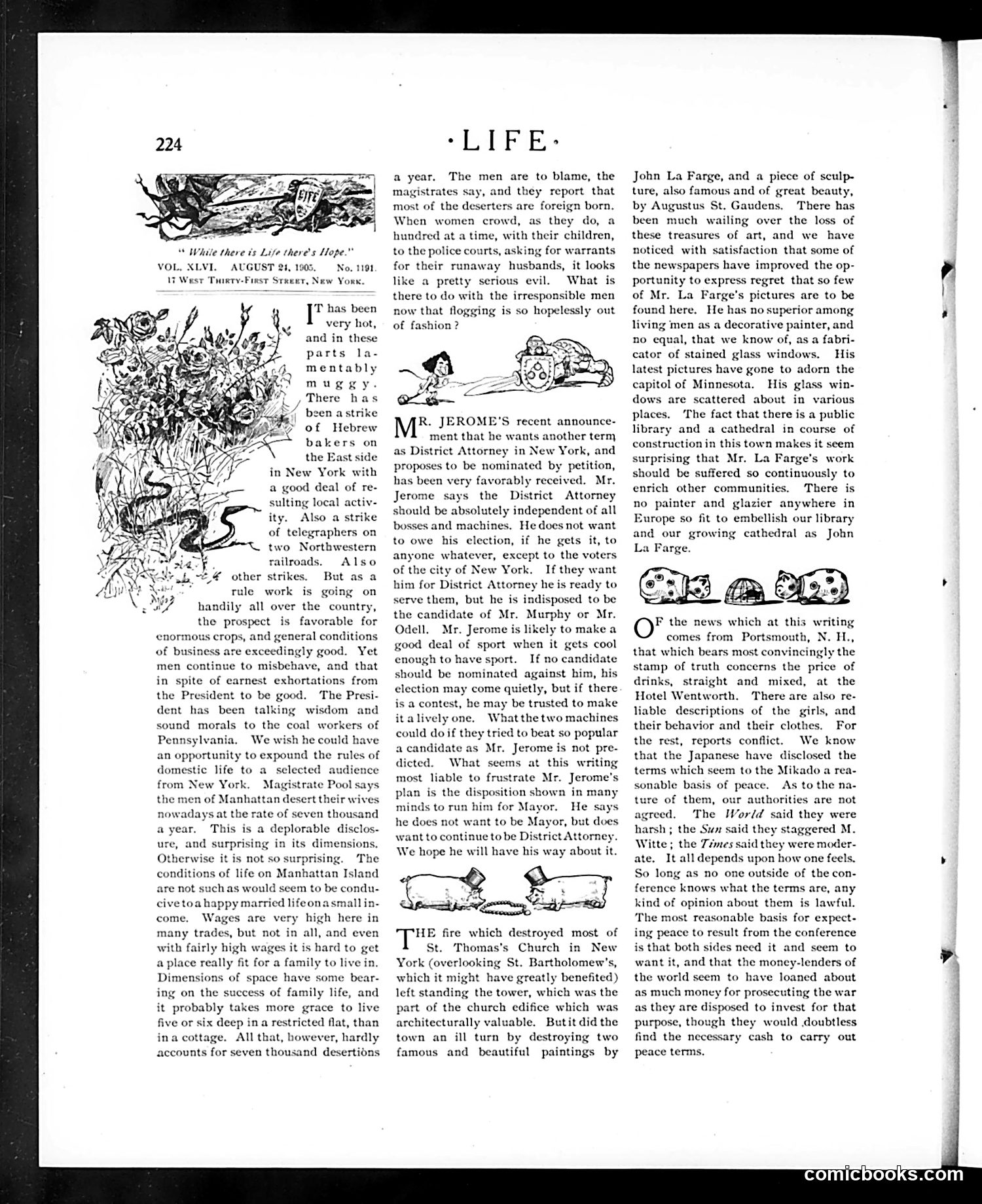
This page contains three illustrated vignettes satirizing contemporary social issues rather than specific political figures. The top-left cartoon depicts **Hebrew bakers on New York's East Side**, mocking their labor disputes and strike activity on two northeastern railroads. The satire targets the working conditions and labor unrest of immigrant workers. The bottom cartoon references **the 1911 fire that destroyed St. Thomas's Church in New York**, which destroyed valuable artistic paintings and sculptures. The satire appears to criticize the loss of culturally important artwork. The right column discusses **Mr. Jerome's potential run for District Attorney**, satirizing local political ambitions and machine politics in New York City. The page primarily engages with local New York labor, cultural, and political controversies rather than national affairs.
📄 Transcribed text from this page (OCR, searchable)
Machine-transcribed from the original scan — historical spelling and the odd misread are preserved.
LV ‘ST 24,1905. No, 1191 West Tiety-Fiest Srreer, New You I has been very hot, and in these parts la- mentably ma muggy , There has been astrike of Hebrew bakers on the East side in New York with a good deal of r sulting local acti it Also a stri of telegraphers on two Northwestern railroads. Also other stri But as a rule work is going on handily all over the country, the prospect is favorable for s crops, and general conditions of business are exceedingly good. Yet men continue to misbehave, and that in spite of earnest exhortations from the President to be good. The Pri dent has been talking wisdom and sound morals to the coal workers of Pennsylvania, We wish he could have an opportunity to expound the rules of domestic life to a selected audience from New York. Magistrate Pool says the men of Manhattan desert their wives ys at the rate of seven thousand ar. This is a deplorable di ure, and surprising in its dimensions. Otherwise it is not so surprising. The conditions of life on Manhattan Island are not such as would seem to be condu- cive toa happy married lifeona small in- come, Wages are very high here in many trades, but not in all, and even with fairly high wages it is hard to get a place really fit for a family to live in. Dimensions of space have some bear- ing on the success of family life, and it probably takes more grace to live five or six deep ina restricted flat, than ina cottage. All that, however, hardly accounts for seven thousand desertidns clos- *LIFE- a year. The men are to blame, the magistrates s: and they report that most of the deserters are foreign born. When women crowd, as they do, hundred at a time, with their children, to the police courts, asking for warrants for their runaway husbands, it looks like a pretty serious evil. What is there to do with the irresponsible men now that flogging is so hopelessly out of fashion? R. JEROME'S recent announce- ment that he wants another term as District Attorney in New York, and proposes to be nominated by petition, as been very favorably received. Mr. Jerome says the District Attorney should be absolutely independent of all bosses and machines. He does not want to owe his election, if he gets it, to anyone whate except to the voters of the city of New York. If they want him for District Attorney he is ready to serve them, but he is indisposed to be the candidate of Mr. Murphy or Mr. Odell, Mr. Jerome is likely to maki good deal of sport when it gets cool enough to have sport. If no candidate should be nominated against him, his election may come quietly, but if there is a contest, he may be trusted to make italively one, Whatthe two machines could do if they tried to beat so popular candidate as Mr. Jerome is not pre- dicted. What seems at this writing most liable to frustrate Mr. Jerom plan is the disposition shown in many minds to run him for Mayor. He says he does not want to be Mayor, but does want to continue to be District Attorney. We hope he will have his way about it. HE fire which destroyed most of St. Thomas's Church in New York (overlooking St. Bartholomew's, which it might have greatly benefited) left standing the tower, which was the part of the church edifice which was architecturally valuable. Butit did the town an ill turn by destroying two famous and beautiful paintings by John La Farge, and a piece of sculp- ture, also famous and of great beauty, by Augustus St. Gaudens. There has been much wailing over the loss of these treasures of art, and we have noticed with satisfaction that some of the newspapers have improved the op- portunity to express regret that so few of Mr. La Farge’s pictures are to be found here. He has no superior among living men as a decorative painter, and no equal, that we know of, as a fabri- cator of stained gl windows, His latest pictures have gone to adorn the capitol of Minnesota. His glass win- dows are scattered about in various ‘The fact that there is a public y and a cathedral in course of construction in this town makes it seem surprising that Mr. La Farge’s work should be suffered so continuously to enrich other communities. There is no painter and glazier anywhere in Europe so fit to embellish our library and our growing cathedral as John O F the news which at this writing comes from Portsmouth, N. H., that which bears most convincingly the stamp of truth concerns the price of drinks, straight and mixed, at the Hotel Wentworth. There are also re- liable descriptions of the girls, and their behavior and their clothes. For the rest, reports conflict. We know that the Japanese have disclosed the terms which seem to the Mikado a rea- sonable basis of peace. As to the na- ture of them, our authorities are not agreed. The World said they were harsh ; the Sux said they staggered M. Witte; the Temes said they were moder- ate. It all depends upon how one feels. So long as no one outside of the con- ference knows what the terms are, any kind of opinion about them is lawful. The most reasonable basis for expect- ing peace to result from the conference is that both sides need it and scem to want it, and that the money-lenders of the world seem to have loaned about as much money for prosecuting the war as they are disposed to invest for that purpose, though they would doubtless find the necessary cash to carry out peace terms.