
Life, 1905-08-24 · page 16 of 24
Life — August 24, 1905 — page 16: what you’re looking at
What you’re looking at
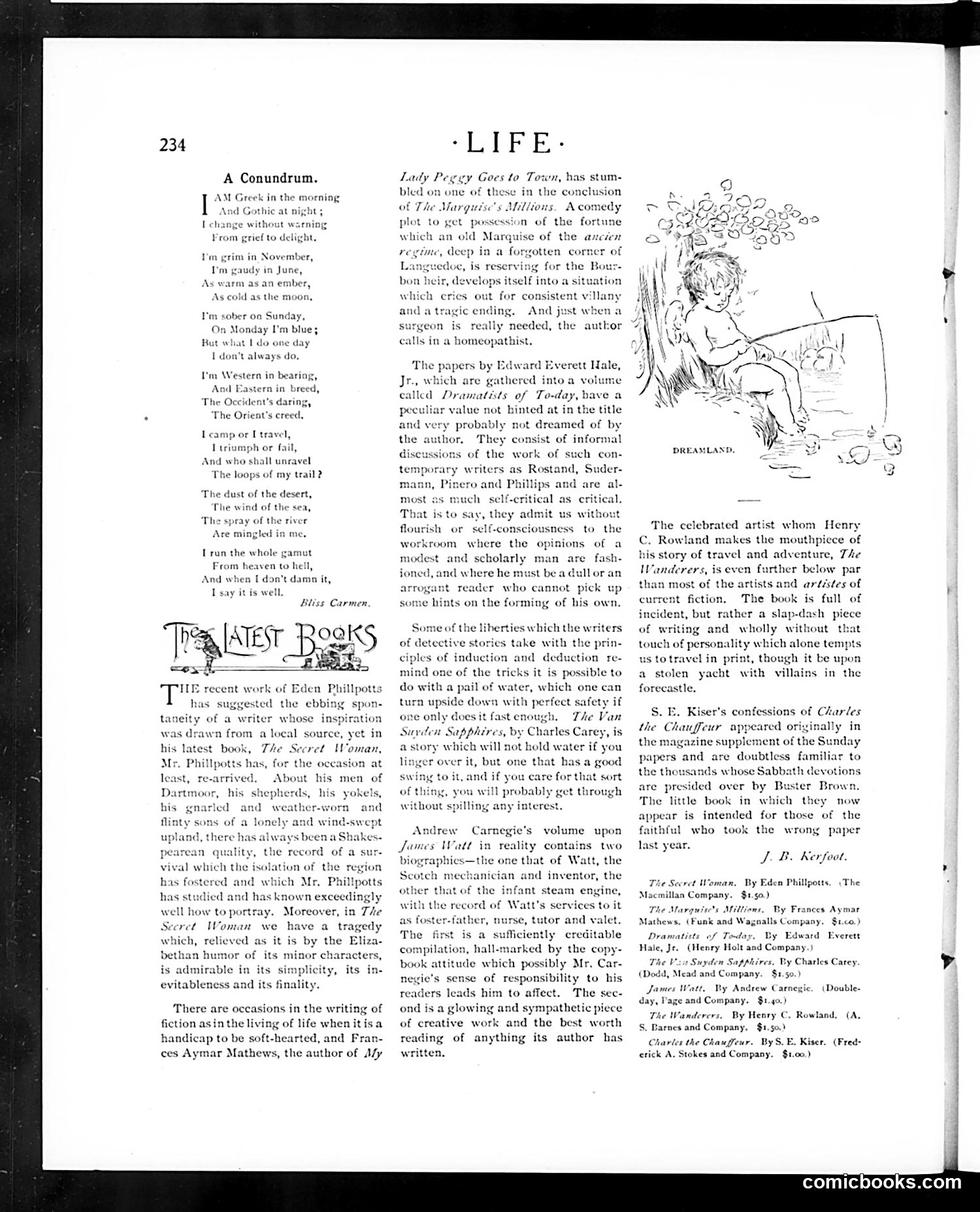
This page from *Life* magazine contains a poem titled "A Conundrum" (credited to Bliss Carman) alongside literary reviews. The poem uses paradoxes and contradictions to describe something that shifts between opposites—Greek yet Gothic, grim yet bright, Eastern yet Western philosophy. The reviews discuss contemporary fiction, including works by Eden Phillpotts and analyses of playwrights by Edward Everett Hale Jr. There's also commentary on Charles Carey's detective story and Andrew Carnegie's biography of James Watt. The illustration labeled "Dreamland" shows a child in nature, likely accompanying the whimsical tone of the conundrum poem. The page represents typical *Life* magazine content: combining literary satire and book criticism with illustrated poetry for educated readers interested in contemporary American and European literature.
📄 Transcribed text from this page (OCR, searchable)
Machine-transcribed from the original scan — historical spelling and the odd misread are preserved.
A Conundrum. AM Greek in the And Gothic at ni I change with R but warning From grief to delight, I'm grim in November, rm as an ember, As cold as the moon, I'm sober 01 oO unday, Monday I’m blue; I don't always do. I'm Western in bearing, 1 Eastern in The Occident’s daring, ‘The Orient’s creed, breed, Lcamp or I travel, Ltriumph or fail, And who shall unravel The loops of my tra The dust of the desert, The wind of th The spray of the river sea, Trun the whole gamut From heaven to hell, And when [don’t dama it, I say it is well. Bliss Carmen. a |STEST Boats recent work of Eden Phillpe € sp inspirat yn from a local source, yet in his latest book, The Secret Woman, Mr. Phillpotts has, for the oc least, re-arrived. About his Dartmo: Is, his his << 1 taneity of a writer whose has suggested the ebbi was dr his shepher and weather-w lonely and wind-sw narled flinty sons of land, there has always been a St d of pearean quality, the re ‘al which the isolation of has fostered has studied and has known exceedingly Moreover, in The have a tragedy well how to portray. Secret Woman we which, relieved as it is by the Eli bethan humor of its minor characters, is admirable in its simplicity, its i evitableness and its finality. There are occasions in the writing of fiction asin the living of life when itisa handicap to be soft-hearted, and Fran- ces Aymar Mathews, the author of A/y ‘LIFE: Lady Peg bled of The Margu gy Goes to Town, has stum- these in the conclusion se's Millions. A n of the fortune one nedy plot to get possess which an old Marquise of th deep in a fc edoc, is reserv ancien sotten corner of ng for the Bc regim La bon heir, develops itself into a situa crics out for consist And just whe which and a tragic ending. s iy needed, the calls in a homeopathist. rgeon is r ‘The papers by Edward Everett Hale, Jr., which are gathered into a vot called Dramatists of To-day, bave a peculiar value not hinted atin title ot dreamed of by nsist of informal and very probabl the author. ‘They sions of the © disex work of such con- temporary writers as Rostand, Suder- and Phil mann, Pi lips and are al- most as. ical as critical. That isto say, they admit us with flourish or se! sness to the workroom where the opinions of a modest and scholarly man are fash- ioned, and where he must be a dull or an ler who cannot pick up arrog re; some hints on the forming of bh own, Ss nerties which the w ies take with the prin- ciples of induction and deduction re- mind one of the tricks it is possible to do with a pail of w an ne of the of detective st ater, which one turn upside down with perfect safety if one only doesit fast enough. The Van Suyden Sapphires, by Charles Carey, is y which will not hold water if you er over it, but one that has a good ¢ to it, and if you care for that sort ng. You will probably get through hout spilling any interest. a ste Andrew Carnegie’s volume upon Jumes Watt in reality contains two biographies—the one that of Watt, the 2 mechanician and inventor, the r thatof the infant steam engine, with the record of Watt's services to it ot as fe The compilation, hall-marked by the copy- book attitude which possibly Mr. C negie’s sense of responsibility to his readers leads him to affect. The se ond is a glowing and sympathetic piece of creative work and the best worth reading of anything its author has writ t is a r= The celebrated artist whom Henry C. Rowland makes the mouthpiece of his story of travel and adventure, The Wanderers, is even further below par rtists and artistes of The book is full of an most of the a current fiction, incident, but rather a slap-dash piece of writing and wholly without that touch of personality which alone tempts us totravel in print, though it be upon a stolen yacht with villains in the forecastle, S. E. Kiser’s confessions of Charles the Chauffeur appeared originally in then azine supplement of the Sunday papers and are doubtless familiar to the thousands whose Sabbath devotions are presided over by Buster Brown, The little book in which they now appear is intended for those of the faithful who took the wrong paper last year. J.B. Kerfoot. The Secret Woman, By Eden Phillpotts. \The Macmillan Company. $1.50.) The Marguiscts Millions, By Frances Aymar Mathews, (Funk and Wagnalls Co: Dramatists of Today. ay. $1.co.) By Edward Everett Hale, Jr, (Henry Holt and Company.) The Vs Suyden Sapphires. By Charles Carey (Dodd, Mead and Company. $1.50.) James Watt, By Andrew Camegic. (Double- day, Page and Company. $1.40.) The Wanderers, By Henry C. Rowland. (A, S. Barnes and Company. $1.50.) Charles the Chauffeur. By SE. Kiser. (Fred erick A. Stokes and Company. $1.00.) comicbooks.com