
A complete issue · 28 pages · 1905
Life — July 20, 1905
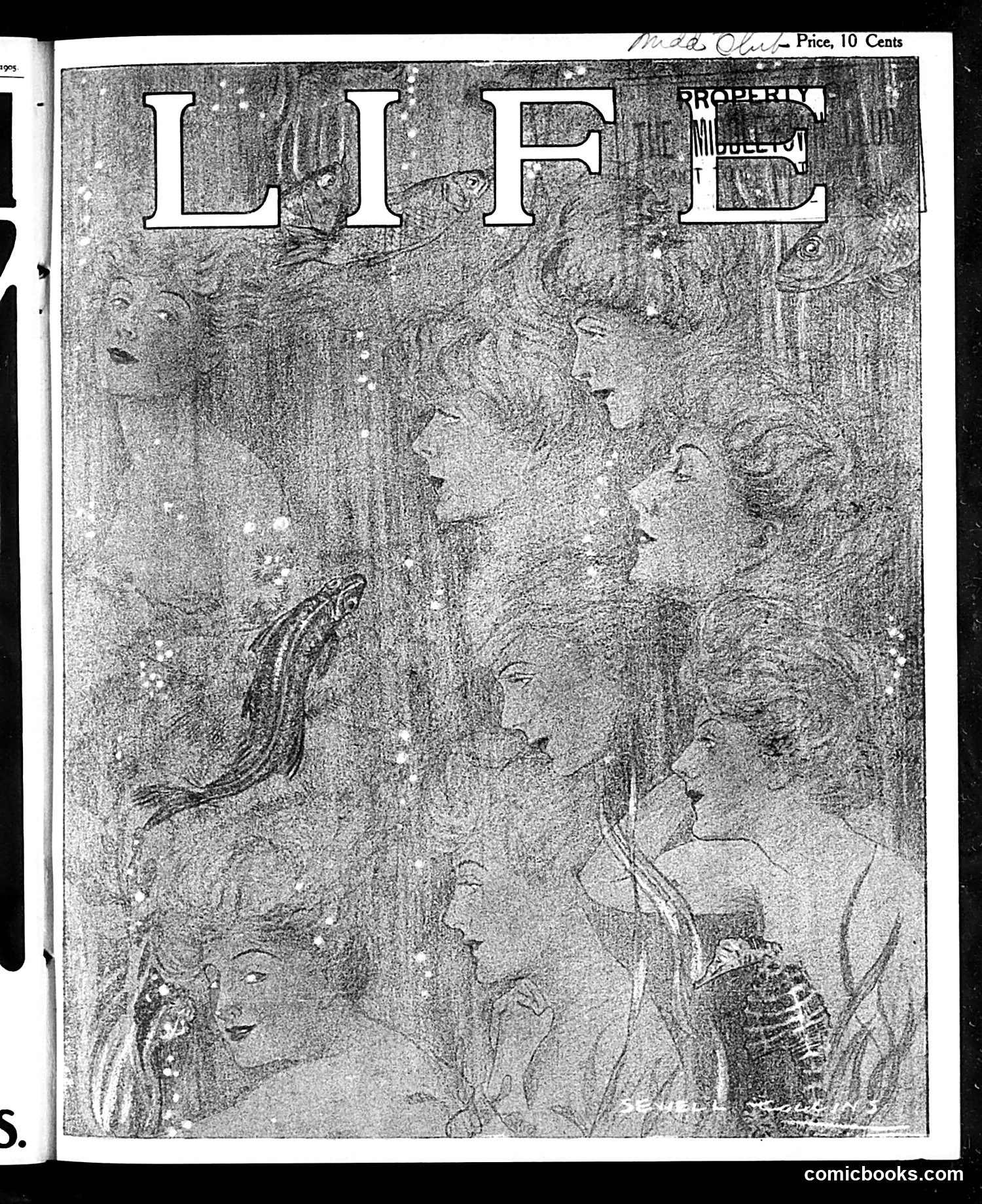
This is a **Life magazine cover** (price 10 cents) featuring underwater imagery. The illustration shows **multiple human profiles** arranged among **fish and aquatic creatures**, rendered in a sketchy style typical of early-to-mid 20th century satirical art. Without clear identifying labels or accompanying text on this cover page, I cannot definitively identify the specific figures or political references depicted. The composition suggests **social satire**—possibly commenting on human nature, society, or contemporary personalities rendered in an "fish-bowl" or underwater setting as a metaphor for observation or social exposure. The artistic style and subject matter are consistent with Life's satirical approach, but **the specific point of this cartoon remains unclear** without additional contextual text or labels visible in the image.
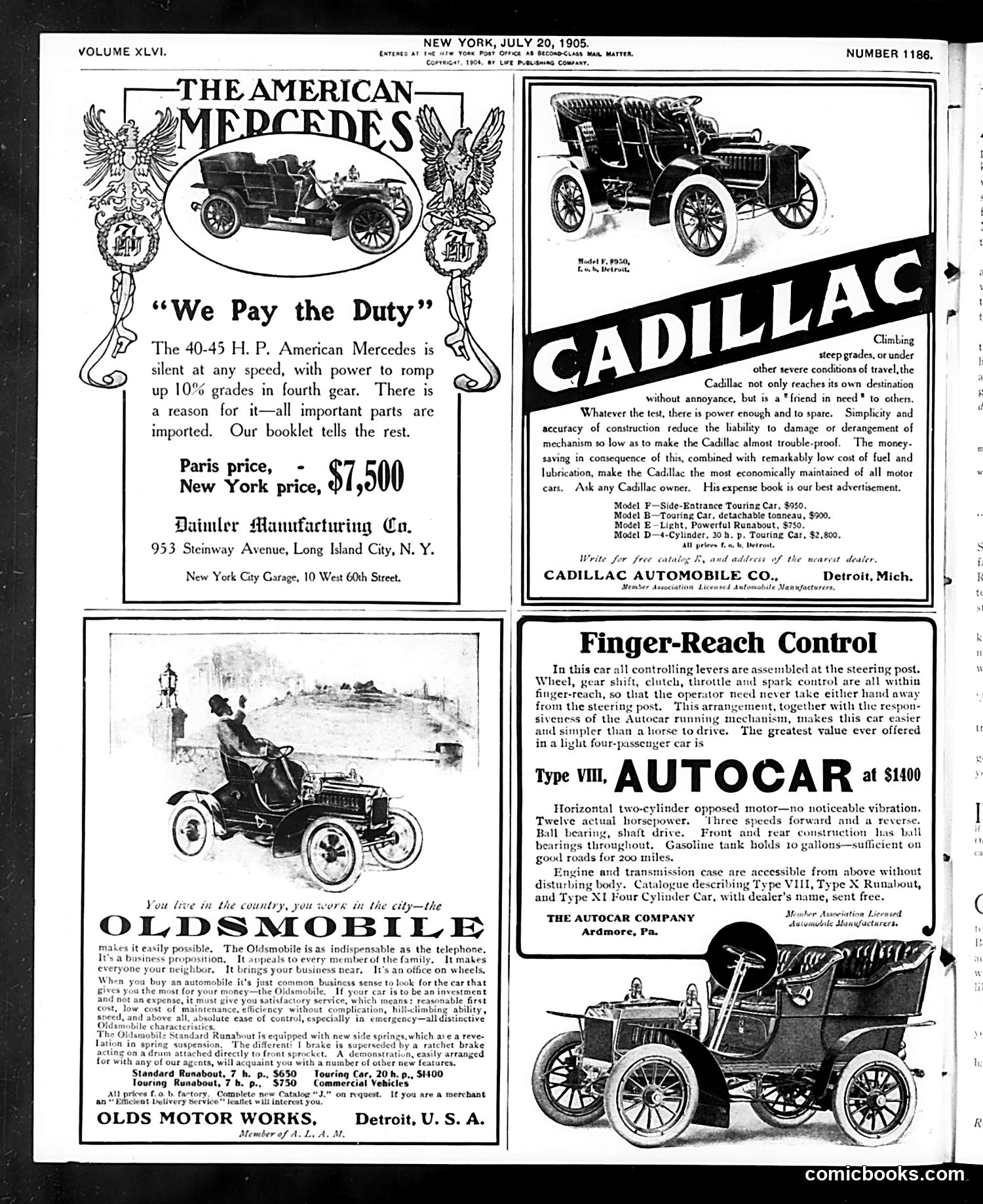
This page is primarily **automobile advertising**, not political satire. It contains four early 1900s car advertisements: 1. **American Mercedes** - emphasizes power and imported quality, priced at $7,500 2. **Cadillac** - highlights reliability and low operating costs 3. **Oldsmobile** - the longest ad, appeals to both rural and urban buyers, positioning the car as practical family transportation 4. **Autocar** - emphasizes ease of control with "finger-reach" steering The Oldsmobile copy is most revealing of the era's social assumptions, suggesting automobiles were becoming accessible to the middle class and could serve both practical (country) and leisure (city) purposes. There is no discernible political cartoon or satire on this page—it's straightforward commercial content reflecting the early automotive industry's competition and marketing strategies circa 1905.
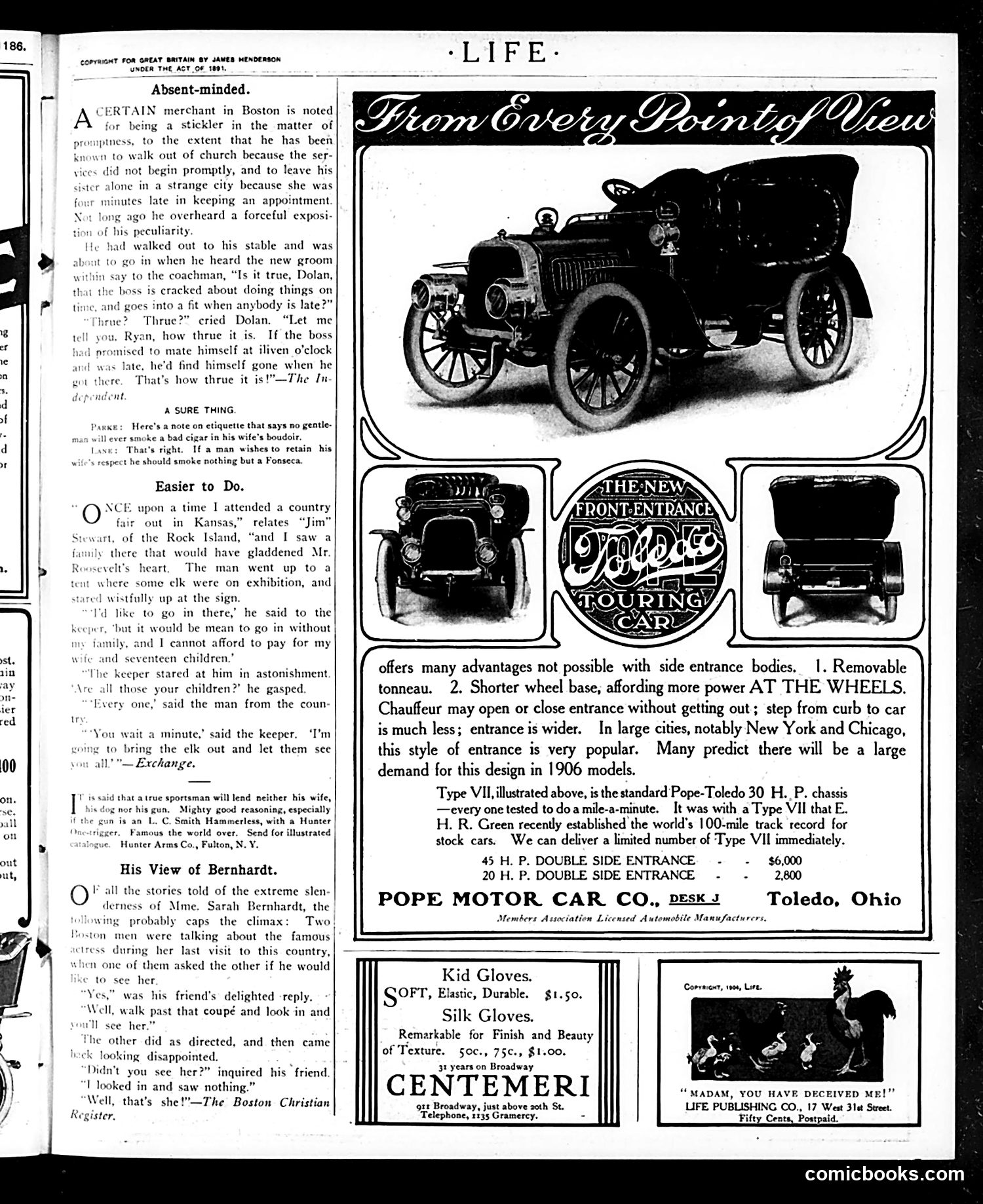
This page contains three humor columns and advertisements rather than political cartoons. The left column features three anecdotes satirizing absent-mindedness, smoking etiquette, and misunderstandings—typical early 1900s humor. "Absent-minded" mocks a Boston merchant's forgetfulness. "A Sure Thing" presents a dialogue about cigars and respectability. "Easier to Do" jokes about free fair admission. The right half advertises the Pope Motor Car Company's new Toledo touring car, emphasizing its front entrance design as an innovation. Below are advertisements for kid gloves, silk gloves, and Centauri perfume. The final anecdote, "His View of Bernhardt," references actress Sarah Bernhardt's recent visit to America, using a misunderstanding joke about "coupe" (a carriage type). This page reflects early 1900s consumer culture and genteel humor standards.
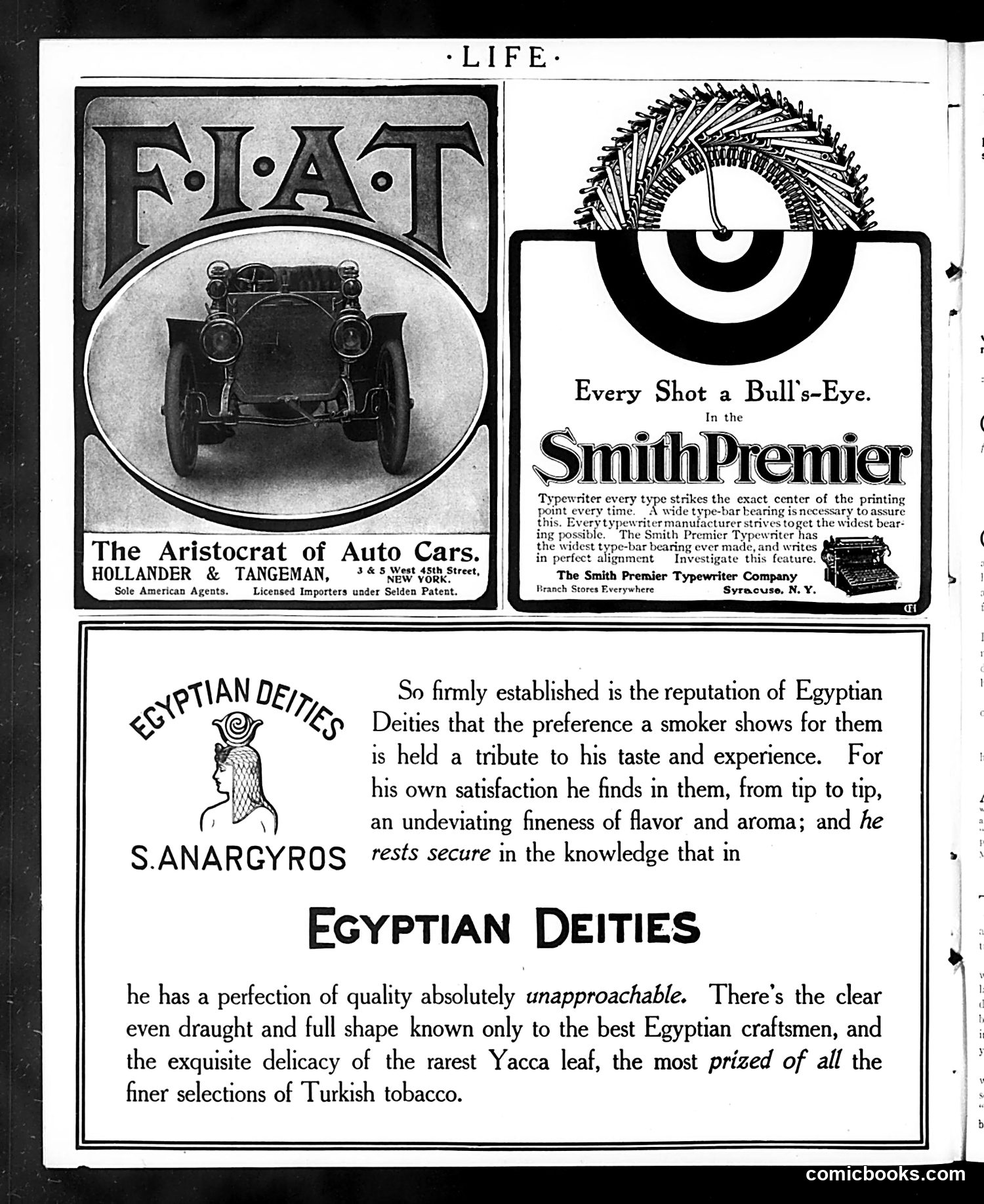
This page contains three advertisements, not political cartoons. The top-left features a Fiat automobile ("The Aristocrat of Auto Cars"), marketed through New York distributors Hollander & Tangeman. The top-right advertises Smith Premier typewriters, emphasizing precision with a "bull's-eye" targeting metaphor—each keystroke supposedly hits the exact center of the printing point. The bottom section promotes Egyptian Deities cigarettes by S. Anargyros, using orientalist imagery (a pharaonic profile) to market Turkish tobacco cigarettes. The ad appeals to refined smokers' taste and experience, highlighting the product's quality and use of rare Yacca leaf. All three are straightforward commercial advertisements typical of early 20th-century Life magazine, not satirical content.
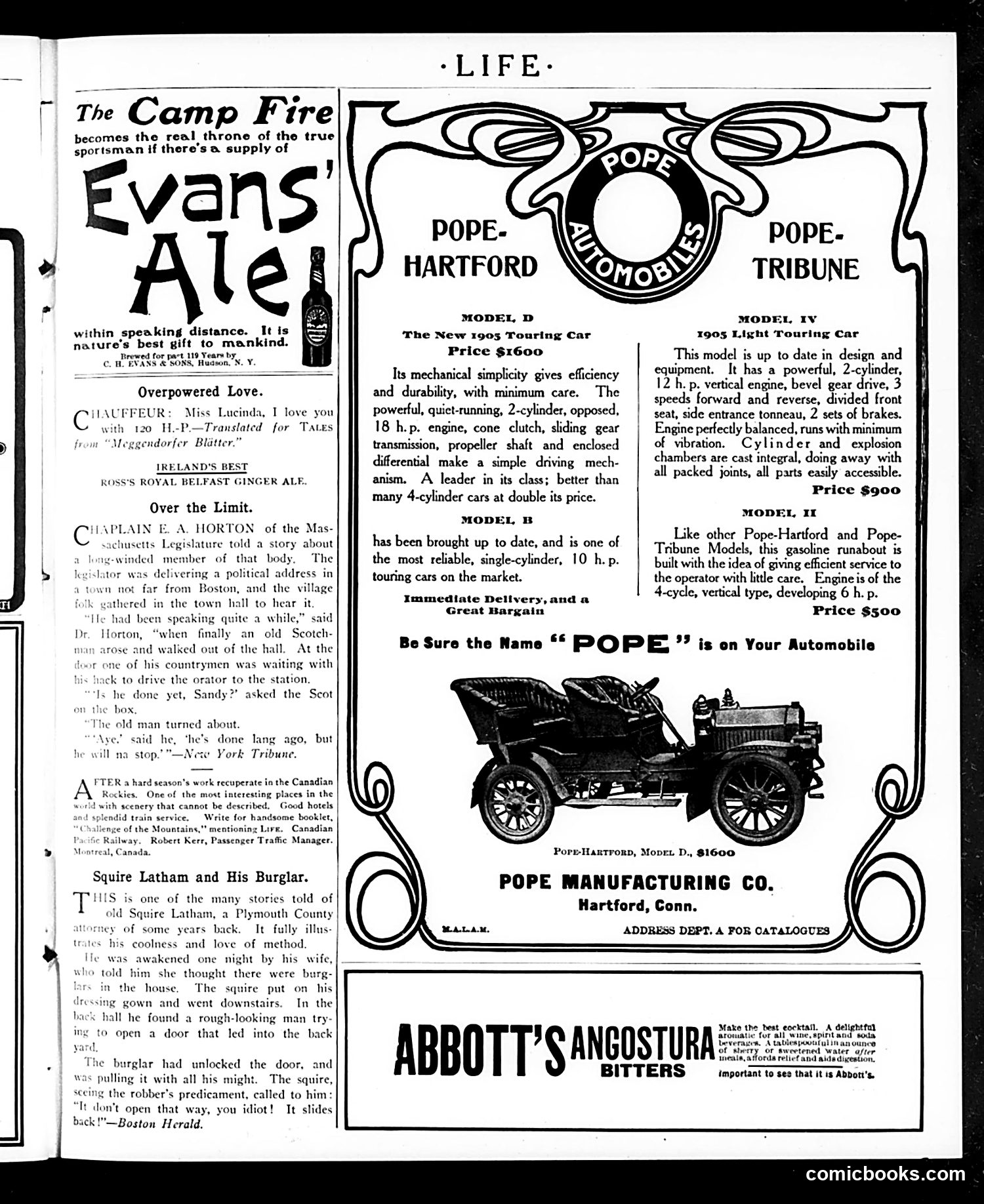
This page is **primarily advertising**, not political satire. It features: **Evans' Ale advertisement** (top left): A straightforward liquor ad emphasizing the product's quality as "nature's best gift to mankind." **Pope Manufacturing Company** (center-right): A large automobile advertisement showcasing their Model D and Model IV touring cars, priced $1,600 and $800 respectively. The ad emphasizes mechanical reliability and efficiency—standard product marketing. **Abbott's Angostura Bitters** (bottom): Another beverage advertisement promoting their cocktail ingredient. **Short stories** (left column): Humorous anecdotes unrelated to the ads, typical of Life magazine's editorial content. The page contains **no political cartoons or satire**. It represents early 20th-century magazine content mixing editorial humor with commercial advertisements—a common format for that era.
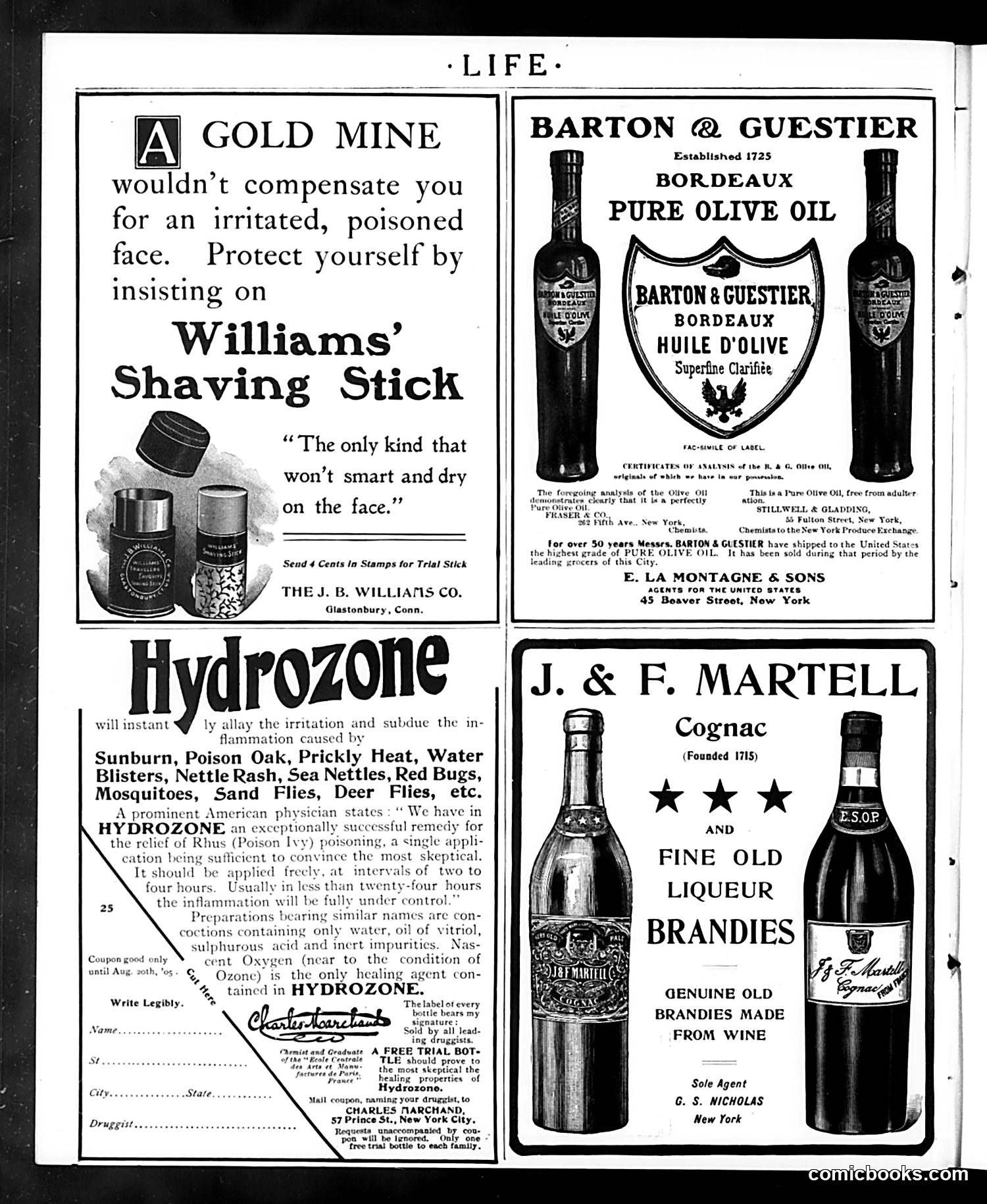
This page is **primarily advertising**, not political satire. It contains four product advertisements from what appears to be an early 20th-century issue of *Life* magazine: 1. **Williams' Shaving Stick** — advertises a shaving product claiming it won't irritate sensitive skin 2. **Barton & Guestier Olive Oil** — promotes French olive oil imported to New York 3. **Hydrozone** — claims to treat various skin conditions and irritations (sunburn, poison oak, insect bites) 4. **J. & F. Martell Cognac** — advertises French brandy The ads reflect period marketing conventions: testimonials from "prominent physicians," claims of medical efficacy, and emphasis on imported European products as luxury goods. There is no political cartoon or satire present on this page—it's a straightforward commercial publication page typical of early 20th-century magazines that relied heavily on advertising revenue.
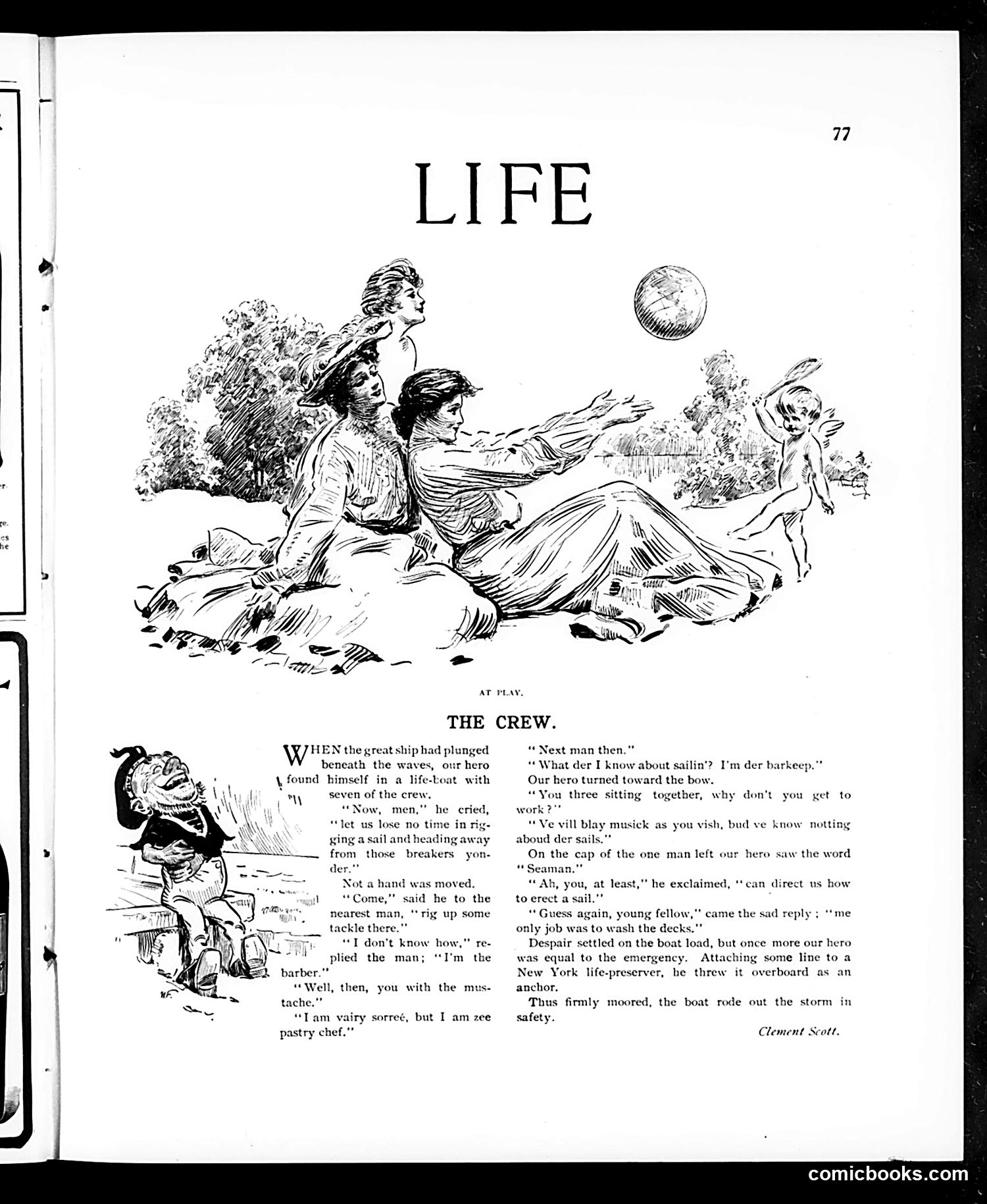
This page features an illustrated story by Clement Scott titled "The Crew." The top illustration shows an allegorical scene of "Life" personified as a woman with wings, accompanied by other figures in classical dress, playing with a globe—representing life's playful, dynamic nature. The main story below depicts a shipwreck scenario where a ship's crew must survive. The narrative is a moral tale about cooperation: when the captain asks crew members to help save the vessel, they each claim incompetence (one's a barkeeper, another a pastry chef). However, when genuinely needed, they overcome their limitations and work together, successfully mooring the boat safely during the storm. The satire mocks class pretensions and laziness while celebrating human capability under pressure.
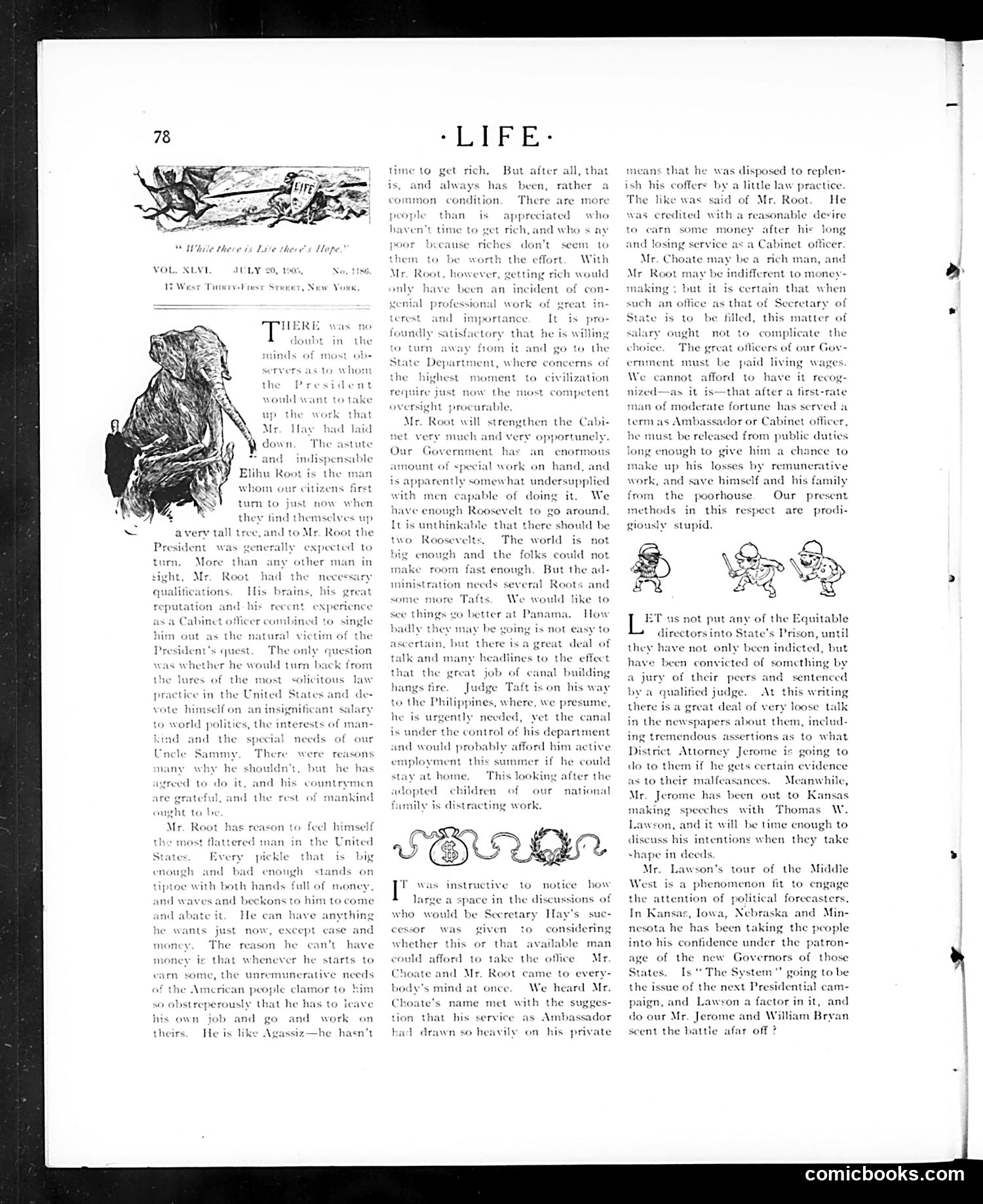
This page contains political commentary about government appointments and personnel decisions, likely from the Roosevelt administration era (references to "two Roosevelts" and Cabinet positions). The main illustration shows **Elihu Root**, identified in the text as a prominent figure being considered for a Cabinet position. The article discusses his qualifications and experience as a potential Secretary of State successor. The text criticizes the administration's approach to filling high offices, arguing that competent individuals like Root are being underutilized. It references discussions about **Secretary Hay's successor** and mentions Judge Taft's assignment to the Philippines. Small decorative illustrations of figures appear throughout, typical of Life's satirical style. The overall tone is critical of administration decision-making regarding capable government officials and their proper deployment.
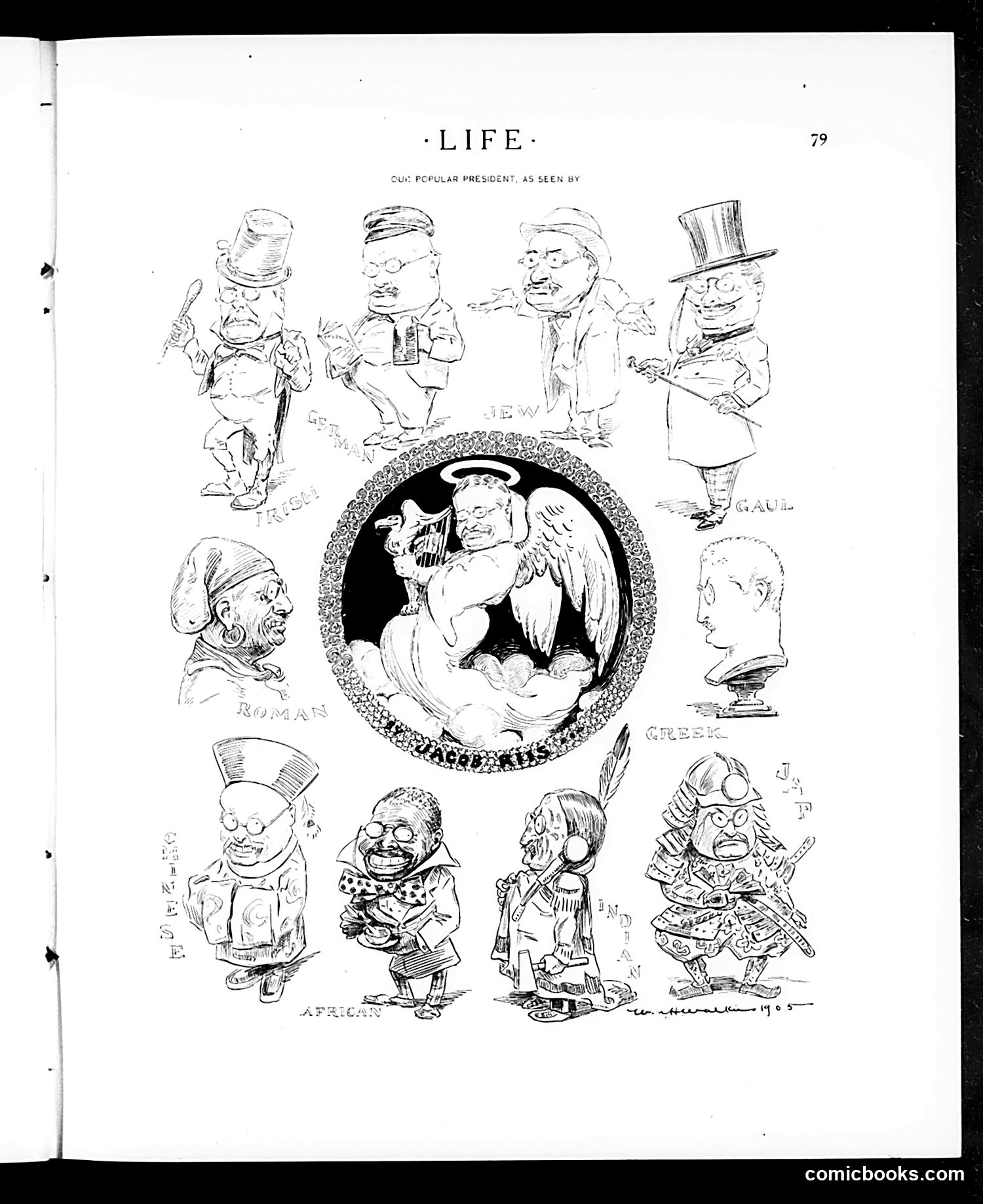
This page from *Life* magazine presents "Our Popular President, As Seen By" different cultural and national perspectives. A central medallion shows a cherub or cupid figure, surrounded by caricatured heads representing various viewpoints. The labeled figures appear to include representations of different nations or cultures—"ROMAN," "GREEK," and what seem to be other cultural stereotypes ("AFRICAN," "ORIENT," and others), each depicting the same unnamed "Popular President" through distinct artistic traditions and exaggerated features typical of early 20th-century satirical cartooning. The satire likely mocks how different groups or nations view the American president differently, or how the president's image is interpreted and distorted through various cultural lenses. The cherub at center suggests idealization, contrasting with the grotesque caricatures surrounding it. Without the date visible, the specific president referenced remains unclear.
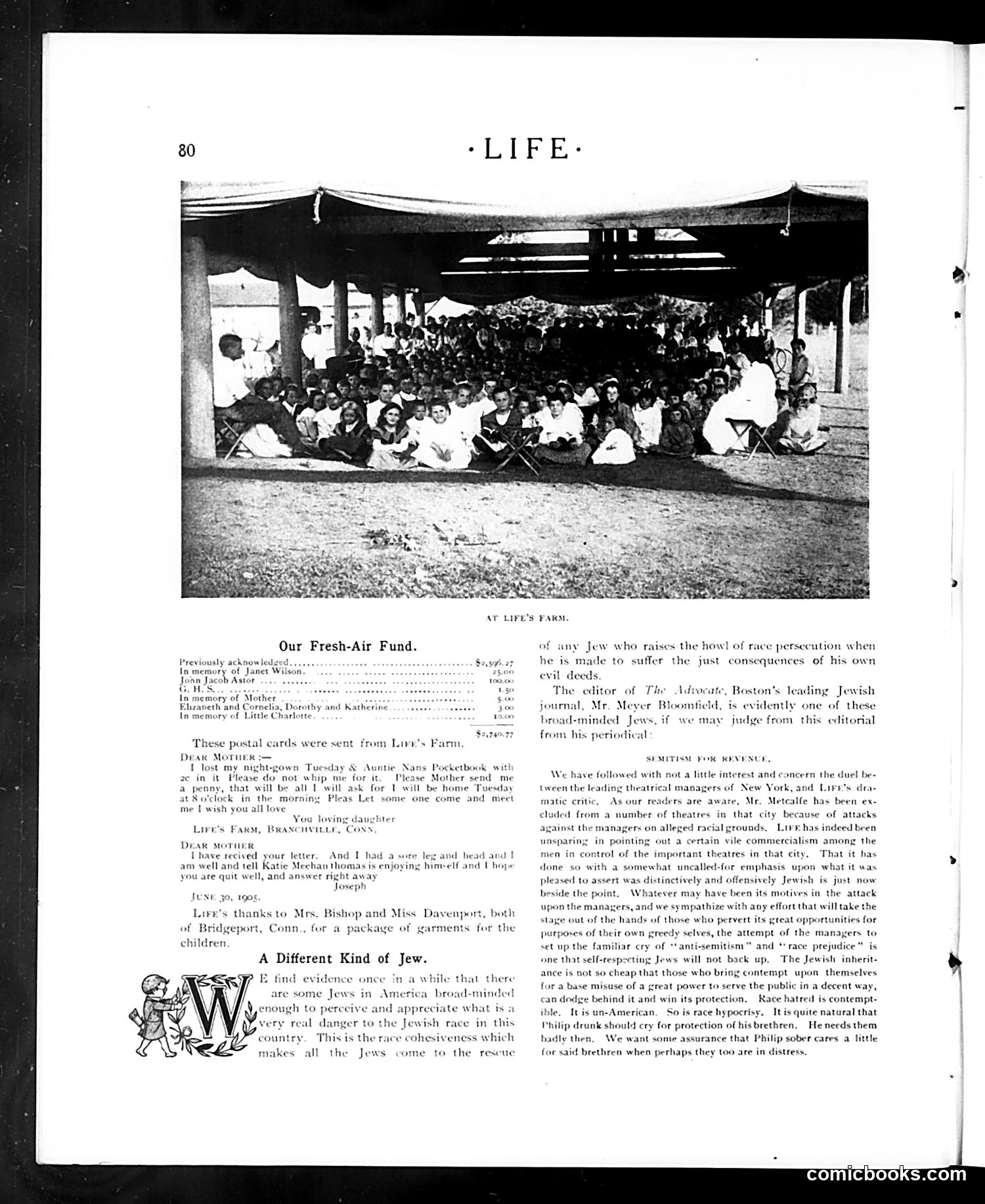
This page from *Life* magazine contains articles about Jewish topics and social issues. The main image shows a large gathering under a tent, labeled "AT LIFE'S FARM." The visible articles include: 1. **"Our Fresh-Air Fund"** — describing donations for children's welfare, with postal cards from correspondents. 2. **"A Different Kind of Jew"** — beginning with a decorative capital letter. The text discusses "evidence...that there are some Jews in America broad-minded enough to perceive and appreciate what is a very real danger to the Jewish race in this country." The article appears to critique certain Jewish figures (including Meyer Bloomfield, editor of *The Advocate*, a Boston Jewish journal) for failing to condemn or address alleged racial prejudice and anti-Semitic behavior by theatrical managers in New York. **Context**: This reflects early 20th-century Jewish-American debates about assimilation, community leadership, and responses to discrimination.
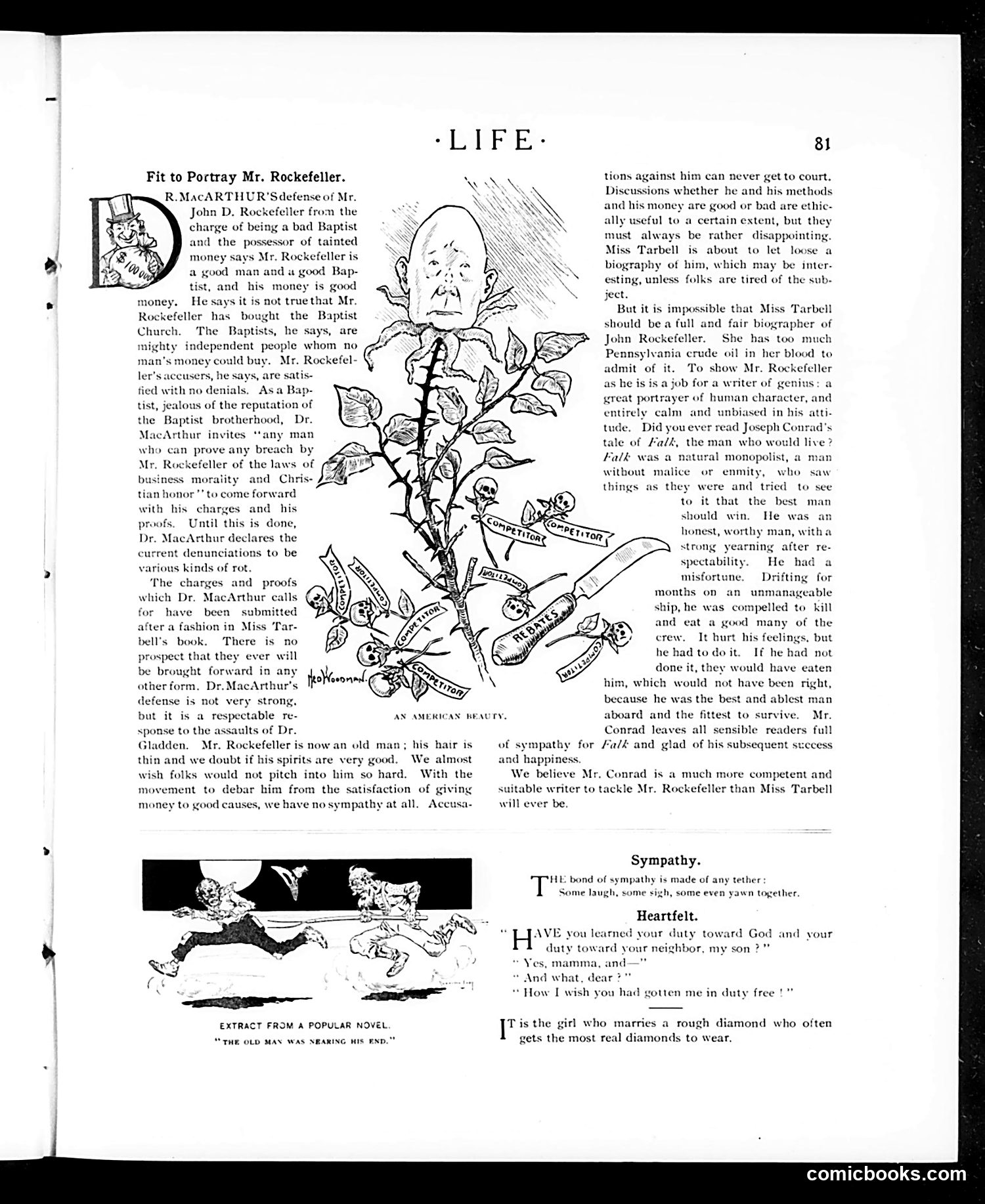
**Main Cartoon: "An American Beauty"** This political cartoon depicts a caricatured figure growing from a plant, with labels on the roots and stems reading "PETITION," "LITIGATION," and other legal/financial terms. The figure appears bloated and unflattering, suggesting criticism of someone built upon dubious business and legal practices. **Context:** The page's text defends John D. Rockefeller against accusations of being a "bad Baptist" and unethical businessman. The cartoon appears to satirize Rockefeller himself—portraying his wealth and influence as artificially constructed from questionable legal maneuvering rather than legitimate enterprise. The accompanying text debates whether a biography by Miss Tarbell would fairly represent Rockefeller, ultimately suggesting Joseph Conrad would be a better chronicler of such morally complex figures.
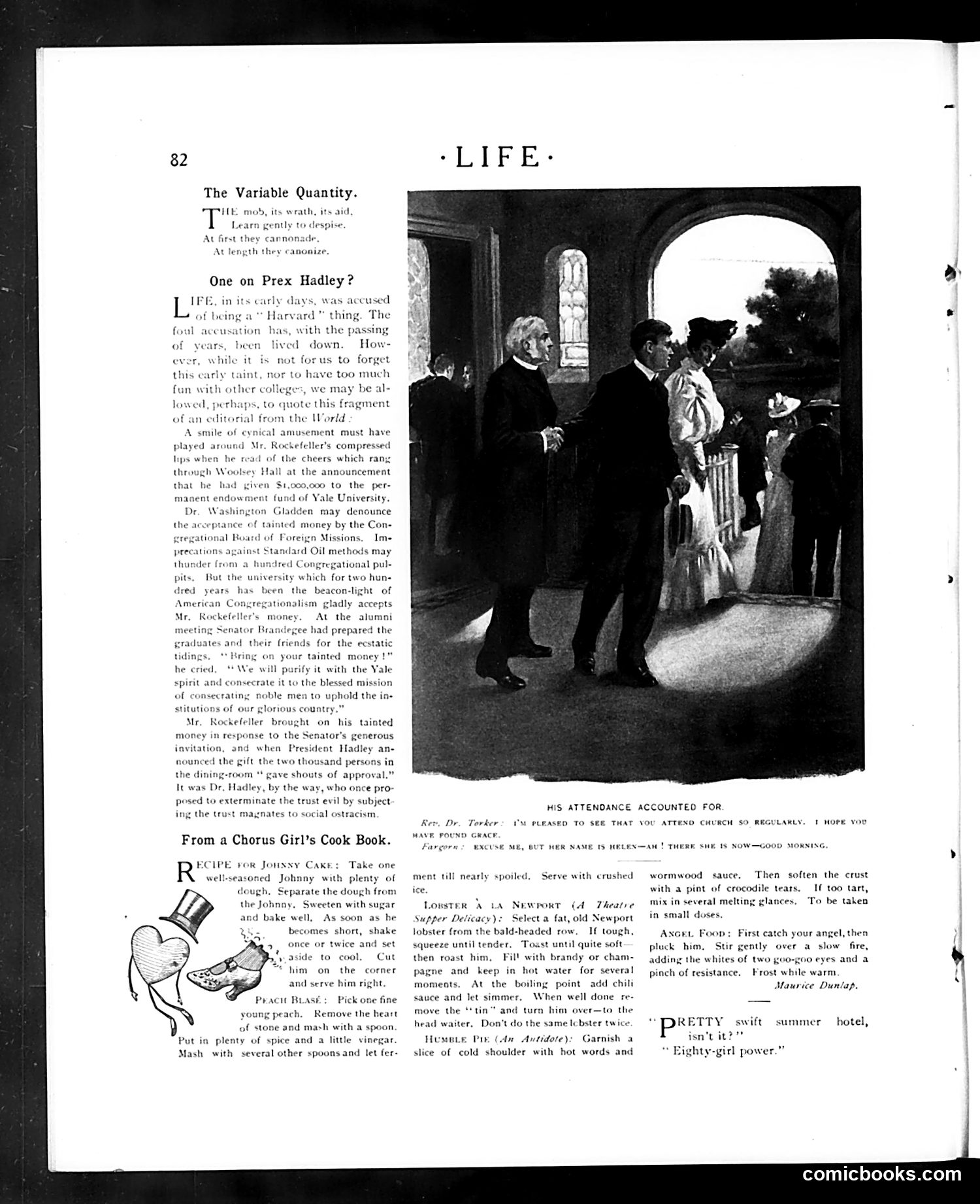
The page contains a article titled "One on Prex Hadley?" discussing President Hadley of Yale University and criticism of his acceptance of a $1,000,000 donation from John D. Rockefeller for Yale's endowment fund. The article satirizes the tension between accepting "tainted money" from wealthy industrialists (Rockefeller was associated with Standard Oil monopoly practices) and upholding institutional principles. Senator Brandegee's response—urging the university to "consecrate" the money to noble purposes—is mocked as rationalization. The accompanying photograph shows what appears to be a formal church or university gathering with well-dressed men in conversation. Below this is an unrelated "Chorus Girl's Cook Book" section with recipes and humorous illustrations about preparing food.
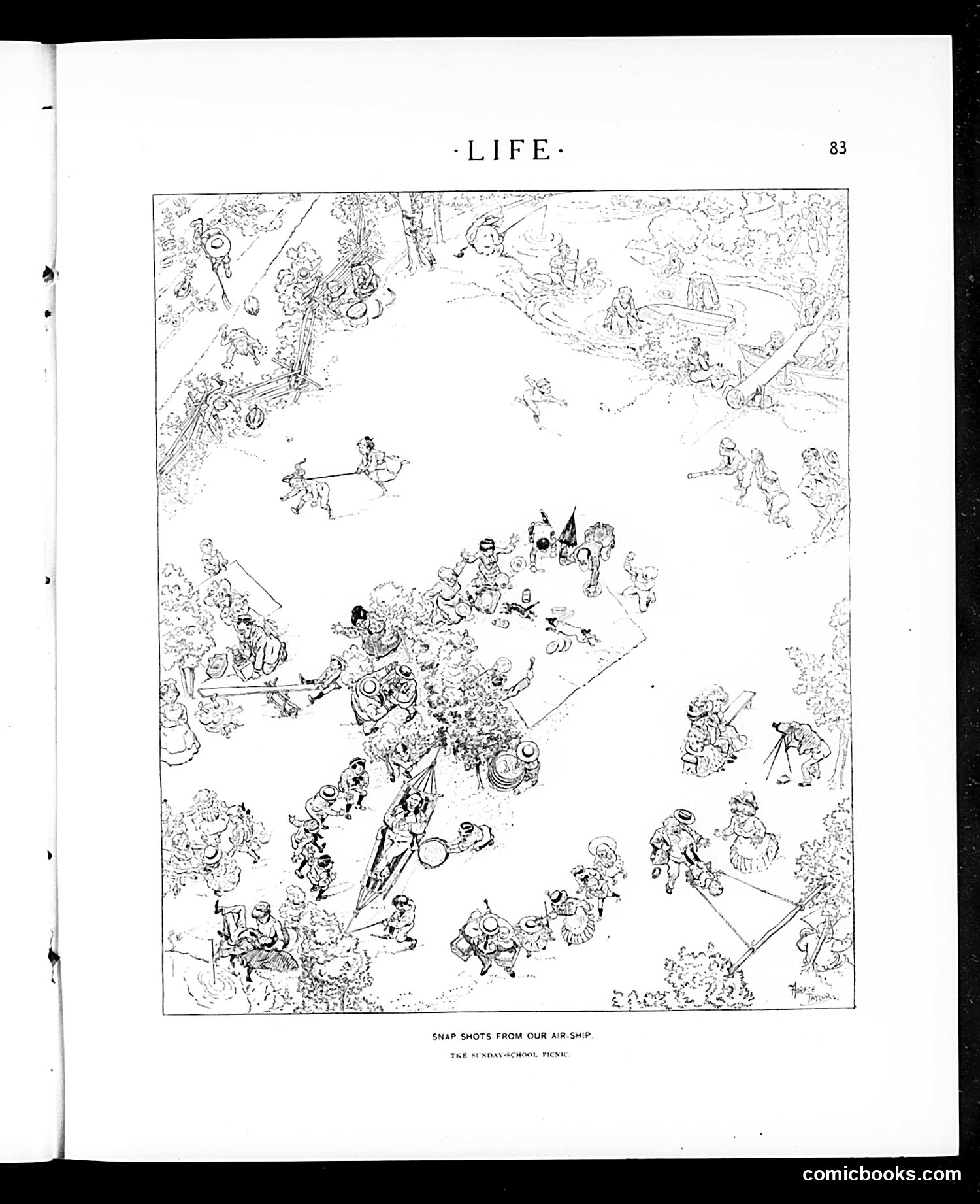
This is a bird's-eye-view cartoon depicting a crowded summer picnic scene, likely from the early 1900s based on the "air-ship" perspective (a novelty viewing angle). The illustration shows numerous figures engaged in typical picnic activities scattered across a landscape—eating, playing games, relaxing under trees. The satire appears to mock the chaos and crowding of fashionable outdoor gatherings. The "air-ship" vantage point—presenting an impossibly elevated view—is itself the joke: Life magazine was satirizing the popular notion of aerial photography and the bird's-eye-view perspective trendy in contemporary illustrated magazines. The detailed, crowded composition humorously captures the disorder of mass leisure culture rather than targeting specific political figures.
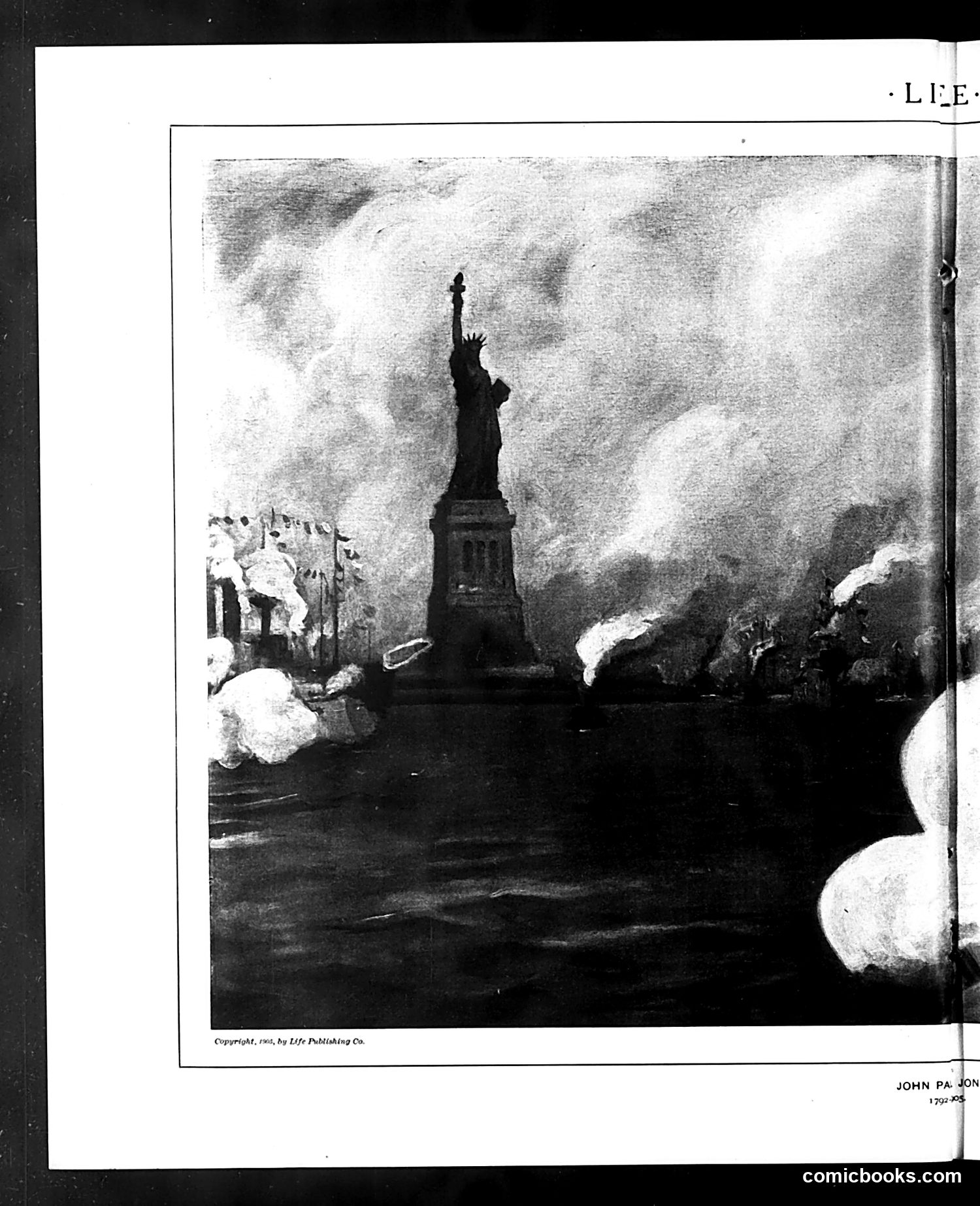
This appears to be a satirical illustration from *Life* magazine depicting the Statue of Liberty silhouetted against a dark, stormy sky with explosions or fire visible on either side. The dramatic, ominous atmosphere suggests commentary on a threat to American values or security. Given the copyright date of 1908 and the artist name "John Pa[...]on" (likely Paxson), this likely responds to early-20th-century American anxieties—possibly regarding labor unrest, anarchist concerns, or immigration debates of that era. The contrast between Liberty's iconic symbol of freedom and the surrounding chaos suggests irony: the cartoon questions whether American ideals are under siege or whether the nation itself faces internal turbulence during this period. The exact historical reference remains unclear without additional context.
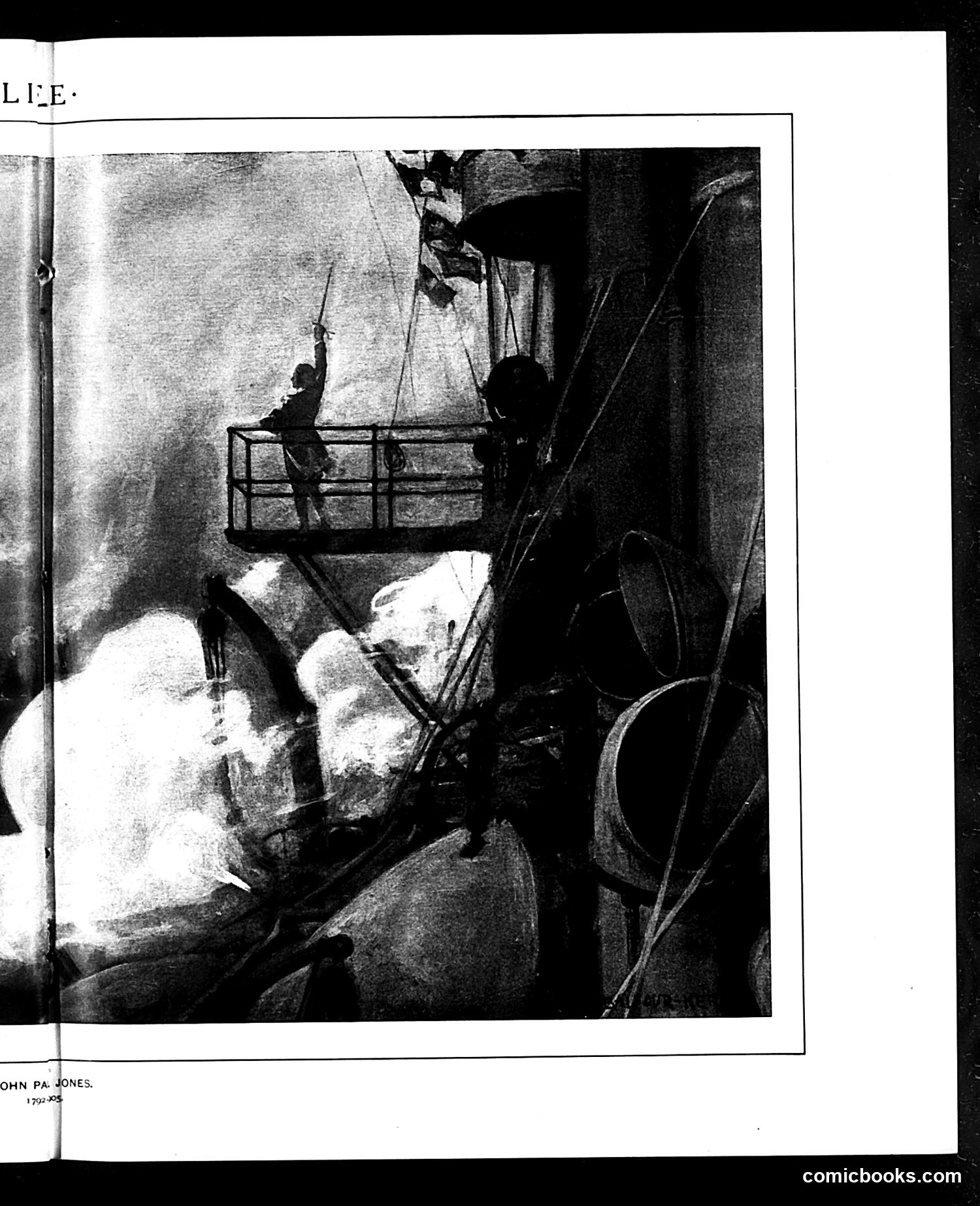
This appears to be a black and white photograph or illustration showing industrial/construction work, likely from the early 20th century. A worker stands on a suspended platform or scaffold, appearing to be engaged in some form of labor on or near a large industrial structure or vessel. The attribution to "John Pa. Jones" and the reference number suggest this may document a specific historical figure or incident, though without additional context from the magazine's text, the exact satirical or editorial point remains unclear. The image quality and composition suggest it's meant to illustrate a commentary on labor, industrial progress, or working conditions—common themes in *Life* magazine's satirical content during this era. Without visible accompanying text or caption, the specific social or political commentary cannot be definitively determined.
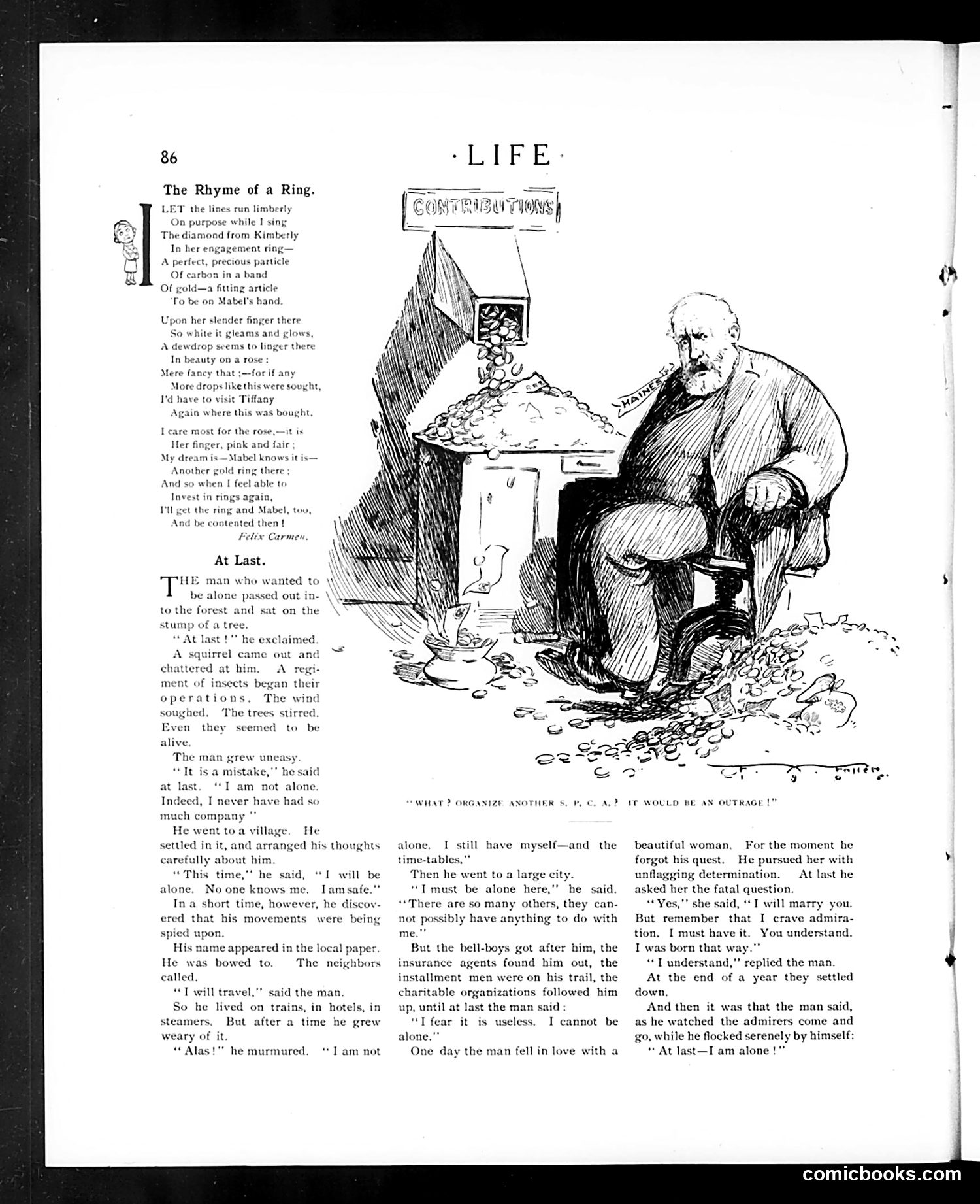
This page contains two separate pieces of satirical writing: **"The Rhyme of a Ring"** is a romantic poem about a man purchasing a diamond engagement ring from Tiffany & Co. for his beloved Mabel. The satire mocks sentimental engagement narratives and consumer materialism—the speaker fancies buying multiple rings if he could afford them. **"At Last"** is a longer satirical story about a man seeking solitude. He progressively discovers that isolation is impossible: living alone attracts neighborhood attention; moving to a city means dealing with salesmen and charities; finally, marrying for companionship achieves his goal ironically—his wife demands constant admiration from other men, leaving him alone by default. The punchline critiques both modern social intrusions (bell-boys, insurance agents) and the paradoxes of human connection. The cartoon illustration shows a man surrounded by a pile of money/coins, apparently representing the accumulation of wealth or materialism referenced in the stories.
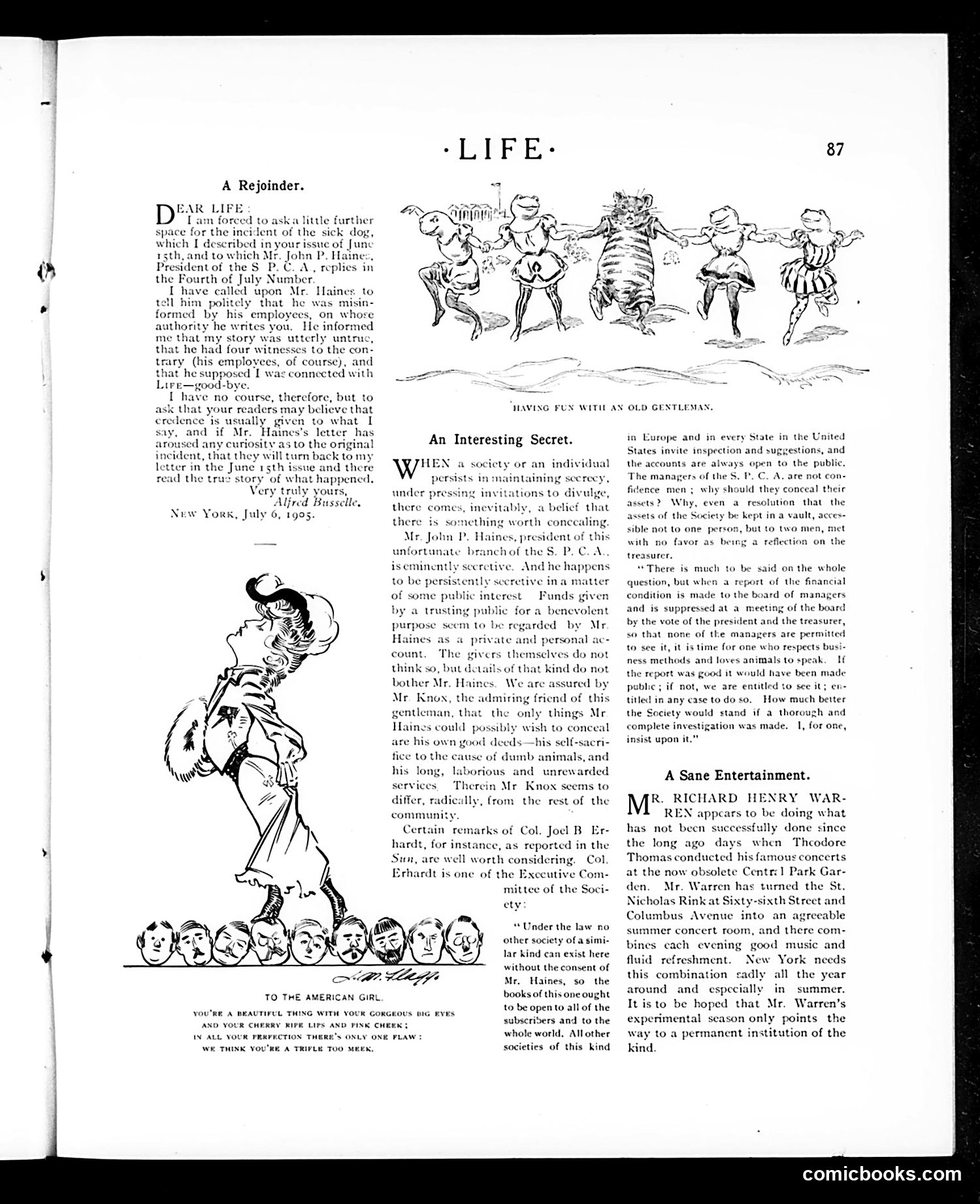
This page contains a dispute over animal welfare management. A reader (Alfred Busselle) responds to John P. Haines, president of the S.P.C.A. (Society for the Prevention of Cruelty to Animals), who had denied Busselle's published account of mistreatment of a sick dog. Busselle insists his story was accurate. The main article criticizes the S.P.C.A.'s secrecy regarding finances and operations. It quotes Col. Joel B. Erhardt (an Executive Committee member) noting that the S.P.C.A. demands transparency from other organizations but refuses to open its own books to the public or even its donors. The article suggests this secretive behavior raises questions about how funds are being managed—a critique of institutional opacity and potential mismanagement. The cartoon at top shows figures dancing around a tiger, titled "Having Fun with an Old Gentleman," apparently satirizing the controversy. The page reflects Progressive Era concerns about accountability in charitable organizations.
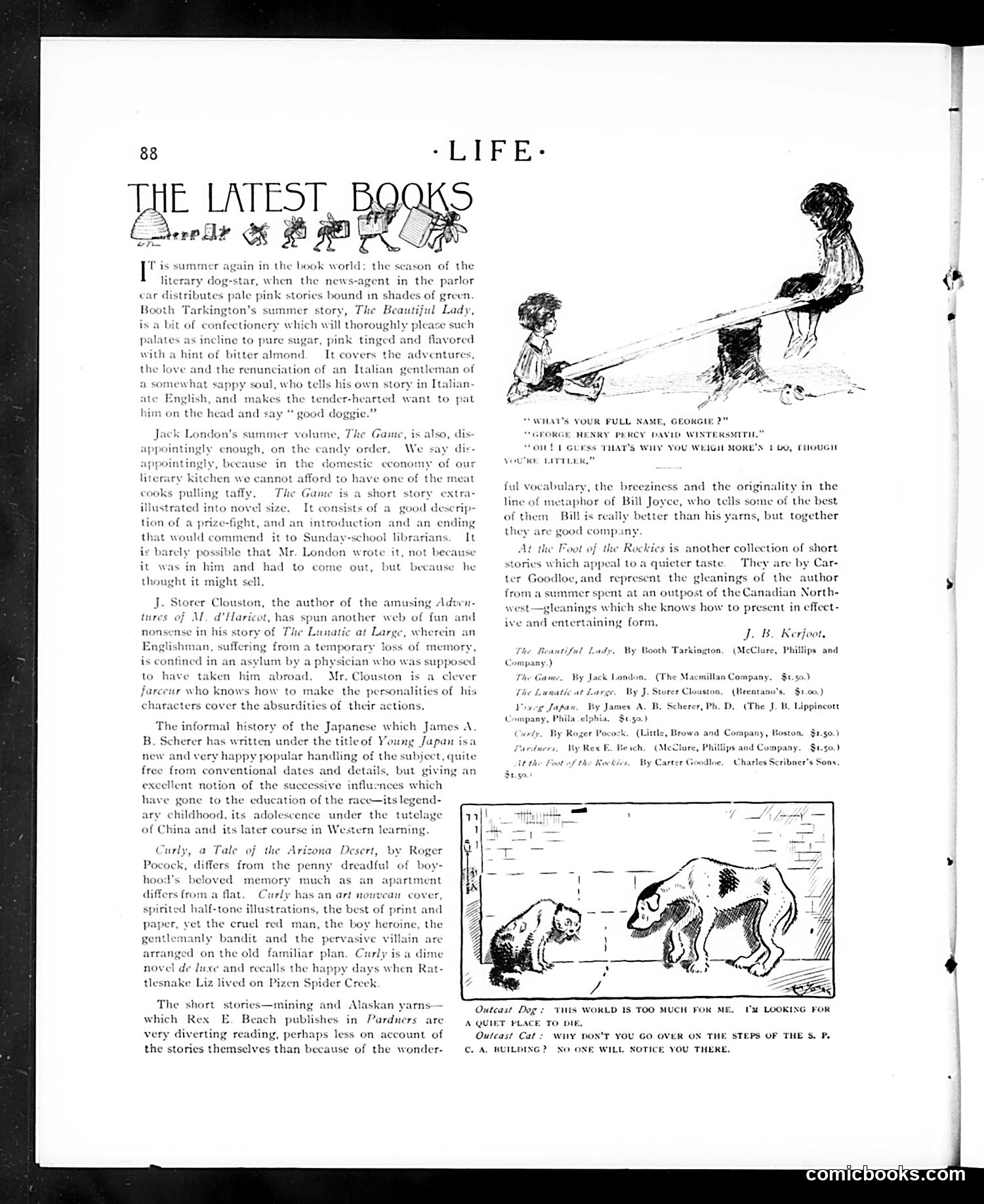
This page is a book review section titled "The Latest Books," discussing summer literary releases. The main cartoon depicts two children fishing, with dialogue about one child's lengthy formal name ("George Henry Percy David Wentersmith") versus his small physical size—the joke being that his elaborate, upper-class name is absurdly disproportionate to his tiny frame. The reviews themselves discuss popular summer fiction, including works by Booth Tarkington, Jack London, and J. Storer Clouston. The commentary is gently satirical, mocking the literary pretensions of "summer stories"—lightweight pink-covered novels meant for parlor reading. London's boxing story is criticized for being commercially driven rather than artistically motivated, while other works are praised for appealing to "quieter taste." The cartoons' humor relies on class-consciousness about naming conventions among the wealthy, a theme evident in the period's satire about social aspiration and inherited privilege.
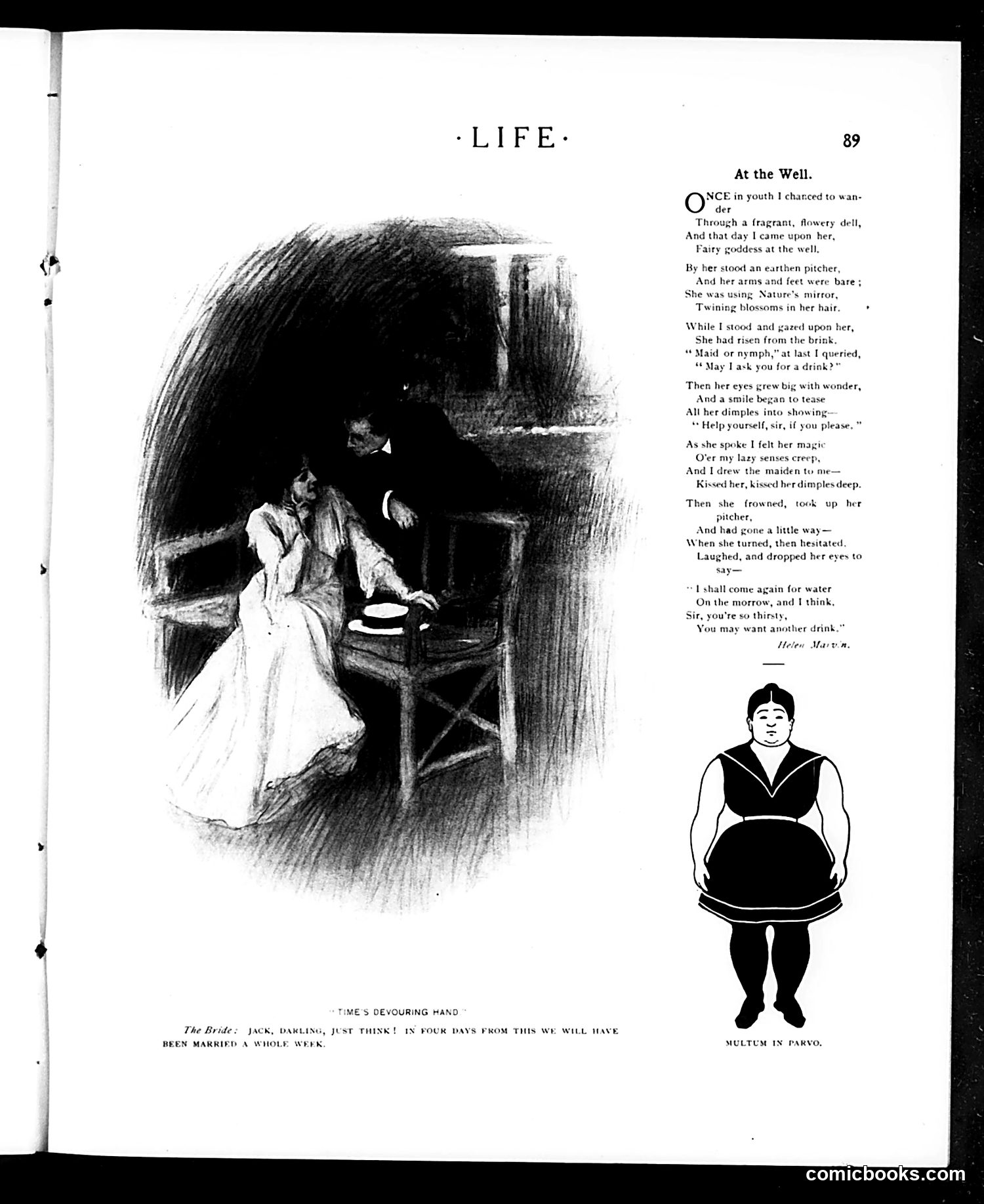
This page contains two distinct pieces of satirical content: **"At the Well"** (main poem and illustration): A romantic narrative poem depicting a young man's encounter with a woman at a well. The sketch shows the scene in period dress. The poem's humor lies in the woman's final line—after the man kisses her, she suggests he'll be thirsty again tomorrow and may "want another drink," implying she'll return for future romantic encounters. It's gentle satire on courtship rituals and male desire. **"Time's Devouring Hand"** (bottom cartoon): Shows a newly married couple where the bride reflects that in four days they'll have been married a whole week. The caption's darkly humorous point appears to be satirizing the rapid dissolution of marital bliss—suggesting that marriage's honeymoon period is fleeting, consumed quickly by time. The accompanying illustration "Multum in Parvo" (much in little) depicts what appears to be a domestic figure, possibly commenting on married life's realities versus romantic expectations. Both pieces use humor to deflate romantic idealization.
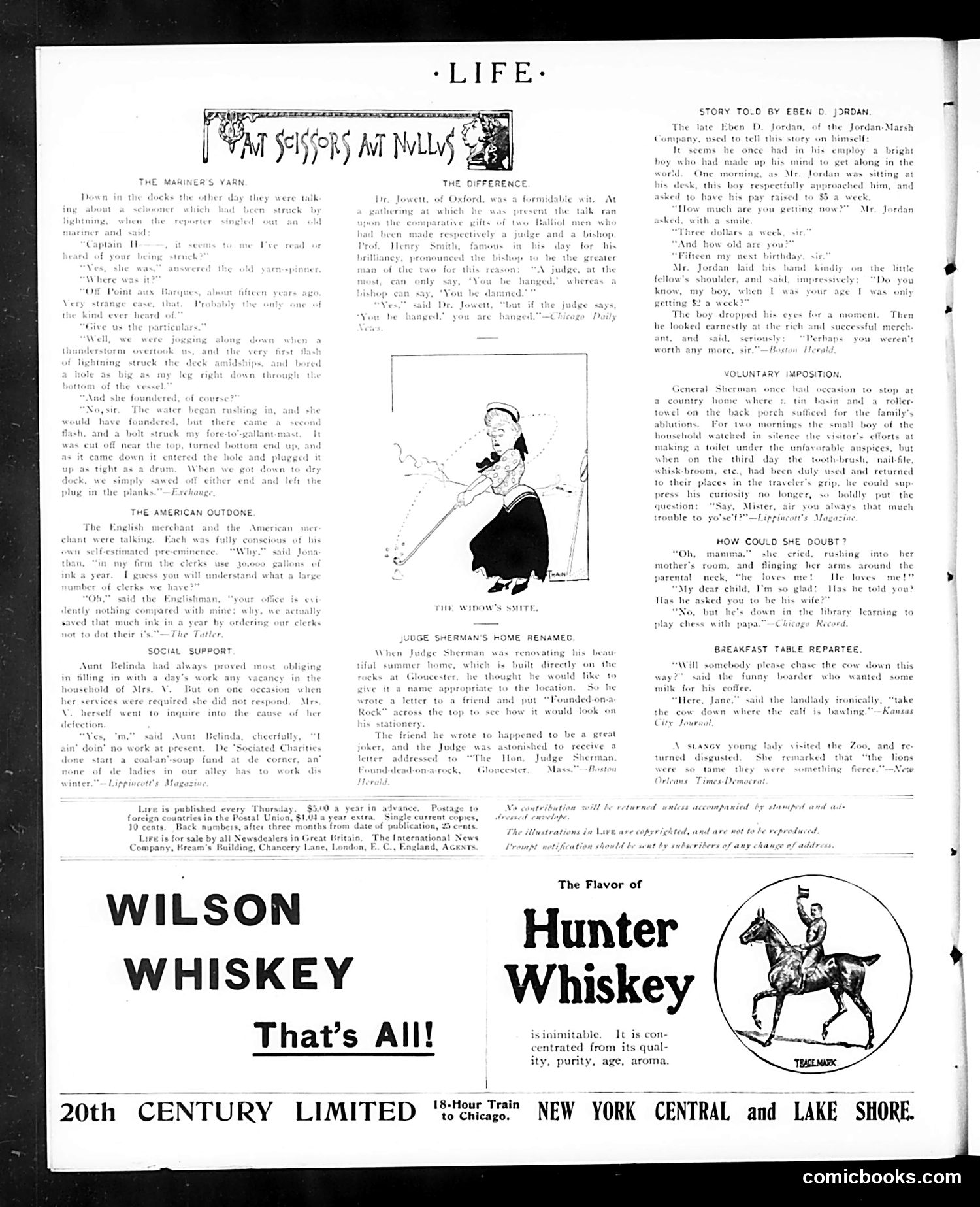
This page mixes **short humorous stories** with **period advertisements**. The main content includes: 1. **"The Mariner's Yarn"** and related short stories (titles visible: "The Difference," "The American Outlook," "Social Support," "The Widow's Smite," "Judge Sherman's Home Renamed," "How Could She Doubt?," "Breakfast Table Repartee," "A Slancy Young Lady") — these are light domestic anecdotes typical of Life's humor section, involving romantic misunderstandings, class interactions, and everyday situations. 2. **The cartoon illustration** (center-right) shows a woman in early 1900s dress, apparently the subject of one story, though the specific narrative isn't fully clear from the OCR'd text. 3. **Large advertisements** for Wilson Whiskey, Hunter Whiskey, and the 20th Century Limited train dominate the lower half, typical of Life's revenue model. The satirical content appears gentle and domestic rather than political—focused on social comedy rather than social critique.
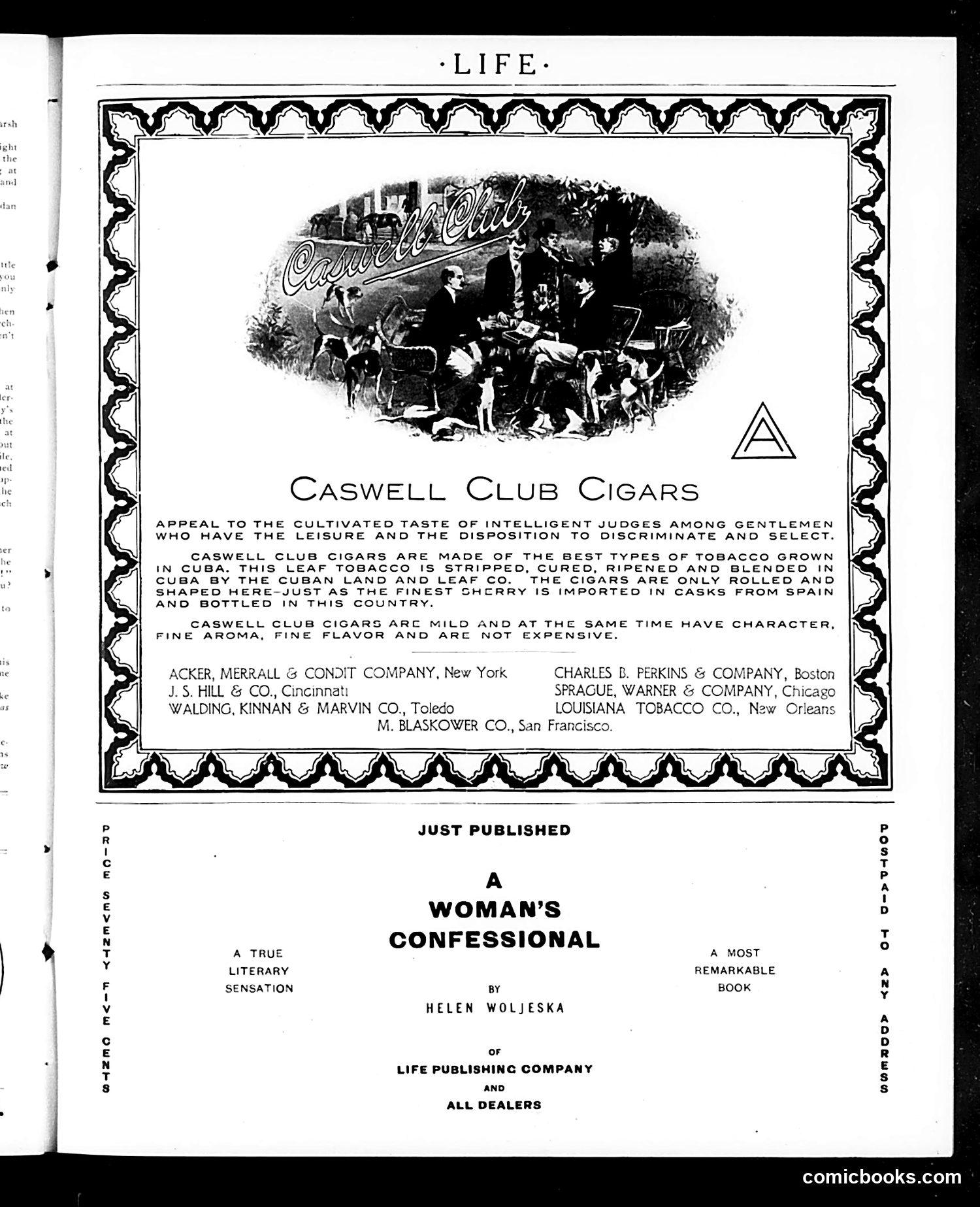
This is primarily a **advertisements page** from Life magazine, not a political cartoon. The top half features a **Caswell Club Cigars advertisement** targeting wealthy gentlemen. The ad emphasizes luxury and exclusivity—the cigars appeal to "cultivated taste" and "intelligent judges" with "leisure" and "disposition to discriminate." The copy stresses Cuban tobacco processed in Cuba (like fine sherry imported from Spain), positioning the product as refined and cosmopolitan for the upper class. The bottom half advertises a book: **"A Woman's Confessional" by Helen Woljeska**, published by Life Publishing Company. It's marketed as both "a true literary sensation" and "a most remarkable book"—sensationalist language suggesting scandal or scandalous revelations, likely appealing to readers' voyeuristic interest in women's private lives or secrets. Together, these ads reflect early-20th-century consumer culture targeting educated, wealthy audiences through appeals to sophistication and sensationalism.
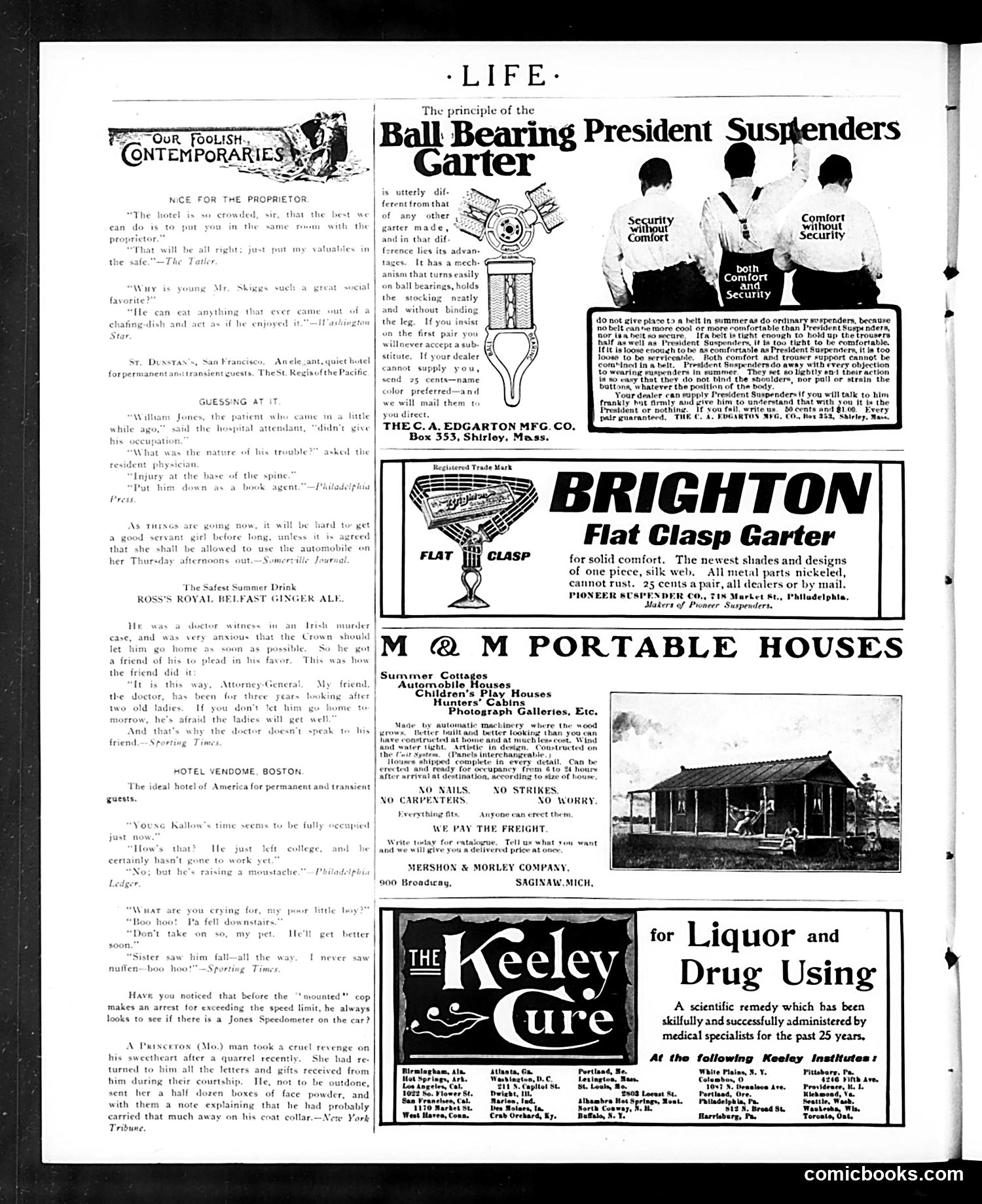
This page is primarily **advertising content** from an early 20th-century *Life* magazine, with the main feature being a satirical product advertisement for "President Suspenders." The central cartoon mocks the absurdity of marketing suspenders by claiming they provide "Security without Contact," "Comfort without Security," and "both Comfort and Security"—an obvious logical impossibility. The advertisement then humorously acknowledges this contradiction: a belt tight enough to hold up trousers can't be comfortable, while a comfortable belt won't hold up trousers properly. The "President" branding appears designed to lend authority and prestige to the product. The detailed technical explanation satirizes how manufacturers use pseudo-scientific language to sell ordinary products as revolutionary solutions to non-problems. The page also contains miscellaneous humor columns and advertisements for other products (garters, portable houses, the Keeley Cure for substance abuse), typical of *Life's* mixed editorial-advertising format from this era.
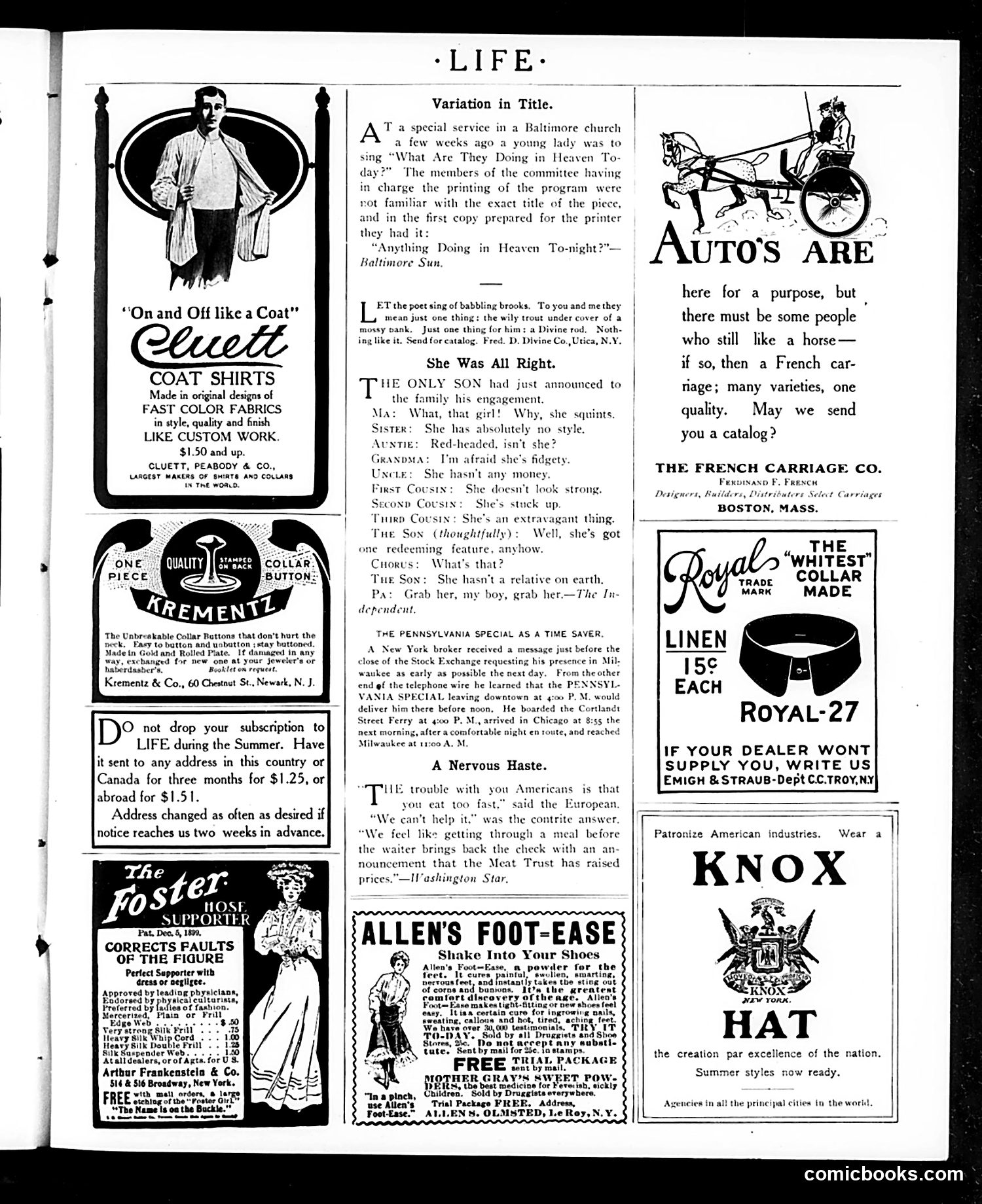
This page is primarily **advertisements with brief humorous content**. The main satirical pieces are short anecdotes: 1. **"Variation in Title"**: A joke about a Baltimore church program where "What Are They Doing in Heaven Tonight?" was mistyped as "Anything Doing in Heaven To-night?"—playing on awkward wording. 2. **"She Was All Right"**: A domestic humor piece where a young man's entire family criticizes his fiancée (she squints, has no style, is red-headed, is fidgety, has no money, looks weak, is stuck-up, extravagant), but the son reveals her one redeeming quality: she has no relatives. The father enthusiastically endorses marriage for this reason—satire on mercenary family attitudes and relief at avoiding in-laws. 3. **"A Nervous Haste"**: Ethnic humor contrasting American and European dining habits—Americans eat too fast due to anxiety about restaurant bills. The rest is period advertising for coat shirts, corsets, hose supporters, and carriages typical of early 1900s Life magazine.
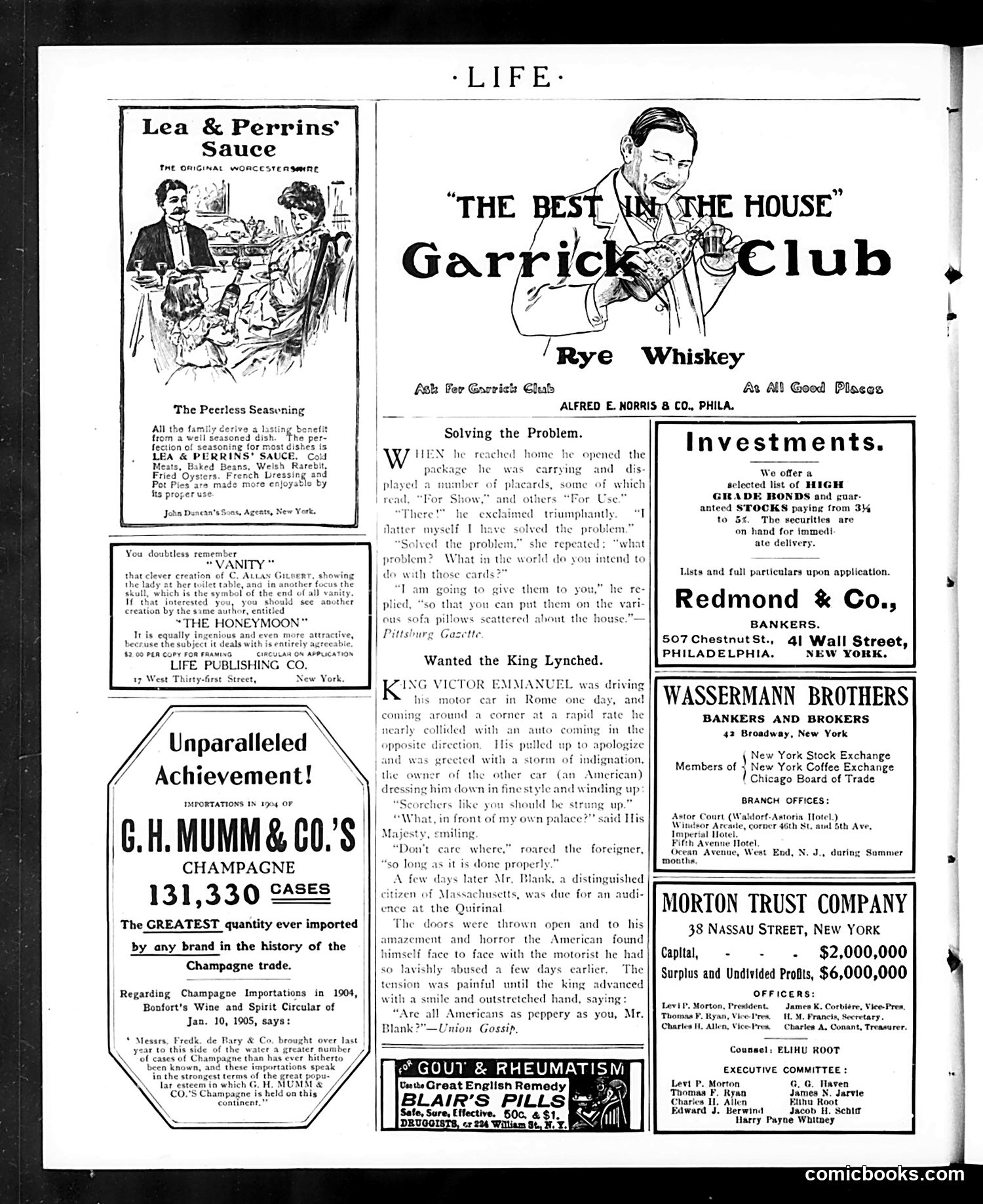
This page is primarily **advertising**, not satirical commentary. It contains two brief humorous anecdotes alongside commercial ads for financial services and consumer products. The two stories are: 1. **"Solving the Problem"**: A domestic humor piece about a husband returning home with placard souvenirs, which he gifts to his wife to decorate the parlor sofa pillows—presented as solving some unnamed household dispute. 2. **"Wanted the King Lynched"**: An anecdote about King Victor Emmanuel of Italy nearly colliding with an American motorist in Rome. The American, indignant at being nearly hit "in front of [the King's] own palace," demands the foreigner apologize and sarcastically suggests Americans are naturally "peppery" (hot-tempered). The joke relies on the American's obliviousness to the other driver's royal status. Both are lightweight period humor with no deep political meaning. The page's primary content is financial and luxury advertising aimed at wealthy readers.
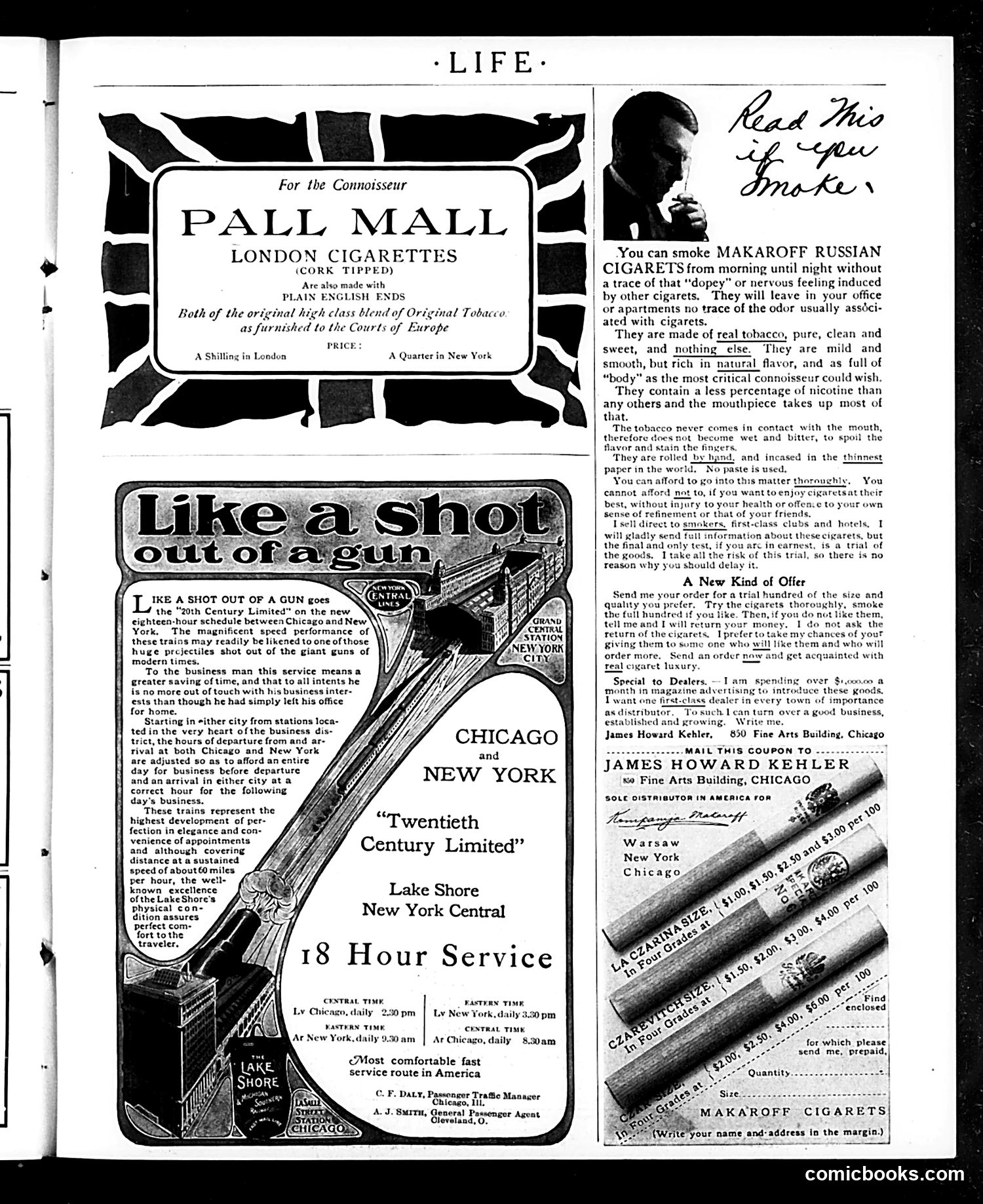
This page consists primarily of **advertisements** rather than satirical cartoons, typical of Life magazine's revenue model. **Main advertisements:** 1. **Pall Mall London Cigarettes** (top left): Marketed as a luxury product for connoisseurs, with cork tips and "high class blend." 2. **"Like a Shot Out of a Gun"** (center): Railroad advertisement for the "20th Century Limited" train service between Chicago and New York. The imagery compares the train's speed to a projectile fired from modern artillery. This appeals to businessmen valuing time-saving efficiency—a modernist concern of the era. 3. **Makaroff Russian Cigarettes** (right): Advertises Russian cigarettes claiming minimal nicotine and no lingering odor, with an unusual "satisfaction guaranteed" sales pitch where the distributor (James Howard Kehler) offers to refund money if unsatisfied. The page reflects early 20th-century consumer culture emphasizing speed, luxury goods, and aggressive marketing tactics. No political satire is evident—this is commercial advertising.
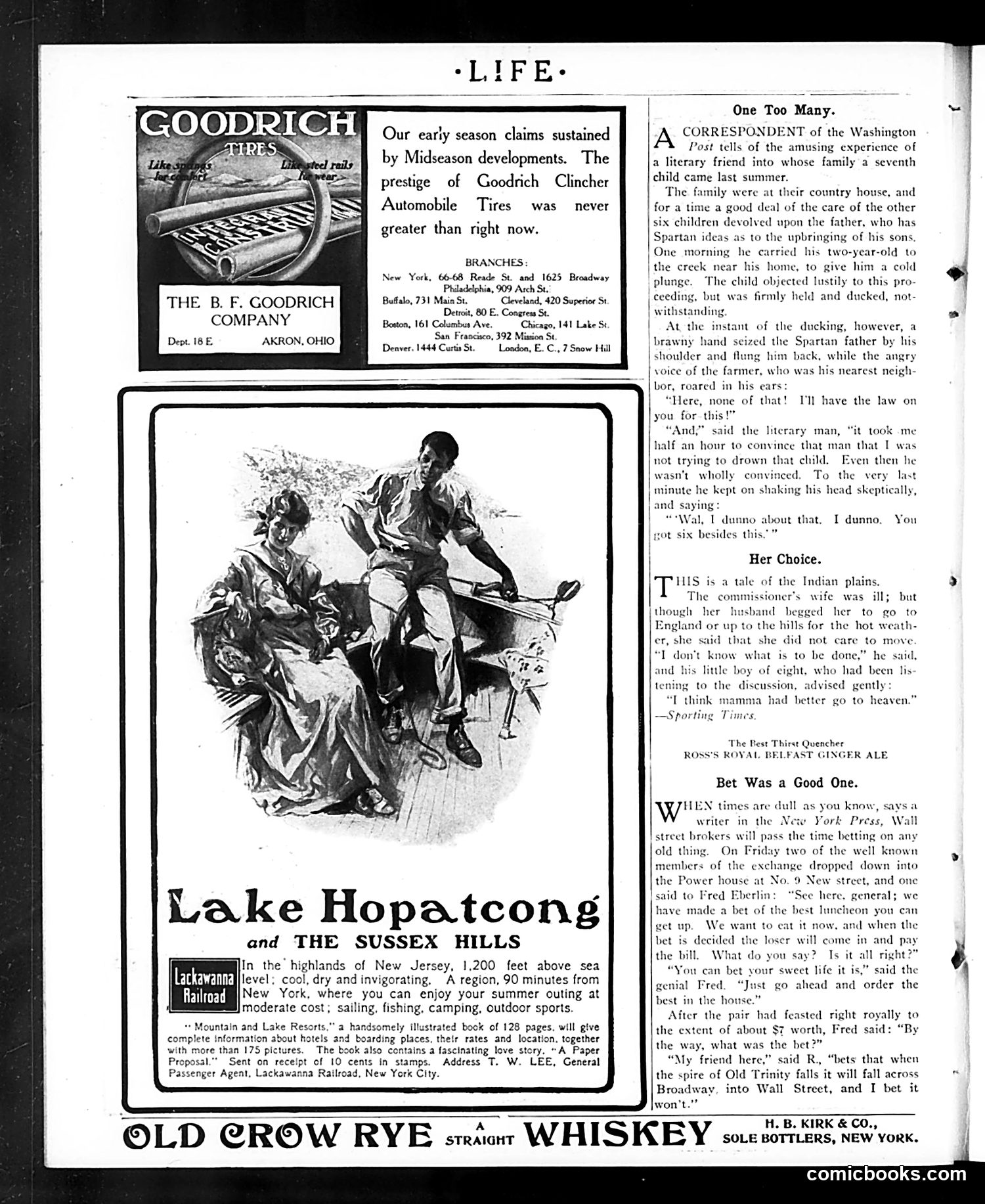
This page is primarily **advertising**, with short humorous anecdotes interspersed. The main illustrated advertisement promotes **Lake Hopatcong and Sussex Hills** in New Jersey as a vacation destination, featuring a classical drawing of a couple in period dress. The text pieces are lighthearted social humor: - **"One Too Many"**: A literary father dunks his toddler in a creek (following "Spartan" child-rearing ideas); a neighboring farmer intervenes, threatening legal action, misunderstanding the father's intentions. - **"Her Choice"**: A colonial India story where a sickly commissioner's wife refuses to leave; their eight-year-old suggests she "go to heaven" instead—dark Victorian humor about mortality. - **"Bet Was a Good One"**: Wall Street brokers wager over whether Trinity Church's spire will fall across Broadway into Wall Street when it eventually collapses—satirizing both the obsolescence of historic structures and financial district speculation. The advertisements include **Goodrich Tires, Old Crow Whiskey, and Ross's Royal Belfast Ginger Ale**—period products now extinct or transformed.
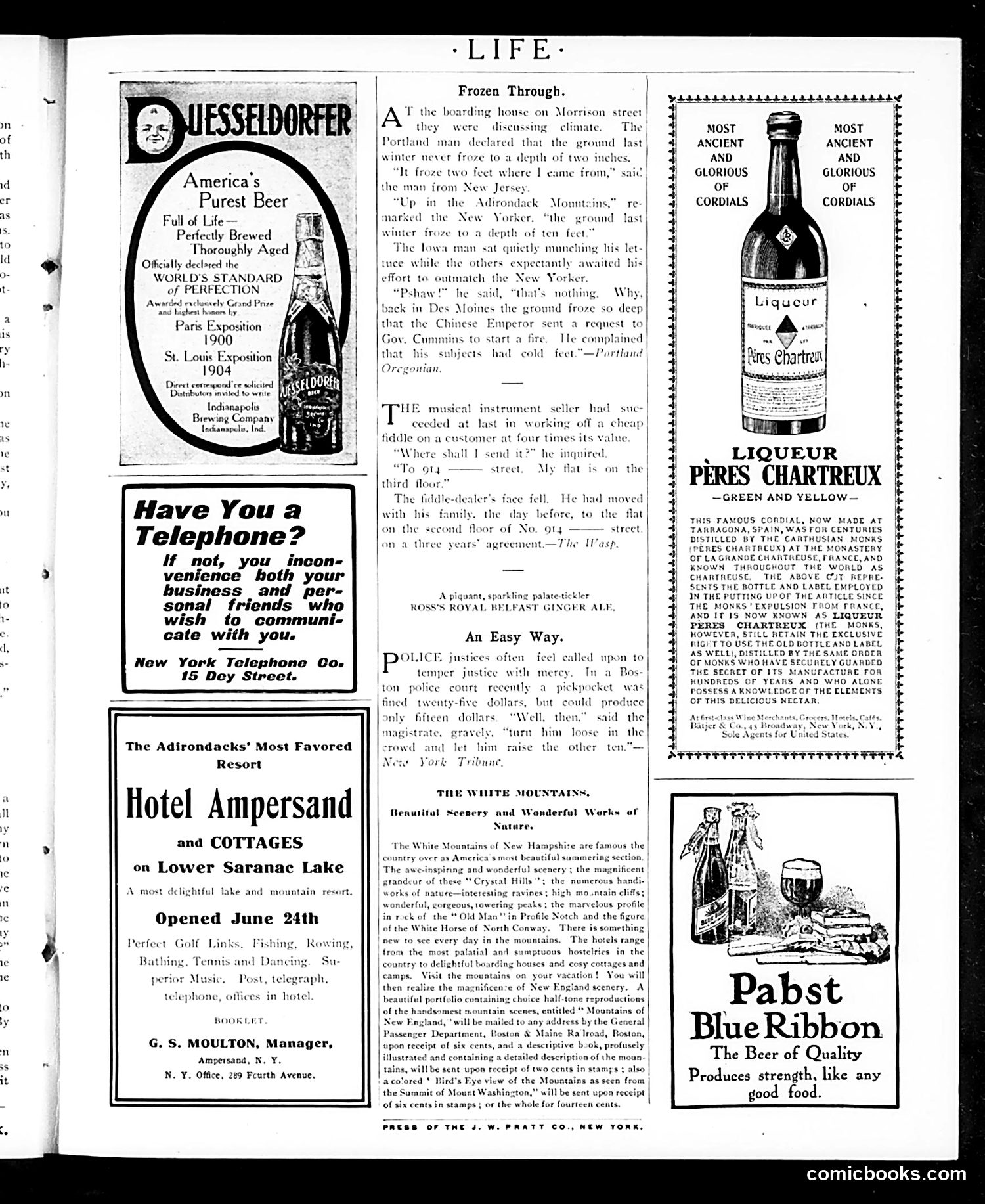
This page is primarily **advertising and light humor** rather than political satire. The content includes: **Advertisements:** Beer (Uesseldorfer, Pabst Blue Ribbon), liqueur (Pères Chartreux), a hotel resort, and telephone service dominate the page—typical early 1900s magazine ads emphasizing awards and quality. **Humor pieces:** Short anecdotes about exaggerated winter freezing (a tall-tale competition between regional braggarts), a musical instrument seller's apartment mishap, and a judge's merciful solution to a pickpocket's poverty. These are gentle, observational jokes about everyday life—not political commentary. **Tourism content:** A lengthy promotional piece about New Hampshire's White Mountains, encouraging leisure travel. The page reflects early-20th-century American consumer culture and leisure aspirations, with advertising subsidizing the magazine's satirical content rather than the satire itself being prominent here.
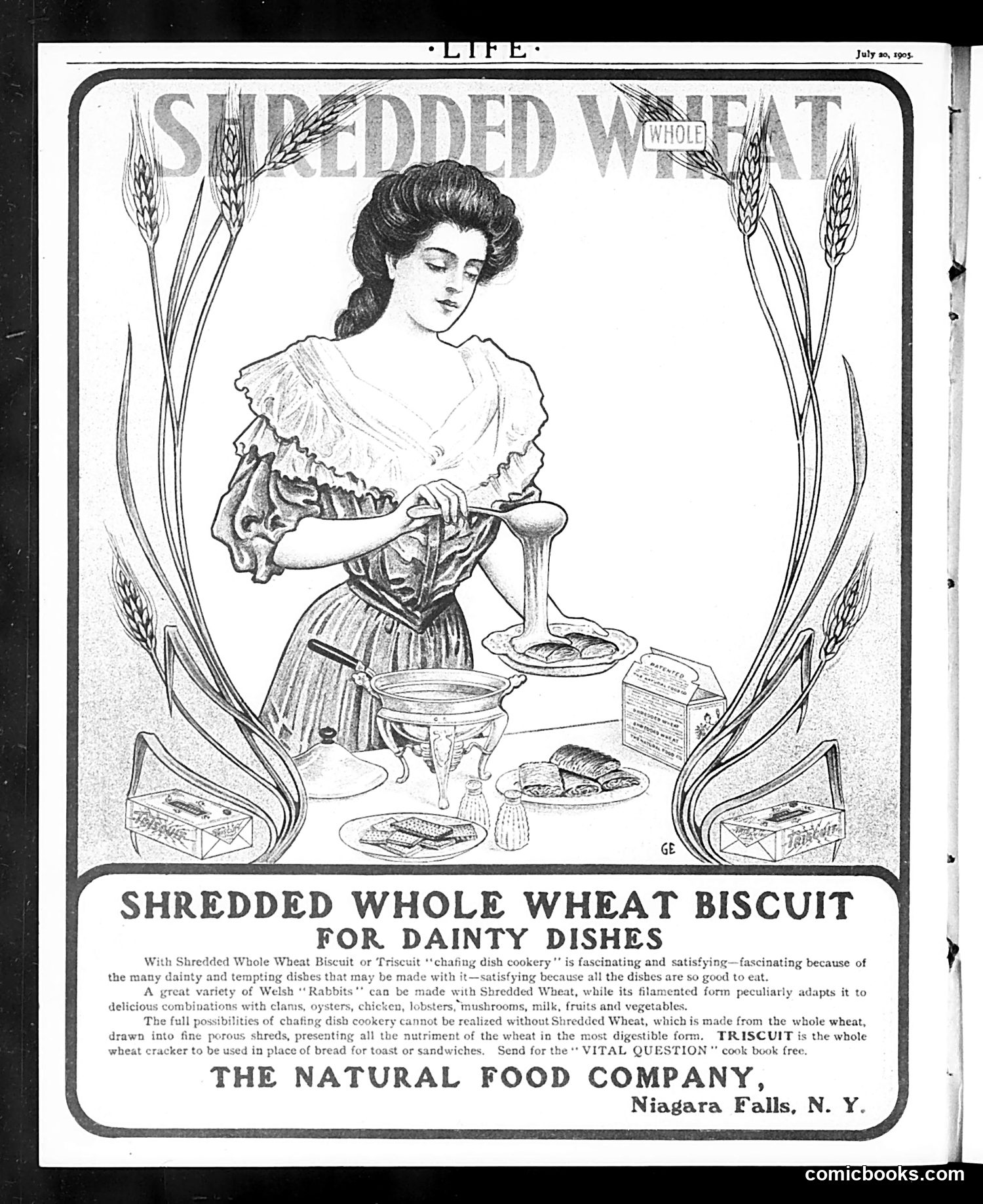
This is **not a cartoon or satire** — it's a straightforward product advertisement from *Life* magazine (July 20, 1905). The page advertises "Shredded Whole Wheat Biscuit" and "Triscuit" crackers made by The Natural Food Company in Niagara Falls, New York. The illustration shows a well-dressed Edwardian woman demonstrating the product's versatility in "chafing dish cookery" — a popular entertaining method of the era involving small heating devices at the table. The advertisement emphasizes that Shredded Whole Wheat products are nutritious ("all the nutriment of the wheat"), adaptable to various dishes (clams, oysters, chicken, mushrooms, etc.), and suitable for refined entertaining. The text promotes the product's digestibility and practicality for "dainty dishes," appealing to early 1900s middle-class domestic aspirations. This reflects the period's interest in health foods and convenient home cooking methods.