
Life, 1905-07-20 · page 16 of 28
Life — July 20, 1905 — page 16: what you’re looking at
What you’re looking at
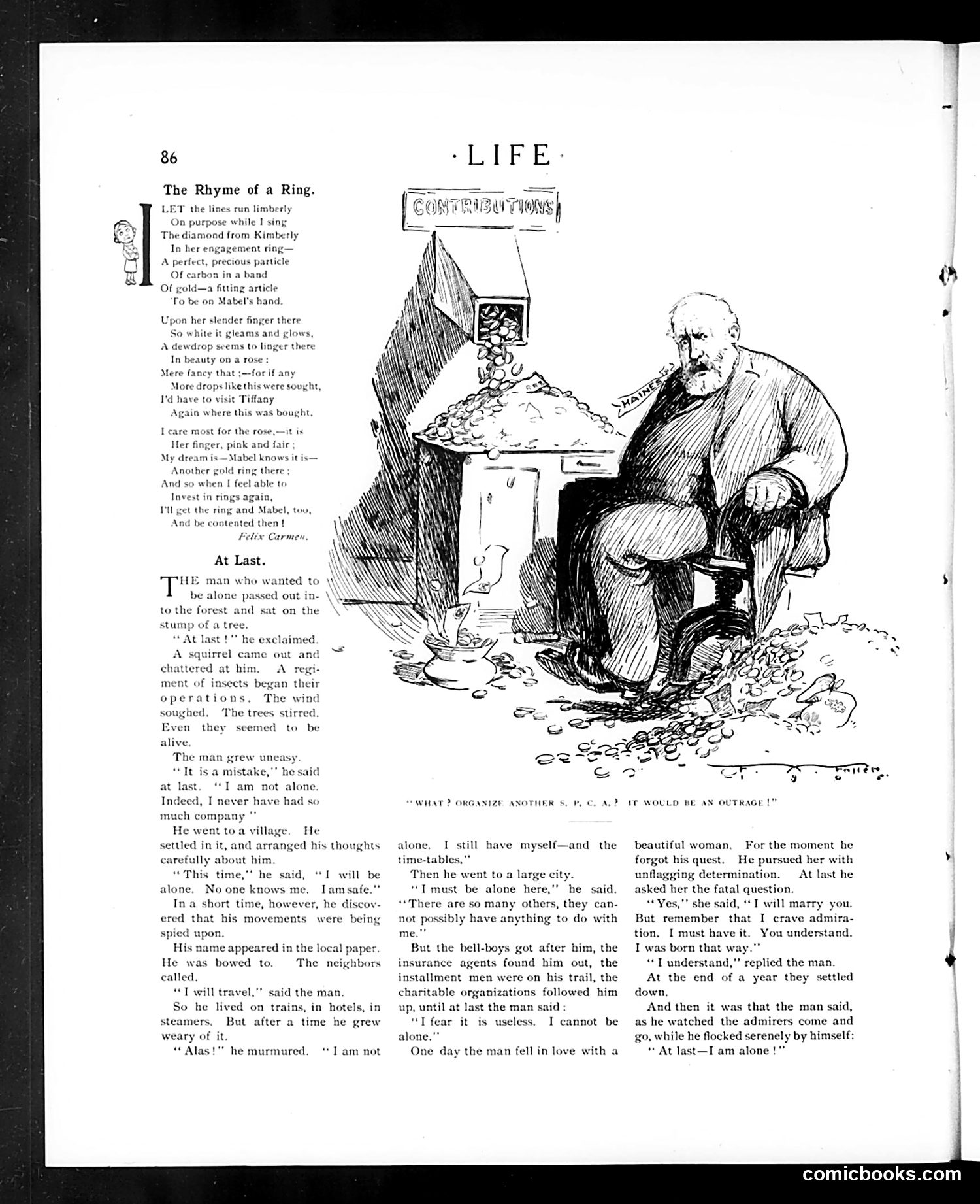
This page contains two separate pieces of satirical writing: **"The Rhyme of a Ring"** is a romantic poem about a man purchasing a diamond engagement ring from Tiffany & Co. for his beloved Mabel. The satire mocks sentimental engagement narratives and consumer materialism—the speaker fancies buying multiple rings if he could afford them. **"At Last"** is a longer satirical story about a man seeking solitude. He progressively discovers that isolation is impossible: living alone attracts neighborhood attention; moving to a city means dealing with salesmen and charities; finally, marrying for companionship achieves his goal ironically—his wife demands constant admiration from other men, leaving him alone by default. The punchline critiques both modern social intrusions (bell-boys, insurance agents) and the paradoxes of human connection. The cartoon illustration shows a man surrounded by a pile of money/coins, apparently representing the accumulation of wealth or materialism referenced in the stories.
📄 Transcribed text from this page (OCR, searchable)
Machine-transcribed from the original scan — historical spelling and the odd misread are preserved.
86 The Rhyme of a Ring. LET the lines run limber, On purpose while I si The diamond from Kimberly Io her eng: nt ring— A perfect, precious particle Of carbon ina band Of gold—a fitting article To be on Mabel's hand, Upon her slender finger there So white it gleams and glows, A dewdrop seems to linger there In beauty on a rose: Mere fancy that More drops like this were sou I'd have to visit Tiffany Again where this was bought. for if any . pink and fair Mabel knows it is— And so when I fe Inve Vit in rings aga’ t the ring and Mabel, nd be contented then Felix Carmen, At Last. an who wanted to passed out in- stand sat on the stump of a tre “At last !"" he exclaimed. A squirrel cai and attered at him. A. regi- ment of insects began their © out ations, The wind The tre seemed stirred. to be soughed The man grew “Tt isam at last. “Ia ed, I ne uneasy he said t alone. ad so much company "* He went toa village. He settled in it, and arranged his thoughts bout him. time," he said, alone. No one knows me. Iamsafe."* Ina short time, how: » he discov- ered that his movements were being spied His name appeared in the local paper. He was bowed to. The neighbors called. “Twill 8 So he lived on But after a time ¢ “Twill be npon, steamers. grew ‘he murmured. “I am not “WHAT 2 OKGANIZE ANOTHER S. Py ¢ alone, I still have myself—and the time-tables,”” Then he went toa large city “IT must be alone here," he said. “There are so many others, they can- not possibly have anything to do with me.” But the bell-boys got after him, the insurance agents found him out, the installment men were on his trail, the charitable organizations followed him up, until at last the man said ; “Tfear it is useless. I cannot be alone.” One day the man fell in love with a If WOULD BE AN OUTRAGE L” For the moment he He pursued her with At last he beautiful woman, forgot his quest. unflagging determination. asked her the fatal question. Yes," she said, “I will marry you. But remember that I crave admira- tion, I must have it. You understand. I was born that way.”’ “T understand,” replied the man. At the end of a year they settled down, And then it was that the man said, as he watched the admirers come and go, while he flocked serenely by himself: « At last—I am alone!" comicbooks.com