
A complete issue · 32 pages · 1905
Life — June 15, 1905
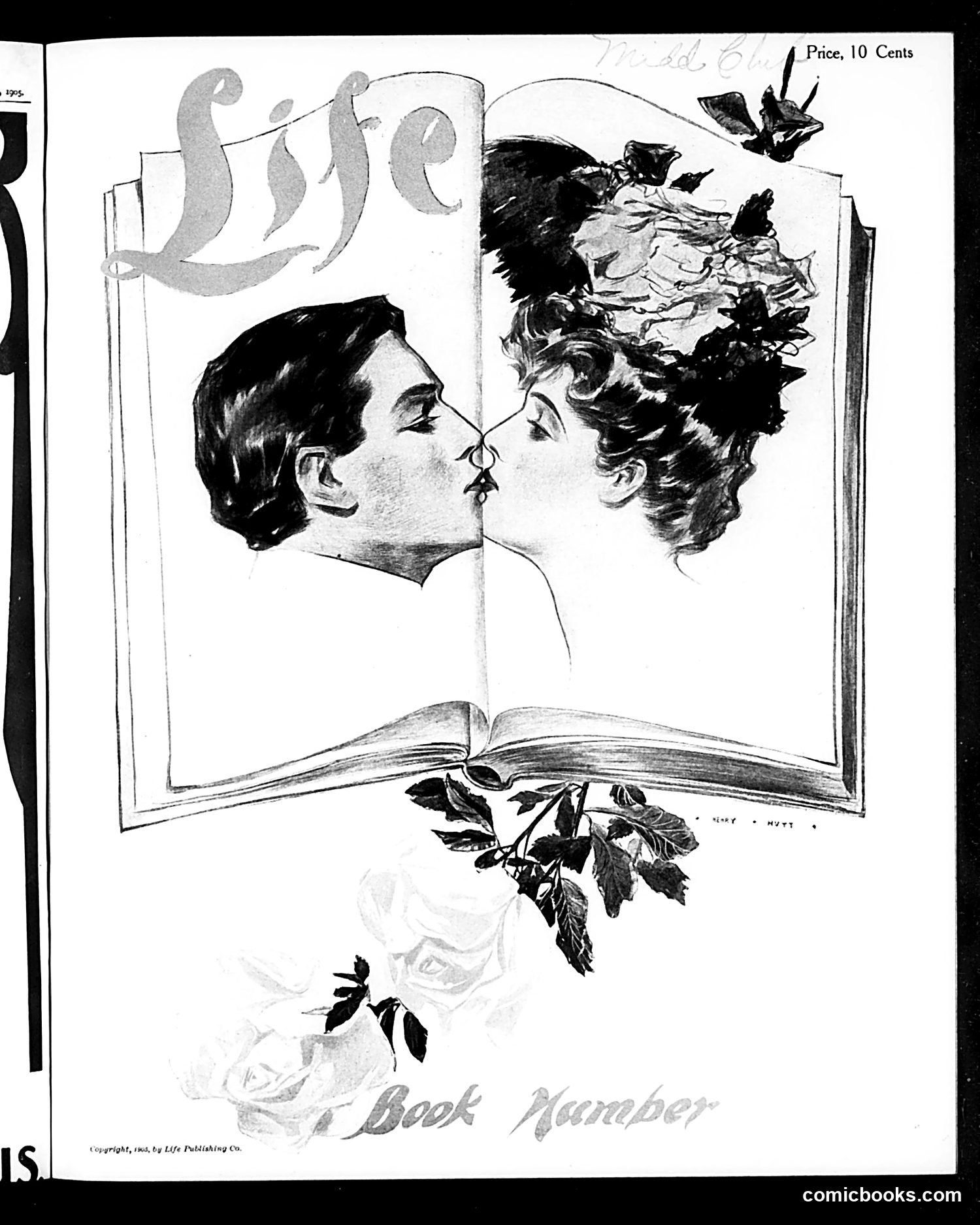
This page shows a romantic illustration within an open book, featuring two profiles about to kiss, with decorative flourishes including birds and flowering branches. The ornate "Life" masthead at the top and the text "Book Number" at the bottom indicate this is a cover or title page for a special book-themed issue of Life magazine. The satirical point appears to be gentle mockery of romantic literature—the idealized, flowery aesthetic of popular love stories. The expensive presentation (10 cents was substantial in this era) and elaborate artistic framing suggest Life is poking fun at the sentimental, illustrated romance books that appealed to middle-class readers, particularly women. The ornamental styling ironically emphasizes the decorative, somewhat overwrought nature of such publications.
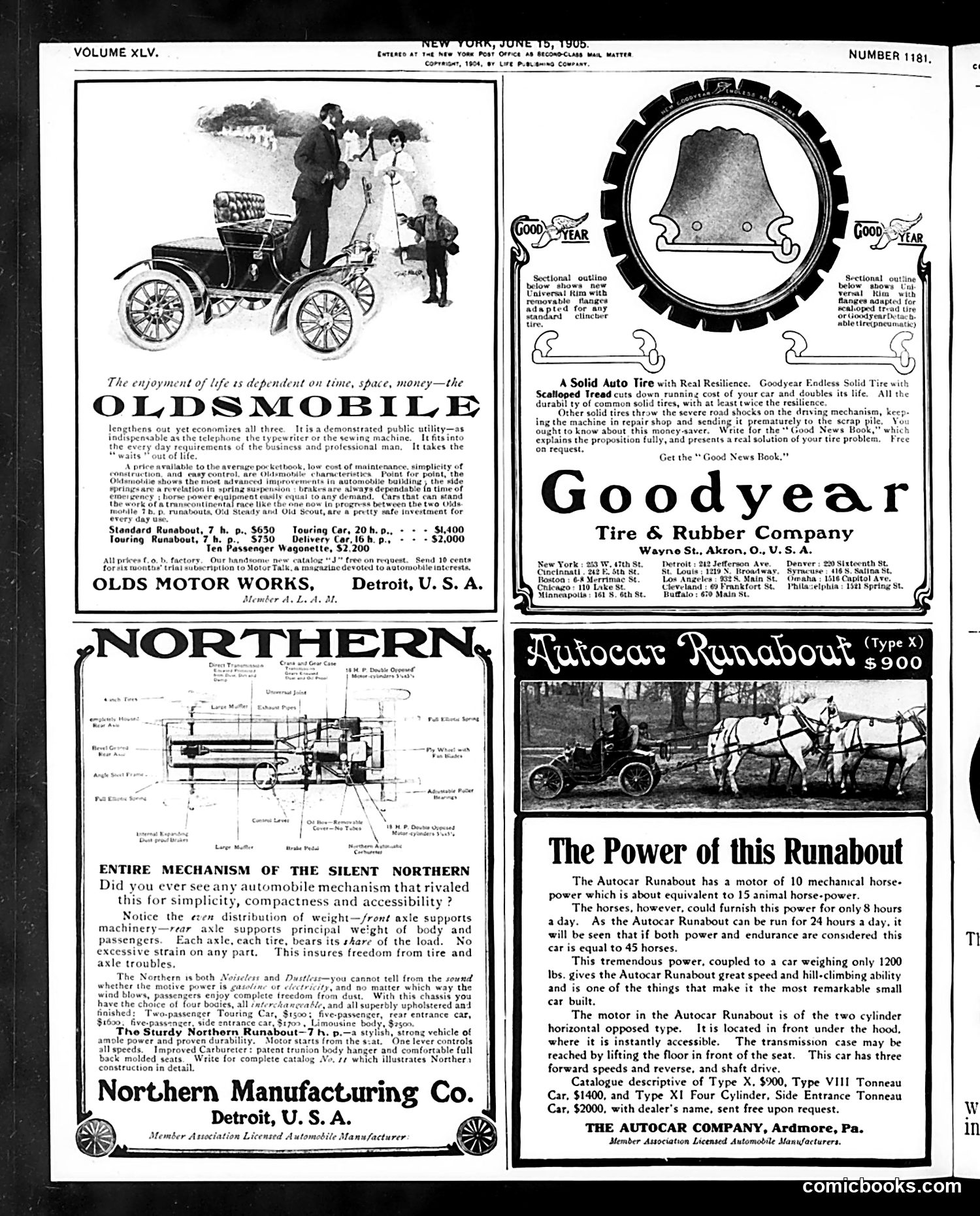
This page is primarily **advertising rather than satire or political content**. It contains four automobile advertisements from June 15, 1905: 1. **Oldsmobile** - depicts an early motorcar with well-dressed passengers, emphasizing reliability and practicality ("the enjoyment of life is dependent on time, space, money") 2. **Goodyear Tire & Rubber Company** - advertises solid auto tires with "real resilience," highlighting durability 3. **Northern Manufacturing Co.** - technical diagram of the "Silent Northern" automobile, emphasizing mechanical simplicity and accessibility 4. **Autocar Runabout** - promotes a small vehicle with 10 mechanical horsepower, equivalent to 15 animal horses The page reflects early 1900s automobile marketing, targeting affluent buyers with promises of reliability, mechanical innovation, and practical transportation. No political satire or caricature is present—this is straightforward commercial content from Life magazine's advertising section.
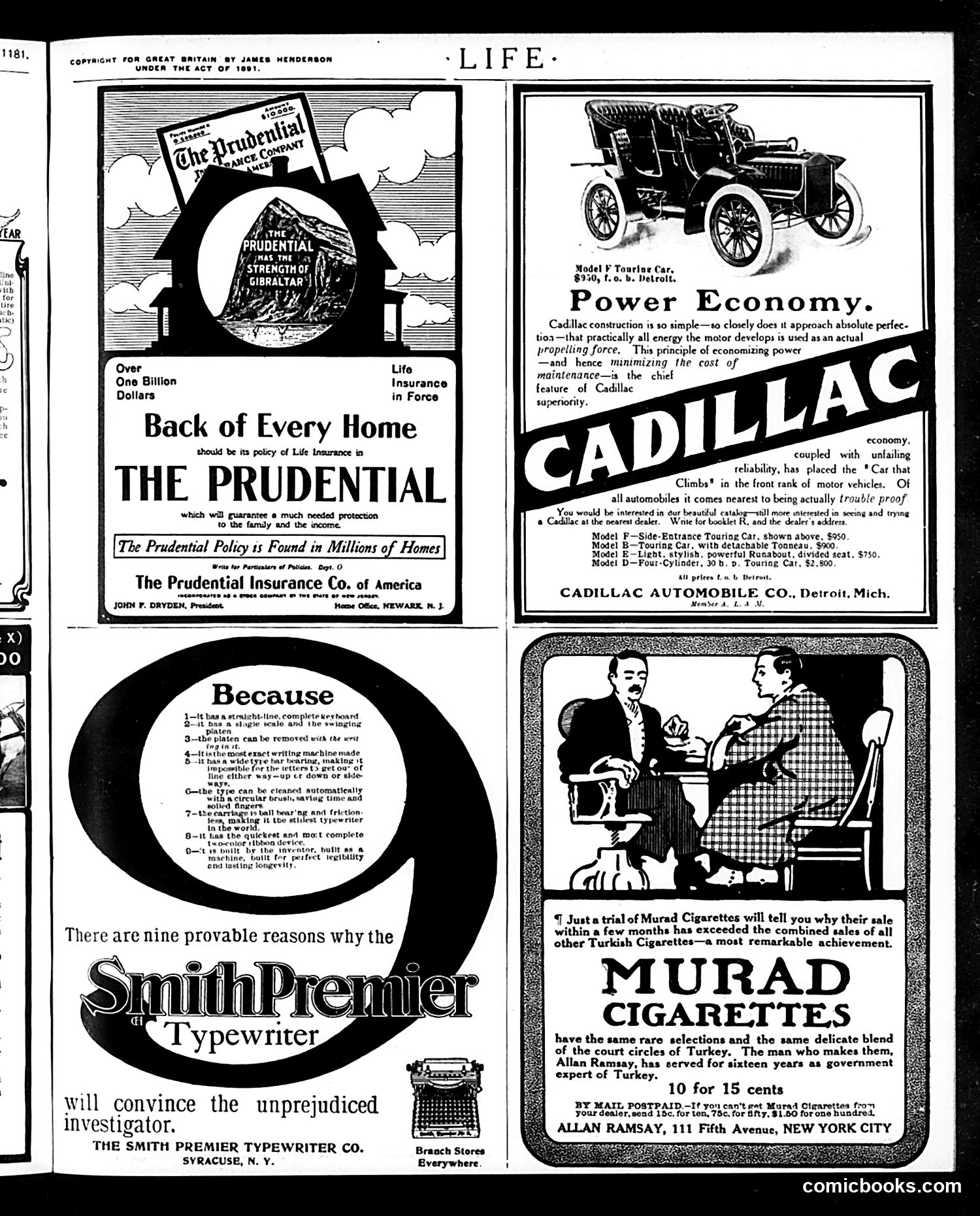
This page is primarily **advertisements**, not satirical content. It contains four ads: 1. **The Prudential Insurance Co.** — promotes life insurance as essential household protection, using the metaphor of a strong foundation ("strength of Gibraltar"). 2. **Cadillac automobiles** — emphasizes "Power" and "Economy" as key selling points, listing several models with prices around $800-$2,800. 3. **Smith Premier Typewriter** — lists "nine provable reasons" for purchasing this model, promising to convince any "unprejudiced investigator." 4. **Murad Cigarettes** — claims exceptional sales success among Turkish cigarettes, noting the maker served as a government tobacco expert for sixteen years. These ads reflect early 1900s consumer goods marketing, with emphasis on reliability, economy, and expert endorsement.
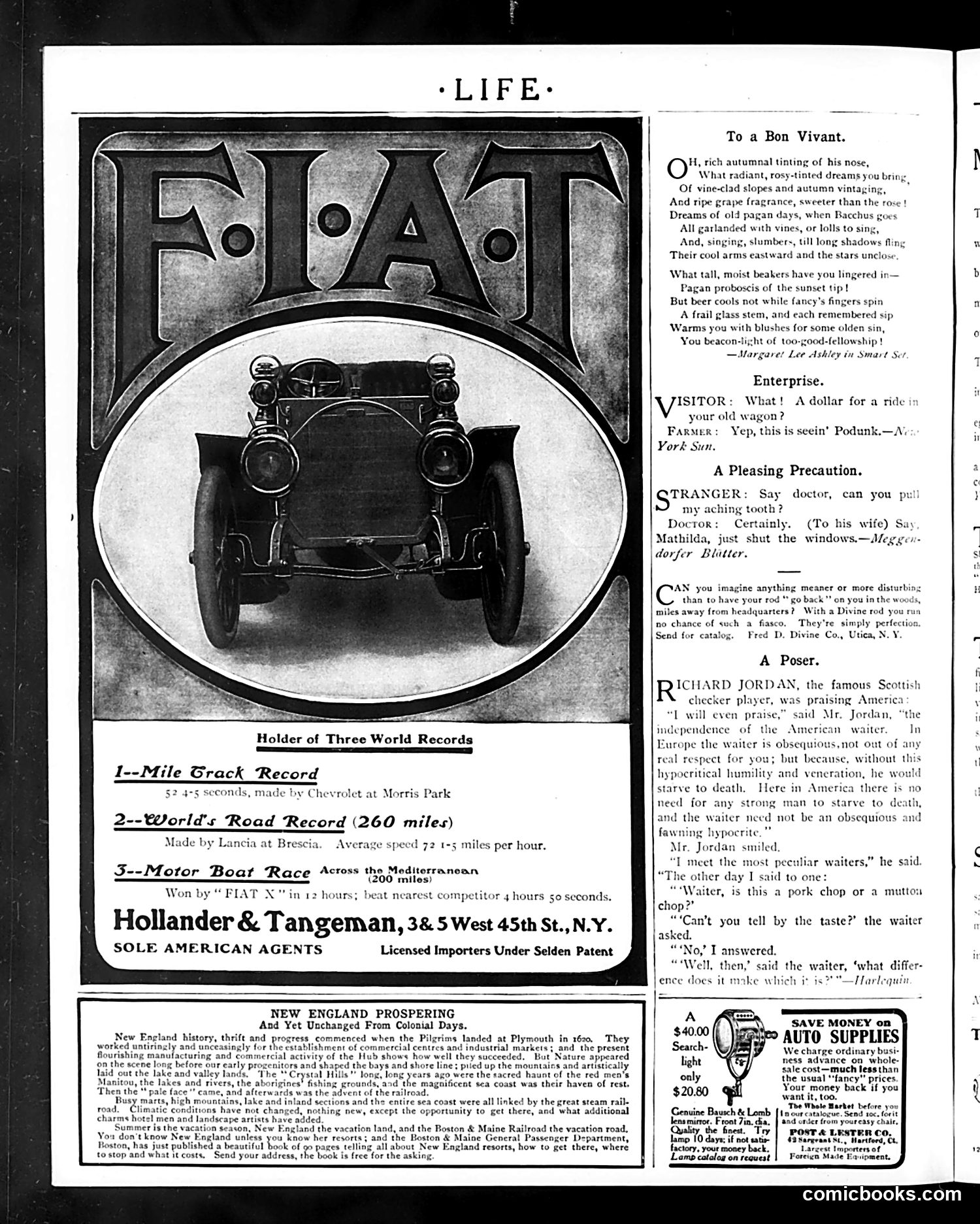
This page is primarily **advertising and humor content** rather than political satire. The main feature is a **FIAT automobile advertisement** showcasing a car that holds "Three World Records": a 1-mile track record, a 260-mile road record, and a Mediterranean motor boat race victory. The car is positioned as a high-performance vehicle to American readers. The right column contains **short humorous anecdotes** unrelated to the advertisement: - "Enterprise" jokes about rural pricing - "A Pleasing Precaution" involves a doctor and tooth-pulling - "A Poser" features Scottish playwright Richard Jordan praising American waiters' independence versus European servility At bottom, a section on **New England tourism** promotes vacation destinations and railroad travel. This is essentially a **commercial page** with light humor, not political commentary.
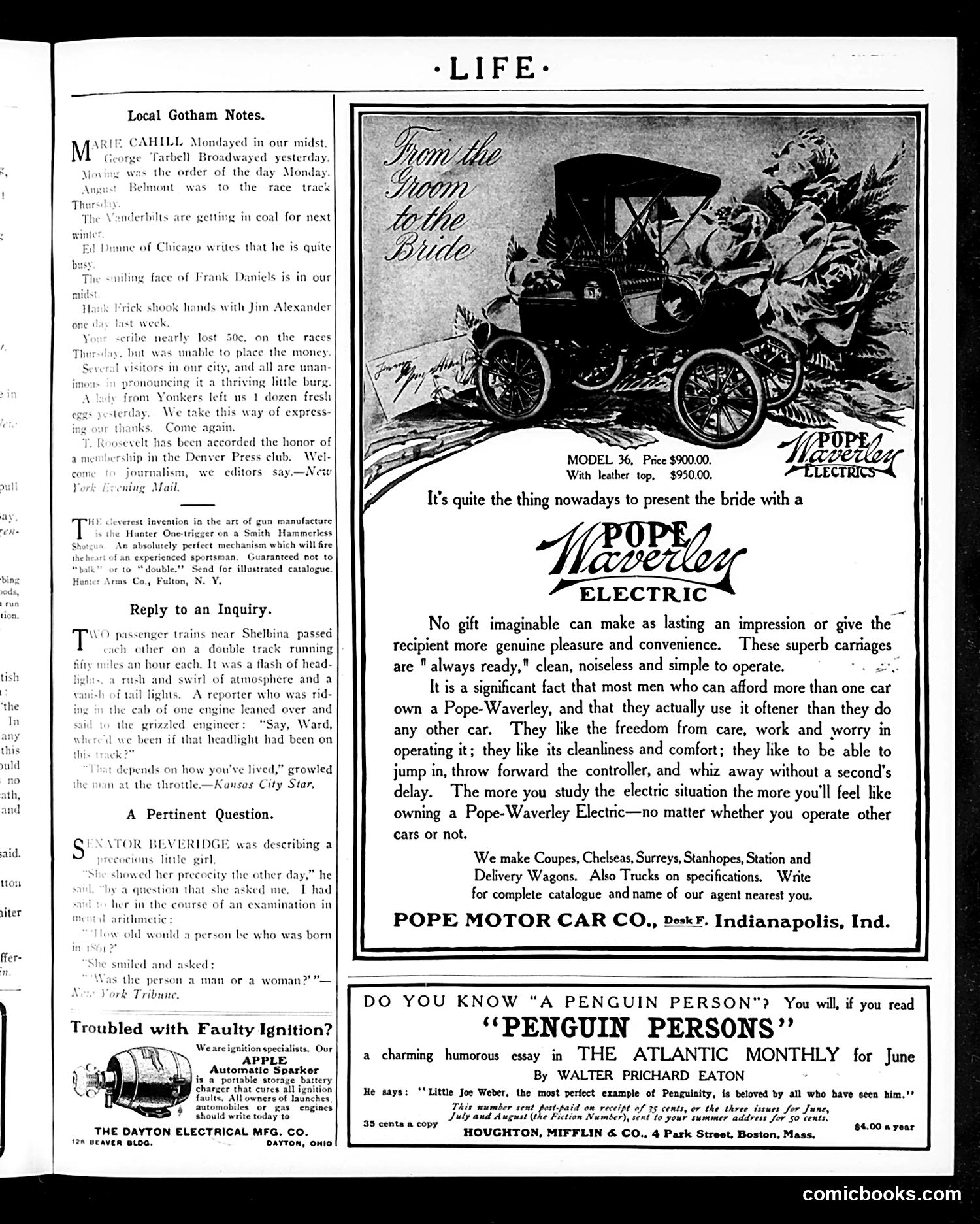
This page is **primarily advertising** rather than political satire. The dominant content is a full-page advertisement for Pope-Waverley Electric automobiles, featuring an illustration of a bride and groom in an early electric car ("From the Groom to the Bride"). The left column contains brief **social gossip and humor items** about local Gotham (New York) personalities and events—including mentions of people like Marie Cahill and Frank Daniels—typical of Life's "Local Notes" section. Below the ads is a small humor piece about a precocious girl, and another about trains passing each other. The remaining advertisements promote the Dayton Electrical Manufacturing Company's spark plugs and The Atlantic Monthly magazine. No political cartoons or significant satire appears on this page.
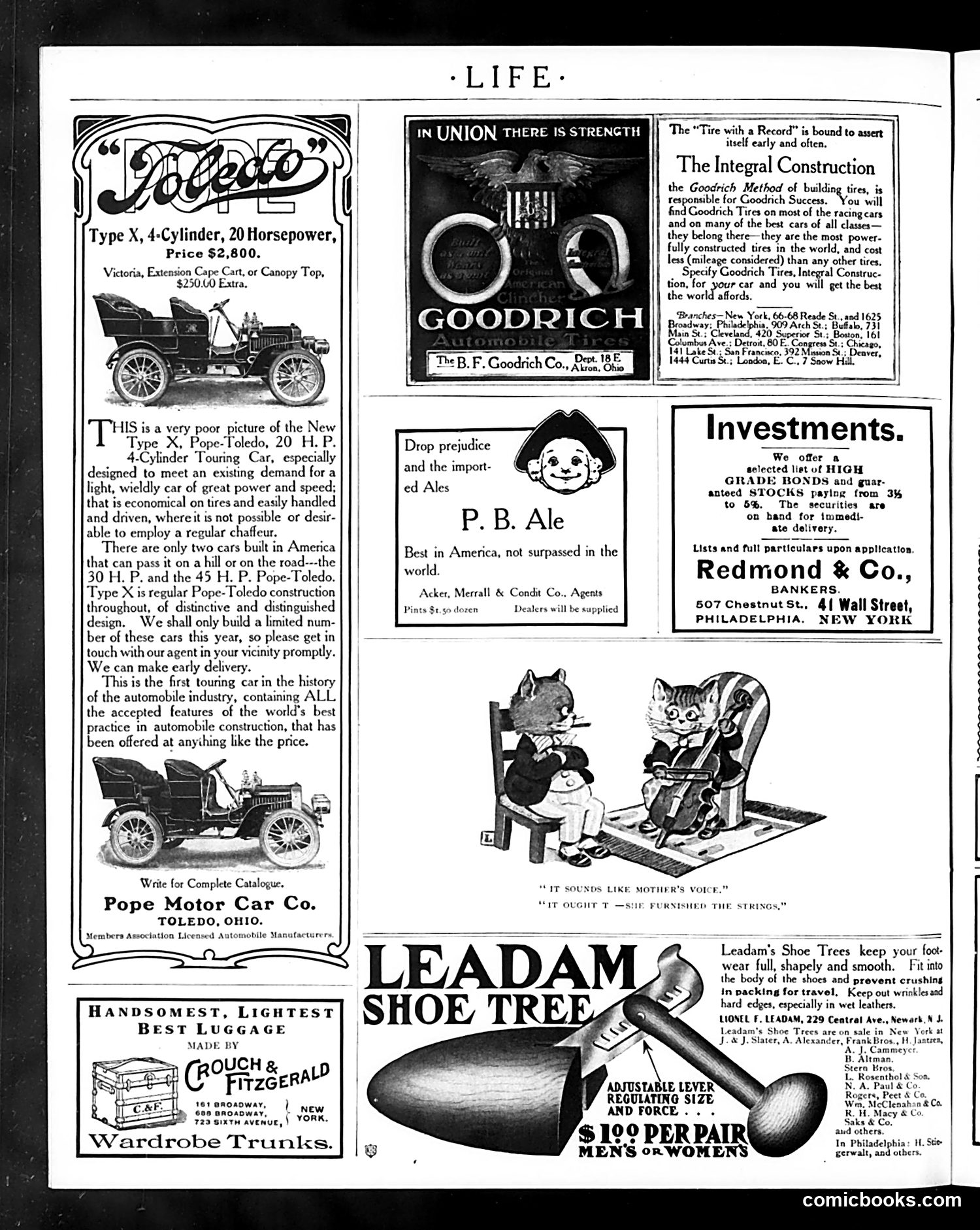
This page is primarily **advertising content** from an early 1900s Life Magazine, not political satire or editorial cartoons. The main advertisements include: - **Pope Motor Car Company** (Toledo, Ohio) - promoting their Type X touring automobile - **Goodrich Tires** - emphasizing "integral construction" for durability - **P.B. Ale** - with a mascot character and slogan "Best in America" - **Leadam Shoe Trees** - with an adjustable lever mechanism - **Crouch & Fitzgerald Wardrobe Trunks** - **Redmond & Co. Bankers** (investment services) The only cartoon element appears to be a small humorous illustration of animals in a carriage with the caption about "mother's voice" and "furnished strings"—likely a pun on puppet strings. This is minor comic relief rather than political commentary.
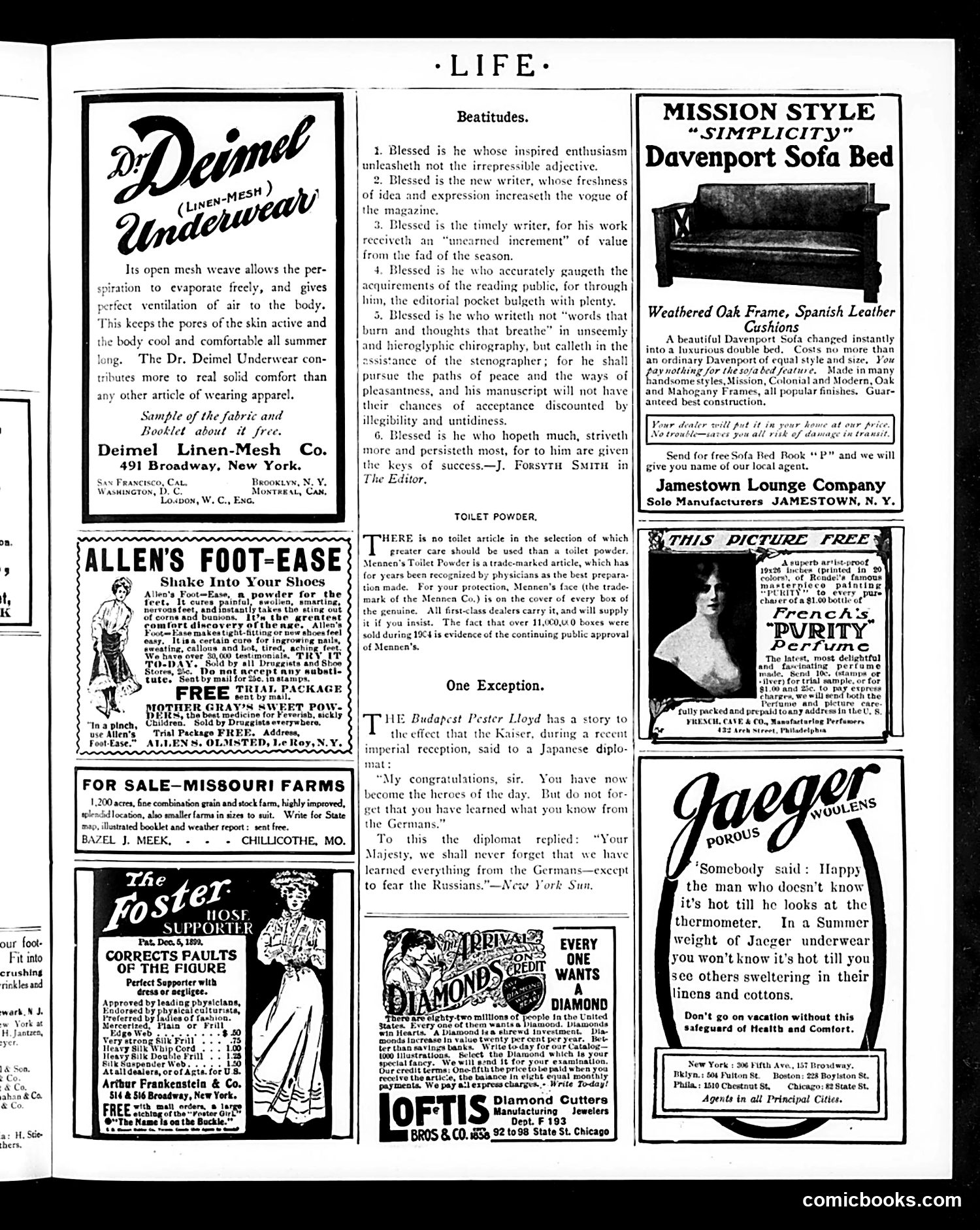
This page is primarily **advertising and editorial content** rather than political satire. The main pieces include: - **"Beatitudes"** by Forsyth Smith—a humorous essay blessing various types of writers (those with enthusiasm, fresh ideas, timely work, etc.), satirizing literary pretension. - **"Toilet Power"** and **"One Exception"**—brief humorous pieces about Mennen's Toilet Powder and a story involving the Kaiser and a Japanese diplomat, making light of international diplomacy. The page is dominated by **period advertisements** for underwear, foot powder, farms, hosiery supports, perfume, and diamond cutters—typical early 20th-century commercial content. There is **no significant political cartoon** on this page. The humor is mild and domestic rather than satirical commentary on current events.
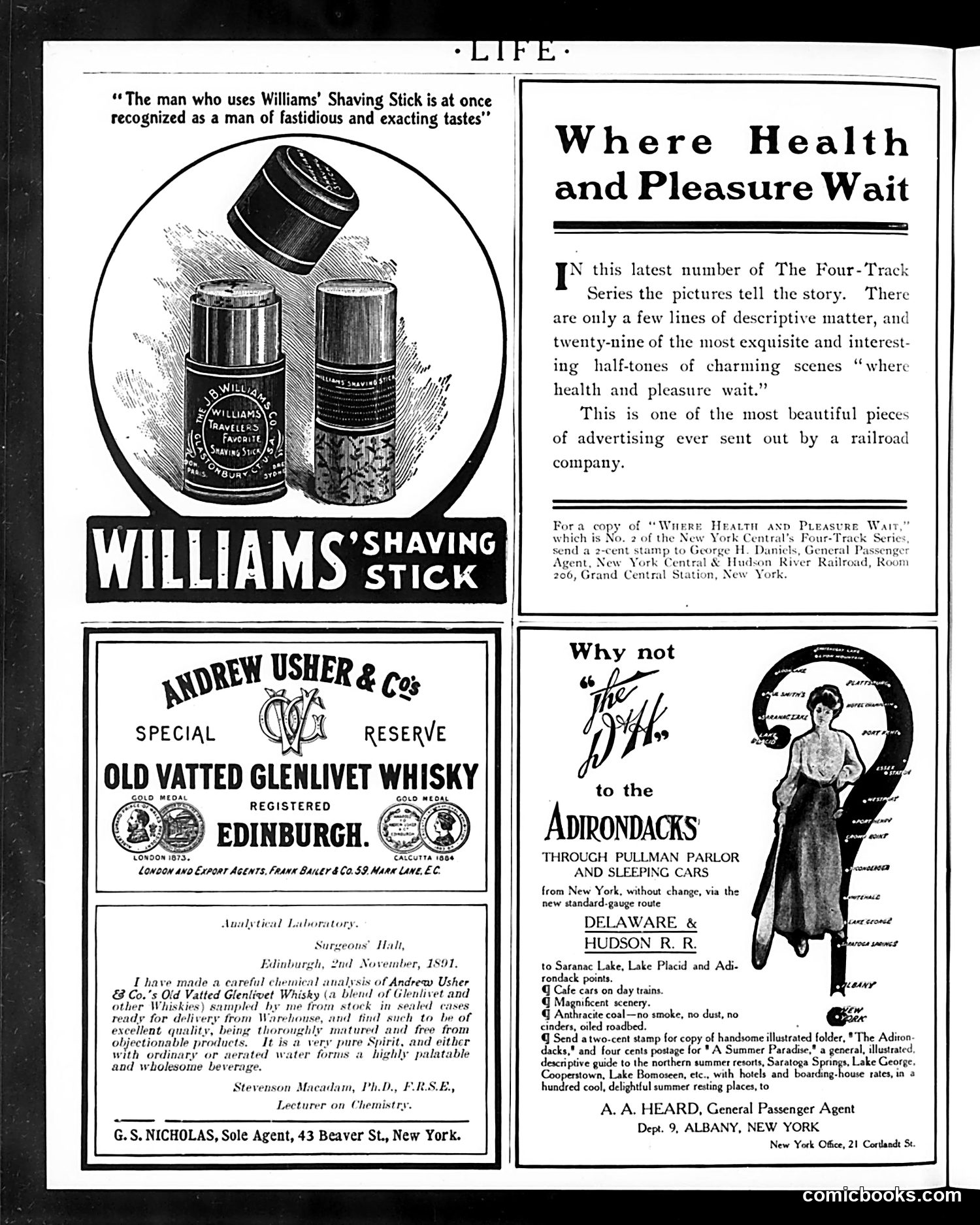
This page is primarily **advertising**, not satire or political cartoons. It contains four distinct ads: 1. **Williams' Shaving Stick** — uses a testimonial claiming the product signals refined taste and fastidious habits 2. **"Where Health and Pleasure Wait"** — promotes the New York Central's Four-Track Series No. 2, a railroad travel brochure featuring scenic photography 3. **Andrew Usher & Co's Old Vatted Glenlivet Whisky** — includes a chemical analysis testimonial from an Edinburgh chemist (dated 1891) endorsing purity 4. **Delaware & Hudson Railroad** — advertises Pullman service to the Adirondacks, emphasizing comfort amenities and clean coal-burning technology These ads reflect late-19th/early-20th-century consumer culture targeting affluent men: grooming products, luxury travel, quality spirits, and leisure destinations. The scientific testimonials and specific claims reflect marketing conventions of the era.
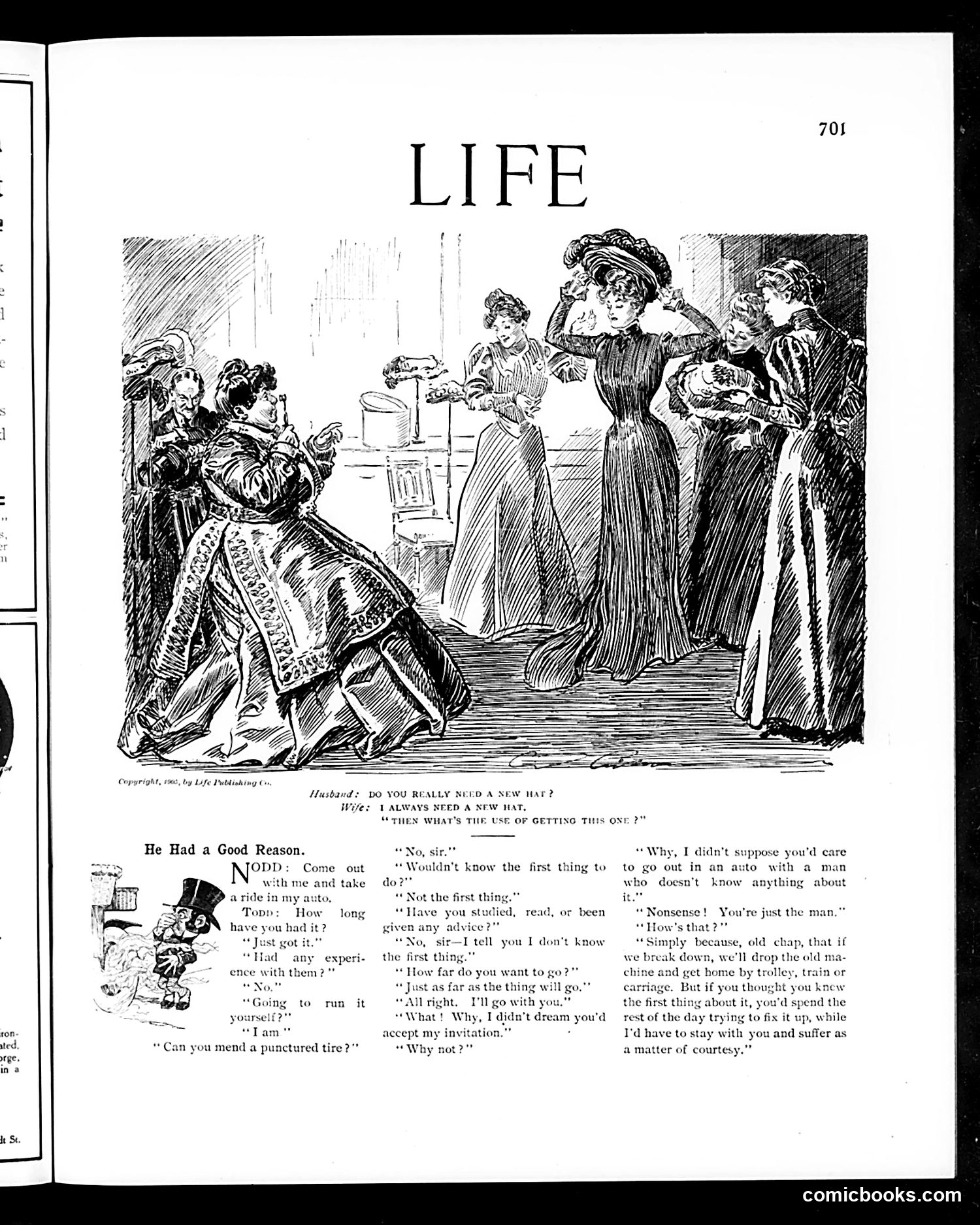
This page contains two related satirical pieces about early automobiles and gender roles. The upper cartoon depicts a social gathering where a husband asks his wife if she needs a new hat, to which she responds that she always needs one—then sarcastically asks what use getting a new hat is if she can't go out in an automobile. The lower section, "He Had a Good Reason," shows a conversation between a man and woman about automobile etiquette. The joke centers on the woman's complaint that the man doesn't know basic driving safety (handling a puncture tire), revealing anxieties about women's independence and competence with new automotive technology—a marker of early 20th-century social disruption.
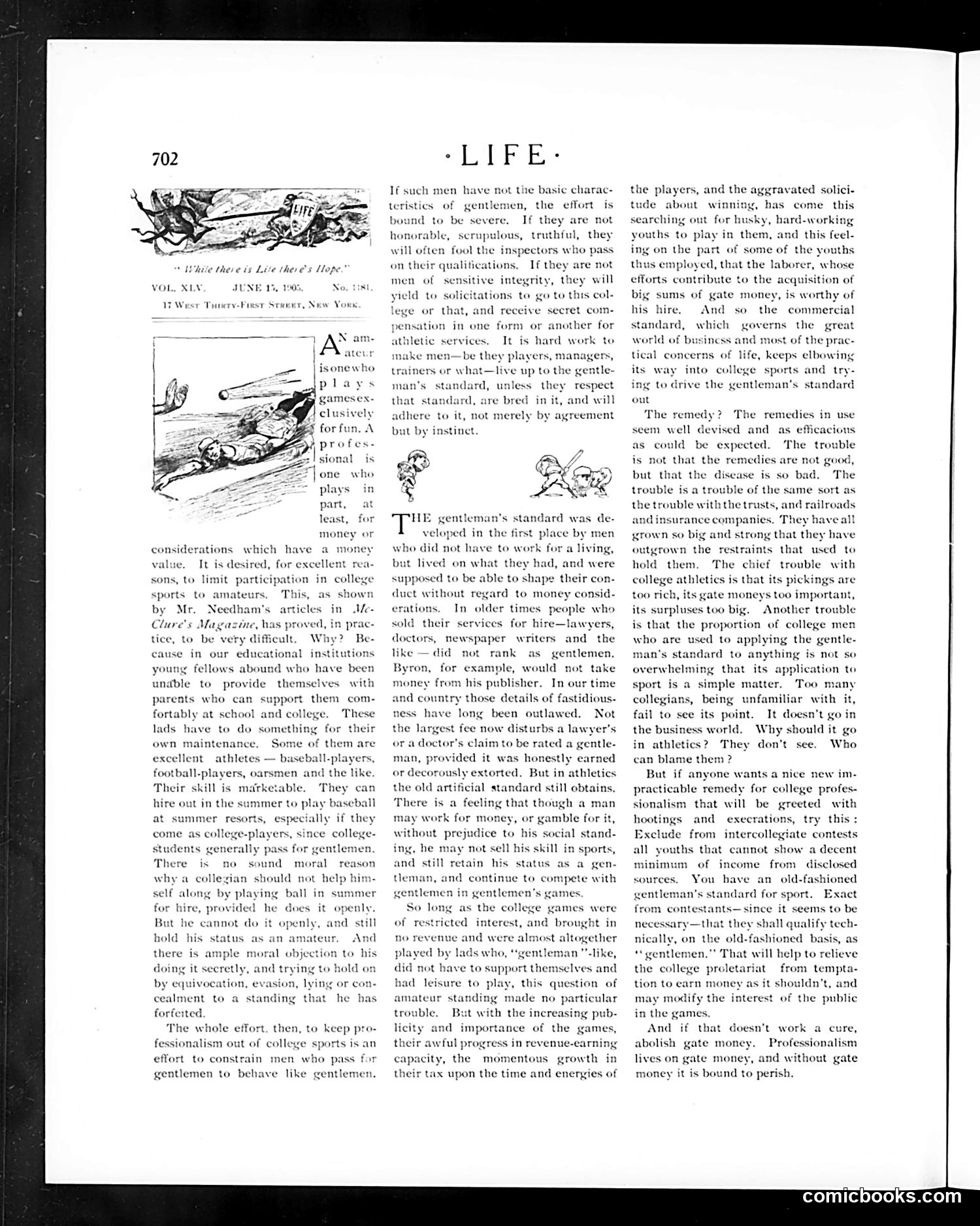
This page contains editorial commentary on college athletics and amateurism, not political cartoons. The small illustrations show athletes in action (baseball, football). The text argues that college sports have become corrupted by money and professionalism. The author criticizes: - Young men hired to play college sports who lack "gentlemanly" qualities - The breakdown of the amateur standard due to gate receipts and revenue pressure - College athletes who sell their skills like professional players rather than competing for honor - The contradiction between maintaining a "gentleman's standard" while professionalizing sports The piece advocates for restoring amateurism and gentlemanly conduct in college athletics, arguing professionalism inevitably corrupts student-athletes and institutional integrity. This reflects early 20th-century anxiety about commercialization of college sports.
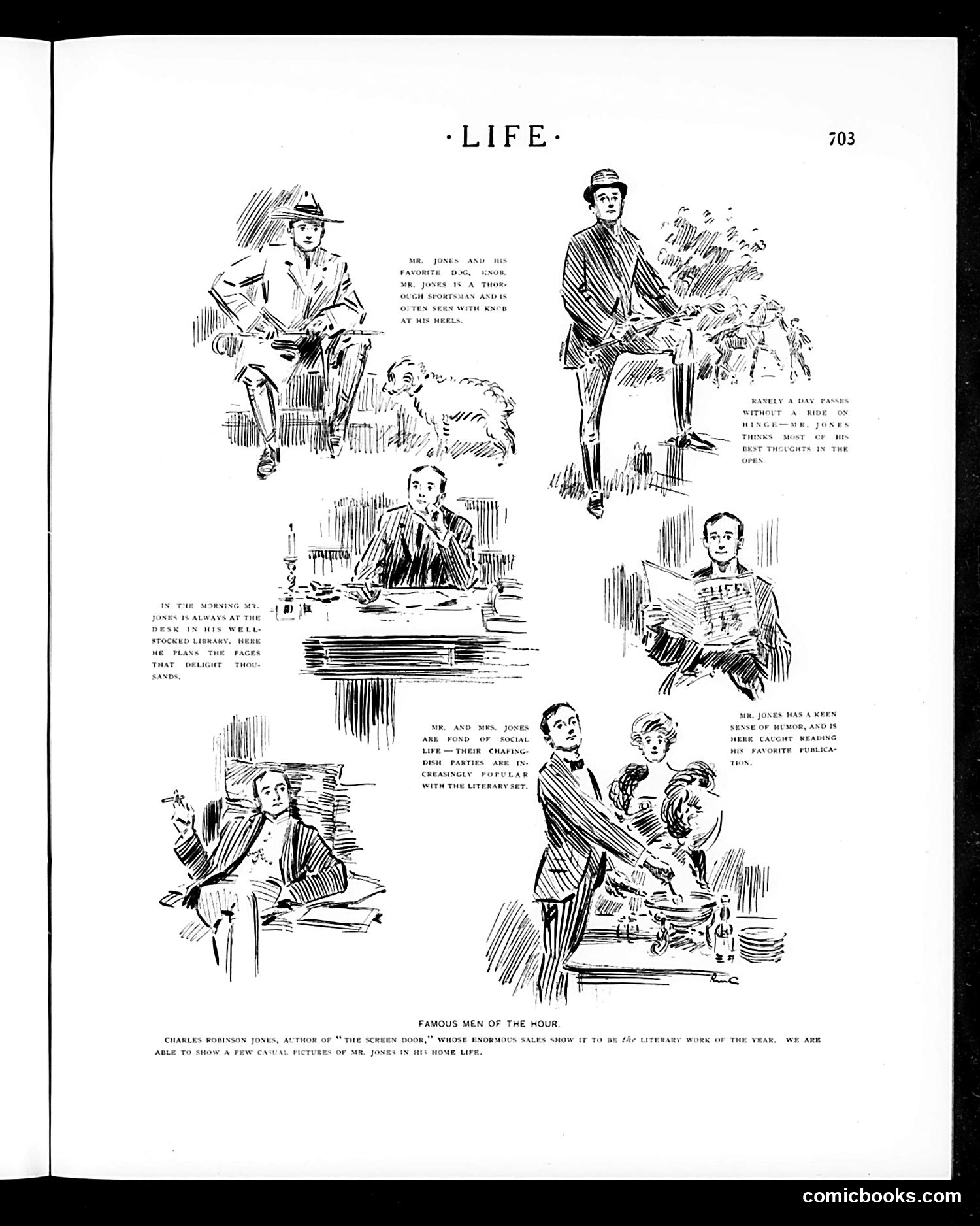
This page features a profile of **Charles Robinson Jones, author of "The Screen Door,"** whose book apparently achieved significant sales success as "the literary work of the year." The six illustrated vignettes humorously depict Jones's daily domestic life: 1. **Morning routine**: Jones reads at his desk, planning his day 2. **Outdoor recreation**: Jones rides with his dog, his preferred leisure activity 3. **Social life**: Jones attends fashionable parties popular with "the literary set" 4. **Reading habit**: Jones catches up on publications 5. **Private moments**: Jones relaxes with papers/writing materials 6. **Family time**: Jones entertains with children The satire gently mocks the pretensions of literary celebrity—presenting an ostensibly ordinary man whose mundane activities are now deemed worthy of public documentation simply because he wrote a commercially successful book.
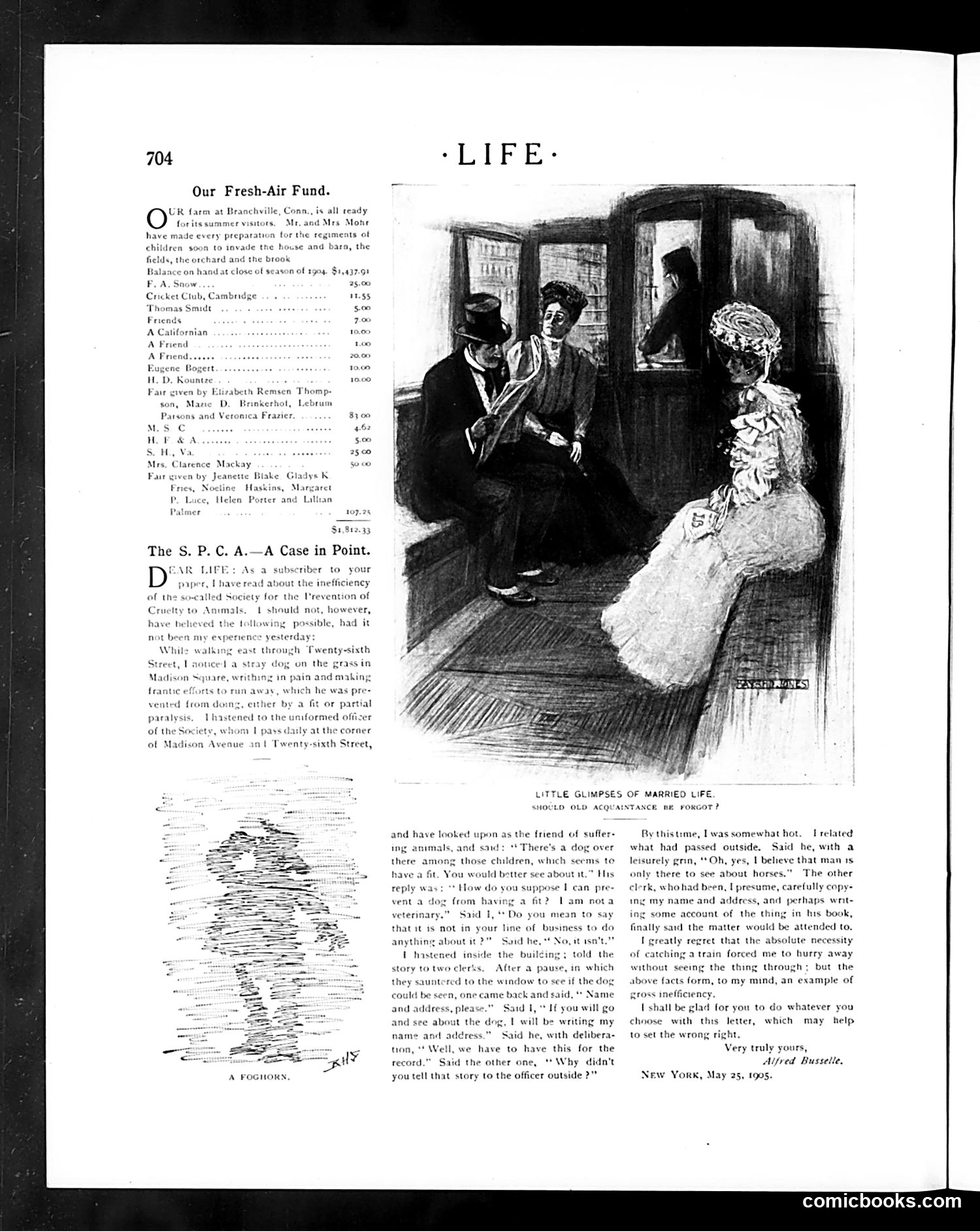
This page contains two distinct items: 1. **"Our Fresh-Air Fund"** (upper left): A fundraising list for a charitable program providing outdoor recreation for urban children, listing donors and amounts. 2. **"The S.P.C.A.—A Case in Point"** (main article with cartoon): A letter to *Life* magazine describing an incident where the writer witnessed a suffering stray dog in Madison Square. When the writer contacted the Society for the Prevention of Cruelty to Animals, officers were dismissive and unhelpful, offering excuses rather than assistance. 3. **"Little Glimpses of Married Life" (cartoon, upper right)**: A sketch satirizing married couples' social awkwardness, showing what appears to be an uncomfortable domestic scene. The S.P.C.A. letter critiques the organization's ineffectiveness and indifference to animal suffering, using a specific anecdote to make the satirical point that the society fails its stated mission.
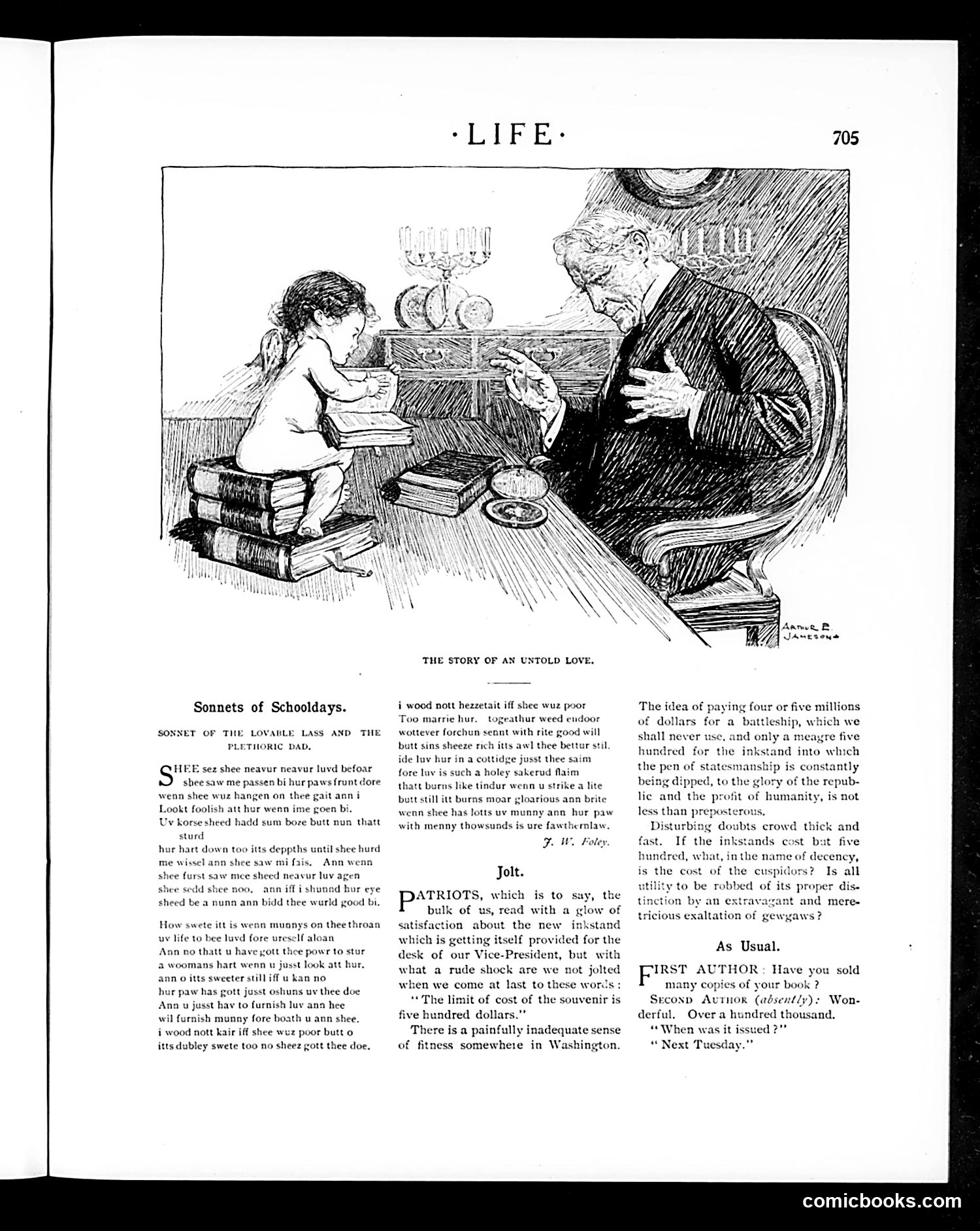
**Main Cartoon ("The Story of an Untold Love"):** The illustration depicts a wealthy older man in a chair facing a young woman sitting on books. This satirizes courtship motivated by money—the woman is literally elevated by stacks of books (representing education or social pretense), while the man's corpulent appearance suggests excess wealth. The joke targets gold-digging and transactional romance among the wealthy. **"Sonnets of Schooldays":** A deliberately misspelled, phonetically-written poem mocking sentimental love poetry. The humor lies in its crude grammar and its frank admission that romantic love is secondary to the woman's father's wealth and financial prospects ("will furnish munny fore boath u ann shee"). **"Jolt":** Political satire criticizing government waste. Congress approved a $500 souvenir inkstand for the Vice-President's desk while spending millions on battleships. The piece questions the absurd priorities and "fitness" of government spending—why spend $500 on an inkstand when warship costs dwarf it? **"As Usual":** A brief joke about publishing fraud: an author claims his book sold 100,000 copies, but admits it hasn't been released yet.
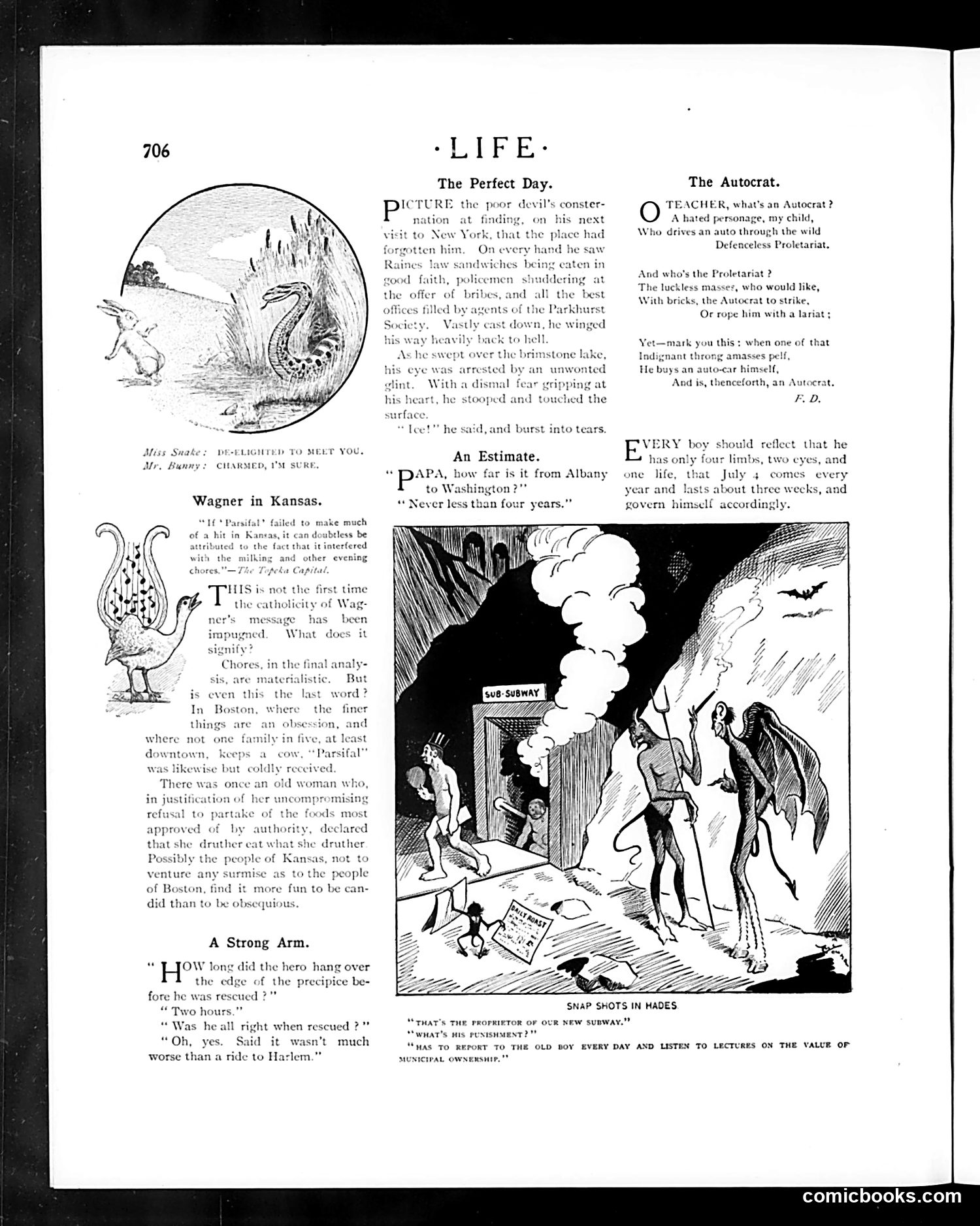
This page contains several satirical pieces mocking American society and politics circa early 1900s: **"Wagner in Kansas"** ridicules Catholic resistance to secular authority—specifically Kansas's rejection of high culture or "Wagnerian" sophistication. The joke suggests Boston Catholics were similarly obstinate about defying established rules. **"An Estimate"** is a political jab: the distance from Albany to Washington (state capitals) is "never less than four years"—meaning a presidential term. It suggests political/bureaucratic distance between New York and federal government. **"Snap Shots in Hades"** depicts the new subway's proprietor being punished in the afterlife for poor municipal management—a common complaint about subway construction chaos in early-1900s cities. **"The Autocrat"** uses a teacher-student dialogue to satirize class mobility: an autocrat is defined as someone who oppresses the poor, yet once a working-class person buys an automobile, he becomes an autocrat himself—mocking newly wealthy industrialists adopting authoritarian pretenses. The humor relies on contemporary references to urban infrastructure debates and class anxieties of the Progressive Era.
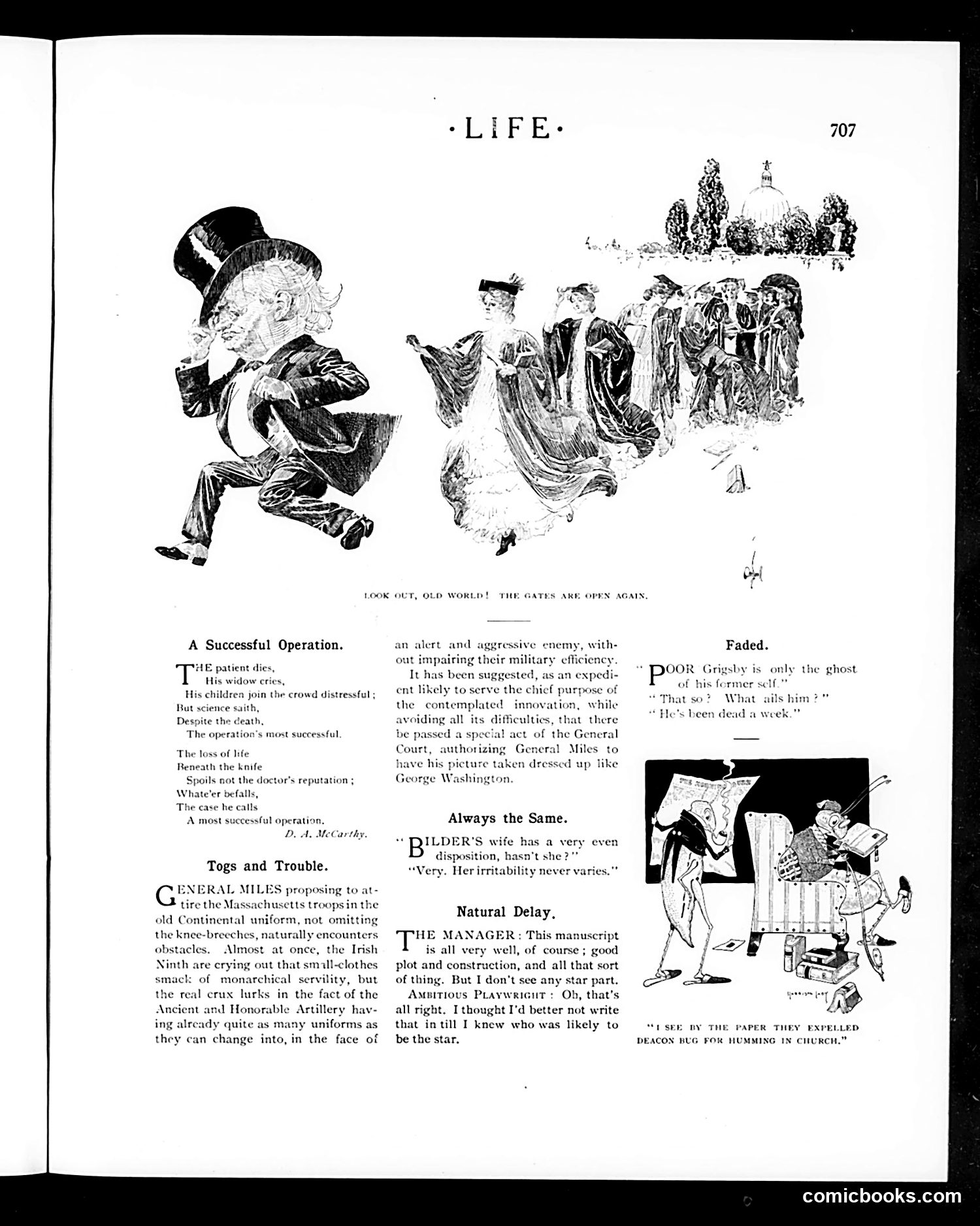
This page contains four separate satirical pieces typical of early 20th-century American humor: **"A Successful Operation"** mocks doctors who declare surgeries "successful" even when patients die—the operation succeeds while the patient fails. **"Togs and Trouble"** references General Miles's proposal to dress Massachusetts troops in Revolutionary War-era Continental uniforms, including knee-breeches. Irish regiments object on principle (seeing them as monarchical), while the Ancient and Honorable Artillery complains they already have too many uniforms to manage. **"Always the Same"** is a one-liner joke about a wife whose irritability is so consistent it's predictable. **"Natural Delay"** satirizes an ambitious playwright who won't write in a starring role until knowing which actor will play it—putting the cart before the horse. The cartoons mock military logistics, medical pretense, and theatrical practicality—standard targets of satire across any era.
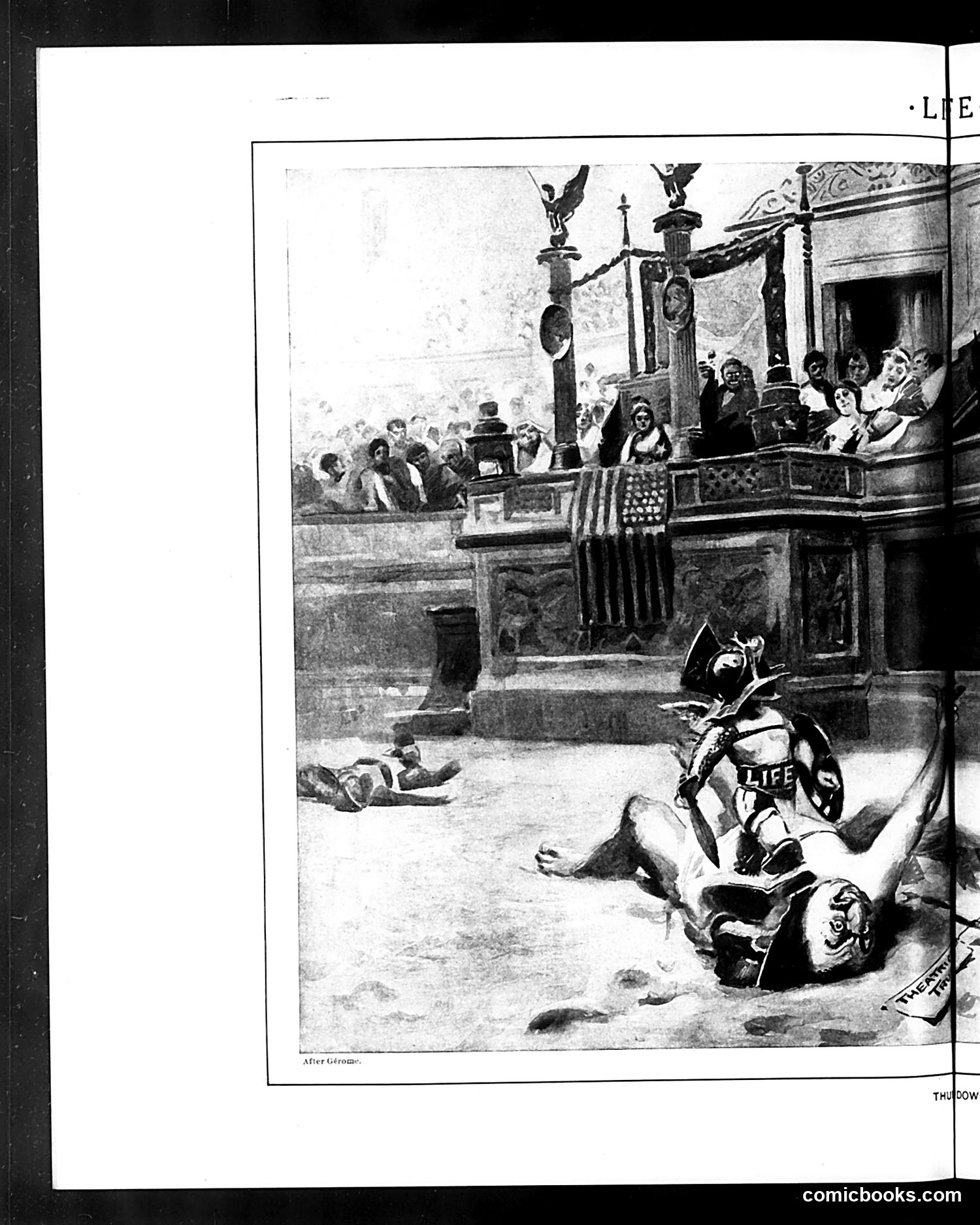
This appears to be a political cartoon from Life magazine depicting an execution scene. The image shows figures lying dead or dying in the foreground, while officials and spectators observe from an elevated platform decorated with an American flag. A personified figure labeled "LIFE" appears on the right side. The caption reads "After Germane" (or similar), though the exact reference is unclear from the visible text. The cartoon likely satirizes American capital punishment or a specific execution, using the contrast between official proceedings and human suffering. The presence of "LIFE" as a character suggests commentary on the irony or moral questions surrounding executions. Without clearer dating or additional context, I cannot identify the specific historical event referenced, though the style suggests early-to-mid 20th century American political cartooning.
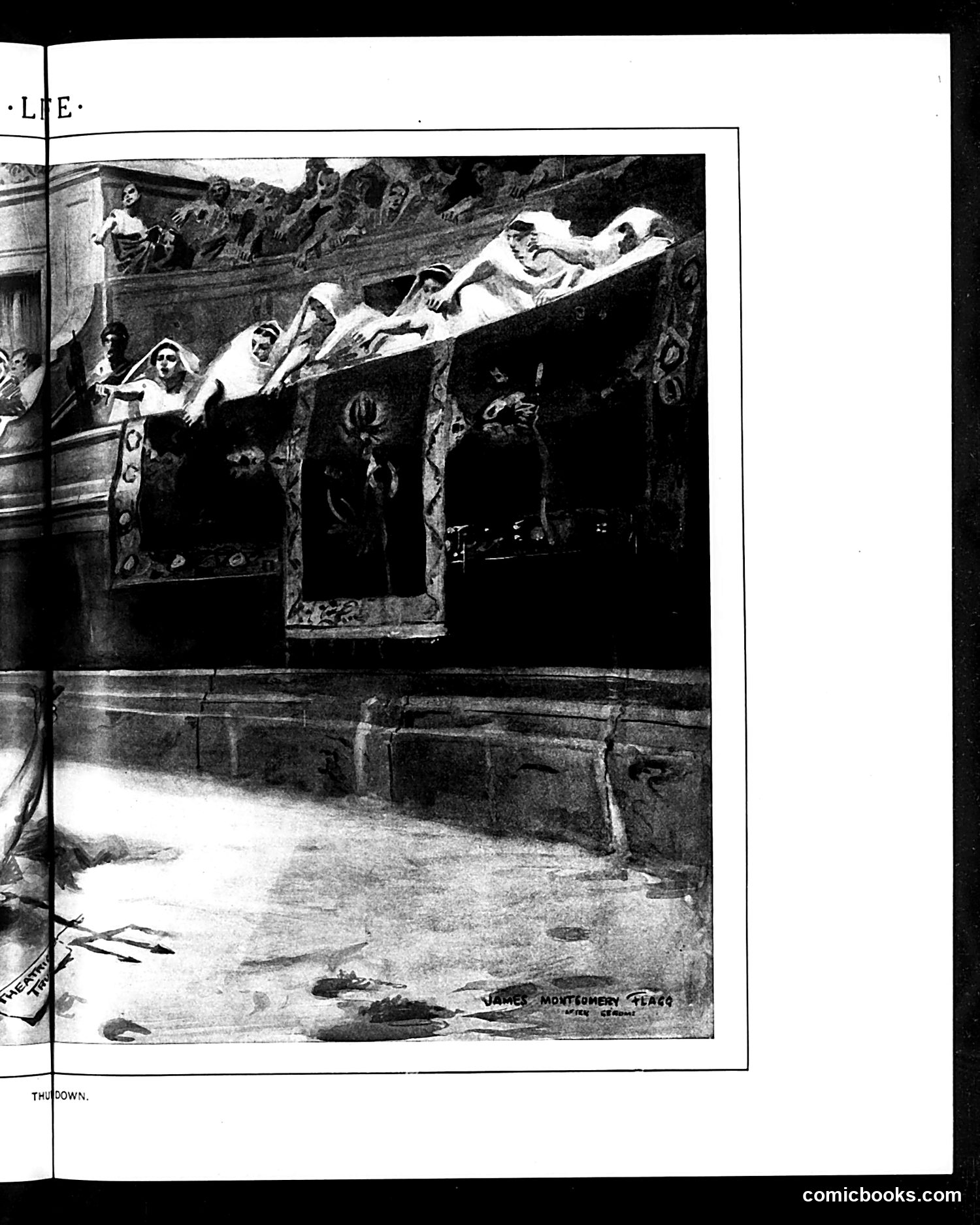
This appears to be a satirical illustration by James Montgomery Flagg showing figures in classical Roman dress positioned on what looks like a gladiatorial arena structure. The figures are depicted in a comedic, exaggerated style typical of early 20th-century political satire. The image likely references Roman history or classical themes as metaphor for contemporary American politics or society—a common satirical device in *Life* magazine. The architectural setting and the posed figures suggest commentary on public spectacle or entertainment, possibly critiquing how political or social figures were "performing" for public consumption. Without clearer text or publication date visible, the specific contemporary references remain unclear, though the classical framing suggests commentary on American power dynamics or public discourse of that era.
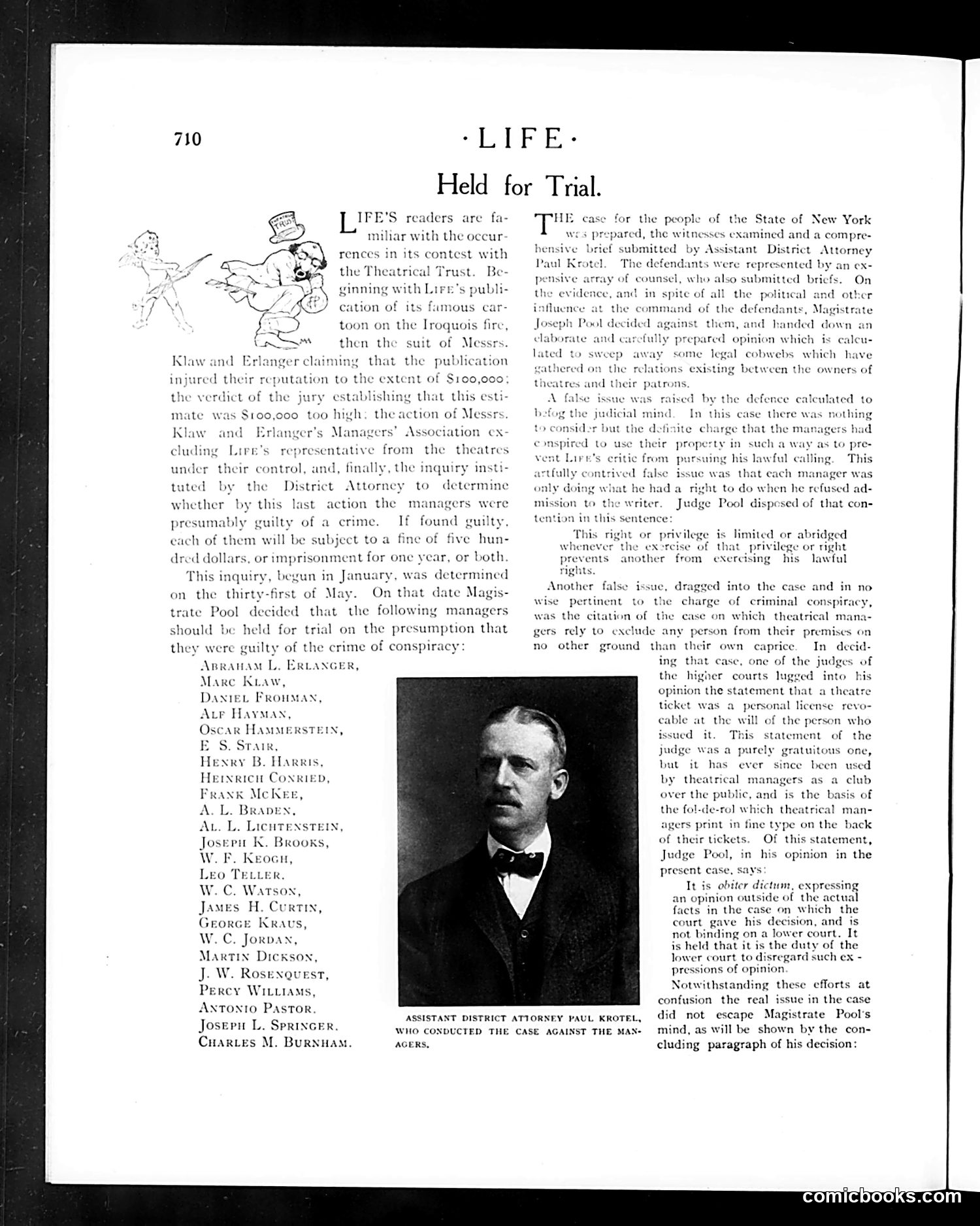
This page documents a legal case arising from Life magazine's conflict with theatrical moguls Abraham L. Erlanger and Marc Klaw. The cartoon in the upper left satirizes Klaw and Erlanger as comical, mischievous figures—likely referencing their role in the "Theatrical Trust," a monopoly controlling American theater distribution. The small inset photograph shows Assistant District Attorney Paul Krotel, who prosecuted the case. Life had published a famous cartoon about the Iroquois Theatre fire and subsequently sued by Klaw and Erlanger for allegedly damaging their reputations. The case escalated into a conspiracy investigation against theater managers (the list provided). Magistrate Pool determined they should stand trial, presumably for conspiring to monopolize theater access and exclude Life's representatives. Judge Pool's ruling reportedly challenged theater managers' standard claim that admission tickets were revocable "personal licenses," establishing instead that lower courts aren't bound by such opinions. The piece celebrates this legal victory against theater monopoly practices.
This page reports on Judge Pool's decision in a conspiracy case against theater managers. Twenty-four theater managers allegedly conspired to prevent Life magazine's critic from pursuing his livelihood by denying him access to theatrical venues—essentially blacklisting him. The article celebrates Judge Pool and Assistant District Attorney Krotel for prosecuting this "Theatrical Trust" conspiracy. Life argues the real question is simple: did these men combine to prevent a citizen from lawfully working? The text praises E.G. Gilmore, who managed the Academy of Music and courageously refused to vote with the conspiracy despite attendance at their meeting. Meanwhile, Sam S. Shubert (who recently died in a railroad accident) is absolved, having attended unwillingly under Trust pressure. The small cartoon showing an overloaded cart titled "SEEING NEW YORK" appears unrelated to the main story.
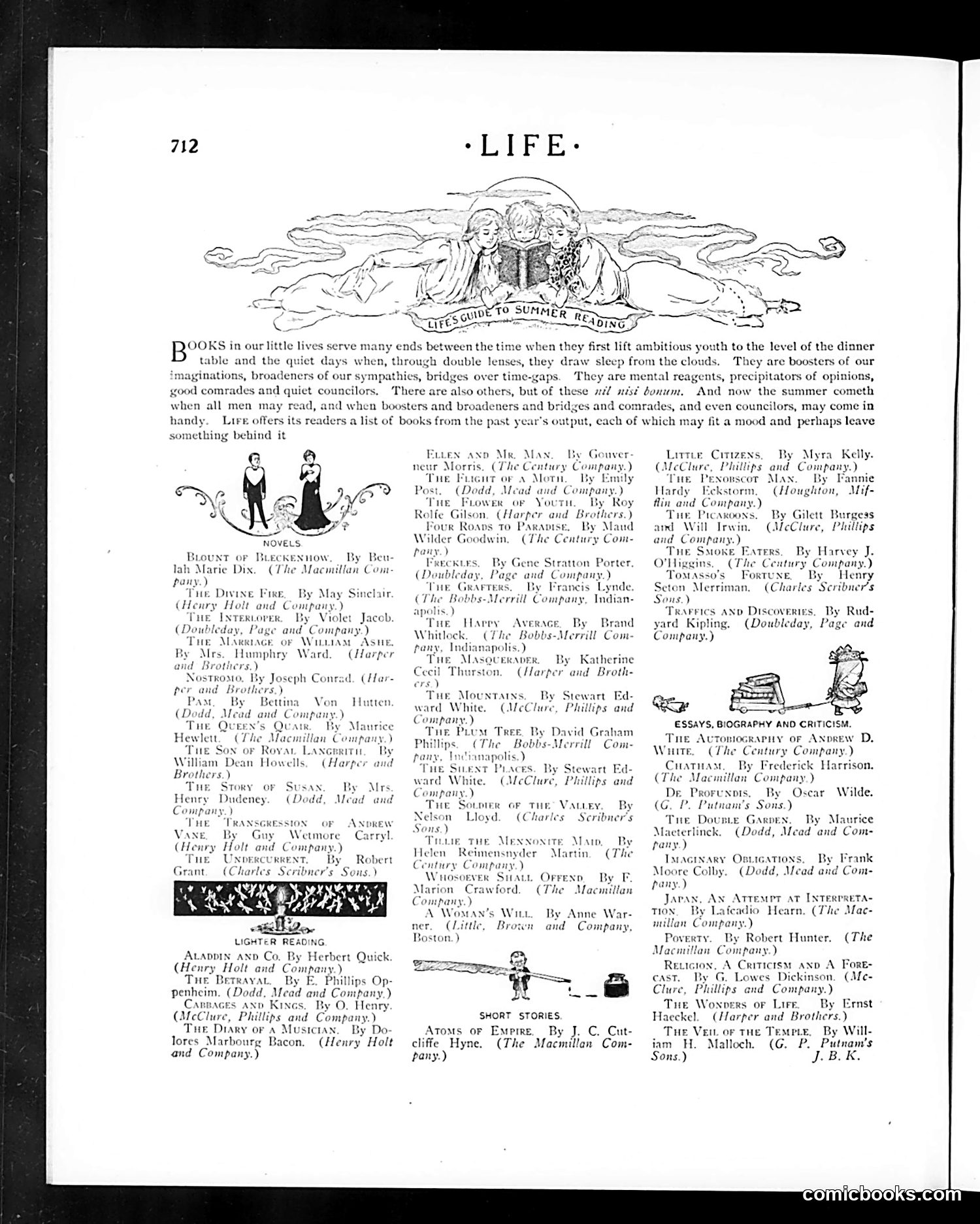
This page is primarily a **book recommendation list**, not a political cartoon. Life magazine's editors present summer reading selections organized by category: Novels, Lighter Reading, and Short Stories/Essays. The decorative header shows three figures reading beneath clouds—a visual metaphor for books as intellectual escape and enrichment. The introductory text frames books as "mental reagents" and "bridges over time-gaps," suggesting literature's value during leisure time. The list reflects early 1900s literary tastes, featuring authors like Joseph Conrad, Henry James, and Rudyard Kipling alongside now-forgotten names. Publishers like Harper, Doubleday, and Century Company dominate, indicating the publishing industry's consolidation. This serves as a **cultural artifact**: it shows what educated American audiences read for summer entertainment and self-improvement—a mixture of serious literature and "lighter reading" designed for various moods.
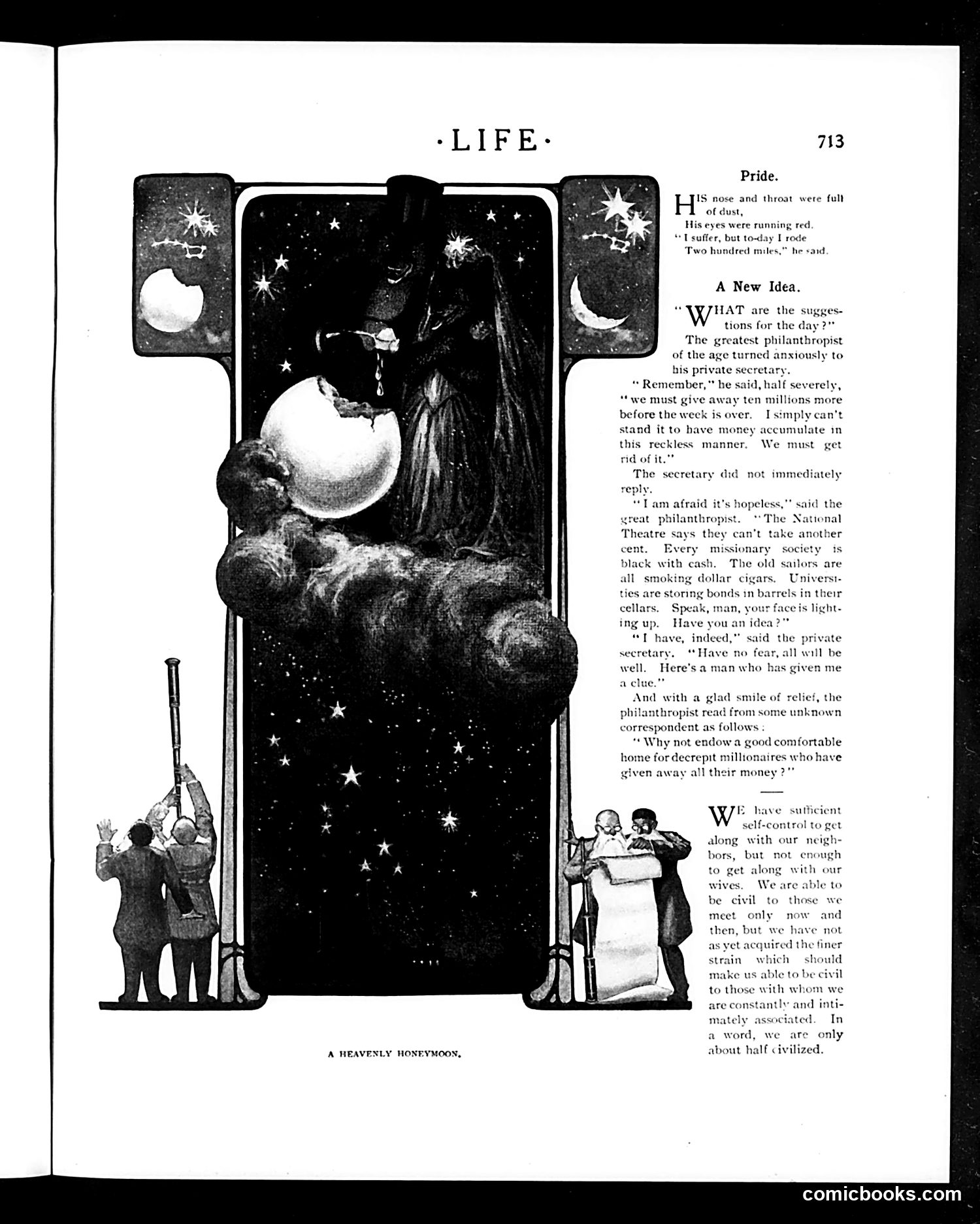
**The Main Cartoon ("A Heavenly Honeymoon"):** The central illustration depicts a couple on their honeymoon, gazing at the moon and stars in a romantic nighttime scene. The satire lies in the caption and the contrasting text on the right: while the image suggests romantic bliss, the accompanying story undermines it entirely. The husband brags about riding 200 miles despite exhaustion—prioritizing masculine achievement over romance. The joke satirizes how newlyweds, particularly men, fail to maintain civility and attention to their wives. The final text explicitly states couples lack "the finer strain" of civility needed for constant intimate association, suggesting marriages deteriorate quickly from their idealized "heavenly" beginnings. **"A New Idea":** A wealthy philanthropist struggles to give away money fast enough. A correspondent suggests endowing a home for "decrepit millionaires who have given away all their money"—satirizing the era's wealthy philanthropists (likely referencing figures like Andrew Carnegie) and the contradiction of their compulsive charitable giving despite personal excess. Both pieces mock 1910s-era attitudes toward wealth, romance, and social obligation.
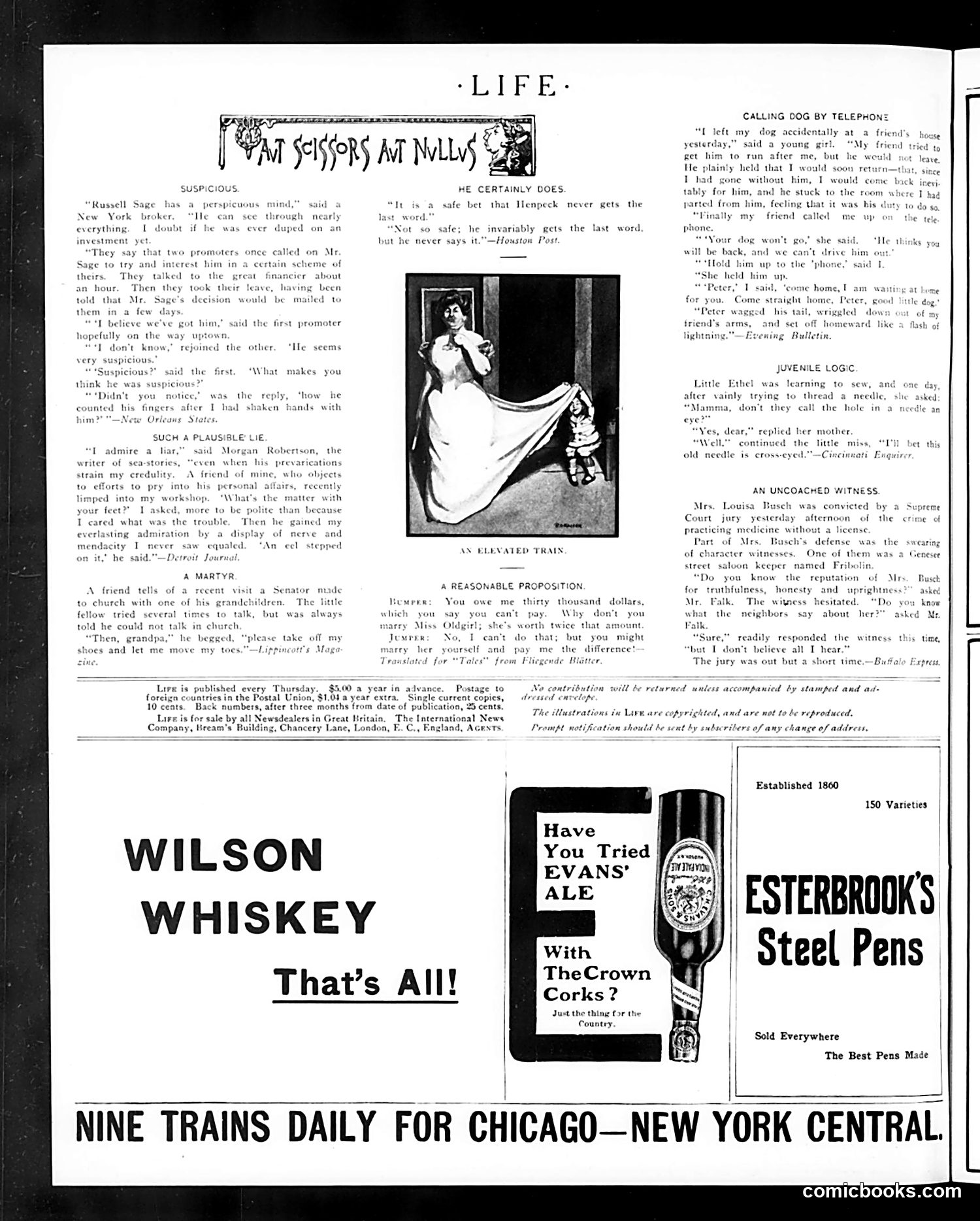
This page from *Life* magazine contains several humorous short anecdotes satirizing human behavior and social types of the era. **"Suspicious"** mocks gullible wealthy men (likely referencing the real financier Russell Sage) who are easily deceived by con artists and promoters. **"Such a Plausible Lie"** satirizes Morgan Robertson, a writer, for his tendency to invent elaborate stories that strain credulity—a commentary on blowhards and exaggerators in society. **"Certainly Does"** is a brief joke about henpecked husbands, suggesting men never win arguments with wives. **"A Martyr"** depicts a grandfather unable to speak in church because his grandchildren monopolize him, satirizing family dynamics and children's selfishness. **"A Reasonable Proposition"** mocks a suitor's calculation that marrying a woman twice costs the same as marrying her once. Other pieces include "Calling Dog by Telephone," "Juvenile Logic," and "An Uncoached Witness"—all depicting everyday absurdities and human folly through dialogue-based humor typical of *Life*'s satirical style.
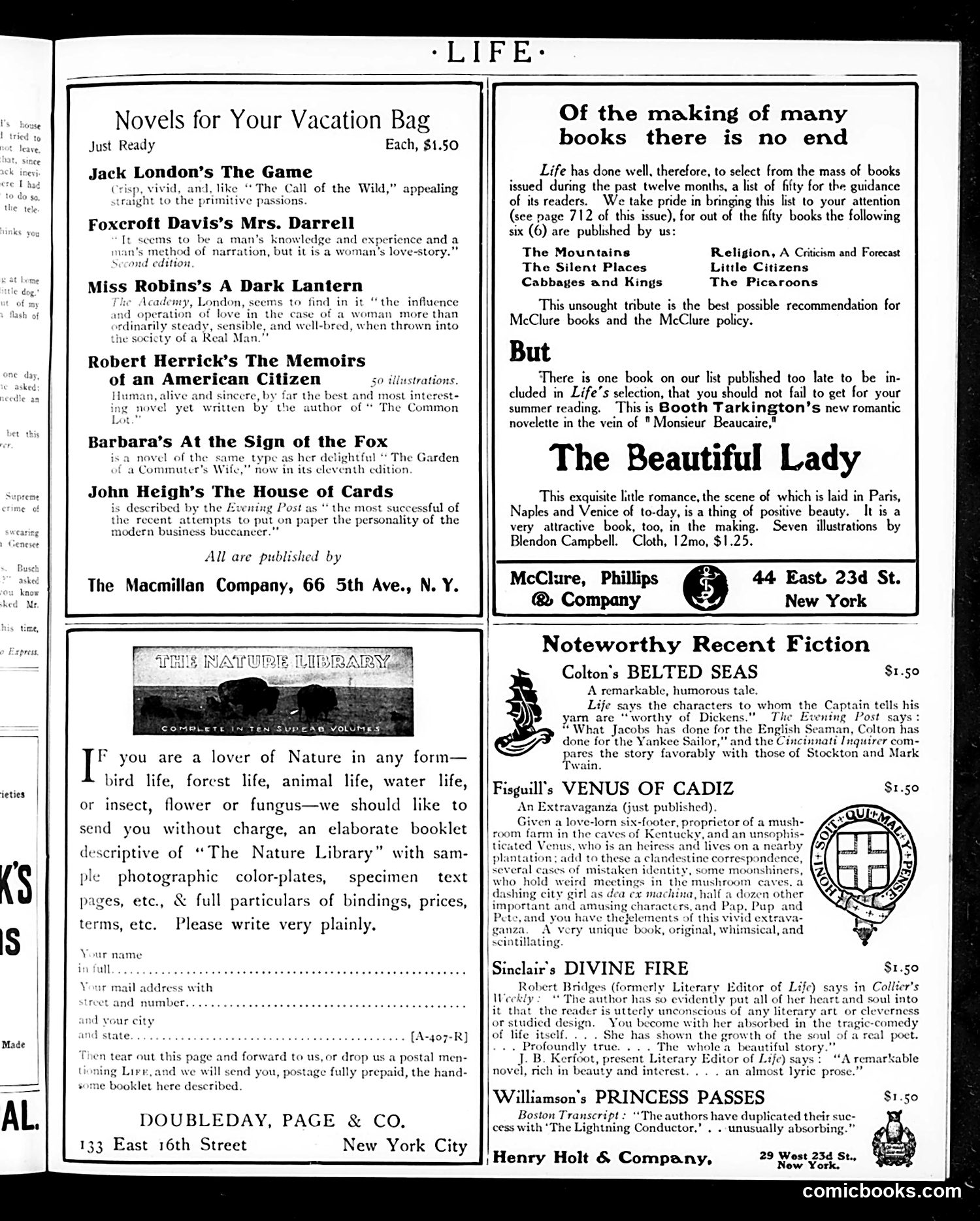
This is primarily a **book advertisement and review page**, not a political cartoon. It showcases novels recommended for summer vacation reading, circa early 1900s. The page highlights: **Left column**: Vacation novels ($1.50 each) by major authors—Jack London, Foxcroft Davis, Miss Robins—all published by Macmillan Company. **Right column**: Life magazine's curated list of fifty "noteworthy recent fiction," proudly noting six titles are published by Life's own McClure, Phillips & Company. They particularly promote Booth Tarkington's *The Beautiful Lady*, a romantic novella set in Paris and Venice. **Bottom section**: A free promotional offer for *The Nature Library*—an elaborate multi-volume set with color plates about wildlife and nature, distributed by Doubleday, Page & Co. The page reflects **Gilded Age publishing culture**: magazines functioned as both arbiters of literary taste and publishers themselves, using editorial content to promote their own books. The emphasis on "vacation reading" suggests leisure as a marker of middle-class respectability.
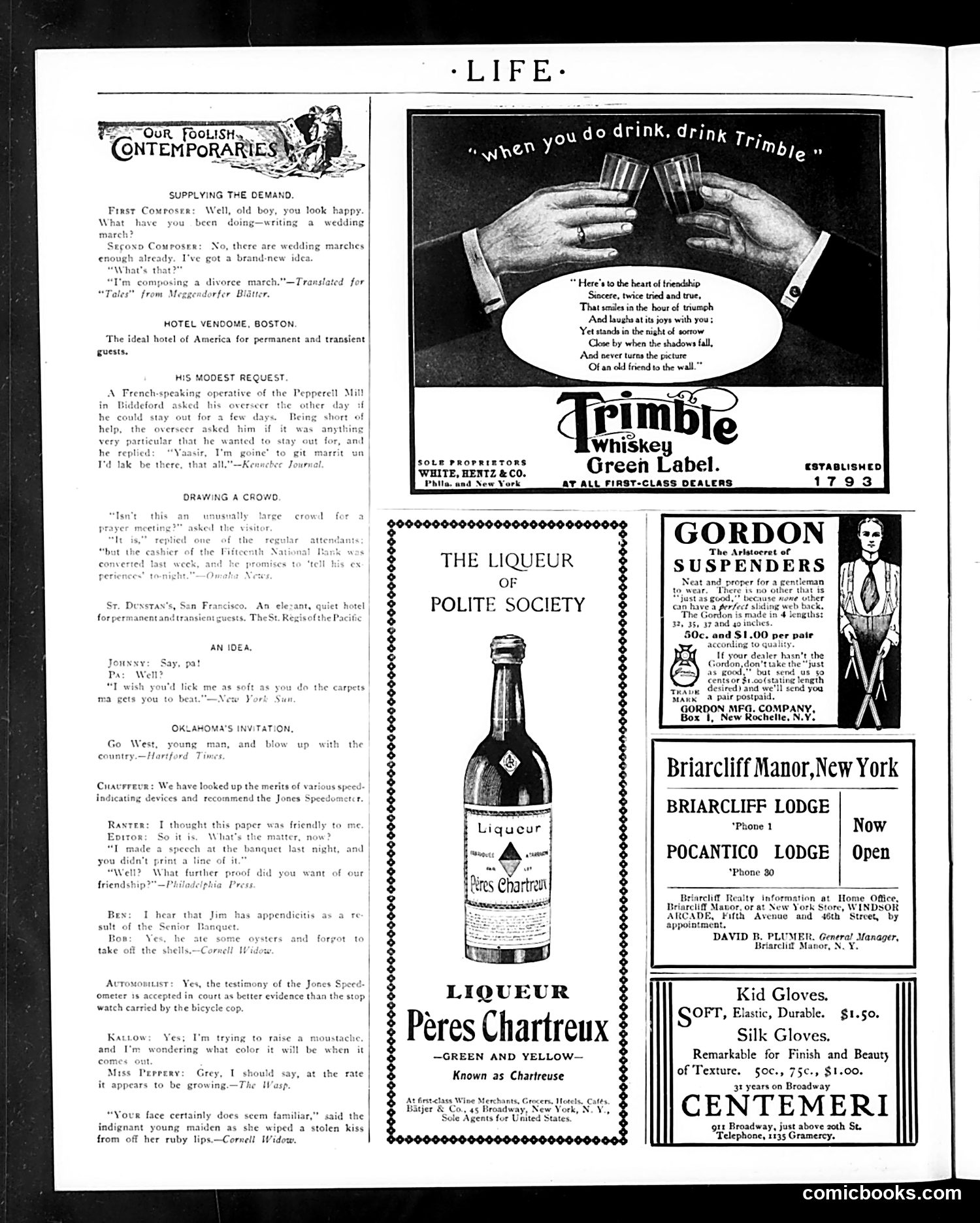
This page is primarily **advertising** with minimal satirical content. The left column contains brief humorous anecdotes titled "Our Foolish Contemporaries"—short jokes mocking various people's absurd statements or behaviors (a hotel guest's odd request, someone composing a "divorce march," etc.). The main visual content consists of **product advertisements**: Trimble Whiskey, Pères Chartreux liqueur, Gordon suspenders, Briarcliff Manor lodges, Kid Gloves, and Centemeri gloves. These ads are typical of early 20th-century magazine marketing. The Trimble ad features hands toasting with a sentimental poem about friendship—conventional advertising sentiment of the era. **For modern readers**: This demonstrates how Life mixed light satire with commercial advertising. The humor is gentle observational comedy about contemporary social pretensions rather than hard political satire. The product placement reflects the magazine's business model of advertising luxury goods to affluent readers.
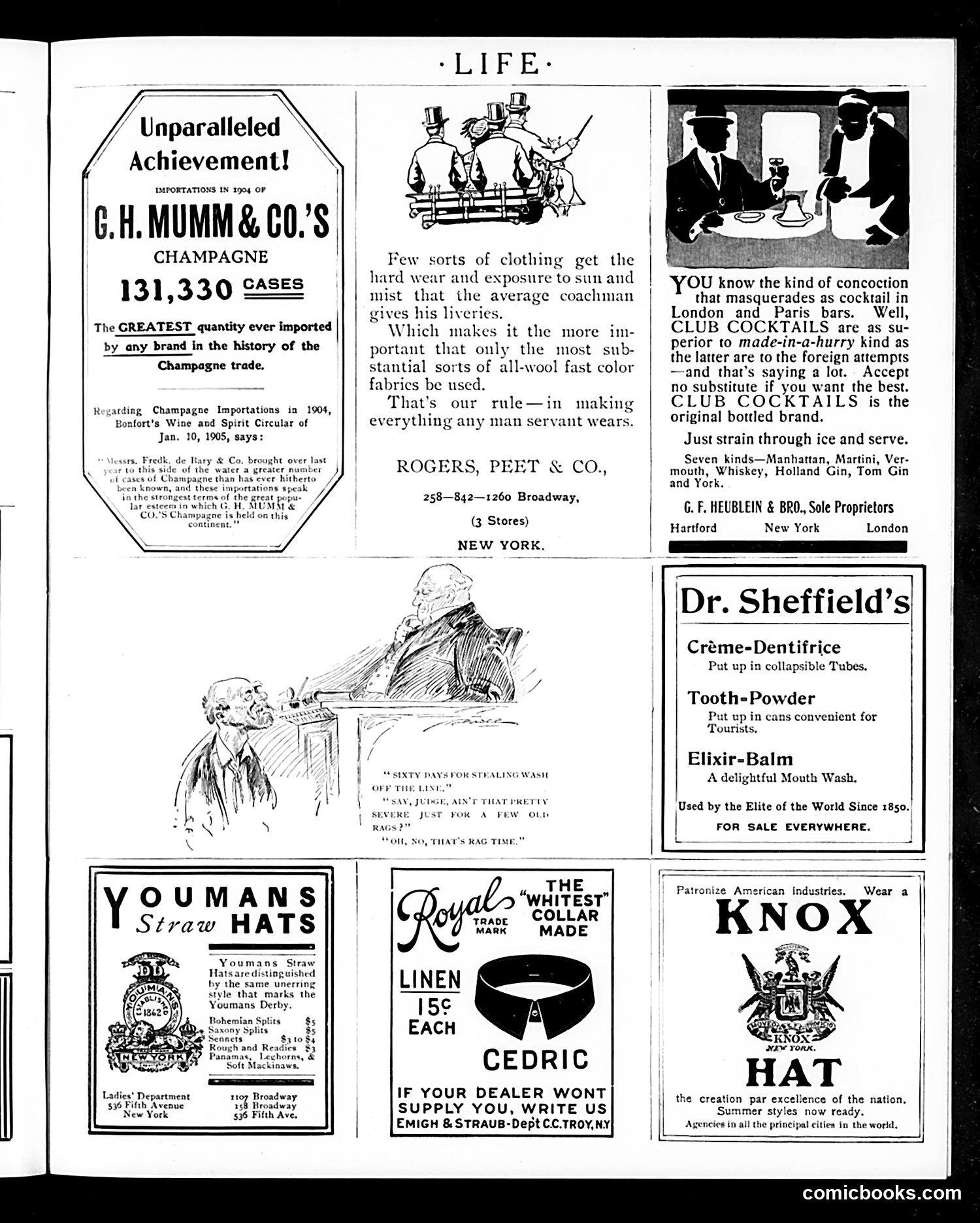
This page is primarily **advertising**, not political satire. It showcases luxury and consumer goods circa 1904-1905, targeting affluent American readers. The single cartoon depicts a judge sentencing someone, with the caption "SIXTY DAYS FOR STEALING WASH OFF THE LINE"—a mild joke about petty crime and laundry theft, not political commentary. The advertisements emphasize **class markers**: G.H. Mumm champagne (131,330 cases imported), Rogers Peet clothing for servants, Youmans straw hats, and Club Cocktails (presented as superior to European versions). These ads signal wealth and refined taste to readers. One notable advertisement reads "Patronize American industries"—suggesting early 20th-century economic nationalism or protectionism sentiment, though the page itself advertises foreign champagne. The humor is gentle and lifestyle-focused rather than satirical. This reflects Life magazine's role as sophisticated entertainment for the wealthy rather than hard-hitting social commentary.
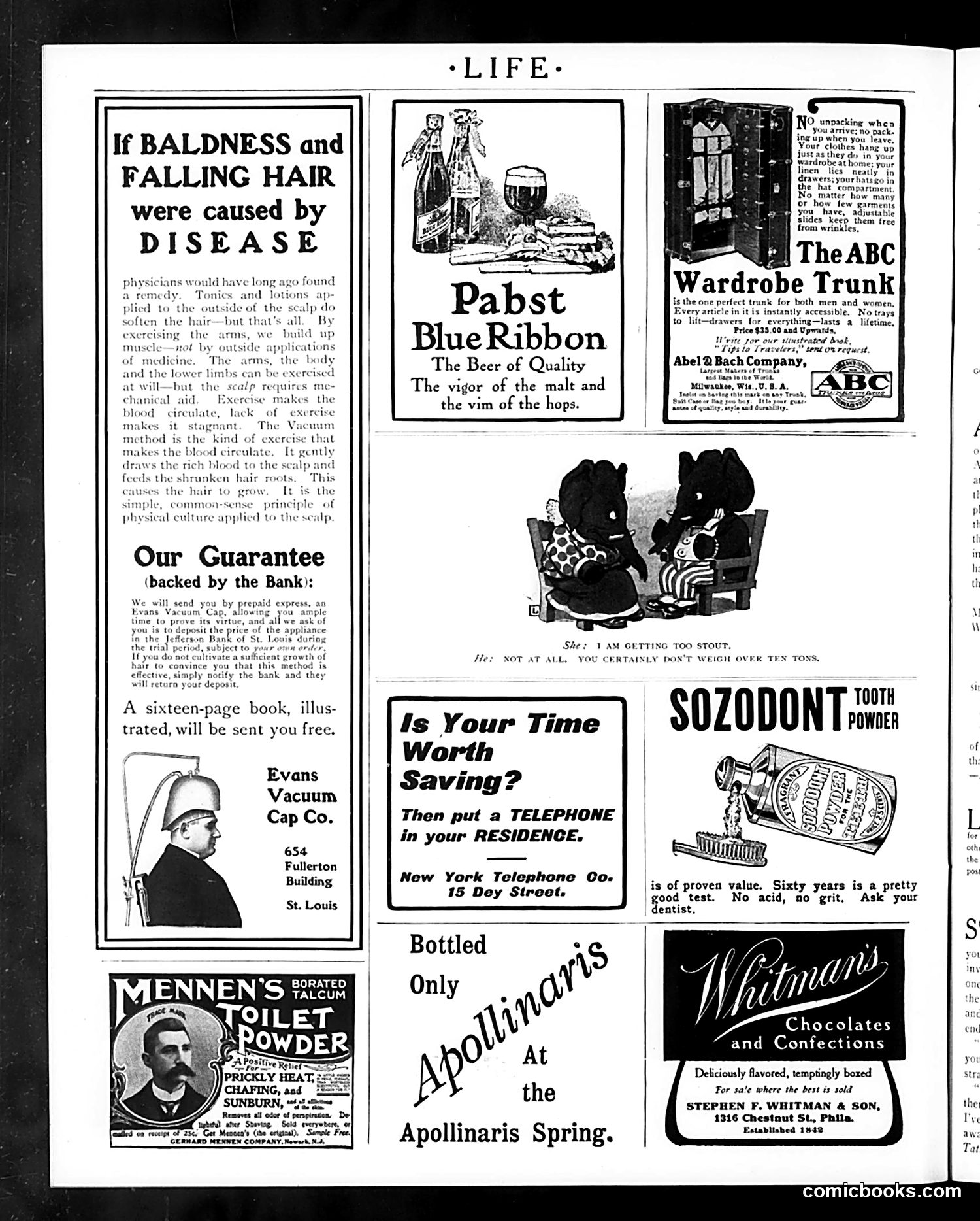
This is primarily an **advertising page** from an early 20th-century Life magazine, not political satire. The content consists of period product advertisements and one humorous illustration. The main cartoon depicts a couple where the woman says she's "getting too stout" (gaining weight), and the man reassures her by joking she doesn't weigh "over ten tons"—a crude compliment typical of the era's humor about female weight and appearance. The advertisements reveal historical consumer concerns: the Evans Vacuum Cap promises to cure baldness through "physical culture" (exercise); Pabst Blue Ribbon beer emphasizes quality; the ABC Wardrobe Trunk advertises luxury travel; Mennen's Talcum Powder and Sozodont toothpaste promote personal hygiene; and Whitman's Chocolates represents premium confections. These ads document early 1900s anxieties about health, grooming, and consumer status—revealing what people worried about and valued in that era.
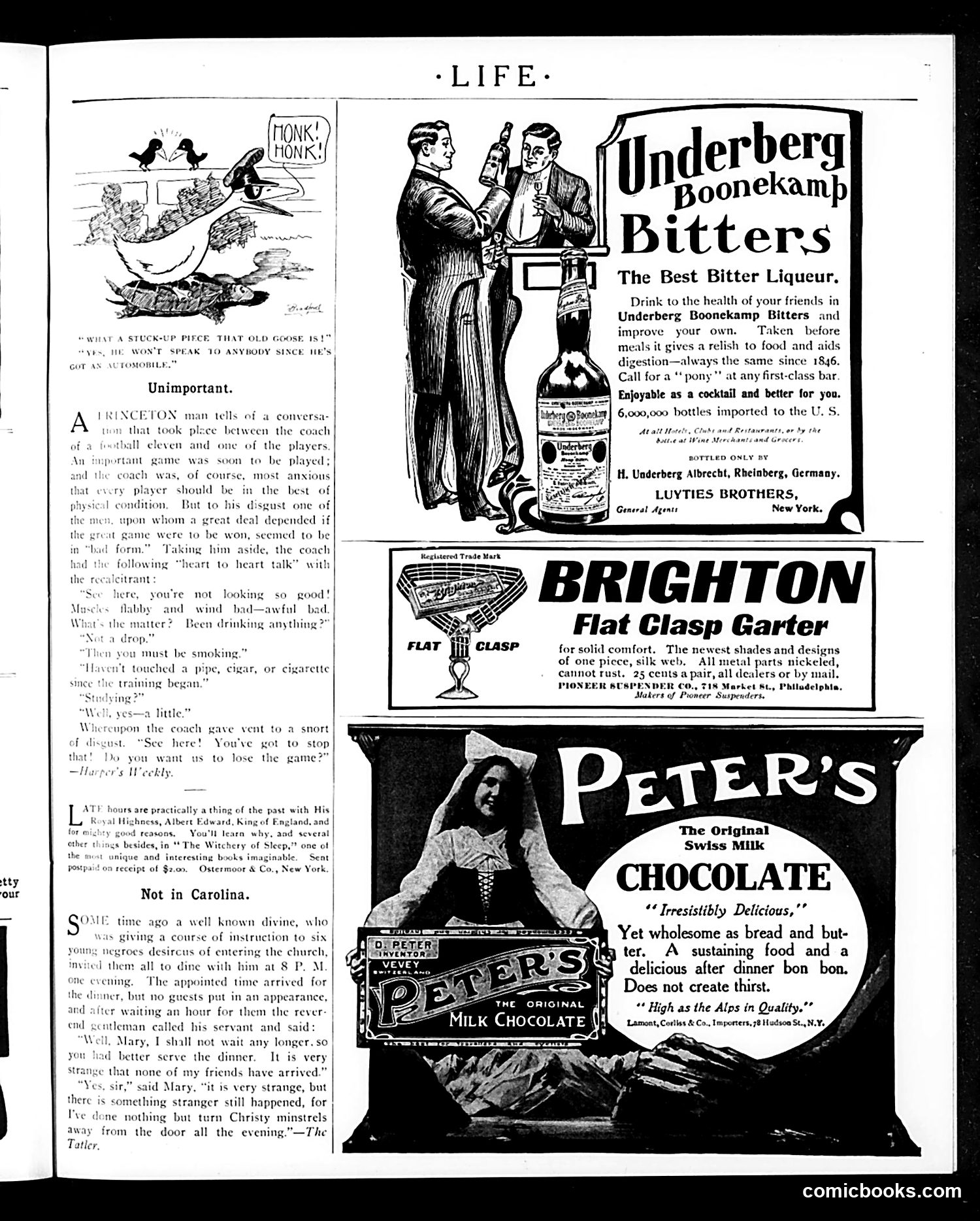
This page contains two unrelated humorous anecdotes separated by period advertisements. **Top cartoon**: A coach confronts a baseball player about poor performance. The joke hinges on the player's evasive answers—he claims he hasn't been drinking, smoking, or doing anything wrong. The coach's frustration builds until the punchline: the player admits to "yes—a little" when asked if he's been *smoking*. The satire mocks how athletes make excuses and how coaches must motivate players facing a crucial game. **"Not in Carolina" story**: A white minister invites six Black men he's instructing for the priesthood to dinner. They never arrive. His servant Mary reveals the real problem: she's been "turn[ing] Christy minstrels" away from the door all evening—implying the guests, being Black, were turned away by racist entertainment performers, or that such performances drove them away. The joke satirizes racial discrimination in the Jim Crow South. **Advertisements** dominate the right side: Underberg Bitters, Brighton garters, and Peter's Swiss Milk Chocolate—typical early 20th-century product placements.
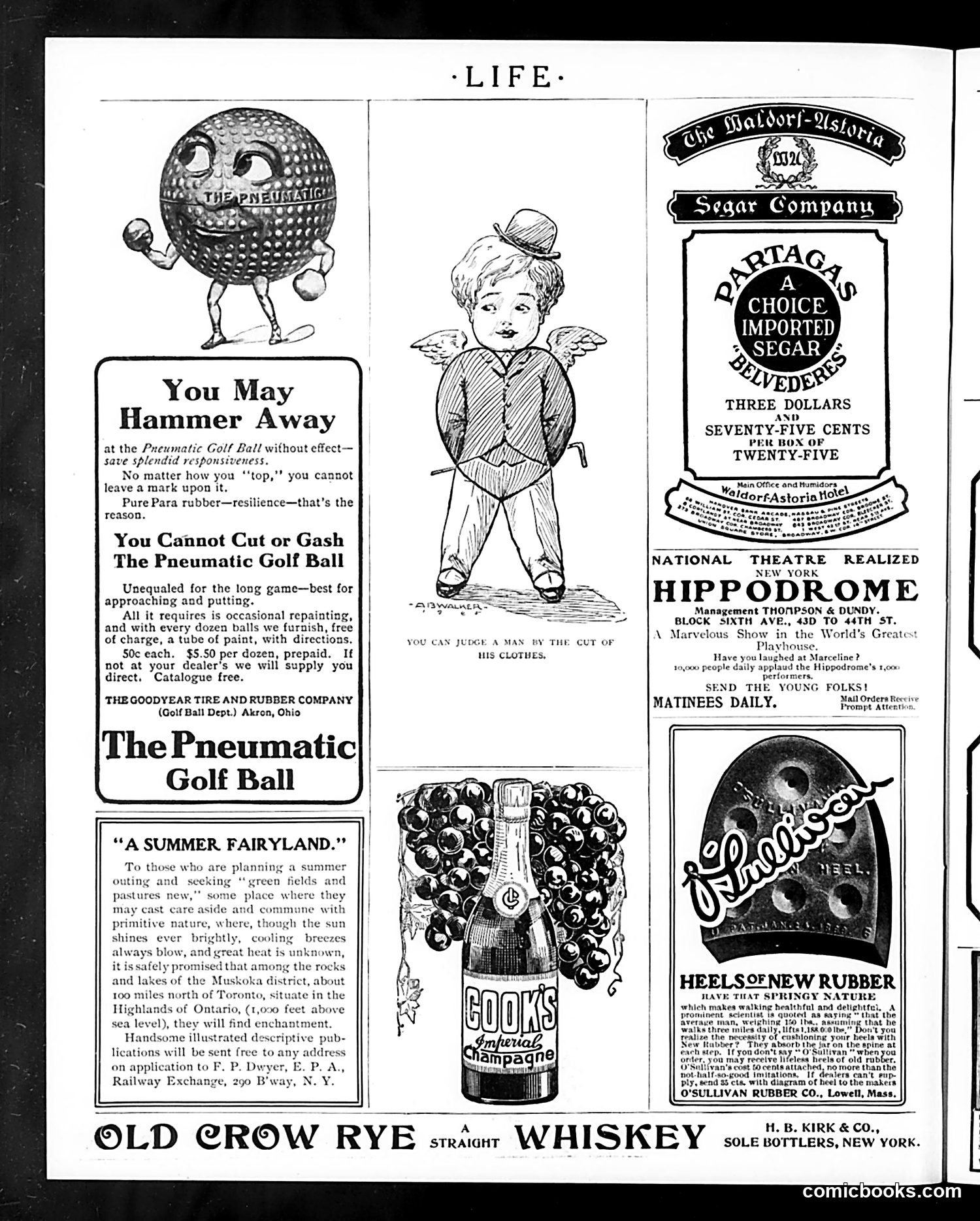
This page is primarily **advertising**, not political satire. It features product advertisements from early 20th-century America: **Main advertisements:** - **Pneumatic Golf Ball** (Goodyear): Emphasizes the ball's durability—it cannot be marked, cut, or gashed due to its rubber resilience. The cartoon shows a personified ball "hammering away" without damage. - **Partagas Cigars**: A luxury import priced at $3.75 per box. - **Hippodrome Theatre**: Promotes New York's largest playhouse with daily matinee performances. - **Cook's Imperial Champagne**: Featured with decorative grape imagery. - **O'Sullivan Rubber Heels**: Advertises springy rubber shoe heels as superior to competitors. - **Old Crow Rye Whiskey**: Straightforward liquor advertisement. **The central illustration** shows a cherubic child figure with wings captioned "You can judge a man by the cut of his clothes"—promoting quality apparel. The page reflects consumer culture and leisure activities of the era: golf, theater, fine spirits, and quality footwear for the affluent.
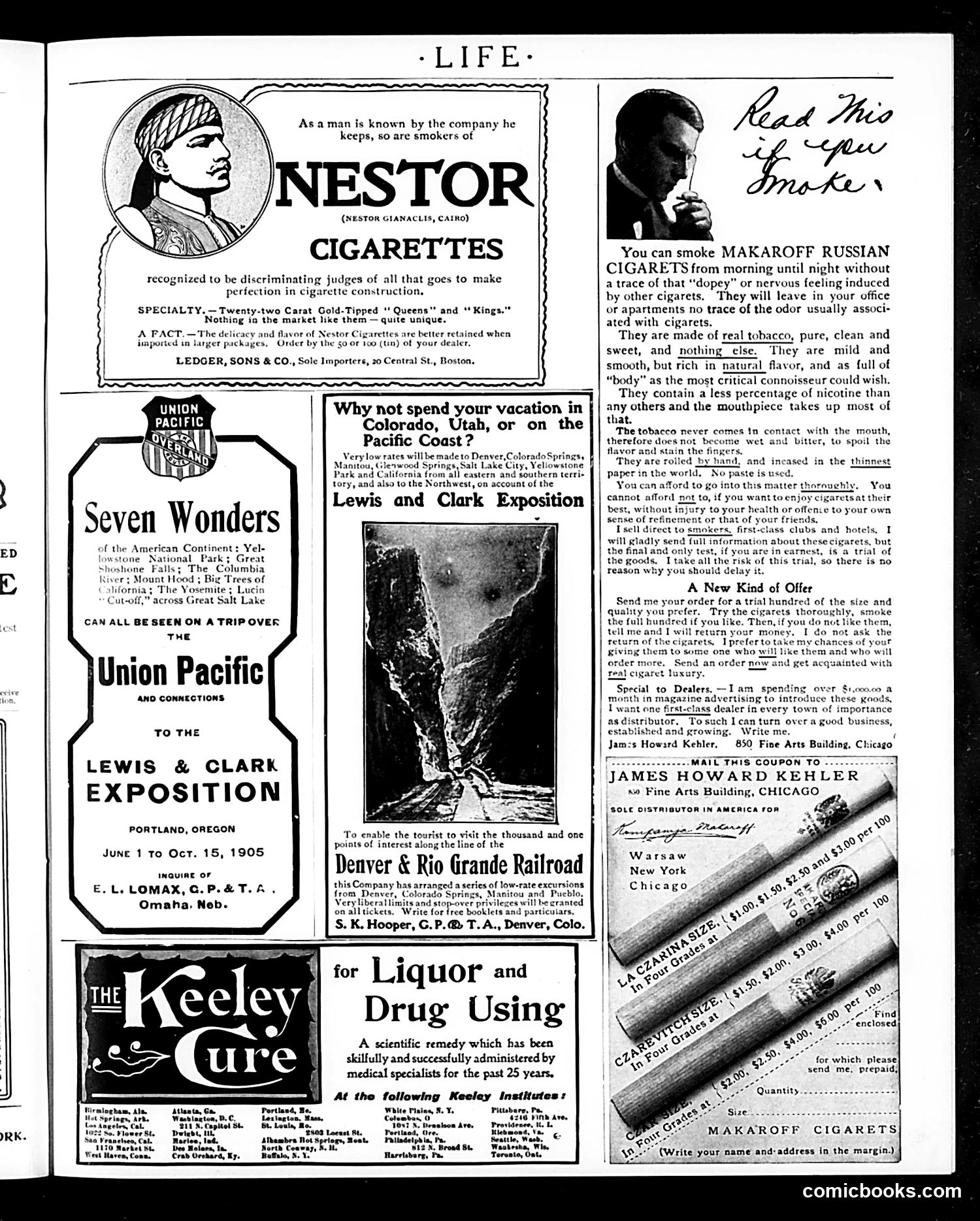
This page is primarily **advertising**, not satirical content. It contains multiple product advertisements rather than political cartoons. The main ads feature: 1. **Nestor Cigarettes** - emphasizing the brand's Egyptian origin and quality tobaccos 2. **Makaroff Russian Cigarettes** - claiming to lack nervousness-inducing "dopey" effects and leave no odor 3. **Union Pacific Railroad** - promoting vacation travel to Western attractions and the Lewis and Clark Exposition (Portland, Oregon, 1905) 4. **Denver & Rio Grande Railroad** - offering excursion rates 5. **Keeley Cure** - advertising treatment for "liquor and drug using" The cigarette ads are notable for their health claims—then-common marketing assertions that their products were superior, pure, and wouldn't cause undesirable effects. The Makaroff ad explicitly addresses nervousness concerns, suggesting contemporary awareness of tobacco's effects, even while promoting smoking. This reflects early-1900s advertising standards before modern regulations on health claims.
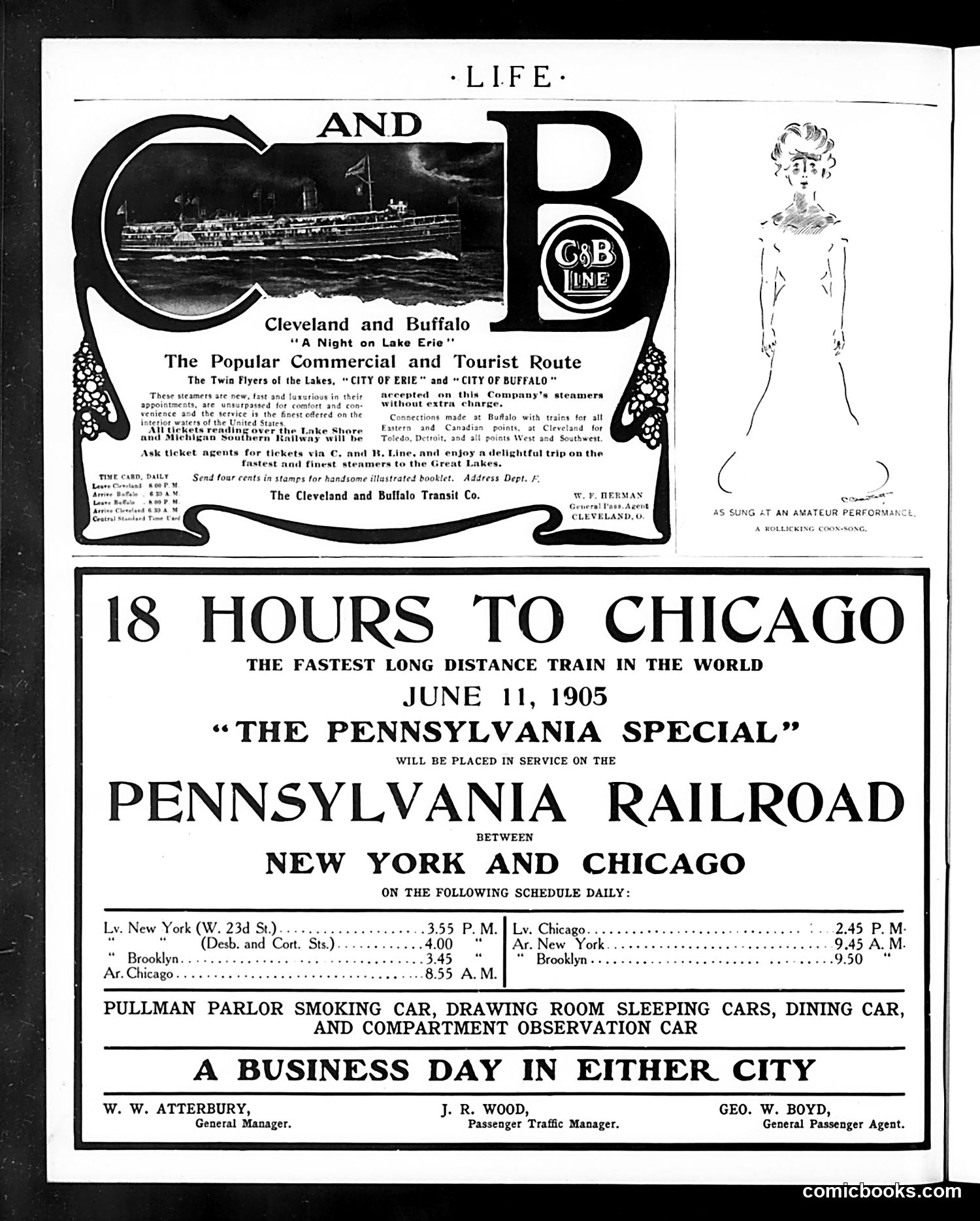
This page is primarily **advertising**, not satirical content. It contains two transportation advertisements from 1905: 1. **Top**: Cleveland and Buffalo Transit Company promotes steamship service on Lake Erie between Cleveland and Buffalo, featuring the twin vessels "City of Erie" and "City of Buffalo." The small illustration on the right depicts a woman singing "a rollicking coon-song"—a reference to **minstrel entertainment**, popular in early 1900s America. This reflects the period's casual racism in entertainment marketing. 2. **Bottom**: Pennsylvania Railroad advertises "The Pennsylvania Special," claiming it's "the fastest long distance train in the world" at 18 hours New York-to-Chicago. The ad emphasizes luxury amenities (Pullman cars, dining car, observation car) and highlights that passengers can conduct "a business day in either city"—appealing to businessmen's efficiency concerns. Both ads reflect turn-of-the-century transportation competition and the era's emphasis on speed and comfort for commercial travelers.
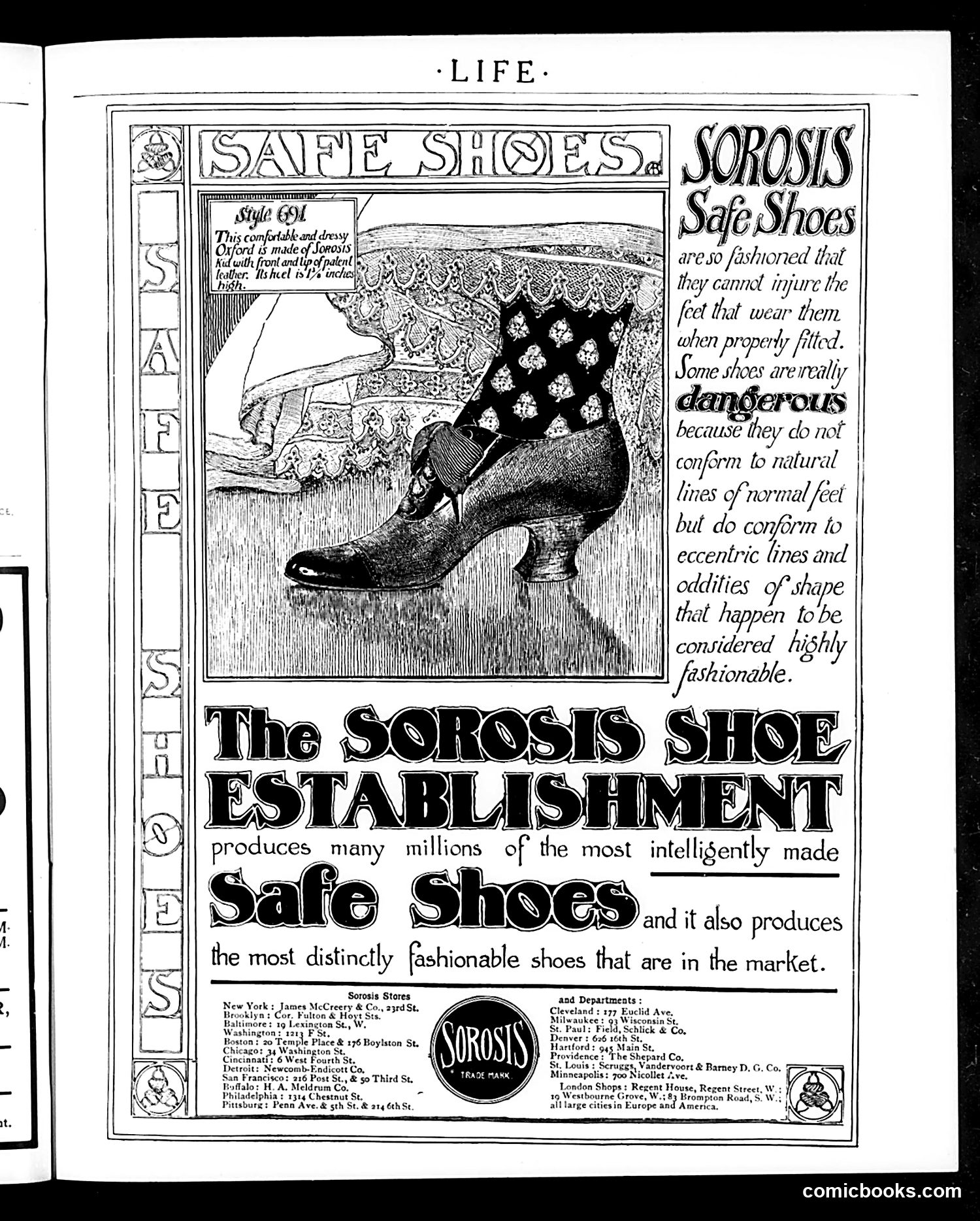
This is primarily a **product advertisement**, not political satire. It's a full-page ad for Sorosis Safe Shoes from an early 20th-century *Life* magazine. The illustration shows a fashionable women's shoe with decorative lace trim and a curved heel. The ad's rhetorical strategy works by **contrasting safety with fashion**: the text acknowledges that some "dangerous" shoes prioritize eccentric style over natural foot anatomy, but claims Sorosis shoes uniquely combine both virtues—they're safe *and* fashionable. This reflects genuine contemporary concerns about women's footwear. High heels and tight shoes were medically criticized in this era, yet women wanted fashionable appearance. Sorosis's pitch: they've solved this problem. The decorative border and prominent branding suggest this was a prestigious, expensive brand targeting affluent women. The ad lists numerous Sorosis retail locations across major American cities.
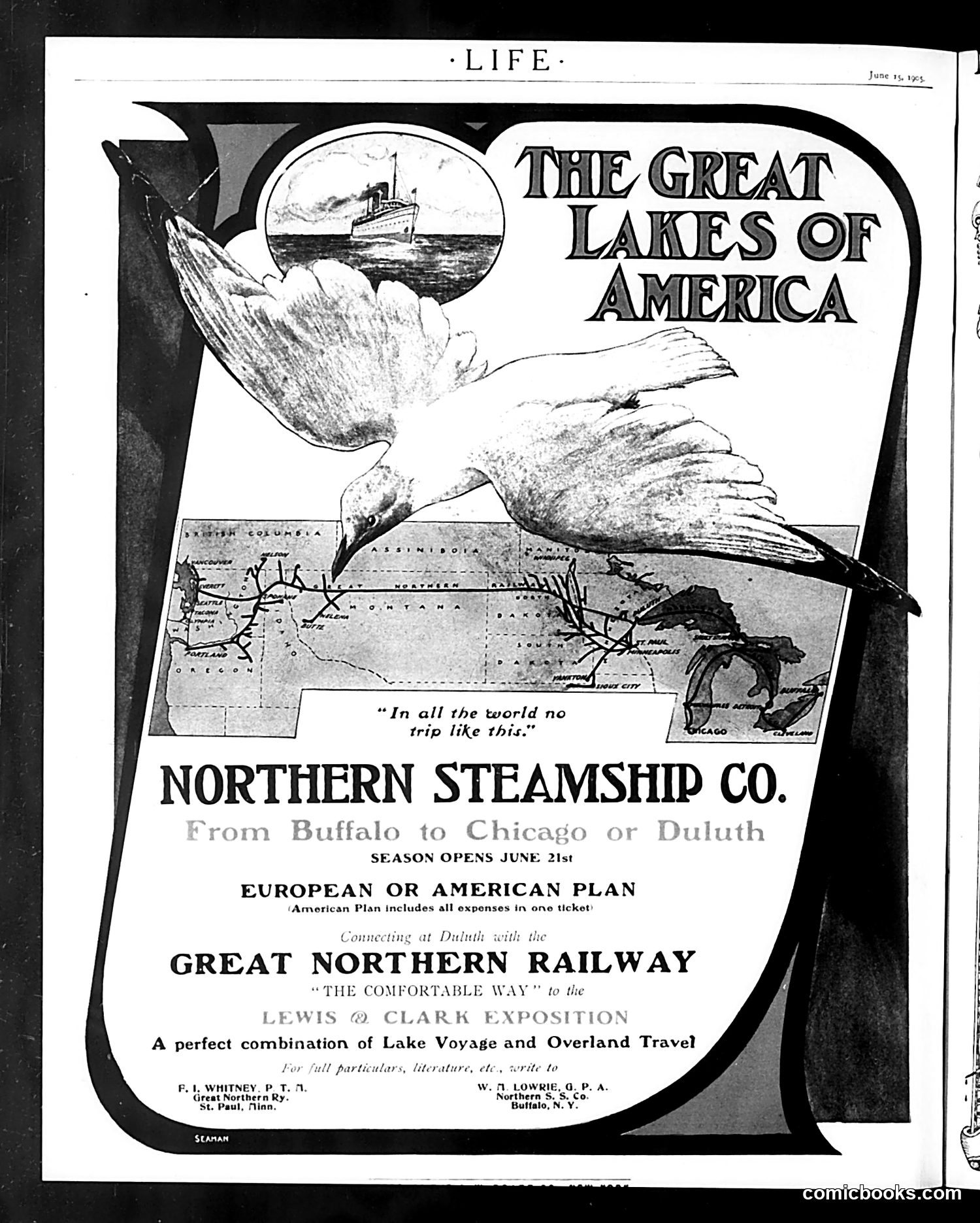
This is primarily a **travel advertisement**, not political satire. The Northern Steamship Company promotes lake cruises from Buffalo to Chicago or Duluth, opening June 21st. The imagery features a decorative **dove carrying an olive branch**—a symbol of peace and goodwill—holding a steamship in its beak. Below is a map of the Great Lakes region showing the route. The ad highlights a connection to the **Lewis and Clark Exposition** (a real 1905 world's fair in Portland, Oregon), positioning the journey as offering "A perfect combination of Lake Voyage and Overland Travel." The phrase "In all the world no trip like this" emphasizes the voyage's uniqueness and luxury. The European or American plan options indicate different pricing packages. This represents early 1900s commercial tourism marketing—positioning Great Lakes travel as an attractive, prestigious vacation option for affluent Americans.