
Life, 1905-06-15 · page 19 of 32
Life — June 15, 1905 — page 19: what you’re looking at
What you’re looking at
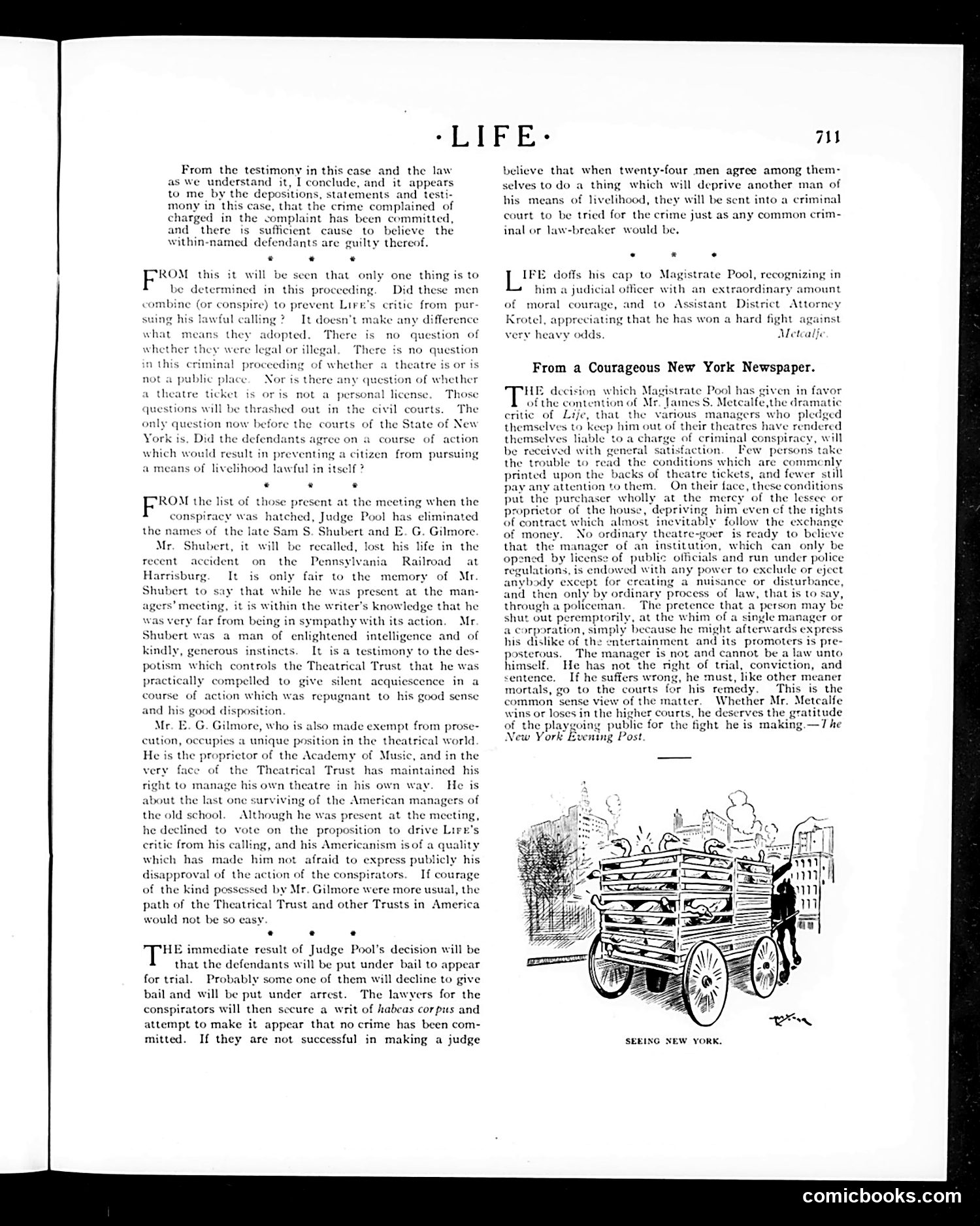
This page reports on Judge Pool's decision in a conspiracy case against theater managers. Twenty-four theater managers allegedly conspired to prevent Life magazine's critic from pursuing his livelihood by denying him access to theatrical venues—essentially blacklisting him. The article celebrates Judge Pool and Assistant District Attorney Krotel for prosecuting this "Theatrical Trust" conspiracy. Life argues the real question is simple: did these men combine to prevent a citizen from lawfully working? The text praises E.G. Gilmore, who managed the Academy of Music and courageously refused to vote with the conspiracy despite attendance at their meeting. Meanwhile, Sam S. Shubert (who recently died in a railroad accident) is absolved, having attended unwillingly under Trust pressure. The small cartoon showing an overloaded cart titled "SEEING NEW YORK" appears unrelated to the main story.
📄 Transcribed text from this page (OCR, searchable)
Machine-transcribed from the original scan — historical spelling and the odd misread are preserved.
LIFE: mh From the testimony in this case and the law as We understand it, I conclude, and it appears to me by the depositions, statements and mony in this case, that the crime complained of charged in the complaint has been committed, and there is sufficient cause to believe the within-named defendants are guilty thereof. * * * ROM this it will be seen that only one thing is to be determined in this proceeding. Did these men combine (or conspire) to prevent Lire’s critic from pur- ng his lawful calling? It doesn't make any difference what means they adopted. There is no question of they were legal or illegal. There is no question 1 proceeding of whether a theatre not a public place or is or is there any question of whether al license. Those hrashed out in the civil courts. The before the courts of the State of New York is. Did the defenda’ which would result in preventing a citizen from pursuing means of livelihood lawful in itself ? t theatre ticket is or is not a_ per questions will be only question no agree on & course of action . e . ROM the list of those present at the meeting when the conspiracy was hatched, Judge Pool has eliminated the names of the late Sam S. Shubert and E Mr. Shubert, it will be recalled, recent . Gilmore. lost his tite in the accident on the Pennsylvania Railroad at Harrisburg. It is only fair to the memory of Mr. Shubert to say that while he was present at the man- agers’ meeting, it is within the writer’s knowledge that he was very far from being in sympathy with its action. Mr Shubert was a man of enlightened intelligence and of kindly, generous instincts. It is a testimony to the des- potism which controls the Theatrical Trust that he was practically compelled to give silent acquiescence in a course of action which was repugnant to his good sense and his good disposition Mr. E. G. Gilmore, who is also made exempt from prose- cution, occupies a unique position in the theatrical world He is the proprictor of the Academy of Music, and in the very face of the Theatrical Trust has maintained his y. He is he last one surviving of the American managers of the old school. Although he was present the meeting, he declined to vote on the proposition to drive Lirr’s critic from his right to manage his own theatre in his own w, about th ng, and his Americani: which has made him not afraid to express publicly his disapproval of the action of the conspirators. If courage of the kind possessed by Mr. Gilmore were more usual, the path of the Theatrical Trust and other Trusts in America would not be so casy . . * HE immediate result of Judge Pool’s decision will be that the defendants will be put under bail to appear for trial. Probably some one of them will decline to give and will be put under arrest. The lawyers for the conspirators will then secure a writ of habeas corpus and attempt to make it appear that no crime has been com- mitted. If they are not successful in making a judge believe that when twenty-four men agree among them- selves to do a thing which will deprive another man of his means of livelihood, they will be sent into a criminal court to be tried for the crime just as any common crim- inal or law-breaker would be. IFE doffs his cap to Magistrate Pool, recognizing in him a judicial officer with an extraordinary amount of moral courage, and to Assistant District. Attorney Krotel, appreciating that he has won a hard fight against odds Metcalfe very heav From a Courageous New York Newspaper. HE decision which Magistrate Pool has given in favor of the cont om of Mr. James S. Metcalfe,the dramatic critic of Lije, that the various managers who pledged themselves to keep him out of their theatres have rendered themselves liable to a charge of criminal conspiracy, will be received with general satisfaction. Few persons take the trouble to read the conditions which are commenly printed upon the backs of theatre tickets, and fewer still pay any attention to them. On their face, these conditions put the purchaser wholly at the mercy of the lessee or proprietor of the house, “dept ving him even ef the tights of contract which almost inevitably follow the exchange of money. No ordinary theatre-goer is ready to belicve that the manager of an institution, which can only be opened. by license of public officials and run under police regulations, is endowed with any power to exclude or eject anybody except for creating a nuisance or disturbance, and then only by ordinary process of law, that is to say, through a policeman. The pretence that a person may be shut out peremptorily, at the whim of a single manager or a corporation, simply because he might afterwards ex pre his dislike of the entertainment and its promoters is pre- posterous. The manager is not and cannot be a law unto himself. He has not the right of trial, conviction, and sentence. If he suffers wrong, he must, like other meaner mortals, go to the courts for his remedy. This is the common sense view of the matter. Whether Mr. Metcalfe ns or loses in the higher courts, he deserves the gratitude of the playgoing public for ht he is making.—7 he New York Eventing Post YORK. comicbooks.com