
Life, 1905-06-15 · page 18 of 32
Life — June 15, 1905 — page 18: what you’re looking at
What you’re looking at
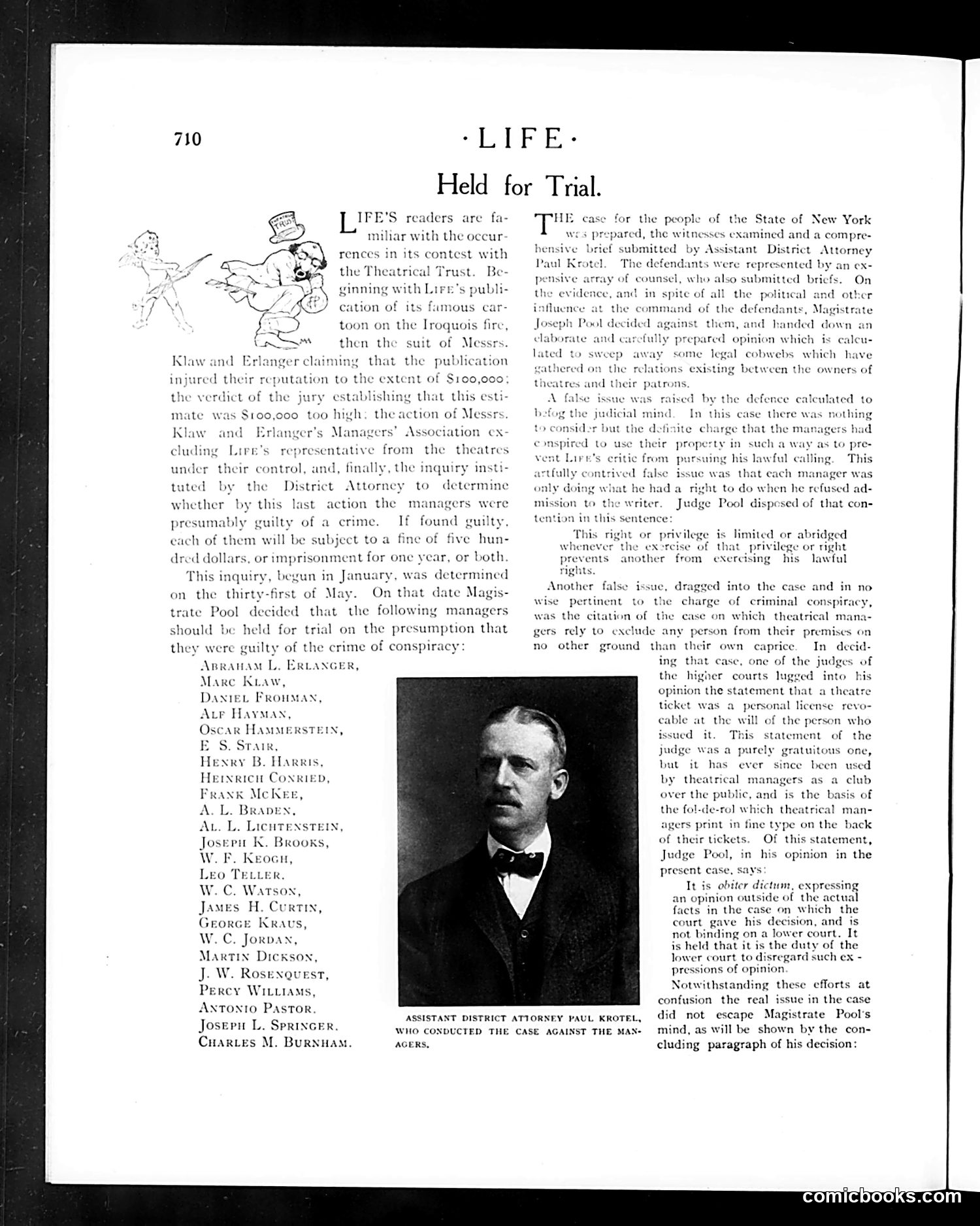
This page documents a legal case arising from Life magazine's conflict with theatrical moguls Abraham L. Erlanger and Marc Klaw. The cartoon in the upper left satirizes Klaw and Erlanger as comical, mischievous figures—likely referencing their role in the "Theatrical Trust," a monopoly controlling American theater distribution. The small inset photograph shows Assistant District Attorney Paul Krotel, who prosecuted the case. Life had published a famous cartoon about the Iroquois Theatre fire and subsequently sued by Klaw and Erlanger for allegedly damaging their reputations. The case escalated into a conspiracy investigation against theater managers (the list provided). Magistrate Pool determined they should stand trial, presumably for conspiring to monopolize theater access and exclude Life's representatives. Judge Pool's ruling reportedly challenged theater managers' standard claim that admission tickets were revocable "personal licenses," establishing instead that lower courts aren't bound by such opinions. The piece celebrates this legal victory against theater monopoly practices.
📄 Transcribed text from this page (OCR, searchable)
Machine-transcribed from the original scan — historical spelling and the odd misread are preserved.
-LIFE- Held for Trial. IFE’S readers are fa- lar with the occur rences in its contest with the Theatrical Trust. Be- ginning with Lire’s publi- ation of its famous car- toon on the Iroquois fire, then the suit of Messr Janger claiming that t Klaw and publication njured their repu m to the extent of $100,000; the verdict of the jury establishing that this esti mate was $100,000 too high; the action of Messrs Klaw and Erlanger’s Managers’ Association ex- cluding Lire’s representative from the theatres under their control, and, finally, the i District. Attorney to action the quiry insti- tuted by the determine managers were If found guilty. whether by this last pres’ bly guilty of a crime each of them will be subject to a fine of five hun- dred dollars, or imprisonment for one year, or both This inquiry, begun in January, was determined on the thirty-first of May. On trate Pool decided that the following managers should be held for trial on the presumption that hat date Magis- they were guilty of the crime of conspiracy: Apratanm L. ERLANGER, Mare Kiaw, DanteL FRouUMAN, Ar Hayman, Oscar HAMMERSTEIN, ES. Stair, Hexry B. Harris, Herxricit Coxriep, Fraxk McKee, A. L. BRrapex, AL. L. LicuTexstein, Joseru K. Brooks, W. F. Keocu, Leo TELLER, W. C. Watson, H. Curtin, ORGE Krav: Martin Dickson, J. W. Rosexovesr, Percy WILtiams, Axtont1o Pastor Josep L. Sprincer Citarces M. Burnuam. AGERS, ASSISTANT DISTRICT ATTORNEY PAUL KROTEL, WHO CONDUCTED THE CASE AGAINST THE MAX- mind, as will be shown by the con- Te case for the people of the State of New York wes prepared, the witnesses examined and a compre- hensive brief submitted by Assistant District: Attorney aul Krotel. The d represented by an ex- nsive array of counsel, who also submitted briefs. On of all the political dof the defenda Joseph Pool decided t them, and elaborate lated nered 0 P tl evidence, and in spi fluence at the comm. anded down an nd carefully prepared opinion which is calc some legal cobwebs which » relations existing between the owners of reir patrons sstie raixed by the defence calculated to adicial In this case there was nothing harge t ad conspired to use their property in such a way as to pre- his lawful cal Thi yut the definite ¢ from pursui tfully contrived false issue was that cach manager was only d he had a right to do when he refused ad- missio’ writer. Judge Pool disposed of that con- this sentence s right or { whenever the ex:rcise another from exercising his limited or abridged privilege or right lawful false issue, dragged into the case and in no wise pertinent to the charge of criminal conspiracy, was the citation of the case on which theatrical mana- gers rely to exclude any person from their premises on no other ground than their own caprice. In decid- ing that case, one of the judges of the higher courts lugged in} his opinion the statement that a theatre ticket was a personal license revo- cable at the will of the person who issued it. This statement of the judge was a purely gratuitous one, but it has ever since been used by theatrical managers as a cl over the public, and is the basis of the fol-de-rol which theatrical man- agers print in fine type on the back of their tickets. Of this statement, Judge Pool, in his opinion in the present case, says It is obiter dictum, expressing an opinion outside of the actual facts in the on Which the court gave his decision, and is not binding on a lower court. It is held that it is the duty of the lower court to disregard such ex - pressions of opinion Notwithstanding these efforts at confusion the real issue in the case did not escape Magistrate Pool's cluding paragraph of his decision: